
Strategic responses to environmental turbulence: a study of four brazilian exporting clusters
20
0
0
Texto completo
(2) 156. Da Rocha, A., Kury, B., Tomassini, R., Velloso, L.. tores (empresarios, expertos de la industria, agentes gubernamentales y miembros de asociaciones locales) y una amplia gama de fuentes secundarias. Los clusters presentan diferentes respuestas dependiendo de su grado de dependencia de los mercados externos, la posibilidad de reorientar la producción hacia los mercados internos y el nivel de cooperación. Clasificación JEL: F23; F61; G01; L10; L66; L67; L68; M16; R12. Palabras clave: clúster; internalización; crisis; dependencia de la trayectoria.. 1.. Introduction. The existence of clusters of firms with related activities is not a new phenomenon, but their importance as a source of competitive advantage seems to have increased, or at least gained greater visibility, with the expansion of the globalization process. Scott (1996) emphasized the paradox between the spread of economic activities across national borders and the economic growth of regions within national borders. Along the same lines, Porter (1998) believed that, paradoxically, as access to goods, capital, knowledge and technology increases in any part of the world, the importance of local factors, such as knowledge and relationships, also increases. Clusters thus tend to develop competitive advantages, which in most cases are often not only national but global. As a result, the more internationalized a cluster is, the greater is its exposure to crises of global capitalism. Although the literature has examined the issue of decline in clusters, as well as the impact of globalization on traditional manufacturing clusters, most studies have looked at these problems from the perspective of developed markets (e.g. De Marchi and Grandinetti, 2014; De Propris and Lazzeretti, 2009; Sacchetti and Tomlinson, 2009; Samarra and Belussi, 2006). Specifically, few studies have looked into how emerging markets’ clusters respond to the challenges of globalization. Therefore this paper is intended to contribute to the debate on the impacts of globalization on manufacturing clusters located in emerging markets. The analysis is particularly relevant considering the current economic context of the Brazilian economy, and the challenges that globalization poses to regional development. The paper adopts the multi-case study method of investigation, examining how four Brazilian clusters, which export manufactured products at different levels of export intensity, responded to the global crisis that began in 2008 resulting from the world economic recession, as well as the intensification of Asian competition and the appreciation of the Brazilian currency. The cases selected are particularly apropos, since the internationalization processes of the four clusters have been successful, although on different levels. The following question guided the research: How did traditional Brazilian manufacturing clusters respond to the threats of globalization? Investigaciones Regionales – Journal of Regional Research, 39 (2017) – Pages 155 to 174.
(3) Strategic Responses to Environmental Turbulence: A Study of Four Brazilian Exporting Clusters 157. 2.. Literature Review. Clusters transcend the mere agglomeration of related activities. They are a form of spatial organization of economic activities, which constitute areas of attraction of capital and labor (Beccatini, 1990; Markusen, 1995; Porter, 1998). It is their organicity that gives the firms in a cluster the ability to gain competitive advantages. Geographic proximity tends to encourage interactions between the various players (Brusco, 1990; Iammarino, Sanna-Randaccio and Savona, 2006; Scott and Garofoli, 2007). These interactions, which may be either internal or external to the cluster, are the mechanism by which innovation takes place. Existing social networks play a crucial role in the development of trust and cooperation among individuals and firms in a cluster, thereby facilitating the spilling over of knowledge (Audretsch and Aldridge, 2008), and, specifically, the transfer of tacit knowledge (MacKinnon, Cumbers and Chapman, 2002; Maskell and Malmberg, 1999). Cooperation is a crucial element in cluster dynamics (Tomlinson and Jackson, 2013), although competition and rivalry also play a role (Porter, 1998). Transfers among firms can be of various kinds, and may include marketing and managerial know-how, technology, market knowledge, access to external networks and markets, etc. In addition, many clusters are located in areas that offer natural resources or have physical characteristics that are important to specific economic activities. Several actors, such as suppliers of equipment and raw materials, local and national government agencies, universities and training organizations, and research institutes contribute to a cluster’s locational advantages (Porter, 1998). Focal or flagship firms may play a major role in introducing «new technologies, organizational skills, and markets» (Lazerson and Lorenzoni, 1999: p. 369). External actors, such as foreign buyers and trading companies, may support the development of international activities (Ellis, 2003). In fact, Scott and Garofoli (2007) claim that participation in global value chains can be of utmost importance to clusters located in developing countries, because they can gain access to distant markets and managerial, commercial and technological know-how. Cluster firms can thus take advantage of several types of locational economies that are often not available in dispersed locations (Polenske, 2008), and that are attractive to investors (Iammarino, Sanna-Randaccio and Savona, 2006). Cluster life cycles have received substantial attention in the literature (Bergman, 2008; Martínez-Fernández, Capó-Vicedo and Vallet-Bellmunt, 2012). In fact, although the literature on clusters portrays mostly cases of success, clusters can finally reach a stage of stagnation (Bergman, 2008) or they can even fall into decay (Menzel and Fornahl, 2010). Trippl and Tödtling (2008: p. 213) point out that scholars frequently ignore the fact that clusters «can be a blessing and a curse» for the regions where they are located. Their decline can cause general impoverishment in the region, in addition to unemployment and an exodus of part of the workforce, thus generating all types of social problems. Even so, only a limited number of studies have looked into the subject of stagnation or decline in clusters (Karlsson, 2008; Bergman, 2008; Zuchella, 2006); a couple exceptions are studies by De Propris and Lazeretti (2009) and Ramazzotti (2010). Investigaciones Regionales – Journal of Regional Research, 39 (2017) – Pages 155 to 174.
(4) 158. Da Rocha, A., Kury, B., Tomassini, R., Velloso, L.. There are several factors that may influence a cluster’s success or failure. A cluster’s trajectory is shaped by its history, physical environment, industry specificities, level of cooperation, and institutional governance, among a number of other internal factors (Bergman, 2008; Gaggio, 2006). It can also be influenced by external threats such as economic cycles, technological rupture, changes in demand or in the nature of competition, and changes in government policies, etc. Isomorphic behavior (DiMaggio and Powell, 1991), that is, the tendency of firms in a cluster to copy each other, may also increase a cluster’s vulnerability. Karlsson (2008: p. 13) points out that «the factors that once enabled a cluster to form and to grow may not necessarily be as important in sustaining it.» Therefore, the vitality of a cluster and its member organizations depends strongly on their ability to change. De Marchi and Grandinetti (2014) look specifically at the impact of globalization on Italian industrial districts, focusing on the effects of immigration on the workforce, changes in the nature of entrepreneurship, and production diversification as major forces of change. The authors identify four different directions in which globalization can shape the future of Italian industrial districts: decline (caused by the unavailability of resources for implementing change), oligopolization (characterized by a limited number of larger firms that remain active by expanding internationally), hierarchization (where a small number of larger firms keep a limited number of smaller suppliers), and «glocal» reproduction (where local networks are more connected with global networks). Belussi (2015) also points out the extent to which Italian districts have responded to the challenges of globalization, particularly by increased internationalization. Both contributions show the importance of aligning with global buyers and global value chains as discussed by Humphrey and Schmitz (2002), who see these networks as mechanisms for cluster upgrading. Other authors point out the need to improve governance and cooperation within a cluster (e.g. Sacchetti and Tomlinson, 2009) in order for it to face the challenges of globalization. Path dependence is a major risk faced by clusters, industries, and firms because it may threaten their growth and survival (Dobusch and Schüssle, 2013). Path dependence is associated with structural inflexibility regarding change, with organizations persisting in maintaining obsolete behaviors and practices that are no longer adequate for facing new challenges or exploring new opportunities (Meyer-Stamer, 1998). Path dependence has been defined as «a property of a stochastic process which obtains under two conditions (contingency and selfreinforcement) and causes lock-in in the absence of external shock» (Vergne and Durand, 2010: p. 737). Industries, clusters and firms are constantly faced with situations in which past decisions determine future outcomes, creating situations of «functional lock-in, cognitive lock-in, cultural-political lock-in or other such self-reinforcing and constraining structures and processes» (Martin, 2012: p. 185). Teece, Pisano and Shuen (1997) explored the importance of organizational history for defining long-term strategies, indicating that previous investments and the sets of routines established by organizations along their trajectories may hamper future choices. Krugman (1991) draws attention to economic Investigaciones Regionales – Journal of Regional Research, 39 (2017) – Pages 155 to 174.
(5) Strategic Responses to Environmental Turbulence: A Study of Four Brazilian Exporting Clusters 159. geography as a factor that contributes to a cluster’s historical dependence. The spatial location of production in any industry is a constraint on future strategic alternatives. Technology also often becomes a limiting element that affects the strategic choices of industries, clusters and firms (Cohen and Levinthal, 1994; Sydow, Schreyogg and Koch, 2009). Several studies in the business literature have shown that, generally speaking, the initial success of a company by applying a certain strategy tends to lead the firm to allocate more resources to its business in order to replicate and amplify its initial success. However, the opposite may also be true, that is, initial failure may tend to lead a company away from a certain path (Noda and Collis, 2001). On the other hand, a number of authors have challenged the idea of the irreversibility of the lock-in effect (e.g. Drahokoupil, 2012; Martin, 2010, 2012), suggesting that firms and clusters may reorient their trajectories. Garud, Kumaraswamy and Karnoe (2010: p. 760) offer the concept of path creation, in which «...“initial conditions” are not given, “contingencies” are emergent contexts for action, “self-reinforcing mechanisms” are strategically manipulated, and “lockin” is but a temporary stabilization of paths in-the-making». That is, while path dependence impedes a cluster to adopt a new trajectory, path creation means that a cluster escapes the self-reinforcing, lock-in mechanism by following a new path. Martin (2010: p. 186) proposes an evolutionary model with several possible future trajectories for a cluster that are neither discontinuous nor radical, but «can also be consistent with ongoing forms of cumulative change, mutation and adaptation of economic states and trajectories». A cluster could thus fall into a rigid trajectory, although this may not necessarily lead to decline, or it may persist in a dynamic process of adaptation and change, either radical or incremental (Trippl and Tödtling, 2008). Incremental change could take place with small changes in the cluster’s trajectory in order for it to adapt to new conditions and regain competitiveness. These changes include adoption of new management practices, entry into new markets or market niches, cost reduction programs, etc. Diversification means adding new economic activities to existing ones. Radical change involves drastic alterations in the nature of a cluster and in the strategies it has adopted. Change processes can be triggered by the emergence of new leaders, changes in cluster governance, alliances with organizations external to the cluster, and even fortuitous events. The degree of cluster heterogeneity is also a factor in escaping the lock-in effect. The more heterogeneous the firms in a cluster, the higher the probability of some of them progressing while others stay behind and eventually fail or leave the cluster (Martin, 2010, 2012). In summary, the review of the literature suggests that the analysis of the strategic responses adopted by clusters to escape historical dependencies —associated with the cluster trajectory and the industry itself— constitutes an important and still under-researched subject. In addition, it points out the importance of investigating the impact of globalization on shaping the trajectory of clusters and their strategic responses. Investigaciones Regionales – Journal of Regional Research, 39 (2017) – Pages 155 to 174.
(6) 160. Da Rocha, A., Kury, B., Tomassini, R., Velloso, L.. 3.. Methodology. The research method used is the case study and the unit of analysis is the industrial cluster. The study is longitudinal; i.e. we sought to analyze the historical trajectory of each selected cluster. This approach is considered the most appropriate for answering the research question addressed in this paper, and it is supported by an article published in the Journal of International Business Studies, in which Jones and Khanna (2006) advocate the use of qualitative studies to investigate historical trajectories in international businesses. This multi-case study examines four clusters in traditional manufacturing industries: footwear (Vale dos Sinos, state of Rio Grande do Sul), furniture (São Bento do Sul, state of Santa Catarina), wine (Serra Gaúcha, state of Rio Grande do Sul) and beachwear (city of Rio de Janeiro). The clusters display different characteristics and distinct degrees of internationalization, but they have faced recent external threats to their survival. We used primary and secondary data. The primary data were obtained by means of 39 personal interviews with various actors. Each interview varied from 50 minutes to one and half hours. All the interviews were taped and transcripts made of each of them. Of the total number of interviews, 24 were done with key firms in each cluster, and 15 with members of manufacturers’ associations, private consultants and government experts. The secondary sources included: data from government agencies related to exports and specific sectors; publications in general regarding the sectors; business magazines and newspapers; focal company sites; information available on the internet; monographs, dissertations and theses. We also collected data from local sources such as public libraries, municipalities and local associations. In addition, previous studies by Schmitz (1995, 1999, 2007) and Schmitz and Konorringa (2000) regarding the footwear cluster were used to support the findings concerning this particular cluster. Several visits were made to each cluster. The use of a variety of sources enabled triangulation to ensure the validity and reliability of the study. The qualitative analysis was performed in two steps: descriptive and analytical. The first, descriptive, step included: (i) a preparation of reports on each cluster, with general data and historical evolution of the cluster; (ii) a detailed description of the environmental changes and threats faced by the clusters; and (iii) a detailed description of the actions taken by the clusters in response to environmental changes. The second, analytical, step consisted of: (i) an analysis of each case, including a timeline of external and internal events and their interrelation; (ii) a comparison of cluster studies; analysis within and between cases; (iii) generalizations and conclusions.. 4.. Results. 4.1. Descriptions of the four clusters. Due to space limitations, only brief descriptions of the clusters are given. It should be noted, however, that the historical trajectory of each cluster generated an extensive Investigaciones Regionales – Journal of Regional Research, 39 (2017) – Pages 155 to 174.
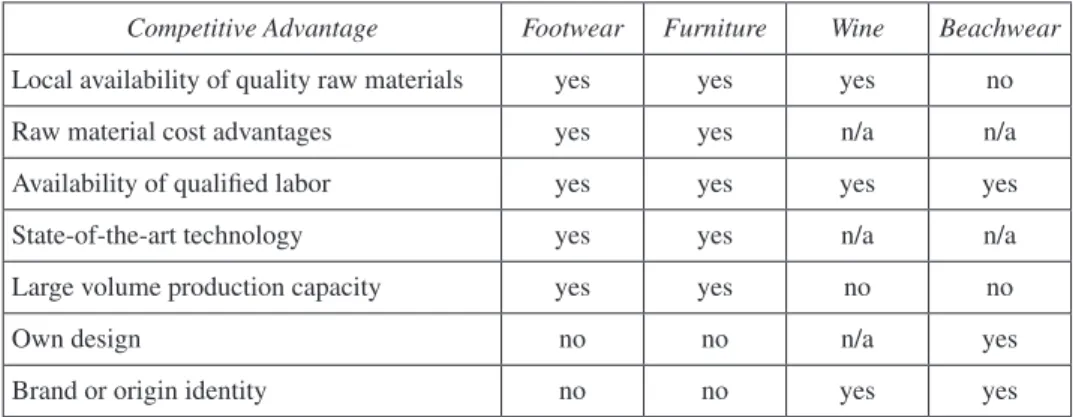
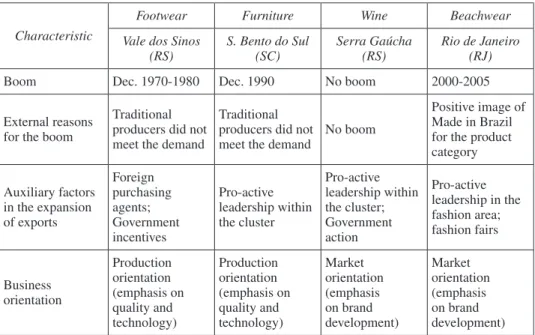
(7) Strategic Responses to Environmental Turbulence: A Study of Four Brazilian Exporting Clusters 161. and detailed report on the main events and actors that influenced the development of the cluster. Appendix 1 summarizes the main characteristics of the four clusters. The footwear, furniture and wine clusters are typically made up of large, medium and smaller-sized family firms. A significant number of the companies are in the hands of second or third generations because the economic activities in the regions are quite old. The origins of the three clusters are associated with the German, Austrian and Italian immigration to the South of Brazil, with the immigrants bringing the know-how of their countries of origin. The clusters are located in geographically defined regions, with a strong concentration of economic activity, which makes them play a central role in the local economy. However, due to the fact that the footwear cluster is located on the periphery of a large metropolis, it receives more external influences than the other two. In the cases of Vale dos Sinos and São Bento do Sul, internationalization is a critical activity for the success of the clusters, but for different reasons. While São Bento do Sul specializes in furniture for exporting, the Vale dos Sinos cluster targets the demand for women’s footwear in both the domestic market and the international market. In the case of São Bento do Sul, the cluster specializes in European design furniture made from pine wood, mainly to serve the German market, but also to meet the tastes of other European consumers and of American consumers. However, such products are not well-accepted in the domestic market. As for the Serra Gaúcha wine cluster, it is geared more to the domestic market, but for the past few years it has been making efforts at exportation, with still modest results. Within this general framework, the Rio de Janeiro beachwear cluster presents completely different characteristics and serves for a counterfactual analysis. This cluster is urban, and its manufacturers’ production facilities are scattered in different locations within the municipality, although the points of sale are located on the more upper class beach regions of the city. The firms are mostly in the hands of the founders, and are much smaller, less solid and less professionalized than those in the other clusters. The largest and most successful companies often rely on an entrepreneurdesigner who is responsible for creating models. Although it is the second-largest beachwear exporting cluster in the country, this cluster holds an inconsequential share of the city’s economy. It should be further noted that the size of the clusters is quite varied, although rough estimates of the number of firms are available. Such estimates are very imprecise, given the variation in the number of firms due to the expansion and contraction of the clusters as the result of the economic situation at the time. Table 1 presents the competitive advantages of the clusters. Possibly due to the strong German influence, the Vale dos Sinos and the São Bento do Sul clusters are very production-oriented, but they have a low degree of market orientation. In fact, an important, systematic criticism by the experts interviewed is the excessive focus on production, to the detriment of market issues. The dominance of focus on production is reflected in the competitive advantages of these two clusters, particularly their state-of-the-art technology. In addition, thanks to the tradition Investigaciones Regionales – Journal of Regional Research, 39 (2017) – Pages 155 to 174.
(8) 162. Da Rocha, A., Kury, B., Tomassini, R., Velloso, L.. Table 1.. Competitive Advantages of the Clusters. Competitive Advantage. Footwear. Furniture. Wine. Beachwear. Local availability of quality raw materials. yes. yes. yes. no. Raw material cost advantages. yes. yes. n/a. n/a. Availability of qualified labor. yes. yes. yes. yes. State-of-the-art technology. yes. yes. n/a. n/a. Large volume production capacity. yes. yes. no. no. Own design. no. no. n/a. yes. Brand or origin identity. no. no. yes. yes. n/a = not applicable.. of the immigrants who populated the regions, they have a qualified workforce. The availability of low-cost, high-quality raw materials is also noteworthy. Interestingly, in the case of Vale dos Sinos, with the economic crisis plaguing the footwear cluster, tanned leather as well as skilled technicians have gone over to the Chinese footwear industry. On the other hand, the Serra Gaúcha wine and the Rio de Janeiro beachwear clusters are more market-oriented, focusing on brand development both in the domestic market and in the international market. In both cases, the latter still represents a small portion of the cluster’s sales. In the beachwear cluster, design is an important element of its companies’ strategies since they are either fashion creators or imitators of the trends launched by leading firms. Table 2 shows the characteristics of internationalization in the four clusters examined. The internationalization process of the Vale dos Sinos footwear cluster is the oldest, dating to the beginning of the 1970s. This process was precipitated by supply crises in the Spanish and Italian industries, which served the U.S. market. As a result, purchasing agents from American wholesalers settled in Brazil and transferred to the companies the know-how necessary for the production of footwear. This transfer of know-how played a key role in the subsequent development of the Vale dos Sinos cluster since it included everything from product specifications, raw materials and quality standards, to model designs and effective quality control at the plant. The purchasing agents completely took over marketing and design, whereas the Brazilian manufacturers were only responsible for production. By 1972, the country had become the third largest exporter of footwear in the world and the cluster led in the production and export of women’s footwear. Although extremely auspicious for the cluster, it was at this early stage that one can find the roots of the problems that culminated with the recent crisis. In turn, the São Bento do Sul furniture cluster did not benefit from a growing foreign demand, nor was it particularly sought after by buyers, except on an occasional Investigaciones Regionales – Journal of Regional Research, 39 (2017) – Pages 155 to 174.
(9) Strategic Responses to Environmental Turbulence: A Study of Four Brazilian Exporting Clusters 163. Table 2.. Characteristics of the Internationalization Process of the Clusters. Characteristic. Footwear. Furniture. Wine. Beachwear. Vale dos Sinos (RS). S. Bento do Sul (SC). Serra Gaúcha (RS). Rio de Janeiro (RJ). Boom. Dec. 1970-1980. Dec. 1990. No boom. External reasons for the boom. Traditional Traditional producers did not producers did not No boom meet the demand meet the demand. Positive image of Made in Brazil for the product category. Auxiliary factors in the expansion of exports. Foreign purchasing agents; Government incentives. Pro-active Pro-active leadership within leadership within the cluster; the cluster Government action. Pro-active leadership in the fashion area; fashion fairs. Business orientation. Production orientation (emphasis on quality and technology). Production orientation (emphasis on quality and technology). Market orientation (emphasis on brand development). Market orientation (emphasis on brand development). 2000-2005. basis; on the contrary, through proactive actions spearheaded by local businesspersons, it was able to open foreign markets for its products, mainly Germany and the U.S. Although it has benefited from the disorganization of production in Eastern European countries —traditional international suppliers— the key role in developing exports has fallen to local leaders. The Serra Gaúcha wine cluster began exporting in the 1940s, having gone through periods of expansion and contraction. However, it was not until the early 2000s that several producers came together with government support to organize a cooperative export group known as Wines of Brazil. In this case, one cannot speak of an actual wine exporting boom, since the volume exported was always small; nevertheless, from then on the presence of fine Brazilian wines in foreign markets became more planned and developed. In this case, the active presence of business leaders, who also played a fundamental role in the development and professionalization of the cluster and in its presence in foreign markets, stands out. Lastly, the Rio de Janeiro beachwear cluster benefited from the pioneering efforts of a few entrepreneurs (but who acted independently) and the favorable image of Brazil (country-of-origin effect) with regard to this type of product, which contributed to the rise of Brazilian top models on the international fashion scene and at fashion fairs organized in Brazil, in addition to the participation of Brazilian designers at international fairs. Although predominantly focused on the domestic market, beachwear designers perceived the international presence of the brand as an important element in their strategies in the domestic market. Investigaciones Regionales – Journal of Regional Research, 39 (2017) – Pages 155 to 174.
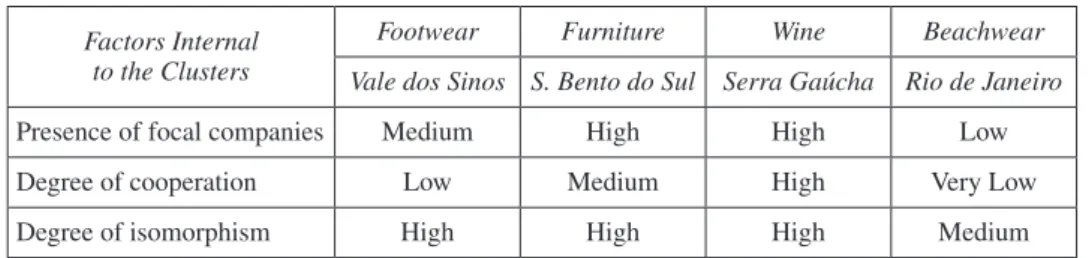
(10) 164. Da Rocha, A., Kury, B., Tomassini, R., Velloso, L.. It is worth evaluating some factors related to the structure and organicity of the clusters (Table 3). The classification derives from the authors’ comparative judgment based on the literature and is valid only for comparing the four clusters. It is relative, not absolute. Table 3. Factors Internal to the Four Clusters Factors Internal to the Clusters Presence of focal companies. Footwear. Furniture. Vale dos Sinos S. Bento do Sul. Wine. Beachwear. Serra Gaúcha. Rio de Janeiro. Medium. High. High. Low. Degree of cooperation. Low. Medium. High. Very Low. Degree of isomorphism. High. High. High. Medium. The presence of focal companies, which lead the cluster in the exploring of potential opportunities and overcoming threats, is an important element for the cohesion of the cluster’s members. The presence of these companies in two of the four clusters was confirmed. In São Bento do Sul, two companies (Zipperer and Artefama) and their respective leaders played a crucial role, at different times, in determining the path to be followed by the cluster. The same was true of the Serra Gaúcha wine cluster, where business leaders from two of the region’s family businesses (Vinícola Miolo and Casa Valduga) developed joint efforts to attract other companies in order to promote the international development of the cluster. But regarding the footwear cluster, the trajectory was different. Schmitz (1995, 1999, 2007) studied the Vale dos Sinos cluster, examining the role of leading firms and export agents in its development, as well as the state’s failure to support the cluster in a time of crisis. The author identified three distinct periods in terms of cooperation: the first, when the footwear industry and the cluster in particular structured their export capacity; the second, in which competition among companies led to the erosion of cooperative relations, but in which the integrative links were restored in the end; and the third, in the mid-1990s, when there was an effort to improve the competitiveness of the cluster, but which failed, at least in part, due to the particular alliances that the leading companies each formed with their international customers to the detriment of internal alliances within the cluster. In spite of this, as the global economic crisis reached the cluster in the late 2000s, cooperative efforts became more visible. Later on, several leading firms moved out of the cluster, mainly to lower-income areas of the country, where local governments offered subsidies. As they dispersed geographically, the benefits of agglomeration were lost. Schmitz and Konorringa (2000) also pointed out that, in spite of the cluster’s production capabilities being considered by international buyers to be comparable to the world’s best (in this case Italy), the Vale dos Sinos cluster lacked design capabilities. Lastly, in the beachwear cluster there is no cooperation at all. In fact, there is rivalry between the entrepreneurs-designers in the select group of the cluster’s leading compaInvestigaciones Regionales – Journal of Regional Research, 39 (2017) – Pages 155 to 174.
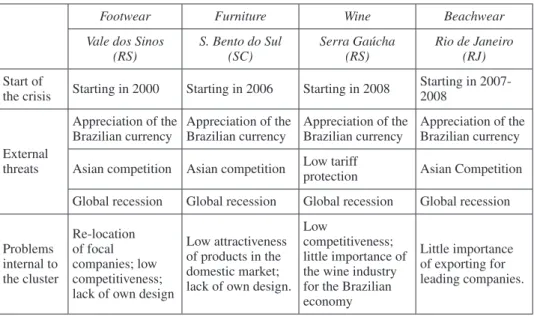
(11) Strategic Responses to Environmental Turbulence: A Study of Four Brazilian Exporting Clusters 165. nies. Although isomorphic behavior may be observed in all the clusters, with companies copying one another’s strategies, it is in the Rio de Janeiro beachwear cluster that such behavior was less noticeable, which is an expected outcome, given the geographic dispersion and the high degree of rivalry among the entrepreneurs-designers. 4.2. The crisis, its impact on the clusters, and their strategic responses. The international crisis starting in the second half of the 2000s had negative effects on the clusters (Table 4), not only in terms of their international insertion but also in relation to their competitive position in the domestic market. The appreciation of the Brazilian currency had a strong impact on all the sectors analyzed, just as it had on all Brazilian export manufacturing sectors. In the specific case of wine, the sector’s low level of tariff protection resulting from international agreements, especially in the case of Mercosur, threatened the competitiveness of Brazilian wine producers. Table 4. Crisis-Related Aspects. Start of the crisis. Footwear. Furniture. Wine. Beachwear. Vale dos Sinos (RS). S. Bento do Sul (SC). Serra Gaúcha (RS). Rio de Janeiro (RJ). Starting in 2000. Starting in 2006. Starting in 2008. Starting in 20072008. Appreciation of the Appreciation of the Appreciation of the Appreciation of the Brazilian currency Brazilian currency Brazilian currency Brazilian currency External threats. Problems internal to the cluster. 4.2.1.. Asian competition. Asian competition. Low tariff protection. Asian Competition. Global recession. Global recession. Global recession. Global recession. Re-location of focal companies; low competitiveness; lack of own design. Low attractiveness of products in the domestic market; lack of own design.. Low competitiveness; little importance of the wine industry for the Brazilian economy. Little importance of exporting for leading companies.. Impacts on the clusters. The difficulties faced by the Vale dos Sinos cluster in the 2000s had already shown the first signs in the 1990s, when competition from low-cost Asian producers, especially Chinese, took on a more obvious shape. However, Brazilian companies, for the most part, had already begun to control the low-medium price footwear segment, most of which managed to resist the advance of Asian producers. Starting in the 2000s, the situation worsened, as Chinese producers upgraded their production Investigaciones Regionales – Journal of Regional Research, 39 (2017) – Pages 155 to 174.
(12) 166. Da Rocha, A., Kury, B., Tomassini, R., Velloso, L.. to reach the middle segments of the market. As the Brazilian footwear industry became less price-competitive, buyers in the U.S. reduced their commitment to Brazilian suppliers (Schmitz, 2007). In addition, Asian products invaded the Brazilian market, making damaging incursions into the position of Brazilian companies on the domestic front. The situation became even worse with the appreciation of the Brazilian currency against the dollar, leading to a drastic reduction of exports to the U.S. market. Lastly, the global recession had a further negative impact on Brazilian footwear exports. In 2009, with the adoption of protectionist measures by the Brazilian government for the footwear industry, in response to the undervaluation of the Chinese currency, the Vale dos Sinos cluster got the break it needed for reorganization. However, even then the total output of the cluster could not be absorbed by the domestic —albeit expanding— market, and exports continued to decline. Even in 2015, with the strong devaluation of the Brazilian currency, exports did not recover because the country had plunged into a recession. The São Bento do Sul furniture cluster experienced several external threats starting in 2006, which had a negative impact on its development and the survival of its companies. These threats were very similar to those that affected the footwear cluster: appreciation of the Brazilian currency, competition from Asian products, and, starting in 2008, economic recession in the main export markets. Together, these factors produced a sharp decrease in exports. The crisis had profound impacts throughout the supply chain, drastically affecting the local economy. It is estimated that 6% of the local population left the region in 2008. In subsequent years, the number of furniture manufacturers comprising the cluster fell from 400 to around 300, with a large number of closures, bankruptcies and creditors agreements, affecting even the two focal companies: one closed its doors and the other filed for bankruptcy. The firms in the cluster were unable to transfer sales to the domestic market because their products were not well accepted in Brazil. External threats to the Serra Gaúcha wine cluster began to manifest with the formation of the Mercosur trading bloc and the opening of the Brazilian market to imported products in the 1990s. At the time, the producers of fine Brazilian wines —concentrated in the region of Serra Gaúcha, and more specifically in the subregion known as Vale dos Vinhedos— faced competition from foreign wines, including low quality products from Germany and quality products from Argentina, but with cost advantages, thanks in part to the preferences for Mercosur countries. With the continuous appreciation of the Brazilian currency until 2015, wine producers experienced strong competition in the domestic market for fine wines from the most varied origins. In addition, exports were also impacted by the global recession. Lastly, once again, the Rio de Janeiro beachwear cluster is useful for a counterfactual analysis. The firms in this cluster never considered exporting (or internationalization) as a strategic part of their business. They emphasized the domestic market instead. International activities, in general, were seen by designers as a way of adding glamor to the brand, attributing it an aura of prestige. Although some leading companies managed to open stores overseas, such efforts were always individual, Investigaciones Regionales – Journal of Regional Research, 39 (2017) – Pages 155 to 174.
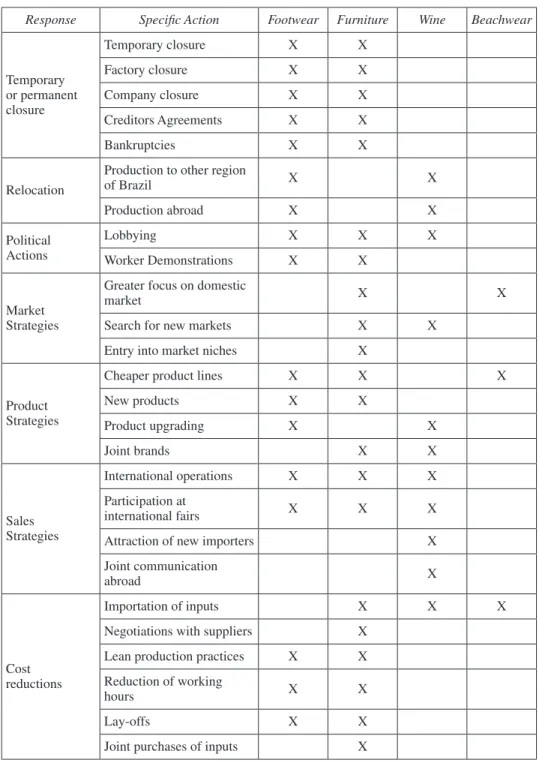
(13) Strategic Responses to Environmental Turbulence: A Study of Four Brazilian Exporting Clusters 167. by a particular company, and never entailed a concerted effort. As a result, although the recession in the developed countries had a strong negative impact on Brazilian beachwear exports (which fell by 83% between 2005 and 2011), this was offset by the concurrent expansion of the domestic market and, in particular, by the boom in the local economy (the city of Rio de Janeiro) until 2016. Given the low intensity of exports by the cluster’s firms, most of them simply abandoned international markets. 4.2.2. Strategic responses by the clusters The firms in the four clusters presented different strategic responses to external threats. Although some of these responses started years before the global economic crisis, when threats to the clusters were already manifesting, there is no doubt that they intensified with the worsening of the situation starting in the second half of the 2000s through 2015. Table 5 provides a summary of the strategic responses iden tified. The strategic responses varied substantially among the clusters, according to their specificities and the degree of importance of exports in their sales. The Vale dos Sinos footwear cluster and the São Bento do Sul furniture cluster were most affected by the global economic crisis because they were export clusters, whose production could not be absorbed by the domestic market. Possibly because of their previous success over a long period of time, these clusters had a hard time changing their trajectories and finding a new path. In the case of the Vale dos Sinos cluster, the problem was even more serious, given that one of the few adequate strategic responses would entail transferring part of the production to countries with cheap labor, such as Southeast Asian countries. Actually, the footwear companies that invested abroad did so in Argentina, with the purpose of guaranteeing that market, which had been closed to Brazilian imports due to protectionist measures, but where the cost of labor was higher than in Brazil. Several companies relocated to other regions of Brazil, but this was an independent movement, with only partial success. Until 2014, the expansion of the domestic market, combined with protectionist measures by the government, kept the manufacturers breathing, but the cluster’s trajectory seems compromised when one considers the way the footwear industry has moved throughout history —always in the direction of reservoirs of cheap labor. A possible strategic response would be the upgrading of the products, which would justify a higher price, with a decrease in quantity. This strategy was followed by Italian and Spanish manufacturers, which had thus been able to survive the competition of new entrants in the past. However, the lack of proprietary design, international brands and own distribution channels abroad makes this task much more difficult for the cluster. In the case of São Bento do Sul, attempts at solving problems also had to break with the patterns of the past in order to find new ways, not by continuing an exhausted model. However, the emphasis of the responses was on mitigating the effects of the economic crisis and reducing costs. The greatest vulnerability of the cluster is its high export inInvestigaciones Regionales – Journal of Regional Research, 39 (2017) – Pages 155 to 174.
(14) 168. Da Rocha, A., Kury, B., Tomassini, R., Velloso, L.. Table 5. Strategic Responses by the Clusters Response. Temporary or permanent closure. Relocation. Political Actions. Market Strategies. Product Strategies. Specific Action. Footwear. Furniture. Temporary closure. X. X. Factory closure. X. X. Company closure. X. X. Creditors Agreements. X. X. Bankruptcies. X. X. Production to other region of Brazil. X. X. Production abroad. X. X. Lobbying. X. X. Worker Demonstrations. X. X. Greater focus on domestic market. X. Search for new markets. X. Entry into market niches. X. Cheaper product lines. X. X. New products. X. X. Product upgrading. X. Joint brands. Sales Strategies. Cost reductions. Wine. X. X X. X. X X. X. International operations. X. X. X. Participation at international fairs. X. X. X. Attraction of new importers. X. Joint communication abroad. X. Importation of inputs. X. Negotiations with suppliers. X. Lean production practices. X. X. Reduction of working hours. X. X. Lay-offs. X. X. Joint purchases of inputs. Beachwear. X. X. Investigaciones Regionales – Journal of Regional Research, 39 (2017) – Pages 155 to 174. X.
(15) Strategic Responses to Environmental Turbulence: A Study of Four Brazilian Exporting Clusters 169. Table 5. (continue) Response. Specific Action. Footwear. Product differentiation Differentiation. Internationalization. Furniture. Wine. Beachwear. X. X. X. Foreign brand licensing. X. X. Investments in design. X. X. X. Acquisitions of foreign companies. X. Production contracts abroad. X. Own stores abroad Synthesis of Strategic responses. X Path dependence. Path creation. No response. tensity, which makes it more sensitive to foreign demand crises. For this cluster, the only short-term solution is to reorient production to the domestic market, which requires, however, investing in raw materials, products and processes by financially depleted companies. Again, the lack of proper design, international brands and own distribution channels abroad has been an obstacle to the supply of products in external markets. In comparison, the Serra Gaúcha wine cluster and, in particular, the producers in the Vale dos Vinhedos sub-region, adopted creative new strategies (path creation) that opened up new opportunities for the firms, mainly through internationalization. These strategies were in part cooperative and included the creation of an export consortium, overseas joint branding, and cooperative sales activities. There was also a voluntary transfer of learning between the firms in the cluster, with a view to increasing international competitiveness. At the same time, the leading firms started internationalization strategies aimed at serving the Brazilian market, considering the preference of the Brazilian consumer for imported wines. The main wineries entered into strategic agreements and alliances, ranging from production contracts and leasing of wineries abroad, to the creation of brands in joint venture with foreign producers and, more recently, the acquisition of wineries in other countries. Lastly, faced with the collapse of Brazilian beachwear exports, most of that cluster’s companies stopped exporting altogether. Only the largest companies kept at it, with recognized brands and customers already established abroad. Response strategies were individual and there was no collective effort within the cluster.. 5.. Final Considerations. The present study has sought to evaluate the extent to which the historical trajectory of four traditional Brazilian manufacturing clusters, mainly in terms of their inInvestigaciones Regionales – Journal of Regional Research, 39 (2017) – Pages 155 to 174.
(16) 170. Da Rocha, A., Kury, B., Tomassini, R., Velloso, L.. ternationalization, determined their responses to external threats. Although the space does not allow a broad description of the succession of events that led to the current situation of the clusters, the evidence presented is clear in indicating the existence of path dependence in two of the analyzed clusters. We found evidence that the strategic responses of the internationalized clusters studied to demand crises are different, depending on the degree of dependence on external markets and the possibility of redirecting production to the domestic market. High homogeneity (Martin, 2010, 2012), previous international success and high dependence on external markets were behind the problems faced at the time. However, the two clusters with low and recent international insertion and limited success in internationalization presented a greater capacity to face the threats. Their strategic responses differed radically: while one cluster sought to increase its internationalization through joint export actions, production contracts, leasing of foreign properties and direct investment through joint ventures and acquisitions, the other reduced its international penetration. Interestingly, Schmitz (2007) had already pointed out that the more internationalized firms in the Vale dos Sinos footwear cluster were less capable of changing strategies and redirecting their efforts to new markets in Latin America than less internationalized firms were. There is some evidence, therefore, that a high degree of internationalization may make change more difficult for a firm or a cluster. Also, it seems that the longer the international success of the cluster, the greater the difficulty in finding new strategic responses. This study also found that the Brazilian manufacturing clusters that reached a high degree of success in their international insertion showed a greater propensity to path dependence. This is not surprising, since the literature has already pointed out that the larger the investments made in a successful trajectory, the more difficult to escape path dependence (e.g. Teece et al., 1997; Noda and Collis, 2001). The degree of cooperation in each cluster was also quite different. In general, there was evidence that lower levels of cooperation led to the search for individual solutions for companies, suggesting that the lower the level of cooperation previously existing in the cluster, the greater the likelihood that companies will seek out individual rather than joint solutions. The importance of cooperation for a cluster’s success has been extensively studied in the literature (Tomlinson and Jackson, 2013). This study shows that the choice of cooperation may become more difficult when firms face serious external threats. These findings should be considered preliminary and tested in future quantitative studies, given the limitations of the present study regarding the number of clusters analyzed and the fact that all the clusters are located in only one emerging market, Brazil. In addition, we did only 39 personal interviews; although they included key actors in each cluster, they may not have covered some relevant aspects of the problem. However, the use of a large selection of secondary sources may have helped to reduce potential bias from the limited number of informants. The lack of local studies on the trajectories of Brazilian manufacturing clusters (as reported by Mascena, Figueiredo and Boaventura, 2013) is also a limitation and a challenge for other researchers. Investigaciones Regionales – Journal of Regional Research, 39 (2017) – Pages 155 to 174.
(17) Strategic Responses to Environmental Turbulence: A Study of Four Brazilian Exporting Clusters 171. The study of Brazilian industrial clusters and their internationalization process is more current than ever, considering the changes in the world economy, particularly the rise of Asian countries as strong competitors in the most diverse branches of manufacturing and the long-lasting global recession in developed countries, with repercussions in the export industries. This study specifically sought to analyze how four Brazilian industrial clusters responded to threats from the external environment and to what extent these responses revealed the existence of path dependence. We hope it contributes to the understanding of how internationalized clusters in an emerging market are impacted by and respond to globalization.. 6.. References. Audretsch, D. B., and Aldridge, T. T. (2008): «The knowledge spillover theory of entrepreneurship and spatial clusters», in Karlsson, C. (ed.), Handbook of Research on Cluster Theory, Cheltenham, UK, Edward Elgar, pp. 67-77. Becattini, G. (1990): «The Marshallian industrial district as socioeconomic notion», in Pyke, F., Becattini, G., and Sengenberger, W. (eds.), Industrial Districts and Inter-Firm Cooperation in Italy, Geneva, International Institute of Labour Studies, pp. 37-51. Belussi, F. (2015): «The international resilience of Italian industrial districts (ID/C) between knowledge re-shoring and manufacturing off (near)-shoring», Investigaciones Regionales, Special Issue, 2015, 89-113. Bergman, E. M. (2008): «Cluster life-cycles: an emerging synthesis», in Karlsson, C. (ed.), Handbook of Research on Cluster Theory, Cheltenham, UK, Edward Elgar, pp. 114-132. Brusco, S. (1990): «The idea of industrial district: its genesis», in Pyke, F., Becattini, G., and Sengenberger, W. (eds.), Industrial Districts and Inter-Firm Cooperation in Italy, Geneva, International Institute of Labour Studies, pp. 10-19. Cohen, W. M., and Levinthal, D. A. (1994): «Fortune favors the prepared firm», Management Science, 40(2), 227-251. De Marchi, V., and Grandinetti, R. (2014): «Industrial districts and the collapse of the Marshallian model: looking at the Italian experience», Competition and Change, 18(1), 70-87. De Propris, L., and Lazzeretti, L. (2009): «Measuring the decline of a Marshallian industrial district: the Birmingham Jewellery Quarter», Regional Studies, 43(9), 1135-1154. DiMaggio, P. J., and Powell, W. W. (1991): «The iron cage revisited: institutional isomorphism and collective rationality in organizational fields», in Powell, W. W. and DiMaggio, P. (eds.), The New Institutionalism in Organizational Analysis, Chicago, The University of Chicago Press, pp. 5-28. Dobusch, L., and Schüssle, E. (2013): «Theorizing path dependence: a review of positive feedback mechanisms in technology markets, regional clusters, and organizations», Industrial and Corporate Change, 22(3), 617-629. Drahokoupil, J. (2012): «Beyond lock-in versus evolution, towards punctuated co-evolution: on Ron Martin’s “Rethinking regional path dependence”», International Journal of Urban and Regional Research, 36(1), 166-171. Ellis, P. (2003): «Are international trade intermediaries catalysts in economic development? A new research agenda», Journal of International Marketing, 11(1), 73-96. Gaggio, G. (2006): «Pyramids of trust: social embeddedness and political culture in two Italian gold jewelry districts», Enterprise & Society, 7(1), 19-57. Garud, R., Kumaraswamy, A., and Karnoe, P. (2010): «Path dependence or path creation?», Journal of Management Studies, 47(4), 760-774. Investigaciones Regionales – Journal of Regional Research, 39 (2017) – Pages 155 to 174.
(18) 172. Da Rocha, A., Kury, B., Tomassini, R., Velloso, L.. Humphrey, J., and Schmitz, H. (2002): «How does insertion in global value chains affect upgrading in industrial clusters?», Regional Studies, 36(9), 1017-1027. Iammarino, S., Sanna-Randacio, F., and Savona, M. (2006): «Obstacles to innovation and multinational firms in the Italian regions: firm-level evidence from the Third Community Innovation Survey», in Tavares, A. T., and Teixeira, A. (eds.), Multinationals, Clusters and Innovation: Does Public Policy Matter?, New York, Palgrave, pp. 63-83. Jones, G., and Khanna, T. (2006): «Bringing history (back) into international business», Journal of International Business Studies, 37, 453-468. Karlsson, C. (2008): «Introduction», in Karlsson, C. (ed.) Handbook of research on cluster theory, Cheltenham, UK, Edward Elgar, pp. 1-22. Krugman, P. (1991): «History and industrial location: the case of the Manufacturing Belt», The American Economic Review, 81(2), 80-83. Lazerson, M., and Lorenzoni, G. (1999): «Resisting organizational inertia: the evolution of industrial districts», Journal of Management and Governance, 3(4), 361-377. MacKinnon, D., Cumbers, A., and Chapman, K. (2002): «Learning, innovation and regional development: a critical appraisal of recent debates», Progress in Human Geography, 26(3), 293-311. Markusen, A. (1995): «Áreas de atração de investimentos em um espaço econômico cambiante: uma tipologia de distritos industriais», Nova Economia, 5(2), 9-44. Martin, R. (2010): «Roepke lecture in economic geography – rethinking regional path dependence: beyond lock-in to evolution», Economic Geography, 86(1), 1-27. — (2012): «(Re)Placing path dependence: a response to the debate», International Journal of Urban and Regional Research, 36(1), 179-192. Martínez-Fernández, M. T., Capó-Vicedo, J., and Vallet-Bellmunt, T. (2012): «The present state of research into industrial clusters and districts - content analysis of material published in 1997-2006», European Planning Studies, 20(2), 281-304. Mascena, K. M. C, Figueiredo, F.C., and Boaventura, J. M. G. (2013): «Clusters and LPAs: bibliometric analysis of national publications from 2000 to 2011», Revista de Administração de Empresas, 53(5), 454-468. Maskell, P., and Malmberg A. (1999): «Localised learning and industrial competitiveness», Cambridge Journal of Economics, 23(2), 167-185. Menzel, M. P., and Fornahl, D. (2010): «Cluster life cycles - dimensions and rationales of cluster evolution», Industrial and Corporate Change, 19, 205–238. Meyer-Stamer, J. (1998): «Path dependence in regional development: persistence and change in three industrial clusters in Santa Catarina, Brazil», World Development, 26(8), 14951511. Noda, T., and Collis, D. J. (2001): «The evolution of intraindustry firm heterogeneity: insights from a process study», Academy of Management Journal, 44(4), 897-925. Porter, M. (1998): «Clusters and the new economics of competition», Harvard Business Review, November-December, 77-89. Ramazzotti, P. (2010): «Industrial districts, social cohesion and economic decline in Italy», Cambridge Journal of Economics, 34, 955-974. Sacchetti, S., and Tomlinson, P. R. (2009): «Economic governance and the evolution of industrial districts under globalization: the case of two mature European industrial districts», European Planning Studies, 17(12), 1837-1859. Sammarra, A., and Belussi, F. (2006): «Evolution and relocation in fashion-led Italian districts: evidence from two case studies», Entrepreneurship & Regional Development, 18(6): 543-62. Schmitz, H. (1995): «Small shoemakers and Fordish giants: tale of a supercluster», World Development, 23(1), 9-28. — (1999): «Global competition and local cooperation: success and failure in the Sinos Valley, Brazil», World Development, 27(9), 1627-1646. Investigaciones Regionales – Journal of Regional Research, 39 (2017) – Pages 155 to 174.
(19) Strategic Responses to Environmental Turbulence: A Study of Four Brazilian Exporting Clusters 173. — (2007): «Regional systems and global chains», in Scott, A. J., and Garofoli, G. (eds.), Development on the Ground: Clusters, Networks and Regions in Emerging Economies, London, Routledge, pp. 322-339. Schmitz, H., and Knorringa, P. (2000): «Learning from global buyers», Journal of Development Studies, 37(2), 177-205. Scott, A. J. (1996): «Regional motors of the global economy», Futures, 28(5), 391-411. Scott, A. J., and Garofoli, G. (2007): «The regional question in economic development», in Scott, A. J. and Garofoli, G. (eds.), Development on the Ground: Clusters, Networks and Regions in Emerging Economies, London, Routledge, pp. 3-22. Sydow, J., Schreyogg, G., and Koch, J. (2009): «Organizational path dependence: opening the black box», Academy of Management Review, 34(4), 689-709. Teece, D. J., Pisano, G., and Shuen, A. (1997): «Dynamic capabilities and strategic management», Strategic Management Journal, 18(7), 509-533. Tomlinson, P. R., and Jackson, I. (2013): «Cooperative ties and the impact of external factors upon innovation in an industrial district: some insights from the North Staffordshire table and giftware sector», Regional Studies, 47(4), 580-596. Trippl, M., and Tödtling, F. (2008): «Cluster renewal in old industrial regions: continuity or radical change», in Karlsson, C. (ed.), Handbook of Research on Cluster Theory, Cheltenham, UK, Edward Elgar, pp. 203-218. Vergne, J. P., and Durand, R. (2010): «The missing link between the theory and empirics of path dependence: conceptual clarification, testability issue, and methodological implications», Journal of Management Studies, 47(4), 736-759. Zuchella, A. (2006): «Local cluster dynamics: trajectories of multiple districts between decline and multiple embeddedness», Journal of Institutional Economics, 2(1), 21-44.. Investigaciones Regionales – Journal of Regional Research, 39 (2017) – Pages 155 to 174.
(20) 174. Da Rocha, A., Kury, B., Tomassini, R., Velloso, L.. Appendix 1.. Characteristics. Characteristics of the Four Clusters Footwear. Furniture. Wine. Beachwear. Vale dos Sinos (RS). S. Bento do Sul (SC). Serra Gaúcha (RS). Rio de Janeiro(RJ). Beginning of activities in the cluster. 19th Century. Beginning of the 20th Century. 19th Century. 1970s. Type of company. Small, medium, large family. Small, medium, large family. Small, medium, large family. Micro, small, medium Entrepreneurial. Predominantly Cultural Origins in German the region and Italian immigration.. Predominantly German and Austrian immigration.. Predominantly Italian immigration.. Not characterized by immigration. Geographic agglomeration. High. High. Low. High. High More than 50% of local economic Importance of the activity cluster for the local Nearly 50% economy of Brazilian footwear exports (in value). High More than 40% of local economic activity High Nearly 50% of Brazilian furniture exports (in value). Importance of the cluster for the sector. Cluster producer and exporter. Second-largest Country’s largest Country’s largest beachwear export export cluster fine wine cluster cluster. Main focus of the cluster. Foreign market. Foreign market. Domestic market. Domestic market. High (average of Importance of 40% of export internationalization intensity in the for the cluster 1990s). Very High (average of 80% of production in the 1990s). Low. Low. Estimated number of companies in the 1,700-2,000 cluster. 300-400. 20-30. 50-70. Insignificant. Investigaciones Regionales – Journal of Regional Research, 39 (2017) – Pages 155 to 174.
(21)
Figure
+2
Documento similar