Instituto Tecnológico y de Estudios Superiores de Monterrey
Campus Monterrey
Monterrey, Nuevo León a
Lic. Arturo Azuara Flores;
Director de Asesoría Legal del Sistema
Por medio de la presente hago constar que soy autor y titular de la obra titulada:''
en los sucesivo LA OBRA, en virtud de lo cual autorizo a el Instituto Tecnológico y de Estudios Superiores de Monterrey (EL INSTITUTO) para que efectúe la divulgación, publicación, comunicación pública, distribución y reproducción, así como la digitalización de la misma, con fines académicos o propios al objeto de EL INSTITUTO.
El Instituto se compromete a respetar en todo momento mi autoría y a otorgarme el crédito correspondiente en todas las actividades mencionadas anteriormente de la obra.
De la misma manera, desligo de toda la responsabilidad a EL INSTITUTO por cualquier violación a los derechos de autor y propiedad intelecutal que cometa el suscrito frente a terceros.
Interference and Capacity Analysis of CDMA Multi-service
Linear Ad Hoc Networks-Edición Única
Title Interference and Capacity Analysis of CDMA
Multi-service Linear Ad Hoc Networks-Edición Única
Authors Rodolfo Javier Fuentes González
Affiliation ITESM
Issue Date 2003-10-01
Item type Tesis
Rights Open Access
Downloaded 18-Jan-2017 12:31:34
Instituto Tecnol´
ogico y de Estudios Superiores de
Monterrey
Campus Monterrey
Divisi´
on de Electr´
onica, Computaci´
on, Informaci´
on, y
Comunicaciones
Programa de Graduados
Interference and Capacity Analysis of CDMA multi-service
linear Ad Hoc Networks
THESIS
Presented as a partial fulfillment of the requeriments for the degree of
Master of Science in Electronic Engineering
Major in Telecommunications
Rodolfo Javier Fuentes Gonz´
alez
Instituto Tecnol´
ogico y de Estudios Superiores de
Monterrey
Campus Monterrey
Divisi´
on de Electr´
onica, Computaci´
on, Informaci´
on, y
Comunicaciones
Programa de Graduados
The members of the thesis committee recommended the acceptance of the thesis of Rodolfo Javier Fuentes Gonz´alez as a partial fulfillment of the requeriments for the degree
of Master of Science in:
Electronic Engineering Major in Telecommunications
THESIS COMMITTEE
David Mu˜noz Rodr´ıguez, Ph.D.
Advisor
C´esar Vargas Rosales, Ph.D.
Synodal
Jos´e Ram´on Rodr´ıguez Cruz, Ph.D.
Synodal
Approved
David Garza Salazar, Ph.D.
Director of the Graduate Program
My work is dedicated with love,
To my Parents Rodolfo and Rufina for all your love and your unconditional support, To my Sisters Erika Itzel and Rocio Guadalupe for all your love and support,
To my Grandparents Demetrio †, Silvina †, Eduardo †, and Ma de la Luz, To all my family and friends not excluding anyone of you. Thank you all.
Este trabajo est´a dedidado a ti Se˜nor por la vida que me diste, por todas tus bendiciones, por todo lo que tengo y todo lo que soy.
Dedico mi trabajo con amor
A mis Padres Rodolfo y Rufina por todo su amor y apoyo incondicional, A mis Hermanas Erika Itzel y Rocio Guadalupe por todo su amor y apoyo,
Acknowledgments
I want to express my gratitude to my thesis advisor, Ph.D. David Mu˜noz Rodr´ıguez, for all the support granted during this work, thank you for all your knowledge and experi-ence during the realization of this work.
I also want to thank Ph.D. C´esar Vargas Rosales and Ph.D. Jos´e Ram´on Rodr´ıguez Cruz, members of this thesis committee, whose advising, comments, and observations helped to improve this thesis work.
I want to thank my Parents for their love, support and their guidance along my life. To my sisters for all your love support, friendship during this time.
Thanks to all my family not excluding any one of you. To all my aunts and uncles specially Eduardo. To all my cousins specially C´esar. Thank you all for your friendship and support.
Patty thank you for all the good moments we spent together, thanks for your advice and for supporting me during this thesis time.
I want to thank all my friends from the Center for Electronics and Telecommunications Ulises, Marco, Adan, Araceli, Jonam, Dulce, Alejandro, Rene, Alberto, Lorenzo, Martha, Fernando and specially Michell, Lluvia, Ana, Luis, Edson, Aldo, Abraham, Carlos, Oscar, Alejandro T. And Mayela. Thank you for all your support and friendship.
To all my friends from Toluca, Monterrey and everywhere.
Rodolfo Javier Fuentes Gonz´
alez
linear Ad Hoc Networks
Rodolfo Javier Fuentes Gonz´alez, M.Sc.
Instituto Tecnol´ogico y de Estudios Superiores de Monterrey, 2003
Abstract
Wireless systems have been under an evolutionary process along the time, in order to satisfy the demanding user needs of these types of systems. Those needs and inquiries of wireless markets have grown considerably in a short time. This fast market growth has pushed companies to employ state of the art technology in order to use and share trustworthy databases in an instantaneous and imperceptible way for the final user.
Ad Hoc mobile networks are being developed and implemented in order to solve and satisfy the needs and problems of mobile users. This technology can be an actual solution in which users demands good quality of service (QoS) in their personal communications and internet devises, according to the current and future market needs.
Interference and Capacity Analysis of CDMA multi-service
linear Ad Hoc Networks
Rodolfo Javier Fuentes Gonz´alez, M.Sc.
Instituto Tecnol´ogico y de Estudios Superiores de Monterrey, 2003
Resumen
Los sistemas de comunicaci´on inalambrica han venido evolucionando a lo largo del tiempo para tratar de cubrir las demandantes necesidades de los usuarios de este tipo de sistemas. Estas necesidades e inquietudes del mercado crecen rapidamente por lo que se requiere contar con sistemas que sean el estado del arte en cuanto a tecnolog´ıa, que cuenten y puedan accesar confiablemente a fuentes y bases de datos de manera instantanea y de manera inperceptible para el usuario final.
Las redes m´oviles Ad Hoc est´an siendo dise˜nadas e implementadas para tratar de resolver y satisfacer las necesidades y problemas de este tipo de usuarios, esta tecnolog´ıa pueden ser una soluci´on a acorde a la problem´atica actual, en donde se requiere contar con una buena disponibilidad de servcicios de comunicaci´on personal e internet acorde a las demandas de los mercados actuales y de un futuro pr´oximo.
List of Figures iii
List of Tables v
Chapter 1 Introduction 1
1.1 Objective . . . 1
1.2 Justification . . . 2
1.3 Organization . . . 2
Chapter 2 Basic Concepts of Wireless Ad-hoc Networks 3 2.1 Ad-hoc Wireless Networks . . . 3
2.1.1 Ad Hoc Characteristics . . . 4
2.2 Link Establishment . . . 6
2.3 Application Scenario . . . 6
2.4 Multi-Hop Wireless Link Systems . . . 8
2.4.1 Single Networks . . . 9
2.4.2 Funnel Networks . . . 9
2.4.3 Double Branch Funnel Networks . . . 10
2.5 Propagation Model . . . 10
2.6 Medium Access . . . 14
2.6.1 Interference Factor . . . 14
2.6.2 CDMA Principles . . . 14
2.7 Outage Probability . . . 17
Chapter 3 Model Description 19 3.1 Linear Ad Hoc CDMA Modeling . . . 19
3.2 Proposed Model . . . 20
3.2.1 Point Process . . . 21
3.3 Power Control . . . 22
3.4 Path Loss Exponent Influence . . . 23
ii CONTENTS
3.5 Variable Activity Factors for Multi-Service CDMA Wireless Systems . . . . 24
3.6 Working With Funnel Networks . . . 26
3.7 Outage Quantification . . . 27
Chapter 4 Numerical Results 29 4.1 Interference Analysis . . . 29
4.1.1 Empirical CDF of Interference . . . 33
4.2 Capacity and Outage Probability . . . 34
4.3 Multiservice Traffic Results . . . 40
4.3.1 Stochastic vs deterministic network behavior . . . 44
4.4 Double Branch Wireless Networks . . . 45
Chapter 5 Conclusions and Future Work 49 5.1 Conclusions . . . 49
5.2 Future Work . . . 50
Bibliography 53
2.1 (a) heterogeneous ad-hoc devises (b) homogeneous ad-hoc networks . . . . 4
2.2 (a) Link of adjacent individuals, and (b) link of no adjacent individuals . . 7
2.3 Single Network . . . 9
2.4 Funnel Network . . . 9
2.5 Double Branch Funnel Network . . . 10
2.6 r(x) along x-axis in the space . . . 11
2.7 Description of a mobile radio environment . . . 12
2.8 Multipath fading region . . . 13
2.9 CDMA Spreading Process . . . 15
3.1 Planar to linear scenario . . . 20
3.2 Linear generated scenario . . . 20
3.3 Analized scenario . . . 21
3.4 Point Process in one and two dimensions . . . 22
3.5 AF considerations on linear ad hoc networks . . . 25
3.6 Algorithm diagram of a CDMA linear ad hoc network . . . 28
4.1 Comparative interference density for 64 users . . . 30
4.2 Comparative interference density for 32 users . . . 31
4.3 Comparative interference density for 8 users . . . 31
4.4 Comparative interference density for different λ and γ = 2 . . . 33
4.5 Comparison of interference density for different λ and γ = 4 . . . 34
4.6 Empirical CDF of interference for a funnel network with γ = 2 . . . 35
4.7 Empirical CDF of interference for funnel network with γ = 4 . . . 35
4.8 Outage probability single network, γ = 4 . . . 36
4.9 Outage probability single network, γ = 2 . . . 37
4.10 Outage probability of a funnel network with different PLE . . . 37
4.11 Outage probability funnel networkγ = 4 . . . 38
4.12 Outage probability funnel networkγ = 6 . . . 39
iv LIST OF FIGURES
4.14 Outage probability funnel network γ = 4, BW 30MHz . . . 40
4.15 Capacity comparison single VS funnel networks . . . 41
4.16 Outage probability funnel multiservice network, γ = 4 . . . 41
4.17 Outage probability funnel multiservice network, γ = 2 . . . 42
4.18 Outage probability funnel multiservice network, γ = 6 . . . 43
4.19 Outage probability funnel multiservice network λ=.005 . . . 43
4.20 Capacity of a multiservice network . . . 44
4.21 Stochastic vs deterministic network, users distance 500m . . . 45
4.22 Stochastic vs deterministic network, users distance 1000m . . . 46
4.23 Outage probability funnel multiservice, double branch γ = 4 . . . 46
3.1 Path Loss Exponents . . . 24
3.2 Different rates with different AF´s . . . 26
3.3 Reached capacity with parallel codes . . . 26
4.1 Characteristics of the simulated scenarios . . . 29
4.2 Interference statistics single network: 64, 32, and 8 users. . . 32
4.3 Interference statistics funnel network: 64, 32, and 8 users. . . 32
4.4 Characteristics of the simulated scenarios . . . 32
4.5 Parameters of current CDMA systems . . . 36
4.6 Experimental parameters in funnel CDMA systems . . . 38
4.7 Multiservice parameters . . . 42
4.8 Parameters of compared scenarios . . . 44
4.9 Multiservice parameters for double branch networks . . . 47
Chapter 1
Introduction
Advances in wireless technology and portable computing along with demands for greater user mobility and bandwidth have provided a major impetus toward development of an emerging class of self-organizing, rapidly deployable network architectures referred to as ad-hoc wireless networks [18]. Ad-hoc wireless networks are systems of mobile nodes with-out a fixed infrastructure. In such networks, users can communicate with each other by using intermediate nodes as relays. Several advantages can be seen by using ad hoc wire-less networks. Alternatively, an area can be served with fewer base stations, and faraway terminals can connect via a neighboring node. Due to the benefits and the unique versatil-ity that ad hoc networks provide in certain environments and applications is that ad hoc networks will be implemented. Their properties are turning relay stations into an attrac-tive feature for operators of conventional cellular networks. New services, such as email, internet, ftp and video-service, are offered by companies, implying that the user bandwidth requirement will grow considerably. The equipment supplier or network operator must be able to guarantee a definite Quality of Service (QoS) to their customers at all time.
1.1
Objective
The objective of this thesis is to evaluate the performance of a network by simulating the interference and its behavior when we work on funnel and single-network schemes, using CDMA as a Medium Access Control (MAC) in a linear ad hoc network. This work also analyzes the outage probability for both schemes when we have different physical conditions such as user separation, path loss exponent (PLE) and size of the network. Finally, we will present results for the case of multi-traffic schemes and for one branch and double branch communications system networks.
1.2
Justification
Due to rapid advances in technology along with the change of platform to wireless and de-mands of new services and mobility, the installation of new infrastructure and renovation could be unprofitable to the operator. For this reason, the development of self-organizing network architectures that are capable of managing a nonhomogeneous collection of sub-scribers is of great importance for the health of the market. On the other hand, the most important aspect that all network operators must guarantee in order to be commercially successful is the QoS. As result, an analysis that enables us to determine the way to ensure a good QoS for these kinds of networks needs to be conducted.
1.3
Organization
Chapter 2
Basic Concepts of Wireless Ad-hoc Networks
Today we see a great expansion in the production of technology to support mobile com-puting. Not only are computers themselves becoming more and more capable, but many applications are being developed in order to interact with other devices. The purpose of this chapter is to present the fundamental aspects of multi-hop, ad-hoc wireless networks, such as their main characteristics and configuration.
2.1
Ad-hoc Wireless Networks
An ad-hoc wireless network is a collection of two or more devices equipped with wireless communications and networking capability. Such devices can communicate with another node that is immediately within their radio range or one that is outside their radio range. For the latter scenario, an intermediate node is used to relay or forward the packet from the source toward its destination,[1].
An ad-hoc wireless network is self -organized and adaptive. This means that a formed network can be de-formed on the fly without the need of any system administration. The term “ad-hoc” implyes that it can take different forms, and it can be mobile, standalone, or networked. Since ad-hoc wireless devices can take different forms (laptop, palmtop, in-ternet mobile phone, etc.) the computation, storage, and communications capabilities of such devices can vary tremendously. Ad-hoc devices should not only detect the presence of connectivity with neighboring devices/nodes, but also identify what type the devices are as well as their corresponding attributes.
In general, cellular networks consist of a number of centralized entities, such as BS (Base Station), MSC (Mobile Switching Center), HLR (Home Location Registry), and so on. These centralized entities perform the function of coordination. But an ad-hoc wireless
Figure 2.1: (a) heterogeneous ad-hoc devises (b) homogeneous ad-hoc networks
network is characterized by the lack of a wired backbone or centralized entities. However, due to the presence of mobility, routing information will have to change to reflect changes in link connectivity [1]. The diversity of ad-hoc mobile devices also implies that the battery capacity of such devices will also vary. In Figure 2.1 we see two different networks: the first is made by one type of device and the second network is made by different devices. Since ad-hoc networks rely on forwarding data packets sent by other nodes, power consumption becomes a critical issue.
In flat-routed networks, all nodes are “equal” and the packet routing is done based on peer-to-peer connections, restricted only by the propagation conditions, and we sim-ply note that flat-routed networks are more suitable for a highly versatile communications environment, [11]. Figure 2.1(b) shows two different forms of ad hoc devices. There are great differences among these devises, and this heterogeneity can affect communications performance and the design of communications protocols. It is evident that each device has different computational power, memory and battery capacity. The ability of an ad hoc device to act as a server or service provider will depend on its computation, memory storage and battery life capacity. The presence of heterogeneity implies that some devices are more powerful than others. Some can also be servers while others can only be clients, in addition relay communications from other users can result in a device expelling its own energy [11].
2.1.1
Ad Hoc Characteristics
2.1. AD-HOC WIRELESS NETWORKS 5
• Network size
Usually refers to the number of network nodes, but it can also refer to geographical area covered by the network. Both are critical parameters coordinating network actions with distributed control mechanisms. Taking together the number of nodes over a given geographical space defines the network density.
• Connectivity
This refers to a number of neighbors to which each node can link directly. This may or may not be directional links because of, for example, interference conditions. Connectivity also refers to the link capacity between two nodes. Also related to connectivity are specialized military operating modes, such as emission-controlled operation. During this (EMCOM) nodes do not transmit to prevent detection by the enemy, and they must be still able to receive critical messages.
• Network topology
User mobility can directly affect the speed of the node connectivity and, hence, the network topology changes. Thus, it influences how and when the network protocol must adapt to changes.
• User traffic
The characteristics and types of user generated traffic heavily influence the design of an ad hoc network. How is the users traffic; Does it consist of short, busrty packets that are without strict delay bound but intolerant of loss, does it consist of longer packets that are generated periodically with strict delay bound but tolerant to loss? Such knowledge is obviously important to the design of the medium access control layer, because efficient access to the spectrum can be a bottleneck in a mobile ad hoc network.
• Operational environment
Operational environment refers to the terrain (urban, rural, maritime, etc) that may prevent line of sight (LOS) operation. It also refers to potential sources of interference in the radio channel, which is especially relevant in the military environments where the potential for intentional enemy interference necessitates that the design of the physical MAC and network layers resist such attacks.
• Energy
over those that are battery operated. Specifically, battery-operated store-and-forward nodes present a significant challenge in developing low-energy networking approaches. Often overlooked in the design of MANET is the impact on energy consumption of layers above the physical layer.
• Regulatory
A MANET must adhere to existing regulations for emitted power, for both legal and public health reasons.
• Performance metrics
After determining the basic framework of a MANET, the designer must choose the important performance metrics to satisfy user needs. Typically throughput and delay along with their associated mean, variance, and distribution, are used as performance metrics for user data.
• Cost
Ultimately cost-versus-performance trades must be made if the MANET design is to be implemented. The designer must determine how cost affects the most critical aspects of the design, specially the performance perceived by the users.
2.2
Link Establishment
Mobile users in ad hoc networks can communicate with their immediate peers, this is a peer-to-peer single radio hop. Each individual has an influence area defined by its transmitting power and its sensitivity threshold. Two individual are said to be adjacent if they are within the intersection of their influence areas. Therefore, they can establish a direct connection by a single link. Nonadjacent individuals are connected via a relaying individual lying in the intersection of the influence areas of individuals A and B. Both sceneries are shown in Figure 2.2.
2.3
Application Scenario
Since the ad hoc wireless networks have a network architecture that can be rapidly deployed, without the pre-existence of almost any fixed infrastructure, they have a number of special characteristics that are listed below, [11]:
2.3. APPLICATION SCENARIO 7
Figure 2.2: (a) Link of adjacent individuals, and (b) link of no adjacent individuals
• Large network coverage; Large network radius
• Large number of network nodes
• Terminals are distributed stochastically
Examples of the scenarios where ad-hoc wireless networks are being used are described below:
• Military communication
For fast establishment of communication infrastructure during deployment of forces in hostile terrain.
• Rescue missions
For communication in areas without adequate wireless coverage.
• Security
For communication when the existing communication infrastructure is non-operational due to a natural disaster.
• Commercial use
For setting up communications in exhibitions, conferences, or sales presentations.
• Education
For operation of virtual classrooms.
• Sensor networks
Mounted on mobile platforms.
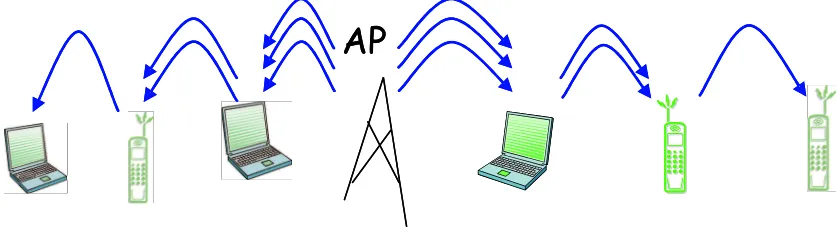
existent cellular systems in order to get crowded heterogeneous networks with very high data rates and bandwidth. This kind of networks will appear gradually in the next years and are expected to be the network architecture of 4G. Its main advantages will be the deployment of adaptive applications and partial coverage in places with a reduced density of users. This will be possible because users will be those who deploy the network. Finally, due to the multiple kinds of hosts, an analysis to determine the QoS in such networks is an important research issue. A sketch of this scenery can be seen in Figure 2.3.
2.4
Multi-Hop Wireless Link Systems
The IMT-2000 mobile communications system, which supports global roaming services, is to be introduced, as expected for broadband mobile multimedia services. Based on new generation, mobile communications should offer at least 20 Mb/s data communications channels. They also indicate that the network for these systems will utilize IP based tech-nologies and transfer traffic 10 times bigger than current traffic, since broader bandwidth mobile multimedia services will be offered so that not only people but also things will be connected [1].
Because there will be the need to transport an enormous amount of traffic in a more efficient manner by increasing the spectrum efficiency, the coverage of a base station will be shorter than present systems. The radio frequency signal bandwidth will be broadened to provide broadband communications, and because the propagation loss increases according to the radio frequency increase, the cell radius is also supposed to be shorter. Therefore, a new system will require more base stations to cover a wide area.
In order to utilize wireless links in future communications systems, these links must have greater traffic capacity and economic performance. The radio frequency band of the wireless link will become higher (such as the millimeter-wave band) to support a much broader link bandwidth. Thus, the range of each radio link is assumed to be shorter because of its broader link bandwidth and higher radio frequency band requirements. To compensate for this problem, we could increase the output power and use high directivity antennas. However, this is not desirable from the point of view of equipment cost.
2.4. MULTI-HOP WIRELESS LINK SYSTEMS 9
[image:23.612.97.540.92.382.2]Figure 2.3: Single Network
Figure 2.4: Funnel Network
and how do they work.
2.4.1
Single Networks
We have seen in the previous section that a multi-hop network can transport not only native traffic but also other users traffic. This means that the radio link between mobile users must be ready to handle highrate information. Figure 2.3 shows a multi-hop radio network in which information departs from an access point and travels along the communication path until it reaches its destination node.
In a single network scheme we see how information hops from user to user by using one key per hop link. Every code key is orthogonal from each other. In later sections of this work we will explain and define CDMA as the access method employed, which means that the used key will be a CDMA code taken from the code pool of the system, [3].
2.4.2
Funnel Networks
On the other hand, we define a funnel network as a network array in which information could appear to be in an imaginary funnel where the wider part is at the starting part and as it goes ahead it becomes narrow as information is delivered to each element of the network.
Figure 2.5: Double Branch Funnel Network
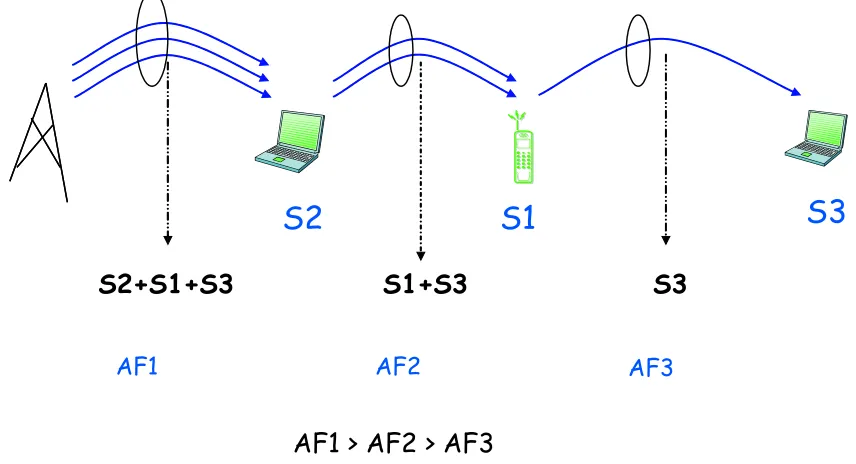
works in the following way: each element of the network demands a certain fixed quantity of information. This information must flow from an access point. We have to take into account that each user demands a certain amount of information, a key multiple keys of information that will be carried along the network. The main repercussion of this is that the information will be carried in a cumulative way from its starting point, meaning that the first link will carry all information belonging to then elements of the network. Carried information will be delivered user by user. Each user will take its information part and will forward the rest of the information to the next user until information reaches the last user. The main advantage of this type of ad hoc configuration is that the network can carry the whole block of information and deliver to each user its requested information. Figure 2.4 shows an example of a funnel network.
2.4.3
Double Branch Funnel Networks
A double branch scheme could be possible when two communications branch are held by the same access point. This is seen in Figure 2.5. This scenario is formed by two funnel networks, one running in the opposite sense of the other. The double branch system will work like the funnel network that we have described in previous part. Of course, we need to analyze and see the repercussions that the use of this network configuration could have for the system´s behavior and, in general, how the network performance is.
2.5
Propagation Model
2.5. PROPAGATION MODEL 11
Figure 2.6: r(x) alongx-axis in the space
designing a mobile radio system in certain environments several factors need to be account. Such factors are listed as follows:
• Free Space Loss
• Antenna height of mobile units
• Multi-path fading
• Scattering
The field strength of a signal can be represented as a function of distance in the space (space domain) or as a function of time (time domain). We can see that if a Tx antenna is fixed, then the field strength varies, as is seen in Figure 2.6. The field strength at every point is measured along the distance, and it is measured by the receptor. In Figure 2.6, we see how a signal behaves along the distance.
Figure 2.7: Description of a mobile radio environment
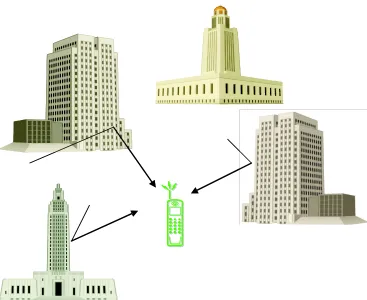
In the real environment instead of just having one direct signal from an antenna of a mobile, we have another, or several other paths that are produced when the waves are reflected in buildings or in the terrain. Figure 2.7 shows this effect [5].
In addition to the losses that the signal suffers when travels in space there are other considerations such the condition of the terrain, which can be represented by a random variable that follows a Log-Normal distribution this is called slow fading. Another type of fading is caused by multipath when the signal is reflected by buildings or big objects, and this effect is called fast fading.
Dispersion in a communication link is caused by the time in which different copies of a signal arrive, and the frequency dispersion is called the Doppler effect, we can see this effect in Figure 2.8.
Finally it is important to observe the next two points:
2.5. PROPAGATION MODEL 13
compensated by adaptive antennas and/or power control.
• Fading (small-scale) is a much more rapid fluctuation of received signals, caused by constructive and destructive interference between two or more versions of the same signal. This may be corrected by adaptive equalizers or by robust modulation and error correction.
2.6
Medium Access
Unlike in cellular networks, there is a lack of centralized control and global synchronization in ad hoc wireless networks. Hence, time division multiple access (TDMA) and frequency di-vision multiple access (FDMA) schemes are not suitable. In addition many MAC protocols do not deal with host mobility. As such, the scheduling of frames for timely transmission to support QoS is difficult.
In ad hoc wireless networks, since the media are shared by multiple mobile ad hoc nodes, access to the common channel must be made in a distributed fashion, through the presence of a MAC protocol. Given the fact that there are no static nodes they cannot rely on a centralized coordinator. The MAC protocol must contend for access to the channel while at the same time avoiding possible collision with neighboring nodes.
2.6.1
Interference Factor
Interference is the main limiting factor in wireless communications. As a result of this, it is vital to use the radio spectrum efficiently and to the limited resource among multiple users. The channel assignment strategies minimize interference between users in different cells in conventional cellular environments. Interference is caused by transmitted signals that extend outside the intended coverage area into neighboring cells. The choice of multiple-access technique directly affects subscriber capacity, which is a measure of the number of users that can be supported in a predefined bandwidth at any time. Because of this is the importance of characterize and study the interference.
2.6.2
CDMA Principles
2.6. MEDIUM ACCESS 15
Data signal
PN Code
Coded Signal
1 bit period 1 chip period
Figure 2.9: CDMA Spreading Process
occur at the receiver by applying a replica of the sequence (code) used for spreading each signal. This process enhances the interested signal while dismissing all others as broadband interference.In Figure 2.9, we show how the expansion processes is done by a sequence which is a unique code for each user. The period of the code is shorter than the information, so the band width is bigger, because when signals are multiplied, the bandwidth is wider.
The CDMA concept can be contrasted with other multiple access techniques. In (FMDA), each mobile station has full usage of the spectral allocation. In TDMA, breaks down the allocation into a number of time slots. Each mobile cofinites its signal energy within a time slot. In CDMA, the base station has full-time use of the entire spectral allocation and spreads its signal energy over the entire bandwidth. Base stations and mobile station use a unique code to sign each signal and to distinguish those signals coincident in time and frequency.
There are two types of CDMA Direct Sequence (DS-CDMA) or Frequency Hop (FH-CDMA). In the direct sequence all users share the same frequency at the same time with a special and unique code. Before a signal transmission, user signals are multiplied by a sequence which is different for each user [15].
Capacity considerations are fundamental to CDMA planning and operation, by ca-pacity we mean simply the number of users that can be simultaneously supported by the system. Power control minimizes the impact of interference by adjusting each signal level to the minimum necessary to achieve desired call or service quality.
The relation between both bandwidths information and sequence, is known as the Processing Gain and is defined by
P G= Bss
B , (2.1)
In digital communications there is an important metric denoted Eb
N0, or bit energy to
noise power density ratio, this quantity can be related to the conventional signal-to-noise ratio (SNR) by recognizing that energy per bit equates to the average modulation signal power allocated to each bit duration, that is
Eb =ST, (2.2)
where S is the average modulating signal power and T is the time duration of each bit. Notice that (2.2) is consistent with dimensional analysis, which states that energy is equiv-alent to power multiplied by time. We can further manipulate (2.2), by substituting the bit rateR, which is the inverse of the bit duration:
Eb =
S
R, (2.3)
Eb
N0 is thus
Eb
N 0 = S
RN0
, (2.4)
We further substitute the noise power density N0, which is the total noise power N divided by the bandwidth W, which is,
N0 =
N
W, (2.5)
substituting (2.4) into (2.5) yields
Eb
N0 = S
N W
R, (2.6)
which relates Eb
N0 to two factors: theS/N of the link, and the ratio of transmitted bandwidth
W to bit rate R. The ratio W/Ris also known as the processing gain of the system, which is the same as that in [15], and it handles and commands the performance of a CDMA system.
Here we consider the reverse-link capacity since in CDMA this is often the limit-ing link in terms of capacity. Assumlimit-ing that the system possesses perfect power control, which means that the transmitted power from all mobile users are equal. Based on this assumption, the SN R of one user can be written as
S N =
1
2.7. OUTAGE PROBABILITY 17
where M is the total number of users present in the band. This is so because the total interference power in the band is equal to the sum of the powers from individual users. We proceed to substitute (2.7) into (2.6), and the result is
Eb
N0
= 1
M −1
W
R, (2.8)
Solving for (M −1) yields
M −1 = W
R Eb
N0
, (2.9)
Note that ifM is large, then
M = W R Eb N0 . (2.10)
2.7
Outage Probability
The Outage probability is defined as the probability that the output signal to interference (SIR) falls below a prescribed level. This is given by:
POU T =P
h C0 I ≤ γb P G i
=PhC0
I ≤γb W
R
i
,
Chapter 3
Model Description
In order to analyze the network performance from the point of view of its capacity and interference in this chapter we have made a simulation to model and analyze the behavior of a wireless CDMA multi-service lineal ad hoc network. In the following sections we will explain the characteristics considered to model and simulate a linear ad hoc network when single and funnel schemes are used, both under one type of traffic and for the case of multi-traffic scheme.
3.1
Linear Ad Hoc CDMA Modeling
For the analysis proposed in this work, we have considered the following points:
• In this work, we analyze an ad hoc network that uses CDMA as the access method, which is deployed on a straight line, so the analysis will be considered in such scenario.
• We have chosen a point for the interference analysis. We will address this point as the Analysis Point (AP) a point at which the interference conditions will have bigger or crucial repercussions.
• Omnidirectional antennas are considered.
• The transmission power is considered in the sense that this power is the lowest possible and is about -80dBm, which is the minimum receiver signal level [13].
• Power control is considered in order to reach the closest mobile, and the signal level received is the minimum, and the same, for all users.
• User position follow a Poisson distribution, and mobiles are distributed independently of each other.
Figure 3.1: Planar to linear scenario
Figure 3.2: Linear generated scenario
• In this work all interference measures will be done before considering the cross-correlation factor of each code.
• Mobiles use the closest neighbors to communicate.
• It is important to say that our system do not consider signal processing algorithms such as, blind deconvolution and adaptive filter theory. Signal processing is proposed as part of future work.
3.2
Proposed Model
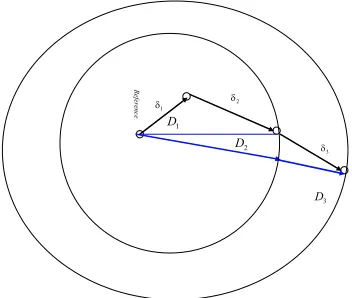
The interference analysis made here was done by using simulations of a linear ad hoc net-work. It is important to say that a planar model can be reduced to a linear scenario. In Figure 3.1 we see a planar ad hoc network. Distance between points is represented by δi, and the distance which will be refereing as the linear distance is represented by Di. Every
Di, will be formed by the sum of the previous radio Di−1, starting on the reference point.
3.2. PROPOSED MODEL 21
Figure 3.3: Analized scenario
The simulated scenario is shown in Figure 3.3 and has the following configuration. Our linear ad hoc network starts with an access point. The first element in the network is placed at the first network’s position. After this point, we find user or node one, and then successively the rest of the users; All network elements are generated with a Point Process on the line. Based on this process we generate the mobile positions, which will compound our complete scenario. Each event in the point process represents the mobile position along the network.
3.2.1
Point Process
In order to model the mobile positions we use the Poisson Point Process on the line, withλ
as the parameter of occurrence, whereλ is the average number of mobile stations per unit length. The Poisson Point Process arises in many situations where the arrival or events need to be counted and modelled. Our case events, produced by the point process are considered as mobile positions on the working space that, for this work, will be on a line. All our analysis will start here with the point process, so it is vital for the rest of the work to have trustable point process. Figure 3.4 shows a point process in one and two dimensions. Assuming that the points are distributed in a line according to a Poisson distribution with intensityλ, the probability to have n points on the working space is given by
Pn=
(λx)ne−λx
n! , n= 0,1,2...,
Figure 3.4: Point Process in one and two dimensions
limited line (working space WS), where the occurrence of an event represents a point which is considered a mobile user in a particular scenario.
The exponential random variable arises in situations where the time of event occur-rences and time modeling need to be modeled. In this work we use the exponential density to generate the distances between the mobile positions, this density used is
f(x) =λe−λx, x≥0, (3.1)
where the parameter λ is the rate at which events occur. So the probability of an event occurring by the time x increases as the rate λ also increases.
3.3
Power Control
In CDMA, the system capacity is maximized if each mobile transmitter power level is controlled so that the signal arrives at the mobile receptor with the minimum required signal-to-interference ratio [17].
In order to have the minimum interference and to work with minimum interference levels in the network, all signals must be transmitted at the minimum possible level, but the minimum threshold level must be achieved at the receiver in order to fill the quality requirement levels, most equipment suppliers have settle this level at -80dBm, [13] so for this work our mobile receptors will be receiving that signal level.
3.4. PATH LOSS EXPONENT INFLUENCE 23
We have proposed an analysis point in which all interference has critical repercussions, so the applied power for each link will depend on the distance between users. In this way we come to the following. The power of the transmitted signal, [10] is given by
P Tx =P0[1 +d] γ
, (3.2)
where P Tx is the transmitted power, P0 is the threshold reception level, γ is the loss exponent, anddis the distance between transmitter and receiver. The power at the receiver is given by the following
P Rx =P Tx[1 +d]−γ (3.3)
=P0[1 +d]γ[1 +D]−γ. (3.4)
3.4
Path Loss Exponent Influence
Path loss exponent is an important factor that must be consider when a communications system is designed. Loss factor is related to the signal attenuation of the transmission media. In free space, the causes of propagation path loss are merely frequency f and distance d. In the next equation, we see how all of these this factors behave and we see, if one changes how it affects the entire behavior of signal and interference
Por
Pt
= 1 4πdf
c
2
= h 1 4πd
λ
i2, (3.5)
wherecis the speed of light,λ is the wavelength, PTx is the transmitting power, and PRx is the received power in free space. The next equation defines the difference between two received signals. The difference between two received signals in free space and the different distances is given by
∆P = 10 log10
P
R2
PR1
= 20log10
d1
d2
!
(dB), (3.6)
∆P =20log10(.5) = −6dB,
so the free space propagation path loss is 6 dB/oct (octave), or 20 dB/dec (decade). And an octave means doubling in distance, and a decade means a period of 10. Twenty dB/dec means a propagation path loss of 20 dB and will be observed in distances between 3 to 3 km, in the case in which we would be working with signals in dB at the receiver we must work also the path loss exponent (PLE) in dB units. A PLE changes depending on the environment characteristics. In Table 3.1, we show different values of γ for different environments [8].
Table 3.1: Path Loss Exponents
Environment Path Loss Exponent
Free space 2
Ideal specular relfection 4 Urban cells 2.7-3.5 Urban cells, shadowed 3-5 In building, line-of-sight 1.6-1.8 In building, obstructed path 4-6
In factory, obstructed path 2-3
3.5
Variable Activity Factors for Multi-Service CDMA
Wireless Systems
Voice activity factor (VAF) can enhance the network performance in a very convenient way but also can be used to solve the management problem of multi-service in CDMA wireless networks. For example in a conventional voice link, the user´s voice is active about half the time, and if transmitters vary output power with voice activity, the total interference power from a large number of users will be reduced about a factor of two. This reduction in interference translates naturally into a direct increase in system capacity. The use of voice activity is possible because all subscribers reuse the same channel [8].
3.5. VARIABLE ACTIVITY FACTORS FOR MULTI-SERVICE CDMA WIRELESS SYSTEMS25
Figure 3.5: AF considerations on linear ad hoc networks
of thinking will allow us to work with channels of higher rates, for example 1Mbps with the possibility of choosing different VAF’s and multiple parallel codes of this capacity, in order to adapt our channel to the changing and demanding user information request we see an example in Figure 3.5. we see that each link has its own VAF which depends on the amount of information that is being carried.
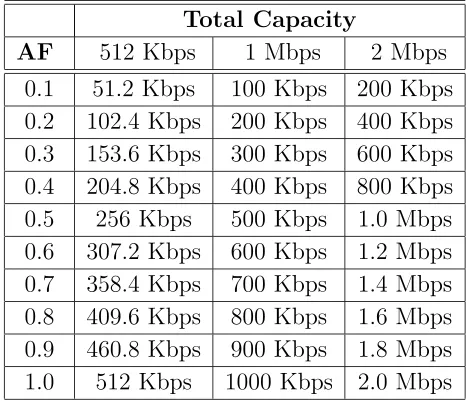
Table 3.2 gives us the real rates that we could reach when three different transmission capabilities are used, combined with different activity factors. If we have a channel of 1 Mbps and we need to transmit at 500Kbps, we employ a VAF of 0.5, which will allow us to reach that transmission rate. In the case in which we need to transmit 1.5Mb, the system would be using one full code. Another code would be used, at half of its capacity in order to reach the required capacity.
Table 3.2: Different rates with different AF´s
Total Capacity
[image:40.612.185.418.161.362.2]AF 512 Kbps 1 Mbps 2 Mbps 0.1 51.2 Kbps 100 Kbps 200 Kbps 0.2 102.4 Kbps 200 Kbps 400 Kbps 0.3 153.6 Kbps 300 Kbps 600 Kbps 0.4 204.8 Kbps 400 Kbps 800 Kbps 0.5 256 Kbps 500 Kbps 1.0 Mbps 0.6 307.2 Kbps 600 Kbps 1.2 Mbps 0.7 358.4 Kbps 700 Kbps 1.4 Mbps 0.8 409.6 Kbps 800 Kbps 1.6 Mbps 0.9 460.8 Kbps 900 Kbps 1.8 Mbps 1.0 512 Kbps 1000 Kbps 2.0 Mbps
Table 3.3: Reached capacity with parallel codes
Total Capacity
Parallel Codes 256 Kbps 512 Kbps 1 Mbps 2 Mbps 1 256 Kbps 512 Kbps 1 Mbps 2 Mbps 2 512 Kbps 1024 Kbps 2 Mbps 4 Mbps 3 768 Kbps 1536 Kbps 3 Mbps 6 Mbps 4 1024 Kbps 2048 Kbps 4 Mbps 8 Mbps 5 1280 Kbps 2560 Kbps 5 Mbps 10 Mbps
3.6
Working With Funnel Networks
3.7. OUTAGE QUANTIFICATION 27
3.7
Outage Quantification
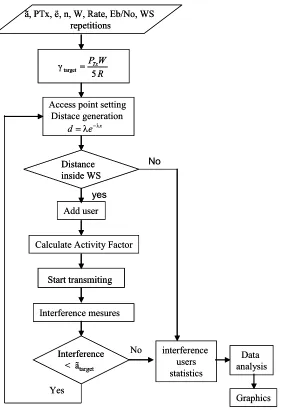
Outage probability is a very important parameter related to the QoS of a network. In general outage values must be under 2-4%. Values beyond this threshold means poor´s network Quality. Equipment suppliers must warranty this level. For this work Outage statistics will be taken from the number of users that a network can accept successfully. This means that all interference generated by the network in out reference point must be less than a fixed valueγtarget.
Chapter 4
Numerical Results
In this chapter, we present results obtained for those schemes proposed in chapter two. The first scenario analyzed is single networks, in which users transmit one key per link as current conventional cellular systems. On the other hand we have funnel networks, which are formed when the user´s traffic is cumulative then is transmitted to relay nodes, until information reaches its destiny. In both scenarios CDMA is used as the MAC. We make a comparative analysis of the interference measures. We continue analyzing the outage probability, where we can see the behavior of the capacity for different scenarios, and changing different physical parameters, such as loss exponent, transmission rate, node density, finally we make some appreciations.
4.1
Interference Analysis
[image:43.612.240.394.590.676.2]In this part we will analyze the interference behavior for both scenarios carried out here in Figure 4.1, we see the interference distribution comparison for a CDMA ad hoc network carrying one type of service. Parameters used in this simulation are seen in Table 4.1.
Table 4.1: Characteristics of the simulated scenarios
Loss Exponent γ 2 Sensibility -80dBm
λ .01 1/λ 100 m Working Space 10 Km
In Table 4.1, loss exponent is explained in Section 3.4, sensibility is refereed to the minimum signal threshold needed to set a successful communication. λ is refereed to the user occurrence, and 1/λ is refereed to the separation distance between users.
−85 −80 −75 −70 −65 −60 −55 0 0.02 0.04 0.06 0.08 0.1 0.12 0.14 0.16 0.18 0.2 Interference (dBm) Funnel Network Single Network
Figure 4.1: Comparative interference density for 64 users
In Figure 4.2, we are comparing a single network vs a funnel network in their inter-ference level using the same parameter values showed in table 4.1, because the nodes in a funnel network work as relay stations, not only carrying their own traffic but also carrying other user traffic. Funnel networks produce higher interference levels. On the other hand we can see that single networks produce fewer interference levels because these networks carry links of a single code, compared with the funnel networks which carries multiple codes under the same physical conditions. Interference levels were reduced when the number of users were also reduced, as we see in this case in which we have 32 users in the network under the same physical conditions. Also in this scenario, the network which was carrying funnel traffic was seen with the highest interference levels, but the highest interference levels are seen for the 64-user scenario, as is shown in Figure 4.1.
In Figure 4.3, we are considering 8 users, also using the same parameters as shown in table 4.1. We can see that interference levels are close similar in its level so there is a tendency to reach the same level but, it will not be the same because of the funnel effect on the traffic. The closest interference level between both schemes (single and funnel) would be when we have two interfering users.
4.1. INTERFERENCE ANALYSIS 31
−900 −85 −80 −75 −70 −65 −60 0.02
0.04 0.06 0.08 0.1 0.12 0.14 0.16 0.18 0.2
Interference (dBm)
[image:45.612.193.436.468.669.2]Funnel Network Single Network
Figure 4.2: Comparative interference density for 32 users
−110 −105 −100 −95 −90 −85 −80 −75 −70 −65 10−3
10−2 10−1 100
Interference (dBm)
Funnel Network Single Network
level. The maximum refers to the highest interference level, and the mean which is the expected value.
Table 4.2: Interference statistics single network: 64, 32, and 8 users.
Single network
Statistic values (dBm) 64 users 32 users 8 users
minimum -87.28 -89 -99.96
maximun -75.95 -75.84 -76.72 mean -79.57 -79.75 -81.69
std 3.3284 3.78 6.121
Table 4.3: Interference statistics funnel network: 64, 32, and 8 users.
Funnel network
Statistic values (dBm) 64 users 32 users 8 users minimum -71.34 -73.75 -92.35 maximun -58.21 -62.07 -69.46 mean -62.13 -65.76 -74.41
std 3.773 3.415 6.041
Table 4.4: Characteristics of the simulated scenarios
Loss Exponent γ=2, γ=4
Sensibility -80dBm
Rate of user occurrence λ1 =.04, λ2 =.02, λ3 =.01 Working Space 3.5 Km
In Figure 4.4, we have a comparison of interference density using parameters from table 4.4. We choose different user density. For the first λ1, users would be separated about 25m, In the second case λ2, user´s separation would be about 50m. Finally in the third case λ3, distance would be around 100m. The highest interference levels are seen in the case in which distance between users is bigger.
4.1. INTERFERENCE ANALYSIS 33
[image:47.612.195.440.137.339.2]−660 −65 −64 −63 −62 −61 −60 −59 −58 −57 −56 −55 0.05 0.1 0.15 0.2 0.25 0.3 0.35 0.4 0.45 0.5 Interference (w) f(I) Probability λ=.04 λ=.02 λ=.01
Figure 4.4: Comparative interference density for different λ and γ = 2
number of users that we will have in our proposed scenario. The same working space is used in Figure 4.5, in which also we vary the occurrence rate of users. Table 4.4 show the values used to simulate the scenario in which we have different values of node occurrence.
Figure 4.5 shows a comparison of interference distribution levels using a loss exponent of γ = 4. When we use this value instead of using γ = 2, we have lower interference levels because the attenuation is higher, producing lower interference levels for the rest of the users, in this simulation we used values of Table 4.4.
4.1.1
Empirical CDF of Interference
−68 −66 −64 −62 −60 −58 −56 0
0.05 0.1 0.15 0.2 0.25
Interference (dBm)
f(I) Probability
λ=.04
λ=.02
λ=.01
Figure 4.5: Comparison of interference density for different λ and γ = 4
Empirical CDF graphs are generated from statistics that are taken in the reference point. These statistics consists of multiple values of interference of our generated scenarios. Once we have repeated the experiment a good number of times, we have a data collection of interference. The whole block of statistics is ordered, starting from minimum values to the maximum values. At this point we can get the data range which is the maximum value less the minimum level. This data range we divide it into several intervals. Those sub segments represent the data density (With this information it is possible to plot the interference density). The empirical CDF is done adding each of the sub segment density values, until the plot reach the maximum value of 1.
Finally Figure 4.7, shows the empirical CDF graphic for the same scenario, using a loss exponent of γ = 4, also employing values of Table 4.4.
4.2
Capacity and Outage Probability
4.2. CAPACITY AND OUTAGE PROBABILITY 35
−640 −63 −62 −61 −60 −59 −58 −57 −56 −55 −54 0.1
0.2 0.3 0.4 0.5 0.6 0.7 0.8 0.9 1
Interference (dBm)
F(I) Probability
λ=.04
λ=.02
λ=.01
Figure 4.6: Empirical CDF of interference for a funnel network with γ = 2
−72 −70 −68 −66 −64 −62 −60 −58 −56 0.2
0.3 0.4 0.5 0.6 0.7 0.8 0.9 1
Interference (dBm)
F(I) Probability
λ=.04
λ=.02
[image:49.612.197.439.164.366.2]λ=.01
10 20 30 40 50 60 70 10−2
10−1
100
Interferents
Outage Probability
λ=.003
λ=.002
λ=.001
Figure 4.8: Outage probability single network, γ = 4
[image:50.612.221.384.464.549.2]behavior is also under 0.04 percent which guaranties good QoS.
Table 4.5: Parameters of current CDMA systems
Bandwidth 1.25MHz Tx Rate 14.4Kbps
Eb/No 7 dB
VAF .4
Loss exponent γ = 2, γ = 4
In Figure 4.10, make a comparison of the outage probability between three loss ex-ponents. In this case, we are working with a funnel network. We have use a occurrence rate λ=.0111, which implies a user separation of about 90 meters. In this case the outage probability is also under levels of 0.04 percent of outage which is also appropriate to guar-anty good QoS.
4.2. CAPACITY AND OUTAGE PROBABILITY 37
10 20 30 40 50 60 70 10−2
10−1 100
Interferents
Outage Probability
λ=.003
λ=.002
[image:51.612.194.439.470.670.2]λ=.001
Figure 4.9: Outage probability single network, γ = 2
5 10 15 20 25 30 35 40 45 50 55 60 10−1
100
Interferents
Outage Probability
γ=2
γ=4
γ=6
0 5 10 15 20 25 30 35 40 45 50 10−3
10−2 10−1 100
Interferents
Outage Probability
λ=.003
λ=.002
[image:52.612.182.430.143.348.2]λ=.001
Figure 4.11: Outage probability funnel networkγ = 4
lower outage probability levels, because signals suffer high attenuation.
Finally before going to the multiservice section we will make an experiment in which we propose to use different values of system´s characteristics. We will use a bigger bandwidth and a bigger transmission rate. Table 4.6, show these experimental parameters.
Table 4.6: Experimental parameters in funnel CDMA systems
Bandwidth 30MHz Tx Rate 128Kbps
Eb/No 7 dB
VAF .4
Loss exponent γ = 2, γ = 4
Employing a bandwidth of 30 MHz and a rate of R=128Kbps with a γ = 2, we see the outage probability behavior in Figure 4.13. For the same scenario, but using now a loss exponent ofγ = 4, we see the outage probability behavior in Figure 4.14. Both simulations are on a working space of 10Km.
[image:52.612.222.385.529.615.2]4.2. CAPACITY AND OUTAGE PROBABILITY 39
5 10 15 20 25 30 35 40 45 50 10−3
10−2 10−1 100
Interferents
Outage Probability
λ=.003
λ=.002
[image:53.612.193.440.162.363.2]λ=.001
Figure 4.12: Outage probability funnel networkγ = 6
10 20 30 40 50 60 70 10−2
10−1 100
Interferents
Outage Probability
λ=.003
λ=.002
λ=.001
[image:53.612.195.439.469.670.2]10 20 30 40 50 60 70 10−2
10−1
100
Interferents
Outage Probability
λ=.003
λ=.002
[image:54.612.179.424.134.333.2]λ=.001
Figure 4.14: Outage probability funnel network γ = 4, BW 30MHz
0.04% and a second value for outage 0.08%. We can compare both schemes, single net-works, and funnel networks. The figure shows bigger user capacity for the case of single users. For the case of the fixed outage, if we decrease the outage requirement, the number of users grow. Refer to Table 4.5, to see the utilized parameters to simulate both schemes single and funnel CDMA networks.
4.3
Multiservice Traffic Results
In this section, we present results obtained when different transmission rates are used in the ad hoc network. The procedure used here to use different activity factor (AF) is the same as in section 3.6. For this work we consider that the network will be offering three types of services with the same probability of occurrence in each node of the network. Parameters used for the present scenarios are shown in Table 4.7.
Figure 4.16, shows the network behavior for a funnel network using a bandwidth of 20Mhz as well as the three proposed services with the same probability of the user demand.
4.3. MULTISERVICE TRAFFIC RESULTS 41
300 400 500 600 700 800 900 1000 1100 0 10 20 30 40 50 60 70
User separation 1/lambda (m)
Users Number
[image:55.612.195.438.164.360.2]Outage Single @ .04% Outage Single @ .08% Outage Funnel @ .04% Outage Funnel @ .08%
Figure 4.15: Capacity comparison single VS funnel networks
5 10 15 20 25 30 35 40 45 50 55 60 10−2 10−1 100 Interferents Outage Probability λ=.001 λ=.002 λ=.003 Service types S
1= 64Kbps
S
2=128Kbps
S
3=384Kbps
[image:55.612.193.438.469.669.2]Table 4.7: Multiservice parameters
Bandwidth 20MHz Tx Rate 512Kbps
Eb/No 7 dB
VAF variable Loss exponent γ = 2, γ = 4
5 10 15 20 25 30 35 40 45 50 55 60 10−2 10−1 100 Interferents Outage Probability λ=.001 λ=.002 λ=.003 Service types S
1= 64Kbps
S2=128Kbps S
3=384Kbps
Figure 4.17: Outage probability funnel multiservice network,γ = 2
We can see the same scenario, but now using a path loss exponent of γ = 2 and offering the same services, in Figure 4.17. To see the effect that the loss exponent plays in the network behavior, we have Figure 4.18. In this figure, we are using a γ = 6. Under these physical conditions, in which we expected to observe the best results. Finally, Figure 4.19 directly compares three different values of γ1 = 2, γ2 = 4, γ3 = 6. Expecting to have the best results when the path loss exponent is biggest.
4.3. MULTISERVICE TRAFFIC RESULTS 43
5 10 15 20 25 30 35 40 45 50 55 60 10−3 10−2 10−1 100 Interferents Outage Probability λ=.001 λ=.002 λ=.003 Service type S
1= 64Kbps
S
2=128Kbps
S
[image:57.612.193.439.163.362.2]3=384Kbps
Figure 4.18: Outage probability funnel multiservice network, γ = 6
10 20 30 40 50 60 70 10−2 10−1 100 Interferents Outage Probability γ=2 γ=4 γ=6 Service types S1= 64Kbps S
2=128Kbps
S
3=384Kbps
[image:57.612.195.438.471.670.2]300 400 500 600 700 800 900 1000 5
10 15 20 25 30
Users separation 1/lambda (m)
Users Number
[image:58.612.182.421.135.329.2]Outage @ .04% Outage @ .08%
Figure 4.20: Capacity of a multiservice network
4.3.1
Stochastic vs deterministic network behavior
In this part of this work we are comparing two linear networks. The first network is the same as the other networks whit the characteristic that user position is in function of the occurrence rate (λ) of the point process. On the other hand, we compare the results versus a deterministic network in which users are set at a fixed distance from each other. In this scenario, we are refereing a network which all users are separated by 500m. A second analyzed scenario was a case in which users are separated for about 1000m. We will se this results then we will discuss them. Both scenarios, stochastic and deterministic, are generated with the same physical characteristics of Table 4.8.
Table 4.8: Parameters of compared scenarios
Bandwidth 20MHz Tx Rate 512Kbps
4.4. DOUBLE BRANCH WIRELESS NETWORKS 45
0 10 20 30 40 50 60 70 80 90 100 10−2
10−1
100
Interferents
Outage Probability
Constant node separation 500m Employing λ=.002
CDMA Multiservice Funnel Net
[image:59.612.192.440.134.333.2]γ=2
Figure 4.21: Stochastic vs deterministic network, users distance 500m
In Figure 4.21 we see the comparison of the outage probability behavior, between, proposed scenarios, we see that the stochastic network does not warranty outage levels as the other networks did. On the other hand we see that the defined position network can reaches without problem the outage quality requirements.
On the other case we have Figure 4.22 in which we see the same comparison but now our distance between users is 1000m. In both graphs we see that exist an asymptotic be-havior for the case in of the fixed distance, in both cases we see an imaginary line in 30 users.
4.4
Double Branch Wireless Networks
As we saw in Section 2.5.3, funnel networks can be deployed to form a double branch net-work. This has large repercussions throughout the network behavior. For these case, see services table 4.9.
In Figure 4.24, we see the network behavior using parameters as in Table 4.9. For this case we compare a one-branch funnel network VS a double branch network. In this case
γ = 4.
0 10 20 30 40 50 60 70 80 90 100 10−2
10−1 100
Interferents
Outage Probability
Constant node separation 1000m
λ=.001
CDMA Multiservice Funnel Net
[image:60.612.178.426.162.363.2]γ=2
Figure 4.22: Stochastic vs deterministic network, users distance 1000m
5 10 15 20 25 30 35 40 45 50 55 60 10−2
10−1 100
Interferents
Outage Probability
One branch Double branch
Service types S1= 64Kbps S
2= 128Kbps
S
3= 384Kbps
[image:60.612.180.424.470.670.2]4.4. DOUBLE BRANCH WIRELESS NETWORKS 47
Table 4.9: Multiservice parameters for double branch networks
Bandwidth 20MHz Tx Rate 512Kbps
Eb/No 7 dB
VAF variable Occurrence rate λ=.01
Loss exponent γ = 4, γ = 6
5 10 15 20 25 30 35 40 45 50 55 60 10−2
10−1
100
Interferents
Outage Probability
One branch Double branch
Service types S
1= 64Kbps
S
2= 128Kbps
S
3= 384Kbps
Figure 4.24: Outage probability funnel multiservice, double branchγ = 6
Chapter 5
Conclusions and Future Work
In this chapter, we present the general conclusions of this work and at, the end of the chapter, in Section 5.2, we offer ideas on future research that would continue within this line of research.
5.1
Conclusions
In this work we have analyzed the interference and capacity behavior of a linear ad hoc network carrying multi service and one service type traffic, under cumulative traffic carrying (funnel network) and under single traffic scheme (single network) all working with CDMA as the Medium Access Control. Based on a point process in the line we have characterized user distance. Parameters varied were system´s bandwidth, transmission rate, observing physical conditions as the path loss exponent to the global scenario, we proceeded to evaluate the interference and outage performance.
• For the case of funnel networks, we observed higher interference levels than those for single networks. Ad hoc networks which work as funnel networks must be designed to work with higher interference levels.
• Interference levels in funnel networks have larger levels than single networks. This is because funnel make a cumulative transport of traffic, producing more interference.
• User density is an influential factor in the amount of total interference generated in the network. The number of users is directly proportional to the total interference level.
• For the case of the network´s capacity, interference levels directly affected the number of users that the system could serve. In the case of this work, we used three values of PLE, γ=2, γ=4, and γ=6, observing the best results for the case ofγ=6. Which means bigger attenuation and which produces lower interference levels.
• The Activity Factor can be used as a multi-service controller, as it is explained in Section 3.5 and 3.6. We use the Activity Factor as the transmission controller for 4 types of traffic. Implications on capacity were observed when we had different service types, especially for those which transmitted higher data rates.
• Increasing the transmission rate implies that users will demand higher amount of resources. Because of the increase in users demands, the number of served users is decreased.
• For the case in which we increased the bandwidth, we could observe a few advantages in the performance of the network, so for future wireless communications systems in order to achieve QoS, carriers must provide wider band widths.
• We can conclude that networks that work with one communication branch have bet-ter results than those networks of double branch, because inbet-terference is directly proportional to the user number.
5.2
Future Work
According to the work done in this thesis, the following ideas can be suggested for future research.
• In this work we consider a network on a line configuration. It would be interesting to see what happens when we deliver our scheme in a two dimensional space.
• For this work, our transmission targets are adjacent nodes. It would be interesting to see what happen when, for example instead of just one hop, we have a two hop scheme.
• What would be the implication of considering a cross-correlation factor among all codes of the system?
• Based on the outage probability, we could extend the work to analyze the BER for a certain case of digital modulation.
• Consider different transmission rates according to a defined protocol.
• Vary the service use probability for different values and see what the repercussions of this are?
5.2. FUTURE WORK 51
Bibliography
[1] Yamao Yasushi, Suda Hiroito, Umeda Narumi, and Nakajima Nobuo, “Radio Access Network Design Concept for the Fourth Generation Mobile Communications,” Vehic-ular Technology Conference Proceedings, 2000. VTC 2000-Spring Tokyo. 2000
[2] Flament Maxime, Gessler Fredrik, Lagergren Frederick, Zader Jens, “Key Research Is-sues in 4th Generation Wireless Infraestructure,” PCC Workshop 98, Stokolm, Novem-ber 1998
[3] Outsu Toru and Aburakawa Yuji, “Multi-Hop Wireless Link System for New genera-tion,” IECE Transactions on Communications,Vol.E85-B no. 8 pp. 1542-1551, August 2002.
[4] W C Y Lee, “Overview of cellular CDMA,” IEEE Transactions on Vehicular Tech-nology, Vol. 40, no. 2, pp. 292-302, May 1991.
[5] W C Y Lee, Mobile Communications Design Fundamentals, Wiley Series in Telecom-munications, 1993.
[6] Papoulis Athanasios,Probability, Random Variables and Stochastic Processes,Mc Graw Hill, 1965.
[7] Ojanper¨a Tero and Prasad Ramjee,WCDMA: Towards Ip Mobility and Mobile Internet, Artech House, 2001.
[8] Theodore S. Rappaport, Wireless Communications Principles and Practice, Prentice Hall, Second Edition, 2002
[9] Dietrich Stoyan, Wilfrid S. Kendall and Joseph Mecke, Stochastic Geometry and Its Applications, Wiley, Second Edition, 1995.
[10] D. Mu˜noz-Rodriguez, O. Uribe-Arambula, C. Vargas and H. Maturino, “Interference Bounds in Power Controlled Systems,” IEEE Communications Letters, Vol. 40, no. 12, pp. 398-401, December 2000.