https://doi.org/10.33044/revuma.v60n2a04
CLASSIFICATION OF LEFT INVARIANT HERMITIAN STRUCTURES ON 4-DIMENSIONAL NON-COMPACT
RANK ONE SYMMETRIC SPACES
SRDJAN VUKMIROVI ´C, MARIJANA BABI ´C, AND ANDRIJANA DEKI ´C
Abstract. The only 4-dimensional non-compact rank one symmetric spaces areCH2 andRH4. By the classical results of Heintze, one can model these spaces by real solvable Lie groups with left invariant metrics. In this paper we classify all possible left invariant Hermitian structures on these Lie groups, i.e., left invariant Riemannian metrics and the corresponding Hermitian complex structures. We show that each metric from the classification onCH2 admits
at least four Hermitian complex structures. One class of metrics onCH2and
all the metrics onRH4admit 2-spheres of Hermitian complex structures. The
standard metric of CH2 is the only Einstein metric from the classification,
and also the only metric that admits K¨ahler structure, while onRH4 all the
metrics are Einstein. Finally, we examine the geometry of these Lie groups: curvature properties, self-duality, and holonomy.
Introduction
Thanks to Heintze [9], it is known that all non-compact rank one symmetric spaces are exactly the hyperbolic spaces
RHn =SO0(1, n)/SO(n),
CHn =SU(1, n)/S(U(1)×U(n)),
HHn =Sp(1, n)/Sp(1)×Sp(n),
and Cayley’s octonionic planeOH2=F
4(−20)/Spin(9).
In dimension four this comes down to spaces CH2 andRH4, since the
quater-nionic hyperbolic lineHH1coincides withRH4. This follows from the isomorphism
of Lie groupsSp(1,1)∼=SO(1,4)/±, giving
HH1=Sp(1,1)/Sp(1)×Sp(1) =SO(1,4)/SO(4) =RH4.
From Heintze’s papers [9, 10], we also know that a connected homogeneous manifold of non-positive curvature can be represented as a connected solvable Lie
2010Mathematics Subject Classification. Primary 53B35; Secondary 22E60, 53C20.
Key words and phrases. Non-compact rank one symmetric spaces; Complex hyperbolic plane; Left invariant metrics; Hermitian complex structures.
group with a left invariant metric1.
RH4 and CH2 are both symmetric spaces
of negative sectional curvature, therefore they are solvmanifolds, i.e., they can be represented as connected solvable Lie groups with left invariant metrics. They are exactly the noncompact part in the Iwasawa decomposition of the corresponding isometry groups. We denote these solvable Lie groups byRH4andCH2,and their
Lie algebras byrh4 andch2.2
In the sequel we classify the Hermitian structures on these groups: all possible non-isometric left invariant Riemannian metrics and Hermitian complex structures in regard to those metrics.
Left invariant Riemannian metrics. We give the classification of non-isometric left invariant Riemannian metrics on the Lie group CH2 in Theorem 2.1. The classification of non-isometric left invariant Riemannian metrics on the Lie group RH4is presented in Theorem 3.1. These results are partially known (see [6, Table 2,
A41,9forch2,A41,,15 forrh4]).
In dimension three, Milnor [14] gave a complete solution to the more general problem: he used the cross product to classify all left invariant Riemannian metrics on 3-dimensional Lie groups. For the classification of metrics in higher dimensions we use different methods based on Alekseevsky’s result that for completely solv-able Lie groups the isometry classes of left invariant metrics are the orbits of the automorphism group acting on the space of left invariant metrics (see [1, 2] and Lemmas 1.1, 1.2).
From Jensen’s classification of homogeneous Einstein spaces of dimension four [11], we know that CH2 and RH4 are the only non-compact, non-flat,
indecom-posable 4-dimensional Riemannian homogenous spaces that admit a left invariant Einstein metric. They are also found in [12] within a classification of 4-dimensional Einstein Lie groups. These results are in line with Alekseevsky’s conjecture that every non-compact Riemannian Einstein homogenous space is a solvmanifold. A left invariant Riemannian Einstein metric on a given Lie group, if it exists, is unique up to a scaling (see [13] for recent results on Einstein solvmanifolds). Therefore, the Einstein metrics obtained onRH4andCH2in [11, 12] are the usual metrics of
hyperbolic spacesRH4 andCH2viewed as symmetric spaces.
Hermitian complex structures. The main result of this paper is a classifica-tion of left invariant Hermitian complex structures on CH2 with respect to all non-isometric left invariant Riemannian metrics (Theorem 2.2). Note that for each left invariant metric there exists a 2-dimensional sphere of Hermitianalmost com-plex structures. However, the integrability condition imposes further restrictions, sometimes so strong that there are even-dimensional Lie groups that do not admit any integrable complex structures at all (see [8]). In our case, finding the integrable
1Note that a simply connected, homogeneous manifold can be isometric to more than one Lie group equipped with a left invariant metric. In other words, non-isomorphic Lie groups might admit left invariant metrics which make them isometric as Riemannian manifolds. For a way to test whether two given solvmanifolds are isometric see [7].
2The Lie algebrach
2is denoted byd4,1
2 in [3, 4],A
1
Hermitian structures onCH2 amounts to intersecting the sphere of Hermitian al-most complex structures with some non-trivial surfaces of second order coming from the Nijenhuis integrability condition. On RH4 the integrability condition
is automatically satisfied, so each metric allows a sphere of Hermitian complex structures (Theorem 3.2).
The classification of left invariant Hermitian complex structures on CH2 is re-lated to many known results of complex geometry of Lie algebras. For example,
ch2 appears in Barberis’s classification of invariant hypercomplex structures on
4-dimensional Lie groups [4]. These structures happen to be Hermitian, but not K¨ahlerian (the first case from Table 1). In fact, it was shown in [5] that ch2 is
one of three non-abelian 4-dimensional Lie algebras admitting both the hypercom-plex and the para-hypercomhypercom-plex structure. Snow [18] investigated 4-dimensional solvable simply-connected real Lie groups with commutator subalgebra of dimen-sion less than three. He classified left invariant complex structures with respect to certain subalgebras of the complexification of real Lie algebras. Ovando [16] extended this result to 4-dimensional Lie algebras with 3-dimensional commutator algebra. Thech2case (denoted byH3 in [16]) is related to our result in the special
case of the left invariant metric associated with an orthonormal base. Specially, Ovando [17] considered spaces CH2 and RH4 modelized as Lie groups and
clas-sified all left invariant complex structures with respect to standard metrics (see Remarks 2.2, 3.1). In therh4 case she found a sphere of Hermitian complex
struc-tures which is consistent with our result.
Outline. Section 1 explains the automorphism group action on the space of left invariant metrics. Basic notation and formulas are introduced here.
In Section 2 we classify Hermitian structures on CH2. The group of
automor-phisms of the Lie algebrach2is given by Lemma 2.1. Theorem 2.1 classifies all
non-isometric positive definite inner products onch2. They are denoted byS(p, x, β),
wherep, β >0,x≥0 are real parameters, andp−x2>0. The corresponding left
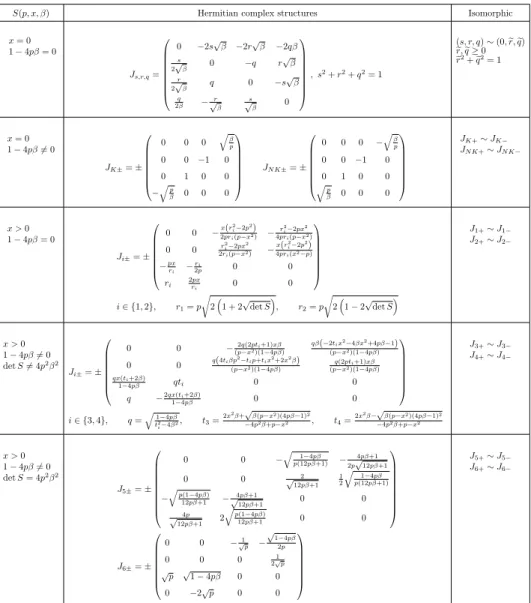
invariant Riemannian metrics are denoted byg(p, x, β). Lemma 2.2 describes the isometric automorphisms of these metrics. In Theorem 2.2 we classify Hermitian complex structures onCH2with respect tog(p, x, β). Their matrix representations are listed in Table 1.
In Section 3 we classify Hermitian structures onRH4. Lemma 3.1 describes the automorphisms of the Lie algebra rh4, and Theorem 3.1 classifies non-isometric
positive definite inner products S(λ). We prove that each of the metrics g(λ), corresponding toS(λ), has a 2-dimensional sphere of Hermitian complex structures (Theorem 3.2).
Section 4 considers geometry of the metric Lie groupsCH2andRH4. Curvature properties of CH2 are given in Theorem 4.1. In Theorem 4.2 we show that all metricsg(p, x, β) have the full holonomy, except the K¨ahler metricg(β1,0, β) whose holonomy group is U(2). Theorem 4.3 shows that all metrics g(λ) on RH4 have constant negative sectional curvature and full holonomy group.
1. Preliminaries
A Lie algebra gtogether with an inner product is called a metric Lie algebra. Every metric Lie algebra defines, by left translations, the unique left invariant metric on the corresponding Lie groupG, called ametric Lie group. Two metric Lie algebras areisometricif they are isomorphic as vector spaces, and the isomorphism between them preserves curvature tensor and its covariant derivatives. In other words:
Lemma 1.1 (Alekseevsky [2]). Two metric Lie algebras are isometric if and only if the corresponding Riemannian spaces are isometric.
In general, two isometric metric Lie algebras do not have to be isomorphic. However, this does hold for completely solvable Lie algebras.
Lemma 1.2(Alekseevsky [1, 2]). Isometric completely solvable metric Lie algebras are isomorphic.
Therefore, the isometry classes of different left invariant metrics are precisely the orbits of the automorphism group Aut(g) acting on the space of left invariant metrics. Since CH2 and RH4 are completely solvable groups, this allows us to
classify non-isometric metrics using algebraic methods in Theorems 2.1 and 3.1. Recall that an almost complex structure on a manifoldM is an automorphism
J :T M →T M satisfying
J2=−Id. (1)
Ifg is a Riemannian metric onM, thenJ isHermitianif
g(X, Y) =g(J X, J Y), X, Y ∈T M. (2)
The space of Hermitian orientation preserving almost complex structures on 2n-dimensional vector space with a given positive definite inner product is the symmetric space SO(2n)/U(n). For 2n = 4 we haveSO(4)/U(2) = S2, the two
dimensional sphere of the almost complex Hermitian structures.
The Nijenhuis tensor N of an almost complex structure J is a tensor field of rank (1,2) given by
N(X, Y) = [J X, J Y]−[X, Y]−J[J X, Y]−J[X, J Y] (3)
for anyX, Y ∈T M.
If an almost complex structureJ is integrable, i.e., its Nijenhuis tensor vanishes identically, then J is acomplex structure andM is a complex manifold. In Theo-rems 2.2 and 3.2 we essentially look for those almost complex Hermitian structures that annihilate the Nijenhuis tensor.
Note that a Lie group admitting a left invariant complex structure may not be a complex Lie group. In order to have the structure of a complex Lie group, the group multiplication has to be holomorphic, or equivalently, the complex structure
J has to be ad-invariant.
Let (M, g) be a Riemannian manifold and∇ its Levi-Civita connection. When the manifoldM is a Lie group, Koszul’s formula reduces to
for any left invariant vector fieldsX, Y, Z.
We define the Riemann curvature operator R(X, Y) :TpM →TpM,p∈M, by
R(X, Y) =∇X∇Y − ∇Y∇X− ∇[X,Y]X (5)
for any vector fieldsX, Y onTpM. The Ricci curvature tensor is defined by
ρ(X, Y) =T r(Z7→R(Z, X)Y). (6)
A manifold (M, g) is Einstein if ρis proportional to the metric g. The scalar curvatureτ is the trace of the Ricci tensor with respect to the metricg. If (X, Y) is a basis of a 2-dimensional planeπ⊂TpM then
K(π) := g(R(X, Y)Y, X)
g(X, X)g(Y, Y)−g(X, Y)2 (7)
is asectional curvature in the planeπ. IfM is endowed with a Hermitian complex structureJ, then for a unit vectorX ∈TpM, vectorsXandJ Xform an orthonor-mal basis of theJ-invariant planeπ andK(π) is called aholomorphical sectional curvature.
The curvature operators R(X, Y) satisfy g(R(X, Y)Z, W) =−g(R(X, Y)W, Z) and therefore belong to the algebra of skew-symmetric endomorphismsso(g). We identify the skew-symmetric endomorphisms so(g) with 2-vectors Λ2TpM by the formula
(X∧Y)(Z) :=g(Z, Y)X−g(Z, X)Y,
for any Z ∈ TpM. Since R(X, Y) =−R(Y, X), the curvature tensor can be re-garded as an operator on the space of 2-vectors
R: Λ2TpM →Λ2TpM ∼=so(g), R(X∧Y) :=R(X, Y).
A Riemannian metric onTpM naturally induces a positive definite inner product
h·,·ion the space of k-vectors ΛkTpM by
hX1∧ · · · ∧Xk, Y1∧ · · · ∧Yki:= det(g(Xi, Yj)).
The operatorR: Λ2T
pM →Λ2TpM is symmetric with respect to the inner product
h·,·ion Λ2T
pM.
IfM is 4-dimensional andω∈Λ4TpM is the unit vector, aHodge star operator
∗: Λ2TpM →Λ2TpM is defined by the relation
α∧ ∗β =hα, βiω. (8)
It is symmetric with respect to the inner producth·,·iand satisfies∗2=Id.
There-fore, it induces an orthogonal splitting
Λ2= Λ2+⊕Λ2−
of the 6-dimensional space Λ2 into the 3-dimensional±1 eigenspaces of∗.
With respect to that splitting, the curvature tensor has the well known decom-position
R= τ
12I6+
W+ B
B∗ W−
where τ denotes the scalar curvature,W± is the Weyl conformal tensor, andB is the traceless Ricci tensor. We say that (M, g) is self-dual (resp. anti-self-dual) if
W+ = 0 (resp. W− = 0) and conformally flat ifW+ = 0 = W−. If either of W± vanishes we say that M is half-conformally flat. The manifold is Einstein if and only ifB= 0.
2. Classification of left invariant Hermitian structures onCH2
Consider the Iwasawa decomposition,SU(1,2) =KAN, of the semisimple group of isometries ofCH2. The compact part is isomorphic toU(2), the nilpotent partN
is the Heisenberg groupH3, and the abelian part is 1-dimensional. The completely
solvable group CH2 = AN acts simply transitively on the complex hyperbolic
planeCH2 and gives it a structure of a Lie group in a way that its K¨ahler metric
is left invariant. Its Lie algebrach2is spanned by vectorsX, Y, Z, W with nonzero
commutators:
ch2: [X, Y] =
1
2Y, [X, Z] = 1
2Z, [X, W] =W, [Z, Y] =W. (10)
ch2is a semidirect product of the nilpotent Heisenberg ideal spanned byY, Z, W
and the 1-dimensional center spanned byX.
CH2 is a solvmanifold in a trivial way, i.e., it acts on itself isometrically by left translations. Equipped with the K¨ahler left invariant metric,CH2 is the complex hyperbolic planeCH2 in the usual sense.
Lemma 2.1. The automorphism group of the Lie algebrach2 is
Aut(ch2) =
1 0 0 0
u1 a b 0
u2 c d 0
e v1 v2 λ
|
u1
u2
= 1
2λ
−b a
−d c v1
v2
, λ=ad−bc
.
(11)
Theorem 2.1. All non-isometric positive definite inner products onch2, in some
basis with Lie algebra commutators (10), are represented by the matrices
S(p, x, β) =
p x 0 0
x 1 0 0
0 0 1 0
0 0 0 β
, (12)
wherex≥0, β >0, p−x2>0.
Proof. Two different inner products onch2 define two metric Lie algebras on the
same space. If the inner products are represented by symmetric positive defi-nite matrices S and FTSF, F ∈ Aut(ch
2), those metric Lie algebras are
iso-morphic, and therefore they are isometric. The converse statement follows from Lemma 1.2. Thus, non-isometric left invariant inner products correspond to the orbits of the group Aut(ch2) acting on the space of positive definite symmetric
matrices. Lengthy calculations similar to the proof of Theorem 3.1 (rh4case) show
A left invariant metric on a Lie group is uniquely determined by an inner product on its Lie algebra. We denote byg(p, x, β) the left invariant Riemannian metric on CH2corresponding to the inner productS(p, x, β). From Lemma 1.1 it follows that the isometry classes of the metrics onCH2are the orbits of the automorphism group
Aut(CH2) acting on the space of left invariant metrics. Therefore, Theorem 2.1
gives us the classification of all non-isometric left invariant metrics onCH2.
Lemma 2.2. The group of isometric automorphisms ofch2 with the inner product
S(p, x, β) is isomorphic to the discrete groupZ2, if x >0, and to the orthogonal
groupO(2), ifx= 0.
Proof. The matrix of an automorphism F is of the form (11). It is an isometry if
FTSF =S is satisfied.
Ifx >0, thenF is either the identity matrix orF = diag(1,1,−1,−1).
Ifx= 0, then F=
1 0 0 0
0 cosφ −λsinφ 0
0 sinφ λcosφ 0
0 0 0 λ
, λ=±1.
Now we classify the left invariant Hermitian complex structures on CH2 with respect to all non-isometric left invariant Riemannian metricsg(p, x, β).
Theorem 2.2. All left-invariant Hermitian complex structures on the metric Lie group(CH2, g)corresponding to the metric Lie algebra ch
2 with the inner product
S(p, x, β)are:
1a) forx= 0,1−4pβ= 0, the 2-dimensional sphere of structures{Js,r,t |s2+
r2+t2= 1};
1b) forx= 0,1−4pβ6= 0, 4 structuresJK±, JN K±; 2a) forx >0,1−4pβ= 0, 4 structuresJ1±,J2±; 2b) forx >0,1−4pβ6= 0,detS6= 4p2β2, 4 structures J
3±, J4±; 2c) forx >0,1−4pβ6= 0,detS= 4p2β2, 4 structures J5±, J6±.
Matrices of these structures and their isometric isomorphism classes are given in Table 1.
Proof. LetJ = (aij) denote the matrix representing the complex structureJ in a basis with commutators (10). SinceJ is a Hermitian complex structure, it imposes certain constraints on the entries of the matrixJ = (aij).
The condition (2) that the structureJ is Hermitian, is equivalent to
S(p, x, β) Hermitian complex structures Isomorphic
x= 0
1−4pβ= 0
Js,r,q=
0 −2s√β −2r√β −2qβ
s
2√β 0 −q r √
β
r
2√β q 0 −s √
β
q
2β − r √ β s √ β 0
,s2+r2+q2= 1
(s, r, q)∼(0,er,eq)
e
r,qe≥0
e
r2+ e
q2= 1
x= 0
1−4pβ6= 0
JK±=±
0 0 0
q
β p
0 0 −1 0
0 1 0 0
−qp
β 0 0 0
JN K±=±
0 0 0 −qβ
p
0 0 −1 0
0 1 0 0
qp
β 0 0 0
JK+∼JK−
JN K+∼JN K−
x >0
1−4pβ= 0
Ji±=±
0 0 −x(ri2−2p2)
2pri(p−x2) − r2
i−2px2
4pri(p−x2)
0 0 r2i−2px2
2ri(p−x2) −
x(r2
i−2p2)
4pri(x2−p)
−px ri −
ri
2p 0 0
ri 2rpxi 0 0
i∈ {1,2}, r1=p r
21 + 2√detS, r2=p
r
21−2√detS
J1+∼J1−
J2+∼J2−
x >0
1−4pβ6= 0
detS6= 4p2β2
Ji±=±
0 0 −2q(2pti+1)xβ
(p−x2)(1−4pβ)
qβ(−2tix2−4βx2+4pβ−1)
(p−x2)(1−4pβ)
0 0 q(4tiβp2−tip+tix2+2x2β)
(p−x2)(1−4pβ)
q(2pti+1)xβ
(p−x2)(1−4pβ)
qx(ti+2β)
1−4pβ qti 0 0
q −2qx(ti+2β)
1−4pβ 0 0
i∈ {3,4}, q=qt1−42 pβ
i−4β2, t3=
2x2β+√β(p−x2)(4pβ−1)2
−4p2β+p−x2 , t4=
2x2β−√β(p−x2)(4pβ−1)2
−4p2β+p−x2
J3+∼J3−
J4+∼J4−
x >0
1−4pβ6= 0
detS= 4p2β2
J5±=±
0 0 −q 1−4pβ
p(12pβ+1) − 4pβ+1 2p√12pβ+1
0 0 √ 2
12pβ+1 1 2 q
1−4pβ p(12pβ+1)
−qp(1−4pβ) 12pβ+1 −
4pβ+1
√
12pβ+1 0 0 4p
√
12pβ+1 2 q
p(1−4pβ)
12pβ+1 0 0
J6±=±
0 0 −√1
p − √
1−4pβ
2p
0 0 0 1
2√p √
p √1−4pβ 0 0
0 −2√p 0 0
J5+∼J5−
J6+∼J6−
Table 1. Hermitian complex structures on ch2with inner product S(p, x, β).
which implies the following linear relations:
a33= 0, a44= 0, a22=−a12x,
a34=−a43β, a11=a12x, a21=−a12p,
a13=
a31−a32x
x2−p , a23=
−a32p+a31x
p−x2 ,
a14=
−a41β+a42xβ
p−x2 , a24=
−a42pβ+a41xβ
The condition thatJ is a complex structure is equivalent to the system of qua-dratic equations
N(X, Y) = 0, J2=−Id, (13)
where the Nijenhuis tensorN is given by (3). These quadratic constraints lead us to discuss the following cases:
Case 1a. x= 0, 1−4pβ= 0.
Conditions (13) are now equivalent to
4a231β+ 4a241β2+a243β = 1.
Denoting
r= 2a31
p
β, s=a43
p
β, t= 2a41β,
we have the sphere of complex structures Jr,s,t, with r2+s2+t2 = 1, listed in
Table 1.
Case 1b. x= 0, 1−4pβ6= 0.
Conditions (13), together with the regularity of J, are now equivalent to
a43= 0, a12= 0, a42= 0, a31= 0, a232= 1, a
2 41=
p β.
Consequently, in this case we have four complex structuresJK±, JN K±, listed in Table 1.
Case 2. x >0.
From conditions (13) and the regularity of J it follows that
a43= 0, a12= 0,
a31=a32x−2a42pβ+ 2a41xβ, (14)
a232+(a42+ 2a32x)(a42p−a41x)β
p−x2 −1 = 0, (15)
a232+4(a42p−a41x)
2β2
p−x2 −1 = 0. (16)
Case 2a. x >0, 1−4pβ= 0.
From conditions (15) and (16) it follows that a32 = −a241p. From the relation
(14) we geta31=−a422 . Conditions (13) are now equivalent to
a41a42= 2px, (17)
a241+a242p= 4p2. (18)
Now we consider the system (17), (18) with respect to coordinates (a41, a42).
Sincep6= 0,x6= 0, the equation (17) is always a hyperbola, and the equation (18) is an ellipse. One can check that these curves always intersect in 4 points given by
a41=±
q
2(1±2√detS), a42=
2px a41
.
All four possible values ofa41are real under the given conditions. Denoting
r1=p
q 2(1 + 2
√
detS), r2=p
q 2(1−2
we have matrices of the corresponding complex structures J1± and J2± given in Table 1.
Casex >0, 1−4pβ6= 0.
From conditions (15) and (16) and the regularity of the matrixJ it follows that
a42=
2(a32x+ 2a41xβ)
4pβ−1 .
Conditions (13) are now equivalent to
a232−4a241β2+ 4pβ−1 = 0, (19)
(4βp2−p+x2)a232+ 4a32a41βx2+ (β−4β2p+ 4β2x2)a241= 0. (20)
The equation (19) with variables a32and a41 represents a hyperbola. Notice that
the determinant of the quadratic form (20) equals−(1−4pβ)2detS. It is strictly
negative, so the equation (20) represents two lines intersecting at the origin. There-fore, the solution of the system above is the intersection of a hyperbola and two lines. The coefficient of the term a2
32 in (20) equals 1
β(4p
2β2−detS) which leads
us to consider the following cases:
Case 2b. x >0, 1−4pβ6= 0, detS6= 4p2β2.
In this case,a416= 0. We puta32=ta41 and from (20) we get
a41=
s
1−4pβ
t2−4β2, t±=
2x2β±p
β(p−x2) (4pβ−1)2
−4p2β+p−x2 .
The corresponding complex structures J3± and J4± are given in Table 1. We use the notationt3=t+,t4=t−,q=a41.
Case 2c. x >0, 1−4pβ6= 0, detS= 4p2β2. In this case equation (20) becomes
a41β(1−4pβ)(4a32p+ 4a41pβ+a41) = 0.
The only two options, a41 6= 0 and a41 = 0, give structuresJ5± andJ6± respec-tively. This covers all the cases, so all complex structures have been found.
If two structuresJ andF−1J F are related by an isometric automorphism from Lemma 2.2 they determine the same geometry. We call them isomorphic and they
are listed in Table 1.
Remark 2.1. The sphere of complex structures {Js,r,t} from Theorem 2.2 was
found by Barberis [4] within a classification of hypercomplex structures on 4-dimen-sional Lie groups. Namely, the structures I = J1,0,0, J =J0,1,0, K=J0,0,1
con-stitute a hypercomplex structure (I, J, K), i.e., they satisfy IJ =K=−J I. It is interesting that a hypercomplex structure on a 4-dimensional manifold determines a conformally unique Hermitian metric. On the Lie group CH2 that metric is
Remark 2.2. Ovando [16, 17] found three classes of left invariant complex struc-tures with respect to certain subalgebras of the complexification of the real Lie algebrach2. Considering an orthonormal basis (thus fixing one left invariant
met-ric) she noted that one of those classes contains the standard K¨ahler metric on
CH2. This case corresponds to JK± from our classification in the special case of the left invariant metricg(1,0,1). The second class from [16] corresponds to
JN K± with the same metrics, and complex structures from the third class are not Hermitian.
3. Classification of left invariant Hermitian structures on RH4 If SO(1,4) =KAN is the Iwasawa decomposition of the group of isometries of
RH4, then the compact part is SO(4), the abelian part is R3, and the nilpotent
part is 1-dimensional. The Lie groupRH4=AN, acting simply transitively on the real hyperbolic spaceRH4, has the Lie algebrarh4spanned by vectorse1, e2, e3, e4
with nonzero commutators:
rh4: [e4, ek] =ek, k= 1,2,3. (21)
It is a two step nilpotent algebra with a 3-dimensional commutator subalgebra spanned bye1, e2, e3.
Lemma 3.1. The automorphism group ofrh4 is
Aut(rh4) =
A b
0 1
|A∈Gl3(R), v∈R3
. (22)
This group is isomorphic to the groupAff3(R)of affine transformations of R3. Theorem 3.1. All non-isometric positive definite inner products onrh4, in some
basis with Lie algebra commutators(21), are represented by the matrices
S(λ) =
I3 0
0 λ
, (23)
whereλ >0.
Proof. Thanks to Alekseevsky’s results (Lemmas 1.1 and 1.2), describing non-isometric inner products on rh4 is equivalent to finding equivalence classes of
positive definite symmetric matricesS under the equivalence relationS ∼FTSF,
whereF =F(A, b) is an automorphism of the form (22) (i.e., finding orbits of the automorphism group). IfS is any symmetric positive definite 4×4 matrix, we can
write it in a block matrix form S = ¯
S v
vT ¯λ
, where ¯S is a symmetric positive
definite 3×3 matrix,v∈R3, ¯λ∈
R. Choosing the automorphismF1(I3,−S¯−1v),S
gets simplified toS1=F1TSF1=
¯
S 0
0 λ
. Now we choose automorphismF2(A,0),
whereAis a matrix diagonalizing ¯S. The resulting matrixS2=F2TSF2=
I3 0
0 λ
is the simplest representative of an orbit of the automorphism group acting on the
Every positive definite inner product S(λ) gives rise to a unique left invariant Riemannian metricg(λ) by left translations, so the previous theorem describes all non-isometric left invariant Riemannian metrics onRH4.
Theorem 3.2. Every left invariant metricg(λ)onRH4, determined by the inner productsS(λ),λ >0 onrh4, admits a 2-dimensional sphere of Hermitian complex
structures
0 −α −β −γ√λ
α 0 −γ β√λ
β γ 0 −α√λ
γ
√
λ −
β
√
λ α
√
λ 0
, α2+β2+γ2= 1.
Proof. Direct calculation shows that conditions of integrability (Nijenhuis) are a
consequence of conditionsJ2=−IdandJ being Hermitian.
Remark 3.1. With respect to the standard metric g(1), Ovando [17] found a 2-sphere of Hermitian complex structures onrh4which is consistent with the
pre-vious result.
4. Left invariant geometry of metric Lie groupsCH2 andRH4 Now we are ready to prove the theorems that describe curvature properties of left invariant metricsg(p, x, β) onCH2, and of left invariant metricsg(λ) onRH4.
Theorem 4.1.
i) For all left invariant Riemannian metrics g(p, x, β),CH2 has a constant neg-ative scalar curvature
τ=− 11 +pβ
2(p−x2).
ii) Among g(p, x, β), the unique Einstein metric is g(β1,0, β), β >0. Moreover, it is the unique metric that admits a K¨ahler structure (JK± in classification). CH2 with this metric is a solvmanifold with constant holomorphic sectional curvature−β and it is isometric to the complex hyperbolic plane CH2.
iii) g(41β,0, β)andg(β1,0, β)are the only half-conformally flat metrics onCH2. Proof. Since we work with left invariant basis, we have a natural identification
TpCH2∼=ch2for anyp∈ CH2. Let (X, Y, Z, W) be a basis ofch2with commutators
of the form (10). In that basis, the metric g(p, x, β) is represented by the matrix
S=S(p, x, β) of the form (12).
covariant derivatives are determined by
∇XX = x
2(p−x2)(xX−pY), ∇XY =
x
2(p−x2)(X−xY),
∇YY =
1
2(p−x2)(X−xY), ∇YZ =−
1
2W, ∇YW =
β
2Z,
∇ZZ =
1
2(p−x2)(X−xY), ∇ZW =
β
2(p−x2)(xX−pY),
∇WW = β
p−x2(X−xY).
Note that the 2-dimensional submanifold whose tangent space is spanned by left invariant vector fieldsX and Y is totally geodesic. Using formula (5) we obtain the curvature operatorR: Λ2ch
2→Λ2ch2:
R(X∧Y) =− 1
4(p−x2)(X∧Y + (p−x
2)Z∧W),
R(X∧Z) =− 1
4(p−x2)(X∧Y + 2xX∧W −pY ∧W),
R(X∧W) =− 1
4(p−x2)(3xβX∧Z+ 4X∧W + 2βY ∧Z−2xY ∧W),
R(Y ∧Z) = 1
4(p−x2)(3xβX∧Z+ 2X∧W−(1 + 3pβ)Y ∧Z−3xY ∧W),
R(Y ∧W) = 1
4(p−x2)(βX∧Z−xβX∧W−2xβY ∧Z+ (pβ−2)Y ∧W),
R(Z∧W) =− 1
4(p−x2)(βX∧Y −(pβ−2)Z∧W).
(24)
Using formula (6) we obtain the Ricci tensor matrix in the basis (X, Y, Z, W):
ρ= 1
p−x2
x2−3p
2 −x 0 0
−x −pβ−x22β+2 0 0
0 0 −pβ2+2 −54xβ
0 0 −54xβ β(pβ2−4)
. (25)
The scalar curvature is then
τ=− 11 +pβ
2(p−x2).
Sincep, β >0 andp−x2>0, the scalar curvature is negative. This proves part i)
of the theorem.
The condition g(p, x, β) is Einstein, i.e.,ρ=λgfor someλ∈R, is according to
(12) and (25) equivalent to
x= 0, pβ= 1, and λ=− 3
Therefore, the only Einstein left invariant metric on CH2 is g(1
β,0, β). For the
complex structure JK± from Table 1, direct calculation shows ∇VJK±= 0 for any V ∈ ch2. Thus, (CH2, g(β1,0, β), JK±) is a K¨ahler manifold with constant
holomorphic sectional curvature−β, so it is isometric to the complex hyperbolic plane CH2. Note that g(β1,0, β) with complex structureJN K± is not K¨ahlerian,
but also has a constant holomorphic sectional curvature−β.
We check case-by-case structures from Table 1 to prove that no metric other thang(β1,0, β) admits a K¨ahlerian structure. This proves part ii).
To prove iii) we introduce an orthonormal basis ofch2with respect to the inner
productS(p, x, β)
e1=
1 p
p−x2X−
x
p
p−x2Y, e2=Y, e3=Z, e4=
1 √
β.
The basisei∧ej,i < j, is an orthonormal basis of Λ2ch
2, andω=e1∧e2∧e3∧e4
is a unit vector that spans Λ4ch2. Further lengthy calculations show that
Λ2± =L 1
√
2(e1∧e2±e3∧e4), 1 √
2(e1∧e3∓e2∧e4), 1 √
2(e1∧e4±e2∧e3)
(26) are orthonormal bases of±1 eigenspaces Λ2
±of the Hodge operator∗defined by (8). One can useR: Λ2→Λ2 given by (24) with respect to the basis (26) to obtain the
decomposition (9). Ifx6= 0 thenW±6= 0, so a metric cannot be half-conformally flat. Ifx= 0 we obtain
W±=
1±3√pβ+ 2pβ
12p diag(1,1,−2).
We see thatW− vanishes whenpβ= 1 or 4pβ= 1, so iii) is proved.
Remark 4.1. Milnor showed that the scalar curvature of a non-flat left invariant Riemannian metric on a solvable Lie group is strictly negative ([14, Theorem 3.1]). None ofg(p, x, β) onCH2is flat and this is consistent with our result.
Theorem 4.2. All left invariant metricsg(p, x, β)onCH2have the full holonomy
group, except the K¨ahler metricg(β1,0, β), whose holonomy group is isomorphic to
U(2).
Proof. The infinitesimal holonomy algebra is spanned by curvature operatorsR(·,·) and their covariant derivatives ∇kR of all degrees k ∈
N. The corresponding
uniquely determined connected subgroup of GL(4,R) is called the infinitesimal
holonomy group. Since a Lie group is an analytic manifold, its restricted, local and infinitesimal holonomy groups coincide (see [15]). Moreover, CH2 is simply connected, therefore, the holonomy group is the same as the local holonomy group. In the pβ = 1, x= 0 case the metric is symmetric. Hence, ∇R = 0 and the holonomy algebra isu(2) spanned only by curvature operators. In all other cases, direct but lengthy calculations show that the holonomy algebra is isomorphic to
We may now conclude that in the pβ = 1, x = 0 case the holonomy group is
U(2). In all other cases, the metric ghas the full holonomy group.
Corollary 4.1. All left invariant metricsg(p, x, β)onCH2 are indecomposable. Now we consider the geometry of RH4.
Theorem 4.3. All left invariant Riemannian metricsg(λ) onRH4 are Einstein. They have constant negative sectional curvature−1
λ, constant scalar curvature−
12
λ,
and the holonomy group is full.
Proof. From Koszul’s formula for left invariant vector fields (4), it follows that all nonzero covariant derivatives are determined by
∇e1e4=−e1, ∇e2e4=−e2, ∇e3e4=−e3, ∇e1e1=∇e2e2=∇e3e3= e4
λ.
Further calculation brings us a nice expression for the curvature operator
R: Λ2rh
4→Λ2rh4 given on the basis of the space of 2-vectors Λ2rh4:
R(ei∧ej) =−
1
λei∧ej, 1≤i < j≤4.
From definition (7) and the previous formula, it follows that the sectional curvature is
K(π) =−1
λ,
for any 2-dimensional planeπ⊂TpRH4. Using (6) we find the matrix of the Ricci tensor: ρ = diag(−3
λ,−
3
λ,−
3
λ,−3). Since ρ is proportional to the inner product
matrix (23), the corresponding left invariant metricg(λ) is Einstein, and the scalar curvature isτ=−12
λ. The holonomy algebra is 6-dimensional, henceg(λ) has the
full holonomy group.
References
[1] D. V. Alekseevsky,The conjugacy of polar decompositions of Lie groups, Mat. Sbornik (N.S.)
84(126) (1971), 14–26. MR 0277662.
[2] D. V. Alekseevsky, Homogeneous Riemannian spaces of negative curvature, Mat. Sbornik (N.S.)96(138) (1975), 93–117, 168. MR 0362145.
[3] A. Andrada, M. L. Barberis, I. G. Dotti, G. P. Ovando,Product structures on four dimen-sional solvable Lie algebras, Homology Homotopy Appl.7(2005), no. 1, 9–37. MR 2138348. [4] M. L. Barberis,Hypercomplex structures on four-dimentional Lie groups, Proc. Amer. Math.
Soc.125(1997), no. 4, 1043–1054. MR 1353375.
[5] N. Blaˇzi´c, S. Vukmirovi´c,Para-hypercomplex structures on a four-dimensional Lie group, Contemporary geometry and related topics, 41–56, World Sci. Publ., River Edge, NJ, 2004. MR 2070865.
[6] T. Christodoulakis, G.O. Papadopoulos, A. Dimakis, Automorphisms of real four-dimensional Lie algebras and the invariant characterization of homogeneous 4-spaces, J. Phys. A: Math. Gen.36(2003), no. 2, 427–441. MR 1960069.
[7] C. S. Gordon, E. N. Wilson,Isometry groups of Riemannian solvmanifolds, Trans. Amer. Math. Soc.307(1988), no. 1, 245–269. MR 0936815.
[8] M. Goze, E. Remm, Non existence of complex structures on filiform Lie algebras, Comm. Algebra30(2002), no. 8, 3777–3788. MR 1922311.
[10] E. Heintze,Riemannsche Solvmannigfaltigkeiten, Geom. Dedicata1(1973), no. 2, 141–147. MR 0309012.
[11] G. R. Jensen,Homogeneous Einstein spaces of dimension four, J. Differ. Geom. 3(1969), 309–349. MR 0261487.
[12] M. B. Karki, G. Thompson,Four-dimensional Einstein Lie groups, Differ. Geom. Dyn. Syst.
18(2016), 43–57. MR 3507749.
[13] J. Lauret, C. Will, Einstein solvmanifolds: existence and non-existence questions, Math. Ann.350(2011), no. 1, 199–225. MR 2785768.
[14] J. Milnor,Curvatures of left invariant metrics on Lie groups, Advances in Math.21(1976), no. 3, 293–329. MR 0425012.
[15] A. Nijenhuis, On the holonomy groups of linear connections. IA, IB. General properties of affine connections, Nederl. Akad. Wetensch. Proc. Ser. A.56= Indagationes Math.15
(1953), 233–240, 241–249. MR 0063737.
[16] G. Ovando, Invariant complex structures on solvable real Lie groups, Manuscripta Math.
103(2000), no. 1, 19–30. MR 1794329.
[17] G. Ovando, Complex structures onRH4 and CH2, 10th School on Differential Geometry (Belo Horizonte, 1998). Mat. Contemp.17(1999), 237–249. MR 1787828.
[18] J. E. Snow, Invariant complex structures on four-dimensional solvable real Lie groups, Manuscripta Math.66(1990), no. 4, 397–412. MR 1035634.
S. Vukmirovi´c
Faculty of Mathematics, University of Belgrade, Serbia
M. Babi´cB
Faculty of Mathematics, University of Belgrade, Serbia
A. Deki´c
Faculty of Mathematics, University of Belgrade, Serbia