TESI DOCTORAL
FACULTAT DE BIOLOGIA
Programa de Doctorat: Biologia Animal I: Zoologia. Bienni: 1997/1999
Habitat disturbance in Mediterranean landscapes:
Effects of fire and fragmentation on birds
Memòria presentada per Sergi Herrando Vila per optar al títol de Doctor en Ciències Biològiques, al Departament de Biologia Animal (Vertebrats), Facultat de Biologia, Universitat de Barcelona, sota la direcció del Doctor Santiago Llacuna Claramunt.
Sergi Herrando i Vila Barcelona, febrer de 2001
ViP
El director de la tesi doctoral Dr. Santiago Llacuna Claramunt
Facultat de Biologia, UB
ViP
El tutor de la tesi doctoral Dr. Joaquim Gosàlbez Noguera
Als meus pares...
....per haver-me donat la vida i una manera de veure-la.
És evident que considerar un fet com bona o mala sort depèn de la manera de veure-ho de cadascú. Tanmateix, els més independents de les circumstàncies externes tindran menys tendència a classificar les coses com bones o dolentes.
Index Page number
Chapter 1:Introduction (English)...…………..…4
Capítol 1: Introducció (Català)...………...9
Chapter 2: Post-fire bird succession in a dry Mediterranean shrubland (English)...…16
Chapter 3: Post-fire succession and influences of external population dynamics (English)...………...26
Chapter 4: Fire and spatial heterogeneity of bird communities (English)...35
Chapter 5: Fire and seasonal variability of bird communities (English)...49
Chapter 6: Fire and body condition in Sardinian Warblers (English)...……….61
Chapter 7: Effects of forest fragmentation due to fires on birds (English)...71
Chapter 8: Fragmentation and birds in farmlands (English)...…89
Chapter 9: Main results, discussion and conclusions (English)...104
Capítol 9: Principals resultats, discussió i conclusions (Català)...112
HABITAT DISTURBANCE IN MEDITERRANEAN LANDSCAPES:
EFFECTS OF FIRE AND FRAGMENTATION ON BIRDS
INTRODUCTION
Much of the early development of ecology was premised on the comfortable notion that population dynamics were in a state of equilibrium. More recently, theoretical and empirical interest has shift away from this deterministic perspective to place much more emphasis on the role of disturbances on natural systems (Meffe et al 1997). Pickett & White (1985) defined disturbances as relatively discrete events in time that disrupt the structure of ecosystems. Sooner or later all natural systems are affected by some form of disturbance, which contributes to the spatial and temporal dynamics of species and communities (Turner 1987). In contrast with former tendencies, which were centred on the process of re-organisation known as succession (Odum 1969), current thought often emphasises the dynamics of disturbed patches in both space and time (Forman 1995, Meffe et al 1997). This perspective allows a better approximation to highly dynamic landscapes such as those of the Mediterranean Basin, where temporal and spatial patterns related to disturbances are probably closer to a rule than an exception.
Due to the transitional position between cold temperate, and dry tropical climates, the Mediterranean climate is especially variable and unpredictable. Consequently, Mediterranean landscapes are periodically affected by natural disturbances associated with extreme weather conditions such as flooding, drought, severe cold spells and wildfires, which, together with the diverse topography, geology and geography, configure their heterogeneous mosaics (Blondel & Aronson 1999). Among these disturbances, fire deserves special attention since it is considered one of the major forces that influences the ecosystems of the region (Trabaud 1981). Furthermore, fires not only affect burnt ecosystems themselves but also strongly modify previous landscape patterns, causing the appearance of new landscape units, the elimination of others and the fragmentation of remnant patches (Trabaud & Galtié 1996).
Human activity is another key factor to consider in understanding the spatial and temporal dynamics of natural systems in the Mediterranean Basin. Like few other regions in the world, humans have shaped the Mediterranean landscapes for millennia by means of practices such as burning, cutting, cultivating, terracing, hunting, livestock breeding or irrigating (Trabaud 1981, Blondel & Aronson 1999). With few exceptions, this long-lasting management of the Mediterranean has not resulted in a sharp decrease in biodiversity. On the contrary, it appears that, in general, the continuous redesign of fragmented Mediterranean landscapes with frequent but moderate disturbances has been beneficial for many organisms (Farina 1997, Blondel & Aronson 1999).
Chapter 1: Introduction 5
Ecological research in this complex framework did not start until recently and little is known about the response of organisms to both traditional and recent disturbance regimes, which involve such distinct landscape patterns. This is, therefore, a challenge for researchers, who should not only attempt to understand the role of disturbances on wildlife but also provide feasible guidelines for compatible land management and biological conservation.
Birds have been widely used to monitor habitat and landscape alterations because they are relatively easy to monitor and are reliable and known biological indicators (Furness & Greenwood 1993). Furthermore, many Mediterranean bird species are classified as vulnerable or endangered (Tucker & Heath 1994) and hence, the environmental factors that affect these species are receiving special attention from investigators and wildlife managers alike. Within this framework, this thesis attempts to contribute to the knowledge of the relationships between birds and disturbances in Mediterranean landscapes; specifically, it focuses on the effects of fire and fragmentation on bird communities.
Fire and Mediterranean birds
Despite the high frequency of fires in Mediterranean landscapes, few studies have been carried out on their effects on bird populations (Prodon & Pons 1993). However, the last two decades have brought valuable data, especially from studies carried out in southern France by R. Prodon and others.
Due to their ability to fly, birds can often avoid the direct effects of flames through moving into adjacent habitats not affected by the passage of fire (Lawrence 1966). Nevertheless, the drastic modification of habitat has important consequences on the re-colonisation of the burnt area. Due to their strong philopatry, habitat tolerance, and to the persistence of standing dead trees, some species can return to burnt territories the first breeding season after fire, but they progressively leave their breeding territories and do not reappear until the vegetation attains a woody appearance (Prodon et al. 1987, Pons & Prodon 1996). Apart from these exceptional cases, the post-fire succession of bird communities is closely linked with vegetation recovery, first starting with open-space species, then shrubland species and finally forest species (Prodon et al. 1984). Within this context, and from a conservational perspective, it should be noted that in Mediterranean environments the initial successional stages provide suitable habitats for many vulnerable bird species (Rocamora 1997). In contrast, woodland bird communities are essentially composed of species that are widespread and common in the Western Palaearctic (Blondel & Farré 1988).
The intervention of man in the successional process has also been studied in relation to the extraction of burnt timber, which causes appreciable deviations from the spontaneous turnover of bird communities after fire (Llimona et al. 1993, Izhaki & Adar 1997). Finally, regarding the increasing interest in the use of prescribed burning to prevent large fires (Miller & Hardy 2000), Pons (1998) studied the effects of these small fires and showed that the enhancement of habitat heterogeneity allowed the persistence of all species that inhabited the zone before the burning, and even allowed the recruitment of some open-space passerines.
analyses some temporal and spatial patterns of bird communities related to the occurrence of fire.
Fragmentation and birds in Mediterranean landscapes
The study of the effects of habitat fragmentation on birds in Mediterranean landscapes also remained poorly developed until recently. Over the last 10 years, a group of researchers from the Universidad Complutense de Madrid headed by J.L. Tellería and T. Santos have obtained a considerable amount of data on forest fragments in the Iberian Plateaux.
As shown in other temperate regions of the world (e.g. Hinsley et al. 1995, Bellamy et al. 1996), Díaz et al. (1998) found that fragment size was the major factor behind the patterns of bird occupancy in Iberian forest patches. Studying the effects of fragmentation in areas with low total forest cover, these authors also showed that birds were negatively influenced by the isolation of remnant patches. This result was consistent with that reported by Andrén (1994), who suggested that this effect appeared in landscapes that contain less than 30% of suitable habitat. However, as suggested by Mönkönen and Reunanen (1999), this pattern cannot be generalised because in another study in landscapes with less than 20% of forest cover, Tellería & Santos (1999) did not observe any significant effect of isolation. Another interesting result is that of the effect of ecological densities on the ability of birds to occupy fragments, the most abundant species being those tending to occupy a wider range of forest sizes and the more scarce species those which tend to reside only in larger forests (Díaz et al. 1998, Tellería & Santos 1999). Finally, Tellería & Santos (1997) found that the between-year persistence in the occupation of fragments was directly related to species abundance.
Therefore, these data suggest that, in spite of the particular history of forest fragmentation in the Mediterranean Basin, forest species respond to this disturbance in a similar way as in other regions. Nevertheless, to date, most studies have focused on forest archipelagos located within cereal cropland matrixes on the Iberian Plateaux and no data are available from shrubby matrixes, which are common in many coastal regions of the Mediterranean Basin. Given the importance of matrix type for birds inhabiting remnant isolates (Pearson 1993, McGarigal & McComb 1995, Sisk et al. 1997, Saab 1999), I studied forest fragmentation within shrubby matrixes (both agricultural and natural) of the Northeast Iberian Peninsula. Moreover, this thesis has also focussed on the little studied effects of fragmentation in Aleppo pine forests, which constitute one of the most common forest types in fragmented landscapes that surround the Mediterranean Sea.
Box 1: Bird species
Chapter 1: Introduction 7
Box 2: Study area
Most of the previous research about the effects of disturbances on Mediterranean birds has been carried out in the meso-Mediterranean life-zone, which is characterised by Holm-oak forests (Blondel & Aronson 1999). This contrasts with the scarcity of data from the warmer and drier thermo-Mediterranean life-zone, characterised by dense coastal shrublands (nowadays heavily degraded) of wild olive tree, carob tree, lentisk or Mediterranean dwarf palm This thesis is essentially focused on the second life-zone but in the fragmentation studies partly penetrated the meso-Mediterranean zone. Field work was carried out in the calcareous mountain ranges and valleys of the coast of the Northeast Iberian Peninsula, between the cities of Barcelona and Tortosa. Specifically, most of field work (five chapters) was done exclusively in the Garraf Natural Park.
Objectives of the thesis
The main objective of this thesis is to analyse how fire and fragmentation in Mediterranean habitats affect birds. Each chapter of this work poses questions and hypothesises about the ecological responses of birds to these disturbances. At present, the relationship between avian communities and habitat changes is one of the main areas of interest with respect to bird conservation (Tucker & Evans 1997). Therefore, whenever findings are considered relevant for conservation, special attention has been taken to show the contributions of this research to wildlife management. The specific objectives of this thesis can be explained as follows.
The first objective was to analyse the succession of bird communities after fire in a “thermo-Mediterranean” zone. I carried out this research in the Garraf Natural Park and, given that the dryness of the zone may provoke slow vegetation recovery, I hypothesised that bird succession would also be characterised by a slow recovery of richness and abundance and, at the same time, by a slow change from communities dominated by open-space bird species to those dominated by shrubland birds (Chapter 2). Furthermore, I focussed on two species (the Dartford Warbler Sylvia undata and the Sardinian Warbler Sylvia melanocephala) to analyse whether post-fire dynamics could be influenced by population trends on a larger scale than that of the disturbed habitat (Chapter 3).
Large wildfires cause a loss of landscape heterogeneity by converting the vegetal mosaic into a homogeneous burnt area. In Chapter 4, I study the spatial variability of bird communities in zones affected by fires to a variable degree. Specifically, I address two main questions: Are bird communities more spatially uniform in burnt than in unburnt areas? Do the species that inhabit burnt and unburnt zones respond similarly to changes in habitat structure?
It is generally accepted that mature systems contain a more stable bird community than disturbed ones. Therefore I hypothesised that bird communities in burnt zones undergo greater seasonal changes than those in unburnt areas. Field censuses of breeding and wintering birds in three zones of the Garraf Natural Park were carried out to test this hypothesis (Chapter 5).
research was made using measures of tail feather asymmetry from Sardinian Warblers (Chapter 6).
As explained above, wildfires play a major role in fragmenting Mediterranean forests. Chapter 7 of this thesis addresses, for first time, the consequences of fires on birds inhabiting forest patches that remain unburnt after the passage of fire. Considering the historical role of this disturbance on Mediterranean landscapes, I hypothesised a moderate impact of this type of fragmentation on these species.
Finally, the last chapter of this thesis analyses the factors that determine bird assemblages in fragments of Aleppo pine forest surrounded by vineyards. Special attention is drawn to the effect of forest size, level of isolation, role of riparian corridors and vegetation composition and structure (Chapter 8).
Capítol 1: Introducció 9
PERTORBACIONS DE L’HÀBITAT EN PAISATGES
MEDITERRANIS: EFECTES DEL FOC I DE LA FRAGMENTACIÓ
EN OCELLS
INTRODUCCIÓ
Bona part del desenvolupament inicial de l’ecologia estava centrat en la confortable noció que les dinàmiques poblacionals estaven en un estat d’equilibri. Més recentment, l’interès teòric i empíric ha fugit d’aquesta perspectiva determinística i ha donat més importància al paper de les pertorbacions en els sistemes naturals (Meffe et al 1997). Pickett & White (1985) van definir les pertorbacions com esdeveniments discrets en el temps que desbaraten l’estructura de l’ecosistema. Tard o d’hora, tots els sistemes naturals són afectats per alguna de les múltiples formes de pertorbació, les quals contribueixen a la dinàmica espacial i temporal de les espècies i de les comunitats (Turner 1987). En contrast amb les primeres tendències, que estaven centrades en el procés de reorganització conegut com a successió (Odum 1969), el pensament actual sovint emfatitza la dinàmica de les unitats pertorbades en l’espai i el temps (Forman 1995, Meffe et al 1997). Aquesta perspectiva permet una millor aproximació a la realitat de paisatges altament dinàmics com els de la conca mediterrània, on els patrons temporals i espacials relacionats amb les pertorbacions estan probablement més a prop de la norma que de l’excepció.
Degut a la seva posició de trànsit entre els climes temperats freds i els tropicals secs, el clima mediterrani és especialment variable i impredictible. En conseqüència, els paisatges mediterranis estan periòdicament afectats per pertorbacions naturals associades a extrems meteorològics, com inundacions, sequeres, fredorades i focs, les quals, junt a una topografia, geologia i geografia diversa, configuren l’heterogeni mosaic dels paisatges mediterranis (Blondel & Aronson 1999). Dins d’aquest conjunt de pertorbacions, el foc mereix una consideració especial ja que representa una de les majors forces que influeixen el els ecosistemes de la regió (Trabaud 1981). A més, el foc no només afecta els ecosistemes incendiats sinó que modifica fortament els patrons de paisatge amb l’aparició de noves unitats paisatgístiques, l’eliminació d’altres i la fragmentació de les no directament cremades (Trabaud & Galtié 1996).
L’home és un altre factor clau per a la comprensió de la dinàmica temporal i espacial dels sistemes naturals de la conca mediterrània. Com a poques altres regions del món, els humans han modelat els paisatges del voltant de la mar mediterrània des de fa mil·lenis a través de pràctiques com els incendis, les tales, el conreu, la construcció de terrasses, la caça, l’alimentació del bestiar o la irrigació dels camps (Trabaud 1981, Blondel & Aronson 1999). Amb poques excepcions, aquesta ancestral gestió de l’espai no ha resultat en una marcada disminució de la biodiversitat. Al contrari, en conjunt, el continu redisseny dels fragmentats paisatges mediterranis, amb freqüents però moderades pertorbacions ha estat, de fet, beneficiós per a molts organismes (Farina 1997, Blondel & Aronson 1999).
també ha contribuït a l’expansió de les superfícies afectades pel foc (Piñol et al. 1998). D’altra banda, l’activitat humana s’ha intensificat a les valls fèrtils i a les costes, on els fragments de vegetació natural han esdevingut cada cop més escassos i isolats. Les dades disponibles suggereixen que tots dos extrems, tant l’abandonament com la intensificació de l’ús de la terra, estan comportant una reducció de la diversitat biològica (Blondel & Aronson 1999).
La recerca ecològica en aquest escenari tant complex va començar no fa gaire temps i encara se sap poca cosa sobre la resposta dels organismes als règims de pertorbació tradicionals o recents, que condueixen a patrons de paisatge tant diferents. Això representa, per tant, un repte pels investigadors, que no només han d’intentar entendre el paper de les pertorbacions en la vida salvatge sinó també subministrar pautes factibles que serveixin per a fer compatibles el maneig del territori i la conservació biològica.
Els ocells han estat àmpliament utilitzats per al seguiment de les alteracions dels hàbitats i els paisatges ja que són relativament fàcils de censar i són bons i coneguts indicadors biològics (Furness & Greenwood 1993). A més, moltes espècies d’ocells mediterrànies estan en un estat de conservació vulnerable o en perill (Tucker & Heath 1994) i, per tant, els factors ambientals que afecten a aquestes espècies estan rebent una atenció especial per part dels investigadors i dels gestors del medi natural. Dins aquest marc, aquesta tesi intenta contribuir al coneixement de les relacions entre els ocells i les pertorbacions en els ambients mediterranis i, concretament, es centra en els efectes del foc i de la fragmentació en els ocells.
El foc i els ocells mediterranis
Tot i l’alta freqüència de focs en paisatges mediterranis, l’estudi dels seus efectes en els ocells ha estat pobrament desenvolupat si el comparem amb altres regions del món (Prodon & Pons 1993). No obstant, durant les darreres dues dècades s’han aportat dades valuoses, especialment a partir dels estudis portats a terme al sud de França per R. Prodon i altres.
Degut a la seva capacitat de volar, les ocells poden sovint evitar l’impacte directe de les flames a través del seu desplaçament cap als hàbitats adjacents no afectats pel pas del foc. Tot i això, la dràstica modificació de l’hàbitat té importants conseqüències en la recolonització de l’àrea cremada. Algunes espècies són capaces de retornar als territoris cremats durant la primera estació reproductora després del incendi, gràcies a la seva forta filopàtria, l’alta tolerància als canvis en l’hàbitat i a la presència d’arbres morts dempeus, però abandonen progressivament els territoris de nidificació i no tornen a aparèixer fins que la vegetació torna a assolir l’aspecte forestal (Prodon et al. 1987, Pons & Prodon 1996). Sense comptar amb aquestes casos excepcionals, la successió post-incendi de les comunitats d’ocells està estretament lligada amb la recuperació de la vegetació, començant primer amb les espècies d’espais oberts, seguit de les espècies d’hàbitats arbustius i, finalment, de les forestals (Prodon et al. 1984). Dins d’aquest marc, i des d’una perspectiva conservacionista, cal remarcar el fet que als ambients mediterranis, els estadis successionals inicials proveeixen hàbitats adequats per a moltes espècies d’ocells vulnerables (Rocamora 1997), mentre que les comunitats d’ocells de zones boscoses estan essencialment formades per espècies comunes i àmpliament distribuïdes per tot el Paleartic occidental (Blondel & Farré 1988).
Capítol 1: Introducció 11
Adar 1997). Finalment, i en relació al interès en augment que les cremes prescrites tenen com a tècnica per a prevenir els grans focs (Miller & Hardy 2000), Pons (1998) va estudiar els efectes d’aquestes petites cremes i va mostrar que l’increment de la heterogeneïtat de l’hàbitat no només permetia la persistència de totes les espècies que habitaven la zona abans del foc, sinó que fins i tot afavoria l’establiment de passeriformes d’espais oberts.
Fins ara, la majoria dels treballs sobre els efectes del foc en els ocells a la conca Mediterrània s’han dut a terme a la zona mèsica “meso-mediterrània” (veure marc 2) (Prodon et al. 1984, Prodon et al. 1987, Vicente 1991, Pons & Prodon 1996, García 1997) i són escasses les dades provinents de la zona més seca i càlida “thermo-mediterrània”, la qual està encara més afectada pels focs. Dins d’aquest context geogràfic, aquesta tesi analitza alguns patrons espacials i temporals de les comunitats i d’ocells relacionades amb els incendis.
Fragmentació i ocells en paisatges mediterranis
L’estudi dels efectes de la fragmentació en els ocells en paisatges mediterranis ha estat també pobrament desenvolupat fins fa poc. Durant el darrers 10 anys un grup d’investigadors de la Universidad Complutense de Madrid encapçalats per J.L. Tellería i T. Santos ha obtingut una considerable quantitat de dades estudiant fragments forestals de la Meseta Ibèrica.
Tal i com s’ha vist en altres regions temperades del món (e.g. Hinsley et al. 1995, Bellamy et al. 1996), Díaz et al. (1998) van trobar que la mida del fragment era el factor més important que hi havia al darrera dels patrons d’ocupació dels fragments forestals ibèrics. Estudiant els efectes de la fragmentació en àrees amb una cobertura forestal total baixa, aquests autors també van mostrar que els ocells forestals estaven negativament influenciats pel grau d’isolament dels fragments. Aquest resultat és consistent amb els d’Andrén (1994), qui va suggerir que aquest efecte apareixia en paisatges que contenien menys d’un 30% de l’hàbitat en qüestió. Però, tal i com ja suggerien Mönkönen i Reunanen (1999), aquest patró no pot ser generalitzat perquè en una altre estudi portat a terme en un paisatge amb una cobertura forestal inferior al 20%, Tellería i Santos (1999) no van trobar cap efecte significatiu de l’isolament. Un altre resultat interessant és el del paper de les densitats ecològiques en la capacitat dels ocells per ocupar els fragments, essent les espècies més abundants les que tendeixen a ocupar un rang més ampli de mides de bosc, i les més escasses les que tendeixen a residir només en els fragments més grans (Díaz et al. 1998, Tellería & Santos 1999). Per últim cal dir que Tellería & Santos (1997) van trobar que la persistència interanual en la ocupació d’un fragment estava directament relacionada amb l’abundància de l’espècie.
quals constitueixen un dels tipus de bosc més freqüents als paisatges que envolten el mar Mediterrani.
Marc 1: Espècies d’ocells
Aquesta tesi tracta del conjunt de la comunitat d’ocells, amb la única excepció dels rapinyaires i de les espècies que mengen al vol, com les orenetes i els falciots. La riquesa, l’abundància i ordenacions ecològiques de les espècies han estat àmpliament utilitzades com a descriptors de la comunitat d’ocells per a testar diferents prediccions. Tot i això, les respostes de poblacions específiques també han estat considerades quan ha estat apropiat per a testar les hipòtesis corresponents (Capítol 3 i Capítol 6). La major part del treball de camp ha estat portat a terme durant la temporada de nidificació però una part ha estat fet durant la d’hivernada. No s’ha intentat monitoritzar les relacions existents entre les pertorbacions en l’hàbitat i els migrants de llarga distància perquè aquests ocells resideixen als hàbitats mediterranis només durant breus períodes a la tardor i a la primavera. Encara que aquest darrer grup també pot estar influenciat per les pertorbacions estudiades, el curt període que aquestes espècies passen a la zona i la seva alta mobilitat dificulten extraordinàriament l’estudi de la resposta d’aquestes espècies a les pertorbacions.
Marc 2: Àrea d’estudi
La major part de la recerca que havia estat realitzada sobre els efectes de les pertorbacions en ocells mediterranis havia estat duta a terme a la zona meso-Mediterrània, que es caracteritza per la presència de boscos d’alzina (Blondel & Aronson 1999). Això contrasta amb l’escassetat de dades provinents de la més càlida i seca zona thermo-Mediterrània, que està caracteritzada per la presència de màquies (actualment molt degradades) d’ullastre (Olea europaea), garrofer (Ceratonia siliqua), llentiscle (Pistacia lentiscus) o margalló (Chamaerops humilis) (Blondel & Aronson 1999). Aquesta tesi està bàsicament centrada en la segona zona, però en els estudis de fragmentació es situa a cavall entre les dues zones. El treball de camp es va realitzar a les muntanyes i valls de litologia calcària del nord-est peninsular, entre les ciutats de Tortosa i Barcelona. Específicament, la major part del treball de camp (cinc capítols) es va fer exclusivament al Parc Natural del Garraf.
Objectius d’aquesta tesi
El principal objectiu d’aquesta tesi és analitzar com el foc i la fragmentació afecten als ocells en paisatges mediterranis. Cada capítol d’aquest treball planteja qüestions i hipòtesis sobre les respostes ecològiques dels ocells a aquestes pertorbacions. La relació existent entre els ocells i els canvis en els hàbitats és actualment un dels principals objectius quant la conservació dels ocells (Tucker & Evans 1997) i, per tant, sempre que els resultats són considerats rellevants per a la conservació, s’ha pres una atenció especial per mostrar les contribucions d’aquesta recerca a la gestió de la natura. A continuació s’especifiquen els objectius d’aquesta tesi.
Capítol 1: Introducció 13
(la tallareta cuallarga Sylvia undata i el tallarol capnegre Sylvia melanocephala) per analitzar si la dinàmica post-incendi podia estar influenciada per les tendències poblacionals a una escala més gran que l’hàbitat pertorbat (Capítol 3).
Els grans incendis causen una pèrdua d’heterogeneïtat paisatgística ja que converteixen el mosaic vegetal en una homogènia àrea cremada. En el capítol 4, vaig estudiar la variabilitat espacial de les comunitats d’ocells en zones afectades pels focs en un grau variable. Específicament, em vaig fer dues preguntes principals: són les comunitats d’ocells més espacialment uniformes als llocs cremats que als no cremats? Responen de manera semblant les espècies de llocs cremats i de llocs no cremats als canvis en l’estructura de l’hàbitat?
Està generalment acceptat que els sistemes madurs contenen una comunitat d’ocells més estable que els pertorbats. Per tant, vaig hipotetitzar que la comunitat d’ocells dels llocs cremats patien majors canvis estacionals que les que vivien en àrees no cremades. Es van fer censos d’ocells nidificants i hivernants al Parc Natural del Garraf per a testar aquesta hipòtesi (Capítol 5).
L’estudi dels efectes dels canvis en l’hàbitat en els ocells ha estat normalment basat en la concepció que l’abundància d’ocells és un indicador adequat de les respostes de la població a les transformacions de l’hàbitat. No obstant, les estimes d’abundància no donen una informació directa sobre la qualitat dels individus en les seus hàbitats (Van Horne 1983, Wiens 1989). Per aquesta raó, vaig realitzar un estudi per determinar si els individus d’una espècie capaç d’habitar tant zones cremades com no cremades (el tallarol capnegre Sylvia melanocephala), mostrava diferències en la seva condició física en aquestes dues zones. Aquesta investigació es va portar a terme utilitzant mesures d’asimetria obtingudes de les rectrius d’aquests ocells(Capítol 6).
Tal i com s’ha explicat, els focs tenen un paper important com a fragmentadors de la massa forestal. El capítol 7 d’aquesta tesi planteja, per primera vegada, la qüestió de les conseqüències dels incendis en els ocells que viuen en els fragments de bosc que queden sense cremar després del pas del foc. Tenint en compte el paper que aquesta pertorbació ha tingut en les paisatges mediterranis, Vaig hipotetitzar un moderat impacte d’aquest tipus de fragmentació en aquestes espècies.
Finalment, el darrer capítol d’aquesta tesi està dedicat a analitzar els factors que determinen la comunitat d’ocells en boscos de pi blanc envoltats per vinyes, amb un especial èmfasi en les influències de la mida del bosc, el grau d’isolament, el paper dels corredors riberencs i la composició i estructura de la vegetació (Capítol 8).
BIBLIOGRAFIA
Andrén, H. 1994. Effects of habitat fragmentation on birds and mammals in landscapes with different proportions of suitable habitat: a review. Oikos 71: 355-366.
Bellamy, P.E., Hinsley, S.A & Newton, I. 1996. Factors influencing bird species numbers in south-east England. Journal of Applied Ecology 33: 249-262.
Blondel, J. & Aronson, J. Biology and Wildlife of the Mediterranean Region. Oxford University Press, Oxford.
Blondel, J. & Farré, H. 1988. The convergent trajectories of bird communities in European forests. Oecologia 75: 83-93.
Díaz, M., Carbonell, R., Santos, T. & Tellería, J.L. 1998. Breeding bird communities in pine plantations of the Spanish plateaux: biogeography, landscape and vegetation effects. Journal of Applied Ecology 35: 562-574.
Forman, R.T.T., 1995. Land mosaics: the ecology of landscapes and regions. Cambridge University Press. Cambridge.
Furness, R.W. & Greenwood, J.J.D. 1993. Birds as monitors of environmental change. Chapman & Hall, London.
García, J.A. 1997. Caracterización y uso del hábitat por la avifauna en los bosques quemados de la provincia de León. PhD thesis. Universidad de León.
Hinsley S.A., Bellamy P.E., Newton I. & Sparks T.H. 1995. Habitat and landscape factors influencing the presence of individual breeding bird species in woodland fragments, Journal of Avian Biology 26 94-104.
Izhaki, I. & Adar, M. 1997. The effects of Post-fire management on bird community succession. International. Journal of Wildland fire 7 (4), 335-342.
Le Houerou, H.N. 1990. Agroforestry and sylvopastoralism to combat land degradation in the Mediterranean Basin: Old approaches to new problems. Agriculture Ecosystems & Environment 33 (2): 99-110.
Lawrence, G.E. 1966. Ecology of vertebrate animals in relation to chaparral fire in the Sierra Nevada foothills. Ecology 47: 278-291.
Llimona, F., Matheu, E. & Prodon, R. 1993. Role of snag persistence and of tree regeneration in postfire bird successions: comparison of pine and oak forests in Montserrat (Catalonia, NE Spain). In: Trabaud, L & Prodon, R. (eds.) Fire in Mediterranean ecosystems. Ecosystems research report 5. Commission of European Communities, Brussels.
McGarigal, K. & McComb, W.C. 1995. Relationships between landscape structure and breeding birds in the Oregon Coast Range. Ecological Monographs 65: 235-260. Meffe, K.G, Carrol, C.R. & contributors. 1997. Principles of Conservation Biology.
Second Edition. Sinauer associates, Sunderland Massachusetts.
Miller, C. & Hardy, D.L., 2000. Modelling the effects of fire management alternatives on Sierra Nevada mixed-conifer forests. Ecological applications 10 (1):, 85-94. Mönkkönen, M. & Reunanen, P. 1999. On critical thresholds in landscape connectivity:
a management perspective. Oikos 84 (2): 302-305.
Odum, E.P. 1969. The strategy of ecosystems development. Science 164: 262-270. Pearson, S.M. 1993. The spatial extent and relative influence of landscape-level factors
on wintering bird populations. Landscape Ecology 8: 3-18.
Pickett, S.T.A. & White, P.S. 1985. The ecology of natural disturbances and patch dynamics. Academic press, New York.
Piñol, J, Terradas, J. & Lloret, F. 1998. Climate warming, wildfire hazard, and wildfire occurrence on coastal eastern Spain. Climatic Change 38: 345-357.
Pons, P. 1998. Bird site tenacity after prescribed burning in a Mediterranean shrubland. In Fire management and landscape ecology, ed. L. Trabaud, pp. 261-270. Fairfield, Washington.
Pons, P. & Prodon, R. 1996. Short term temporal patterns in a Mediterranean shrubland bird community after fire. Acta Oecologica 17 (1), 29-41.
Preiss, E., Martin, J.L. & Debussche, M. 1997. Rural depopulation and recent landscape changes in a Mediterranean region: Consequences to the breeding avifauna. Landscape Ecology 12: 51-61
Prodon, R. & Pons, P. 1993. Postfire bird studies: methods, questions and perspectives. In Fire in Mediterranean ecosystems, ed. L. Trabaud, R. Prodon, pp. 332-343. Ecosystems research reports 5. Commission of the European communities. Brussels. Prodon, R., Fons, R. & Peter, A.M. 1984. L’impact du feu sur la vegetation, les oiseaux
Capítol 1: Introducció 15
Prodon, R., Fons, R. & Athias-Binche, F. 1987. The impact of fire on animal communities in Mediterranean area. In The role of fire on ecological systems, ed. L. Trabaud, pp. 121-157. SPB Academic Publishing, The Hague.
Rocamora, G. 1997. Mediterranean forest, shrubland and rocky habitats. In Habitat for birds in Europe: a conservation strategy for a wider environment, ed. D. Brooks, pp. 239-265. Birdlife International. Cambridge.
Saab, V. 1999. Importance of spatial scale to habitat use by breeding birds in riparian forests: a hierarchical analysis. Ecological Applications 9(1): 135-151.
Sisk, T.D., Haddad, N.M. & Ehrlich, P.R. 1997. Bird Assemblages in patchy woodlands: modeling the effects of edge and matrix habitats. Ecological Applications 7 (4): 1170-1180.
Tellería J.L. & Santos T. 1997. Seasonal and interanual occupation of a forest archipelago by insectivorous passerines. Oikos 78: 239-248.
Tellería J.L. & Santos T. 1999. Distribution of birds in fragments of Mediterranean forests: the role of ecological densities. Ecography 22: 13-19.
Trabaud, L. 1981. Man and fire: impacts on Mediterranean vegetation. In: F. di Castri, D.W. Goodall, and R.T. Specht (eds.) Mediterranean-type shrublands. Ecosystems of the world, 11. Elsevier, Amsterdam. pp. 523-537.
Trabaud, L. & Galtié J.F. 1996. Effects of fire frequency on plant communities and landscape pattern in the Massif des Aspres (southern France). Landscape Ecology 11 (4): 215-224.
Tucker, G.M. & Heath, M.F. 1994. Birds in Europe. Their conservation status. Birdlife Conservation Series No. 3. Bird Life International. Cambridge.
Tucker, G.M. & Evans, M.I. 1997. Habitat for birds in Europe: A Conservation Strategy for a Wider Environment. Birdlife Conservation Series no. 6. BirdLife International. Cambridge.
Turner, M.H.G. 1987. Landscape heterogeneity and disturbance. Ecological Studies 64. Springer-Verlag, New York.
Van Horne, B. 1983. Density as a misleading indicator of habitat quality. Journal of Wildlife Management 47: 893-901.
Vicente, A.M. 1991. Algunos aspectos sinecológicos de los sistemas avifauna-vegetación. Caso de un gradiente estructural simplificado. Orsis 6: 167-190.
Bird community succession after fire in a dry Mediterranean
shrubland
1Abstract
Animal succession dynamics and restoration of community structure after fire are related to vegetation recovery, which is highly influenced by climate. As the thermo-Mediterranean life zone is characterised by stronger dryness conditions than other Mediterranean zones, we hypothesised that the bird community succession here is very slow. We used the point-count method to census birds from the first to the sixth breeding seasons after fire in burnt and unburnt shrublands of the Northeast Iberian Peninsula. Bird richness and abundance increased rapidly and even exceeded the values of the unburnt zone the sixth year after fire. Nevertheless, in the burnt zone, the expected change from communities dominated by open-space species to communities dominated by shrubland species was not detected and high proportions of the former were maintained in the species pool throughout all the study period.
1
Chapter 2: Post-fire bird succession in a dry Mediterranean shrubland 17
INTRODUCTION
The understanding of ecosystem response to perturbations has greatly interested biologists and wildlife managers (Meffe et al. 1997). In particular, the effects of fire in bird communities has focused researchers’ attention all over the world, but, despite the high frequency of this disturbance in Mediterranean ecosystems, the post-fire bird studies are not particularly abundant in these systems (Prodon & Pons 1993). The studies of post-fire bird successions in Mediterranean habitats were initiated in California by Lawrence (1966), who showed that flames did not kill birds, but rather forced relocation in appropriate adjacent habitats and that grassland bird species colonised the burnt areas. Prodon et al. (1984) started these types of successional studies in the Mediterranean Basin and showed that the recovery of bird populations was dependent on how vegetation regenerated. Thus, bird communities reached pre-fire species composition faster in areas where trees sprouted from main branches than in those where fire killed the aerial parts of plants. In spite of such parallelism, Prodon et al. (1987) found that, as a consequence of the bird philopatry and the habitat tolerance of some forest species, bird recovery could be temporally non-equilibrated with vegetation regeneration in some burnt habitats. Later, Pons & Prodon (1996) reported an early and continuous use of burnt shrublands and explained the moderate effects of fire on bird communities as a consequence of mechanisms such as site tenacity and the persistence of patches of unburnt vegetation.
Nevertheless, all these studies have been carried out in the “meso-Mediterranean” life zone, which has a moderate climate and is characterised by evergreen oaks such as Holm-oak (Quercus ilex) and Cork-oak (Quercus suber) as dominant tree species (Blondel & Aronson 1999). No attempt has been made to study bird successions after fire in the dryer “thermo-Mediterranean” life zone, which is characterised by dense coastal woodlands of Wild Olive Trees (Olea europaea), Lentisk (Pistacia lentiscus), Mediterranean Dwarf Palm (Chamaerops humilis) and a variable abundance of Aleppo Pines (Pinus halepensis) (Blondel & Aronson 1999). Furthermore, these plant communities are believed to recover slowly after fire since water limitation is one of the key factors in the successional dynamics of Mediterranean vegetation (Zavala et al.
2000). In addition, Stanton (1986) indicated that bird community dynamics after fire in dry Mediterranean coastal shrublands of California differed notably from that of the more humid chaparrals.
The aim of this work was to study the succession of bird communities in a thermo-Mediterranean shrubland. We hypothesised that, given the dryness of this area, avian succession after fire would be characterised by a slow recovery of richness and abundance and by a slow change from communities dominated by open-space bird species to communities dominated by shrubland bird species.
METHODS
Study areaThis study was carried out in the Garraf Natural Park, situated 20 km to the south of the city of Barcelona (NE Iberian Peninsula). The study area (41º 15’ N, 1º 55’ E) consists of low hills and small valleys located between 100 and 500 m.a.s.l. Yearly average precipitation ranges from 450 to 650 mm, but the karstic lithology of these hills provides only skeletic soils which implies very dry conditions for plant communities. In fact, the Garraf Massif represents the northern border of the thermo-Mediterranean life zone in the Iberian Peninsula.
and the second, which burnt entirely over the first, affected 5000 ha in 1994. This last fire was very intense and thus, the total area covered by the small remnant patches of unburnt vegetation accounted for less than 2% of the 5000 ha. Hereafter and to simplify the terminology with respect to the second fire, the two zones are called burnt zone (the zone burnt in 1994) and unburnt zone (the zone not burnt in 1994). The simultaneous monitoring of burnt and unburnt control zones represents one of the most suitable ways to study successions after fire since it incorporates a parallel control in order to eliminate the influence of temporal variations unrelated to the occurrence of fire (Prodon & Pons 1993). Similarities between the two zones were not tested before the fire event. Nevertheless, we did not find significant differences in relief, landscape characteristics and floristic composition between both zones. Moreover, the zone burnt in 1994 was mostly surrounded by the unburnt one. Therefore, we considered the unburnt zone as a suitable control to study the temporal dynamics of bird communities occurred in the burnt one. The unburnt control zone was dominated by shrub species, which, sorted with respect to decreasing abundance, were Quercus coccifera, Pistacia lentiscus, Phillyrea latifolia, Rosmarinus officinalis, Olea europaea and Chamaerops humilis. These shrubs formed a 1-m tall layer that covered from 70% to 90% of the surface. Scattered young pines (Pinus halepensis) (8% cover) reached a mean of 3 m tall and grasses (mainly Brachypodium restusum) cover about 20%. Finally, protruding karstic rocks covered almost 9% of surface on average.
Bird counting
The censuses were carried out in the burnt and in the unburnt zones during the breeding seasons of 1995, 1997, 1998 and 2000. Point-counts to infinity with no estimation of distance were employed to assess the abundance of bird species (Bibby et al. 1992). We selected 35 counting stations (19 in the burnt zone and 16 in the unburnt), locating them at a minimum 400-m distance from each other to avoid pseudoreplication. We also assured that the area around each station was homogeneous and did not include farmland, urbanised areas or cliffs. Thus a total of 140 censuses was carried out during the study period.
Counting was conducted in the morning, during the period of maximum activity for birds, starting 1 h after dawn and 5 min after the arrival at the station. Point counts taken by other authors have ranged from 5 to 20 min, but following the recommendations of Fuller & Langslow (1984), 10 min was chosen as a compromise. Raptors, aerial feeders (such as swallows, swifts or bee-eaters) and crepuscular species were not taken into account in the calculations because this method is not appropriate for assessing their abundance (Bibby et al. 1992). We only considered in this paper species that bred in the study stations. Therefore, very mobile species that used the habitat as a feeding site but were not reported to breed in the stations at any time (such as finches, doves and woodpeckers) were excluded from the analyses. We carried out bird censuses exclusively under uniformly good weather conditions, without rainfall or wind.
Data analysis
Chapter 2: Post-fire bird succession in a dry Mediterranean shrubland 19
principal ordination of bird species and was interpreted a posteriori regarding the knowledge about the ecology of the species concerned. CA is a descriptive/exploratory technique designed to analyse multi-way tables containing some measure of correspondence between the rows and columns (Greenacre 1984). This analysis attributes scores to both species and stations so that the correlation between station scores and species scores is maximal, given the best “correspondence” between species and stations (Prodon 1992). We used repeated measures ANOVA and the post-hoc Tukey Honest Significant Difference (HSD) Test (Sokal & Rohlf 1995) to analyse variations on bird community descriptors (richness, abundance and the main factor from the CA) in relation to zone (burnt and unburnt) and time since fire. All statistical analyses were run with Statistica Statsoft, Inc 1999.
RESULTS
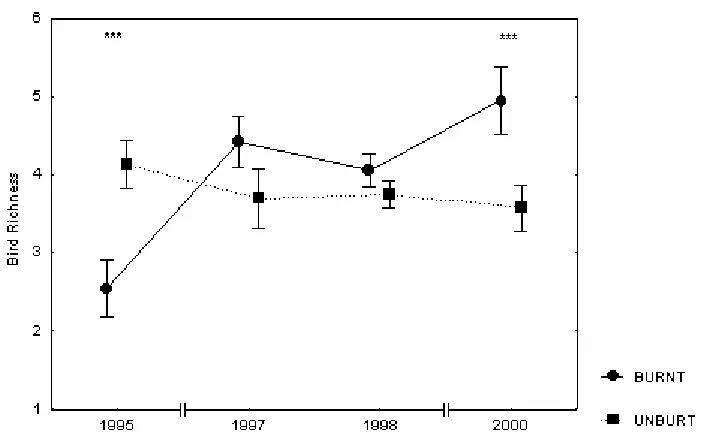
Considering the whole of the study period, bird richness did not differ between the burnt and the unburnt zones (F1,33=0.39, P=0.536). However, bird richness was not constant across years (F3,99=4.17, P<0.01). This temporal variation in bird richness was not homogenous and was greatly determined by the zone under study (F3,99=10.74,
[image:19.595.125.477.383.606.2]P<0.001). Richness was higher in the unburnt zone than in the burnt one during the first year after fire, did not differ between zones from the second to the fourth year after fire and became higher in the burnt zone in the sixth year after fire (Fig. 1).
Similarly, bird abundance did not differ between zones (F1,33=1.01, P=0.321), but it differed between years (F3,99=4.63, P<0.01) and the interaction between the zone and the year was also highly significant (F3,99=9.74, P<0.001). As for bird richness, the abundance was higher in the unburnt zone than in the burnt zone during the first year after fire but this difference disappeared from then until the sixth year after fire, when bird abundance became higher in the burnt zone (Fig. 2).
Figure 2. Variation in bird abundance after 1994 fire. Bars indicate Standard Error. According to Tukey HSD test, significant differences between zones in a year are marked *** in the top of the figure.
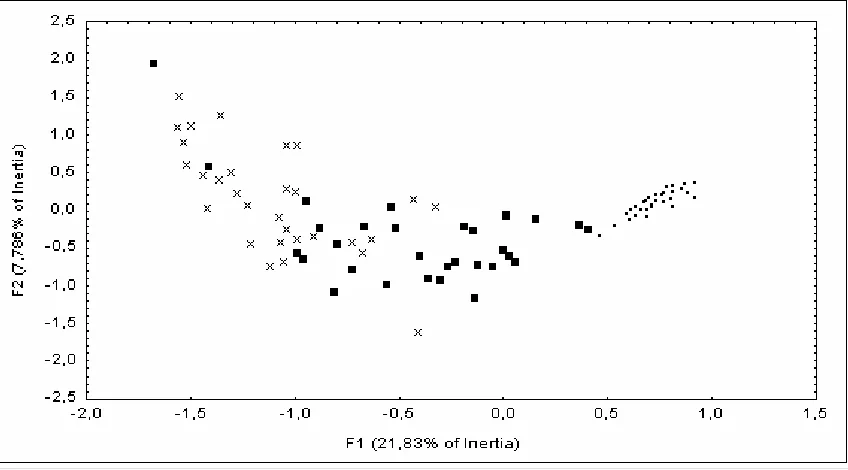
A total of 18 breeding species were found in the set of stations during the study period (Table 1). The first factor (F1) obtained with the correspondence analysis, which represented 13.4 % of total data variance, corresponded to an ecological gradient from open-space bird species (positive values) to shrubland bird species (negative values). The extreme negative values represented forest species that managed to breed in stations with a high shrub development (Table 1). Therefore, variations of F1 corresponded to the variations from communities dominated by a set of open-space species to communities dominated by a set of shrubland species. Independently on the studied year, the community composition was clearly characterised by open-space birds in the burnt stations and by shrubland species in the unburnt ones (F1,32=20.06, P=0.001) (Fig.3). However, F1 remained very stable during the studied period (five years) in both, burnt and unburnt zones, and no significant trend was found neither between years (F3,96=0.30, P=0.827) nor in the interaction between years and zone (F3,96=0.56,
Chapter 2: Post-fire bird succession in a dry Mediterranean shrubland 21
Table 1. Relative abundance of the bird species found in the two studied zones (the burnt zone / the unburnt zone), expressed as the mean number of individuals detected in a station during the 10 min. census. The score of the first factor of the correspondence analysis (F1) for each bird species is also shown.
Bird species 1995 1997 1998 2000 F1
Tawny Pipit Anthus campestris 0.05 / 0 0.21 / 0.06 0.16 / 0.13 0.21 / 0 1.51 Ortolan Bunting Emberiza hortulana 0.11 / 0.13 0.11 / 0 0.05 / 0.13 0.26 / 0 0.93 Thekla Lark Galerida theklae 0 / 0 0.11 / 0 0.11 / 0 0.16 / 0 0.88 Corn Bunting Miliaria calandra 0.21 / 0.13 0.37 / 0 0 / 0 0.26 / 0 0.78 Rock Thrush Monticola saxatilis 0.05 / 0.30 0.11 / 0.06 0 / 0.13 0.05 / 0.06 0.64 Southern Grey Shrike Lanius meridionalis 0.21 / 0.13 0.42 / 0.19 0.37 / 0.13 0.32 / 0.25 0.62 Black-eared Wheatear Oenanthe hispanica 0.74 / 0.19 1.05 / 0.31 1.05 / 0.13 0.79 / 0.12 0.56 Woodchat Shrike Lanius senator 0.26 / 0.06 0.26 / 0 0.05 / 0 0.11 / 0 0.50 Red-legged Partridge Alectoris rufa 0.47 / 0.13 0.95 / 0.31 0.53 / 0.06 0.16 / 0.13 0.40 Stonechat Saxicola torquata 0.42 / 1.06 0.53 / 0.75 1.00 / 0.50 1.21 / 0.50 0.35 Dartford Warbler Sylvia undata 0.68 / 1.94 1.32 / 2.19 2.37 / 2.00 3.11 / 1.82 -0.14 Sardinian Warbler Sylvia melanocephala 0.26 / 1.44 0.79 / 2.00 0.63 / 1.81 1.58 / 2.62 -0.37 Great Tit Parus major 0.05 / 0.44 0.11 / 0.25 0 / 0.06 0.11 / 0.25 -0.77 Rock Bunting Emberiza cia 0 / 0 0 / 0.13 0 / 0.13 0 / 0 -0.80 Blackbird Turdus merula 0.16 / 0.75 0.05 / 0.56 0.26 / 1.00 0.26 / 0.19 -1.01 Wren Troglodytes troglodytes 0 / 0.38 0 / 0.19 0 / 0.25 0 / 0.25 -1.40 Long-tailed Tit Aegithalos caudatus 0 / 0 0 / 0.44 0 / 0 0 / 0 -1.79 Nightingale Luscinia megarrhynchos0 / 0.19 0 / 0.19 0 / 0.13 0 / 0.13 -2.21
Figure 3. Variation in the gradient open-space species / shrubland species (F1) after 1994 fire. Bars indicate Standard Error. According to Tukey HSD test, significant differences between zones in a year are marked *** in the top of the figure.
DISCUSSION
humid “meso-Mediterranean” burnt shrublands (Prodon et al. 1984). Trabaud & Papió (1987), studying the post-fire vegetation recovery in the Garraf Natural Park after 82’ fire found a really slow recuperation of pre-fire vegetation. However, they reported a rapid plant growth during the first two years after fire followed by an extraordinary slowing down of the process from then on. Therefore, the rapid vegetation recovery soon after fire seemed to be enough for birds to reach, and even exceed, pre-fire abundance and richness.
Low richness and abundance in burnt areas one year after fire, compared with unburnt controls, are common in post-fire studies in the Mediterranean Basin (e.g. Prodon et al. 1987, Pons & Prodon 1996, García 1997). More unusual is that richness and abundance surpass the values observed in the unburnt control as succession continued. Nevertheless, Prodon et al. (1984) also reported higher bird richness in French burnt shrublands than in unburnt controls. As suggested by these authors, this event seems to indicate that the number of ecological niches per counting station was higher in these burnt shrublands than in neighbour unburnt ones, which may be related to a higher heterogeneity of habitat structure in burnt stations. This association between spatial heterogeneity and bird richness has been repeatedly reported (Wiens 1989). In our case, six years after fire, isolated shrubs have grown enough to form a patchily mosaic with grasses and stony grounds, which contrasts with the higher uniformity of habitat within unburnt stations. However, the spatial heterogeneity of landscapes are usually scale-dependent (Forman & Gordon 1986). In fact, we analysed the spatial variations of habitat structure and avifauna in our two study zones and found that the unburnt stations differed among them more than the burnt ones (unpubl. data). This suggests that, in a large scale (zone), the area affected by fire is more homogeneous than the unburnt, whereas in small scale (stations) the relationship is opposite.
Chapter 2: Post-fire bird succession in a dry Mediterranean shrubland 23
from neighbour sink areas. At a landscape level, the burnt zone was mostly surrounded by closed shrublands that were not suitable for open-space species, which, after fire, had to spread to the 5000-ha burnt zone. Thus, open-space species did not become abundant during the first years after fire, although they probably increased afterwards helped by local reproduction in the burnt zone.
Our findings also have interesting implications in bird diversity conservation in Mediterranean areas. In fact, 75% of bird species inhabiting the burnt zone are considered to be either decreasing or in a vulnerable situation in Europe (Tucker & Heath 1994). These bird species are all open-space species for which habitat loss might be the most relevant threat in the Mediterranean Basin (Rocamora 1997). Therefore, the permanence of proper populations of these species at least during the first six years after fire suggests that these burnt dry Mediterranean shrublands may represent appropriate habitats for their conservation. Several of these species were also present in the unburnt control (which in fact was also burnt in 1982), but their abundance was lower here than in the burnt zone, which suggests that the latter is a more suitable habitat. From a management perspective, large fire prevention practices carried out to reduce the amount of combustible using prescribed burning may contribute to maintain high quality habitats for these species. In the Mediterranean Southern France, Pons (1998) reported a colonisation of open-space species (e.g. Tawny Pipit and Woodlark) after a prescribed fire, but it was followed by a fast decrease of their densities as early as the second year after fire, when the shrub cover was regenerated enough. Our results suggest that these types of management policies could be of great interest in dry Mediterranean shrublands, where these species do not seem to decrease rapidly after fire.
In conclusion, our results suggest that the bird community succession after fire in the thermo-Mediterranean life-zone is, at least during the first years after fire, characterised by a fast increase in bird richness and abundance, but not by a clear change from communities dominated by open-space species to communities dominated by shrubland species. However, further studies are needed to complete the hypothetical progression towards a shrubland and forest species composition during following years. The interest in these long-term studies is stressed by current fire frequency and by the regional aspects of climate change. Recurrent fires may reduce the sprouting capacity of many Mediterranean plants, impede the storage of enough seeds during the pre-fire stage and degrade soils via erosion (Le Houérou 1981, Blondel & Aronson 1999). As a result, plant succession may be blocked and thus, open vegetation formations become permanent, even if fire frequency decreases. During the last decades, this phenomenon has taken a predominant role in many areas of the Iberian Mediterranean coast (Carreira & Niell 1992, Puigdefàbregas & Mendizabal 1998), and thus, the bird communities of these areas may remain dominated by open-space species. Moreover, several models of climate change are also suggesting an increase in the aridity of this area (Moreno & Oechel 1995), thus affecting the recovery of burnt vegetation and hence, indirectly, birds. However, this hypothetically dramatic framework may favour bird species that are considered as threatened, which gives an idea of the complexity of the problem from a conservation point of view.
Acknowledgements
financial support from the CAICYT (PB-96-0224). Sergi Herrando (FI fellowship) received financial support from the Comissionat per a Universitats i Recerca de la Generalitat de Catalunya.
REFERENCES
Bibby C.J., N.D. Burguess & D.A. Hill 1992. Bird Census Techniques. Cambridge University Press, Cambridge.
Blondel J. & J. Aronson 1999. Biology and wildlife of the Mediterranean region. Oxford University Press, Oxford.
Carreira J.A. & F.X. Niell 1992. Plant nutrient changes in a semi-arid Mediterranean shrubland after fire. Journal of Vegetation Science 3 (4): 457-466.
Forman R.T.T. & M. Gordon 1986. Landscape Ecology. Wiley, New York.
Fuller R.J. & D.R. Langslow 1984. Estimating numbers of birds by point counts: how long should counts last? Bird Study 31: 195-202.
García J.A. 1997. Caracterización y uso del hábitat por la avifauna en los bosques quemados de la provincia de León. PhD thesis. Universidad de León, León.
Greenacre M.J. 1984. Theory and applications of correspondence analysis. Academic Press, New York.
Helle P. & M. Mökkonen 1990. Forest succession and bird communities: theoretical aspects and practical implications. In: Keast A.(ed). Biogeography and ecology of forest bird communities: 299-318. SPB Academic Publishing, The Hague.
Lawrence G.E. 1966. Ecology of vertebrate animals in relation to chaparral fire in the Sierra Nevada foothills. Ecology 47: 278-291.
Le Houérou H.N. 1981. Impact of man and his animals. In: di Castri F., D.W. Goodall & R.L. Specht (eds). Mediterranean-type shrublands: 479-521. Collection Ecosystems of the world, Volume 11. Elsevier, Oxford.
Meffe G.K., C.R Caroll & contributors 1997. Principles of Conservation Biology. Sinauer Associates INC, Massachusetts.
Moreno J.M. & W.C. Oechel 1995. Global change and Mediterranean-type ecosystems. Spriger-Verlag, Berlin.
Pons P. & R. Prodon 1996. Short term temporal patterns in a Mediterranean shrubland bird community after fire. Acta Oecologica 17 (1): 29-41.
Pons P. 1998. Bird site tenacity after prescribed burning in a Mediterranean shrubland. In: Trabaud L. (ed). Fire Management and landscape Ecology: 261-270. International Association of Wildland Fire, Fairfield, Washington.
Prodon R., R. Fons & A.M. Peter 1984. L’impact du feu sur la vegetation, les oiseaux et les micromamifères dans diverses formations des Pyrénées-Orientales: premiers résultats. Rev. Eco. Terre Vie 39: 129-158.
Prodon R., R. Fons & F. Athias-Binche 1987. The impact of fire on animal communities in Mediterranean area. In: Trabaud L. (ed) The role of fire on ecological systems: 121-157. SPB Academic Publishing, The Hague.
Prodon R. 1992. Animal communities and vegetation dynamics: measuring and modeling animal community dynamics along forest successions. In: Teller A., P. Mathy & J.N.R. Jeffers (eds). Responses to forest ecosystems to environmental changes: 126-141. Elsevier Applied Science, London.
Prodon R. & P. Pons 1993. Postfire bird studies: methods, questions and perspectives. Fire in Mediterranean ecosystems. In: Trabaud L. & R. Prodon (eds) Ecosystems research reports 5: 332-343. Commission of the European communities, Brussels. Puigdefàbregas J. & T. Mendizabal 1998. Perspectives on desertification: Western
Chapter 2: Post-fire bird succession in a dry Mediterranean shrubland 25
Rocamora G. 1997. Mediterranean forest, shrubland and rocky habitats. In: Tucker G.M. & M.I. Evans (eds). Habitat for birds in Europe: a conservation strategy for a wider environment: 239-265. Bird Life International, Cambridge.
Sokal R.R. & F.J. Rohlf 1995. Biometry. Freeman, New York.
Stanton P.A. 1986. Comparison of avian community dynamics of burnt and unburnt coastal sage scrub. Condor 88: 285-289.
Trabaud L. & C. Papió 1987. Recuperació de les garrigues cremades de Montpellier i Garraf. In: Terrades J. (ed). Ecosistemes terrestres: la resposta als incendis i a d’altres pertorbacions, 8: 101-112. Quaderns d’Ecologia Aplicada. Diputació de Barcelona, Barcelona.
Tucker G. M. & M. F. Heath 1994. Birds in Europe. Their conservation status. Bird Conservation Series No. 3. Bird Life International, Cambridge.
Wiens J.A. 1989. The ecology of bird communities. Vol. I, II. Cambridge University Press, Cambridge.
Zabala M.A., J.M. Espelta & J. Retana 2000. Constraints and trade-offs in Mediterranean plant communities: The case of Holm oak – Aleppo pine forests. Botanical Review 66 (1): 119-149.
Factors influencing post-fire dynamics of Sardinian and Dartford
Warblers in Mediterranean shrublands
Abstract
We studied the post-fire dynamics of two Mediterranean warblers (the Sardinian (Sylvia melanocephala) and the Dartford Warbler (Sylvia undata)) to determine whether these were influenced by local habitat recovery or by external population trends unrelated to the occurrence of fire. We used the point-count method to survey warblers from the first to the sixth breeding seasons after fire in burnt and unburnt control zones of the Iberian Peninsula. Both species increased similarly in the burnt zone until the fourth year after fire, but the Dartford Warbler increased faster than the Sardinian Warbler from then on. Six years after fire, the abundance of the Dartford Warbler was even higher in the burnt zone than in the control, where the population of this species remained constant during the study period. In contrast, a parallel increase in the populations of Sardinian Warbler in both zones was observed, thus suggesting that processes other than fire were profoundly involved in the dynamics of this species in the burnt zone. Our results indicate that the post-fire dynamics of these two species greatly differ, the Dartford Warbler being highly influenced by local habitat changes in the burnt zone and the Sardinian Warbler by population trend on a larger scale than the disturbed habitat.
1
Chapter 3: Post-fire succession and influences of external population dynamics 27
INTRODUCTION
Fires are a frequent disturbance in the Mediterranean area and are known to play a key role in the spatial and temporal dynamics of forest and shrubby systems (Blondel & Aronson 1999). The study of bird succession after fire in the Mediterranean Basin has focused on species turnover and its close association with vegetation recovery (e.g. Prodon et al. 1984, Prodon et al. 1987, Pons & Prodon 1996, Izhaki & Adar 1997). Prodon and Pons (1993) pointed out the importance of simultaneously monitoring burnt and unburnt control zones to eliminate the influence of temporal variations unrelated to the occurrence of fire. Therefore, as well as changes in the local habitat, factors with an effect on a larger scale, such as fluctuations in the nearby “source" population, mortality associated with migration, changes in predation or parasitism rates, climatic oscillations and so on, may influence local bird numbers (Wiens 1989). Several studies have reported how regional population trends greatly affect local bird abundance independently of habitat modifications (e.g. Hickey & Brittingham 1991, Böhning-Gaese & Bauer 1996, Bellamy et al. 2000). However, to our knowledge, to date no study has focused on the influences of regional population trends in the post-fire succession of burnt areas.
Two Mediterranean warblers, the Sardinian Warbler (Sylvia melanocephala) and the Dartford Warbler (Sylvia undata), often coexist in Western Mediterranean shrublands, although the former prefer low matorrals, whereas the latter seems to be favoured by medium and tall ones (Cody & Walter 1976, Martin & Thibault 1996). The post-fire abundance patterns of these shrub-dwelling species is usually characterised by their absence during the first breeding season after fire and by a gradual increase in their numbers afterwards (Prodon & Lebreton 1983, Prodon et al. 1987, López & Guitian 1988, Llimona et al. 1993). Nevertheless, the temporal variations of these two warblers in burnt zones may be affected by temporal dynamics on a larger scale. Available data suggest that the population trends of these two warblers differ at a regional level. In contrast to the stability of the populations of Sardinian Warbler, the populations of Dartford Warbler have undergone a slow but progressive decrease since the 1970s in Spain (which has 75-95% of the world population of this species) (Tucker & Heath 1994). Furthermore, the current tendencies of land abandonment and progressive afforestation in European countries in the Mediterranean have been reported to affect the Dartford Warbler negatively and the Sardinian Warbler positively (Preiss et al.
1997). Therefore, these two species of the genus Sylvia are an ideal set with which to study whether post-fire dynamics are influenced by factors other than local changes in habitat after fire.
METHODS
Study areaThis study was carried out in the Garraf Natural Park (41º 15’ N, 1º 55’ E), situated 20 km to the south of the city of Barcelona, Spain (NE Iberian Peninsula). The vegetation in this park is dominated by shrubs such as Quercus coccifera, Pistacia lentiscus, Phillyrea latifolia, Olea europaea, Rosmarinus officinalis and Chamaerops humilis, and by pines (Pinus halepensis) in areas which have not been burnt recently. After a long period in which there were only some small fires, two large wildfires have profoundly marked the last two decades. The first burnt 10,000 ha in 1982 and the second, which burnt entirely within the zone previously burnt in 1982, affected 5,000 ha in 1994. The 1994 fire was intensive and the total area covered by the remnant patches of unburnt vegetation accounted for less than 2% of the 5000 ha.
We did not find significant differences in relief and landscape structure between the zone burnt in 1994 and the zone not affected by this fire (Table 1). Moreover, the lithology (Mesozoic calcareous rocks) and phytosociologic composition ( Oleo-Ceratonion with some plants of Quercion ilicis (Folch 1986)) was highly homogeneous. Therefore, we considered the zone that did not burnt in 1994 as a suitable area for controlling the variations of Sardinian and Dartford Warbler populations unrelated to the occurrence of fire. To simplify the terminology of the study sites, hereafter the two zones are called burnt zone and control zone respectively.
Table 1. Similarities in relief (altitude, slope and orientation) and landscape structure (percentage of habitat burnt in 1994 within the zone affected by that fire, and percentage of habitat burnt in 1982 within the zone only affected by that fire) between study zones. Data comes from the comparison of 30 surveys (12.5 ha) randomly distributed in each zone. Mean (SD) and t-test for independent samples are shown for parametric variables, but for orientation, a circular variable, mean angle (angular deviation) and the Watson-Williams test are shown (Zar 1984).
Burnt in 1982 and 1994
Burnt only in 1982 Test P
Altitude (m) 333 (101) 376 (104) t = - 1.62 0.111
Slope (degrees) 14.1º (8.8º) 17.0º (8.4º) t = - 1.28 0.207
Orientation (degrees) -24º (63º) -33º (72º) F1,53 = 0.12 0.265
Habitat (%) 95.6 (8.28) 95.4 (7.03) t = 1.26 0.900
Bird counting
The censuses were carried out in the burnt zone and the control zone during the breeding seasons of 1995, 1997, 1998 and 2000. We selected 35 stations (19 in the burnt zone and 16 in the control zone), which were located a minimum of 400-m apart to minimise pseudo-replication. Thus a total of 140 censuses was carried out during study period. We also ensured that the area around each station was homogeneous and did not include farmland, urbanised areas or cliffs.
Point-counts were used to assess the abundance of the Sardinian Warbler and the Dartford Warbler (Bibby et al. 1992). We conducted censuses with several counting bands to analyse the differences in detectability between the two species (Bibby et al.
Chapter 3: Post-fire succession and influences of external population dynamics 29
observer. Thus, from here onwards, abundance means number of individuals detected per counting station.
Counting was conducted in the morning, during the hours of maximum bird activity, and started 1 h after dawn and 5 min after the arrival at the station. Point-counts taken by other authors have ranged from 5 to 20 min, but following the recommendations made by Fuller and Langslow (1984), 10 min was chosen as a compromise. Whenever we were sure that we had already observed the same individual it was not included as a new record. We carried out bird censuses exclusively under uniformly good weather, without rainfall or wind.
Data analysis
We used repeated measures ANOVA and the post-hoc Tukey Honest Significant Difference (HSD) test to analyse temporal variations in the abundance of the two species throughout the study period in both the burnt and the control zones (Sokal & Rohlf 1995). All statistical analyses were run with Statistica Statsoft, Inc 1999.
RESULTS
[image:29.595.95.491.452.655.2]We found a continuous increase in overall abundance of the warblers in the burnt zone after the occurrence of fire (F3,72 = 22.83, P < 0.001), but the speed of re-colonisation differed between the two species since the interaction between time since fire and the abundance of the two species was significant (F3,72 = 4.00, P < 0.05). The results of the Tukey HSD test showed that the abundance of both species did not differ until de forth year after fire; however, the Dartford Warbler became significantly more abundant than the Sardinian Warbler from then on (Fig. 1). Therefore, the two species colonised the burnt zone at a similar speed until the fourth year after fire, when the population of the Dartford Warbler began to increase faster.
Regarding the whole study period, the overall abundance of the Dartford Warbler did not differ between the burnt and the control zone (F1,33 = 0.179, P = 0.674). Nevertheless, the abundance of this warbler increased significantly from 1995 to 2000 (F3,99 = 5.570, P < 0.01). This trend was highly influenced by the zone (F3,99 = 7.488, P < 0.001) since although the abundance of this species remained constant in the control zone, it steadily increased in the burnt zone (Fig. 2). The results of the Tukey HSD test showed that the abundance of the Dartford Warbler was significantly lower in the burnt zone than in the control zone in 1995 and 1997, did not differ in 1998 and was significantly higher in the burnt zone in 2000 (Fig 2). In summary, the temporal pattern shown by the Dartford Warbler in the burnt zone was characterised by a continuous increase in abundance, reaching even higher values than those measured in the control zone.
Figure 2. Variation in the abundance of the Dartford Warbler (measured as number of individuals detected in a station during the 10-minute census) after the 1994 fire in the two study areas. Bars indicate Standard Error. Significant differences between zones in a year, according to Tukey HSD test are marked *** at the top of the figure.