Artículo Original
Bioethical foundations application
for practice of critical care in ICU patients
Aplicación de fundamentos bioéticos
para la práctica del cuidado crítico en pacientes UCI
María Araceli García Martínez1*
Dinora Margarita Rebolledo Malpica1
Marcos Elpidio Pérez Ruiz2
Yanetzi Loimig Arteaga Yanez2
Carmen de Lourdes Condo León1
Gloria Janeth Muñiz Granoble1
1 Universidad de Guayaquil. Ecuador.
2 Universidad Metropolitana del Ecuador. Ecuador.
*Correo electrónico: [email protected]
ABSTRACT
Introduction: Most critically ill patients are not located in time, space and person, and even
some are unconscious, which makes them vulnerable to moral and ethical performance of
Objective: To describe the nursing bioethical behavior in the patient care in intensive care
unit of Guayaquil Specialty Hospital "Dr. Abel Gilbert Pontón ", Ecuador.
Methods: This was a qualitative research, of a clinical ethnography type, for which four
nurses working in intensive care unit of said hospital were selected. The information was
collected with open interviews and interpreted through a categorization process.
Results: The results show the following categories: First, that the commitment in
nurse-patient relationship when providing care in the critical units reflects a moral quality of
bioethical and humanizing care. Second, that empathy attitudes and patient acceptance as a
recipient of care recognize bioethical and humanizing values. Third, there is emotional,
social and cultural understanding of what it means to be in a critical care situation according
to patient perspective and his family.
Conclusions: It is confirmed that nursing care bioethics is a rational and critical reflection
of human values implicit in the needs satisfaction perception of critical patient, which entails
to provide care with warmth, with a disposition to understand it and to do it feel
comfortable, allowing to establish human links between patient-nurse.
Keywords: Nursing, bioethics,care, critics.
RESUMEN
Introducción: Los pacientes en estado crítico en su mayoría no están ubicados en tiempo,
espacio y persona, e incluso algunos están inconscientes, lo cual los hace vulnerables a la
actuación moral y ética de sus cuidadores.
Objetivo: Describir el comportamiento bioético de enfermería en el cuidado del paciente en
la unidad de cuidados intensivo del Hospital de Especialidades de Guayaquil “Dr. Abel Gilbert Pontón”, Ecuador.
Métodos: Se trató de una investigación con enfoque cualitativo, de tipo etnografía clínica,
para lo cual se seleccionaron cuatro enfermeras que trabajan en la unidad de cuidados
intensivos de dicho hospital. La información fue recogida con entrevistas abiertas e
interpretadas a través de un proceso de categorización.
Resultados: Los resultados muestran las siguientes categorías: Primero, que el compromiso
en la relación enfermera-paciente al momento de proporcionar atención en las unidades
actitudes de empatía y aceptación del paciente como sujeto receptor del cuidado reconocen
los valores bioéticos y humanizantes. Tercero, existe comprensión emocional, social y
cultural de lo que significa estar en una situación de cuidados críticos según la perspectiva
del paciente y su familia.
Conclusiones: Se confirma que la bioética del cuidado de enfermería es una reflexión
racional y crítica de los valores humanos implícitos en la percepción de satisfacción de las
necesidades del paciente crítico, lo cual conlleva a proporcionar un cuidado con calidez, con
disposición de comprenderlo y hacerlo sentir confortable, permitiendo establecer vínculos
humanos entre paciente-enfermera.
Palabras clave: enfermería; bioética;cuidados; críticos.
Recibido: 30/4/2019
Aprobado: 31/5/2019
INTRODUCTION
The critical care units are characterized as being environments prepared to patients care who
have a death potential risk.(1) Under this approach, organizational support must be complex,
requiring technological and human resources trained to meet the care demands for patients
and their families.(2,3,4,5) However, the Intensive Care Unit (ICU) of "Dr. Abel Gilbert
Pontoon "in Guayaquil, has limitations in the human talent endowment, especially nursing
staff, which affects in one way or another the care quality provided to patient.
In this context, nursing constantly seeks conditions to maintain and improve to service
ethics code,(6,7) that is, the ethical conscience reinforcing is a professional obligation.
However, this staff complains of fatigue, stress and is even accused of a disinterested
practice and poor understanding of the patient's vulnerability. In that sense, the ICU patient
is characterized by being dependent on nursing care, that is, it requires 24 hours of attention
to achieve their health needs; in such a way that the care of these critical patients becomes
the existence central axis of critical care units. For the professionals of these units, care is
considered beyond biologic care, to become a reflection on the protecting action or helping
the other in a meaningful way in nurse-patient therapeutic relationship.(8,9)
Under this approach, we cite Sandman, Molander, & Benkel(10) who see reflection as a
nursing care basis, linked to bioethical postulates; that is to say, of the theoretical abstraction
that implies a morally acceptable behavior. In the critical patient, their ability to express
their thoughts, feelings and, of course, the suffering due to their health state is diminished.
However, the bioethical care of nursing in these patients allows to integrity recognize of
human response to pathological processes that they live, as well as the interrelation of this
with their physical environment. In this sense, nursing reflects its performance in a way that
seeks to provide a humanized care that reflects a bioethical conduct, guaranteeing the
satisfaction of critical patient from an integral and holistic perspective.(11)
The foregoing can be corroborated with the Cantos(12) proposals on bioethical care, the
person integral care, the family, the community and their environment, helping to maximum
develop the individual and collective potentials that allow to state optimal health safeguard
in all life stages. In this sense, Nursing experiences in its daily life the phenomenon of
overcoming its limitations and work stress, above the bioethical care of the critical patient.
In the case of the Abel Gilbert Pontón Hospital, nurses refer to a preliminary diagnosis that
their performance is generally based on medication administration and biologic care based
only on the pathological, leaving out the biopsychosocial relationship, which implies
unsatisfactory care and deficient bioethics.(13)
As stated by Rosero; Ibarra; Silver; Mena, & González,(14) as well as Collado Quezada, &
Parra,(15) the vulnerability degree of health personnel facing the conditions of hospital
environment is high, facing technological, physical and human environments of complex
and vulnerable management , which has a direct impact on ethically satisfactory care.
a rationality based on care, it takes an effort in bioethical care not to get lost in technological
environment and away from a humanized care.(16) Under this approach, the study nurses
allude that limitations situation and work stress is given by the work overload that
complexity generates of a critical patient, and a hospital environment, coupled with a
marked shortage of nursing personnel. This situation demonstrates the organizational
support lack to manage ethical problems in a consistent manner.(17)
Given the above, and as a preliminary step to design solutions, the research purpose is
describe of nursing bioethical behavior in patient care for intensive care unit of Guayaquil
Specialty Hospital of "Dr. Abel Gilbert Pontoon. "
METHODS
The study uses a qualitative approach, under the localized clinical ethnography
methodology.(18) The paradigmatic approach is interpretive and hermeneutic, trying to give
meaning to experiences lived by the nurses themselves to daily life within the studied ICU,
without losing the hermeneutical perspective. In this sense, it was a study in the critical care
unit, paying attention to bioethical behavior in nursing for patient care, in such a way that it
is considered a clinical ethnography.
The key informants of this study are 4 nurses working in the Critical Care Unit of Abel
Gilbert Pontón Hospital, with more than 3 years of experience who expressed their interest
in study participating, providing all the necessary ethical considerations. Key informants are
people who can provide information about the study element. In the present research a data
saturation was achieved as the findings are interpreted, reaching the fulfillment of study
objectives. The data collection was carried out after an extensive explanation to the study
subjects about the ethical considerations, especially the informed consent.
The technique used in this research was the open interview, focused on research objectives,
allowing direct interaction with the research subject, and therefore knowing the experiences
as they are lived by informants as established by Morse.(19) The interviews were conducted
individually to four Nurses of the Critical Care Unit, with prior agreement of time and place,
and analyze the results obtained. The chronology used in data collection, was based on a
first time to conduct a ICU survey in the Hospital studied, conducted by a doorman, who
also works in the critical care unit under study, voluntarily accessing being part of the
investigation and contacting the other informants, the interviews were conducted within a 4
months period, according to available time of nurses in their hospital daily life.
The authors of the present study consider the credibility criterion to determine the truth
value of data collected as established by Taylor, & Bogdan,(20) to confirm the findings and
review some particular data. The researchers reevaluated the informants during the
information collection. In this sense, most of informants were able to errors correct of facts
interpretation, and for that they took care to give more examples that help to researchers
interpretations clarify.
RESULTS
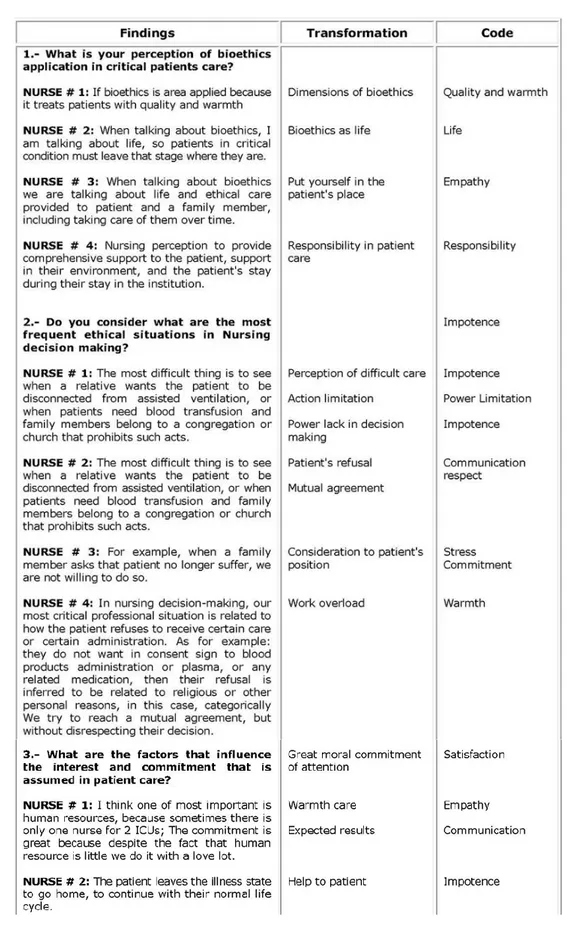
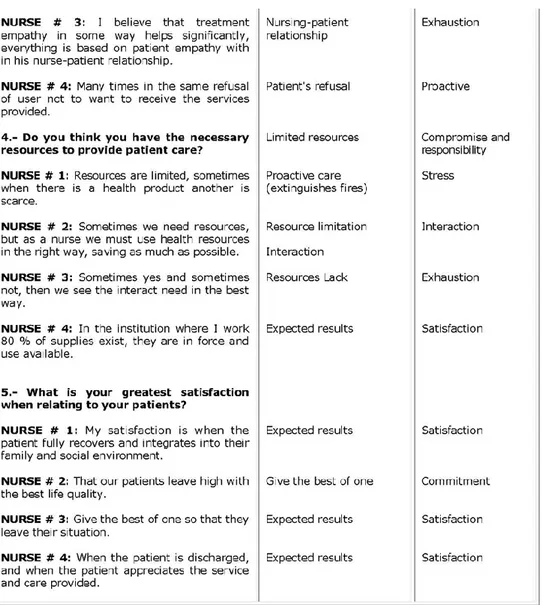
Table 1 represents Phase 1 of the findings organization, which consists in data meanings
assignment and transformation into categories. In Phase 2 (Table 2) the data process
DISCUSSION
The discussion was made based on 3 relevant categories during the analysis phase, which
are presented below:
The commitment and attitude in the Nurse-Patient relationship when providing care
in critical units that reflect a moral quality of bioethical and humanistic care.
The moral quality in Nursing care from a bioethical and humanizing perspective, is
understood as the commitment and attitude in Nurse-Patient relationship at the moment of
providing care to critical patients; this relationship has a bioethical and humanistic
perception. Under this approach, we bring up the results obtained in the interview with
informants, who say that "nursing care expresses life, with warmth and quality" referring to
welcome feeling and comfort that occurs in nurse care to patient. This sensation is
interpreted according to their own perception of warmth and quality, evidencing themselves
when they express that "care is life" with moral qualities of bioethics and humanization.
The aforementioned can be corroborated with what the literature expresses "... the warmth is
implicit in the patient's satisfaction, focused on treatment that is provided, willingness to
listen to him, understand him and make him feel attended and comfortable".(21,22)
On the other hand, quality is understood as the patients' expectations scope; Although in this
study it is a critical patient, who may be unconscious, the nurses assure that they must
satisfy the quality care expectations to patient and see it reflected in their prompt
recovery.(23)
The bioethical and humanizing perspectives of care are based on a moral quality, since they
allow to establish a link with the patient person to person, strengthening the human
integrating potentials, present in both the nurse and patient, impregnated with a series of
moral and bioethical values that lead to satisfaction of the care need.(24,25,26) This moral
quality of care is behavior evidenced of study nurses. There is interest in showing care that
can be perceived as comfortable, pleasurable and protective, that is, translated into warm
principles and patient safety, understood as protectors of critical patient's life and based on
bioethical and humanistic principles.
In relation to commitment moral quality, it was indicated that "the commitment is great
because despite the fact that human resources are little we do it with a love lot." The moral
and ethical agreement of patient care can be observed, since nurses feel responsible
(according to their conscience and human condition) to patient consider as a vulnerable
being that needs understanding and care with quality and warmth.
For the nurses studied, the patient in a vulnerable and unconscious state is as important as
any other patient, indicating an ethical point that provides care with justice and autonomy.
The foregoing, corroborated with the statement by Waldow(27) "Nursing is a profession that
has the privilege of being together with the patient, offering comfort, not only physical, but
emotional, regardless of their condition."
Regarding communication and interaction, expressed by subjects "one is going to treat it in
some way to help them, that is, everything is based on patient empathy, in nurse-patient
relationship". This is confirmed by Muñoz(28) when he states that "... Nursing is a profession
based on relationship between the nurse and the person who requires their care". However,
this nurse-user relationship is decisive in quality terms and satisfaction of care provided, and
in turn in person well-being, with the help relationship being an accompaniment that goes
beyond the biological, through of empathy and dialogue. The help relationship is expressed
is not only an intervention in Nursing, but it is the essence of this, from which the rest of
care is initiated.
The study nurses reflect in the expression indicated that communication is valuable in
critical patient care, taking into account that even without being conscious, the patient
establishes levels of communication and interaction that allow to provide a satisfactory care.
The study nurses consider that patient's responses to care, such as vital signs alteration,
stimuli responses, treatment and others, are a form of communication and interaction that
must be taken into account with a bioethical and humanizing perspective.
Nursing care includes effective communication involving a nurse-patient interaction"(29)
Care as a moral value represents the nursing ideal to maintain respect for dignity of the
starting point, a posture, an attitude that has to become: desire, an intention, a commitment,
and a conscious judgment that manifests itself in acts concrete. As an interpersonal
relationship, care favors the meaningful interaction between the person being cared for and
the caretaker, in which knowledge and feelings are incorporated, together with the skills,
and safety in the technical procedures execution.
Attitudes of empathy and acceptance of patient as a care recipient that recognizes
bioethical and humanistic values.
A humanized accompaniment of critical condition patient is reflected by the empathy
attitudes, the patient acceptance as subject receiving the care, and the nurse's reflection on
the humanistic and bioethical values of a therapeutic relationship in an unconscious patient.
The empathy identified as the a code result was considered as humanistic competence par
excellence of nursing care. The caring experience is based in need identification of the other,
nursing being a discipline based on empathy to ensure satisfactory care. In this line Watson,
& Smith,(30) define care as the moral idea in the profession, ensuring that caring is not a
procedure or an action, it is a process of shared feelings between nurse-patient.
The values and care practical aspects take into account the patient human nature, the critical
patient is not in all their cognitive capacities, being more vulnerable in unfamiliar
surroundings such as the ICU, considering the patient as a person with limited behaviors.
The study nurses assure that sometimes decisions must be made about the progress and
patient care, even if it is with a negative prognosis, consulting the relatives who sometimes
are not in a position to decide. However, nursing assumes a consideration role and respect in
decision making.(31)
As the nurses of study show, "Their refusal is seen for different religious reasons or they can
be of any personal nature, and we emphatically try to reach a mutual agreement, but without
disrespecting their decision". In this sense, the role of relative related to patient helps in the
decision.
The moral behavior that nurse reflects in care perception is the training received result,
being responsible for providing comprehensive care to vulnerable subject. Jover, & col(32)
produce security feelings, tranquility, feeling person allowing the patient a close and trusting
relationship with the nurse who performs individualized care ". The study nurses assure that
they are responsible for bioethical and humanistic care of critical patient and show that the
care quality is a moral commitment as caregivers. Responsibility for care is valued as
awareness of caring consequences for a critical patient.
The responsibility expressed by nurses investigated was related to recognition as a bioethical
and humanistic value in critical care. Care is related to an intersubjective relationship, the
nurse abstracts from personal reality, making a self-perception to objectify their needs. From
this interaction are derived qualitative actions based on love, respect for person dignity.
"Nursing builds its own action culture based on their daily life",(29) this is how the study
nurses show "the daily support to patient in their environment during their stay is our
responsibility until their last stay at the Institution", evidenced the support for integral care
and its environment.
Emotional, social and cultural understanding of what it means to be in a critical care
situation according to patient perspective and his family.
In the approach of globalization and technification, nursing is no exception. Without a
human understanding of care, this technological advancement could lead to a biologicist
reductionism of nursing care.
The critical units care allows maintaining the patient life support in conditions of death risk.
However, care goes beyond life support. This care includes the emotional, social and
cultural understanding that for patient and their family means being in a critical care
situation. The human nature of nursing leads its professionals to be aware of need to
understand a critical situation, expressing the study participants that "the most difficult thing
is to see when a family member wants the patient to be disconnected from assisted
ventilation", interpreted as a painful decision.
In this sense, the nurse lives the experience of accepting that care can be seen as fatal, that
does not cover the family members expectations of a healing, this feeling of impotence
present before care has bioethical implications, both the patient and his family, expressing
Likewise, the subjects investigated expressed that "making a critical decision in nursing is
related when there is a patient's refusal to receive certain care.
FINAL CONSIDERATIONS
It is possible to bioethical behaviors describe of ICU nurses in the critical patient care,
obtaining as a result that the commitment and attitude in nurse-patient relationship when
providing care in critical units reflect a moral quality of care bioethical and humanist. The
care bioethics is based on moral quality that allows establishing human links between
patient-nurse.
In relation to objective, it is concluded that the care takes into account the human nature of
nurse-patient relationship; evidencing the meaning of respect and responsibility in critical
patient care. However, the results show different feelings or divergent behavioral reactions
such as face impotence of reality experienced in the ICU, where on occasions it does not
achieve the goals of satisfactory care, due to implications of hospital's administrative
management, both the material as in human talent.
On the other hand, the critical patient bioethical care of the Abel Gilbert Pontón Hospital: is
a response to relationship between the nurse-patient in a situation of critical patient
vulnerability, demonstrating that nursing has been incorporating into their daily practice the
reflection on the caring action, taking into account the patient rights, based on an effort
considered superhuman; that is, beyond the personality limits in nurse, emphasizing the
bioethical and moral principles that humanize nursing care.
REFERENCES
1. Camelo SH. Competencias profesionales de los enfermeros para trabajar en Unidades de
Cuidados Intensivos: una revisión integradora. Revista latino-americana de enfermagem.
2. Robles RE, Serrano HB, Serrano GL, Gaibor FM, Armijo GM, Fernández A, et al. Retos
de la planificación estratégica en instituciones de salud. Revista Cubana de Investigaciones
Biomédicas. 2017;36(3):1-7.
3. Fernández A, Calero S, Parra H, Fernández RR. Corporate social responsibility and the
transformation of the productive matrix for ecuador sustainability. Journal of Security &
Sustainability Issues. 2017;6(4):575-84.
4. Obregón TC, Lorenzo AF, Rodríguez AM, Morales SC. Habilidades profesionales de
intervención clínica según modos de actuación de estudiantes de tercer año de
Estomatología. Revista Cubana de Educación Médica Superior. 2017;31(1):153-65.
5. Terán GJ, Montenegro BL, García VJ, Realpe IA, Villarreal FJ, Fernández A, et al.
Diagnóstico de las variables del comportamiento organizacional en farmacias de Sangolquí,
Ecuador. Revista Cubana de Investigaciones Biomédicas. 2017;36(1):1-8.
6. Milliken A, Grace P. Nurse ethical awareness: Understanding the nature of everyday
practice. Nursing ethics. 2017;24(5):517-24.
7. Espinosa Aguilar A, Lamadrid G, del Pilar M, Oria Saavedra M. El desempeño de los
profesionales de Enfermería. Revista Cubana de Enfermería. 2016;32(1):87-97.
8. García-Rueda N, Errasti-Ibarrondo B, Solabarrieta MA. La relación enfermera-paciente
con enfermedad avanzada y terminal: revisión bibliográfica y análisis conceptual. Medicina
Paliativa. 2016;23(3):141-52.
9. Elers Mastrapa Y, Lamadrid G, del Pilar M. Relación enfermera-paciente una perspectiva
desde las teorías de las relaciones interpersonales. Revista cubana de enfermería.
2016;32(4):126-36.
10. Sandman L, Molander U, Benkel I. Developing organisational ethics in palliative care: A
three-level approach. Nursing ethics. 2017;24(2):138-50.
11. Veatch RM. The basics of bioethics. 3rd ed. New York: Routledge; 2016.
12. Cantos M. Enfermería y Bioética. 2018 [cited 3 May 2018]. Available from:
13. da Ponte Portela AD, de Castro Olimpio M, Vasconcelos Ponte MA, dos Santos FD,
Gomes de Paiva AF, Carvalho de Sousa VE, et al. Nurses' perceptions of patient safety in
the emergency setting: a qualitative study. Cultura de los Cuidados. 2017;21(49):25-34.
14. Rosero EV, Ibarra RC, Plata DM, Mena Y, González ER. Percepción de las condiciones
de seguridad de pacientes con enfermedad crónica sobre el entorno hospitalario en
Colombia. Aquichan. 2017;17(1):53-69.
15. Quezada CA, Parra SC. Reflexiones sobre enfermería desde la biopolítica: relaciones de
poder y cuidado. Cultura de los Cuidados. 2017;47:22-7.
16. Rodríguez BE. Humanismo y tecnología en los cuidados de enfermería desde la
perspectiva docente. Enfermería clínica. 2003;13(3):164-70.
17. Andersson Marchesoni M, Axelsson K, Fältholm Y, Lindberg I. Technologies in older
people’s care: Values related to a caring rationality. Nursing Ethics. 2017;24(2):125-37.
18. Malpica DM. Enfermería según la perspectiva deconstructivista de Derrida. Revista de la
Facultad de Medicina. 2019;67(1):91-6.
19. Morse JM. Asuntos críticos en los métodos de investigación cualitativa. Alicante:
Publicaciones de la Universidad de Alicante; 2005.
20. Taylor SJ, Bogdan R. Introducción a los métodos cualitativos de investigación
Barcelona: Paidós; 1987.
21. Castelo Rivas WP, Castelo Rivas AF, Rodríguez Díaz JL. Satisfacción de pacientes con
atención médica en emergencias. Revista Cubana de Enfermería. 2016;32(3):1-6.
22. Moreno-Monsivais M, Moreno-Rodríguez C, Interial-Guzmán M. Omisión en atención
de enfermería para pacientes hospitalizados. Aquichan. 2015;15(3):329-38.
23. Romero-García M, de la Cueva-Ariza L, Jover-Sancho C, Delgado-Hito P,
Acosta-Mejuto B, Sola-Ribo M, et al. La percepción del paciente crítico sobre los cuidados
enfermeros: una aproximación al concepto de satisfacción. Enfermería intensiva.
24. Pineda Pérez EJ. Bioética: necesidad de su aplicación en la atención a niños con
Síndrome de Down. Revista Cubana de Medicina General Integral. 2016;32(3):1-9.
25. Acosta Sariego JR, Hernández Borrero TR. La cuestión bioética en el contexto de la
Revista Habanera de Ciencias Médicas, 2002-2016. Revista Habanera de Ciencias Médicas.
2017;16(1):106-22.
26. Betancourt GD, Castillo JA, Reyes GL. La adecuación del esfuerzo terapéutico en la
Atención Primaria de Salud. Revista Cubana de Medicina General Integral. 2018;34(2):1-14.
27. Waldow VR. Cuidado humano: la vulnerabilidad del ser enfermo y su dimensión de
trascendencia. Index de Enfermería. 2014;23(4):234-8.
28. Muñoz Devesa A, Morales Moreno I, Bermejo Higuera JC, Galán González Serna J. La
Enfermería y los cuidados del sufrimiento espiritual. Index de Enfermería. 2014;23(3):153-6.
29. Ramírez P, Müggenburg C. Relaciones personales entre la enfermera y el paciente.
Enfermería universitaria. 2015;12(3):134-43.
30. Watson J, Smith MC. Caring science and the science of unitary human beings: a
trans‐theoretical discourse for nursing knowledge development. Journal of advanced
nursing. 2002;37(5):452-61.
31. Barrio IM, Simón P, Pascau MJ. El papel de la enfermera en la planificación anticipada
de las decisiones: más allá de las instrucciones previas o voluntades anticipadas. Enfermería
clínica. 2004;14(4):235-41.
32. Jover-Sancho C, Romero-García M, Delgado-Hito P, de la Cueva-Ariza L, Solà-Solé N,
Acosta-Mejuto B, et al. Percepción de las enfermeras de UCI en relación al cuidado
satisfactorio: convergencias y divergencias con la percepción del paciente crítico.
Enfermería Intensiva. 2015;26(1):3-14.
Interest declaration