Inter and intrapatient evolution of hepatitis C virus
Federico A. Di Lello, Andrés C. A. Culasso, Rodolfo H. Campos
Cátedra de Virología, Facultad de Farmacia y Bioquímica,
Universidad de Buenos Aires, Ciudad Autónoma de Buenos Aires, Argentina. Consejo Nacional de Investigaciones Científicas y Técnicas CONICET.
ABSTRACT
Hepatitis C virus (HCV) has a short replication time, high mutation rates and large population sizes, all of which make it an excellent experimental model for evolution studies, because evolution can be visualized in real-time. In this review, we discuss the implications to study HCV evolution at the interpatient and in-trapatient levels of infection. The HCV interpatient dynamics is relatively slow, because the generation time is generally long. Then, at population level, the HCV diversity originated by the high mutation and replication rates is modulated by the bottleneck at transmission. Thus, when the virus is transmitted to other hosts, viral diversity is reduced as a result of the founder effect. On the other hand, during intrap-atient infection, HCV evolves rapidly, resulting in quasispecies. Accumulated evidence suggests that this quasispecies composition of the HCV population within the same individual may allow the virus to evade the immune response or escape treatment, leading to chronic infection. Thus, a better understanding of the complexities underlying the molecular evolution of HCV in natural populations is needed before accu-rate predictions of viral evolution can be made. In summary, HCV evolves both within and among patients. Consequently, HCV evolution should be studied at both levels in order to better understand the natural history of the virus and its potential implications in epidemiology, outcome of infection and progression of liver disease.
Key words. HCV. Quasispecies. Liver disease.
Correspondence and reprint request: Federico A. Di Lello, Ph.D.
Cátedra de Virología, Facultad de Farmacia y Bioquímica, Universidad de Buenos Aires. Junín 954, 4th floor. (1113) Ciudad Autónoma de Buenos Aires, Argentina.
Tel.: +54 11 4964 8200 E-mail: [email protected]
Manuscript received: September 29, 2014. Manuscript accepted: December 10, 2014.
INTRODUCTION
Hepatitis C Virus (HCV) is an enveloped
single-stranded positive RNA virus
1that currently infects
approximately 3% of the world’s population.
2In
about 80% of infections, HCV causes a silent
chron-ic hepatchron-ic illness that can lead to fibrosis, cirrhosis
and hepatocellular carcinoma.
3This RNA virus
dis-plays high genetic diversity. Seven genetic clades
and various subtypes have been described and are
associated either with a specific geographic
distribu-tion or with different biological features.
4-8HCV
evolves very rapidly during the progress of
infec-tion, resulting in genetically diverse viral
popula-tions whose composition is determined by a
combination of evolutionary processes that include
a short generation time, high mutation rates, large
population sizes, natural selection and random
ge-netic drift. All these mechanisms allow adaptation of
viruses to selective pressures and make HCV an
ex-cellent experimental model where evolution can be
monitored in real-time.
9,10The evolution of HCV is
mostly determined by its own characteristics and by
host-mediated or antiviral selection pressures.
11-17Nevertheless, despite their apparent simplicity and
advantages, viral populations exhibit features that
make their evolutionary dynamics extremely
com-plex to evaluate.
11,12Firstly, in nature, HCV exists
in an intricate hierarchy of populations, from single
infected cells to global pandemics. Secondly, the
long infectious periods, which are in the order of
years, mean that both inter- and intrapatient
evolu-tionary patterns can be observed. Additionally, HCV
also exists within its hosts as a dynamic pool of
ge-netically distinct but closely related variants
re-ferred to as “quasispecies”.
11,12Accordingly, HCV
among the different regions of the genome. Then, its
fast adaptation allows this virus to prevail over
nat-ural or artificial barriers such as host defenses,
pa-thogeny and drug therapy.
13-17As mentioned above, regardless of their rapid
growth, HCV virus populations suffer repeated
bot-tlenecks, both within hosts and when transmitted
from host to host. The population bottleneck can be
defined as a marked reduction in the number of
viral genomes within a population which leads to
significant effects. Particularly, intrapatient
evolu-tionary effects of bottlenecks can be observed by
comparing sequences of quasispecies that represent
different virions from a single chronically infected
patient over several years.
18,19On the other hand, in
interpatient evolution, the size of the viral
popula-tion replicating is a very informative point to
con-sider. Additionally, when the virus is transmitted,
selection can act deeply in large populations,
where-as the random effect of genetic drift is more severe
in small populations.
Thus, one of the largest distinctions between
these two levels is that interpatient evolution is
mostly conducted by numerous bottlenecks arising
from transmission events, whereas in intrapatient
evolution the bottlenecks are not very relevant while
the patient is not treated.
20The two patterns
out-lined above suggest that different evolutionary and
population genetic processes should be inferred from
inter- and intrapatient sequence data. For all these
reasons, understanding HCV evolution is important
itself but also in view of the fact that viral diversity
could be relevant in the outcome of the infection and
liver disease progression.
7,8,21-23INTERPATIENT EVOLUTION
As it happened with HIV, HCV may have been
transmitted to humans through interspecific
infec-tions that were only possible with the demographic
changes that occurred 50-100 years ago. The fact
that HCV is transmitted mainly through parenteral
routes implicates the transmission through
unsteri-lized needles, blood transfusion and injecting drug
use (IDU). The current HCV screening and the
ex-pansion of needle exchange programs have led to
re-ductions in blood transfusion risk and significant
falls in HCV incidence among IDUs.
24For this
rea-son, the HCV interpatient dynamics is relatively
slow, since the time between transmission events is
generally long (months or years).
25Then, at
popula-tion level, the HCV diversity originated with high
viral mutation and replication rates is modulated by
the bottleneck at transmission.
26Each new host
rep-resents a novel environment for the virus. Such
ex-treme genetic bottleneck associated with
transmission may largely depend on the structure of
the virus population in the donor host, the virus
genotype, the host factors, and the rapid and radical
decline in population size that normally reduces the
population’s genetic diversity. Accordingly,
bottle-neck could be enhanced by the influence of host
fac-tors such as the favorable IL28B genotype
rs12979860 (CC) that was associated with the
spon-taneous clearance (SC) of HCV in several
stud-ies.
27,28Additionally, the HCV non-1 genotypes have
also been related with SC increasing the importance
of HCV diversity in the persistence and pathogeny of
this virus.
29On the other hand, if the structure of virus
popu-lation is genetically heterogeneous, transmission
bottlenecks could be determined partially by the
ge-netic diversity available in the host. Therefore,
among-virus competition after transmission
typical-ly generates a strong population bottleneck, making
it very unlikely that multiple viral lineages will be
repeatedly transmitted.
30-32Consequently, the
phylo-genetic structure of HCV at the population level
re-flects the demographic and spatial history of
transmission.
26In this context, it is known that
HCV phylogenetic trees often span several decades
so the time when two viral lineages coalesce is close
(relative to the timescale of the phylogeny) to the
actual transmission times. Accordingly, interpatient
phylogenies of HCV sampled through time are not
stepwise and show the persistence of multiple
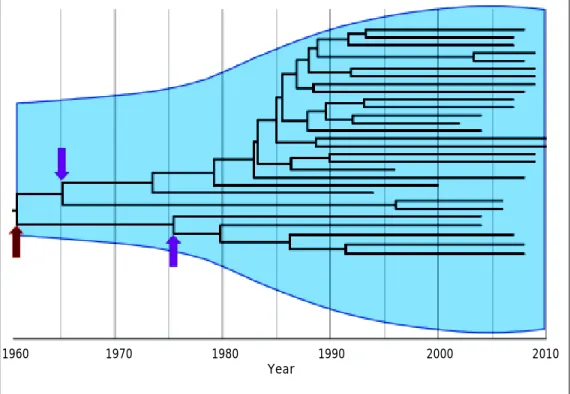
line-ages through time (Figure 1). The shapes of these
trees are primarily determined by neutral
demo-graphic and spatial dynamics in both
immune-medi-ated positive selection and purifying selection for
replication ability.
26-33In this way, the evolutionary
analysis has shed light on the origins of HCV and
on the epidemic spread of viral variants in different
geographic locations and populations.
Additionally, HCV diversity has also implications
for the transmission. It is known that genotype
dis-tribution is associated with the mode of
transmis-sion, with subtypes 1a, 3a and 4 being mostly
IDU-related and genotypes 1b and 2 associated with
blood transfusion and unsafe medical procedures.
34-36Currently, this distribution is changing due to the
difficult-to-treat genotype in HCV-monoinfected and HIV/HCV
coinfected patients, because the rate of sustained
vi-rological response to pegylated interferon plus
riba-virin is poorer than that for HCV genotypes 2 or
3.
8,40-43Then, this issue is of importance since the
HCV genotype and subtype are also very relevant in
terms of antiviral therapy.
INTRAPATIENT EVOLUTION
HCV is among the most successful of all
persist-ent human viruses. Chronic infection is seen in up
to 75% of those infected by successfully undermining
virus-specific immunity.
44Previous studies suggest
that HCV alters the host defense and innate
immu-nity early during infection through a variety of
com-plementary mechanisms, thereby facilitating chronic
infection and leaving host defenses to other
infec-tious agents intact.
45The mechanism responsible
for the high rate of persistence is attributed to the
efficient capacity of generation and fixation of
es-cape mutants associated to HLA in the non
struc-tural protein of HCV, which allows the virus to
evade the adaptive and innate components of the
host’s immune system.
46Additionally, HCV capacity
of persistence is strongly influenced by the age and
the nature of the host’s innate and adaptive
antivi-ral immunity. In this sense, seveantivi-ral studies had
shown that IL28B, CXCL10, IFNL3, HLA class I
and II are associated with outcome of HCV and may
explain an important percentage of spontaneous
clearance of HCV infection.
47-53The
misincorpora-tion of nucleotides during HCV replicamisincorpora-tion and the
subsequent effects of selection pressure, from either
neutralizing antibodies or cytotoxic T lymphocytes,
as well as the drift that fix substitutions in
popula-tions, represent the fundamental driving force in
in-trapatient evolution.
21,54,55As a consequence, HCV
evolves very rapidly during intrapatient infection,
resulting in variants whose dynamic composition is
determined by a combination of evolutionary
proc-esses that include mutation, replication rate, natural
selection, and random genetic drift at transmission
time. In this sense, accumulated evidence suggests
Figure 1. Interpatient evolution of HCV in a country. Maximum Clade Credibility Tree constructed by Bayesian coalescent methodology from direct sequences of the first half of the E2 region in plasma samples from HCV genotype 1a isolations in Ar-gentina. The tree is presented in time scale (calendar years). The overall process is depicted by the diversification of the current lineages from the 60’s to the 80’s independently of the actual time of sampling. The arrows indicate possible bottleneck effects. The dark red one indicates the possible introduction of HCV in the community, whereas the magenta ones may indicate the acqui-sition of the virus by different routes of transmission. Virtually, every transmission event is thought to be a bottleneck effect for virus diversity. The light blue shaded area represents the viral genetic diversity trough the time measured by the Bayesian Sky-line methodology.65
1960 1970 1980 1990 2000 2010
that the genetic variation of HCV within the same
individual may allow the virus to evade the immune
response, leading to chronic infection.
19Virtually in
a patient infected with HCV, it is likely that all
pos-sible variants are present in the quasispecies at
eve-ry moment. However, the point is to determine
which the threshold of variant frequency for
estab-lishing a particular phenotype is, either a variant
resistant to treatment or a variant causing more
se-vere liver damage. Thus, a rapid emergence of
re-sistant variants was detected in the majority of
patients with treatment failure to direct-acting
anti-viral (DAA).
56-59However, this is not an unexpected
finding. Naturally, HCV can produce approximately
10
12virus particles per day.
60Furthermore, the viral
replication complex lacks proofreading capacity,
leading to a large number of mutants. As a result,
the virus population is a highly complex and
contin-uously changing mutant spectrum or mutant cloud
known as quasispecies.
61These are the lowest level
of viral heterogeneity variation with only 1 to 2%
and, thus, the major challenge with regard to
resist-ance to treatment.
61Despite the fact that, in theory,
an active HCV infection can produce all possible
mu-tants in just one day, not all are able to persist in
the population. This is because, in the viral genome,
there are constraints with restrictions to change
since most mutations generate viral variants that
have a reduced replicative ability and, therefore, do
not proliferate. However, this will surely be
differ-ent for each patidiffer-ent because of the multiplicity of
factors involved in each process related to viral
in-fection.
Phylogenetic analyses of intrapatient evolution
reconstructed from HCV genomes sampled from
mul-tiple time points have mostly revealed two or more
genetically distinct co-existing viral lineages that
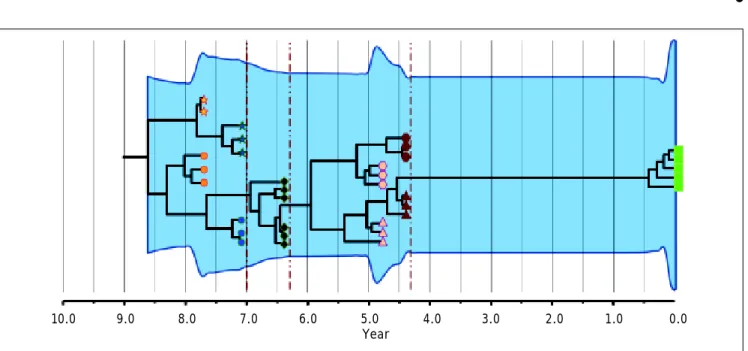
are not detected at all sampling times (Figure 2).
This phenomenon is seen in both acute
62and
chron-ic infection.
17,63-65Then, the intrapatient tree
topolo-gy is manifested by a temporal structure that shows
continual adaptation to the patient immune
re-sponses and by high rates of lineage extinction
which result in a modest genetic diversity at any
time point. This suggests that the succeeding viral
population is not always immediately derived from
the preceding population and sometimes would
be the effect of evolutionary shift. Briefly, regardless of
the complexity or diversity of the viral populations
at the early stage of infection, HCV evolves towards
genetic diversification following selective pressure.
Once the environment becomes stable, the entire
population tends towards homogeneity.
18Then,
HCV intrapatient evolution, which may be driven by
Figure 2. Intrapatient evolution of HCV in an 8-year follow up. Maximum Clade Credibility Tree constructed by Bayesian coa-lescent methodology from cloned sequences of the first half of the E2 region in serially obtained plasma samples from a single patient. The tree is presented in time scale (years before present). Each symbol (star, circle, diamond, hexagon, triangle and square) represents different viral lineages. The colors indicate, as the axis position does, the time of the sampling. The vertical dark red dotted lines represent bottleneck events where one of the lineages (shapes) got extinct. The overall process is depict-ed by the modification or extinction of existing lineages (quasispecies shift). The light blue shaddepict-ed area represents the viral ge-netic diversity trough the time measured by the Bayesian Skyline methodology.65
adaptive selection, becomes important from a
clini-cal perspective because it contributes to the
variabil-ity in disease progression and development of drug
resistance. In this sense, pathobiological studies
linking nucleotide and amino acid sequences with
clinical findings have identified relationships
be-tween certain genotypes and characteristic
biologi-cal properties.
23For example, HCV-3 infection was
found to be associated with a high level of liver
stea-tosis.
66At quasispecies level it has been reported
that an increase in HVR1 diversity during acute
in-fection predicts progression to chronic disease,
whereas a decrease correlates with resolution of the
disease.
21On the other hand, it has been extensively
de-scribed the effect of genetic variability between HCV
genotypes and subtypes on response to therapy.
HCV-1 and 4 were found to be more resistant to
in-terferon based therapies than HCV-2 and 3 and,
in the same way, 1b respond better than
HCV-1a.
67,68However, there is contradictory data about
the influence of quasispecies on treatment
re-sponse.
69-72Some reports have demonstrated that
resistant mutants are present in DAA naïve-patients
as either dominant or minority species.
56,73When
treated with DAA, resistant variants, initially
present as minority species, may expand to occupy
the free replicative space, thus becoming the
domi-nant variant.
72,74Consequently, this may lead to
failure of antiviral regimen. In this context, it has
been reported that mutations need to be present at a
certain frequency to result in a measurable
pheno-typic effect.
75,76However, more recently, literature
has emerged that offers contradictory findings about
this topic.
72,77For all these reasons, the study of
vi-ral genetic variation and the emergence of drug
re-sistance are of major importance in the era of new
treatments.
CONCLUSION
In intrapatient evolution, once the virus is
in-stalled in the new host, the first molecular events
occurring immediately after may result in the
gener-ation of a highly heterogeneous viral populgener-ation.
20,26Subsequently, the HCV specific adaptive immunity
probably shapes this founder population into a
dy-namic quasispecies complex, each of which may
be-come dominant at different phases of HCV infection.
Then, negative selection acts to achieve a stable
ad-aptation to the host. HCV evolution is therefore
de-fined mainly by two distinct mechanisms: drift and
shift on the variants present in a chronic infected
patient. This consideration implies that succeeding
dominant subpopulations may not be directly
de-rived from each other but may rather share a
com-mon ancestor.
Lastly, in the interpatient evolution, the
trans-mission to a new host represents a novel
environ-ment for the virus. Such extreme genetic bottleneck
may largely depend on the inoculum and the
struc-ture of the virus population in the donor host.
In conclusion, the long infectious period of HCV
means that evolution occurs both within and among
patients. Consequently, the evolution of HCV
should be studied both at interpatient level
(bottle-neck at transmission) to better understand the
nat-ural history of the virus and its potential
implications in epidemiology and, at intrapatient
level (adaptation to the exogenous and host’s
pres-sures) to better understand the outcome of infection
and the progression of liver disease.
SUPPORT
This work was supported by the Agencia Nacional
de Investigaciones Científica y Técnicas PICT 0705,
Universidad de Buenos Aires UBACyT 405, Consejo
Nacional de Investigaciones Científicas y Técnicas
CONICET PIP 0215.
ACKNOWLEDGMENT
We thank Victoria Eusevi and Paula S. Perez for
enhancing the readability of this paper.
REFERENCES
1. Choo QL, Kuo G, Weiner AJ, Overby LR, Bradley DW, Houghton M. Isolation of a cDNA clone derived from a blood-borne non A non B viral hepatitis genome. Science 1989; 244: 359-62.
2. Lavanchi D. The Global Burden of Hepatitis C. Liver Int 2009; 29: 74-81.
3. Lauer GM, Walker BD. Hepatitis C virus infection. N Engl J
Med 2001; 345: 41-52.
4. Smith DB, Bukh J, Kuiken C, Muerhoff AS, Rice CM, Stapleton JT, Simmonds P. Expanded classification of hepatitis C virus into 7 genotypes and 67 Subtypes: updated criteria and as-signment web resource. Hepatology 2014; 59: 318-27. 5. Simmonds P, Bukh J, Combet C, Deleage G, Enomoto N,
Feinstone S, Halfon P, et al. Consensus Proposals for a Uni-fied System of Nomenclature of Hepatitis C Virus Geno-types. Hepatology 2005; 42: 962-73.
6. Pawlotsky JM. Mechanisms of antiviral treatment efficacy and failure in chronic hepatitis C. Review. Antivir Res 2003; 59: 1-11.
8. Mira JA, Rivero A, de Los Santos-Gil I, López-Cortés LF, Girón-González JA, Márquez M, Merino D, et al. Hepatitis C virus genotype 4 responds better to pegylated interfer-on with ribavirin than genotype 1 in HIV-infected pa-tients. AIDS 2012; 26: 1721-4.
9. Holland J, Spindler K, Horodyski F, Grabau E, Nichol S, VandePol S. Rapid evolution of RNA genomes. Science 1982; 215: 1577-85.
10. Belshaw R, Sanjuán R, Pybus OG. Viral mutation and substi-tution: units and levels. Curr Opin Virol 2011; 1: 430-5. 11. Weiner AJ, Brauer MJ, Rosenblatt J, Richman KH, Tung J,
Crawford K, Bonino F, et al. Variable and hypervariable domains are found in the regions of HCV corresponding to the flavivirus envelope and NS1 proteins and the pestivi-rus envelope glycoproteins. Virology 1991; 180: 842-8. 12. Martell M, Esteban JI, Quer J, Genescà J, Weiner A,
Este-ban R, Guardia J, et al. Hepatitis C virus (HCV) circulates as a population of different but closely related genomes: quasispecies nature of HCV genome distribution. J Virol 1992; 66: 3225-9.
13. Canobio S, Guilbert CM, Troesch M, Samson J, Lemay M, Pelletier VA, Bernard-Bonnin AC, et al. Differing patterns of liver disease progression and hepatitis C virus (HCV) quasispecies evolution in children vertically coinfected with HCV and human immunodeficiency virus type 1. J Clin
Microbiol 2004; 42: 4365-9.
14. Veillon P, Payan C, Le Guillou-Guillemette H, Gaudy C, Lunel F. Mutation analysis of ISDR and V3 domains of Hepa-titis C Virus NS5A region before interferon therapy with or without ribavirin. Pathologie Biologie 2004; 52: 505-10. 15. Pellerin M, Lopez-Aguirre Y, Penin F, Dhumeaux D, Pawlot-sky JM. Hepatitis C Virus Quasispecies Variability Modu-lates Nonstructural Protein 5A Transcriptional Activation, Pointing to Cellular Compartmentalization of Virus-Host Interactions. J Virol 2004; 78: 4617-27.
16. Fan X, Mao Q, Zhou D, Lu Y, Xing J, Xu Y, Ray SC, et al. High diversity of hepatitis C viral quasispecies is associat-ed with early virological response in patients undergoing antiviral therapy. Hepatology 2009; 50: 1765-72.
17. Ramachandran S, Campo DS, Dimitrova ZE, Xia GL, Purdy MA, Khudyakov YE. Temporal variations in the hepatitis C virus intrahost population during chronic infection. J Virol 2011; 85: 6369-80.
18. Alfonso V, Flichman DM, Sookoian S, Mbayed VA, Campos RH. Evolutionary study of HVR1 of E2 in chronic hepatitis C virus infection. J Gen Virol 2004; 85: 39-46.
19. Uebelhoer L, Han JH, Callendret B, Mateu G, Shoukry NH, Hanson HL, Rice CM, et al. Stable cytotoxic T cell escape mutation in hepatitis C virus is linked to maintenance of viral fitness. PLoS Pathog 2008; 4: e1000143.
20. Gray RR, Parker J, Lemey P, Salemi M, Katzourakis A, Py-bus OG. The mode and tempo of hepatitis C virus evolu-tion within and among hosts. BMC Evol Biol 2011; 11: 131. 21. Farci P, Shimoda A, Coiana A, Diaz G, Peddis G, Melpolder
JC, Strazzera A, et al. The outcome of acute hepatitis C predicted by the evolution of the viral quasispecies.
Sci-ence 2000; 288: 339-44.
22. Sheridan I, Pybus OG, Holmes EC, Klenerman P. High-reso-lution phylogenetic analysis of hepatitis C virus adapta-tion and its relaadapta-tionship to disease progression. J Virol 2004; 78: 3447-54.
23. Chayama K, Hayes CN. Hepatitis C virus: How genetic var-iability affects pathobiology of disease. J Gastroenterol
Hepatol 2011; 26(Suppl. 1): 83-95.
24. Alter JM. Epidemiology of hepatitis C virus infection. WJ
Gastroenterol 2007; 13: 2436-41.
25. Magiorkinis G, Sypsa V, Magiorkinis E, Paraskevis D, Katsoulidou A, Belshaw R, Fraser C, et al. Integrating phy-lodynamics and epidemiology to estimate transmission di-versity in viral epidemics. PLoS Comput Biol 2013; 9: e1002876.
26. Grenfell BT, Pybus OG, Gog JR, Wood JL, Daly JM, Mumford JA, Holmes EC. Unifying the epidemiological and evolution-ary dynamics of pathogens. Science 2004; 303: 327-32. 27. Thomas DL, Thio CL, Martin MP, Qi Y, Ge D, O’Huigin C,
Kidd J, et al. Genetic variation in IL28B and spontaneous clearance of hepatitis C virus. Nature 2009; 461: 798-801. 28. Nattermann J, Timm J, Nischalke HD, Olbrich A, Michalk M, Tillmann HL, Berg T, et al. The predictive value of IL28B gene polymorphism for spontaneous clearance in a single source outbreak cohort is limited in patients carrying the CCR5Δ32 mutation. J Hepatol 2011; 55: 1201-06.
29. Ruiz-Extremera A, Muñoz-Gámez JA, Salmerón-Ruiz MA, de Rueda PM, Quiles-Pérez R, Gila-Medina A, Casado J, et al. Genetic variation in interleukin 28B with respect to verti-cal transmission of hepatitis C virus and spontaneous clearance in HCV-infected children. Hepatology 2011; 53: 1830-8.
30. Wolinsky S, Wike C, Korber B, Hutto C, Parks WP, Rosen-blum LL, Kunstman KJ, et al. Selective transmission of HIV-1 variants from mothers to infants. Science HIV-1992; 255: 1134-7.
31. Derdeyn C, Decker J, Bibollet-Ruche F, Mokili JL, Muldoon M, Denham SA, Heil ML, et al. Envelope-constrained neu-tralization-sensitive HIV-1 after heterosexual transmis-sion. Science 2004; 303: 2019-22.
32. Edwards C, Holmes EC, Wilson D, Viscidi RP, Abrams EJ, Phillips RE, Drummond AJ. Population genetic estimation of the loss of genetic diversity during horizontal transmis-sion of HIV-1. BMC Evol Biol 2006; 6: 28.
33. Rambaut A, Posada D, Crandall K, Holmes E. The causes and consequences of HIV evolution. Nat Rev Genet 2004; 5: 52-61.
34. Sawada L, Pinheiro AC, Locks D, Pimenta Ado S, Rezende PR, Crespo DM, Crescente JÂ, et al. Distribution of hepati-tis C virus genotypes among different exposure catego-ries in the State of Pará, Brazilian Amazon. Rev Soc Bras
Med Trop 2011; 44: 8-12.
35. Jamalidoust M, Namayandeh M, Asaei S, Aliabadi N, Ziyaey-an M. Determining hepatitis C virus genotype distribution among high-risk groups in Iran using real-time PCR. World
J Gastroenterol 2014; 20: 5897-902.
36. Esteban JI, Sauleda S, Quer J. The changing epidemiology of hepatitis C virus infection in Europe. J Hepatol 2008; 48: 148-62.
37. Morice Y, Roulot D, Grando V, Stirnemann J, Gault E, Jeantils V, Bentata M, et al. Phylogenetic analyses confirm the high prevalence of hepatitis C virus (HCV) type 4 in the Seine-Saint-Denis district (France) and indicate seven different HCV-4 subtypes linked to two different epidemiological patterns. J Gen Virol 2001; 82: 1001-12. 38. Van Asten L, Verhaest I, Lamzira S, Hernandez-Aguado I,
Zangerle R, Rezza G, Broers B, et al. Spread of hepatitis C virus among European injection drug users infected with HIV: A phylogenetic analysis. J Infect Dis 2004; 189: 292-302.
39. Cifuentes C, Mira JA, Vargas J, Neukam K, Escassi C, García-Rey S, Gilabert I, et al. Prevalence of hepatitis vi-rus infection markers in HIV-infected patients in Southern Spain. Enferm Infecc Microbiol Clin 2012; 30: 452-7. 40. Carrat F, Bani-Sadr F, Pol S, Rosenthal E, Lunel-Fabiani F,
plus ribavirin, for chronic hepatitis C in HIV-infected pa-tients. A randomized controlled trial. JAMA 2004; 292: 2839-48.
41. Torriani FJ, Rodriguez-Torres M, Rockstroh JK, Lissen E, González-García J, Lazzarin A, Carosi G, et al. Peginter-feron alfa-2a plus ribavirin for chronic hepatitis C virus in-fection in HIV-infected patients. N Engl J Med 2004; 351: 438-50.
42. Núñez M, Miralles C, Berdun MA, Losada E, Aguirrebengoa K, Ocampo A, Arazo P, et al. Role of weight-based ribavirin dosing and extended duration of therapy in chronic hepa-titis C in HIV-infected patients: The PRESCO trial. AIDS
Res Hum Retroviruses 2007; 23: 972-82.
43. Pineda JA, Mira JA, de los Santos-Gil I, Valera-Bestard B, Rivero A, Merino D, Girón-González JA, et al. Influence of concomitant antiretroviral therapy on the rate of sus-tained virological response to pegylated interferon plus ribavirin in hepatitis C virus/HIV-coinfected patients. J
Antimicrob Chemother 2007; 60: 1347-54.
44. Pawlotsky JM. Pathophysiology of hepatitis C virus infec-tion and related liver disease. Trends Microbiol 2004; 12: 96-102.
45. Gale M Jr, Foy EM. Evasion of intracellular host defence by hepatitis C virus. Nature 2005; 436: 939-45.
46. Rauch A, James I, Pfafferott K, Nolan D, Klenerman P, Cheng W, Mollison L, et al. Divergent adaptation of hepati-tis C virus genotypes 1 and 3 to human leukocyte antigen-restricted immune pressure. Hepatology 2009; 50: 1017-29.
47. Posthouwer D, Fischer K, van Erpecum KJ, Mauser-Bun-schoten EP. The natural history of childhood-acquired hepatitis C infection in patients with inherited bleeding disorders. Transfusion 2006; 46: 1360-6.
48. Thomas DL, Thio CL, Martin MP, Qi Y, Ge D, O’Huigin C, Kidd J, et al. Genetic variation in IL28B and spontaneous clear-ance of hepatitis C virus. Nature 2009; 8; 461: 798-801. 49. Di Lello FA, Caruz A, Rallon NI, Rivero-Juarez A, Neukam K,
Barreiro P, Camacho A, et al. Effects of the genetic pat-tern defined by low-density lipoprotein receptor and IL28B genotypes on the outcome of hepatitis C virus in-fection. Eur J Clin Microbiol Infect Dis 2013; 32: 1427-35. 50. Riva A, Laird M, Casrouge A, Ambrozaitis A, Williams R,
Naoumov NV, Albert ML, et al. Truncated CXCL10 is asso-ciated with failure to achieve spontaneous clearance of acute hepatitis C infection. Hepatology 2014; 60: 487-96. 51. Fitzmaurice K, Hurst J, Dring M, Rauch A, McLaren PJ,
Günthard HF, Gardiner C, et al. Additive effects of HLA al-leles and innate immune genes determine viral outcome in HCV infection. Gut 2014 [Epub ahead of print].
52. McKiernan SM, Hagan R, Curry M, McDonald GS, Kelly A, No-lan N, Walsh A, et al. Distinct MHC class I and II alleles are associated with hepatitis C viral clearance, originating from a single source. Hepatology 2004; 40: 108-14. 53. Kuniholm MH, Anastos K, Kovacs A, Gao X, Marti D, Sette
A, Greenblatt RM, et al. Relation of HLA class I and II su-pertypes with spontaneous clearance of hepatitis C virus.
Genes Immun 2013; 14: 330-5.
54. Bukh J, Miller RH, Purcell RH. Genetic heterogeneity of hepatitis C virus: quasispecies and genotypes. Semin
Liv-er Dis 1995; 15: 41-63.
55. Ray SC, Wang YM, Laeyendecker O, Ticehurst JR, Villano SA, Thomas DL. Acute hepatitis C virus structural gene se-quences as predictors of persistent viremia: hypervaria-ble region 1 as a decoy. J Virol 1999; 73: 2938-46. 56. Kuntzen T, Timm J, Berical A, Lennon N, Berlin AM, Young
SK, Lee B, et al. Naturally occurring dominant resistance
mutations to hepatitis C virus protease and polymerase inhibitors in treatment-naive patients. Hepatology 2008; 48: 1769-78.
57. Rong L, Dahari H, Ribeiro RM, Perelson AS. Rapid emer-gence of protease inhibitor resistance in hepatitis C vi-rus. Sci Transl Med 2010; 2: 30-2.
58. Hiraga N, Imamura M, Abe H, Hayes CN, Kono T, Onishi M, Tsuge M, et al. Rapid Emergence of Telaprevir Resistant Hepatitis C Virus Strain From Wild Type Clone in Vivo.
Hepatology 2011; 54: 781-8.
59. Schneider MD, Sarrazin C. Antiviral therapy of hepatitis C in 2014: do we need resistance testing? Antiviral Res 2014; 105: 64-71.
60. Neumann AU, Lam NP, Dahari H, Gretch DR, Wiley TE, Layden TJ, Perelson AS. Hepatitis C viral dynamics in vivo and the antiviral efficacy of interferon alpha therapy.
Sci-ence 1998; 282: 103-07.
61. Domingo E, Sheldon J, Perales C. Viral quasispecies evolu-tion. Microbiol Mol Biol Rev 2012; 76: 159-216.
62. Smith JA, Aberle JH, Fleming VM, Ferenci P, Thomson EC, Karayiannis P, McLean AR, et al. Dynamic coinfection with multiple viral subtypes in acute hepatitis C. J Infect Dis 2010; 202: 1770-9.
63. Alfonso V, Mbayed VA, Sookoian S, Campos RH. Intra-host evolutionary dynamics of hepatitis C virus E2 in treated patients. J Gen Virol 2005; 86: 2781-6.
64. Li H, McMahon BJ, McArdle S, Bruden D, Sullivan DG, Shel-ton D, Deubner H, et al. Hepatitis C virus envelope glyco-protein co-evolutionary dynamics during chronic hepatitis C. Virology 2008; 375: 580-91.
65. Gray RR, Salemi M, Klenerman P, Pybus OG. A new evolu-tionary model for hepatitis C virus chronic infection. PLoS
Pathog 2012; 8: e1002656.
66. Zampino R, Ingrosso D, Durante-Mangoni E, Capasso R, Tripodi MF, Restivo L, Zappia V, et al. Microsomal triglyc-eride transfer protein (MTP)-493G/T gene polymorphism contributes to fat liver accumulation in HCV genotype 3 infected patients. J Viral Hepat 2008; 15: 740-6.
67. Feld JJ, Hoofnagle JH. Mechanism of action of interferon and ribavirin in treatment of hepatitis C. Nature 2005; 436: 967-72.
68. Jacobson I, Dore GJ, Foster GR, Fried MW, Radu M, Ra-falskiy VV, Moroz L, et al. Simeprevir (TMC435) with peginterferon/ribavirin for chronic HCV genotype 1 in-fection in treatment- naive patients: results from QUEST-1, a phase III trial. J Hepatol 2013; 58(Suppl. 1): S574.
69. Chambers TJ, Fan X, Droll DA, Hembrador E, Slater T, Nickells MW, Dustin LB, et al. Quasispecies heterogeneity within the E1/E2 region as a pretreatment variable during pegylated interferon therapy of chronic hepatitis C virus infection. J Virol 2005; 79: 3071-83.
70. Morishima C, Polyak SJ, Ray R, Doherty MC, Di Bisceglie AM, Malet PF, Bonkovsky HL, et al. Hepatitis C virus-spe-cific immune responses and quasi-species variability at baseline are associated with nonresponse to antiviral therapy during advanced hepatitis C. J Infect Dis 2006; 193: 931-40.
71. Wohnsland A, Hofmann WP, Sarrazin C. Viral determinants of resistance to treatment in patients with hepatitis C.
Clin Microbiol Rev 2007; 20: 23-38.
72. Verbinnen T, Jacobs T, Vijgen L, Ceulemans H, Neyts J, Fanning G, Lenz O. Replication capacity of minority vari-ants in viral populations can affect the assessment of re-sistance in HCV chimeric replicon phenotyping assays. J
73. Bartels DJ, Sullivan JC, Zhang EZ, Tigges AM, Dorrian JL, De Meyer S, Takemoto D, et al. Hepatitis C virus variants with decreased sensitivity to direct-acting antivirals (DAAs) were rarely observed in DAA-naive patients prior to treatment. J Virol 2013; 87: 1544-53.
74. Adiwijaya BS, Herrmann E, Hare B, Kieffer T, Lin C, Kwong AD, Garg V, et al. A multi-variant, viral dynamic model of genotype 1 HCV to assess the in vivo evolution of pro-tease-inhibitor resistant variants. PLoS Comput Biol 2010; 6: e1000745.
75. Middleton TY, He T, Pilot-Matias R, Tripathi BH, Lim A, Roth CM, Chen G, et al. A replicon-based shuttle vector system for assessing the phenotype of HCV NS5B
polymer-ase genes isolated from patient populations. J Virol
Meth-ods 2007; 145: 137-45.
76. Qi X, Bae A, Liu S, Yang H, Sun SC, Harris J, Delaney W, et al. Development of a replicon-based phenotypic assay for assessing the drug susceptibilities of HCV NS3 pro-tease genes from clinical isolates. Antiviral Res 2009; 81: 166-73.