
Teachers’ Conceptualization of Information and Communication Technology ICT
135
0
0
Texto completo
(2) Teachers’ Conceptualization of Information and Communication Technology - ICT. Teachers’ Conceptualization of Information and Communication Technology - ICT. By Adriana Marcela Ibáñez Sánchez Thesis Director: Dr. Harold Andres Castañeda Peña. “A thesis submitted as a requirement to obtain the degree of M.A. in Implemented Linguistics to Teaching English as a Foreign Language”. Universidad Distrital Francisco José de Caldas School of Sciences and Education Master’s in Implemented Linguistics to TEFL Bogotá, Colombia 2015. 2.
(3) Teachers’ Conceptualization of Information and Communication Technology - ICT. Note of acceptance. Thesis Director: _____________________________. Jury 1: _______________________________. Jury 2: _______________________________. :. 3.
(4) Teachers’ Conceptualization of Information and Communication Technology - ICT. Acuerdo 19 de 1988 del Consejo Superior Universitario. Artículo 177: “La Universidad Distrital Francisco José de Caldas no será responsable por las ideas expuestas en esta tesis”.. 4.
(5) Teachers’ Conceptualization of Information and Communication Technology - ICT. For Maria Agueda and Manuel Jose, my angels… love you to the Sky, the Stars and beyond…. 5.
(6) Teachers’ Conceptualization of Information and Communication Technology - ICT. Acknowledgements I would like to thank my family for their endless support, love, patience and strength in this amazing and rewarding journey. Also to all my professors at the Masters in Implemented Linguistic Program to whom I truly admire and respect. I would like to thank Doctor Harold Andres Castañeda Peña for his support during these astonishing years. Thank you! I also would like to thank the superheroes in this study, my hardworking, devoted, cheerful, sharing, and awesome peers. Johana, Nicolas, David, Edgar David, J. Mauricio, Mauricio, Carlos and all teachers at the Centro Colombo Americano; without your support, inspiration and participation, this study could not have happened. Thank you so much! Last but not least, to my peers in the 2010 and 2011 Master cohorts, and to my new ship family who has taken me to the Sky and to see the some of the most beautiful Stars in this planet. This one is also for all those who have inspired me in and outside a classroom, in land and at the ocean, my loyal, caring friends.. .. 6.
(7) Teachers’ Conceptualization of Information and Communication Technology - ICT. Table of Contents Page Abstract…………………………………………………………………….......11 Chapter 1……………………………………………………………………....12 Introduction…………………………………………………………………....12 Needs Analysis………………………………………………………………...15 Class Observations………………………………………………………....16 Class Observation Checklist…………………………………………….....16 Teachers’ Survey on ICT Use……………………………………………...18 ICT and Curriculum Survey……………………………………………......22 Technology at the Institution…………………………………………………..25 Statement of the Problem………………………………………………….......37 Research Questions………………………………………………………........38 Research Objectives.………………………………………………...…….......38 Justification……………………………………………………………………38 Chapter 2……………………………………………………………………....41 Literature Review……………………………………………………………...41 Teachers’ Cognition and Conceptualization……………..…………...…….....41 ICT ( Information and Communication Technology)………………….....…...44. 7.
(8) Teachers’ Conceptualization of Information and Communication Technology - ICT. Conceptualization of ICT……………………………………………………...46 Proof of Concept or Computational View……….………………………..47 Presence–Absence or Nominal View……………………………………..48 Feature or Tool View……………..……………………………………….49 Functional or Ensemble View………………………………...…………..50 Technology Acceptance Model – TAM…...…………………………………..50 ICT and Education……………………………………………………………..53 Teachers’ Development………………………………………………………..55 Chapter 3………………………………………………….…………………...59 Research Design……………………………………………………………….59 Type of Study………………………………………………………………….59 Context…………………………………………………………………….......60 Participants…………………………………………………………………….61 Instruments………………….....………………………………………............66 Questionnaire………………………………………………………………66 Unstructured Interviews…………………………………………………...67 Lesson Plans and Teachers’ Artifacts…..…………………………………68 The Researchers’ Role and Ethical Issues…………………………………….69. 8.
(9) Teachers’ Conceptualization of Information and Communication Technology - ICT. Validation of the Instruments………………………………………………….70 Chapter 4……………………………………………………………………....72 Data Analysis and Findings……………………………………………………72 Categories……………………………………………………………………...73 Conceptualization 1: Feature or Tool View-ICT as a Means to Increase Productivity………………………………………………………….........75 ICT to Foster Autonomy……………………………………………….75 Conceptualization 2: Feature or Tool View – ICT as a means to Increase Information Processing…………………………………….........77 Conceptualization 3: Feature or Tool View – ICT as a means for Improving or Maintaining Social Relations………………………………86 Technology Acceptance Model………………………………………………..90 Subjective Norm in the Perceived Usefulness……………..……………...91 Job Relevance in the Perceived Usefulness……………………….………93 Cognitive Instrumental Processes in the Perceived Usefulness…………..95 Output Quality in the Perceived Usefulness…………………...............95 Chapter 5………………………………………………………………………99 Conclusions, Pedagogical Implications and Limitations of the Study………...99 Pedagogical Implications…………………………………………………......105 Limitations of the Study……………………………………………………...107. 9.
(10) Teachers’ Conceptualization of Information and Communication Technology - ICT. Appendix A: Coordinators’ Replies..………………………………………...109 Appendix B: Class Observation Checklist…………………………………...112 Appendix C: Class Observation Checklist – Technology…………………....116 Appendix D:Teachers’ Survey on ICT Use…………………………………..118 Appendix E: Teachers’ Consent Form ((Purposive Sampling)……………....120 Appendix F: Teachers’ Conceptualization of ICT Questionnaire…………....123 Appendix G: Instrument Test………………………………………………...124 References…………………………………………………………………....127 List of Figures………………………………………………………………...133. 10.
(11) Teachers’ Conceptualization of Information and Communication Technology - ICT. Abstract This exploratory case study was carried out in order to identify, analyze and describe the conceptualization of six teachers about Information and Communication Technology tools and how those conceptualizations were implemented into their teaching practices. The data was collected by means of a questionnaire, an unstructured interview, and teachers’ lesson plans. Such conceptualizations were analyzed from the perspectives of Sawyer and Chen’s characterization of ICT (2002) and Venkatesh & Davis (2002) Technology Acceptance Model (TAM). These two frameworks were used based on the content analysis method in which both merged with the data collected as to analyze the teachers’ cognition of the ICT (conceptualization) and also in their practices (perceived usefulness in TAM).. Keywords: Information and Communication Technology, conceptualization, Technology Acceptance Model, teachers’ cognition.. 11.
(12) Teachers’ Conceptualization of Information and Communication Technology - ICT. Chapter 1 Introduction This research report aims at informing and describing the ways teachers conceptualize Information and Communication Technology (ICT) tools when using computer and web-mediated teaching practices in an adult EFL environment. To begin with, there were two important reasons that raised the research interest in developing this study at the bi-national center where this study was conducted. First, through the years the researcher I worked as a teacher, I was a witness to the appearance and increasing incorporation of different ICT tools as part of the development of the weekly, monthly and the three-month Task-based learning projects promoted at the institution in their eighteen levels for the Adult English Program (AEP) and second, I also saw how the implementation of such tools became an institutional interest to offer great opportunities for teachers’ development. Such interest implicitly profiled some teachers to become leaders and well-known for their knowledge and creativity when incorporating such tools at an institutional level. The institution as a bi-national center has specified educational and social goals as well as a mission for achieving English language learning and teaching, with the use of ICTs mirrored implicitly in its principles. For example, to “use effectively advanced methodologies to enable Colombians to learn English as a foreign language” is stated in the institution’s mission (Adult Program Mission, 2009). They state for the adult program it is important “to put students squarely in the center of the. 12.
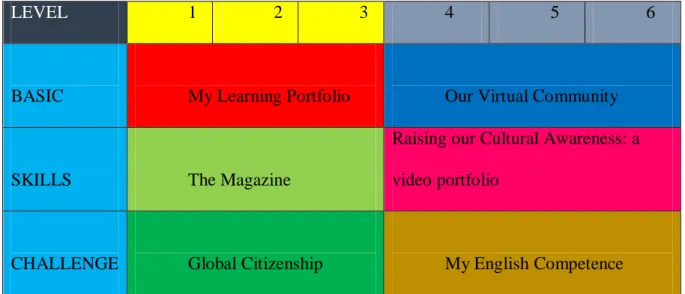
(13) Teachers’ Conceptualization of Information and Communication Technology - ICT. 13. process, and to monitor and coach each students’ learning in a continuous way [in addition] to create rich contexts and conditions for students to be in contact with reallife English encounters on a daily basis” (Adult Program Mission, 2009). As mentioned by one of the adult program coordinators, “At the [Institution] we are interested in maximizing the permeability of the classroom by bringing the outside world into the classroom and directing classroom activities out towards the real world around us” (See Appendix A), these are the goals of the implementation of ICT from the institution. In order to make sure of such ICT incorporation, the adult program has worked under the Task-Based learning principles. The 18 levels have been divided into six blocks, which are joined in three levels and are achieved at one level per month. LEVEL. 1. 2. BASIC. My Learning Portfolio. 3. 4. 5. Our Virtual Community Raising our Cultural Awareness: a. SKILLS. The Magazine. CHALLENGE. Global Citizenship. video portfolio. Figure 1 Adult English Program blocks, levels, and tasks. My English Competence. 6.
(14) Teachers’ Conceptualization of Information and Communication Technology - ICT. Each three-month block focuses on specific projects or tasks that have been stated in the syllabi and teachers must carry out each step to achieve them. According to the institution, “a task would be a very concrete action which the student would take to accomplish a real-life academic, learning, communicative or personal goal in the target language” as presented in Taylor, Nausa, Tinoco and Gomez (2009, p. 21). According to what is presented through the AEP mission and the objectives of the program in the institutional definition of task aforementioned, Coordinators’ and teachers’ replies also complemented the concept of task by the achievement of such projects by means of the use of the ICT tools. Initially, the interest in working on this exploratory study emerged since 2008 after I held ongoing personal conversations about the use of virtual communities, and other online tools with coworkers and fellow teachers from the Saturday, Adult and, Blended programs at the institution. It was a very interesting moment for most of the teachers in all the programs as many of us started implementing and sharing different tools. It all started with free websites where we could open virtual forums and communities such as ning.com. It was a very popular tool and it offered the chance to link to other tools such as surveymonkey.com, where students and teachers were able to create our own surveys; glogster.com, which was a very attractive site to create posters with our own tools, from external links to other websites to link to your favorite videos from youtube.com; voxopop.com, which became a really important tool for students to practice their pronunciation and being able to be constantly. 14.
(15) Teachers’ Conceptualization of Information and Communication Technology - ICT. assessed either by their teachers, peers or themselves. The main purpose was to offer students appealing ways to display and develop their weekly tasks. With the incorporation of the Blended program in 2009, the interest on such tools became even more important. Even I was nominated and actually certified to work on the two programs simultaneously, the Blended and the AEP where I was able to continue working with the some of the tools mentioned above and some others that I learnt about from fellow teachers in both programs. Unfortunately some of those tools such as our main sites and pages in ning.com started charging a fee for monthly and yearly plans therefore, teachers’ and students’ information was lost. The tools seemed to be so successful that students were constantly trying to access the site to their ning.com domains but there was no answer. As a manager of the site you can decide on different functions depending on the number of tabs and what you want to use them for, also invite new members by using their emails, create blog entries, attach videos and images even voice recordings or mp3 recordings. This was a very enriching moment for all the academic experience for teachers as well as for students. Needs Analysis With the years and once this research project was thought of and proposed in 2012, I collected data by means of different instruments such i class observation protocols at the institution I carried out through the same year; second, by analyzing the area devoted to technology in the class observation checklist from the institution. 15.
(16) Teachers’ Conceptualization of Information and Communication Technology - ICT. (see Figure 2); third, the results gathered from the implementation of a teachers survey on technology use (see Figures 4-9); and last, the results taken from ICT and curriculum survey implemented to teachers and coordinators at the institution. Class observations. First, the observations were carried out while I was a supervisor for the Adult English Program and I was in charge of checking the accomplishment and fulfillment of the procedures set by the institution. Those procedures were listed in a Class observation checklist (2012) (see Appendix B) that was presented and explained to all teachers at the institution before institutional observations were carried out. It took into account areas such as Class Objectives, Activities and Instructions, Language, Learning, Communication, Communicative Event, Project work, Assessment, Technology and Language Use. I carried out these observations in 16 teachers; some of them were observed two or three times during the year (2012) depending on the results after analyzing the data collected in their classes. In the end and based on those results, the Technology area inside the checklist increased my interest in this study. Class observation checklist. As mentioned before I collected data when observing the fulfillment of one of the sections of the Class observation checklist just devoted to the incorporation of ICT tools in the adult program classes (See Appendix C). When carrying out the initial observations, it was evident that teachers resorted to online dictionaries such as Cambridge online dictionaries and wordreference.com.. 16.
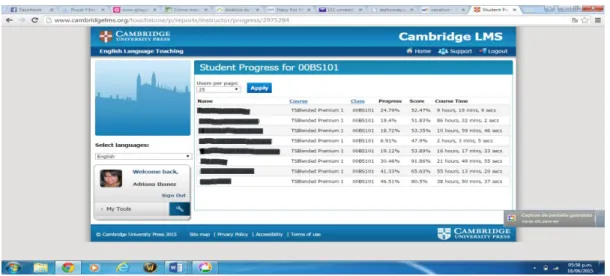
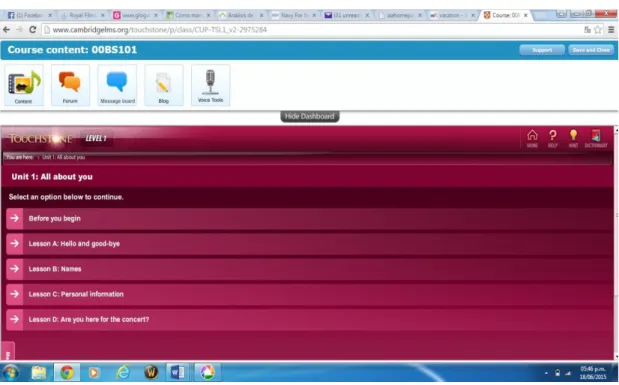
(17) Teachers’ Conceptualization of Information and Communication Technology - ICT. In these pages, most teachers highlighted the use of the International Phonetic Alphabet (IPA), the use of synonyms and context in order to foster the use of learning strategies; this was another of the most important areas to be part in the AEP at the institution. Among the incorporation of ICT tools, there was a massive development from an institutional perspective since 2012. The implementation of a Learning Management System (LMS) or “Platform” became mandatory and it was also mentioned in the Class observation checklist. TECHNOLOGY Technology is an effective tool to enhance learning Teacher uses the book’s digital version and web tools Students are trained to work with different multimedia resources Training and follow up on the use of the platform is evident Figure 2 Technology use, taken from Class Observation Checklist, 2014 This platform was developed per level and students had access to their online books and workbooks, chats, messages and blogs among the participants in their classes. They could also keep track of their progress; however the teacher would only have access to his/her own classes. Each teacher was given the chance to enable or disable some of the tools or exercises from the LMS itself. It also meant that students had to accomplish a certain amount of exercises and keep in mind their progress as part of their evaluation.. 17.
(18) Teachers’ Conceptualization of Information and Communication Technology - ICT. Figure 3 Learning management system, taken from www.cambridgelms.org Teachers’ survey on ICT use. I also conducted a “Teachers Survey on ICT use” (see Appendix D) that I adapted from Curriculum K-12 Directorate. This survey was sent through Surveymonkey.com to eleven teachers who were asked if they would willingly answer and send their results. By that means, I found out about whether teachers agreed on the incorporation of some ICT tools; if they did, the frequency they incorporated them, to what populations and maybe for what purposes. Attitude towards ICTs, to what extent are you: 12 10 8 6 4 2 0. Not at all Somewhat a. Interested b. Interested c. Convinced d. Confident e. Sure of the in developing in developing of the that ICT can usefulness of ICT skills and ICT skills and educational make my work ICT in finding knowledge knowledge benefits of ICT easier and managing information. Mostly Very much Total. Figure 4Teachers Survey on ICT use, taken from www.surveymonkey.com, 2012. 18.
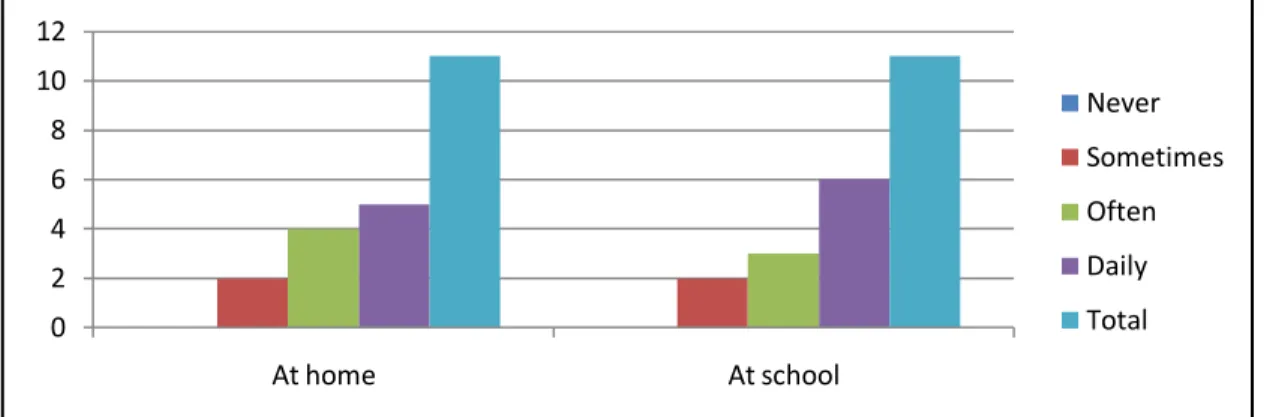
(19) Teachers’ Conceptualization of Information and Communication Technology - ICT. As seen in this chart, most teachers trust on the use of ICT tools as help in educational and professional areas but it was also interesting to see how they felt overwhelmed somehow by the developments of such tools. This initial finding was also key to not only carry on with this project but also to count on the teachers’ points of view and attitudes regarding their conceptualization of ICT tools. Confidence and competence in the use of ICTs How often do you use ICTs: 12 10. Never. 8. Sometimes. 6. Often. 4 2. Daily. 0. Total. At home. At school. Figure 5 Teachers Survey on ICT use, taken from www.surveymonkey.com, 2012 Regarding the frequency of the use and the places where teachers use ICT tools the most, it was evident to see that most of them use them while at work even more than for personal use. This was also key as to trust on their implementation of the ICT tools as reported from the personal conversations we used to have as a team and how it progressed into a more constant use at work.. 19.
(20) Teachers’ Conceptualization of Information and Communication Technology - ICT. How often do you use ICTs: 12 10 8 6 4 2 0. Never Rarely Sometimes Often. to access and organise to create content for my content for my lessons lessons. with students in the classroom?. Total. Figure 6 Teachers Survey on ICT use, taken from www.surveymonkey.com, 2012 In this question it was important to take into account the three dimensions it portrayed. For instance, the first one about accessing and organizing content, the second on creating from a teacher’s perspective and the third one where students played an active role in the incorporation of the ICT tools were all evidenced in the teachers’ replies. These answers also reflected how important it was for teachers to not only become confident in the search and use of the ICT tools but also how these impacted their students. I am confident using ICTs with students to create content 4 3 2 1 0. I am confident using ICTs with students to create content Never. Sometimes. Often. Always. Figure 7 Teachers Survey on ICT use, Taken from, surveymonkey.com, 2012. 20.
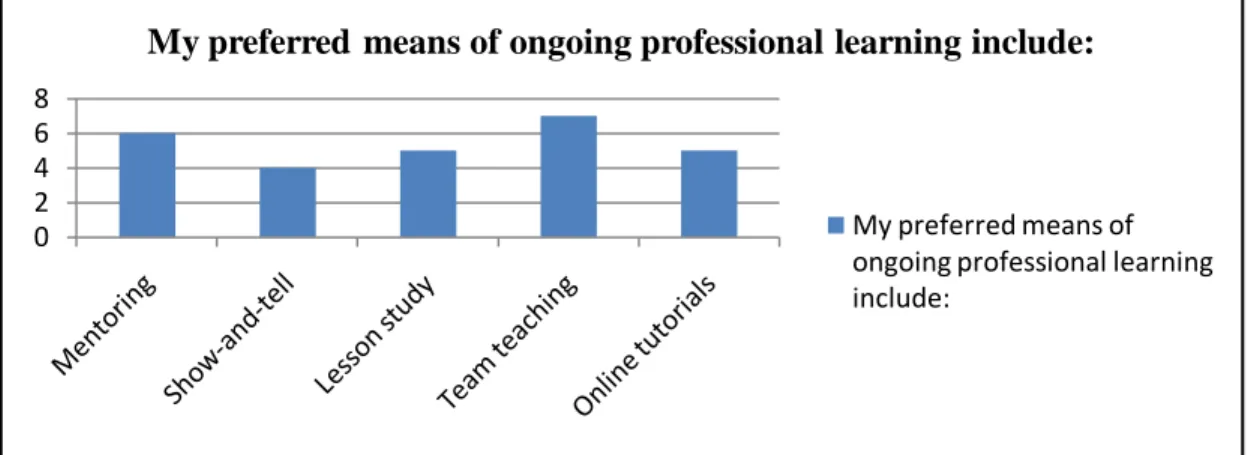
(21) Teachers’ Conceptualization of Information and Communication Technology - ICT. This answer portrayed similar results to the previous question as teachers, although they incorporated ICT tools with their students, they still reflected they needed to feel more comfortable and confident with such tools. Professional learning I would like to know more about: 12 10 8 6 4 2 0. Not really Definitely Later integrating ICT the application of into teaching and ICTs into my learning subject area. developing effective pedagogical approaches. improving students’ ICT skills. Soon Total. Figure 8 Teachers Survey on ICT use, taken from, surveymonkey.com, 2012 In these results, teachers presented a very optimistic and open attitude towards the use of the ICT tools. The different areas portrayed in the questions evidenced teachers’ interest in gaining more confidence when using the tools. My preferred means of ongoing professional learning include: 8 6 4 2 0. My preferred means of ongoing professional learning include:. Figure 9 Teachers Survey on ICT use, taken from www. surveymonkey.com, 2012. 21.
(22) Teachers’ Conceptualization of Information and Communication Technology - ICT. This answer is really important as team teaching is the most frequent means of ongoing learning for teachers at the institution. Once one becomes a teacher for any of the programs offered at the institution, this is the initial stage. A teacher who has been working for the program is in charge of a (a group of) new teacher/s. This is a very important stage as new teachers have the possibility to first observe how the program works through the eyes of the senior teacher. S/he has access to the classes, take notes and most importantly ask any questions while also attending face-to-face training sessions with Coordinators and Supervisors, plus participating in an online training forum in Wikispaces. ICT and curriculum survey. Lastly I implemented the ICT and Curriculum survey, (2008) (see Appendix D) sent to a group of four teachers, and the adult program Coordinators in two branches in 2012. When asking the General Coordinator of the Adult English Program (AEP) about the role of technology or in this case, ICT tools, in the teaching practice this was one of his replies. “Technology is a means to enhance learning processes. Technology should be integrated to the day-to-day classes to promote and extend students learning. It shouldn’t be treated as a separate subject or an outside of class activity. The implementation of technology has certain implications for teachers and the institution: •. Being aware of the pedagogical intervention and theoretical framework of using CALL in the AEP and projects. •. Assessing learners’ use of CALL. 22.
(23) Teachers’ Conceptualization of Information and Communication Technology - ICT. •. A strong team that provides technical support is a must. •. Availability of spaces and time in order to train teachers, students and staff in general” Reales & Rey, 2012, email communication. Another of the Branch Coordinators also replied to the role and inclusion of technology and ICT tools. “It certainly plays an important role. At the (institution) we are interested in maximizing the permeability of the classroom by bringing the outside world into the classroom and directing classroom activities out towards the real world around us. For us, the on-line learning component involves mainly five areas: 1) implementation of language content in meaningful language practice activities; 2) implementation of course content in real world language use; 3) interaction with an English-speaking and English-learning world through webbased tools for communication; 4) research related to classroom topics; 5) exploration of personal interests and passions on the web.” Reales & Rey, 2012 email communication When referring to their opinions on the role of ICT tools and technology with teachers’ development, they replied. “It definitely helps teacher development. Teachers need to learn how to use new tools, they help train others and innovate. We are creating a community of practice where teachers with more advanced knowledge of technology implementation can help others understand its role and apply it. When. 23.
(24) Teachers’ Conceptualization of Information and Communication Technology - ICT. aware of technological resources for language teaching, teachers can then structure their lessons to meet curricular requirements, set projects as well as construct their own on-line learning possibilities for their classes. With appropriate training on the use of technology, teachers are able to connect their students with useful web-based resources appropriate for each class and each level. Teachers become more critical towards the virtually thousands of on-line language learning resources and trained with criteria on how to choose and evaluate these resources.” Reales & Rey, 2012 email communication As a result of this, teachers and coordinators’ answers showed willingness and interest in using ICT tools as part of their regular teaching practices, potentially mainly because the institution strongly believes that ICT incorporation improves both teaching practices and learning processes. As stated by the International Institute for Communication and Development – IICD, “ICT-enabled solutions improve access to relevant educational resources, stimulating tools for engaging students and new ways of communicating with all participants in educational systems. Furthermore, building ICT capacities of teachers can lead to equipping students with critical 21st century skills, such as digital literacy, critical thinking, collaboration, communication and problem solving” At the same time, it was seen that teachers also share different views on what, how, and why to use ICT tools in their teaching. Therefore, when developing this exploratory study I aimed at identifying and describing teachers’ conceptualization of ICT tools at a binational institution in. 24.
(25) Teachers’ Conceptualization of Information and Communication Technology - ICT. Colombia based on Sawyer’s and Chen’s Conceptualizing Information Technology in the Study of Information Systems (2009) and on how teachers incorporated such conceptualizations into their own practices by implementing Venkatesh & Davis’ Technology Acceptance Model – TAM (2000). Consequently, how ICT incorporation began to take place in the context will be thoroughly described in the following section of this study. Technology at the Institution This section of this chapter describes the relationship between the adult program policies at the institution and the implementation of ICT. First, it is the institution’s responsibility to make sure that all participants in the program (teachers and students) follow institutional methodology and policies, as well as adopting and implementing task-based syllabi that has been established for the adult program in all classes. As seen in the previous section the incorporation of ICT has become one of the most important features in the adult program, as the institution is looking towards the future by working with state-of-the-art tools to maximize “the permeability of the classroom by bringing the outside world into the classroom and directing classroom activities out towards the real world around it” (See Appendix B, questionnaire 2– Adult Program Coordinators, December, 2012). As seen in the Coordinarors’ points of view regarding the importance of the incorporation of the ICT tools, the institution was definitely interested in such tools as part of the learning goals of students not only as a means but as a cognitive skill as. 25.
(26) Teachers’ Conceptualization of Information and Communication Technology - ICT. well. This also implied that teachers were also considered in the process by assuming the roles of providers of the ICT tools and be knowledgeable and liable in the process of incorporation. The institution also became responsible for providing the necessary training for both, their teachers and their students. The second aspect when linking the role of the ICT tools to the learning process also reflected the nature of the methodology used at the AEP with the use of the Task- based learning. It appealed to the connection of reality and the use of the language enhanced by the use of the ICT tools. A very important aspect of research was also mentioned where teachers and students can use the ICT tools as a means to deepen in their classroom topics, especially for pre-intermediate and more advanced levels. It was also important to highlight how these opinions from teachers and the institution through its Coordinators was a reflection of the current status the Colombian government is granting to the implementation of ICT tools and its importance for teachers’ development and education. “Professional development for educational innovation needs to prepare teachers to add to the quality of education by means of educational practices through the use of ICT tools, create strategies to foster the use of ICT tools with students to create positive changes of their environment and promote the transformation of institutions into learning organizations from an academic, administrative and community perspective. To achieve this such programs must be pertinent, practical, situated, collaborative, and inspiring” (Ministerio de. 26.
(27) Teachers’ Conceptualization of Information and Communication Technology - ICT. Educacion Nacional, Competencias TIC para el Desarrollo Profesional Docente, 2013 p.8) Taking into account the institutional policies and the findings of my initial stages of this study, I further describe in the following section how ICT has been incorporated at the institution for the last 5 or 6 years.. Figure 10 Learning Management System, taken from www.cambridgelms.org, 2015 First, throughout all the process (level 1 to level 18) there was an incorporation of a learning management system (LMS). This incorporation started happening since 2011 and it became institutionalized in 2012. The use of the LMS is mainly for students to work on their online workbook and to have the chance to work on their own, at the same time, teachers enable the units and the contents they want their students to work on and also teachers assign activities and exercises depending. 27.
(28) Teachers’ Conceptualization of Information and Communication Technology - ICT. on students’ level and progression. This statement is one of the goals of the institution to foster autonomy in the sense that students can access the contents of the LMS whenever they can, however there are minimum standards established in the monthly evaluation checklists that every student-user needs to accomplish in order to access to the next level in every course. The second tool that has been incorporated into the classroom practices is a white-board software of the textbooks that are currently used in every level. The purpose of this tool is to be incorporated as part of the classroom practices for teachers to work with picture exploitation and also walk students into working with the material in and out of class. The whiteboards also have the audios for the lesson which teachers use for the listening exercises in class; nevertheless, students can also have access to such software in the computers available at the audio-visual and multimedia labs at every branch of the institution, students can work on their class preparation and they can also work with the listening exercises as they do in class. For the advanced courses there is a platform available from e-college in which instructors have the possibility to modify and incorporate new features depending on the objectives of the course. Students have access to additional exercises and they are to work online for 5 hours every week on average. The rest of the tools that have been incorporated into the classroom practices have come from companion websites for the textbooks and also depending on the kind of language skill teachers are interested in working with students. For example,. 28.
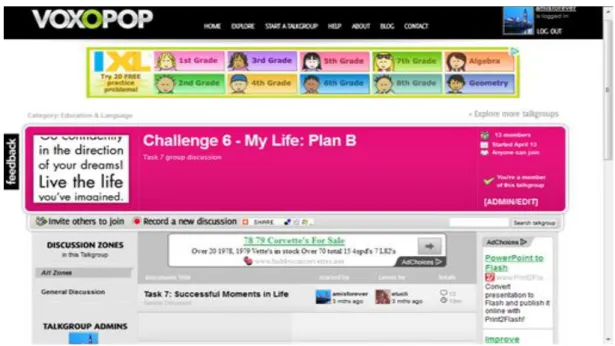
(29) Teachers’ Conceptualization of Information and Communication Technology - ICT. for practicing speaking teachers usually resort to voxopop, voicethread, vocaroo, and English central mostly where students are usually assigned some speaking tasks to perform and also share with their classmates by posting comments to either continue the thread of the discussion or to peer-assess their partners among other uses.. Figure 11 Voxopop Speaking Community, Taken from www.voxopop.com, 2015 For practicing listening, teachers usually use online pages such as ello.org, esl-lab.com, podcasts, youtube videos and many others for students to work on listening either in class or at home assignments.. 29.
(30) Teachers’ Conceptualization of Information and Communication Technology - ICT. Figure 12 Randall’s Cyber Listening Lab, taken from, www.esl-lab.com, 2015 For practicing vocabulary, teachers also work with online sites where students can create mind-maps or different graphic organizers as tools for students to resort to the most suitable strategy according to their needs and the class objectives. For grammar purposes, teachers usually surf the Internet to work with worksheet engines, online games, or online checking exercises where students receive an immediate score after accomplishing the given exercise. This is evident when as part of the completion of real-life tasks ICT tools are necessary for students to develop such tasks as seen in one of the Exit Profiles from the pre-intermediate block at the institution. “Outside class: I use the laboratory in the Colombo, and the CD-ROM. I use English every day in my personal routine. I use resources like magazines and Internet to get the information I need.. 30.
(31) Teachers’ Conceptualization of Information and Communication Technology - ICT. I have the skills I need to be an active member of an on-line community. I can post weblogs and images. I know how to use the Internet safely and responsibly. Socialization: I can work well with my classmates in pairs and groups to practice, give and receive feedback, and collaborate on class projects. I use the online community for learning English and for socializing too. Motivation and attitude: I am motivated and open about learning and about the book project and tasks. I can use technology to complete the tasks and projects in the book.” Exit Profile, Basic 4,5,6 block, 2013 Task: A virtual community. Most importantly, the institution agreed in September 2012 that teachers were the ones who decided on how to accomplish the goals regarding the use of ICT and meet the expectations of what was presented in the mission, objectives, and the development of the mandatory tasks in their classes as presented in an institutional document called “Rules of Thumb” in 2012. Now, a brief description of the relationship between each task at the institution and the ICT tools will be provided. In the first block of the program (Elementary) students organize an individual portfolio for three months, which are divided into three levels. ICT tools are incorporated if the teacher so chooses. If s/he proposes it, students create their portfolios using online tools, in this case a learning management system (which will be described later in this section of the paper) or another tool (such as a virtual community) where students and teachers can post blogs.. 31.
(32) Teachers’ Conceptualization of Information and Communication Technology - ICT. In the second block of the program (Elementary) the project is based on communicating and interacting through a virtual community as specified in the syllabus. In this case the use of ICT is mandatory to accomplish the project. In this stage, students need to gather and organize information and post and comment on each other’s assignments. Such activities are weekly tasks assigned in the syllabus; therefore, our role as teachers is to be facilitators for that process. Nevertheless, in order to make sure ICT is incorporated into the syllabus, the adult program has gone through different stages. In 2008 the syllabus specified the use of Yahoo 360º, a virtual community where people who were registered in Yahoo mail were able to connect to other Yahoo users. Later, the same year, the institution started using ning.com, a public (now paid) online platform where people could open virtual communities. Each person could customize and share blogs, links, and other pieces of information. Teachers used ning.com for the whole project for the second block. Consequently, other teachers started integrating it into latter projects including posting weekly blogs, commenting in forums, sharing links, and posting and sharing photos and music. This experience was the first I had in which I had contact with students, the syllabus, and peers outside the classroom by means of a virtual community. In 2009, in addition to the implementation of virtual communities and learning management systems, the institution incorporated the use of whiteboard software of the textbook series the adult program works with in all levels: whiteboard software in the. 32.
(33) Teachers’ Conceptualization of Information and Communication Technology - ICT. Elementary levels and multimedia whiteboard software in Pre-intermediate, Intermediate, and Upper Intermediate levels. Unfortunately in 2009 ning.com started charging a fee for using the communities we had created, and in the end, all our students’ contents was lost or erased, after a year of having collected and organized information with students and peers. Eventually, teachers who wanted to continue using such platforms started looking for different web tools, which included Facebook, Socialgo, or Grouply, Google circles among others. The following picture was a message from one of the users from Grouply reporting that this website was no longer available,. Figure 13 A review on closing of Grouply, Taken from social.networkreviews.com, 2015. 33.
(34) Teachers’ Conceptualization of Information and Communication Technology - ICT. The following picture was an example of how some teachers started using Facebook as a tool for the completion of the mandatory tasks. In this case, a virtual community where students post their tasks and they can be commented and corrected by their peers or the teacher.. Figure 14 A conversation between a student and a teacher in a Facebook post, taken from, www.facebook.com, 2013 This was all done for the purpose of complying with the syllabus and project as stated. In the end, to our surprise, some of these communities started charging a fee as well and we “lost” all the content we had posted with our students during the year again. In order to avoid this, a couple of years ago the institution started to look for a more efficient and reliable means to organize information and at the same time. 34.
(35) Teachers’ Conceptualization of Information and Communication Technology - ICT. increase the interest of students and teachers in ICT. The result was finding and implementing a Learning Management System which was recently launched in the EFL market. The Learning Management System (LMS) for the institution is a fully organized online platform where students can work on content similar to content they study in their face-to-face classes. Some units they have in their textbooks are similar to those in the platform and in other cases, they are provided with extra activities. The LMS offers an online workbook, forums, blogs, announcements and voice tools; it is also possible for students (and teachers) to keep track of their progress. This learning management system has been implemented for all the elementary levels as of 2012. Therefore, all these levels should use the platform simultaneously to comply with the syllabus, as well as to carry out two projects: the learning portfolio and/or the Virtual Community.. Figure 15 Tasks menu in the LMS, taken from, www.cambridgelms.org, 2013. 35.
(36) Teachers’ Conceptualization of Information and Communication Technology - ICT. In this picture, one can see some posts from the tasks. In this case, students used blogs to link to a voice recording tool (vocaroo.com) where they had to describe an anecdote and then comment on each other’s tasks. The following picture displays a Google circle for an intermediate class whose task was to develop their Cultural awareness and video portfolio. Students created their own videos which were then posted and commented by their peers and the teacher.. Figure 16 Google plus,taken from, https//:plus.google.com, 2013 From my position as a teacher in the adult program, the use of ICT has become an important element to observe in the classroom as there must be “evident technology use in the classroom” as presented in the Class Visit Checklist (2012).. 36.
(37) Teachers’ Conceptualization of Information and Communication Technology - ICT. Statement of the Problem As seen in the Needs Analysis section of this paper, teachers at the AEP have raised their interest in implementing ICT tools, therefore it became necessary to identify the conceptualizations those teachers have of such tools for getting to know why they incorporated the ICT tools in their teaching practices. According to Gilakani (2012), “if we are to achieve fundamental changes in classroom teaching practices we need to examine teachers themselves and the beliefs they hold about teaching, learning, and computer technology” (p. 64). Such beliefs would be represented in the conceptualizations teachers have, plus how ICT tools were implemented into their practices would also be analyzed from Venkatesh & Davis’ Technology Acceptance Model (TAM). These conceptualizations were of great interest for the institution in this research because of the increasing incorporation of policies regarding the use of ICT tools and how those conceptualizations may be evidenced in actual classroom practices. For that purpose, this study worked with 6 teachers (purposive sampling, see chapter 3) who expressed interest and evidenced actual use of ICT tools. Additionally, as mentioned in the Introduction above, the mission and the objectives of the Adult Program in the context where the project took place suggest that students need to develop literacy in the use of ICT tools to complete real-life. 37.
(38) Teachers’ Conceptualization of Information and Communication Technology - ICT. tasks in real-life situations. Therefore, in this particular context, teachers need to align their practices with the wants, likes and needs of students and to meet the exit profile of the institution as stated in its mission. Research Questions Based on the data collected to back up a researchable problem and my research interest, I decided to formulate the following research questions: How do teachers in an adult program who are interested in working with ICT tools in a bi-national center conceptualize these tools? How do teachers who are interested in working with ICT tools integrate them into their teaching practice? Research objectives . To identify and describe how teachers conceptualize ICT.. . To explain how they integrate ICT tools in their classroom practices.. Justification Warschauer and Meskill (2000) state “The computer is a powerful tool for this process [professional development and learning] as it allows students access to online environments of international communication. By using new technologies in the language classroom, we can better prepare students for the kinds of international cross-cultural interactions which are increasingly required for success in academic, vocational, or personal life.” (p. 303). This seems to be a recurring argument for the educational community to foster the incorporation of ICT tools hence,based on the. 38.
(39) Teachers’ Conceptualization of Information and Communication Technology - ICT. emerging data in the initial stage of the process (of the research project) as described in the Introduction of this paper, it is important to address teachers’ conceptualizations of ICT tools. As presented in Johnson 2009there is an “oversold/under-used phenomenon” (p. 4) going on suggesting that the incorporation of ICT tools in educational contexts is both necessary and useful. Furthermore, Ertmer, Gopalakrishnan,& Ross, (2000) focus on the fact that “although studies have shown that most teachers today recognize the importance of using technology in their classrooms, they often lack a clear vision of how technology can be used to support educational best practices” (p. 3) which means that despite the increasing development of technological devices and ICT tools, the educational community still needs to work on ways in which such tools work efficiently for the sake of teaching and learning processes. For instance, in the setting where the study took place, and also based on conversations with teachers in the adult program, there are distinct concepts related to ICT which in the end, affect teachers’ decisions whether or not they should incorporate ICT tools. Moreover, Hutchinson and Reinking (2011) remark that “in research carried out about teachers’ beliefs and ICT use, more attention has been paid to the extent to which teachers have used ICT than to how they have conceptualized them in their practices” (p.313). This suggests that quantitative data has been the major outcome in research about teachers’ beliefs which in this study were analyzed as Conceptualizations in ICT use. Next, the relationship between ICT and the EFL. 39.
(40) Teachers’ Conceptualization of Information and Communication Technology - ICT. classroom will be described in the following chapter of this research report based on a literature review and from an experiential basis.. 40.
(41) Teachers’ Conceptualization of Information and Communication Technology - ICT. Chapter 2 Literature Review This framework follows the main six constructs that support this study. First, the term teacher cognition will be treated in a similar level as conceptualization due to how close research has proven conceptualizations and beliefs to be (Birello 2012; Swuannasom 2010; Sedgeman 1996). Then, Toomey’s (2005) definition of Information and Communication Technology - ICT will be presented, analyzed, and linked to the field of English as a Foreign Language. In addition, Sawyer and Chen’s Categorization of ICT (2002), Venkatesh’ and Davis’ (2000) Technology Acceptance Model will be presented. In the end, how teachers’ conceptualization of ICT relates to teachers’ development will also be described. Teachers’ Cognition and Conceptualization According to Sedgeman (1996) Conceptualization is “the use of particulars to illuminate (bring to light within the mind) a generalizable idea or construct. The act of conceptualization is the act of thinking through and seeing beyond existing ideas to discover higher order ideas from within one's own mind. Conceptualization means deliberately looking beyond the known -- i.e., beyond beliefs, assumptions, commonplace interpretations, prevailing theories, and habitual conclusions and so on -- to see what is not yet known, or to understand what is not yet clearly understood.”. 41.
(42) Teachers’ Conceptualization of Information and Communication Technology - ICT. Also, Raymo (2009) stated that conceptualization is “the process of development and clarification of concepts. In other words, clarifying one's concepts with words and examples and arriving at precise verbal definitions” Furthermore, Moini, (2009) specified beliefs as “tacitly held assumptions and perceptions about teaching and learning” (p. 144).When looking for a typology of belief systems, Gilakhani (2012) categorized belief systems as “an eclectic mix of rules of thumb, generalizations, opinions, values, and expectations grouped in a more or less structured way” (p. 64). In Moini, (2009), the belief system is made of “the information, attitudes, values, theories, and assumptions about teaching, learning, learners, and other aspects of teaching” (p. 143). In addition, conceptualization has also been related to teachers’ cognition studies where Swuannasom, (2010) characterized teachers’ cognition as “teachers’ beliefs, knowledge, theories, attitudes, images, assumptions, metaphors, conceptions and perspectives” (p. 18). All these definitions were important for supporting the similarity between conceptualization and beliefs. Now how teachers’ cognition was connected to actual practices was also evident when looking for literature about teachers’ cognition, beliefs and conceptualization. Birello (2012) stated that “beneath the behavior there are beliefs and knowledge and related constructs which influence what teachers do and if we really want to understand what teachers do, we need to understand what they believe, what they know, their attitudes, their feelings” (p. 88). In addition to that according. 42.
(43) Teachers’ Conceptualization of Information and Communication Technology - ICT. to Moini (2009), “teachers’ beliefs influence their judgment and perception, the classroom activities they use, and it can contribute to the improvement of teaching practices and teacher education programs” (p. 144). According to these definitions, as humans, we perform as we think and our thoughts are still influenced by our actions. In the research process I report here, the purpose was to work with teachers who actually used ICT tools, for instance, it was necessary to first identify their attitudes, feelings, experiences, for then analyze how those belief systems were represented in their practices in the EFL classroom; as in Moini, (2009) “teachers’ beliefs can determine the way they approach their teaching” (p. 143). Moini (2009) also provided a very clear state-of-the-art regarding the way teachers develop their belief systems. First, teachers’ belief systems can be socially constructed, as a result of personal experiences and influence from the settings in which they work. Second, belief systems can arise from teacher training and preservice programs. At the same time, teachers’ beliefs are built over time as in Moini, (2009) “teachers’ beliefs are derived from their prior experiences, school practices, educational theory, reading, their individual personalities, and a number of other sources. Teachers’ views are also shaped by students’ wants, syllabus expectations, and prior experiences.” (p.144). Participant teachers in this study have been working at the institution from 1 to 8 years plus former experiences they have had in TEFL (see participants in Chapter 3) therefore, they have already become familiar and also been influenced by their experiences, their working and academic environments, the. 43.
(44) Teachers’ Conceptualization of Information and Communication Technology - ICT. curricula and even students’ needs or learning preferences. In the context where this exploratory research study took place, a group of teachers working with ICT tools has become characterized for being highly knowledgeable of working with these kinds of tools. This proved the fact of the reciprocity between the types of conceptualizations and actions and that if teachers have already awakened their interest of working with ICT tools, there would be not only a variety of tools but also a variety of uses. However, in spite of this potential reciprocity there is still a gap in understanding, at least in this bi-national institution, what those conceptualizations are in order to fully comprehend teaching practices that incorporate ICT use as it was stated earlier. These conceptualizations were of great interest for the institution in this research because of the increasing incorporation of policies regarding the use of ICT tools and, as presented in Chapter 1, the influence of such beliefs in the curricula and actual classroom practices. ICT (Information and Communication Technology) According to Toomey’s (2005) definition “ICT generally relates to those technologies that are used for accessing, gathering, manipulating and presenting or communicating information. The technologies could include hardware (e.g. computers and other devices); software implementations; and connectivity (e.g. access to the Internet, local networking infrastructure, and video-conferencing).” (p.3) this was used first, because this is the definition currently used by the UNESCO in its section for Education and ICT. Second, because communication and information. 44.
(45) Teachers’ Conceptualization of Information and Communication Technology - ICT. technologies are linked together in one concept, and third, due to its closeness towards the institutional policies regarding ICT use at the binational center. Institutions around the world have witnessed an increasing display of technological infrastructure. This infrastructure, in turn, serves as support for learning communities which provide the opportunity to gather, store, retrieve, process, analyze, and transmit information. As a result, such perspective also modifies teacher-centered approach towards a more learner-centered one. Such supportive environment is led through different approaches of ICT (Tezci, 2010). Therefore, technology is a means to enhance learning processes in the research context as seen in Chapter 1 and so, the institution focuses on five goals for ICT tools to be incorporated in the classes for the adult program: . Implementation of language content in meaningful language practice activities;. . Implementation of course content in real world language use;. . Interaction with an English-speaking and English-learning world through web-based tools for communication;. . Research related to classroom topics;. . Exploration of personal interests and passions on the web (Adult program objectives, 2012).. With this, ICT from an institutional purpose has not only been regarded from the perspective of being just an instrument. Its incorporation has also been related to. 45.
(46) Teachers’ Conceptualization of Information and Communication Technology - ICT. communication purposes, i.e. accessing, gathering, and manipulating information. At the same time, these functions also include the implementation, interaction, increasing research interests, and exploration of concepts. These processes are perceived as compulsory in the eyes of the institution and reflected in the curricula therefore; teachers’ practices are also affected as a whole. As a result, the incorporation of ICT tools at the institution has become mandatory, and this is reflected in the classroom visit checklist referred to in Chapter 1. Conceptualization of ICT In order to identify teachers’ conceptualization of ICT tools, this study refers to Orlikowski and Iacono (2001) characterizations of ICT and their subsequent development into Sawyer and Chen (2002) Conceptualization of Information and Communication Technologies. Orlikowski and Iacono´s (2001) initial views were as follows:. the tool view. the proxy view Orlikowski & Iacono’s (2001) Conceptualizations of ICT. computational view. the ensemble view. the nominal view. Figure 17 Orlikovski and Iacono Conceptualizations of ICT, 2001. 46.
(47) Teachers’ Conceptualization of Information and Communication Technology - ICT. A year later, proof of concept, presence/absence, component, feature and function were later developed by Sawyer and Chen (2002) into the following:. Proof of concept/ Computational view Function/ Ensemble view. Presence/absence / Nominal view Sawyer & Chen Conceptualization s (2002). Componen t/ Proxy view. Feature/ Tool view. Figure 18 Sawyer and Chen’s Conceptualizations of ICT, 2002 Proof of concept or computational view. This is related to the computational or information processing the tool is able to perform, in this view the algorithms and simulators are the key factors to observe when working with ICT (Sawyer and Chen, 2002).At the same time, this view has two sub-categories described below:. Proof of concept/ Computational. Algorithm Figure 19 Proof of Concept. Model. 47.
(48) Teachers’ Conceptualization of Information and Communication Technology - ICT. In the algorithm view, ICT is used to create new algorithms and formulas that will improve the system to help humans perform better in specific labors (Orlikowski and Iacono, 2001, p. 126). In the model view, ICT is taken as a system to create or organize knowledge by means of “data modeling or simulation” For instance, databases and artificial intelligence. (Orlikoswki and Iacono, 2001, p. 127) Presence/absence/nominal view. This view refers to an implicit or nominal characterization of ICT (Orlikowski and Iacono, 2001). It means that the tool is identifiable but the previous features (functions, models, and proxy) such as its uses are not defined unless there is a comparison of tools that may evidence any of the other views presented here (Sawyer and Chen, 2002) Proxy/ component view. This is the quantitative perception of ICT. In this view, there are three measurements for the value of ICT. Proxy/ Component view. Perception. Diffusion. Capital. Figure 20 Proxy view The first proxy refers to people’s attitudes towards the tools, “The variables include “ease of use,” “usefulness,” and “intention to use the technology.” (Orlikowsi and Iacono, 2001, p.124) The second refers to the availability of the tools in certain. 48.
(49) Teachers’ Conceptualization of Information and Communication Technology - ICT. contexts, “What researchers want to know is how many people, organizations, or nations are currently using the technology. The focus is on understanding the processes of diffusion of such technology.” (Orlikowski and Iacono, 2001, p.125), and the third one is about the capital investment (Sawyer and Chen, 2002) “This view of technology is grounded in the economics discipline, and focuses specifically on the value of the information technology resource or investment to firms, industries, or economies.” Orlikowski and Iacono, 2001, p. 125) . Feature or tool view. This is said to be most common of the views as ICT is seen from its technical nature. This means that the tool is seen from the identifiable purposes it is supposed to accomplish, as in Orlikowski and Iacono (2001) “technology is the engineered artifact, expected to do what its designers intend it to do” (p.123) such purposes are represented in the “values, effects and impacts of the tools” (Sawyer & Chen, 2002, p.113), therefore, there are four sub-categories which identify the uses of ICT as a tool:. Feature/Tool view. Substitute for labor Figure 21 Feature view. To improve productivity. To increase information processing. To improve and maintain social relations. 49.
(50) Teachers’ Conceptualization of Information and Communication Technology - ICT. Functional or ensemble view. This view refers to the socio-technical relationship of the tools and the users. This view refers to the roles, uses, and actions; the most important aspect is to focus on the ways of using a particular tool. Such ways are reflected on the values, effects, and impacts of the particular uses of the tools; therefore, the context where this relation takes place is also important for the particularity and uniqueness of the perspectives (Sawyer and Chen, 2002).. Functional/ Ensemble view. Technology as Development project. Technology as Production network. Technology as Embedded system. Figure 22 Functional view Technology Acceptance Model – TAM Venkatesh & Davis’ Technology Acceptance Model (TAM) was first developed almost thirty years ago (1986), but it is still one of the most recurrent models related to the literature in ICT research when “explaining and predicting user acceptance of information technology at work, also represented in the proportion in usage intentions and behavior”(Venkatesh & Davis, 2002, p.186, Orlikowski and Iacono, 2001, p.125) The model has undergone modifications, hence the TAM was updated by the same authors by taking into consideration the reviews made through. 50.
(51) Teachers’ Conceptualization of Information and Communication Technology - ICT. the years, one of the most important observations was regarding the solidity of the theoretical constructs underpinning the model and the new version TAM2 (2002) incorporated new features to the existing model. Initially, TAM’s intention is to theorize that “an individuals’ behavioral intention to use a system is determined by two beliefs: perceived usefulness, and perceived ease of use” (Venkatesh & Davis, 2002, p.187) The first belief refers to the “extent in which a person believes that using certain system will enhance his or her job performance; the second one refers to the extent to which a person believes that using the system will be free of effort”. (Venkatesh & Davis. 2002, p.187) TAM theorizes that all external variables that influence a person’s intention to use are influenced to some extent by both perceived usefulness and perceived ease of use. This was how the initial exploration of conceptualizations of ICT is connected to the actual practices of teachers.. Figure 23 TAM2 – Venkatesh & Davis (2002). 51.
(52) Teachers’ Conceptualization of Information and Communication Technology - ICT. Each aspect of the chart was defined by Venkatesh (200_) as follows: . Voluntariness: The extent to which potential adopters perceive the adoption decision to be non-mandatory.. . Perceived Usefulness: The degree to which an individual believes that using the system will help him or her to attain gains in job performance.. . Subjective Norm: Person's perception that most people who are important to him think he should or should not perform the behavior in question.. . Image: The degree to which use of an innovation is perceived to enhance one's status in one's social system.. . Job Relevance: Individual's perception regarding the degree to which the target system is relevant to his or her job.. . Output quality: The degree to which an individual believes that the system performs his or her job tasks well.. . Result Demonstrability: Tangibility of the results of using the innovation.. . Perceived ease of use: The degree of ease associated with the use of the system.. . Intention to use / Usage behavior: The degree to which a person has formulated conscious plans to perform or not perform some specified future behavior. In the end, both constructs Conceptualizations of ICT and the Technology. Acceptance Model – TAM merged at the Data Analysis stage (Chapter 4). For. 52.
(53) Teachers’ Conceptualization of Information and Communication Technology - ICT. instance, the conceptualizations offered a wider perspective and at the same time were a reflection and contained some of the variables of the TAM from a more practical perspective. ICT and Education In this section of this theoretical framework, the connection of ICT in education was described and how it was evident in the institution and the adult program. For example, Warschauer (2004) stated that “the number of computers in an institution is not what matters, but instead how they are used to awaken individual and collective responses from the learning community.” (p. 47) In addition to that, Clavijo, Hine and Quintero, (2009) stated that “computers in the classrooms are no longer a teaching tool and institutions around the world (such as mine) are looking forward to an increasing display of such infrastructure.” (p. 154) Namely, at the binational center where the study was carried out every classroom has a “computer station”. The institution also has an audio-visual multimedia lab. How teachers used these tools and what they thought about ICT were the underpinning variables in the research questions for this project. According to Nguyen (2008) there are different advantages for using different ICT tools in the learning environment, these advantages will be contextualized with the actual research context and how the ICT tools are used: First, students receive immediate feedback when interacting with the tool. This is evidenced in the use of the LMS (learning management system) students (and. 53.
(54) Teachers’ Conceptualization of Information and Communication Technology - ICT. teachers) have been using since 2012 and which has been one of the most important incorporations of ICT tools in the curricula for the last 5 years. Both, teachers and students can follow their progress on a daily basis and after they develop each activity they can check whether their answers are right or wrong. Second, with the use of ICT students’ learning become individualized, this means that students are able to work at their own pace when they have the time of working on the activities proposed in the LMS. Third, students explore different modes of literacy as they have to work with video exercises, voice tools, forums, and blogs in addition to the fill-in the blanks and multiple choice types of answers. (Nguyen, 2008) As seen in the previous example, there must be an environment fostered by all the participants in the learning community (administrators, teachers, students) in order to truly achieve learning with ICT. Besides, this was one of the reasons to propose a study like this in the context, due to the constant use of ICT tools evidenced by participant teachers in their practices besides the growing demand of ICT materials from teachers’ and the EFL publishing market in general as also described in Chapter 1. Similarly, regarding the Colombian context, the National Ministry of Education (MEN) in its 2008 document Ser Competente en Tecnologia: una necesidad para el desarrollo presented its position towards the inclusion of ICT tools in Colombian education. “The challenges Colombian education has had to face concern keeping and increasing interest from students, acknowledging the nature of. 54.
Figure

+7



Documento similar