Design of a Real-Time Hidden Markov Model State Decoding System
José Gómez-Cipriano, Dante Barone, Sergio Bampi
Instituto de Informática – Universidade Federal do Rio Grande do Sul Av. Bento Gonçalves, 9500 – Bairro Agronomia
Campus do Vale – Bloco IV Caixa Postal 15064 – Porto Alegre – Brazil Phone: 55-51-3167036 Fax: 55-51-3191576
Email: [email protected]
Abstract -
Hidden Markov Models are used in different kinds of sequence recognition problems. Specially, Hidden Markov Models are suited for speech/speaker recognition systems. Due to the complexity of the algorithms involved, general-purpose computing solutions are typically significantly slower than real time. For many applications, however, real-time is essential and thus a system based in specific purpose hardware becomes necessary. For the probability computation in pattern recognition systems using Hidden Markov Models, a state decoding system is necessary. The state decoding system must be able to decide, based on the input sequence, which is the most probable state sequence that produces the input sequence and therefore the reference pattern which best matches with the input pattern. In this work, the implementation of a real-time Hidden Markov Model state decoding system is described. The prototype was implemented for left-right Markov Models.1. Introduction
Speech is a very natural and efficient way of communication for humans. The study of speech recognition concerns itself with the development of systems that emulate the human’s ability to process such an exchange of information. Automatic speech recognition is the first step in a spoken language system that recognizes a person’s word, interprets its meaning and provides an appropriate response. Research concerning spoken language systems is important since it will enable people to interact with machines using speech [LEE 89] [RABINER 93].
In figure 1 [RABINER 93], a block diagram of a canonic pattern recognition approach to speech/speaker recognition is shown. The pattern recognition paradigm has four steps, namely: (1) feature measurement, which is made on the input speech signal to define the “test pattern”; (2) pattern training, in which one or more test patterns corresponding to speech sounds of the same class are used to create a pattern representative of the features, producing a reference pattern or template; (3) pattern classification, in which the unknown test pattern is compared with each reference pattern and a measure of similarity between the test pattern and each reference is computed; (4) decision rule, in which the reference pattern similarity scores are used to decide which reference pattern best matches the unknown test pattern.
The factors that distinguish different pattern recognition approaches are the types of feature measurement, the choice of template or models for reference patterns, and the method used to create reference patterns and classify unknown test patterns.
A speech recognition system may work within certain, previously specified, constraints such as: size of vocabulary, speaker dependence or independence, manner of utterance (isolated vs. continuous) and response time. Depending upon these constraints, the computational load may be very high. If real-time characteristics are added as a new constraint, a possible solution could be to employ a specific purpose hardware.
frequency bands. The assumption is that these features were produced by a HMM speech process consisting of a finite set of N states and a set of transitions between these states.
Fig. 1. Block Diagram of Pattern –Recognition Speech/speaker Recognition [RABINER 93].
Hidden Markov Models (HMMs) are used in the most successful modern speech/speaker recognition systems [LEE 89] [RABINER 93].
A HMM speech recognition system consists of a probabilistic state machine and a method for tracing the state transitions of the machine for a given input speech waveform. The states in the HMM correspond to generic speech sounds (e.g. a group of phonemes, a phoneme or a part of a phoneme) where every state has a probability distribution that gives the output probability, P(oi| qi), that the state qi will output the feature oi. Speech can be considered as being generated by transitions between these
states yielding a state sequence, q=(q1 q2 ... qT). The likelihood of these transitions is described with a
set of transition probabilities, aij, which reflect the probability that state Sj follows state Si
A HMM requires the observation probability distribution, that is the probability of observing the symbol k in state S
.
j and is denoted as bj(k). It becomes also necessary an initial state distribution
probability πi that gives the probability that the first state is the state Si
2. Using HMMs in Speech Recognition
.
Hidden Markov Models (HMMs) are the most widely used approach to speech recognition problems. The task of recognition is the problem of, given an observation sequence and HMM parameters, finding the most probable path or sequence of the hidden stochastic process. Our goal during speech/speaker recognition with HMMs is to trace out the most likely path through this state machine that could have produced the input speech waveform.
In a matrix form, the transition probability could be represented as: A={aij=P[qt+1=Sj|qt=Si]}.
The observation probability could be represented in a matrix form as: B={ bj(k)=P[ot=vk|qt=Sj]}.
The initial state distribution could be represented by the vector:π={πi=P[q1=Si
An HMM can be represented by using the compact notation λ=(A, B, π). Specification of HMM involves the choice of the number of states, N, the number of discrete symbols M, and three probability densities with matrix form A, B and π.
]}.
For example, consider an isolated word recognizer based in HMMs. Assuming a vocabulary of v words to be recognized and that each word is to be modeled by a distinct HMM, λv. Further assuming
(1) For each word v in the vocabulary, the model parameters of the HMMs that optimize the likelihood of the training set observations for vth
(2) For each unknown word which is to be recognized, the processing of figure 2 must be carried out, namely measurement of the observation sequence O=(o
word must be estimated. This step is known as training.
1 o2 ... oT), via a feature analysis of the
speech corresponding to the word; followed by calculation of model likelihoods for all possible models, P(O/λv
The recognition step could be divided in two fundamental blocks: The front-end parameterization and the recognition block. The front-end block operates over the input voice: A/D conversion, aliasing filtering, window-FFT, parameter extraction and vector quantization. The front-end output is a sequence of indexes. This sequence is the input for the recognition block. The recognition block makes the pattern training and the pattern matching. The heart of the recognition block is a state decoding system for the probability computation [MARKOWITZ 96] [RABINER 89]. The state decoding system must be able to decide, based on the input sequence coming from the front-end block, which is the most probable word uttered by the speaker.
[image:3.595.129.468.297.539.2]). Finally, the selection of the word whose model likelihood is highest is realized [CHONG 96] [DELLER 93]. This step is known as recognition.
Fig. 2. Block Diagram of isolated word HMM Speech/Speaker Recognizer [RABINER 93].
3. State Decoding
The state decoding problem consists in the determination of the state sequence qi=(q1 q2 ... qT),
of the model λ, that most probably produce an observation sequence O=(o1 o2 ... oT
For calculating the optimal state sequence it is necessary to calculate the highest probability inside a path, that ends in the i-state and produces the first t observations being in the time t. By defining the variable δ
). By definition, in HMMs the state sequence is hidden. There is the possibility of reproducing the state sequence with the highest probably of generating the observation sequence [DELLER 93] [FOSTER 93] [TEBELSKIS 95].
t
)] | ... , , ... ( [ ... )
( 1 2 1 1 2
1 2 1
λ
δ t t i t
t
ti =qqmáxq Pq q q− q =S o o o
−
(i) as the highest probability or best score of a single path which at time t ends in state i we have:
(1)
) ( ]}. ). ( [ { ) ( 1 1 +
+ = t ij j t
i
t j máxδ i a b o
δ (2)
Notice that equation (2) can be computed by only accessing the model parameters and the best scores for all the states at time t-1. This implies a frame synchronous progression of the computations, starting with t=1 and continuing with one frame at a time, as time t evolves from 1 to T. The path information (i. e. the argument of the max operation in equation (2)) is stored in a T by N array ψt
[
t ij]
N i
t j = máx − i ⋅a
≤ ≤ ) ( arg ) ( 1 1 δ ψ (j), also called back-pointer array. The complete procedure to find the best state sequence will be:
(3)
The likelihood of producing the observation sequence given the model λ, will be
[
()]
) | ( 1 * i máx P T N iδ
λ
≤ ≤ =O (4)
The final state reached in the T interval of time is:
[
( )]
arg 1 i máx q T N i T δ ≤ ≤ = (5)At the end of the sentence, after equation (5) has been calculated for the last frame, it is necessary a means of tracing the path from the state at the end of the most probable sequence back through the state trellis to the first frame, so that it could report the entire sequence. This is done by maintaining a backtrace list where, for every state and for every frame, a tag pointing to the most probable preceding state is stored. This tag is the address in the backtrace list of the preceding state. Using the tags, the most likely state sequence can be determined at the end of the sentence. The backtrace step will be:
q*t = ψt+1.(q *
t+1
4. Implementation
) (6)
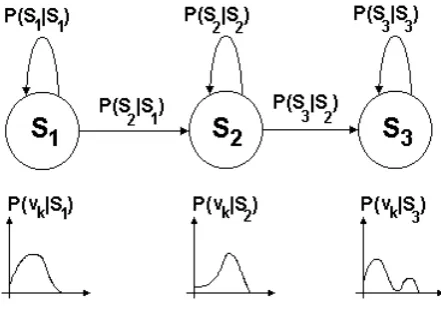
The topology of HMM is defined by the probable transitions. The general case where all the states are connected is known as ergodic model. A special topology widely used for speech recognition is the left-right model [MARKOWITZ 96]. The state sequence of the left-right model has the property that the state index always increments or stays the same but never decrements in the time. In other words the state system goes from left to right.
In the figure 3, a left-right model is shown. Some simplifications could be made in the state-decoding block for left-right models. If j=1 then ψt(j)=1, because if the next state is Si=1, the current
[image:4.595.186.407.542.699.2]state must also be Si-1=1. For the states j and i, the value of aij will not be zero only in the case that j =i or j=i+1.
Fig. 3. Typical three-state HMM left-right model.
logarithm of probabilities. Thus, in the equations (2) and (3), all the multiplications are reduced to additions, and the maximum operation corresponds to a minimum operation since the absolute value of the logarithm of a high probability is a small number. The main computational load as described above, is in equation (2), and consists of N2
+
log(aii+1) δt-1(i)
+
log(aii) δt-1(i)
COMPARE
MUX
+
(bj(ot))
δt(i)
MUX
log(bj(o
i-1 i
ψt(i)
[image:5.595.181.418.131.423.2]T add and maximize operations.
Fig. 4. Basic Block for add-compare-select operations.
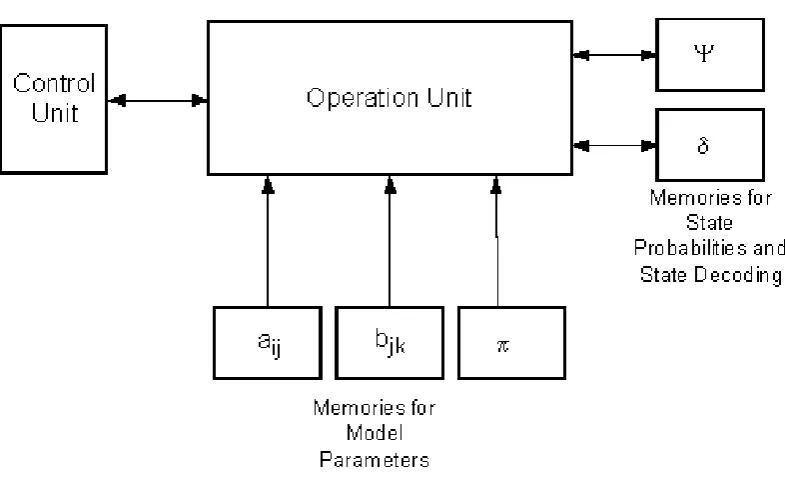
Fig. 5. State Decoding System.
[image:5.595.100.493.465.705.2]increased complexity, we implemented a fixed-point representation. For a fixed-point implementation, we may employ a scaling procedure to maintain a limited range of the accumulated likelihoods δt
Model parameters log(π
(i).
i), log(aij), log(bj(ot
In figure 5, the complete system is shown. A preliminary design of a state decoding for isolated speech recognition was implemented using FPGA. The Maxplus tool for Altera devices was used [SCARPINO 98]. The circuit was mapped in the EPF10K20TC144-3 device. There were necessary 197 logic cells for an 8-state HMM state decoding. Simulation results showed a good performance.
)) and probabilities values are stored in internal memories.
5. Conclusions
This paper presents a preliminary design of a FPGA implementation of HMM state decoding.
The implementation is a starting point for a second-generation state decoder design that would serve as a practical building block for pattern recognition systems.
Future work involves the examination of the issues involved in integrating the state decoder into a computer system. The fixed-point implementation makes necessary a stage normalization to retain accuracy and avoid underflow.
Perhaps the hardest task in the creation of an efficient high-level simulation model for the complete design that captures the non idealities of each block of a speech/speaker recognition system. The ultimate design goal of a speech recognition system is low recognition error. Achieving this goal requires circuit-level and microarchitecture optimizations.
6. References
[CHONG 96] CHONG, J.; TOGNERI, R. Speaker Independent Recognition of Small Vocabulary. Sixth Australian International Conference on Speech Science and Technology, Dec. 1996. p.133-137.
[DELLER 93] DELLER, J. R. et. al. Discrete-Time Processing of Speech Signals. Macmillan Publishing Co. 1993.
[FOSTER 93] FOSTER, P.; SCHALK, T. B. Speech Recognition. The Complete Practical Reference Guide. New York: Telecom Library, Inc., 1993. 377p.
[LEE 89] LEE, K.- F. Automatic Speech Recognition - The Development of the SPHINX System. London: Kluwer Academic Publishers, 1989. 207p.
[MARKOWITZ 96] MARKOWITZ, J. Using Speech Recognition. Prentice-Hall, 1996.
[RABINER 89] RABINER, L. A Tutorial on Hidden Markov Models and Selected Applications in Speech Recognition. Proceedings of the IEEE, vol. 77, No. 2, February, 1989. p. 257-286.
[RABINER 93] RABINER, L.; JUANG, B.- H. Fundamentals of Speech Recognition. Prentice-Hall, 1993.
[SCARPINO 98] SCARPINO, F. VHDL and AHDL Digital System Implementation. New Jersey: Prentice-Hall, 1998. 316p.
![Fig. 1. Block Diagram of Pattern –Recognition Speech/speaker Recognition [RABINER 93]](https://thumb-us.123doks.com/thumbv2/123dok_es/4757749.60888/2.595.99.500.107.301/block-diagram-pattern-recognition-speech-speaker-recognition-rabiner.webp)
![Fig. 2. Block Diagram of isolated word HMM Speech/Speaker Recognizer [RABINER 93].](https://thumb-us.123doks.com/thumbv2/123dok_es/4757749.60888/3.595.129.468.297.539/fig-block-diagram-isolated-speech-speaker-recognizer-rabiner.webp)