CAMILA: Formal Software Engineering
Supported by Functional Programming
J. J. Almeida, L. S. Barbosa, F. L. Neves and J. N. Oliveira Computer Science DepartmentUniversity of Minho
Largo do Paco | 4710 Braga Portugal
fjj,lsb,n,[email protected]
Abstract. This paper describes two experiences in teaching a formal approach to
software engineering, at undergraduate level, supported byCamila, a functional programming based tool. Carried on in dierent institutions, each of them addresses a particular topic in the area: requirement analysis and generic systems design in the rst case,specication andimplementation development in the second.
Camila, the common framework to both experiences, animates a set-based
language, extended with a mild use of category theory, which can be reasoned upon for program calculation and classication purposes. The project aliates itself to, but is not restricted to, the research in exploring Functional Programming as arapid
prototyping environment for formal software models. Its kernel is fully connectable
to external applications and equipped with a component repository and distribution facilities.
The paper explains howCamilais being used in the educational practice, as a
tool to think with, providing a kind of cross-fertilization between students'
under-standing of dierent parts of the curriculum. Furthermore, it helps in developing a number of engineering skills, namely the ability to analyze and classify (infor-mation) problems and models and to resort to (the combined use of) dierent programming frameworks in approaching them.
Keywords Education and applications of functional programming, functional
CAMILA: Formal Software Engineering
Sup-ported by Functional Programming
ABSTRACT
This paper describes two experiences in teaching a formal approach to software engineering, at undergraduate level, supported by Camila, a func-tional programming based tool. Carried on in dierent institutions, each of them addresses a particular topic in the area: requirement analysis and generic systems design in the rst case, specication and implementation de-velopment in the second.
Camila, the common framework to both experiences, animates a
set-based language, extended with a mild use of category theory, which can be reasoned upon for program calculation and classication purposes. The project aliates itself to, but is not restricted to, the research in explor-ing Functional Programmexplor-ing as a rapid prototypexplor-ing environment for formal software models. Its kernel is fully connectable to external applications and equipped with a component repository and distribution facilities.
The paper explains howCamilais being used in the educational practice, as a tool to think with, providing a kind of cross-fertilization between students' understanding of dierent parts of the curriculum. Furthermore, it helps in developing a number of engineering skills, namely the ability to analyze and classify (information) problems and models and to resort to (the combined use of) dierent programming frameworks in approaching them.
1 Introduction
A signicant majority of the students who apply for an undergraduate degree in Software Engineering do possess, from the outset, some working knowledge in computation. Yet some are really sparkling with particular systems or tools. University teaching is expected to build on this knowledge for develop-ing engineerdevelop-ing skills. That is to say, the ability to classify (information) prob-lems and models and to resort to (the combined use of) dierent programming frameworks in approaching them. Moreover, the basic problem solving strat-egy people get used to from school physics | understand the problem, create a mathematical model, reason in the model, calculate a solution | should be taught as the usual way of dealing with Software Engineering problems.
This paper describes two experiences in using a particular functional pro-gramming system |Camila | to teach the principles of a Software Engi-neering methodology at undergraduate level. They were carried on in dierent institutions and each of them addresses a particular topic in the area: require-ment analysis and generic systems design in the rst case, specication and implementation development in the second.
The common framework to both experiences isCamila, an emerging plat-form for (mathematical) software development. Based on a notion of plat-formal software component, Camila encompasses a set-theoretic language and an inequational calculus Oli90,Oli92] for classifying and reasoning about them. In particular, it enables the synthesis of target code programs by transfor-mation of the initial specications. Its kernel is a functional prototyping en-vironment BA95], fully connectable to external applications, equipped with a component repository and distribution facilities.
Camila1 was originally devised as a collection of interrelated support
tools for teaching formal specication methods. A number of educational projects and non trivial case-studies carried on in industrial (see, e.g. Oli95]) contexts have shown the language potential in exploring a broader scope of the curriculum. In fact, using Camila as a common working framework provided a kind of cross-fertilization between students' understanding of a number of dierent domains. Furthermore it helps in concentrating on the essential and requiring more and more precision and clarity in problem for-mulation.
Camila development aliates itself to, but is not restricted to, the
re-search in exploring Functional Programming as a rapid prototyping environ-ment for formal software models, whose origin can be traced back to Peter Hendersen'sme tooHen84]. In fact, a major achievement of Functional Pro-gramming has been to enforce a view of proPro-gramming as a mathematical ac-tivity, at the right (human) level of abstraction, concentrated on exploring the complexity (and beauty) of problems to be solved. Since the pioneer working of McCarthy McC63], the interplay of research in Functional Programming, Formal Specication Methods and Semantics, has made it possible to liber-ate software development from ad hoc approaches and to set up information technologies with sound mathematical basis. We believe that this program remains, at present, a fundamental concern, with relevant implications in education.
In the next two sections we try to support this claim by describing in some detail the above mentioned teaching experiences using Camila in a Software Engineering course at undergraduate level. The Camila language
1
Camila is named after a Portuguese 19th-century novelist | Camilo
and calculus will be introduced along the way. Finally, section 4 presents some conclusions and comparison with related work.
2 Case A: Systems Modeling and Design
The rst experience to be reported here concerns the use of Camilafor ap-proaching requirement analysis and software design, as part of the Systems Design course taught to third-year students of the Computer Systems Engi-neering degree at the University of Bristol (UK). This degree is particularly oriented towards computer architectures, communications and systems pro-gramming, though in the rst two years students are supposed to undertake courses in programming (usingHaskellandC) as well as in logic, discrete mathematics and -calculus.
The Systems Design course aims to challenge students' ability to deal with the diculties of analyzing and managing the design of \real" information systems as well as to develop teamwork skills. In this context a medium-size case study, in the form of an, often ambiguous, user requirements document, is assigned to a group up to ten people. A full prototype of the system, exhibiting its functionality and modular organization, is expected within a 3 months period. Typical themes have been, in recent years, an Emergency Network Management System, a Control System for a TaxiBus Service, Data Mining over a Temporal Warehouse Database and a study of Fault-Tolerance Strategies for Distributed Systems.
In a rst phase,Camila is used to model the project requirements, cap-turing its structure as a network of software components. When analyzing the structure of an information system, Software Engineering draws a funda-mental distinction between entities, which represent information sources, and transformations upon them. The former will originate the data structures, the later the algorithms. A similar distinction appears in the denition of an algebra (sets and functions) or relational structure (sets and relations), which makes such mathematical objects suitable in modeling information systems. Hence, mathematically, a software component stands for a (multi sorted) al-gebra or a relational structure, which expresses, in a concise but meaningful way, the specication of (some part of) an information system.
Components are described in the centenary notation of set theory. For several years in their past education, since the primary school, students have become familiar with such a notation as a tool to think with. This course intends to build on this experience.
In fact, the specication language is an executable version of set theory, resorting to the \pure" mathematical notation arising from the (Cartesian closed) structure of the categorySet of sets and set-theoretical functions. It
Basic set constructors capture essential operations upon information:
{ Cartesian product (A B) for aggregation in the spatial axis,
{ coproduct (A+B), for choice (i.e., aggregation in the temporal axis) and { exponentiation, or function space, (A
B) for functional dependence.
Notice that when processing entities denitions, the prototyper generates automatically the constructors and selectors of each product type as well as the canonical origin predicates associated to coproduct types2. A number of
derived constructors are also available in theCamilakernel notation. Those include, for niteAandB,
2
A nite subsets
2
A B binary relations
A,!C , X
KA C
K nite mappings
A
, X
nN A
n nite sequences
as well as the \null" alternative (A+1), where 1 is a terminal (singleton)
set, and recursive denitions in the form X = F(X), where F is a
set-theoretical expression involving the above constructs. Those constructs are directly expressible in the prototyping language3, from which a high level
description is automatically generated (in the form of a LATEX le). The basic
algebras associated with them (e.g., intersection or union of two sets, joining of binary relations, domain or range of a mapping, concatenation of sequences and reduce operators, structure denition by enumeration or comprehension, etc.) are also available as primitives in the language. So are the propositional connectives and quantiers. Anonymous function denitions, in the form of
-expressions, and high-order functions are also allowed.
A very important feature (to our knowledge new in an executable nota-tion) is the fact that the set constructors also act upon functions (either prim-itive or user-dened) lifting its eect to the generated structure. Technically this amounts to saying that entities inCamilaare modeled by (endo)functors inSet, uniformly transforming either sets and functions OB97]. For example,
the expressions(f-set)-seqand (f-seq)-setcorrespond, respectively, to
the action upon the function f : A ;! B of the functors (2 ) and
2 ( ).
In the rst case f is applied to all the elements of the sets aggregated in a
sequence in the second to all the elements of the sequences collected in a set.
2 In a coproduct A
i
A
;! A+B i
B
; B origin predicates are dened as in
is-A(x) , 9a2AiA(a) =x.
These enables a particularly fruitful modular calculus in which students are able either to enrich or specialize their system components by composing them with suitable functors, respectively, on the right and on the left. For example, suppose a team has arrived to the following denition of a (pa-rameterized) data relation as a set of tuples of mappings from attributes to something:
DR( ) =2 Att,!
This may be either enriched, e.g. by aggregating a decision tree component on the attributesDT =P (Att,!DT),Pstanding for a set of propositions
about attributes, or specialized, e.g. to allow for associations of attributes to sequences of values. Doing both amounts to the following composition:
S( ) = ( DT)DR
that is,
S( ) =2 Att,!
DT
This can be instantiated toS(Val),Valbeing whatever set chosen to model
values in the system, or further lifted to a temporal indexed structure by com-posing again on the right with the functorT,! , whereT is a non-empty set
thought of as a discrete representation of time. This yieldsT,!S(Val), one
of the structures actually used in the temporal warehouse database project. What is interesting in this process is the fact that all the functions dened upon the simpleDRmodel can be lifted to the new structures in a functorial
way, and this mechanism is indeed supported by the language. For example, having dened a query operationq:S(Val);!ValuponS(Val), one may
directly useT,!q:T,!S(Val);!T,!Val on the temporal enrichment.
TheCamila notation provides a straightforward way to make progress
from very simple models to complex ones. Moreover it oers a framework for classifying models (and problems) encouraging re-use of previous solutions. In fact, architectural relationships in the Camila repository such as is-a, is-used-by, is-special-case-of or, as we shall discuss in the following section, is-implementation-of, are formally decided rather than xed by intuition. Furthermore they are built-in in the Camila components repository. As an example of the former consider again the entityDTof a component modeling
decision trees. This may be specialized into a model of either genealogical diagrams or subject taxonomies as soon as we make Att = 2 or P = 1,
respectively4(see Oli92] for details). 4 Making simultaneously
Att=P =1,DT boils down to a model of the natural
numbers (byDT
= 1(1,!DT)
= 1,!DT
As most projects in Software Engineering have to deal with distribution and communication issues, and those form a fundamental part of the curricu-lum, the orientation towards concurrent and distributed systems emerged as a major theme in theCamilaproject from the very beginning. The prototyp-ing environment oers a small set of communication primitives so that, in a second phase of the Design Project, students are able to distribute their com-ponents along a network ofCamilaprocesses, simulating the physical archi-tecture of the \real" system. A prototyper tool (calledinterface) generates
for each component the entities names and operations signatures concerning the available external services oered5. Dierent communication disciplines
| ranging from synchrony to asynchrony, or point-to-point to multicast | can be prototyped inCamilajust in the same functional style used in mod-eling any other software component. Moreover, structural properties of these disciplines can be documented (and compared) as equations on functional terms. It is worthy notice that this usually provides a fresh look on the stu-dents previous background on protocols and communications.
In summary we shall point out that resorting toCamila as a framework to study Systems Design has been proved helpful in a number of issues:
{ Camila helps in concentrating on the essence of the dierent aspects
to be modeled, recording their structure and properties at an abstract level, while retaining the possibility of executing (i.e., animating) the de-sign. More than being seen as another course in the curriculum,Camila
is understood as a common language to integrate previous knowledge, interrelating concepts and put them to work.
{ It requires more precision from students, contributing to developing
strate-gies for the correct formulation of systems requirements and questioning their own designs by asking the prototyper questions like and what if ...?. Notice the target students have no previous experience on formal speci-cation methods, which are introduced, through aZcourse, only on the following semester.
{ Finally, we have found that usingCamilaas a project framework allows
for a more eective communication among the design team, developing teamwork skills, and emphasizes the incremental and iterative character of the software design process. A distinguished feature ofCamila is the capacity to handle partially dened functions, i.e. functions whose sig-nature has been declared but whose computation rule has not yet been supplied. Whenever the interpreter is requested to evaluate such a func-tion it will prompt the user for a value and proceed with the calculafunc-tion. This enables to test incomplete prototypes, eventually integrating mate-rial still under development.
5 In subsequent phases this same tool allows for the automatic generation of on-line
3 Case B: Renement and Interconnection
This section describes the experience gathered at Minho University (Portu-gal) in teaching formal methods for software development at undergraduate level, supported by functional programming tools. Although these methods have been taught to Minho undergrads since 1984, it is only after the ad-vent of the Camila environment (1990) and of the rst steps of the Sets
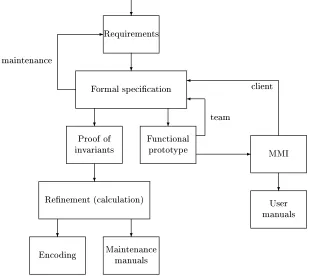
reication calculus Oli87] that such a teaching eort becomes systematic and follows a regular pattern | that of the formal development life cycle depicted in Figure 1.
As systems modeling inCamila has been discussed in the previous sec-tion, we will be concerned here with the development phase, which constitutes the main subject of a nal year undergraduate course in Formal Methods at Minho. The overall target is to teach students how to develop a client-server architecture for a (possibly distributed) information system.
Proof of
invariants Functionalprototype
? ?
Formal specication
?
Requirements
- MMI ?
Renement (calculation)
?
Encoding Maintenancemanuals
? ?
team
client maintenance
User manuals
?
Fig.1.A Formal Software Development Life Cycle
[image:8.595.151.463.302.578.2]and quick feedback about its behavior being gathered within the design team (see the team arrow). Camila's type-checking lters primary specication (syntactic) errors and unexpected semantic behavior is likely to be spot and corrected.
After a few iterations, the design should become stable and all members of the team should believe in it. It will be time to bring the \client" in (either the teacher or whoever wrote the requirements), just to see whether critical misreading of the requirements are under way. To comply with current standards on human-machine interaction, it will be convenient to \hide" the prototype behind a capable window-manager. This is the start-point of the client-server bi-partition, made possible by the fact that Camila code can be easily embedded in C/C++ code6.
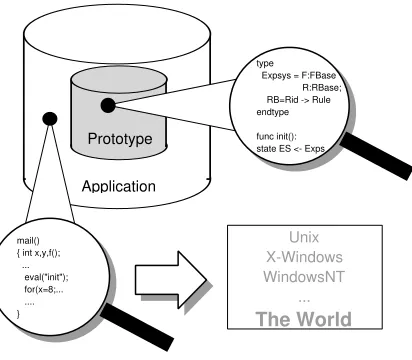
Students are encouraged to dene the functional API which emerges nat-urally from the algebraic structure of the formal model itself, so that their prototype may be called from the outset as a normal C/C++ server appli-cation. It is such an algebraic signature which induces the specication of a \canonical" syntax-directed-editor-like interaction layer (see box MMI in Figure 1), following a formal approach to user-interface design described else-where (see e.g. MO90,Mar95]). The next task is to encode such a structural editor in a particular technology, typically Tcl/Tk or Borland's Delphi, and provide for its interconnection to the C/C++ protocol which embeds the originalCamilaprototype (see Figure 2).
At this point, the existing formal specication and its prototype are likely to undergo a new iteration of changes, as suggested by the client's taste and experimentation with the prototype system. These may either be concerned with the user-interface (adding to or modifying the underlying signature) or the semantic model itself (adding to or modifying the behavior of the pro-vided functionality). This is the \higher-energy" design iteration loop which corresponds to the client arrow in Figure 1.
Once both team and client agree to exit from this loop, two parallel ac-tivities may start: the preparation of the user-manuals, made possible by the belief that the user-interface has reached a stable phase7, and the so-called
reication phase (see box Renement (calculation) in Figure 1). The latter is preceded by what may be called a (ne-grain) \design certication" ef-fort: should data-type invariants be present in the formal specication, time
6 But note that this client-server split is not bound to the need for a user interface.
A good illustration is provided in report RP95]: in a cross-fertilization with a parallel course on compiling, a batch version of a production planning system was made available as an interpreter (written in Eli), the semantic actions of which were emulated byCamilaanimation of the system's formal specication,
on the background.
7 In practice, it is hard to obtain such a high level of satisability: because the
C
Unix X-Windows WindowsNT
...
The World
Application Prototype
type Expsys = F:FBase R:RBase; RB=Rid -> Rule endtype
func init(): state ES <- Exps
mail() { int x,y,f(); ... eval("init"); for(x=8;... .... }
Fig.2.Design Embedding inCamila
has come for providing invariant preservation formal proofs concerning all relevant operations (functions). This is perhaps the most expensive task in the whole life-cycle (it requires good skills in mathematics) but it is of vital importance to the overall quality of the design.
The reication phase is a systematic process, that of step-wise transforma-tion of the original specicatransforma-tion into another formal specicatransforma-tion which can be eventually recognized as the formal semantics of a particular command, or program fragment in the intended target server technology. A particular-ity of the Camila life-cycle at this point is to adopt a program calculation strategy instead of the more conventional \invent-and-verify" one. For this purpose, a particular abstraction invariant calculus, using the terminology of Mor90], has been developed | Sets Oli90,Oli92] | which exploits the categorical foundations of theCamila's notation so that more and more con-crete data-structures modeling the specication sorts can be found by cal-culation, accompanied by the synthesis of abstraction functions and induced implementation-level invariants.
Dierent laws of Sets lead to dierent implementation structures and platforms. For instance, the most common target technology is that of rela-tional databases, typically materialized by a particularSqlserver. A database table is trivially formalized, in theSetsnotation, by a relation in2
A Bor a
mapping inA,!B, forA,Barbitrary products of \atomic" types. Therefore,
[image:10.595.197.403.119.299.2]a target environment8. A Setslaw is an (in)equation of the form
AE
f B
stating that every instance ofAcan be reied into the corresponding instance
ofB, by adopting abstraction functionfand provided that concrete invariant is enforced over B. On the whole, the following abstraction invariant is
synthesized:
ab:(a=f(b))^(b)
For instance, law
A,!D (B ,!C)E dpi
o n
n(
A,!D) ((A B),!C) (1)
states that nite mapping nesting of can be attened. Repeated application of this law makes it possible to boil arbitrarily nested, intricate mapping-based data structures, down to products of atomic relation tables. The relevant abstraction function (on
n) computes a kind of \nested join" and invariant dpiwill guarantee that such a join operation is eectively computed (see e.g.
Oli92] for details).
Sets is pregnant of useful laws for data reication. Among these, laws which like (1) \push the construct outwards" make for horizontal rene-mentGog86] and distribution OBM97] in a natural way. This has a benecial consequence at Camilaprototyping level: students may choose which \fac-tor" of a given product (e.g. the left-hand-side of (1)) will be vertically reied in the next place. This leads to what (in the Camilaterminology) is called a \hybrid" prototype: parts of the system which are already fully reied may cohabit (and communicate) with other parts still awaiting for their reication to take place (i.e. functionality still emulated by aCamilaprocess).
Of course, such temporary congurations of the system (which may re-quire abstraction/representation functions explicit at run time) cannot be expected to be particularly ecient ones. But they provide for smooth, step-wise reication and testing. Should the system be too complex or students run out of time, a hybrid prototype system will be tolerated9. Otherwise, all
Camila components will eventually yield place to full implementations10.
8 Should the target programming language be, for instance, C, then laws leading
to structures of the 1 +Apattern (the \pointer toAabstraction") will become
relevant, in particular recursive structures of theX = 1 +F(X) shape. Besides
the relational database paradigm, including a re-interpretation ofnormalization
theoryas a subset of theSetstheory Rod93], hash tablesare a class of
imple-mentation device which has been carefully calculated inSetsOli94].
9 Report SRVN96] of last year's course provides a good example of this, in which
students went further to displaying data evaluated by theCamilasubprototype
in blue-background text-boxes and data produced by already calculatedSqlcode
(overOracle) in white ones, thus providing good evidence of the hybridization
process at demo time.
10Report RP95] of the 1995/96 course was particularly successful in showing
Pro-C-Concerning operation reication, and once the overall abstraction invari-ant has been calculated, two alternatives are available: either the Oxford Renement Calculus Mor90] or the Fold-Unfold Calculus Dar82]. The lat-ter has been more popular simply because of the functional avor ofCamila
specication. For each abstract function
:A;!B
in the formal specication, and renement diagram
A
A
1
B
1 B
6
f
6
g
whereA 1and
B
1are implementations of, respectively,
AandB(witnessed by
the abstraction functionsf andg), the exercise amounts to nding a solution
for
1 in equation
8
a
1 2A
1 :g(
1( a
1)) = (f(a
1)) (2)
thus \closing" the diagram:
A
A
1
B
1 B
1
6
f
6
g
The categorical basis of theSetscalculus helps particularly in this reasoning by providing many \functorial" or \natural transformation" (\Wadler-like" Wad89]) theorems for function transformation OB97].
The nal tasks of code and documentation generation (see the Encoding and Maintenance manuals boxes in Figure 1) are softened by the overall discipline. The former is a repetitive exercise of re-writing \abstract code" into some concrete syntax, that of the chosen target language (e.g. the same embeddedSqlmay happen to be. A fullCamila prototype was demonstrated
side by side with the full Sql version (nal implementation). Switching from
tail-recursive abstraction will lead to dierent for-loops in Pascalor C).
The latter is but a systematic transliteration of mathematics into natural language, browsing the whole specication and reication process.
Last but not least, a few words about the maintenance arrow in Figure 1. The academic context in which these experiments have been carried out has not yet provided sucient experience in this area. However, the overall formal discipline can only help in keeping the impact of changes under control, once the documentation can be easily followed up (provided the maintainer knows the adopted formal method). The \locality of eect" of both the formal spec-ication and the formal respec-ication process (as inherited from the underlying mathematics) is the good news here, in contrast with chaotic development and eventual lack of information.
4 Conclusions and Comparison
In recent years Camila has been used on several educational projects as part of undergraduate and master degrees curricula, witnessing the adequacy of Functional Programming for developing modeling, re-use and calculation skills in Software Engineering (see Ker95] for a similar discussion in a related area). The two experiences reported here may provide some evidence on this claim.
With respect to the rst, we would like to point out that, quite surpris-ingly (or perhaps not), manipulating and combiningSet-expressions appears
to be a much more eective way (with a clear semantics and rich calculus) for understanding and reasoning about a sheet of requirements, than the tons of \diagrams" and \structured analysis" used in traditional approaches to teach-ing Software Engineerteach-ing. Notice however that Camila incorporates a tool for generating the mathematics underlying traditional Entity-Relationship diagrams OC93] useful whenever a particular system component is already implemented and some reverse engineering is needed to reason about it. De-sign evolves in an experimental setting, starting with simple, yet executable models and calculating possible elaborations. The words of P. Halmos about mathematics in, Hal85], may be adopted to the kind of approach to Software EngineeringCamilastimulates:
Mathematics is not a deductive science { that's a clich e. When you try to prove a theorem, you don't just list the hypotheses, and then start to reason. What you do is trial and error, experimentation, guesswork. (...) the source of all great mathematics is the special case, the concrete example. It is frequent in mathematics that every instance of a concept of seemingly great generality is in essence the same as a small and concrete special case.
With respect to the second experience, our main conclusion is that the
and the functional programming traditions11, in a way which appears to be
reasonably successful in both academia and industry.
But the potential of Functional Programming in teaching may be further assessed by looking atCamilaexperiences in the extreme points of the edu-cational spectrum: teaching set theory and elementary discrete mathematics at secondary school level VA94], one the one hand, training programming professionals in industry, on the other.
The Camila approach to programming technology claims to provide a
smooth way to teaching and using (constructive) formal methods in software engineering. Similar motivations may be found in the research on formal specication methods, such asVdmJon86],ZSpi89],RaiseGeo91], Cold-K FJ92] or Larch GH93]. In fact, a Camila component resembles what is called a model in the Vdm meta-language or a schema in Z. We could stress, however, the lighter notation of Camila, borrowed from set theory, and the direct correspondence to the prototyping functional system. But what is, to our knowledge, new is the associated calculus for model reasoning and renement as well as the full incorporation, at the executable level, of the functorial structure of functions. On the other hand, Camila lacks the sophisticated interface and documentation management features available, for instance, inRaise.
Acknowledgments
TheCamilaproject has been supported by theJNICTcouncil underPMCT
contract nr. 169/90. The on-going interaction with our students at Minho and Bristol Universities provided several remarks into both the tools and the methodology. Fruitful discussions with Bruce Pilsworth and John Lloyd on the Bristol experience have been illuminating.
References
BA95] L. S. Barbosa and J. J. Almeida.Camila: a reference manual. Technical
Report DI-CAM-95:11:2, DI (U. Minho), 1995.
Bac78] J. Backus. Can programming be liberated from the von Neumann style? a functional style and its algebra of programs. Communications of the ACM, 21(8):613{639, August 1978.
Dar82] J. Darlington. Program transformation. InFunct. Prog. and Its
Appli-cations: An Advanced Course. Cambridge Univ. Press, 1982.
FJ92] L. Feijs and H. Jonkers.Formal Specication and Design. 35. Cambridge Tracts in Theoretical Computer Science, 1992.
Geo91] C. George. The raise specication language: a tutorial. In Proc. of
VDM'91. LNCS (551), 1991.
11Sometimes, one has the impression of programming and reasoning in a categorical
GH93] J. Guttag and J Horning. Larch: Languages and Tools for Formal
Spec-ication. Springer-Verlag, 1993.
Gog86] J. A. Goguen. Reusing and interconnecting software components. IEEE
Computer, 19(2):16{28, 1986.
Hal85] P. Halmos. I Want To Be a Mathematician. MAA Spectrum, 1985. Hen84] P. Hendersen. me too: A language for software specication and model
building. Preliminary Report, University of Stirling, 1984.
HPe95] P. H. Hartel and M. J. Plasmeijer (editors).Functional programming
lan-guages in education (Proc. of FPLE, Nijmegen). LNCS (1022).
Springer-Verlag, 1995.
Jon86] Cli B. Jones. Systematic Software Development UsingVDM. Series in
Computer Science. Prentice-Hall International, 1986.
Ker95] E. T. Keravnou. Introducing computer science undergraduates to prin-ciples of programming through a functional language. In P. H. Hartel and M. J. Plasmeijer, editors,Functional programming languages in
ed-ucation (FPLE), LNCS 1022, pages 15{34, Nijmegen, The Netherlands,
Dec 1995. Springer-Verlag.
Mar95] F. M. Martins. M etodos Formais na Concepc~ao e Desenvolvimento de
Sistemas Interactivos. University of Minho, 1995. Ph. D. thesis (in
Por-tuguese).
McC63] J. McCarthy. A basis for a mathematical theory of computation. In P. Braort and D. Hirshberg, editors,Computer Programming and
For-mal Systems, pages 33{70. North-Holland, 1963.
MO90] F. M. Martins and J. N. Oliveira. Archetype-oriented user interfaces.
Computer & Graphics, 14(1):17{28, 1990.
Mor90] C. Morgan.Programming from Specication. Series in Computer Science. Prentice-Hall International, 1990. C. A. R. Hoare, series editor.
OB97] J. N. Oliveira and L. S. Barbosa. Sets (subtyped) polymorphism as
natural transformation. Technical report, (submitted for publication), Jan. 1997.
OBM97] J. N. Oliveira, L. S. Barbosa, and F. S. Moura. Can distribution be (stat-ically) calculated? Technical report, DI/INESC, 1997. (In preparation). OC93] J N. Oliveira and M. Cruz. Formal calculi applied to software component knowledge elicitation. Technical report c19-wp2d, project c.1.9. sviluppo di metodologie, sistemi e servizi innovativi in rete, INESC, 1993. Oli87] J. N. Oliveira. Renamento transformacional de especicac~oes
(termi-nais). In Actas das XII \Jornadas Luso-Espanholas de Matem atica", volume II, pages 412{417, Braga, Portugal, 4-8 Maio 1987.
Oli90] J. N. Oliveira. A reication calculus for model-oriented software speci-cation. Formal Aspects of Computing, 2(1):1{23, 1990.
Oli92] J. N. Oliveira. Software reication using theSetscalculus. In Proc. of
the BCS FACS 5th Renement Workshop, Theory and Practice of Formal
Software Development, London, UK, pages 140{171. Springer-Verlag, 8{
10 January 1992. (Invited paper).
Oli94] J. N. Oliveira. Hash tables | a case study inE-calculation. Technical
Report DI/INESC 94-12-1, DI/INESC, U. Minho, December 1994. Oli95] J. N. Oliveira. Fuzzy object comparison and its application to a
Rod93] C. J. Rodrigues. Sobre o desenvolvimento formal de bases de dados. Master's thesis, University of Minho, 1993. (In Portuguese).
RP95] M.A.R. Rebelo and R.M.N. Pinto. Trabalho pr#atico | departamento de planeamento de produc~ao. Technical Report LMCC-Op6-95/1, Univer-sidade do Minho, Feb. 1995. (In Portuguese).
Spi89] J. M. Spivey. The Z Notation: A Reference Manual. Series in Computer Science. Prentice-Hall International, 1989.
SRVN96] A.C. Sampaio, J.M. Rodrigues, L.F. Varandas, and M. Noval. Informa-tizac~ao de uma empresa de construc~ao civil. Technical Report LMCC-Op6-96/1, Universidade do Minho, Jun. 1996. (In Portuguese).
TH95] S. Thompson and S. Hill. Functional programming through the cur-riculum. In P. H. Hartel and M. J. Plasmeijer, editors,Functional
pro-gramming languages in education (FPLE), LNCS 1022, pages 85{102,
Nijmegen, The Netherlands, Dec 1995. Springer-Verlag.
VA94] M. Vieira and R. Alves. Camilain secondary schools. Technical Report
(in Portuguese), Universidade do Minho, 1994.
Wad89] P. Wadler. Theorems for free! In4th International Symposium on
Func-tional Programming Languages and Computer Architecture, September