Universidad Nacional de La Plata Facultad de Ciencias Económicas
Departamento de Economía
Sexto Seminario Internacional
sobre Federalismo Fiscal
26 de noviembre de 2001
Pilar, Buenos Aires, Argentina
Evaluating the Impact of School Decentralization on Education
Quality
Evaluating the Impact of School Decentralization
on Education Quality
Sebastián Galiani
UdeSA
and
Ernesto Schargrodsky*
UTDT
September 19, 2001
Abstract
An important piece of the major fiscal and structural reforms undertaken in Argentina in the early 1990’s was the decentralization of education services from the federal government to the provincial governments. The theoretical literature does not find absolute superiority of centralization or decentralization in the provision of public services. We evaluate empirically the effect of the decentralization of secondary schools in Argentina on education quality. Our results suggest that, on average, decentralization improved the performance of public school students in test scores. We also explore whether the effect of decentralization depends on province characteristics. We find that the effect is positive when schools are transferred to fiscally ordered provinces, but negative when provinces run significant fiscal deficits.
JEL: H40, H52, H70, I20
Keywords: Decentralization, evaluation, education quality.
*
Sebastián Galiani, Universidad de San Andrés, Vito Dumas 284, (B1644BID) Victoria,
Provincia de Buenos Aires, Argentina, Tel: (54-11) 4746-2608, [email protected]. Ernesto
Schargrodsky, Universidad Torcuato Di Tella, Miñones 2177, (C1428ATG) Buenos Aires,
Argentina, Tel: (54-11) 4784-0080, [email protected]. This paper was done while Sebastián
I. Introduction
Decentralization is a major component of current institutional innovation throughout
the world. In Latin America, most countries implemented decentralization policies in the
recent past after a long tradition of centralized government (Burki, Perry, and Dillinger,
1999).1 Argentina has not been the exemption. An important piece of the structural
reforms undertaken in Argentina in the early 1990’s was the decentralization of education
services from the federal government to the provincial governments.
The main argument in support of decentralization policies is to bring decisions closer
to the people. Information asymmetries, agency costs and problems of collective decision
can be alleviated through decentralization. However, decentralization can also worsen the
provision of public goods in the presence of positive spillovers, lack of technical
capabilities by local governments, or capture of low-level administrations by local elites.
Thus, the theoretical literature obtains trade-offs without universal superiority of
centralization or decentralization in the provision of public services. The problem needs
to be analyzed empirically.
In this paper, we evaluate the effect of secondary school decentralization in
Argentina on education quality. Between 1992 and 1994, the national government
transferred to the provincial governments all its dependent secondary schools.2 This
1
Recent studies analyzing decentralization processes in Latin America include Lopez Murphy (1995), Tendler (1997), Bird and Vaillancourt (1998), Fukasaku and Hausmann (1998), Savedoff (1998), and Willis et al (1999). On Argentina, see Porto and Gasparini (1998), Grindle (2000), Tomassi, Saiegh, and Sanguinetti (2000), inter alia.
2
political experiment generates an exogenous variation in the jurisdiction of administration
of secondary schools across time and space. We exploit this instrument to identify the
causal effect of school decentralization on education quality, measured by the outcome of
a standardized test of Language and Mathematics administered to students in their final
year of secondary school.
An advantageous feature of our study is that we not only control the performance of
students on test scores by the evolution of observable variables but, by contrasting public
and private school test outcomes, we are also able to control the performance of students
on test outcomes by the effect of unobservable factors that could differentially affect the
evolution of student performance in each province. Thus, our estimator of the effect of
school decentralization on test outcomes is the conditional difference in difference of the
difference of public and private test outcomes. Our results suggest that, on average,
decentralization improved the performance of students in test scores.
As theoretical results suggest, we also interact the decentralization policies with
measures of province characteristics: fiscal performance, political alternation, and
province size (surface, population and density). We find that the effect of school
decentralization on test outcomes is heterogeneous with respect to provincial fiscal
performances. The effect of decentralization on test scores is positive when schools are
transferred to fiscally ordered provinces, but negative when provinces run significant
fiscal deficits. If fiscal performance proxies for the technical capabilities of local
administrations, our results suggest that decentralization is deleterious when services are
decentralization on test outcomes is not heterogeneous with respect to the other
characteristics interacted.
Two related papers analyze the effect of decentralization on education in Argentina.
Their approaches are quite different from ours. Eskeland and Filmer (2000) find that
school decision autonomy and parental participation (proxied by survey measures) raise
test scores. However, their cross-section study does not rule out the possibility that
autonomy and participation are endogenously determined. Habibi et al (2001) find a
positive effect of fiscal decentralization (measured by revenue-sharing ratios between the
provinces and the federal government) on secondary school enrollment at the province
level. Without controlling by trend or year effects, their results may be capturing a
spurious correlation. None of these papers analyze an explicit policy intervention of
school decentralization.
The organization of the paper is as follows. Section 2 discusses potential trade-offs in
school decentralization. Section 3 explains the process of decentralization of secondary
schools in Argentina. Section 4 describes our empirical exercise and Section 5 presents
our results. In the last section, we summarize our conclusions.
II. Decentralization Trade-Offs
The theoretical literature obtains trade-offs without absolute dominance of
centralization or decentralization in the provision of public services. In Oates (1972),
central governments produce a common level of public goods for all localities, while
governments are preferable when the better match between local government outputs and
local preferences is not outweighed by spillovers or economies of scale in central
government provision. Lockwood (1998) and Besley and Coate (2000) allow for
heterogeneous local provision but central policy making in which elected representatives
bargain over public goods provision. With heterogeneous provision, the case for
decentralization has to be driven by political economy considerations, i.e. drawbacks in
the political and legislative processes of centralized systems that may induce inequity,
uncertainty, or excessive public spending.
Bardhan and Mookherjee (1998) trade off limited central government ability to
monitor the bureaucrats against capture by local elites under decentralization. If the
capture of political process by interest groups is easier at the local level (by interest
groups that are locally big but nationally small), then decentralization will tend to favor
those local groups disproportionately. In Tommasi and Weinschelbaum (1999), the
advantages of centralized decision making (internalization of externalities) are compared
to those of decentralized decision making (increased control of agents by the citizens
through lower information asymmetries, less free-riding and easier coordination). In
addition, decentralization may have the advantage of encouraging competition if citizens
“vote with their feet” (Tiebout, 1956).
Thus, the main argument in favor of decentralization is to bring decisions closer to
the people. The problems of information asymmetries over heterogeneous preferences,
and the problems of collective decision and accountability in controlling political agents
can be alleviated with decentralization. In addition, decentralization may encourage
there are positive externalities, if low-level governments lack technical capabilities, or if
local administrations are captured by local elites that face reduced political competition
within the region.
Most of these advantages and disadvantages may be relevant in the provision of
educational services in Argentina. Lack of expertise of local management, and capture by
corrupt local elites (Bardhan and Mookherjee, 1998; Rose-Ackerman, 1999) are
potentially important in our context. The presence of positive externalities in education
has been pointed out by Adam Smith and Alfred Marshall. Becker (1964) and Lucas
(1988) argue that education social returns exceed private returns, although Heckman and
Klenow (1997) question these externalities. In our context, however, it is arguable
whether these externalities are exhausted at the province level, or whether they spill to
the whole country.
The advantages of having “policy closer to the people” may also be relevant in our
context. The explicit reasons for the school transfer in Argentina were to increase
efficiency and efficacy through proximity to demand and unification of management and
control at the province level (Llach et al, 1999). Faguet (2001)’s results on Bolivian
decentralization suggest that local government have better knowledge of idiosyncratic
preferences. As mentioned, Eskeland and Filmer (2001) find a positive effect of parental
participation on school performance. Paes de Barros and Mendonca (1998) find no effect
on test performance of school financial autonomy and school boards in Brazil, but
positive effects of decentralized director appointment. Decentralization seem to lower
participation in El Salvador and Nicaragua (Jimenez and Sawada, 1999; King and Ozler,
2000).
Regarding competition for students, previous empirical work shows that competition
can improve schools (Hoxby, 2000). However, as it will be described in the next section,
decentralization of secondary schools in Argentina from the federal to provincial
governments implied less, rather than more, competition in the provision of public school
services. In most Argentine provinces, national and provincial schools “competed” before
decentralization in the same cities, but uniform provincial provision remained after
decentralization.
III. School Decentralization in Argentina
The traditional organization of the school system in Argentina had three stages:
Pre-School, Primary School (mandatory, 7 years), and Secondary School. Throughout the
country, school services were provided by public (national, provincial, and municipal)
and private schools. There were three types of secondary schools: general (“bachiller” -5
years-), commercial (“comercial” -5 years-) and technical (“tecnico” -6 years-). By Law
24.049 (December 5, 1991), the Argentine Congress established the transfer of federal
secondary schools from the national government to the provincial governments.3
Most Argentine provinces already administered a significant proportion of secondary
schools. For historical reasons, this proportion was very heterogeneous across provinces
represented 61% of total public students, fluctuating from 8% in Rio Negro to 100% in
Tierra del Fuego.4 By 1994, less than 3% of public secondary school students studied in
federal schools.5,6
The Decentralization Law stated that school transfers would be scheduled through
the signature of bilateral agreements between the federal government and each province.
These agreements introduced variability across provinces in transfer dates. According to
the bilateral agreements, secondary school decentralization took place between February
1992 and January 1994. The transfer dates were unrelated to education quality. The
heterogeneity originated in political conflicts between the Nation and the provincial
governments (Rothen, 1999).7
This significant variation in the degree and timing of the decentralization process
across provinces allows us to identify its effects on education quality controlling for fixed
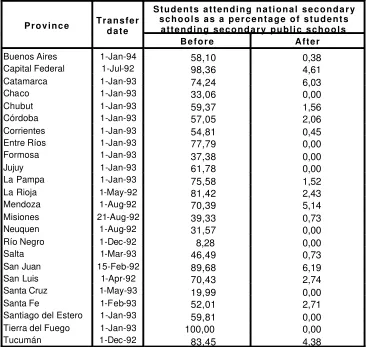
and year effects. Table 1 shows the decentralization month, and the initial and final
shares of national school students in total public school students by province.
3
Decentralization of primary and pre-schools started in 1961 and ended in 1978 (Law-Decree 21.809 and Complementary Law 21.810). For a historical description of the Argentine educational system, see Llach et al (1999), Annex IV.1.
4
In Rio Negro, general secondary schools had been transferred to the province in 1971 (Dussel, 1995). Tierra del Fuego is the youngest Argentine province. It was transformed from a national territory into a province in September 1992.
5
A handful of secondary schools remained under federal administration (a few specifically named technical schools, and schools belonging to national universities, security forces or other autarchic units).
6
The share of municipal secondary school students grew with decentralization from 0.2% to 7%. However, 98% of this 7% correspond to the City of Buenos Aires, the only district in which municipal secondary schools are relevant. Although it is not a province, but a federal district, we treat the City of Buenos Aires as a province in this study. Until the Constitutional Reform of 1994, the city authorities were directly elected by the President. After the reform, they are appointed through general elections.
7
Decentralization in Argentina transferred secondary schools from the federal
government to the provincial governments. The transfer included the budget and the
personnel increasing province expenditures and revenues in the same amount. The
administration of subsidies and the regulation of private schools were also transferred.
The transfer affected the most important school decisions, as these are not taken at the
school level. OECD (1998) shows that most education decisions in Argentina are now
taken at intermediate (i.e., provincial) levels. The determination of expenditures, the
allocation of personnel and non-personnel budget, the appointment and dismissal of
directors, teachers and staff, the wage decisions, the definition of the calendar year, and
the opening or closure of schools and sections are decisions transferred with the schools
from the nation to the province levels. Schools only choose textbooks, teaching methods,
evaluation methods, and (partially) contents, but in consultation with the provincial
authority (see Table 4.2, Burki et al, 1999; and Table 9, Llach et al, 1999).
The national government transferred the schools, but it is in charge of performance
measurement through the administration of standardized tests. Since 1993, the National
Education Ministry annually tests fifth-year secondary school students in Language and
Mathematics through the National System of Education Quality Evaluation (SINEC).8
We use these test scores to measure school quality. The 1993 test was experimental and
the results are not available separately for public and private schools. For 1994 through
1996, a sample of students was tested in each province.9 After 1997, every fifth-year
student has to answer the test. The Education Ministry does not provide the test results at
8
Natural and Social Sciences were also evaluated for 1994 and 1997. Results are not internationally comparable as Argentina does not participate in TIMMS (Third International Mathematics and Science Survey). Seventh-grade primary students are also regularly tested. 9
the school level prior to 1997. Thus, our measure of education quality is only available at
the province level, the unit of analysis for our study.10
The results are available for three groups: general and commercial public schools,
general and commercial private schools, and technical schools. As the technical school
results are not available for public and private schools separately, we only consider
non-technical schools. We averaged the Language and Math grades for both public and
private schools.11 By 1998, all high school students had passed the five years of their
secondary schooling under provincial administration. For this reason, we do not consider
test results after that date. Thus, we should have five observations (1994 through 1998)
for 24 provinces, although for the province of Santa Cruz the results are not available for
private schools for 1994, and for public and private schools for 1995.
Other performance measures are also regularly used in school system evaluations.
Typical measures are the gross schooling rate (ratio of number of students to population
size of that age), the net schooling rate (ratio of number of students in appropriate grade
for their age to population size of that age), the repetition rate (ratio of number of
repeating students to total students),12 the time graduation rate (ratio of number of
on-time graduating students to number of initial class students), and the over-age rate (ratio
of number of students of appropriate age to number of students). However, these
variables tend to measure coverage rather than quality. For example, school requirements
may loosen, inducing lower repetition and over-age rates, and higher schooling and
on-time graduation rates, together with a deterioration in quality. Moreover, these variables
10
Habibi et al (2001) also consider provinces as the appropriate unit of analysis for their study of fiscal decentralization in Argentina.
11
are easily affected by administrative school decisions (that could be correlated with
decentralization),13 and uniform measurement is unwarranted. Moreover, there exist
significant data restrictions in Argentina. Most of these alternative measures are not
available, or are only defined at the province level, without possible comparison between
public and private schools. We prefer to use nationally administered test scores, a
uniform, popular, monotonous, and good quality measure of school performance,
although we recognize that standardized test scores do not capture all the dimensions of
students’ achievements.
After school decentralization, another important law affected the Argentine
education system. Among other reforms, the Education Federal Law (Law 24.195, April
14, 1993), replaced the seven years of primary school and five (or six) years of secondary
school with a nine-year uniform cycle (EGB, Educacion General Basica) and a
three-year specialized cycle (Polimodal). Preschool and EGB were made mandatory. The Law
applies to both public and private schools in every province. The Education Federal Law
has been being gradually implemented across provinces and several issues are still
pending (Ministerio de Educacion, 2001). As the implementation of the Law differs in
time and degree across provinces, and as this policy applies to both public and private
schools, the effect of this additional reform on students’ performance will be controlled
by our difference in difference of the public-private difference approach.
12
In Argentina, students that do not make the grade have to “repeat” the course the next year. 13
IV. Our empirical exercise
Our objective is to identify the effect of secondary school decentralization on
education quality measured by the outcome of a standardized test. As it is generally
recognized, however, the identification of the effect of school decentralization on
education quality requires attention to the fact that the variation in the jurisdiction of
administration of schools may not be orthogonal to unobservable factors that jointly
affect the outcomes studied. To address this endogenity problem, we exploit an unusual
policy experiment: the Argentine secondary school decentralization process of the
1990’s. This political experiment generates an exogenous variation in the jurisdiction of
administration of secondary schools across time and space that provides an instrument to
identify the causal effect of school decentralization on test outcomes.
Secondary school decentralization was one piece of the major structural reforms
undertaken in Argentina during that period. As explained in the previous section, all the
provinces were treated (i.e., all national schools were decentralized) although at different
periods and with different intensities. For political reasons, decentralization took place
gradually between 1992 and 1994. For historical reasons, most provinces already had a
significant number of secondary schools under their administration and the proportion of
students in the schools administered by provincial governments before the
decentralization process varied significantly. The Argentine decentralization experiment
induced an exogenous variation in the administration of secondary schools across units
and time. Our identification strategy exploits the fact that exposure to school
decentralization of a secondary school final-year student varied both by province and
Suppose one is interested in estimating the influence of a policy instrument on an
outcome for a group (e.g., the effect of school decentralization on test outcomes).14 The
group consists of units i = 1…N observed over a sample horizon t = 1…T. Suppose
further that the policy instrument changes in a particular period t for a segment of the
group (or, as in our case, that it changes for all the segments but at different points in
time). Let dIit be a zero-one indicator that equals unity if the policy change was operative
for individual i in period t. Members of the group who experience the policy change react
according to a parameter α0. The standard statistical model to estimate α0 is the following
two-way fixed effect error component model:
it i t it 0
it á dI ë ì å
y = + + + (1)
where µi is a time-invariant effect unique to individual i, λt is a time effect common to all
individuals in period t, and εit is an individual time-varying error distributed
independently across individuals and time and independently of all µi and λt (cf.
Chamberlain, 1984; and Heckman and Robb, 1985). This difference in differences
estimator of α0, possibly including a set of control regressors that vary both across units
and time, is the most widely used estimator in policy evaluation (see, among many
others, Angrist and Lavy, 2001; Dufflo, 1998; PROGRESA, 1999; and Rosenzweig and
Wolpin, 1986). Although the difference in difference approach is extensively applied in
14
the economic literature, it is the exogenous treatment across units and time induced by a
political or natural experiment what provides a reliable instrument to identify α0.15
Consider the evaluation of the impact of school decentralization on test outcomes.
Suppose that test outcomes are available by school. Then, the difference in difference
estimator of α0 is obtained by estimating the following regression function:
jit i t jit 0
jit á dSC ë ì å
ScorePub = + + + (2)
where ScorePubjit is the test outcome of public school j (the average test outcome over
students) in province i and year t, and dSCjit is a zero-one indicator that equals unity if
school j in period t is administered by the national government.
Unfortunately, test outcomes are not available at the school level, but separately
aggregated by province and year for public and private schools. Thus, we have that:
it i t it 0
it á PC ë ì å
ScorePub = + + + (3)
where ScorePubit is the average test score over all students that attend the last year of
public schools in province i and year t, and PCit is the proportion of students enrolled in
the last year of public national schools over the total students enrolled in the last year of
public schools in province i and year t. Therefore, at the province level, the effect of
interest is that of PCit on ScorePubit.
15
Models (1) and (2) and hence, model (3), assume that the effect of the policy change
on the dependent variable operates immediately. However, that may not be the case.
Conspicuously, the dependent variable may respond, instead, to the intensity of exposure
to treatment which may accumulate over time. For example, in the case of school
decentralization, test outcomes most likely respond to the number of years an student has
spent in a public school administered by a provincial government (a public provincial
school) instead to respond solely to whether the student is in a public provincial school at
the time the test is performed (cf., e.g., Meyer, 1993).16 That is, we expect that individual
test outcomes respond to the intensity of the treatment at which the student has been
exposed.
For example, Dufflo (1998) also uses exposure to treatment as the measure of policy
change in an experiment with some similarities to the one we analyze in this paper. She
estimates the effect of a large construction of primary schools in Indonesia on school
attainment. The policy variable in her study is the average number of schools constructed
by the Indonesian program per year in region i during the period spent in primary school
by a child of a given cohort birth in region i that followed the normal curriculum.
Similarly, we define our policy variable as the proportion of years that a student in
the final year of secondary school in region i and year t has spent in a public national
school. Thus, at the province level, the effect of interest is the impact of the proportion of
years that on average the students of the last year of secondary public school in province i
and year t have spent in a national school (Cenit) on ScorePubit. Consequently, the
identification strategy in this paper uses the fact that exposure to school decentralization
16
Test outcomes are only available since 1994 while the decentralization of schools took place
of a student in the final year of secondary school varies both by province and student
cohort. Letting α be the impact of Cenit on ScorePubit, its difference in difference
estimator is given by estimating the following regression function:
it i t it
it á Cen ë ì å
ScorePub = + + + (4)
where, given the specification adopted, a negative (positive) α means that test outcomes
increase (decrease) with the level of decentralization.
Naturally, the identification of α may require that we include a set of control
variables x in the regression function (4). Thus, we have that:
it i t it 0 it
it áCen ë ì å
ScorePub = +β x + + + (5)
It is necessary to highlight the interest of the exercise we realize. Although there is a
wide literature that outlines the pros and cons of decentralization, there is no causal
evidence of the impact of a national school decentralization program on standardized test
outcomes (education quality) while theoretically, the effect may be negative, zero or
positive.
Nonetheless, two nuisances may interfere with the experimental design generated by
the decentralization policy experiment that we analyze. Firstly, the difference in
difference estimator maintains the assumption that the composition of units remains
stable before and after the policy change. In our case, this assumption would not hold if
the composition of the pool of students of public schools changes in any way that is
correlated with the level of centralization (Cen). This may occur if actual or prospective
students non-randomly change their election of school between public and private school
after decentralization. We evaluate this possible nuisance in our empirical analysis.
Secondly, even if the units treated are not selected in response to values of the error
term ε in model (5), it may be the case that Cen and ε are correlated and hence, Cen is not
exogenous for the parameter of interest, α (cf. Engle et al., 1983). Unobservable factors
may affect both public and private test outcomes by province and induce a correlation
between Cen and ε. A particularly worrisome case is one in which the evolution of test
outcomes by province are different due to unobservable factors violating the common
time effects assumption of model (5). It could also be the case that some provinces apply
others programs that affect test outcomes while some provinces do not, inducing,
specially in a small population like the one treated in our case, a correlation between Cen
and ε.17,18
Our empirical strategy to control for likely differences in the evolution of test
outcomes across provinces is to contrast public test scores with private test scores by
province. Thus, we argue that α, the causal effect of school decentralization on test
outcomes, is identified by estimating the following two-way fixed effect error component
model:
17
For example, the implementation of the Education Federal Law introduced further reforms in the Argentine education system. The degree of implementation of these reforms differs across provinces in a way that could potentially be correlated with the process of decentralization. 18
Moreover, it could be the case that the evolution of test outcomes in a province is related to unobserved factors that are correlated with the pre-decentralization level of Cen inducing a
correlation between this variable and ε in model (5). Unfortunately, the lack of pre-intervention
it i t it 1 it
it áCen
Score = +β x +τ +υ +ω (6)
where the dependent variable is Scoreit = ScorePubit – ScorePrivit, instead of ScorePubit
and where ScorePrivit is the average test score over all students that attend the last year of
private schools in province i and year t. Then, the statistical model to estimate α is a
difference in difference of the difference of public and private test outcomes. υi is a
time-invariant effect unique to province i, τt is a time effect common to all provinces in period
t, and ωit is an individual time-varying error distributed independently across individuals
and time and independently of all υi and τt and, crucially, uncorrelated with Cen. Note
that α still is the causal effect of school decentralization on public schools test outcomes.
This assumes that the decentralization of schools only affects the test outcomes of public
schools.19 Otherwise, α estimates the differential effect of decentralization on test
outcomes between public and private schools.
Thus, model (6) controls for the existence of different trends in the evolution of test
outcomes that are specific to each province. Additionally, it controls for any transitory
shock in province i and year t that affects both private and public test outcomes. Again,
these common shocks may severely distort the estimate of α in a small sample like the
one we analyze. Under the presence of different trends in the evolution of test outcomes
that are province specific, only the difference in difference estimate of the difference of
test outcomes identifies the causal effect of school decentralization on test scores.
19
The discussion so far involves a stylized description of the world, wherein causal
effects are the same for every unit (province). However, the theory of decentralization
highlights several channels through which decentralization may differently affect
outcomes. Decentralization effects may depend on the technical capabilities of local
governments, the risks of capture by local elites, or the significance of agency costs.
Thus, our estimate of α may be subsuming positives as well as negatives impacts of
school decentralization on test outcomes. This may not only obscure the existence of
heterogeneous impacts on test outcomes but also impede us to learn about the channels
through which decentralization operates. To investigate this heterogeneity of program
impact, we postulate the following model that encompasses model (6):
it i t it 2 it 1 it it
0 it 1
it á Cen (z Cen ) z
Score = +φ × +φ +β x +κ +ι +ζ (7)
where zit is a covariate supposed to affect the way decentralization impacts on test
outcomes that may or may not vary over time. In the latter case, φ1 is not identified. ι, κ,
and ζ satisfy the same properties that υ, τ, and ω. Then, the impact of school
decentralization on test outcomes is given by:
it 0 1 it
it
z
á
Cen = +φ ∂
∂Score
(8)
If φ0 = 0, the impact of decentralization on test outcomes is homogenous with respect
to z, while if it is statistically different from zero, the impact of decentralization on test
outcomes depends on z. Advantageously, we may also identify why decentralization
affects differently to different provinces.
Finally, we need to consider the instrumentation of the standardized tests. For 1994
through 1996, a representative sample of fifth-year students was tested in each province,
while after 1996, every fifth-year student has to answer the test. Thus, between 1994 and
1996, tests outcomes present sampling variability while, after 1996, they do not. Thus, for
example, ζit in equation (7) is not an i.i.d random variable. Rewriting equations (5) to (7)
we have:
it it
it å
y =ψw + (9)
where yit stands alternatively for Scoreit and ScorePubit, ψ is the appropriate vector of
parameters, wit is the vector of regressors (including the province and year fixed effects
dummy variables) and where εit ~ i.i.d(0,σ1) for ∀ i and t = 1994, 1995, 1996, and εit ~
i.i.d(0,σ2) for ∀ i and t = 1997, 1998.
The estimator of ψ that we apply is the Estimated Generalized Least Squares
Dummy Variables Estimator (ψGLS). This estimator has the advantage over the Least
Squares Dummy Variables Estimator that the estimator of the variance-covariance matrix
of ψGLS is consistent. As a result, the statistical inference we conduct in the next section is
transform the observations of both yit and wit by dividing them by the estimate of σ1 for t
= 1994, 1995 and 1996 and by the estimate of σ2 for t = 1997 and 1998.
V. Results
In Table 2 we present the results of the estimation of equation (6) under several
specifications. The dependent variable is Score, the difference of the test outcomes
between public and private schools. First, in Column 1, we do not include any control
variable. We find a negative and statistically significant effect of Cen on Score, that is,
we find that school decentralization improves the performance of public school
students.20 The average effect of decentralization on test outcomes is notable. We predict
that, on average, between 1994 and 1998, test outcomes of public schools improved 0.7
standard deviations of its distribution as a result of the decentralization process.21
In Column 2 we add a set of control variables: monthly average real teachers’ wage
(Wage),22 the unemployment rate (Unemp), the household real income (Income) and an
inequality measure (Ineq) by province and year. The last three variables are obtained
from the ongoing permanent household survey that covers, almost only, the population of
20
Remember that α estimates the causal effect of decentralization on public school outcomes,
even though, to build what we believe is the correct counterfactual, the dependent variable in the regression function we estimate is Score. As we already mentioned, however, if the
decentralization of schools would have also affected private test outcomes, then, α would be an
estimate of the differential effect between public and private schools of the decentralization on test outcomes.
21
This statistics is calculated as Ä Cen
ó á
98,94 ScorePub
, where σScorePub is the standard deviation of
ScorePub. It is worth to note that σScorePub > σScore. 22
the capitals of the provinces. Thus, they are less than perfect estimates of the respective
parameters at the province level. This is an important additional reason to contrast the
result of public and private schools test outcomes when attempting to identify the impact
of the decentralization of schools on public test scores.
In terms of the results, it is not clear a priori whether these variables should have any
impact on Score and, if they have any, it is not obvious what is their sign. Unemployment
shows no effect on Score while both income and inequality have a negative and
statistically significant effect. We do not find any effect of Wage on Score. More
importantly, we find a negative and statistically significant effect of Cen on Score once
we include this set of controls. The estimated average effect of decentralization on test
outcomes is higher than the one estimated without including the control variables.
In column 3 we exclude Unemployment from the set of controls and the results
remain completely unchanged. Finally, in Column 4 we also exclude Wage from the set
of control variables and the results remain unaltered. More importantly, the effect of
decentralization on test outcomes is similar across the specifications in Columns 2
through 4. Thus, we find that the performance of the public schools improves
significantly with the decentralization of schools. We predict that on average, between
1994 and 1998, test outcomes of public schools improved 1.2 standard deviations of its
distribution as a result of the decentralization process.23
Our estimates in Table 2 consider that the causal effects of decentralization are the
same for every province. However, the theory of decentralization highlights several
channels through which decentralization may differently affect test outcomes. In what
23
follows, we investigate if decentralization impacts dissimilarly to provinces with different
characteristics, that is, we evaluate whether the impact of the decentralization of schools
on test outcomes is homogenous or heterogeneous across province characteristics.
Although “bringing decisions closer to the people” may be generally optimal, the
advantages of decentralization may dilute when local governments lack technical
capabilities. We use provincial fiscal surpluses and deficits to proxy for the quality of
province governments. Provincial fiscal disorders in Argentina are frequent and typically
associated with misgovernments. Moreover, provincial fiscal results may have an
important impact on the education sector. In several occasions, provincial fiscal deficits
generate reductions and delays in teachers’ wage payments that prompt long strikes.24 We
first interact provincial fiscal results (normalized by province gross output) with our
policy variable.25
In Table 3 we report the interaction of Cen with Fiscal Result, that is, we estimate
equation (7) where z first equals Fiscal Resultit and then it equals Fiscal Resulti, the
province average over time. In Column 1 we do not include other control variables than
Fiscal Resultit itself. Interestingly, we find that the effect of school decentralization on
test outcomes is heterogeneous. It depends on the province fiscal result.
24
For example, in 1995 and 1996 wages were reduced in Misiones, Entre Rios, San Juan, Santa Fe, Rio Negro, Corrientes, and Neuquen; while delays occurred in La Rioja, Entre Rios, Jujuy, Tucuman, Salta, Cordoba, Misiones, Rio Negro, Capital, Neuquen and Buenos Aires. Over 170 class-days in 1995, strikes lasted for 50 days in San Juan, 40 in La Rioja, 30 in Jujuy, 10 in Misiones, 120 in Rio Negro, 20 in Salta and 70 in Cordoba (Senen Gonzalez, 1997). Provincial fiscal crises provoked federal interventions in Santiago del Estero in 1993 and in Corrientes in 1999. In Santiago del Estero, a teachers’ strike had lasted for 50 days (La Nación, October 30, 1993), while there were basically no classes in Corrientes during that whole year (Clarín, November 16, 1999). More recently, a long teachers’ strike prompted by a fiscal crisis is affecting the province of Buenos Aires (Clarín, September 14, 2001).
25
As expected, we find that the higher the provincial fiscal deficit, the smaller the
positive impact of decentralization on test outcomes, being possible that this positive
impact disappears or, even worse, reverts its sign for provinces with huge fiscal deficits.
We also find that Fiscal Result has a positive and significant direct effect on test
outcomes.
In Column 2 we add the complete set of control variables (Unemp, Ineq, Income, and
Wage). Similarly to what we report in Table 2, the impact of school decentralization on
test outcomes increases once we control by these variables. We still find that the higher
the provincial fiscal deficit, the smaller the positive impact of decentralization on test
outcomes. Again, the fiscal stance shows a positive and significant direct effect on test
scores.26
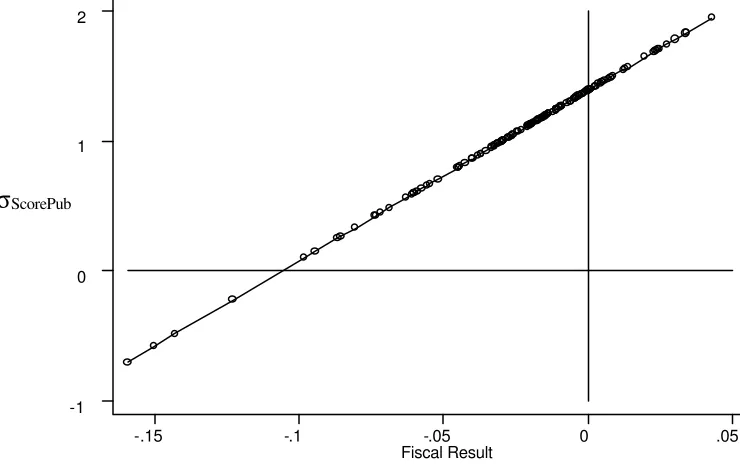
Figure 1 illustrates the relationship between Fiscal Result and the effect of school
decentralization on test outcomes measured in units of standard deviation of ScorePub,
σScorePub, at the average change of Cen between 1994 and 1998. This figure shows that the
effect of school decentralization on test outcomes is null for a fiscal deficit in terms of
gross product of approximately 10 percent. Only a province with a very high fiscal deficit
could be negatively affected by the decentralization of schools.
26
Figure 1: Change in test scores in units of standard deviation of ScorePub
Note: Figure computed by using the parameter estimates in Table 3, Column 2 and the actual observations of Fiscal Resultit.
In Column 3 we report the interaction of Cen with Fiscal Resulti, the average of
Fiscal Resultit over time. The results are very similar to the one we obtain in Column 2.
Thus, none of the conclusions change when we consider the average level of Fiscal
Result by province instead of the current level.
In Table 4 we estimate equation (7) exploring other possible channels through which
the impact of school decentralization could be heterogeneous. Decentralization may
allow for a better match between government outputs and local preferences. It may also
reduce agency costs improving accountability of political agents. However, we may
argue that the heterogeneity of preferences and the collective decision problems are still σScorePub
Fiscal Result
-.15 -.1 -.05 0 .05
significant in large provinces, weakening the decentralization benefits. Thus, the effects
of decentralization may depend on province size.
In the first three columns of Table 4, we proxy for province size alternatively using
surface (Sur), population as of the 1991 Census (Pop), and 1991 population density
(Den). We find that the effect of school decentralization on test outcomes is not
heterogeneous with respect to these size variables.
Moreover, the benefits of decentralization may dilute if the capture of the political
process by interest groups is easier at the local level. We proxy for political capture using
Alt, a zero-one indicator that equals unity if the political party governing the province has
changed since the return to democracy in 1983. Again, the interaction term reported in
Column 4 is not statistically significant. Thus, it seems that the effect of decentralization
on test outcomes is homogeneous with respect to all the variables included in Table 4.
Finally, we need to provide evidence in favor of our empirical strategy. To avoid the
rejection of the interpretation of the results of the effect of school decentralization on test
outcomes that we reported, we need to show that during the period studied there has not
been migration between public and private schools induced by the decentralization.27 We
explore whether it is the case that the proportion of students in public secondary schools
over total secondary school students (SharePub) is correlated with decentralization. We
estimate the following two-way fixed effect error component model:
27
it i t it 1 it 0
it ð Cen ð ë ì å
SharePub = + x + + + (10)
where µi is a time-invariant effect unique to province i, λt is a time effect common to all
provinces in period t, and εit is an individual time-varying error.28
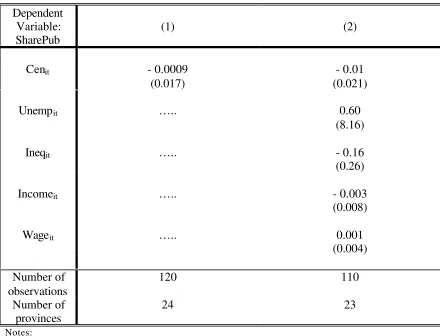
Table 5 reports the result of estimating equation (10) for the period 1994 to 1998,
that is, the same period for which we estimate the models reported in Tables 2 to 4. We
do not find any relation between SharePub and Cen. Indeed, in both regressions the
coefficient π0 is numerically equal to cero and statistically insignificant. Thus, our
empirical analysis shows no relation between the proportion of students in public
secondary schools over total secondary school students and the level of decentralization
for the period studied. Accordingly, we do not find any evidence indicating that students
that would have attended public schools without decentralization and whose abilities are
below the average abilities of private school students, have moved to the private schools
as a result of decentralization, spuriously inducing the effect of school decentralization on
test outcomes that we report in this section.
VI. Conclusions
Although there is a wide literature that outlines the pros and cons of decentralization,
there is no evidence on the causal effect of school decentralization on education quality.
28
The contribution of this paper is to evaluate the impact of the Argentine secondary school
decentralization program of the early 1990’s on students’ standardized test scores.
The Argentine decentralization program generated an exogenous variation in the
jurisdiction of administration of secondary schools across time and space that provides an
instrument to identify our parameter of interest. Our identification strategy uses the fact
that exposure to school decentralization varied both by province and student cohort. We
also exploit the fact that, by contrasting public and private school test outcomes, we are
able to control for the effect of unobservable factors that may differentially affect the
evolution of student performance across provinces. Thus, our estimator of the causal
effect of school decentralization on test outcomes is the conditional difference in
difference of the difference of public and private test outcomes. Although we provide
arguments and evidence in favor of this identification strategy, its validity could be
disputed.
We focus on the effects of school decentralization on education quality, while we
recognize that standardized test scores do not capture all the dimensions of school system
achievements. Additionally, our argument that test outcomes respond to the amount of
time a secondary school final-year student has spent under a certain type of
administration, instead of responding solely to the type of school the student attends at
the time the test is performed, could be criticized.
Having these caveats in mind, our results suggest that decentralization improved the
performance of students in test scores. We find that the performance of public schools
test outcomes improved 1.2 standard deviations of its distribution between 1994 and 1998
as a result of the decentralization process.
Although decentralization may be generally optimal, its advantages may dilute when
schools are transferred to severely mismanaged provinces. Indeed, we find that the effect
of school decentralization on test outcomes is heterogeneous depending on provincial
fiscal performance. The higher the provincial fiscal deficit, the smaller the positive
impact of decentralization. Moreover, the effect of school decentralization on test
outcomes may become negative for provinces running significant fiscal deficits. Thus, we
conclude that, although school decentralization generally shows a positive impact on
education equality, advice should be cautious when there are doubts on the competence
Appendix: Description of the Data
Summary Statistics
Variable Observations Mean Std. Dev. Min Max
Score 118 -9.16629 4.56703 -25.18 2.380001
Cen 120 15.92418 15.64173 0 60.968
Unemp 115 0.115676 0.038741 0.040785 0.202752
Income 115 302.0589 86.63253 188.3864 579.403
Ineq 115 8.674907 1.171806 6.250445 12.11429
Wage 114 552.026 150.4942 320.8194 969.48
Fiscal Result 120 -0.02045 0.033302 -0.15928 0.04288
SharePub 120 80.7765 10.6301 52.2339 93.1644
Sur 24 156719.8 194090.1 200 1002445
Pop 24 1448686 2683194 89992 13379401
Den 24 641.8789 3087.995 0.089773 15139.43
Alt 24 0.583333 0.50361 0 1
Data Definitions and Sources
Variable Definition Source
ScorePubit 5
th
year test scores (measured as the number of right answers as a percentage of total answers) for public non-technical schools in province i in period
t. Not available for Santa Cruz for 1995.
Ministerio de Cultura y Educación (MCyE), Operativos Nacionales de Evaluación, and Llach et al (1999)
ScorePrivit 5
th
year test scores (measured as the number of right answers as a percentage of total answers) for private non-technical schools in province i in
period t. Not available for Santa Cruz for 1994 and
1995.
See ScorePub
Scoreit =ScorePubit-ScorePrivit. See ScorePub ShareNacit Students attending national secondary schools as
percentage of students attending public secondary schools in province i in period t.
MCyE: Centro Nacional de Estadísticas de la Educación, Dirección General Red Federal de Información, and Instituto para el Desarrollo de la Calidad Educativa (IDECE) Cenit
∑
= − = 4 0 ) ( 5 j j t i ShareNac. Proportion of years that on
average the students of 5th of public secondary schools in province i and year t have spent in public national schools.
See ShareNac
Unempit Unemployment rate (May and October average) in
period t of the surveyed cities located in province i
(population weighted average if data is available
for more than one city in province i). None of Rio Negro cities are surveyed.
Incomeit Household income (May and October average in
constant 1995 pesos) in period t for households with positive income in the surveyed cities located in province i (population weighted average if data is available for more than one city in province i).
None of Rio Negro cities are surveyed.
See Unemp
Ineqit Ratio of top 10% to bottom 10% household income
(May and October average) in period t for
households with positive income in the surveyed cities located in province i (population weighted average if data is available for more than one city in province i). None of Rio Negro cities are surveyed.
See Unemp
Wageit Monthly gross wage in 1995 constant pesos for
public school primary teachers in province i in period t. Six observations are not available.
MCyE, Series Salariales 1989-1997, Análisis de Composición (November 1998), and Informe Indicativo de Salarios Docentes (March 2000)
GDPit Gross geographic product for province i in period t
at current prices
Consejo Federal de Inversiones and INDEC
Fiscal Levelit Fiscal result (deficit or surplus) of government of
province i in period t.
DataFiel
Fiscal Resultit =Fiscal Levelit / GDPit. Fiscal result as percentage
of gross geographic product of government of province i in period t.
See Fiscal Level and GDP
SharePubit Students attending public secondary schools as a
percentage (multiplied by 100) of students attending total secondary schools in province i in period t.
See ShareNac
Suri Area (in km
2
) of province i. INDEC
Popi Population of province i in 1991. 1991 Census INDEC
Deni = Populationi/ Surfacei See Population and Surface
Alti Dummy variable that equals 1 if the political party
governing the province changed between 1983 and 2000, and 0 otherwise.
Jones, Mark P., Pablo Sanguinetti and Mariano Tommasi, 2000, “Voters as Fiscal Liberals”, mimeo, Centro de Estudios para el Desarrollo
References
Angrist, J., 1995, “Introduction to the JBES Symposium on Program and Policy Evaluation”,
Journal of Business and Economic Statistics 13, pp. 249-88.
Angrist, J. and V. Lavy, 2001, “Does Teacher Training Affect Pupil Learning? Evidence from
Matched Comparisons in Jerusalem Public Schools”, Journal of Labor Economics 19, pp.
343-69.
Chamberlain, G., 1984, “Panel Data”, in Griliches, Z. and M. Intriligator (eds.), Handbook of Econometrics, North-Holland.
Bardhan, Pranab and Dilip Mookherjee, 1998, “Expenditure Decentralization and the Delivery of Public Services in Developing Countries”, CIDER Working Paper C98/104.
Becker, G., 1964, Human Capital: A Theoretical and Empirical Analysis, with Special Reference to Education, Columbia University Press.
Besley, Timothy J. and Stephen Coate, 2000, “Centralized versus Decentralized Provision of
Local Public Goods: A Political Economy Analysis”, NBER Working Paper No. W7084. Bird, Richard M. and Vaillancourt, Francois (eds.), 1998, Fiscal Decentralization in Developing
Countries, Cambridge, New York and Melbourne: Cambridge University Press.
Burki, Shahid Javed; Guillermo E. Perry, and William R. Dillinger, William R., 1999, Beyond the Center: Decentralizing the State, Washington, D.C., World Bank.
Dufflo, E., 1998, “Schooling and Labor Market Consequences of School Construction in
Indonesia: Evidence from an Unusual Policy Experiment”, forthcoming American Economic
Review.
Dussel, Inés, 1995, “La Situación del Sistema Educativo Argentino”, mimeo, FLACSO.
Engle, R., D. Hendry and J-F. Richard, 1983, “Exogeneity”, Econometrica 51, pp. 277-304.
Eskeland, Gunnar S. and Deon Filmer, 2000, “Does Decentralization Improve Learning? Autonomy and Parental Participation in Argentine Schools”, mimeo, World Bank.
Faguet, Jean Paul G., 2001, “Does Decentralization Increase Government Responsiveness to Local Needs? Evidence from Bolivia”, World Bank Policy Research Working Paper No. 2516. Fukasaku, Kiichiro and Ricardo Hausmann, 1998, Democracia, Descentralización y Déficit
Presupuestarios en América Latina, Inter-American Development Bank and OECD.
Grindle, Merilee, 2000, “Designing Reforms: Problems, Solutions, and Politics”, KSG Working
Paper No. 01-020.
Habibi, Nadir, Cindy Huang, Diego Miranda, Victoria Murillo, Gustav Ranis, Mainak Sarkar, and Frances Stewart, 2001, “Decentralization in Argentina”, Yale Economic Growth Center Discussion Paper No. 825.
Heckman, J. and V. Hotz, 1989, “Choosing Among Alternative Nonexperimental Methods for
Estimating the Impact of Social Programs: The Case of Manpower Training”, Journal of the
American Statistical Association 84, pp. 862-74.
Heckman J. and P. Klenow, 1997, Human Capital Policy, University of Chicago Press, Chicago. Heckman, J. and R. Robb, 1985, “Alternative Methods for Evaluating the Impact of
Interventions: An Overview”, Journal of Econometrics 30, pp. 239-67.
Hoxby, Caroline M., 2000, “Does Competition among Public Schools Benefit Students and
Taxpayers?” American Economic Review, 90(5): 1209-38.
Jimenez, E and Y. Sawada, 1999, “Do Community-Managed Schools Work? An Evaluation of El
Salvador’s EDUCO Program.” World Bank Economic Review 13(3): 415-41.
King, Elizabeth M. and Berk Ozler, 2000, “What’s Decentralization Got To Do With Learning? Endogenous School Quality and Student Performance in Nicaragua” Development Research Group, World Bank, Washington, D.C.
Lockwood, Ben, 1998, “Distributive Politics and the Cost of Decentralization”, CEPR Working Paper No. 2046.
Lopez Murphy, Ricardo, ed., 1995, Fiscal decentralization in Latin America, Inter-American Development Bank, Washington, D.C.
Lucas, Robert E., 1988, “On the Mechanics of Economic Development”, Journal of Monetary
Economics, 22: 3-42.
Meyer R., 1993, “Can Schools Be Held Accountable for Good Performance? A Critique of Common Educational Performance Indicators”, in Hoffman E. (ed.), Essays on the Economics of Education, Kalamazoo, Michigan, W. E. Upjohn Institute for Employment Research.
Meyer, B., 1995, “Natural and Quasi-Experiments in Economics”, Journal of Business and
Economics Statistics 13, pp. 151-61.
Ministerio de Educacion, 2001, “Estado de Implementacion de la Ley Federal de Educacion al Año 2001.”
Oates, Wallace, 1972, Fiscal Federalism, Harcourt Brace, New York.
OECD, 1998, Education at a Glance, in www.oecd.org.
Paes de Barros, Ricardo and Rosane Mendonca, 1998, “The Impact of Three Institutional Innovations in Brazilian Education.”, in Organization Matters: Agency Problems in Health and Education in Latin America, William Savedoff (ed.), Inter-American Development Bank, Washington, D.C.
Porto, Alberto and Leonardo Gasparini, 1998, Descentralización Fiscal: El Caso de las Municipalidades de la Provincia de Buenos Aires, Universidad Nacional de La Plata, La Plata. PROGRESA, 1999, Evaluación de Resultados del Programa de Educación, Salud y Alimentación: Primeros Avances, Secretaria de Desarrollo Social, Gobierno Federal de México.
Rose-Ackerman, Susan, 1999, Corruption and Government. Causes, Consequences, and Reform, Cambridge University Press, Cambridge.
Rosenzweig, M. and K. Wolpin, 1986, “Evaluating the Effects of Optimally Distributed
Programs: Child Health and Family Planning Interventions”, American Economic Review 76,
pp. 470-82.
Rosenzweig, M. and K. Wolpin, 2000, “Natural “Natural Experiments” in Economics”, Journal
of Economic Literature 38, pp. 827-74.
Rhoten, Diana R., 1999, “Global-Local Conditions of Possibility: The Case of Education Decentralization in Argentina”, Unpublished dissertation, Stanford University.
Senen González, Silvia N. de, 1997, “Ajuste y Reforma Educativa: Dos Lógicas en Pugna”, mimeo, III Congreso Latinoamericano de Administración de la Educación, San Pablo
Savedoff, William (ed.), 1998, Organization Matters: Agency Problems in Health and Education in Latin America, Inter-American Development Bank, Washington, D.C.
Tendler, Judith, 1997, Good government in the tropics, Baltimore and London: Johns Hopkins University Press.
Tiebout, Charles, 1956, “A Pure Theory of Local Expenditures”, Journal of Political Economy,
64(5): 416-424.
Tomassi, Mariano, Sebastian Saiegh, and Pablo Sanguinetti, 2000, “Fiscal Federalism in
Argentina: Policies, Politics, and Institutional Reform”, Economia, 1(2): 157-211.
Tommasi, Mariano and Federico Weinschelbaum, 1999, “A Principal-Agent Building Block for the Study of Decentralization and Integration”, mimeo, Universidad de San Andres.
Willis, Elisa, C. Garman, and S. Haggard, 1999, “The Politics of Decentralization in Latin
Table 1
The Variability in Decentralization across Provinces
S t u d e n t s a t t e n d i n g n a t i o n a l s e c o n d a r y s c h o o l s a s a p e r c e n t a g e o f s t u d e n t s
a t t e n d i n g s e c o n d a r y p u b l i c s c h o o l s P r o v i n c e T r a n s f e r d a t e
B e f o r e A f t e r
Buenos Aires 1-Jan-94 58,10 0,38
Capital Federal 1-Jul-92 98,36 4,61
Catamarca 1-Jan-93 74,24 6,03
Chaco 1-Jan-93 33,06 0,00
Chubut 1-Jan-93 59,37 1,56
Córdoba 1-Jan-93 57,05 2,06
Corrientes 1-Jan-93 54,81 0,45 Entre Ríos 1-Jan-93 77,79 0,00 Formosa 1-Jan-93 37,38 0,00 Jujuy 1-Jan-93 61,78 0,00 La Pampa 1-Jan-93 75,58 1,52 La Rioja 1-May-92 81,42 2,43 Mendoza 1-Aug-92 70,39 5,14 Misiones 21-Aug-92 39,33 0,73 Neuquen 1-Aug-92 31,57 0,00 Río Negro 1-Dec-92 8,28 0,00
Salta 1-Mar-93 46,49 0,73
San Juan 15-Feb-92 89,68 6,19
San Luis 1-Apr-92 70,43 2,74
Santa Cruz 1-May-93 19,99 0,00 Santa Fe 1-Feb-93 52,01 2,71
Santiago del Estero 1-Jan-93 59,81 0,00 Tierra del Fuego 1-Jan-93 100,00 0,00
Tucumán 1-Dec-92 83,45 4,38
Table 2
Test outcomes: Homogeneous impact
Dependent Variable:
Score
(1) (2) (3) (5)
Cenit - 0.14*
(0.08) - 0.25*** (0.09) - 0.25*** (0.09) - 0.26*** (0.09)
Unempit ….. 2.83
(17.00)
….. …..
Ineqit ….. -1.64***
(0.43)
-1.62*** (0.39)
-1.79*** (0.37)
Incomeit ….. - 0.024**
(0.009)
- 0.023** (0.009)
- 0.018** (0.008)
Wageit ….. 0.007
(0.006) 0.006 (0.005) ….. Number of observations
118 108 108 108
Number of provinces
24 23 23 23
Notes:
(i) All parameters are estimated by the method of GLS Dummy Variable. (ii) All regressions include year and province fixed effects.
(iii) *** Statistically different from zero at the 0.01 level of significance. ** Statistically different from zero at the 0.05 level of significance. * Statistically different from zero at the 0.1 level of significance.
Table 3
Test outcomes: Heterogeneous impacts
Dependent Variable:
Score
(1) (2) (3)
Cenit - 0.14*
(0.08)
- 0.27*** (0.09)
- 0.30*** (0.09)
Cenit* Fiscal
Resultit - 1.45* (0.88) - 2.55*** (0.99) …..
Cenit* Fiscal
Resulti
….. ….. - 4.92***
(1.73)
Unempit ….. 2.27
(16.24)
11.18 (15.45)
Ineqit ….. - 1.25***
(0.418)
- 1.44*** (0.398)
Incomeit ….. - 0.025***
(0.009)
- 0.023*** (0.008)
Wageit ….. 0.006
(0.005) 0.006 (0.005) Fiscal Resultit 60.03*** (17.17) 50.50*** (15.81) …..
F Statistic F(1,87) = 1.84 F(1,74) = 6.0** F(1,75) = 4.6**
Number of observations
118 108 108
Number of provinces
24 23 23
Notes:
(i) All parameters are estimated by the method of GLS Dummy Variable. (ii) All regressions include year and province fixed effects.
(iii) *** Statistically different from zero at the 0.01 level of significance. ** Statistically different from zero at the 0.05 level of significance. * Statistically different from zero at the 0.1 level of significance.
(v) In Column (1), we lose two observations because test scores are not available for 1994 and 1995 for Santa Cruz. In the rest of the table, we lose ten observations because the control variables are not available.
Table 4
Test outcomes: Heterogeneous impacts
Dependent Variable:
Score
(1) (2) (3) (4)
Cenit - 0.25**
(0.11) - 0.24** (0.10) - 0.24** (0.10) - 0.18* (0.12)
Cenit* Suri - 0.008
(0.10)
….. ….. …..
Cenit* Popi ….. - 0.011
(0.01)
….. …..
Cenit* Deni ….. ….. - 0.003
(0.007)
…..
Cenit* Alti ….. ….. ….. - 0.078
(0.007)
F Statistic F(1,75) = 6.29*** F(1,75) = 7.13*** F(1,75) = 6.09** F(1,75) = 5.26** Number of observations
108 108 108 108
Number of provinces
23 23 23 23
Notes:
(i) All parameters are estimated by the method of GLS Dummy Variable. (ii) All regressions include year and province fixed effects.
(iii) All regressions include Unemp, Income, Ineq and Wage as controls.
(iv) *** Statistically different from zero at the 0.01 level of significance. ** Statistically different from zero at the 0.05 level of significance. * Statistically different from zero at the 0.1 level of significance.
(vii) We lose two observations because test scores are not available for 1994 and 1995 for Santa Cruz, and ten observations because the control variables are not available.
(viii) The F statistics test the null hypothesis that equation (8) evaluated at the average level of z is zero. (ix) Suri = Surface of Province i divided by 1,000,000.
(x) Popi = Population of Province i divided by 1,000,000.
Table 5
Proportion of secondary students in public schools over total secondary students
Dependent Variable: SharePub
(1) (2)
Cenit - 0.0009
(0.017)
- 0.01 (0.021)
Unempit ….. 0.60
(8.16)
Ineqit ….. - 0.16
(0.26)
Incomeit ….. - 0.003
(0.008)
Wageit ….. 0.001
(0.004)
Number of observations
120 110
Number of provinces
24 23
Notes:
(i) All regressions include year and province fixed effects.
(ii) *** Statistically different from zero at the 0.01 level of significance. ** Statistically different from zero at the 0.05 level of significance. * Statistically different from zero at the 0.1 level of significance.