C
C
|
E
E
|
D
D
|
L
L
|
A
A
|
S
S
Centro de Estudios
Distributivos, Laborales y Sociales
Maestría en Economía Universidad Nacional de La Plata
Equality of Opportunity and Optimal Cash and
In-Kind Policies
Leonardo Gasparini y Santiago Pinto
Documento de Trabajo Nro. 22
Abril, 2005
Leonardo C. Gasparini ∗
Santiago M. Pinto †‡
March 4, 2005
Abstract
This paper examines the argument for public provision of certain private goods, like education and health, based onequality of opportunity by studying the utility possibility frontier of a society in which there is a concern for the distribution of these goods. A given quality of education or health services can be consumed for free in the public sector, but people can opt-out and purchase their desired quality levels in the private sector. Some of the conclusions are: (i) a pure cash transfer is optimal when the utility redistribution is either “sufficiently” small or large; (ii) if and only if both the equality-of-opportunity concern and the utility redistribution are large enough, can an in-kind program which attracts the whole population be justified; (iii) even when everybody chooses the in-kind program, it may be optimal to perform some additional utility redistribution by increasing the size of such program.
JEL Classification: D3, H4, I2
Keywords: equality of opportunity, redistribution, education, in-kind
1
Introduction.
Governments have a very active role in the provision of many essentially private goods. Promi-nent examples are education and health services. Although there is an extensive literature on the topic, the question of why there should be public provision is far from settled. Any strong argument intended to support public provision of education and health must offer a justifica-tion for the government to provide an in-kind transfer instead of cash. The normative public finance literature has dealt mainly with three major arguments: merit goods, redistribution, and market failure. Behind the concept of merit goods lies the idea of paternalism: the donor (usually the social planner) thinks that the recipient’s preferences for education or health are a faulty representation of her well-being, so she will choose a “wrong” consumption bundle if given cash (Sandmo (1983) and Besley (1988)).1 The second argument lies in the distribution of the
publicly provided good among individuals being socially preferred to the best implementable distribution of a cash transfer (Nichols and Zeckhauser (1982), Blackorby and Donaldson (1988),
∗Centro de Estudios Distributivos, Laborales y Sociales (CEDLAS), Universidad Nacional de La Plata. E-mail: [email protected].
†Department of Economics, West Virginia University. E-mail: [email protected].
‡Corresponding author: Santiago M. Pinto, West Virginia University, College of Business and Economics, Division of Economics and Finance, 412 Business and Economics Building, P.O. Box 6025, Morgantown, WV 26506-6025. Office Phone #: (304) 293-7871. Fax #: (304) 293-5652.
1
The approaches followed by Sandmo (1983) and Besley (1988) are different, though. Sandmo considers the policy implications of a divergence between the agents’ beliefs about the future states of the world and those of the social planner, for different degrees of market completeness, while Besley’s model assumes a divergence between preferences.
and Besley and Coate (1991)). Finally, the argument of market failure is mainly based on the existence of consumption externalities or informational problems, which make private markets inefficient or even prone to collapse (see Cohn and Geske (1990), and Barr (1992) for interesting surveys).2
Although the above justifications are well known, in the real-world debate about the pro-vision of education and health, policy makers, politicians, people in general, and even economists usually prefer to invoke the argument of equality of opportunity (EO).3 One of the versions of
the EO argument roughly states that the government should provide basic education and health free of charge, or at subsidized prices, with the purpose of reducing dispersion in the consump-tion of those goods. To the extent that an individual’s educaconsump-tional level and health state are considered to be beyond his/her control and are closely related to future “opportunities”, dis-persion in these variables is viewed as unfair. Children do not choose the education quality they receive, yet take advantage of (or suffer) the consequences. Also, the attainable level of utility depends on the individual’s health state which in many circumstances cannot be chosen. This paper is built upon the assumption that people care about the distribution of education and health, which we associate with a concern for equality of opportunity.4 One can think of a
society which cares about the starting point of the next generation, and wishes to equalize some basic factors that are beyond children’s control, like education and health. Different quality levels of education or health acquired by an individual will condition potential earnings and well-being. For the sake of simplicity, the model presented here considers only one generation with good-specific distributional preferences, which can be seen as the reduced form of a more general problem.
The EO argument is generally recognized as one of the main justifications to sustain public schools or hospitals, but its importance is not reflected in the current theoretical economic literature. This literature has repeatedly overlooked the argument by including it under one of the three categories mentioned above (merit goods, redistribution and market failures) with almost no discussion, and by ignoring it when analyzing optimal policies.5 This paper takes one
additional step to fill that gap by clarifying the public policy implications of people’s concern about the distribution of certain specific goods, like basic education and health care. The paper
2
Other contributions on the desirability of in-kind transfers can be found in the literature. For instance, the Samaritan’s dilemma has been extensively used to explore possible rationales for some policies, like mandated health insurance and other in-kind transfers. The public provision of a private good, in this case, mitigates time-consistency problems (see, for example, Bruce and Waldman (1991) and Coate (1995)). In addition, there is literature on the political economy of publicly provided private goods (see, for example, Gouveia (1997), Epple and Romano (1996), and Blomquist and Christiansen (1999)).
3
To give one of many examples, the new Argentinean Constitution establishes that it is the authority of the National Congress “to make laws regarding the organization of education which ... ensure ... theequality of opportunity and guarantee the principles of equity and free of charge provision of education.” (Constituci´on Nacional Argentina (1994), article 75, clause 19.)
4
Social concern about the distribution of particular goods is also usually known as specific egalitarianism or commodity egalitari-anism (see Tobin (1970)). The concept of equity as equality of opportunity has been treated in the economic and political philosophy literature. See for example Coleman et al. (1966), Archibald and Donaldson (1979), Arneson (1989), Green (1989), LeGrand (1991), Gravel (1994), Rubin (1996), and Roemer (1997, 1998).
5
is not only intended to specify the conditions under which such a concern implies a justification for free public provision, but also, and especially, to characterize how the cash versus in-kind dichotomy is decided upon along the utility possibility frontier, and which is the resulting social composition of people attending public facilities.6
The framework chosen for the analysis includes two features that are crucial for many results: (i) education and health can be consumed for free in the public sector, but they can also be purchased in the private sector; (ii) individuals are not allowed to top up the publicly provided good: children cannot attend a public and a private school at the same time, and a health operation cannot be performed on a single person in two different hospitals.7 These two
points imply that people who look for a better education or health quality might opt-out of the public system, even if it is free.
The paper examines every point on the utility possibility frontier without inquiring about the mechanism which takes the economy from the laissez-faire situation to that point. Each of those points has associated with it an optimal combination of cash and in-kind transfers. The in-kind transfer takes the form of free public provision of a given good to whoever wants to receive it. The discussion in the paper will be in terms of education, although basic health care should be kept in mind as well. Several elements should be taken into account when choosing the optimal policy: (i) A cash transfer is always the “cheapest” way to attain a given target utility level for the poor since it does not distort behavior. (ii) However, a cash transfer is target inefficient since recipients ignore the externality caused by the concern about the distribution of education. (iii) While any cash transfer can be used to supplement the consumption of education, an in-kind program entirely substitutes private consumption, since education is assumed to be non-supplementable. (iv) If the in-kind program is sufficiently large, it can attract not only the poor but also the rich, implying a much stronger effect on reducing dispersion than a cash transfer.8
The rest of the paper is organized as follows. The model is presented in section 2 and the basic results are explained in sections 3, 4, and 5. Section 6 provides an analysis of some
6
Given that in our framework some kind of policy intervention is justified, the model developed here addresses the conditions under which transfers should be given in kind or in cash. We ignore alternative policies, such as price subsidies, that could also be used to deal with the EO concern.
7
In many cases there exists the possibility of supplementing consumption to some extent. However, the important point is that supplementation is costly. Sometimes that cost is endogenous. For instance, the government can offer public school for free, or can issue educational vouchers to be used in any school which can be supplemented if desired. See Boadway and Marchand (1995), Cremer and Gahvari (1997), and Blomquist and Christiansen (1998) for models with endogenous possibility to supplement public provision in a context of imperfect information.
8
extensions of the model, and section 7 concludes. All proofs are presented in the Appendix.
2
The Model
We consider an economy that is populated by two types of consumers: the poor (p) and the rich (r). Both groups are assumed to be of the same size N. Individuals of each group, poor and rich, respectively, are identical in terms of preferences and endowments. Consumers of each type derive utility from the consumption of a numeraire good xand education qualityq. Every poor person has an endowment of the numeraire or “income” Yp, while every rich person has
incomeYr, with Yp < Yr.9 Preferences over x and q are represented by the twice continuously
differentiable, strictly quasi-concave utility function U(x, q). The marginal utility ofx, U1, and
the marginal utility ofq, U2, are positive, and both goods are assumed to be non-inferior. The
concern for EO is introduced by modeling preferences in the following way. We assume that rich people’s utility depends on the distribution of education consumption. In particular, we consider that they are negatively affected by the difference between average education quality levels between groups. Hence, rich people’s preferences are given by
U(x, q)−α
2 (¯q
r−q¯p)2
(1)
where ¯qiis the average education quality level of group i, andα≥0 is a parameter that captures
the relevance of the equity concern.10 For analytical simplicity, it is assumed that poor people
do not have an equity concern, and their utility function is just U(x, q).
Suppose that the government can tax the rich and, either give a cash transfer to the poor, or fund a free public education program open to whoever wants to use it. We assume for the moment that institutional restrictions prevent taxing the poor or closing public schools to rich students.11 Post-public intervention nominal income (post-tax income, for simplicity) is
denoted by yi, i=p, r, and defined as
yr = Yr−C−E, (2)
yp = Yp+C, (3)
where C are taxes paid by each rich person devoted to finance a cash transfer program, while E are taxes devoted to finance a free public education program.12 It is also assumed that taxes
are never so high so as to make yr lower than yp.
9
The assumption of exogenous income allows the government to implement a costless redistribution when possible. This assump-tion is justified in the present context because the focus is in the choice between cash and in-kind transfers to promote “equality of opportunity”, so a simplification in other respects is required. We introduce costly tax funding in Section 6.1 in a very simplistic manner.
10
To the extent that individuals consider that the levels of education and health services are highly determined by exogenous factors that would condition future outcomes (for instance, parents’ income will affect the quality of education and health of the children), differential access to those goods is viewed as unfair. Hence, as the dispersion in these variables gets bigger (in our model this is represented by an increase in the difference between average levels ofq), it is perceived that the set of opportunities for the low income group will become smaller.
11
The case in which the poor are also taxed is treated in Section 6.3. 12
Education quality in the public sector, qg, which is the same in all public schools, is
measured by the real resource use per pupil:
qg =
EN
pJ , (4)
where J is the mass of people who attend public schools and p is the (constant) unit cost of quality. Notice that it depends not only on the educational budget, but also on the number of people who choose public provision.
Education services can also be purchased in a perfectly competitive market. With con-stant average costs equal top, each unit of quality is sold atp. The optimal choice ofq, provided that an individual decides to attend a private institution, is given by the demand function:
qi =qm(p, yi) = argmax{q} U(yi−pq, q). (5)
Even though equation (1) includes the dispersion of education quality as an argument of the rich’s utility function, this term does not show up in equation (5): since there is an infinite number of rich people, the effect of one individual’s decision over the global education quality dispersion is zero. It is assumed that education quantity does not change; what does change is quality.13 Also, consumption of education quality cannot be supplemented. People have to
either buy it in the private sector, giving up the possibility of getting education for free in the public sector, or accept the quality offered in public schools, giving up the possibility of choosing its level.
Equation (6) defines ql
i as the “limit” quality in public schools such that individual i is
indifferent between public and private education:
U(yi−pqm(p, yi), qm(p, yi)) = U(yi, qil). (6)
When quality at public schools is lower than ql
i, individual i prefers to opt-out of the public
system school and attend a private institution to receive education of a better quality. From the assumption that q is not inferior, ql
i is non-decreasing in yi. Each person maximizes her utility
by allocating her post-tax income between a good x, whose price is normalized to one, and education quality q. Individuals’ equilibrium choices of education quality can be summarized by:
q∗(p, yi, qg) =
qm(p, yi) if q g < qil
qg if qg > qil
∈ {qm(p, yi), q
g} if qg =qil
(7)
The sequence of events is as follows: (1) the government announces the educational budgetEand the cash transfer policyC(and implicitly the tax policy and the post-tax incomes); (2) people make a prediction about public education qualityqg, which depends on the prediction
13
of the number of students J who would choose public education; (3) given an expected public school quality, people maximize utility and decide whether to attend a private or a public institution. An equilibrium is reached when the number of students choosing public education coincides with the prediction of step (2).
2.1 Equilibrium
Define G(J) as the mass of individuals who would choose public education if J were the mass of students expected at public schools. Specifically, define the following correspondence G : [0,2N]→[0,2N]:
G(J)∈[N ı(J < Jr) +N ı(J < Jp), N ı(J ≤Jr) +N ı(J ≤Jp)]
where Ji = EN/pqli, and ı(e) is an indicator function which is unity if e is true and zero
otherwise.14 If J = J
i, individual i is indifferent between attending a public or a private
school. AsJ decreases, quality at public schools increases, so individual i will prefer the public option. Given a value J, the correspondence G(J) tells the number of individuals for whom ql
i < qg, plus the set of those for whom qil = qg. The mass of students at public schools
J∗ ∈ [0,2N] is an equilibrium if everybody is maximizing utility given J∗, and J∗ ∈ G(J∗).
G(J) is an upper hemi-continuous correspondence that maps a nonempty, compact, convex set into itself, with the property thatG(J)∈[0,2N] is nonempty and convex for every J ∈[0,2N]. Therefore, Kakutani’s fixed point theorem assures that G(J) has a fixed point, and hence that the equilibrium exists. Also, since the correspondence is always non-increasing, the equilibrium is unique.
2.2 A simplifying assumption
For analytical simplicity, it will be assumed that the demand for quality of education is perfectly income inelastic in the rich’s income range, i.e. preferences are locally quasi-linear. Specifically,
∂qm(p, yi)
∂yi
(
>0 ifyi <(Yp +Yr)/2,
= 0 if yi ≥(Yp+Yr)/2. (8)
This assumption is made just because it simplifies a great deal the analysis, especially because under this condition ql
r does not depend on the value of yr.
2.3 Utility possibility frontier
In the framework presented above, we will study the shape and properties of the utility possibility frontier (UPF). Each point on the frontier shows the maximum utility that a typical rich agent can achieve, given a target utility level for the representative poor agent. Each point is implicitly associated with an optimal cash and in-kind policy. When constructing the UPF two effects
14
are considered: (1) the cost of the policy; and (2) the impact of the policy on (¯qr−q¯p), which
ultimately affects the rich’s utility. The frontier results from the following maximization problem:
max
{C,E} Vr(C, E) subject toVp(C, E) = V
o
p, (9)
whereVi(C, E) is individuali’s indirect utility function that depends on the policy combination
(C, E). The UPF is obtained by varying Vo
p, the target utility level for the poor, and plotting
the resulting values of Vr.
Before proceeding with the analysis, it is useful to introduce the following notation. DefineVs
i the utility level of individuali=p, r with no government intervention, i.e.,
Vis ≡U(Yi −pqm(p, Yi), qm(p, Yi)). (10)
Notice that if the target utility level of the poor individuals,Vo
p, is just the status-quo level Vps,
then the optimal policy is non-intervention. This result is in part trivial because it comes from the assumption that the poor cannot be taxed.15
DefineVl
p as the level of utility attainable by a poor person when offered a pure in-kind
transfer of quality ql
r (i.e. the “limit” quality necessary to drive the rich to public schools):
Vpl ≡U(Yp, qrl). (11)
It is easy to show that when the target levelVo
p is less thanVpl, in equilibrium there are no rich
people at public schools.16
Next, define Ve
p as the poor’s utility level for which a pure in-kind transfer has exactly
the same effect as a pure cash transfer of the same size (Ce):
Vpe≡U(Yp+Ce−pqm(p, Yp+Ce), qm(p, Yp+Ce)) = U(Yp, Ce/p). (12)
The ensuing definition implicitly assumes that rich people choose private schools when they are offered the possibility to attend public schools with quality Ce/p. The latter is always true if
Ve
p < Vpl. However, even when Vpe > Vpl (which is analyzed in Section 4), this characterization
will still result very useful. Observe that the definition implies that the slope (in absolute value) of the poor’s indifference curve at (x, q) = (Yp, Ce/p) is equal to p (tangency point).
Finally, Vpd is defined as the poor’s utility level such that a pure cash transfer that leads
the poor to that level implies an education quality bought by the poor of ql r, i.e.
Vpd≡U(Yp+Cd−pqm(p, Yp+Cd), qm(p, Yp+Cd)), (13)
where Cd is such that qm(p, Yp +Cd) = ql
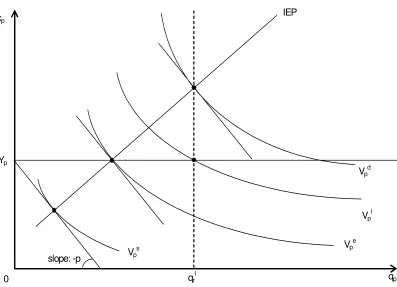
r. Figure 1 shows some utility levels on the plane
(x, q).17 The line IEP represents the income expansion path.
15
If it were possible to tax the poor, it might be optimal to do so and use the proceeds (plus some additional resources provided by the rich) to fund a public school system of a higher quality than the private one attended by the poor in the laissez-faire situation (see Section 6.3).
16
Notice thatVl
p ≥Vps. Also note that the assumption of an income-inelastic demand in the rich’s income range allows us to
define a uniqueVl
p, which greatly simplifies the analysis.
17
3
Public Education Chosen Only by the Poor
This section investigates the optimal policy when the rich are not attracted to public schools, i.e. Vo
p < Vpl. The following proposition18 characterizes the optimal policy for target utility
levels Vs
p < Vpo < Vpe. Proposition 1. For Vs
p < Vpo < Vpe, the optimal public intervention is through cash transfers.
Since the poor’s indifference curves are strictly convex, the cheapest way to get to Vo p from
Vs
p is by a pure cash transfer. Moreover, for Vpo < Vpe that policy has the largest impact in
reducing education quality dispersion. The key point is that while a pure cash transfer is used by poor people to supplement their consumption of education, any policy which includes an in-kind program entirely substitutes for the poor’s private consumption of education. When redistribution is “small” (i.e. Vo
p < Vpe), a small in-kind program is enough to get the poor to
the target utility level. Hence, the quality offered at public schools ends up being lower than the education quality bought by the poor under a pure cash transfer.19 Thus, even when there
is a specific concern about the distribution of education, if the utility redistribution is small, it should be performed via pure cash transfers. A sufficient condition for the optimality of such a policy whenVo
p < Vpl, i.e., the rich are not attracted to public schools, isqm(p, Yp+C)> C/p.
From this condition, it is easy to see that the more sensitive the demand for education of poor households with respect to cash transfers (income), and the higher the education quality purchased by the poor when there is no public education, the “wider” the region where pure cash transfers are the optimal policy.20 When the demand for education is highly sensitive
to income in the poor’s income range, a cash transfer can be very effective in increasing the poor’s education quality, and thus reducing quality dispersion. Also, if the share of education in the poor’s budget is large, it is necessary to spend a greater amount of resources to build a public education system which offers a quality level higher than that previously consumed by the poor. Again, the impossibility of supplementing public provision is crucial: even a small cash transfer can be used by the poor to buy moreq in the market and supplement his consumption. Instead, an in-kind program has to be big enough to entirely substitute for the poor’s private consumption of education.
Differentiation of (9) when cash transfers are the optimal policy21 yields the slope of the
UPF in the region of Vo
p ∈(Vps, Vpe)
dVs r
dVo p
= q
p
yα(qr−qp)−U1r
U1p , (14)
18
All the proofs are relegated to the Appendix. 19
The difference between the two policies is even more extreme for values ofVo
p close toVps: an in-kind program that places the
poor atVo
p might offer a lower quality than the quality bought in the market by the poor in the non-intervention situation. The
possibility of a reduction in the level of education quality brought about by introducing subsidized public education is pointed out in Peltzman (1973), and documented in Ganderton (1992) for the college level.
20
See Gasparini (1997) for a formal proof. 21
Remember that under the present circumstances (i.e.,Vo
p < Vpl), all rich individuals behave in the same way: they all purchase
their preferred quality of education in the market. As a result, the rich’s average education quality level ¯qrcan be replaced any rich
where qi ≡ qm(p, yi) is the education quality purchased in the private sector by an individual
with incomeyi. The first term in the numerator is the gain for a rich person of giving one dollar
when the rest of the rich also give one dollar. That dollar increases the poor’s consumption of education in qp
y (the change in the poor’s education demand with respect to income), which in
turn increases rich’s utility by α(qr−qp). The second term is the loss experienced by the rich
from giving up a dollar, i.e. her marginal utility of the numeraire consumption. The condition for a point in the UPF to be Pareto-dominated isqp
yα(qr−qp)> U1r.
Strong Externality
An externality is defined as strong when rich people are better-off by all giving one dollar to finance education for the poor, i.e., through a donation from the rich to the poor, the economy reaches a Pareto-superior allocation. The definition requires that this donation should be made under two conditions: (i) every rich gives one dollar, and (ii) resources should be fully allocated to finance education for the poor. Analytically, the condition for an externality to be strong is (1/p)α[q∗(p, yr, q
g)−q∗(p, yp, qg)] > U1r. From equation (14), if there is a strong externality
and the poor’s education demand is sufficiently sensitive with respect to income (and thus qp y
is close to 1/p), there will be a region of Pareto-desirable redistribution. But if demand is relatively income-inelastic (smallqp
y), even when there is a strong externality, there could be no
allocations “close” to the laissez-faire (meaning in the range Vs
p < Vpo < Vpe) which are Pareto
superior to it. From the status quo situation, if the rich build a “cheap” (low-quality) public education system, the poor might give up their private education and reduce their consumption of education quality. Instead, if the rich decide to give in cash the equivalent of the education budget, and the demand is sufficiently income-inelastic in the poor’s income range, the increase in the poor’s consumption of education will not be enough to make the rich better-off. Therefore, there is no policy that can help the rich make a donation or transfer that is Pareto-desirable.
The next proposition studies the optimal public policy when the target utility level for the poor lies between Ve
p and Vpl.
Proposition 2. Consider the range where Vo
p ∈(Vpe, Vpl). Then,
(a) Pure cash transfers are never optimal. (b) For Vo
p sufficiently close to Vpe, a pure in-kind transfer is the optimal policy.
(c) If the externality is strong, a pure in-kind transfer is optimal.
(d) If the externality is not strong, a pure in-kind transfer could still be optimal, but this is more unlikely to occur as we move away from Ve
p.
To see why pure cash transfers are never optimal in the range being studied note that when Ve
p < Vpo and rich people are not attracted to the public option, the outcome of a cash transfer
keep the poor at the same utility level, but the larger educational budget will increase the poor individual’s consumption of education quality, which is a first order gain for the rich.
Point (b) of Proposition 2 can be explained as follows. Recall that when the target utility level is equal to Ve
p, pure cash and pure in-kind policies are completely equivalent.22 When we
slightly increase the target utility from Ve
p, the cost to the rich of getting the poor to that level
is similar under any pure policy. But this means that a pure in-kind transfer should be chosen, since it is the policy with the greatest effect on quality dispersion.
Regarding points (c) and (d) of the proposition, note that an in-kind program is efficient to improve equity in education consumption (in the region of the UPF being analyzed), but it is relatively an expensive policy to increase the poor’s utility. However, when the externality is strong, the rich do not care about the “price” of in-kind redistribution since a dollar is worth more in the poor’s hands. As soon as the externality becomes not strong the trade-off becomes effective. But a corner solution can still be optimal: reallocating money from public education to a cash transfer program significantly reduces education quality received by the poor since none of the poor’s increased income will be allocated to buy more education (again because of non-supplementability). This effect can be larger than the rich’s savings by using a cheaper tool for redistribution. As we move away from Ve
p, the dispersion in education quality, and hence
the gains from reducing it, become smaller. Also, the distortion caused by a larger education program, and hence the gains of replacing part of it by a cash transfer program, become larger. Therefore, a combination of cash and in-kind transfers is likely to be the best policy.
Using the envelope theorem from (9) it can be proved that if and only if the externality is strong, the slope of the utility possibility frontier is positive. Also, from comparative statics it is easy to see that an increase in the concern for the distribution of education (i.e. an increase in parameter α) leads to an increase in public provision of education, and to a decrease in cash transfers, given Vo
p. Overall, the amount of resources taken from the rich to finance public
programs (cash and in-kind) increases.23. This is natural since an in-kind program is better
for improving equality of opportunity (in the region of the frontier being analyzed). Hence, an increment in the rich’s concern for the distribution of education leads to an increase in the size of the in-kind program. To keep the poor indifferent, the cash transfer must be reduced. Since cash transfers are “cheaper” than in-kind ones, rich’s total contribution to public programs must increase.
4
Public Education Chosen by the Poor and the Rich
Thus far, Vo
p was small enough so that any public education program that takes the poor from
laissez-faire to that target level was not appealing to rich people. However, whenVo
p reaches the
valueVl
p a pure in-kind program needed to achieve that level offers a quality that is just enough
22
Any combination of these policies which take the poor toVe
p would imply higher taxes on the rich (than the pure policies) and
a lower education quality consumption by the poor, so it would never be chosen. 23
to attract the rich. The number of rich people that choose public education depends on the value of E. In particular if E = Jpql
r/N, S(≡ (J −N)) rich individuals attend public schools
while the rest attend private institutions. Note that as E increases in the interval (pql
r,2pqrl),
the equilibrium public school quality level qg does not move from the rich’s limit quality qrl. A
fixed quality with an increasing budget is explained by a rising enrolment of rich people who move to the public sector.
Rich people can be attracted to the public sector only when the target utility level for the poor is equal or greater than Vl
p. At that point, the relative power of in-kind provision
over cash transfers significantly increases because it can be used to drive the rich to the public sector and hence, to obtain a more dramatic effect in reducing education quality dispersion. If this effect is strong enough, all taxes should be allocated to finance a public education program which attracts some of the rich. In Gasparini (1997), it is shown that even when the externality is not strong, the optimal policy to reachVl
p can be a pure in-kind transfer that benefits all poor
and some rich individuals, i.e. a semi-universal program. As a result, all poor and some rich individuals attend public schools.24 In the present paper we prefer to skip the discussion of that
point and jump to the study of utility levels greater thanVl
p, since the intuition and results are
basically the same.
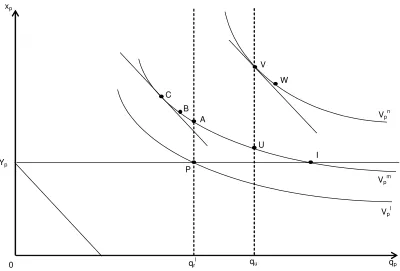
There are several policies capable of achieving a target utility larger than Vl
p (like Vpm in
Figure 2): (a) An in-kind program which offersqg > qlr and attracts all the rich to public schools
(a universal in-kind program). This policy could consist of a pure in-kind program (point I in Figure 2), or an in-kind program combined with a cash transfer (a point on Vm
p between A and
I, like U).25 (b) An in-kind program which offers q
g = qrl (and again possibly direct in-cash
transfers) and attracts just some of the rich to public schools (a semi-universal in-kind program). This policy is represented by point A in Figure 2. (c) A combination of a cash and an in-kind program which offers qg < qrl and is chosen only by poor people, i.e., a point onVpm between C
and A, like B (a reduced in-kind program). (d) A pure cash transfer (point C).
We start by looking for the best universal in-kind program (labeled qu), although this
does not mean that it will necessarily be the best policy among all the policies mentioned above. Given that we are choosing among universal programs, equalization is complete under any policy. There are two forces driving the choice ofqu: (i) it would be convenient to choose a program that
provides a quality level close to qp because that level minimizes the transfer needed to achieve
Vo
p; but also (ii) a quality level close toqr is desirable because at that point the rich’s preferences
are fully respected and the distortion is minimized. To establish the range of variation forquone
should find the optimal universal program that maximizes U(Yr −C−E, E/2p) with respect
24
A pure in-kind transfer that attainsVl
pis represented as pointPin Figure 2. PointP is consistent with any value ofS. A larger
value implies a higher degree of education quality equalization, but also a larger educational budget and a corresponding heavier tax burden on the rich.
25
In this section, we assume thatC≥0, i.e. the poor cannot be taxed, so thatyp≥YP. Otherwise, positive or negative in-cash
to{C, E},subject to Vo
p =U(Yp+C, E/2p).26 The first order condition for an interior solution
can be expressed as (Ur
2/U1r)−p=p−(U
p
2/U
p
1), where marginal utilities are evaluated at points
like U. Hence, qu cannot be larger than qr because in that case the LHS would be negative
and the RHS would be positive. In addition, it cannot be smaller than qp because if it were,
the LHS would be positive and the RHS negative, which again is a contradiction. Hence, the most preferred universal in-kind program will offer an education quality level always in the range betweenqp and qr. Once q
u is chosen, it has to be compared with the rest of the policies
which are capable of reaching Vo
p > Vpl: a pure cash transfer, a reduced in-kind program, and a
semi-universal in-kind program. This comparison is carried out in the following sections.
4.1 Universal public education versus pure cash transfers
It is shown in the Appendix that the condition for a universal public education program to be preferred to a pure cash transfer is27
α 2(q
r−qp)2
> U1r(c)θc+ (qr−qu) [U2r(u)−U1r(u)p], (15)
whereθc ≡Cu+Eu/2−Cc,qp ≡qm(p, Yp+Cc),uandcrefer to points likeU andC, respectively,
in Figure 2, andUi
j(v) denotes the marginal utility of good j for individual ievaluated at point
v = u, c. The LHS is the education quality dispersion under a pure cash transfer which is also the gain from switching to a universal in-kind program with complete equalization. The RHS shows two sources of savings when pure cash transfers are selected: (i) Cash transfers are cheaper than any other policy to get the poor to any given target utility level. θc is defined as
the difference between the part of the costs associated with pointU, which are devoted to poor people (the cash transfer implicit in U plus half of the education expenditures), minus the cost of the pure cash program (allocated entirely to the poor). This value is necessarily non-negative. (ii) A universal program induces the rich to buy a bundle different from the one they would have bought with a similar post-tax income, but without the free public provision of education. The last term captures this distortion. When qu is less than qr, the term in brackets is positive and
the whole term is positive. Notice that we did not have to worry about rich’s preferences in the last section since they chose their most preferred bundle at private markets. On the contrary, when qg ≥ qlr, rich people are induced to consume public education, and thus, their decisions
26
Specifically, the problem can be written as
max {C,E,µ}U(Y
r
−C−E, E/2pq) +µ[U(Yp+C, E/2pq)−Vpo],
subject toC≥. The first order conditions are given by
E : −Ur
1+U2r/2p+µU
p
2/2p= 0
C : −Ur
1+µU
p
1 ≥0, C≥0, (−U
r
1 +µU
p
1)C= 0 and the corresponding expression forµ. At an interior solution we obtain (Ur
2/U
r
1)+(U
p
2/U
p
1) = 2p, which is simply the Samuelsonian condition for publicly provided private goods. If at pointIin Figure 2, Ur
1(Yr−E, E/2p)> µU
p
1(Yp, E/2p),then it would be optimal to tax the poor (i.e.,C <0). The previous inequality holds ifVo
p or the difference betweenYr andYpis small enough.
However, if the latter condition is satisfied and we assume that institutional restrictions prevent taxing the low income group (C≥0), then the universal program will consist only of pure in-kind transfers.
27
are distorted by the public policy. An interesting case occurs if Vl
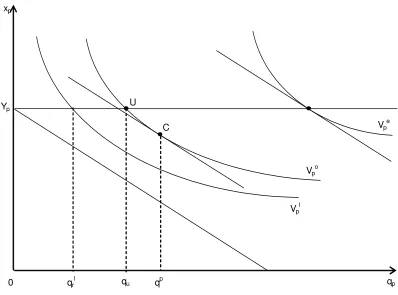
p < Vpo < Vpe. This situation is depicted in Figure 3. A
pure cash transfer leads to point C and quality qp, while a pure in-kind program is represented
by point U and quality qu. Since Vpo < Vpe, we know from last section, and it is clear from the
graph, that a pure cash transfer is not only the cheapest policy to get toVo
p, but also it increases
the poor’s education quality consumption more than any other policy. In particular, qp > q u.
That was the end of the story in last section since the rich were not attracted by quality qu.
However, whenVo
p > Vpl as in the graph, a pure in-kind program necessarily becomes a universal
program. In comparingU andC, some new elements should be added. On the one hand, ifU is chosen the rich’s decisions are distorted (from qr to q
u); however, on the other hand, the effect
on equity is more powerful. WhenVe
p < Vpo < Vpl a pure in-kind program just moves the poor’s
education quality towards the rich’s. If instead Vl
p < Vpo < Vpe education quality is completely
equalized by driving both the rich and the poor to public schools. The condition for U to be preferred to C in Figure 3 is similar to inequality (15). This analysis leads us to conclude that if the concern for equality of opportunity is sufficiently large, a universal in-kind program could be better than a pure cash transfer, even when the latter leads to a higher education quality for every individual than the former. Of course, this result depends on the specific form of the externality assumed in this paper, which focuses on the concern about the distribution of education (or health). In the case of a traditional externality, where rich people care only about the poor’s consumption, a cash transfer will be unambiguously chosen in the above situation. Notice also the important difference with the redistributive arguments of public provision based on informational problems.28 In such justifications, public provision is optimal only when it
does not attract the rich, so only reduced public programs make sense. In the case we just analyzed, if α is sufficiently large the conclusion is quite different: it is by attracting the rich and becoming a universal program that public provision may be optimal.
4.2 Universal public education versus reduced in-kind programs
When qp is larger than ql
r, a pure cash transfer dominates any policy which includes a reduced
public education program chosen only by the poor because it implies both a lower cost and a lower level of quality dispersion. Hence, only the case where qp is smaller than ql
r will be
considered. The condition for a universal public education program to be preferred to a reduced public education program chosen only by the poor is:29
α 2(q
r−q
b)2 > U1r(b)θb+ (qr−qu) [U2r(u)−U1r(u)p], (16)
where θb ≡ Cu +Eu/2−Cb −Eb, and b refers to reduced programs like B in Figure 2. This
expression is similar to the pure-cash one. The value ofθb is still positive sinceU is to the right
of B, which implies a larger distortion from qp. The advantages of a reduced program are that
28
See, for example, Besley and Coate (1991), Blomquist and Christiansen (1995), and Pinto (2001, 2004). 29
it is cheaper and the rich’s decisions are not distorted. However, if the concern for equality of opportunity is important and the distance between qr and q
b is large, a universal program
should be chosen.
4.3 Universal public education versus semi-universal public education
Recall that to attract only some of the rich to public schools,qg should be equal toqlr. Equation
(17) is an approximation of the condition for a universal program to be preferred to a semi-universal program:30
α 2
(1−π) qr−qlr2
> U1r(a)θa+
(1−π) (qr−qu) +π(qlr−qu)
[U2r(u)−U1r(u)p], (17)
where θa ≡ Cu +Eu/2−Ca−Ea/(1 +π), π is the proportion of rich individuals that attend
public schools, i.e., π =S/N, and a refers to a semi-universal program (point A in Figure 2). The previous condition can be interpreted as follows: (i) A universal program achieves complete education quality equalization, while in a semi-universal one, some rich people attend private schools of a higher quality and thus, equalization is not complete. This effect is reflected on the LHS of (17). (ii) The first term on the RHS reflects the difference between a semi-universal and a universal program in terms of the amount of resources required to support each scheme (as valued by the rich). We will emphasize later that when the target utility level for the poor Vo p
is high enough, a universal program becomes relatively cheaper with respect to a semi-universal one, i.e. θa eventually becomes negative. (iii) Everybody in a universal program gets qu, while
under a semi-universal scheme some rich people,π, consumeql
rand some others, (1−π), purchase
qr. Recall thatql
r < qu < qr. Therefore, on the one hand, a universal program is beneficial since
it takesπrich individuals to a more desired bundle (from ql
r toqu); on the other hand it distorts
the decision of (1−π) rich persons who reduce their education quality consumption from qr to
qu. The second term of the RHS of (17) illustrates this effect, where (U2r−U1rp) is evaluated at
qu, and thus, it is positive.
4.4 Increase in Vo
p when the optimal policy is a universal in-kind program
It can be shown that even when there is universal public education, and hence an increase in the educational budget does not reduce education quality dispersion, it will still be optimal to increase the education budget as the target utility for the poor gets higher. In addition, if the optimal universal program provides in-cash transfers, then they will also increase with Vo
p, and
the optimal public education quality will approach the quality level chosen by the poor at price p.
Proposition 3. In the region where a universal in-kind program is the optimal policy: (i) an increase in Vo
p leads to an increase in the size of the program, i.e. E rises; (ii) an increase
in Vo
p leads to an increase in the cash transfers associated with the universal in-kind program,
30
i.e. C rises; and (iii) as Vo
p increases, the optimal public education quality qu gets closer to
qp ≡q(p, yp).
To understand the intuition behind (i), start at point U in Figure 2 and increase the poor’s utility fromVm
p toVpn. Consider a pointV where total transfers devoted to the in-kind program
are the same as in U. In addition, assume that the slope of the poor’s indifference curve at V is −p. The resources transferred from the rich to the poor at point V are about the same as in W, a point close to V, but with a larger educational budget. The difference in the rich’s post-tax income between those two points is equal to p(qv−qw). But rich people are getting a
higher quality at W, more precisely (qw −qv). This means that, by moving from V to W, rich
people are “allowed” to buy education quality at a price p. Note that they are better-off with this deal, since at V they were consuming a lower education quality than the desired one (i.e., qv =qu < qr).
From point (iii) of Proposition 3, we can conclude that θa tends to be negative as Vpo
increases, i.e. a universal program becomes increasingly cheaper with respect to a semi-universal one in terms of the amount of resources devoted to the poor. Given that ql
r remains fixed and
that education quality is a normal good, asVo
p becomes greater thanVpd,31qp moves to the right
ofql
r. In addition, the optimal public school quality under a universal programqu not only rises
withVo
p (given thatE goes up), but also gets closer toqp. Since the amount of resources assigned
to the poor is minimized at qp, the provision of q
u will eventually require a lower amount of
transfers from the rich compared toql r.
4.5 Summing up
The previous analysis allows us to assert that an in-kind transfer taken by the whole population has the property of achieving complete education equalization, which could make it preferable to any other policy combination if the concern for equalization is sufficiently large. In some circumstances, it could also have the advantage over non-universal programs of achieving Vo
p at
a smaller cost. Finally, it implies a higher level of quality for some of the rich (i.e., a level closer to their most desired bundle) than a semi-universal program. Proposition 4 summarizes these findings.
Proposition 4. If the concern for equality of opportunity is sufficiently high, a universal in-kind program (likely complemented with cash transfers) is optimal to achieve a level Vo
p > Vpl.
5
Optimal Policies Along the UPF
Given the complexity of the preceding arguments, it is worth summarizing the main conclusions. The previous analysis has shown that optimal policies depend on many parameters. Two of them are especially relevant: the degree of concern about the distribution of education quality (α),
31
Remember thatVd
p was defined in (13) as the poor’s utility level such that a pure cash transfer that leads the poor to that level
and the target utility level for the poor (Vo
p). It might be clarifying to draw a graph showing the
policy choices given different values of these parameters. To do so, we make some assumptions with respect to the values of Ve
p, Vpl, and Vpd. For simplicity only the case where Vpe< Vpl < Vpd
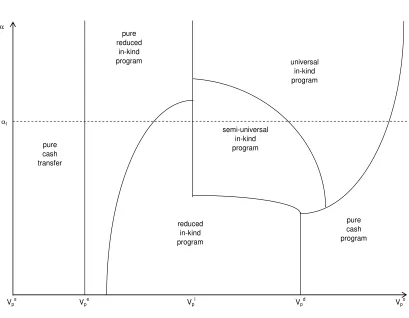
is presented. The resulting optimal-policy map is shown in Figure 4.
The best policy is non-intervention on the vertical axis and a pure cash transfer on the horizontal axis.32 Pure cash transfers are also chosen for Vo
p less than Vpe regardless of the
value of α. For values greater but close to Ve
p, a pure reduced in-kind program should be
selected for any α. This kind of program should be complemented with cash as Vo
p increases,
unless α is sufficiently large to make the externality strong or nearly strong. When we reach Vl
p, a semi-universal in-kind program is likely to be chosen, even when the externality is not
strong. As we increase the target utility from Vl
p, a universal program can be optimal if the
concern for equality of opportunity is important. Finally, for levels of utility greater than Vd p,
reduced programs are dominated by pure cash transfers, and also semi-universal programs start to lose strength against universal ones. Perhaps one of the main conclusions of the analysis is that given a certain concern for the distribution of education quality, any policy can be optimal depending on the degree of utility redistribution. Take the value α1 in Figure 4. That
value is consistent with pure cash transfers, pure in-kind programs, or a combination of both; and with public provision taken only by the poor, also by some rich people, or even by the whole population. If social planners followed the prescriptions of this analysis, we would not expect in-kind programs in societies with little utility redistribution. But we would expect the same observation from highly redistributive societies, even when the concern for equality of opportunity is high. Societies with a high concern for equality of opportunity are naturally more likely to have universal in-kind programs.
6
Extensions
The model may be extended in different directions. This section considers the effects of costly redistribution and includes a preliminary analysis of costly take-up, and taxes on the poor.
6.1 Costly government intervention
Up to now, even though government intervention (through the public provision of private goods) distorts individuals’ decisions, the policy is justified if the concern for equality of opportunities is strong enough. It was, however, implicitly assumed that there were no other costs associated with government’s involvement in the economy. Costly intervention can be introduced in a simplistic manner by assuming that from each dollar paid by the rich there is only a fraction 0< β <1 available to support a cash or an in-kind program (or a combination of both). Thus,
32
a fractionβ of the tax revenues collected is “lost” in the welfare state. This may reflect shadow costs of public funds, organizational and administrative cost of executing the programs, leakages in the system, or governmental waste of resources. Equation (3) changes to yp =Yp+βC, and
equation (4) to qg = βEN/pJ. These modifications do not substantially alter any previous
result. In contrast, the existence of efficiency costs of public intervention is crucial as we move to higher levels of the poor’s target utilityVo
p. Proposition 5. If 0< β < 1, when Vo
p is sufficiently large a pure cash transfer is the optimal
policy.
In order to understand this last proposition, compare a pure cash transfer with a universal program. The former will be preferred when:33
α 2 (q
r−qp)2
< U1r(c)θc+ (qr−qu)
U2r(u)−U1r(u)p β
+U1r(u)pqr
1 β −1
. (18)
As the target utility level Vo
p is increased, qp grows and quality dispersion shrinks, making the
LHS increasingly smaller. Also, asVo
p goes up and qp tends to qr, qu tends to be equal to both.
Hence, the first two terms in (18) tend to zero. But notice that the third term does not vanish as Vo
p grows large. Rather, it becomes larger as the rich’s marginal utility of income increases
andpqr[(1/β)−1], which is positive, remains fixed.34 Therefore, there will be a sufficiently large
Vo
p such that (18) holds. The intuition is simple: when the target utility level is large, a cash
transfer leads the poor to buy an education quality level in the private sector similar to the one purchased by the rich. The effects of a pure cash transfer become similar to a universal program. But a difference remains: an in-kind program makes everybody “buy” education through the public sector rather than in the market, and thus, it generates an unnecessary efficiency loss.
A pure cash transfer is also better than a combination of cash and a reduced in-kind program. As Vo
p increases, eventually we get to a point where qp is greater than qrl (i.e. C
is to the right of A). From that point on, a pure cash transfer implies less education quality dispersion than a reduced in-kind program, and is cheaper as well. Finally, for large values of Vo
p a pure cash transfer is better than an education program chosen by the poor and just some
of the rich. In addition to the “β-inefficiencies”, such a program needs to keep quality fixed at ql
r and hence, it implies a higher education quality dispersion, a larger cost to achieveVpo, and
a distortion on the behavior of some of the rich.
6.2 Costly take-up
It is important to recognize that the opportunity costs of attending school may induce some people not get any education at all, even when it is offered in the public sector free of charge. Analytically, opportunity costs can be captured by adding a function w(q) to the post-tax income: w(q) =wo if q = 0, and w(q) = 0 if q >0. An individual i will be indifferent between
33
See Appendix. 34
attending a public school and not going to school at all when U(yi+w
o,0) = U(yi, qg). It is
possible to show that opportunity costs are more burdensome for poor people, and therefore they are the first to drop school.35 The introduction of costly take-up modifies some of the
previous results:
(i) Without costly take-up the optimal policy for the status-quo level Vs
p is nonintervention.
The basic reason is that an in-kind transfer implies a lower quality level than the status-quo education quality bought by the poor in the market. Suppose that with opportunity costs and no public intervention poor people decide not to receive any education at all. Recall that, given that the poor cannot be taxed, any policy containing cash cannot be used if we want to stay at Vs
p. With costly take-up, a pure in-kind policy may drive the poor to school, and at the same
time keep them atVs
p. The way an in-kind program does so is by subtracting the valuewo from
the poor’s income. A pure in-kind program may be optimal but if the externality is not strong non-intervention is still the preferred policy.
(ii) In Section 3 it is shown that forVo
p < Vpe a pure cash transfer is the optimal policy. However,
notice that with opportunity costs the income effect of a pure cash transfer might not be enough to drive the poor to school. Thus, a pure in-kind program, although costly, might be chosen because it is helpful in reducing education quality dispersion.
(iii) WhenVo
p > Vpe (but less thanVpl) Proposition 2 establishes that pure cash transfers should
never be used. This conclusion may vary with costly take-up. An important point underlying Proposition 2 is that a pure cash transfer can always be mimicked by a combination of a smaller cash transfer and some in-kind program. Now, consider the costly-take up case and assumewo
is big enough so that the poor choose not to receive education when offered a given pure cash transfer. In that case the outcome of a pure cash transfer cannot be replicated anymore. The reason is that an in-kind transfer that drives the poor to public schools will make them lose the opportunity costwo. To take them back to the target level attained by a pure cash transfer and
still want them at public schools requires a much larger budget than with a pure cash transfer. The key point is that an in-kind program has the additional cost of paying the cost wo lost by
poor people.
(iv) The introduction of costly take-up can offer a rationale for mandatory school. Suppose the optimal policy to attainVo
p is a combination of cash and in-kind transfers, but that due to the
presence of opportunity costs the poor decide not to attend school. Mandatory school can solve this problem as poor people are “forced” to move to the socially desired point on Vo
p.36
35
See Gasparini (1995) 36
6.3 Taxes on the poor
Some of our earlier results change when the poor can be taxed. Take for instance a target utility level equal to the status-quo situation, i.e. Vo
p =Vps. Ignoring the existence of opportunity costs
of consuming education and with no taxes on the poor, the optimal policy is non-intervention. Notice that if the poor can be taxed and public policy is not costly, the non-intervention outcome can be replicated by taxing the poor and use the proceeds to create a public education system that offers the same quality bought by the poor under non-intervention. But then, from that point it is optimal to increase the tax on the poor a little bit more and use the extra resources to increase the quality of public education. The marginal increase in taxes on the poor will not be enough to finance the increase in public education quality needed to place them back atVo
p.
However, the difference, that should be financed by the rich, is of a second order magnitude since the poor were at a tangency point. On the other hand, the increase in the quality of public education attended by poor people will decrease education dispersion, and hence will be a first-order gain for the rich.
The same line of reasoning can be applied to show that in the range Vs
p < Vpo < Vpe a
pure cash transfer is not the optimal policy anymore when the poor can be taxed. A pure cash transfer financed by a tax on the rich can be replicated by a pure in-kind transfer financed by a similar tax on the rich and a tax on the poor. From that point, and using the same argument as above, it will be optimal to increase the size of the in-kind program.
7
Concluding Remarks
Equality of opportunity is perhaps one of the most used arguments in the education and health debates. Yet there has been relatively little theoretical attention on what kind of public inter-vention it justifies. In our trip along the utility possibility frontier we have seen that there is not a unique policy to deal with equality of opportunity. In some regions of the UPF a pure cash transfer is optimal, in others in-kind provision or a combination of both instruments are the best policies. The choice of the optimal policy for a given utility redistribution depends on certain particular characteristics of the economy: income dispersion, income sensitiveness of the education quality demand, budget share of individual education expenses, and the degree of people’s concern about education quality dispersion. The conclusions also depend on the existence of costs associated with consuming education that can lead to zero consumption, and on the possibility of taxing the poor.
when there is a strong externality involved in people’s concern about equality of opportunity, sometimes there is no policy which can take the economy to a situation Pareto-preferred to the market allocation. (iii) For “middle” values of utility redistribution, public provision limited to the poor can be socially optimal. (iv) A public education (or health care) program attended by the whole population might be justified, even in a world where cash transfers are possible, if the concern for equality of opportunity and the desired utility redistribution are sufficiently large. (v) The educational (or health) budget might be optimally increased beyond the point where it attracts the whole population and achieves complete equalization.
Acknowledgments
The authors are grateful to Timothy Besley for stimulating comments and suggestions. We also thank Ann Case, Tom´as Chuaqui, Igal Hendel, Alessandro Lizzeri, Alex Patelis, Federico Weinschelbaum, seminar participants at Princeton University, Universidad Nacional de La Plata, and Universidad T. Di Tella, and AAEP for helpful comments. We also appreciate the comments of three anonymous referees. Of course, the usual disclaimer applies.
Appendix
A. Proof of Proposition 1
It is sufficient to prove that (i) a pure cash transfer requires fewer resources transferred from the rich to the poor to attain a level of utilityVo
p than any other policy, and (ii) a pure cash transfer results in a lower level of education quality
dispersion than any other policy. The first part is well-known and straightforward. Poor’s indifference curves are strictly convex, thus, the cheapest way to get to a given level ofVo
p from the original poor’s utility level is by a pure cash transfer
(label it as Co). For part (ii), label the education budget needed to get to Vo
p in a pure in-kind policy as Eo. Any
combination of in-kind and cash which attainsVo
p implies E < Eo and then a lower level of education quality for the
poor. So we need to compare only a pure cash transfer with a pure in-kind transfer and show thatqm(Yp+Co)> Eo/p.
From the definition ofVe
p and strict convexity of indifference curves,qm(Yp+Ce) =Ce/p, and thus
Yp+Ce−pqm(Yp+Ce) =Yp (19)
Since both goods are normal in the poor’s income range andCo < Ce,
Yp+Co
−pqm(Yp+Co)< Yp+Ce−pqm(Yp+Ce).
From (19),
Yp+Co−pqm(Yp+Co)< Yp, (20)
and from the definition ofCo andEo
U(Yp+Co−pqm(Yp+Co), qm(Yp+Co))≡Vpo≡U(Y p
, Eo/p). (21)
Using (20) and the fact that marginal utilities are positive we get thatqm(Yp+Co)> Eo/p.
B. Proof of Proposition 2
For part (a) assume by contradiction that a pure cash transfer is optimal for some Vo
p in the range (Vpe, Vpl). Thus,
Vr(C,0)> Vr(x, y) for everyxandysuch thatVp(x, y) =Vpo=Vp(C,0). We can always choose a pair (C′, E′) such that
Vp(C,0) =Vp(C′, E′) andC =C′+E′. Now reduce the cash transfer a little bit toC′′, and increaseE to E′′ so that
Vp(C′′, E′′) =Vp(C,0). We want to show thatVr(C′′, E′′)−Vr(C,0)>0. This expression can be approximated by
(C′+E′−C′′−E′′)U1r+
α
2
"
qr−E ′
p
2 −
qr−E ′′
p
Since the poor are at a tangency point when the policy is (C′, E′), (C′+E′
−C′′−E′′) is negligible. Finally, the second
term is positive sinceE′′> E′.
For (b), (c) and (d) defineD as the difference in the rich’s utility between a pure in-kind program E and any combination of cash and in-kind transfers (C′, E′) that take the poor toVo
p. D can be approximated by
D≈(E−E′)
α p
qr−E
p
−U1r
+C′U1r
Consider a combination (C′, E′) sufficiently close to (0, E) (this is enough for our purposes). Then (E−E′) can be
approximated by (C′pUp
1/U
p
2) and,
D≈C′
Ur
1 +
pU1p
U2p α p qr −E p
−U1r
For (b), note that when Vo
p tends toVpe, pU p
1/U
p
2 tends to 1. Thus, sinceq
r > E/p, D is positive and a pure in-kind
transfer is the optimal policy. For (c) recall that a strong externality means (α/p)(qr
−E/p)> U1r, which impliesD >0.
For (d) notice that if (α/p)(qr
−E/p)< U1r,D could still be positive ifpU
p
1/U
p
2 is close to 1. This does occur close to
Ve
p. But as we move away from that utility level,pU1p/U
p
2 (evaluated at a pure-in-kind-policy point) grows larger and the
difference between quality levels gets smaller, soD tends to get smaller and eventually becomes negative.
C. Proof of Proposition 3
When both kind of individuals choose public education, the optimization problem (9) becomes:
max
{C,E}L=U
Yr
−C−E, E
2p +µ U
Yp+C,E
2p
−Vpo
Note thatdql
r/dyr= 0 impliesU12r =U11rU2r/U1r. From the first order conditions,
1 2 Ur 2 Ur 1 +U p 2 Up 1
=p. (22)
Comparative static yields
dE dVo p = 1 H µ
2p(U
p
1U
p
21−U
p 2U p 11) ,
whereH is the corresponding (positive) Hessian. Sinceqis normal in the poor’s income range, the term between brackets is positive as well. Hence, the whole expression is positive, which also means thatqu increases withVpo. We can also
obtain that dC dVo p = 1 H 1
(2p)2
µ(U2pU
p
12−U
p
1U
p
22) +
1
µ(U
r
2U
r
21−U
r
1U
r
22)
>0. (23)
This last result holds because good xis a normal good for both the rich and poor, so the first and second terms (the expressions in parenthesis) are both positive. As a consequence, the rich’s utility decreases withVo
p. From the previous
results we can also conclude that (Ur
2/U1r) falls withVpo, which implies (due to (22) that (U p
2/U
p
1) rises withV
o
p. In other
words,quapproachesqp.
D. Proof of Proposition 4
The proof of this proposition is based on Figure 2, where each policy is represented by a point on the poor’s target utility levelVm
p . The sketch of this proof is divided in three parts:
(1)A universal in-kind program could be better than a pure cash transfer. Comparing the rich’s utility levels under both policies,U is better thanC if
α
2(q
r
−qp)2> U(Yr−Cc−pqr, qr)−U(Yr−Cu−Eu, qu),
where subscripts u and c refer to points U and C in Figure 2. Since Cc minimizes the transfer to the poor, θc ≡
Cu+ (Eu/2)−Cc>0. Also recall thatEu/2 =pqu. Then, the above equation can be rewritten as
α
2(q
r
−qp)2 > U(Yr−Cc−pqr, qr)−U(Yr−Cc−θc−pqu, qu).
The last term can be decomposed to get
α
2(q
r
−qp)2 > U(Yr−Cc−pqr, qr)−U(Yr−Cc−θc−pqr, qr)
+U(Yr
The first two terms of the RHS can be approximated by Ur
1(c)θc >0, and the last two by (qr−qu)[U2r(u)−U
r
1(u)p],
whereUi
j(v) denotes the marginal utility of goodjfor individualievaluated at pointv. Applying these approximations
to the above inequality leads to inequality (15) in the text which is positive for a sufficiently largeα.
(2)A universal in-kind program could be better than a reduced in-kind program. The condition forU to be better thanB
is
α
2(q
r
−qb)
2
> U(Yr−Cb−Eb−pqr, qr)−U(Yr−Cu−Eu, qu),
whereCband Ebare meant to belong to pointB. Defineθb≡Cu+ (Eu/2)−Cb−Eb>0. A decomposition similar to
the one performed in point (1) gives equation (16) in the text, which is positive for a large value ofα.
(3)A universal in-kind program could be better than a semi-universal program. Comparing the rich’s utility atU andA, a universal in-kind program is better than a semi-universal one when
α
2
h
(1−π)
qr−qrl
i2
>(1−π)U(Yr−Ca−Ea−pqr, qr) +πU(Yr−Ca−Ea, qlr)−U(Yr−Cu−Eu, qu),
whereCa andEa are meant to belong to pointA, andπ=S/N. At that point,qrl =Ea/p(1 +π) soEa=pqlr+πpq l r.
Defineθa≡Cu+ (Eu/2)−Ca−Ea/(1 +π), which again is the difference of resources devoted to the poor under both
regimes. Note that by (6),U(Yr
−Ca−Ea−pqr, qr) =U(Yr−Ca−Ea, qlr). WhenVpo increases, this difference tends to
be negative, asqpandq
umove to the right whileqrl remains fixed. Replacingθa, and performing a decomposition similar
to points (1) and (2), we obtain equation (17) in the text. This expression establishes the conditions under whichU is better thanA. Equation (17) holds for a sufficiently largeα.
E. Proof of Proposition 5
The conditions under which a pure cash transfer is better than a universal program are studied in part 1 of Proposition 3. If we introduce the inefficiency costβ,Cis better thanU when
α
2(q
r
−qp) 2
< U(Yr−Cc−pqr, qr)−U(Yr−Cc−θc−pqβu, qu).
A decomposition can be performed to get
α
2(q
r
−qp)2 < U(Yr−Cc−pqr, qr)−U(Yr−Cc−θc−pqr, qr)
+U(Yr−Cc−θc−pqr, qr)−U(Yr−Cc−θc−pq
r
β , q
r
)
+U(Yr−Cc−θc−pq
r
β , q
r
)−U(Yr−Cc−θc−pqu
β , qu)
The second term can be approximated byUr
1pqr[(1/β)−1], which is positive. Equation (18) is derived using the procedure
of part 1 of Proposition 3. The rest of the proof follows the lines given in the text.
References
Archibald, G. and Donaldson, D., 1979. Notes on economic equality. Journal of Public Eco-nomics 12, 205-214.
Arneson, R., 1989. Equality and equality of opportunity for welfare. Philosophical Studies 56, 77-93.
Barr, N., 1992. Economic theory and the Welfare State: a survey and interpretation. Journal of Economic Literature XXX, 741-803.
Besley, T., 1988. A simple model for merit good arguments. Journal of Public Economics 35, 371-383.