Alternatives for Implementing Methods
for Finding Agents in a Multi-Agent Systems
Mariano Tucat
Alejandro J. Garc´ıa
[email protected] [email protected]
Artificial Intelligence Research and Development Laboratory
Department of Computer Science and Engineering, Universidad Nacional del Sur, Consejo Nacional de Investigaciones Cient´ıficas y T´ecnicas (CONICET)
ABSTRACT
Interaction is an essential characteristic of Multi-Agent Systems (MASs). Multi-Agents that are part of a MAS usually interact by exchanging messages accord-ing to some conversation policy. Therefore, the ability to find other agents and exchange messages with them are features that need to be implemented in agents that are part of a MAS. Finding an agent means been aware of it existence and obtaining the information needed to send to it a message. There exists different alternatives of implementing the capability of finding other agents. In this work we will analyze the al-ternatives of implementing a discovery mechanism, a centralized Agent Name Server (ANS), a distributed ANS, or several ANSs.
1 INTRODUCTION
Interaction is an essential characteristic of Multi-Agent Systems (MASs). Multi-Agents that are part of a MAS usually interact by exchanging messages according to some conversation policy. There-fore, the ability to find other agents and exchange messages with them are features that need to be implemented in agents that are part of an open MAS. Finding an agent means been aware of it existence and obtaining the information needed to send to it a message.
There exist different alternatives of implement-ing MASs. One alternative is to implement the whole MAS ad-hoc. Another way is to use a MultiAgent development framework such as JACK [5], JADEX [7] or 3APL [1]. Finally, an-other alternative is to implement a MAS is using an extension of a Programming Language that provides the capability of finding other agents and exchanging messages.
The alternative of implementing the whole MAS ad-hoc means that the developer of the sys-tem is allowed to choose the architecture of each
Partially supported by CONICET (PIP 5050) and Agencia Nacional de Promoci´on Cient´ıfica y Tecnol´ogica (PICT 2002 Nro 13096)
agent, the way they interact and also the way they locate each other. Thus, this alternative has the advantage of a great flexibility in the design and implementation of the system. However, the main disadvantage is that the developer may have to implement everything, including the mechanisms used to locate the agents and also the primitives for exchanging messages.
The alternative of using a MultiAgent devel-opment framework such as JACK, JADEX or 3APL, will probably bound the developer of the systems to use a specific agent architecture and may also determine the way in which the agents should exchange messages. This alternative has the advantage of reducing the amount of work needed to implement the system.
Finally, the alternative of implementing the MAS using an extension of a Programming Lan-guage or a framework that provides the capability of finding other agents and exchanging messages (such as [4], JADE [6] or MadKit [8]) allows a flexible design of the system. This way of im-plementing the MAS will try to maintain the ad-vantages of the alternatives mentioned before also avoiding their disadvantages.
In [4] we have proposed an extension of the Logic Programming Language Prolog that pro-vides the agents the capability of finding other agents and also allows an easy way of exchang-ing messages. The proposed extension include some primitives that were motivated by the im-plementation of multi-agent systems for dynamic and distributed environments, where intelligent agents communicate and collaborate. One of the main goals of these primitives was to hide as much of the implementation details as possible, in or-der to provide a transparent way of finding agents and also a transparent way of programming agent interaction.
with others by just knowing the other agents’ names. These MASs are groups of agents and any agent may join and leave these groups dy-namically. To be member of a MAS means that the agent knows which other agents belong to the MAS. Any agent is allowed to be member of sev-eral MASs simultaneously, and also to join other existing MASs, create new ones and leave the ones that is connected to.
There exists different alternatives of imple-menting the capability of finding other agents. In this work we will analyze the following four alternatives:
1. a proper discovery mechanism in the agent code,
2. a centralized Agent Name Server (ANS), 3. a distributed ANS, or
4. several ANSs.
2 FINDING AGENTS
As stated before, finding an agent means been aware of it existence and obtaining the informa-tion needed to send to it a message. There exists different alternatives of implementing the capa-bility of finding other agents. One alternative is to provide the agents the ability of searching for the existence of agents. This is, to provide a mechanism in which each agent looks for agents that are also trying to interact with other agents. Another alternative is to allow the agents to find each other by using one or more special agents in which the agents register theirselves and obtain information of other registered agents. These kind of agents are often called Agent Name Server (ANS) and they store the information of the registered agents and answer any query made by them.
The ANS is similar to the Agent Management System (AMS) defined by FIPA [3] since both al-low the agents to register theirselves and also ob-tain information of other registered agents. How-ever, the AMS is also responsible of the creation and deletion of agents and represents the manag-ing authority of the Agent Platforms (the physical infrastructure in which agents are deployed).
We will explain next the alternatives mentioned before for implementing the capability of finding other agents. In this paper we will assume that an agent is implemented by a process and we will use the term node as usual as any environment capable of executing a process, like a desktop PC or a Laptop
2.1 A Discovery Mechanism
The agents may broadcast messages to find each other (see [2] for details). This way of implement-ing agent discovery allow a great flexibility in the initialization of the system and also allows the agents to dynamically discover different MASs. However, note that using broadcast, some mes-sages may be lost or delivered out of order. Also, losses and misordering may vary by agent, which means that some agents may receive the message as intended while others may experience various losses. Thus, in a domain in which there exists several agents, this mechanism is not allowed to ensure that any agent will discover any other ex-istent agent in the system. However, this alter-native may be useful for other purposes.
Figure 1: The mechanism of discovery imple-mented with broadcast messages.
As an example, in Figure 1, Agent “A” broad-cast a discovery message (dark arrows) and the existing agents (“B” and “C”) answers this mes-sage (dashed arrows). There exists different al-ternatives of the way of using this kind of mes-sages in order to allow the agents to find each other. One alternative is to use them to locate any existing agent in the system and then, the agent may decide with which other ones it wants to interact with. Another alternative is to spec-ify in these messages certain information that al-low the agents receiving the message to decide whether they want to interact with this agent or not. While the first alternative may be useful in specific domains with a small number of agents, the second alternative allows an efficient but dif-ficult way of implementing MultiAgent Systems of large number of agents.
[image:2.595.317.515.277.429.2]This is, the agents should only know the existence of the agents they may interact with.
The second alternative allow this, by specify-ing in the broadcasted message certain informa-tion that the agents use to detect common in-terests, creating independent MASs. Thus, only the agents that share the same interests will be member of the same MAS, replying the messages specifying common interests and achieving an ef-ficient use of the network. However, this alter-native requires a more detailed implementation and also a standard or shared way of expressing agents interests.
2.2 A Centralized Agent Name Server
This centralized approach has the advantage of an easy development of the ANS and, in the case of any other agent, the easy way of obtaining the information of the other registered agents. Note that the ANS is responsible for maintaining the data entries consistent, specially the agent identi-fiers, in which duplicates are not allowed. Thus, a centralized implementation of this agent reduces it complexity.
[image:3.595.86.270.501.648.2]However, this approach have some disadvan-tages. One disadvantage is that the ANS may represent a performance bottleneck when the sys-tem has several agents. Also note that this way of implementing the ANS represents a single point of failure in the system. This means that a fail-ure in the ANS may disable the services provided and thus, the agents will not be able to find each other.
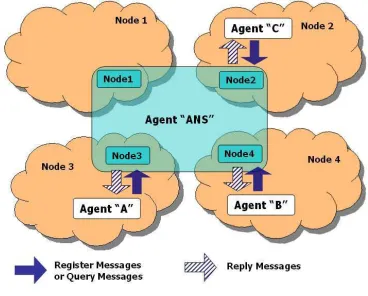
Figure 2: A Centralized ANS
In this alternative, the problem of knowing the location of other agents is solved with the exis-tence of the ANS that maintains this informa-tion. Thus, the problem of finding other agents is reduced to find only one agent: the ANS. Any agent should know the location of the ANS in or-der to register itself and also obtain the location
of other registered agents. For example, in Fig-ure 2, Agent “A” (in Node 3) register itself by exchanging messages with the ANS (in Node 2) and it may also query for obtaining the other reg-istered agents. The same happens for Agent “B” in Node 4.
There exists different ways of solving the prob-lem of finding the ANS. One alternative is to hardcode its location to a specific node, as in Fig-ure 2, in which the ANS may be hardcoded to Node 3, and thus, any agent know where to find it. Another alternative is to use a mechanism of agent discovery as explained in the previous sub-section. Note that, using the first alternative re-duces the flexibility of the system, however, this reduction in the flexibility only affects the ANS, allowing the other agents to be executed in any node. Also note that implementing a discovery mechanism to find a single known agent will avoid the problems present in this alternative.
2.3 A Distributed Agent Name Server
This alternative eliminates the single point of fail-ure of the system and also the performance bot-tleneck present in the centraliced approach. How-ever, the main problem with this alternative is the burden of implementing the ANS.
The way in which this alternative is imple-mented is using only one ANS created by several processes running one in each node of the sys-tem. As can be seen in Figure 3, there exists only one logical ANS, implemented by the processes executing on each node. Thus, the agents inter-act with the ANS through the process running in the same node, solving the problem of finding the ANS present in the alternative mentioned before.
Figure 3: A Distributed ANS
[image:3.595.323.507.540.688.2]all the different processes implementing the ANS. Another way of doing this is to distribute all the information without replicating it.
While the first approach allows the agents to obtain the information of other registered agents quickly, the services that modify this informa-tion may require the exchange of several messages in order to maintain this information consistent. The other way allows easier modifications of the information stored but may require more time to obtain information of a specific agent.
2.4 Several Agent Name Servers
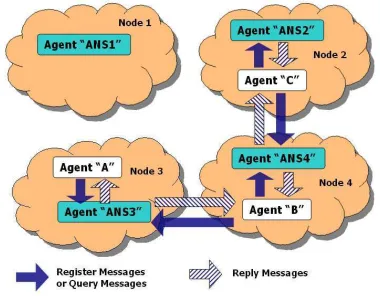
[image:4.595.80.270.373.522.2]Another alternative is to implement one ANS for each node, achieving most of the advantages of the distributed approach like the easy finding of the ANSs, and also avoiding the disadvantages of the centraliced one, like the performance bottle-neck and the single point of failure in the system. The problems with this approach are the same as the ones in the distributed approach, with the dif-ference that the agents are aware of the existence of several ANSs.
Figure 4: Several ANSs
Thus, one alternative is to allow the agents to create groups of interests or MASs. Each MAS must be managed by only one ANS. The agents may register theirselves in different MASs, also simultaneously. This way of storing the informa-tion of the agents registered is similar to the cen-traliced approach, achieving its advantage of an easy implementation.
Any agent that wants to interact with other agent may first interact with the local ANS in order to register itself and obtain information of a specific MAS. The local ANS may be the manager of the MAS that the agent is looking for, in which case it register the agent. However, the local ANS may not be the responsible of the MAS, and thus, it may inform the agent which ANS is managing the determined MAS.
The creation of independent MASs may be im-plicit whenever an agent requires to register itself to an inexistent MAS. In this case, the local ANS asks the other ANSs for the existence of the spec-ified MAS obtaining no positive answers. Thus, it decides to create the MAS and informs this creation to the rest of the ANSs. Note that the process of creating a MAS should avoid the cre-ation of MASs with the same interests managed by different ANSs.
3 COMPARING THE
ALTERNATIVES
In the previous section we have explained four different alternatives of implementing the capa-bility of finding other agents. There exists several differences between these alternatives as we will show next. These differences will allow the devel-oper to choose between them also considering the domain in which the alternative will be used.
The alternative of using a discovery mechanism allows a great flexibility in the initialization of the system and also allows the agents to dynamically discover different MASs. Also note that this al-ternative avoids relying in the existence of one or more specific agents as the other approaches does, representing an important disadvantage.
However, note that using broadcast, some mes-sages may be lost or delivered out of order. Also, losses and misordering may vary by agent, which means that some agents may receive the message as intended while others may experience various losses. Thus, this mechanism is not allowed to en-sure the discovery of every existent agent in the system.
This problem is avoided in the other alterna-tives by the existence of the ANS. The centralized approach has the advantage of an easy develop-ment of this agent and, in the case of any other agent, the easy way of obtaining the information of the other registered agents. However, this ap-proach have the disadvantage that the ANS may represent a performance bottleneck when the sys-tem has several agents. Also note that this way of implementing the ANS represents a single point of failure in the system.
A discovery mechanism may be used in the im-plementation of these alternatives. It may be used by the agents to locate the centralized ANS. It may also be used by the distributed ANSs to discover theirselves dynamically. Note that using a discovery mechanism in these particular cases will probably avoid the disadvantages of using this alternative to find every agent in the system. Considering the domains of application of these approaches, in systems with a small number of agents, a centralized ANS may solve the prob-lem of finding agents obtaining good results and also allowing an easy implementation of the sys-tem. In this domains, implementing a discovery mechanism may be a good alternative whenever the developer wants to avoid the existence of cen-tralized information that means the existence of a single point of failure.
In domains in which the number of agents is important, the centralized approach will proba-bly result in a performance bottleneck. Thus, the alternative of implementing several ANSs and al-lowing the creation of independent MASs avoids this problem and also the complexity of imple-menting the other alternative, a distributed ANS. In the case of the discovery mechanism, the losses and misordering of the messages is such domain will be greater also increasing the time needed to find other existent agents, turning this alternative less feasible.
4 CONCLUSION
In this paper we have mentioned different alter-natives of implementing MASs. One of the fea-tures that must be implemented in the develop-ment of any MAS is the way the agents find or locate each other. We explained four different alternatives of implementing this capability. We have also shown the differences existing between these alternatives.
We compared these alternatives, finding that the alternative of implementing a centralized
ANS allows an easy development of small MAS. However, in larger domains, the approach of im-plementing several ANSs may allow a better per-formance of the whole system also avoiding the complexity of implementing a distributed ANS. A discovery mechanism may be used in the im-plementation of these alternatives. A discovery mechanism may by also used whenever the devel-oper prefers to avoid the existence of centralized information, at the cost of a more time consuming location of the agents.
References
[1] 3APL. An Abstract Agent Programming Lan-guage. http://www.cs.uu.nl/3apl/.
[2] B. Langley, M. Paolucci, and K. Sycara. Dis-covery of Infrastructure in Multi-Agent Sys-tems. In Workshop on Infrastructure for Agents, MAS, and Scalable MAS, 2001. [3] FIPA. Foundation for intelligent physical
agents. http://www.fipa.org.
[4] Alejandro J. Garc´ıa, Mariano Tucat, and Guillermo R. Simari. Interaction Primitives for Implementing Multi-agent Systems. In
VII Argentine Symposium on Artificial Intel-ligence, Rosario, Argentina, August 2005. [5] JACK. JACK Intelligent Agents Framework.
http://www.agent-software.com/.
[6] JADE. Java Agent DEvelopment Framework. http://www.lpa.co.uk/atk.htm.
[7] JADEX. Jadex BDI Agent Sys-tem. http://vsis-www.informatik.uni-hamburg.de/projects/jadex/.