66 PONTIFICIA UNIVERSIDAD CATÓLICA DEL ECUADOR
FACULTAD DE COMUNICACIÓN, LINGÜÍSTICA Y LITERATURA ESCUELA DE LINGÜÍSTICA
MAGISTER EN ENSEÑANZA EN INGLÉS
MASTER’S DEGREE IN TEACHING ENGLISH THESIS
“ANALYSIS OF THE PRIMARY SCIENCE CURRICULUM IN A SCHOOL IN QUITO: IMPLEMENTATION AND ALTERNATIVES”
GABRIELA UNDA GARCÍA
ii
INDEX
ACKNOWLEDGEMENTS……….…………...……….vii
ABSTRACT ……….………. viii INTRODUCTION ………...….ix
JUSTIFICATION ………..…………...……….... x
BACKGROUND INFORMATION ………...xii
OBJECTIVES……….……… xv
PROBLEM DEFINITION ………... xv
1 CHAPTER ONE: THEORETICAL AND CONCEPTUAL FRAMEWORK …..1
1.1 BASIS CONCEPTS - DEFINITIONS ………. 1
1.2 TEACHING MATERIALS………..…….3
1.2.1 THE ROLE OF TEACHING MATERIALS ……… 5
1.2.2 TEXTBOOK ANALISIS ………..… 7
1.3 APPROACHES RELEVANT TO SCIENCE TEACHING IN A FOREIGN LANGUAGE ………...………..……. 9
1.3.1 LEARNER- CENTERED INSTRUCTION …………..………..……… 9
1.3.2 COOPERATIVE AND COLLABORATIVE LEARNING ……….….…….. 9
1.3.3 INTERACTIVE LEARNING ………...………...……….. 10
1.3.4 WHOLE LANGUAGE EDUCATION………..…...…….. 10
1.3.5 TASK- BASED INSTRUCTION………...…...….. 11
1.4 ALTERNATIVE METHODS TO CONTENT TEACHING ………. 11
1.4.1 CONTENT- BASED INSTRUCTION (CBI) ………...………. 12
1.4.2 THE SHELTERED MODEL ………...…….…. 12
1.4.3 THE ADJUNCT MODEL ………...…..……. 13
1.4.4 THE THEME BASED MODEL ………...…………. 13
1.4.5 CONTENT AND LANGUAGE INTEGRATED LEARNING THEORY (CLIL) ………...….... 13
1.4.6 COGNITIVE ACADEMIC LEARNING APPROACH (CALLA)………….14
iii
1.5.1 UNIVERSAL GRAMMAR …... 15
1.5.2 INTERLANGUAGE …... 16
1.6 CHILDREN’S COGNITIVE DEVELOPMENT ………... 16
1.6.1 JEAN PIAGET: STAGES OF DEVELOPMENT IN CHILDREN ……...… 16
1.6.2 LEV VYGOTSKY………..……. 18
2 CHAPTER TWO: METHODOLOGY ……….………...….. 19
2.1 UNIVERSE AND SAMPLE ………....….. 19
2.2 METHODOLOGICAL DESIGN………...……. 20
2.3 RESEARCH TECHNIQUES AND PROCEDURES ………...……. 21
3 CHAPTER THREE: RESULTS ANALYSIS………...….…. 22
3.1 ANALYSIS OF THE QUESTIONNAIRES BY GRADE ………. 22
3.1.1 SECOND GRADE ………...…. 22
3.1.2 THIRD GRADE ………...…….. 23
3.1.3 FOURTH GRADE ………...………24
3.1.4 FIFTH GRADE ……….……. 25
3.1.5 SIXTH GRADE ………..……….27
3.1.6 SEVENTH GRADE ……….……….. 28
3.2 DESCRIPTION AND ANALYSIS OF THE STUDENT BOOK AND THE SUPPORTING MATERIAL FOUND IN THE TEACHER’S GUIDE………. 30
3.2.1 CONTENT DISCREPANCIES ………...……30
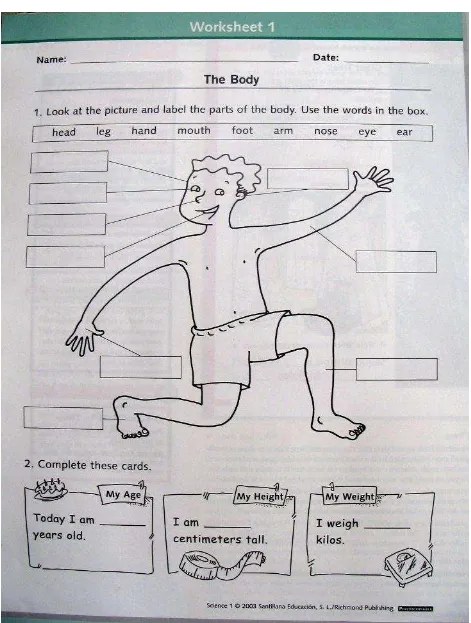
3.2.1.1 SCIENCE 1 - WORKSHEET 1 –SUPPORTING MATERIAL …….30
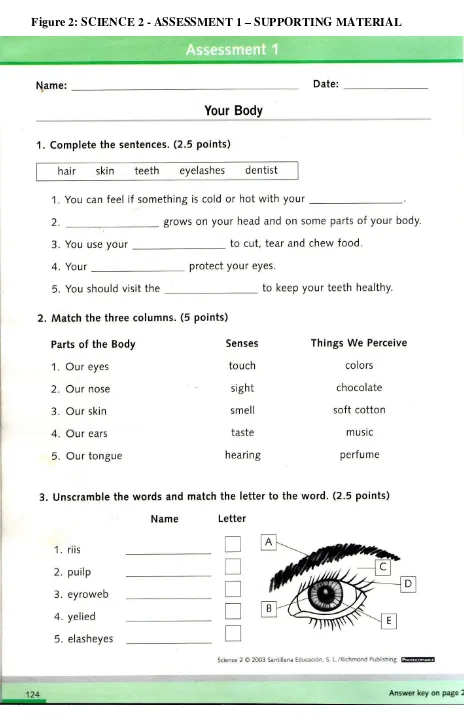
3.2.1.2 SCIENCE 2 - ASSESSMENT 1 –SUPPORTING MATERIAL …... 31
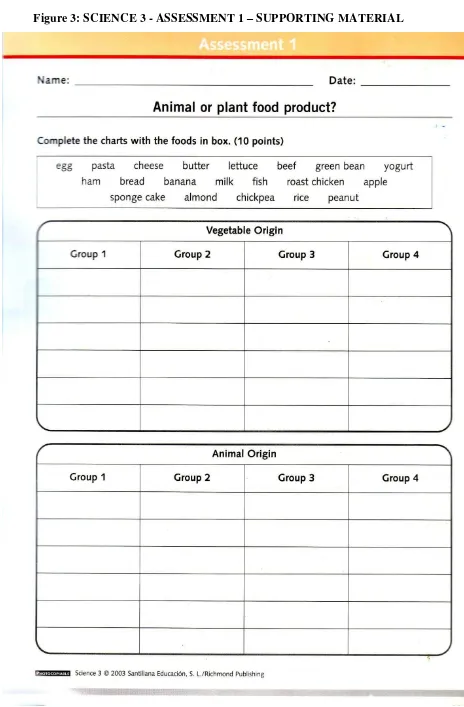
3.2.1.3 SCIENCE 3 - ASSESSMENT 1 –SUPPORTING MATERIAL….... 33
3.2.1.4 SCIENCE 3 - ASSESSMENT 7 –SUPPORTING MATERIAL….... 34
3.2.1.5 SCIENCE 4 - ASSESSMENT 5 –SUPPORTING MATERIAL….... 35
iv 3.2.2 QUANTITY DISCREPANCIES
3.2.2.1 SCIENCE 3 - ASSESSMENT 8 – SUPPORTING MATERIAL..….. 38
3.2.2.2 SCIENCE 4 - ASSESSMENT 3 – SUPPORTING MATERIAL...…. 39
3.2.2.3 SCIENCE 5 - ASSESSMENT 4 – SUPPORT MATERIAL…...…… 39
3.2.2.4 SCIENCE 5 - ASSESSMENT 5 – SUPPORTING MATERIAL…… 40
3.2.2.5 SCIENCE 6 - ASSESSMENT 2 – SUPPORTING MATERIAL…… 41
3.2.3 CULTURAL DISCREPANCIES ………...….42
3.2.3.1 SCIENCE 1 - UNIT 2 – TEXTBOOK PG. 19 ...………...43
3.2.3.2 SCIENCE 1 - ASSESSMENT 1 –SUPPORTING MATERIAL….... 43
3.2.3.3 SCIENCE 3 - UNIT 4 –TEXTBOOK PG. 65…...……….………… 45
3.2.4 OTHER………...………. 46 3.2.4.1 SCIENCE 1 - ASSESSMENT 1 – SUPPORTING MATERIAL….…46 3.3 ANALYSIS OF THE TEACHER’S QUESTIONNAIRE ………...….47
3.4 ANALYSIS OF THE STUDENT QUESTIONNAIRE………...… 48
CONCLUSIONS ………..……. 49
RECOMMENDATIONS………...……. 50
ANNEX # 1: TEACHER’S QUESTIONNAIRE ………..…. 51
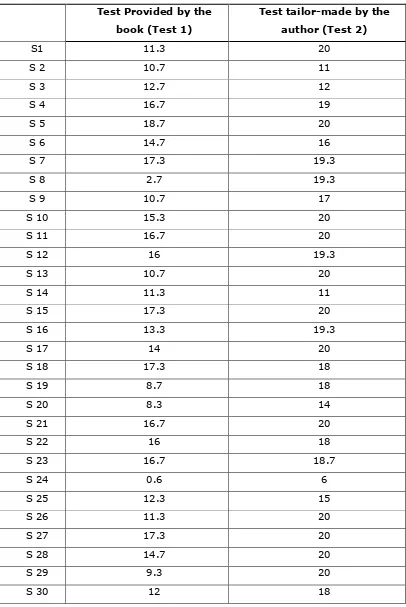
ANNEX # 2: GRAPHS AND TABLES -TEACHER’S QUESTIONNAIRE……… 52 ANNEX # 3: STUDENTS’ QUESTIONNAIRE ……….………….. 54 ANNEX # 4: GRAPHS AND TABLES - STUDENTS’ QUESTIONNAIRE …………..… 55
ANNEX # 5: EXAMS RESULTS ...………...…… 56 SUPPORTING MATERIAL TAKEN FROM THE SCIENCE BOOKS COLLECTION BY RICHMOND ……….………...…….. 58 CONTENT DISCREPANCIES Figure 1: SCIENCE 1 - WORKSHEET 1 –SUPPORTING MATERIAL…………...……. 59
v
Figure 3: SCIENCE 3 - ASSESSMENT 1 – SUPPORTING MATERIAL………...……. 61
Figure 4: SCIENCE 3 - ASSESSMENT 7 –SUPPORTING MATERIAL…………...…… 62 Figure 5: SCIENCE 4 - ASSESSMENT 5 – SUPPORTING MATERIAL…………...…… 63
Figure 6: SCIENCE 6 - ASSESSMENT 1 – SUPPORTING MATERIAL…………...…… 64 QUANTITY DISCREPANCIES Figure 7: SCIENCE 3 - ASSESSMENT 8 – SUPPORTING MATERIAL…………...…… 65 Figure 8: SCIENCE 4 - ASSESSMENT 3 – SUPPORTING MATERIAL…………...….…66 Figure 9: SCIENCE 5 - ASSESSMENT 4 –SUPPORT MATERIAL………... 67 Figure 10: SCIENCE 5 - ASSESSMENT 5 –SUPPORTING MATERIAL ……...………. 68 Figure 11: SCIENCE 6 - ASSESSMENT 2 – SUPPORTING MATERIAL……...…….…. 69
CULTURAL DISCREPANCIES Figure 12: SCIENCE 1 - WORKSHEET 2 – SUPPORTING MATERIAL……...…….….. 70
OTHER Figure 13: SCIENCE 1 - ASSESSMENT 1 – SUPPORTING MATERIAL……...……..… 71 SUPPORTING MATERIAL TAILOR-MADE BY THE AUTHOR OF THIS THESIS ……….………..………...………... 72
Figure 14: WORKSHEET 1 –SECOND GRADE ………...…..……... 73 Figure 15: ASSESSMENT 1 –THIRD GRADE ………...……...…..74
Figure 16: ASSESSMENT 1 – FOURTH GRADE ………...……….... 75 Figure 17: ASSESSMENT 7 – FOURTH GRADE ………...………… 78 Figure 18: ASSESSMENT 5 – FIFTH GRADE………...………….. 80 Figure 19: ASSESSMENT 1 – SEVENTH GRADE ……….………..… 82 QUANTITY DISCREPANCIES Figure 20: ASSESSMENT 8 –FOURTH GRADE……….84 Figure 21: ASSESSMENT 3 –FIFTH GRADE ………...……. 87
Figure 22: ASSESSMENT 4 – SIXTH GRADE ………....…90
Figure 23: ASSESSMENT 5 –SIXTH GRADE………...……..92
vi Figure 25: ASSESSMENT 2 (B) – SEVENTH GRADE ………...……... 96
CULTURAL DISCREPANCIES
Figure 26:
WORKSHEET 2
–
SECOND GRADE
………...……….. 98OTHER
Figure 27: ASSESSMENT 1 – SECOND GRADE ………...………… 99
BIBLIOGRAPHY ………....……… 101
vii
ACKNOWLEDGEMENTS
viii
ABSTRACT
ix
INTRODUCTION
Concerned with the changing world whose lingua franca is English, educators are continuously improving their teaching approaches and methods in order to effectively give tools to students learning this language. Because of this, teaching different subjects using English as a means of instruction has increased; alongside this, the need for specialized textbooks. Textbooks that will reinforce English knowledge, as well as teach the subject itself. However, even if there are textbooks on the market, they are not always appropriate to every group of students. In fact, teachers must analyze them and be able to make the necessary changes so as to fit their contents to the different realities of the learners.
This dissertation is divided into three chapters: the first one is the theoretical and conceptual framework which will describe basic definition used throughout this thesis; what teaching materials are, their types and roles in a language class. Also, there will be a description on how to analyze textbooks. It will also include a summary of different approaches and methods such as CBI (Content-Based Instruction), CALLA (Cognitive Academic Language Learning) and CLIL (Content and Language Integrated Learning) used nowadays in many schools to teach content subjects. These approaches support the idea of teaching a different subject other than English in this language so as to reinforce learning of the language. This chapter also illustrates the objectives and aims of these approaches. In this chapter, the theories of children’s cognitive development will be included. Especially the ones form the psychologists Jean Piaget and Lev Vygotsky
The second chapter will include the methodology used to perform the research for this thesis. Surveys to teachers using the book to know the problems they have had when using it will be included. Moreover, there will be a description of what a case study is and it will include a description of this specific case study.
x specifically by the author, which have been tailor made to fit the reality of the girls that are studying science with this workbook.
Finally, conclusions and recommendations are incorporated.
JUSTIFICATION
In order to be able to correctly carry out this dissertation analysis, it is important to set forth some background information about the school.
The location of the school is in the northern part of the city of Quito. The school is an all-girls school and all teachers are female. Most of the teachers are academically well-prepared, and belong to a middle – high socio-economic level, which in a certain sense provides a better environment for the students, not only regarding the treatment the students receive from their teachers, but also regarding the quality of the English they are taught. Since all the girls’ families have the possibility to send their daughters to universities abroad, it is precisely their English level that is one of the most appreciated qualities this school offers.
Knowing this, the school decided about 15 years ago to introduce other subjects other than LB “Lengua B” (English taught as a foreign language), (“Lengua A” of course being Spanish) to its curriculum. The first subject chosen was “Health”, taught first in the two higher grades of primary school. Later on, in order to complement LB in middle and high school, Geography was introduced as the second subject taught in the English language, and later Science was added as a third subject. Both are still part of the middle and high-school curriculum, with two and three hours per week assigned to the subjects respectively.
xi Both Geography and Science are still part of the school curriculum for Basic1 8th, 9th and 10th grades. For diversified2 1st, 2nd and 3rd grades, it was impossible to continue including such support subjects to support the learning of English for the reasons previously mentioned, since high demands for the IB program did not allow time to do so.
For both subjects, Geography and Health, the school purchased hard-cover books that were rented to the students for the school year. At first, these two additional subjects were taught only in Basic 6th and 7th grades, but gradually they were introduced into Basic 5th and 4th
grades respectively; this decision was taken because of the improved production of the language evidenced in the students.
About seven years ago, the school decided to discard the geography hard-cover books. This decision was taken most of all because the books were already obsolete, due mainly to the changes which had occurred in the former Soviet Union, and in general in Eastern Europe. A new collection of soft-back geography workbooks was adopted that included updated information, many visual aids and additional work materials that allowed the subject itself to become more meaningful for the students, thus helping enhance the internalization of the language even more.
Unfortunately, this series of soft-back workbooks was not updated too often, and about three years ago, a bit tired of waiting for the updated new editions of this geography series, and since the health hard-back books had also become obsolete, the school decided to eliminate both subjects taught in English from the curriculum of the primary section. It is important to mention that each of these subjects was assigned a schedule load of two hours per week.
Having had a positive experience, the school did not have the intention to abolish other subjects from being taught in English. On the contrary, until now it is trying very hard to include more, but limitations in having enough time and budget have only allowed to include Science to replace health and geography, with a schedule load of four weekly hours for this subject. During the first year, science was taught instead of health and geography; it was
1 Basic is a term used for the lower grades at the school, from Basic 2nd until Basic 10th
that would be from 1st grade (6 – 7 year old girls) until 3rd course (14 – 15 year old girls). 2 Diversified is a term used for the last three grades in high-school 4th, 5th and 6th courses.
xii included in the curriculum of 4th, 5th, 6th, and 7th grades. At the end of this first year, the school realized the importance of having the entire science program including 2nd and 3rd grades as well, since the 4th grade students, with no knowledge at all of the subject, had a hard time dealing with the new vocabulary, as well as with the contents.
During the first three months of the school year, the 4th graders were practically lost, and a lot of time was spent learning vocabulary rather than the subject itself; thus, the purpose of enhancing the language was not completely achieved since science class became a vocabulary-centered class. The teacher and author of this thesis had to develop additional material not only to cope with the lack of vocabulary knowledge, but also to deal with the different levels of the students. The teacher developed worksheets and quizzes or tests that fit the students’ needs. This was a hard time for both teacher and students. By the fourth or fifth month in class, students had acquired enough knowledge of basic science vocabulary to have a greater knowledge of the subject, be more independent of the teacher, and thus be able to carry out activities on their own.
By the second year, science was incorporated in the primary school curriculum, 2nd and 3rd grades were also included. During this first year for 2nd and 3rd grades, the same problems with vocabulary and fluency the teachers had with 4th graders arose. As a result of this, the school decided the basic 1st grade teachers had to include basic science vocabulary in their program, so as to prepare the students for science classes with some background to start with. A vocabulary list of approximately 25 words was provided for them.
In spite of this, a much higher level of English is required in the lower primary grades in order for the students to start a new grade with a little more language proficiency.
BACKGROUND INFORMATION
xiii if different authors present diverse figures about the number of people who speak English, it is still among the first three places on the lists.
According to O'Neill, English is the third most common language spoken around the world with approximately 341,000,000 native speakers (2011). On the other hand, The Summer Institute for Linguistics (SIL), in a survey made in 1999 presented these findings: (numbers of native speakers) (Branding, 2011)
Chinese (937,132,000) Spanish (332,000,000) English (322,000,000) Bengali (189,000,000) Hindi/Urdu (182,000,000) Arabic (174,950,000) Portuguese (170,000,000) Russian (170,000,000) Japanese (125,000,000) German (98,000,000) French (79,572,000)
And yet, George Weber’s lists the number of secondary (non-native) speakers as follows: (Weber, 2008)
French (190 million) English (150 million) Russian (125 million) Portuguese (28 million) Arabic (21 million) Spanish (20 million) Chinese (20 million) German (9 million) Japanese (8 million)
xiv in order to be able to apply for a scholarship. If anybody wants to pursue studies in any university around the world, knowing English is an international regulation to do so.
Moreover, English is the way to communicate with the world. With technology all around us in social networks, for example, we can connect with people far away from us, and what better way to do it than by using the lingua franca. Also, there is important information in English on the Internet that has not been translated to every language and that needs to be read in its original language. A person who does not know English cannot reach all the huge amount of information there is.
As mentioned before, globalization is a very important matter. As a matter of fact, it has made businesses from different countries get connected and make transactions with other companies and business people around the globe. Because of this, having a good level of the English language gives a huge plus to a person looking for a job. Additionally, this language will allow students to travel and be able to get to know other cultures and traditions.
Conscious of the importance of this language, it is taught in the majority of schools in Quito as a foreign language, to primary, middle and high school students. Furthermore, in some universities, English is part of the study curriculum, and even holds a status of “must be approved” subject. Similarly, in schools, learning this language has increased its importance day by day. In fact, teachers are now encouraged by the government to improve their language knowledge so as to impart it with students and have a better outcome.
xv secondary but key goal is to enhance and improve their communication skills and general level regarding the English language.
OBJECTIVES
a. GENERAL OBJECTIVE
The aim of this study is to adapt and accommodate the material and textbooks used in a Science program in a private school of Quito to fit the needs of the EFL learners in accordance to their environment.
b. SPECIFIC OBJECTIVES
The specific objectives are:
- Analyze the usefulness of the original material, according to the reality of the students of this particular primary school, and determine the need of developing tailor-made materials that fit the students’ reality.
- Analyze the modifications that the Science teacher (author) has had to make, in order to adapt the original materials to the students’ reality.
- Develop local tailor-made materials that could replace those of the original program, developed in another country, and that present several barriers for EFL learners.
PROBLEM DEFINITION
As previously mentioned, the implementation of teaching different subjects in English in several schools in Quito has been increasing as years go by, not only regarding the schools themselves, but the number of subjects taught in English. However, the way in which these schools manage to introduce these subjects into their curricula has been different. In fact, all books have certain discrepancies with the needs of the intended market because every reality is different.
xvi primary science books. The grades in this school use the series of books “Science” by Richmond publishing (2003).
Since the language spoken in Ecuador is Spanish, students learning English here, learn it as EFL (English as a Foreign Language). However, because of the lack of appropriate books, schools have been forced to use books such as the one employed at this particular school. The use of this book has been a challenge because although it includes some activities more appropriate for ESL (English as a Second Language) students, it is basically not designed for them. As a matter of fact, it is not specified who it was written for, neither in the books themselves nor in the web sites found on the Internet.
Moreover, it seems that the authors of these books have confused the terms ESL (English as a Second Language) and EFL (English as a Foreign Language), since on one site, it says that this series of books fulfills the curricular objectives of both Spain and the United Kingdom. It is really difficult to understand how this will work since these two countries have different mother tongues and, as a result, they will have different needs. Consequently, Science being taught in England would be for native speakers (or ESL students if their mother tongue was not English) and if taught in Spain, it would be for EFL learners, and not ESL learners.
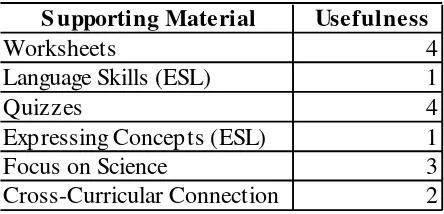
If we analyze the teacher’s guide, in the margins we can find useful suggestions for the material found in the students’ books. Included in these extra activities, we find extension activities suitable only for ESL students (such as expressing concepts and language skills), presenting scientific concepts, and cross-curricular activities. That is why teachers have been forced to adapt the book and its contents to the reality of the students of this particular school.
Although the level of English of the students in this school is B1 (according to the Common European Framework3) when they finish 7th grade, several problems have arisen because
3 B1: Can understand the main points of clear standard input on familiar matters regularly
xvii the school has not been able to find in the market a science text specifically developed for foreign language learners. The first problem to be faced by both teachers and students is to be able to adapt the learning materials, which were not developed for that specific group level and may vary from year to year, to the actual group of students.
1
1
CHAPTER ONE: THEORETICAL AND CONCEPTUAL
FRAMEWORK
1.1
BASIS CONCEPTS - DEFINITIONS
This chapter starts by defining several concepts used throughout this dissertation. Then, it describes what teaching materials are, their types and roles in the classroom. Then, it describes a brief history of different methodologies of content language teaching that have been developed and changed over the years. Moreover, some concepts that have been described in diverse ways by different authors will also be specified herein.
Throughout the years, several teaching methodologies have been described by several authors who have given different concepts to define these three words: approach, method and technique.
In 1963, Edward Anthony (qtd in Brown 2001 p.14) defined the following terms as follows: “An approach was a set of assumptions dealing with the nature of language, learning and teaching.” On the other hand, “a method was an overall plan for systematic presentation of language based upon a selected approach.” Furthermore, “techniques were the specific activities manifested in the classroom that were consistent with a method and therefore were in harmony with an approach as well.”
According to Brown (2001), some important terms are defined as:
Methodology: Pedagogical practices in general (including theoretical underpinnings and
related research). Whatever considerations involved in “how to teach” are methodological.
Approach: “Theoretically well informed positions and beliefs about the nature of language, the nature of language learning, and the applicability of both to pedagogical settings.
Method: A generalized set of classroom specifications for accomplishing linguistic
2 a variety of audiences in a variety of contexts.
Technique: Any of a variety of exercises, activities, or tasks used in the language classroom
for realizing lesson objectives.
Curriculum/syllabus: Designs for carrying out a particular language program. Features
include a primary concern with the specification of linguistics and subject-matter objectives, sequencing, and materials to meet the needs of a designated group of learners in a defined context.
A curriculum in a school context refers to the whole body of knowledge that children acquire in school. In fact, Keith says that:
“Curriculum is used in the British sense to include all the factors which contribute to the teaching and learning situation.” (Keith, 1989)
According to Keith,
Syllabi or syllabuses4, which prescribe the content to be covered by a given course, form only a small part of the total school program. Curriculum are all those activities in which children engage under the auspices of the school. This includes not only what pupils learn, but how they learn it, how teachers help them learn, using what supporting materials, styles and methods of assessment, and in what kind of facilities (Keith, 1989).
Other important definitions are the following:
Lingua Franca: A language common to speakers of diverse languages that can be used
for communication and commerce. (Fromkin, Rodman, & Hyams, 2011)
Native Language (NL): This term refers to the first language learned by a child. It is also
known as mother tongue or L1. (Gass & Selinker, 2008)
Target Language (TL): This one refers to the language that the person is learning. It is also
known as L2. (Gass & Selinker, 2008)
3 Foreign Language Learning: This term refers to learning a language that is not their native
one in a country where only the native language is spoken. For example, learning English in Ecuador where Spanish is spoken. (Gass & Selinker, 2008)
Second Language Learning: This term refers to learning a second language in the country where this second language is spoken. For instance, immigrants’ kids who are learning English in the US. (Gass & Selinker, 2008)
Interlanguage: The language produced by a nonnative speaker of a language (i.e. a learner’s output). It refers to the systematic knowledge underlying learners’ production (Gass & Selinker, 2008).
The terms above will be used throughout this dissertation, based on these given definitions, which are believed to be the most adequate of all the ones that were found.
1.2
TEACHING MATERIALS
The Literature review of this dissertation will give the reader an overview of the different contributions there have been made throughout the last years in the topic of the use of Teaching Materials in the classroom.
Jane Crawford, in her work entitled The Role of Materials in the Language Classroom: Finding the Balance5, discusses two different points of view regarding teaching materials. The first one mentions that they may deskill the teacher and diminish their professional capabilities; they may also interfere in the students’ learning since they use artificial language that does not reflect the reality. On the other hand, she mentions that teaching materials may help teachers develop professionally and increase autonomous learning strategies in students.
5 Crawford, J. (2002). The Role of Teaching Materials: Finding a balance. En J. C. Richards,
4 There are many factors that may influence learning another language as described in the book Materials and Methods in ELT6. One of these factors, among others, is the materials used to teach. (McDonoough, Shaw, & Masuhara, 2003). According to the authors, we should take into consideration all the different aspects that make up the learning/teaching situation because making different decisions regarding setting, students, and materials may change everything.
Kenji Kitao and S. Kathleen Kitao in their paper Selecting and Developing Teaching/Learning Materials7 argue two opposing views on the use of teaching materials such as textbooks. On the one hand, they mention that textbooks control learning and teaching. On the other, they emphasize that teaching materials only help teachers. This occurs depending on the teacher; that is to say, new teachers usually depend 100% on the materials. However, an experienced teacher may be able to develop his/her own materials.
Allwright, in his article What do we want Teaching Materials for?8 talks about the limited role materials should play in a classroom. It also discusses the important role learners are supposed to play in a classroom. It is not only the teacher’s job to teach, but it is also the learners’ job to handle their part of the responsibility. He also mentions the change of teaching materials to learning materials, focusing on the view of cooperative language teaching and learning.
The role of materials is viewed in a different way by Karla Araya Araya, who describes it in her article Teaching Materials: A Critical Position about the Role they play in the Language Classroom9. Here, she discusses how materials used in the classroom may transmit discourse and ideologies in favor of certain social classes. She mentions that these
6 McDonoough, J., Shaw, C., & Masuhara, H. (2003). Materials and Methods in ELT. Oxford:
Wiley Blackwell.
7 Kitao, K., & Kathleen, K. S. (4 de April de 1997). The Internet TESL Journal. Obtenido de
Selecting and Developing Teaching /LearningMaterials: http://iteslj.org/Articles/Kitao-Materials.html
8 Allwright, R. L. (1 de October de 1981). ELT Journal. Obtenido de What do we want teachng
materials for?: http://203.72.145.166/ELT/files/36-1-2.pdf
9 Araya Araya, K. (2007). Teaching Materials: A Critical Position about the Role they play in the
5 materials could influence students into changing their point of views regarding social, political and economic issues.
Robert O’Neill in his article Why use textbooks?10 argues the fact that even if there are differences among groups of students, there are more similarities. These characteristics they have in common make the use of books a good idea. He claims that textbooks are the starting point of the classroom on which teachers base the structure of their teaching. However, they should be used and considered as the tools they are. He mentions that teachers should be aware of textbook limitations and adapt the material to their own reality. Also, he mentions the importance of teacher improvisation.
1.2.1 THE ROLE OF TEACHING MATERIALS
Teachers should assess the materials they use. As a matter of fact, many times schools choose textbooks that teachers have to use in their classrooms without taking into account the teachers’ opinions and experiences. Even if these books can be used in the classroom, most of the time, these textbooks do not fit the reality of their students, and teachers find the need to develop new materials that are more appropriate to their students’ needs.
There are certain aspects that must be considered by every school when choosing textbooks, (McDonoough, Shaw, & Masuhara, 2003):
- The intended audience: Who are the books written for? We cannot use books designed for teens with adults and vice versa.
- The proficiency level: Are the levels of the books appropriate for our group of students? - The context in which the materials are to be used: Where is the book being used? - How the language is presented and organized: Is the book easy to follow?
Teaching materials are very important in language programs. According to Richards (2001), these materials can be divided into:
- Commercial Materials
10 O' Neill, R. (2 de January de 1982). ELT Journal. Obtenido de Why use textbooks:
6 - Printed Materials, such as books, workbooks, worksheets or readers.
- Nonprinted materials, such as cassette or audio materials, videos or computer-based materials.
- Materials that comprise both printed and nonprinted sources, such as self-access materials and materials on the Internet.
- Materials not designed for instructional use such as magazines, newspapers, and TV materials.
Regarding the role of materials in language teaching, Cunningsworth (qtd in Richards p. 251, 2001) summarizes them as follows:
- a resource for presentation materials.
- a source of activities for learner practice and communicative interaction.
- a reference source for learners on grammar, vocabulary, pronunciation, and so on. - a source of stimulation and ideas for classroom activities.
- a syllabus (where they reflect learning objectives that have already been determined). - support for less experienced teachers.
In fact, commercial or created materials11 are important in the classroom. They attract the students’ attention, help the teacher save time, standardize the instruction, provide a syllabus for the program, and train teachers who are beginning their career (Richards, 2001). They may also have flaws that could impair appropriate learning. According to Richards (2001), this type of materials may contain unauthentic language, which is not a representative of real language use. Also, textbooks may distort content, since they could be biased; teachers could rely too much on them and they may not reflect the students’ real needs.
Authentic materials12 should be used in the classrooms because students should get used to
listening and understanding real videos and movies (Richards, 2001). This could give the students the listening skills they need. For instance, the use of videos related to Science is a good way to improve the students’ motivation and practice listening. In fact, each teacher should have the ability to manipulate the material in such a way so as to reach school
11 The term, created materials, refers to textbooks and other specially developed instructional
resources (Richards, 2001).
12 The term, authentic materials, refers to the use in teaching of texts, photographs, video
7 objectives, and fulfill the students’ needs. However, the use of created materials should not be left aside, since these types of materials are good learning support, and give the teacher a reference source to work with.
Whether the material dominates the teacher or the teacher dominates the material is up to the type of teacher. Even if she has a textbook to follow, the educator should be creative enough to develop new, better material for the students; of course, this depends on her experience.
1.2.2 TEXTBOOK ANALISIS
According to Nicholls, little work has been done on this area and; consequently, there are not clear guidelines as to how analyze a text. He mentions some works done by UNESCO and others in order to produce procedures when evaluating textbooks. (Nicholls, 2011)
These procedures are described as followed:
- Defining a textbook sample: Pinkel considers the type and quantity of textbooks to be analyzed as an important matter (Pinkel qqt in Nicholls, 2011).
- Quantitative and qualitative analytical techniques: Pinkel mentions two major concerns regarding this type of research. These are… “How are textbooks used by teachers and received by students? And what is included and omitted in the text?” (Pinkel qqt in Nicholls, 2011).This author emphasizes the importance of the fact the qualitative and quantitative research methods are complementary.
He also provides a very general guideline for textbook analysis. He mentions that it cannot be more specific since every project is a different reality.
8 - Structures of publishing houses
Formal criteria:
- Bibliographic references
- Target group (school level, type of school) - Dissemination
Types of texts/mode of presentation: - Author’s intentions (if specified) - Descriptive author’s text (narrative) - Illustrations/photos/maps
- Tables/statistics - Sources
- Exercises
Analysis of content:
- Factual accuracy/completeness/errors - Up-to-date portrayal
- Topic selection/emphasis (balance)/representativeness - Extent of differentiation
- Proportion of facts and views/interpretation
Perspective of presentation:
- Comparative/contrastive approach - Problem-oriented
- Rationality/evocation of emotions (taken from Pinkel qqt in Nicholls, 2011).
9
1.3
APPROACHES RELEVANT TO SCIENCE TEACHING IN A FOREIGN
LANGUAGE
Throughout history, there have been numerous theories regarding teaching English as a second or foreign language. Nowadays, newer language methods have been developed. These methods and approaches are mentioned here because they are all used when teaching. A brief summary of some of the most important ones is provided below:
1.3.1 LEARNER- CENTERED INSTRUCTION
This type of instruction includes:
Techniques that focus on or account for learners’ needs, styles, and goals. Techniques that give control to the student such as group work.
Techniques that give room for students’ creativity and innovation. Techniques that enhance students’ sense of competence and self-worth.
According to this type of instruction, giving certain powers of decision to the students will provide them with a sense of ownership regarding learning and will lead to their intrinsic motivation. In the words of Brown, “The most powerful rewards are those that are intrinsically motivated within the learner. Because the behavior stems from needs, wants, or desires within oneself, the behavior itself is self-rewarding; therefore, no externally administered reward is necessary” (Brown, 2001).
1.3.2 COOPERATIVE AND COLLABORATIVE LEARNING
Brown (2001) explains that this type of learning is based on teamwork. It is cooperative and not competitive. Students work in pairs or groups to achieve mutual goals and objectives, which would not happen if they were working individually. This kind of learning promotes intrinsic motivation and self-esteem. Also, since the students are working in groups, the level of anxiety lowers, and they get the opportunity of learning from more capable people such as advanced peers, or teachers.
10
1.3.3 INTERACTIVE LEARNING
Having interaction within language classes has been a very effective tool in improving both oral and listening skills. In fact, this communication has created the opportunity for genuine interaction in the classroom.
In these interactive classes, students will: - Do a great amount of group work.
- Have the opportunity of receiving authentic language context. - Producing language for a meaningful conversation.
- Performing classroom tasks that will reflect real world activities. - Practice through spontaneous conversations.
- Writing for real audiences.
Interactive learning is based on Stephen Krashen’s input hypothesis, that states that humans acquire language by receiving comprehensible input and moving on to the next level of learning, along the natural order (Krashen, 1985).
1.3.4 WHOLE LANGUAGE EDUCATION
The main purpose of this type of education was to evidence language as a whole, and not as fragmented in phonemes, graphemes, morphemes and words. It also wants to emphasize the “wholeness” of language as the interconnection between listening and speaking production; and the importance of developing written and oral code.
Nowadays, according to Brown, the use of the term has changed to describe: (Brown, 2001) - Cooperative learning.
- Participatory learning. - Student-centered learning.
- Focus on the community of learners. - Focus on the social nature of language. - Use of authentic language.
11 Edelsky (qtd in Brown p.49, 2001), mentioned that whole language is an educational way of life, and that this term should not be used carelessly by teachers and material developers. There are two main interconnected concepts in whole language: 1. The wholeness of language implies that during language acquisition, children perceive “wholes” and not “parts” of the new language. Therefore, the inclusion of the four skills in second language learning is important. 2. Language is used to construct meaning and reality, teaching language enables learners to understand a system of social practices that both constrain and liberate.
1.3.5 TASK- BASED INSTRUCTION
To describe this type of instruction, it is useful to define the word task first. According to Peter Skehan (1998), a task is an activity in which
- Meaning is primary.
- There is some communication problem to solve.
- There is some sort of relationship to comparable real-world activities. - Task completion has some priority; and
- The assessment of the task is in terms of the outcome.
Tasks usually contain several techniques. For example, a problem-solving task may include grammatical explanation, teacher-initiated questions and a turn-taking procedure.
This type of task-based instruction is not a new methodology. It is a type of instruction that puts the task at the center of teaching and learning; which focuses on tasks as a way to enhance learning.
1.4
ALTERNATIVE METHODS TO CONTENT TEACHING
12 Some of these important theories and approaches are discussed below and are Content Based Instruction (CBI); the Content and Language Integrated Learning Theory (CLIL), and the Cognitive Academic Language Learning Approach (CALLA). They are some of the most important methods and approaches that support the idea that teaching English through different subjects could help students learn the language in a better and more effective way.
1.4.1 CONTENT- BASED INSTRUCTION (CBI)
Several authors have given different concepts to what Content-Based Instruction is.
Here are some examples:
“Content-Based Instruction is the integration of content learning with language teaching aims. More specifically, it refers to the concurrent study of language and subject matter, with the form and sequence of language presentation dictated by content material” (Brinton et al., 1989)
According to Short (1989), content-based language instruction is defined as:
“An approach that integrates second language instruction with subject matter instruction. Each lesson in a content-based class has content (e.g., math, science, social studies) and language objectives (e.g., grammar, functions). Students learn language through the context of specific subject matter rather than through isolated language features.”
This type of instruction focuses on the idea that language should not be taught in an isolated way, but rather within a meaningful context, which will not only intrinsically motivate the learners, but also will empower them. CBI gives students the challenge of learning the subject matter through the language.
According to Davies (2003), CBI is a teaching method that emphasizes learning about something rather than learning about language. He also describes three different types of Content Based Instruction models as follows:
1.4.2 THE SHELTERED MODEL
13 teachers may work together: a content specialist and an ESL teacher to have the students understand content and important English words. This type of teaching has been used, for example, at the Bilingual University of Ottawa.
1.4.3 THE ADJUNCT MODEL
This model is usually used by ESL teachers. Its main objective is to prepare students for “mainstream”13 classes. They emphasize the acquisition of specific target vocabulary and
some necessary skills, so as to get a better understanding of the regular classes.
1.4.4 THE THEME BASED MODEL
This model, on the other hand, is found in EFL (English as a Foreign Language) contexts. This type of CBI can be taught by an EFL teacher only or by a team including a content specialist. The teachers can create a course designed according to their students’ diverse interests.
1.4.5 CONTENT AND LANGUAGE INTEGRATED LEARNING THEORY (CLIL)
Another theory, which supports the idea of teaching a subject through a foreign language, is one that is called CLIL (Content and Language Integrated Learning). According to the European Commission on Multilingualism (2008), CLIL is being and has been used for the past ten years all over Europe.
The subjects taught using CLIL are in the areas of the humanities and social sciences, (i.e. history, geography, science and social studies). David Marsh (2007) says that CLIL involves an educational context in which the medium of teaching is not in the students’ mother tongue.
According to Marsh, there are several benefits in using this approach. The most important ones are that:
13Mainstreaming:“In some submersion programs, students first receive instruction in ESL before
14 It improves language competence and oral communication skills.
It provides opportunities to study content through different perspectives. It allows learners more contact with the target language.
Language is seen in real-life situations.
Students become academically proficient in English after 5-7 years.
Learners develop fluency in English by using English to communicate for a variety of purposes.
It introduces the wider cultural context.
It prepares for future studies and / or working life. It increases learner motivation.
It develops multilingual interests and attitudes.
Moreover, it does not require extra teaching hours; it complements other subjects rather than competing with them. It is accompanied by normal foreign language instruction. These benefits have made this method well used around Europe and several different countries in America.
1.4.6 COGNITIVE ACADEMIC LEARNING APPROACH (CALLA)
The next approach to be discussed is the CALLA approach. There are studies such as the one made by Noorchaya Yahya at Florida Atlantic University, and by Joseph M. Furner at the University of Florida, in which they want to prove the benefits of using the CALLA
approach to improve the use of the English language and, at the same time, to teach other subjects to non-native speakers of English. (Uhl, 1994)
CALLA (Cognitive Academic Language Learning Approach), developed by Anna Uhl Chamot and J. Michael O'Malley (1994), is based on several theories that sustain this idea. This theory focuses on combining subject instruction with the development of language skills and learning strategies. One of the major objectives of this theory is for students to learn content knowledge and language skills to achieve a successful academic future.
15 already come with ideas on how to develop language and content. However, it is very important for teachers to be aware of this, so that they can adapt those ideas to the students.
1.5
SECOND LANGUAGE ACQUISITION (SLA)
According to Gass & Selinker, Second Language acquisition deals with the different processes people go through in order to learn a language that is not their native one. This study includes the process to create a new language the student has been exposed to; what is learned and what is not, why learners reach different levels of proficiency. These authors also mention that SLA deals with the hypotheses language learners produce concerning the rules of the second language (2008).
Gass & Selinker emphasized that SLA and pedagogy are two separate fields that sometimes get confused. However, even if they are in fact two fields, they do have an important relation and having knowledge about SLA is basic for a teacher involved in helping students acquired a second language. Understanding how students learn the language is beneficial for teaching since many misunderstandings could be avoided.
There are several theories regarding SLA. Inside those theories, there are hypotheses that describe various aspects of this field. According to Gass & Selinker, the different theories focus on diverse areas such as linguistics, psychology and sociolinguistics. Even if each emphasis is different, they do share one common area of interest: “how is it that learners acquire, when they do, the complexities of a second language?” (Gass & Selinker, 2008).
1.5.1 UNIVERSAL GRAMMAR
This area of research has been important for several researchers in this field. It deals with the supposition that there is an innate universal language in each one of us. In fact, Chomsky stated “The theory of a particular language is its grammar. The theory of languages and the expressions they generate is Universal Grammar (UG)” (qqt in Gass & Selinker, 2008, p. 160).
16 they receive from the environment (2008). Thus Chomsky defines UG as “the system of principles, conditions, and rules that are elements or properties of all human languages (qqt in Gass & Selinker, 2008 p. 163).
1.5.2 INTERLANGUAGE
The term interlaguage refers to the sort of “language” created by the learner of a second or foreign language while being in the process of learning it (Frith, 1978). According to Selinker, interanguage is not a translation from the native language nor is it the target language as if produced by a native speaker. It is a new separated system created by the learner. (Gass & Selinker, 2008)
Frith mentions that this system could also be called “transitional competence” which is a name that makes its meaning really clear since the learner is still acquiring the TL and will improve when he/she learns more.
However, this learning is several times restricted by the phenomenon called fossilization. This term, according to Selinker, refers to the interlanguage which in spite of instruction, remains the same (Selinker qqt in Frith, 1978).
1.6
CHILDREN’S COGNITIVE DEVELOPMENT
1.6.1 JEAN PIAGET: STAGES OF DEVELOPMENT IN CHILDREN
In order to understand how children think, it is necessary to include a description of the stages of children’s development. The theories of two important psychologists will be describe below. The first one is the theory introduced by psychologist Jean Piaget who described the different stages of cognitive development from birth to adolescence.
17
Stage Age range
Sensorimotor Birth to about 24 months Substages:
Reflexes: 0–2 months
Primary circular reactions: 2–4 months Secondary circular reactions: 4–6 months Coordination of secondary schemes: 6–12 months
Tertiary circular reactions: 12–18 months Transition to symbolic thinking: 18–24 months Preoperational About 24 months to about 6 years
Concrete operations About 6 years to about 12 years
[image:34.595.97.519.71.348.2]Formal operations About 12 years to about 18 years and beyond - a: Ages are approximate; substantial variation in individual children is assumed.
Table taken from (Feldman , 2004)
Since this study focuses on the primary section of the school, the concrete operational stage will be described. This stage, as we can see in the chart, deals with children from about 6 to about 12 years old. That is to say children from 2nd grade to 7th. According to Piaget, in this
stage kids learn to manage concrete objects rather than oral hypotheses. They are able to classify and order. Also, they acquire the idea of number, space, time and the basics of logic, math, geometry and physics (Piaget, 1964).
These stages describe children’s development. However, Piaget mentions that there are four factors that influence the fact that a child moves from one stage to the next. These factors are: maturation, experience, social transmission and equilibration (self-regulation). (Piaget, 1964)
- Maturation: The maturation of the nervous system is just one part of these factors. Piaget mentions that this factor is only one of the four and that it depends on the society the child comes from.
18 conclusions about them. On the other hand, in the logical mathematical, “the knowledge is not drawn from the objects, but it is drawn by the actions effected upon he objects.” (Piaget, 1964). And again experience depends on each child and his or hers society.
- Social transmission: This factor is also called linguistic transmission or educational transmission. Children can receive information through education; however, the fact that they really comprehend the material depends on whether the child is able to assimilate it or not.
- Equilibration (self-regulation): This factor equilibrates the other three. Also, the subject tends to find an equilibrium by reacting when faced to an external influence. (Piaget, 1964)
1.6.2 LEV VYGOTSKY
This Russian psychologist also talked about cognitive development in children. His major ideas were: social interaction, zone of proximal development and the more knowledgeable other (MKO). Regarding social interaction, Vigotsky believed that society played a very important role in learning. Children develop because they have social interactions that help them do so. According to him, this occurs because they have a More Knowledgeable Other to help them reach their Zone of Proximal Development. This MKO could be a teacher, a parent, a peer or even a technological device such as a computer. And his theory of the zone proximal development is what they want to learn. Students can handle new, more difficult information if they have a MKO who can provide them with scaffolding (McLeod, 2007).
19
2
CHAPTER TWO: METHODOLOGY
2.1
UNIVERSE AND SAMPLE
As mentioned before, this school located in Quito, Ecuador believes in the importance of teaching English to the students. This is reflected in the importance the school gives to having not only English, but Science taught in English to the students. The school has always been working on the improvement of English Teaching. Hence the usefulness of this study.
The Science program adopted by the school is: Science– by Richmond Publishing – books 1 to 6, for primary school. However, if we pay attention to the books’ contents and to the additional supporting materials they include, we can realize that only some activities are appropriate for non-native speakers of English. This is one of the reasons why teachers have to adapt the content to the reality of the students.
Another reason why teachers have to modify the worksheets and tests included in the books is the fact that the grading system is also different, depending on the country. In fact, since the book was printed in Mexico, this culture has a strong influence on the series of books, and the authors decided to use the grading system of that country. According to the World Education Services - International Grade Conversions, Mexico’s grading system goes from 1 to 10 as follows:
International Grade Conversions
Mexico US Equivalent
9-10 90-100 muy bien (MB)
(very good)
8 80-89 bien (B)(good)
6-7 60-79 (average sufficient)suficiente (S)
0-5 0-59 reprobado (R)(fail)
20 According to the grading system above, the authors decided to grade every test over 10 points, without realizing the fact that other countries, like Ecuador, may have different systems. Because of this, having a unit test that only has a few questions and grading it over 20 would be very negative for the students. Thus, there was a need to extend the unit tests to an appropriate length, not only to add more points, but also to include all the important topics studied in each unit. Some examples will be included in the discrepancies section of the analysis.
2.2
METHODOLOGICAL DESIGN
The research methodology used in this project is an instrumental case study based on the elementary section of this school, grades 2nd to 7th. Each grade has 2 parallels, each one with about 25 students
.
According to Stake, the instrumental case study is used to achieve understanding of a general question through a specific case (Stake, 1995).This research has been based on the primary Science books (by Richmond). The decisions made by the author of this dissertation, who has had to adjust numerous activities, have been based on the purpose of fitting the supporting material to the reality of her students. The guidelines given by UNESCO were taken into account when the textbook was analyzed, as were the theories mentioned before. In order to make the modifications, the author of this thesis considered not only the stages of development of children, but also how they can vary depending on maturation, experience, social transmission and equilibration (Piaget, 1964). Moreover, Vigotsky’s theory of the MKO and the ZPD were also considered.
The method used in this dissertation is a descriptive – analytic one. The data was compiled through a qualitative approach (case study).
21 According to the questionnaire filled out by the science teachers (including the author of this thesis) of this institution, they have to modify worksheets and tests so that they customize them to their students’ needs and reality, according to each grade level.
Moreover, they affirm that they try to use the material included in the books because parents and authorities expect them to do so, and not because they are really useful or appropriate for the students.
2.3
RESEARCH TECHNIQUES AND PROCEDURES
In order to collect the necessary information, the following has been done:
- A survey of the Science teachers (including the author) of the primary school of this institution has been carried out in order to determine how many of them alter the supporting material for it to be suitable to the children.
- The different material was used with the students as pre-test and then modified according to their needs.
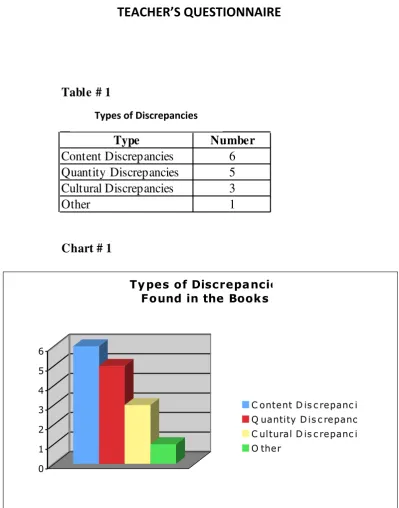
In order to have a better understanding of the most important issues encountered in the Science book, the different worksheets that were examined and developed by the author of this thesis were divided into three main categories: content, quantity, and cultural discrepancies. A fourth category called “other” was added in order to include examples that did not fit the three main ones (See annex # 2).
Every graph and table included in this paper comes from the data obtained from this investigation. If any of them reflect findings or results obtained or evidenced in any other investigation of the sort, it will be specified, but independent of them.
22
3
CHAPTER THREE: RESULTS ANALYSIS
3.1
ANALYSIS OF THE QUESTIONNAIRES BY GRADE
3.1.1 SECOND GRADE
Starting to study Science in English in second grade has been quite recent, as mentioned in the first part of this analysis. The students begin their science studies with basic notions about human beings and their surroundings. This book “Science 1”, addressed to very young children (6, 7 year old girls), focuses on the differences among people, and about learning to respect that diversity.
In addition, unit 2 covers notions of health such as eating properly, types of food, and food sources (animal or plant). Unit 3 deals with healthy habits such as brushing our teeth and going to the doctor and the dentist regularly. Unit 4 describes water and its properties and uses. Unit 5 studies the sun and the sky, including the effects of the sun and the phases of the moon. Unit 6 introduces the notions of light and color, especially opaque, and transparent objects and the formation of shadows. Unit 7 is concerned with living things and their habitats, and the factors that may determine the species found in specific habitats. Unit 8 develops the anatomy of some animals and their classification by their physical characteristics.
As seen before, it is in this grade that the girls start having the science background they need to continue their studies successfully. Moreover, in this grade, the students also learn to like the subject through different, fun and interesting activities they perform with the teacher. As usual, the teacher finds information and extra activities to complement the themes treated in the book. In addition to this, the need for the analysis of which worksheets and tests are suitable for the children also arises.
23 An issue to be taken into account is the fact that the teacher needs to work step by step with the girls, since a great number of them lack spatiality, which makes it difficult for them to find their way on a sheet of paper or a page in the book. Notions of right, left, top, and bottom are still being learnt, and the complexity of teaching Science in a foreign language increases.
Having analyzed these problems, the second grade teachers decided to photograph the entire book in order to work with the students at the same time, with the help of a data projector. This helps the girls better visualize the activities, the teacher gains time, and the students’ learning improves.
3.1.2 THIRD GRADE
At the beginning of the school year, girls from this grade are not yet prepared to write in English, nor have they had enough exposure to reading in the English language; thus, this causes the start to be somewhat difficult, since as said before, these books are not appropriately designed for foreign language learners. The contents have to be complemented by the teacher, who luckily has additional aids in order to help her present the themes to the students in a more audio-visual way, with the object of allowing students to internalize new vocabulary and concepts through the help of activities planned specifically for them that will assure this.
This first difficult stage takes about two months. During the third month, the students have already had enough exposure through their LB classes to be able to further understand vocabulary. In fact, they are not only able to read, write and express themselves in a basic way through the English language, but they are also capable of a more extensive understanding of the language. It is then, that they really begin to use the book as it is intended. They are able to read and comprehend the short instructions at the beginning of each activity, both in the workbook and in the worksheets and tests. Moreover, they are able to understand oral instructions and are able to enjoy more both the reading information and the hands-on activities; thus, internalization of the knowledge of science is smoother for them.
24 concentrating more on developing the contents, rather than setting all her energy on the acquisition of knowledge. By the end of the school year, students are much more proficient in handling the workbook, on following instructions, and are ready for the next step within these series of workbooks.
The teacher finds that workbooks 1 and 2 of this series present more difficulty at their beginnings because of the barrier of the language. This occurs since these books have not been designed appropriately for foreign language users, and even if they are basic in content, they assume an English level more appropriate to first language learners. As an example of this, the first three worksheets contained within the workbook’s supporting material are not used since they contain activities regarding writing and reading that the students, at this stage of learning, are not able to carry out in the English language.
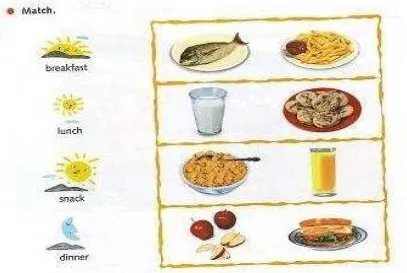
In addition, some instructions are not as clear for students as they should be, creating a bit of confusion. This is given not only in the worksheets, but also in the workbook, and thus the students need an extra explanation from the teacher. The program also uses a lot of “matching” activities, which help the young children, since it uses pictures and few words.
3.1.3 FOURTH GRADE
The initial grades are usually the ones that have more problems in general, since they are beginning to learn English and, at the same time, they learn Science in the foreign language. For most girls in this school, this subject is not easy. However, as time goes by, they manage to get the grasp of it and they turn into successful Science learners.
It is in this grade that the students are challenged by the teacher, since they start having pieces of homework that they did not have until now. Also, they start having longer quizzes than they used to. For this reason, they have to study at home and their responsibility starts to grow. Also, it is at this level that the teacher starts to add additional information with the help of the program power point and an “in focus” to project the presentation to the girls. It is in this way that the teacher reviews the different topics presented in the book.
25 of this that the teachers have looked for interesting interactive games that the girls can use to practice and increase their Science knowledge.
Usually, fourth grade is not easy, also because the themes presented in the book are not experiment-oriented. The units are focused on topics that do not let the girls get into real hands-on activities, mainly because in this grade they study body organs and systems. Specifically, the topics included in this book are the following: Unit one, “Food,” deals with different types of food and nutrition of living things. Unit two, “Digestion,” studies the digestive system and the processes involved. Unit three, “Respiration, Circulation and Excretion,” is about the functions and the organs that are part of these three systems. Unit four, “The Earth and Soil,” examines the properties and uses of minerals and the soil. Unit five, “The Earth and Water,” revises the states of water and the water cycle. Unit six, “Earth and the Sun,” studies the solar system, the earth’s movements and the seasons. Unit seven, “Animals,” they learn about animal classification and nutrition. Unit eight, “Plants,” examines the parts of a plant and plant classification, as well as, their nutrition and respiration. Finally, unit nine, “Ecosystems,” considers the parts of ecosystems and some basic knowledge about food chains.
As mentioned before, the three last units about animals, plants and ecosystems are repeated in all the books of this collection. However, the degree of complexity and quantity of information increases according to the grade the students are in. At this level, there is also the necessity of creating new worksheets and quizzes because of the lack of appropriate worksheets and quizzes provided in the books. The specific examples will be analyzed in the following section (Section 4.3).
3.1.4 FIFTH GRADE
26 Due to this fact, the teacher has seen the necessity to create new worksheets more suitable for the level of the students. Or, if there is no need to create an entirely new one, there is the necessity to add more information to the existing ones or to modify them so that they fit the students’ needs, since, as was mentioned before, the supporting material provided in the book is not completely suitable for the students of this school.
The themes of the book of this level are appropriate to carry out experiments with the students. So the girls perform hands-on activities throughout the units. The book contains 9 units as follows: Unit one, “Living things interact in different ways”, deals with animal and plant behavior. Unit two, “Movement”, studies the locomotor system. Unit three, “The Senses”, is about the functions and parts of the five senses. Unit four, “Materials, Heat”, examines the types and properties of materials, as well as heat and temperature.
Unit five, “Light and Sound”, revises the properties of light and sound, as well as opaque, transparent and translucent objects. Unit six, “Electricity”, studies the ways to obtain electricity and electrical conductors and insulators. Unit seven, “Animals”, expands the information about animal classification they learnt the previous year. Unit eight, “Plants and Algae”, examines plant classification, and what they need to be alive. Finally, unit nine, “Ecosystems”, considers relationships between living things and food chains.
Most units in the books allow the students to use their multiple intelligences and have experiences that will help them learn the contents in a better way. That is the way the teacher has been working with the fifth grade students. Working with multiple intelligences and developing new worksheets and quizzes more appropriate to their specific requirements has been a challenge to the teacher.
Furthermore, since the school has given the Science department the opportunity of having one hour a week in the computer lab, the teacher takes the students there to reinforce their knowledge. Given that the Internet is a very useful tool for the modern teacher, the teacher has researched several sites14 that could be useful for the students. This new tool has been
14 Some examples are:
BBC:http://www.bbc.co.uk/schools/scienceclips/ages/9_10/science_9_10.shtml
How the body works: http://kidshealth.org/kid/htbw/
National Geographic:http://kids.nationalgeographic.com/Animals/