Rev
ista
Lat
inoamer
icana
de
MICROBIOLOGÍA
MICROBIOLOGÍA
Patterns of bacterial resistance in urinary isolates at a
public health care center
Ana I. Barnes,* Julio E. Arce Miranda,* M. Cristina Cosiansi,** Amalia Farías,** M. Gabriela Paraje*
* Departamento de Farmacia, Facultad de Ciencias Químicas, Universidad Nacional de Córdoba. Córdoba, Argentina.
** Laboratorio Regional de Microbiología. Córdoba, Argentina.
First version received: December 21, 2007; first version revised: April 03, 2008 and April 14, 2008; second version received: May 26, 2008; second version revised: July 11, 2008 and Au-gust 28, 2008; third version received: September 9, 2008; Accepted: December 16, 2008.
Vol. 50, Nos. 3 y 4 July - September. 2008 October - December. 2008 pp. 72 - 78
ABSTRACT. The objective of this paper was to evaluate the bacte-rial resistance to antibiotics in inpatients as well as in outpatients who have been diagnosed as having urinary tract infections (UTI), by analyzing the resistance profiles to different antibiotics related to E. coli and Staphylococcus sp. In this way, epidemiologic data was also added to the empirical prescription. We conducted our stu-dy on patients with UTI who attended a Public Health Care Center in Argentina. Data were collected by retrospective observational re-search from 2,800 adults, over a three-year period. Positive diagno-ses were analyzed according to gender, and differences between outpatients and inpatients. The resistance of E. coli to nitrofuranto-ine (NIT) and gentamicin (GEN) in female outpatients was of 6 and 5% respectively, with these figures rising to 13 and 27% in inpa-tients. The resistance to trimethoprime-sulfamethoxazol (TMS) and norfloxacin (NOR) was higer in inpatients. The global resistance of E. coli and Staphylococcus sp. to NOR was approximately 55%, and the resistance to ampicillin (AMP) was greater than 70% in in-patients. Few previous studies have been undertaken in Argentina similar nature to this one. Therefore, the selection and prescription of an antimicrobial needs be evaluated in future with more com-plex parameters in order to obtain more accurate analysis of regio-nal epidemiologic data, thus enabling better empirical therapies.
Key words: Epidemiology, bacterial resistance, antibiotics, public health, urinary tract infections.
RESUMEN. El objetivo de este trabajo fue comparar y evaluar la resistencia bacteriana a diferentes antibióticos en pacientes hospita-lizados y ambulatorios con diagnóstico de infección en el tracto uri-nario (ITU). Se analizaron los perfiles de resistencia de Escherichia coli y Staphylococcus sp. a diferentes antibióticos y se aportaron datos epidemiológicos para la prescripción empírica de los mismos. Los datos corresponden a un estudio observacional retrospectivo, durante 3 años, de 2,800 adultos que fueron asistidos en un hospi-tal público de Argentina con diagnóstico de IU. Los cultivos micro-biológicos positivos fueron analizados según el sexo y si el pacien-tes era ambulatorio u hospitalizado. La resistencia de E. coli a nitrofurantoína (NIT) fue mayor al 6% y a gentamicina (GEN) fue de 5% en mujeres ambulatorias y del 13% y 27% respectivamente en hospitalizadas. La resistencia a trimetoprima-sulfametoxazol (TMS) y a norfloxacina (NOR) fue mayor en pacientes hospitaliza-dos que ambulatorios. La resistencia global a E. coli y a Staphylo-coccus sp. por NOR fue cercana a 55%, y a ampicilina (AMP) ma-yor al 70% en internados. Existen pocos antecedentes en nuestro país de investigaciones epidemiológicas de este tipo. La selección y prescripción de los antimicrobianos debe ser evaluada en los más estrictos parámetros, con un análisis epidemiológico regional de da-tos para obtener mejores resultados en la terapia empírica.
Palabras clave: Epidemiología, resistencia bacteriana, antibióticos, salud pública, infecciones del tracto urinario.
ORIGINAL ARTICLE
INTRODUCTION
Hospital environments allow very aggressive germs to arise; these germs are easily transmitted from one patient to another, where the bacterial resistance becomes more relevant, leading to poor effectiveness in the conventional therapeutic resources.1
If we analyze the sepsis acquired in the community in relation to the in-hospital sepsis, the differences observed are mainly based on the sources of infection, the dominant
germ and the sensitivity they have against the antimicro-bials.2
Urine Infections (UTI) are a very important occurrence in medical appointments. They generally affect women, with the most frequently isolated germ being Escherichia coli. The infectious source of Staphylococcus sp. causing UTI in women is unknown. However, it has been shown that S. saprophyticus is widely spread in the ecosystem. Furthermore, rectal, vaginal, or urethral colonization with S. saprophyticus has been associated with UTI. This or-ganism is second to coliforms as the most common cause of the acute urethral syndrome in women.3 The frequency of Staphylococcus aureus increased over time, corre-sponding to an increase in the occurrence of methicillin-resistant S. aureus (MRSA).
where diagnosis took place is very important, as many differ-ences are observed when analyzing infections in outpatients compared to those infections in inpatients.4 Within this con-text, a patient being catheterized is more exposed to infec-tions caused by multi-resistant germs. Antimicrobial resis-tance among intensive care unit pathogens is generally increasing, probably due to individual antimicrobial use pat-terns. When new medical practices and alternative antimicro-bials are introduced, changes in the dominant microbial eti-ologies may emerge prompting novel empiric selections.
In inpatient, a number of factors has been considerate to choose the antimicrobial therapy, including the severity of patient illness, predisposition to nosocomial infections, cross-transmission of pathogens characteristic of critical care areas within the hospital, compromised membrane and skin barriers following the use of invasive devices, ex-tended length of hospital stay, and the widespread use of prophylactic and therapeutic anti-infective agents.5
Furthermore, a prudent antibiotic policy must take into account not only the dominant microorganisms of each clinical presentation but also the epidemiologic knowl-edge of the pathogens as well as their sensitivity in infec-tions affecting each hospital or non-hospital community.6
The epidemiological record as a tool is indispensable in order to improve the quality when assisting patients.7-9 An epidemiological assessment of its infection and the resistance through research about its prevention and hygiene measures, allows us to determine resistance and infection rates for the different medical services of each institution. Knowledge about the coverage and residence of these infections will en-able the assessment of proben-able advantages and drawbacks in the use of antibiotics. Better information about the use of drugs at each institution as well as the dominant germs relat-ed to the types of infections will make the empirical treat-ments more adequate and will help in reducing the produc-tion of multi-resistant bacteria.
The objective of this paper was to evaluate the bacterial resistance to antibiotics in inpatients as well as in outpatients with urine infection. The resistance profiles to different anti-biotics of E. coli and Staphylococcus sp. were collected over a 3-year period in order to add epidemiologic data to the em-pirical prescription of antibiotics in UTI.
MATERIALS AND METHODS
Retrospective observational research was done on 2,800 adult patients who attended a Public Health Care Center in Argentina. A microbiological diagnosis for the UTI was requested over a 3- years period of time.
The samples were cultivated in CLDE medium (Cys-teine-lactose electrolit deficient agar-Britania) and were considered positive when greater than or equal to 105
u.f.c/ml of urine, unique isolation or in two samples with associated isolation. Althought, as equal to was relation-ate with presence of leucocytes in urine.
Positive diagnoses were evaluated according to gender, and also considering the differences between outpatients and inpatients. Two types of microorganisms were select-ed in E. coli and Staphylococcus sp., which were then iso-lated for microbiological culture.
Data about resistance in relation to the studied micro-organisms were gathered by the specialized Microbiology Diagnosis Laboratory of the institution, using the Diffu-sion Method according to recommendations made by CLSI (Clinical Laboratory Standards Institute).
The antimicrobials compared in this represented re-search different groups: Quinolones (norfloxacin-NOR), β Lactamic (ampicillin- AMP, cephalotine-CEF), Aminoglu-cosid (gentamicin-GEN), Trimethoprime-sulfamethoxazol (TMS) and Nitrofurans (nitrofurantoine-NIT).
Differences between means were assessed using relative values and ANOVA followed by the Student-Newman-Keuls test for multiple comparisons. A p value < 0.05 was considered statistically significant.
RESULTS
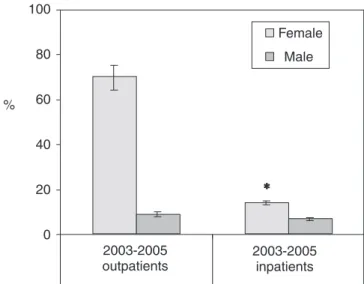
Positive urine culture analyses (674) of E. coli (outpa-tient 446 and inpa(outpa-tient 98)and Staphylococcus sp. (out-patient 85 and in(out-patient 45) performed between 2003 – 2005 on outpatients and inpatients of both sexes are shown in Figure 1. The genus Staphylococcus sp.
corre-100
80
60
40
20
0
2003-2005 outpatients
2003-2005 inpatients
Female
%
Male
*
sponded to 20% of S. aureus with predominance in inpa-tients. Staphylococcus coagulase negative was prevalent in out patient (data not show). If we analyze the results as per microbial species, the isolations of E. coli were found to represent 85% in female outpatients and 62% in male outpatients, with the corresponding percentages for Sta-phylococcus sp. being 74 and 46% respectively.
The data for the resistance of E. coli to TMS, NOR, GEN, NIT, AMP and CEF, obtained according to the characteristics of type of patient (outpatients n = 446 or inpatients n = 98) and gender are depicted in Table 1. In the isolates of E. coli in outpatients and inpatients, the resistance to NIT was lower than 22%. The resistance to GEN was 5.667% in female outpatients in contrast with 28.667% in female inpatients. When the resistance to TMS was evaluated in female outpatients and in
pa-tients, 35.667 and 47.667% tested positive respectively (Table 1), with these figures being 26.0 and 41.333 % for NOR.
The isolations of E. coli in male patients presented a re-sistance to GEN of 23.667% in outpatients and 37.333% in inpatients (Table 1). As son Staphylococcus sp., a low resistance to NIT (< 4%) was observed in both these types of patients, with this increasing to 55.333 and 70.0% in the resistance to GEN in female and male inpatients, re-spectively. There was also a remarkably high resistance to NOR in male outpatients (78.0%) (Table 2).
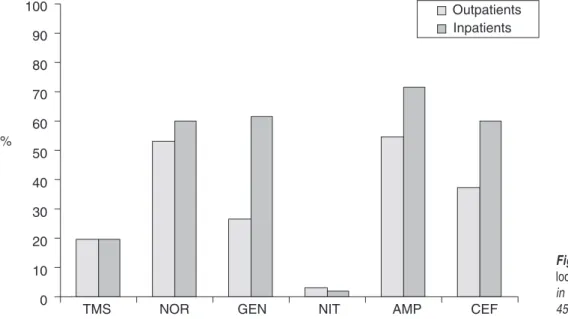
The global results are depicted in Figures 2 and 3, in which there is no gender differentiation. These reveal a low resistance of E. coli to NIT, both in outpatients and in inpatients, of close to 10% and an even lower one to Sta-phylococcus sp. (approximately 3%). Also, there is a
resis-100 90 80 70 60 50 40 30 20 10 0 %
Outpatients Inpatients
TMS NOR GEN NIT AMP CEF
Figure 2. Global resistance of E. coli isolated from urine cultures in outpatients (n = 446) and inpatients (n = 98).
Table 1. Female and male isolates with indicated resistance to E. coli (n = 544).
Outpatients Inpatients Resistant (%) Resistant (%)
Female Male Female Male
Antimicrobial agent (n = 404) (n = 42) (n = 72) (n = 26)
TMS 35.7 ± 3.2 31.0 ± 12.1 47.7 ± 5.9* 58.0 ± 14.1 NOR 26.0 ± 5.0 55.3 ± 23.2 41.3 ± 6.5* 76.0 ± 21.9 GEN 5.7 ± 4.0 23.7 ± 6.4 28.7 ± 9.0 37.3 ± 7.4 NIT 5.7 ± 1.5 13.3 ± 3.2 13.4 ± 5.7* 21.3 ± 11.9 AMP 59.0 ± 8.2 88.0 ± 10.4 81.7 ± 9.1* 81.7 ± 3.8* CEF 19.3 ± 9.9 38.7 ± 18.5 35.3 ± 10.6 58.0 ± 14.1
tance of Staphylococcus sp. to TMS. The global resistance to NOR was about 55%, and the resistance to AMP was higher than 70% in inpatients for both studied microor-ganisms. The average resistance of Staphylococcus sp. to GEN and CEF was 44 and 48.7% respectively and there was a low resistance of this bacterium to NIT whereas there was a high one to AMP.
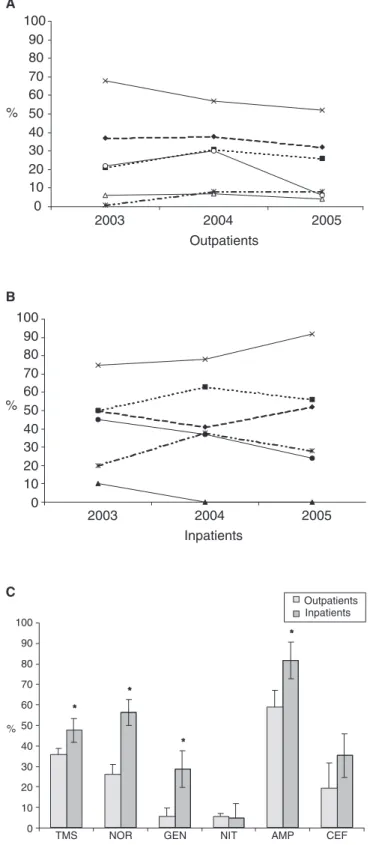
In Figure 4, we can observe the tendency of the antibi-otic resistance found in the isolates of E. coli in females outpatients (A) and inpatients (B) during 2003, 2004 and 2005 and global resistance outpatients vs inpatients (C). A tendency for a reduction in the resistance in female outpa-tients, took place except for NOR and GEN. There was a more remarkable increase in the resistance to TMS and NOR in male outpatients. A reduction in the resistance to CEF was observed in male outpatients.
The resistance of E. coli in female inpatients, to NOR tended to decrease. It is important to highlight the rele-vant sensitivity of NIT in both male and female patients.
There was a more remarkable increase in the global resis-tance to TMS and NOR in females inpatients (Figure 4C).
An analysis of Staphylococcus sp. covering the same peri-od of time, shows a variable resistance to TMS y NIT being observed in outpatients, and a tendency for a reduction in the resistance to AMP, CEF Y GEN in out and inpatients of both sexes. We can observe that in inpatients there was a tendency for the resistance to NOR to be reduced (data not show).
DISCUSSION
The selection and prescription of an antimicrobial must be evaluated with more complex parameters wherebly an
Outpatients Inpatients 100
90 80 70 60 50 40 30 20 10 0 %
TMS NOR GEN NIT AMP CEF
Figure 3. Global resistance of Staphy-lococcus sp. isolated from urine cultures in outpatients (n = 85) and inpatients (n = 45).
Table 2. Female and male isolates with indicated resistance to Staphylococcus sp. (n = 130).
Outpatients Inpatients Resistant (%) Resistant (%)
Female Male Female Male
Antimicrobial agent (n = 67) (n = 18) (n = 24) (n = 21)
TMS 16.3 ± 13.9 23.0 ± 17.0 24.7 ± 14.4 14.0 ± 10.4 NOR 28.0 ± 13.0 78.0 ± 23.1 63.7 ± 21.2 57.0 ± 20.4 GEN 13.3 ± 9.9 39.7 ± 31.8 55.3 ± 9.2* 70.0 ± 26.5 NIT 3.3 ± 5.8 3.0 ± 5.2 1.0 ± 0.0 2.7 ± 4.6 AMP 41.0 ± 16.7 68.0 ± 27.8 66.7 ± 16.5 76.7 ± 25.2 CEF 23.3 ± 9.5 51.3 ± 23.2 58.3 ± 14.1* 61.6 ± 14.4
accurate analysis of regional epidemiologic data can pro-duce better results of the empirical therapies. In the case of UTI, it is indispensable to assess whether it is actually a UTI or a bacterial contamination, in both outpatients and inpatients. In this research, outpatients presented a higher number of urine infections, with women being the most af-fected and E. coli the bacterium most frequently isolated.
Most cases of UTI in the hospital setting are initially treatedempirically based on the frequency of potential pathogens, localantimicrobial resistance rates and illness severity. The useof inappropriate empirical therapy to be able a predictorof mortality in patients who had bacteri-emia originating froma urinary tract source. Catheter-asso-ciated urinary tract infections (CAUTIs) are cause of noso-comial infections. Additionally, the frequency distribution of pathogens causing CAUTIs might differ from of patho-gens isolated from patients without catheters. The incidence of UTI caused by MRSA is increasing because patients are more frequently fitted with various urinary stents and cathe-ters as endourology progresses technologically.10 The resis-tance of these uropathogens to commonly prescribe antibi-otics is clinically essential and would be helpful in improving the efficacy of empirical treatment. The use of the antibacterial agents has been reduced as much as possi-ble, because the prolonged and uncontrolled use of antibac-terial agents, especially third-generation cephalosporins, will induce the emergence of antimicrobial-resistant bacte-ria such as MRSA.11
In Argentina, TMS is the most common drug chosen for the treatment of non-complex urine infections, being ef-fective against 85% of the urine pathogens occurring in this type of infection (in vitro) and having an even better clinical response thanks to the drug kinetic.12,13 In our present study, we have observed that the community ana-lyzed presented values of resistance of E. coli to TMS of between 35 and 60% in female and male outpatients re-spectively (p value < 0.05).
The second most frequent drug chosen for the treatment of non-complex urine infections is NOR. All data shown in this paper demonstrate a high resistance of E. coli to this antibiotic in inpatients. Similar results on the resistance of
E. coli to fluorquinolones have also been found by other authors.12 Moreover, some research has demonstrated that, in Argentina, NOR is used as an alternative drug, -between 3 or 4 times more than TMS, with the second most used drug being Cephalexin. In various research studies, 50% of antimicrobials have been demonstrated to be inade-quately used.13
The use of Cephalosporin 1st. generation, cephalexin on cephadroxil is not recommended if the resistance rates of E. coli are higher than 20%.13 In particular, Cephalex-in should be only prescribed after proven sensitivity to
0 10 20 30 40 50 60 70 80 90 100
2003 2004 2005 Outpatients
%
A
2003 2004 2005 Inpatients
0 10 20 30 40 50 60 70 80 90 100
%
B
Outpatients Inpatients 100
90
80
70
60
50
40
30
20
10
0
TMS NOR GEN NIT AMP CEF %
*
*
*
*
C
this drug and on the basis of documented resistance to TMS and NOR. In the present study, we observed resis-tance indicators of 58% to TMS and 76% to NOR in male inpatients for the strains of E. coli. We must also consider that the use of alternative drugs may cause pres-sure on the germs’ resistance, thus having an impact on future morbidity.
Lopardo et al presented results of the resistance of out-patients’ E. coli, to NIT and GEN of 5 and 4% respective-ly.13 In the current work, we observed resistance of E. coli to these antibiotics of 6 and 5%.
When evaluating UTI in male patients, we could ob-serve a greater resistance of E. coli to both NOR and TMS. However, NIT was an exception, but its use is not recom-mended due to the low concentration that it reaches in tis-sues, and also because of the risk of prostitis, pyelonefritis and hidden pyelonefritis, which are quite frequent among male patients.14-18
We were able to determine the global resistance (in both sexes) of E. coli and Staphylococcus sp. to NOR - ap-proximately 55%, and also show that the resistance to AMP was greater than 70% in inpatients. These values could be related to the use of high generation betalactam-ic antibiotbetalactam-ics and new quinolones in the treatment of in-fectious pathologies associated to other illnesses in inpa-tients.
The values of resistance of E. coli to NIT are low in male as well as in female inpatients. These results may be conditioned by the little or no use made of nitrofurans in this type of patient due to the low concentrations found of this antibiotic in tissues and fluids, with the exception of urinary tract.
The variation profile over these three years has changed, with the most important impact being on inpa-tients and on NOR, GEN, AMP and CEF antibiotics.19-21
Few previous studies, have been undertaken in Argenti-na of a similar Argenti-nature to this one, despite the fact that they are very important in any institution in order to plan the rational use of antibiotics and avoid the appearance of re-sistant strains as much as possible.
The results presented in this report confirmthat bacteri-al resistancecontinues to be a great problem inthe health care center. We postulate that the resultsobtained in this study could be generalized for other center that have the same epidemiologicalcharacteristics as ours. However, distinct local conditionssuch as local population, antimi-crobial use and local infectioncontrol policies could re-sult in differences in the etiologyand susceptibility pro-file of bacterial pathogens.
Therefore, programs for the vigilance of anti-microbial resistance in all health care institutions should be imple-mented so that an assessment can be carried out of the
modification of local resistance patterns and the selection of microorganisms in relation to the antimicrobials used, since microorganisms are considered to have the capacity to modify the susceptibility of a drug according to the ex-posed causes.
ACKNOWLEDGMENTS
MG Paraje is a career member of CONICET.
The authors want to thank the Ministerio de Salud Pública de Córdoba.
REFERENCES
1. Silva, SJ. 2006. Resistencia a antibióticos. Revista Latinoameri-cana de Microbiología. 48 (2): 105-112.
2. Díaz Ramos, R. 2006. Principales microorganismos causantes de infecciones nosocomiales. Revista Latinoamericana de Mi-crobiología. 48 (2): 112-120.
3. Widerström M, Wiström J, Ferry S, Karlsson C & Monsen T. 2007. Molecular Epidemiology of Staphylococcus saprophyti-cus Isolated from Women with Uncomplicated Community-Ac-quired Urinary Tract Infection. J Clin Microbiol. May;45(5): 1561-4.
4. Moreno E, Andreu A, Pérez T, Sabaté M, Johnson JR & Prats G. 2006. Relationship between Escherichia coli strains causing uri-nary tract infection in women and the dominant faecal flora of the same hosts. Epidemiology and Infection. 134 (5): 1015-1023. 5. Bayram A & Balci I. 2006. Patterns of antimicrobial resistance
in a surgical intensive care unit of a university hospital in Tur-key. BMC Infect Dis. Oct 25;6:155.
6. Warren JW, et al. 1999. Guidelines for antimicrobial treatment of uncomplicated acute bacterial cystitis and acute pyelone-phritis in women. Clinical Infection Disease. 29:745-758. 7. Wagenlehner FM & Naber KG. 2006. Current challenges in the
treatment of complicated urinary tract infections and prostati-tis. Clinical Microbiology and Infection. 12 Suppl 3:67-80. 8. Barnes, AI & Paraje, MG. 2006. Análisis de la dispensación de
antibióticos a pacientes ambulatorios según proceso infeccioso. Atención Primaria. 37(7): 421-423.
9. Paraje, MG & Barnes, AI. 2006. Motivos y características de la Dispensación de Antibióticos en Farmacias Comunitarias. Rol del Profesional Farmacéutico en la Antibioticoterapia. Acta Far-macéutica Bonaerense. 25 (2): 289-95.
10. Matsukawa M, Kunishima Y, Takahashi S, Takeyama K & Tsukamoto T. 2001. Staphylococcus aureus bacteriuria and surgical site infections by methicillin-resistant Staphylococcus aureus. Int J Antimicrob Agents. 17(4):327-9.
11. Ando E, Monden K, Mitsuhata R, Kariyama R & Kumon H. 2004. Biofilm formation among methicillin-resistant Staphylo-coccus aureus isolates from patients with urinary tract infec-tion. Acta Med Okayama. 58(4):207-14.
12. Karlowsky JA, et al . 2002. Trends in Antimicrobial Resistance among Urinary Tract Infection Isolates of Escherichia coli from Female Outpatients in the United States. Antimicrobial Agents and Chemotherapy. 46(8): 2540–2545.
13. Lopardo G & Clara L. 2004. Diagnóstico y Tratamiento de la Infección Urinaria no complicada. Atención Primaria de la Sa-lud. 7:10-13.
commu-nity outbreaks of urinary tract infections. Epidemiology and Infection. 134(2):425-31.
15. Biswas D, et al. 2006. Choice of antibiotic for empirical thera-py of acute cystitis in a setting of high antimicrobial resistance. Indian Journal of Medical Sciences. 60:53-58.
16. Hooton TM, et al. 2004. Acute uncomplicated cystitis in an era of increasing antibiotic resistance: a proposed approach to em-pirical therapy. Clinical Infection Disease. 39(1):75-80. 17. Verdier R, et al. 2006. Impact of an infection control program
in an intensive care unit in France. Infection Control and Hos-pital Epidemiology. 27(1):60-6.
18. Barberan Lopez J & Moya Mir MS. 2005. Repercusión ecológica de la utilización de antibióticos. Emergencia. 18: 105-108.
19. Navaneeth BV, et al. 2002. Urinary pathogens resistance to common antibiotics: a retrospective analysis. Tropical Doctor. 32:20-2.
20. Sotto A, et al . 2001. Risk factors for antibiotic-resistant Es-cherichia coli isolated from inpatients with urinary tract
infec-tions: a prospective study. Journal of Clinical Microbiology. 39(2):438-44.
21. Karlowsky JA, et al. 2003. Susceptibility of antimicrobial-re-sistant urinary Escherichia coli isolates to fluoroquinolones and nitrofurantoin. Clinical Infection Disease. 36(2):183-7.
Correspondence to:
Dra. M. Gabriela Paraje Departamento de Farmacia, Facultad de Ciencias Químicas, Haya de la Torre y Medina Allende, Ciudad Universitaria, (5000) Córdoba, República Argentina.
Telephone: 0351-4334163 int 105 Tel-Fax: 0351-4334127.