Este artículo puede ser consultado en versión completa en http://www.medigraphic.com/rma
www.medigraphic.org.mx
Role of video laryngoscopes in anesthesia practice
Maya S Suresh, MD*
* The following presentation is the intellectual property of Maya S. Suresh, M.D., Baylor College of Medicine, Houston, Texas
C
CONFERENCIAS MAGISTRALES
Vol. 35. Supl. 1 Abril-Junio 2012 pp S344-S361
OBJECTIVES
• Briefl y discuss the airway –related closed claims studies in surgical/obstetrical patients
• Discuss the introduction of video laryngoscopy in airway management
• Discuss the different types of video laryngoscopes cur-rently available in anesthesia practice
• Discuss the role of video laryngoscopes in the airway management of unanticipated, diffi cult or failed intubation – Obstetrical patients
ASA CLOSED CLAIMS PROJECT
Incidence of death and brain damage % of total claims
50
40
30
20
10
0
1970-79 N=674
1980-89 N=2904
1990-94 N=783 Death
Brain damage Nerve injury
N=4,459 Claims
N=4,459 Claims
41%
15% 15%
32%
12%
16% 22%9%18%
Incidence of respiratory, cardiovascular & equipment –related damages
60
50
40
30
20
10
0
1970-79 N=374
1980-89 N=1294
1990-94 N=248 56%
13% 7%
49%
19%
6%
38%
25%
9%
Respiratory events Cardiovascular events Equipment problems
Cheney FW. The ASA closed claims project:
www.medigraphic.org.mx
COMPARISON OF INJURIES IN OBSTETRICAN-ESTHESIA CLAIMS BEFORE AND AFTER 1990
40
30
20
10
0
Proportion of claims in each group (%) Maternal death
Maternal brain damage
Maternal nerve injurie Newborn
death/ brain damage
Headache Back pain Pre-1990 (n=190) 1990 and later (n=426)
Davies JM, Posner KL, Lee LA, Cheney FW, Domino KB. Liability associated with obstetric anesthesia –a closed claims study. Anesthesiology 2009;110:131-9.
CLOSED CLAIMS STUDY IN OBSTETRICAL PATIENTS 1990-2003
• Closed claims study: Obstetric anesthesia claims for inju-ries from 1990 to 2003 compared to obstetric claims for injuries before 1990
– Obstetric claims 1990-2003,
Maternal death or brain damage and newborn death or brain damage decreased
– Respiratory causes of injuries decreased in claims from 1990 or later
24% - pre-1990
4% - 1990 or later
• Claims related to inadequate oxygenation/ventilation, aspiration decreased
• Claims related to diffi cult intubation did not change
DIFFICULT AIRWAY INCIDENCE
Surgical patients
• Diffi cult Intubation occurs relatively commonly in associa-tion with GA
– Estimated incidence 1-3%
• Diffi cult Mask Ventilation
– Estimated incidence 0.9-5% in general surgery patients
Pre-1990* 1990 or later P value Proportion of
perioperative claims 190 (12%) 426 (13%) NS Mean age, yr (SD) 28 (5) 29 (6) 0.044 Mode of delivery
Cesarean section 127 (67%) 246 (58%) 0.029 Vaginal delivery 63 (33%) 180 (42%) 0.029 Primary anesthetic
Regional
anesthesia 124 (65%) 342 (80%) < 0.001
General
anesthesia 62 (33%) 73 (17%) < 0.001 Other or unknown 4 (2%) 11 (3%)
Respiratory damaging event 46 (24%) 17 (4%) < 0.001 Aspiration of gastric contents 8 (4%) 2 (< 1%) 0.012 Diffi cult intubation 10 (5%) 11 (3%) NS
Esophageal
intubation 7 (4%) 0 (0%) 0.007
Inadequate
oxygenation/ ventilation 10 (5%) 3 (1%) 0.006 Standard of care
Substandard care 74 (39%) 92 (22%) < 0.001 Appropriate 87 (46%) 293 (69%) < 0.001 Impossible
to judge 29 (15%) 41 (10%) NS Payment made 100 (58%) 164 (42%) < 0.001 Adjusted total
payment in
2007 dollars
Median $455,000 $222,000 NS Range $1,539- $1,196- $19,656,000 $18,400,000
• Cannot intubate–cannot ventilate (CICV)
– Estimated incidence CICV – 0.0.01% to 2 per 10,000
Obstetrical patients
• Cormack & Lehane
– Diffi cult laryngoscopy Grade III view 1:2,000
• Hawthorne
www.medigraphic.org.mx
• Lyons
– Failed intubation 1:300
• Samsoon & Young – Failed intubation 1:283
• Rocke et al.
– Failed intubation 1:750
• Palanisamy et al. – CICV 1:98
BREAKING DOWN COMPLEXITIES OF ENDOTRACHEAL INTUBATION
• Direct laryngoscopy (DL): Technology developed in the 1940s (Miller and Macintosh)
• DL & Tracheal Intubation involves three distinct challenges:
– Laryngeal (glottic opening) sighting – Delivering the tube to the glottic opening
– Advancing the tube beyond the target into the trachea
w
w
w
w
w
w
w
w
w
w
w
w
w
w
w
w
w
w
w
w
w
w
w
w
w
w
w
w
w
w
w
w
w
w
w
w
w
w
w
w
w
w
w
w
w
w
w
w
w
w
w
w
w
w
w
w
w
w
w
w
w
w
w
w
w
w
w
w
w
w
w
w
w
w
w
w
w
w
w
w
w
w
w
w
w
w
w
w
w
w
w
w
w
w
w
w
w
w
w
w
w
w
w
w
w
w
w
w
w
w
w
w
w
w
w
w
w
w
w
w
w
w
w
w
w
w
w
w
w
w
w
w
w
w
w
w
w
ww
w
w
w
w
w
w
w
w
w
w
w
w
w
w
w
w
w
w
w
w
w
w
w
w
w
w
w
w
w
w
w
w
w
w
w
w
w
w
w
w
w
w
w
w
w
w
w
w
w
w
w
w
w
w
w
w
w
w
w
w
w
w
w
w
w
w
w
w
w
w
w
w
w
w
w
w
w
w
w
w
w
w
w
w
w
w
w
w
w
w
w
w
w
w
w
w
w
w
w
w
w
w
w
w
w.
w
w
w
w
w
w
w
w
w
w
w
w
w
w
w
w
w
w
w
w
w
w
w
w
w
w
w
w
w
w
w
w
w
w
w
w
w
w
w
w
w
w
w
w
w
w
w
w
w
w
w
w
w
w
w
w
w
w
w
w
w
w
w
w
w
w
w
w
w
w
w
w
w
w
w
w
w
w
w
w
w
w
w
w
w
w
w
w
w
w
w
w
w
w
.m
.
.
m
m
m
m
m
m
m
m
m
m
m
m
m
m
m
m
m
m
m
m
m
m
m
m
m
m
m
m
m
m
m
m
m
m
m
m
m
m
m
m
m
m
m
m
m
m
m
m
m
m
m
m
m
m
m
m
m
m
m
m
m
m
m
m
m
m
m
m
m
m
m
m
m
m
m
m
m
m
m
m
m
m
m
m
m
m
m
m
m
m
m
m
m
m
m
m
m
m
m
m
m
m
m
m
m
m
m
m
m
m
m
m
m
m
m
m
m
m
m
m
m
m
m
m
m
m
m
m
m
m
m
m
m
m
m
m
e
ed
e
e
e
e
e
e
e
e
e
e
e
e
e
e
e
e
e
d
d
d
d
d
d
d
d
d
d
d
d
d
d
d
d
d
d
d
d
d
d
d
d
d
d
d
d
d
d
d
d
d
d
d
d
d
d
d
d
d
d
d
d
d
d
d
d
d
d
d
d
d
d
di
d
d
d
d
d
d
d
d
d
d
d
d
d
d
d
d
d
d
d
d
d
d
d
d
d
d
d
d
d
d
d
d
d
d
d
d
d
d
d
d
d
d
d
d
d
d
d
d
d
d
d
d
d
d
d
d
d
d
d
d
d
d
d
d
d
d
d
d
d
d
d
d
d
d
d
d
d
d
d
d
d
d
d
d
d
d
d
d
d
d
d
d
d
d
d
d
d
d
d
d
d
i
ig
i
i
i
i
i
i
g
gr
g
g
g
g
g
g
g
g
g
r
r
r
r
r
r
r
r
r
r
r
r
VISUALIZATION OF THE GLOTTIS
• Video and optical/mirror laryngoscopes: (Routine & dif-fi cult intubation; teaching & training)
– Achieve laryngeal exposure
– These devices look around the curve of the tongue – Bypass the mechanical challenges of creating a direct
line of sight to the larynx
– Miniature video camera (charge coupling device) or prisms/mirrors at the tip of the scope transmits image of - glottic area/vocal cords & can be viewed on a moni-tor screen
ALTERNATIVE DEVICES IN INTUBATION VIDEO & MIRROR/OPTICAL LARYNGOSCOPES
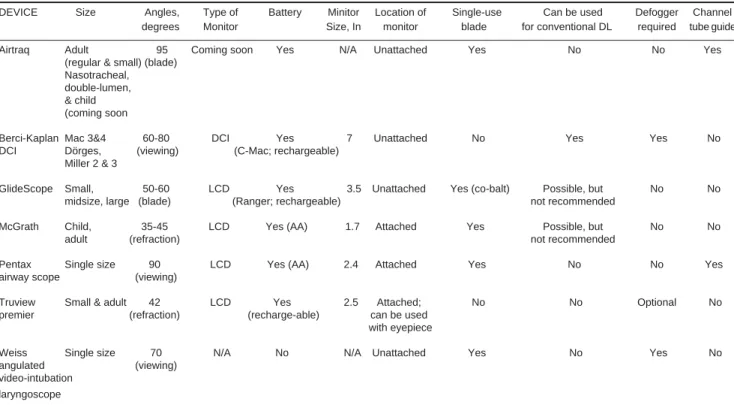
• Glide scope video laryngoscope • Storz C -MAC video laryngoscope • McGrath video laryngoscope • Airtraq
• Pentax • King vision
a
a
a
a
a
a
a
a
a
a
a
a
aa
a
a
a
a
a
a
a
a
a
www.medigraphic.org.mx
FEATURES AND COST OF VIDEO-LARYNGOSCOPESVideo Blade shape Monitor Portability Disposability Size range Anti-fog Cost
-laryngoscope mechanism
Storz C-Mac Standard Separate, 7 in. Sizes
Macintosh TFT monitor Yes Reusable 2 – 4 Yes $ 7,980 VL,
blade Monitor
D -Blade: $5,300
Glidescope Angulated Separate, 7 in. No Reusable Sizes Yes GVL :$11,000
original blade LCD monitor 2 – 5 Additional
blades $4,000
Glidescope Angulated Separate, 7 in. No Single-use Sizes Yes Video,
Cobalt blade LCD monitor blades 1 – 4 monitor,
Cable, scope 11,000 Disposable blades $15/each
Glidescope Angulated Separate, 3.5 in. Yes Reusable or Reusable: 3-4 Yes $11,000 Ranger blade LCD monitor single-use Single use: 1-4
formats
McGrath Angulated Integrated, 1.7 in. Yes Single-use Three adult No $8,900 blade LCD monitor blades lengths blades $10/each
Pentax-AWS Anatomically Integrated, 2.4 in. Yes Single-use One size No $10,000 shaped blade LCD Monitor blades available Blades
with a $20/each
guide channel
Airtraq Anatomically External monitor Not when Single-use Four sizes Yes $80 each shaped blade (when used as a used as a device available disposable
with a video-, video- blade
guide channel laryngoscope) laryngoscope Monitor $500
Niforopoulou et al. Acta Anaesthesiol Scand 2010;54:1050-1061.
ACHIEVING LARYNGEAL VIEW DEFINING THE VIEW AXIS
w
ww
ww
w.
.m
me
ed
di
ig
g
gr
g
g
g
g
g
g
g
g
r
r
r
r
Miller Bladeer Macintosh Blade
• Miller blade has a very defi ned & limited view axis to target (narrow spatula/fl ange height)
• View axis is a straight line perpendicular to the handle 900 • Laryngeal sighting is by direct line of sight
• Macintosh blade permits the view axis to pivot • Amount of pivoting is restricted:
www.medigraphic.org.mx
– mouth opening, upper dentition, tongue characteristics, epiglottis lift
• Laryngeal sighting is by direct line of sight
Levitan RM, Heitz JW, Sweeney M, et al. Ann Emerg Med 2011;57(3):240-247.
ACHIEVING LARYNGEAL VIEW DEFINING THE VIEW AXIS
McGrath videolaryngoscope
Glide video-laryngoscope
C-MAC vide-olaryngoscope
• Compared to direct laryngoscopy these videolaryngo-scopes (VL) provide a look around the curve from 0 degrees to a visual axis of approximately 270 to 300° • The distal tips of these video laryngoscopes point toward
the 290°
• The cameras have a wide fi eld of view: both up & down; left to right; including the distal tip of their blades • Result is supraepiglottic panoramic view of the larynx,
from above the epiglottis & posterior to the base of the tongue.
Levitan RM, Heitz JW, Sweeney M, et al. Ann Emerg Med 2011;57(3):240-247.
ACHIEVING LARYNGEAL VIEW DEFINING THE VIEW AXIS
w
w
w
w
w
w
w
w
w
w
w
w
w.
w
w
w
w
w
w
w
w
w
w
w
w
w
w
w
w
w
w
w
.
m
m
m
m
m
m
m
m
m
m
m
m
m
m
m
m
m
m
m
e
e
e
e
e
e
e
e
e
e
d
d
i
i
g
g
r
r
r
r
Airtraq airway scope Pentax airway scope
Airtraq & Pentax airway scope (AWS)
• These airway scopes have integrated channel for endotra-cheal tube delivery
• Viewing angle of these devices is less steep- distal tip is close to the handle
• Essentially offer a view to the larynx (optically designed) the view is approximately 900 to 260-270°
• The view axis is optically manipulated counterclockwise approximately 270°
Levitan RM, Heitz JW, Sweeney M, et al. Ann Emerg Med 2011;57(3):240-247.
GLIDESCOPE VIDEO SYSTEM
• Provides unobstructed & clear magnifi ed view of the air-way on a monitor
• Provides a view that is more anterior than the operator would expect
• Novice user may experience diffi culty in placing the ETT between the cords
www.medigraphic.org.mx
DELIVERING THE TUBE TO THE TARGET: GLIDERITE STYLET
• The glide rite stylet, promoted by the GlideScope manu-facturer
• The bend angle approximates 70 degrees
• The large plastic proximal stop permits 1-handed retraction of the stylet after the tube tip has passed through the vocal cords.
Levitan, Heitz, Sweeney Cooper. Ann Emerg Med 2011;57:240-247.
CLINICAL PEARLS: SUCCESSFUL
VIDEOLARYNGOSCOPY GETTING AROUND THE CURVATURE OF THE TONGUE TO THE GLOTTIC
OPENING DELIVERING THE TUBE TO THE GLOTTIC OPENING
w
w
w
w
w
w
w
w
w
w
w
w
w
w
w
w
w
w
w
w
w
w
w
w
w
w
w
w
w
w
w
w
w
w
w
w
w
w
w
w
w
w
w
w
w
w
w
w
w
w
w
w
w
w
w
w
w
w
w
w
w
w
w
w
w
w
w
w
w
w
w
w
w
w
w
w
w
w
w
w
w
w
w
w
w
w
w
w
w
w
w
w
w
w
w
w
w
w
w
w
w
w
ww
w
w
w
w
w
w
w
w
w
w
w
w
w
w
w
w
w
w
w
w
w
w
w
w
w
w
w
w
w
w
w
w
w
w
w
w
w
w
w
w
w
w
w
w
w
w
w
w
w
w
w
w
w
w
w
w
w
w
w
w
w
w
w
w
w
w
w
w
w
w
w
w
w
w
w
w
w
w
w
w
w
w
w
w
w
w
w
w
w
w
w
w
w
w
w
w
w
w
w
w
w
ww
w
w
w
w
w
w
w
w
w
w
w
w
w
w
w
w
w
w
w
w
w
w
w
w
w
w
w
w
w
w
w
w
w
w
w
w
w
w
w
w
w
w
w
w
w
w
w
w
w
w
w
w
w
w
w
w
w
w
w
w
w
w
w
w
w
w
w
w
w
w
w
w
w
w
w
w
w
w
w
w
w
w
w
w
w
w
w
w
w
w
w
w
w
w
w
w
w
w
w
w
w
w
w
w
w
w
w
w
w
w
w
w
w
w
w
w
w
w
w
w
w
w
w
w
w
w
w
w
w
w
w
w
w
w
w
w
w
w
w
w
w
w
w
w
w
w
w
w
w
w
w
w
w
w
w
w
w
w
w
w
w
w
w
w
w
w
w
w
w
w
w
w
w
w
w
w
w
w
w
w
w
w
w
w
w
w
w
w
w
w
w
w
w
w
w
w
w
w
w
w
w
w
w
w
w
w
w
w
w
w
w
w
w
w
w
w
w
w
w
w
w
w
w
w
w.
.m
.
.
.
m
me
m
m
m
m
m
m
m
m
m
m
m
m
m
m
m
m
m
m
m
m
m
e
e
e
e
e
e
e
e
e
e
e
e
e
e
e
e
e
e
e
e
e
e
e
e
e
e
e
e
e
e
e
e
e
e
ed
e
e
e
e
e
e
e
e
e
e
e
e
e
e
e
e
e
e
e
e
e
e
e
e
e
e
e
e
e
e
e
e
e
e
e
e
e
e
e
e
e
e
e
e
e
e
e
e
e
e
e
e
e
e
e
e
e
e
e
e
e
e
e
e
e
e
e
e
e
e
e
e
e
e
e
e
e
e
e
e
e
e
e
e
e
e
e
e
e
e
e
e
e
e
e
e
d
d
d
d
d
d
d
d
d
d
4 Steps: First pass success
• Step 1: Look in the mouth to introduce the scope in midline
• Step 2: Look at video screen to obtain best optimal glottic view (top 1/3 of the video screen)
• Step 3: Back to mouth to introduce TT:
– Use the glide rite 700 angled stylet reinforced TT – or ET bent into a 900
– Insert the TT sideways in a horizontal plane through the mouth; along the blade
• Step 4: Final step: Look at screen to intubate the trachea
CLINICAL PEARLS FOR SUCCESSFUL VIDEOLARYNGOSCOPY:
www.medigraphic.org.mx
SUCCESSFUL INTUBATIONS WITH GLIDESCOPEOperators’ experience
First author Number of patients with Glidescope Laryngoscopy Intubation with Glidescope Improvement in the C/L Overall Success in Intubation (s) grade with Glidescope success (%) diffi cult airways time
(%)
Cooper 728 adults Limited or no previous 20 C/L III15 C/L I 696/722 (96.3) 15/18 (83.3) – experience with Glidescope and 1 C/L II. 15 C/L
IV 9 C/L I and 2 C/L II
Rai 50 adults No previous experience 2 C/L III 1 C/L I 47/50 (94) – 40 with Glidescope and 1 C/L II
Nouruzi-Sedeh 200 adults Only manikin training 37 C/L III and 93/100 (93) – 63 ± 30 13 C/L IV 5 C/L III and 3 C/L IV
Xue 91 adults No previous experience 17 C/L III and 2 C/L IV 91/91 (100) 27/27 (100) 38 ± 11 with Glidescope 19 C/L I and II
Stroumpoulis 112 adults Good familiarity 28 C/L III and 13 C/L IV 110/112 (98.2) 39/41 (95.1) 44.9 ± 19.7 with Glidescope 9 C/L III and 2 C/L IV
Malik 75 adults Good familiarity 6 C/L III and 2 C/L IV 24/25 (96) – 17 ± 12.31 with Glidescope 0 C/L III and IV
Malik 120 adults with Good familiarity 5 C/L III 0 C/L > II 30/30 (100) – 18.9 ± 6 c-spine immobilization with Glidescope
Maassen 150 morbidly obese adults Good familiarity Mean C/L = 2.1 + 0.8 50/50 (100) 17/17 (100) 33 ± 18 with Glidescope Mean C/L = 1.1 ± 0.24
Liu 70 adults with Good familiarity 14 C/L III and 6 C/L IV 31/35 (88.6) – 71.9 ± 47.9 c-spine immobilization with Glidescope 0 C/L III and IV
Van Zundert 450 adults More than 30 intubations Mean C/L = 1.68 + 0.76 150/150 (100) – 34 ± 20 with Glidescope Mean C/L = 1.01 + 0.11
Sun 200 adults Good familiarity 15 C/L III 8 C/L I 100/100 (100) 15/15 (100) 46 with Glidescope and 6 C/L II
Xue 57 adults Good familiarity – 30/10 (100) – 37.4 ± 9.9
with Glidescope
C/L, Cormack–Lehane; c-spine, cervical spine.
Niforopoulou et al. Acta Anaesthesiol Scand 2010;54:1050-1061.
CASE SERIES OF SUCCESSFUL VIDEOLARYNGOSCOPIC INTUBATION IN OBSTETRIC PATIENTS GLOTTIC VIEW AT
INTUBATION
C+L 1 C+L 2 C+L 3
Standard view 14 (52) 12 (44) 1 (4) Videolaryngoscope view 27 (100) 0 (0) 9 (0)
• 27 patients requiring general anesthesia were intubation successfully with videolaryngoscope
• An improved C&L view with VL was clearly evident – 100% grade I view
• All 27 parturients intubated successfully with VL • VL shown to be superior to conventional laryngoscopy
COMPLICATIONS WITH GLIDESCOPE
• Perforation of the right palatopharyngeal arch (two reports) • Perforation of the right soft palate
www.medigraphic.org.mx
• Diversion of attention from mouth to the monitor • Injury to the lips, teeth, tongue
• Practitioner unaware of the location of the ETT
• As the VL is advanced to achieve laryngeal visualization upward force stretches the tonsillar pillars making them taut
• Susceptible to perforation by an advancing ETT
• Glide VL should be introduced into the mouth, in the midline under direct visual control
• To avoid injury, insertion of the ETT parallel to and as close as possible to the laryngoscope blade attempting to reproduce its course
• Introduce ETT in midline, with proximal end oriented towards the right & then rotate counterclockwise 90º in a horizontal plane bringing it parallel to the blade • Visualize the ETT go into the mouth and around the tongue • If slightest resistance encountered STOP do not use force
PENETRATING INJURY OF THE SOFT PALATE DURING INTUBATION WITH GLIDE SCOPE
Hsu W, Hsu SC, Lee JS, Huang JS, Chen CL. Penetrating injury of the soft palate during Glidescope video laryngos-copy. Anesthesia & Analgesia 2007;104(6):1609-1610.
COMPLICATIONS WITH GLIDESCOPE: PENETRATION THROUGH RIGHT ANTERIOR
TONSILLAR PILLAR
COMPLICATIONS WITH GLIDESCOPE
w
w
w
w
ww
w
w
w
ww
w
w
w.
.m
m
me
ed
di
i
ig
g
g
gr
r
r
r
r
Uúvula
SP soft palate
PARKER FLEX TIP TUBE/GLIDE RITE TUBE: SKI TIP
www.medigraphic.org.mx
PATIENT CHARACTERISTICS AND INTUBATIONPROFILES
Standard tube Parker tube Signifi cance ASA PS (I/II/III) 12/5/3 11/6/3 NS Age 61 ± 12 58 ± 13 NS Height 157 ± 7 159 ± 9 NS Weight 56 ± 9 58 ± 15 NS TMD 6.4 ± 0.5 6.5 ± 0.7 NS POGO 68 ± 14 65 ± 15 NS Success rate at 4/20 14/20 P < 0.01 fi rst attempt
Cumulative success 6/20 17/20 P < 0.01 rate by second attempt
Intubation time (s) 25 ± 4 17 ± 5 P < 0.01 Postoperative sore throat 8/20 4/20 NS Postoperative hoarseness 4/20 2/20 NS Data are presented as mean ± SD or actual number
NS not signifi cant, ASA PS American Society of Anesthesiology Physical Status, TMD thyromental distance, POGO percentage of glottic opening
Parker Flex-Tip® «Hugs» all tubular intubation guides
(fi beroptic cables, bougies, ET tube exchangers)
Parker Flex-Tip® Tube
Standard ET Tube
No gap be-tween tip of Parker tube and intro-ducer
G a p b e t w e e n l e a d i n g e d g e of standard ET t u b e a n d i n -troducer. This gap allows the projecting tube edge to catch on airway anatomy as the tube is « r a i l r o a d e d » downward along the introducer
introducer
Suzuki, Ohmura, Tampo, et al. Parker Flex-Tip Tube
®provides higher intubation success with the Pentax-AWS
Airwayscope® despite the AWS tip being inserted into the
vallecula. J Anesth 2012; March 4 (Epub ahead of print).
ADVANCING THE TUBE INTO THE TRACHEA: TRACHEAL AXIS AND TRACHEAL RINGS
Top: Leading edge of the tube impinging between the 1st
and 2nd tracheal rings
Middle: Rotation of the tube clockwise drops the tip down-ward, disengaging it from the tracheal rings
Bottom: The symmetric, ski-tip distal tip of the Parker endotracheal tube; advocated by the manufacturer
1st and 2nd Tracheal rings
www.medigraphic.org.mx
The top image shows a left-facing bevel of a standard en-dotracheal tube, with the leading edge of the tube between the fi rst and second tracheal rings (the vocal cords are denoted by the thin vertical line; the rings, by solid dots). The drawing is from a lateral perspective of the trachea, with the round dots representing a sagittal cross-section of the tracheal rings. An inset shows the tracheal rings as they appear with a fi beroptic instrument. Rotation of the tube clockwise (middle image) drops the tip downward, disengaging it from the tracheal rings, and also lowering the trajectory of the tube. At the bottom is the symmetric, ski-tip distal tip of the Parker endotracheal tube. This tube design is also advocated by the manufacturer of the GlideScope.
Levitan, Heitz, Sweeney, Cooper. Ann Emerg Med 2011;57:240-247.
MCGRATH VIDEOLARYNGOSCOPE (MVL)
• Designed by a British Student
– Won the 1999 Royal Society of Arts student design competition
• Series 5 McGrath VL is available for clinical use • Fully portable video laryngoscope
• Single-use blade
– Placed in three different positions • On board mini color camera
• Flat screen monitor mounted on handle • Battery powered
– Single AA battery
w
w
w
w
w
w
w
w
w
w
w
w
w
w
w
w
w
w
w
w
w
w
w
w
w
w
w
w
w
w
w
w
w
w
w
w
w
w
w
w
w
w
w
w
w
w
w
w
w
w
w
w
w
w
w
w
w
w
w
w
w
w
w
w
w
w
w
w
w
w
w
w
w
w
w
w
w
w
w
w
w
w
w
w
w
w
w
w
w
w
w
w
w
w
w
w
w
w
w
w
w
w
w
w
w
w
w
w
w
w
w
w
w
w
w
w
w
w
w
w
w
w
w
w
w
w
w
w
w
w
w
w
w
w
w
w
w
w
w
w
w
w
w
w
w
w
w
w
w
w
w
ww
w
w
w
w
w
w
w
w
w
w
w
w
w
w
w
w
w
w
w
w
w
w
w
w
w
w
w
w
w
w
w
w
w
w
w
w
w
w
w
w
w
w
w
w
w
w
w
w
w
w
w
w
w
w
ww
w
w
w
w
w
w
w
w
w
w
w
w
w
w
w
w
w
w
w
w
w
w
w
w
w
w
w
w
w
w
w
w
w
w
w
w
w
w
w
w
w
w
w
w
w
w
w
w
w
w
w
w
w
w
w
w
w
w
w
w
w
w
w
w
w
w
w
w
w
w
w
w
w
w
w
w
w
w
w
w
w
w
w
w
w
w
w
w
w
w
w
w
w
w
w
w
w
w
w
w
w
w
w
w
w
w
w
w
w
w
w
w
w
w
w
w
w
w
w
w
w
w
w
w
w
w
w
w
w
w
w
w
w
w
w
w
w
w
w
w
w
w
w
w
w
w
w
w
w
w.m
w
w
w
w
w
w
w
w
w
w
w
w
w
w
w
w
w
w
w
w
w
w
w
w
w
w
w
w
w
w
w
w
w
w
w
w
w
w
w
w
w
w
w
w
w
w
w
w
w
w
w
w
w
w
w
w
w
w
w
w
w
w
w
w
w
w
w
w
w
w
w
w
w
w
w
w
w
w
w
w
w
w
w
w
w
w
w
w
w
w
w
w
w
w
m
me
m
m
m
m
m
m
m
m
m
m
m
m
m
m
m
m
m
m
e
e
e
e
e
e
e
e
e
e
e
e
e
e
e
e
e
e
e
e
e
e
e
e
e
e
ed
e
e
e
e
e
e
e
e
e
e
e
e
e
e
e
e
e
e
e
e
e
e
e
e
e
e
e
e
e
e
e
e
e
e
e
e
e
e
e
e
e
e
e
e
e
e
e
e
e
e
e
e
e
e
e
e
ee
e
e
e
e
e
e
e
e
e
e
e
e
e
e
e
e
d
d
d
d
d
d
d
d
d
d
d
d
d
d
d
d
d
d
d
d
di
d
d
d
d
d
d
d
d
d
d
d
d
d
d
d
d
d
d
d
d
d
d
d
d
d
d
d
d
d
d
d
d
d
d
d
d
d
d
d
d
d
d
d
d
d
d
d
d
d
d
d
d
ig
i
i
i
i
i
i
i
i
i
g
g
g
g
g
g
g
g
g
g
g
g
g
g
g
g
gr
MCGRATH VIDEOLARYNGOSCOPE
Original Mc Grath
McGrath series 5 video laryngoscope
With permission of Dr. James Du Canto
CASE SERIES: THE MCGRATH®
VIDEOLARYNGOSCOPE – AN INITIAL CLINICAL EVALUATION
[Série de cas: Le vidéolaryngoscope McGrath® - une première évaluation Chinique]
Ben Shippey BMBS MRCP FRCA, David Ray MD FRCA, Dermot McKcown MBChB FRCA
• Prospectively recorded factors associated with diffi cult tracheal intubation and complications using the McGrath in patients with normal airways
– Phase I – 75 patients, experience with airway instru-mentation was documented
– Phase II – 75 patients, time to obtain an optimal view of the larynx and to complete tracheal intubation • 98% of all intubations were successful using the McGrath
– CL grade I views were obtained in 143 patients ( 95%) – Median time to obtain an adequate view was 6.3 seconds
tracheal intubation was 24.7 sec
– No complications were encountered in any patient • The McGrath is an effective aid to airway management in
patients with normal airways
USE OF THE MCGRATH®
VIDEOLARYNGOSCOPE IN THE MANAGEMENT OF DIFFICULT AND FAILED TRACHEAL
INTUBATION
www.medigraphic.org.mx
• Report of 3 patients who had Grade 3 or 4 views in whom tracheal intubation was not possible using a conventional Macintosh laryngoscope
• Using the McGrath resulted in a Grade 1 laryngoscopic view followed by successful intubation
• Intubation was more awkward because of the more anterior view of the larynx with the McGrath -stylet is required for intubation
• Offers a valuable addition to the equipment currently available to rescue diffi cult or failed tracheal intubation
Shippey B, Ray D, Mc Keown D. Brit J of Anaesth 2008;100(1):116-19S.
British Journal of Anaesthesia 2008;100(1):116-19.
ALTERNATIVES APPROACHES TO INTUBATION: STORZ VIDEO LARYNGOSCOPE
w
w
w
w
w
w
w
w
w
w
w
w
ww
w
w
ww
w
w
w
w
w
w
w
w
w
w
w
w
w
w
w
w
w.
w
w
w
w
w
w
w
w
w
w
w
w
w
w
w
w
.m
.
.
.
.
m
m
m
m
m
m
m
m
me
m
m
m
m
m
m
m
m
m
m
m
m
m
m
e
e
e
e
e
e
e
e
e
e
e
e
e
e
e
e
e
e
e
e
e
e
e
e
e
e
e
e
e
e
e
e
e
e
e
e
e
e
e
e
e
e
e
e
e
e
e
e
e
e
e
e
e
e
e
e
e
e
e
e
e
e
e
e
e
e
e
e
e
e
e
e
e
e
e
e
e
e
e
e
e
e
e
e
e
e
e
e
e
ed
e
e
e
e
e
e
e
e
e
e
e
e
e
e
e
e
e
e
e
e
e
e
e
e
e
e
e
e
e
e
e
e
e
e
e
e
e
e
e
e
e
e
e
e
e
e
e
e
e
e
e
e
e
e
e
e
e
e
e
e
e
e
e
e
e
e
e
e
e
e
e
e
e
e
e
e
e
e
e
e
e
e
e
e
e
e
e
e
e
e
e
e
e
e
e
e
e
e
e
e
e
e
e
e
e
e
e
e
e
e
e
e
e
e
e
e
e
e
e
e
e
e
e
e
e
e
e
e
e
e
e
e
e
e
e
e
e
e
e
e
e
e
e
e
e
e
e
e
e
e
e
e
e
e
e
e
e
e
d
d
d
d
d
d
d
d
d
d
d
d
d
d
d
d
d
d
d
d
d
d
d
d
d
d
d
d
d
d
d
d
d
d
d
d
d
d
d
d
d
d
d
d
d
d
d
d
d
d
d
d
d
d
d
d
d
d
d
d
d
d
d
d
d
d
d
d
d
d
d
d
di
d
d
d
d
d
d
d
d
d
d
d
d
d
d
d
d
d
d
d
d
d
d
d
d
d
d
d
d
d
d
d
d
d
d
d
d
d
d
d
d
d
d
d
d
d
d
d
d
d
d
d
d
d
d
d
d
d
d
d
d
d
d
d
d
d
d
d
d
d
d
d
d
d
d
d
d
d
d
d
d
d
d
d
d
d
d
d
d
d
d
d
d
d
d
d
d
d
d
d
d
d
d
d
d
d
d
d
d
d
d
d
d
d
d
d
d
d
d
d
d
d
d
d
d
d
d
d
d
d
d
d
i
ig
i
i
i
i
i
i
i
i
g
gr
g
g
g
g
g
g
g
g
g
g
g
g
r
r
r
r
r
r
r
r
r
r
r
r
r
• The C-MAC VL contains a small camera and a light source at the distal third of the blade
• Two different types of Blades – Mac#3 & #4 Blades
– D- Doerges Diffi cult airway blade
• Two different ways to visualize the glottis
Classic direct view using the naked eye similar to Ma-cintosh blade
Indirect view via a miniature camera at the blade tip visualize the image on the monitor
FIRST CLINICAL EVALUATION OF THE C-MAC D-BLADE VIDEO LARYNGOSCOPE DURING
ROUTINE AND DIFFICULT INTUBATION
Comparison of the conventional C-MAC videolaryngo-scope blades (Macintosh sizes 3 and 4; left panel, A,B) with the curved C-Mac D-Blade (right panel, C)
Cavus E, Neumann T, Doerges V, et al. Anesth Analg 2011;112:382-5.
PERFORMANCE OF THE C-MAC VIDEO LARYNGOSCOPE IN PATIENTS WITH LIMITED
GLOTTIC VIEW USING MACINTOSH LARYNGOSCOPY
• 52 consecutive patients found to have unanticipated CL grade 3 (n = 49) and CL grade 4 (n = 3)
• The percentage of glottic opening (POGO)/glottic view improved in 49 of 52 patients
www.medigraphic.org.mx
Piepho T et al. Performance of C-MAC VL in patients after limited glottic view using Macintosh blade Anaesthesia 2011;66:1101-1105.
4
3
2
1
Cormack and Lehane
ML C-MAC
(a) PERFORMANCE OF THE C-MAC VIDEO
LARYNGOSCOPE IN PATIENTS WITH LIMITED GLOTTIC VIEW USING MACINTOSH
LARYNGOSCOPY
(b) 100
80 60 40 20 0
POGO (%)
ML C-MAC
• The percentage of glottic opening (POGO) improved in 49 of 52 patients
• Tracheal intubation in 3 patients failed
Redrawn from «C-MAC in limited glottic view», Piepho T et al. Anaesthesia 2011;66:1101-1105 POGO: Percentage of Glottic Opening.
COMPARATIVE EFFECTIVENESS OF THE C-MAC VL VS DIRECT LARYNGOSCOPY IN PREDICTED DIFFICULT INTUBATION
Aziz M et al. Anesthesiology 2012;116:629-36.
1
147
Loss due to device inavailability
150
Randomized to C-MAC
300 patients enrolled
Randomized to direct laryngoscopy
150
Switched to alternate modalities
3 Remain assigned to C-MAC laryngoscopy Remain assigned to direct laryngoscopy
149
First attempt C-MAC First attempt direct laryngoscopy
Successes Failures Successes Failures 138 (93%) 11 124 ( 84%) 23
Rescue device Rescue device
5 2 2 2 11 9 3
Repeat C-MAC
Direct laryngoscopy
Alternate videoscope
Flexible fi beroptic
Repeat direct laryngoscopy
Alternate