c
h
a
p
t
e
r
Heat and the First Law
of Thermodynamics
20.1 Heat and Internal Energy
20.2 Heat Capacity and Specific Heat
20.3 Latent Heat
20.4 Work and Heat in
Thermodynamic Processes
20.5 The First Law of Thermodynamics
20.6 Some Applications of the First Law of Thermodynamics
20.7 Energy Transfer Mechanisms Biting into a hot piece of pizza can be
either a pleasant experience or a painful one, depending on how it is done. Eating the crust doesn’t usually cause a prob-lem, but if you get a mouthful of hot cheese, you can be left with a burned palate. Why does it make so much differ-ence whether your mouth touches the crust or the cheese when both are at the same temperature? (Charles D. Winters)
C h a p t e r O u t l i n e
20.1 Heat and Internal Energy 603
ntil about 1850, the fields of thermodynamics and mechanics were consid-ered two distinct branches of science, and the law of conservation of energy seemed to describe only certain kinds of mechanical systems. However, mid –19th century experiments performed by the Englishman James Joule and oth-ers showed that energy may be added to (or removed from) a system either by heat or by doing work on the system (or having the system do work). Today we know that internal energy, which we formally define in this chapter, can be transformed to mechanical energy. Once the concept of energy was broadened to include internal energy, the law of conservation of energy emerged as a universal law of nature.
This chapter focuses on the concept of internal energy, the processes by which energy is transferred, the first law of thermodynamics, and some of the important applications of the first law. The first law of thermodynamics is the law of conserva-tion of energy. It describes systems in which the only energy change is that of inter-nal energy, which is due to transfers of energy by heat or work. Furthermore, the first law makes no distinction between the results of heat and the results of work. According to the first law, a system’s internal energy can be changed either by an energy transfer by heat to or from the system or by work done on or by the system.
HEAT AND INTERNAL ENERGY
At the outset, it is important that we make a major distinction between internal en-ergy and heat. Internal energy is all the energy of a system that is associated with its microscopic components — atoms and molecules — when viewed from a reference frame at rest with respect to the object.The last part of this sentence ensures that any bulk kinetic energy of the system due to its motion through space is not included in internal energy. Internal energy includes kinetic energy of translation, rotation, and vibration of molecules, potential energy within molecules, and potential energy between molecules. It is useful to relate internal energy to the temperature of an object, but this relationship is limited — we shall find in Section 20.3 that internal energy changes can also occur in the absence of temperature changes.
As we shall see in Chapter 21, the internal energy of a monatomic ideal gas is associated with the translational motion of its atoms. This is the only type of en-ergy available for the microscopic components of this system. In this special case, the internal energy is simply the total kinetic energy of the atoms of the gas; the higher the temperature of the gas, the greater the average kinetic energy of the atoms and the greater the internal energy of the gas. More generally, in solids, liq-uids, and molecular gases, internal energy includes other forms of molecular en-ergy. For example, a diatomic molecule can have rotational kinetic energy, as well as vibrational kinetic and potential energy.
Heat is defined as the transfer of energy across the boundary of a sys-tem due to a sys-temperature difference between the syssys-tem and its surround-ings.When you heata substance, you are transferring energy into it by placing it in contact with surroundings that have a higher temperature. This is the case, for ex-ample, when you place a pan of cold water on a stove burner — the burner is at a higher temperature than the water, and so the water gains energy. We shall also use the term heatto represent the amount of energy transferred by this method.
Scientists used to think of heat as a fluid called caloric,which they believed was transferred between objects; thus, they defined heat in terms of the temperature changes produced in an object during heating. Today we recognize the distinct difference between internal energy and heat. Nevertheless, we refer to quantities
20.1
U
Heat
using names that do not quite correctly define the quantities but which have be-come entrenched in physics tradition based on these early ideas. Examples of such quantities are latent heatand heat capacity.
As an analogy to the distinction between heat and internal energy, consider the distinction between work and mechanical energy discussed in Chapter 7. The work done on a system is a measure of the amount of energy transferred to the system from its surroundings, whereas the mechanical energy of the system (kinetic or potential, or both) is a consequence of the motion and relative posi-tions of the members of the system. Thus, when a person does work on a system, energy is transferred from the person to the system. It makes no sense to talk about the work ofa system — one can refer only to the work done onor bya sys-tem when some process has occurred in which energy has been transferred to or from the system. Likewise, it makes no sense to talk about the heat ofa system — one can refer to heatonly when energy has been transferred as a result of a tem-perature difference. Both heat and work are ways of changing the energy of a system.
It is also important to recognize that the internal energy of a system can be changed even when no energy is transferred by heat. For example, when a gas is compressed by a piston, the gas is warmed and its internal energy increases, but no transfer of energy by heat from the surroundings to the gas has occurred. If the gas then expands rapidly, it cools and its internal energy decreases, but no transfer of energy by heat from it to the surroundings has taken place. The temperature changes in the gas are due not to a difference in temperature between the gas and its surroundings but rather to the compression and the expansion. In each case, energy is transferred to or from the gas by work,and the energy change within the system is an increase or decrease of internal energy. The changes in internal en-ergy in these examples are evidenced by corresponding changes in the tempera-ture of the gas.
Units of Heat
As we have mentioned, early studies of heat focused on the resultant increase in temperature of a substance, which was often water. The early notions of heat based on caloric suggested that the flow of this fluid from one body to another caused changes in temperature. From the name of this mythical fluid, we have an energy unit related to thermal processes, the calorie (cal), which is defined as the amount of energy transfer necessary to raise the temperature of 1 g of wa-ter from 14.5°C to 15.5°C.1(Note that the “Calorie,” written with a capital “C”
and used in describing the energy content of foods, is actually a kilocalorie.) The unit of energy in the British system is the British thermal unit (Btu),which is de-fined as the amount of energy transfer required to raise the temperature of 1 lb of water from 63°F to 64°F.
Scientists are increasingly using the SI unit of energy, the joule,when describ-ing thermal processes. In this textbook, heat and internal energy are usually mea-sured in joules. (Note that both heat and work are meamea-sured in energy units. Do not confuse these two means of energy transferwith energy itself, which is also mea-sured in joules.)
The calorie
1Originally, the calorie was defined as the “heat” necessary to raise the temperature of 1 g of water by
20.1 Heat and Internal Energy 605
The Mechanical Equivalent of Heat
In Chapters 7 and 8, we found that whenever friction is present in a mechanical system, some mechanical energy is lost — in other words, mechanical energy is not conserved in the presence of nonconservative forces. Various experiments show that this lost mechanical energy does not simply disappear but is transformed into internal energy. We can perform such an experiment at home by simply hammer-ing a nail into a scrap piece of wood. What happens to all the kinetic energy of the hammer once we have finished? Some of it is now in the nail as internal energy, as demonstrated by the fact that the nail is measurably warmer. Although this con-nection between mechanical and internal energy was first suggested by Benjamin Thompson, it was Joule who established the equivalence of these two forms of energy.
A schematic diagram of Joule’s most famous experiment is shown in Figure 20.1. The system of interest is the water in a thermally insulated container. Work is done on the water by a rotating paddle wheel, which is driven by heavy blocks falling at a constant speed. The stirred water is warmed due to the friction between it and the paddles. If the energy lost in the bearings and through the walls is ne-glected, then the loss in potential energy associated with the blocks equals the work done by the paddle wheel on the water. If the two blocks fall through a distance h, the loss in potential energy is 2mgh, where mis the mass of one block; it is this en-ergy that causes the temperature of the water to increase. By varying the conditions of the experiment, Joule found that the loss in mechanical energy 2mghis propor-tional to the increase in water temperature ⌬T. The proportionality constant was found to be approximately 4.18 J/g⭈°C. Hence, 4.18 J of mechanical energy raises the temperature of 1 g of water by 1°C. More precise measurements taken later demonstrated the proportionality to be 4.186 J/g⭈°C when the temperature of the water was raised from 14.5°C to 15.5°C. We adopt this “15-degree calorie” value:
(20.1)
This equality is known, for purely historical reasons, as the mechanical equiva-lent of heat.
1 cal⬅4.186 J
m m
Thermal insulator
Benjamin Thompson (1753 –1814).
Figure 20.1 Joule’s experiment for determining the mechanical equivalent of heat. The falling blocks rotate the paddles, causing the temperature of the water to in-crease.
HEAT CAPACITY AND SPECIFIC HEAT
When energy is added to a substance and no work is done, the temperature of the substance usually rises. (An exception to this statement is the case in which a sub-stance undergoes a change of state — also called a phase transition— as discussed in the next section.) The quantity of energy required to raise the temperature of a given mass of a substance by some amount varies from one substance to another. For example, the quantity of energy required to raise the temperature of 1 kg of water by 1°C is 4 186 J, but the quantity of energy required to raise the tempera-ture of 1 kg of copper by 1°C is only 387 J. In the discussion that follows, we shall use heat as our example of energy transfer, but we shall keep in mind that we could change the temperature of our system by doing work on it.
The heat capacity C of a particular sample of a substance is defined as the amount of energy needed to raise the temperature of that sample by 1°C. From this definition, we see that if heat Qproduces a change ⌬Tin the temperature of a substance, then
(20.2)
The specific heat c of a substance is the heat capacity per unit mass. Thus, if energy Qtransferred by heat to mass mof a substance changes the temperature of the sample by ⌬T, then the specific heat of the substance is
(20.3)
Specific heat is essentially a measure of how thermally insensitive a substance is to the addition of energy. The greater a material’s specific heat, the more energy must be added to a given mass of the material to cause a particular temperature change. Table 20.1 lists representative specific heats.
From this definition, we can express the energy Qtransferred by heat between a sample of mass m of a material and its surroundings for a temperature change
⌬Tas
(20.4)
For example, the energy required to raise the temperature of 0.500 kg of water by 3.00°C is (0.500 kg)(4 186 J/kg⭈°C)(3.00°C)⫽6.28⫻103J. Note that when the temperature increases, Q and ⌬Tare taken to be positive, and energy flows into
Q⫽mc⌬T
c⬅ Q
m⌬T Q⫽C⌬T
20.2
Heat capacity
Specific heat
10.3
Losing Weight the Hard Way
E
XAMPLE20.1
The work done in lifting the barbell a distance his equal to
mgh, and the work done in lifting it n times is nmgh. We equate this to the total work required:
If the student is in good shape and lifts the barbell once every 5 s, it will take him about 12 h to perform this feat. Clearly, it is much easier for this student to lose weight by dieting.
8.54⫻103 times n⫽ 8.37⫻10
6 J
(50.0 kg)(9.80 m/s2)(2.00 m) ⫽ W⫽nmgh⫽8.37⫻106 J
A student eats a dinner rated at 2 000 Calories. He wishes to do an equivalent amount of work in the gymnasium by lifting a 50.0-kg barbell. How many times must he raise the barbell to expend this much energy? Assume that he raises the bar-bell 2.00 m each time he lifts it and that he regains no energy when he drops the barbell to the floor.
Solution
Because 1 Calorie⫽1.00⫻103cal, the work re-quired is 2.00⫻106 cal. Converting this value to joules, we have for the total work required:20.2 Heat Capacity and Specific Heat 607
the system. When the temperature decreases, Qand ⌬Tare negative, and energy flows out of the system.
Specific heat varies with temperature. However, if temperature intervals are not too great, the temperature variation can be ignored and c can be treated as a constant.2For example, the specific heat of water varies by only about 1% from
0°C to 100°C at atmospheric pressure. Unless stated otherwise, we shall neglect such variations.
Measured values of specific heats are found to depend on the conditions of the experiment. In general, measurements made at constant pressure are different from those made at constant volume. For solids and liquids, the difference be-tween the two values is usually no greater than a few percent and is often ne-glected. Most of the values given in Table 20.1 were measured at atmospheric pres-sure and room temperature. As we shall see in Chapter 21, the specific heats for
2The definition given by Equation 20.3 assumes that the specific heat does not vary with temperature
over the interval In general, if c varies with temperature over the interval, then the cor-rect expression for Qis
Q⫽m
冕
Tf
Ti
cdT
⌬T⫽Tf⫺Ti.
TABLE 20.1
Specific Heats of Some Substances at 25°C and Atmospheric PressureSpecific Heat c
Substance
Elemental Solids
Aluminum 900 0.215
Beryllium 1 830 0.436
Cadmium 230 0.055
Copper 387 0.092 4
Germanium 322 0.077
Gold 129 0.030 8
Iron 448 0.107
Lead 128 0.030 5
Silicon 703 0.168
Silver 234 0.056
Other Solids
Brass 380 0.092
Glass 837 0.200
Ice (⫺5°C) 2 090 0.50
Marble 860 0.21
Wood 1 700 0.41
Liquids
Alcohol (ethyl) 2 400 0.58
Mercury 140 0.033
Water (15°C) 4 186 1.00
Gas
Steam (100°C) 2 010 0.48
gases measured at constant pressure are quite different from values measured at constant volume.
Imagine you have 1 kg each of iron, glass, and water, and that all three samples are at 10°C. (a) Rank the samples from lowest to highest temperature after 100 J of energy is added to each. (b) Rank them from least to greatest amount of energy transferred by heat if each in-creases in temperature by 20°C.
It is interesting to note from Table 20.1 that water has the highest specific heat of common materials. This high specific heat is responsible, in part, for the mod-erate temperatures found near large bodies of water. As the temperature of a body of water decreases during the winter, energy is transferred from the cooling water to the air by heat, increasing the internal energy of the air. Because of the high specific heat of water, a relatively large amount of energy is transferred to the air for even modest temperature changes of the water. The air carries this internal en-ergy landward when prevailing winds are favorable. For example, the prevailing winds on the West Coast of the United States are toward the land (eastward). Hence, the energy liberated by the Pacific Ocean as it cools keeps coastal areas much warmer than they would otherwise be. This explains why the western coastal states generally have more favorable winter weather than the eastern coastal states, where the prevailing winds do not tend to carry the energy toward land.
A difference in specific heats causes the cheese topping on a slice of pizza to burn you more than a mouthful of crust at the same temperature. Both crust and cheese undergo the same change in temperature, starting at a high straight-from-the-oven value and ending at the temperature of the inside of your mouth, which is about 37°C. Because the cheese is much more likely to burn you, it must release much more energy as it cools than does the crust. If we assume roughly the same mass for both cheese and crust, then Equation 20.3 indicates that the specific heat of the cheese, which is mostly water, is greater than that of the crust, which is mostly air.
Conservation of Energy: Calorimetry
One technique for measuring specific heat involves heating a sample to some known temperature Tx, placing it in a vessel containing water of known mass and
temperature and measuring the temperature of the water after equilib-rium has been reached. Because a negligible amount of mechanical work is done in the process, the law of the conservation of energy requires that the amount of energy that leaves the sample (of unknown specific heat) equal the amount of en-ergy that enters the water.3This technique is called calorimetry, and devices in
which this energy transfer occurs are called calorimeters.
Conservation of energy allows us to write the equation
(20.5)
which simply states that the energy leaving the hot part of the system by heat is equal to that entering the cold part of the system. The negative sign in the equa-tion is necessary to maintain consistency with our sign convenequa-tion for heat. The
Qcold⫽ ⫺Qhot
Tw⬍Tx,
Quick Quiz 20.1
3For precise measurements, the water container should be included in our calculations because it also
exchanges energy with the sample. However, doing so would require a knowledge of its mass and com-position. If the mass of the water is much greater than that of the container, we can neglect the effects of the container.
QuickLab
20.2 Heat Capacity and Specific Heat 609
heat Qhotis negative because energy is leaving the hot sample. The negative sign
in the equation ensures that the right-hand side is positive and thus consistent with the left-hand side, which is positive because energy is entering the cold water.
Suppose mxis the mass of a sample of some substance whose specific heat we
wish to determine. Let us call its specific heat cx and its initial temperature Tx.
Likewise, let mw, cw, and Twrepresent corresponding values for the water. If Tfis
the final equilibrium temperature after everything is mixed, then from Equation 20.4, we find that the energy transfer for the water is which is posi-tive because , and that the energy transfer for the sample of unknown spe-cific heat is which is negative. Substituting these expressions into Equation 20.5 gives
Solving for cxgives
cx⫽
mwcw(Tf⫺Tw)
mx(Tx⫺Tf)
mwcw(Tf⫺Tw)⫽ ⫺mxcx(Tf⫺Tx)
mxcx(Tf⫺Tx),
Tf⬎Tw
mwcw(Tf⫺Tw),
Cooling a Hot Ingot
E
XAMPLE20.2
The ingot is most likely iron, as we can see by comparing this result with the data given in Table 20.1. Note that the temperature of the ingot is initially above the steam point. Thus, some of the water may vaporize when we drop the in-got into the water. We assume that we have a sealed system and thus that this steam cannot escape. Because the final equilibrium temperature is lower than the steam point, any steam that does result recondenses back into water.
Exercise
What is the amount of energy transferred to the water as the ingot is cooled?Answer
4 020 J. A 0.050 0-kg ingot of metal is heated to 200.0°C and thendropped into a beaker containing 0.400 kg of water initially at 20.0°C. If the final equilibrium temperature of the mixed system is 22.4°C, find the specific heat of the metal.
Solution
According to Equation 20.5, we can writeFrom this we find that
453 J/kg⭈⬚C
cx⫽
⫺(0.050 0 kg)(cx)(22.4⬚C⫺200.0⬚C)
(0.400 kg)(4 186 J/kg⭈⬚C)(22.4⬚C⫺20.0⬚C)⫽
mwcw(Tf⫺Tw)⫽ ⫺mxcx(Tf⫺Tx)
Fun Time for a Cowboy
E
XAMPLE20.3
heat from a stove to the bullet. If we imagine this latter process taking place, we can calculate ⌬T from Equation 20.4. Using 234 J/kg⭈°C as the specific heat of silver (see Table 20.1), we obtain
Exercise
Suppose that the cowboy runs out of silver bullets and fires a lead bullet of the same mass and at the same speed into the wall. What is the temperature change of the bullet?Answer
156°C.85.5⬚C
⌬T⫽ Q mc ⫽
40.0 J
(2.00⫻10⫺3 kg)(234 J/kg⭈⬚C) ⫽ A cowboy fires a silver bullet with a mass of 2.00 g and with a
muzzle speed of 200 m/s into the pine wall of a saloon. As-sume that all the internal energy generated by the impact re-mains with the bullet. What is the temperature change of the bullet?
Solution
The kinetic energy of the bullet isBecause nothing in the environment is hotter than the bullet, the bullet gains no energy by heat. Its temperature increases because the 40.0 J of kinetic energy becomes 40.0 J of extra internal energy. The temperature change is the same as that which would take place if 40.0 J of energy were transferred by
1 2mv2⫽
1
LATENT HEAT
A substance often undergoes a change in temperature when energy is transferred between it and its surroundings. There are situations, however, in which the trans-fer of energy does not result in a change in temperature. This is the case whenever the physical characteristics of the substance change from one form to another; such a change is commonly referred to as a phase change.Two common phase changes are from solid to liquid (melting) and from liquid to gas (boiling); an-other is a change in the crystalline structure of a solid. All such phase changes in-volve a change in internal energy but no change in temperature. The increase in internal energy in boiling, for example, is represented by the breaking of bonds between molecules in the liquid state; this bond breaking allows the molecules to move farther apart in the gaseous state, with a corresponding increase in intermol-ecular potential energy.
As you might expect, different substances respond differently to the addition or removal of energy as they change phase because their internal molecular arrangements vary. Also, the amount of energy transferred during a phase change depends on the amount of substance involved. (It takes less energy to melt an ice cube than it does to thaw a frozen lake.) If a quantity Qof energy transfer is re-quired to change the phase of a mass mof a substance, the ratio charac-terizes an important thermal property of that substance. Because this added or re-moved energy does not result in a temperature change, the quantity Lis called the
latent heat(literally, the “hidden” heat) of the substance. The value of Lfor a substance depends on the nature of the phase change, as well as on the properties of the substance.
From the definition of latent heat, and again choosing heat as our energy transfer mechanism, we find that the energy required to change the phase of a given mass mof a pure substance is
(20.6)
Latent heat of fusion Lfis the term used when the phase change is from solid to
liquid (to fusemeans “to combine by melting”), and latent heat of vaporization
Q⫽mL
L⬅Q/m
20.3
TABLE 20.2
Latent Heats of Fusion and VaporizationMelting Latent Heat Boiling Latent Heat of Point of Fusion Point Vaporization Substance ( °C) ( J/ kg) ( °C) ( J/kg)
Helium ⫺269.65 5.23 ⫻ 103 ⫺268.93 2.09 ⫻ 104 Nitrogen ⫺209.97 2.55 ⫻ 104 ⫺195.81 2.01 ⫻ 105 Oxygen ⫺218.79 1.38 ⫻ 104 ⫺182.97 2.13 ⫻ 105 Ethyl alcohol ⫺114 1.04 ⫻ 105 78 8.54 ⫻ 105
Water 0.00 3.33 ⫻ 105 100.00 2.26 ⫻ 106
Sulfur 119 3.81 ⫻ 104 444.60 3.26 ⫻ 105
Lead 327.3 2.45 ⫻ 104 1 750 8.70 ⫻ 105
Aluminum 660 3.97 ⫻ 105 2 450 1.14 ⫻ 107
Silver 960.80 8.82 ⫻ 104 2 193 2.33 ⫻ 106
Gold 1 063.00 6.44 ⫻ 104 2 660 1.58 ⫻ 106
20.3 Latent Heat 611
Lvis the term used when the phase change is from liquid to gas (the liquid
“vapor-izes”).4 The latent heats of various substances vary considerably, as data in Table 20.2 show.
Which is more likely to cause a serious burn, 100°C liquid water or an equal mass of 100°C steam?
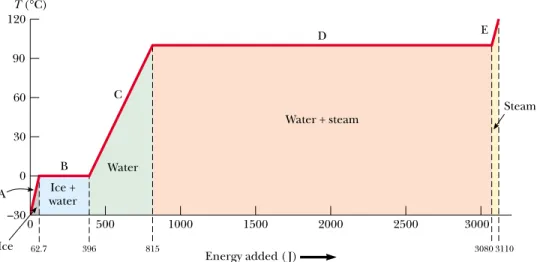
To understand the role of latent heat in phase changes, consider the energy required to convert a 1.00-g block of ice at ⫺30.0°C to steam at 120.0°C. Figure 20.2 indicates the experimental results obtained when energy is gradually added to the ice. Let us examine each portion of the red curve.
Part A. On this portion of the curve, the temperature of the ice changes from
⫺30.0°C to 0.0°C. Because the specific heat of ice is 2 090 J/kg⭈°C, we can calcu-late the amount of energy added by using Equation 20.4:
Part B. When the temperature of the ice reaches 0.0°C, the ice –water mixture remains at this temperature — even though energy is being added — until all the ice melts. The energy required to melt 1.00 g of ice at 0.0°C is, from Equation 20.6,
Thus, we have moved to the 396 J (⫽62.7 J⫹333 J) mark on the energy axis. Q⫽mLf⫽(1.00⫻10⫺3 kg)(3.33⫻105 J/kg)⫽333 J
Q⫽mici⌬T⫽(1.00⫻10⫺3 kg)(2 090 J/kg⭈⬚C)(30.0⬚C)⫽62.7 J
Quick Quiz 20.2
4When a gas cools, it eventually condenses— that is, it returns to the liquid phase. The energy given up
per unit mass is called the latent heat of condensationand is numerically equal to the latent heat of vapor-ization. Likewise, when a liquid cools, it eventually solidifies, and the latent heat of solidificationis numeri-cally equal to the latent heat of fusion.
120
90
60
30
0 T (°C)
B
Ice + water
Water
0 500 1000 1500 2000 2500 3000
3110 3080 815
396 62.7 Ice
Water + steam
E
Steam
A
D
–30
C
Energy added ( J)
Part C. Between 0.0°C and 100.0°C, nothing surprising happens. No phase change occurs, and so all energy added to the water is used to increase its temper-ature. The amount of energy necessary to increase the temperature from 0.0°C to 100.0°C is
Part D. At 100.0°C, another phase change occurs as the water changes from wa-ter at 100.0°C to steam at 100.0°C. Similar to the ice –wawa-ter mixture in part B, the water –steam mixture remains at 100.0°C — even though energy is being added — until all of the liquid has been converted to steam. The energy required to convert 1.00 g of water to steam at 100.0°C is
Part E. On this portion of the curve, as in parts A and C, no phase change oc-curs; thus, all energy added is used to increase the temperature of the steam. The energy that must be added to raise the temperature of the steam from 100.0°C to 120.0°C is
The total amount of energy that must be added to change 1 g of ice at ⫺30.0°C to steam at 120.0°C is the sum of the results from all five parts of the curve, which is 3.11⫻103J. Conversely, to cool 1 g of steam at 120.0°C to ice at ⫺30.0°C, we
must remove 3.11⫻103J of energy.
We can describe phase changes in terms of a rearrangement of molecules when energy is added to or removed from a substance. (For elemental substances in which the atoms do not combine to form molecules, the following discussion should be interpreted in terms of atoms. We use the general term moleculesto refer to both molecular substances and elemental substances.) Consider first the liquid-to-gas phase change. The molecules in a liquid are close together, and the forces between them are stronger than those between the more widely separated mole-cules of a gas. Therefore, work must be done on the liquid against these attractive molecular forces if the molecules are to separate. The latent heat of vaporization is the amount of energy per unit mass that must be added to the liquid to accom-plish this separation.
Similarly, for a solid, we imagine that the addition of energy causes the ampli-tude of vibration of the molecules about their equilibrium positions to become greater as the temperature increases. At the melting point of the solid, the ampli-tude is great enough to break the bonds between molecules and to allow mole-cules to move to new positions. The molemole-cules in the liquid also are bound to each other, but less strongly than those in the solid phase. The latent heat of fusion is equal to the energy required per unit mass to transform the bonds among all mol-ecules from the solid-type bond to the liquid-type bond.
As you can see from Table 20.2, the latent heat of vaporization for a given sub-stance is usually somewhat higher than the latent heat of fusion. This is not sur-prising if we consider that the average distance between molecules in the gas phase is much greater than that in either the liquid or the solid phase. In the solid-to-liquid phase change, we transform solid-type bonds between molecules into liquid-type bonds between molecules, which are only slightly less strong. In the liquid-to-gas phase change, however, we break liquid-type bonds and create a situation in which the molecules of the gas essentially are not bonded to each
Q⫽mscs⌬T⫽(1.00⫻10⫺3 kg)(2.01⫻103 J/kg⭈⬚C)(20.0⬚C)⫽40.2 J
Q⫽mLv⫽(1.00⫻10⫺3 kg)(2.26⫻106 J/kg)⫽2.26⫻103 J
20.3 Latent Heat 613
other. Therefore, it is not surprising that more energy is required to vaporize a given mass of substance than is required to melt it.
Calculate the slopes for the A, C, and E portions of Figure 20.2. Rank the slopes from least to greatest and explain what this ordering means.
Quick Quiz 20.3
Problem-Solving Hints
Calorimetry ProblemsIf you are having difficulty in solving calorimetry problems, be sure to con-sider the following points:
• Units of measure must be consistent. For instance, if you are using specific heats measured in cal/g⭈°C, be sure that masses are in grams and tempera-tures are in Celsius degrees.
• Transfers of energy are given by the equation only for those processes in which no phase changes occur. Use the equations and
only when phase changes aretaking place.
• Often, errors in sign are made when the equation is used. Make sure that you use the negative sign in the equation, and remember that ⌬Tis always the final temperature minus the initial temperature.
Qcold⫽ ⫺Qhot
Q⫽mLv
Q⫽mLf
Q⫽mc⌬T
Cooling the Steam
E
XAMPLE20.4
Adding the energy transfers in these three stages, we obtain
Now, we turn our attention to the temperature increase of the water and the glass. Using Equation 20.4, we find that
Using Equation 20.5, we can solve for the unknown mass:
1.09⫻10⫺2 kg⫽10.9 g ms⫽
⫽ ⫺[⫺ms(2.53⫻106 J/kg)]
2.77⫻104 J
Qcold⫽ ⫺Qhot
⫽2.77⫻104 J
⫹(0.100 kg)(837 J/kg⭈⬚C)(30.0⬚C)
Qcold⫽(0.200 kg)(4.19⫻103 J/kg⭈⬚C)(30.0⬚C)
⫽ ⫺ms(2.53⫻106 J/kg)
⫹2.09⫻105 J/kg)
⫽ ⫺ms(6.03⫻104 J/kg⫹2.26⫻106 J/kg
Qhot⫽Q1⫹Q2⫹Q3 What mass of steam initially at 130°C is needed to warm 200 g
of water in a 100-g glass container from 20.0°C to 50.0°C?
Solution
The steam loses energy in three stages. In the first stage, the steam is cooled to 100°C. The energy transfer in the process iswhere msis the unknown mass of the steam.
In the second stage, the steam is converted to water. To find the energy transfer during this phase change, we use where the negative sign indicates that energy is leaving the steam:
In the third stage, the temperature of the water created from the steam is reduced to 50.0°C. This change requires an energy transfer of
⫽ ⫺ms(2.09⫻105 J/kg)
Q3⫽mscw⌬T⫽ms(4.19⫻103 J/kg⭈⬚C)(⫺50.0⬚C)
Q2⫽ ⫺ms(2.26⫻106 J/kg)
Q⫽ ⫺mLv,
⫽ ⫺ms(6.03⫻104 J/kg)
WORK AND HEAT IN THERMODYNAMIC PROCESSES
In the macroscopic approach to thermodynamics, we describe the stateof a system using such variables as pressure, volume, temperature, and internal energy. The number of macroscopic variables needed to characterize a system depends on the nature of the system. For a homogeneous system, such as a gas containing only one type of molecule, usually only two variables are needed. However, it is impor-tant to note that a macroscopic stateof an isolated system can be specified only if the system is in thermal equilibrium internally. In the case of a gas in a container, in-ternal thermal equilibrium requires that every part of the gas be at the same pres-sure and temperature.
Consider a gas contained in a cylinder fitted with a movable piston (Fig. 20.3). At equilibrium, the gas occupies a volume V and exerts a uniform pressure P on the cylinder’s walls and on the piston. If the piston has a cross-sectional area A, the
20.4
Boiling Liquid Helium
E
XAMPLE20.5
of energy is
Exercise
If 10.0 W of power is supplied to 1.00 kg of water at 100°C, how long does it take for the water to completely boil away?Answer
62.8 h.35 min
t⫽ 2.09⫻10 4 J
10.0 J/s ⫽2.09⫻10 3 s⬇ Liquid helium has a very low boiling point, 4.2 K, and a very
low latent heat of vaporization, 2.09⫻104J/kg. If energy is transferred to a container of boiling liquid helium from an immersed electric heater at a rate of 10.0 W, how long does it take to boil away 1.00 kg of the liquid?
Solution
Because we must supply 2.09⫻104J of energy to boil away 1.00 kg. Because 10.0 W⫽ 10.0 J/s, 10.0 J of energy is transferred to the helium each second. Therefore, the time it takes to transfer 2.09⫻104JLv⫽2.09⫻104 J/kg,
10.6
P A
V
V + dV
dy
(b) (a)
20.4 Work and Heat in Thermodynamic Processes 615
force exerted by the gas on the piston is Now let us assume that the gas ex-pands quasi-statically,that is, slowly enough to allow the system to remain essen-tially in thermal equilibrium at all times. As the piston moves up a distance dy,the work done by the gas on the piston is
Because A dyis the increase in volume of the gas dV, we can express the work done by the gas as
(20.7)
Because the gas expands, dVis positive, and so the work done by the gas is positive. If the gas were compressed, dV would be negative, indicating that the work done by the gas (which can be interpreted as work done onthe gas) was negative.
In the thermodynamics problems that we shall solve, we shall identify the sys-tem of interest as a substance that is exchanging energy with the environment. In many problems, this will be a gas contained in a vessel; however, we will also con-sider problems involving liquids and solids. It is an unfortunate fact that, because of the separate historical development of thermodynamics and mechanics, positive work for a thermodynamic system is commonly defined as the work done by the system, rather than that done onthe system. This is the reverse of the case for our study of work in mechanics. Thus, in thermodynamics, positive work repre-sents a transfer of energy out of the system.We will use this convention to be consistent with common treatments of thermodynamics.
The total work done by the gas as its volume changes from Vito Vfis given by
the integral of Equation 20.7:
(20.8)
To evaluate this integral, it is not enough that we know only the initial and final values of the pressure. We must also know the pressure at every instant during the expansion; we would know this if we had a functional dependence of P with re-spect to V. This important point is true for any process — the expansion we are dis-cussing here, or any other. To fully specify a process, we must know the values of the thermodynamic variables at every state through which the system passes be-tween the initial and final states. In the expansion we are considering here, we can plot the pressure and volume at each instant to create a PV diagram like the one shown in Figure 20.4. The value of the integral in Equation 20.8 is the area bounded by such a curve. Thus, we can say that
W⫽
冕
Vf
Vi
PdV dW⫽PdV dW⫽Fdy⫽PAdy
F⫽PA.
i Pi
P
Work = Area under curve
f
V Vf
Vi
Pf
Figure 20.4 A gas expands quasi-statically (slowly) from state ito state f. The work done by the gas equals the area under the PV curve.
the work done by a gas in the expansion from an initial state to a final state is the area under the curve connecting the states in a PVdiagram.
As Figure 20.4 shows, the work done in the expansion from the initial state ito the final state f depends on the path taken between these two states, where the path on a PV diagram is a description of the thermodynamic process through which the system is taken. To illustrate this important point, consider several paths connecting iand f (Fig. 20.5). In the process depicted in Figure 20.5a, the pres-sure of the gas is first reduced from Pito Pfby cooling at constant volume Vi. The
gas then expands from Vito Vfat constant pressure Pf. The value of the work done
along this path is equal to the area of the shaded rectangle, which is equal to
In Figure 20.5b, the gas first expands from Vito Vfat constant pressure
Pi. Then, its pressure is reduced to Pfat constant volume Vf. The value of the work
done along this path is which is greater than that for the process de-scribed in Figure 20.5a. Finally, for the process dede-scribed in Figure 20.5c, where both Pand V change continuously, the work done has some value intermediate be-tween the values obtained in the first two processes. Therefore, we see that the work done by a system depends on the initial and final states and on the path followed by the system between these states.
The energy transfer by heat Q into or out of a system also depends on the process. Consider the situations depicted in Figure 20.6. In each case, the gas has the same initial volume, temperature, and pressure and is assumed to be ideal. In Figure 20.6a, the gas is thermally insulated from its surroundings except at the bot-tom of the gas-filled region, where it is in thermal contact with an energy reservoir. An energy reservoiris a source of energy that is considered to be so great that a finite transfer of energy from the reservoir does not change its temperature. The piston is held at its initial position by an external agent — a hand, for instance. When the force with which the piston is held is reduced slightly, the piston rises very slowly to its final position. Because the piston is moving upward, the gas is doing work on
Pi(Vf⫺Vi),
Pf(Vf⫺Vi).
Work done depends on the path between the initial and final states.
Figure 20.5 The work done by a gas as it is taken from an initial state to a final state depends on the path between these states.
i Pi
P
f
V Vf
Vi
Pf
(a)
i Pi
P
f
V Vf
Vi
Pf
(b)
i Pi
P
f
V Vf
Vi
Pf
(c)
Energy reservoir at Ti
Gas at Ti
(a)
Insulating wall
Final position
Initial position
Insulating wall
Gas at Ti
(b) Membrane
Vacuum
Figure 20.6 (a) A gas at temperature Tiexpands slowly while absorbing energy from a
20.5 The First Law of Thermodynamics 617
the piston. During this expansion to the final volume Vf, just enough energy is
trans-ferred by heat from the reservoir to the gas to maintain a constant temperature Ti.
Now consider the completely thermally insulated system shown in Figure 20.6b. When the membrane is broken, the gas expands rapidly into the vacuum until it occupies a volume Vfand is at a pressure Pf. In this case, the gas does no
work because there is no movable piston on which the gas applies a force. Further-more, no energy is transferred by heat through the insulating wall.
The initial and final states of the ideal gas in Figure 20.6a are identical to the initial and final states in Figure 20.6b, but the paths are different. In the first case, the gas does work on the piston, and energy is transferred slowly to the gas. In the second case, no energy is transferred, and the value of the work done is zero. Therefore, we conclude that energy transfer by heat, like work done, depends on the initial, final, and intermediate states of the system.In other words, be-cause heat and work depend on the path, neither quantity is determined solely by the end points of a thermodynamic process.
THE FIRST LAW OF THERMODYNAMICS
When we introduced the law of conservation of mechanical energy in Chapter 8, we stated that the mechanical energy of a system is constant in the absence of non-conservative forces such as friction. That is, we did not include changes in the inter-nal energy of the system in this mechanical model. The first law of thermodynamics is a generalization of the law of conservation of energy that encompasses changes in internal energy. It is a universally valid law that can be applied to many processes and provides a connection between the microscopic and macroscopic worlds.
We have discussed two ways in which energy can be transferred between a sys-tem and its surroundings. One is work done by the syssys-tem, which requires that there be a macroscopic displacement of the point of application of a force (or pressure). The other is heat, which occurs through random collisions between the molecules of the system. Both mechanisms result in a change in the internal energy of the sys-tem and therefore usually result in measurable changes in the macroscopic variables of the system, such as the pressure, temperature, and volume of a gas.
To better understand these ideas on a quantitative basis, suppose that a system undergoes a change from an initial state to a final state. During this change, en-ergy transfer by heat Qto the system occurs, and work W is done by the system. As an example, suppose that the system is a gas in which the pressure and volume change from Piand Vito Pfand Vf. If the quantity is measured for various
paths connecting the initial and final equilibrium states, we find that it is the same for all paths connecting the two states. We conclude that the quantity is de-termined completely by the initial and final states of the system, and we call this quantity the change in the internal energy of the system. Although Qand W both depend on the path, the quantity QⴚWis independent of the path.If we use the sumbol Eint to represent the internal energy, then the change in internal
energy ⌬Eintcan be expressed as5
(20.9)
⌬Eint⫽Q⫺W
Q⫺W Q⫺W
20.5
Q⫺Wis the change in internal energy
First-law equation
5It is an unfortunate accident of history that the traditional symbol for internal energy is U, which is
also the traditional symbol for potential energy, as introduced in Chapter 8. To avoid confusion be-tween potential energy and internal energy, we use the symbol Eintfor internal energy in this book. If
you take an advanced course in thermodynamics, however, be prepared to see Uused as the symbol for internal energy.
10.6
where all quantities must have the same units of measure for energy.6Equation 20.9
is known as thefirst-law equationand is a key concept in many applications. As a reminder, we use the convention that Qis positive when energy enters the system and negative when energy leaves the system, and that Wis positive when the system does work on the surroundings and negative when work is done on the system.
When a system undergoes an infinitesimal change in state in which a small amount of energy dQ is transferred by heat and a small amount of work dW is done, the internal energy changes by a small amount dEint. Thus, for infinitesimal
processes we can express the first-law equation as7
The first-law equation is an energy conservation equation specifying that the only type of energy that changes in the system is the internal energy Eint. Let us
look at some special cases in which this condition exists.
First, let us consider an isolated system— that is, one that does not interact with its surroundings. In this case, no energy transfer by heat takes place and the value of the work done by the system is zero; hence, the internal energy remains constant. That is, because it follows that and thus We conclude that the internal energy Eintof an isolated system
remains constant.
Next, we consider the case of a system (one not isolated from its surround-ings) that is taken through a cyclic process— that is, a process that starts and ends at the same state. In this case, the change in the internal energy must again be zero, and therefore the energy Qadded to the system must equal the work W done by the system during the cycle. That is, in a cyclic process,
On a PVdiagram, a cyclic process appears as a closed curve. (The processes de-scribed in Figure 20.5 are represented by open curves because the initial and final states differ.) It can be shown that in a cyclic process, the net work done by the system per cycle equals the area enclosed by the path representing the process on a PVdiagram.
If the value of the work done by the system during some process is zero, then the change in internal energy ⌬Eintequals the energy transfer Qinto or out of the
system:
If energy enters the system, then Qis positive and the internal energy increases. For a gas, we can associate this increase in internal energy with an increase in the kinetic energy of the molecules. Conversely, if no energy transfer occurs during some process but work is done by the system, then the change in internal energy equals the negative value of the work done by the system:
⌬Eint⫽ ⫺W
⌬Eint⫽Q
⌬Eint⫽0
and
Q⫽W
Eint, i⫽Eint, f.
⌬Eint⫽0,
Q⫽W⫽0, dEint⫽dQ⫺dW
First-law equation for infinitesimal changes
Isolated system
Cyclic process
6For the definition of work from our mechanics studies, the first law would be written as
because energy transfer into the system by either work or heat would increase the inter-nal energy of the system. Because of the reversal of the definition of positive work discussed in Section 20.4, the first law appears as in Equation 20.9, with a minus sign.
7Note that dQand dWare not true differential quantities; however, dE
intis. Because dQand dWare
in-exact differentials,they are often represented by the symbols and . For further details on this point, see an advanced text on thermodynamics, such as R. P. Bauman, Modern Thermodynamics and Sta-tistical Mechanics,New York, Macmillan Publishing Co., 1992.
d W dQ
20.6 Some Applications of the First Law of Thermodynamics 619
For example, if a gas is compressed by a moving piston in an insulated cylinder, no energy is transferred by heat and the work done by the gas is negative; thus, the in-ternal energy increases because kinetic energy is transferred from the moving pis-ton to the gas molecules.
On a microscopic scale, no distinction exists between the result of heat and that of work. Both heat and work can produce a change in the internal energy of a system. Although the macroscopic quantities Qand Ware notproperties of a sys-tem, they are related to the change of the internal energy of a system through the first-law equation. Once we define a process, or path, we can either calculate or measure Qand W,and we can find the change in the system’s internal energy us-ing the first-law equation.
One of the important consequences of the first law of thermodynamics is that there exists a quantity known as internal energy whose value is determined by the state of the system. The internal energy function is therefore called a state function.
SOME APPLICATIONS OF THE FIRST LAW
OF THERMODYNAMICS
Before we apply the first law of thermodynamics to specific systems, it is useful for us to first define some common thermodynamic processes. An adiabatic process
is one during which no energy enters or leaves the system by heat — that is, An adiabatic process can be achieved either by thermally insulating the system from its surroundings (as shown in Fig. 20.6b) or by performing the process rapidly, so that there is little time for energy to transfer by heat. Applying the first law of thermodynamics to an adiabatic process, we see that
(20.10)
From this result, we see that if a gas expands adiabatically such that Wis positive, then ⌬Eint is negative and the temperature of the gas decreases. Conversely, the
temperature of a gas increases when the gas is compressed adiabatically.
Adiabatic processes are very important in engineering practice. Some com-mon examples are the expansion of hot gases in an internal combustion engine, the liquefaction of gases in a cooling system, and the compression stroke in a diesel engine.
The process described in Figure 20.6b, called an adiabatic free expansion,is unique. The process is adiabatic because it takes place in an insulated container. Because the gas expands into a vacuum, it does not apply a force on a piston as was depicted in Figure 20.6a, so no work is done on or by the gas. Thus, in this adi-abatic process, both and As a result, for this process, as we can see from the first law. That is, the initial and final internal energies of a gas are equal in an adiabatic free expansion.As we shall see in the next chap-ter, the internal energy of an ideal gas depends only on its temperature. Thus, we expect no change in temperature during an adiabatic free expansion. This predic-tion is in accord with the results of experiments performed at low pressures. (Ex-periments performed at high pressures for real gases show a slight decrease or in-crease in temperature after the expansion. This change is due to intermolecular interactions, which represent a deviation from the model of an ideal gas.)
A process that occurs at constant pressure is called an isobaric process. In such a process, the values of the heat and the work are both usually nonzero. The
⌬Eint⫽0
W⫽0. Q⫽0
⌬Eint⫽ ⫺W
(adiabatic process)
Q⫽0.
20.6
In an adiabatic process, Q⫽0.
First-law equation for an adiabatic process
In an adiabatic free expansion,
⌬Eint⫽0.
work done by the gas is simply
(20.11)
where P is the constant pressure.
A process that takes place at constant volume is called an isovolumetric process.In such a process, the value of the work done is clearly zero because the volume does not change. Hence, from the first law we see that in an isovolumetric process, because
(20.12)
This expression specifies that if energy is added by heat to a system kept at constant volume, then all of the transferred energy remains in the system as an increase of the internal energy of the system.For example, when a can of spray paint is thrown into a fire, energy enters the system (the gas in the can) by heat through the metal walls of the can. Consequently, the temperature, and thus the pressure, in the can increases until the can possibly explodes.
A process that occurs at constant temperature is called an isothermal process.A plot of Pversus Vat constant temperature for an ideal gas yields a hy-perbolic curve called an isotherm.The internal energy of an ideal gas is a function of temperature only. Hence, in an isothermal process involving an ideal gas, For an isothermal process, then, we conclude from the first law that the energy transfer Qmust be equal to the work done by the gas — that is, Any energy that enters the system by heat is transferred out of the system by work; as a result, no change of the internal energy of the system occurs.
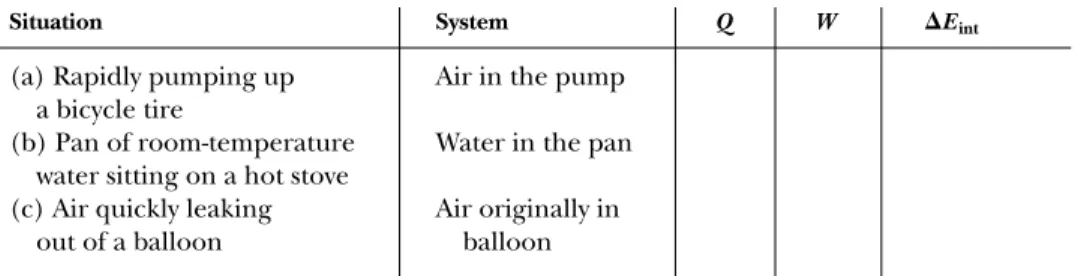
In the last three columns of the following table, fill in the boxes with ⫺, ⫹, or 0. For each situation, the system to be considered is identified.
Quick Quiz 20.4
Q⫽W.
⌬Eint⫽0.
⌬Eint⫽Q
(isovolumetric process)
W⫽0,
W⫽P(Vf⫺Vi)
(isobaric process)
In an isothermal process, T remains constant.
First-law equation for a constant-volume process
f i
V PV = constant Isotherm P
Pi
Pf
Vi Vf
Situation System Q W ⌬Eint
(a) Rapidly pumping up Air in the pump a bicycle tire
(b) Pan of room-temperature Water in the pan water sitting on a hot stove
(c) Air quickly leaking Air originally in out of a balloon balloon
Figure 20.7 The PVdiagram for an isothermal expansion of an ideal gas from an initial state to a fi-nal state. The curve is a hyperbola.
Isothermal Expansion of an Ideal Gas
Suppose that an ideal gas is allowed to expand quasi-statically at constant tempera-ture, as described by the PVdiagram shown in Figure 20.7. The curve is a hyper-bola (see Appendix B, Eq. B.23), and the equation of state of an ideal gas with T constant indicates that the equation of this curve is PV⫽constant. The isothermal expansion of the gas can be achieved by placing the gas in thermal contact with an energy reservoir at the same temperature, as shown in Figure 20.6a.
20.6 Some Applications of the First Law of Thermodynamics 621
An Isothermal Expansion
E
XAMPLE20.6
(b) How much energy transfer by heat occurs with the sur-roundings in this process?
2.7⫻103 J
⫽
W⫽(1.0 mol)(8.31 J/mol⭈K)(273 K) ln
冢
10.0 3.0冣
A 1.0-mol sample of an ideal gas is kept at 0.0°C during anex-pansion from 3.0 L to 10.0 L. (a) How much work is done by the gas during the expansion?
Solution
Substituting the values into Equation 20.13, we haveW⫽nRT ln
冢
VfVi
冣
Work done by an ideal gas in an isothermal process
the path. Therefore, we have
Because Tis constant in this case, it can be removed from the integral along with nand R:
To evaluate the integral, we used Evaluating this at the initial and final volumes, we have
(20.13)
Numerically, this work Wequals the shaded area under the PVcurve shown in Fig-ure 20.7. Because the gas expands, and the value for the work done by the gas is positive, as we expect. If the gas is compressed, then and the work done by the gas is negative.
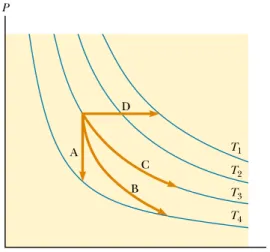
Characterize the paths in Figure 20.8 as isobaric, isovolumetric, isothermal, or adiabatic. Note that Q⫽0for path B.
Quick Quiz 20.5
Vf⬍Vi,
Vf⬎Vi,
W⫽nRT ln
冢
Vf Vi冣
冕(dx/x)⫽lnx. W⫽nRT
冕
Vf
Vi
dV
V ⫽nRT ln V
兩
Vf
Vi
W⫽
冕
Vf
Vi
PdV⫽
冕
Vf
Vi
nRT V dV
A
B C D
V P
T1
T3 T2
T4
Boiling Water
E
XAMPLE20.7
To determine the change in internal energy, we must know the energy transfer Q needed to vaporize the water. Using Equation 20.6 and the latent heat of vaporization for water, we have
Hence, from the first law, the change in internal energy is
The positive value for ⌬Eintindicates that the internal energy of the system increases. We see that most (2 090 J/2 260 J⫽ 93%) of the energy transferred to the liquid goes into increasing the internal energy of the system. Only 169 J/2 260 J⫽7% leaves the system by work done by the steam on the surrounding atmosphere.
2.09 kJ
⌬Eint⫽Q⫺W⫽2 260 J⫺169 J⫽
Q⫽mLv⫽(1.00⫻10⫺3 kg)(2.26⫻106 J/kg)⫽2 260 J
Suppose 1.00 g of water vaporizes isobarically at atmospheric pressure (1.013⫻105Pa). Its volume in the liquid state is cm3, and its volume in the vapor state is cm3. Find the work done in the expansion and the change in internal energy of the system. Ignore any mixing of the steam and the surrounding air — imagine that the steam simply pushes the surrounding air out of the way.
Solution
Because the expansion takes place at constant pressure, the work done by the system in pushing away the surrounding air is, from Equation 20.11,169 J
⫽
⫽(1.013⫻105 Pa)(1 671⫻10⫺6 m3⫺1.00⫻10⫺6 m3) W⫽P(Vf⫺Vi)
Vf⫽Vvapor⫽1 671 Vi⫽Vliquid⫽1.00
Solution
From the first law, we find that(c) If the gas is returned to the original volume by means of an isobaric process, how much work is done by the gas?
Solution
The work done in an isobaric process is given by Equation 20.11. We are not given the pressure, so we need to incorporate the ideal gas law:2.7⫻103 J Q⫽W⫽
0⫽Q⫺W
⌬Eint⫽Q⫺W
Notice that we use the initial temperature and volume to de-termine the value of the constant pressure because we do not know the final temperature. The work done by the gas is neg-ative because the gas is being compressed.
⫺1.6⫻103 J
⫽
⫻(3.0⫻10⫺3m3⫺10.0⫻10⫺3m3)
⫽ (1.0 mol)(8.31 J/mol⭈K)(273 K)
10.0⫻10⫺3 m3
W⫽P(Vf⫺Vi)⫽
nRTi
Vi
(Vf⫺Vi)
Heating a Solid
E
XAMPLE20.8
The work done is
(b) What quantity of energy is transferred to the copper by heat?
Solution
Taking the specific heat of copper from Table 20.1 and using Equation 20.4, we find that the energy trans-ferred by heat is1.7⫻10⫺2 J
⫽
W⫽P⌬V⫽(1.013⫻105 N/m2)(1.7⫻10⫺7 m3)
⌬V⫽(1.5⫻10⫺3)
冢
1.0 kg8.92⫻103 kg/m3
冣
⫽1.7⫻10 ⫺7 m3 A 1.0-kg bar of copper is heated at atmospheric pressure. Ifits temperature increases from 20°C to 50°C, (a) what is the work done by the copper on the surrounding atmosphere?
Solution
Because the process is isobaric, we can find the work done by the copper using Equation 20.11, We can calculate the change in volume of the copper using Equation 19.6. Using the average linear ex-pansion coefficient for copper given in Table 19.2, and re-membering that  ⫽3␣, we obtainThe volume Viis equal to m/, and Table 15.1 indicates that
the density of copper is 8.92⫻103kg/m3. Hence,
⫽[5.1⫻10⫺5(⬚C)⫺1](50⬚C⫺20⬚C)V
i⫽1.5⫻10⫺3Vi
⌬V⫽Vi⌬T
20.7 Energy Transfer Mechanisms 623
ENERGY TRANSFER MECHANISMS
It is important to understand the rate at which energy is transferred between a sys-tem and its surroundings and the mechanisms responsible for the transfer. There-fore, let us now look at three common energy transfer mechanisms that can result in a change in internal energy of a system.
Thermal Conduction
The energy transfer process that is most clearly associated with a temperature dif-ference is thermal conduction. In this process, the transfer can be represented on an atomic scale as an exchange of kinetic energy between microscopic parti-cles — molecules, atoms, and electrons — in which less energetic partiparti-cles gain en-ergy in collisions with more energetic particles. For example, if you hold one end of a long metal bar and insert the other end into a flame, you will find that the temperature of the metal in your hand soon increases. The energy reaches your hand by means of conduction. We can understand the process of conduction by examining what is happening to the microscopic particles in the metal. Initially, before the rod is inserted into the flame, the microscopic particles are vibrating about their equilibrium positions. As the flame heats the rod, those particles near the flame begin to vibrate with greater and greater amplitudes. These particles, in turn, collide with their neighbors and transfer some of their energy in the colli-sions. Slowly, the amplitudes of vibration of metal atoms and electrons farther and farther from the flame increase until, eventually, those in the metal near your hand are affected. This increased vibration represents an increase in the tempera-ture of the metal and of your potentially burned hand.
The rate of thermal conduction depends on the properties of the substance being heated. For example, it is possible to hold a piece of asbestos in a flame in-definitely. This implies that very little energy is conducted through the asbestos. In general, metals are good thermal conductors, and materials such as asbestos, cork, paper, and fiberglass are poor conductors. Gases also are poor conductors because the separation distance between the particles is so great. Metals are good thermal conductors because they contain large numbers of electrons that are relatively free to move through the metal and so can transport energy over large distances. Thus, in a good conductor, such as copper, conduction takes place both by means of the vibration of atoms and by means of the motion of free electrons.
Conduction occurs only if there is a difference in temperature between two parts of the conducting medium. Consider a slab of material of thickness ⌬xand cross-sectional area A. One face of the slab is at a temperature T1, and the other
face is at a temperature T2⬎T1(Fig. 20.9). Experimentally, it is found that the
20.7
(c) What is the increase in internal energy of the copper?
Solution
From the first law of thermodynamics, we have1.2⫻104 J
⌬Eint⫽Q⫺W⫽1.2⫻104 J⫺1.7⫻10⫺2 J⫽
1.2⫻104 J
Q⫽mc⌬T⫽(1.0 kg)(387 J/kg⭈⬚C)(30⬚C)⫽ Note that almost all of the energy transferred into the systemby heat goes into increasing the internal energy. The fraction of energy used to do work on the surrounding atmosphere is only about 10⫺6! Hence, when analyzing the thermal expan-sion of a solid or a liquid, the small amount of work done by the system is usually ignored.