Informing Game Sense Pedagogy with a Constraints-Led
Perspective for Teaching Tennis in Schools
Impregnando la pedagogía centrada en el juego con
una perspectiva «Constraint-Led»
1para la enseñanza
del tenis en las escuelas
MITCHELL HEWITT
University of Southern Queensland
Education Project Manager, Tennis Australia, Melbourne, Victoria. Australia [email protected]
SHANE PILL
School of Education, Flinders University, South Australia GPO Box 2100, Adelaide, SA, 5001. Australia.
ORCID: https://orcid.org/0000-0003-3970-6724
REBECCA MCDONALD
Head of Schools, Tennis Australia, Melbourne, Victoria. Australia [email protected]
Recibido / Received: 29/06/17. Aceptado / Accepted: 25/10/17
Cómo citar / Citation: Hewitt, M., Pill, S., & McDonald, R. (2018). Informing Game Sense Pedagogy with a Constraints-Led Perspective for Teaching Tennis in Schools. Ágora para la Educación Física y el Deporte, 20(1), 46-67.
DOI: https://doi.org/10.24197/aefd.1.2018.46-67
Abstract. The Game Sense approach (GSA) helps sport teachers adopt a pedagogical toolkit for the complex interplay of collective decision making in tennis that evolves from the dynamics of momentary configurations of play meeting the personal coordination dynamics of the players. This pedagogical toolkit emphasises game-based play to teach players how to perceive the game as “thinking players” capable of functional behaviours that answer the requirements of momentary configurations of play. This paper, therefore, builds on recent theoretical debate in the areas of skill
1 La expresión Constraint-Led ha sido traducida en algunos lugares como teoría de los
acquisition, the complementarity of perception-decision making and personal coordination dynamics (techniques), complex learning theory and coaching pedagogy, to connect the constraints-perspective of skill acquisition and the pedagogy of the Game Sense approach to enable theoretically informed tennis teaching. Practical implications of game-based training will be explained using the example of the Tennis for Primary Schools program alignment with the developmental stages of the Australian Curriculum for Health and Physical Education (ACHPE), which are described as student achievement standards in this curriculum.
Keywords: Tennis; games; game sense; sport; teaching; coaching.
Resumen. El enfoque centrado en el sentido del juego (GSA) proporciona a los profesores deportivos un conjunto de herramientas pedagógicas para el abordaje de las complejas interacciones que tienen lugar en la toma colectiva de decisiones en el tenis, que evoluciona a partir de la confluencia dinámica entre las configuraciones momentáneas del juego y la coordinación entre los jugadores. Estas herramientas pedagógicas destacan la comprensión del juego a fin de enseñar a los deportistas a percibirlo como “jugadores pensantes”, capaces de comportamientos funcionales que respondan a los requisitos de las configuraciones momentáneas del juego. Este artículo se basa en los recientes debates teóricos en las áreas que estudian la adquisición de habilidades; la complementariedad entre los procesos de percepción, la toma de decisiones y las dinámicas de coordinación personal; la compleja teoría del aprendizaje y la pedagogía del entrenamiento; todo ello para conectar la perspectiva de los “limitadores” (contraints, ver nota 1) y la pedagogía del enfoque centrado en el sentido del juego, para lograr una enseñanza del tenis fundamentada teóricamente. Las implicaciones prácticas del entrenamiento basado en el sentido del juego se explicarán sirviéndonos del ejemplo de un programa de Tenis para la Escuelas Primaria, el cual está en línea con las etapas del desarrollo del Currículo Australiano de Educación Física y Salud (ACHPE), descritas en el mismo como estándares de logro para los estudiantes.
Palabras clave. Tenis; juegos; sentido del juego; deporte; enseñanza; entrenamiento.
INTRODUCTION
Internationally, the instructional practice of tennis teaching/coaching2 has typically been defined by directive instruction of technical models of stroke mechanics developed separate from the game and before tactical aspects of the game are introduced (Crespo, Reid & Miley, 2004; Pill & Hewitt, 2017). There is some evidence that community tennis coaching retains an emphasis on directive instruction and replicative practice, sometimes metaphorically referred to as ‘skill and drill’ (Hewitt, Edwards & Pill, 2016; Hewitt, Edwards, Ashworth & Pill, 2016).
Much has been written about the various instructional practices and behaviours available for teachers to employ during coaching sessions (Lyle
2
& Cushion, 2010). The instructional practices of tennis coaching has traditionally been characterised by high levels of explicit verbal instruction with a particular emphasis on developing technique in isolation and prior to the tactical aspects of the game (Crespo, Reid & Miley, 2004). Under these conditions, tennis coaches have been responsible for the unidirectional transmission of information to players who have primarily adopted a passive role in the process of learning (Jones, 2006). The coach usually explains, demonstrates, organises and conducts the session, in addition to providing explicit feedback in order to correct players’ errors (Crespo & Reid, 2009). This coaching style (the coach tells and the players do) has customarily been accompanied by a rigid session structure comprising of a warm-up, followed by a sequence of drills that practice technique in isolation followed by the implementation of the actual game (Werner, Thorpe & Bunker, 1996; Hopper & Bell, 2001).
In 2012, Tennis Australia (TA) launched a major advance in the conceptualisation of junior tennis teaching and coaching in Australian schools and community coaching settings with the release of the Tennis for Primary Schools program (Emmel, Baldock, & Pill, 2012). The Tennis for Primary Schools program explained a game-based approach for tennis incorporating the pedagogical tenets of GSA (Hewitt & Pill, 2017).
This paper builds on recent theoretical debate in the areas of skill acquisition, the complementarity of perception-decision making and personal coordination dynamics (techniques), complex learning theory and coaching pedagogy, to connect the constraints-perspective on skill acquisition and the pedagogy of the GSA to enable theoretically informed tennis teaching. Practical implications of game-based teaching will be explained using the example of the Tennis for Primary Schools program. Alignment with the developmental stages of the Australian Curriculum for Health and Physical Education (ACHPE), which are described as student achievement standards in this curriculum, are explained in this strengths-based, educative foregrounding of tennis teaching.
The pedagogical elements of the Game Sense approach
the engagement of students in secondary physical education (Bunker & Thorpe, 1982). Unlike traditional pedagogical framing of sport teaching as a technical-to-tactical progression, and the 6-step TGfU model describing a tactical-to-technical progression (Bunker & Thorpe, 1982), the GSA highlights the complementarity of tactical and technical components of skilled performance at all levels of game development (den Duyn, 1997; Pill, 2007). The formative GSA equation consists of - technique + game context = skill (‘game context’ refers to elements such as pressure, decision-making, timing, use of space and risk) (den Duyn, 1997).
The GSA has been described as both game-based and player-centred (Pill, 2011). It is described as a game-based approach as it emphasises beginning teaching episodes with a game or game-form to contextualise the technical and tactical learning intention, or to allow for the emergence of understanding of a technical and/or tactical intention (ASC, 1996). The approach is considered player or ‘athlete-centred’ as it promotes the adoption of a teaching ‘style’ whereby the sport teacher supports player autonomy through preferential use of teaching strategies intended to enhance each player’s decision-making ability during game play (Desouza & Oslin, 2008). The GSA is, therefore, identified by its priority on developing ‘thinking players’ (den Duyn, 1997) in contrast to the more historical common teaching approach focussed on replication of stipulated movement responses called techniques. The teaching style is inquiry oriented rather than directive (Light, 2013). The prominence on the sport teacher’s use of well-considered questions to create reflective moments, a debate of ideas, and the guided discovery of tactical and technical concepts distinguishes the GSA from the more historically common ‘sport as sport techniques’ (Kirk, 2010). Purposeful questions designed to promote problem-solving presents as a key tenet of the GSA (den Duyn, 1997).
The GSA is operationally defined by the following concepts:
1. The game is the focus of practice, whereby players are challenged to think about ‘what’ they are doing and ‘why’ they are doing it via primarily games selected to purposefully achieve this objective;
2. The sport teacher’s role is to act more as a facilitator setting challenges and guiding player problem solving for player learning by self-discovery;
3. A pedagogical emphasis on questioning in preference to directing and ‘telling’ players what to do; and
4. The pedagogical use of the manipulation of environment, player and task constraints to modify games to purposefully achieve the objective of learning ‘what’ to do and ‘why’ to do it as complementary game dimensions interwoven into the development of skillful ‘thinking’ players (ASC, 1996; 1999; den Duyn, 1997; Schembri, 2005; Pill, 2007).
1.GAME-BASED APPROACHES AND TEACHING TENNIS
or stage of learning. This is not accomplished within a one-size-fits-all sport as sport techniques’ teaching approach (Kirk, 2010).
TA’s, recognising the need for teachers of tennis to employ teaching styles that adequately developed the perception-decision making ability of competent players (Pill & Hewitt, 2017), adopted a game-based approach that shares complementary features with the GSA. The provision of tennis coach education has emphasised the approach and its embrace of increased player involvement in the learning process in formal coach accreditation literature (Hewitt, 2015). As early as 1996, the Australian Tennis Coaches Conference featured discussion on the GSA (Hewitt, 2015). The content of coach education guides and manuals have for some time emphasised a game-based approach (Tennis Australia, 2010a, 2010b).
This move in coach education in Australia via the GSA is mirrored in the global direction in tennis away from a coaching focus on directive instruction of a ‘technical stroke model’ encouraging players to copy idealised stroke mechanics towards a game-orientated approach in coach education provided by coaching associations (Crespo, 1999; Holt, Strean & Bengoecha, 2002). This pedagogical direction has been described as a ‘discovery’ approach where technique teaching is placed within the context of a game and player understanding is guided to ‘discovery’ by the player through the teacher’s use of inquiry processes, such as questioning strategies (Crespo & Reid, 2009; Hewitt & Pill, 2017). The preferred way of teaching novice and beginner players now has an emphasis on ‘match play’ and the incorporation of isolated technique work is kept to timely teaching episodes (teachable moments) with players of this standard (Tennis Australia, 2010a).
Aligning the Tennis Primary Schools program with the curriculum frameworks
technical motor skills and tactical decision-making skills of tennis as complementary pairs.
2.DISCUSSION
Game Modification
A central pedagogical element of the GSA incorporated into the Tennis for Primary Schools program is game modification (ASC, 1996). Modifying games permits sport teachers to highlight certain features of play, while retaining the essential elements of the game. The CHANGE IT formula (Schembri, 2005) (Figure 1) serves to assist sport teachers in understanding how task, performer and environment constraints (Pill & Hewitt, 2017) structure the modification of games by “eliminating, refining, or adding to game rules and playing conditions (such as field size) to focus attention on specific tactical or technical game understanding” (Pill, 2013, p. 9).
Figure 1. The CHANGE IT formula (Schembri, 2005)
A constraints-led perspective and game modification
constraints-led game development deliberately places the player as a problem solver (Coker, 2010; Pill, 2013). As the constraints change (i.e., physical, environmental and task) so do the solutions for various moments in the game (Breed & Spittle, 2011; Davids, 2010; Pill, 2014). In this way, tennis teachers have the opportunity to modify and adapt the structure of games to foster, exaggerate or change player actions to develop responsive movements (Pill & Hewitt, 2017). A constraints-led perspective can therefore be seen to provide a theoretical basis for the pedagogy of game modification to teach principles of play in game-based approaches like the GSA (Breed & Spittle, 2011; Chow et al., 2007; Pill, 2013). In summary, one of the pedagogical tenets of the GSA is game modification by exaggeration, elimination or simplification (ASC, 1996) which can be explained by a constraints-led perspective (Breed & Spittle, 2011; Chow et al., 2007; Pill, 2013). This directs teachers of tennis to:
1. Modify the structure of games, including game rules and playing area in an attempt to exaggerate, eliminate, or enhance player movement during game play; and
2. Apply modified activities that maintains the central tactical features of the game that appeals to the developmental readiness and individual needs of the player.
The deliberate modification of task and environmental constraints to meet the learning needs of players at different stages of game development is an inherent feature of the program. The activities provide teachers of tennis with the pedagogical indicators to modify the game, such as adapting the playing area (e.g., making the court smaller or larger), changing the equipment (e.g., using a variety of sized balls with varying compression levels and different size racquets) and changing the rules (e.g., permitting the ball to bounce twice).
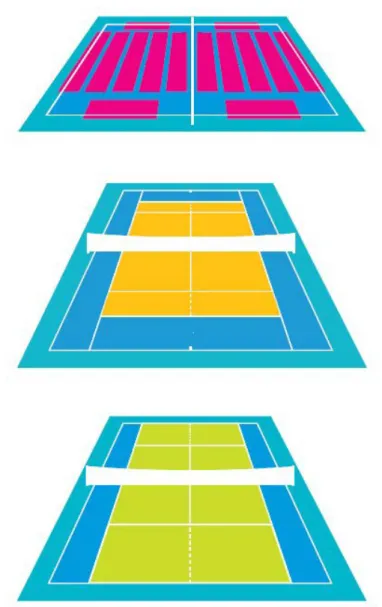
In the next section of the paper, we provide practical examples of the pedagogy of game modification, informed by a constraints-led perspective, as a guide for teachers of tennis wishing to employ a GSA. An example modification of the environment constraint (playing area) is illustrated by the different size playing areas, shown in Figure 2.
coordination and control of fundamental movement skills related to the serve be in the form of an underarm or overarm throw, or a bounce and hit forehand for those with competency in striking, to commence the rally. These serve adaptations not only promote the crucial feature of a strengths-based physical education (ACARA, 2017) –inclusive participation– but in the case of a throw, permit the player to also focus attention on the tactical aspects of the game as a technical aspect has been eliminated.
Curriculum framework alignment
The ACHPE (ACARA, 2017) Movement and Participation strand progresses a coherent complexity from fundamental movement skill development to the performance of specialised movement skills and sequences (such as those of sports) to achieve movement outcomes and to solve movement challenges by the end of the primary years (Foundation – Year 6). The following two examples illustrates the GSA pedagogy of game modification of tennis to assist teachers addressing the movement skill learning of the ACHPE achievement standard expectation of the Foundation to Year 2 using a tennis theme.
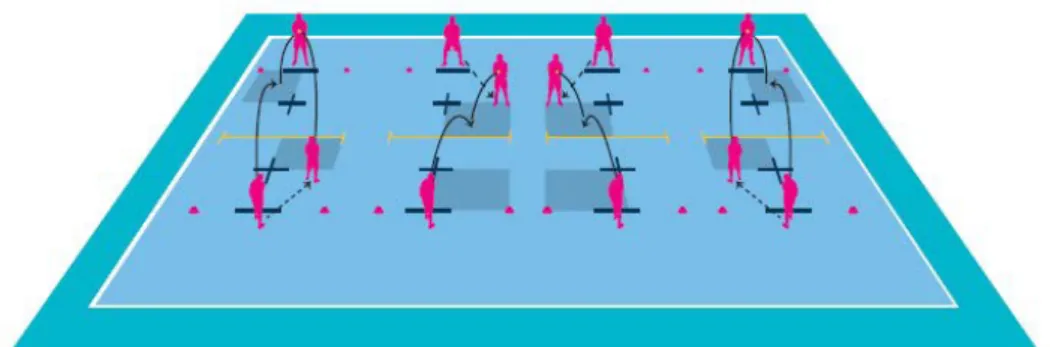
Game 1: Feed the Crocodiles (Figure 3) is an activity that addresses aspects of the ACHPE Foundation Year Achievement Standard – They (students) perform fundamental movement skills and solve movement challenges. This game is designed to develop consistency and accuracy while projecting and receiving an object with a partner. The central feature of the game of tennis – the rally (projection and reception of a ball) are represented. In this game, modifications are employed to make it easier for players to achieve success. For instance, the play space is reduced so players are not required to project the ball over a large distance and players use their hands (instead of rackets) to roll the ball along the ground. These modifications represent task and environment constraints changed to reduce the complexity of the game while maintaining the representation of the rally (projection and reception) in the game.
Instructions
• Students form pairs and are positioned opposite each other approximately two metres apart.
• Each pair is to have one tennis ball.
• Drop down lines are positioned to indicate the starting position for each student.
• Each time the ball is successfully rolled into the crocodiles mouth the pair scores one point.
• The teacher indicates an appropriate amount of time or a number of points the pairs are to achieve.
Variations
• Increase or decrease the distance between the cones (crocodiles mouth).
• Increase or decrease the distance that students are required to project the ball.
Figure 3. The Purple Stage (Foundation Year) activity of Feed the Crocodiles from the Tennis for Primary Schools resource
the playing area are ‘blacked out’ to encourage players to explore solutions to achieve accuracy to different parts of the playing space. Players use hands to project and receive the ball in the air to reduce the complexity of the game.
Instructions
• Students form pairs and define a playing area with soft cones, a net (line on the ground) and drop down lines to divide their half into four (the playing area should look like a four square court on each side).
• Students are positioned opposite each other approximately four metres apart inside the playing area.
• Drop down lines are positioned to indicate all starting positions of students.
• Student 1 commences the rally by projecting the ball with an underarm throwing action aiming to land the ball over the net and in one of students 2’s four squares.
• If student 1 lands the ball in one of the squares, the square is ‘blacked-out’ and three squares remain.
• Student 2 tracks the movement of the ball allowing it to bounce once before catching with two hands.
• Student 2 continues the rally by projecting the ball with an underarm throwing action aiming to land the ball over the net and in one of students 1’s four squares.
• If student 2 lands the ball in one of the squares, the square is ‘blacked’ out and three squares remain.
• Students continue the rally aiming to ‘black-out’ all squares on their partners side before any other team.
• The teacher indicates an appropriate amount of time or squares the pairs are to achieve.
Variations
Figure 4. Blackout
The following two examples illustrates the GSA pedagogy of game modification of tennis to assist teachers addressing the movement skill learning of the ACHPE achievement standard expectation of the Year 3-4 and 5-6 using a tennis theme.
Game 3: Deep Trouble (Figure 5) is an activity that addresses aspects of the ACHPE Years 3 and 4 achievement standards – They (students) refine fundamental movement skills and apply movement concepts and strategies in a variety of physical activities and to solve movement challenges. This game is designed to develop and understand depth and for players to use the length of the court during play. In this game, a task constraint is employed that consists of manipulating the playing area to achieve a tactical outcome. Drop down lines are positioned approximately three meters back from the net on each side, and players only score a point when they successfully place the ball in this part of the playing space. In this way, the players are encouraged to use the length of the court.
Instructions
• Students form pairs and are positioned opposite each other on either side of a net approximately eight metres apart with one tennis ball, two racquets, one peg and six drop down lines.
• Student 1 commences the rally by projecting the ball with a overarm serving action over the net, aiming to land the ball deep in the back quarter of student 2’s court.
• Student 2 tracks the movement of the ball, allowing it to bounce once before trapping the ball with their racquet.
• Students score one point each time the serve is made deep and one point for the trap.
• Students run to the net to move their peg up the rungs of the ladder (bottom of the net to the top of the net) trying to get to the top before the other pairs.
• Students alternate serving after each point.
• The teacher indicates an appropriate amount of time or a number of points the students are to achieve.
Variations
• Increase or decrease the depth of the court (1/2 court instead of 3/4 court).
• Serve and trap is played out with a rally.
Figure 5. Deep Trouble
game. This indirect teaching style of asking questions in preference to directing players’ behaviour is promoted as encouraging players to learn how to search and select information from the game environment, and to solve problems and explore solutions to various movement challenges (Breed & Spittle, 2011; Light, 2013; Pill, 2014).
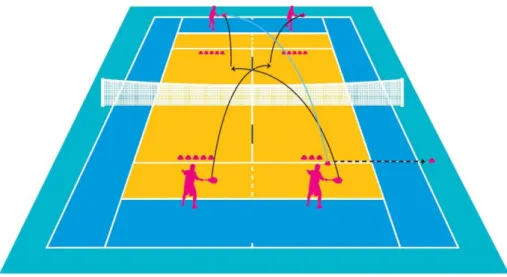
Game 4: Jackpot (Figure 6) is an activity that addresses aspects of the ACHPE Years 5 and 6 achievement standards – They (the students) perform specialised movement skills and sequences and propose and combine movement concepts and strategies to achieve movement outcomes and solve movement challenges. The game is designed to apply forehand and backhand groundstrokes in a cross-court direction. Similar to the game of Deep Trouble (Figure 5), a task constraint is employed that consists of manipulating the playing area to achieve a tactical solution. In this case, the players are encouraged to use the angles and width of the court. Permitting players to replace rackets with hands reduces the complexity of the game while maintaining the central feature of the game of tennis – the rally (projection and reception).
Instructions
• Students form pairs and are positioned cross court from each other in an orange playing area with one tennis ball, two racquets, two drop down lines and 10 cones/markers.
• Drop down lines are positioned in the middle on either side of the net, diving the court into a forehand and backhand side.
• Students place their cones (five cones) at the backhand service line in the same half of their court.
• Student 1 commences the rally by projecting the ball with a drop and hit serving action cross court, aiming to land the ball as close to the cones of student 2.
• Student 2 tracks the movement of the ball, allowing it to bounce once before returning the ball with a backhand, aiming to land the return as close to the cones of student 1.
• The rally continues with students aiming to remove all cones from their partner and score the jackpot.
• Students alternate the server after each point.
• The teacher indicates an appropriate amount of time or a number of points the students are to achieve.
Variations
• The ball is permitted to bounce twice
• Racquets to be removed for one or both students
Focus questions
• How do you hit a backhand in a cross court direction? • How do you hit a backhand in a down the line direction? • What should you do after making contact with the ball? Why?
Student reflection
• What are the benefits of being able to hit the ball cross court and down the line during a competitive rally?
Game variations are provided in all the games to further manipulate game structures which are intended to accommodate the individual needs of the players, stage of learning, enjoyment and tactical and technical objectives. This is consistent with a GSA pedagogy of shaping games (ASC, 1996). Focus questions are also presented, consistent with the GSA pedagogical emphasis on inquiry pedagogy (Breed & Spittle, 2011; Light, 2013; Hewitt, 2015; Pill, 2007), to guide the players’ understanding of the game and to promote problem solving exploration of movement challenges.
4.CONCLUSION
This paper has demonstrated how the Tennis for Primary Schools program implements game modifications to shape and focus play for specific learning intentions, consistent with a constraints-led perspective on skill acquisition.
We have demonstrated how the activities align with the coherent progression of movement development of the ACHPE (ACARA, 2017), to assist teachers of tennis in addressing aspects of the ACHPE Achievement Standards relevant to the Movement and Physical Activity Strand from Foundation to Year 6 (ACARA, 2017).
Teachers and coaches have indicated the need for more resource development to guide their understanding and support their implementation of game-based approaches like the GSA. In Australia, TA has played a leading role in this space. Validation of the game modification concepts employed by TA in the Tennis for Primary resource as part of the programs adherence to the GSA, have been examined through the lens of ‘scaling’.
Stronger learning effects have been demonstrated by use of court scaling such as those illustrated in Figure 2. Scaling the net and court have also been found to lead to children’s games of tennis with closer play approximation to the adult game (Timmerman et al., 2015). Further, the use of modified court size and balls (compression) typical of that used in the Tennis for Primary Schools program have been shown to increase the success rate of tennis groundstrokes of children (Larson & Guggenheimer, 2013).
capacity for teachers and coaches to employ the pedagogical concept of game modification not only serves to promote tactical and technical development through ‘play with purpose’, but also caters for the individual needs of students, their stage of learning and the promotion of enjoyment.
REFERENCES
Abernathy, B. (1987). Anticipation in sport: A review. Physical Education Review, 10(1), 5-16.
Australian Curriculum and Assessment Authority (ACARA). (2017). Australian Curriculum: Health and Physical Education, version 8.3. Retrieved 20 September, 2017, from http://www.australiancurriculum.edu.au/health-and-physical-education/curriculum/f-10?layout=1
Araújo, D., Davids, K., Bennett, S. J., Button, C., & Chapman, G. (2004). Emergence of sport skills under constraints. In A. M. Williams & N. J. Hodges (Eds.), Skill acquisition in sport: Research, theory and practice (pp. 409–433). London: Routledge, Taylor & Francis.
Australian Sports Commission. (1996). Game sense: Perceptions and actions research report. Belconnen, ACT: Australian Sports Commission.
Australian Sports Commission. (2005). Playing for Life: Active after schools communities kit. Belconnen, ACT: Australian Sports Commission.
Australian Sports Commission. (1999). Game sense cards: 30 games to develop thinking players. Belconnen, ACT: Australian Sports Commission.
Australian Sports Commission. (2017). Legacy of the active after school
communities program. Clearing House for Sport. Retrieved from
https://www.clearinghouseforsport.gov.au/knowledge_base/sport_participation /community_engagement/community_sport_coaching
Breed, R., & Spittle, M. (2011). Developing game sense through tactical learning: A resource for teachers and coaches. Melbourne, Vic: Cambridge University Press.
Buszard, T., Reid, M., Masters, R. S. W., & Farrow, D. (2016). Scaling tennis racquets during PE in primary school to enhance motor skill acquisition.
Research Quarterly for Exercise and Sport, 87, 4, 414-420. doi: 10.1080/02701367.2016.1216653
Charlesworth, R. (1994). Designer games. Sport Coach, 17, 30–33.
Chow, J.Y., Davids, K., Button, C., Shuttleworth, R., Renshaw, I., & Araujo,D. (2007). The role of nonlinear pedagogy in physical education. Review of Educational Research, 77(3), 251-278. doi: 10.3102/003465430305615
Coker, C.A. (2010). Motor learning and control for practitioners. (2nd ed.). Scottsdale, AZ: Holcomb Hathaway.
Crespo, M., & Reid, M. (2009). Coaching beginner and intermediate tennis players. London: International Tennis Federation (ITF).
Crespo, M., Reid, M., & Miley, D. (2004). Tennis: Applied examples of a game-based teaching approach. Strategies: A Journal for Physical Education and Sport Educators, 17(4), 27-30. doi: 10.1080/08924562.2004.10591100
Davids, K. (2010). The constraints-based approach to motor learning: Implications for a non-Linear pedagogy in sport and physical education. In I. Renshaw, K. Davids, & G. Savelsbergh (Eds.), Motor learning in practice: A constraints-led approach (pp. 3-16). New York, NY:Routledge.
Davids, K., Araújo, D., & Shuttleworth, R. (2005). Applications of dynamical systems theory to football. In T. Reilly, J. Cabri, & D. Araújo (Eds.), Science and football V (pp. 556–569). New York, NY: Routledge.
Davids, K., Button, C., & Bennett, S. (2008). Dynamics of skill acquisition: A constraints led approach. Champaign, IL: Human Kinetics.
den Duyn, N. (1997). Game sense: developing thinking players: A presenters guide and workbook. Belconnen, ACT: Australian Sports Commission.
Desouza, A., & Oslin, J (2008). A player-centred approach to coaching. Journal of
Physical Education, Recreation and Dance, 79(6), 24-30. doi:
10.1080/07303084.2008.10598195
Farrow, D., & Reid, M. (2010). The effect of equipment scaling on the skill acquisition of beginning tennis players. Journal of Sports Science, 28(7), 723-732. doi: 10.1080/02640411003770238
Hewitt, M. (2015). Teaching styles of Australian tennis coaches: An exploration of practices and insights using Mosston and Ashworth’s Spectrum of Teaching Styles. Thesis (PhD), Faculty of Business, Education, Law and Arts, University of Southern Queensland. Retrieved 15 September, 2016, from https://eprints.usq.edu.au/27206/2/Hewitt_2015_whole.pdf
Hewitt, M., Edwards, K. & Pill, S. (2016). Teaching styles of Australian junior tenniscoaches. In J. Bruce & C. North (Eds.) 2015 Game Sense for Teachers and Coaches Conference: Proceedings (pp. 40-52). University of Canterbury: School of Sport and Physical Education. Retrieved 15 May, 2017, from http://www.education.canterbury.ac.nz/sportpe/GameSense/
Hewitt, M., Edwards, K., Ashworth, S., & Pill, S. (2016). Investigating the teaching styles of tennis coaches using the Spectrum. Sport Science Review, 25(5/6), 321-344. Retrieved from https://www.degruyter.com/view/j/ssr.2016.25.issue-5-6/ssr-2016-0019/ssr-2016-0019.xml. doi: 10.1515/ssr-2016-0019
Holt, N.L., Strean, W.B., & Bengoechea, E.G. (2002). Expanding the teaching games for understanding model: New avenues for future research and practice.
Journal of Teaching in Physical Education, 21, 162-176. Retrieved 15 May, 2016, from https://journals.humankinetics.com/doi/pdf/10.1123/jtpe.21.2.162. doi: 10.1123/jtpe.21.2.162
Hopper, T., & Bell, R. (2001). Can we play THAT game again? Strategies. A Journal for Physical and Sport Educators, 14(6), 23-27. Retrieved 15 May, 2016,https://www.researchgate.net/publication/261666209_Can_We_Play_T HAT_Game_Again. doi: 10.1080/08924562.2001.10591507
Hopper, T., & Kruisselbrink, D. (2001). Teaching games for understanding; What does it look like and how does it influence skill acquisition and game performance? Journal of Teaching Physical Education, 12, 2-29. Retrieved 15 May, 2016, from http://web.uvic.ca/~thopper/WEB/articles/JTPE/TGFU.htm
Jones, R.L. (2006). The sports coach as educator: Re-conceptualising sports coaching. London: Routledge.
Light, R. (2013). Game sense: pedagogy for performance, participation and enjoyment. New York, NY: Routledge.
Larson, E., & Guggenheimer, J. D. (2013). The effects of scaling tennis equipment on the forehand groundstroke performance of children. Journal of Sports Science and Medicine, 12(2), 323-331. Retrieved 15 September, 2016, from http://jssm.org/vol12/n2/14/v12n2-14text.php
Lyle, J., & Cushion, C. (2010). Sports coaching: Professionalization and practice. Edinburgh: Churchill Livingston Elsevier.
Newell, K. (1991). Motor skill acquisition. Annual Review of Psychology, 42, 213-237.
Pill, S. (2007). Play with Purpose. Hindmarsh, SA: ACHPER Publications.
Pill, S. (2011). Seizing the moment: Can game sense further inform sport teaching in Australian physical education. Physical and Health Education Academic
Journal, 3(1), 1-15. Retrieved 15 September, 2016, from
http://ojs.acadiau.ca/index.php/phenex/article/view/1327/1188
Pill, S. (2012). Rethinking sport teaching in physical education. Thesis (PhD), University of Tasmania, Faculty of Education. Retrieved 15 September, 2016, from https://eprints.utas.edu.au/15016/1/Pill_-_front_matter%5B1%5D.pdf
Pill, S. (2013). Play with purpose: Game sense to sport literacy. Hindmarsh, SA: ACHPER Publications.
Pill, S. (2014). Informing Game Sense pedagogy with constraints led theory for coaching in Australian football. Sports Coaching Review, Published online: 14 March 2014. doi: 10.1080/21640629.2014.890778
Pill, S., & Hewitt, M. (2017). Tennis coaching: Applying the game sense approach.
Strategies: A Journal for Physical and Sport Educators, 30(2), 10-16. doi: 10.1080/08924562.2016.1273807
Renshaw, I., Davids, K., Chow, Y.J., & Hammond, J. (2010). A constraints-led perspective to understanding skill acquisition and game play: A basis for integration of motor learning theory and physical education praxis? Physical
Education and Sport Pedagogy, 15(2), 117-131. doi:
Schembri, G. (2005). Playing for life coach’s guide. Belconnen, ACT: Australian Sports Commission.
SueSee, B., Pill, S., Edwards, K. (2016). Reconciling approaches – a game centred approach to sport teaching and Mosston’s spectrum of teaching styles.
European Journal of Physical Education and Sport Science, 2(4), 69-86. Retrieved 5 May, 2017: https://oapub.org/edu/index.php/ejep/article/view/308
Tennis Australia. (2010a). Junior development coaching course learner guide. Melbourne, Vic: Tennis Australia.
Tennis Australia. (2010b). Club professional coaching course learner guide.
Melbourne, Vic: Tennis Australia.
Timmerman, E., De Walter, J., Kachel, K., Reid, M., Farrow, D., & Savelsbergh, G. (2015). The effect of equipment scaling on children’s sport performance: the case for tennis. Journal of Sports Science, 33(10), 1093-1100. doi: 10.1080/02640414.2014.986498