
Agent based modeling of human behaviour using PECS model and game theory
79
0
0
Texto completo
(2) Dr. Jordi Duch Gavaldà, certifies that the student Javier Navarro González has elaborated the work under his direction and he authorizes the presentation of this memory for its evaluation. Director’s signature:. i.
(3) Credits/Copyright A page with the specification of credits / copyright for the project (either application on one hand and documentation on the other, or unified), as well as the use of brands, products or services of third parties (including source codes). If a person other than the author collaborated in the project, his identity must be made explicit and what he did. The most usual case is exemplified below, although it can be modified by any other alternative:. This work is subject to a licence of Attribution-NonCommercial-NoDerivs 3.0 of Creative Commons. ii.
(4) Final Project Sheet. Title:. Agent-Based Modeling of Human Behavior using PECS model and Game Theory. Autor:. Javier Navarro González. Tutor:. Jordi Duch Gavaldà. Delivery date (mm/aaaa): Program: Area:. 07/2019 Master in Computational and Mathematical Engineering Computer Science and AI. Language:. English. Key words. Agent-Based Modelling, PECS, Predictability of Human Behaviour. iii.
(5) Abstract In this thesis we present a tool for studying human behavior using agent-based modeling combined with game theory. With the help of the software Netlogo, and using the PECS reference model, we have implemented a tool for studying human behaviour based on decisions done playing to Prisoner’s Dilemma, a classical game theory paradox, by using an agent-based model. We have summarized the personality of agents in five different types, and by a given repertoire of possible actions, we have made agents play by using a set of rules for observing its behaviour. The experiment consist on see how agents decide whether cooperate or defect its opponent, based on their initial configuration and the influence of each component by assigning different weights, and to demonstrate the feasibility of a tool that combine game theory, PECS reference model and agent-based modelling for studying human behaviour and use it as starting point for future studies..
(6) Resumen En este proyecto presentamos una herramienta para estudiar el comportamiento humano usando un modelado basado en agentes combinado con teorı́a de juegos. Con la ayuda del software Netlogo y usando el modelo de referencia PECS, hemos implementado una herramienta para estudiar el comportamiento humano basándose en decisiones hechas jugando al Dilema del Prisionero, una paradoja clásica de teorı́a de juegos, usando un modelado basado en agentes. Hemos concentrado la personalidad de los agentes entre cinco tipos distintos, y dado un repertorio de acciones posibles, hemos hecho jugar a los agentes entre sı́, usando un conjunto de reglas para observar su comportamiento. El experimento consiste en ver como los agentes deciden entre cooperar o defectar a su oponente, basándose en su configuración inicial y en la influencia de cada coponente sobre ellos, asignándoles diferentes pesos, y para demostrar la factibilidad de una herramienta que combina teoria de juegos, el modelo de referencia PECS y modelado basado en agentes para estudiar el comportamiento humano y usarla como punto de partida en futuros estudios..
(7) Resum En aquest projecte presentem una eina per a la predicció del comportament humà fent ús d’un modelatge basat en agents combinat amb teoria de jocs. Amb l’ajut del software Netlogo i utilitzant el model de referència PECS, hem implementat una eina per estudiar el comportament humà basant-nos en decisions presses jugant al Dilema del Presoner, una paradoxa clàssica de teoria de jocs, usant un modelatge basat en agents. Hem concentrat la personalitat dels agents entre cinc tipus diferents, i donat un repertori d’accions possibles, hem fet jugar als agents entre sı́, usant un conjunt de regles per a observar el seu comportament. L’experiment consisteix a veure com els agents decideixen entre l’opció de confiar o defectar amb els seus oponents, basant-se en la seva configuració inicial i en la influència de cada component sobre ells, asignant-los diferents pesos, y per a demostrar la factibilitat d’una eina que combina teoria de jocs, el model de referència PECS i el modelatge basat en agents per a estudiar el comportament humà, i utilitzar-la com a punt de partida en estudis futurs..
(8) Acknowledgements I would like to thank my project director, Jordi for his guiding and supporting, for being patient even though sometimes it was not easy, and for helping me in any way possible during the realization of this project, providing me all the essential knowledge and material resources. I would also like to thanks to my family, particularly to my parents, my sister and my friends for all the support, for encourage me and let me see that where there is a will there is always a way.. i.
(9) Contents 1. Introduction. 1. 1.1. Motivation. . . . . . . . . . . . . . . . . . . . . . . . . . . . . . . . . . . . . . . .. 1. 1.2. Context . . . . . . . . . . . . . . . . . . . . . . . . . . . . . . . . . . . . . . . . .. 2. 1.2.1. Areas of interest . . . . . . . . . . . . . . . . . . . . . . . . . . . . . . . .. 2. 1.2.2 1.3. Stakeholders . . . . . . . . . . . . . . . . . . . . . . . . . . . . . . . . . .. 3. State of the art . . . . . . . . . . . . . . . . . . . . . . . . . . . . . . . . . . . . .. 4. 1.3.1. Reference models . . . . . . . . . . . . . . . . . . . . . . . . . . . . . . . .. 4. 1.3.2. Previous studies . . . . . . . . . . . . . . . . . . . . . . . . . . . . . . . .. 7. 1.4. Objectives . . . . . . . . . . . . . . . . . . . . . . . . . . . . . . . . . . . . . . . .. 8. 1.5. Scope . . . . . . . . . . . . . . . . . . . . . . . . . . . . . . . . . . . . . . . . . .. 9. 1.6. Project contribution . . . . . . . . . . . . . . . . . . . . . . . . . . . . . . . . . .. 9. 2. Background 2.1. 2.2. Netlogo . . . . . . . . . . . . . . . . . . . . . . . . . . . . . . . . . . . . . . . . .. 10. 2.1.1. Basic concepts . . . . . . . . . . . . . . . . . . . . . . . . . . . . . . . . .. 11. 2.1.2. Sets of agents and functions . . . . . . . . . . . . . . . . . . . . . . . . . .. 13. Agent-Based Modelling. . . . . . . . . . . . . . . . . . . . . . . . . . . . . . . . .. 18. Entities in Agent-Based modelling . . . . . . . . . . . . . . . . . . . . . .. 19. PECS model . . . . . . . . . . . . . . . . . . . . . . . . . . . . . . . . . . . . . .. 19. 2.3.1. Structure of the agent world . . . . . . . . . . . . . . . . . . . . . . . . . .. 20. 2.3.2. Environment . . . . . . . . . . . . . . . . . . . . . . . . . . . . . . . . . .. 20. 2.3.3. Connector . . . . . . . . . . . . . . . . . . . . . . . . . . . . . . . . . . . .. 21. 2.3.4. 2.2.1 2.3. 2.4. 10. Structure of PECS agents . . . . . . . . . . . . . . . . . . . . . . . . . . .. 21. Game Theory . . . . . . . . . . . . . . . . . . . . . . . . . . . . . . . . . . . . . .. 22. 2.4.1. Basics . . . . . . . . . . . . . . . . . . . . . . . . . . . . . . . . . . . . . .. 22. 2.4.2. Types . . . . . . . . . . . . . . . . . . . . . . . . . . . . . . . . . . . . . .. 23. 2.4.3. Examples . . . . . . . . . . . . . . . . . . . . . . . . . . . . . . . . . . . .. 23. 2.4.4. Limitations . . . . . . . . . . . . . . . . . . . . . . . . . . . . . . . . . . .. 24. ii.
(10) 3. Initial architecture. 25. 3.1. Overview . . . . . . . . . . . . . . . . . . . . . . . . . . . . . . . . . . . . . . . .. 25. 3.2. Game theory . . . . . . . . . . . . . . . . . . . . . . . . . . . . . . . . . . . . . .. 25. 3.2.1. Prisoner’s Dilemma. 26. 3.2.2. Payoff matrix . . . . . . . . . . . . . . . . . . . . . . . . . . . . . . . . . .. 26. 3.2.3. Players phenotypes . . . . . . . . . . . . . . . . . . . . . . . . . . . . . . .. 27. Agents . . . . . . . . . . . . . . . . . . . . . . . . . . . . . . . . . . . . . . . . . .. 30. 3.3.1. Breeds . . . . . . . . . . . . . . . . . . . . . . . . . . . . . . . . . . . . . .. 30. 3.3.2. 3.3. 3.4. . . . . . . . . . . . . . . . . . . . . . . . . . . . . . .. Internal variables . . . . . . . . . . . . . . . . . . . . . . . . . . . . . . . .. 31. 3.3.3 Setup . . . . . . . . . . . . . . . . . . . . . . . . . . . . . . . . . . . . . . System architecture . . . . . . . . . . . . . . . . . . . . . . . . . . . . . . . . . .. 31 32. 3.4.1. Constants and variables . . . . . . . . . . . . . . . . . . . . . . . . . . . .. 33. 3.4.2. Checks and setup . . . . . . . . . . . . . . . . . . . . . . . . . . . . . . . .. 34. 3.4.3. Methods . . . . . . . . . . . . . . . . . . . . . . . . . . . . . . . . . . . . .. 34. 3.4.4. Data representation . . . . . . . . . . . . . . . . . . . . . . . . . . . . . .. 37. 4. Final tool 4.1. 4.2. 4.3. 38. PECS integration . . . . . . . . . . . . . . . . . . . . . . . . . . . . . . . . . . . .. 38. 4.1.1. Physic and Social Status . . . . . . . . . . . . . . . . . . . . . . . . . . . .. 38. 4.1.2. Emotion . . . . . . . . . . . . . . . . . . . . . . . . . . . . . . . . . . . . .. 39. 4.1.3. Cognition . . . . . . . . . . . . . . . . . . . . . . . . . . . . . . . . . . . .. 40. Tool changes . . . . . . . . . . . . . . . . . . . . . . . . . . . . . . . . . . . . . .. 40. 4.2.1. Variables . . . . . . . . . . . . . . . . . . . . . . . . . . . . . . . . . . . .. 40. 4.2.2. Interface . . . . . . . . . . . . . . . . . . . . . . . . . . . . . . . . . . . . .. 41. Final methods . . . . . . . . . . . . . . . . . . . . . . . . . . . . . . . . . . . . . .. 42. 4.3.1. Move. 42. 4.3.2. Possible actions . . . . . . . . . . . . . . . . . . . . . . . . . . . . . . . . .. 42. 4.3.3. Play . . . . . . . . . . . . . . . . . . . . . . . . . . . . . . . . . . . . . . .. 45. 4.3.4. Update variables and report data . . . . . . . . . . . . . . . . . . . . . . .. 45. . . . . . . . . . . . . . . . . . . . . . . . . . . . . . . . . . . . . . .. 5. Experimentation and results. 46. 5.1. Theoretical experiment . . . . . . . . . . . . . . . . . . . . . . . . . . . . . . . . .. 46. 5.2. Irrational experiment . . . . . . . . . . . . . . . . . . . . . . . . . . . . . . . . . .. 50. 5.3. Rational experiment . . . . . . . . . . . . . . . . . . . . . . . . . . . . . . . . . .. 55. 5.4. Balanced experiment . . . . . . . . . . . . . . . . . . . . . . . . . . . . . . . . . .. 59. 6. Conclusions and Future Work. 63. Bibliography. 64. iii.
(11) List of Figures 1. Illustration of human behaviour prediction . . . . . . . . . . . . . . . . . . . . . .. 1. 2. PECS model reference diagram . . . . . . . . . . . . . . . . . . . . . . . . . . . .. 5. 3. BDI model reference diagram . . . . . . . . . . . . . . . . . . . . . . . . . . . . .. 6. 4. Netlogo desktop application . . . . . . . . . . . . . . . . . . . . . . . . . . . . . .. 11. 5. Netlogo possible shapes . . . . . . . . . . . . . . . . . . . . . . . . . . . . . . . .. 16. 6. Netlogo experiment setupscreen . . . . . . . . . . . . . . . . . . . . . . . . . . . .. 18. 7. Fire propagation example of ABM . . . . . . . . . . . . . . . . . . . . . . . . . .. 19. 8. PECS fundamental components . . . . . . . . . . . . . . . . . . . . . . . . . . . .. 20. 9. PECS structure and internal organization . . . . . . . . . . . . . . . . . . . . . .. 21. 10. PD Payoff matrix . . . . . . . . . . . . . . . . . . . . . . . . . . . . . . . . . . . .. 26. 11. Optimist phenotype heatmap . . . . . . . . . . . . . . . . . . . . . . . . . . . . .. 27. 12. Pessimist phenotype heatmap . . . . . . . . . . . . . . . . . . . . . . . . . . . . .. 28. 13. Envious phenotype heatmap . . . . . . . . . . . . . . . . . . . . . . . . . . . . . .. 28. 14. Trustful phenotype heatmap . . . . . . . . . . . . . . . . . . . . . . . . . . . . . .. 29. 15. Undefined phenotype heatmap . . . . . . . . . . . . . . . . . . . . . . . . . . . .. 29. 16. Slider variable number of individuals . . . . . . . . . . . . . . . . . . . . . . . . .. 31. 17. Netlogo interface of our tool initial approach . . . . . . . . . . . . . . . . . . . .. 32. 18. Heatmap sample . . . . . . . . . . . . . . . . . . . . . . . . . . . . . . . . . . . .. 37. 19. Potential opponents based on neighbors . . . . . . . . . . . . . . . . . . . . . . .. 39. 20. Final interface of our tool . . . . . . . . . . . . . . . . . . . . . . . . . . . . . . .. 41. 21. Interface setup for first experiment . . . . . . . . . . . . . . . . . . . . . . . . . .. 47. 22. Heatmap of optimist breed . . . . . . . . . . . . . . . . . . . . . . . . . . . . . .. 47. 23. Heatmap of pessimist breed . . . . . . . . . . . . . . . . . . . . . . . . . . . . . .. 48. 24. Heatmap of envious breed . . . . . . . . . . . . . . . . . . . . . . . . . . . . . . .. 48. 25. Heatmap of trustful breed . . . . . . . . . . . . . . . . . . . . . . . . . . . . . . .. 49. 26 27. Heatmap of undefined breed . . . . . . . . . . . . . . . . . . . . . . . . . . . . . . Heatmap of the aggregation of all breeds results . . . . . . . . . . . . . . . . . . .. 49 50. 28. Interface setup for second experiment. . . . . . . . . . . . . . . . . . . . . . . . .. 51. 29. Heatmap of optimist breed . . . . . . . . . . . . . . . . . . . . . . . . . . . . . .. 51. 30. Heatmap of pessimist breed . . . . . . . . . . . . . . . . . . . . . . . . . . . . . .. 52. iv.
(12) 31. Heatmap of envious breed . . . . . . . . . . . . . . . . . . . . . . . . . . . . . . .. 52. 32. Heatmap of trustful breed . . . . . . . . . . . . . . . . . . . . . . . . . . . . . . .. 53. 33. Heatmap of undefined breed . . . . . . . . . . . . . . . . . . . . . . . . . . . . . .. 53. 34. Heatmap of the aggregation of all breeds results . . . . . . . . . . . . . . . . . . .. 54. 35. Interface setup for third experiment . . . . . . . . . . . . . . . . . . . . . . . . .. 55. 36. Heatmap of optimist breed . . . . . . . . . . . . . . . . . . . . . . . . . . . . . .. 56. 37. Heatmap of pessimist breed . . . . . . . . . . . . . . . . . . . . . . . . . . . . . .. 56. 38. Heatmap of envious breed . . . . . . . . . . . . . . . . . . . . . . . . . . . . . . .. 57. 39. Heatmap of trustful breed . . . . . . . . . . . . . . . . . . . . . . . . . . . . . . .. 57. 40 41. Heatmap of undefined breed . . . . . . . . . . . . . . . . . . . . . . . . . . . . . . Heatmap of the aggregation of all breeds results . . . . . . . . . . . . . . . . . . .. 58 58. 42. Interface setup for fourth experiment . . . . . . . . . . . . . . . . . . . . . . . . .. 59. 43. Heatmap of optimist breed . . . . . . . . . . . . . . . . . . . . . . . . . . . . . .. 60. 44. Heatmap of pessimist breed . . . . . . . . . . . . . . . . . . . . . . . . . . . . . .. 60. 45. Heatmap of envious breed . . . . . . . . . . . . . . . . . . . . . . . . . . . . . . .. 61. 46. Heatmap of trustful breed . . . . . . . . . . . . . . . . . . . . . . . . . . . . . . .. 61. 47. Heatmap of undefined breed . . . . . . . . . . . . . . . . . . . . . . . . . . . . . .. 62. 48. Heatmap of the aggregation of all breeds results . . . . . . . . . . . . . . . . . . .. 62. v.
(13) List of Tables 1. Breed inherited commands . . . . . . . . . . . . . . . . . . . . . . . . . . . . . . .. vi. 15.
(14) List of Abbreviations ABM. Agent-Based Modeling. PECS. Physical, Emotional, Cognitive and Social Status. BDI. Belief-Desire-Intention. PD. Prisoner’s Dilemma. C. Cooperate. D. Defect. vii.
(15) 1. Introduction 1.1. Motivation. Human behaviour is the response of individuals or group of humans to internal and external stimulation. It is influenced by biology and the environment in which someone is immersed, and the interaction of these two factors. But, it is possible to be predicted? Can we know why people do what they do, even before the person itself?. Figure 1: Illustration of human behaviour prediction. This question has been asked during years by hundred of scientific and psychologist, but still we do not have clear answers. Physics professor of Boston University Albert-László Barabási stands 1.
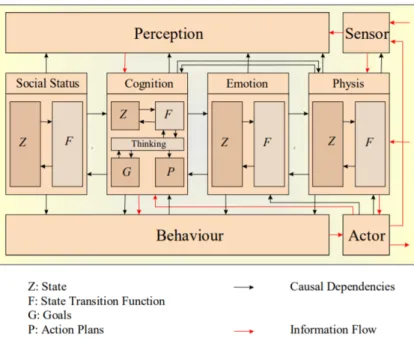
(16) that human behaviour is 93% predictable by studying mobility patterns of anonymous cell-phone users and concluded that [1], despite the common perception that our actions are random and unpredictable, human mobility follows surprisingly regular patterns. But, can it be extended to other situations? The aim of this project is to develop a tool using agent-based modelling capable of predict human behaviour using the PECS reference model for the construction of human-like agents by enabling an integrative modelling of physical, emotional, cognitive and social influences within a component-oriented agent architecture and combined with game theory.. 1.2. Context. This section is about the terms and concepts related to the project. We are going to make a description of the areas of interest as well as the stake-holders of the project: target audience, users and beneficiaries.. 1.2.1. Areas of interest. We can distinguish three main areas of interest in the project. The first area is human behaviour and its predictability, which is related to the psychology field, the second one is about agentbased modeling, a technique for running simulations with a set of features and the third one is game theory field. Predictability of human behaviour In this project we are trying to develop a tool capable of predict human behaviour, which is the capacity of mental, physical, emotional and social activities experienced during the five stages of a human being’s life - prenatal, infancy, childhood, adolescence and adulthood. For sociologists, most of this behaviour is predictable. Spontaneous individuals are largely absent from the population and human mobility follows surprisingly regular patterns, free will is not absolute. Suggestion plays an important role on human behaviour, because we cannot completely control our thoughts, what makes behaviour predictable [3]. For answer this question, we are going to use the most well-know model for representing human behaviour, and setting up its input and output functions and weighting the different components, we are going to see how affects to agents behaviour. By using common features shared by all person and a limited set of actions, we are going to simulate what agents will do depending on its capacities and develop a tool for observe if they do what we think that agents will do.. 2.
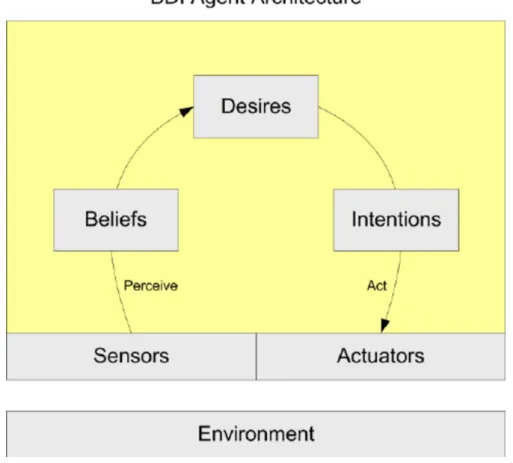
(17) Agent-Based modeling For developing the project, we need to generate a model for doing simulations and analyze its results. Agent-based modeling (ABM) [4] focuses on the individual active components of a system. With ABM, active entities, known as agents, must be identified and their behaviour defined. They may be people, house holds, vehicles, products, etc. whatever is relevant to the system. Connections between them are established, environmental variables set, and simulations run. The global dynamics of the system then emerge from the interactions of the many individual behaviours. ABM helps in understanding how simple micro-rules of individual behaviour emerge into macrolevel behaviour of a system. Being able to model these complex systems can lead to a better understanding of them, thereby being able to control the course of events, just by tweaking simple rules at the individual level. Games Theory Game theory is the study of mathematical models of strategic interaction between rational decision-makers, developed during 50s, that has been applied into different fields as social science, logic, computer science or biology [5]. It has a very general scope, encompassing questions that are basic to all of the social science. It can offer insights into any economic, political or social situation that involves individuals who have different goals or preferences. From all possible game types that offers game theory, we are going to focus in the Cooperative / Non-cooperative games. A game is cooperative if the players, agents in our case, are able to from binding commitments externally enforced, meanwhile a game is non-cooperative if players cannot form alliances or if all agreements need to be self-enforcing. This kind of games focuses on predicting which coalitions will form, the joint actions that groups take and the resulting collective payoffs. It is opposed to the traditional no-cooperative game theory which focuses on predicting individual players’ actions and payoffs and analyzing Nash equilibria.. 1.2.2. Stakeholders. The development of this project can draw the attention of some people from different areas. These are the potential stakeholders and the reasons why they can be interested in our project.. 3.
(18) Target audience Our target audience can be either in business side or in an non-profitable way such in the academical world. In the first case, by predicting human behaviour, companies can anticipate a person needs even before itself. Thus, it makes a competitive advantage for developing non-existing products by learning from its future clients needs or by improving an existing product. On the other hand, learn from people how they ’work’ can be the key for understanding spread of epidemics, population dynamics, vegetation ecology, landscape diversity, the growth and decline of ancient civilizations, mental diseases, or even eviscerate key concepts such love. Users The aim of the project is to implement a tool that can be able to predict human behaviour and understand better how human beings make its decisions. Our project can be extrapolated to other areas, which generate a lot of potential users. This potential users will be in fact any company, because human behaviour condition any decision of a human being. Beneficiaries Besides the final users, this project can be beneficial for investigators on the topic. They can take benefit of the investigation done during the development of this project and improve the results or add new features using our tool as starting point.. 1.3. State of the art. In this section, we are going to give information about the state of the art of the different elements related to our project. We are going to describe the most important reference models and the latest techniques used in our interest fields. Moreover, we are going to summarize previous studies related with our project and discuss about them.. 1.3.1. Reference models. As we have said above, there are several reference models. Coming up next, we are going to cite the two closest to our problem.. 4.
(19) Physical, Emotional, Cognitive and Social Status (PECS) PECS [6] is a reference model which makes it possible to specify and to model physical, emotional, cognitive and social factors and their interactions. Is a multi-purpose reference model for the simulation of human behaviour in a social environment. PECS agent architecture grounds on the opinion that an agent must be capable of integrating physical, emotional, cognitive and social attributes and processes in order to provide an adequate means for modelling human behaviour. The architecture may be divided up into three different horizontal layers. The input layer consists of the componets Sensor and Perception and is responsible for the processing of input data coming from the environment of the agent. The internal layer is composed by the components Physics, Emotion, Cognition and Social Status. This group of components models the internal state of the agent. Finally, in the output layer, covering the components Behaviour and Actor, the behaviour of the agent is calculated and the actions are executed.. Figure 2: PECS model reference diagram. 5.
(20) Belief–Desire–Intention (BDI) BDI [7] is a software model developed for programming intelligent agents. BDI stands for Belief, Desire and Intention, and the original principles were set by Michael Bratman during the 80s. In essence, it provides a mechanism for separating the activity of selecting a plan from the execution of currently active plans. BDI as whole can be represented by the following components: • Belief : The knowledge of the world, state of the world. • Desire: The objective to accomplish, desired end state. • Intention: The course of actions to achieve the desire of the agent.. Figure 3: BDI model reference diagram. 6.
(21) The BDI software model is closely associated with intelligent agents, but does not, of itself, ensure all the characteristics associated with such agents. For example, it allows agents to have private beliefs, but does not force them to be private. It also has nothing to say about agent communication. Ultimately, the BDI software model is an attempt to solve a problem that has more to do with plans and planning (the choice and execution thereof) than it has to do with the programming of intelligent agents.. 1.3.2. Previous studies. Starting our project, we had taken into account previous works and studies related. In the next sections, we are going to summarize the three most relevant studies, the ones that are close to our project, but there are also another important works, as Predicting Human Behaviour in Normal-Form Games [8], that give to us very useful information. PECS: Agent-Based Modelling of Human Behaviour This work [9] from Christoph Urban and Bernd Schmidt done at University of Passau, is a base point for understanding the used reference model PECS. In this project it is presented the PECS reference model for the construction of human-like agents, which enables an integrative modeling of physical, emotional, cognitive and social influences within a component-oriented agent architecture. Furthermore, the case study Learning Group is introduced which demonstrates the practical application of the design methodology, and is intended to model basic social psychological mechanisms in the context of group formation and disbandment. Modelling of Human Behaviour. The PECS Reference Model In this second work [10] from the University of Passau and again done by Dr. Bernd Schmidt, PECS model is detailed. Different components of the model are explained deeply for a better understand of how it model an agent behaviour. PECS is presented as a reference model for the modelling of human behaviour. The architecture proposed claims to be universally applicable, and adaptation to individual conditions occurs by means of filling in the empty spaces provided by the architecture. Agents can be endowed with a varied repertoire of actions that state the external actions of which the agent is capable. As a result, very diverse agents and agent communities develop but they all have the same deep structure and therefore they can all be described by one and the same reference model.. 7.
(22) Humans display a reduced set of consistent behavioral phenotypes in dyadic games The article [11] questions about people behavior when play games, precisely when are exposed to the constraint introduced in game theory designs, where people are often not ”rational” in the sense that they do not pursue exclusively self-interested objectives . This behavior is especially clear in the case of prisoner’s dilemma, where rational choice theory predicts that players will always defect but empirical observation shows that cooperation oftentimes occurs, even in ”one shot” games where there is no expectation of future interaction among the parties involved. These findings beg the question as to why players sometimes choose to cooperate despite incentives not to do so, questioning if these choices are a function of a person’s identity and therefore consistent across different strategic settings, if individuals draw from a small repertoire of response, and if so, what are the conditions that lead them to choose one strategy over another. For that reasons, an empirical experiment has been done over more than 500 people, with prizes in form of incentives for assuring that people with try to do whatever to win if they are motivated to. There are 5 phenotypes of person and it is studied differences between each phenotype from theoretical expected results to empirical collected results.. 1.4. Objectives. The main goal of the project is simulate human behaviour by building a tool based on agents modelling, applying game theory and with PECS reference model embedded for handling its behavior. For doing that, we are going to implement a model where agents plays a classic games theory paradox, the prisoner’s dilemma. We are going to bring agents with a repertoire of actions and rules, which are going to influence its behaviour, even though sometimes they are not going to pick the best option, from a rational point-of-view, due to the impact of emotions and cognition, which are going to be represented in form of revenge or the best option based on previous games that the agent have played. Hence, objectives can be divided in: • Different phenotypes: Each agent as the representative of a human being will be endowed with an elementary personality that will influence its behaviour. We need to have a number of different personalities very accurate to no interfere on the experiment results. • Set of actions: Alongside the different personalities, we need to endow to the agent with a repertoire of possible actions of an agent. The number of actions must be kept to the strict minimum for simplicity reasons, but the necessary ones to have realistic results.. 8.
(23) • Agent behaviour: By using different personalities and a limited set of actions, we have to manifest the agent behavior. This is a key point because if we do not define well all the possible situations and we leave some corner cases, we cannot obtain representative results.. 1.5. Scope. In order to achieve the proposed objectives, we need to implement a program capable of determine different agents depending on its personalities, able them with a set of actions and manifest it with a coherent behaviour on each decision made. We are going to implement this model in Netlogo [13], which will carry the simulations of the agent over the time and develop the experiment. The program brings a visual tool for watching on real time the simulation and also the possibility of represent the results in plots or by ’asking’ to the agents. Also, we are going to use the previous mentioned works PECS – Agent Based Modelling of Human Behaviour and Humans display a reduced set of consistent behavioral phenotypes in dyadic games as starting point. Both will bring us needed information about agents phenotypes and reference model to define its behavior. The final result will be a set of agents with different personalities wandering in a defined universe, interacting with other agents to achieve its internal needs and goals, and we are going to be the observers that take notes and study how they interact for extracting conclusions about human behaviour without interfere in the result of the experiment.. 1.6. Project contribution. The contribution of this project is to develop and show the feasibility of a power tool that combines game theory, PECS reference model and agent-based modelling that can be scaled and tuned to predict human behaviour in a particular case, to understand better why human beings do what they do or how they make its decisions. The results reached from our tool can be easily extrapolated to other fields, so in fact, we want to contribute on something that is global, as can be understand better how human brain works. Since our tool has been done with academical purposes, all code is open source, as well as all frameworks, packages and other software used in its development.. 9.
(24) 2. Background Before starting to explain the project development, it is necessary to have some background on the related topics of the project. Therefore, in this chapter we provide a definition and the essential knowledge of the techniques and models used during the development of the project.. 2.1. Netlogo. Netlogo is a programming language adapted to the modelling/simulation of phenomenons where appears a large number of individuals interacting between each others. It is called Netlogo because it is a dialect of the Logo language [14], and is a multi-agent programmable modelling environment that: • Is adequate for modelling complex systems which evolve during the time. • Is adequate for modelling hundred or thousands of individuals (persons, bacteria, insects, organizations, graph nodes, etc. • Allow explore connections between local interactions at individual level and the macroscopic patterns that emerge from them. It is also an easy and intuitive programming environment for create and testing new models: • Allows open and experiment simulations. • Allows implement models fast for checking hypothesis about decentralized systems. • Granted with a large library of simulations in natural and social sciences, which ones can be used and modified. • Models are built using a simple language inspired in functional/declarative paradigm. • Have an intuitive graphical interface. 10.
(25) It has a Desktop application with the complete feature set of functionality but also has a web version for running simulations in browsers, even though it is not available full functionality.. Figure 4: Netlogo desktop application. 2.1.1. Basic concepts. Even though Netlogo language is easy to learn, it does not set limits to the sophistication of the models that can be implemented. It has as main orientation modelling systems composite by individuals that interact between each others and with the environment, based on the agent modelling paradigm:. 11.
(26) • An agent is an synthetic individual, autonomous and doted with rules or features that govern its behaviour and its capacity for making decisions. • Agents interact between each others and with the environment obeying a set of rules. • Agents are flexible and have the ability of learning and adapt its behaviour based on the experience. This ability requires some way of memory. Agents can even have rules for modifying its behaviour rules.. Agents Netlogo is equiped with for types of agent: • Mobile agents (turtles): They are the ones that are moving ’around the world’. The world is in 2D (even though there is a 3D version) and it is divided in a mesh of patches. • Immobile agents (patches): Every square division of the world. • Linking agents (links): Agents that connect between each others the turtles (like edges in a graph) • Observer agent: It is not located and it can interact with all the elements of the world. In a way, it represents the super agent that can control all the elements of the world. We can control a Netlogo model by using buttons and switches. Furthermore, the system offers the possibility of controlling the models by a command center, where it is possible execute commands about a model and modify its parameters.. Variables In Netlogo we can either user defined framework variables or create our own. This own-created variables can be global when represents a global system property (i.e. number of generations formed), variables that belongs to patches and are used for representing memory attributes for each portion of ’universe’ (i.e. altitude, amount of food allocated in that slice of ’universe’), or variables that belongs to the turtles and represent equally memory attributes for each one of the turtles (i.e., type, gender or last occupied position). We are going to show some examples of these three type of variables that can be found in Netlogo: • Patch variables: patches-own [ altitude town ] • Turtle variables: turtles-own [ gender last-position ]. 12.
(27) • Global variables: globals [ generation ] These commands only works on Procedures tab, where it is implemented the model code.. 2.1.2. Sets of agents and functions. Sets of agents In this section we are going to use turtle’s gender for modifying its visual aspect. One way of doing this consist on divide turtles by its gender variable. For that, we can use the command:. ask turtles with [ gender = 0 ] [ set color pink ] What previous command achieves is to execute a determined action over the subset of turtles which verifies a certain property. Netlogo bring very powerful tools for applying commands selectively over a set of agents that verify a certain property by using ask set-of-agents [ commands ]. This is the general way of the ask instruction, but previously we have applied to the particular case in which we consider as set of agents from the total of turtles or patches. Some examples of how implement set of agents are: • turtles with [ gender = 1 ]: Turtles with gender 1. • turtles with [ xcor > 0 ] : Turtles on the right side of the ’universe’. • patches with [ pycor > 0 ] : Patches on the north ’hemisphere’. • turtles-here: All the turtles in a certain patch. This form must be used by another turtle or patch. • other turtles: Similar to turtles, but in this case the turtle that executes the call is not included.. Control structures We are going to change the visual appearance of turtles with gender 1. On this case, we are going to use control structures for illustrate its use. For that, we can execute the command 13.
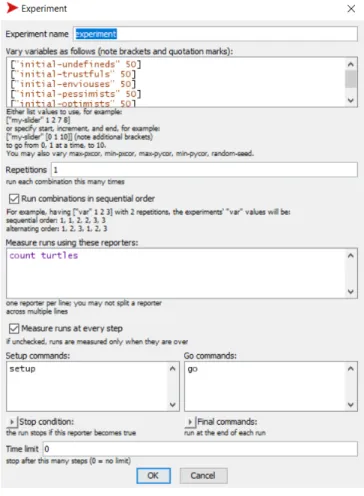
(28) ask turtles [ if (gender = 1) [ set color pink ] ] Control structures offer another way for executing selectively actions in Netlogo: • if condition [ commands ]: If the condition is verified, commands are executed: if (gender = 1) [ set color sky ] • ifelse condition [ commands1 ] [ commands2 ]: If the condition is verified, commands1 are executed, if not commands2 : ifelse (gender = 0) [ set color pink ] [ set color sky ] • ifelse condition1 [ commands1 ] condition2 [ commands2 ] ...: If condition-i is verified, commands-i are executed, if not, else-commands: ifelse (gender = 0) [ set color pink ] (gender = 1) [ set color sky ] [ set color green ] • while [ condition ] [ commands ]: Meanwhile condition is verified, commands are executed: ask turtles [ while [ycor < 0 ] set ycor (ycor + 1) ] ] ]. Breeds In the system we are not limited to the use of one and only specie of mobile agents (turtles), we can create many as we want, each one with its own attributes and behaviours. On that way, we 14.
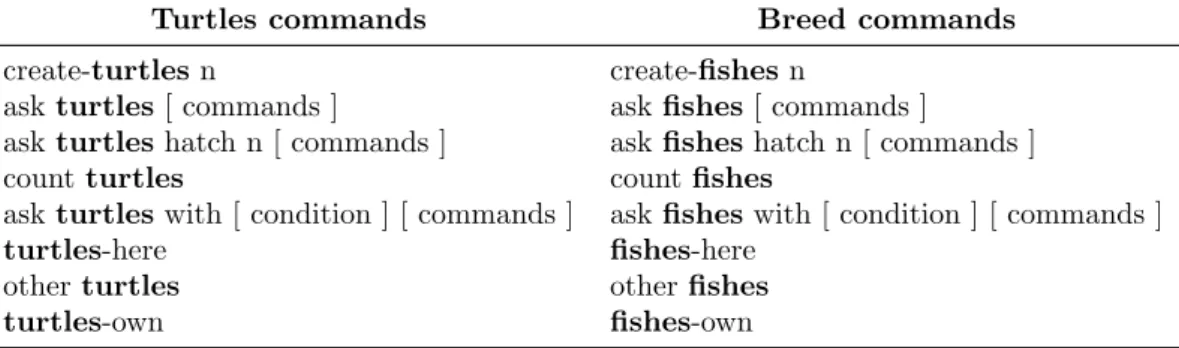
(29) can imitate ecosystems composed by some species or sophisticated economies formed by different types of producers and consumers. For creating and specie, it is used the command. breed [ plural-specie singular-specie ] On this way, we can refer to the whole specie or to one of its individuals. Some commands and reports will use the plural name of the breed, for instance create-, meanwhile others will use singular version, -neighbor (environment of the individual). In general, the rules that follows for using one or another are the derived ones of the natural language. Once defined a new breed, automatically it is generated a set of agents associated to itself, in the way that everything that we have seen for sets of agents in general can be applicable for selecting individuals of the same breed. For instance, for creating two breeds (fishes and frogs) we will use commands:. breed [ fishes fish ] breed [ frogs frog ] Once created, all new breeds have equivalent commands to the turtles ones, that are inherited automatically. For using them it is enough with substitute, on each command, the word turtles by the name of the breed: Turtles commands. Breed commands. create-turtles n ask turtles [ commands ] ask turtles hatch n [ commands ] count turtles ask turtles with [ condition ] [ commands ] turtles-here other turtles turtles-own. create-fishes n ask fishes [ commands ] ask fishes hatch n [ commands ] count fishes ask fishes with [ condition ] [ commands ] fishes-here other fishes fishes-own. Table 1: Breed inherited commands Moreover, each breed inherit the following primitives automatically: create-, hatch-, sprout-, -here, -at, -on and is-?. Even though, individuals of a breed can migrate to another breed. For instance a fish do not must be fish the rest of its life, and it could transforms to an amphibian (supposing that we have created both breeds), by properly modifying its breed property that all agents have: 15.
(30) ask one-of fishes [ set breed frogs ] As visual enforcement, Netlogo offers also a way of modifying the aspect of diverse turtles families by using command:. ask turtles [ set shape name-of-shape ]. Figure 5: Netlogo possible shapes. Actions and functions Netlogo allows the construction of our own commands. The most common use is actions, which are like scripts that group in logic units a set of commands that is repeated commonly, which makes it easier its execution and modification in case of necessity. The are defined in the following way:. to name-action [ parameter1 parameter2 ... parametern ] command-1 command-2 ... command-n end For calling a routine, it is used straight its name with its associated input parameters. The methods are another way of grouping commands, with the difference that a method returns a value. 16.
(31) to-report name-method [ parameter1 parameter2 ... parametern ] command-1 command-2 ... command-n report val end. Experiments BehaviorSpace is one of the integred tools in Netlogo that allows make experiments about the models. Its basic function is to run the model several times, modifying systematically the parameters of the model and recording the results of each execution. It is common that models have a lot of parameters which depends on, each one with its range. It is recurrent that the modification of this mentioned parameters provoke a drastic change on the behaviour of the system which is being modeled. In complex systems it is specially hard to know before an execution the values of the parameters that the model is going to follow. As simple example we can take the fire propagation through a forest model. For instance, the fire starts from the left side of the ’universe’ and it propagates by contacting with trees. In the model we just have one parameter which is tree density in the forest (between 0 and 100) and we check the evolution through the proportion of burnt trees. We can observe that the model presents a very abrupt transition phase, in which, for certain values of density (above a very thigh threshold), the fire propagation is very low, meanwhile with values above a certain threshold, the final proportion of burnt trees is around 100%. Of course, we can do several executions of the model modifying manually density, but this is a tedious process when the space of parameters is too big. Is here where play an important role this tool, which allows us to automatize this process and storing the interesting results in a file to be analyzed later with the proper tool.. 17.
(32) Figure 6: Netlogo experiment setupscreen. 2.2. Agent-Based Modelling. Agent-Based Modelling (ABM) [15] is a style of modelling in which we represent the interaction between individuals and with each other environment in a program. Agents can be, for example, people, animals, groups, or cells. They can model entities that do not have a physical basis but are entities that can perform some tasks such as gathering information or modelling the evolution. ABM is a method of modelling complex systems by defining rules and behaviours for individual components (agents) as well as the environment thy are present in. Further, we aggregate these rules to see the general behaviour of the system. It helps in understanding how simple micro-rules of individual behaviour emerge into macro-level behaviour of a system. Being able to model these complex systems can lead to a better understanding of them, thereby being able to control the course of events, just by tweaking simple rules at the individual level. 18.
(33) 2.2.1. Entities in Agent-Based modelling. ABM contains autonomous models called agents. These agents can be an individual, a group of individuals, or even an organization. Each agent is defined with properties of its own along with relationships with other agents. Apart from agents, ABM also have environments, which is a set of conditions the agent is exposed to. Once these entities are defined in an ABM, individual behavioral rules of how an agent would behave in a given environment is defined. An aggregate of these simple individual-level behaviours that lead to a complex macro level patter. A feedback-based-learning-model is often used in ABMs to update agent actions based on their changing relationships with other agents and their environment.. Figure 7: Fire propagation example of ABM. 2.3. PECS model. PECS is a reference model which makes it possible to specify and to model these factors and their interactions. A detailed description of the PECS reference model and its underlying methodology.. 19.
(34) PECS stands for: Physical conditions, Emotional state, Cognitive capabilities and Social status. We are going to describe into five subsections the PECS reference model.. 2.3.1. Structure of the agent world. The agent world of the reference model PECS consists of the following fundamental components: • The environment component • The connector component • The agents. Figure 8: PECS fundamental components. 2.3.2. Environment. The environment component is used to model external events and influences which are important for the behaviour and the actions of agents. It may also include other agents. It is also reflected in the agents’ knowledge. The environmental knowledge that an agent has and that is represented in the model it has made of the environment may be incomplete, uncertain and even erroneous. As the environment is generally very diverse and difficult to squeeze into a uniform schema, PECS reference model provides little assistance in this respect. It merely provides a frame within which the agents can move. The individual design of the environment component is a mater for the user alone.. 20.
(35) 2.3.3. Connector. Communication is an essential aspect of multi-agent systems. The basic principle is that all agents must have the possibility of communicating with all other agents. For this purpose the Connector component is introduced, which serves as a central switchboard that organizes the exchange of information between agents. Again, its individual design is a matter for the user. 2.3.4. Structure of PECS agents. The basic structure of PECS model is clearly recognizable: Based on system theory, consists of input, internal state and output.. Figure 9: PECS structure and internal organization. The upper level with the components Sensors and Perception corresponds to the input. These components are responsible for the reception and initial processing of information from the environment. The middle four components Status, Cognition, Emotion and Physis contain the state variables of the agent and their changes of state. The components at the bottom of the diagram Behaviour and Actor, are responsible for output. The Behaviour component determines the execution order. It contains the set of rules on the basis of which an execution order is issued as it were automatically. 21.
(36) The execution orders are passed to the Actor, who is responsible for their execution. The Actor contains the full repertoire of actions of which the agent is capable.. 2.4. Game Theory. Game theory [16] is a theoretical framework for conceiving social situations among competing players. In some respects, game theory is the science of strategy, or at least the optimal decisionmaking of independent and competing actors in a strategic setting. The key pioneers of game theory were mathematicians John von Neumann and John Nash, as well as economist Oskar Morgenstern.. 2.4.1. Basics. The focus of game theory is the game, which serves as a model of an interactive situation among rational players. The key to game theory is that one player’s payoff is contingent on the strategy implemented by the other player. The game identifies the players’ identities, preferences, and available strategies and how these strategies affect the outcome. Depending on the model, various other requirements or assumptions may be necessary. Game theory has a wide range of applications, including psychology, evolutionary biology, war, politics, economics, and business. Despite its many advances, game theory is still a young and developing science.. The Nash Equilibrium Nash Equilibrium [17] is an outcome reached that, once achieved, means no player can increase payoff by changing decisions unilaterally. It can also be thought of as ”no regrets,” in the sense that once a decision is made, the player will have no regrets concerning decisions considering the consequences. The Nash Equilibrium is reached over time, in most cases. However, once the Nash Equilibrium is reached, it will not be deviated from. After we learn how to find the Nash Equilibrium, take a look at how a unilateral move would affect the situation. Does it make any sense? It shouldn’t, and that’s why the Nash Equilibrium is described as ”no regrets.” Generally, there can be more than one equilibrium in a game. However, this usually occurs in games with more complex elements than two choices by two players. In simultaneous games that are repeated over time, one of these multiple equilibrium is reached after some trial and error. This scenario of different choices over time before reaching. 22.
(37) equilibrium is the most often played out in the business world when two firms are determining prices for highly interchangeable products, such as airfare or soft drinks.. 2.4.2. Types. Although there are many types (i.e. symmetric/asymmetric, simultaneous/sequential, et al.) of game theories, cooperative and non-cooperative game theories are the most common. Cooperative game theory deals with how coalitions, or cooperative groups, interact when only the payoffs are known. It is a game between coalitions of players rather than between individuals, and it questions how groups form and how they allocate the payoff among players. Non-cooperative game theory deals with how rational economic agents deal with each other to achieve their own goals. The most common non-cooperative game is the strategic game, in which only the available strategies and the outcomes that result from a combination of choices are listed. A simplistic example of a real-world non-cooperative game is Rock-Paper-Scissors.. 2.4.3. Examples. There are several ”games” that game theory analyzes. Below, we will just list a few of these, only describing the one that we use in our thesis, the Prisoners’ Dilemma • Dictator Game • Volunteer’s Dilemma • Centipede Game • Prisoner’s Dilemma The Prisoner’s Dilemma is the most well-known example of game theory. Consider the example of two criminals arrested for a crime. Prosecutors have no hard evidence to convict them. However, to gain a confession, officials remove the prisoners from their solitary cells and question each one in separate chambers. Neither prisoner has the means to communicate with each other. Officials present four deals, often displayed as a 2 x 2 matrix. 1. If both confess, they will each receive a five-year prison sentence. 2. If Prisoner1 confesses, but Prisoner2 does not, Prisoner1 will get three years and Prisoner2 will get nine years.. 23.
(38) 3. If Prisoner2 confesses, but Prisoner1 does not, Prisoner1 will get 10 years, and Prisoner2 will get two years. 4. If neither confesses, each will serve two years in prison. The most favorable strategy is to not confess. However, neither is aware of the others strategy and without certainty that one will not confess, both will likely confess and receive a five-year prison sentence. The Nash equilibrium suggests that in a prisoner’s dilemma, both players will make the move that is best for them individually but worse for them collectively.. 2.4.4. Limitations. The biggest issue with game theory is that, like most other economic models, it relies on the assumption that people are rational actors that are self-interested and utility-maximizing. Of course, we are social beings who do cooperate and do care about the welfare of others, often at our own expense. Game theory cannot account for the fact that in some situations we may fall into a Nash equilibrium, and other times not, depending on the social context and who the players are.. 24.
(39) 3. Initial architecture 3.1. Overview. The goal of this initial point is to build the main system that will place our simulations. On this incipient part of the project development, we want to setup a scalable structure for creating agents with different personalities, with a set of variables that will rule their fate and a certain number of actions to develop. Also, we want to introduce game theory as the key concept to evaluate human behaviour. We are going to make our agents play between each others randomly to the Prisoner’s Dilemma, a standard example of a game analyzed in game theory that shows why two completely rational individuals might not cooperate, even if it appears that it is in their best interests to do so. We need to build an ecosystem to handle our game and agents too. The system is going to be built using Netlogo framework, which is very accurate for agent-based modelling and brings us all needed tools for handling our simulations. The system will be the universe that contains our agents, and will act as an observer, giving us visual and data feedback about agents chances.. 3.2. Game theory. As we have said before, game theory will be the way that we use to evaluate agents decisions. We are going to make agents play against each other to Prisoner’s Dilemma (PD), which is a game theory classical paradox. We use PD as a way for evaluate agent decisions and so, include a reward in form of a payoff matrix to make agents try to maximize the number of points that they can achieve based on its decisions. All the data used in the project about the phenotypes, payoff matrix (scoring system) and the dynamics of PD is based on article Humans display a reduced set of consistent behavioral phenotypes in dyadic games [11].. 25.
(40) 3.2.1. Prisoner’s Dilemma. In our project, we have implemented classical PD game version, but changing the payoff matrix values. Agents will play against each other and they will have to choose between Cooperate (C) or Defect (D), and depending on its decision and rival’s decision, they will obtain a score. The decision is conditioned by agent personality, because it will impact in the way how to make it. By combining different agents personalities and a changing payoff matrix every round, we are creating a situation to check every agent strategy.. 3.2.2. Payoff matrix. The payoff matrix will be crucial for making agents to change its behaviour depending on the values that it holds. As we have pointed above, some values of the matrix are variable, meanwhile than others are constants. This is the payoff matrix used in our tool:. Figure 10: PD Payoff matrix. This way, we have all possible combinations generated from the choices of two agents (four possible combinations). The payoff matrix form is interpreted as the rows are agent’s strategies, whereas columns are those of its opponent. In that way, an agent will have one of the four possible values as score every round, stated by variables R, S, T and P. As we have mentioned before, not all values of the payoff matrix are constant. The ones on the main diagonal will be constant, while the ones on the secondary diagonal will be variable. This way, will have constant values for R and P, while values for S and T are variable. These are their assigned values: • R: Result of both agents C has a fixed value of 10. • P: Result of both agents D has a fixed value of 5. • S: Result of first agent C and second agent D has a variable value in range [0,10]. • T: Result of first agent D and second agent C has a variable value in range [5,15]. 26.
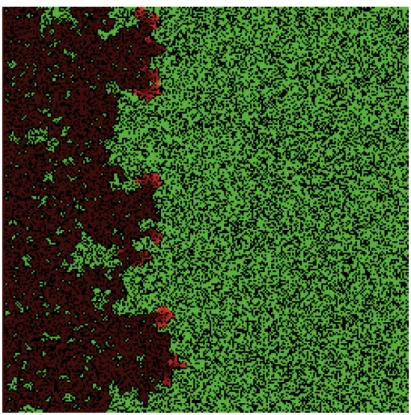
(41) The matrix is generated each round with equal probability for each point in the S, T plane. This variable values are chosen randomly, assuring this way there is no intention to condition the agent’s decisions. By having 11 options for each variable, we will have a 11 x 11 matrix of possible combinations. We are going to use this matrix for representing the obtained results depending on variables values and will be explain deeply in the data representation section.. 3.2.3. Players phenotypes. For having different strategies, we have defined 5 different phenotypes of agents. Each phenotype will follow its own rules, what will determine its behaviour. As we want to make a tool as real as possible, our goal is to assess whether individuals behave in a highly idiosyncratic manner or whether, on the contrary, there are only a few ”phenotypes” by which all our experimental subjects can be classified. As our goal is to make a tool for embed game theory and PECS reference model, not to classify human beings, we have taken the phenotypes described previously in the reference article used for developing this tool. Coming up next, we are going to show the possible phenotypes and its heatmap. The cooperation level is represented from 0 in blue to 1 in red: • Optimist: The first phenotype, called Optimist cooperates wherever T < R. By using this strategy, these subjects aim to obtain the maximum payoff without taking into account the likelihood that their counterpart will allow them to get it. In other words, when he feels that he can obtain a higher value that the one offered by cooperating, it will defect its opponent.. Figure 11: Optimist phenotype heatmap. 27.
(42) • Pessimist: Conversely to the first, we label subjects in the second phenotype Pessimists, because they use a maximin principle to choose their actions, cooperating only when S > P to ensure a best worst-case scenario. As previous phenotype, its decisions can hardly be considered rational, and are related with different degrees of risk aversion.. Figure 12: Pessimist phenotype heatmap. • Envious: The third phenotype is called Envious, because it exclusively cooperates in the upper-left triangle of the heatmap, when (S − T ) >= 0. Its name is given due to it takes decisions based in preventing their counterparts from receiving more payoff than themselves, even when, by doing so, they diminish their own potential payoff, which is far from being a rational decision.. Figure 13: Envious phenotype heatmap. 28.
(43) • Trustful: The four phenotype is called Trustful, because its unconditional faith in its opponents. It includes those players who cooperate always in almost every site of the (S,T) plane. This phenotype is the opposite to the previous one. Its behaviour can be associated with trust in partners behaving in a cooperative manner. They follow the formula p(C) = 1.. Figure 14: Trustful phenotype heatmap. • Undefined: The last group are the ones who cooperate in an approximately random manner, with a probability of 50% in any situation. For that reason, they are called Undefined. They follow the formula p(C) = 0.5. Figure 15: Undefined phenotype heatmap. 29.
(44) 3.3. Agents. Agents will play a key role in our system, as they are going to be the subjects of our further experiments over which we are going to study its behaviour by setting them a personality and a set of rules while seeing how they interact with the universe and other agents. In this section we are going to talk about their different breeds, their internal variables that will condition part of its behaviour, the features that an agent holds and also how we are going to set up them at the start of each simulation.. 3.3.1. Breeds. As we want to build a tool for holding simulations capable to represent real human behaviour, we need to make our agents as real as possible. As in real world not every person thinks or act the same, in our tool we need to have the ability of modelling different kind of agents. For that reason, we have implemented five types of breeds, each one representing one of the previous mentioned phenotypes:. breed [optimists optimist] breed [pessimists pessimist] breed [enviouss envious] breed [trustfuls trustful] breed [undefineds undefined] For distinguish them on the visual simulations, we have labeled each breed with a different colour. Also, they have the appearance of a person, because we have set ”person” as default shape for all the breeds. This is the chosen breed representation: • Optimist will be represented with colour green. • Pessimist will be represented with colour red. • Envious will be represented with colour orange. • Trustful will be represented with colour blue. • Undefined will be represented with colour grey.. 30.
(45) The number of individuals of each breed is handled by five sliders on the Netlogo interface tab. Each one of them is related to a system variable that is used at the time of agent creation, during setup method.. Figure 16: Slider variable number of individuals. 3.3.2. Internal variables. Besides the breed, each agent have internal variables. These variables are needed to store data about the games that they are playing, to have knowledge against which other agents it has played during the current round or even to modelling emotions or cognition as we will see in the next chapter. For this base implementation where we want to reproduce a reduced set of personalities without having any external input that can affect to its behaviour, we are going to use only one variable called games-current-tick , which will store the id of our rivals during a certain round to assure that we are only playing against same agent once, at most, every round, to avoid data duplication. This agent variable is reset at the end of every round, and only works as a constraint for limiting games between same agents.. 3.3.3. Setup. For setting up the agents before each experiment, we have implemented a method that holds all needed initialization of variables, breeds and even though, agents creation. In this method, we define the five breeds available in our tool. Also, we assign to each one of them the shape of person for a better understanding during the simulation on the interface tab. Once we have defined the breeds, we define how many individuals we are going to create for each one, based on the previous slider variable introduced. 31.
(46) For each breed, we set up the previous assigned color, as well as initialize its list of agents whom has player in current round.. 3.4. System architecture. All the reported information about our tool holds over a defined architecture defined in Netlogo framework. As we know that this implementation is just for setting up the structure for our finale implementation, we had in mind potential scale in its design, but implemented just our initial purpose. We are going to explain everything on detail in next sections, but here there is an image of the tab interface of our tool.. Figure 17: Netlogo interface of our tool initial approach. 32.
(47) 3.4.1. Constants and variables. The system, as responsible of data result report, must hold all the data that it is created during a simulation. Besides that, it also has to store the constants values needed for some methods during the simulation, and variable values that are changing on each round or growing up. Following there are reported all constant and variable values used for develop the simulations.. Constants • payoffs: This is where there are stored the values of the payoff matrix. Even though its values on the secondary diagonal are variable, we catalog it as a constant. It is checked after each game for determine the score of each agent. • C: Here there is store the value of cooperate. It is used as index for accessing into a matrix specific value. • D: Here there is store the value of defect. It is used as index for accessing into a matrix specific value. • R: Here there is store the value of the action of both cooperation. It is used for check conditions of the agents depending on its breed and make a decision. • P: Here there is store the value of the action of both defection. It is used for check conditions of the agents depending on its breed and make a decision.. Variables As a simulation is a changing phenom, we need to have several variables for capturing all the events. This is a crucial part because it is not only needed for developing the simulation properly, but also it is needed to hold the results to be able of representing later and reach conclusions or discover phenoms. These are the variables that handle all these data on this first approach: • S: Variable that holds the random-generated every round value of the action where agent1 cooperates and agent2 defects. • T: Variable that holds the random-generated every round value of the action where agent1 defects and agent2 cooperates. • num-games-per-round: Variable that determines how many games are done on each round for every agent.. 33.
(48) • res-sum: Matrix of 11x11 that holds the cooperation factor for a given values of S and T. Here it is stored the result of a game by using as indexes of the matrix S and T. This is used later for generate the heatmaps. There is on array per breed and the results of each personality are stored in its matrix. • res-times: Similar to res-sum. It has the same sizes, but instead of store the result, it is stored the times that it happens for computing average once it is requested the data. Also, there is a matrix for each breed.. 3.4.2. Checks and setup. During the setup phase, started when pressed setup button, our tool have some initialization needed for the proper development of the further simulation. Inside this setup method, we are also doing some initial checks needed before start a simulation. The first action done is to reset the tick counter that are associated to each iteration of the simulation. After that, there are also cleared all the turtles. Next methods executed inside setup are the system checks. In this part of the tool, we only have one active check that count all initial agents distributed into different breeds for assuring that we are not over passing the maximum agents number handled by the program. Once we have assured the feasibility of the simulation, we set up the agents as we have explained on agent’s section, and also we need to set up the system. In the setup-system method we set the values of C to 1 and D to 0. Also, we generate the first two random values of S and T, and we use it to initialize payoffs matrix with them and also with the initialized values of R = 10 and P = 5. Finally, we initialize the five 11x11 matrix (one for each breed) that store the results of the game for S and T values. Initially, these matrix have all its positions equal to 0. Also the number of times matrices (res-times) are equally initialized too.. 3.4.3. Methods. We are going to show the four methods that will handle the agents fate over the simulation, showing its pseudo-code of the implementation and explaining its behaviour. This four methods are inside a general method called go, which is represented in the interface tab of Netlogo as a button. Once the button is pressed, as it has marked the option forever, it will repeat it forever or until we push the button again.. 34.
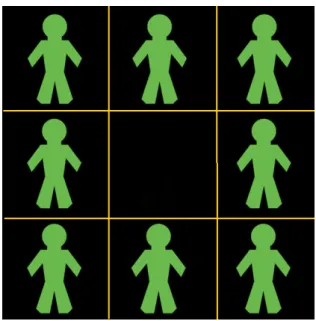
(49) action-rstp This method is called inside the next method play. For each agent, and depending on its breed and the values of S and T, it decides its final chosen action. This is the pseudo-code of the method: Algorithm 1 Pseudo-code of method action-rstp Input: agentBreed if agentBreed = optimist then if T < R then return C else return D end if else if agentBreed = pessimist then if S > P then return C else return D end if else if agentBreed = envious then if S − T ≥ 0 then return C else return D end if else if agentBreed = trustf ul then return C else return random(C, D) end if. 35.
(50) play Here is where all the ’action’ is done. In this first phase, we select for each agent a set of agents to play with in base of variable num-games-per-round. For each rival, we check that there are not repetitions, and in case of have it any, we select randomly another opponent. After that, for each agent and rival, we compute its decision based on its personality. Also, we add to the list of games-current-tick the rival and do the same from the rival point-of-view. Once we have both decisions, we update heatmap matrix of each breed involved in the game with the chosen action. Here is the pseudo code of the method: Algorithm 2 Pseudo-code of method play for all agents do rivals = getRandomRivals(num − games − per − round) for all rivals do agentAction = actionRST P (agentBreed) rivalAction = actionRST P (rivalBreed) agentGamesCurrentT ick.add(rivalID) rivalGamesCurrentT ick.add(agentID) resSumAgentBreed[S][T ] = agentAction resSumRivalBreed[S][T ] = rivalAction end for end for. update-variables This method is in charge of update system and agent variables needed for starting a new iteration of the simulation, and for update changing data in order to have reliable results on the next iteration. Here we have a snippet of its pseudo code: Algorithm 3 Pseudo-code of method update-variables T = random(5, 15) S = random(0, 10) payof f s[C][D] = S payof f s[D][C] = T for all agents do gamesCurrentT ick = [] end for. 36.
(51) plots-data This method is in charge of report breeds matrix for creating the heatmaps and evaluate the results. It is attached to the button do-plots from the interface tab of Netlogo and returns both res-sum-<breed> and res-times-<breed> for each breed. We decided to report it this way (pre-processed, without compute average) because we taught that could be interesting for our tool to report any times as we want intermediate results that do not compromise the data. Here is the pseudo code of the method Algorithm 4 Pseudo-code of method plots-data return resOptimist, resP essimist, resEnvious, resT rustf ul, resU ndef ined. 3.4.4. Data representation. For data representation we have chosen heatmaps because it is easier to represent the data on a visual way, to see how it affects to the cooperation the different values that S and T can take for each breed. As Netlogo outputs only raw data, we have implemented a Python script that handles the matrix and use it with the help of the matplotlib library to plot the heatmaps. This is a sample of a resulting heatmap:. Figure 18: Heatmap sample. 37.
(52) 4. Final tool 4.1. PECS integration. The greatest challenge of our tool is to make feasible to have inside the same tool an agent-based modelling implementation with PECS reference model for taking part of the decision making embedded and game theory with PD as the way of generate options to the agents. For that purpose, we need to integrate inside our tool the PECS reference model. PECS reference model is composed of four components: Physical, Emotional, Cognitive and Social status. We need to develop a module for each one of the four components and embed it to the agent for checking if they modify its behaviour to prove the feasibility of our tool. 4.1.1. Physic and Social Status. For including these two modules for developing PECS model, we need to bring the capability of movement and social interaction to our agents. In this section we are going to explain how did we manage to bring to agents these two abilities.. Physic On our first approach, agents were static actors that get a fixed number of opponents with the only condition of not playing against the same agent during the same round. For changing this, we have gave to the agents the ability of moving free over the whole universe. Now, instead of receiving on each round a set of opponents, the agent is making a movement over the map every round, and based on its position, he will check its eight potential neighbors. For each neighbor patch that contains an agent, it will be added to the rivals list for that round and our agent will compete against them.. 38.
(53) Figure 19: Potential opponents based on neighbors. Social status The social status component was the easiest to embed in our tool. This is because it implies having relation with other human beings. As in our first approach we were playing against other agents, we have fulfilled this condition, as the social interaction was covered yet by the act of playing to the PD against each others.. 4.1.2. Emotion. The emotion component was implemented in our model in the form of revenge. We have added to the agents the capability of having ’memory’, and now they are ’recording’ everything that happens related to a game of the PD. By building for each agent an array of size equal to the number of agents that are in our same universe, we are storing the last game that we had against each one of them. So then, the first time that we play against them, we will have no background of being potentially betrayed by them, and this component will not affect to the occurrence of the expectations. The same as if in the last game he did not betrayed us But at the moment that the agent become betrayed, it store this information in the array of last games against agents, in the index of the agent, that he defected, and commit betray.. 39.
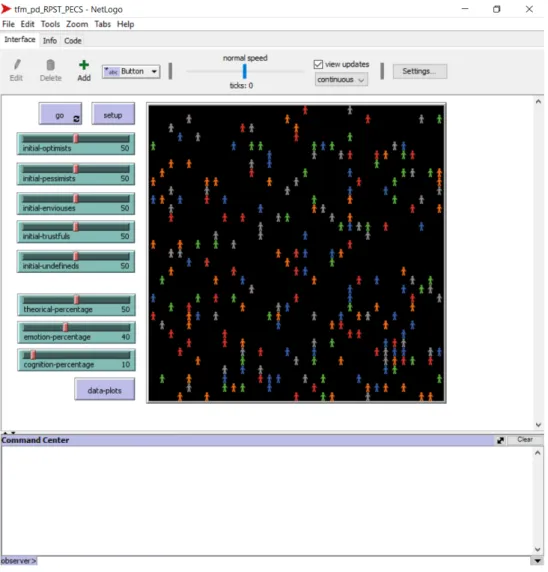
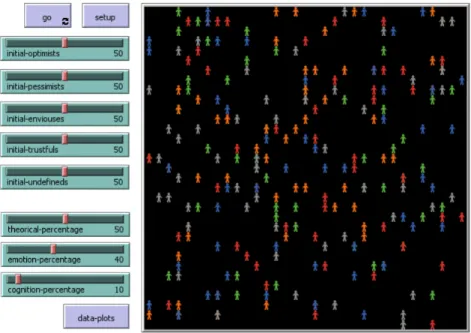
(54) 4.1.3. Cognition. The same way that we have used the agent’s ’memory’ for modelling emotion component of the PECS model, for the last remaining agent’s capability we have done the same. We have build an array with previous games done against agents for different values of T and S, and depending of the results that gave us best chances in the past, we are going to made our decision. For the initial part of the cognition, as we do not have previous records, we are taking a 20% of the total ticks of the simulation as training. We allow this ’licence’ based on trial and test sets done in areas that requires a learning, and this learning (or training) phase should take about 10-20% of the total set, so we will assume too that the first 20% of the set of data will be our ’training’. On the training stage we are going to made the decision in base to a formula that compute the average of scores for the current round of choosing to Cooperate or to Defect. If the condition is satisfied, we will choose to cooperate. Otherwise we will defect. (R + S)/2) >= ((T + P )/2). 4.2. Tool changes. In order to make capable of make decisions not only by agent personality and embed PECS model, we have need to make some changes on our tool. Besides the changes on the methods (that are explained in the next section), the variables and the interface, we have added a new check too based in the three new variables that we are going to introduce in this section, called theoretical-percentage, emotional-percentage and cognitional-percentage. This checks guarantees that the sum of these three variables is not over 100 (total percentage).. 4.2.1. Variables. We needed to grant agents with new set of variable for being capable of handling the previous commented abilities. These are these variables: • payment: This arrays stores the results of all scores in games done by an agent. • payment-option-c: In this matrix we store the score results where we have cooperated for each value of S and T. 40.
(55) • payment-option-d: In this matrix we store the score results where we have defected for each value of S and T. • theoretical-percentage: Percentage (from 0 to 100) of the weight in the simulation of ’theoretical’ result. • emotional-percentage: Percentage (from 0 to 100) of the weight in the simulation of the emotional result. • cognitional-percentage: Percentage (from 0 to 100) of the weight in the simulation of cognitional result.. 4.2.2. Interface. As we have commented, also the interface suffered some changes due to the introduction of the PECS model. We had to add the capability of tuning the weight of each component that reach to a final action for deciding our final action. We have model it in a slider way to easier its modification:. Figure 20: Final interface of our tool. 41.
Figure
+7


Documento similar
In the preparation of this report, the Venice Commission has relied on the comments of its rapporteurs; its recently adopted Report on Respect for Democracy, Human Rights and the Rule
The draft amendments do not operate any more a distinction between different states of emergency; they repeal articles 120, 121and 122 and make it possible for the President to
The total and polarized emission of the C80/A80 structure, its lack of motion, and brightness temperature excess are best reproduced by a model based on synchrotron emission from
Drawing on the theory of cognitive dissonance and on previous research on how control systems affected individual behaviour, we examined the relationship between the perceptions
We first quantified the influence of phylogeny on variation in each trait by means of K statistics [28], to assess whether traits conserved a phylogenetic signal and
The sensitivity of a long-baseline experiment using Hyper-K and the J-PARC neutrino beam is studied using a binned likelihood analysis based on the reconstructed neutrino
The influence of the presence of rGO and the photocatalyst concentration on the radiation absorption inside the reactor was evaluated by solving a radiation model
Based on this, we studied whether innovative, marketing, financial, managerial, and human capabilities affect competitive success in terms of fostering innovation and the performance
