UNIVERSIDAD TÉCNICA PARTICULAR DE LOJA
La Universidad Católica de Loja
ÁREA SOCIO HUMANÍSTICA
TITULO DE LICENCIADO EN CIENCIAS DE LA EDUCACIÓN
MENCIÓN INGLÉS
Teachers and students´ perceptions of teaching English in small classes in
Ecuador
TRABAJO DE TITULACIÓN
AUTOR: Sarmiento Urgilés, Ana Margarita
DIRECTOR: Solano Jaramillo, Lida Mercedes, Mgs.
CENTRO UNIVERSITARIO DURAN
Esta versión digital, ha sido acreditada bajo la licencia Creative Commons 4.0, CC BY-NY-SA: Reconocimiento-No comercial-Compartir igual; la cual permite copiar, distribuir y comunicar públicamente la obra, mientras se reconozca la autoría original, no se utilice con fines comerciales y se permiten obras derivadas, siempre que mantenga la misma licencia al ser divulgada. http://creativecommons.org/licenses/by-nc-sa/4.0/deed.es
ii
Aprobación Del Director Del Trabajo De Titulación Magister.
Lida Mercedes Solano Jaramillo. DOCENTE DE LA TITULACIÓN
De mi consideración:
El presente trabajo de titulación: Teachers and students´ perceptions of teaching English in small classes in Ecuador realizado por Sarmiento Urgiles Ana Margarita, ha sido orientado y revisado durante su ejecución, por cuanto se aprueba la presentación del mismo.
Loja, febrero de 2016
iii
Declaración de autoría y cesión de derecho
“Yo Sarmiento Urgiles Ana Margarita declaro ser autor del presente trabajo de titulación: Teachers and students´ perceptions of teaching English in small classes in Ecuador, de la Titulación de Ciencias de la Educación mención Inglés, siendo Lida Mercedes Solano Jaramillo director del presente trabajo; y eximo expresamente a la Universidad Técnica Particular de Loja y a sus representantes legales de posibles reclamos o acciones legales. Además certifico que las ideas, conceptos, procedimientos y resultados vertidos en el presente trabajo investigativo, son de mi exclusiva responsabilidad.
Adicionalmente, declaro conocer y aceptar la disposición del Art. 88 del Estatuto Orgánico vigente de la Universidad Técnica Particular de Loja que en su parte pertinente
textualmente dice: “forman parte del patrimonio de la Universidad la propiedad intelectual de
investigaciones, trabajos científicos o técnicos y tesis o trabajos de titulación que se realicen
con el apoyo financiero, académico o institucional (operativo) de la Universidad”
f:……….
iv Dedication
v
Acknowledgment
I would like to give special thanks to my niece Ginger Bustamante and my Thesis Director Lida Solano because they were there for me in so many ways. Not only they
vi CONTENTS
Cover………... i
Aprobación Del Director Del Trabajo De Titulación……….…….. ii
Declaración de autoría y cesión de derecho……….…....iii
Dedication ... …………...iv
Acknowledgment ... ………..…..v
Contents……….………..……….vi
Abstract ... ……….1
Resumen. ... ……… 2
Introduction ... ……….3
Literature Review ... ……….5
Method ... …………...19
Discussion ... …………...20
Description, Analysis, and Interpretation of Results ... …………...20
Conclusions ... ………...39
Recommendations………40
References ... …………...41
1 Abstract
This research titled “Teachers and students´ perceptions of teaching English in small
classes in Ecuador”, whose purpose is to know teachers and students’ perceptions of teaching
and learning English in small classes.
The sample consisted of five EFL teachers and one hundred students from a private high school in the city of Guayaquil. The methods used were qualitative and quantitative; also, classroom observations and questionnaires were performed. The aim of the observations was to analyze classroom management, use of teaching strategies, resources, and interaction quality in five English classes. The questionnaires aimed to inquire teachers and students perceptions regarding the benefits of teaching and learning English in small classes. These also included teaching strategies, helpful resources, small classes and their possible limitations. Finally, results were presented in charts.
The most important conclusion shows that working in small classes favors the learning
process because interactions, including teachers’ feedback, enhance students’ achievement in
a supportive, challenging learning environment.
2 Resumen
Esta investigación Titulada "Percepciones de maestros y estudiantes en la enseñanza de Inglés en clases pequeñas en Ecuador", cuyo propósito es conocer las percepciones de profesores y estudiantes en la enseñanza y el aprendizaje de inglés en clases pequeñas.
La muestra consistió de cinco profesores de inglés y cien estudiantes de un colegio privado en la ciudad de Guayaquil. Los métodos usados fueron cualitativo y cuantitativo, también fueron realizados cuestionarios y encuestas en el salón de clase. El objetivo de estos cuestionarios era analizar el manejo de la clase, el uso de las estrategias y recursos de las enseñanzas y la calidad de la interacción en cinco clases de inglés. Los cuestionarios estaban orientadas a preguntar sobre las percepciones de los profesores y de los estudiantes acerca de los beneficios de la enseñanza y el aprendizaje de Inglés y las posibles limitaciones de trabajar en clases pequeñas. Finalmente los resultados fueron demostrados en tablas.
La conclusión más importante demuestra que trabajar en clases pequeñas beneficia el proceso de aprendizaje para la interacción incluyendo la retroalimentación de profesores, mejorar el rendimiento de los estudiantes en un ambiente propicio y desafiante.
3 Introduction
The current research is about teachers and students´ perceptions of teaching English in small classes. The purpose of this study is to research on Ecuadorian teachers and students’
perceptions of teaching and learning English in small classes. In order to achieve the purpose of this research, four questions have been answered; each of them includes a group of aspects oriented to provide a deeper understanding on this topic, the questions are: What are the benefits of teaching and learning English in small classes? What teaching strategies and resources improve teaching English in small classes? How do students feel about learning English in small classes? Are there any limitations when teaching English in small classes?
Also, some previous studies related to the topic have been conducted in many countries to analyze various aspects regarding teachers and students´ perceptions of teaching-learning English in small classes.
The first one was carried out by Harfitt (2012), whose purpose was to observe whether and how class size reduction might help to reduce language-learning anxiety, which has long been identified as an obstacle to L2 acquisition. The results showed that students reflect on
their experiences of studying in reduced-size classes in a mature and confident way. They reported that smaller classes promoted a strong sense of security within their classroom community and seemed to weaken their fears of negative evaluation from peers and teachers. They also reported that they felt more confident about participating in English lessons.
4
The results shows that all participants find it daunting to. Besides, teachers comment that despite their efforts to elevate the level of language learning in such context, the outcome of their students is considered to be unsatisfactory. They believe that this can be contributed to the fact that there are big numbers of students in one class and wish for the number to be reduced.
Finally, Blatchford, Bassett, and Brown (2005) carried out a study with the purpose of examining connections between: a) size of class and students’ progress, and b) size of class along with classroom processes, teacher-student behavior, and class grouping practices, teacher self-perceptions, assessment, and record keeping.
The results are clear in showing that an effect of small classes on individual attention did take place because there was more chance that pupils would be the focus of a teacher´s attention.
The present research offers new lights for institutions willing to improve English learning and their teaching learning-process. As a result, students will have a formation that not only allows them to be competent both at home as well as abroad allowing them to contribute on future research.
5
Literature Review
This section contains relevant information about teaching English in small classes. Topics related with the importance of managing learning, teacher-student interaction, student-student interaction, class size, teaching techniques, strategies or activities for teaching English to small classes, as well as learning environment. Also, it is presented a brief description of five previous studies regarding teacher and students´ perceptions of teaching English in small classes.
Managing learning
Teachers have the responsibility to guide students’ learning. Educators have to know
how to give effective instructions when teaching. According to Harmer (1998), instructions need to be clear and convey the meaning to the whole class before doing an activity. For this reason, Gower, Phillips, and Walters (2005) mention that teachers need to keep a simple
language appropriate to the students’ level; also, the teacher has to inform learners what
activity they are going to carry out, how it is organized, and its purpose. It is necessary that educators favor instruction with visual clues whenever possible.
Furthermore, Harmer (1998) mentions that giving a demonstration of the activity reinforces the instruction. Hence, Gower, Phillips, and Walters (2005, p. 41) say that
“Showing what to do is more effective than telling what to do”. In addition, they suggest that teachers perceive if students have understood the instructions given in order to assess how well they perform a task and to evaluate particular language strengths and weaknesses.
6
behavior, both as individuals and as a group. Feedback must be a regular part of the teaching process. Feedback activities should depend on the level and age of the learners, the language points you are dealing with, and the time it can take place after the learners have done an activity. It can also be carried on at the end of a series of activities or on a set day each week. In fact, at any time the teacher feels it will be useful. The role of the teacher is not to dominate, but to listen and interpret what the learners are saying in a more concise and coherent form. A feedback session is an opportunity for learners to contribute with their thoughts, feels, and ideas to the class (Rovegno&Bandhauer, 2013).
Rovegno and Bandhauer (2013) and Richards, Hull, and Proctor (1998) agree that a main function of the teachers is to give feedback to their students. Moreover, Bandhauer (2013) indicates that the aim of feedback is to bring about self-awareness and improvement. It means that learners have the opportunity to correct their mistakes. Furthermore, Richards, Hull, & Proctor (1998) say that feedback is classified in a positive and negative way, being the most effective the first one since it focuses on giving praise to students so they can feel motivated. Hence, Rovegno and Bandhauer (2013) note that teachers need to focus on the positive points of students when they give feedback, especially in oral and written works.
In addition, feedback can be given through praise and encouragement; corrections; setting regular tests; having discussion about how the group as a whole is doing; giving individual tutoring. Therefore, the process of giving feedback offers teachers the opportunity to become assessor of their students (Rovegno&Bandhauer, 2013).
7
instructional time, before and after class, getting ready to teach and manage your students (Richards & Farrell, 2011).
Rovegno and Bandhauer (2013) claim that performing multiple tasks is one benefit of practicing time management. When teachers are able to structure their classroom to make optimal use of their time, they can use the extra minutes to help those students who have special needs. For instance, while the teacher has one group of good readers doing a buddy read followed by a sequence chain, he might be working with students in a less capable group that need personalized attention with reading and comprehension skills.
Woolfolk (2007) points out that managing the time allotted for different activities might be a key role for teachers in achieving success in a lesson. Teachers must evaluate the necessary time for each activity. Planning-time for a lesson enables the teacher to have good judgment in choice taking.
Teacher- student and student-student interaction
Teacher–student interaction is one of the most powerful elements within the learning environment (Gaddy, Foseid,&Marzano, 2005). Moreover, a number of aspects including gender do not only influence teacher–student interaction, but in turn it also influences the students´ academic achievement and behavior. Supportive and positive relationship between teachers and students ultimately promote a sense of school belonging and encourage students to participate cooperatively in classroom activities (Hellermann, 2008).
8
teachers know their students so the planning of challenging activities is appropriate for the variety of different abilities within the learning environment (Hellermann, 2008). When teachers pursue positive relationships with students and tailor class work that enables students to construct their own meaning, students are more likely to behave and participate effectively in learning tasks.
On the other hand, student-student interaction addresses how well students communicate with one another in class. Classes where students have opportunities to communicate with each other help them to construct their knowledge effectively. By emphasizing the collaborative and cooperative nature of scientific work, students share responsibility for learning with each other, discuss divergent understandings, and shape the direction of the class. The pedagogy in action module on cooperative learning is a great place to learn more about structuring student-student interactions both in and out of the classroom (Austin, Dwyer,&Freebody, 2005).
According to Hellermann (2008) classes that have low interaction among students are more lecture-focused, often well organized, and tend to present material clearly with minimal text and well-chosen images. The instructor is usually well versed in the content, but this teaching do not provide an opportunity for interactions among students.
9
to all students and to provide sufficient time and opportunity to listen and consider the ideas of the students (Hellermann, 2008).
A teacher can consider structuring the class so that it provides opportunities for students to work in pairs and small groups and use multiple types of communication (e.g., discussions, making presentations, and brainstorming). This encourages students to work together as a class to contribute with a comprehensive answer to an open-ended problem. More students learn more when they work together, cooperatively, talking through the material with each other and making sure that all group members understand, than when students compete with one another or work alone individually. Students are more assertive about the subject being studied, the teacher, themselves as learners in that class, are more accepting of each other (male or female, handicapped or not, bright or struggling, or from different ethnic backgrounds) when they work together cooperatively (Hellermann, 2008). On the contrary, Austin, Dwyer, and Freebody (2005) say that many students do not have the basic skills in interacting with other people in a work group. These collaborative skills need to be taught by using actives as listening, checking other group members for understanding, etc. Student/student interaction is focused more on internal dynamics of cooperative groups and less on comparisons with competitive and individualistic goal structures.
Class size
Students’ class size is a remarkable point not only in large groups but also in smaller groups because it let us choose the adequate process, techniques, lesson plans, and learning styles, which are used into the English class. Lee (2005) claims that smaller classes have some advantages, one of them is when there are a few students, they have more probabilities to talk
10
However, Baker, and Westrup (2000) explain that large classes make difficult the learning and teaching procedure. In addition, large classes can present logistical problems when managing class and it is not easy to arrange lessons as in smaller classes. Consequently, teachers need to take care of how they order lesson activities and estimating the features of classroom physical space for certain activities.
On the other hand, Harmer (2007) says that the number of students variety in language classes because it relays on the education system where teachers work.
Taking into account the above mentioned by Harmer (2007), it is relevant to mention that some institutions have a very large number of students up to 40 per class, while others have 20 (small classes). Harmer (2007) also says that working with one student has its
advantages since educators focus on the student’s abilities and assess them more efficiently. Also, this researcher mentions that teachers adapt the syllabus and content to the student’
needs, interests, and learning styles. This is adequate for students who need individual attention. However, one-to-one classes also have disadvantages; for instance, they could induce tiredness and sleepiness on students and teachers making lessons boring (Harmer, 2007).Therefore, Baker and Westrup (2000) recommend that teachers need to be enthusiastic in order to keep a class interesting when teaching a one to one lesson.
11
Teaching techniques
Teaching techniques are activities that teachers use in classroom to include communicative processes, negotiation of meaning, and interaction to engage students into communication. To have a better comprehension about teaching techniques, it is essential to provide a definition. Richards, Hull, and Proctor (1998) mention that every activity a teacher undertakes soon after he enters the classroom until he leaves are teaching techniques. Furthermore, Raimes (1983) adds that teaching techniques have two different focuses since they can be aimed at student-centered activities, for example student-made reports, and can be teacher-centered, for example a lecture. Some teaching techniques used in the language classroom are mentioned below.
Raimes (1983) describes teaching techniques such as brainstorming, debating, and group discussion. Brainstorming is a technique that produces ideas about a particular subject or solution for a problem. Debating is a technique that allows students to present arguments to defend their points of view regarding a topic. Group discussion is a technique that gives the learners the opportunity to exchange their thoughts in an organized way. These three techniques help students increase their confidence while they are speaking.
12
while students listen and take notes. Regarding translation technique, Richards, Hull, and Proctor (1998) say that this technique enables teachers to give explanations through translation; this technique permits to give an equivalent meaning of English words and phrases in the students’ L2. With regard to dictation and story-telling, Raimes (1983) states that the dictation technique is familiar to most ESL teachers. The teacher reads a passage through once, and then reads it slowly, broken down into short meaningful segments, which the students write down, and then the teacher reads it through once more. In story-telling the students read each other`s continuations and some read theirs aloud to the whole class.
Additionally, other techniques that can be used for teaching English are choral pronunciation, definition question, and reformulation. Richards, Hull, and Proctor (1998) say that choral pronunciation involves the whole class in repeating the utterance being taught. Regarding definition question, Raimes (1983) comments that this technique helps teachers provide a definition of new vocabulary and ask the students to use it. In relation to reformulation technique, Lewis and Hill point out that this technique enables teachers to generate natural answers to their questions to avoid made up answers by students.
Learning environment in small classes
Meléndes and Beck (2010) affirm that learning environment is a mixture of social and physical qualities that create the classroom experience. This includes classroom management procedures, as well as the way classroom space is organized, furnished, and maintained.
Regarding this Woolfolk (2007) says that classroom management has a clear impact
on student’s achievement. For example, rules for classroom upkeep, including desks, and
13
for interaction with others. These vary according to the age group but generally include guidelines to respect others and their property, listening while others are speaking, and obeying school Rules (Woolfolk, 2007).
Harmer (2007) says that a well-organized classroom permits more positive interactions between teachers and children, reducing the probability for challenging negative behavior.
Woolfolk (2007) presents several guidelines on how teachers might arrange their English classroom to positively impact on their students' learning experience: assure students have easy access to learning materials and know where to store them. In addition, surfaces for studying and working should be clean and easily available when needed. Other guidelines include providing private work areas free of distractions for individual study or groups working separately. Moreover, teachers can arrange tables, desks and chairs in a way that prevents wide-open spaces for chasing (for the elementary grades). Desks should be placed within clear view of the teacher, whiteboard, or anything that students need to see to become effective learners.
Learning environment has been found to be a significant factor influencing the learning process. Woolfolk (2007) shows that there are many ways to arrange the seats in a classroom which differ mainly according to the type of interaction taking place between the class members, the features of the activities being carried out, and class size. For instance, orderly rows are used when there is a teacher to a whole class interaction or when the class is numerous. Rows have the advantage of allowing visual contact between the teacher and the learners; still, it is considered a limiting arrangement.
14
tables or café style which fits to small groups work; nevertheless, it is claimed that it does not favor whole class interaction as learners are usually too distributed around the classroom (Harmer, 2007).
In addition, Finn and Wang(2002) claim that behavior is systemic and skill-based, and many of the specific behavior expectations of schools and teachers are unique to their system. Students do not have these expectations imposed upon them in other settings, e.g. the home or peer group, and so do not use some of the skills required by the school other than in the school setting. Schools and teachers need to teach students the necessary skills and then revisit and reteach the skills, especially after periods when the student has been away from the school, e.g. on holidays or in a different school system.
Additionally, Kennedy (2005) mentions that teachers must establish a positive classroom environment where students are respectful of themselves and others to help reduce the risk of conflict.
Furthermore, classroom physical and emotional environment have an impact on learning, so it does the social environment. As our students meet each other at the beginning of each semester, anxieties about the demands of the course work are often increased by concern over other students in the class (Meléndes & Beck, 2010). Even if a student is highly motivated and has a high self-concept, without a supportive community, he or she will be unwilling to take risks, and without creative risk taking deep learning is not going to happen (Kennedy, 2005).
In the following pages, a brief description of five previous studies dealing with teachers and students´ perceptions of teaching English in small classes will be presented.
15
seen as an obstacle to L2 acquisition. The research process for this study relied on multiple case studies in four Hong Kong secondary schools. Each case involved a teacher of English language and Chinese students in a reduced-size class (between 21 to 25 students) and a large class (between 38 to 41 students) from the level grade, and of similar academic ability. Multiple interviews were conducted with the four teachers and data stemmed from group and individual interviews with 231 students. Student interview questions focused on their perspectives and experiences in studying in large and reduced-size classes. A total of 78 lessons were also observed across four case studies. The data was described and analyzed to identify any emergent patterns and themes.
The study’s conclusions were that the strength of the research approach adopted in this study lies in comparing what students say about their classroom context versus what they subsequently do in that classroom. Conclusions outlined earlier point to the need for a deeper review of students and teachers working in large and reduced-sized classes through the elaboration of longitudinal studies that capture the reality and fine details of the classroom context.
16
participating teachers were requested in the introduction letter to return the answered questionnaire in a sealed envelope to their principal. The project assistant went to the Principals and collected the data two weeks thereafter. A survey questionnaire was developed based on the research questions. Basically, the questions were open-ended. They were designed to collect the perceptions of the Chinese rural teachers on class size related issues.
The findings indicated that Chinese rural teachers did not see a necessary link between class size and student achievement. However, they believed that small classes facilitate classroom management, more student-teacher interactions, more individualized help from the teachers, and reduce teachers’ workloads. Chinese rural teachers also believed that competition among students promoted learning for students in large classes.
A similar study directed by Çakmak (2009) researched on the perceptions of student teachers on the effects of class size regarding effective teaching processes. The method used was open-ended questions. These were developed to gather data on the perceptions of teachers regarding class size. Teachers were asked: What are your thoughts on class size and its relation with motivation, teaching methods, techniques, classroom management, evaluation and assessment? Other questions were; what are your thoughts about the effects of class size on student achievement in the teaching process? And what are your thoughts on the effects of class size regarding teacher behavior in the teaching process?
17
The study’s conclusions were that the majority of student teachers who participated indicated that a close relationship exists between class size and student achievement, and also between class size and teacher behavior. Given the fact similar studies indicated no change in teacher behavior regarding class size; it may be argued that there seems to be differences on student teachers’ views on class size and their teaching practices.
Another study by Blatchford, Bassett, and Brown (2005) researched about teachers´ and students´ behavior in large and small classes. The study had two objectives; to evaluate links on: a) class size and students` progress, and b) class size and classroom processes such as teacher-student behavior within class grouping practices, teacher self-perceptions, assessment, and record keeping.
The study used a time sampling method on a sample of 257 children in 16 small (25 or below) and 26 large (31 and over) 6th grade classes (aged 10/11 years). In the small classes there was more individualized task related interaction between teacher and students as well as a more active role on students.
The research supports two conclusions: elementary school small class students are more engaged in learning behavior and less disruptive than students in larger classes. They also conclude that effects on processes appear to fade out on upper grades and that class size seems to affect student engagement more than teaching, though there is some evidence that
teachers’ interpersonal styles benefit from small class reductions.
18
of grammatical knowledge of EFL learners?, and What is the effect of cooperative in comparison to traditional small group learning on the achievement of writing skills of EFL learners?
The method employed was quantitative. The instrument used was a test with both a pre-test and a post-test to investigate the impact of cooperative learning on students’ English language achievements. The test comprised twenty multiple-choice questions. At the beginning of the test, the participants were asked to choose the correct answer from four options with a time limit of 40 minutes for this part. After that, students were required to write a paragraph to identify their productive grammar and time set for this part was 20 minutes. The time set for the whole test was 60 minutes. There were two marks for each correct answer in the multiple-choice question and ten marks for the writing task, making it fifty the total obtainable score.
19 Method
Setting and Participants
This study was conducted in the city of Guayaquil, Ecuador. The sample selected for this study was taken from five high school classrooms, where English was taught as a foreign language. The participants were five English teachers and one hundred students, who belonged to the 10thgrade of basic education to the 3rd year of senior high school. The students were girls between 14 and 17 years old.
Procedures
This research began with a literature review on topics related to the subject. It was also required to read five previous studies related to the researched topic.
The methodology applied in this study was qualitative and quantitative. The techniques used for this study were surveys, observations, and note-taking. To gather the data two questionnaires were administered, one for teachers and another for each student surveyed.
The teacher’sand the students’ questionnaire contained twenty-two questions.
In addition, it was necessary to observe a class in which the corresponding observation sheet was filled in. The information gotten from these sources was described and analyzed.
20
Discussion
Description, Analysis, and Interpretation of Results
In this section, the data gathered from this research is shown and analyzed following a qualitative and quantitative approach. In order to do this, the responses to each question in the teachers´ and students` questionnaires are displayed in statistical tables.
Qualitative and Quantitative Analysis
What are the benefits of teaching and learning English in small classes?
Table 1
Teachers’ Perceptions
NO In classes with a small number of students:
T
otally agree Agree
P ar ti all y agr ee Dis agr ee T OT AL
f % f % f % f % f %
1 It is easier to design activities that help students to apply what they have learned in class.
4 80 1 20 5 100
2 The students are attentive and participate in class
activities. 4 80 1 20 5 100
3 Classroom space allows students to properly do
the activities designed 4 80 1 20 5 100
4 Appropriate feedback can be given 4 80 1 20 5 100
5 Activities that allow more interaction among
students are performed. 4 80 1 20 5 100
6 There is more interaction between the teacher and the students
4 80 1 20 5 100
7 It is easier to remember students´ names 4 80 1 20 5 100
[image:27.595.88.521.372.584.2]Author: Ana Sarmiento Source: Teacher’s questionnaire
Table 2
Students’ Perceptions
NO In classes with a small number of students:
T
otally agree Agree
P ar ti all y agr ee Dis agr ee T OT AL
F % f % f % f % f %
1 The activities done in class help to apply what
21
2 The students are attentive and participate in class activities.
32 32 57 57 11 11 - -- 100 100
3 The students can better concentrate because there
is less noise in the classroom. 50 50 33 33 17 17 - -- 100 100
4 The classroom space allows students to carry out
the activities assigned by the teacher. 43 43 46 46 11 11 - -- 100 100
5 Students receive proper feedback form the teacher.
49 49 44 44 6 6 1 1 100 100
6 There is interaction between the students. 51 51 43 43 5 5 1 1 100 100
7 There is interaction between the teachers and
students. 69 69 26 26 5 5 - -- 100 100
8 The teacher remembers the students´ names. 34 34 52 52 14 14 - -- 100 100
Author: Ana Sarmiento Source: students’ questionnaire
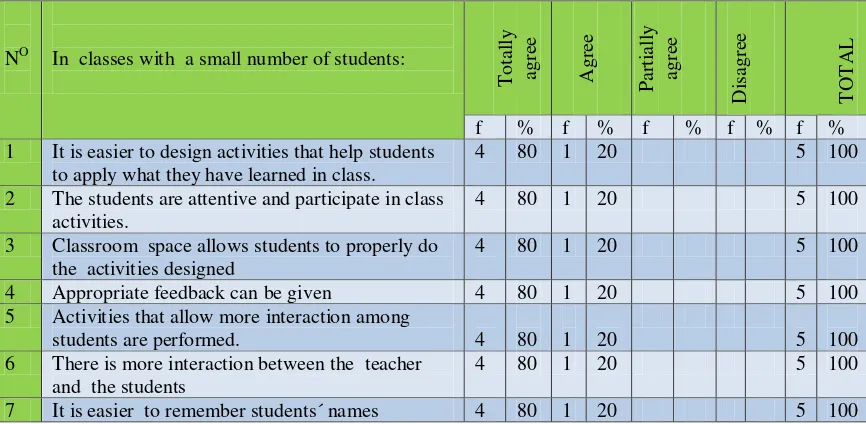
Statement 1 in table 1 reports that 80% (4 teachers) totally agree and 20% (1 teacher) agrees that in small classes it is easier to design activities that help students apply what they have learned.
On the other hand, based on students´ answers it was found on table 2 that 51% (51 students) totally agree, and 41% (41 students) agree, and 8% (8 students) partially agree that in small classes it is easier to design activities that help students to apply what they have learned.
The above mentioned results are corroborated with the observation performed since it was evident that teachers during their entire lessons used several activities to help students apply what they have learned. For example, describing pictures, debating, group discussions, role-play, and debates, among others.
Raimes (1983) states that the fundamental importance of teaching strategies is to make it easier to implement a variety of teaching methods and techniques. Teachers can also find a variety of strategies to help students take more responsibility of their own learning and to enhance the teaching learning process.
22
Regarding definition question, Raimes (1983) comments this technique helps teachers provide a definition of new vocabulary and ask students to use it.
Statement 2 in table 1 reports that 80% (4 teachers) totally agree that in small classes students are attentive and participative during class activities and 20% (1 teacher) agrees.
In contrast, table 2 indicates that 32 % (32 students) totally agree that in small classes they are attentive and participative during class activities, 57% (57 students) agree, and 11% (11 students) partially agree.
As a result of the observations, it can be said that students were attentive and participative in class because it was noticed that when the teacher explained the lesson, all the learners were in silence. It was also observed that when the teacher asked students some questions they were ready to participate and contribute with their ideas and opinions; all these aspects contributed to have great classes and an appropriate teaching-learning process.
Regarding this, Baker and Westrup (2000) mention that in small classes there are several ways to get students motivated to participate in class. For example, the teacher can give them an assignment they have to prepare to speak about, or the teacher may ask students to bring a quote from a passage they do not understand to discuss it in the classroom.
Regarding statement 3 on the students` questionnaire, table 2 indicates that 50% (50 students) totally agree that in small classes they can better concentrate because there is less noise in the classroom, 33% (33 students) agree, and 17% (17 students) partially agree. This
question is not included in the teachers’ questionnaire.
23
In this regard, Lee (2005) argues that discipline is paramount when students are
learning English in the classroom. Besides, when the teacher controls the class, it contributes to do not make unnecessary noises and students can concentrate better and assimilate what they are learning more quickly.
Statement 3 shows that 80% (4 teachers) totally agree and 20% (1 teacher) agrees that in classes with small number of students, the classroom space allows students to properly do the activities designed by them.
In statement 4, table 2 shows that 43% (43 students) totally agree that in classes with small number of students, the classroom space allows students to properly do the activities designed by the teacher, 46% (46 students) agree, and 11% (11 students) partially agree.
In the class observations, class space allowed to develop the designed activities adequately. Mostly, it was because the classroom was wide enough, which facilitated to develop activities properly; besides, the teacher could carry out pair and group work activities; furthermore, it was observed that the teacher could arrange seats as rows, and semi-circles. It was also evident that students displayed higher levels of adequate behavior during the activities developed in class.
In this regard, Woolfolk (2007) shows that there are many ways to arrange seats in a classroom which differ mainly according to the type of interaction that take place between the class members, the features of the activities being carried out, and class size. For instance, orderly rows are used when there is a teacher for the whole class interaction or when the class is numerous. Rows have the advantage of allowing visual contact between the teacher and the learners; still, it is considered a limiting arrangement.
24
Additionally, in the observed classes, it was evident that during all classes, feedback was used appropriately; for example, at the end of every lesson, the teacher made several questions to students, if the teacher noted some weaknesses; then the teacher provided appropriate feedback. Regarding to this, Rovegno and Bandhauer (2013) indicate that the aim of feedback is to bring about self-awareness and improvement. It means that learners have the opportunity to correct their mistakes.
This result is confirmed in the students´ questionnaire, in statement 5 in table 2 reports that 49% (49 students) totally agree, 44% (44 students) agree, 6% (6 students) partially agree, and 1% (1 student) disagrees that in small classes the teacher provides an appropriate feedback.
In this regard, Richards, Hull, and Proctor (1998) say that feedback is classified in a positive and negative way, being the most effective the first one since it focuses on giving praise to students so they can feel motivated.
Concerning to statement 5, in table 1 shows that 80% (4 teachers) totally agree that in small classes the activities that allow more interaction among students are performed and 20% (1 teacher) agrees.
These results are supported in the students´ questionnaire, statement 6, table 2 reports that 51% (51 students) totally agree that in small classes there is interaction among students, 43% (43 students) agree, 5% (5 students) partially agree, and 1% (1 student) disagrees.
25
of communication (discussions, making presentations, and brainstorming). This encourages students to work together as a class to contribute to a comprehensive answer to an open-ended problem. More students learn more material when they work together, cooperatively, talking through the material with each other, and making sure that all group members understand; than when students compete with one another or work alone, individually.
Additionally, Austin, Dwyer, and Freebody, (2005, p. 29) state that “Student-student interaction includes ´listening or talking to another student concerning topics that are no relevant to the tasks and showing no discernible involvement in the set task – observations
that would probably not shock most teachers”.
In statement 6, table 1 reports that 80% (4 teachers) totally agree that in small classes there is interaction among the teacher and students, and 20% (1 teacher) agrees.
In the same way in the students` questionnaire, statement 7, table 2 indicates that 69% (69 students) totally agree, 26% (26 students) agree, and 5% (5 students) partially agree that in small classes there is interaction among the teacher and students,.
Based on the observations performed this result was evident since the teacher made questions and students answered correctly, and students doubts were classified by applying error correction and helping learners understand a word or phrase.
Regarding interaction between teachers and students, Gaddy, Foseid, and Marzano (2005) say teacher–student interaction is one of the most powerful elements within the learning environment. In fact, school engagement and academic motivation, teacher–student relationship form the basis of the social context in which learning takes place.
26
Supportive and positive relationship between teachers and students ultimately promote a sense of school belonging and encourage students to participate cooperatively in classroom activities.
Similarly, the interaction between students was evident because they worked in the activities by talking to each other; this helped to discuss ideas in small groups. Tasks had the potential for more than one answer, which generated a deeper thinking process and facilitated the teaching learning process.
Statement 7 in table 1 reports that 80% (4 teachers) totally agree that in small classes, it is easier to remember students` names, and 20% (1 teacher) agrees.
Similarly, based on students´ questionnaire, in statement 8, table 2 shows that 34 % (34 students) totally agree that their teacher remembers their names, 52% (52 students) agree, and 14% (14 students) partially agree.
As stated in the results above, the greater number of teachers indicate that for them it is easy to remember students` names and it is confirmed with the results obtained from the students´ questionnaire.
However, the observed classes demonstrate that only 60% (3 teachers) remember students` name, and 40% (2 teachers) do not.
Regarding this fact, Gaddy, Foseid, and Marzano (2005) mention that teachers have to remember the students´ names because it helps to increase teacher-student interaction in the teaching-learning process.
27
teacher. Besides, activities allow more interaction among students and teacher-students. In addition, students are more eager to participate in the activities performed in class and it is easier to give feedback during and at the end of the lesson.
[image:34.595.88.518.274.479.2]What teaching strategies and resources benefit teaching English in small classes?
Table 3
Teachers’ Perceptions
NO In classes with a small number of students, it is
easier to: Totally agr
ee Agr ee P ar ti all y agr ee Dis agr ee T OT AL
f % f % f % f % f %
9 Design and apply activities that allow student to practice listening skills.
4 80 1 20 5 100
10 Design and apply activities that allow students to
practice speaking skills. 4 80 1 20 5 100
11 Design and apply activities that allow students to
practice reading skills. 4 80 1 20 5 100
12 Design and apply activities that allow students to
practice writing skills. 4 80 1 20 5 100
13 Design and apply group work activities 4 80 1 20 5 100
14 Design and apply individual activities. 4 80 1 20 5 100
15 Use technological tools 4 80 1 20 5 100
16 Use didactic materials 4 80 1 20 5 100
Author: Ana Sarmiento Source: Teacher’s questionnaire
Table 4
Students’ Perceptions
NO In classes with a small number of students:
T
otally agree Agree
P ar ti all y agr ee Dis agr ee T OT AL
f % f % f % f % f %
9 The activities done allow students to practice
listening skills. 53 53 33 33 12 12 2 2 100 100
10 The activities done allow students to practice speaking skills. 52 52 33 33 14 14 1 1 100 100 11 The activities done allow students to practice
reading skills. 52 52 35 35 11 11 2 2 100 100
12 The activities done allow students to practice
writing skills. 63 63 33 33 4 4 -- -- 100 100
[image:34.595.92.535.596.769.2]28
Author: Ana Sarmiento Source: Student’s questionnaire
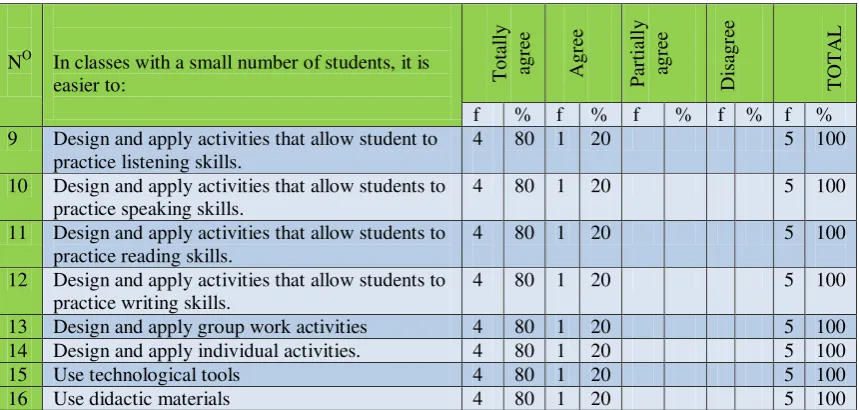
Concerning activities for listening skills, in statement 9, table 3 shows that 80% (4 teachers) totally agree and 20% (1 teacher) agrees that in small classes it is easier to design and apply activities that allow students to practice listening skills.
Similarly, based on students´ questionnaire, table 4 shows that 53% (53 students) totally agree that in small classes it is easier to design and apply activities that allow students to practice listening skills, 33% (33 students) agree, 12% (12 students) partially agree, and 2% (2 students) disagree.
It was evident in the observed classes that teachers used different activities to practice listening skills. It was noticed that the most used activities were role-play, interviews, and lectures. Besides, it is confirmed that students felt comfortable working with these activities because they helped them practice their listening skills.
Regarding listening activities, Raimes (1983) said that students are comfortable working with activities in the classroom specially when the teacher teaches listening skills, it is up to teacher ensure that students have a chance not only to use the new language but also to play with it. Students also need to experiment with new words and new sentence types.
Besides, statement 10 in table 3 reveals that 80% (4 teachers) totally agree and 20% (1 teacher) agrees that in small classes it is easier to design and apply activities that allow students to practice speaking skills.
The observed classes showed that the five surveyed teachers used activities to practice speaking skills. For example, teachers used choral pronunciation, definition question, and reformulation.
14 Individual activities are used. 63 63 34 34 3 3 - -- 100 100
15 Technological tools are used. 41 41 34 34 23 23 2 2 100 100
29
Regarding choral pronunciation, definition question and reformulation, Richards, Hull, and Proctor (1998) said that these exercises can be used for both listening and speaking practice. They usually require students to work with a partner to practice expressions and pronunciation.
This fact is confirmed by students in table 4 who indicated that 52% (52 students) totally agree that in small classes it is easier to design and apply activities that allow students to practice speaking skills, 33% (33 students) agree, 14% (14 students) partially agree, and 1% (1 student) disagrees.
Based on the observations, it was evident that the majority of students participated in speaking activities; for instance, when the teacher made them repeat words or phrases, students imitated the pronunciation until they had it right.
Concerning statement 11 in table 3, it shows that 80% (4 teachers) totally agree and 20% (1 teacher) agrees that in small classes it is easier to design and apply activities that allow students to practice reading skills.
Table 4 reports that 52% (52 students) totally agree that in small classes it is easier to design and apply activities that allow students to practice reading skills, 35% (35 students) agree, 11% (11 students) partially agree, and 2% (2 students) disagree.
Comparing the mentioned data above with the observed classes, it can be said that five teachers used activities to practice reading skills, and the most used activities were dictation and story-telling. It was also noticed that students liked and enjoyed these activities.
30
present the first paragraph of a text, to revise an area of vocabulary, to provide a summary of a reading or listening exercise, and to provide practice in different areas of grammar.
Regarding, statement 12 in table 3 shows that 80% (4 teachers) totally agree that in small classes it is easier to design and apply activities that allow students to practice writing skills and 20% (1 teacher) agrees.
Table 4 indicates that 63% (63 students) totally agree that in small classes the activities done allow students to practice writing skills, 33% (33 students) agree, and 4% (4 students) partially agree.
It was evident in the observed classes that at least one writing practice activity was used; this activity was role-play writing. The activity consisted in drawing three pictures on the board about three people (two women and a man). Then the teacher read the situation from the role-play to their students to explain how they all met. Finally, the class was divided into four groups to practice writing skills by writing letters to each other.
Regarding role-play writing, Richards, Hull, and Proctor (1998) stated that role-play writing can be much more motivating if teachers give students a chance to play a role. In this activity, the students will have the chance to write to an imaginary romantic partner.
Statement 13 in table 3 reveals that 80% (4 teachers) totally agree that in small classes it is easier to design and apply group work activities, and 80% (4 teachers) totally agree, and 20% (1 teacher) agrees.
These results are supported in the student’s questionnaire, table 4 indicates that 48 %
31
In the observations, it was confirmed that only three teachers used group activities, and the most used Jigsaw. It was also observed that two teachers did not form groups to work with the students, and used individual activities instead.
Concerning jigsaw activity, it was observed that students were grouped into teams to solve a problem or analyze a reading. These were also done in two ways – either each team worked on completing a different portion of the assignment and then contributing their knowledge to the class as a whole, or within each group. All these activities allowed great classes and an appropriate teaching - learning process.
Concerning group activities applied by the teacher in class, Richards, Hull, and Proctor (1998) stated that group work activities are important because these give students the opportunity to learn from each other, teaches them communication skills and helps to interact and develop interpersonal relationship skills among students.
Regarding individual activities, statement 14 in table 3 reports that 80% (4 teachers) totally agree that in small classes it is easier to design and apply individual activities and 20% (1 teacher) agrees.
Based on student’s answers, table 4 indicates that 63% (63 students) totally agree that
in small classes it is easier to design and apply individual activities, 34% (34 students) agree, and 3% (3 students) partially agree.
In the observed classes, it was evident that teachers used individual activities in class; for example, each of the students developed a mental map of their community and they gave a meaning to the place where they live. In this activity, each student used a set of questions to interview four peers in class.
32
Statement 15 in table 4 indicates that 41% (41 students) totally agree, 34% (34 students) agree, 23% (23 students) partially agree, and 2% (2 students) disagree that in small classes it is easier to use technological resources.
Nonetheless, the observed classes show that only three teachers used technological resources; in fact, the most commonly used were CD players and laptops which were used to show power point presentations on a projector. On the other hand, two teachers did not use any technological resources in their classes.
Raimes (1983) stated that audio-visuals are different types of useful materials, devices, and symbols which make the study of a subject more comprehensible and interesting. For instance, audio aids such as tape recording, background music to promote a relaxed environment; and the course book in order to follow a revised content sequence.
Statement 16 in table 3 shows that 80% (4 teachers) totally agree and 20% (1 teacher) agrees that in small classes it is easier to use didactic material.
Table 4 reports that 41% (41 students) totally agree, 49% (49 students) agree, 7% (7 students) partially agree, and 3% (3 students) disagree that in small classes it is easier to use didactic material.
Based in the observations performed, it was evident that all teachers (5 in total) used different teaching materials in class. The most commonly used in all classes were flashcards, magazines, pictures, wall-charts, and multimedia-projector. In this regard, Rovegno and Bandhauer (2013) state that teaching materials support students´ learning and increase students´ success during the teaching-learning process.
33
Besides, the resources used by teachers were CD players, laptops, slide projectors, and other materials commonly used as flashcards, magazines, pictures, and wall-charts.
[image:40.595.88.520.277.444.2]How do students feel about learning English in small classes?
Table 5
Teachers’ Perceptions
NO In classes with a small number of students:
T
otally agree Agr
ee P ar tia lly ag re e D is ag re e T O T A L
f % f % f % f % f % 17 They are relaxed when speaking in front of their
classmates. 4 80 1 20 5 100
18 They are taken into account by the teacher because
they have more opportunities to participate in class. 4 80 1 20 5 100
19 They are motivate to participate because of the small
number students. 4 80 1 20 5 100
20 They are at ease because they can healthy compete with their classmates.
4 80 1 20 5 100
Author: Ana Sarmiento Source: Teacher’s questionnaire
Table 6
Students’ Perceptions
NO In classes with a small number of students: Totally Agr
ee Agr ee P ar ti all y agr ee Dis agr ee T OT AL
f % f % f % f % f %
17 I am relaxed when speaking in front of my
classmates. 50 50 38 38 11 11 1 1 100 100
18 I am taken into account by the teacher because I
have more opportunities to participate in class. 53 53 38 38 9 9 -- -- 100 100
19 I am motivated to participate because of the
small number of classmates. 49 49 40 40 11 11 -- -- 100 100
20 I am at ease because I can healthy compete with my classmates.
60 60 32 32 7 7 1 1 100 100
[image:40.595.89.534.532.697.2]34
As it is observed in table 5, statement 17 reveals that 80% (4 teachers) totally agree and 20% (1 teacher) agrees that in small classes, students are relaxed when speaking English in front of their classmates.
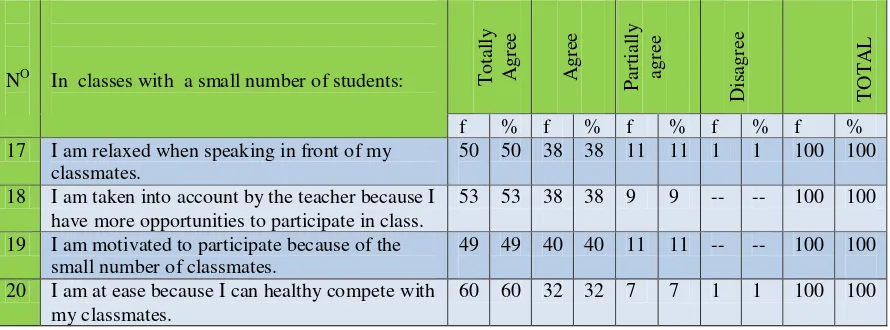
Similarly, based on students´ questionnaire in table 6, it was found that 50% (50 students) totally agree that in small classes, they feel relaxed when speaking English in front of their classmates, 38% (38 students) agree, 11% (11 students) partially agree, and 20% (1 student) disagrees.
It was observed that students were relaxed when they spoke in front of their classmates. It was also evident that when learners had to interact, they used English without any problem. There was not difficulty to communicate with their peers.
Concerning to speaking English in front of the class, Finn and Wang (2002) mention that through speaking English in class students can become truly proficient in the language; besides, it can be intimidating to speak a foreign language, especially in front of native speakers, but it has to be done to become fluent.
Statement 18 in table 5 reports that 80% (4 teachers) totally agree and 20% (1 teacher) agrees that in small classes, the students are taken into account by the teacher because they have more opportunities to participate in class.
These results were supported in the students´ questionnaire because it was found in table 6 that 53% (53 students) totally agree that in small classes, they feel taken into account because they have more opportunities to participate in class, 38% (38 students) agree, and 9% (9 students) partially agree.
35
to have every student participating in the same way or at the same rate, but by creating an environment in which all participants have the opportunity to learn and in which the class explores issues and ideas in depth, from a variety of viewpoints.
Statement 19 in table 5 shows that 80% (4 teachers) totally agree and 20% (1 teacher) agrees that students feel motivated to participate because there are few classmates in class.
Similarly, based on students´ questionnaire, it was found in table 6 that 49% (49 students) totally agree, 40% (40 students) agree, and 11% (11 students) partially agree that they feel motivated to participate because they are few students in the classroom.
Based on the observations performed, it was evident that students were motivated during the entire lesson. The students raised their hands to participate and motivate other students to do it.
On this topic, Finn and Wang (2002) state that teachers can create a positive learning environment in the classroom, which will allow students feel comfortable, safe, and engaged
– something that all students deserve. In a classroom where values and roles remain constant and focus is placed on the positive aspects of learning, students will be more open to participate in class actively.
Statement 20 in table 5 shows that 80% (4 teachers) totally agree and 20% (1 teacher) agrees that in classes with a small number of students, they feel at ease because they can safely compete with their classmates.
36
Analyzing the observation sheet, it was evident that students could compete safely among themselves; for example, during the lessons learners were free of violence or aggression. The teaching process was comfortable which made it easier for students to learn English.
Regarding safe competition with classmates, Lee (2005) asserts that competition between students within the class can contribute to create positive attitudes, mutual reliance, and companionship for each other.
Finally, based on the results, it can be said that students feel motivated and comfortable during the English lessons; furthermore, they have a greater opportunity to participate in the different activities in class; students are also relaxed when they speak English in front of their classmates because of class size. So, it can be stated that small classes allow students to safely compete with their classmates during the teaching-learning process.
Are there any limitations when teaching English in small classes?
Table 7
Teachers’ Perceptions
NO In classes with a small number of students:
T
otally Agree Agr
ee P ar tia lly ag re e D is ag re e T O T A L
F % f % f % f % f % 21 There is anxiety among students because there is
more control form the part of the teacher. 3 60 2 40 5 100
22 Listening and speaking skills are more difficult to
develop. 3 60 2 40 5 100
37 Table 8
Students’ Perceptions
NO In classes with a small number of students:
T
otally Agree Agree
P ar ti all y agr ee Dis agr ee T OT AL
F % f % f % f % f %
21 There is anxiety among students because there
is more control on the part of the teacher. 35 35 44 44 15 15 6 6 100 100
22 Listening and speaking skills are more difficult
to develop. 23 23 45 45 24 24 8 8 100 100
Author: Ana Sarmiento Source: Student’s questionnaire
Statement 21 in table 7 shows that 60% (3 teachers) totally agree and 40% (2 teachers) agree that in small classes there is anxiety among students because there is more control by the teacher.
These results are supported in the student’s questionnaire as table 8 indicates that 35% (35 students) totally agree, 44% (44 students) agree, 15% (15 students) partially agree, and 6% (6 students) disagree that in small classes there is anxiety among students because there is more control by the teacher.
Moreover, the observations showed that students did not feel strained by the control teachers had in class. Regarding this, Meléndes and Beck (2010) argue that the most important thing is to make students feel comfortable when teachers control them in class. If teachers want to make children feel comfortable in the classroom, they can make a conscious effort to reach out to every individual smile, to pat shoulders gently, and to use children's name. Doing this helps students to do not feel tense in the classroom.
38
Similarly, table 8 indicates that 23% (23 students) totally agree, 45% (45 students) agree, 24% (24 students) partially agree, and 8% (8 students) disagree that in small classes listening and speaking skills are more difficult to develop.
However, through the observations performed, it was noticed that during class there was not any difficulty to practice listening and speaking skills. In fact, students felt confident while developing listening and speaking skills; some of the activities performed were debates, CD recordings among other. Regarding listening and speaking, Lee (2005) said that both
students and teachers must build a strong rapport in order to create an effective learning environment. Some important listening and speaking skills are enunciation, projecting, and active listening.
39
Conclusions
Most of teachers give appropriate feedback to learners during the lesson because of the small number of students; it helps students understand English lessons and gives them clear guidance on how to improve their learning.
Classroom space allows students to interact among them because of the small number of students, which helps to develop activities such as language games, role-play, group work, and other activities that encourage whole class participation.
In small classes, it was evident that all teachers (5 in total) used different teaching materials in class. The most commonly used in all classes were flashcards, magazines, pictures, wall-charts, and multimedia-projector.
In small classes, it was noticed that there was not any difficulty to practice listening and speaking skills. In fact, students felt confident while developing listening and speaking skills; some of the activities performed were debates, CD recordings among other.
Students are relaxed and motivated because of the small number of classmates; it allows students to express themselves in front of their classmates using English and safely competing with their classmates.
40
Recommendations
In small classes, teachers should use a variety of technological resources such as video, tape/Cd recorders, computer(s), and smart board in order to increase the students’ learning
and motivation.
Teachers should arrange students´ seats in different ways; for instance, U-shape or/horseshoe, rectangle, stadium seating, and groups to increase students´ attention when learning English in small classes.
41 References
Alghamdi, R., &Gillies, G. (2013).The impact of cooperative learning in comparison to
traditional learning (small groups) on EFL learners’ outcomes when learning English
as a foreign language.Asian Social Science, 9(13), 19-27.
Austin, H., Dwyer, B., &Freebody, P. (2005).Schooling the child: The making of students in classrooms. New York: Routledge.
Baker, J., &Westrup, H. (2000).The English Language teacher´s handbook: How to teach large classes with few resources. New York, NY: Continuum.
Blatchford, P., Bassett, P., & Brown, P. (2005) Teaches´ and pupils´ behavior in large and small classes: a systematic observation study of pupils aged 10/11 years. Journal of Educational Psychology, 97 (3), 454-467.
Çakmak, M. (2009). The perceptions of student teachers about the effects of class size with regard to effective teaching process. The Qualitative Report, 14 (3), 1-14.
Din, F. (1999). The functions of class size perceived by Chinese rural school teachers.National Forum of Applied Educational Research Journal, 12 (3), 1-5.
Finn, J.,& Wang, M. (2002).Taking small classes one step further. Washington, DC:
International Age Publishing.
Gaddy, B., Foseid, M., &Marzano, J. (2005). A Handbook for classroom management that works.Alexandria, VA: Cover art.
Gower, R., Phillips, D., & Walters, S. (2005). Teaching practice handbook: A Handbook for teachers in training. Oxford: Macmillan-Heinemann.
Harfitt, G. (2012). Class size and language learning in Hong Kong: The students’ perspective.
42
Harmer, J. (1998).How to teach English: An introduction to the practice of English language teaching. Edinburgh, England: Addison Wesley Longman Limited.
Harmer, J. (2007).How to teach English. England: Pearson Education Limited.
Hellermann, J. (2008). Social actions for classroom language learning. Tonawanda, NY:
Cromwell Press.
Kennedy, M. (2005).Inside teaching: How classroom life undermines reform. Cambridge,
MA: Harvard University Press.
Lee, S. W. (2005). Encyclopedia of school psychology. London, UK: Sage Publications.
Meléndes, W., & Beck, V. (2010).Teaching young children multicultural classroom: Issues, concepts, and strategies (3rd ed). Belmont, CA: Cengage Learning.
Raimes, A. (1983). Techniques in teaching writing. Oxford: Oxford University Press.
Richards, J., &Farrell, T. (2011).Practice teaching: A reflective approach. New York, NY:
Cambridge University Press.
Richards, J., Hull, J., & Proctor, S. (1998). New interchange: English for international communication (2nd ed).Cambridge, Cambridge University Press.
Rovegno, I., &Bandhauer, D. (2013).Elementary physical education: Curriculum and instruction. Burlington, MA: Jones &Barlett Learning.