Integrating Defeasible Argumentation with
Fuzzy ART Neural Networks for Pattern Classification
Sergio Alejandro G´omez
Artificial Intelligence Laboratory∗
Department of Computer Science and Engineering – Universidad Nacional del Sur
Av. Alem 1253 – B8000CPB Bah´ıa Blanca, ARGENTINA
Email:[email protected]
Carlos Iv´an Ches ˜nevar† Artificial Intelligence Research Group
Department of Informatics and Industrial Engineering – University of Lleida
C/Jaume II,69 - E-25001 Lleida, SPAIN
Email:[email protected]
ABSTRACT
Many classification systems rely on clustering techniques in which a collection of training examples is provided as an input, and a number of clustersc1, . . .cmmodelling some
conceptCresults as an output, such that every clusterciis
labelled aspositiveornegative. Given a new, unlabelled instanceenew, the above classification is used to determine
to which particular clustercithis new instance belongs. In
such a setting clusters can overlap, and a new unlabelled instance can be assigned to more than one cluster with con-flicting labels. In the literature, such a case is usually solved non-deterministically by making a random choice. This pa-per presents a novel, hybrid approach to solve this situation by combining a neural network for classification along with a defeasible argumentation framework which models pref-erence criteria for performing clustering.
Keywords:Machine Learning, Defeasible Argumenta-tion, Neural networks, Pattern Classification
1. INTRODUCTION
Many classification systems rely on clustering techniques in which a collection of labelled training examples{e1,e2, . . .en }(each of them labelled as positive or negative) is
provided as an input, and a number of clusters c1, . . .cm
modelling some conceptCresults as an output. Every clus-terciis labelled aspositive(resp. negative) indicating that
those examples in the cluster belong (resp. do not belong) to the conceptC. Given a new, unlabelled instanceenew, the
above classification is used to determine to which particular clustercithis new instance belongs. Should the clusterci
be labelled as positive (negative), then the instanceenewis
regarded as positive (negative). This approach has been ex-ploited in some applications such as the web document fil-tering agent Querando! [9] and in the counter-propagation neural network model [19]. In such a setting clusters can overlap, and a new unlabelled instance can be assigned to
∗Member of the Instituto de Investigaci´on en Ciencia y Tecnolog´ıa
In-form´atica.
†Partially supported by Projects CICYT TIC2001-1577-C03-03,
TIC2003-00950, and Ram´on y Cajal Program. Ministery of Science and Technology, Spain.
more than one clusterwith conflicting labels (ie., some
clus-ters are positive whereas others are negative). In the litera-ture, such a case is solved non-deterministically, usually by making a random choice.
This paper introduces a novel, hybrid approach to solve the above problem by combining a background theoryT speci-fied indefeasible logic programming(DeLP) [7] and a neu-ral networkNbased on the Fuzzy Adaptive Resonance The-ory model [2]. Given a new, unlabelled instanceenewit will
be first analyzed and classified using the networkN. Should enewbelong to one or more conflicting clusters, then
defea-sible argumentation based on the theoryT is used to make a decision based on preference criteria declaratively specified by the user.
The article is structured as follows. First in Section 2 we present a particular learning algorithm for neural networks, called Fuzzy Adaptive Resonance Theory (ART). Then, in Section 3 we introduce the fundamentals of DeLP, a de-feasible argumentation formalism. In Section 4 we show how to model clustering in terms of Fuzzy ART learning and DeLP, characterizing the user’s preference criteria in terms of adefeasible logic program. Section 5 presents a worked example of the proposed approach. Section 6 sum-marizes previous work related to combining argumentation with other machine learning techniques. Finally section 7 discusses the main conclusions that have been obtained and outlines some future research work.
2. FUZZY ART NEURAL NETWORKS: FUNDAMENTALS
Adaptive Resonance Theory (ART) [2, 19] is a class of neu-rally inspired models of how the brain performs clustering and classification of sensory data, and associations between the data and representation of concepts. Fuzzy ART per-forms unsupervised learning of categories under continuous presentation of inputs, through a process of ‘adaptive reso-nance’ in which the learned patterns adapt only to relevant inputs, but remain stable under irrelevant or insignificant ones. Thus the ART models solve the so-called
stability-plasticitydilemma where new patterns are learned without
forgetting those learned previously.
ana-log inputs (in the real interval[0,1]) [15, 16]. Familiar in-puts activate the category, whereas unfamiliar inin-puts trig-ger either adaptive learning by an existing category or a commitment of a new category. The behaviour of Fuzzy ARTs lends itself well to simple geometrical interpreta-tion of category prototypes ashyperrectanglesin the input space. These rectangles are allowed to overlap each other. Although Fuzzy ART always responds the same way to a familiar input —it recalls the smallest hyperrectangle con-taining this input—, the overlaps are inconvenient if cate-gories are mutually exclusive.
Next we present a synthetized version of the Fuzzy ART algorithm as well as the geometrical interpretation of its fast learning rule. For further details we refer the reader to [15].
Learning Algorithm
The Fuzzy ART learns acategorizationorclusteringof a sequence of examples presented to the network. Its learning algorithm is as follows [15]:
Category initialization: Each categoryjis represented by an 2M-dimensional vector wj= (wj1, . . . ,wj2M) of
adaptive weights. Before any input presentation oc-curs, each category is initially uncommitted, and its weights are initialized to one.
Complement coding: To avoid a category proliferation problem, the input is normalized by complement cod-ing. Letabe anM-dimensional vector(a1, . . . ,aM),
where 0≤ai≤1. The complement coded inputIis
obtained asI=(a1, . . . ,aM,1−a1, . . . ,1−aM)=(a,ac).
Category choice: Upon presentation of an inputI, achoice
function Tjis computed for each categoryj, withTj=
(|I∧wj|) / (α+|wj|). The norm operator| · |is defined
as|x|=∑2M
i=1|xi|, the symbol∧denotes the fuzzy AND
operator, i.e,x∧y= (min(x1,y1), . . . ,min(x2M,y2M)),
andαis a user-defined parameter,α>0. The cate-goryJfor which the choice functionTJis maximal is
chosen for the vigilance test.
Vigilance test: The similarity betweenwJ and I is
com-pared to a parameterρcalledvigilance, 0≤ρ≤1, in the following test:
|I∧wJ|
|I| ≤ρ. (1)
If the test is passed, then resonance occurs and learning takes place. Is the test is failed, then mismatch reset occurs: the value ofTj is set to -1 for the duration
of the current input presentation, another category is chosen and the vigilance test is repeated. Categories are searched until one that meets Eq. 1 is found. This category is said to be selected forI. It is either already committed or uncommitted, in which case it becomes committed during resonance.
Resonance: During resonance, the weight vectorwJof the
selected category is updated according to:
wJ(t+1) =β(I∧wJ(t)) + (1−β)wJ(t) (2)
whereβis a learning rate parameter, 0<β≤1. When
β=1, this special case is called fast learning. Once resonance is finished, a new input may be presented and the last three steps repeated.
Geometrical Interpretation of Learning
The Fuzzy ART has a very well known geometrical in-terpretation [15]. Each weight vector wj may be
writ-ten in the form wj= (uj,vcj) where uj and vj are M
-dimensional vectors corresponding to the two opposite cor-ners of a hyperrectangleRj. With fast learning Eq. 2
re-duces towJ(t+1) =I∧wJ(t) and the corners ofRj are
updated byuJ(t+1) =a∧uJ(t)andvJ(t+1) =a∨vJ(t),
where∨denotes the fuzzy OR operator, that is, x∨y= (max(x1,y1), . . . ,max(xM,yM)). When a committed
cate-gory is selected,RJexpands to the minimum hyperrectanlge
containing bothRJ and the inputa. Ifalies inside ofRJ,
thenRJis unchanged. Thus when a category jis
commit-ted, its size can only grow or remain the same.
Fuzzy ART as a Basis for Supervised Learning As explained above, the Fuzzy ART neural network learns a clustering of the input space. If we choose to label each one of these clusters either as positive or negative depending on a label assigned to training examples, the Fuzzy ART can be used as a basis for supervised learning.
Given a set S={e1,e2, . . . ,en}of positive and negative
training instances wrt some conceptC, the application of the Fuzzy ART neural network will result in a number of labelled clusters{c1,c2, . . . ,cn}. A cluster labelled as
pos-itive (resp. negative) will group instances belonging (resp. not belonging) to the conceptC. In the Fuzzy ART setting, conflict appears when a new unlabelled instance is classified as belonging tomore than one cluster with different labels. In the literature [15, 16], such situation is usually solved nondeterministically by making a random choice. Our pro-posal is to define a novel, hybrid approach to solve this problem by relying ondefeasible logic programming[7], an argument-based framework based on logic programming.
3. DEFEASIBLE ARGUMENTATION AND DEFEASIBLE LOGIC PROGRAMMING:
FUNDAMENTALS
Artificial Intelligence has long dealt with the issue of find-ing a suitable formalization for commonsense reasonfind-ing. Defeasible argumentation [22, 4, 18] has proven to be a suc-cessful approach in many respects, since it naturally resem-bles many aspects of human commonsense reasoning. As pointed out in [1], most argument-based frameworks share a number of common notions, namely:
1. Knowledge Base. Underlying logical language: Most argument-based frameworks involve a knowl-edge base K= (Π,∆) which provides background
knowledgeusing a first-order languageL. This
back-ground knowledge typically involves a setΠofstrict rulesandfactsas well as a set∆ofdefeasible rules.
2. Argument: An argument is a defeasible proof ob-tained from the knowledge baseKby applying suitable (defeasible) inference rules associated with the under-lying logical languageL.
defines a partial order among arguments, allowing to determine whenA defeats B. In order to determine whether a given argumentAis ultimately undefeated (orwarranted), a dialectical process is recursively car-ried out, where defeaters forA, defeaters for these de-featers, and so on, are taken into account.
Argumentation provides mostly a non-numerical,
quali-tative setting for commonsense reasoning. Contrasting
with defeasible argumentation, pattern classification relies mostly onquantitative aspectsof the data involved (such as numeric attributes or probability distributions). As we will see in the next sections, our final goal is to develop a hybrid approach in which both quantitative and qualitative features required for pattern classification are combined. Qualitative aspects will be captured in terms of defeasible argumenta-tion using DeLP, whereas quantitative ones will be captured by using Fuzzy Adaptive Resonance Theory.
Defeasible Logic Programming: Fundamentals
Defeasible logic programming (DeLP) [7] is a particular
formalization of defeasible argumentation [4, 18] based on logic programming. A defeasible logic program (delp) is a setK= (Π,∆)of Horn-like clauses, whereΠand∆stand for sets of strict and defeasible knowledge, respectively. The setΠof strict knowledge involvesstrict rules of the form p ← q1, . . . ,qk and facts (strict rules with empty
body), and it is assumed to benon-contradictory. The set
∆of defeasible knowledge involvesdefeasible rulesof the form p−≺−q1, . . . ,qk, which stands forq1, . . .qkprovide a
tentative reason to believe p. The underlying logical
lan-guage is that of extended logic programming, enriched with a special symbol “−≺− ” to denote defeasible rules. Both de-fault and classical negation are allowed (denotednot and
∼, resp.). Syntactically, the symbol “−≺−” is all what distin-guishes adefeasiblerulep−≺− q1, . . .qkfrom astrict
(non-defeasible) rulep← q1, . . . ,qk. DeLP rules are thus
Horn-like clauses to be thought of asinference rulesrather than implications in the object language.
Deriving literals in DeLP results in the construction of
argu-ments. An argument
A
is a (possibly empty) set of grounddefeasible rules that together with the setΠprovide a log-ical proof for a given literalh, satisfying besides the addi-tional requirements ofnon-contradictionandminimality.
Definition 1 (Argument) Given a DeLP program
P
, anargument
A
for a query q, denoted hA
,qi, is a subset ofground instances of defeasible rules in
P
, such that:1. there exists adefeasible derivationfor q fromΠ∪
A
,2. Π∪
A
is non-contradictory (ie,Π∪A
does noten-tail two complementary literals p and∼p (or p and
notp)), and
3.
A
is minimal with respect to set inclusion.An argument h
A
1,Q1i is a sub-argumentof anotherar-gumenth
A
2,Q2i ifA
1⊆A
2. Given a DeLP programP
,Args(
P
)denotes the set of all possible arguments that canbe derived from
P
.The notion of defeasible derivation corresponds to the usual query-driven SLD derivation used in logic programming,
performed by backward chaining on both strict and defea-sible rules; in this context a negated literal∼pis treated just as a new predicate nameno p. Minimality imposes a kind of ‘Occam’s razor principle’ [22] on argument con-struction: any superset
A
′ofA
can be proven to be ‘weaker’than
A
itself, as the former relies on more defeasible in-formation. The non-contradiction requirement forbids the use of (ground instances of) defeasible rules in an argu-mentA
wheneverΠ∪A
entails two complementary lit-erals. It should be noted that non-contradiction captures the two usual approaches to negation in logic programming (viz. default negation and classic negation), both of which are related to the notion of counterargument, as shown next.Definition 2 (Counterargument. Defeat) An argument h
A
1,q1i is acounterargumentfor an argumenthA
2,q2i iff1. There is an subargumenth
A
,qi ofhA
2,q2i such that the setΠ∪ {q1,q}is contradictory.2. A literalnotq1is present in the body of some rule in
A
1.An argumenth
A
1,q1i is adefeaterfor an argumenthA
2,q2i if hA
1,q1i counterargueshA
2,q2i, and hA
1,q1i ispre-ferred overh
A
2,q2i wrt apreference criteriononcon-flicting arguments. Such criterion is defined as a partial
order⊆Args(
P
)×Args(P
). For cases (1) and (2) above,we distinguish betweenproperand blocking defeaters as
follows:
• In case 1, the argumenth
A
1,q1iwill be called aproperdefeaterforh
A
2,q2i iffhA
1,q1iis strictly preferredoverh
A
,qiwrt.• In case 1, ifh
A
1,q1iandhA
,qi are unrelated to eachother, or in case 2,h
A
1,q1iwill be called ablockingdefeaterforh
A
2,q2i.Specificity [22] is typically used as a syntax-based criterion among conflicting arguments, preferring those arguments which aremore informedormore direct[22, 23]. However, other alternative partial orders could also be valid.
Computing Warrant Through Dialectical Analysis
An argumentation line starting in an argument h
A
0,Q0i(denoted λhA0,q0i ) is a sequence [h
A
0,Q0i, hA
1,Q1i, hA
2,Q2i, . . . ,hA
n,Qni . . . ] that can be thought of as anexchange of arguments between two parties, aproponent (even-indexed arguments) and anopponent (odd-indexed arguments). Each h
A
i,Qii is a defeater for the previousargumenth
A
i−1,Qi−1i in the sequence, i>0. In orderto avoidfallaciousreasoning, dialectics imposes additional constraints on such an argument exchange to be considered rationally acceptable:
• Non-contradictionGiven an argumentation lineλ, the set of arguments of the proponent (resp. opponent) should benon-contradictorywrt
P
. Non-contradictionfor a set of arguments is defined as follows: a setS=
Sn
i=1{h
A
i,Qii}iscontradictorywrt a DeLP programP
iffΠ∪Sni=1
A
iis contradictory.• No circular argumentationNo argumenth
A
j,Qji in• Progressive argumentationEvery blocking defeater
h
A
i,Qii in λ is defeated by a proper defeater hA
i+1,Qi+1i inλ.The first condition disallows the use of contradictory infor-mation on either side (proponent or opponent). The sec-ond csec-ondition eliminates the “circulus in demonstrando” fallacy (circular reasoning). Finally, the last condition en-forces the use of a stronger argument to defeat an argument which acts as a blocking defeater. An argumentation line satisfying the above restrictions is called acceptable, and can be proven to be finite [7].
Given a DeLP program
P
and an initial argumenthA
0,Q0i, the set of all acceptable argumentation lines starting inh
A
0,Q0i accounts for a whole dialectical analysis for hA
0,Q0i(ie., all possible dialogues abouthA
0,Q0ibetweenproponent and opponent), formalized as adialectical tree.
Definition 3 (Dialectical Tree) Let
P
be a DeLP program,and let
A
0be an argument for Q0inP
. Adialectical treeforh
A
0,Q0i, denotedT
hA0,Q0i, is a tree structure defined as
follows:
1. The root node of
T
hA0,Q0iish
A
0,Q0i.2. h
B
′,H′i is an immediate children ofhB
,Hi iff thereexists an acceptable argumentation line λhA0,Q0i =
[h
A
0,Q0i,hA
1,Q1i, . . . ,hA
n,Qni] such that there aretwo elementsh
A
i+1,Qi+1i=hB
′,H′i andhA
i,Qii = hB
,Hi, for some i=0. . .n−1.Nodes in a dialectical tree
T
hA0,Q0i can be marked as
un-defeatedanddefeatednodes (U-nodes and D-nodes, resp.).
A dialectical tree will be marked as anAND-ORtree: all leaves in
T
hA0,Q0iwill be marked U-nodes (as they have no
defeaters), and every inner node is to be marked asD-node iff it has at least one U-node as a child, and asU-node oth-erwise. An argumenth
A
0,Q0i is ultimately accepted asvalid (orwarranted) wrt a DeLP program
P
iff the root ofits associated dialectical tree
T
hA0,Q0iis labelled asU-node.
Given a DeLP program
P
, solving a queryqwrtP
accountsfor determining whetherqis supported by a warranted ar-gument. Different doxastic attitudes are distinguished when answering that queryqaccording to the associated status of warrant, in particular:
1. Believeq(resp. ∼q) when there is a warranted argu-ment forq(resp.∼q) that follows from
P
.2. Believeqisundecidedwhenever neitherqnor∼qare supported by warranted arguments in
P
.4. A HYBRID APPROACH COMBINING FUZZY ART NETWORKS AND DELP
As discussed in the introduction, conflict appears in the Fuzzy ART setting when a new unlabelled instance is clas-sified as belonging totwo or more clusters with different la-bels. The proposed hybrid approach involves combining a traditional Fuzzy ART networkNwith a background theory formalized as a DeLP program
P
. As the neural network Nis fed with a set of training examples, new facts encod-ing knowledge about such examples as well as the resultencod-ing cluster structure are added as part of a DeLP programP
. The programP
also models the user’s preference criteriato classify new, unlabelled instances belonging to conflict-ing clusters. This can be encoded by providconflict-ing appropriate
strict and defeasible rules as part of the program
P
. Several preference criteria among competing clusters are possible, such as:• The cluster with newer information is preferred over other ones (newer examples are considered more ac-curate than older ones).
• The cluster that subsumes more examples is preferred (the more examples are subsumed by a cluster proto-type, the more veritable the cluster label is).
• The smallest cluster containing the new instance is preferred (the smaller a cluster is, the more specific it is assumed to be).
It must be noted that the above criteria may be also in con-flict, making necessary to analyze which one prevails over the other ones. This ultimate decision will be made on the basis of a dialectical analysis performed by the DeLP infer-ence engine.
Figure 1 shows a sketch of an algorithm that combines the use of DeLP and the Fuzzy ART for determining the clas-sification of a new unlabelled instanceenewafter training
the Fuzzy ART networkN. The algorithm takes as input a Fuzzy ART neural network, a DeLP program
P
(char-acterizing a set of examples and preference criteria), and the data corresponding to a new unlabelled instanceenew.Such an instanceenew is first classified using the Fuzzy
ART neural network (modifying the cluster structure ac-cordingly if needed). In case that such a classification cannot be solved successfully by the networkN, then the program
P
is used to perform a dialectical analysis tode-cide how to label the new instanceE. To do so, a dis-tinguished predicateis(<NewInstance>,<Label>) will be considered. The classification will be (1) positive (pos) if the literalis(E,pos)is warranted from
P
; (2) negative (neg) if the literalis(E,neg)is warranted fromP
; (3) undecidedif neither (1) nor (2) hold. Is is important to note that if some argumenth
A
,hiis warranted, then there does not ex-ist a warranted argument for the opposite conclusion, i.e,h
B
,∼hi[7]. As a consequence, when analyzing thela-belling associated with a new instanceE, it cannot be the case that bothis(E,pos)andis(E,neg)hold, provided that posandnegare defined as opposite concepts.
5. A WORKED EXAMPLE
In this section we will discuss an example of how the pro-posed approach works. First we will describe how the train-ing of the neural network results in new facts added to a DeLP program
P
. Then we will show how to specify pref-erence criteria inP
. Finally we show how to apply thealgo-rithm shown in Figure 1 for solving a conflicting situation wrt a given unlabelled instanceenewand a particular
pro-gram
P
.Encoding Training Information
Suppose that a setS={p1,p2, . . . ,pk}of training instances
ALGORITHMClassifyNewInstance
INPUT:NetN, DeLP programP, new instanceE OUTPUT:pos,neg, undecided{Classification of E} BEGIN
Propagate unlabelled instanceEthrough NetN CL:= SetOfClustersContainingNewInstance(E,F)
IFeveryci∈CLisposOReveryci∈CLisneg
THEN RETURNLabel = label of anyci∈CL
ELSE
Solve queryis(P,pos)using DeLP programP IFis(P,pos)is warranted
THEN RETURNLabel=pos
ELSE
Solve queryis(P,neg)using DeLP programP IFis(P,neg)is warranted
THEN RETURNLabel=neg
ELSE RETURNLabel=undecided
END
Figure 1: High-level algorithm for integrating DeLP and the Fuzzy ART model
being learnt (see Figure 2). As the networkN is trained, new facts corresponding to a DeLP program
P
will be gen-erated to encode some of the above information, as shown below:point(p1,neg,5,coor(x1,y1)). trigger(p3,c2). point(p2,neg,7,coor(x2,y2)). trigger(p5,c1). point(p3,pos,9.9,coor(x3,y3)). trigger(p2,c3). point(p4,pos,10.7,coor(x4,y4)). cluster(c1,pos). point(p5,neg,12.5,coor(x5,y5)). cluster(c2,neg). . . . cluster(c3,neg).
c+1 c−2
c−3
q enew
Figure 2: Unlabelled instanceenewbelonging to conflicting
clustersc1,c2, andc3
Note that every new training instance corresponding to a point plabelled as sat timet with coordinates(x,y) re-sults in a fact point(p,s,t,coor(x,y)) added to the DeLP program
P
. When the dynamics of the neural networkde-termines that a new cluster is to be created by occurrence of a pointp, a new facttrigger(p,c)is added to
P
.Analo-gously, when the networkNdetermines that a clustercis la-belled as positive (resp. negative), a new factcluster(c,pos) (resp.cluster(c,neg)) is also added to
P
.Providing Preference Criteria
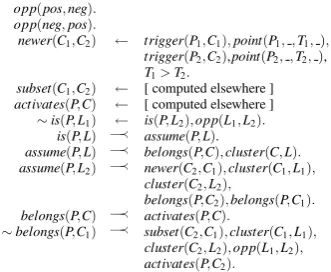
Figure 3 presents strict and defeasible rules that character-ize possible preference criteria among clusters. Predicate oppindicates thatposandnegare opposite concepts. Pred-icatenewer(C1,C2)holds whenever clusterC1is newer than C2. We adopt here one possible criterion, using the times-tamp associated with the trigger point for comparing clus-ters. Predicatesubset(C1,C2)holds whenever clusterC1is subsumed by clusterC2. This is assumed to be computed
opp(pos,neg). opp(neg,pos).
newer(C1,C2) ← trigger(P1,C1),point(P1, ,T1,), trigger(P2,C2),point(P2, ,T2,),
T1>T2.
subset(C1,C2) ← [ computed elsewhere ]
activates(P,C) ← [ computed elsewhere ] ∼is(P,L1) ← is(P,L2),opp(L1,L2).
is(P,L) −≺− assume(P,L).
assume(P,L) −≺− belongs(P,C),cluster(C,L). assume(P,L2) −≺− newer(C2,C1),cluster(C1,L1),
cluster(C2,L2),
belongs(P,C2),belongs(P,C1).
belongs(P,C) −≺− activates(P,C).
[image:5.595.317.483.70.206.2]∼belongs(P,C1) −≺− subset(C2,C1),cluster(C1,L1), cluster(C2,L2),opp(L1,L2), activates(P,C2).
Figure 3: Modelling preference among clusters in DeLP
elsewhere, based on the data structures of the neural net-workNwhere cluster information is stored. The same ap-plies to predicateactivates(P,C), which holds whenever a pointPfalls within clusterC. The definition of predicate isinvolves two parts: on the one hand, we specify that if a clusterCis labelled as positive (resp. negative), then it
is notnegative (resp. positive); on the other hand, we also
have a defeasible rule indicating that a clusterCgets a la-belLif we have tentative reasons to assume this to be so. The predicateassume(P,L)defeasibly holds whenever we can assume that a pointPgets a labelL. First, belonging to a clusterCwith labelLis a tentative reason to assume that pointPgets that labelL. If pointPbelongs to two clusters C1andC2, andC2is newer thanC1, this provides a tenta-tive reason to assume thatPshould be labelled as the newer clusterC2. IfPis found within clusterC(ie.PactivatesC), then usuallyPbelongs to clusterC. IfPbelongs to a cluster C2which is a subset of another clusterC1with a conflicting label, then this is a tentative reason to believe thatPdoes not belong toC1(the smaller cluster is preferred over the bigger one).
Performing Dialectical Analysis
Consider a new unlabelled instance enew, as shown in
Figure 2. As discussed before, in the traditional Fuzzy ART setting, such instance would be classified non-deterministically. A DeLP program
P
as the one presentedbefore can provide additional, qualitativeinformation for making such a decision. Asenewbelongs to the intersection
of clustersc1,c2andc3, and not all of them have the same label, the algorithm shown in Figure 1 will start searching for a warranted argument foris(enew,pos), which involves solving the queryis(enew,pos)wrt
P
. The DeLP inferenceengine will find an argumenth
A
1,is(enew,pos)i, with A1={(is(enew,pos)−≺− assume(enew,pos)),(assume(enew,pos)−≺−belongs(enew,c1),cluster(c1,pos)), (belongs(enew,c1)−≺−activates(enew,c1))}
supporting the fact thatenewshould be labelled as positive,
as it belongs to positive clusterc1. The DeLP inference en-gine will search (in a depth-first fashion) for defeaters for
h
A
1,is(enew,pos)i. A blocking defeaterhA
2,is(enew,neg)i,will be found, stating thatenewshould be labelled as
nega-tive as it belongs to neganega-tive clusterc2. Here we have A2={(is(enew,neg)−≺− assume(enew,neg)),
[image:5.595.88.264.344.489.2]Note in this case that Π∪
A
2 derives the complement ofA
1 (i.e. ∼is(enew,pos)) via the strict rule∼is(P,L1)←is(P,L2), opp(L1,L2) (see Figure 3). This second
argu-ment will in turn be defeated by a more informed arguargu-ment
h
A
3,is(enew,pos)i: the new instanceenewshould be labelledas positive as it belongs to both clustersc1andc2, but pos-itive clusterc1is newer than negative clusterc2. Here we have:
A3={(is(enew,pos)−≺− assume(enew,pos)), (assume(enew,pos)−≺− newer(c1,c2),cluster(c1,pos),
cluster(c2,neg),belongs(enew,c2),belongs(enew,c1)),
(belongs(enew,c1)−≺− activates(enew,c1))
(belongs(enew,c2)−≺− activates(enew,c2))
Note thath
A
1,is(enew,pos)icould not be used once again todefeath
A
2,is(enew,neg)i, as it would be a fallacious, circu-lar reasoning, which is disallowed in acceptable argumen-tation lines. However there is a fourth argument hA
4,∼belongs(enew,c1)i that can be derived from
P
whichdefeatsh
A
3,is(enew,pos)i, providing a more informedar-gument about the notion of membership for an instance: enewdoes not belong to clusterc1because that cluster sub-sumes clusterc3, andenewbelongs to clusterc3. Here we
have:
A4={∼belongs(enew,c1)−≺− subset(c3,c1),cluster(c1,pos), cluster(c3,neg),opp(pos,neg),activates(enew,c3)}
Note that the argument h
A
4,∼belongs(enew,c1)i is alsoa defeater for the first argument h
A
1,is(enew,pos)i. Thiscompletes the computation of the dialectical tree rooted in
h
A
1,is(enew,pos)i, as there are no more arguments to con-sider as acceptable defeaters. The dialectical tree can be marked as discussed before: leaves will be marked as un-defeated nodes (U-nodes), as they have no defeaters. Every inner node will be marked as a defeated node (D-node) if it has at least one U-node as a child, and as a U-node other-wise. The original argument (the root node) will be a war-ranted argument iff it is marked as U-node. In the preced-ing analysis, the resultpreced-ing marked dialectical tree is shown in Figure 4(a): nodes are arguments, and branches stand for acceptable argumentation lines. As the root of the tree is marked as D, the original argumenthA
1,is(enew,pos)i is not warranted. The DeLP inference engine will start searching automatically for other warranted arguments for is(enew,pos). Figure 4(b) shows the dialectical tree forh
A
3,is(enew,pos)i, in which hA
3,is(enew,pos)i is not awarranted argument. There are no other arguments for is(enew,pos)to consider. Following the algorithm shown in Figure 1, the DeLP inference engine will now start search-ing for warranted arguments foris(enew,neg). A warranted argument will be found, namelyh
A
2,is(enew,neg)i, whose dialectical tree is shown in Figure 4(c). Therefore, programP
allows us finally to conclude that the given unlabelled instanceenewshould be labelled as negative.DeLP: Implementation Issues
Performing defeasible argumentation is a computationally complex task. An abstract machine for an efficient im-plementation of DeLP has been developed, based on an extension of the WAM (Warren’s Abstract Machine) for Prolog. Several features leading to efficient implementa-tions of DeLP have been also recently studied, particularly
(a) (b) (c)
❅ ❅
A
D1
A
U2
A
4UA
D3
A
U4
A
D3
A
U4
A
U2
A
3DA
U4
Figure 4: Dialectical analysis for arguments
h
A
1,is(enew,pos)i, hA
3,is(enew,pos)i and hA
2,is(enew,neg)ithose related to comparing conflicting arguments by speci-ficity [23], pruning the search space [5], and logical prop-erties relating DeLP to normal logic programming [3]. In particular, the search space associated with dialectical trees is reduced by applyingα−βpruning. Thus, in Figure 4(a), the right branch of the tree is not even computed, as the root node can be already deemed as ultimately defeated af-ter computing the left branch.
6. RELATED WORK
The combination of machine learning and argumentation is a recent development. In a recent paper [8], we explored the combination of machine learning techniques and argu-mentation systems. To the best of our knowledge, there have been no similar approaches in this direction. There are many texts that explore the field of neural network ap-plications [15, 19, 25]. The area of clustering algorithms has a wide range of applications which include image pro-cessing, information retrieval [20], text filtering [10, 9], among others. In particular, the pitfalls of Fuzzy ART are exploited as an advantage for doing multiple catego-rization in [15], proposing a variation on the Fuzzy ART model. In early work for combining neural networks and rule sets [21], rules are used to initialize the neural network weights, whereas we use defeasible rules for revising a neu-ral network classificationa posteriori. Other approaches [13] involve algorithms for inducing a defeasible theory from a set of training examples. In our case, the defeasi-ble logic theory is assumed to be given. In [12], a method to generate non-monotonic rules with exceptions from pos-itive/negative examples and background knowledge is de-veloped. Such a method induces a defeasible theory from examples; in contrast, the proposed approach uses a defea-sible theory for improving an incremental categorization. Another hybrid approach includes an agent collaboration protocol for database initialization of a memory-based rea-soning algorithm [14], using rules for improving learning speed. In contrast, the proposal presented in this paper is aimed to improve learning precision.
7. CONCLUSIONS AND FUTURE WORK
The growing success of argumentation-based approaches has caused a rich cross-breeding with interesting results in several disciplines, such as legal reasoning [17], text classi-fication [11] and decision support systems [1].
with clustering techniques, making them more attractive and suitable for solving real-world applications. Argumen-tation provides a sound qualitative setting for common-sense reasoning, complementing thus the pattern classifi-cation process, which relies onquantitativeaspects of the data involved (such as numeric attributes or probabilities). Recent research in information technology is focused on developingargument assistance systems[24], i.e. systems that can assist users along the argumentation process. Such systems provide visual tools which help to keep track of the different issues that are raised and the conclusions that are drawn. We think that such assistance systems could be integrated with the approach outlined in this paper, com-plementing existing visual tools for clustering and pattern classification [6].
The algorithm presented in this paper has been implemented and tested successfully on several representative problems with different competing criteria for clustering. Part of our current research involves to test it with respect to some benchmark standard collections.1
8. REFERENCES
[1] D. Carbogim, D. Robertson, and J. Lee. Argument-based applications to knowledge engineering.
Knowl-edge Engineering Review, 15(2):119–149, 2000.
[2] G. Carpenter, S. Grossberg, and D. Rosen. Fuzzy art: Fast stable learning and categorization of analog pat-terns by an adaptive resonance system. Neural
Net-works, 4:759–771, 1991.
[3] C. I. Ches˜nevar, J. Dix, F. Stolzenburg, and G. R. Simari. Relating Defeasible and Normal Logic Pro-gramming through Transformation Properties.
Theo-retical Computer Science, 290(1):499–529, 2003.
[4] C. I. Ches˜nevar, A. Maguitman, and R. Loui. Logi-cal Models of Argument. ACM Computing Surveys, 32(4):337–383, Dec. 2000.
[5] C. I. Ches˜nevar, G. R. Simari, and A. Garc´ıa. Pruning Search Space in Defeasible Argumentation. InProcs.
of Workshop on Advances & Trends in AI, pages 46–
55. XX Intl. Conf. of the SCCC, Chile, Nov. 2000.
[6] I. Davidson. Visualizing Clustering Results. InProc. of 2nd SIAM International Conference on Data
Min-ing, Arlington VA, USA. SIAM, 2002.
[7] A. J. Garc´ıa and G. R. Simari. Defeasible Logic Pro-gramming: An Argumentative Approach.Theory and
Practice of Logic Programming, 4(1):95–138, 2004.
[8] S. A. G´omez and C. I. Ches˜nevar. Integrating De-feasible Argumentation and Machine Learning Tech-niques: A Preliminary Report. In Procs. V
Work-shop of Researchers in Comp. Science, pages 320–
324, 2003.
[9] S. A. G´omez and L. Lanzarini. Querando!: Un agente de filtrado de documentos web. Procs. of the VII
Ar-gentinean Conf. in Computer Science (CACIC), pages
1205–1217, 2001.
1E.g.http://www.ics.uci.edu/∼mlearn/MLRepository.html
[10] T. Honkela. Self-organizing maps in Natural
Lan-guage Processing.PhD thesis, Helsinky Univ., 1997.
[11] A. Hunter. Hybrid argumentation systems for struc-tured news reports. Knowledge Engineering Review, (16):295–329, 2001.
[12] K. Inoue and Y. Kudoh. Learning Extended Logic Programs. InProc. of the 15th IJCAI (vol.1), pages 176–181. Morgan Kaufmann, 1997.
[13] B. Johnston and G. Governatori. An algorithm for the induction of defeasible logic theories from databases.
In Proc. of the 14th Australasian Database
Confer-ence (ADC2003), pages 75–83, 2003.
[14] Y. Lashkari, M. Metral, and P. Maes. Collaborative interface agents. InReadings in Agents, pages 111– 116. Morgan Kaufmann, 1997.
[15] P. Lavoie, J. Crespo, and Y. Savaria. Generaliza-tion, discriminaGeneraliza-tion, and multiple categorization us-ing adaptive resonance theory. IEEE Transactions on
Neural Networks, 10(4):757–767, July 1999.
[16] J. Lubkin and G. Cauwenberghs. VLSI Implementa-tion of Fuzzy Adaptive Resonance and Learning Vec-tor Quantization. Analog Integrated Circuits and
Sig-nal Processing, 23:1–10, 2001.
[17] H. Prakken and G. Sartor. The role of logic in com-putational models of legal argument - a critical sur-vey. In A. Kakas and F. Sadri, editors,Computational
Logic: Logic Programming and Beyond, pages 342–
380. Springer, 2002.
[18] H. Prakken and G. Vreeswijk. Logical Systems for Defeasible Argumentation. In D. Gabbay and F.Guenther, editors,Handbook of Phil. Logic, pages 219–318. Kluwer Academic Publishers, 2002.
[19] V. Rao and H. Rao.C++ Neural Networks and Fuzzy
Logic, Second Edition. MIS Press, 1995.
[20] E. Rasmussen. Clustering algorithms. In W. Frakes and R. Baeza-Yates, editors, Information Retrieval, pages 419–442. Prentice Hall, 1992.
[21] J. Shavlik and G. Towell. An approach to combin-ing explanation-based and neural learncombin-ing algorithms.
Connection Science, 1(3):233–255, 1989.
[22] G. R. Simari and R. P. Loui. A Mathematical Treat-ment of Defeasible Reasoning and its ImpleTreat-mentation.
Artificial Intelligence, 53:125–157, 1992.
[23] F. Stolzenburg, A. Garc´ıa, C. I. Ches˜nevar, and G. R. Simari. Computing Generalized Specificity. Journal
of Non-Classical Logics, 13(1):87–113, 2003.
[24] B. Verheij. Artificial argument assistants for defea-sible argumentation. Artificial Intelligence Journal, 150:291–324, 2003.
[25] P. D. Wasserman. Neural Computing. Theory and