Efecto anabólico y androgénico del esteroide acetato
de trembolona en el guppy (Poecilia reticulata)
Anabolic and androgenic effect of steroid trenbolone
acetate on guppy (Poecilia reticulata)
Recibido el 14 de febrero de 2007 y aceptado el 23 de abril de 2008.
*Departamento de Química Orgánica, Escuela Nacional de Ciencias Biológicas, Instituto Politécnico Nacional, Prolongación de Carpio esq. Plan de Ayala, Col. Casco de Santo Tomás, 11340, México, D. F.
**Laboratorio de Sistemas Acuícolas, Departamento El Hombre y su Ambiente, Universidad Autónoma Metropolitana, Unidad Xochimilco, Calzada del Hueso 1100, Col. Villa Quietud, 04960, México, D. F.
Abstract
The effect of semi-synthetic steroid trenbolone acetate (TBA) on the ornamental fi sh Poecilia reticulata (guppy) was studied. The steroid at a dose of 300 mg/kg feed was administered to 30 days old juvenile specimens during 60 days. Forty days after treat-ment was ended, an evaluation aimed to determine the steroid residual effect was undertaken. Survival, masculinization ratio and the drug anabolic effect were analyzed. Results showed TBA to be effective to induce masculinization, differing (P < 0.001) with the control group, which registered 32% males and 68% females. TBA turned out to be an excellent anabolic as well, since treated fi sh showed weight increase, a larger body and an increased size of caudal fi n. The steroid did not cause any damage on the treated population. The survival factor was 93.3% for the treated fi sh as compared to 83% for the control group.
Key words: ANABOLIC STEROID, ORNAMENTAL FISH, GUPPY, POECILIA RETICULATA, MASCULINIZATION.
Resumen
Se investigó el efecto del esteroide semisintético acetato de trembolona (ATB) en el pez de ornato Poecilia reticulata (guppy). Especímenes juveniles de 30 días de edad fueron tratados con el esteroide a dosis de 300 mg/kg de alimento durante 60 días. Al término del tratamiento, 40 días después, se estimó el efecto residual del esteroide. Se analizó la sobrevivencia, la proporción de peces masculinizados, así como el efecto anabólico. Los resultados indicaron que el ATB es efi caz para inducir la masculinización, a diferencia del grupo testigo, donde se registraron 32% de machos. Asimismo, el ATB tuvo un efecto anabólico, ya que los peces tratados mostraron mayor peso y talla e incremento de la aleta caudal. El esteroide no causó daño en la población tratada, al sobrevivir 93.3% de los peces, comparado con 83% del grupo testigo.
Palabras clave: ESTEROIDE ANABÓLICO, PEZ ORNAMENTAL, GUPPY, POECILIA RETICULATA,
MASCULINIZA-CIÓN.
Héctor Salgado Zamora* Aída Azpeitia Hernández** Samuel Marañón Herrera** Eduardo Maya Peña**
Artemisa
Introduction
T
he guppy (Poecilia reticulata) is one of the most appreciated ornamental fi sh for its morpho-logical traits, reproduction and easy manage-ment, as well as for not requiring vast areas for its culture and for its relative low production cost, in rela-tion to culture of other fi shes.1The guppy commercial production in controlled spaces has allowed the creation of an industry whose profi ts reach several million dollars.2,3 In some
coun-tries, such as Singapore, intensive aquaculture proj-ects have been developed, where the guppy has been the main culture fi sh, for its production volume and amount of currency which generates.4
Sex reversal is used to investigate mechanisms related with sex determination and gonad differentia-tion in fi shes.5-7 At the same time, it is a useful tool for
increasing benefi ts derived from aquaculture, since monosexual populations provide traits which increase productivity.8
In the guppy, males develop more fl ashy secondary sexual traits than females, which makes them more valued than females;4-7 therefore, a production
strat-egy would be to induce fi sh into male sex.1
For some time, the use of steroids has been known to modify sex in ornamental fi sh. In particular, guppy has been masculinized by the use of 17α -methyltestos-terone steroid,6,9-12 11-ketotestosterone13 and
andro-stenedione.14
On its own, trenbolone acetate (TBA) has been applied as masculinizing agent with an effectiveness greater than 90% in channel catfi sh (Ictalurus
punc-tatus),15,16 blue tilapia (Oreochromis aureus)17 and Nile
tilapia (Oreochromis niloticus).18 In these studies there
are no reports in relation to any anabolic activity induced by the steroid.
TBA is a synthetic steroid with hormonal activ-ity similar to testosterone, but with a major anabolic activity19 and it has been successfully used in
poul-try, bovine, porcine and livestock. It is considered an anabolic sexual hormone according to Hoffman and Evers.20
The objective of the present study was to deter-mine the anabolic and androgenic effect of trenbo-lone acetate in juvenile specimens of Poecilia reticulata, as strategy to add major economical and income value to its culture.
Material and methods
Guppy juvenile specimens, king cobra variety, from 30 ± 1 day of age obtained under laboratory conditions were used; they were maintained in three aquariums
Introducción
E
l guppy (Poecilia reticulata) es uno de los peces de ornato más apreciado por sus característi-cas morfológicaracterísti-cas, reproducción y fácil manejo, así como por no requerir de extensiones grandes de terreno para su cultivo y porque su costo de produc-ción es relativamente bajo, con respecto al cultivo de otros peces.1La producción comercial del guppy en espacios controlados ha permitido la creación de una indus-tria cuyas ganancias ascienden a varios millones de dólares anuales.2,3 En algunos países, como Singapur,
se han desarrollado proyectos de acuicultura inten-siva; ahí el guppy es el principal pez de cultivo, por el volumen de producción y la cantidad de divisas que genera.4
La inversión sexual es utilizada para investigar los mecanismos relacionados con la determinación del sexo y diferenciación de las gónadas en peces.5-7 Al
mismo tiempo, es una herramienta útil para aumen-tar los benefi cios derivados de la acuicultura, ya que las poblaciones monosexuales proveen características que incrementan la productividad.8
En el guppy, los machos desarrollan caracteres sexuales secundarios más llamativos que las hembras, lo que los cotiza mejor que éstas;4,7 por tanto, una
estrategia de producción será inducir los peces al sexo masculino.1
Desde hace tiempo se conoce el empleo de esteroi-des para modifi car el sexo en los peces de ornato. En particular, el guppy ha sido masculinizado por el uso del esteroide 17 α-metiltestosterona,6,9-12
11-cetotestos-terona13 y androstendiona.14
Por su parte, el acetato de trembolona (ATB) se ha aplicado como agente masculinizante con efi cacia mayor de 90% en el bagre de canal (Ictalurus
puncta-tus),15,16 tilapia azul (Oreochromis aureus)17 y tilapia del
Nilo (Oreochromis niloticus).18 En estos trabajos no
exis-ten informes respecto de alguna actividad anabólica inducida por el esteroide.
El ATB es un esteroide sintético con actividad hor-monal similar a la testosterona, pero con mayor activi-dad anabólica19 y se ha empleado con éxito en forma
comercial en las industrias avícola, bovina, porcina y pecuaria. Se le considera como hormona sexual ana-bólica, según Hoffman y Evers.20
of 40 L, at 25 ± 1°C, with saturation oxygen concentra-tion of 6.6 mg/L and pH of 7.0 ± 0.5.
The experiment consisted of a completely random-ized design based on two experimental groups, with or without steroid, each treatment was done by triplicate with 45 fi sh, corresponding 15 per aquarium. TBA at 300 mg/kg of commercial food was used, incorpo-rated by alcohol evaporation.21 Feed preparation of
the control group was done with the same procedure (including alcohol), but without the steroid.
The experiment lasted 100 days and it was done in two periods: in the fi rst one, fi sh were subjected to TBA administration for 60 days, and the second one, in order to determine the residual effect, they were fed for 40 days with free steroid food.
Each week, morphometric parameters were recorded: total body length (BL), measuring from the start of the mouth to the base of the caudal fi n: caudal fi n length (CFL), from the base of the caudal fi n to its end; height (H), from the anal fi n to the base of the dorsal fi n, and weight (W). The length measurements were made with a vernier** (± 0.01 cm) and weight with a digital scale *** (± 0.001 g). Sex was determined at the end of the fi rst period by anal fi n recognition, modifi ed in males as gonopodium.22
The effectiveness of TBA was determined for each of the experimental periods with the following indi-cators: a) survival, b) masculinization, c) fi sh growth, estimated at two levels: punctually, with BL, CFL, H and W; according to functions: specifi c growth rate: (SGR = fi nal weight – initial weight/time × 100), and caudal fi n proportion in relation to body length (CFPBL).
Statistical analysis
To estimate the differences between sex proportion, a chi square with Yates correction was done.23 The
survival records for each of the treatment repetitions were transformed into an arcsine function for bino-mial data expressed as fractions,24 next a two factor
(experimental and period groups) analysis of variance was applied. Growth was analyzed in the following way: Bartlett’s test was used to prove the homogeneity of the variances of: BL, CFL, H, W, SGR and CFPBL; if resulting signifi cant (P < 0.05), a logarithm trans-formation was done, later an analysis of variance was performed to determine differences between groups, if resulting signifi cant (P < 0.05), it was estimated between which groups by Tukey test.24 Finally, to
determine the growth of the fi sh while passing from the fi rst to the second experimental period, the incre-ment, in percentage, of each variable was estimated and afterwards the same procedure for the growth variables was performed.
Material y métodos
Se emplearon especímenes juveniles de guppy, varie-dad king cobra, de 30 ± 1 días de evarie-dad, que fueron obtenidos en condiciones de laboratorio; se les man-tuvo en tres acuarios de 40 L, a 25 ± 1°C, con concen-tración de oxígeno a saturación de 6.6 mg/L y pH de 7.0 ± 0.5.
El experimento consistió en un diseño completa-mente aleatorio con base en dos grupos experimen-tales, con y sin esteroide; cada tratamiento se realizó por triplicado con 45 peces, correspondiendo 15 por acuario. Se utilizó ATB a 300 mg/kg de alimento comercial,* que fue incorporado mediante evapora-ción de alcohol.21 La preparación del alimento del
grupo testigo se realizó con el mismo procedimiento (incluyendo el alcohol), pero sin el esteroide.
La duración del experimento fue de 100 días y se realizó en dos periodos: en el primero, los peces fueron sometidos durante 60 días a la aplicación del ATB, y en el segundo, para evaluar el efecto residual, fueron alimentados durante 40 días con alimento libre de esteroide.
Cada semana se registraron los parámetros mor-fométricos: longitud total del cuerpo (LC), midiendo desde el inicio de la boca a la base de la aleta caudal; longitud de la aleta caudal (LAC), de la base de la aleta caudal hasta su terminación; altura (A), de la aleta anal hasta la base de la aleta dorsal y peso (P). Las mediciones en longitud se realizaron con un ver-nier** (± 0.01 cm) y el peso con una balanza digital*** (± 0.001 g). El sexo se determinó al fi nalizar el primer periodo mediante el reconocimiento de la aleta anal, modifi cada en los machos como gonopodio.22
La efi cacia del ATB se determinó para cada uno de los periodos experimentales con los indicadores siguientes: a) sobrevivencia, b) masculinización, c) crecimiento de los peces, estimado a dos niveles: en forma puntual, con LC, LAC, A y P; de acuerdo con las funciones: tasa específi ca de crecimiento: (TEC = ln peso fi nal – ln peso inicial/tiempo × 100), y propor-ción de la aleta caudal en relapropor-ción con la longitud del cuerpo (PACLC).
Análisis estadístico
Para estimar las diferencias entre la proporción de sexos, se realizó una prueba de Ji cuadrada con la corrección de Yates.23 Los registros de sobrevivencia
para cada una de las repeticiones de los tratamientos fueron transformados a una función arcoseno para datos binomiales expresados como fracciones,24 a
Results
At the end of the fi rst period of evaluation, TBA was effective to induce masculinization of the guppy, contrasting with the sex proportion of fi sh from the control group. Chi square test indicated signifi cant differences in male proportion between the control group and the treated fi sh (P < 0.001). Survival of 91.2% which was higher than the one of fi sh that did not received the steroid (82.2%), showed that TBA did not affect the treated fi sh, the analysis of variance indicated that there are no signifi cant differences (P > 0.05) due to treatment, experimental period, nor treatment-experimental period interaction.
Results of the second period showed presence of 32% of intersexual fi sh, from the total of masculin-ized fi sh in the fi rst period, since secondary sexual traits of both sexes were recorded; consequently, male proportion decreased (P < 0.01); this condition was not seen in treated fi sh, since survival stayed the same. While the control group had a slight drop in survival (75.6%), but did not differ signifi cantly (P > 0.05) in relation to the fi rst period registry.
Table 1 describes the steroid effect on the growth of guppy during both experimental periods, in the fi rst one it is noted that TBA manifested its anabolic activity recording superior values in masculinized fi sh than in control group males, standing out SGR and CFPBL, the difference was 84.6% and 74.4%, respec-tively.
The analysis of variance determined signifi cant differences (P < 0.01) in all variables, being control group female values superior than the ones of males from the same experimental group and than the ones of treated fi sh with TBA. Tukey test showed that females differ (P < 0.03) in all the analyzed variables, with exception (P > 0.05) of CFPBL of control group males and CFL of masculinized males. While the dif-ferences (P < 0.05) among males of both treatments limit to CFL, CFPBL and mostly, SGR.
In the second period masculinized males continued growing, but not at the same rate as in the fi rst period, while the control group males had an outstanding growth by recording similar values to the females of the same experimental group, and in contrast to the fi rst period, the SGR was similar in the three experi-mental groups. The analysis of variance determined differences (P < 0.05) only in the four morphometric variables, indicating that there were no differences in the Tukey test (P > 0.05) between males and females of the control group, but both differed (P < 0.05) with treated males with TBA, with exception (P > 0.05) of the control group males’ weight.
Figure 1 shows the increment, in percentage, of the growth fi sh variables passing from the fi rst to
tinuación se aplicó un análisis de varianza de dos fac-tores (grupos experimental y periodo). El crecimiento se analizó de la siguiente forma: se utilizó la prueba de Bartlett para probar la homogeneidad de las varianzas de: LC, LAC, A, P, TEC y PACLC; de resultar signifi ca-tiva (P < 0.05), se realizaba una transformación loga-rítmica, posteriormente se les aplicaba un análisis de varianza para estimar diferencias entre los grupos, de resultar signifi cativa (P < 0.05), se determinaba entre qué grupos por la prueba de Tukey.24 Por último, para
estimar el crecimiento de los peces al pasar del pri-mero al segundo periodo experimental, se evaluó el incremento, en porcentaje, de cada variable y poste-riormente se les aplicó el mismo procedimiento para las variables de crecimiento.
Resultados
Al fi nalizar el primer periodo de evaluación, el ATB fue efi caz para inducir la masculinización del guppy, contrastando con la proporción de sexos de los peces del grupo testigo. La prueba de Ji cuadrada indicó diferencias signifi cativas en la proporción de machos entre el grupo testigo y los peces tratados (P < 0.001). El ATB no afectó a los peces tratados al registrarse sobrevivencia de 91.2%, que fue mayor a la de los peces que no recibieron el esteroide (82.2%), el análi-sis de varianza indicó que no existían diferencias sig-nifi cativas (P < 0.05) debido al tratamiento, al periodo experimental ni a la interacción tratamiento-periodo experimental.
Los resultados del segundo periodo indicaron presencia de 32% de peces intersexuales, del total de peces masculinizados en el primer periodo, al regis-trarse características sexuales secundarias de ambos sexos; como consecuencia, disminuyó la proporción de machos (P < 0.01); esta situación no repercutió en los peces tratados al mantener la misma sobrevi-vencia. Mientras que el grupo testigo tuvo un ligero descenso de la sobrevivencia (75.6%), pero no difi rió signifi cativamente (P < 0.05) con respecto al registro del primer periodo.
En el Cuadro 1 se describe el efecto del esteroide sobre el crecimiento del guppy en los dos periodos experimentales, en el primero se advierte que el ATB manifestó su actividad anabólica al registrarse valo-res superiovalo-res en los peces masculinizados que en los machos del grupo testigo, sobresaliendo la TEC y la PACLC, la diferencia fue de 84.6% y 74.4%, respecti-vamente.
las hembras difi eren (P < 0.03) en todas las variables analizadas, con excepción (P > 0.05) de la PACLC de los machos del grupo testigo y la LAC de los machos masculinizados. Mientras que las diferencias (P < 0.05) entre los machos de ambos tratamientos se limi-tan a la LAC, PACLC y, sobre todo,a la TEC.
En el segundo periodo los machos masculiniza-dos continuaron creciendo, pero no en la misma pro-porción que en el primer periodo, mientras que los machos del grupo testigo tuvieron crecimiento sobre-saliente al registrar valores similares a las hembras del mismo grupo experimental y, a diferencia del primer periodo, la TEC fue similar en los tres grupos expe-rimentales. El análisis de varianza determinó dife-rencias (P < 0.05) únicamente en las cuatro variables morfométricas, indicando la prueba de Tukey que no había diferencias (P > 0.05) entre los machos y las hembras del grupo testigo, pero ambos diferían (P < 0.05) con los machos tratados con ATB, con excepción (P > 0.05) del peso de los machos del grupo testigo.
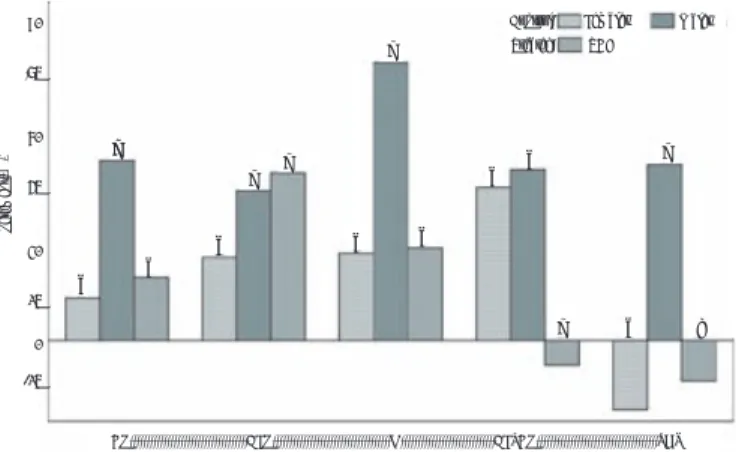
En la Figura 1 se muestra el incremento, en por-centaje, de las variables del crecimiento de los peces al pasar del primero al segundo periodos, con excep-ción del peso, que fue la variable con mayor creci-miento al registrar un incremento de 245 y 87% para los machos del grupo testigo y los masculinizados, res-pectivamente; mientras las hembras del grupo testigo the second periods, with exception of weight which
was the variable with greater growth by recording an increment of 245 and 87% for control group males and masculinized, respectively; while control group females had 65.3%. The rest of the variables showed that control group males were the ones with the greater growth, with the exception of CFL of the mas-culinized males. Also, in this last treatment decreases in CFPBL and in SGR, as well as females in this last variable were recorded.
The analysis of variance, for growth increment, determined differences (P < 0.03)in all variables, indi-cating, in Tukey test, that control group males and masculinized differed (P < 0.01) in all variables, with exception of CFL (P > 0.05). The contrast between males and females of the control group shows a similar pattern, while differing (P < 0.01) in all variables, with the exception of CFPBL (P > 0.05). While masculin-ized males and females from the control group differ (P < 0.01) in CFL, CFPBL and SGR.
Discussion
According to Reznick,25 manifestation of the attributes
of P. reticulata are a casual relation or an energetic trade, thus the increment of one of the life cycle com-ponents is in inverse proportion to the drop of other,
Cuadro 1
INDICADORES DEL CRECIMIENTO DE Poecilia reticulata DEBIDO A LA APLICACIÓN DEL ACETATO
DE TREMBOLONA PROMEDIO ± DESVIACIÓN ESTANDAR
GROWTH INDICATORS OF Poecilia reticulata DUE TO THE ADMINISTRATION OF
TRENBOLONE ACETATE AVERAGE ± STANDARD ERROR
Control Treatment Treatments
♀ ♂ ♂
Variables 60 days
Body length (mm) 17.19 ± 3.79a 12.45 ± 0.90b 13.50 ± 1.56b Caudal fin length (mm) 6.64 ± 1.64a 5.55 ± 0.85b 6.76 ± 1.29a Height (mm) 3.94 ± 0.95a 2.79 ± 0.38b 3.19 ± 0.49b Weight (mg) 14.49 ± 7.16a 5.49 ± 1.01b 7.61 ± 2.53b Caudal fin proportion in relation to the body (mm) 2.67 ± 0.60a 2.46 ± 0.65a 4.29 ± 0.53b
Specific rate of growth (p.100/day) 0.028± 0.700a 0.013 ± 0.003b 0.024 ± 0.006c
100 days
Body length (mm) 19.43 ± 2.72a 19.31 ± 2.31a 16.12 ± 2.25b Caudal fin length (mm) 8.34 ± 1.88a 8.10 ± 1.77a 10.23 ± 1.45b Height (mm) 5.00 ± 0.80a 5.17 ± 0.75a 4.10 ± 0.67b
Weight (mg) 23.95 ± 10.14a 18.92 ± 4.4ab 14.23 ± 4.85b
such is the case of the growth and reproduction bal-ance and this last in relation to survival. From this point of view, to establish the best TBA application strategy in the guppy its biological cycle would have to be known, above all the age at which it initiates its sexual activity, to associated with the growth pat-tern and impact caused by the steroid treatment. The result must guarantee the masculinization success, and desired shape and size.
The aforementioned has sense when considering that the available information is scarce; therefore, it is diffi cult to compare results here described to the ones obtained by other authors. For that reason, it was necessary to consider previous experiences,* which indicate that when the 2 ± 1 day old guppy is treated with TBA at the same concentration and period used in this study, 100% of masculinization and 84.4% of survival is obtained, but the body and caudal fi n size is much smaller (P < 0.001) than fi sh treated at 30 ± 1 days. Nevertheless, after 100 days the percentage of intersexual fi sh is 5.26% for treatment with juvenile fi sh, while 38% was obtained in this study. From this, it is concluded that the administration of TBA in older fi sh is determinant for increasing survival and size of fi sh, with the inconvenience to increase the intersex fi sh proportion.
In relation to age, the guppy has a short biologi-cal cycle that is characterized by beginning its sexual activity between the fourth and fi fth week of age26 and
it is related with growth,25 which takes place in three
stages: the fi rst one is mainly manifested in the body; in the second, growth is seen in the caudal fi n; in the third one, development is present in the dorsal fi n. Even though longevity of the guppy is between 2.5 and three years, the body only grows until the ninth month of age, with a major rate during the fi rst four; in that period of time the fi sh will have 70% of its maximum size. While the caudal fi n in males, at four months will have reached a third part of its total length and at nine months will reach 90%, although it frequently reaches the same length as the body.27
This last shows that when the experiment was
initi-tuvieron 65.3%. El resto de las variables muestran que los machos del grupo testigo fueron los que tuvieron mayor crecimiento, con excepción de la LAC de los machos masculinizados. Incluso, en este último tra-tamiento se registraron decrementos en la PACLC y en la TEC, al igual que las hembras en esta última variable.
El análisis de varianza, para los incrementos del crecimiento, determinó diferencias (P < 0.03) en todas las variables, indicando la prueba de Tukey que los machos del grupo testigo y los masculinizados dife-rían (P < 0.01) en todas las variables, a excepción de la LAC (P > 0.05). El contraste entre los machos y las hembras del grupo testigo muestra un patrón similar, al diferir (P < 0.01) en todas las variables, a excepción de la PACLC (P > 0.05). Mientras que los machos mas-culinizados y las hembras del grupo testigo difi eren (P < 0.01) en LAC, PACLC y TEC.
Discusión
De acuerdo con Reznick,25 la manifestación de los
atributos de P. reticulata son una relación de causalidad o un trueque energético, así el aumento de uno de los componentes del ciclo de vida está en proporción inversa al decremento de otro, tal es el caso del balance crecimiento y reproducción y este último en relación con la sobrevivencia. Desde esta perspectiva, para establecer la mejor estrategia de aplicación del ATB en el guppy se tendría que conocer su ciclo biológico, sobre todo la edad en que inicia su actividad sexual, para asociarla con el patrón de crecimiento e impacto ocasionado por el tratamiento con el esteroide. El resultado debe garantizar el éxito de la masculinización, la forma y el tamaño deseado.
Lo anterior tiene sentido al considerar que la información disponible es escasa, por lo que es difícil comparar los resultados aquí descritos con los obtenidos por otros autores. Por tal razón, fue necesario considerar experiencias previamente obtenidas*, que indican que cuando el guppy de 2 ± 1 días de edad es tratado con ATB a la misma concentración y
Control: Females Males Treated: TBA
BL CFL H CFPBL SGR 90
75
60 45
30 15 0 -15
Increment (%)
a a
a a a
a a
a b
b b
b
b
b
b c Figura 1: Crecimiento de los peces al pasar del primer periodo al
segundo
periodo que se utilizó en este trabajo, se obtiene 100% de masculinización y supervivencia de 84.4%, pero el tamaño del cuerpo y de la aleta caudal es mucho menor (P < 0.001) que cuando los peces son tratados a los 30 ± 1 días. Sin embargo, después de 100 días el porcentaje de peces intersexuales es de 5.26% para el tratamiento con peces juveniles, mientras que en esta investigación se obtuvo 38%. De lo anterior se deduce que una mayor edad del pez para administrarle el ATB es determinante para aumentar la sobrevivencia y el tamaño de los peces, con el inconveniente de aumentar la proporción de peces intersexuales.
Con respecto a la edad, el guppy tiene un ciclo biológico corto que se caracteriza por el inicio de la actividad sexual entre la cuarta o quinta semanas de edad26 y se encuentra ligado con el crecimiento,25 que
se realiza en tres etapas: la primera se manifi esta en el cuerpo principalmente; en la segunda, el crecimiento se presenta en la aleta caudal; en la tercera, se centra en el desarrollo de la aleta dorsal. A pesar de que la longevidad del guppy es entre 2.5 y tres años, el cuerpo crece solamente hasta los nueve meses de edad, con mayor ritmo durante los cuatro primeros; en ese lapso el pez habrá adquirido 70% de su talla máxima; mientras que la aleta caudal a los cuatro meses, en los machos, habrá alcanzado una tercera parte de su longitud total y a los nueve meses llegará a 90%, aunque es frecuente que alcance una longitud igual a la del cuerpo.27
Lo anterior, indica que cuando se inició el experimento los peces de 30 ± 1 días estaban diferenciados sexualmente y se encontraban en proceso de maduración sexual cuando fueron tratados con el ATB durante 60 días. Al fi nalizar el primer periodo, los peces tenían 90 ± 1 día, que corresponde a un ciclo de producción comercial.
Los resultados del primer periodo indicaron que los peces masculinizados con el ATB crecieron más que los machos del grupo testigo, al registrar valores superiores en todas las variables del crecimiento, sobretodo la tasa de crecimiento específi co que registró una diferencia de 84.6%. Es probable que el incremento de la masa muscular fuera en detrimento del desarrollo de las gónadas y la consecuente esterilización de los peces tratados. De esta manera, los organismos invirtieron energía en el crecimiento y no en la maduración de las gónadas.
En síntesis, los peces tratados con ATB tuvieron una efi cacia masculinizante de 100%, que de no haberse aplicado, 68% hubiera sido hembras; no les causó daño al registrar 100% de sobrevivencia; alcanzaron un tamaño superior al de los machos del grupo testigo en menor tiempo y sus registros morfométricos ated, 30 ± 1 day old fi sh were sexually differentiated
and were in sexual maturation process when they were treated with TBA during 60 days. At the end of the period, fi sh were 90 ± 1 day old, which corresponds to a commercial production cycle.
Results of the fi rst period showed that masculi-nized fi sh with TBA grew more than control group males, while recording superior values in all growth variables, most of all the specifi c growth rate which registered a difference of 84.6%. It is probable that muscular mass increment caused failure in gonad development, provoking sterilization of treated fi sh. In this manner, organisms spent energy in growing at the expense of gonads maturation.
In summary, fi sh treated with TBA had a mas-culinization effectiveness of 100%, while not being administered, 68% would have been females; they were not harmed while recording 100% survival; they reached a superior size earlier than the control group males and their morphometric registries are compa-rable to the ones of males cultivated in commercial ponds, with the difference that the steroid high-lighted the color of masculinized males and modi-fi ed the shape while making them fusiform; inclusive more aesthetic, presenting a small body with a large caudal fi n, in relation to the proportion recorded by control group males.
It is doubtless that TBA had androgenic and ana-bolic activity in the guppy. It is convenient to notice that this combination of effects has not been reported, even though TBA constitutes an androgenic steroid the same as testosterone, but with a superior anabolic capacity.19,20
At the end of the second period, fi sh were 130 ± 1 days old and control group females were sexually mature, it is probable that this stimulus had an effect on males, which were sharing the same aquariums, presenting greater growth than masculinized fi sh, but with morphometric parameters similar to the ones of females.
The analysis of growth increment in percentage, unquestionably showed how masculinized fi sh and control group females kept growing, but not at the same rate that in the fi rst period; on the contrary, the control group males showed greater growth, specially in weight. Analyzing only the information of masculi-nized males, the length of the caudal fi n was the only variable that kept growing, but not in proportion, in relation to the body length and much less, the specifi c growth rate, which presented a drop.
Other relevant aspect at the end of the evaluation is the presence of 32% of intersexual fi sh, which shows that the residual effect of TBA was refl ected in the sec-ondary sexual traits, since the obtained
the action range of these steroids is short, which is why at the moment the administration was stopped, part of the masculinized organisms manifested female traits, which indicates that these fi sh continued to produce estrogens. From the aforementioned it is deduced that TBA is a chemical compound which its molecular structure gives a less virile androgenic function than testosterone, but with greater anabolic capacity.
From a commercial point of view, results show that based on trenbolone acetate, a strategy may be sug-gested to instrument monosexual populations of male guppies, which could have economical impact in the orientation of its culture, if it is considered that in wild poeciliid populations it is common that females predominate,28 these show a more robust and opaque
body, while the males have a more slender and elon-gated body, more intense color and caudal and dorsal fi ns are larger.26 These differences determine the
male to be more appreciated; therefore, more valued in the market.4
In the present document it was demonstrated that the biological process can be directed by the use of TBA to induce the sex of the fi sh and improve the morphometric parameters of the guppy, besides its use is not restricted because this type of organism is not destined for human consumption.
A determinant aspect for practical use is how to consider intersexual fi sh in an economical projection, since the male and female have a differential cost. Nev-ertheless, it is possible to consider intersexual fi sh as a factor which adds value to commercial production, since desirable scenario would be the obtainment of a fi sh with fl ashy morphological traits of the males, but with the corpulence of the females, in a maximum time of 90 days.
In conclusion, trenbolone acetate steroid is a good alternative for use in the guppy, with a masculiniz-ing effectiveness of 100%, and its anabolic effect is refl ected in the increment of the growth rate and the size of the caudal fi n of the fi sh.
Referencias
son comparables con los de los machos cultivados en estanques comerciales, con la diferencia de que el esteroide acentuó la coloración de los machos masculinizados y modifi có la forma al hacerlos más fusiformes; incluso más estéticos, al presentar cuerpo pequeño con aleta caudal grande, con respecto a la proporción que registraron los machos del grupo testigo.
Es indudable que el ATB tuvo actividad androgénica y anabólica en el guppy. Es conveniente aclarar que esta combinación de efectos no se ha notifi cado, a pesar de que el ATB constituye un esteroide androgénico al igual que la testosterona, pero con capacidad anabólica superior.19,20
Al fi nalizar el segundo periodo, los peces tenían 130 ± 1 días de edad y las hembras del grupo testigo estaban maduras sexualmente, es probable que este estímulo repercutiera sobre los machos, que se encontraban compartiendo los mismos acuarios, al presentar mayor crecimiento que los peces masculinizados, pero con parámetros morfométricos similares al de las hembras.
El análisis del incremento del crecimiento en porcentaje, mostró en forma inobjetable cómo los peces masculinizados y las hembras del grupo testigo continuaron creciendo, pero no al mismo ritmo que en el primer periodo; por el contrario, los machos del grupo testigo presentaron mayor crecimiento, sobre todo en peso. Analizando únicamente la información de los machos masculinizados, la longitud de la aleta caudal fue la única variable que continuó creciendo, no así la proporción de ésta, en relación con la longitud del cuerpo, y, mucho menos, la tasa de crecimiento específi co, que presentaron un decremento.
Otro aspecto relevante al fi nalizar la evaluación es la presencia de 32% de peces intersexuales, lo cual demostró que el efecto residual del ATB se refl ejó en las características sexuales secundarias, ya que la masculinización obtenida a los 60 días no fue permanente, e indica que el rango de acción de estos esteroides es corto, por lo que en el momento en que se dejó de administrar, parte de los organismos masculinizados manifestaron características femeninas, lo cual indica que estos peces siguieron produciendo estrógenos. De lo anterior se deduce que el ATB es un compuesto químico cuya estructura molecular le confi ere una función androgénica menos virilizante que la testosterona, pero con mayor capacidad anabólica.
Desde una perspectiva comercial, los resultados indican que con base en el acetato de trembolona se puede proponer una estrategia para instrumentar poblaciones monosexuales de machos en el guppy, que podría tener impacto económico en la orientación de su cultivo, si se considera que en las poblaciones 1.
2.
3.
4.
5.
Maya E, Marañón S. Efecto del pH sobre la proporción de sexos, el crecimiento y la sobrevivencia del guppy Poecilia reticulata Peters (1859). Hidrobiológica 1998; 8: 125-132.
Bassleer G. The international trade in aquarium/orna-mental fi sh. Infofi sh Int 1994; 5:15-17.
Chapman F, Fitz-Coy S, Thunberg EM, Adams C. United States of America trade in ornamental fi sh. J World Aquacult Soc 1997; 1 (28): 1-10.
silvestres de poecílidos es común que predominen las hembras;28 éstas presentan un cuerpo más robusto y
opaco, mientras que los machos tienen cuerpo esbelto y alargado, coloración más intensa y las aletas caudal y dorsal son de mayor tamaño.26 Estas diferencias
determinan que el macho sea más apreciado y, por consiguiente, mejor cotizado en el mercado.4
En el presente documento se demostró que el proceso biológico puede ser orientado por el uso del ATB para inducir el sexo del pez y mejorar los parámetros morfométricos del guppy, además de que su empleo no es tan restringido porque este tipo de organismo no está destinado al consumo humano.
Un aspecto que es determinante para fi nes prácticos es cómo considerar a los peces intersexuales en una proyección económica, ya que el macho y la hembra tienen un precio diferencial. Sin embargo, es posible considerar a los peces intersexuales como factor que agrega valor a la producción comercial, pues un escenario deseable sería la obtención de un pez que tenga las características morfológicas vistosas de los machos, pero con la corpulencia de las hembras, en un tiempo máximo de 90 días.
En conclusión, el esteroide acetato de trembolona es buena alternativa para usarse en el guppy, con efi cacia masculinizante de 100%, y su efecto anabólico se refl eja en el incremento de la tasa de crecimiento y en el tamaño de la aleta caudal de los peces.
Takahashi H. Modifi cation of the development of female reproductive organs in the guppy, Poecilia reticu-lata, following an androgen treatment in their juvenile period. Bull Fac Fish Hokkaido Univ 1974; 25: 174-199. Pandian J, Sheela G. Hormonal induction of sex rever-sal in fi sh. Aquaculture 1995; 138: 1-22.
Green B, Veverica K, Fitzpatrick M. Fry and fi ngerling production. In: Egna HS, Boyd CE, editors. Dynamics of pond aquaculture. New York: CRC Press, Boca Raton 1997: 215-243.
Dzwillo M. Über künstliche Erzeugung funktioneller Männchen weiblichen genotyps bei Lebistes reticulatus. [Artifi cial production of functional males of female genotype of Lebistes reticulatus]. Biol Zentralbl 1962; 81: 575-584.
Dzwilo M. Über den Einfl uss von Methyltestosteron auf primäre und sekundäre Geschlechtsmerkmale während verschiedener Phasen der Embryonal-entwicklung von Lebistes reticulatus. [ Infl uence of Methyltestosteron on primary and secondary sex characteristics during different phases of the embryonic development of Lebi-stes reticulatus] Zool Anz 1966; 29: 471-476.
Clemens HP, McDermitt C, Inslee T. The effects of feeding methyl testosterone to guppies for sixty days after birth. Copeia 1966; 2: 280-284.
Pandian J. Endocrine and chromosome manipula-tion techniques for the producmanipula-tion of male and all-female population in food and ornamental fi shes. Proc Indian Natl Sci Acad 1993; 59(b): 549-566.
Takahashi H. Masculinization of the gonad of juvenile guppy, Poecilia reticulata, induced by 11-ketotestoster-one. Bull Fac Fish Hokkaido Univ 1975; 26: 11-22. Kavumpurath S, Pandian J. Masculinization of Poecilia reticulata by dietary administration of synthetic or natu-ral androgen to gravid females. Aquaculture 1993; 116: 83-89.
Galvez J, Mazik M, Phelps P, Mulvaney R. Masculin-ization of channel catfi sh Ictalurus punctatus by oral administration of trenbolone acetate. J World Aquacult Soc 1995; 4: 378-383.
Davies K, Morrison R, Galvez J. Reproductive character-istics of adult channel catfi sh treated with trenbolone acetate during the phenocritical period of sex differen-tiation. Aquaculture 2000;189: 351-360.
Galvez J, Morrison R. Effi cacy of trenbolone acetate in sex inversion of the blue tilapia Oreochromis aureus. J World Aquacult Soc 1996; 4 (27): 483-486.
Contreras-Sanchez W, Fitzpatrick MS, Milston RH, Schreck CB. Masculinization of Nile Tilapia (Oreo-chromis niloticus) by single immersion in 17α -Methildi-hydrotestosterone and Trenbolone Acetate. Fourth International Symposium on Tilapia in Aquaculture; 1997 Nov 9-12; Orlando (Florida) USA. Orlando (Flor-ida) USA: Department of Soil, Water and Environmen-tal Science, University of Arizona 1997: 783-790. Rico A, Burgat V. Nueva información sobre el meta-bolismo de anabólicos. En: Scientifi que Meissonnier, editor. Anabólicos en producción pecuaria. Aspectos de salud pública, métodos de análisis y reglamentación. 6. 7. 8. 9. 10. 11. 12. 13. 14. 15. 16. 17. 18. 19.
París, Francia: Organización Mundial de Sanidad Animal, 1983:112-121.
Hoffman B, Evers P. Anabolic agents with sex hor-mone-like activities: Problems of residues. In: Rico E, editor. Drug Residues in Animals. Veterinary Science and Comparative medicine: A Series. London, UK: Academic Press Inc., 1986: 111-146.
Guerrero R. Use of androgens for the production of all-male Tilapia aurea (Steindachner). Trans Am Fish Soc 1975; 2: 342-348.
Meffe G, Snelson F. An ecological overview of Poeci-liid fi shes. In: Meffe G, Snelson F; Parenti L, Rauchen-berger M, Constantz D, Angus R, et al., editors. Ecology and evolution of livebearing fi shes. New Jersey, EUA: Simon & Schuster 1989: 13-31.
Zar J. Biostatistical analysis. 4a ed. New Jersey, EUA: Simon & Schuster, 1999: 122-129.
Montgomery D. Design and analysis of experimental. 2nd ed. New York: William and Sons. Inc., 1984. Reznick D. The structure of guppy life histories: The tradeoff between growth and reproduction. Ecology 1983; 64: 862-873.
Dawes J. Livebearing fi shes. London England: Bland-ford 1991.
Sorin S. Peces tropicales vivíparos. Littec, Buenos Aires, Argentina: Acuarama 1972:1-70.
Epilepsia en perros
Canine epilepsy
Recibido el 2 de marzo de 2007 y aceptado el 27 de febrero de 2008.
*Departamento de Fisiología y Farmacología, Facultad de Medicina Veterinaria y Zootecnia, Universidad Nacional Atónoma de México, 04510, México, D. F.
**Departamento de Neurofi siología, Departamento de Anatomía, Facultad de Medicina, Universidad Nacional Autónoma de México, 04510, México, D. F.
Abstract
Idiopathic epilepsy (IE) and other convulsive disorders represent at least 14% of neurological consultations in veterinary medi-cine. In spite of this, there is a gap in the information usually handled by the small animal clinician, because the pathophysi-ological aspects of this disease are still not completely understood. Since there is no specifi c method for diagnosing IE, exclusion criteria are used to reach diagnosis. Although the electroencephalogram (EEG) can provide diagnostic elements, abnormalities in the EEG record are not always found. Pharmacologic treatment options are reduced and not void of adverse effects. The pos-sibility of encountering IE refractory to antiseizure pharmacological treatment is high and it has been concluded that non phar-macological treatment options should be explored through systematic clinical studies. Up to date, early diagnosis, appropriate pharmacological treatment, owners’ education and a combination with non pharmacological options represent the only way to improve prognosis for dogs with IE.
Key words: IDIOPATHIC EPILEPSY, DOG, SEIZURES, REVIEW.
Resumen
La epilepsia idiopática (EI), así como otras enfermedades convulsivas representan al menos 14% de las consultas neurológicas en la medicina veterinaria. A pesar de esto último, se reconoce que existe un vacío en la información que maneja el clínico especialista en pequeñas especies porque aún no se han elucidado todos los aspectos patofi siológicos de ese padecimiento. Debido a que no existe un método diagnóstico específi co, se llega a él por exclusión. Aunque el electroencefalograma (EEG) brinda algunos elementos diagnósticos no siempre se tiene la fortuna de ubicar anormalidades en el registro. Las alternativas terapéuticas farmacológicas son reducidas y no carentes de efectos adversos. Es mucha la posibilidad de encontrar EI refractaria al tratamiento farmacológico y se ha concluido que deben evaluarse las alternativas de tratamiento no farmacológico mediante estudios clínicos sistemáticos. El diagnóstico temprano, la instauración de un tratamiento farmacológico, la educación de los propietarios de animales y la combinación con terapias no farmacológicas representan a la fecha la única forma de mejorar el pronóstico de perros afectados con EI.
Palabras clave: EPILEPSIA IDIOPÁTICA, PERROS, CONVULSIONES, REVISIÓN.
Gabriela Goiz-Márquez* Sara Caballero Chacón* Hugo Solís Ortiz** Héctor Sumano López*