PARTIAL RESULTS ABOUT PEOPLE REACTIONS TO THE URBAN NOISE
PACS: 43.50.Qp
Barrigón-Morillas, J.M.; Méndez-Sierra, J.A.; Gómez-Escobar, V.; Vílchez-Gómez, R.; Vaquero-Martínez, J.M
Universidad de Extremadura
Escuela Politécnica / Departamento de Física Avda. de la Universidad, s/n
10071 Cáceres Spain
Tel.: 34 927 257 195 Fax: 34 927 257 203 e-mail: [email protected]
ABSTRACT
The Group of Acoustics of the University of Extremadura has developed an opinion poll that allows to evaluate the effects and subjective annoyance due to urban noise. Moreover, these reactions can be related with the sound levels measured in the neighbourhood of the houses and with the own characteristics of neighbourhood and houses. This opinion poll has been tested previously with several pilot polls between different social groups and urban environments. Some partial results of the opinion poll taken to 400 people of the city of Cáceres during the months of June and July 2001 are shown here.
INTRODUCTION
The effects of noise on the human body cannot be evaluated only by instruments of measurement due to the importance of the psychological component of the acoustic pollution. The annoyance due to the noise change drastically between persons as a function of several aspects: state of mind of the receptor, economic level, personal experiences, attitude to the noise source, knowledge, etc…So that, it is basic to made polls to evaluate the subjective environmental impact that, finally, the urban noise has on the people.
Our research group has developed our own poll1, in such a way that several aims, normally
not considered by other authors, can be covered. A wide bibliographic revision about polls was
done, and from here the most interesting aspects were selected1, adapting those to our line of work
and to the marked aims in this project.
We decided to focus our attention in the following goals:
1) To know the importance given by the citizen to his closest environment, and the degree of satisfaction with it.
3) To have knowledge about the importance that the citizen gives to the problem of the noise in his different environments (house, job, street, public transports, etc…) during his normal activities.
4) To evaluate, in the home environment, the effects on the daily activities, behaviour and personality of the citizen that urban noise has.
In this communication, and due to the extension of the obtained results, we are presenting a summary of those relative to the fourth point where are describing the perturbations of noise in the daily activities are described, the actions taken to avoid these perturbations, and the effects of noise on the behaviour, personality and during the sleep. For more information reference 2 can be seen.
METHODOLOGY
Previously to write our poll we analyse several aspects:
The first of them is the election between open or close questions. It was preferred a structure base on close questions, mainly because it makes easier the interpretation, evaluation and comparison of the obtained answers with other results. Anyway, in the final poll, we have decided not to renounce to the versatility of the open questions, either because sometimes are essential, or because allow to accede to information and details which could not be considered in the normal development of the poll.
The second considered aspect affects to the scale. In this poll, the taken decision was that in questions where a level of satisfaction or disturbance had to be indicated, to use a Likert verbal scale with five levels. When a frequency had to be indicated, also a verbal scale of five levels was used. Both scales can be seen in Table 1 showing the equivalence Spanish / English:
Level of satisfaction or disturbance Frequency
mucho / a lot muy a menudo / very often
bastante / enough a menudo / often
regular / regular algunas veces / sometimes
poco / few raramente / rarely
nada / nothing nunca / never
Table 1: Verbal scales for the levels of satisfaction or disturbance,
and frequency used in the poll. (Spanish / English)
The last general considered aspect in the poll has been the possibility of a structure by modules, in such a way that the poll can be adapted for smaller noise surveys with fewer aims that those initially thought in this project.
As a previous step to the distribution of the poll between the general population, and to correct possible gaps and defects in the elaborated questions, several pilot surveys have been done. The first pilot survey was made between more than one hundred persons belonging to
different staffs of the university of Extremadura, and the results have been presented previously3, 4.
After improving some aspects of the initial poll, this was repeated between 30 inhabitants of Valdefuentes (Cáceres), a small village with about 1000 inhabitants, and again repeated between 50 persons of Cáceres living in not very important streets associated mainly to districts of the city. In this way, the poll has been depurated, and some initial doubts between the polled people have been resolved.
RESULTS
Disturbances On The Daily Activities Due To The Noise
Daily activities such as to hear audiovisual apparatus (for a 12% of the polled), night sleep (for a 14%), the siesta (12%) or intellectual activities (7%) are affected often or very often by the noise produced mainly by the traffic in general (Fig. 1). It can be observed that, in any case, there are a very elevated proportion of persons, between 54% and 80%, depending on the activity, which does not perceive appreciable effects on the considered daily activities.
Taken Actions To Avoid The Disturbances Due To The Noise
If we consider the actions taken by the citizens to avoid the effects of the noise, the traffic noise provoked often or very often to the 29% of the polled persons to close the windows, and the 18% to increase the volume of the radio or TV set. (Fig. 2)
Activities affected by the noise
0% 10% 20% 30% 40% 50% 60% 70% 80% 90% 100%
To hear audiovisual
apparatus
Night sleep Siesta Conversation Intellectual Activities
Concentration Capacity
Activities
Rate
Very often Often Sometimes Rarely
[image:3.612.96.522.180.422.2]Never
Figure 1: Percentage of disturbance by some noise sources for diverse activities made by
the polled.
Induced actions by the noise
0% 10% 20% 30% 40% 50% 60% 70% 80% 90% 100%
Close windows Increase volume Take a break Take pastilles
Induced actions
Rate
Very Often Often Sometimes Rarely Never
[image:3.612.92.517.523.758.2]Effects Of The Noise On The Behaviour And The Personality
If we analyse now the effects of noise on the behaviour and the personality, we observe that the noise of scooters and motorcycles provoked irritability to the 10%, and the traffic in general impeded to relax to the 5% (Fig.3).
Disturbances Due To The Noise On The Night Sleep
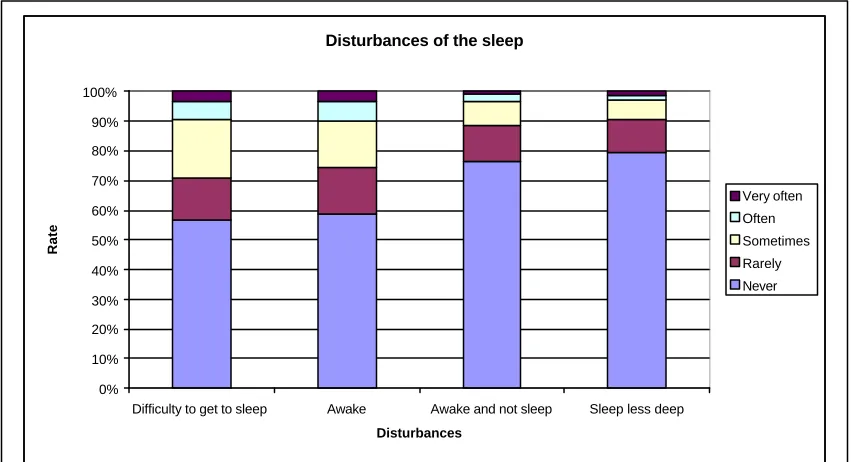
If, finally, we consider the disturbances that noise produces on the night sleep, we obtain that traffic in general has caused difficulty to sleep to the 9%, and the dustcart, has caused awakening during the night a 10% (Fig. 4).
Induced states by the noise
0% 10% 20% 30% 40% 50% 60% 70% 80% 90% 100%
Irritability Anxiety
Desorientation
Decreasing efficiency
Fright
Not relaxing Accident
States
Rate
[image:4.612.111.536.146.391.2]Very often Often Sometimes Rarely Never
Figure 3: Percentage with that the noise has produced changes in the state of mind of
polled person.
Disturbances of the sleep
0% 10% 20% 30% 40% 50% 60% 70% 80% 90% 100%
Difficulty to get to sleep Awake Awake and not sleep Sleep less deep
Disturbances
Rate
Very often
Often
Sometimes
Rarely
Never
[image:4.612.102.528.492.723.2]Relation between the noise sources and the produced annoyance
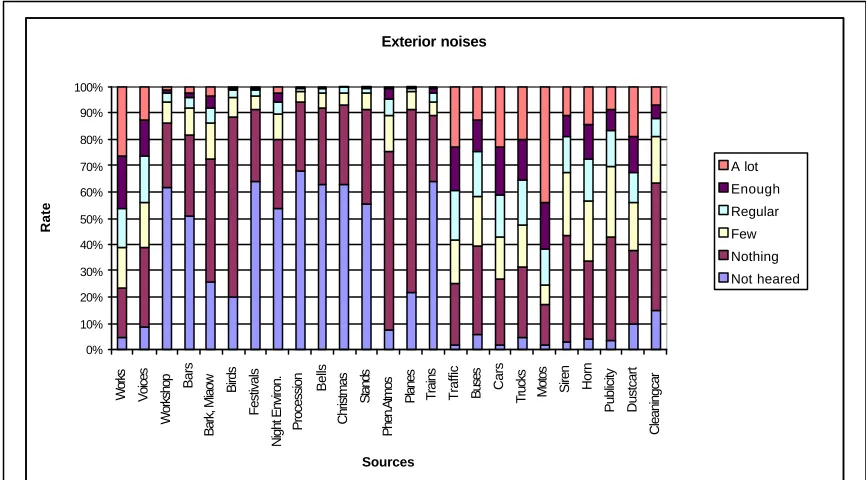
Figure 5 shows the results according to different noise sources. From here it can be pointed out some comments. The three external sources more disturbing (A lot or enough) for the people have resulted: noise of scooters and motorcycles (62%), the works, constructions, buildings, etc. (46%) and finally, traffic noise (41%).
In the study about internal sources to the buildings, the three more disturbing ones (A lot or enough) were: works inside the buildings (26%), voices of the neighbours (18%), and audiovisual equipments (13%).
Comparison Of The Obtained Results With Some Reference Values
The studies relative to the effects of noise are much less numerous and are much less published that those relative to the evaluation of the acoustic situation from objectives indicators (acoustic levels and indexes). For that reason, in this point we can use a fewer number of reference values that those in the studies previously mentioned.
If the results are compared with the values that, in average, have been obtained for the countries belonging to the European Union, we can conclude that in the city of Cáceres:
The proportion of people who declares to be annoying as a consequence of the levels of noise is similar in the City of Cáceres to the average values corresponding to the EU.
However, in reference to the night time, the percentage of population who says to have disturbances in the sleep very often, is in Cáceres in the inferior limit of the corresponding oscillation band, in average, in the EU.
Exterior noises
0% 10% 20% 30% 40% 50% 60% 70% 80% 90% 100%
Works Voices
Workshop
Bars
Bark, Miaow
Birds
Festivals
Night Environ.
Procession
Bells
Christmas
Stands
Phen.Atmos
Planes Trains Traffic Buses Cars Trucks Motos Siren Horn Publicity Dustcart
Cleaningcar
Sources
Rate
A lot
Enough
Regular
Few
Nothing
[image:5.612.95.528.170.410.2]Not heared
CONCLUSIONS
The night sleep is the daily activity more affected by the urban noise. A 5% of person is very often affected and a 14% often or very often affected.
The more relevant effects of the urban noise on the night sleep are:
Difficulty to get to sleep: Very often for a 3% of the population and often or very often for a 9%.
To awake during the night: Very often for a 3% of the population and often or very often for a 10%.
The action more frequently made by the person in his daily life to avoid the effects of the urban noise is to close the windows of his home. This is done very often by a 10% of the population and often and very often by a 20%.
The induction of irritability is the psychological disturbance more important suffered by the citizen due to the urban noise. This happens very often in a 3% of the population and often and very often in a 10 %.
REFERENCES
1
Barrigón Morillas, J.M.; Vílchez Gómez, R.; Gómez Escobar, V.; Méndez Sierra, J.A.;Tejeiro Vidal, C; Alejandre Bueno, L.; Vaquero Martínez, J.M.; “Presentación de una encuesta para la realización de estudios sociales sobre el impacto del ruido urbano”, Revista Española de Acústica, Vol. XXXIII, nº 1 y 2, pp. 27 – 33 (2002)
2
Barrigón Morillas, J.M.; Vílchez Gómez, R.; Gómez Escobar, V.; Méndez Sierra, J.A.;Tejeiro Vidal, C; Gutiérrez Marcos, P.D.; Alejandre Bueno, L.; Vaquero Martínez, J.M.; “Resultados más relevantes relativos a la evaluación del impacto urbano del ruido urbano sobre la población de Cáceres”, Informe de proyecto presentado a la Consejería de Sanidad de la Junta de Extremadura, (2002).
3
Barrigón Morillas, J.M.; Vílchez Gómez, R.; Gómez Escobar, V.; Méndez Sierra, J.A.; Tejeiro Vidal, C., “Formalización de una encuesta sobre efectos del ruido urbano”, Revista Española de Acústica, Vol. Especial XXXI., Tecniacústica 2000, Madrid.
4