O R I G I N A L A R T I C L E
Efficient secretion of a modified E7 protein from human
papilloma virus type-16 by
Lactococcus lactis
D. Quistia´n-Martı´nez1, J. Villatoro-Herna´ndez2, M.J. Loera-Arias2, B.R. Rangel-Colmenero2, L.M. Zavala-Flores2, J. Sepu´lveda-Saavedra2, S. Guzma´n-Lo´pez3, R.E. Elizondo-Oman˜a3, R. Montes-de-Oca-Luna2 and O. Saucedo-Ca´rdenas2,4
1 Departamento de Bioquı´mica, Facultad de Ciencias Biolo´gicas, Universidad Auto´noma de Nuevo Leo´n (UANL), San Nicola´s de los Garza, N.L. Me´xico
2 Departamento de Histologı´a, Facultad de Medicina, UANL, Monterrey, N.L. Me´xico 3 Departamento de Anatomı´a Humana, Facultad de Medicina, UANL, Monterrey, N.L. Me´xico
4 Divisio´n de Gene´tica, Centro de Investigacio´n Biome´dica del Noreste, Instituto Mexicano del Seguro Social (IMSS), Monterrey, N.L. Me´xico
Introduction
More than 99% of cervical cancers are associated with the human papilloma virus (HPV). In these HPV-associated tumours, two viral proteins remain expressed, E6 and E7. The development of vaccines and immunotherapies against cervical tumours targeting these viral oncoproteins has been documented to be effective and highly immuno-genic (Roden and Wu 2006; Kimet al. 2008). Immuniza-tion with E7 has been shown to cause specific therapeutic effects against established E7-expressing tumours in mice
(Kim et al. 2007). Even though the use of this viral pro-tein as immunotherapy against cervical cancer was shown to be specific and effective, it possesses an undesired char-acteristic. This unfavourable condition is that E7 main-tains its transforming activity (Shi et al. 1999). This inconvenience was overcome by the modification of two repeating Cys-X-X-Cys sequence motifs at the carboxyl terminus of E7 in the CR3 domain containing residues 58–61 and 91–94 with repeating cysteines, which is neces-sary for the formation of a zinc finger, an important struc-ture that gives stability to the E7 protein. The inability of
Keywords
antitumour protection, HPV-16,Lactococcus lactis, modified E7, secretion.
Correspondence
Odila Saucedo-Ca´rdenas, Divisio´n de Gene´tica, Centro de Investigacio´n Biome´dica del Noreste, IMSS. Col. Independencia, Monterrey, N. L. Me´xico 64720. E-mail: [email protected]
D. Quistia´n-Martı´nez and J. Villatoro-Herna´ndez have contributed equally to this work.
Present address: J. Villatoro-Hernandez, Molecular Genetics, Groningen Biomolecular Sciences and Biotechnology Institute, University of Groningen, Kerklaan 30, 9751 NN Haren, NED. Kluyver Centre for Genomics of Industrial Fermentation, PO Box 5057, 2600 GA Delft, The Netherlands.
2010⁄0493: received 26 March 2010, revised 2 July 2010 and accepted 11 July 2010
doi:10.1111/j.1472-765X.2010.02905.x
Abstract
Aims:To create and provide a strain of the food-grade bacterium Lactococcus lactis able to efficiently secrete a modified form of the E7 protein from the human papilloma virus (HPV) type-16.
Methods and Results:We cloned the coding sequence of a modified E7 (E7m) from the HPV-16 in a plasmid regulated by the strong expression promoter p59. Secretion of the E7m was made by the signal peptide of the usp45 gene. The E7m was detected by Western blot in the cell-free-medium fraction, show-ing no degradation or aberrant forms.
Conclusions: We constructed a strain of L. lactis able to secrete efficiently a HPV-16 E7 modified protein with diminished transforming activity.
this modified E7 to form this particular structure dramati-cally diminishes its transforming activity in cultures in vitroof murine and human cells (McIntyreet al.1993).
It has been demonstrated that this modified E7 is degraded rapidly by the proteosome and that a greater amount of antigenic peptides are being transported to the endoplasmatic reticulum and presented to antigen-pre-sented cells (APCs) (Shiet al.1999). Moreover, this mod-ified E7 with altered motifs has a reduced ability to transform a variety of rodent fibroblasts, fails to immor-talize human keratinocytes, and exhibits a lower transacti-vating efficiency (McIntyre et al. 1993). Immunization with this modified E7 caused stronger protection immu-nity against E7-expressing cell lines than the wild-type E7 (Shiet al.1999).
For years, the use of L. lactis to produce and deliver heterologous proteins of medical interest has been dem-onstrated to be efficient and innocuous (Wells and Mercenier 2008). The intranasal immunization with this food-grade bacterium expressing antigens has resulted in the generation of specific protective and therapeutic responses against infectious and chronic diseases (Hann-iffyet al.2007; Wells and Mercenier 2008). We have con-structed a strain of the lactic acid bacterium (LAB) L. lactis able to secrete a modified E7 of the HPV that may be used as a live vaccine against the HPV-16 and tumours associated with this virus.
Materials and methods
Bacterial strains and growth conditions
Escherichia coli DH5a was grown aerobically in Luria Bertani broth at 37C with vigorous agitation. TheL. lac-tis strain MG1363 was grown aerobically in M17 broth supplemented with 0Æ5% glucose (GM17) at 30C without agitation. Selection of clones was carried out by the addi-tion of 100lg ml)1 of ampicillin for E. coli and 75lg ml)1of erythromycin for L. lactis. All constructions were first established in E. coli and then transferred to L. lactisby electrotransformation using the method previ-ously described (Holo and Nes 1989). Plasmid DNA iso-lation, DNA manipuiso-lation, and PCR were carried out essentially as described (Sambrooket al.1989).
Protein extraction fromL. lactis
Cell and cell-free-medium fractions were prepared sepa-rately. Samples were processed from 1Æ35 ml of the culture. Cell pellets were obtained by centrifugation at 21000g
at 4C for 5 min, and the pellets resuspended in 100ll of TES-lysis buffer (25% sucrose, 1 mmol l)1 EDTA, 50 mmol l)1 Tris.HCL [pH 8Æ0], lysozyme [10 mg ml)1]
complemented with 1 mmol l)1 phenylmethylsulfonylfluo-ride (PMSF), and 10 mmol l)1 of dithiothreitol). The mixture was incubated at 37C for one h, and then 50ll of 20% SDS and one volume of loading buffer were added. The samples were maintained at )20C before loading onto the gel.
The cell-free-medium samples were treated with 1 mmol l)1of PMSF and 10 mmol l)1of dithiothreitol to avoid proteolysis. Proteins were precipitated using 150ll of 100% trichloroacetic acid (TCA) and incubated on ice for 10 min, then followed by centrifugation at 21000g
at 4C for 15 min. The pellet was resuspended in 50ll of 50 mmol l)1 NaOH and 50ll of SDS-PAGE loading buffer (100 mmol l)1 Tris.HCl, [pH 6Æ8], 200 mmol l)1 dithiothreitol, 4% SDS, 0Æ1% bromophenol blue, and 10% glycerol).
SDS-PAGE and Western blotting
One-fifteenth of the whole cell extracts and one-fifth of the cell-free-medium fractions from 1Æ35 ml culture were loaded onto 12% acrylamide gels. SDS-PAGE and Western blotting were carried out essentially as described (Sambrook et al. 1989). Immunodetection of E7 was carried out by the use of monoclonal anti-E7 (Santa Cruz Biotechnology, Santa Cruz, CA) as a primary antibody and protein-G horseradish peroxidase conjugate (Bio-Rad, Hercules, CA) and the SuperSignal West Pico Chemiluminescent Substrate kit (Thermo Scientific Pierce, Rockford, IL) as recommended by the suppliers.
Coomassie Blue staining
Twelve per cent SDS-PAGE gels with electrophoresed protein samples were submerged in CBB Buffer (0Æ1% Coomassie Brilliant Blue R-250, 20% methanol, 0Æ5% ace-tic acid) overnight. The gel was incubated in destaining buffer (40% methanol, 7% acetic acid) for 2 h at room temperature with mild agitation.
Results
Generation of an expression system to secrete the modified E7 by L. lactis
in-frame with the signal peptide of usp45, the most secreted protein of L. lactis (van Asseldonk et al. 1990). The TER-Rv oligo generated arho-independent transcrip-tion terminator for clone stability (underlined) and a stop codon (in bold). Amplicons were directly cloned into pGEM-T Easy Vector (Promega, Madison, WI) and then digested with SalI-SpeI sequentially. The fragment corre-sponding to E7m was subcloned in the pVE-5524 vector cut with the same enzymes. This new plasmid (pSEC-E7m) has controlling sequences to allow expression and secretion of E7m under the regulation of the high expres-sion and constitutively active promoter p59 (Fig. 1). The pSEC-E7m was introduced into the L. lactis strain MG1363 by electroporation. Clones were selected by the resistance to erythromycin. This newly constructed strain ofL. lactis was named Ll-pSEC-E7m. All constructs were characterized by endonuclease restriction analysis and PCR and sequenced to verify DNA integrity.
Secretion of E7m byL. lactis
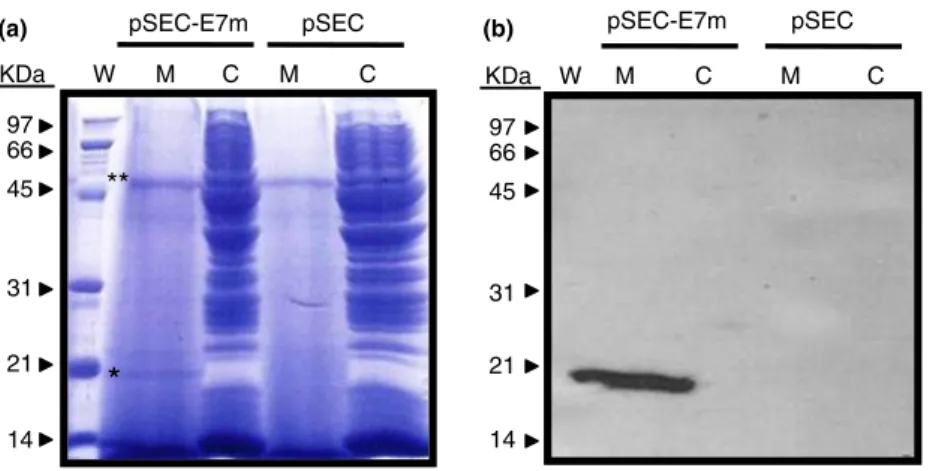
Detection of E7m by Coomassie blue staining.To evaluate the ability of the strain Ll-pSEC-E7m to secrete E7m, protein extracts from cell and cell-free-medium fractions were made from cultures of our recombinant strain. For this, we allowed cultures of the Ll-pSEC-E7m to reach an OD600nm of one. From each culture, 1Æ35 ml was centri-fuged at 17000g for five min at 4C to separate bacteria and the cell-free medium. The cell-free medium was fil-tered through a 0Æ22-lm pore-diameter (Milipore, Biller-ica, MA) filter to remove the remaining bacteria. The total proteins were precipitated with TCA (for more details, see materials and methods). Samples from the cell fractions of L. lactis were prepared as well. After electro-phoresis, acrylamide gels were stained with Coomassie Blue to visualize total proteins from the and cell-free-medium protein extracts from cultures ofL. lactis.
Figure 2a shows the electrophoresed L. lactis protein samples from the strains transformed with an empty vec-tor (pSEC) and our recombinant strain Ll-pSEC-E7m. Samples from the cell-free medium of our recombinant
strain revealed the secretion of a distinctive protein band that corresponds to the expected size of the E7m (indi-cated with asterisk in Fig. 2a). This particular protein band is absent in the cell-free-medium samples from L. lactistransformed with the empty vector pSEC (lacking the E7m-coding sequence) and in whole cell-extract sam-ples from both strains. The stain intensity of this secreted protein is close in amount to the major lactococcal secreted protein Usp45 (indicated by a double asterisk in Fig. 2a).
Detection of E7m by Western blot.To determine whether the secreted protein band seen in the SDS-PAGE protein gel corresponds to the protein E7, a duplicated gel from Fig. 2a was analysed by immunoblotting using a mouse monoclonal anti-E7 (Santa Cruz). Western blot analysis revealed a single clear band in the sample from the cell-free cultures of our recombinant strain Ll-pSEC-E7m cor-responding to the expected size of E7m (Figure 2b). Moreover, no signal was detected in the whole cell frac-tion of this recombinant strain, meaning that the secre-tion of E7m was achieved successfully and that no protein remained inside the cell. As expected, no signal was detected in either of the samples from cell-free cul-tures or cell fractions of L. lactis wild-type (data not shown) or in L. lactis transformed with an empty vector (pSEC) with no E7m coding sequence (Fig. 2b).
Discussion
The E7 protein of the HPV has been demonstrated to be a good target to develop both prophylactic and therapeu-tic tumour vaccines (Roden and Wu 2006; Kim et al. 2008). Immunization with this antigen has been demon-strated to cause a specific, cytotoxic immune response against tumours expressing E7. An adverse side effect of this is that E7 maintains its transforming activity, increas-ing the risk of cellular transformation.
We made a strain of the food-grade bacteriumL. lactis, a lactic acid bacterium (LAB), able to secrete a modified E7 from the HPV type-16. To address the E7m outside the cell, we made use of the signal peptide from the usp45 protein, which is the most secreted protein of L. lactis(van Asseldonket al.1993).
Western blot analysis using specific monoclonal anti-bodies corroborated the highly efficient secretion of E7m byL. lactis. Only one strong signal corresponding to E7m was detected in the cell-free-medium sample of the recombinant lactococcus. The absence of signal in the whole-cell extract sample means that the E7m protein was efficiently processed and secreted by this recombinant lactococcus.
p59 RBS USP45 E7m Ter
Figure 1Expression cassette for E7m secretion by L. lactis. Coding sequence of E7m was placed under control of the high-expression constitutive p59 promoter (stripped bar), the ribosome binding site (RBS) indicated in the empty bar, and the signal peptide of usp45 fromL. lactis. The grey bar (Ter) represents a rho-independenttrpA
The secreted protein identified as E7 by Western blot corresponds to the Coomassie-Blue-stained protein shown in the SDS-PAGE gels. It is noteworthy to compare the intensity of this E7m band (indicated with an asterisk in Fig. 2a) with that of the usp45, which is the major pro-tein secreted inL. lactis(indicated with a double asterisk). In this work, we used the usp45 secretion signal to secrete our E7m. Both the usp45-protein bands, from strains transformed with an empty vector (with no E7m coding DNA sequence) and the recombinant transformed with the vector coding for E7m, were similar in intensity. This outcome indicates how a heterologous protein expressed by L. lactis using an endogenous-signal peptide may be secreted in the same manner and undergo the same processing as the native protein from which the signal peptide was used.
Because this strain ofL. lactisis able to secrete consid-erable amounts of E7m, it could be used in large-scale bioreactors to produce E7m in large amounts, with several benefits including the favourable quality of this food-grade bacterium that does not produce lipopolysac-charides or any other toxins.
For years, L. lactis has been used to express heterolo-gous proteins of medical importance. In 2008, the intra-nasal immunization with a strain of L. lactis expressing the PspA antigen of Streptococcus pneumoniae demon-strated the ability to generate a protective immunity in mice challenged with this pathogen (Hanniffy et al. 2007). Another strain of L. lactis expressing the interleu-kin 10 is now in Phase I of clinical trials in humans to treat the inflammatory bowel disorder Crohn’s disease (Braat et al. 2006). Because the use of this micro-organ-ism has been shown to be competent and safe, and more
importantly, to cause specific immune responses against chronic and infectious diseases, we propose the use of this new strain of L. lactisable to secrete the E7 of the HPV for the development of a new live vaccine against cervical cancer. Further studies will be necessary to confirm the diminished transforming properties of this modified E7 antigen to cause specific antitumour activity against HPV-associated tumours and infections with this virus associated in more than 90% of cervical cancers.
Actogenix and Mucosis (to our knowledge) are the first two companies offering several vaccines based onL. lactis expressing immonomodulators and antigens of viral and bacterial origin to treat pneumonia, mucositis, and influ-enza. The value of more strains available to make preclin-ical and clinpreclin-ical trials using L. lactis can provide feasible and imminent new biopharmaceuticals that can become commercially available in a short time. This strain, effi-ciently secreting E7, may be able to determine the thera-peutic ability to cause specific immune responses against E7-tumour-bearing organisms, without the transforming activity of E7 (Audouyet al.2007; Steidleret al.2009).
Acknowledgements
JVH, MJLA, BRRC and LMZF are recipients of a PhD scholarship from CONACyT of Mexico. The authors thank Dr Qiao for donating BC219-E7 plasmid. Thanks to Dr Ellis Glazier for editing this English-language text.
References
van Asseldonk, M., Rutten, G., Oteman, M., Siezen, R.J., de Vos, W.M. and Simons, G. (1990) Cloning of usp45, a
pSEC-E7m pSEC pSEC-E7m pSEC
KDa W M C M C
*
**14 31
21 97 66
45
KDa W M C M C
14 31
21 97 66
45 (a) (b)
Figure 2Expression analysis of E7m secretion by recombinantL. lactis. The cell fraction (C) and cell-free-medium (M) proteins from cultures of
gene encoding a secreted protein from Lactococcus lactis subsp. lactis MG1363.gene95, 155–160.
van Asseldonk, M., de Vos, W.M. and Simons, G. (1993) Functional analysis of the Lactococcus lactis usp45 secre-tion signal in the secresecre-tion of a homologous proteinase and a heterologous alpha-amylase.Mol Gen Genet240, 428–434.
Audouy, S.A., van Selm, S., van Roosmalen, M.L., Post, E., Kanninga, R., Neef, J., Esteva˜o, S., Nieuwenhuis, E.E.et al. (2007) Development of lactococcal GEM-based pneumo-coccal vaccines.Vaccine25(13), 2497–2506.
Braat, H., Rottiers, P., Hommes, D.W., Huyghebaert, N., Remaut, E., Remon, J.P., van Deventer, S.J., Neirynck, S.
et al.(2006) A phase I trial with transgenic bacteria
expressing interleukin-10 in Crohn’s disease.Clin
Gastro-enterol Hepatol4, 754–759.
Hanniffy, S.B., Carter, A.T., Hitchin, E. and Wells, J.M. (2007) Mucosal delivery of a pneumococcal vaccine using
Lacto-coccus lactisaffords protection against respiratory infection.
J Infect Dis195, 185–193.
Holo, H. and Nes, I.F. (1989) High-Frequency Transformation, by Electroporation, of Lactococcus lactis subsp. cremoris Grown with Glycine in Osmotically Stabilized Media.Appl
Environ Microbiol55, 3119–3123.
Kim, D., Hoory, T., Wu, T.C. and Hung, C.F. (2007) Enhanc-ing DNA vaccine potency by combinEnhanc-ing a strategy to prolong dendritic cell life and intracellular targeting
strategies with a strategy to boost CD4 + T cell.Hum
Gene Ther18, 1129–1139.
Kim, D., Gambhira, R., Karanam, B., Monie, A., Hung, C.F., Roden, R. and Wu, T.C. (2008) Generation and character-ization of a preventive and therapeutic HPV DNA vaccine.
vaccine26, 351–360.
McIntyre, M.C., Frattini, M.G., Grossman, S.R. and Laimins, L.A. (1993) Human papillomavirus type 18 E7 protein requires intact Cys-X-X-Cys motifs for zinc binding, dimerization, and transformation but not for Rb binding.
J Virol67, 3142–3150.
Roden, R. and Wu, T.C. (2006) How will HPV vaccines affect cervical cancer?Nat Rev Cancer6, 753–763.
Sambrook, J., Fritsch, E.F. and Maniatis, T. (1989).Molecular
Cloning: A Laboratory Manual, 2nd edn. NY.
Shi, W., Bu, P., Liu, J., Polack, A., Fisher, S. and Qiao, L. (1999) Human papillomavirus type 16 E7 DNA vaccine: mutation in the open reading frame of E7 enhances specific cytotoxic T-lymphocyte induction and antitumour activity.J Virol73, 7877–7881.
Steidler, L., Rottiers, P. and Coulie, B. (2009) Actobiotics as a novel method for cytokine delivery.Ann N Y Acad Sci
1182, 135–145.