UNIVERSIDAD TÉCNICA DE AMBATO
DIRECCIÓN DE POSGRADO
MAESTRÍA EN LA ENSEÑANZA DE INGLÉS COMO
LENGUA EXTRANJERA
Tema: “THE FLIPPED CLASSROOM METHOD IN ENGLISH SPEAKING
SKILL DEVELOPMENT”
Trabajo de Titulación Previo a la obtención del Grado Académico de Magíster en la Enseñanza del Idioma Inglés como Lengua Extranjera
Autora: Licenciada Silvia Paulina Telenchana Carvajal
Directora: Licenciada Sarah Jacqueline Iza Pazmiño, Magíster
PORTADA
Ambato – Ecuador 2019
ii
A LA UNIDAD DE TITULACIÓN DE LA UNIVERSIDAD TÉCNICA DE AMBATO
El Tribunal receptor de la defensa del Trabajo de Titulación presidido por el Doctor Héctor Fernando Gómez Alvarado, Presidente y Miembro del Tribunal, e integrado por la señora Licenciada Miryan Salazar Tobar Consuelo Magíster, la Licenciada Lorena Monserrath Meléndez Escobar Magíster, Evaluadores del Trabajo de Titulación, designadas por la Unidad de Titulación de la Universidad Técnica de Ambato, para receptar el Trabajo de Titulación con el tema: “THE FLIPPED CLASSROOM
METHOD IN ENGLISH SPEAKING SKILL DEVELOPMENT”,
elaborado y presentado por la señora Licenciada Silvia Paulina Telenchana Carvajal, para optar por el Grado Académico de Magíster en la Enseñanza del Idioma Inglés como Lengua Extranjera; una vez escuchada la defensa oral del Trabajo de Titulación, el Tribunal aprueba y remite el trabajo para uso y custodia en las bibliotecas de la UTA.
………. Dr. Héctor Fernando Gómez Alvarado
Presidente y Miembro del Tribunal
……….. Lic. Miryan Salazar Tobar Consuelo, Mg.
Miembro del Tribunal
……… Lic. Lorena Monserrath Meléndez Escobar, Mg.
iii
AUTORÍA DEL TRABAJO DE TITULACIÓN
La responsabilidad de las opiniones, comentarios y críticas emitidas en el Trabajo de Titulación presentado con el tema: “THE FLIPPED
CLASSROOM METHOD IN ENGLISH SPEAKING SKILL DEVELOPMENT”, le corresponde exclusivamente a: la Licenciada
Silvia Paulina Telenchana Carvajal, autora bajo la Dirección de la Licenciada Sarah Jacqueline Iza Pazmiño, Magíster, Directora del Trabajo de Titulación; y el patrimonio intelectual a la Universidad Técnica de Ambato.
__________________________________ Lic. Silvia Paulina Telenchana Carvajal
c.c: 1803560448
AUTORA
___________________________________
Lic. Sarah Jacqueline Iza Pazmiño, Mg. c.c: 0501741060
iv
DERECHOS DE AUTOR
Autorizo a la Universidad Técnica de Ambato, para que este Trabajo de Titulación, sirva como documento disponible para su lectura, consulta y procesos de investigación, según las normas de la Institución.
Cedo los Derechos de mi Trabajo de Titulación, con fines de difusión pública, además apruebo la reproducción de este, dentro de las regulaciones de la Universidad.
__________________________________ Lcda. Silvia Paulina Telenchana Carvajal
c.c: 180356044-8
v
GENERAL TABLE OF CONTENTS
PORTADA ... i
A la Unidad de Titulación de la Universidad Técnica de Ambato ... ii
Autoría del trabajo de titulación ... iii
Derechos de autor ... iv
General table of contents ... v
List of figures ... viii
List of tables ... ix
Agradecimiento ... x
Dedicatoria ... xi
RESUMEN EJECUTIVO ... xii
EXECUTIVE SUMMARY ... xiii
INTRODUCTION ... 1 CHAPTER I ... 3 PROBLEM STATEMENT ... 3 1.1 Theme ... 3 1.2 Problem statement ... 3 1.2.1 Contextualization ... 3 1.2.3 Critical Analysis ... 7 1.2.4 Prognosis ... 8
1.2.5 Formulation of the problem ... 10
1.2.6 Research Questions ... 10 1.2.7 Delimitation ... 10 1.3 Justification ... 10 1.4 Objectives ... 11 1.4.1 General Objective ... 11 1.4.2 Specific Objectives ... 11 CHAPTER II ... 12 THEORETICAL FRAMEWORK ... 12 2.1 Research Background ... 12 2.2 Philosophical Foundation ... 14 2.2.1 Propositive criticism ... 15
vi 2.2.2 Ontological Foundation ... 15 2.2.3 Axiological Foundation ... 15 2.3 Legal Basis ... 15 2.4 Key Categories ... 18 2.4.1 Independent Variable ... 19
2.4.1.2 Trends in 20th Century language teaching ... 22
2.4.2 Dependent Variable ... 35
2.4.2.3 SPEAKING SKILL ... 40
CAPITULO III ... 43
RESEARCH METODOLOGY ... 43
3.1 Basic method of research... 43
3.2 Level or type of research ... 43
3.3 Population ... 44
3.4.1 Independent Variable ... 47
3.4.2 Dependent Variable ... 48
3.5 Method of data collection ... 49
3.6 Data collection and analysis ... 50
CHAPTER IV ... 52
ANALYSIS AND INTERPRETATION ... 52
4.1 Analysis of results ... 52
4.2 Data Interpretation ... 52
4.2.1 Pre-test ... 52
4.3 Hypothesis verification ... 71
4.3.1 Null hypothesis and alternative hypothesis statement ... 71
4.3.2 Mathematical model ... 72 4.3.3 Statistical model ... 72 4.3.4 Significance level ... 73 4.3.5 Degrees of freedom ... 73 4.3.6 Bell curve 67 ... 73 4.3.7 Decision making ... 74 CHAPTER V ... 75
CONCLUSIONS AND RECOMENDATIONS ... 75
5.1 Conclusions ... 75
vii
CHAPTER VI ... 77
PROPOSAL ... 77
6.2 Background of the Proposal ... 77
6.3 Justification ... 78 6.4 Objectives ... 79 6.4.1 General Objectives ... 79 6.4.2 Specific Objectives ... 79 6.5 Feasibility analysis ... 80 6.6 Theoretical-scientific foundations ... 80 6.7 Methodology ... 82
6.8 Administration of the proposal ... 83
REFERENCES ... 130
viii
LIST OF FIGURES
Figure 1. Problem Tree ... 7
Figure 2. Key Categories... 18
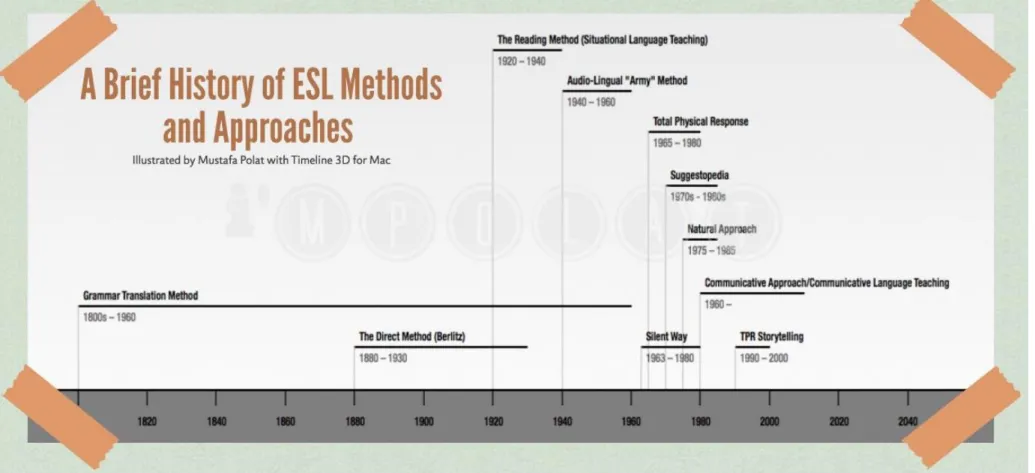
Figure 3 Methods to teach English through history Scullion, M. (2017) ... 21
Figure 4 Flipped Classroom ... 27
Figure 5 English language proficiency. Ministry of Education (2016) ... 37
Figure 6 Linguistic skills. (Willis, 2012) ... 38
Figure 7 Range from pre-test and post-test. (Telenchana, 2018) ... 57
Figure 8 Accuracy from pre-test and post-test ... 58
Figure 9 Fluency from pre-test and post-test ... 59
Figure 10 Interaction from pre-test and post-test ... 60
Figure 11 Coherence from pre-test and post-test ... 61
Figure 12 Students´ description about their English class ... 62
Figure 13 Students use platforms to do homework ... 63
Figure 14 The use of platforms in English class. ... 64
Figure 15 Studentsin a virtual environment, in the use of platforms or social net 65 Figure 16 Technological and interactive classes help in the English learning ... 66
Figure 17 Students´ feelings in English classes ... 67
Figure 18 How often students speak English in class ... 68
Figure 19 Measurement of speaking competence ... 69
Figure 20 Technological and interactive classes help in the English learning. .... 70
ix
LIST OF TABLES
Table 1. A technological and interactive class to learn English ... 22
Table 2. Technological tools for Flipped Classroom ... 24
Table 3. Pillars of the Flipped Classroom ... 28
Table 4. Teacher and students’ roles in Flipped Class ... 34
Table 5. Pre-test control group ... 53
Table 6. Pre-test experimental group ... 54
Table 7. Post-test control group ... 55
Table 8. Post-test experimental group ... 56
Table 9. Range-vocabulary results ... 57
x
AGRADECIMIENTO
Quiero expresar mi agradecimiento a Dios por permitirme alcanzar una meta más en mi vida como estudiante, de la misma manera a la Mg. Sarah Iza, por el gran apoyo y guía que me ha sabido brindar durante el desarrollo y estudio de la tesis, agradecida por el tiempo empleado para realizarme las sugerencias en mejora de la tesis, paciencia y el tiempo que ha sabido dedicarme para la elaboración de la tesis de una manera coordinada y coherente. Es muy importante para mí agradecer de igual manera a los docentes de mi área quienes me ayudaron con la validación de las encuestas y su aplicación.
De la misma manera mi gratitud al señor rector de la Unidad Educativa “Mario Cobo Barona”, quien me ha permitido desarrollar el proyecto de investigación en bien de la institución.
Finalmente, un aporte importante a la dedicación y colaboración a los estudiantes que han sido parte esencial de este proyecto de investigación.
xi
DEDICATORIA
Este trabajo investigativo va dedicado a Dios por permitirme concedido la sabiduría y tiempo para la elaboración de la misma, siempre ha sido mi apoyo me ha brindado la fuerza para seguir adelante y llegar a estar donde estoy ahora. Le dedico este logro que con mi esfuerzo y su protección lo he realizado para llegar alcanzar una meta propuesta en mi vida profesional.
Personas muy importantes también como son mi familia por su apoyo moral, puesto que me han motivado para seguir mis estudios y alcanzando metas en mi vida profesional. Mi padre, hermanas, esposo e hijos quienes me han demostrado apoyo incondicional siendo parte de mis éxitos durante el camino y desarrollo de mi proyecto. Sin dejar de lado mi dedicatoria aquella mujer que ya no está conmigo pero recibo sus bendiciones desde el cielo que es mi madre, quien fue alguien fundamental para llegar a donde estoy en mi vida personal y profesional.
xii
UNIVERSIDAD TÉCNICA DE AMBATO DIRECCIÓN DE POSGRADO
MAESTRÍA EN LA ENSEÑANZA DEL IDIOMA INGLÉS COMO LENGUA EXTRANJERA
TEMA
“THE FLIPPED CLASSROOM METHOD IN ENGLISH SPEAKING DEVELOPMENT”
AUTHOR: Licenciada. Silvia Paulina Telenchana Carvajal TUTOR: Licenciada. Sarah Jacqueline Iza Pazmiño, Magíster. DATE: January 25th, 2019
RESUMEN EJECUTIVO
Hablar es una de las habilidades productivas en el idioma Inglés, que permite proporcionar y compartir información. Un importante aspecto es hacer que los sonidos en el mensaje sean significativos utilizando una selección de sonidos claros. El maestro es la herramienta principal para que los estudiantes sigan el modelo apropiado para llegar a la práctica oral de una manera muy correcta, muchas veces esto se logra mediante prácticas supervisadas por el maestro. Probablemente, no solo radique el problema en el sistema educativo, ya que los maestros trabajan y solo cuentan con el material proporcionado por el ministerio de educación (libro) que ofrece pocas oportunidades para desarrollar la habilidad de hablar. Es muy importante contribuir para mejorar buscando diferentes estrategias y métodos para aplicar en el aula para mejorar el conocimiento de nuestros estudiantes y obtener mejores resultados. Por lo tanto, esta investigación tuvo como objetivo determinar la relación entre el Método ¨Flipped Classroom¨ como un modelo pedagógico que transfiere el trabajo de ciertos procesos de aprendizaje fuera del aula y utiliza el tiempo en el aula, junto con la experiencia docente y el desarrollo de las habilidades de expresión oral en 33 alumnos del primer año de bachillerato con edades comprendidas entre los 15 y los 18 años en la Unidad Educativa “Mario Cobo Barona”. Se realizó empleando una investigación de campo, bibliográfica e intervención social. Este trabajo aplicó un enfoque cualitativo-cuantitativo. Los datos se recopilaron a través de una encuesta, una entrevista / discusión en clase, y exámenes previos y posteriores. Los resultados indican que algunos beneficios potenciales de una aula invertida hacen que sea una metodología que los maestros no deben pasar por alto. El cuestionario fue respondido por 207 participantes. Los hallazgos revelaron que la aplicación de este método de clase invertida sea un modelo pedagógico efectivo en las clases, ya que los resultados mostraron un aumento relevante en las calificaciones de los estudiantes. Por lo tanto, el Método de clase invertida no solo promovió la habilidad de hablar, sino que también ayudó a los estudiantes a motivar y hablar inglés libremente.
Palabras clave: hablar, aula invertida, e-learning (aprendizaje virtual), sonidos, docentes, estudiantes, oportunidades, habilidad, estrategias y método.
xiii
UNIVERSIDAD TÉCNICA DE AMBATO DIRECCIÓN DE POSGRADO
MAESTRÍA EN LA ENSEÑANZA DEL IDIOMA INGLÉS COMO LENGUA EXTRANJERA
TEMA
“THE FLIPPED CLASSROOM METHOD IN ENGLISH SPEAKING DEVELOPMENT”
AUTHOR: Licenciada. Silvia Paulina Telenchana Carvajal TUTOR: Licenciada. Sarah Jacqueline Iza Pazmiño, Magíster. DATE: January 25th, 2019
EXECUTIVE SUMMARY
One of the productive skills in English language is known as Speaking which is used to provide information. The most important step in making the sounds in the content meaningful is to use a selection of clear sounds. The teacher is the main tool for students to follow the appropriate model in order to reach the oral practice in a very correct way, many times this is achieved by means of practices supervised by the teacher. Probably, there is not just the problem the educational system, as teachers work just with the material provided by the ministry of education (book) which offers just few opportunities to develop the speaking skill. It is very important to contribute having training looking for different strategies and methods to apply in the classroom to improve our student´s knowledge and having better results. Hence, this research aimed to determine the relationship between Flipped Classroom Method as a pedagogical model that transfers the work of certain learning processes outside of the classroom and uses classroom time, along with teaching experience and the development of speaking skills in 33 students of the of first year of Baccalaureate aged between 15 and 18 at Unidad Educativa “Mario Cobo Barona” It was conducted by employing a field, bibliographical and social intervention research. This work applied a qualitative-quantitative approach. Data was collected through a survey, a class interview/discussion, and pre and post-tests. My results indicate that some potential benefits of the flipped classroom make it a form of education that teachers should not overlook. The questionnaire was answered by 207 participants. The findings revealed that the application of this Flipped classroom method was an effective pedagogical model applied in classes since the results showed a relevant increase in students´ grades. Therefore, the Flipped classroom Method did not only promote the speaking skill, it also helped students to motivate and to speak English freely.
Keywords: speaking, flipped classroom, eLearning, sounds, teachers, students, opportunities, ability, strategies and method.
1
INTRODUCTION
English is an international language, teaching it is a big challenge because students needs to practice it in the classroom and outside as a real world to communicate with others. That is the reason because teachers in Ecuador need to be well prepared looking for new strategies and methods in order to help students to develop the speaking skill to communicate and get better opportunities to be included in good jobs and getting better opportunities to study.
The use of Flipped Classroom Method in the language classroom is not a common practice. One reason for this exclusion comes from generalized beliefs about the complexity of the investment of time and from the strengthened by negative experiences some language instructors have had. In fact, the use of this method promotes students can develop the oral ability in English Language. Moreover, it offers teachers big alternatives to practice English through the activities focussed on speaking skill, being the teaching and learning process meaningful and enjoyable.
The use of this method will help students being motivated through the use of technological appliances not just in the classroom, they can work at home and present for the others in the classroom and outside using real objects, knowing that, nowadays students are related with technology since they are children and they are immerse in a technological world.
Under these circumstances, this research project has attempted to determine and examine the effect that Flipped Classroom Method has on speaking skill of a specific group of students at Unidad Educativa “Mario Cobo Barona”. The findings show that through the experimental group students have developed and improved the speaking skill. The report of this study is structured in the following chapters:
Chapter I. This chapter presents the topic of the research. Additionally, the
problem statement of the study is introduced, contextualized, and analysed. Likewise, the justification of the research project is provided, and its established objectives.
2
Chapter II. This chapter structures the Theoretical Framework of the study, which
includes its research background, philosophical and pedagogical foundations, legal basis, and key categories. These elements give the study with scientific and bibliographical support.
Chapter III. The methodology, or research design, is explained in this chapter.
This description includes an explanation of the study’s approach, method, level, and type. Moreover, the population of the research is identified and described, and the operationalization of the variables is carried out. Finally, the data collection and analysis procedures are explained.
Chapter IV. This chapter covers the analysis and interpretation of the results which
were obtained through the administration of survey and the application of pre and post-tests.
Chapter V. The conclusions and recommendations which were taken from the
findings of the study are provided in this chapter.
Chapter VI. This chapter deals with the proposal for the incorporation of eBooklet
with interactive speaking activities. This proposal encompasses a scheme of work for a five-week speaking lessons.
3
CHAPTER I
PROBLEM STATEMENT
1.1 Theme
“The flipped classroom method in English speaking skill development”
1.2 Problem statement
1.2.1 Contextualization
The Flipped classroom is a methodology that changes certain traditional processes. This methodology reverses the traditional form of a classroom where common activities are carried out outside the classroom through multimedia interaction (Lowell, The Flipped Classroom: A Survey of the Research, 2013). The Flipped classroom model is generating a lot of interest in the educational field.
The widespread use of new technologies among young students in recent years has led to a change in teaching methodologies. The teaching staff has made significant efforts to incorporate the digital material into their teaching work, thus adapting to what some "young technological people" were demanding and innovating in order to capture their attention and try to motivate them in the interests of good learning (Gardner, 2015).
In the global context, the flipped classroom emerged more than ten years ago in the United States. In order to help the learners, they encouraged several video recordings and distribution of their lessons, so that teachers would focus more attention on the individual needs of each student and would also allow students to use their brains in the classroom for more than just taking notes on what the teacher said, giving a noticeable twist to what is normally done in a class (Bergmann & Sams, 2014).
However, in Ecuador, education is in full acceptance of changes in the pedagogical and methodological aspects, but it is still necessary to know much more and to change methodical roles in the classroom process. The flipped classroom is a
4
significant issue in relation to the traditional methodology (Raymond, The Effectiveness of the Flipped Classroom, 2014).
In Ecuador, a different methodology that is in line with the technology is under development. The management and use of certain applications and tools for learning need to be applied and improved to develop the teaching role; however, these applications are currently being promoted and developed for the benefit of education. But there is a gap that lies mainly with teachers who lack access to new technologies and have problems using them (Timperley, Wilson, Barrar, & Fung, 2014).
In spite of existing debates in education, the Ministry of Education is seeking improvements to achieve great benefits. This educational entity calls on teachers to train and learn in ICTs so that teachers in institutions can improve their way of socializing the contents to their students; consequently, to be able to change their methodological role in teaching. For this reason, teachers should perceive its usefulness with great importance and learn to use it in a better way in the educational field (Talis, 2015).
In the province of Tungurahua, it has been determined that 22 institutions, both public and in particular represent a 100% representation of the middle level. So, the authorities should promote mandatory pedagogical counselling for all teachers in the different schools. Institutions at all levels to try to soak and develop the process of learning with new technologies with the support of the of information technology. In the province of
In Tungurahua, the Ministry of Education is responsible for updating and training teachers in order to provide students with an integral contribution to their education. The teaching of high school education is lagging behind traditional teaching, which generates non-significant learning and inadequate teaching because of the lack of creativity and education with limitations. Mario Cobo Barona is an institution where teachers are changing to get better results being innovative according to the students’ needs through an active process, it is being applied to research, creativity, imagination and the development of thinking and reasoning skills.
5
For these reasons, the research work is aimed at providing answers about the use of the Internet and it is different innovative and significant applications in learning, allowing students and teachers to make better use of the tools and technological resources in the institution. This generates a strong and important phase for the realization of complementary motivational, interactive and multimedia activities within the classroom.
This institution is located in Ambato where people are improving their knowledge as the potential use of computers to make a better job in an active way. It is necessary to apply different activities applying a new method causing a great impact for the benefit of student achievement. Teachers need to be aware of the scarce forms of teaching by not planning and using them virtually.
The research work is focused on an answer about the use of the Internet and its different innovative and significant applications in learning. As part of the work, the researcher has been able to demonstrate through an informal discussion with the authorities that the Unidad Educativa “Mario Cobo Barona” has technological material open to the Internet, which is little used by the teachers of the institution and also because of the little knowledge they possess, due to the lack of willingness to overcome and change their traditional methodology.
This research, which is being carried out, allows the student and the teacher to make better use of the tools and technological resources in the institution. This generates a strong and important phase for the realization of complementary motivational, interactive and multimedia activities within the classroom. For this to be efficient in the learning process, it is important to know its great usefulness and importance in the educational field and to know the appropriate management of ICTs. This is why the HPA (Tools for the Classroom) Reverse Classroom, a course given by the Ministry of Education in which it is possible to determine a relevant, innovative and current methodology, aimed at the advances of technology for the development of significant learning (Ministry of Education, 2015). This makes teachers think that it is wise to apply to the Unidad Educativa “Mario Cobo Barona” with high school students.
6
1.2.2 Problem tree
Having deficiency of motivation to learn
Teachers lose the interest in use new technologies Low confidence to
speak
Teachers do not use technological resources.
Absence of technological resourses training Limited of knowledge of Flipped Classroom Method to develop speaking skill.
Passive Methodology Few exposure to authentic English language. Application of traditional teaching.
7
Figure 1. Problem Tree Author: Telenchana, S. (2018) 1.2.3 Critical Analysis
Educational demotivation is one of the factors that imply low performance because students get bored easily and do not acquire the contents, the application of traditional teaching is detrimental to both physical and cognitive training, (Cox, 2015) as well as a methodology that do not promote the teaching with activities, strategies to ensure a comprehensive training. It is important to eradicate any learning problems, for this reason, teachers cannot make evaluations for absence of knowledge in students who do not know that answer the questions, however there are teachers who perform inadequate assessments. Most of the times, students do not feel confident to speak in a freeway. Hence, when teachers are teaching a language, it is useful to motivate learners to actively get engaged in the learning process.
Probably, there is not just the problem the educational system, as teachers work just with the material provided by the ministry of education (book) in the classroom and students are not able to practice English in a real way , and it offers just few opportunities to develop the speaking skill. (Loveless, 2018) Consequently, students get bored just with the same material. Indeed, teaching gramma, vocabulary, reading and writing too much time, teachers must focus on the speaking skill because it is one of the productive skill. Students must create an environment where they can get confident to speak and communicate easily. (Rana, 2017) The ability to communicate effectively, whether it be in your personal or professional life, is one of the most crucial skills one can have. When teachers provide material about student´s real life they feel secure to speak.
It is very important to contribute having our own training looking for different strategies and methods to apply in the classroom to improve our student´s knowledge and having better results. In addition teachers can train using the new technological appliances to get material and planning different activities to motivate the students. In addition, it is necessary to improve our knowledge as teachers investing time and if it is necessary checking resources on the web pages. When teachers use passive methodology are creating passive learners. (Gill, 2013) Passive
8
learners may quietly absorb information and knowledge without typically engaging with the information received or the learning experience. They can get lost easily or hate the subject. Teachers need to train getting new techniques and strategies to make an active teaching and learning process.
Finally, the difficulty in the management and process of the technology generated by the teacher of this institution is a weakness in view of the importance in applying new learning paradigms. (Nazzal, 2014)Also, the way of behave of traditional teachers, developing in their problems of applying new effective dynamic methods of learning which in some cases are tedious and they feel tired about looking for more information. Furthermore, teachers with weak professional training are vulnerable to the use of technology, which affects the learning process. There are not enough training for the teachers about technological appliances to use in the learning- teaching process. This does not allow them to know and apply a "flipped classroom" due to the nonexistence of technological pedagogical advice in the education system and its different entities, which do not choose to advise teachers, avoiding teachers can invest time and their economic resources, it is quiet important as teachers look for own personal training in order to provide a high quality of education.
1.2.4 Prognosis
Limited of knowledge of flipped classroom method to develop speaking skill in students of first baccalaureate year at Unidad Educativa “Mario Cobo Barona” is not successful solved now, it will continue having negative effects in the academic process. (Centre, 2017) Firstly, the application of a traditional teaching where the student does not acquire knowledge does not allow him/her to assimilate, even worse, to reach a meaningful learning. If this problem is not solved, the future of the students will remain stagnant, since they will not be able to develop critical thinking, logical thinking, reasoning, analysis or take advantage of the cognitive level that the students possess.
9
Secondly, to all this and more consequences can lead to the emotional imbalance of the teacher and problems of assimilation of the knowledge of the students significantly if this factor is not taken into account; to which it is possible to solve, re-educate and potentiate the development in the learning process. (GMS, 2016) Applying an adequate interactive inverse methodology; since it opens the possibility that if it is not applied it can be delayed in the computer field and lose an efficient, dynamic, relevant and significant learning for its daily development in the educational society and later to face social problems with the help of the advances of the technology. Through the use of this kind of methodology students get confident and act freely and secure to talk. For this reason, the reverse class will better adapt to the rhythms of work and improve the students' attitude towards the subject, avoiding frustration in them.
Thirdly, the application of this methodology will increase the interest, motivation, and degree of satisfaction of all involved (student, teacher, family). With this in the assisted classroom, it will promote social interaction and problem-solve in the student group. (Campinas, 2008)The teacher need to focus on resolving doubts and reinforcing knowledge will have enough time to work consciously. This extra time generated in the learning process will be used to carry out other more traditional activities in terms of teaching and to individualize their teaching, increasing the interest of the learner. Students are involved in a technological world and teachers need to include in it to get better results.
Finally, using inappropriate resources on students´ oral performance is another issue that affects the speaking skill development. When teachers use technological appliances to include in the classroom students will get comfortable and they can speak freely. It is important to think students through the use of technologies can improve the knowledge including web pages that provides examples and they can practice too. (Starr, 2011) Teachers need to use effective communicative language
10
teaching techniques in their classes. It will affect in students ‘lives in order to have better opportunities.
1.2.5 Formulation of the problem
¿How Flipped Classroom method promotes the teaching process in the development of English speaking skill?
1.2.6 Research Questions
How effective could Flipped Classroom be in the development of Speaking Skill?
What is the students’ oral competence in English?
What is the correlation between Flipped Classroom and the development of Speaking skill?
1.2.7 Delimitation
Field: Education
Specific field: Language teaching Aspect: The Flipped Classroom Method
Specific place of research: Unidad Educativa “Mario Cobo Barona.” in Ambato City of Tungurahua Province.
1.3 Justification
The present research work is aimed at addressing the problem of an inverted classroom and the development of speaking skill. The flipped class is important within education for several parameters appropriate for the student and for the teacher. This methodology prepares students to carry out activities in any place where they are located, it is enough for the student to be connected to the Internet so that he can enter to navigate through the different virtual multimedia spaces and applications. The reverse classroom provides the student with personal space and unlimited time to learn, freeing up discomfort caused by noise or distractions, developing attitudes of responsibility and organization.
11
It is original because there is not another similar research project in Universidad Tecnica de Ambato, in class A, B of the Magister program and in Unidad Educativa “Mario Cobo Barona”.
This research has an important interest between authorities, teachers, students and people who are involved in Education at Unidad Educativa “Mario Cobo Barona”. It will improve the learning process of each student through the application of Flipped Classroom in Speaking Skill Development.
The utility of this research is to make the methodological contribution of the invested class for the teachers, and in this way allow them to benefit the students in their speaking skill development process. The direct beneficiaries are the students, because they can improve their knowledge and to promote they develop their speaking skills without fear and they can speak in a freeway. Also, students can be involved in activities which they will be motivated using technological appliances. This project is feasible because it involves the collaboration of all, seeking to improve the appropriate conditions necessary to strengthen the quality of education by trying to eradicate repetitive work and to get better results in order to get a better level in the educational system.
1.4 Objectives
1.4.1 General Objective
To investigate the Flipped Classroom method in the English-speaking skill development.
1.4.2 Specific Objectives
To determine the effectiveness of The Flipped Classroom method to develop speaking skill in students of 1° Baccalaureate.
To identify the students´ oral competence in English Language.
To examine the correlation between The Flipped Classroom method in the development of speaking skill in students of 1° Baccalaureate.
12
CHAPTER II
THEORETICAL FRAMEWORK
2.1 Research Background
After research in the files of the Educational Institution, there is no evidence on the carrying out of studies on the proposed subject. Similarly, it has been reviewed in libraries and repositories with the aim of taking as a reference the research works that have some similarity with the development of the research, described below, and which will serve as support for the present problem.
A research elaborated by Uzunboyld (2015) with the objective was to fulfil the needs concerning the review of current literature on the use of the flipped classroom approach in education. The contribution of the flipped classroom to education is debated in relation to the changes in students' and instructors' role. Subsequently, flipped classroom applications in various disciplines of education are illustrated. The recommendations made in the literature for design specifications that integrate flipped classrooms with technology are discussed. This research concludes that a careful consideration of the warnings and recommendations made in the literature can help to produce effective flipped classroom environments and also it attempts to inform those who are thinking of using new technologies and approaches to deliver courses.
Some literature was explained in the research conducted by Braseby (2015) which explores the different uses of the term “flipped,” examines the research to date, and discusses how and why teachers are starting to use the new model. It offers suggestions for activities both inside and outside of the classroom to encourage deeper learning and greater conceptual understanding. One of those was the implications of the flipped classroom model are for teachers to find the best opportunities for students to achieve higher-order critical thinking skills and to help make learning relevant. Also, used effectively, the flipped classroom is not a vilification of the lecture or a dumbing down of content, nor is it a free-for-all discussion session. It is a carefully planned experience for students that allows for
13
deeper learning of the content, practice in learning collaboratively, and formative feedback as concepts are being learned. And, flipping a class in itself will not make students successful; effective teaching and meaningful learning have to happen to make the class successful.
Other research conducted by Lowell (2013) with the aim to provide a comprehensive survey of prior and ongoing research of the flipped classroom. Studies are characterized on several dimensions. These include the type of in-class and out-of-class activities, the measures used to evaluate the study, and methodological characteristics for each study. Results of this survey show that most studies conducted to date explore student perceptions and use single-group study designs. Reports of student perceptions of the flipped classroom are somewhat mixed but are generally positive overall. Students tend to prefer in-person lectures to video lectures but prefer interactive classroom activities over lectures. Anecdotal evidence suggests that student learning is improved for the flipped compared to traditional classroom. However, there is very little work investigating student learning outcomes objectively. We recommend for future work studies investigating of objective learning outcomes using controlled experimental or quasi-experimental designs. The author also recommends that researchers carefully consider the theoretical framework used to guide the design of in-class activities. Raymond (2014) in his article the author explores the “flipped” or “inverted” classroom and its effects on student learning. The flipped classroom is a form of education in which students learn new content during out-of-class-time instead of the traditional review exercises that are normally given, which opens up class time for activities, problem solving, and other forms of instruction. During this study, a flipped classroom was implemented in a high school mathematics course. Data was collected from student grades, a pre and post survey, a class interview/discussion, and my personal notes from teaching. My results indicate that some potential benefits of the flipped classroom make it a form of education that teachers should not overlook.
Finally, Corso (2015) conducted an article with the aim to compare the impact of the master class with that of the classroom invested in the surgical learning
14
environment. The Dundee Ready Education Environment Measure (DREEM) questionnaire was used in four cohorts of students. The five domains and the overall score of the instrument were analysed with both strategies. The questionnaire was answered by 207 participants (men: 36%; age: 21.9 ± 1.49 years). DREEM's overall score and that of its domains were higher with the inverted classroom strategy, which would place it at a level of excellence. There were no differences between the ANOVA of each domain and the overall score of the questionnaire with the inverted classroom model, but there were differences with the master class strategy (p<0.01). High levels of reliability (Cronbach>0.90) were found for all measurements in both environments and coherence in all cohorts. Finally, the author concludes that the classroom strategy score invested in the DREEM questionnaire was at a level of excellence compared to that of the master class. It is crucial to determine the factors that scored negatively in order to promote the improvement of the learning environment, as well as to measure over time to ensure the quality and success of the strategy.
At present, the use of new pedagogical techniques is being developed as the online teaching resources advance, therefore, the teacher must be updated and mainly to reduce the amount of work that has to be done in a traditional way; and the vain methodology that causes boredom to the student since the manual activities are not focused on how to learn to learn. The reverse classroom provides this important support in the interactive learning process and thus contributes to the development of knowledge in a meaningful and comprehensive way.
2.2 Philosophical Foundation
The present research is framed within the epistemological paradigm because new knowledge will be acquired. This branch of philosophy tries to explain what concepts, methods, and laws scientific knowledge uses. Knowledge is perceived as a permanent process that must be applied according to circumstances and technological progress. The mission of this foundation is to develop the human being in an integral way and that education must be approached in all its reality in
15
all its complexity. The student must adapt to the rhythm to solve everyday problems with creativity and construction for life.
2.2.1 Propositive criticism
Because it questions the reality that has become the object of study and because it is not defined in the research but seeks a permanent solution that benefits those affected by this problem.
2.2.2 Ontological Foundation
The ontology aims rationally to establish the fundamental categories of things and the principles that organize and guide the knowledge of being, as a part of reality.
2.2.3 Axiological Foundation
Through axiology, it can determine the values a person possesses in the social, economic and spiritual environment. To train in values is not to model attitudinal behaviour. These behaviours do not presuppose the internalization of a value. Good manners don't make you polite, just as the simple fact of belonging to solidarity organizations doesn't make you solidarity.
2.3 Legal Basis
The Flipped Classroom methodology is designed so that teachers have an initial approach to technology and gradually deepen their knowledge and use of it, as an instrument that improves their pedagogical task through the application of strategies for the design of interactive classes that encourage students' learning in the classroom.
Priority will be given to the teachers of the institutions that are participating in programs such as laptop delivery, tablet, induction to the use of platforms, teachers who will be studying for their master's degrees, or virtual Continuing Education programs.
This project is supported by the Ministry of Education of Ecuador, since the work that the teacher, the student and the didactic and pedagogical complements interact in the classroom and outside of it so that the learning is relevant and integral with the purpose that the students have a constructive and critical approach. For this the
16
teacher must be prepared in the technological field, constantly updating himself/herself in the flipped classroom field.
The constant technological innovations, make Ecuadorian Higher Education respond to the demands of national and international development, so it is very important to apply virtual learning environments, which today is becoming a modern strategy within education. The present work is based on the following laws that govern the Ecuadorian state: The Political Constitution of the Republic of Ecuador of 2008.
Title II of the rights, within Chapter II: Of the rights of good living, in its Fifth Section, First of Education
Art. 343.- affirms:
The purpose of the Ecuadorian national education system will be to develop the individual and collective skills and strengths of the population, which will enable learning; generate and use of knowledge, techniques, wisdoms, arts and culture. The system will focus on the individual that learns, and it will work in an inclusive, flexible, dynamic, efficient and effective way.
Article 385 numeral 3.- affirms:
Develop technologies and innovations that enhance national production, increase efficiency and productivity; improving the quality of life and contribute to the implementation of good living.
Article 387 .- affirms:
It will be the responsibility of the state: to provide and promote the incorporation into society of knowledge to achieve the objectives of the development regime. To promote the creation and production of knowledge, encourage scientific and technological research, and enhance ancestral knowledge, in order to contribute to the development of good living.
17
The state will assign the necessary resources for scientific research, technological development, innovation, scientific training, recovery and development of ancestral wisdom, and the dissemination of knowledge.
18
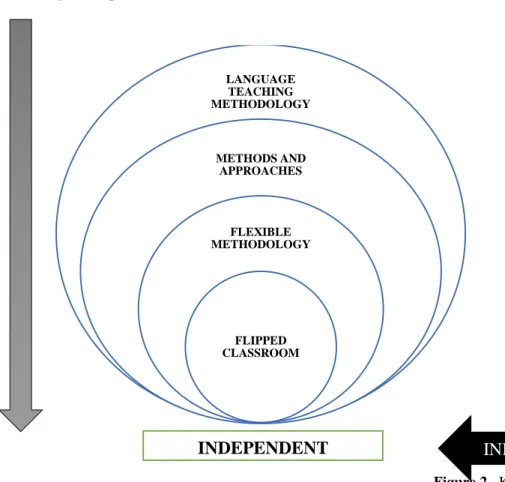
2.4 Key Categories
Figure 2. Key Categories Author: Telenchana, S. (2018) LANGUAGE TEACHING METHODOLOGY METHODS AND APPROACHES FLEXIBLE METHODOLOGY FLIPPED CLASSROOM ENGLISH LANGUAGE LINGUISTIC SKILLS PRODUCTIVE SKILLS SPEAKING SKILL INDEPENDENT VARIABLE DEPENDENT VARIABLE INDEX
19
2.4.1 Independent Variable
LANGUAGE TEACHING METHODOLOGY
English is an international language, it lets teachers to access to understand the world of other cultures and their own. It lets to communicate, develop personal, social and intellectual skills. It is so important to know the methodology applied to teach it. (Council, 2018) “Methodology is a system of practices and procedures that a teacher uses to teach.” It is going to be useful because it is based on our beliefs about the nature of a language. They can be applied according to the needs of the learners. Teachers can mix some methods and approaches. It will depend on aims of each lesson, expectations and resources. Moreover, methodology is so different from the methods. (Rodgers, 2012) “In language teaching, methodology means the study of pedagogical practices in general, including theoretical implications and related research.” It can include the resources we use to teach.
English teachers need to know about methodology to teach a language to motivate people to know another culture, they must have develop some techniques in order to have positive results in some practices in the classroom and outside. (Stern, 2003) “ Language teaching, a great deal of theorizing, experimentation, innovation, debate, and controversy has occurred in the hope of improving practice and of making language teaching more manageable, more affective, and more interesting.” It is important to look for methods which can help teachers to develop the four skills in our students to have good results. English is learnt as a second language and that is the reason because it could be weaker to acquire easily. It is important to create conditions and to have a warm environment in order to have profitable results to get our aims.
2.4.1.1 METHOD AND APPROACHES
The active and interactive methodology allows learning and evaluation when participating in activities in which the main objective is not to show or exemplify the functioning of grammatical structures but to carry out actions in the foreign language (Verspoor, 2015). These methodologies allow students to be actors who use the foreign language to communicate actively both in the classroom and in environmental circumstances that require it. In this way, processes of socialization
20
and knowledge construction are fostered and links are built with others, which allows them to develop tolerance, respect, solidarity, and appreciation for themselves and for other human beings (Ullman, 2015).
21
22 Nowadays, there are new innovative methods:
2.4.1.2 Trends in 20th Century language teaching
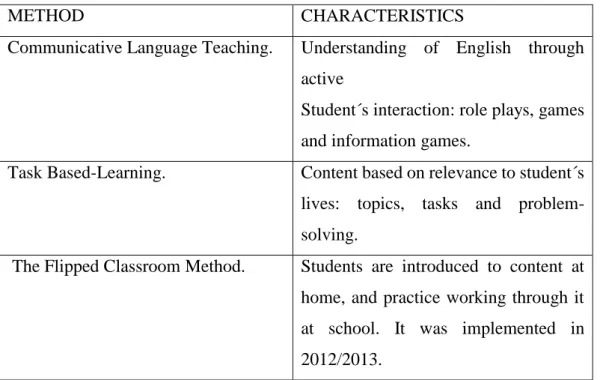
Table 1. A technological and interactive class to learn English
METHOD CHARACTERISTICS
Communicative Language Teaching. Understanding of English through active
Student´s interaction: role plays, games and information games.
Task Based-Learning. Content based on relevance to student´s lives: topics, tasks and problem-solving.
The Flipped Classroom Method. Students are introduced to content at home, and practice working through it at school. It was implemented in 2012/2013.
Author: Zhansaya, K. (2007)
The playfulness factor is a very important element in the student's life as it establishes a connection between his or her usual activities at home and in the neighborhood and what happens in the classroom (Spoelman, 2010). Playful activities have the advantage of having schemes known beforehand by the children and therefore provide a familiar framework for developing the new learning. In addition, they lead to the creation of a context that is shared and recognized by all and that allows students to significantly anchor new elements in something they already master.
2.4.1.3 Methodologies that integrate the known with the new knowledge.
This process of reflection is aimed at making them aware of the relationship between what they are learning and what they already know, to make room for the
23
knowledge and experiences that they bring to the classroom and show them that they form a coherent whole (Richards, 2003).
2.4.1.4 FLEXIBLE METHODOLOGY
Flexible methodologies allow students to use their learning strategies without the extreme rigidities of some traditional methodologies and offer teachers a variety of activities and the selection of appropriate techniques and procedures for each case (Schmitt, 2001).
2.4.1.5 Methodologies that value affective factors
Taking into account the primary role that affectivity plays in children's development (Bruner, 1975), the importance of creating an effective atmosphere in the classroom and reducing the effective filter in order to maximize the level of motivation and interest is highlighted (Krashen, 1981). Creating an equal environment for boys and girls gives them confidence and creates appropriate conditions for them to develop their autonomy and creativity together.
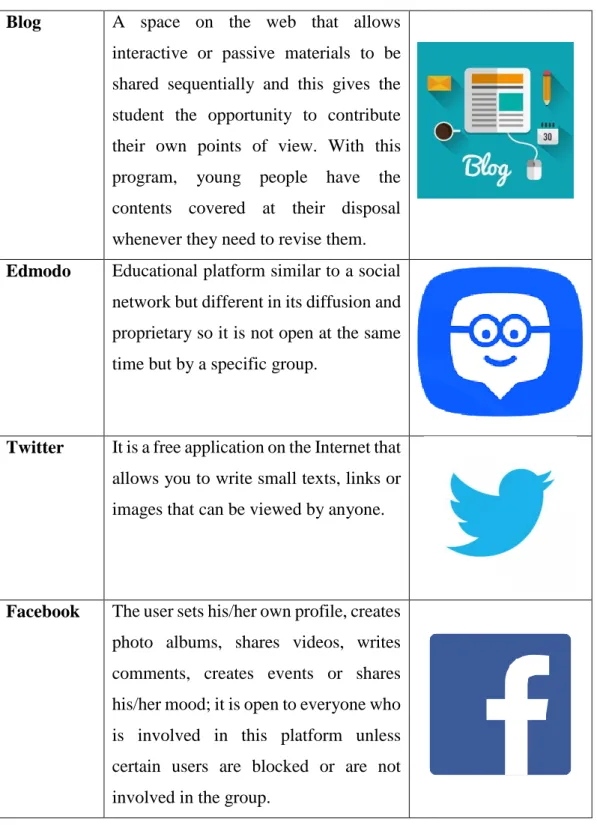
The technological materials are varied according to their purpose but most of them have an educational purpose, which is why teachers have seen the need to establish available and basic tools to apply and solve the subject and generate learning in the student that leads to the resolution of socio-educational problems. With regard to the Flipped Classroom methodology, there are programs created only to design to the degree or level that you think is convenient for those who want to apply for educational purposes and this time select programs that facilitate the creation and dissemination of videoconferences, activities and practical exercises on the content to be studied.
24
Table 2. Technological tools for Flipped Classroom
Blog A space on the web that allows
interactive or passive materials to be shared sequentially and this gives the student the opportunity to contribute their own points of view. With this program, young people have the contents covered at their disposal whenever they need to revise them.
Edmodo Educational platform similar to a social network but different in its diffusion and proprietary so it is not open at the same time but by a specific group.
Twitter It is a free application on the Internet that allows you to write small texts, links or images that can be viewed by anyone.
Facebook The user sets his/her own profile, creates photo albums, shares videos, writes comments, creates events or shares his/her mood; it is open to everyone who is involved in this platform unless certain users are blocked or are not involved in the group.
25
Moodle The free, flexible and basic program used for the creation and management of online courses, developing a virtual learning environment, its objective is to generate enriching learning experiences.
Podcast It is a sound file that can be found on the network can be stored on any portable audio device.
PowerPoint This software allows you to create
presentations that you can share through the theme without the need for the internet, each of the spreadsheets can incorporate text, photos, illustrations, drawings, graphics tablet, movies, etc..
Keynote This software allows you to design presentations with advanced effects and tools. It offers visual tools and allows to insert reflections and frames to the images and to order data in interactive graphics.
YouTube This software has more than seven hundred thousand educational videos. This implies a multitude of resources that the teacher must take advantage of, as long as it is related to the issues raised.
26
Quizbox This application allows you to insert multiple-choice questionnaires on our website, this benefits the teacher who wants to meet each group of students according to their educational needs
Author: Telenchana, S. (2018) Source: (Bishop & Verleger, 2013)
2.4.1.6 THE FLIPPED CLASSROOM METHOD
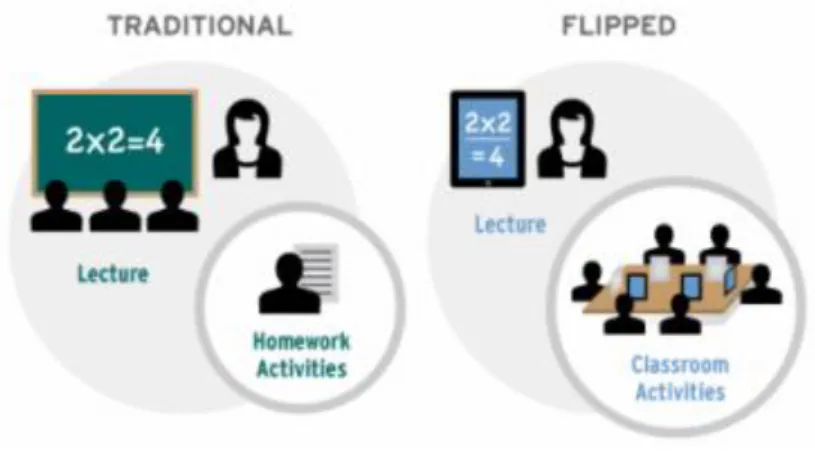
The conceptual and basic idea of an inverted or flipped classroom is found in Bergmann and Sams' book (2012), which specifies that in a flipped classroom what was traditionally done in class is now done at home, and what was traditionally done at home is now completed in class.
Achútegui (2014) states that:
"Flipped Classroom is a pedagogical model that transfers the work of certain learning processes outside of the classroom and uses classroom time, along with teaching experience, to facilitate and enhance other processes of acquisition and knowledge practices within the classroom.
This constructivist model according to its definition makes a significant focus on the learning process, where the student occupies the necessary time and adequate place, according to their realities to acquire concepts and generate a simple and proper construct for their competence and the teacher also has time with this process to carry out other activities that benefit the learner enormously.
The invested class consists fundamentally of using the time outside the classroom to carry out certain teaching-learning processes that have been developed within the same generally, in the classroom time is fundamentally used to promote and facilitate other processes of acquisition and practice of knowledge (Ruiz, 2014). The FC Guide is a compilation of best practices and community resources. It is a model that transfers the learning processes outside of the classroom, and at the
27
moment of attending the class, knowledge is reinforced by means of debates, group work, individualized work, etc.
Figure 4 Flipped Classroom
This new methodology opens another possibility to learn in a systemic, integrative, critical and meaningful way. This new model in education is generating relevant paradigms for the empowerment of knowledge and its development.
The "Flipped Classroom" is being applied by many of the institution's teachers nationwide prior to the knowledge acquired. This current methodology could fully support the interactive learning process through the identification of didactic sessions that are different from those that we apply today in traditional classrooms. In the flipped class, working models change and the roles of the traditional class are reversed thanks to the support of ICT. The teacher's masterclass is replaced by a set of online materials, which can be videos, readings, etc. that the student can consult, view, and contain theoretical and procedural content on a given topic or subject (Prabaharan, 2014).
This methodological model is a good way to take advantage of ICTs. A pedagogical model that changes certain processes that in one way or another were linked to the classroom and transferred to the educational environment. That is, it reverses the traditional way of understanding a class.
Bishop and Verleger (2013) define the inverted class as an educational technique consisting of two parts, one that occurs inside the classroom with group learning
28
activities, and one part outside the classroom with direct individual lessons on the computer.
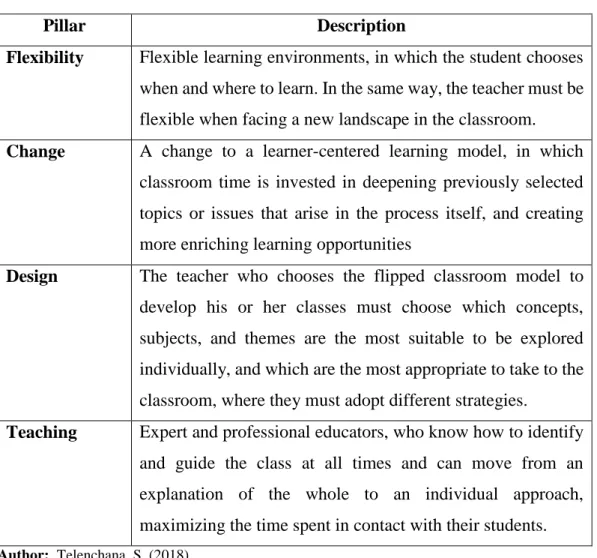
The fundamental pillars of the flipped classroom model according to Hamdan et al. (2013), which many authors cite including Little (2015), are four:
Table 3. Pillars of the Flipped Classroom
Pillar Description
Flexibility Flexible learning environments, in which the student chooses when and where to learn. In the same way, the teacher must be flexible when facing a new landscape in the classroom.
Change A change to a learner-centered learning model, in which classroom time is invested in deepening previously selected topics or issues that arise in the process itself, and creating more enriching learning opportunities
Design The teacher who chooses the flipped classroom model to develop his or her classes must choose which concepts, subjects, and themes are the most suitable to be explored individually, and which are the most appropriate to take to the classroom, where they must adopt different strategies.
Teaching Expert and professional educators, who know how to identify and guide the class at all times and can move from an explanation of the whole to an individual approach, maximizing the time spent in contact with their students.
Author: Telenchana, S. (2018) Source: Hamdan et al. (2013)
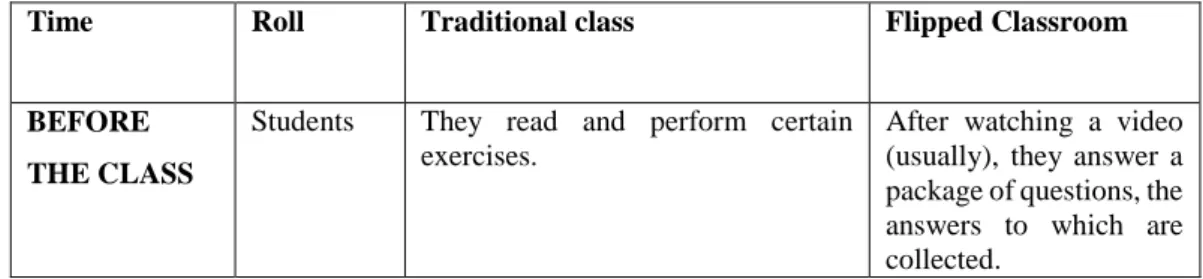
It is, therefore, a mixed learning in which the students at home carry out tasks such as learning online content through videoconferencing, reading and in class carrying out tasks that require greater interaction and collaboration with their classmates or a more personalized guide by the teacher. In this way, it promotes active learning, collaborative work and project work.
29
Another important factor to encourage in order to improve the teaching and learning process is motivation. Many of the failures in education are due to a lack of motivation, which causes the student to lose interest in learning. This fact is presented as learning difficulties in university students and can be attributed to the passive role they play during traditional classes (Andrews, Leonard, Colgrove, & Kalinowski, 2011). The authors themselves propose active learning as a possible improvement to this situation, to get the student to participate and play a leading role in his or her learning.
Wasserman, Quint, Norris, and Carr (2015) state that the flipped classroom methodology is seen as the solution to a combination of pedagogical problems. Educators are confronted with overly passive and disconnected students in traditional master classes. The flipped classroom is presented as a methodology that encourages more active and collaborative learning, which also facilitates adaptation both in time and in learning rhythms, promotes self-regulation and easily combines the corresponding space with formal and non-formal education.
How to do a Flipped Class?
Different resources and strategies can be used to invest in a traditional classroom, as many as teachers who decide to address these challenges may have ideas for. One of the possibilities is to create short videos and podcasts recorded by the teacher himself or to use other existing videos on the Internet with the necessary concepts and/or explanations. Another possibility is to use screencast videos, which are recordings of an explanation developed by the teacher on his or her electronic device (computer, tablet, etc.), is a kind of film of what the person recording can see on his or her monitor. Any of these formats must include key learning content and they will be viewed as homework (Abeysekera & Dawson, 2015).
Another option, less effective according to the cognitive theories of multimedia learning of Mayer (2009), is to use previous readings or static presentations of the basic contents. On the other hand, and according to Brown (2012), the students receive better recordings made by the teacher himself. In this way, a greater approach is achieved, reducing the possible distant perspective that an online explanation may provide.
30
Once classroom time is freed up, this time is invested in activities that encourage student participation in class, through questions, problem-solving, project development and application of ideas and concepts, constructivist teaching and learning methods (Tourón & Santiago, 2015).
These activities are usually carried out in small groups and are guided and led by the teacher in the classroom. Teachers can also use certain concept evaluation tests, carried out after watching videos at home, with questions on the subject matter included in a set of online questions. Through the analysis of these tests, the main shortcomings of the group and conflicting points in the learning process can be identified.
Santiago (2015) offers up to 100 different tools for visualization and/or video production, concept evaluation tests, teamwork, etc. Many resources that facilitate the development of the flipped classroom.
Virtual fields (considered as part of the so-called Learning Management Systems) act as the learning environment that the teacher will use to facilitate online content, encourage online discussions, collect answers to questions asked about the subjects covered, as well as any activity that is raised or used as a resource.
Rotellar and Cain (2016) propose a series of premises as initial recommendations when implementing and developing a methodological strategy based on the inverted class:
1. Use academic programming to determine what content should be presented outside the classroom and how to design classroom learning activities. 2. Facilitate possibilities for individual and group academic development to
help university members in the paradigm shift.
3. Recognize that the natural dynamics of the classroom may require the need for support in the classroom.
4. Be aware that the rule change can overwhelm a large number of students who must be re-educated in how to succeed in this new classroom.
5. Correctly connect the activities prior to the class with the activities that will be carried out in the classroom.
31
6. Advise students to understand exactly what they need to know or do before going to class.
7. Give students options to ask questions and/or clarify information about the contents proposed and presented by the teacher outside the classroom. 8. Focus classroom activities to help learners think like future experts. 9. Promote opportunities for formative evaluation to understand what they
know and what they don't know.
10. Resist the urge to retrain students who do not prepare properly. They must be made aware of their responsibility as future professionals.
11. Be careful not to overload students with too much content outside of class, too many videos, materials, readings, and other documents or resources. 12. Assess what knowledge, skills, behaviours, and attitudes are desired by
students. There is no point in teaching and developing critical thinking and problem-solving in the classroom and only evaluating knowledge.
13. Be prepared to adapt teaching and learning activities as they are seen to contribute or not to learning.
Advantages of Flipped Classroom
As with any methodological approach, the inverse class has its advantages and disadvantages, and some of the great advantages offered to education can be mentioned, using this type of current methodology that implies a great help for the educational improvement of the learner and the educator.
The Flipped Classroom or inverse class allows you to get completely involved in the subject, visiting the interactive activities designed as many times as you think necessary to understand.
Outside the classroom, this programmed methodology allows for online participation through forums, debates, group and personal discussions with colleagues and the facilitator or tutor, making judgments of one's own values concerning the topic.
Develops the student's critical and analytical thinking.
In class, participate actively in problem solving and collaborative activities and discussion in class.
32
It allows the student to become a protagonist and an essential part of his or her learning.
It increases the student's commitment because this method makes him/her co-responsible for the learning process.
Teachers are more efficient in their daily work because they have more time and space in their activities.
Reduces the problem of stress generated by excessive teaching work. However, there are also criticisms and disadvantages to this method of teaching that are indispensable to know in order to know under what circumstances this type of teaching can be developed and put into practice. There are some disadvantages that can be mentioned.
Also, Fulton (2012) and Roehl (2013) mentioned between the different advantages and potentialities the flipped classes are:
The student advances at his or her own pace
Doing homework in class causes teachers to observe students' different learning styles
The teacher can more easily customize and update the materials to be provided to students
It allows the integration of specific videos on the subject in question with class recordings, web sites, relationships, etc.
It enables teachers to gain more knowledge related to student learning, mainly due to greater student-teacher interaction while they research and perform their tasks.
Better use of the hours of physical presence in the classroom
Technology support allows for more flexible and new approaches to learning
33
Disadvantages of Flipped Classroom
To apply this model requires a lot of dedication and effort on the part of the teacher to properly organize its contents and that they achieve the objectives.
Although it is true that technology has made great strides in education, it is limited to the permanent connection to the Internet, which unfortunately is not available in some educational areas.
Some students do not have their own technological devices, so they have to go to a centre for this purpose.
To have Internet, this would be a limitation in the case of some students who do not have sufficient financial resources.
Health is an important part of the company's human being, so if a child spends a lot of time in front of a screen, it could cause weight gain, sleep problems, inattention, anxiety, among others.
These are some of the disadvantages that the teacher must be aware of in order to look for suitable alternatives to put his new methodology into practice, but it is believed that any innovation is good and just as there are disadvantages there are also advantages that make a project of change emerge positively.
The inverted class is not exempt from its disadvantages as they may be:
Give more relevance to technology than to pedagogy and focus only on recording the classes, forgetting that the key will be methodological changes.
Thorough preparation is necessary to make it really work, which requires more effort and time for the teacher.
It should be borne in mind that teachers will upload their videos to YouTube and not all students have adequate access to mobile devices and the Internet. It means that students spend more time in front of the screen.
Teachers’ role in Flipped Classroom
The class is not an adequate methodology in the teaching-learning process if the teacher does not have an extraordinary level of knowledge of the subject, is not