UNIVERSIDAD TECNICA DE AMBATO
DIRECCIÓN DE POSGRADO
MAESTRÍA EN ENSEÑANZA DEL IDIOMA INGLÉS COMO
LENGUA EXTRANJERA
Tema: “TED TALKS AS A STRATEGY TO IMPROVE THE SKILL OF LISTENING”
Trabajo de Investigación, Previo a la Obtención del Grado Académico de Magister en la Enseñanza del Idioma Inglés como
Lengua Extranjera.
Autora: Licenciada Janet Lynn Bravo
Director: Licenciado Peter Oye Rotimi Magíster.
Ambato-Ecuador 2018
ii
A la Unidad de Titulación de la Universidad Técnica de Ambato
AUTORÍA DEL TRABAJO DE INVESTIGACIÓN
iii
iv HOS DE AUTOR
v
INDICE GENERAL
PORTADA ……….………….………….………….………….………….………….………….………...i
A la Unidad de Titulación de la Universidad Técnica de Ambato ... ii
AUTORÍA DEL TRABAJO DE INVESTIGACIÓN ... ii
DERECHOS DE AUTOR ... iv
INDICE GENERAL ... v
INDICE DE FIGURAS ... ix
INDICE DE TABLAS ... xii
AGRADECIMIENTO ... xiii
Dedicatoria ... xiv
Resumen Ejecutivo ... xv
Introduction ... 1
Chapter 1: Problem statement ... 3
1.1 Theme of the Problem ... 3
1.2 Problem Statement: ... 4
1.3 Contextualization of the problem ... 4
1.3.1 Problem tree ... 8
1.3.2 Critical analysis ... 9
1.3.3 Prognosis ... 9
1.3.4 Setting of the problem: ... 10
1.3.5 Research questions ... 10
1.3.6 Delimitations, limitations and scope ... 10
1.3.6.1 Delimitations ... 10 1.3.6.2 Scope ... 11 1.3.5.3 Limitations ... 11 1.4 Justification: ... 12 1.5 Objectives: ... 14 1.5.1 General objectives ... 14 1.5.2 Specific objectives ... 14
Chapter 2 Theoretical framework ... 15
2.1 Previous s / Research background: ... 15
vi 2.2 Philosophical foundations ... 18 2.2.1 Literature review: ... 18 2.2.2 Philosophical framework ... 21 2.3 Legal basis: ... 26 2.4 Key categories ... 28 2.4.1 Communication ... 29
2.4.2 Cross cultural communication ... 31
2.4.3 Strategies and processes ... 32
2.4.4 Listening comprehension ... 34 2.4.5 Ted talks ... 36 2.4.6 Listening Journals ... 38 2.4.7 Authentic materials ... 40 2.4.8 Extensive listening ... 42 2.5 Hypothesis ... 45
2.6 Signaling hypothesis variables ... 45
Chapter 3 Methodology ... 46
3.1 Research approach: ... 46
3.2 Field ... 46
3.3 Level ... 46
3.5 Population and sample ... 47
3.6 Operational Variables ... 47
3.6.1 Independent variable ... 47
3.6.2 Dependent variable ... 48
3.7 Data collection plan ... 48
3.7.1 Procedures of study ... 48
3.7.2 Procedures for the journal ... 51
3.8 Data analysis ... 53
Chapter 4 Analysis and Results ... 54
4.1 Results of the study ... 54
4.1.1 Tests ... 54
4.1.1.1 Results of the tests ... 54
4.1.2 Surveys ... 55
vii
4.1.2.2 Survey two ... 57
4.1.2.3 Survey three ... 59
4.1.3 Journal Results ... 66
4.1.3.1 First month average perception ... 66
4.1.3.2 Second month ... 67
4.1.3.3 Third month ... 68
4.1.3.4 Fourth month ... 69
4.2 Analysis of the results ... 70
4.2.1 Tests ... 70
4.2.2 Analysis of the survey results ... 73
4.2.2.1. Survey one... 73
4.2.2.2 Survey two ... 84
4.2.2.3 Survey three ... 89
4.2.3 Analysis of journal results ... 98
4.3 Hypothesis verification ... 99
Chapter five ... 100
5.1 Conclusions and Recommendations ... 100
5.1.1 Conclusion ... 100
5.1.2 General recommendations ... 101
5.1.3 Lesson plan with recommendations ... 104
Chapter 6 ... 106
Proposal ... 106
6.1 Introduction ... 106
6.2 Background and theoretical foundations ... 106
6.3 Justification ... 107 6.4 Objectives ... 107 6.4.1 General objective ... 107 6.4.2 Specific objectives ... 108 Feasibility ... 108 6.6 Methodology ... 108 6.6.1 Basic Methodology ... 108
6.6.2 Population and sample ... 109
viii
6.7 Administration ... 109
6.7.1 Updated Procedures for the listening journal ... 109
6.7.2 Updated Journal entry form ... 110
6.7.3 Updated reflection questions ... 111
6.7.4 Updated Video list ... 111
6.7.5 Surveys ... 115
6.7.5.1 For the section of participants ... 115
6.7.5.2 Pre-intervention survey ... 115
6.7.5.3 During intervention survey ... 115
6.7.5.4 Post-study survey (adapted from Takaesu, 2013) ... 115
6.7.6 Recommendations for tests ... 116
6.7.7 Weekly time table ... 116
Annexes ... 117 Annex 1 ... 117 Annex 2 ... 118 Annex 3 ... 119 Annex 4 ... 122 Annex 5 ... 123 Annex 6 ... 125 Annex 7 ... 128 Annex 8 ... 130
Annex 9 Permission to use the data obtained from the study ... 133
ix
INDICE DE FIGURAS
Figure 1 Problem tree ... 8
Figure 2 Key Categories ... 28
Figure 4 Average Test Results ... 55
Figure 5 Test 1 averages ... 72
Figure 6 Test 2 averages ... 72
Figure 7 Test 3 averages ... 72
Figure 8 Test averages group 1 ... 73
Figure 9 Test averages group 2 ... 73
Figure 10 Test averages control group ... 73
Figure 11 Survey one results group 1 ... 56
Figure 12 Survey one results group 2 ... 56
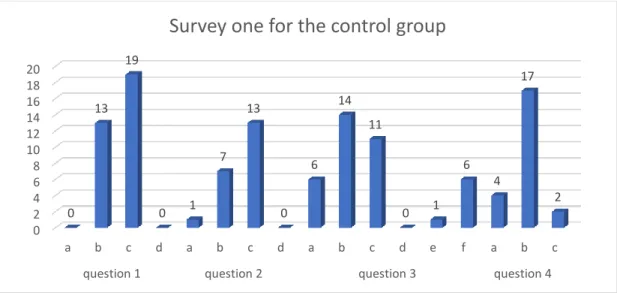
Figure 13 Survey one control group ... 57
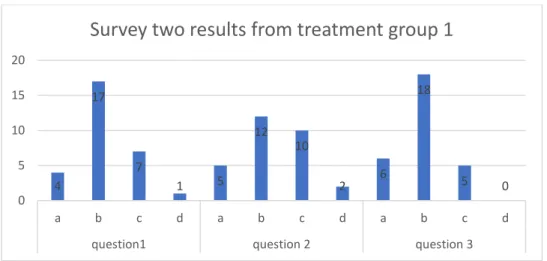
Figure 14 Survey two group 1 ... 58
Figure 15 Survey two group 2 ... 58
Figure 16 Survey 2 control group ... 58
Figure 17 Survey 3 group 1 ... 59
Figure 18 Survey 3 group 2 ... 60
Figure 19 Survey 3 question 1 group 1 ... 61
Figure 20 Survey 3 question 2 group 1 ... 62
Figure 21 Survey 3 question 2 group 1 ... 63
Figure 22 Survey 3 question 2 group 2 ... 64
Figure 23 Survey 3 question 3 group 1 ... 65
Figure 24 Survey 3 question 3 group 2 ... 66
Figure 25 Question 1 group 1 ... 74
Figure 26 Question 1 group 2 ... 74
Figure 27 Question 1 control group ... 75
Figure 28 Question 1 overall comparison ... 75
Figure 29 Question 2 group 1 ... 76
Figure 30 question 2 group 2 ... 76
x
Figure 32 Question 2 overall comparison ... 77
Figure 33 Question 3 group 1 ... 79
Figure 34 Question 3 group 2 ... 79
Figure 35 Question 3 control ... 80
Figure 36 Question 3 overall comparison ... 80
Figure 37 Question 4 group 1 ... 81
Figure 38 Question 4 group 2 ... 81
Figure 39 Question 4 control group ... 82
Figure 40 Question 4 overall comparison ... 82
Figure 41 Question 5 group 1 ... 83
Figure 42 Question 5 group 2 ... 83
Figure 43 Question 5 overall comparison ... 83
Figure 44 Question 1 group 1 ... 84
Figure 45 Question 1 group 2 ... 85
Figure 46 Question 1 control group ... 85
Figure 47 Question 1 overall comparison ... 85
Figure 48 Question 2 group 1 ... 86
Figure 49 Question 2 group 2 ... 87
Figure 50 Question 2 control group ... 87
Figure 51 Question 2 overall comparison ... 87
Figure 52 Question 3 group 1 ... 88
Figure 53 Question 3 group 2 ... 88
Figure 54 Question 3 control group ... 89
Figure 55 Question 1 group 1 ... 89
Figure 56 Question 1 group 2 ... 90
Figure 57 Question 1 control group ... 90
Figure 58 Question 2 group 1 ... 91
Figure 59 Question 2 group 2 ... 91
Figure 60 Question 2 control group ... 91
Figure 61 Question 3 group 1 ... 92
Figure 62 Question 3 group 2 ... 92
xi
Figure 64 Question 4 group 1 ... 93
Figure 65 Question 4 group 2 ... 94
Figure 66 Question 4 Overall comparison ... 94
Figure 67 Combined results question 1 ... 95
Figure 68 combined results question 2 ... 96
Figure 69 Combined results question 3 ... 98
Figure 70 First Month Average group 1 ... 67
Figure 71 First Month Average group 2 ... 67
Figure 72 Second month average group 1 ... 68
Figure 73 Second Month average group 2 ... 68
Figure 74 Third month average group 1 ... 69
Figure 75 Third month average group 2 ... 69
Figure 76 Fourth month average group 1 ... 70
Figure 77 fourth month averages group 2 ... 70
xii
INDICE DE TABLAS
Table 1 Independent Variables ... 47
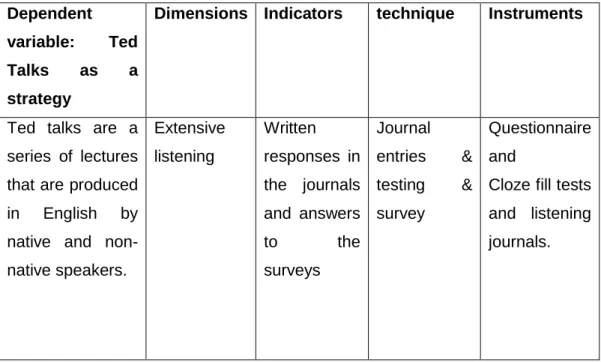
Table 2 Dependent variables ... 48
Table 3 Survey 3 questions 1 group 1 ... 61
Table 4 Survey 3 question 1 group 2... 61
Table 5 Survey 3 question 2 group 1... 62
Table 6 Survey 3 question 2 group 2... 63
Table 7 Survey 3 question 3 group 1 ... 64
Table 8 Survey 3 question 3 group 2 ... 65
Table 9 answers given in combined ... 95
Table 10 combined answers question 2 ... 97
Table 11 Answers Combined answers questions 3 ... 98
Table 12 Proposal 1 ... 103
Table 13 Sample lesson plan ... 105
Table 14 Proposal journal entry ... 110
Table 15 Proposal time table ... 116
Table 16 Journal Entry used ... 117
xiii
AGRADECIMIENTO
Mi eterno agradecimiento a mis apreciados compañeros de la Maestría en enseñanza del idioma inglés como lengua extranjera, que con sus experiencias y consejos me ayudaron a ser mejor persona y profesional.
Infinitas gracias a mis estimados maestros que sin egoísmo dieron todo de si con el fin de nutrirnos con sus conocimientos.
Mis más sinceros agradecimientos a mi tutor Peter Oyi Rotimi por su guía y valiosos consejos en este trabajo de investigación.
Mi reconocimiento a mi “Universidad Técnica de Ambato” que abrió sus puertas y me dio la oportunidad de formarme y encaminarme por esta noble disciplina
Lic. Janet Lynn Bravo
xiv
Dedicatoria
“Todo lo puedo en Cristo que me fortalece.” Filipenses 4:13
Dedico este trabajo primeramente a Dios por que él nos ha dado la vida y la fuerza de lucha en el día a día. Sobre todo, él me ha dado la confianza de seguir adelante sin importar las dificultades en el camino.
También dedico este trabajo a un componente de mi vida super importante que es mi familia. En primer lugar, a mi esposo Fredi, quien me apoyo y me motivo de embarcar en este camino. En segundo lugar, a mis hijos Janet y Roberto, quienes fueron un referente de motivación. Sin olvidar de mis padres, Everret and Janet quienes de la distancia dieron su amor y apoyo en este tiempo.
Dedico este trabajo al Centro de Idiomas que abrió sus puertas y hizo posible hacer este trabajo de investigación. También a mis amigos que me han apoyado en el proceso y con sus palabras de motivación en todo momento.
Gracias a todos que han hecho posible este trabajo
xv
UNIVERSIDAD TÉCNICA DE AMBATO DIRECCIÓN DE POSGRADO
MAESTRÍA EN LA ENSEÑANZA DEL IDIOMA INGLÉS COMO LENGUA EXTRANJERA
TEMA: “TED TALKS AS A STRATEGY TO IMPROVE THE SKILL OF LISTENING”
AUTORA: Licenciada Janet Lynn Bravo
DIRECTED BY: Licenciado. Peter Oye Rotimi, Magíster FECHA: 5/22/2018
Resumen Ejecutivo
El propósito de este estudio es ayudar a los estudiantes del idioma inglés a mejorar sus habilidades de comprensión auditiva. Esta es una lucha en particular para los estudiantes de inglés como lengua extranjera ya que no tienen contacto constante con el idioma en sus situaciones cotidianas. Se sabe que el uso de material auténtico es de gran beneficio para los estudiantes, sin embargo, es una lucha para los maestros asignar el tiempo necesario para dar a los estudiantes el tiempo adecuado para el proceso. Esto se debe en parte al tiempo necesario para desarrollar las otras habilidades del idioma para convertirse en un hablante de inglés completo. Aquí es donde el aprendizaje autónomo se utiliza para complementar el tiempo no disponible en la sala de clase. Sin embargo, es importante orientar a los estudiantes para que el tiempo se use de manera efectiva y productiva. Aquí es donde entran Ted Talks. Ted Talks son videos sobre una gran variedad de temas que son de interés para una amplia variedad de personas. Además, las charlas de Ted tienen transcripciones a las que se puede acceder fácilmente, y un buen número se ha traducido a varios idiomas de todo el mundo. Esto hace posible que este estudio sea hecho en otras partes del mundo donde se enseña inglés como lengua extranjera. Este estudio encontró que hubo una mejora en la comprensión auditiva de los estudiantes a lo largo del estudio. Más importante aún, hubo una mejora en la percepción de la comprensión auditiva por parte de los estudiantes.
Descriptores: aprendizaje auditivo, aprendizaje autónomo, inglés como
lengua extranjera, comprensión auditiva, habilidades auditivas, mejoramiento de comprensión auditiva, percepción de la comprensión auditiva, subtítulos, Ted Talks, videos
xvi
Abstract
The purpose of this study is to help students of the English language improve their listening comprehension skills. This is a struggle in particular for students of English as a foreign language as they do not have constant contact with the language in everyday situations. The use of authentic material is known to be of great benefit to students, yet it is a struggle for teachers to allocate the necessary time to give students adequate time for the process. This is due to in part to the time needed to develop the other language skills to become a well-rounded English language speaker. This is where autonomous learning is used to supplement the time not available in the class room. However, it is important to give students guidance so that the time is used in an effective and productive fashion. This is where Ted Talks come in. Ted Talks are videos on a huge variety of topics that are of interest to a wide variety of people. Moreover, the Ted talks have transcripts that can be easily accessed, and a good number have been translated into various languages from around the world. Making this study possible in other parts of the world where English is taught as a Foreign Language. This study did find that there was an improvement in students listening comprehension over the course of the study. More importantly there was an improvement in the perception of listening comprehension on the part of students.
Key words: Autonomous learning, English as a Foreign language, Learning
to listen, Listening comprehension, Listening comprehension improvement, Listening skills, Perception of listening comprehension, subtitles, Ted Talks, Videos
1
Introduction
The purpose of this study is to determine the impact of Ted Talks on the skill of listening. The goal is to help students better their listening skills through more contact with English in settings outside of the classroom. Implementing the use of listening journals in which students will reflect on what they are listening to.
During this study students will have access to a variety of subjects to listen to and will be exposed to a large variety of Englishes. It is hoped that this exposure and process of listening will boost student confidence in their ability to listen in English. At the same raising the scores that they obtain on exams and/or tests related to listening.
This study will be divided into the following chapters.
Chapter one: This deals with what the issues are in the listening process. It
will explain the reasons why this study is necessary and prudent to be done at this time. It contains the problem statement, contextualization of the problem, critical analysis as well as the general and specific objective of the study.
Chapter two: This give the background to why this particular study was
chosen. It will show the scientific and bibliographical reason why this is a sound study. Moreover, it will include the theory, philosophy, legal ground, fundamental categories, prognosis and hypothesis. Furthermore, the important variables will be identified.
2
Chapter three: This contains the specific methodologies to be used. The
procedures, determination of the sample group as well as the means of collecting the data. The method of data processing and analysis plan will be delineated.
Chapter four: This contains the analysis and interpretation of the results.
These are the results obtained in the pre-test, mid-test, post-test taken, surveys, and journals. This information was obtained by the treatment groups and control groups. Granting that the control group did not participate in the final survey nor in the listening journals as they were specific to the treatment.
Chapter five: This is the conclusions and recommendations. Here there is
a reflection on what happened during the study and it potential impact on the results. It will be possible to determine if further studies should be done or not.
.
Chapter six: The proposal for a possible extension of the study and how to
improve the study based on the results of the current study. This proposal contains the following components: the informative data, the background of the proposal, the justification, objectives, feasibility analysis, the theoretical foundation, the operational plan and the evaluation plan.
Finally, there is a list of bibliographical sources and the annexes used during the research
3
Chapter 1: Problem statement 1.1 Theme of the Problem
Mastery of a language implies mastery in the skill of listening. Over the years there has been research done on what listening is and what it is comprised of. On the whole listening is described as the process of what happens when sound waves hit the ears and the attention that is given. Spilsbury (2014) explains the process by stating that the earflaps collect the sound so that it enters the ear canal where it travels to the eardrum. Spilsbury (2014) goes on to explain that the eardrum goes on to convert this into signals that the brain translates into something understandable. Once sound hits the brain, the process becomes even more complicated, as Chang states in his work, it is an active and complicated system that uses linguistic and non-linguistic information to give the sound meaning (Chang, 2012: p4; Vandergrift, 2002)
Listening is known to have two types that serve two overarching principles which are the interactional and the transactional types of listening (Vandergrift, 2002). Each of these types will determine the kind of strategy that is needed. This is because the listener does not need to hear everything but rather the information that they need according to the purpose that the listening has (Vandergrift, 2002). There are three main strategies that are used while listening. These strategies are the metacognitive strategy, which helps to lead the process of learning, the cognitive strategy, which gives the techniques that should be used, and the socio-affective strategy, which are the techniques that are used to reduce stress levels (Vandergrift, 2002).
4
1.2 Problem Statement:
The problem is that many students have a low level of listening comprehension. This is due to the fact that many of them are learning English as a foreign language so their contact with the language in significant and meaningful way is limited.
1.3 Contextualization of the problem
Rost (2013) implies that there are two main processes involved in learning a new language which are learning to listen in a language and learning by listening in the language. These processes are overlapping ones (Rost, 2013). This is known to cause problems for student all over the world. Moreover, there are four psychoacoustic elements that are involved in the process of listening that the students and teachers from around the world who are learning a language must have in mind while working with listening, these are frequency, tone, duration and intensity (Rost, 2013: p26-27). One of the issues that students face is the ability to properly coordinate the different aspects involved in listening overall (Chang 2012). This lack of ability to do this causes problems in comprehension.
Therefore, the issue of practice becomes very important as it is necessary for students to have strategies in place that can help them with their listening. Hosogoshi (2016: pp153-154) shows agreement by stating that second language (L2) students find this to be a difficult skill. Hosogoshi (2016) implies that this is due to a lack of experience with this skill outside of the classroom. For the instructors of the language this means that the choice of what to listen to is usually challenging. This is where the idea of listenability comes in. Read (2000) makes the term listenability popular as a means by which to measure the complexity of the listening that was chosen which takes into consideration the type of words used and their length to define the level of difficulty.
5
Part of the reason that listenability is important is because when listeners are listening they need to perceive and segment the input (Kurita, 2012: p30). This is only complicated by the fact that unlike reading they are not able to review the information (Kurita, 2012: p30). To complicate the matter listeners will use the things they listen to for different purposes. These are to learn the language and understand what it is that they are hearing (Kurita, 2012: p31). Therefore, it is important that teachers use more than just correct answers to evaluate listening comprehension (Kurita, 2012: p30). Teachers need to focus on those skills and strategies that will help their students become better listeners (Kurita, 2012: p30). Kurita (2012: p41) discusses the important role that the strategies have and the need for them to be taught to students.
Teachers need to teach students to use the cognitive skills to help them learn how to solve problems that they will face during the listening process (Gilakjani et al, 2016). Moreover, it is necessary for students to effectively use the metacognitive strategies because through these strategies’ students have the ability to learn faster (Gilakjani et al, 2016, Wenden, 1998). Socio-affective strategies allow students to deal with the stress that students face when they are listening (Gilakjani et al, 2016). Moreover, it is necessary for teachers and students to make use of extensive listening outside of the class as well as the intensive listening that is used in class. Hosogoshi (2016: p154) agrees with this by stating that one of the means teachers must help L2 students gain exposure to the language is by giving them authentic listening with specifically designed structures to practice with.
Hosogoshi (2016: p154) conducted a study focused on the use of videos with the added scaffolding of captions and subtitles to aid in the understanding of the listening without the need to modify the audio itself. Hosogoshi (2016: p170) concludes that both things aided in the L2 students’ ability to understand and that there is a significant difference the level of comprehension. Chou (2015: p46) discusses the different kind of strategies
6
that are used, and which are the most helpful to the students. Chou (2015: p50) states in the findings that the use of videos in class helped with the overall listening comprehension among some of the other useful strategies. Included in this discussion is the need to integrate the strategies that are used to promote even better comprehension and that certain skills are useful dependent on the familiarity of topic being listened to (Chou, 2015: pp50-51).
Schmidt (2016: p2) states it best when making the following assumption that listening is a skill that is simple acquired without the need for study since it is done naturally, including one’s native language. Unfortunately, this is not true because it is something that must be taught by teachers and learnt by students (Schmidt, 2016: p2). Therefore, it is necessary to practice listening skills throughout the learning process. Moreover, Schmidt (2016: p3) indicates that just like learning to read well requires extensive reading, listening require the same kind of treatment. This view is gaining more support from the English Language Teaching community (Schmidt, 2016: p3).
In Ecuador, there is a growing awareness of the issue that listening is cause for students. Moreover, in the last eight years that has been a growing understanding that student need to practice more. Keeping in mind that Schmidt is not the only scholar to recognize this need to practice. Vandergrift (2002) concurs with the fact that until recently listening comprehension has not been taken into consideration. Vandergrift (2002) refers to a group of scholars who through their research showed the importance of listening in learning a language. With the abundance of things that a listener needs to do in order to comprehend what they are hearing, it follows that they need to practice this skill. Vandergrift (2002) in his article explains the two processes that are used to understand the listening which are the top-down and bottom-up processes.
7
In the Language Center of the Technical University of Ambato, there has been a push to use more of information technologies to help students. This coincides with the area that is currently being researched on a worldwide scale which is that of the use of information communication technologies (ICTs) in the classroom. Park and Cha (2013), Takaesu (2013), Yang and Chang (2013), Vo (2013), Schmidt (2016) as well as others have studied the impact of ICTs on students.
This is an area that merits more research here at the Language Center as there are many types of ICTs that have potential use in language learning. Ted Talks, Youtube, Pod casts, internet radio stations and TV, are a part of a growing list of available ICTs that can be used (Dang et al, 2012, pp11-26). As Park and Cha (2013: p94) state, technology is an important part of learning a language that is becoming prevalent. However, additional research is necessary to observe what the impact of ICTs are on language learning. Here is where the Language Center comes into play, since a number of the professors here have voice their concerns over the low scores student have been obtaining.
1.3.1 Problem tree
Figure 1 Problem tree
Created by Janet Bravo 2018
Effect
Lack of understanding of native or near native speech
Dependence on other to understand listenings
Slow development of the
listening skills Lack of confidence in listening ability
Low Listening Comprehension
Cause
Lack of a variety in authenitic input
Lack of autonomous listening practice
Lack of time to practice in
1.3.2 Critical analysis
The low listen comprehension among English student is an important issue that affects many different aspects of the learning process. There are several causal reasons for this problem that impacts the resolution of the problem. One cause is the lack of variety in the authentic input. Another cause is the lack of time in the classroom to focus on the strategies and time needed to develop this skill. Moreover, there is a lack of autonomous practice by students of this important skill. Finally, low listening test indicate that there is a lack of comprehension by students when listening.
The effects of this problem are varied. The first thing that is noted is that students take longer to develop their listening comprehension ability. This is in part due to the amount of time available to cover all the skills needed to become a well-rounded English speaker. The second thing is that students do not take advantage of practicing listening comprehension skills on their own. They become dependent on others who they see as having more confidence and higher listening skills.
This is affected by the fact that there is a lack of authentic input which leads to a lack of understanding of those who are native or near native speakers. They feel that the native speaker is too fast or hard for them to understand. Finally, there is a lack of confidence in their own ability to comprehend. This lack of confidence derived in part from the low-test scores that have been obtained by the students in the listening comprehension tests that they have received.
1.3.3 Prognosis
If this problem is not dealt with, it is assured that students will continue to develop their listening comprehension skills at a slow rate. Moreover, students will lack contact with authentic materials. This leads to a lack of ability to comprehend what is said at a normal speed used by the majority of
10
native and near native speakers. The frustration that most students face when they have to listen to something in English will only remain instead of finding a solution to the frustrations of low listening comprehension. Moreover, student’s motivation to continue their study towards the mastery of the language will falter.
On the other hand, the use of Ted Talks will allow for the students to have the contact that is necessary for professional and personal development. Furthermore, students will be given the tools they need to develop on their own their listening comprehension skills in the future. The motivation for students will be heightened as they begin to understand English that is spoken at a normal speed for native speakers. It is believed that listening comprehension test score will improve due to the impact of the study.
1.3.4 Setting of the problem:
To what extent do Ted Talk videos impact listening comprehension when used in extensive listening practice?
1.3.5 Research questions
1. How important are Ted Talks to the development of listening skills? 2 What are the difficulties to develop listening skills
3. How Ted Talks influence the listening skills?
4. How to improve the listening skills through Ted Talks?
1.3.6 Delimitations, limitations and scope 1.3.6.1 Delimitations
Field: Education
Area: Methodology / Technology
11
1.3.6.2 Scope
This study will focus on intermediate students in the Technical University of Ambato’s language center located within the country of Ecuador. These students will be on a B1+ level of English study according to the Common European Framework of References for Langauges (CEFR). It is important to pick a level of student in a standardized intermediate level. While there is obviously a variation of level between students of this level, by using CEFR as the standard there should be less of a deviation in the level of English of the participants in the samples taken.
There are three groups that are randomly selected. One group will be the control group and the others will receive the intervention. The study will be run over a semester in which the intervention groups will be keeping a listening journal that will be used when they receive the intervention. The reason for the use of a semester timeframe is that it is the amount of time to pass to a new level in the language in a language institute. This should be a reasonable amount of time to observe changes in the area of listening comprehension. The semester that will be used in this study is from September 2017 to February 2018.
1.3.5.3 Limitations
A limitation that this study has is the amount of time that will be allotted to complete the tasks. As these are university students they will have many other responsibilities therefore the journals will be limited to once a week. This is supported by the study of Park and Cha (2013) in which they have to reduce the number of activities due to the workload of the participants.
Another limitation that this study will have is that some of the students may not be university aged students. This is because the students at the institution may be part of the open program. This means that there may be a
12
possibility of an age difference. However, steps will be taken to limit the age range so that the participants are between the ages of 18-25 years old.
1.4 Justification:
This study is one that needs to be done in the Ecuadorian context. To date there have not been any studies of this kind found in Ecuador. There are some studies that have taken place in Asia that are related to the topic, but they do not follow the same rational nor are they looking for the same thing (Takaesu, 2013; Yeh, 2013; Galloway et al, 2014). Galloway and Rose (2014) and Takaesu (2013) direct the study towards the perceptions of the students. Yeh (2013: p135) focus the study on a different Information and Communication Technology (ICT) to promote the same idea of extensive listening outside of the classroom. This makes the study ideal to perform in the Technical University of Ambato’s Language Center as no study like this has been done here in Ecuador.
Additionally, it is important to observe whether the use of Ted Talks has an impact on the listening comprehension. The study of Takaesu (2013) demonstrates a potential to improve the comprehension. However, this is implied since the study focuses on only the perceptions of the students (Takaesu, 2013: p154). Takaesu (2013: pp155-157) states in his findings that are were some issues that need to be addressed, if this is to be affective for lower level students. The study in this proposal will take these suggestions into consideration as well as the ones made by Schmidt (2016) in his paper.
This study has the potential to benefit the students in the regular and open programs of the Language Center. Student who enter the programs here are in the processes of gain sufficiency and expertise in English. It has been mentioned by some of the students that they have difficulties in understanding the messages that they hear. This study offers a potential
13
solution to some of the difficulties that students face when listening. This could potential allow student to obtain higher test results on exams and on international exams.
Another potential impact of this study on students is the motivational factor. This study gives student the chance to choose the topics that they are interested in to listen to. This can motivate them to do more listening. Furthermore, students are listening to lectures from the real world. This means that they can learn about topics that can be of use for them in the future both for work and for study. One more potential benefit is that of improving self-confidence. One of the things that the participants will be doing is marking down their percentages of understanding and it is believed that there will be improvement. If this is the case, it is expected that participants will feel more confident in their own abilities.
This study can be feasibly done in the language center. This is because students are required to do autonomous work as part of their grade. This means that the Ted Talks could be sent in the place of the other types of work that could be sent. Moreover, permission to use just the data obtained from the journals and surveys is easy to obtain so long as the data is used in an anonymous fashion. Allowing for the use of Action Research as the means for obtaining the information, data collection is facilitated. Furthermore, the time of study per level is one semester which is a sufficient time to observe whether the Ted Talks have an impact or not.
Additionally, in this current age most people have internet in their homes or easy access to the internet as some public building and parks have free internet service. Therefore, it can be assumed that the participants would have either a smart phone or a computer to complete the tasks. This means that it is feasible for the participants to complete the activities. The Language Center has a library where students have free access to computer with
14
internet access in the eventuality that there are any participants with low income and/or lacking the technological tools to do the activities.
Moreover, this research is justified because it complies with the following lines of research in education in the Technical University of Ambato. The first is the study of the impact of communication and information technology on the learning and teaching of English. The second, while it may be weaker, is the widespread use of technology in the acquisition process of English. Based on the expected outcomes for students, it is expected that this will be of benefit the teachers in the language. It will provide teachers with the additional tools that they can provide to their students who are struggling with this skill. Moreover, due to using technology, teachers are able to use Ted Talks in compliance with the university policy of using more information technology in the curriculum.
1.5 Objectives:
1.5.1 General objectives
To analyze the impact of Ted Talk videos on the listening comprehension of English students.
1.5.2 Specific objectives
1. Ascertain the importance of Ted Talks are to the development of listening skills.
2. Determine the difficulties to the development of listening skills. 3. Establish the influence of Ted Talks on listening skills
4. Propose the means by which to improve on the use of Ted Talks to improve listening skills
15
Chapter 2 Theoretical framework 2.1 Previous studies / Research background:
Park and Cha (2013) look at the perspective of pre-service teachers and the use of Ted Talk in a blended course. Park and Cha (2013) have the teacher create activities to use with students based on Ted Talks. The goal of this study is to observe the type of activities created and the perspectives of the pre-service teachers on the use of Ted Talks in blend classroom (Park et al, 2013: p99). The result of this study is that the pre-service teachers feel that the use of this kind of matter is over all beneficial (Park et al, 2013). There are concerns mentioned such as the level of difficulty of the certain Ted Talks and appropriateness of certain talks for teenagers (Park el al, 2013: p106).
Takaesu (2013) studies the use of Ted Talks as an extensive listening resource for university English students. The goal of the study is to improve students listening skills through exposure to authentic speech (Takaesu, 2013: p152). The secondary goal is to offer an enjoyable and motivational experience that they will take into the future (Takaesu, 2013: p152). This study also used listening journals as well (Takaesu, 2013: p153). There is a noted enhancement of the listening comprehension in the results (Takaesu, 2013: p157). However, Takaesu (2013: p157) recommends further studies on the topic.
These studies show that Ted talks are an important tool to be utilized in the process of improving the listening skill. The demonstrate the usefulness of this tool as well. This is because the studies are using the same tool in different and creative ways. This is due to some of the additional features that Ted Talk provide for both the teacher and the student. Making this an ideal tool to use in this study.
16
One of the tools that Ted talks have are the subtitles. There have been a number of different studies done on the use of videos over the last few years. One of these studies is the one that Hosogoshi did which was published in JALT CALL journal of 2016. The premise of this study is to discover the extent at which the use of captions, subtitles and no text affect the listeners in certain ways (Hosogoshi, 2016: p160). Hosogoshi’s (2016: p170) studied found that if the language teacher wants to provide realistic listening situations then the caption and no texts forms are the best. However, the study shows that learner own language (L1) subtitles have a use within the teaching of listening (Hosogoshi, 2016: p170)
There is the one that was done by Harji, Woods and Alavi (2010: p41) which show that using subtitled vides improves vocabulary learning in Iranian EFL learners. Hayati and Mohmedi (2011) did a study on the effectiveness of films recorded in English with subtitles in first language as well as in English and without any type of subtitle. The study reached the conclusions that low level and intermediate level students benefit from subtitles (Hayati et al, 2011: pp188-190). Moreover, it concludes that subtitles in the target language are able to help listening comprehension, especially in the case of the intermediate student (Hayati, 2011: p189). The recommendation given is the need for further studies (Hayati, 2011: p191).
Winke, Gass & Sydorenko (2010: p65) did a study where there were two groups of students that watch a video. One group uses captions and the other do not have the captions (Winke et al, 2010: p65). This study shows that the more input the students had the better the outcomes are (Winke et al, 2010: p71). Moreover, this includes improvement in the areas of vocabulary acquisition, focusing attention, and understanding large chunks of language (Winke et al, 2010: p81).
17
These previous studies show how videos have been an important part of the learning process for listening. With the advances in technology videos now have subtitles that can be used to aide students. What Ted talks has done is to include subtitles of the transcript in an easily accessible fashion so that students and teachers can potential use them in a variety of ways.
In Egypt, Amin, Aly and Amin (2011: p11) did a study to observe the effects of strategic listening on English as a foreign language (EFL) listening comprehension skills. Their study focuses on secondary school students. They conclude that strategic listeners appear to have better listening comprehension then their peers who do not (Amin et al, 2011: p17). Moreover, they recommend that students be taught to use strategic listening in class as a means to improve listening comprehension (Amin et al, 2011, pp3, 17).
Siegel (2014: p5) studies the use of strategies from the perspective of the teacher’s instruction. In the study, only the teachers voice is recorded and only that which pertained to instruction of technique or strategy is kept (Siegel, 2014: p5). The results from the study show an imbalance in the type of instructions that are given (Siegel, 2014: p5). Therefore, more balanced instructions are needed when teaching listening (Siegel, 2014: p5). This possibly explains the reason why Amin, Aly and Amin (2011) study had the results that it had.
These studies have demonstrated the importance of the strategies used when Ted talks are used. This means that in the formation and execution of the study these factors need to be considered and incorporated in such a fashion so as to optimize the results. Therefore, the instruction and steps need to point towards the use of appropriate strategies.
18
Some other useful studies are discussed. One of these is that of Pardo-Ballester (2016: p91) on using video in web-based listening tests. While this study focused primarily on the assessment aspect, the premise that is used is that if videos are good for teaching then they should be used in assessment (Pardo-Ballester, 2016: p91). Pardo-Ballester (2016: pp91-92) demonstrates in the literature review of the study that videos are a good classroom teaching tool. The study concludes by stating that there is a need for including visual aids in listening test, particularly short quizzes (Pardo-Ballester, 2016: p98).
Chang and Millet (2013) did a study the effect of extensive listening on developing second language listening. The goal of the study is to observe what the real impact of reading and listening at the same time to listening fluency (Chang et al, 2013). The study find that extensive listening founded on listening was key to improving listening fluency (Chang et al, 2013: pp38-39). This means that the fact that this study is focused on extensive listening is good since this is a means by which listening can be improved.
2.2 Philosophical foundations 2.2.1 Literature review:
Listening has been defined by Chasten (1971) as having the goal of comprehending speech delivered at normal native speed. This definition has been added to by other over the years to develop it into a more comprehensive and complete definition. Therefore, “listening is a process of receiving what the speaker says, making and showing meaning, negotiating meaning with the speaker and answering, and creating meaning by participation, creativity, and empathy” as Gilakjani (2016: p124) noted. Comprehension is an important part of listening. This can be defined as understanding of the audio stimuli that has been received by the listener, however, there is a variety of opinions on the exact definition of this term (Gilakjani et al, 2016).
19
Moreover, Buck (2001: p4) states that listening is different from other skills. Listening is a skill that is used every day no matter the language, however, when learning a new language there are difficulties that are experienced in the process. Bozorgian (2012) notes that listening comprehension is a difficult skill for students and teachers. Chang (2012) notes that the activity of listening is a complex process that includes both linguistic and non-linguistic knowledge to what is heard. Chang (2012) is not alone in this assertion as other scholars have over the course of time made and agreed with this (Buck, 2001, Field 2004, Long, 1989, Vandergrift, 1999).
Several scholars are also stating that listening has become known as an active skill which is different from what has been said in the past as cited from Mendelsohn and Rubin (1995) by Chang (2012). This means that the strategies for listening should also be focused on and promoted as cited by Chang (2012) from Mendelsohn and Rubin (1995). Richards (2008) notes that after the strategies, there are two ways that the listening is processed for comprehension which are bottom-up and top-down processes.
Each of these processes serve a different purpose for the listener. Bottom-up processes focus on working with different successive levels of organization such as sounds, words, clauses (Richards, 2008: p4). Bottom-up processing makes use of chunks of language to identify the underlying meaning of the words that are heard (Richards, 2008: p4). When remembered, it is in the chuck form that they are remembered and not necessarily in the format that it is originally heard (Richards, 2008: p4). This process requires that the learner have a large vocabulary bank and a good understanding of grammar (Richards, 2008: p5).
Top-down processes focus on the other hand refers to use of background information in the understanding of what is heard (Richards, 2008: p7; Vandergrift,2002). Therefore, the starting point is meaning which then moves
20
to the language, which is the exact opposite of bottom-up processing (Richards, 2008: p7; Vandergrift, 2002). Richards (2008: p8) points out that if the schema is understood then only minimal information is needed to be able to comprehend the situation. Moreover, the meaning of the words used is dependent on the situation in which they are expressed (Richard, 2008: p8). Therefore, teachers when using this process with their students need to activate the schema.
For these reasons, the skill of listening should be studied and not relegated to side. On the whole students have found this to be a difficult skill to master (Chang, 2012). Even though students are facing many different issues, current text books do not emphasis this and teacher have the tendency to ignore the processes involved in learning listening skills (Gilakjani et al,2016). It is very important to develop different techniques and strategies to improve the students listening skill. The strategies that have been considered by researchers are metacognitive strategies, cognitive strategies, and socio-affective strategies (Chamot et al, 1987, Chang, 2012, Gilakjani et al, 2016, Vandergrift, 2003).
These strategies are used to help teachers and students deal with the problems that arise when selecting listening. The things that must be faced are the quality of the recording, cultural differences, accent, unfamiliar vocabulary, length and speed of the listening among others (Gilakjani et al, 2016). The issue of accent has the potential to be particularly challenging since intonation and stress change the meaning of the message thereby insuring that they play an important role in listening (Chang, 2012). Cross (2011) states that listening is an idiosyncratic process and so there are going to be differences among the students in the use of the information they hear and the information that they see such as in a video or a written piece of work. Therefore, it is necessary for the students to be exposed to a larger variety of accents to become more familiar to the language.
21
However, it is more than just exposing students to a variety of accents. It is an issue of practice. Renandya and Farrell (2010: p56) observe that the key to listening is to have opportunities for meaningful practice. Duke, Simmons and Cash (2009: p318) demonstrate that it is the strategies that are used in practice that are the key to retention. O’Bryan and Hegelheimer (2011: p10) agree with this when stating that students have to develop skills and strategies that will help them. If these ideas are combined the conclusion can be drawn that students need opportunities to practice. These practice times need to be well put together so as to re-enforce the strategies needed to be effective listeners.
Besides practice, there are studies that have been done that show the importance of note-taking. One study is that of Kiliçkaya and Cokal-Karadas (2009: p55) which demonstrates that students who take notes do better in listening comprehension tests. Other studies that are compiled by Kiliçkaya and Cokal-Karadas (2009: p54) demonstrate that students take notes for a variety of reasons. Kiliçkaya and Cokal-Karadas (2009: p55) show that taking is a common strategy used in academic situations. Students find note-taking to be beneficial to their comprehension and memory of the lecture listened to (Kiliçkaya et al, 2009: p55). It has been recommended to have students use the note-taking strategy when doing exams (Kiliçkaya et al, 2009: p55). Moreover, students should be encouraged to use this ability when they have to listen in any context.
2.2.2 Philosophical framework
In 1984, Gilman and Moody discuss the importance of listening in the language learning process. They comment on the fact that in first language acquisition among children there is a time when they understand more speech then they can produce (Gilman et al, 1984). This is because listening is the basis of speech, since speech is not just reproduction of sound (Gilman et al, 1984). It works in conjunction with listening to create meaning from the
22
sounds and thus communication (Gilman et al, 1984). Gilman and Moody (1984) state that students need to have heard the sound prior to actually attempting to reproduce said sound and understanding the message is paramount (pg 331).
Departing from this vantage point, listening comprehension became an important part of the English language classroom. Richards (2008) concurs with this statement adding that this could be in part to the fact that listening components have been added to a large variety of tests which are integral to future activities of the students. Richards (2008) indicates that the understanding of how listening works has change much since 1984. Vandergrift (2002) contributes to this view by stating the importance of Gilman’s and Moody’s research on the topic as being a turning point on listening’s importance.
Richards (2008) contrasts the earlier views of listening as being focus on specific skills to the current view of it being tied to processes. These are used to help the listener decode and understand the message that is being spoken (Richards, 2008). Moreover, Gilman and Moody (1984) demonstrate that the quality of the input is important. This is because children who are in the process of learning their first language respond better to normal grammatically correct speech rather than baby talk (Gilman et al, 1984).
Baby talk is similar the scripted speech due to the graded nature of the speech that is used. Moreover, the similarity to each other carries over into the fact that they are not part of natural everyday speech. Fields (1998) states that it is necessary to expose students to authentic material because of the fact that it is composed of natural speech. The heavily scripted material used in are not as effective in teaching the students the skills needed to understand authentic speech (Fields, 1998).
23
Fields (1998) gives two arguments for the use of authentic materials. The first of these is that it affords students the chance to interact with the language in real contexts with the real distractions and coping technics used by native speakers (Fields, 1998). Fields (1998) indicates that there needs to a systematic method to the exposure to the language so lower leveled students can learn the features (pg 115). The second reason for the use of this type of material is that it affords them the opportunity to extract meaning from listenings that are above, by the most part, their current level of understanding (Fields, 1998).
These concepts work together to support the need for students to be involved in the use of authentic materials. Still there is a problem that many of these types of materials are longer and take more time if they are to be used effectively and properly. This cause issues with the fact that listening is not the only skill that teacher need to focus on. Autonomous learning can be used to compensate for the lack of time if the project is properly designed. Moreover, with the advent of modern technology access to authentic material has become easier for both teachers and students.
Moreover, the idea of this study is in line with Krashen’s concept of the need that learners have to sufficient input (Wilson, 2008). Wilson (2008) points out that while Krashen’s concept did not have sufficient empirical evidence, it is a very logical view. Furthermore, this view of the need of input has gone on to influence the certain listening theories (Wilson, 2008). It seems that it is very important to give language student sufficient input in the target language even if they may not understand everything at first.
Harmer (2010) states that there are six principles for teaching listening that are very important. The first of these is that students must be encouraged to do a lot of listening (Harmer, 2010). This is important because students like native speaking children need to have a lot of input so as to grasp the
24
intricacies of the language (Harmer, 2010). Second, teachers need to provide the opportunity for the students to be prepared for what they are going to hear (Harmer, 2010). Third, while in real life things are not usually repeated, it is important for students to sometimes hear things more than once (Harmer, 2010). Four, the content must not be forgotten in favor of focusing only on the language aspects (Harmer, 2010). Five, the tasks need to vary as the stages of the listening are done (Harmer, 2010). Finally, when practicing listening, it is important to use it to its fullest potential (Harmer, 2010).
2.2.3 Theoretical framework:
Vandergrift (1999) affirms that listening comprehension to be an active and complex process that is not acquired passively. Renandya and Farrell (2010) show in their study that this is still a true statement and that students must be afforded extensive listening opportunities because of the benefits that are received. Moreover, demonstrating the importance of practice in the study (Renandya et al, 2010: pp56-57). Fields (1998) states that the issue is not one of just random and large amounts of listening practice. It is one in which the practice teaches and reinforces the teaching of listening skills need (Fields,1998: p113).
Vandergrift and Tafaghodtari (2010: p471) demonstrates the importance of the metacognitive processes in listening by coordinating multiple strategies at once. Hinkel (2016) as cited by Vandergrift and Tafaghodtari (2010: p472) states that there is a range of strategies that are recognized for their vital importance to assisting learners in the process of learning how to listen. These strategies include the metacognitive, cognitive and socio-affective strategies and these have been defined by various theorists.
The issue of authenticity and practice are ones that pose significant challenges to the language teacher. Takaesu (2013: p151) points to the
25
issue of authenticity by stating that learners need to be exposed to this type of material because scripted materials lack key features of authenticity. In order for this study to have a plethora of authentic material, it is important to choose the correct type of ICT. Therefore, this study will use Ted Talks. This is because TED, which stands for Technology, Entertainment, Design, organizes conferences for different people to give lectures in English about their knowledge and ideas (Elk, 2014: p219). What is special about this site is that their videos are free to the public on their website and these have the ability to be watched with or without the subtitles (Elk, 2014: p219).
Other reason for using Ted talks is outlined by DeAngelis (2014). DeAngelis give six reasons for using Ted Talks. The first reason is the provision of engagement for the students (2014: p4). This provision leads to an increased motivation which is the second reason (DeAngelis, 2014: p5). The third reason is that there is support for interdisciplinary learning that is built in to the talks (DeAngelis, 2014:6) A fourth reason is that it offers a challenge to the traditional model of teaching (DeAngelis, 2014: p6). A fifth and very important reason is that it appeals to a variety of learning types (DeAngelis, 2014: p7). The sixth and final reason given is that it promotes intergroup respect and appreciation (DeAngelis, 2014: p8).
Yeh (2013: p135) explains the need for practice outside of the classroom due to the fact that the time in class for practicing listening is not enough so it needs to be practiced outside of the classroom. Vo (2013) explains the benefits of choice when practicing outside of the classroom. Since students chose what they want to listen to, it motivates them to become independent learners (Vo, 2013: p30). Moreover, they derive a sense of pleasure and incidentally pick up more vocabulary as they listen to their stories (Vo,2013: p30). Vo (2013) discusses the importance of using internet tools and the challenges that are faced when using these tools. Vo (2013: p36) notes that these challenges include the need to teach students how to choose the
26
resource and level that they need. This will prevent frustration and motivate them to become self-learners (Vo,2013).
O’Bryan and Hegelheimer (2011: p10) discuss that students have input that is important for their language development which is in an aural form. Therefore, it is important that they have strategies to deal with the information that they are receiving (O’Bryan et al, 2011: p10). It is important to note that this information is in real time and has to be dealt with in real time (O’Bryan et al, 2011: p10). In order for there to be comprehension the input has to be related to what the student already knows (O’Bryan et al, 2011: p12). This is not something that just happens on its own. According to O’Bryan et al (2011: p12) students need to be given opportunities to practice listening at their level and pace as well as training in how to do so.
2.3 Legal basis:
Part of the legal basis for this study is found in the “Ley Orgánica de Educación Intercultural Título I de Los Principios Generales Capítulo Único del Ámbito, Principios y Fines” which was published in 2011. Article 2.- Titled Principios has two points which are related to this subject. The first is letter g which states that learning needs to be permanent over the lifetime of the person. This study is offering a means that the participants can use over their lifetime to practice English and learn about topics of interest at the same time.
The second point was letter s which deals with the need for education to be flexible using both science and technology. Ted Talks are found on the internet and they have the ability to be adapted to the level of the student. There are buttons that allow the listener to change the speed of the speech and to modify other qualities that allow for the easy access to the information. The videos can be downloaded as well, which would allow for them to be
27
transported to another means of viewing if the internet was not easily accessible for those who are to participate.
The next part that shows the legality of this study is found in the rules and regulations of the Consejo de Educación Superior (CES), which is the Superior Education Board. Article 31, which was published in 2017, states that students must learn a foreign language as part of their studies. This must be part of a gradual and progressive process where the student is able to obtain at least a B1 level of the language by the time they finish high school. This B1 level is as defined by the Common European Framework (CEFR). This is with the goal of reaching a B2 level by the end of their studies,
This B2 level is in accordance with the guidelines found in the CEFR. The eventual goal is that the student will demonstrate that they have the level by taking an international accepted exam. They will also need to demonstrate their level in the foreign language to be able to continue their studies at a higher level. This study has the goal of helping the student to obtain higher scores on their listening tests by improving their ability to listen. This will help them better be able to obtain the B1 and B2 levels they need as they study their majors.
These are the laws that are in effect for the university level and high school level students. The majority of the sample group fall within these to groups. This is because the Language Center of the Technical University of Ambato has two programs. One is the regular program which is designed for the students of the university. Other one is the open program which has been designed for general public. Many high school students join in this program as a means of obtaining the necessary levels as stated previously. Therefore, in compliance with the law it is necessary to ensure and help students gain this very important and legally mandate goal.
28
2.4 Key categories
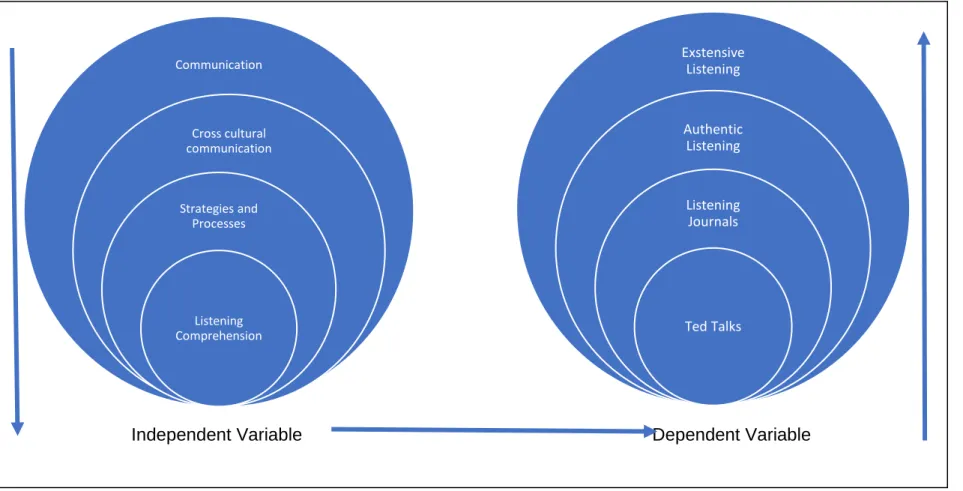
Figure 2 Key Categories
Created by Janet Bravo 2018
Independent Variable Dependent Variable
Communication Cross cultural communication Strategies and Processes Listening Comprehension Exstensive Listening Authentic Listening Listening Journals Ted Talks
29
2.4.1 Communication
De Valoes (2014) states that there are a variety of reason why a person would choose to learn a foreign language. The first of these is that one cannot expect that the rest of the world will be able to speak one’s native language. Moreover, there is the need to business in a global community which requires the ability to communicate with others who do not speak the same language (De Valoes, 2014). It has the tools that are needed to form lasting friendships as well as open the door to opportunities that otherwise would not be possible (De Valoes, 2014). This demonstrates that humanity has the need to communicate with others
Communication is the overarching goal that English students have. The reason that most give for the learning of a language is to be able to understand and be understood. Language students are interested in the ability to communicate their ideas in a language that is not their mother tongue to other who use that language as their means of communication. It is important to remember that listening is just as important as speaking in the ability to communicate (Harmer, 2010).
Reems (NA) give a concise definition of communication in her article. Reems (NA) states that communication is the need to talk with others and this can be done spoken words as well as non-verbal means as well. Communication must be understood in a local context as well as cross cultural contexts (Reems, NA). This means that it will not be effective if both parties do not understand it (Reems, NA).
There are numerous things that can be communicated, and this can be intentional as well as accidental (Reems, NA). This is because communication travels both ways and has implications that are both explicitly and non-explicitly expressed during communication (Reems, NA). Littlejohn and Foss (2010) discuss the theories of communication in greater depth than
30
Reems. Pointing out that communication is a part of every aspect of human daily life (Littlejohn et al, 2010).
Littlejohn and Foss (2010) state that it is a very difficult thing to define communication in particular for scholarly and scientific reasons (pp 3-4). This is due to the fact that the verb has been very clearly defined despite the inherent deficiencies ((Littlejohn et al, 2010). This is because even the most basic theories have a limiting effect on the definition of communication due to the complexities that are involved (Littlejohn et al, 2010). This is because the process itself is nuanced and full of ambiguities (Littlejohn et al, 2010. P 3). This means that even the most basic of theories will be limited in its ability to define communication because to the tendency to not take into consideration all of the inherent complexities of the matter.
It is due to these complexities that communication is often defined by the theory being used for the purpose of the study being done (Littlejohn et al, 2010). There are scholars who believe that it is best to define communication as a family of concepts versus having just one single definition (Littlejohn et al, 2010). These will encompass three dimensions which are observation, intentionality and normative judgement (Littlejohn et al, 2010, pp3-4). This means that the scholar must first take it to consideration which theory best suits the field of study that they are working in (Littlejohn et al, 2010).
Some of the theories available for communication are the Idea theory, Nomothetic, Practical and Evaluating communication theory (Littlejohn et al, 2010). Furthermore, there are the traditions of communication which have their theories (Littlejohn et al, 2010). These are Sematic, Phenomological, Cybernetic, Sociopsycological, Sociocultural, Critical and Rhetorical. (Littlejohn et al, 2010). It is important therefore to define which theory of communication will be use in the area of language learning. (Littlejohn et al, 2010).