PROGRAMA DE DOCTORADO EN FÍSICA
FACULTAD DE CIENCIAS
DEPARTAMENTO DE FÍSICA DE LA MATERIA
CONDENSADA, CRISTALOGRAFÍA Y MINERALOGÍA
TESIS DOCTORAL:
Structural Characterization of Solid Cellular Polymers by
X-ray Tomography and Light Scattering
Presentada por Saúl Pérez Tamarit para optar al grado de
Doctor por la Universidad de Valladolid
Dirigida por:
Dr. Eusebio Solórzano
Introducción en Castellano
... 15
Marco de la Tesis ... 20
Objetivos ... 23
Desafíos ... 24
Principales Novedades ... 26
Estructura de la Tesis ... 27
Referencias ... 35
Chapter 1
Introduction
... 39
1.1 Framework of this Thesis ... 44
1.2 Objectives ... 47
1.3 Challenges ... 48
1.4 Main Novelties ... 50
1.5 Structure of this thesis ... 51
References ... 59
Chapter 2
Basic Concepts on Cellular Materials
... 63
2.1 Cellular Structure ... 65
2.1.1 μ-structure model ... 65
2.1.2 Microscopic descriptors ... 67
2.2 Foaming Dynamics ... 76
2.2.1 Cells formation ... 76
2.2.2 Degeneration of the cellular structure ... 78
2.3 Materials ... 80
2.3.1 Polyurethane (PU) and Reactive Foaming... 80
2.3.2 Polyethylene (PE), poly-methyl methacrylate (PMMA) and Gas Dissolution Foaming ... 83
2.3.3 Polystyrene (PS) and Extrusion Foaming ... 85
2.3.4 Nanosilica Aerosil R812 ... 87
Chapter 3
X-ray Imaging and Image Analysis
... 91
3.1 X-ray imaging fundamentals ... 93
3.1.1 X-ray generation ... 94
3.1.2 X-ray-matter interaction ... 98
3.1.3 X-ray detection ... 102
3.2 X-ray Computed micro Tomography (μ-CT) ... 104
3.2.1 Acquisition ... 105
3.2.2 Projection correction ... 107
3.2.3 Sinograms ... 109
3.2.4 Reconstruction ... 110
3.3 μ-CT device at CellMat ... 118
3.3.1 X-ray Source ... 118
3.3.2 Flat Panel detector ... 119
3.4 Synchrotron facilities ... 112
3.4.1 Bessy II. BAMline ... 112
3.4.2 Diamond Light Source. I13 ... 123
3.4.3 Swiss Light Source (SLS). TOMCAT ... 125
3.5 Image analysis software ... 127
3.5.1 ImageJ/Fiji ... 127
3.5.2 Octopus ... 127
3.5.3 Avizo Fire/Amira ... 128
3.6 Image processing ... 129
3.6.1 Conventional features characterization ... 129
3.6.2 Advanced features characterization ... 130
Chapter 4
X-ray Tomography Studies on Cellular Polymers
... 137
4.1 Multi-scale inspection of the cellular structure ... 139
“Multi-scale tomographic analysis of polymeric foams: A detailed study of the cellular structure” ... 141
4.2 Corrugation influence on physical properties ... 159
“Effect of solid phase corrugation on the thermo-mechanical properties of low density flexible cellular polymers” ... 161
4.3 4D monitoring of the foaming process ... 175
“In-situ understanding of pore nucleation and growth in polyurethane foams by using real-time synchrotron X-ray tomography” ... 177
References ... 187
Chapter 5
Theory of Light Scattering Applied to Cellular Materials
... 189
5.1 Light Scattering ... 192
5.1.1 Single and Multiple scattering ... 193
5.2 Principles of Light Scattering ... 195
5.2.1 Rayleigh Scattering ... 196
5.2.2 Mie Theory ... 198
5.2.3 Geometric Scattering ... 201
5.2.4 Diffusion Approximation ... 201
5.3 Modelling the Light Scattering on Cellular Materials ... 204
5.3.1 Aqueous foams ... 205
5.3.2 Solid cellular polymers ... 207
5.3.3 Nanocellular polymers ... 208
5.4 Practical aspects of implementation ... 210
5.4.1 Transmission measurements setup ... 210
5.4.2 Methodological details ... 212
5.4.3 Systematic studies ... 213
Chapter 6
Light Scattering in Solid Cellular Polymers
... 219
6.1 Solution of the Diffusion Approximation equation ... 221
“Efficient prediction of cell size in solid polymeric foams by numerically solving the diffusion approximation of light scattering equation”... 223
6.2 Novel theoretical modelling in solid cellular polymers ... 237
“Semi-empirical modified light scattering model for cell size characterization of solid cellular polymers” ... 239
6.3 Characterization of the cellular anisotropy ... 249
“Light transmission as a novel tool for the characterization of cell anisotropy in cellular polymers” ... 251
References ... 259
Chapter 7
X-ray Tomography and Light Scattering in
Non-Conventional/Nanocellular Polymers
... 261
7.1 Nano-tomography applied to non-conventional cellular polymers ... 263
7.1.1 Zernike phase contrast X-ray transmission microscopy (TXM) ... 263
7.1.2 Scanning coherent diffraction imaging (ptychography) ... 266
“First 3D characterization of non-conventional cellular polymers by means of X-ray ptycho-tomography” ... 269
7.2 Light Scattering in nanocellular polymers. Transparency ... 277
“Light transmission in nanocellular polymers: Are semi-transparent cellular polymers possible?” ... 279
References ... 285
Chapter 8
Conclusions and Perspectives
... 287
8.1 Conclusions ... 289
Annex
Other Applications of X-ray Imaging Techniques
... 295
A.1 Cell size determination in X-ray transmission images ... 297 “Fast Fourier Transform procedures applied to X-ray transmission images” ... 299 A.2 Quantification of additive dispersion in polymers using X-ray
Tomography ... 313 “Novel quantification methods of fillers dispersion in polymer composites based on high resolution synchrotron X-ray μ-CT” ... 315
17
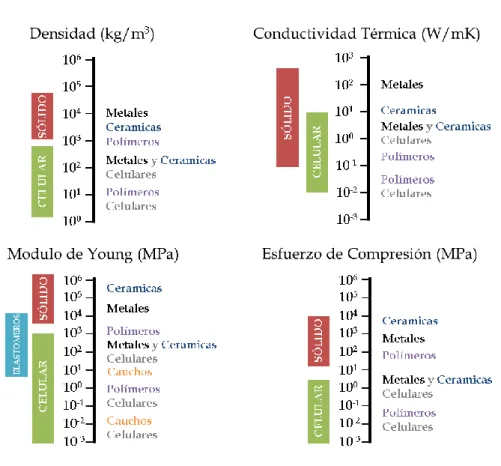
Los materiales celulares son estructuras bifásicas en las cuales una fase gaseosa que puede ser tanto continua como discontinua está dispersa en una fase continua de líquido o sólido [1]. Estos materiales han atraído mucha atención en los últimos tiempos debido a multitud de factores. La presencia de gas en el seno de la matriz sólida se traduce en una reducción de densidad en comparación a los materiales sólidos de partida [2]. Además, los materiales celulares extienden el rango de las propiedades físicas correspondientes de los materiales sólidos de partida (mostrado en la Figura 1) por lo tanto expandiendo también el rango de aplicaciones en las cuales pueden ser empleados.
Figura 1. Propiedades físicas de los materiales celulares y de los sólidos de partida.
18
propiedades de absorción acústica. De hecho, algunos materiales en la naturaleza presentan estructura celular interna y con propiedades increíbles como pueden ser el corcho, la madera, el coral o el hueso. Los materiales celulares creados por el hombre tienden a imitar aquellos de la naturaleza desarrollando procesos de producción que permitan controlar la estructura, fabricando así a medida materiales capaces de cumplir con requerimientos específicos. Por ello, los materiales celulares tienen un gran presente y un futuro prometedor en sectores industriales y tecnológicos tales como el aeronáutico, la automoción, la construcción, el confort, el empaquetado, las energías renovables, la biotecnología, el sector médico, etc. [3, 4] El tipo de material celular más representativo usa los polímeros o plásticos como material sólido de partida (llamados entonces polímeros celulares o espumas poliméricas). Para mostrar la importancia de estos materiales, se espera un consumo de polímeros celulares de 25.3 MT en 2019 [5], lo que representa casi el 10% en peso del consumo global de plásticos (y más del 50% del volumen total consumido) [6].
Entre todas las matrices poliméricas, el poliuretano (PU), el poliestireno (PS), el cloruro de polivinilo (PVC) y las poliolefinas (PO) son habitualmente consideradas en la producción de polímeros celulares aunque es importante incidir que el PU y el PS abarcan el 80% del consumo global de polímeros celulares [7] (como se muestra en la Figura 2).
19
Los materiales celulares basados en PU son principalmente usados como aislantes térmicos (tanto en edificación como en refrigeradores) y como relleno de confort en asientos. Por otra parte, las espumas de PS destacan en aplicaciones tanto de empaquetado (usando poliestireno expandido, EPS) como de aislamiento térmico (en este caso usando poliestireno extruido, XPS). Además de ello, los materiales celulares basados en PVC son básicos en aplicaciones estructurales y de perfilería. Finalmente, las espumas de poliolefinas tienen gran importancia en los mercados de empaquetado, aislamiento térmico y confort [8].
En las últimas décadas, se han llevado a cabo estudios teóricos y experimentales estudiando la tríada de relaciones proceso-estructura-propiedades en los materiales celulares para optimizar el rendimiento y extender aún más el rango de aplicación de estos materiales. Se ha avanzado enormemente en este campo gracias al desarrollo de técnicas de caracterización no destructivas (NDT, por sus siglas en inglés) que permiten caracterizar los materiales sin alterar su estructura. La mayoría de ellas se basan en la interacción radiación-materia (ya sea con radiación visible, infrarrojo, rayos-X, etc.) y en el análisis de la señal recibida para obtener características particulares de los materiales testeados.
Teniendo en cuenta este concepto, esta tesis doctoral se ha enfocado en el uso de dos de estas técnicas, Tomografía de rayos-X y Light Scattering, para llevar a cabo una caracterización detallada de materiales celulares poliméricos.
20
Marco de la Tesis
Esta tesis es parte de la investigación centrada en materiales celulares desarrollada en el Laboratorio de Materiales Celulares (CellMat) de la Universidad de Valladolid [9]. El director de este laboratorio es el Prof. Dr. Miguel Ángel Rodríguez Pérez, uno de los directores de esta tesis doctoral.
El Prof. Dr. José Antonio de Saja, junto al Prof. Dr. Miguel Ángel Rodríguez Pérez fundaron el Laboratorio CellMat en 1999 después de la defensa de la tesis doctoral de Miguel Ángel Rodríguez Pérez, centrada en el estudio de propiedades térmicas y mecánicas de materiales celulares basados en poliolefinas [10]. En los primeros años, la investigación en CellMat se orientó hacia la caracterización de las propiedades físicas de materiales celulares de ese tipo, dando como resultado varias tesis doctorales y publicaciones científicas [11-22] y alcanzando gran comprensión sobre la relación entre la estructura y las propiedades físicas de polímeros celulares. Después de varios años, la investigación se extendió también a la producción de varios materiales para entender mejor la relación proceso-estructura [23-26]. Además de ello, una línea de investigación centrada en la producción y el estudio de espumas basadas en aluminio se inició estos años colateralmente [27-34]. Finalmente, en los últimos años se ha invertido gran esfuerzo en desarrollar técnicas no convencionales que proporcionan conocimiento adicional tanto de la estructura celular como de los procesos de espumado [35-43]. El principal promotor de algunas de estas técnicas fue el co-director de esta tesis doctoral, Dr. Eusebio Solórzano.
21
Figura 3. Tetraedro de los materiales correspondiente a la investigación en materiales celulares.
La investigación llevada a cabo durante esta tesis doctoral trata de profundizar en el desarrollo y aplicación de técnicas de caracterización no convencionales centrándose en las NDT.
Por una parte, la micro-Tomografía computarizada (μ-CT, por sus siglas en inglés) es una técnica de caracterización ampliamente utilizada dado que ofrece la posibilidad de obtener información del objeto escaneado en tres dimensiones [68-72].
22
Por otra parte, el desarrollo de una técnica de caracterización nueva que permita obtener resultados en 3D de una manera rápida, simple y sobre todo barata va a resultar siempre de gran interés para la comunidad científica. Teniendo en cuenta esta premisa, Light Scattering, usada ampliamente en el caso de materiales celulares en base acuosa [73], ha sido adaptada y aplicada en esta tesis doctoral en materiales celulares en base sólida obteniendo resultados prometedores.
23
Objetivos
Esta tesis tiene como objetivo establecer técnicas no destructivas para la caracterización detallada de una amplia gama de polímeros celulares.
Para este fin, por una parte, la Tomografía de rayos-X fue seleccionada para obtener tanto la información básica sobre la fase gaseosa como la descripción detallada de características avanzadas correspondientes a la fase sólida de los materiales celulares, y estudiar su influencia en sus propiedades. Además de ello, su influencia en las propiedades térmicas y mecánicas de los materiales celulares ha sido analizada.
Por otra parte, se ha desarrollado una nueva metodología para la caracterización rápida de parámetros básicos de la estructura celular como el tamaño de celda y la anisotropía, basándose en el Light Scattering.
Estas técnicas han sido aplicadas y optimizadas para el caso de polímeros celulares convencionales (tamaño de celda entre 200 y 1000 μm) basados en PU, PS y PE y consecuentemente con diferente arquitectura celular. Adicionalmente, un objetivo adicional de esta tesis fue realizar experimentos tanto de Tomografía como de Light Scattering por primera vez en polímeros nanocelulares basados en polimetilmetacrilato (PMMA) con tamaños de celda en el rango de los nanómetros (30-1000 nm).
Los objetivos de esta tesis doctoral pueden ser resumidos como sigue:
24
Desafíos
Varios aspectos técnicos fueron propuestos para alcanzar los objetivos previamente comentados:
o Diseñar, adaptar y optimizar el sistema de Tomografía de rayos-X del laboratorio
CellMat para poder realizar experimentos con tamaño de pixel efectivo de 2.5 μm con contraste óptimo en polímeros celulares de baja densidad.
o Diseñar y construir un sistema especifico para la realización de los experimentos
de Light Scattering que permitiera poder testar materiales con características muy variadas (densidad y tamaño de celda).
Además, se ha necesitado resolver multitud de aspectos metodológicos durante esta tesis doctoral:
o Desarrollar nuevas metodologías de análisis de imagen para obtener una
descripción detallada de la estructura celular de los polímeros celulares. Particularmente, nos hemos centrado en los parámetros correspondientes a la fase sólida, que no han sido aún estudiados en profundidad, tales como el reparto de material sólido entre las distintas partes de la estructura, el espesor de la fase sólida o la corrugación de la misma.
o Desarrollar una metodología experimental novedosa para realizar y analizar los experimentos de Light Scattering de polímeros celulares sólidos.
o
Seleccionar una colección adecuada de polímeros celulares basados en PU, PE y PS que permitan verificar la validez de las técnicas y metodologías desarrolladas.Por ultimo pero no por ello menos importante, los principales temas a destacar desde el punto de vista científico son los siguientes:
o Estudiar la morfología de la estructura de los polímeros celulares en 3D mediante
25
volúmenes reconstruidos. Una selección cuidadosa de los parámetros de experimento sirvió para optimizar el contraste en los experimentos realizados de Tomografía de rayos-X.
o Determinar la influencia en las propiedades mecánicas y térmicas de los polímeros celulares de nuevos parámetros estructurales correspondientes a la fase sólida de estos materiales.
o Desarrollar un modelo que permita describir el fenómeno de Light Scattering en
los polímeros celulares sólidos.
26
Principales Novedades
Las principales novedades de esta tesis doctoral sobre la literatura científica actual pueden ser resumidas como sigue:
o El establecimiento de protocolos de análisis de imagen nuevos que permitan
cuantificar las características de la fase sólida mediante Tomografía de rayos-X alcanzando así una descripción global de la estructura bifásica de los materiales celulares.
o El estudio de la influencia de la corrugación de la estructura sólida de estos materiales en el esfuerzo de colapso y el coeficiente de expansión térmica de polímeros celulares flexibles.
o La visualización y cuantificación de la nucleación y crecimiento celular en polímeros celulares en 3D usando Tomografía de rayos-X de sincrotrón en tiempo real.
o El desarrollo tanto de una nueva metodología experimental como de un modelo
teórico para caracterizar los polímeros celulares sólidos mediante Light Scattering con grandes resultados en cuanto a la medida del tamaño de celda y la anisotropía.
o La visualización en 3D de la estructura de polímeros no convencionales y
nanocelulares por primera vez utilizando técnicas de Tomografía de rayos-X con resolución nanométrica.
27
Estructura de la Tesis
Esta tesis doctoral ha sido escrita en el formato de un compendio de publicaciones. Los resultados experimentales presentados se apoyan en 10 artículos científicos, 4 de los cuales ya publicados y el resto pendientes de publicación (tabla 1). También se abordan las comunicaciones en conferencias nacionales e internacionales (tabla 2) así como los proyectos de investigación desarrollados durante esta investigación (tabla 3). Actividades adicionales llevadas a cabo tales como otras publicaciones científicas o estancias en centros de investigación extranjeros también se detallan a continuación (tabla 4).
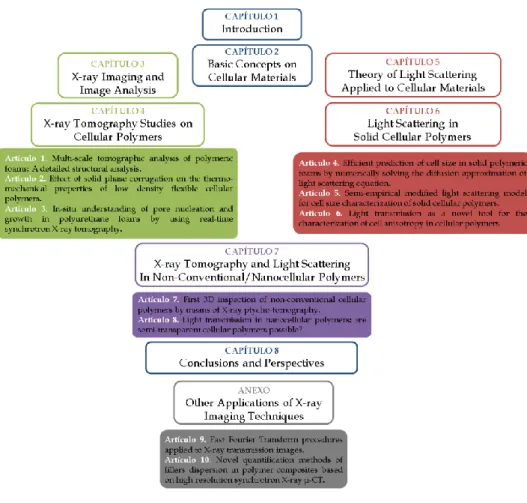
Esta tesis está constituida por ocho capítulos y un anexo. Después de los dos primeros capítulos introductorios, los cinco siguientes están divididos en tres bloques (Tomografía de rayos-X, Light Scattering y la aplicación de ambas técnicas en polímeros celulares no convencionales/nanocelulares) con estructura piramidal (Figura 4). Finalmente, como octavo y último capítulo de la tesis se presentan las conclusiones de este trabajo.
Figura 4. Estructura de esta tesis doctoral.
Adicionalmente, esta tesis cumple con todos los requerimientos para ser acreditada con la Mención Internacional.
28
El Capítulo 2 revisa los principales conceptos sobre la estructura celular, introduciendo un modelo nuevo multicomponente de la estructura celular y además incluyendo la definición de varios parámetros nuevos. Además, se detallan ideas básicas sobre los mecanismos (tanto de generación como de degeneración celular) involucrados en el proceso de espumado.
El Capítulo 3 proporciona una visión general sobre los conceptos básicos relacionados con la formación de imagen con rayos-X, centrándose más en el caso de la Tomografía. Se presentan los pasos y factores clave necesarios para obtener resultados optimizados. Además, se realiza una descripción breve de todos los sistemas de rayos-X utilizados así como de los softwares de análisis de imagen considerados.
El Capítulo 4 presenta los principales resultados de esta tesis doctoral en el tema de la Tomografía de rayos-X. Para comenzar, se presenta una descripción detallada de la estructura celular de dos tipos de polímero celular a dos niveles de resolución (un artículo). Después de ello, se modelizan las propiedades termo-mecánicas de una colección de polímeros celulares flexibles incluyendo el efecto de la corrugación celular (un artículo). Por último, se estudia mediante tomografía rápida de rayos-X el proceso de espumado de dos sistemas de PU (un artículo).
El Capítulo 5 incluye el desarrollo de la teoría de Light Scattering para el estudio de materiales celulares, discutiendo las principales teorías de scattering (Rayleigh, Mie) y la aproximación al caso de sistemas acuosos. Finalmente, los se detallan aspectos prácticos que ha sido necesario superar para la aplicación de esta técnica para la caracterización de polímeros celulares sólidos.
29
El Capítulo 7 resume los primeros resultados tanto de Tomografía de rayos-X (un artículo) como de Light Scattering (un artículo) aplicado a polímeros celulares no convencionales/nanocelulares.
Finalmente, el Capítulo 8 resume las conclusiones de esta investigación y propone posibilidades para el trabajo futuro. Hay también un anexo que incluye otros usos prácticos de la imagen por rayos-X (dos artículos).
La Figura 5 muestra el resumen de capítulos y publicaciones científicas de las que se compone esta tesis doctoral.
30
Tabla 1
No. Publicaciones Científicas Cp.
1
S. Pérez-Tamarit, E. Solórzano, A. Hilger, I. Manke and M. A. Rodriguez-Perez
4
Multi-scale tomographic analysis of polymeric foams: A detailed structural analysisEuropean Polymer Journal 109 (2018) 169-178
2
S. Pérez-Tamarit, E. Solórzano, A. Hilger, I. Manke and M. A. Rodriguez-Perez
4
Effect of solid phase corrugation on the thermo-mechanical properties of low density flexible cellular polymersMaterials and Design 161 (2019) 106-113
3
S. Pérez-Tamarit, E. Solórzano, R. Mokso and M. A. Rodríguez-Pérez
4
In-situ understanding of pore nucleation and growth in polyurethane foams by using real-time synchrotron X-ray tomographyPhysical Review Letters (enviado)
4
S. Pérez-Tamarit, E. Solórzano and M. A. Rodriguez-Perez
6
Efficient prediction of cell size in solid polymeric foams by numerically solving the diffusion approximation of light scattering equationColloid and Surfaces A 534 (2017) 130-137
5
S. Pérez-Tamarit, E. Solórzano and M. A. Rodriguez-Perez
6
Semi-empirical modified light scattering model for cell size characterization of solid cellularpolymers
Colloid and Surfaces A (enviado)
6
S. Pérez-Tamarit, E. Solórzano and M. A. Rodriguez-Perez
6
Light transmission as a novel tool for the characterization of cell anisotropy in cellular polymersMaterials Letters (enviado)
7
S. Pérez-Tamarit, P. Cimavilla, J. Martín-de León, V. Bernardo, E. Solórzano, D. Batey, C. Rau and M. A. Rodriguez-Perez
7
First 3D inspection of non-conventional cellular polymers by means of X-ray ptucho-tomographyMacromolecular Communications (enviado)
8
S. Pérez-Tamarit, B. Notario, E. Solórzano and M. A. Rodriguez-Perez
7
Light transmission in nanocellular polymers: Are semi-transparentcellular polymers possible?
Materials Letters 210 (2018) 39-41
9
S.Pérez-Tamarit, E.Solórzano, A.Kaestner and M.A. Rodriguez-Perez
An
ex
o
Fast Fourier Transform procedures applied to X-ray transmission images
Microscopy and Microanalysis (enviado)
10
S. Pérez-Tamarit, E. Solórzano, E. Laguna-Gutierrez, A. Hilger, I. Manke and M. A. Rodriguez-Perez
A
ne
xo
Novel quantification methods of fillers dispersion in polymer composites based on high resolution synchrotron X-ray μ-CT
31
Tabla 2
Comunicaciones en Conferencias Científicas
S. Pérez Tamarit, B.Notario, E.Solórzano, M.A. Rodriguez-Perez
Cell size determination by means of light scattering methodologies in micro and nanoporous foams (ORAL) VII Escuela Europea de Nanociencia Molecular (ESMolNa 2014), Valencia (España), Octubre 2014
S. Pérez-Tamarit, E. Solórzano, M. A. Rodriguez-Perez, A. Salonen and W. Drenkham Modified light scattering models in solid polymeric foams (ORAL)
X Conferencia Europea en Espumas y Aplicaciones (EuFoam 2014), Salónica (Grecia), Julio 2014
S. Pérez-Tamarit, E. Solórzano, A. Kaestner and M. A. Rodriguez-Perez Cell size determination by means of FFT in X-ray transmission images (POSTER)
X Conferencia Europea en Espumas y Aplicaciones (EuFoam 2014), Salónica (Grecia), Julio 2014
E. Solórzano, E. Laguna-Gutierrez S. Pérez-Tamarit, A. Kaestner, J. Pinto and M. A. Rodriguez-Perez Polymer foam evolution characterized by time-resolved neutron radiography (ORAL)
X Conferencia Europea en Espumas y Aplicaciones (EuFoam 2014), Salónica (Grecia), Julio 2014 S. Pérez-Tamarit, E. Solórzano, A. Hilger, I. Manke and M. A. Rodriguez-Perez
Solid-phase structural characterization in polymeric foams: Synchrotron micro-CT in the limits of resolution (ORAL)
II Conferencia Internacional en Tomografía de Materiales y Estructuras (ICTMS 2015), Quebec (Canadá) Julio 2015
J. Martín-de León, V. Bernardo, S. Pérez-Tamarit, E. Solórzano and M. A. Rodriguez-Perez Nanocellular foams fabrication methods by gas dissolution process (POSTER)
IX Conferencia Internacional en Metales Porosos y Espumas Metálicas (Metfoam 2015), Barcelona (España), Septiembre 2015
V. Bernardo, J. Martín-de León, S. Pérez-Tamarit, E. Solórzano and M. A. Rodriguez-Perez Cellular structure, properties and applications of nanoporous materials (POSTER)
IX Conferencia Internacional en Metales Porosos y Espumas Metálicas (Metfoam 2015), Barcelona (España), Septiembre 2015
S. Pérez-Tamarit, V. Bernardo, J. Martín-de León, E. Solórzano and M. A. Rodriguez-Perez Characterization of the solid phase of cellular materials by means of x-ray micro-CT (POSTER)
IX Conferencia Internacional en Metales Porosos y Espumas Metálicas (Metfoam 2015), Barcelona (España), Septiembre 2015
S. Pérez-Tamarit, E. Solórzano and M. A. Rodriguez-Perez
A numerical approach for solving the light scattering model applied to solid polymeric foams (ORAL) XI Conferencia Europea en Espumas y Aplicaciones (EuFoam 2016), Dublín (Irlanda), Julio 2016
S. Pérez-Tamarit, B. Notario, E. Solórzano and M. A. Rodriguez-Perez Towards transparent nano-cellular polymeric foams (POSTER)
32
S. Pérez-Tamarit, E. Solórzano, E. Laguna-Gutierrez, B. Notario, A. Hilger, I. Manke and M. A. Rodriguez-Perez Characterization of fillers dispersion in composites and nanocomposites by means of synchrotron X-ray micro-tomography (ORAL)
XIV Reunión del Grupo Especializado de Polímeros (GEP 2016), Burgos (España) Septiembre 2016
S. Pérez-Tamarit, E. Solórzano, S. Pardo-Alonso, R. Mokso and M. A. Rodriguez-Perez
Pore Nucleation and growth in cellular polymers analysed by time resolved synchrotron μ-CT (ORAL) III Conferencia Internacional en Tomografía de Materiales y Estructuras (ICTMS 2017), Lund (Suecia) Junio 2017
S. Pérez-Tamarit, E. Solórzano, E. Laguna-Gutierrez, B. Notario, A. Hilger, I. Manke and M. A. Rodriguez-Perez Novel quantification methods of fillers dispersion in polymer composites and nanocomposites based on high resolution synchrotron X-ray μ-CT (POSTER)
III Conferencia Internacional en Tomografía de Materiales y Estructuras (ICTMS 2017), Lund (Suecia) Junio 2017
S. Pérez-Tamarit, E. Solórzano, A. Hilger, I. Manke and M. A. Rodriguez-Perez Multiscale analysis of cellular polymers (POSTER)
VIII Conferencia en Tomografía Computarizada Industrial (iCT 2018), Wels (Austria) Febrero 2018
S. Pérez-Tamarit, E. Solórzano, A. Hilger, I. Manke and M. A. Rodriguez-Perez Determination of solid phase corrugation ratio of polymeric foams (POSTER)
VIII Conferencia en Tomografía Computarizada Industrial (iCT 2018), Wels (Austria) Febrero 2018
S. Pérez-Tamarit, E. Solórzano and M. A. Rodriguez-Perez
Characterization of the cellular architecture of solid polymeric foams by means of optical light transmission measurements (ORAL)
XII Conferencia Europea en Espumas y Aplicaciones (EuFoam 2018), Lieja (Bélgica), Julio 2018
S. Pérez-Tamarit, P. Cimavilla, J. Martín-de León, V. Bernardo , E. Solórzano and M. A. Rodriguez-Perez X-ray tomographic homogeneity inspection in nanocellular polymers produced using different foaming conditions (POSTER)
XII Conferencia Europea en Espumas y Aplicaciones (EuFoam 2018), Lieja (Bélgica), Julio 2018
P. Cimavilla, S. Pérez-Tamarit, M. Santiago-Calvo and M. A. Rodriguez-Perez
In-situ physicochemical analysis of the foaming process of aerogel-rigid polyurethane composite foams (ORAL) XII Conferencia Europea en Espumas y Aplicaciones (EuFoam 2018), Lieja (Bélgica), Julio 2018
P. Cimavilla, S. Pérez-Tamarit, E. Solórzano, A. Hilger, I. Manke and M. A. Rodriguez-Perez Novel subresolution tomographic methods for quantifying fraction of mass in Plateau borders of solid polymeric foams (POSTER)
XII Conferencia Europea en Espumas y Aplicaciones (EuFoam 2018), Lieja (Bélgica), Julio 2018 D. Batey, S. Cipiccia, X. Shi, S. Williams, K. Wanelik, A. Wilson, S. Pérez-Tamarit, P. Cimavilla, M. A. Rodríguez-Pérez and C. Rau
33
C. Rau, M. Storm, S. Marathe, A. J. Bodey, S. Cipiccia, D. Batey, X. Shi, M-C. Zdora, I. Zanette, S. Pérez-Tamarit, P. Cimavilla, M. A. Rodríguez-Pérez, F. Doring and C. David
Multi-Scale Imaging at the Coherence and Imaging Beamline I13 at Diamond (ORAL)
XIV Conferencia Internacional en Microscopía de rayos-X (XRM 2018), Saskatoon (Canadá), Agosto 2018
V. Bernardo, J. Martín-de León, F. Van Loock, N. A. Fleck, P. Cimavilla, S. Pérez-Tamarit and M. A. Rodriguez-Perez
Nanocellular polymers based on PMMA/sepiolite nanocomposites: characterization of the mechanical behaviour (POSTER)
V Materiales Cellulares (CellMat 2018), Bad Staffelstein (Alemania), Octubre 2018
Tabla 3
Proyectos de Investigación
Desarrollo y fabricación en continuo de aislantes térmicos avanzados basados en polímeros nanocelulares Neadfoam: Aditivos innovadores para espumas con mejores prestaciones de aislamiento térmico y comportamiento frente al fuego
Desarrollo de bandejas de espuma de poliestireno extruido con baja densidad y propiedades mejoradas
Tabla 4
Estancias en otros centros de Investigación
XXXIV Berlin School on Neutron Scattering
Helmholtz Zentrum, Berlin (Alemania) 13-21 de Marzo de 2014
Synchrotron tomography of polymer foams: in the limits of resolution (Campaña de Experimentación)
Sioncrotrón BESSY II, Berlín (Alemania) 5-8de Junio de 2014
In-situ characterization of the foaming behaviour and exfoliation of nanoclays in nanocomposites using combined white-beam X-ray radioscopy & diffraction (Campaña de Experimentación)
Sincrotrón BESSY II, Berlín (Germany) 7-10de Mayo de 2015
In-situ study of nanoclay exfoliation of polymeric nanocomposites during foaming with azodicarbonamide
(Campaña de Experimentación)
Sincrotrón BESSY II, Berlín (Alemania) 3-9de Octubre de 2016
Multiscale investigation of nanocellular polymers with synchrotron based tomography Sincrotrón Diamond Light Source, Oxford (Reino Unido) Septiembre-Diciembre de 2017
Estancia de Investigación de la Tesis Doctoral
Multiscale investigation of nanocellular polymers with synchrotron based tomography
(Campaña de Experimentación)
34
Otras Publicaciones Científicas
E. Solórzano, E. Laguna-Gutierrez S. Pérez-Tamarit, A. Kaestner and M. A. Rodriguez-Perez Polymer foam evolution characterized by time-resolved neutron radiography
Colloids and Surfaces A 473 (2015) 46-54
M. Santiago-Calvo, S. Pérez-Tamarit, J. Tirado-Mediavilla, F. Villafañe and M. A. Rodríguez-Pérez
Infrared expandometry: A novel methodology to monitor the expansion kinetics of cellular materials produced with exothermic foaming mechanisms
Polymer Testing 66 (2018) 383-393
D. Batey, S. Cipiccia, X. Shi, S. Williams, K. Wanelik, A. Wilson, S. Pérez-Tamarit, P. Cimavilla, M. A. Rodríguez-Pérez and C. Rau
Coherence Branch at I13, DLS: The Multiscale, Multimodal, Ptycho-tomographic End Station
Microscopy and Microanalysis 24 (2018) 40-41
C. Rau, M. Storm, S. Marathe, A. J. Bodey, S. Cipiccia, D. Batey, X. Shi, M-C. Zdora, I. Zanette, S. Pérez-Tamarit, P. Cimavilla, M. A. Rodríguez-Pérez, F. Doring and C. David
Multi-Scale Imaging at the Coherence and Imaging Beamline I13 at Diamond
Microscopy and Microanalysis 24 (2018) 254-255
V. Bernardo, M. Mugica, S. Perez-Tamarit, B. Notario, C. Jimenez and M. A. Rodriguez-Perez 1
Nanoclay Intercalation During Foaming of Polymeric Nanocomposites Studied in-Situ by Synchrotron X-Ray Diffraction
35
Referencias
[1] L.J. Gibson, M.F. Ahsby, Cellular Solids: Structure and Properties, Pergamon Press, Oxford, England, 1988.
[2] A. Cunningham, N.C. Hilyard, Low Density Cellular Plastics: Physical Basis of Behaviour, Ed. Chapman and Hall, London, 1994.
[3] M.A. Rodriguez- Perez, J.I. Velasco, D. Arencón, O. Almanza, J.A. De Saja, Mechanical characterization of closed-cell polyolefin foams, Journal of Applied Polymer Science, 75 (2000) 156-166.
[4] E. Solórzano, M.A. Rodriguez- Perez, Polymer Foams: Advanced Structural Materials in Transportation, in: D. Lehmhus, M. Busse, A. Herrmann, K. Kayvantash (Eds.) Structural Materials and Processes in Transportation, Wiley2013.
[5] The Future of Polymer Foams to 2019, 2014. [6] www.plasticseurope.es.
[7] http://www.plastemart.com.
[8] D. Klempner, K.C. Frish, Handbook of Polymeric Foams and Foam Technology, in: Hanser (Ed.), 1991.
[9] http://cellmat.es/.
[10] M.A. Rodriguez- Perez, Propiedades Térmicas y Mecánicas de espumas de poliolefinas, PhD Thesis, University of Valladolid, 1999.
[11] J.I. Gonzalez-Peña, Efecto de tratamientos térmicos en bloques de espuma de polietileno de baja densidad fabricados mediante moldeo por compresión, PhD Thesis, University of Valladolid, 2006.
[12] J.L. Ruiz-Herrero, Impacto y Fluencia en espumas con base polietileno, PhD Thesis, University of Valladolid, 2004.
[13] O. Almanza, Caracterización y modelización de las propiedades térmicas y mecánicas de espumas con base polietileno, PhD Thesis, University of Valladolid, 2000.
[14] L.O. Arcos y Rábago, Propiedades térmicas y mecánicas en espumas de poliolefinas fabricvadas en un proceso de moldeo por compresión, PhD Thesis, University of Valladolid, 2002.
[15] M.L. Álvarez Láinez, Propiedades térmicas, mecánicas y acústicas de espumas de poliolefina de celda abierta, PhD Thesis, University of Valladolid, 2007.
[16] F. Hidalgo González, Diseño optimizado de los parámetros de proceso en la fabricación de espumas de poliolefina reticulada mediante moldeo por compresión, PhD Thesis, University of Valladolid, 2008.
[17] R.A. Campo-Arnáiz, Aplicación de técnicas espectroscçopicas al estudio de la morfología polimérica, propiedades térmicas y de emisión de espumas de baja densidad con base poliolefina, PhD Thesis, University of Valladolid, 2011.
[18] M.A. Rodriguez- Perez, O. Alonso, J. Souto, J.A. De Saja, Thermal Conductivity of Physically Crosslinked Closed Cell Polyolefin Foams, Polymer Testing, 16 (1997) 287-298. [19] C. Saiz-Arroyo, M.A. Rodríguez-Pérez, J. Tirado, A. López-Gil, J.A. de Saja, Structure-property relationships of medium-density polypropylene foams, Polymer International, 62 (2013) 1324-1333.
[20] O. Almanza, L.O. Arcos y Rábago, M.A. Rodriguez- Perez, Structure-Property relationships in polyolefin foams, Journal of Macromolecular Science, Part B, 40 (2001) 603-613.
36
[23] C. Saiz-Arroyo, Fabricación de materiales celulares mejorados basados en poliolefinas. Relación procesado-composición-estructura-propiedades, PhD Thesis, University of Valladolid, 2012.
[24] O. Almanza, M.A. Rodriguez- Perez, J.A. De Saja, The microstructure of polyethylene foams produced by a nitrogen solution process, Polymer, 42 (2001) 7117-7126.
[25] M.A. Rodriguez- Perez, O. Almanza, J.L. Ruiz-Herrero, J.A. De Saja, The effect of processing on the structure and properties of crosslinked closed cell polyethylene foams, Cellular Polymers, 27 (2008) 179-200.
[26] M.A. Rodriguez- Perez, O. Almanza, J.A. De Saja, Anomalous thickness increase in crosslinked closed cell polyolefin foams during heat treatments, Journal of Applied Polymer Science, 73 (1998) 2825-2835.
[27] J.A. Reglero Ruiz, Production and characterization of aluminium foams: Applications in the aeronaurical sector, PhD Thesis, University of Valladolid, 2007.
[28] E. Solórzano, Aluminium foams: Foaming process, cellular structure and properties, PhD Thesis, University of Valladolid, 2008.
[29] J. Lázaro Nebreda, Optimization of the cellular structure of aluminium foams, PhD Thesis, University of Valladolid, 2014.
[30] E. Solórzano, M.A. Rodriguez-Perez, J.A. de Saja, Thermal Conductivity of Cellular Metals Measured by the Transient Plane Sour Method, Advanced Engineering Materials, 10 (2008) 371 -377.
[31] E. Solórzano, M.A. Rodríguez-Perez, J.A. Reglero, J.A. de Saja, Mechanical Behaviour of Internal Reinforced Aluminium Foams, Advanced Engineering Materials, 9 (2007) 955-958. [32] J. Lázaro, E. Laguna-Gutiérrez, E. Solórzano, M.A. Rodríguez-Pérez, Effect of Microstructural Anisotropy of PM Precursors on the Characteristic Expansion of Aluminum Foams, Metallurgical and Materials Transactions B, 44 (2013) 984-991.
[33] J. Lázaro, E. Solórzano, J.A. de Saja, M.A. Rodríguez-Pérez, Early anisotropic expansion of aluminium foam precursors, Journal of Materials Science, 48 (2013) 5036-5046.
[34] J. Lázaro, E. Solórzano, M.A. Rodríguez Pérez, F. García-Moreno, Pore connectivity of aluminium foams: effect of production parameters, Journal of Materials Science, 50 (2015) 3149-3163.
[35] E. Laguna Gutiérrez, Understanding the foamability of complex polymeric systems by using extensional rheology, PhD Thesis, University of Valladolid, 2016.
[36] S. Pardo-Alonso, X-ray imaging applied to the characterization of polymer foams' cellular structure and its evolution, PhD Thesis, University of Valladolid, 2014.
[37] E. Solórzano, S. PArdo-Alonso, J.A. de Saja, M.A. Rodriguez-Perez, X-ray radioscopy in-situ studies in thermoplastic polymer foams, Colloids and Surfaces A: Physicochemical and Engineering aspects, 438 (2013) 167-173.
[38] E. Solórzano, S. Pardo-Alonso, J.A. de Saja, M.A. Rodríguez-Pérez, Study of aqueous foams evolution by means of X-ray radioscopy, Colloids and Surfaces A: Physicochemical and Engineering Aspects, 438 (2013) 159-166.
[39] S. Pardo-Alonso, E. Solórzano, S. Estravís, M.A. Rodriguez-Perez, J.A. de Saja, In situ evidence of the nanoparticle nucleating effect in polyurethane–nanoclay foamed systems, Soft Matter, 8 (2012) 11262.
[40] M.M. Bernal, S. Pardo-Alonso, E. Solórzano, M.A. Lopez-Machado, R. Verdejo, M.A. Rodriguez- Perez, Effect of carbon nanofillers on flexible polyurethane foaming from a chemical and physical perspective, RSC Advances, 4 (2014).
[41] E. Solórzano, J. Pinto, S. Pardo, F. Garcia-Moreno, M.A. Rodriguez-Perez, Application of a microfocus X-ray imaging apparatus to the study of cellular polymers, Polymer Testing, 32 (2013) 321-329.
37 cellular materials produced with exothermic foaming mechanisms, Polymer Testing, 66 (2018) 383-393.
[43] E. Solórzano, M. Antunes, C. Saiz-Arroyo, M.A. Rodríguez-Pérez, J.I. Velasco, J.A. de Saja, Optical expandometry: A technique to analyze the expansion kinetics of chemically blown thermoplastic foams, Journal of Applied Polymer Science, 125 (2012) 1059-1067.
[44] S. Estravís Sastre, Cellular nanocomposites based on rigid polyurethane and nanoclays: fabrication, characterization and modeling of the mechanical and thermal properties, PhD Thesis, University of Valladolid, 2014.
[45] S. Estravís, J. Tirado-Mediavilla, M. Santiago-Calvo, J.L. Ruiz-Herrero, F. Villafañe, M.Á. Rodríguez-Pérez, Rigid polyurethane foams with infused nanoclays: Relationship between cellular structure and thermal conductivity, European Polymer Journal, 80 (2016) 1-15.
[46] M. Santiago-Calvo, V. Blasco, C. Ruiz, R. París, F. Villafañe, M.Á. Rodríguez-Pérez, Synthesis, characterization and physical properties of rigid polyurethane foams prepared with poly(propylene oxide) polyols containing graphene oxide, European Polymer Journal, 97 (2017) 230-240.
[47] J. Escudero Arconada, Polyolefin based cellular materials. Development of new production routes and optimization of barrier and mechanical properties by the addition of nanoclays, PhD Thesis, University of Valladolid, 2016.
[48] S. Román Lorza, Production and characterization of flame retardant halogen-free polyolefin based cellular materials, PhD Thesis, University of Valladolid, 2010.
[49] F. Silva-Bellucci, Preparation and characterization of multifunctional nanocomposites by adding paramagnetic ferroelectric nanoparticles to natural rubber films, PhD Thesis, University of Valladolid, Sao Paulo State University, 2013.
[50] J. Lobos Martín, Improving the stiffness and strength of porous materials by enhancement of the matrix microstructure and cellular morphology, PhD Thesis, University of Valladolid, 2013.
[51] M. Dumon, J.A. Reglero Ruiz, J. Pinto, M.A. Rodriguez- Perez, M.A. Tallon, J.M. Pedros, M. Cloutet, P. Viot, Block copolymer-assisted microcellular supercritical CO2 foaming of Polymers and Blends, Cellular Polymers, 31 (2012) 207-221.
[52] J.A. Reglero Ruiz, C. Saiz-Arroyo, M. Dumon, M.A. Rodriguez-Perez, L. Gonzalez, Production, cellular structure and thermal conductivity of microcellular (methyl methacrylate)-(butyl acrylate)-(methyl methacrylate) triblock copolymers, Polymer International, 60 (2011) 146-152.
[53] D. Velasco Nieto, Development of cellular biomaterials based on EVA, PLA and PHB, production and characterization, PhD Thesis, University of Valladolid, 2017.
[54] A. López Gil, Development of environmentally friendly cellular polymers for packing and structural applications. Study of the relationship cellular structure-mechanical properties, PhD Thesis, University of Valladolid, 2016.
[55] H. Ventura Casellas, Development of new lightweight green composites reinforced with nonwoven structures of flax fibers, PhD Thesis, Polytechnic University of Catalonioa and University of Valladolid, 2017.
[56] L. Oliveira-Salmazo, Foaming kinetics and cellular structure control of materials based on natural rubber and polyolefins, PhD Thesis, University of Valladolid and Sao Paulo State University, 2015.
[57] M.A. Rodriguez-Perez, R.D. Simoes, S. Roman-Lorza, M. Alvarez-Lainez, C. Montoya-Mesa, C.J.L. Constantino, J.A. de Saja, Foaming of EVA/starch blends: Characterization of the structure, physical properties, and biodegradability, Polymer Engineering & Science, 52 (2012) 62-70.
38
[59] A. Lopez-Gil, F. Silva-Bellucci, D. Velasco, M. Ardanuy, M.A. Rodriguez-Perez, Cellular structure and mechanical properties of starch-based foamed blocks reinforced with natural fibers and produced by microwave heating, Industrial Crops and Products, 66 (2015) 194-205. [60] L. Oliveira-Salmazo, A. Lopez-Gil, F. Silva-Bellucci, A.E. Job, M.A. Rodriguez-Perez, Natural rubber foams with anisotropic cellular structures: Mechanical properties and modeling, Industrial Crops and Products, 80 (2016) 26-35.
[61] J. Pinto, Fabrication and characterization of nanocellular polymeric materials from nanostructured polymers, PhD Thesis, University of Valladolid and University of Bordeaux, 2014.
[62] B. Notario Collado, Fabrication and characterization of the physical properties of nanocellular polymers: The transition from the micro to the nanoscale, PhD Thesis, University of Valladolid, 2016.
[63] B. Notario, J. Pinto, E. Solorzano, J.A. de Saja, M. Dumon, M.A. Rodríguez-Pérez, Experimental validation of the Knudsen effect in nanocellular polymeric foams, Polymer, 56 (2015) 57-67.
[64] B. Notario, J. Pinto, M.A. Rodríguez-Pérez, Towards a new generation of polymeric foams: PMMA nanocellular foams with enhanced physical properties, Polymer, 63 (2015) 116-126. [65] V. Bernardo, J. Martín-de León, E. Laguna-Gutiérrez, M.Á. Rodríguez-Pérez, PMMA-sepiolite nanocomposites as new promising materials for the production of nanocellular polymers, European Polymer Journal, 96 (2017) 10-26.
[66] J. Pinto, B. Notario, R. Verdejo, M. Dumon, S. Costeux, M.A. Rodriguez -Perez, Molecular confinement of solid and gaseous phases of self-standing bulk nanoporous polymers inducing enhanced and unexpected physical properties, Polymer, 113 (2017) 27-33.
[67] J. Martín-de León, V. Bernardo, M. Rodríguez-Pérez, Low Density Nanocellular Polymers Based on PMMA Produced by Gas Dissolution Foaming: Fabrication and Cellular Structure Characterization, Polymers, 8 (2016) 265.
[68] S. Pardo-Alonso, E. Solórzano, L. Brabant, P. Vanderniepen, M. Dierick, L. Van Hoorebeke, M.A. Rodriguez- Perez, 3D Analysis of the progressive modification of the cellular architecture in polyurethane nanocomposite foams via X-ray microtomography, European Polymer Journal, 49 (2013) 999-1006.
[69] M.D. Montminy, A.R. Tannenbaum, C.W. Macosko, The 3D structure of real polymer foams, Journal of colloid and interface science, 280 (2004) 202-211.
[70] Y. Ma, R. Pyrz, M.A. Rodriguez-Perez, J. Escudero, J.C. Rauhe, X. Su, X-ray microtomographic study of nanoclay-polypropylene foams, Cellular Polymers, 30 (2011) 95-110. [71] J. Lambert, I. Cantat, R. Delannay, A. Renault, F. Graner, J.A. Glazier, I. Veretennikov, P. Cloetens, Extraction of relevant physical parameters from 3D images of foams obtained by X-ray tomography, Colloids and Surfaces A: Physicochemical and Engineering Aspects, 263 (2005) 295-302.
[72] A. Elmoutaouakkil, G. Fuchs, P. Bergounhon, F. Peyrin, Three-dimensional quantitative analysis of polymer foams from synchrotron radiation x-ray microtomography, Journal of Physics D: Applied Physics, 36 (2003) A37-A43.
[73] I. Cantat, S. Cohen-Addad, F. Elias, F. Graner, R. Höhler, O. Pitois, F. Rouyer, A. Saint-Jalmes, Foams Structure and Dynamics, Oxford University Press2013.
Chapter 1
41
Cellular materials are biphasic structures in which a continuous or discontinuous gas phase is dispersed in a continuous liquid or solid phase [1]. These materials have focused a lot of attention in recent decades due to several interesting factors. The presence of the gas phase within the structure provides density reduction in comparison to the solids [2]. In addition, cellular materials extend the range of physical properties of the respective solid precursors (as shown in Figure 1-1) thus expanding the application capabilities of these materials.
Figure 1-1. Comparative properties of solid and cellular materials.
42
materials tend to imitate those from nature by developing production processes that allow controlling the final structure and thus fabricating tailored materials to specific requirements. For this reason, cellular materials have a great present and a promising future in important technological sectors such as aeronautic, automotive, building, cushioning, packaging, renewal energies, biotechnology, medical, etc. [3, 4] The most representative kind of cellular materials are based on polymers as the constituent solid phase (so-called cellular polymers or polymeric foams). To show the importance of this type of materials, it is expected that the polymer foam market will consume 25.3 MT by 2019 [5], representing almost 10 wt.% of the global consumption of plastics (and more than 50 % of the total consumption volume) [6].
Among all the existing polymeric matrixes, polyurethane (PU), polystyrene (PS), polyvinyl chloride (PVC) and polyolefins (PO) are the most employed for the production of cellular polymers although it is important to remark that cellular products based on PU and PS are about 80% of total cellular polymers world-wide consumption [7] (as shown in Figure 1-2).
Figure 1-2. Representative importance of various raw materials used in the production of cellular polymers.
43
packaging (expanded polystyrene, EPS) and insulation (extruded polystyrene, XPS) applications. In addition, PVC cellular materials are basic for profiles and structural applications. Finally, PO foams gain importance in the packaging, buoyancy thermal insulation and cushioning markets [8].
In recent decades, both theoretical and empirical studies have been carried out concerning the so-called process-structure-properties relationships in cellular materials in order to optimize the performance and further extend the range of application of these materials. One important contribution to this task is the development and application of non-destructive techniques (NDT) for the characterization of materials without altering their structure. Most of them are based on the interaction of the material with radiation (visible, infrared, X-rays, etc.) and on the analysis of the subsequent signal to determine particular characteristics of the tested materials.
In the framework of this concept this thesis is focused on the use of two NDT techniques, X-ray Tomography and Light Scattering, to perform a detailed characterization of solid cellular polymers.
44
1.1 Framework of this Thesis
This investigation is part of the research focused on cellular materials developed in the Cellular Materials Laboratory (CellMat) of the University of Valladolid [9]. This laboratory is led by Prof. Dr. Miguel Ángel Rodríguez Pérez, one of the supervisors of this PhD thesis.
CellMat Laboratory was founded in 1999 by Prof. Dr. José Antonio de Saja and Prof. Dr. Miguel Ángel Rodríguez Pérez after the PhD thesis defended by Miguel Ángel Rodríguez Pérez focused on the thermal and mechanical properties of cellular polymers based on polyolefins [10]. During the first years, the research performed at CellMat was oriented on the characterization of the physical properties of such kind of cellular polymers resulting in several PhD thesis and publications [11-22] and reaching a high understanding of the structure-properties relationship in cellular polymers. After a few years, the research was extended also to the production of several types of cellular materials in order to understand better the process-structure relationship [23-26]. Furthermore, in this period a collateral research focused on the production and characterization of cellular materials based on aluminium was established [27-34]. Finally, in the last years the development of non-conventional characterization techniques has engaged a great effort in order to provide further knowledge of both cellular structure and foaming mechanisms [35-43]. The main promoter of some of these techniques was the co-director of this thesis, Dr. Eusebio Solórzano.
45
Figure 1-3. Materials tetrahedron for the research on cellular materials.
The research accomplished in this thesis intends to deepen in the development and application of non-conventional techniques for the characterization of cellular polymers focusing on NDT.
On the one hand, computed micro-tomography (μ-CT) is an extensively used technique for the materials characterization since it offers the possibility of resolving objects in three dimensions [68-72].
The application of this technique in CellMat for the structural characterization of cellular polymers was started by Dr. Samuel Pardo Alonso, as part of his PhD thesis focused on both the study of foaming mechanisms and structure of cellular polymers by X-ray imaging techniques (radioscopy and tomography respectively) [36]. In the research presented in this thesis, an improvement and development of novel image analysis protocols for X-ray tomography results have permitted to go further in the understanding of the process-structure-properties relationships of cellular materials. Additionally, X-ray tomography has been used as reference technique to verify the reliability of the other main technique used during this PhD thesis, Light Scattering.
46
these insights, Light Scattering, extensively used in the case of aqueous foams [73], has been suitably adapted and applied in this thesis to the case of solid cellular polymers obtaining promising results.
47
1.2 Objectives
This thesis is aimed at establishing non-destructive techniques for the detailed characterization of a wide range of cellular polymers.
To this end, on one hand, X-ray tomography has been selected to obtain from the basic structural information of the gas phase to the detailed description of advanced features concerning the solid phase and study its influence on their properties. In addition, the influence of the parameters describing the solid phase on the thermal and mechanical properties has been analysed.
On the other hand, a novel methodology for the fast and reliable characterization of basic structural parameters of cellular polymers such as cell size and anisotropy has been developed based on Light Scattering.
These techniques have been optimized for conventional cellular polymers with cell sizes ranging 200-1000 μm, based on PU, PS and PE with different cellular architectures. In addition, one additional objective of this investigation is to perform both tomographic and light scattering tests for the first time in nanocellular polymers based on poly-methyl methacrylate (PMMA) with cell sizes ranging the nanoscale (30-1000 nm).
The general purposes of this PhD thesis can be summarized as follows:
48
1.3 Challenges
Various technical aspects were proposed with the aim of achieving the objectives previously described:
o To design, adapt and optimize the tomography system at CellMat Laboratory to
obtain tomographic reconstructions with up to 2.5 μm effective pixel size with optimum contrast for low density cellular polymers.
o To design and build a specific system for the characterization of cellular polymers
of a wide range of characteristics (density, cell size) by means of Light Scattering.
Furthermore, during this PhD thesis it has been necessary to overcome several methodological aspects:
o To develop novel methodologies based on image analysis to obtain a detailed
description of the cellular structure of cellular polymers. In particular, we have focused our attention on non well-studied parameters of the solid phase of these materials such as the repartition of material throughout the solid skeleton, the solid material thickness distribution and the quantification of the corrugation of the structure.
o To develop a novel experimental methodology to perform and analyse the Light
Scattering experiments in solid cellular polymers.
o
To select a suitable collection of conventional cellular polymers based on PU, PE and PS that allow verifying the reliability of the developed techniques and methodologies.Last but not least, from a scientific perspective, the main topics to highlight are:
o To study the morphology of cellular polymers structure in 3D by means of X-ray
49
selection of the experiment parameters has served for the contrast optimization on the X-ray tomography performed experiments.
o To determine the influence of novel structural descriptors of the solid phase on
mechanical and thermal properties of cellular polymers.
o To develop a model to describe Light Scattering in solid cellular polymers including the key characteristics of cellular polymers.
50
1.4 Main Novelties
The main novelties of this thesis over current scientific literature could be summarized as follows:
o The establishment of novel image analysis protocols for the quantification of
features corresponding to the solid phase of cellular materials by means of X-ray tomography reaching a global description of the biphasic structure of cellular materials.
o The study of the influence of solid phase corrugation in both collapse stress and thermal expansion coefficient of flexible cellular polymers.
o The visualization and quantification of cell nucleation and growth in cellular polymers in 3D by using real time synchrotron X-ray Tomography.
o The development of both a novel methodology and theoretical model to enable the characterization of solid cellular polymers by means of Light Scattering methodologies with great results concerning the measurement of cell size and anisotropy.
o The 3D structure visualization of non-conventional/nanocellular polymers for the
first time by using synchrotron based X-ray nanotomography techniques.
o The application of Light Scattering technique to nanocellular polymers
51
1.5 Structure of this thesis
This thesis is written in the format of a compendium of publications. The presented experimental results are supported by 10 scientific articles, 4 of them already published and the rest pending of publication (table 1-1). Communications in national and international conferences (table 1-2) and research projects developed during the time of this investigation (table 1-3) are also addressed. Additional activities developed during this investigation such as other scientific publications or stays at foreign research facilities are summarized (table 1-4).
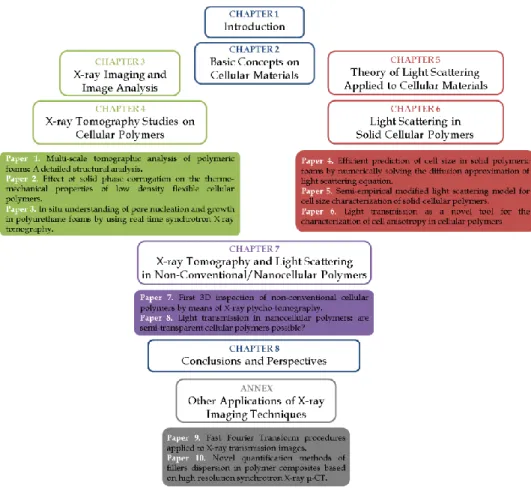
The structure of this thesis is developed over eight chapters and one annex. After the two first introductory chapters, the following five are divided in three blocks (X-ray Tomography, Light Scattering and application of both techniques on non-conventional ocellular polymers) with pyramidal structure (Figure 1-4). Finally, the conclusions of the investigation are presented as the eighth and last chapter of this thesis.
Figure 1-4. Schematic view of the structure of this thesis.
Moreover, this thesis fulfils the necessary requirements to be accredited with the
International Mention.
52
Chapter 2 deals with a revision of the main concepts related to the structure of cellular materials introducing a new multicomponent model of the cellular structure, including the definition of several new advanced descriptors. In addition, basic ideas about the involved mechanisms (cell generation and degeneration processes) occurring during foaming are addressed.
Chapter 3 provides a general overview of the basic concepts of X-ray imaging focused on the case of X-ray μ-CT. The different steps and key factors to obtain optimized tomographic results are presented. Furthermore, a brief description of the different X-ray facilities in which the experimental work of this thesis has been carried out is included as well as the employed image analysis softwares and processing protocols.
Chapter 4 presents the main results of this thesis concerning X-ray μ-CT. Firstly, a detailed tomographic characterization of two sets of cellular polymers combining two sets of tomographies with different spatial resolutions is presented (one paper). After that, the thermo-mechanical properties of one of the precedents cellular polymers collection have been suitably modelled including the effect of the corrugation in the structure (one paper). Finally, the foaming process of two PU systems is studied by means of time–resolved X-ray μ-CT (one paper).
Chapter 5 includes the development of Light Scattering theory for the study of cellular materials, discussing the basis of the existing theories of scattering (Rayleigh, Mie) and the deduction/approach to aqueous system solution. Finally, the practical aspects of implementation that have been overcome for the final application in solid cellular polymers are addressed.
53
Chapter 7 summarizes the first results concerning both X-ray nano-Tomography (n-CT) novel techniques (one paper) and Light Scattering application in non-conventional/nanocellular polymers (one paper).
Finally, chapter 8 summarizes the most remarkable conclusions of this investigation and it proposes topics for further work. There is also one annex including other practical uses of X-ray imaging techniques (two papers).
Figure 1-5 shows the summary of the chapters and scientific publications contributing to this investigation.
54
Table 1-1
No. Scientific Publications Ch.
1
S. Pérez-Tamarit, E. Solórzano, A. Hilger, I. Manke and M. A. Rodriguez-Perez
4
Multi-scale tomographic analysis of polymeric foams: A detailed structural analysisEuropean Polymer Journal 109 (2018) 169-178
2
S. Pérez-Tamarit, E. Solórzano, A. Hilger, I. Manke and M. A. Rodriguez-Perez
4
Effect of solid phase corrugation on the thermo-mechanical properties of low density flexible cellular polymersMaterials and Design 161 (2019) 106-113
3
S. Pérez-Tamarit, E. Solórzano, R. Mokso and M. A. Rodríguez-Pérez
4
In-situ understanding of pore nucleation and growth in polyurethane foams by using real-time synchrotron X-ray tomographyPhysical Review Letters (submitted)
4
S. Pérez-Tamarit, E. Solórzano and M. A. Rodriguez-Perez
6
Efficient prediction of cell size in solid polymeric foams by numerically solving the diffusion approximation of light scattering equationColloid and Surfaces A 534 (2017) 130-137
5
S. Pérez-Tamarit, E. Solórzano and M. A. Rodriguez-Perez
6
Semi-empirical modified light scattering model for cell size characterization of solid cellularpolymers
Colloid and Surfaces A (submitted)
6
S. Pérez-Tamarit, E. Solórzano and M. A. Rodriguez-Perez
6
Light transmission as a novel tool for the characterization of cell anisotropy in cellular polymersMaterials Letters (submitted)
7
S. Pérez-Tamarit, P. Cimavilla, J. Martín-de León, V. Bernardo, E. Solórzano, D. Batey, C. Rau and M. A. Rodriguez-Perez
7
First 3D inspection of non-conventional cellular polymers by means of X-ray ptycho-tomographyMacromolecular Communications (submitted)
8
S. Pérez-Tamarit, B. Notario, E. Solórzano and M. A. Rodriguez-Perez
7
Light transmission in nanocellular polymers: Are semi-transparentcellular polymers possible?
Materials Letters 210 (2018) 39-41
9
S.Pérez-Tamarit, E.Solórzano, A.Kaestner and M.A. Rodriguez-Perez
A
nn
ex
Fast Fourier Transform procedures applied to X-ray transmission images
Microscopy and Microanalysis (submitted)
10
S. Pérez-Tamarit, E. Solórzano, E. Laguna-Gutierrez, A. Hilger, I. Manke and M. A. Rodriguez-Perez
A
nn
ex
Novel quantification methods of fillers dispersion in polymer composites based on high resolution synchrotron X-ray μ-CT
55
Table 1-2
Scientific Communications in Conferences
S. Pérez Tamarit, B.Notario, E.Solórzano, M.A. Rodriguez-Perez
Cell size determination by means of light scattering methodologies in micro and nanoporous foams (ORAL) VII European School on Molecular Nanoscience (ESMolNa 2014), Valencia (Spain), October 2014
S. Pérez-Tamarit, E. Solórzano, M. A. Rodriguez-Perez, A. Salonen and W. Drenkham Modified light scattering models in solid polymeric foams (ORAL)
X European Conference on Foams and Applications (EuFoam 2014), Thessaloniki (Greece), July 2014
S. Pérez-Tamarit, E. Solórzano, A. Kaestner and M. A. Rodriguez-Perez Cell size determination by means of FFT in X-ray transmission images (POSTER)
X European Conference on Foams and Applications (EuFoam 2014), Thessaloniki (Greece), July 2014
E. Solórzano, E. Laguna-Gutierrez S. Pérez-Tamarit, A. Kaestner, J. Pinto and M. A. Rodriguez-Perez Polymer foam evolution characterized by time-resolved neutron radiography (ORAL)
X European Conference on Foams and Applications (EuFoam 2014), Thessaloniki (Greece), July 2014 S. Pérez-Tamarit, E. Solórzano, A. Hilger, I. Manke and M. A. Rodriguez-Perez
Solid-phase structural characterization in polymeric foams: Synchrotron micro-CT in the limits of resolution (ORAL)
II International Conference on Tomography of Materials and Structures (ICTMS 2015), Quebec city (Canada) July 2015
J. Martín-de León, V. Bernardo, S. Pérez-Tamarit, E. Solórzano and M. A. Rodriguez-Perez Nanocellular foams fabrication methods by gas dissolution process (POSTER)
IX International Conference on Porous Metals and Metallic Foams (Metfoam 2015), Barcelona (Spain), September 2015
V. Bernardo, J. Martín-de León, S. Pérez-Tamarit, E. Solórzano and M. A. Rodriguez-Perez Cellular structure, properties and applications of nanoporous materials (POSTER)
IX International Conference on Porous Metals and Metallic Foams (Metfoam 2015), Barcelona (Spain), September 2015
S. Pérez-Tamarit, V. Bernardo, J. Martín-de León, E. Solórzano and M. A. Rodriguez-Perez Characterization of the solid phase of cellular materials by means of x-ray micro-CT (POSTER) IX International Conference on Porous Metals and Metallic Foams (Metfoam 2015), Barcelona (Spain), September 2015
S. Pérez-Tamarit, E. Solórzano and M. A. Rodriguez-Perez
A numerical approach for solving the light scattering model applied to solid polymeric foams (ORAL) XI European Conference on Foams and Applications (EuFoam 2016), Dublin (Ireland), July 2016
S. Pérez-Tamarit, B. Notario, E. Solórzano and M. A. Rodriguez-Perez Towards transparent nano-cellular polymeric foams (POSTER)