3D Tracking Using Multi-view Based Particle
Filters
Raúl Mohedano, Narciso García, Luis Salgado, and F e r n a n d o Jaureguizar Grupo de Tratamiento de Imágenes, Universidad Politécnica de Madrid,
28040, Madrid, Spain
{rmp,narciso,Isa,fjn}@gti.ssr.upm.es http://www.gti.ssr.upm.es
A b s t r a c t . Visual surveillance and monitoring of indoor environments using múltiple cameras has become a field of great activity in computer visión. Usual 3D tracking and positioning systems rely on several in-dependent 2D tracking modules applied over individual camera streams, fused using geometrical relationships across cameras. As 2D tracking sys-tems suffer inherent difñculties due to point of view limitations (percep-tually similar foreground and background regions causing fragmentation of moving objects, occlusions), 3D tracking based on partially erroneous 2D tracks are likely to fail when handling multiple-people interaction. To overeóme this problem, this paper proposes a Bayesian framework for combining 2D low-level cues from múltiple cameras directly into the 3D world through 3D Particle Filters. This method allows to estímate the probability of a certain volume being oceupied by a moving object, and thus to segment and track múltiple people across the monitored área. The proposed method is developed on the basis of simple, binary 2D moving región segmentation on each camera, considered as differ-ent state observations. In addition, the method is proved well suited for integrating additional 2D low-level cues to increase system robustness to occlusions: in this line, a náive color-based (HSI) appearance model has been integrated, resulting in clear performance improvements when dealing with complex scenarios.
1 I n t r o d u c t i o n
Tracking múltiple people in b o t h indoor and outdoor environments is a very active research topic due t o its applicability t o surveillance systems, security and restricted área control, intelligent rooms, etc. Whilst m a n y works have largely addressed 2D tracking [8], m a n y potential capabilities of 3D positioning and tracking of interest t a r g e t s in multi-camera environments are not yet been studied.
Calibration of cameras allows more sophisticated processing. It allows, for instance, to perform 2D tracking on each of the cameras independently and subsequently combining 2D tracks into 3D world using only geometrical consid-erations [5], or both geometry and appearance consistency [10]. This approach relies on 2D tracking, which suffers from certain limitations due to camera point of view, occlusions, etc. Mistakes derived from erroneous decisions at 2D tracking level transíate into 3D tracking failures.
Probabilistic combination of múltiple cameras observations avoids the loss of valuable information due to hard decisions at 2D tracking level. In [4], occupancy probability projection over ground plañe is estimated using background subtrac-tion on individual cameras. More oriented towards accurate 3D segmentasubtrac-tion,
[11] proposes space voxelization, shape from silhouette and voxel grouping for 3D positioning and tracking. This approach provides powerful information for robust tracking and scene understanding, but voxelization represents a great computational cost, specially if detailed 3D segmentation is desired. A non-uniform volume partition could overeóme this limitation, paying attention only to interesting áreas.
The 3D positioning and tracking system proposed in this paper also intends to monitor a limited área, covered with several cameras, where múltiple objeets of Ínterest can enter, interact, and exit. It relies on a set of 2 or more fully-calibrated cameras, each performing independently a standard motion-region (binary) segmentation subject to problems such as fragmentation of objeets and false detections, and considering also color information. Loss of 2D information in hard decisions at 2D level is avoided, as it fuses information directly into 3D world using 3D Particle Filters [1]. Proposed 3D Particle Filters are spe-cially suited for 3D tracking over time, and they can even provide accurate 3D description of shapes, avoiding the computational cost of voxelization.
This paper introduces a complete framework for combining different cues from múltiple cameras into a single, consistent measure of the observation likelihood of the 3D Particle Filter. This measure allows updating a volumetric occu-pancy probability density function for each tracked person over time, making 3D segmentation and tracking posible, as described in Section 2. Subsection 2.1 presents the proposed multi-camera 3D tracking method using motion-region (binary) segmentations in each sensor as system measurement, while Subsec-tion 2.2 extends the system including color as an addiSubsec-tional cue for 3D tracking. Subsection 2.3 addresses the dynamic models for the 3D Particle Filters of both systems, whose results are discussed in Section 3. Finally Section 4 outlines the achievements reached by the proposed methods.
2 State-Space Models for 3D Segmentation and Tracking
Particle Filters), that are broadly used and specially interesting for real-time tasks as they are well suited for recursive implementation.
The Recursive Bayesian tracking has traditionally been applied for on-line probabilistic estimation of trajectories and shapes of isolated targets, and mainly for 2D objects. Most problems are modeled as a state vector xt at each
time step (e.g. position-velocity position-rotation angles, or control points of a parametrized contour [9]). This xt is estimated accurately bearing in mind
every observation up to time step t (Z4) by means of its posterior likelihood KxtIZ4).
The posterior likelihood at time step t can be expressed in terms of that from time step t — 1 through
y
(*,iz-) = ""•'*;> ff
z'">, ni
where zt represents observations at time step t. The dynamic model governing
state evolution is expressed i n p ( xt| xt_ i ) , and the prior distributionp(xt_i|Zt _ )
is considered available as it has been estimated in the previous time step t — 1. The predicted probability density function p ( xt| Z ' ~ ) is updated through (1)
using p(zt|xt), which shows the likelihood of the observation zt given the state
Xf. The posterior likelihood p(xt|Z4) can be approximated using Monte Cario
methods [3], which deal with sampled versions of distributions. This approach is known as Particle Filter [1],
The core idea of this paper is to estimate the volumetric occupancy probability density function p(xt|Z',iífc) of a person Hk (given that Hk is present in the
scene) using a 3D Particle Filter, and considering different views from a set of fully-calibrated cameras as system observations. Using this pdf, the probability that Hk is contained in a volume V is
P(HkcV\Hk)= [[[ pixtlZ^HJdV (2)
According to (2), H¡. spatial position could be identified with the mínimum
vol-ume Vk that contains Hk with probability greater or equal to P¡j, given that Hk is
present in the scene (where, evidently 0 < PH < 1). The volume Vk should then be considered as a 3D bounding volume for Hk, analogous to the classical bound-ing box concept but much more general. The volumetric occupancy pdf evolves over time according to the dynamic model p ( xt| xt_ i ) and the observations at
time step t, allowing 3D tracking. Following the same reasoning, it is possible to estimate p(xt|Z4, Hk), k = 1 , . . . , Np using one individual 3D Particle Filter for
each moving object Hk, and thus track several people simultaneously.
Combining different cues from múltiple cameras into a single and consis-tent measure of the observation likelihood p(zt|xt) is essential for updating
p(xt|Z4,iífc) over time. Supposing that the scene is monitored using M
dif-ferent cameras, the state observation at time step t can break down into camera contributions according to
Therefore, the observation likelihood p(zt|xt) can be rewritten as
p(zt\xt)=p(z?,z?,...,zctM\xt). (4)
For computation purposes, it would be desirable to decompose p(zt|xt) into
factors concerning observations from each camera independently. It would be possible if we assume that the cameras are conditionally independent given xt.
Besides, although the F different features (/i, Í2, • • • , / F ) in each camera Cj are statistically dependent, they could be considered nearly conditionally inde-pendent given Xf. Therefore, this reasoning justifies processing each feature on each camera view independently using individual likelihood measurement mod-els. The complete observation likelihood measurep(zt|xt) can be finally obtained
by simply multiplying all the contributions considered.
Next subsections propose measurement models for two different cues obtained from cameras: moving-region (binary) segmentation and color. The former ex-presses whether a particular camera has detected movement in the environment of the projection of a particle onto the camera plañe, indicating that this particle is likely to be contained into a moving object. As for color, it provides a sim-ple but effective appearance description of objects. Two different systems have been implemented to prove the abilities of the proposed method: the first one is based only on moving-region segmentations, and the second incorporates also color cues into the measurement model. The performance of both methods is compared in Section 3.
2.1 Measurement Model from 2D Motion Segmentation of Views
A common starting point for tracking systems is motion-region segmentation. Detecting moving regions in video sequences usually provides a focus of attention for latter processing, as it aims to discover image áreas corresponding to interest objects. Conventional methods for motion segmentation are temporal differenc-ing, optical-flow computation and background subtraction [8]. The quality of the motion-region segmentation shows a strong dependency on the complexity of the monitored scene, and it conditions clearly the performance of subsequent processes: 2D tracking can be seriously damaged as a result of inaccurate seg-mentations, and thus 3D tracking derived from 2D tracking in several cameras is prone to fail.
The proposed method aims to extract as much information as possible from (generally) inaccurate motion-region segmentations from several overlapping cameras by combining cues directly in the 3D world. The key point to do it is to interpret motion segmentation information as a measurement of the state Xt, and then to intégrate them into the 3D Particle Filter framework discussed previously
Let us consider, first of all, only one camera (c¿). Let M^3 be the binary mask
McUr) = í1 V r G R (5)
4 v ' y O otherwise v '
Let yc. = Pc.(xt) be the projection of the 3D position of xt onto the camera Cj
image plañe. Thus yc. is a 2D vector expressed in pixel units. If xt is contained in
a 3D moving object, we might expect Mt 3( yc. ) to be 1. Although it is intuitive
that p(zct3 |xt) is closely related to the valué of M^3 in its projected position.
some considerations are needed.
If a spatial position xt is actually part of the tracked person H¡., then certain
neighborhood of it should be also part of H¡.- So, p(zt3 |xt) should be determined
not only by the valué of M^3 at the projected point yc., but also by its 2D
neighborhood. As some pixels contain more information about xt than others.
it is clear that their contribution to p(zct3 |xt) should be weighted bearing in
mind their distance to the ideal projection of xt. The proposed measurement
model sets weights according to a bivariate normal distribution J\í(r;yc., E).
whose covariance matrix is E = <T2Í2 (where I<i is the 2 x 2 identity matrix).
All considered, and using a discrete versión of the discussed normal distribution with probability mass function g(r) centered at r = 0, camera c¿ contribution to the observation likelihood can be written as
p ( z ? | xt) = £ < 7 ( r - yc. ) Mt C í( r ) . (6)
Vr
As g(r) is symmetrical with respect to the origin of coordinates, g(r) = g(-r) and then p(zt3 |xt) can be rewritten using the convolution operator as a simple
image filtering, yielding
p(z? |xt) = V g(yCi - r) M? (r) = [ g(r) * M? (r)l . . (7)
Vr r=y
Although it is not strictly necessary due to the normalization performed at weight particle updating, expression (7) can be proved a probability distribution
given Xf.
Additionally, it is not possible to assure that person H¡. is not at 3D position Xt even if no trace of it can be found in mask M^3. The system must let a certain
uncertainty to handle these situations in which moving objects are not seen from a particular point of view (due to occlusions), and also possible segmentation errors. To express this constant uncertainty p(zt 3|xt) is limited to a minimum
background probability ps- Thus binary images Mt3 provided by the
motion-region segmentation module can be transformed into motion likelihood images
Dct3 according to
ncí / \ í #(r) * Mt3(r) /oí
¿ V (r) = max < ^ ' l . (8
[PB
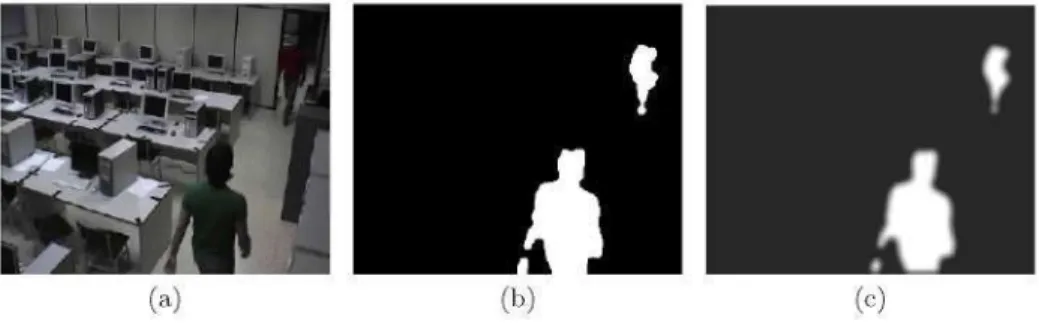
Finally p(zt 3|xt) can be directly taken from Dt3(yc.). Fig. 1 shows a
(a) (b) (c)
Fig. 1. (a) Original image. (b) Binary motion-region segmentation of (a), (c) Motion
likelihood image , using a filtering mask with a = 4 pixels and background probability
PB = 0.2 on (b) (note the greyish background tone due to
PB)-Complete observation likelihood measure p(zt|xt) using motion information
from all cameras can be combined by multiplying individual contributions. Re-sults based only on moving-region segmentation from four different cameras are discussed in Section 3.
2.2 Measurement Model from Color Cues
Motion detection in several overlapping cameras proves to be an effective cue for performing 3D tracking. However, an essential limitation should be pointed out: due to projective geometry fundamentáis, assumptions made for a particular pixel apply equally to every 3D point along its back-projected ray [7]. This leads to serious ambiguities when tracking two or more interacting people, yielding 3D tracking failures (see Section 3). To overeóme this drawback, it is essential to disambiguate between binary silhouettes using appearance modeling (e.g. color, texture,...). This subsection describes a simple color-based appearance model that, combined with the motion segmentation-based model presented in the pre-vious subsection, results in a clear improvement of the system in robustness to occlusions.
Color is usually described according to the RGB color model, as it is closely related to hardware implementations. However, it is not suited for describing perceptual proximity of colors and, in addition, is strongly dependent on illu-mination conditions. This paper proposes thus a color model based on the HSI (Hue-Saturation-Intensity) [6], as it decouples intensity information (I channel) from the color-carrying information (contained in both H and S channels) and provides a perceptual-oriented description of colors.
Ignoring the resulting I channel, and ignoring possible conversión problems arising from low intensity levéis, any RGB color can be robustly represented as two valúes: H and S. Hue and saturation describe a circular color model where H can be regarded as angular information (contained in the range 0o
A = (H,S). (9)
Initially let us consider a single camera (c¿). The observed appearance at each pixel is described in terms of hue and saturation. It is clear that the H and
S valúes of a certain pixel are not independent. However, once again, they can
be considered approximately conditionally independent given xt (assuming that
state xt conveys color information as well as spatial position), as the likelihood of measuring H (or S) is strongly conditioned by xt appearance, and is
com-pletely determined when xt is seen directly in camera c¿ (i.e. it is not occluded).
Therefore the color contribution to observation likelihood in camera c¿ can be written as
p ( ^ | xt) « p ( í rt C í| xt) p ( 5t c' | xt) . (10)
Let ht and st be hue and saturation of xt, respectively, and let yc. = Pc.(xt)
be once again the projection of the 3D position of xt onto camera c¿ image
plañe. The hue (saturation) of pixel yc. should be approximately ht (s¿), taking
into account a certain Gaussian measurement noise with standard deviation a^ (<rs). Since both H and S have been normalized between 0 and 1, the standard
deviation of measurement noise must be o7¡,,o\¡ <C 1. Additionally, as discussed for the 2D motion segmentation cues, it is necessary to set a certain background level (¡IB and SB) to consider the possibility of occlusions. All considered, hue and saturation contributions to the observation likelihood measurement can be expressed as
p(H?\x
t)=h
B+ (l-h
B)—±
?=exp{-U—) ) , (11)
with
and
dh = min {\H?(yCj) - ht\, \ - \H?(yCj) - ht\}, (12)
P(S?\xt)=8B+{l-8B)^=eXP{-USt'Í7Ci) St) \- (13)
The use of this appearance measurement model, along with the motion segmentation-based model described in Subsection 2.1, proves effective for per-forming 3D tracking of múltiple people.
2.3 Dynamic Model
The dynamic model p ( xt| xt_ i ) represents the evolution of the volumetric
oc-cupancy probability density function p(xt|Z4, Hf¡) over time. As the importance
that, in practice, the dynamic model itself governs the evolution of particles x¿ over time.
Two different systems for 3D tracking have been developed: the first one considers only motion-region segmentation from múltiple cameras as state ob-servation, and the latter integrates color modeling along with visual motion detection.
• The system considering only motion-region segmentation works on xt
con-taining 3D position (x, y and z) and velocity ( i , y and ¿). Dynamic model p ( xt| xt_ i ) predicts position assuming constant velocity. Using matrix
nota-tion, prediction can be expressed as
[xt,yt,zt,xt,yt,zt\
\h
[o
3/3
1
h\
Xt- 1 nt, (14)where I3, and O3 are the 3 x 3 identity and zero matrices, respectively, and nt represents the process noise vector [1]. Both position and velocity noise
components follow normal distributions. Every direction is treated equally having so identical power noise.
The system considering both motion-region segmentation and color works on xt containing 3D position and velocity, and also two color dimensions: h and
s. Dynamic model p ( xt| xt_ i ) predicts position assuming constant velocity
(exactly as explained above), considering constant color dimensions. In this case, prediction can be written as
[xt,yt, zt,xt,yt, ¿t,ht, st]J \ h
03
L°2,3
h
h
02,3 03,2] 03,2
h \
X f - 1 (15)
where 0n m is the n x m zero matrix, and n't the process noise vector for
position, velocity and color.
3 Experiments and Results
Fig. 2. (a)(b)(d)(e) Four different views of the monitored office environment, with
con-vex hull 3D segmentation superimposed (using both motion segmentation and color). (c) Volumetric occupancy probability density for two different people (bird's eye view).
Frame 50 Frame 52 Frame 58 Frame 61
Fig. 3. Binary motion-region segmentation performed on images acquired by camera 1.
Note fragmentation and inaccuracy of regions.
greater or equal t o a certain limit PH- T h e experimentation has proved t h a t PH = 0.95 provides good segmentation results.
Fig. 2 depicts 3D segmentation and tracking results of t h e M S + C system, with two different people in t h e scene. Fig. 2(c) shows level curves for b o t h p ( xt| Z4, H\) and p ( xt| Z ' , H2) projection into t h e ground plañe. T h e volumetric
probability density p ( xt| Z4, Hk) has been estimated by applying a 3D Gaussian
kernel on t h e Hk particle set {x¿ , w\ }i=fi • T h e white lines represent t h e
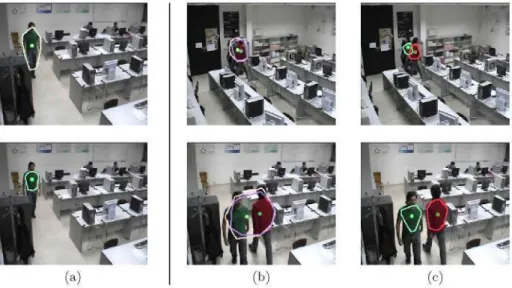
Fig. 4. System using only motion segmentation (MS) versus system using both motion
and color (MS+C). (a) Spatial segmentation using MS (above) and MS+C (below). (b) Failed múltiple people 3D tracking using MS. (c) Múltiple people tracked correctly using MS+C.
Fig. 4(a) compares 3D segmentation precisión for both systems. System us-ing only motion-region segmentation shows better behavior as it proves able to distribute partióles across targets. Motion segmentation and color-based sys-tem, however, tends to undergo particle degeneracy into one single dominant color. This tendency transí ates usually into characterization and tracking of people torsos (see Fig. 2 and 4), as they represent the higher uniform-color visible
Although the MS system performs more accurate 3D segmentations of tracked objects, it is prone to fail when handling occlusions between two or more spatially cióse people (Fig. 4(b)). This is a result of an erroneous weight updating of partióles due to proximity. However, Fig. 4(c) shows MS+C system ability to handle occlusions. Color consistency ensures correct weight updating of partióles from both people with no external help, resulting in excellent robustness to people interaction.
4 Conclusions
the estimation of a volumetric occupancy probability density of a moving target over time, sampled using 3D partióles, and u p d a t e d according t o camera obser-vations. T h u s 3D segmentation can be performed by setting a volume with a high probability (0.95) of containing t h e target.
Multi-camera and multi-feature observation likelihood has been simplified us-ing conditional independence assumptions. Workus-ing on a set of C C D cameras, two different cues or features have been proposed: motion-region segmentation on each camera, and color characterization. Using exclusively motion región segmentation allows accurate 3D segmentation and tracking of non-interacting targets, b u t fails t o overeóme interaction of spatially cióse objeets. However, in-tegrating b o t h motion segmentation and (HSI based) color results in excellent 3D tracking robustness, even in situations involving múltiple interacting people.
Acknowledgements
This work has been partially s u p p o r t e d by t h e Ministerio de Ciencia e Innovación of t h e Spanish Government under project TEC2007-67764 (SmartVision) and by the C o m u n i d a d de Madrid under project S0505/TIC-0223 (Pro-Multidis).
References
1. Arulampalam, M.S., Maskell, S., Gordon, N., Clapp, T.: A tutorial on Partióle Filters for online nonlinear/non-Gaussian Bayesian tracking. IEEE Trans. Signal Processing 50(2), 174-188 (2002)
2. Black, J., Ellis, T., Rosin, P.: Multi view image surveillance and tracking. In: Proc. Workshop on Motion and Video Computing, pp. 169-174 (2002)
3. Doucet, A., Godsill, S.J., Andrieu, C : On sequential Monte Cario sampling meth-ods for Bayesian filtering. Statistics and Computing 10(3), 197-208 (2000) 4. Fleuret, F., Berclaz, J., Lengagne, R., Fuá, P.: Multicamera people tracking with
a probabilistic occupancy map. IEEE Trans. Pattern Analysis and Machine Intel-ligence 30(2), 267-282 (2008)
5. Focken, D., Stiefelhagen, R.: Towards vision-based 3-D people tracking in a smart room. In: Proc. IEEE Int. Conf. Multimodal Interfaces, pp. 400-405 (2002) 6. González, R.I., Woods, R.E.: Digital Image Processing, 3rd edn. Prentice Hall,
Englewood Cliffs (2008)
7. Hartley, R.I., Zisserman, A.: Múltiple View Geometry in Computer Vision, 2nd edn. Cambridge University Press, Cambridge (2004)
8. Hu, W., Tan, T., Wang, L., Maybank, S.: A survey on visual surveillance of object motion and behaviors. IEEE Trans. Systems, Man, and Cybernetics 34(3), 334-352 (2004)
9. Isard, M., Blake, A.: CONDENSATION - Conditional Density Propagation for visual tracking. Int. J. Computer Vision 29(1), 5-28 (1998)
10. Krumm, J., Harris, S., Meyers, B., Brumitt, B., Hale, M.: Multi-camera multi-person tracking for easy living. In: IEEE Int. Workshop on Visual Surveillance (2000)