Robustness of Oscillatory Behavior in
Correlated Networks
Takeyuki Sasai1, Kai Morino1, Gouhei Tanaka2,1,3*, Juan A. Almendral4,5, Kazuyuki Aihara3,1,2
1Graduate School of Information Science and Technology, The University of Tokyo, Tokyo 113-8656, Japan,2Graduate School of Engineering, The University of Tokyo, Tokyo 113-8656, Japan,3Institute of Industrial Science, The University of Tokyo, Tokyo 153-8505, Japan,4Complex Systems Group, Universidad Rey Juan Carlos, 28933 Móstoles, Madrid, Spain,5Center for Biomedical Technology, Univ. Politecnica de Madrid, 28223 Pozuelo de Alarcon, Madrid, Spain
Abstract
Understanding network robustness against failures of network units is useful for preventing large-scale breakdowns and damages in real-world networked systems. The tolerance of networked systems whose functions are maintained by collective dynamical behavior of the network units has recently been analyzed in the framework called dynamical robustness of complex networks. The effect of network structure on the dynamical robustness has been examined with various types of network topology, but the role of network assortativity, or de-gree–degree correlations, is still unclear. Here we study the dynamical robustness of corre-lated (assortative and disassortative) networks consisting of diffusively coupled oscillators. Numerical analyses for the correlated networks with Poisson and power-law degree distri-butions show that network assortativity enhances the dynamical robustness of the oscillator networks but the impact of network disassortativity depends on the detailed network con-nectivity. Furthermore, we theoretically analyze the dynamical robustness of correlated bi-modal networks with two-peak degree distributions and show the positive impact of the network assortativity.
Introduction
From its beginnings, network robustness has been one of the central issues in complex network theory [1–4]. Since networked systems rely on interactions of the network units, failures of the network units and/or their interactions can lead to a large-scale breakdown in the entire net-work. For instance, power-line accidents in power grids can cause large-scale blackouts; cell ne-crosis in biological networks can induce disorders in living things; corporate failures in
business networks can trigger a chain of bankruptcies. To get an insight into how to prevent such enormous damages on a widespread scale in the real-world networked systems, theoreti-cal frameworks for understanding network robustness and vulnerability have been developed together with the advances in network science. Thestructural robustnessindicates the failure tolerance of the network’s connectivity evaluated by the giant component, i.e., the size of the
a11111
OPEN ACCESS
Citation:Sasai T, Morino K, Tanaka G, Almendral JA, Aihara K (2015) Robustness of Oscillatory Behavior in Correlated Networks. PLoS ONE 10(4): e0123722. doi:10.1371/journal.pone.0123722
Academic Editor:Matjaz Perc, University of Maribor, SLOVENIA
Received:December 8, 2014
Accepted:March 6, 2015
Published:April 20, 2015
Copyright:© 2015 Sasai et al. This is an open access article distributed under the terms of the
Creative Commons Attribution License, which permits unrestricted use, distribution, and reproduction in any medium, provided the original author and source are credited.
Data Availability Statement:All relevant data are within the paper.
largest connected component. This framework has been applied to networks consisting of static nodes [1,2]. On the other hand, thedynamical robustnessfocuses on the failure tolerance of dynamical behavior on networks where dynamical processes play important roles in their func-tions [5,6]. While the structural robustness depends only on the network structure, the dynam-ical robustness is governed by the interplay between network structure and dynamics.
Therefore, the important nodes which should be preferentially protected from failures and at-tacks in terms of dynamical robustness can be different from those in terms of structural ro-bustness for the networks with the same topology [6].
So far, many studies on network robustness have focused on the effect of network structure characterized by a degree distribution, i.e., the probability distribution of the number of edges per node over the whole network. The structural and dynamical robustness of complex net-works has been studied in comparison between homogeneously and heterogeneously con-nected networks with different forms of degree distributions [6,7]. However, the degree distribution does not uniquely specify the network topology. Namely, networks with the same degree distribution can have different kinds of network topology. Such a difference can be mea-sured bynetwork assortativitywith respect to node degrees (or degree-degree correlations) [8], the clustering coefficient [9], and other network characteristics [2]. Here we focus on the net-work assortativity. The netnet-work assortativity indicates how the degree of a node is correlated with the degrees of its neighboring nodes. In assortative (positively correlated) networks nodes tend to connect with nodes with similar degrees, whereas in disassortative (negatively correlat-ed) networks high-degree nodes are more likely connected with low-degree nodes. The net-work assortativity is measured by the assortativity coefficientrwhich is defined as a Pearson correlation coefficient with respect to the degrees between the pair of nodes linked each other [8]:r>0 for assortative networks;r= 0 for uncorrelated networks;r<0 for disassortative works. In general, sociological networks are assortative but technological and biological net-works are disassortative [10]. The effect of the network assortativity has been widely studied from various aspects such as the percolation threshold [10–13], the epidemic threshold [14, 15], synchronization [16], and network observability [17], but little is known about its influ-ence on the dynamical robustness of complex networks.
In the present study, we investigate the impact of the network assortativity on the dynamical robustness of coupled oscillator networks against deterioration of the oscillator units. The cou-pled oscillator networks have often been used as a simplified model of interacting units exhibit-ing oscillatory dynamics, as found in various phenomena such as circadian rhythms [18,19], repetitive neuronal firings [20], oscillating gene expressions [21], chemical waves [22], Joseph-son junction arrays [23], and power grids [24]. All these studies show that collective phenome-na, such as synchronization in coupled oscillator networks, are affected by the interplay between the properties of individual oscillators and the network structure [25]. The framework for studying robustness of coupled oscillator networks has been first proposed for a globally coupled network by Daido and Nakanishi [5] and subsequently applied to other globally cou-pled networks [26,27], locally coupled networks [28], multilayer networks [29], and complex networks [6,30,31]. Recently, more extensive studies have been carried out on the recovery strategy of damaged oscillator networks [32], the dynamical robustness of coupled heteroge-neous oscillators [33,34], and the role of time delay in the dynamical robustness of oscillator networks [35]. Based on the framework used in these previous studies, we examine herewith the dynamical robustness of correlated oscillator networks. In this framework, the normal nodes are calledactiveoscillators and the deteriorated ones are calledinactiveoscillators. When all the oscillator nodes are active in the normal state, we observe global oscillatory be-havior in the entire network. As the fractionpof the inactive oscillator nodes increases, the global oscillatory behavior is weakened. At a critical fractionp=pc, the global oscillation
Robustness of Oscillatory Behavior in Correlated Networks
vanishes and a non-oscillatory equilibrium state becomes stable due to a phase transition (called aging transition [5]). The critical valuepcis used as a measure for the dynamical
robust-ness: a larger value ofpcimplies a more robust network.
To consider the effect of the network assortativity, we fix the degree distribution of a given network and change the assortativity coefficientrby two edge-rewiring methods [8,36]. Notice that the degree mixing of a network cannot be completely described byr, since it is a global measure, thus considering the two different edge-rewiring methods lets us study different joint degree distributions regardless they might have the same assortativity coefficientr. In numeri-cal simulations for networks with Poisson and snumeri-cale-free degree distributions, we show that in most cases the network assortativity enhances the dynamical robustness of oscillator networks. The results also indicate that the effect of the network disassortativity on the dynamical robust-ness is different between the network reshuffling methods. We demonstrate that this difference is caused by the fact that disassortative networks generated by the two edge-rewiring methods have essentially different types of network topology even if they have the same assortativity co-efficients. In order to theoretically approach the dynamical robustness of correlated networks, we focus on the extreme cases with bimodal oscillator networks where the degrees of the oscil-lator nodes are limited to two values. The critical fractionpcis analytically derived and
numeri-cally validated for the correlated bimodal networks. The results indicate the positive role of assortativity in the dynamical robustness of oscillator networks. We conclude that the network assortativity is beneficial for the dynamical robustness of coupled oscillator networks. This is consistent with the conclusions from the analysis of the structural robustness of correlated net-works [37].
Methods
Dynamical robustness of coupled oscillator networks
We examine the effect of the network assortativity on the dynamical robustness of coupled os-cillator networks [5,6,34]. Each oscillator is represented by the Stuart-Landau (SL) oscillator [22]. The SL oscillator is equivalent to the normal form of the supercritical Hopf bifurcation, which is a typical mechanism for the onset of oscillatory behavior in dynamical systems [38]. By adjusting the control parameter responsible for the supercritical Hopf bifurcation, the single SL oscillator can be either active or inactive. The network model consisting ofNdiffusively coupled SL oscillators is described as follows [5,6]:
_
zj ¼ ajþiO jzjj
2
zjþ
K N
XN
k¼1
ajk zkzj
forj¼1;. . .;N; ð1Þ
whereistands for the imaginary unit,zj2Cis the complex state variable of oscillator nodej,αj
2Ris the control parameter of oscillator nodej,O2Ris the natural frequency,K2Ris the coupling strength, andajk2{0,1} is the (j,k) entry of the adjacency matrixA= (ajk)
character-izing the network connectivity. We setajk= 1 if the connection is present between nodejand
nodek, andajk= 0 otherwise. We assume that the connections are bidirectional, i.e.,ajk=akj
for anyjandk, and there are no self-connections, i.e.,ajj= 0 forj= 1,. . .,N. The degree of
oscil-lator nodejis given byPNk¼1ajkand the link density is denoted by
dPNj¼1 PN
k¼1ajk=ðNðN1ÞÞ. When the oscillator is isolated (Eq (1)withK= 0), the active
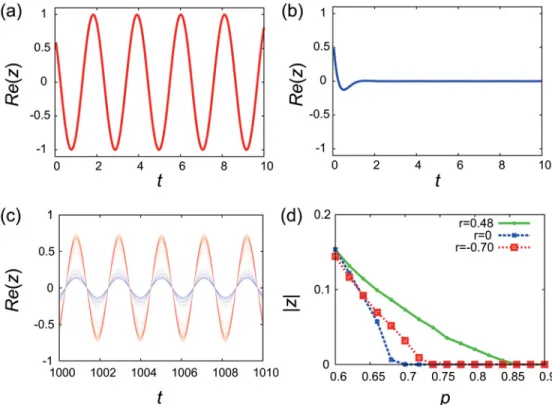
oscillator withαj=a>0 exhibits self-sustained limit-cycle oscillation (Fig 1(a)) and the
inac-tive oscillator withαj=−b<0 settles into a quiescent state after damping oscillation (Fig 1(b))
neighboring active oscillators in the network as shown inFig 1(c). Throughout this paper, the parameters are set atN= 3000,K= 30,d= 0.08,a= 1, andb= 3, unless otherwise noted.
Whether the global oscillatory behavior is observed or not depends on various factors such as the network topology, the fractionpof the inactive oscillators, and the configuration of the active and inactive oscillators.Fig 1(d)shows the decay of the global oscillatory behavior with an increase inpfor uncorrelated, assortative, and disassortative networks. The strength of the global oscillatory behavior in the entire network is measured by the order parameterjZ(t)j
whereZðtÞ PNj¼1zjðtÞ=N. We numerically integrate the coupled oscillator model (Eq 1)
using the fourth-order Runge-Kutta method with time step 0.05 and calculate the order param-eterjZ(t)jatt= 50000. Notice that, in general, the order parameter fluctuates in time and its measure requires a temporal average, but our simulations show that this time period is long enough for the order parameter to approximately converge to a steady-state value. Asp in-creases from 0, the order parameter declines gradually and vanishes at a critical fractionpc. We
consider that the global oscillation has stopped if the order parameter decreases to 10−6in nu-merical simulations. The critical fractionpcis employed as a measure for the dynamical
robust-ness of oscillator networks, i.e., a larger value ofpcimplies that the network is more failure
tolerant. We find that the decline curves of the order parameter are different depending on the assortativity coefficientr, yielding different values ofpc. In terms of the critical valuepc, the
Fig 1. Dynamical robustness of coupled SL oscillator networks.(a) Limit-cycle oscillation produced by the single isolated active oscillator. (b) Damping oscillation produced by the single isolated inactive oscillator. (c) The global oscillatory behavior in an uncorrelated network of active and inactive oscillators. The time evolutions of the state variables of some active (red) and inactive (blue) oscillator nodes are plotted. The parameters are set atN= 3000,p= 0.4, andr= 0. (d) The order parameterjZjplotted against the fractionpof the inactive oscillators in uncorrelated (r= 0), assortative (r= 0.48), and disassortative (r=−0.7) networks with power-law degree distributions. The correlated networks were generated by the GER method.
doi:10.1371/journal.pone.0123722.g001
assortative network seems to be more robust compared with the uncorrelated and disassorta-tive networks. We investigate how the critical valuepcdepends on the network assortativity in
the Results section.
Network assortativity
The assortativity coefficientris an index to measure the network assortativity, or the degree-degree correlations [8], which is defined as the Pearson correlation coefficient of the degrees between pairs of connected nodes. To define the assortativity coefficient, we denote the degree distribution of a network byP(k), which is the probability that a randomly chosen node has de-greek. Let us consider the probability that a node in the end of a randomly chosen edge hask
edges except for the chosen one. Such a number of edges, which is one less than the total de-gree, is called theremaining degree[8]. A node with remaining degreekhas degreek+ 1 totally and the probability that an edge leaving such a node is chosen is proportional tok+ 1. There-fore, the probability distribution of the remaining degree is proportional to (k+ 1)P(k+ 1). The normalized distribution of the remaining degree of the node at the end of a randomly cho-sen edge is given by
QðkÞ ¼ ðkþP1ÞPðkþ1Þ
j jPðjÞ
: ð2Þ
Now we consider the joint probability distributionE(j,k) of the remaining degrees of the two nodes (one with degreejand the other with degreek) at either end of a randomly chosen edge [39]. This quantity satisfiesE(j,k) =E(k,j),∑j∑kE(j,k) = 1, and∑jE(j,k) =Q(k). The level
of assortativity is quantified by the correlation function with respect to node degrees ashjki
−hjihki=∑j∑kjk(E(j,k)−Q(j)Q(k)), where the brackets indicate an average over edges. For
un-correlated networks, the remaining degrees are independent, i.e.,E(j,k) =Q(j)Q(k), and there-fore, the assortativity level is 0. By normalizing the correlation function with its maximal value achieved whenE(j,k) =Q(k)δjk, the assortativity coefficientris defined as follows:
r s12
q
X
j
X
k
jkðEðj;kÞ QðjÞQðkÞÞ; ð3Þ
where the normalizing factor is the variance of the distributionQ(k), i.e., s2
q
P
kk2QðkÞ ð
P
kkQðkÞÞ
2
. The range ofris−1r1:r>0 for assortative networks,
r= 0 for uncorrelated networks, andr<0 for disassortative networks. The assortativity coeffi -cientrinEq (3)can be rewritten as follows:
r ¼ 4M
P
mjmkm ½
P
mðjmþkmÞ
2
2MPmðj2mþk2mÞ ½
P
mðjmþkmÞ
2; ð4Þ
whereMis the total number of edges,m2{1,. . .,M} is the index of edges, andjmandkm
repre-sent the degrees of the two nodes connected by edgem[8].
In our numerical simulations, we change the assortativity coefficientrusing two edge-rewir-ing methods: one is proposed by Xulvi-Brunet and Sokolov [36] and the other by Newman [8]. We call the former method the greedy edge rewiring (GER) and the latter method the stochas-tic edge rewiring (SER). We start with an uncorrelated network withr0 and reshuffle the network edges without allowing self-loops and overlaps. We choose two edges randomly from the network, represented by the connected node pairs, (v1,w1) and (v2,w2). The remaining
edges to control the network assortativity. The rewiring process does not alter the number of edges for each node, and hence, the degree distribution is kept unchanged.
In the GER method, the edge rewiring is conducted based on the degrees of the connected node pairs. We sort the remaining degreesj1,j2,k1, andk2in descending order and relabel
them tol1,l2,l3andl4so thatl1l2l3l4.Fig 2(a)illustrates the three possibilities for
sepa-rating the four nodes into two pairs of connected nodes. When increasing the assortativity co-efficient, Case I is chosen to set the edges between the nodes with more similar degrees if the current state is Case II or III. When decreasing the assortativity coefficient, Case III is chosen to set an edge between the nodes with the largest and smallest degrees if the current state is Case I or II. We increase or decrease the assortativity coefficient by repeating the edge rewiring Fig 2. Network reshuffling methods for changing the network assortativity.(a) The greedy edge-rewiring (GER) method [36]. The remaining degrees of the two connected node pairs, (j1,k1) and (j2,k2), are sorted in the descending order and relabeled asl1,l2,l3, andl4so thatl1l2l3l4. The size of the
node corresponds to its remaining degree. When making the network assortative, Case I is chosen if the current state is Case II or III. When making the network disassortative, Case III is chosen if the current state is Case I or II. (b) The stochastic edge-rewiring (SER) method [8]. The acceptance probability for edge rewiring is given bymin 1;Eðj1;j2ÞEðk1;k2Þ
Eðj1;k1ÞEðj2;k2Þg
n
whereE(j,k) is the joint probability distribution for the remaining degrees of the two nodes in the end of a randomly chosen edge.
doi:10.1371/journal.pone.0123722.g002
in a greedy way and continue until the assortativity coefficient is no longer changed. The assor-tativity coefficientrmonotonically increases or decreases with this method.
In the SER method, we repeat the edge rewiring stochastically to change the network assor-tativity, inspired by the Metropolis dynamics introduced by Newman [8]. Newman used a nu-merical method to generate a network satisfying a given joint probability distributionE(j,k) of the remaining degrees, because it is not trivial to find such a network due to topological con-straints. In this method, the chosen node pairs, (v1,w1) and (v2,w2), are replaced by the new
ones, (v1,v2) and (w1,w2), with acceptance probability min 1;EðjEðj11;;kj21ÞEðkÞEðj12;;kk22ÞÞ
n o
as illustrated in
Fig 2(b). In our study, we employ the following symmetric binomial form [8]:
Eðj;kÞ ¼ NeðjþkÞ=kðCðjþk;jÞfjgkþCðjþk;kÞfkgjÞ; ð5Þ
whereC(m,n)m!/(n!(m−n)!),f+g= 1,κ>0, andN(1−e−1/κ)/2 is a normalization factor. Note that our aim of edge rewiring is not to achieve the aboveE(j,k) but to change the network assortativity. The probabilityfis the control parameter for the assortativity coefficient. In nu-merical simulations, we setf= 0.5 when increasing the assortativity andf= 0.05 when decreas-ing the assortativity [8]. The value ofκis set atκ= 100.
Results
Dynamical robustness of correlated complex networks
Correlated networks with Poisson degree distributions. First, we examine the dynamical robustness of oscillator networks with Poisson degree distributions. The uncorrelated network is initially given as an Erdős-Rényi random graph [40], where the degrees are concentrated around the mean degree. Then the network is changed to be assortative or disassortative using the edge-rewiring techniques introduced in the Methods section. Since each rewiring method modifies the assortativity coefficientroperating differently on the joint degree distribution, the reachable ranges ofrare not the same. The SER method is a random process and, consequent-ly, extreme values ofrare unlikely to be reached. On the contrary, the GER method is a greedy target-oriented method that is able to find those specific networks, even though they are a rath-er small subset of all possible networks having the same degree distribution. Next, for each net-work generated by the edge-rewiring methods, we increase the fractionpof inactive oscillators from 0 until we find the critical valuepcat which the order parameter vanishes. The critical
valuepcdepends on the order in which the oscillators are inactivated with an increase inp. We
consider two ways of oscillator inactivation [6]:randominactivation where the inactive oscilla-tors are randomly chosen;targetedinactivation where the oscillator nodes are inactivated in the order (or the inverse order) of the degree.
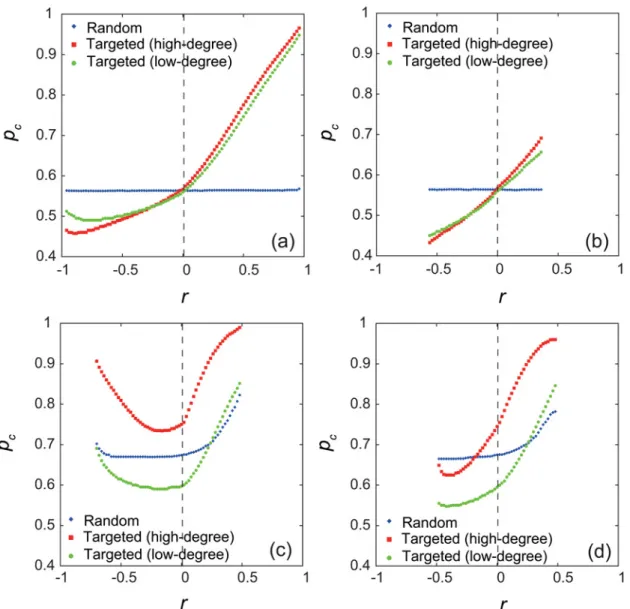
Figs3(a)and3(b)show the critical valuepcfor the networks generated by the GER and SER
methods, respectively. For uncorrelated networks withr0, the value ofpcis the same for the
three types of inactivation, because the way of oscillator inactivation is not significant in the ho-mogeneously connected random network [6]. For the random inactivation in both panels, the value ofpcis almost constant, independently of thervalue. This is because the number of
inac-tive oscillators in the neighborhood of each oscillator node is not affected byr. In fact, the oscil-lation amplitudes of the individual oscillators have similar distributions for disassortative, uncorrelated, and assortative networks (S1andS2Fig).
For the targeted inactivation of high-degree oscillator nodes and that of low-degree oscilla-tor nodes, the value ofpcmonotonically increases withras shown in Figs3(a)and3(b). This
can conclude that the network assortativity has a positive effect on the dynamical robustness of oscillator networks against targeted inactivation.
Correlated networks with power-law degree distributions. Second, we performed similar numerical experiments using correlated scale-free networks with power-law degree distribu-tions. The initial uncorrelated network is given by a Barabási-Albert (BA) scale-free network [41], which consists of a small number of highly connected nodes (hubs) and a large number of loosely connected nodes.
Figs3(c)and3(d)show the critical fractionpcplotted againstrfor the GER and SER
meth-ods, respectively. For uncorrelated networks withr0, the value ofpcfor targeted inactivation
of low-degree nodes is smaller than the values for the other two inactivation types. This is Fig 3. The critical valuepcfor correlated networks.In each panel, the numerically obtained values of the critical fractionpcare plotted against the assortativity coefficientrfor random and targeted inactivation. The system size isN= 3000. The uncorrelated network withr0 is given by the Erdős-Rényi random graph [40] in (a) and (b) and by the BA scale-free network [41] in (c) and (d). (a) Networks with Poisson degree distributions, generated by the GER method. (b) Networks with Poisson degree distributions, generated by the SER method. (c) Networks with power-law degree distributions, generated by the GER method. (d) Networks with power-law degree distributions, generated by the SER method.
doi:10.1371/journal.pone.0123722.g003
consistent with the previous study showing the crucial role of low-degree nodes for the dynam-ical robustness [6]. However, whenris varied, the curves of thepcvalues make intersections as
shown in Figs3(c)and3(d), indicating that the important nodes for the dynamical robustness can change depending on the network assortativity. For all the inactivation types, the value of
pcmonotonically increases asris increased from 0 as shown in Figs3(c)and3(d). It is shown
that the oscillation amplitudes of the active oscillators are smaller for the higher-degree nodes in the random inactivation case (S3andS4Fig). This means that the higher-degree nodes de-crease their oscillation levels more to recover the oscillations of the larger number of neighbor-ing inactive oscillator nodes.
In assortative networks, the connections tend to be made between high-degree nodes and between low-degree nodes. Therefore, for the targeted inactivation of high-degree nodes, the low-degree active oscillators connected to few inactive oscillators can maintain the large oscilla-tion amplitudes (S3andS4Fig). Similarly, for the targeted inactivation of low-degree nodes, the high-degree active oscillators connected to few inactive oscillators can keep the large oscil-lation amplitudes (S3andS4Fig). These nodes maintaining the large oscillation amplitudes are responsible for the large value ofpc, i.e., the highly robust oscillatory behavior. Thus, we
con-firm the positive role of assortativity in the dynamical robustness.
On the other hand, the effect of disassortativity is different between the edge-rewiring meth-ods as shown in Figs3(c)and3(d). Asris decreased from 0, the critical valuepcincreases after
a slight downward trend for the GER method as shown inFig 3(c), but it almost monotonically decreases untilr−0.5 for the SER method as shown inFig 3(d). We notice the qualitative dif-ference in the distributions of the oscillation amplitudes, particularly for the high-degree nodes (S3andS4Fig). This suggests that the networks with the same negative assortativity coefficient can have essentially different types of topology. We next examine the detailed connectivity of the correlated scale-free networks to clarify the difference between the edge-rewiring methods.
Connectivity matrices of correlated networks. The similarity and difference between the correlated scale-free networks generated by the two edge-rewiring methods are clarified inFig 4.Fig 4(a)shows the adjacency matrix of the BA scale-free network withr0 [41]. The dots are dense in the upper-right corner due to the hubs which have a large number of edges.
Figs4(b)and4(c)show the adjacency matrices of assortative scale-free networks with the same positive assortativity coefficientrobtained by the GER and SER methods, respectively. The dots are densely plotted along the diagonal line in both figures and this tendency is strengthened asrincreases. Therefore, the monotonic increase inpcwithris common to the
networks generated by the two edge-rewiring methods. However, the variance from the diago-nal line seems to be smaller for the network obtained by the GER method than that obtained by the SER method. This detailed topological difference results in the different values ofpcas
shown in Figs3(c)and3(d).
Figs4(d)and4(e)show the adjacency matrices of disassortative scale-free networks ob-tained by the GER and SER methods, respectively. There are many dots in the off-diagonal parts, corresponding to the connections between high-degree and low-degree nodes, inFig 4 (d), but not conspicuously inFig 4(e). To quantify the difference in the adjacency matrices be-tween the two disassortative networks, we investigate how the high-degree nodes with indices 800, 900, and 1000 are connected to the neighboring nodes. Figs5(a)and5(b)show the histo-grams of the number of neighboring nodes with respect to each range of index values, [100m
Fig 4. Adjacency matrices of scale-free networks.The dots located at (i,j) indicate the presence of the edges between nodeiand nodej. (a) An uncorrelated network withr0. (b) An assortative network withr= 0.4, generated by the GER method. (c) The same as (b), but generated by the SER method. (d) A disassortative network withr=−0.48, generated by the GER method. (e) The same as (d), but generated by the SER method.
doi:10.1371/journal.pone.0123722.g004
assortativity coefficient is negative because of the greater impact of the latter property decreas-ing the coefficient. On the other hand, inFig 5(b), the three high-degree nodes with indices 800, 900, and 1000 tend to be connected to the nodes with intermediate degrees. The connec-tions to the nodes with similar degrees are very few. Therefore, the assortativity coefficient be-comes negative. These two examples of disassortative networks demonstrate that the
dynamical robustness of oscillator networks depends on the detailed network structure which is not uniquely determined by the assortativity coefficientr.
Verification of the role of the network assortativity. Fig 3, which shows the dependency of the critical valuepcon the assortativity coefficientr, is computed assuming that the system
size isN= 3000, the coupling strength isK= 30, and the parameters for individual oscillators are fixed at (a,b) = (1,3). Hence, it is important to determine if the features found inFig 3are sensitive to other parameter settings. The results for system sizeN= 1500 (S5 Fig) are almost the same as those inFig 3, suggesting that the critical valuepcis almost independent of the
sys-tem size. The results for coupling strengthK= 40 (S6 Fig) are qualitatively similar to those in Fig 3, but the increase in the coupling strength reducespcas in the uncorrelated networks [6].
The results forb= 5 (S7 Fig) are also qualitatively similar to those inFig 3. Consequently, we confirm that the network assortativity has a positive role in the dynamical robustness of oscilla-tor networks for the different parameter settings.
Furthermore, we tested the case with heterogeneous oscillators [34,42]. The parameterαjin
Eq (1)is randomly chosen from a uniform distribution with the range of [μ−δ/2,μ+δ/2] whereμis the average ofαjandδis the distribution width corresponding to the degree of
het-erogeneity. Asμis decreased from a sufficiently large value, the global oscillation vanishes at a critical pointμc. Instead ofpc, as in the case with homogeneous oscillators, nowμcis used as a
measure of dynamical robustness in the coupled heterogeneous oscillators [34]. The smaller the value ofμcis, the more robust the oscillator network is. The results forδ= 2 (S8 Fig) show
that the value ofμcis almost unchanged for the variation ofrin the networks with Poisson
de-gree distributions, but in the networks with power-law dede-gree distributions it decreases asr in-creases in the positive range. The latter result means that the network assortativity enhances the dynamical robustness of heterogeneously coupled networks of heterogeneous oscillators. Fig 5. The histogram of the degrees of the neighboring nodes in the disassortative networks.The network is given by scale-free network with size
N= 1000 and assortativity coefficientr=−0.48. The number of neighboring nodes with indices in the range [100m+ 1,100(m+ 1) + 1) (m= 1,. . .,9) is plotted for the nodes with index 800, 900, and 1000. (a) The network obtained by the GER method. (b) The network obtained by the SER method.
Dynamical robustness of correlated bimodal networks
To theoretically approach the impact of network assortativity on the dynamical robustness of coupled oscillator networks, we consider an extreme case using bimodal networks [43] (or two-peak random networks [44]) where the degrees are limited to two values. We analytically derive the critical fractionpcfor the coupled oscillator model (Eq 1) with correlated bimodal
networks. Note that the topology of the bimodal network is uniquely determined for a given value ofr.
Random inactivation. First we analyze the critical fraction for the random inactivation. We employ the heterogeneous mean field approximation to derive the critical fractionpc[6].
We denote the two degrees byk1andk2for the bimodal networks. We assume that the
oscilla-tor node with degreekm(m= 1, 2) hasNkmknneighboring oscillator nodes with degreekn (n= 1, 2) on average. Then, the interaction of an oscillator node with degreekmwith the
neigh-boring nodes is divided into four types depending on whether the neighneigh-boring node is active or inactive and whether the degree of the neighboring node isk1ork2. Namely, the state variables
are reduced to four representative variables:Akmfor active oscillators with degreekmandIkmfor inactive oscillators with degreekm(m= 1, 2). Now we assume based on numerical observations
that the oscillator nodes with the same activity type and the same degree behave identically. Let the degree of oscillatorjiskm(m= 1, 2) inEq (1). Then the inflow term is approximated as
fol-lows:
XN
k¼1
ajkzk qðNkmk1Ak1þNkmk2Ak2Þ þpðNkmk1Ik1þNkmk2Ik2Þ; ð6Þ
whereq1−p. Here we define the meanfields for the active and inactive oscillators with de-greekm(m= 1, 2), respectively, as follows:
HA
km
X2
n¼1 Nkmkn
km
Akn
X2
n¼1
Eðkm;knÞ
QðkmÞ
Akn; ð7Þ
HI
km
X2
n¼1 Nkmkn
km
Ikn
X2
n¼1
Eðkm;knÞ
QðkmÞ
Ikn; ð8Þ
where the above approximations come fromEq (2). Using these expressions, the model equa-tions inEq (1)can be reduced form= 1, 2 as follows:
_
Akm ¼ aþiO jAkmj
2
Akmþ
Kkm
N qH
A kmþpH
I kmAkm
; ð9Þ
_
Ikm ¼ bþiO jIkmj
2
Ikmþ
Kkm
N qH
A kmþpH
I kmIkm
: ð10Þ
Based on numerical simulations showing that all the oscillators in the entire network exhibit phase synchronization after a transient period, we set
AkmðtÞ ¼r
A
kmðtÞexpðiðOtþyÞÞ; ð11Þ
IkmðtÞ ¼r
I
kmðtÞexpðiðOtþyÞÞ; ð12Þ
whererA kmandr
I
kmrepresent the oscillation amplitudes of the active and inactive oscillators with degreekm, respectively,Ois the oscillation frequency, andθis the phase delay. Substituting Eqs
(11)–(12) into Eqs (7)–(8), the meanfields for the state variables are represented as follows:
HA
kmðtÞ ¼ R
A
kmðtÞexpðiðOtþyÞÞ; ð13Þ
HI
kmðtÞ ¼ R
I
kmðtÞexpðiðOtþyÞÞ; ð14Þ
where the meanfields for the oscillation amplitudes are written as
RA kmðtÞ
X2
n¼1
Eðkm;knÞ
qkm
rA
knðtÞ; ð15Þ
RI
kmðtÞ
X2
n¼1
Eðkm;knÞ
qkm
rI
knðtÞ: ð16Þ
Substituting Eqs (11)–(12) into Eqs (9)–(10), we obtain the equations with respect to the os-cillation amplitudes as follows:
_ rA
km ¼ a
Kkm
N ðr
A kmÞ
2
rA kmþ
Kkm
N qR
A kmþpR
I km ; ð17Þ _ rI
km ¼ b
Kkm
N ðr
I kmÞ
2
rI kmþ
Kkm
N qR
A kmþpR
I km
: ð18Þ
Now let us assume thatRA kmandR
I
kmare given form= 1, 2. The oscillation amplitudes for the steady-state oscillations are calculated as the positive real roots of the following cubic equa-tions:
ðrA kmÞ
3 aKkm
N rA km Kkm N qR A kmþpR
I km
¼ 0; ð19Þ
ðrI kmÞ
3
bKkm
N rI km Kkm N qR A kmþpR
I km
¼ 0: ð20Þ
For these equations to have real roots, we assumekmin>aN/Kwherekminmin(k1,k2) [6,
34]. By solving the cubic equations, the oscillation amplitudes are represented asrkAmðRA km;R
I kmÞ andrkImðR
A km;R
I
kmÞ, respectively (see Refs. [6,34] for the detailed form of the solutions). The meanfields of the oscillation amplitudes should be reconstructed from Eqs (15)–(16) using these steady-state solutions. Hence, the self-consistent condition is represented as follows:
RA
km ¼ G
A kmðR
A
k1;RAk2;RkI1;RIk2Þ; ð21Þ
RI
km ¼ G
I kmðR
A k1;R
A k2;R
I k1;R
I
k2Þ; ð22Þ
form= 1, 2, where
GA kmðR
A
k1;RAk2;RIk1;RIk2Þ ¼
X2
n¼1
Eðkm;knÞ
QðkmÞ
rAkn R
A kn;R
I kn
; ð23Þ
GI kmðR
A k1;R
A k2;R
I k1;R
I k2Þ ¼
X2
n¼1
Eðkm;knÞ
QðkmÞ
rkIn RA kn;R
I kn
The linearized matrix evaluated at the steady-state equilibrium is given by
J0 ¼
@GA k1
@RA k1
@GA k1
@RA k2
@GA k1
@RI k1
@GA k1
@RI k2
@GA k2
@RA k1
@GA k2
@RA k2
@GA k2
@RI k1
@GA k2
@RI k2
@GI k1
@RA k1
@GI k1
@RA k2
@GI k1
@RI k1
@GI k1
@RI k2
@GI k2
@RA k1
@GI k2
@RA k2
@GI k2
@RI k1
@GI k2
@RI k2 0 B B B B B B B B B B B B B B B B B @ 1 C C C C C C C C C C C C C C C C C A ðRA k1;R
A k2;R
I k1;R
I
k2Þ¼ð0;0;0;0Þ:
: ð25Þ
By calculating the matrix components using Eqs (23)–(24), the linearized matrixJ0inEq (25)
is written as follows:
J0¼
qx11LA k1 qx12L
A k2 px11L
A
k1 px12L A k2
qx21LA k1 qx22L
A k2 px21L
A
k1 px22L
A k2
qx11LI
k1 qx12L
I
k2 px11L
I
k1 px12L
I k2
qx21LI
k1 qx22L
I
k2 px21L
I
k1 px22L
I k2 0 B B B B B B B @ 1 C C C C C C C A ; ð26Þ where
xmn¼
Eðkm;knÞ
QðkmÞ
form;n¼1;2; ð27Þ
LA km ¼
Kkm
N 1
Kkm
N a
; LI km¼
Kkm
N 1
Kkm
N þb
for m¼1;2: ð28Þ
The eigenvaluesλj(j= 1, 2, 3, 4) ofJ0are obtained as follows:
l1 ¼l2¼0; l3¼c1þ
ffiffiffiffiffiffiffiffiffiffiffiffiffiffiffiffi c214c0 p
2 ; l4 ¼
c1pffiffiffiffiffiffiffiffiffiffiffiffiffiffiffiffic214c0
2 ; ð29Þ
where
c0 ¼ ðx11x22x12x21ÞðqLA
k1þpLIk1ÞðqLkA2þpLIk2Þ; ð30Þ
c1 ¼ x11ðqLA
k1þpLIk1Þ x22ðqLAk2þpLIk2Þ: ð31Þ
The non-oscillatory equilibrium is stable if all the eigenvalues have absolute values less than unity. Otherwise the global oscillatory behavior is observed. We consider the condition for the phase transition between these two states. Fromc10, the eigenvalue with the largest absolute
value isλ3. The condition thatjλ3j<1 yields ffiffiffiffiffiffiffiffiffiffiffiffiffiffiffiffi c214c0 p
< c1þ2: ð32Þ
The above inequality requires (i)c1+ 2>0 and (ii)−c0<c1+ 1. The condition (i) gives
p > x11L
A k1þx22L
A k22 x11ðLA
k1L
I
k1Þ þx22ðL
A k2L
I k2Þ
: ð33Þ
The condition (ii) gives
hðpÞ g2p2þg1pþg0>0; ð34Þ
where
g0 ¼ ðx11x22x12x21ÞLAk1L
A k2x11L
A k1x22L
A k2þ1;
g1 ¼ ðx11x22x12x21ÞfLA
k1ðLIk2LAk2Þ þLAk2ðLIk1LAk1Þg þx11ðLAk1LIk1Þ þx22ðLAk2LIk2Þ;
g2 ¼ ðx11x22x12x21ÞðLA k1L
I k1ÞðL
A k2L
I k2Þ:
Note that the sign ofγ2is the same as the sign of the assortative coefficientr, and therefore,γ2
6¼0 for correlated networks. Detailed calculations show that the sign ofh(p) changes from neg-ative to positive only once aspis varied from 0 to 1. Solvingh(p) = 0, we obtain the critical frac-tionpcfor the phase transition as follows:
pbim
c ¼
g1þ ffiffiffiffiffiffiffiffiffiffiffiffiffiffiffiffiffiffiffiffig2 14g0g2 p
2g2 : ð35Þ
We can confirm thatpbimc satisfies the inequality condition (Eq 33). For uncorrelated networks
withr= 0,γ2= 0 and the critical fraction is reduced to
pbim
c ¼
x11LA
k1þx22LAk21
x11ðLA
k1LIk1Þ þx22ðLAk2LIk2Þ
; ð36Þ
which is equivalent to that derived in the previous study [6].
Targeted inactivation. Next we consider the targeted inactivation. Without loss of gener-ality, we can assume that the oscillator nodes with degreek1are inactivated prior to those with
degreek2. We separately treat the case where the phase transition occurs when the nodes with
degreek1are inactivated (Case 1) and the case where it occurs when the nodes with degreek2
are inactivated (Case 2).
Case 1: The phase transition occurs during the inactivation of the nodes with degreek1. All
the oscillator nodes with degreek2are active. Therefore, the Jacobian matrix corresponding to
Eq (26)is reduced to
J0 ¼
x11q1LA
k1 x12LAk1 x11p1LAk1
x21q1LA
k2 x22LAk2 x21p1LAk2
x11q1LIk1 x12L I
k1 x11p1L I k1 0 B B B @ 1 C C C
A; ð37Þ
wherep1is the proportion of the inactive oscillators to the total number of nodes with degree k1. The condition that all the eigenvalues have absolute values smaller than unity is given by
p1 > pðk1Þ
c
ðx11x22x12x21ÞLA
k1LAk2þx11LkA1þx22LAk21
ðLA
k1LIk1Þfðx11x22x12x21ÞLAk2þx11g :
By denoting the number of nodes with degreek1byNk1and scaling the above fraction, we ob-tain the critical fraction as follows:
pbim
c ¼
Nk1
N p
ðk1Þ
c : ð39Þ
Case 2: The phase transition occurs during inactivation of the nodes with degreek2after all
the nodes with degreek1are inactivated. All the nodes with degreek1are inactive. The
propor-tion of the inactive oscillators with degreek2to the total number of nodes with degreek2is
de-noted byp2. A similar analysis to that in Case 1 gives the condition that all the eigenvalues have
absolute values less than unity when
p2 > pðk2Þ
c
ðx11x22x12x21ÞLI
k1LAk2þx11LkI1þx22LAk21
ðLA
k2LIk2Þfðx11x22x12x21ÞLIk1þx22g :
ð40Þ
By denoting the number of nodes with degreek2byNk2and scaling the above fraction, we get the critical fraction as follows:
pbim
c ¼
Nk1
N þ
Nk2
N p
ðk2Þ
c : ð41Þ
Numerical validation. The theoretical results for the critical fractionpbimc in the bimodal
networks are numerically validated.Fig 6compares the critical fractions obtained by the theo-retical analysis and those obtained by the numerical simulations. Figs6(a)–6(c)show the re-sults of the random inactivation, the targeted inactivation of high-degree nodes, the targeted inactivation of the low-degree nodes, respectively, for the network withN= 3000,k1= 600,k2
= 150,Nk1= 600, andNk2= 2400. The theoretical results are in good agreement with the numer-ical results in all the panels. The critnumer-ical fraction monotonnumer-ically increases with an increase in the assortativity coefficientrfor all the inactivation types. The results show the positive role of assortativity in the dynamical robustness of bimodal networks. The discontinuity point found inFig 6(c)corresponds to the boundary between Case 1 and Case 2, at which all the nodes with
k1have just become inactive. Figs6(d)–6(f)show the results for another set of bimodal
net-works whereN= 3000,k1= 450,k2= 150,Nk1= 900, andNk2= 2100. The validity of our theo-retical results are confirmed also in these networks.
Discussion
We have studied the dynamical robustness of correlated networks consisting of diffusively cou-pled oscillators. The analyses of the dynamical robustness have been performed based on the critical point at which the global oscillatory dynamics is lost as the fraction of the inactive oscil-lators increases. To see the effect of the network assortativity, we have fixed the degree distribu-tion of the network and changed the correladistribu-tions of the degrees between the connected nodes using the two edge-rewiring methods. As a result, we have shown that the network assortativity enhances the dynamical robustness and the network disassortativity can have a positive or neg-ative impact on the dynamical robustness depending on the edge-rewiring methods. We have investigated the similarity and difference between the networks generated by the edge-rewiring methods through the analyses of the oscillation amplitudes and the adjacency matrices repre-senting the detailed network topology. We have found that the disassortative networks with the same assortativity coefficient can have qualitatively different types of topology, leading to the difference in the dynamical robustness. In the analyses of the correlated bimodal networks, we have theoretically derived the critical point as a measure of the dynamical robustness and
confirmed the positive role of the network assortativity in the dynamical robustness. The previ-ous studies have pointed out that the network assortativity is beneficial for the structural ro-bustness of complex networks through the analyses of the percolation thresholds [12,37,45]. Therefore, we can conclude that the network assortativity improves the failure tolerance of complex networks from the viewpoints of both structural and dynamical robustness.
The numerical and theoretical analyses of the transition points in this study are expected to be applied to various real-world problems where dynamics is important, including how to ef-fectively prevent epidemic spreading on transportation networks [46], how to stabilize electric power supply on power networks [47], and how to robustly keep neuronal firing activity on complex biological networks [48]. These real-world networks typically have degree correlations [8], and therefore, we need to take into consideration not only degree distributions but also de-gree correlations for characterizing the network structure. A future work is to understand the role of the network assortativity in the above phenomena through appropriate modeling of the node dynamics and detailed analyses of the actual network architectures.
Supporting Information
S1 Fig. Oscillation amplitudes in the networks with Poisson degree distributions, generated by the GER method.The model parameters are set atN= 1000 andp= 0.4. The node index is sorted in ascending order of the node degree. The top ((a)-(c)), middle ((d)-(f)), and bottom ((g)-(i)) panels correspond to random inactivation, targeted inactivation of high-degree oscilla-tor nodes, and targeted inactivation of low-degree oscillaoscilla-tor nodes, respectively. The left ((a), (d), (g)), center ((b), (e), (h)), and right ((c), (f), (i)) panels correspond to disassortative (r= Fig 6. The critical value ofpcin correlated bimodal networks of coupled oscillators.The system size isN= 3000. (a)-(c) The results for networks where
k1= 600,k2= 150,Nk1= 600, andNk2= 2400: (a) random inactivation; (b) targeted inactivation of high-degree nodes; (c) targeted inactivation of low-degree
−0.36), uncorrelated (r0), and assortative (r= 0.36) networks, respectively. (EPS)
S2 Fig. Oscillation amplitudes in the networks with Poisson degree distributions, generated by the SER method.The model parameters are set atN= 1000 andp= 0.4. The node index is sorted in ascending order of the node degree. The top ((a)-(c)), middle ((d)-(f)), and bottom ((g)-(i)) panels correspond to random inactivation, targeted inactivation of high-degree oscilla-tor nodes, and targeted inactivation of low-degree oscillaoscilla-tor nodes, respectively. The left ((a), (d), (g)), center ((b), (e), (h)), and right ((c), (f), (i)) panels correspond to disassortative (r= −0.36), uncorrelated (r0), and assortative (r= 0.36) networks, respectively.
(EPS)
S3 Fig. Oscillation amplitudes in the networks with power-law degree distributions, gener-ated by the GER method.The model parameters are set atN= 1000 andp= 0.5. The node index is sorted in ascending order of the node degree. The top ((a)-(c)), middle ((d)-(f)), and bottom ((g)-(i)) panels correspond to random inactivation, targeted inactivation of high-de-gree nodes, and targeted inactivation of low-dehigh-de-gree nodes, respectively. The left ((a), (d), (g)), center ((b), (e), (h)), and right ((c), (f), (i)) panels correspond to disassortative (r=−0.48), un-correlated (r0), and assortative (r= 0.48) networks, respectively.
(EPS)
S4 Fig. Oscillation amplitudes in the networks with power-law degree distributions, gener-ated by the SER method.The model parameters are set atN= 1000 andp= 0.5. The node index is sorted in ascending order of the node degree. The top ((a)-(c)), middle ((d)-(f)), and bottom ((g)-(i)) panels correspond to random inactivation, targeted inactivation of high-de-gree nodes, and targeted inactivation of low-dehigh-de-gree nodes, respectively. The left ((a), (d), (g)), center ((b), (e), (h)), and right ((c), (f), (i)) panels correspond to disassortative (r=−0.48), un-correlated (r0), and assortative (r= 0.48) networks, respectively.
(EPS)
S5 Fig. The critical valuepcfor correlated networks with system sizeN= 1500.In each panel, the numerically obtained values of the critical fractionpcare plotted against the
assorta-tivity coefficientrfor random and targeted inactivation. (a) Networks with Poisson degree dis-tributions, generated by the GER method. (b) Networks with Poisson degree disdis-tributions, generated by the SER method. (c) Networks with power-law degree distributions, generated by the GER method. (d) Networks with power-law degree distributions, generated by the
SER method. (EPS)
S6 Fig. The critical valuepcfor correlated networks with coupling strengthK= 40.In each panel, the numerically obtained values of the critical fractionpcare plotted against the
assorta-tivity coefficientrfor random and targeted inactivation. (a) Networks with Poisson degree dis-tributions, generated by the GER method. (b) Networks with Poisson degree disdis-tributions, generated by the SER method. (c) Networks with power-law degree distributions, generated by the GER method. (d) Networks with power-law degree distributions, generated by the
SER method. (EPS)
S7 Fig. The critical valuepcfor correlated networks with parameterb= 5.In each panel, the numerically obtained values of the critical fractionpcare plotted against the assortativity
coeffi-cientrfor random and targeted inactivation. (a) Networks with Poisson degree distributions, generated by the GER method. (b) Networks with Poisson degree distributions, generated by
the SER method. (c) Networks with power-law degree distributions, generated by the GER method. (d) Networks with power-law degree distributions, generated by the SER method. (EPS)
S8 Fig. The critical valueμcfor correlated networks of coupled heterogeneous oscillators
withδ= 2.In each panel, the numerically obtained values of the critical pointμcare plotted
against the assortativity coefficientr. The parameterαi(i= 1,. . .,N) is randomly chosen from a
uniform distribution with the range of [μ−δ/2,μ+δ/2] whereμis the average ofαiandδis
the distribution width corresponding to the degree of heterogeneity. (a) Networks with Poisson degree distributions, generated by the GER method. (b) Networks with Poisson degree distri-butions, generated by the SER method. (c) Networks with power-law degree distridistri-butions, gen-erated by the GER method. (d) Networks with power-law degree distributions, gengen-erated by the SER method.
(EPS)
Acknowledgments
We thank Dr. Naoki Masuda and Dr. Taro Takaguchi for useful suggestions and valuable com-ments. This research was partially supported by JSPS KAKENHI Grant No. 24700222 (GT) and 26730127 (KM) as well as the Aihara Innovative Mathematical Modelling Project, the Japan Society for the Promotion of Science (JSPS) through the“Funding Program for World-Leading Innovative R&D on Science and Technology (FIRST Program),”initiated by the Council for Science and Technology Policy (CSTP) (GT, KM, and KA).
Author Contributions
Conceived and designed the experiments: GT JA. Wrote the paper: TS KM GT JA KA. Per-formed numerical experiments: TS. PerPer-formed theoretical analyses: TS KM GT.
References
1. Albert R, Barabási AL (2002) Statistical mechanics of complex networks. Rev Mod Phys 74: 47. doi:
10.1103/RevModPhys.74.47
2. Boccaletti S, Latora V, Moreno Y, Chavez M, Hwang DU (2006) Complex networks: Structure and dy-namics. Phys Rep 424: 175–308. doi:10.1016/j.physrep.2005.10.009
3. Barrat A, Barthelemy M, Vespignani A (2008) Dynamical processes on complex networks, volume 1. Cambridge University Press Cambridge.
4. Cohen R, Havlin S (2010) Complex networks: structure, robustness and function. Cambridge Universi-ty Press.
5. Daido H, Nakanishi K (2004) Aging transition and universal scaling in oscillator networks. Phys Rev Lett 93: 104101. doi:10.1103/PhysRevLett.93.104101PMID:15447406
6. Tanaka G, Morino K, Aihara K (2012) Dynamical robustness in complex networks: the crucial role of low-degree nodes. Sci Rep 2: 232. doi:10.1038/srep00232PMID:22355746
7. Albert R, Jeong H, Barabási AL (2000) Error and attack tolerance of complex networks. Nature 406: 378–382. doi:10.1038/35019019PMID:10935628
8. Newman ME (2002) Assortative mixing in networks. Phys Rev Lett 89: 208701. doi:10.1103/ PhysRevLett.89.208701PMID:12443515
9. McGraw PN, Menzinger M (2005) Clustering and the synchronization of oscillator networks. Phys Rev E 72: 015101. doi:10.1103/PhysRevE.72.015101
10. Newman ME (2003) Mixing patterns in networks. Phys Rev E 67: 026126. doi:10.1103/PhysRevE.67. 026126
12. Noh JD (2007) Percolation transition in networks with degree-degree correlation. Phys Rev E 76: 026116. doi:10.1103/PhysRevE.76.026116
13. Goltsev A, Dorogovtsev S, Mendes J (2008) Percolation on correlated networks. Phys Rev E 78: 051105. doi:10.1103/PhysRevE.78.051105
14. Boguná M, Pastor-Satorras R, Vespignani A (2003) Absence of epidemic threshold in scale-free net-works with degree correlations. Phys Rev Lett 90: 028701. doi:10.1103/PhysRevLett.90.028701
PMID:12570587
15. D’Agostino G, Scala A, ZlatićV, Caldarelli G (2012) Robustness and assortativity for diffusion-like pro-cesses in scale-free networks. Europhys Lett 97: 68006. doi:10.1209/0295-5075/97/68006
16. Sorrentino F, Di Bernardo M, Cuellar GH, Boccaletti S (2006) Synchronization in weighted scale-free networks with degree–degree correlation. Physica D 224: 123–129. doi:10.1016/j.physd.2006.09.030
17. Hasegawa T, Takaguchi T, Masuda N (2013) Observability transitions in correlated networks. Phys Rev E 88: 042809. doi:10.1103/PhysRevE.88.042809
18. Winfree AT (2001) The geometry of biological time, volume 12. Springer.
19. Welsh DK, Takahashi JS, Kay SA (2010) Suprachiasmatic nucleus: cell autonomy and network proper-ties. Annual review of physiology 72: 551. doi:10.1146/annurev-physiol-021909-135919PMID:
20148688
20. Buzsáki G, Draguhn A (2004) Neuronal oscillations in cortical networks. Science 304: 1926–1929. doi:
10.1126/science.1099745PMID:15218136
21. Kruse K, Jülicher F (2005) Oscillations in cell biology. Current opinion in cell biology 17: 20–26. doi:10. 1016/j.ceb.2004.12.007PMID:15661515
22. Kuramoto Y (2003) Chemical oscillations, waves, and turbulence. Courier Dover Publications. 23. Watanabe S, Strogatz SH (1993) Integrability of a globally coupled oscillator array. Phys Rev Lett 70:
2391. doi:10.1103/PhysRevLett.70.2391PMID:10053550
24. Filatrella G, Nielsen AH, Pedersen NF (2008) Analysis of a power grid using a kuramoto-like model. The European Physical Journal B 61: 485–491. doi:10.1140/epjb/e2008-00098-8
25. MarkovičR, Gosak M, Marhl M (2014) Broad-scale small-world network topology induces optimal syn-chronization of flexible oscillators. Chaos, Solitons & Fractals 69: 14–21. doi:10.1016/j.chaos.2014. 08.008
26. Pazó D, Montbrió E (2006) Universal behavior in populations composed of excitable and self-oscillatory elements. Phys Rev E 73: 055202. doi:10.1103/PhysRevE.73.055202
27. Tanaka G, Okada Y, Aihara K (2010) Phase transitions in mixed populations composed of two types of self-oscillatory elements with different periods. Phys Rev E 82: 035202(R). doi:10.1103/PhysRevE.82. 035202
28. Daido H (2008) Aging transition and disorder-induced coherence in locally coupled oscillators. Euro-phys Lett 84: 10002. doi:10.1209/0295-5075/84/10002
29. Morino K, Tanaka G, Aihara K (2011) Robustness of multilayer oscillator networks. Phys Rev E 83: 056208. doi:10.1103/PhysRevE.83.056208
30. He Z, Liu S, Zhan M (2013) Dynamical robustness analysis of weighted complex networks. Physica A 392: 4181–4191. doi:10.1016/j.physa.2013.05.005
31. Huang W, Zhang X, Hu X, Zou Y, Liu Z, Guan S (2014) Variation of critical point of aging transition in a networked oscillators system. Chaos: An Interdisciplinary Journal of Nonlinear Science 24: 023122. doi:10.1063/1.4881215
32. Morino K, Tanaka G, Aihara K (2013) Efficient recovery of dynamic behavior in coupled oscillator net-works. Phys Rev E 88: 032909. doi:10.1103/PhysRevE.88.032909
33. Daido H, Kasama A, Nishio K (2013) Onset of dynamic activity in globally coupled excitable and oscil-latory units. Phys Rev E 88: 052907. doi:10.1103/PhysRevE.88.052907
34. Tanaka G, Morino K, Daido H, Aihara K (2014) Dynamical robustness of coupled heterogeneous oscil-lators. Phys Rev E 89: 052906. doi:10.1103/PhysRevE.89.052906
35. Thakur B, Sharma D, Sen A (2014) Time-delay effects on the aging transition in a population of coupled oscillators. Phys Rev E 90: 042904. doi:10.1103/PhysRevE.90.042904
36. Xulvi-Brunet R, Sokolov I (2004) Reshuffling scale-free networks: From random to assortative. Phys Rev E 70: 066102. doi:10.1103/PhysRevE.70.066102
37. Newman ME (2003) The structure and function of complex networks. SIAM Rev 45: 167–256. doi:10. 1137/S003614450342480
38. Guckenheimer J, Holmes P (1983) Nonlinear oscillations, dynamical systems, and bifurcations of vec-tor fields, volume 42. New York Springer Verlag.
39. Callaway DS, Hopcroft JE, Kleinberg JM, Newman ME, Strogatz SH (2001) Are randomly grown graphs really random? Phys Rev E 64: 041902. doi:10.1103/PhysRevE.64.041902
40. Erdős P, Rényi A (1960) On the evolution of random graphs. Publ Math Inst Hungar Acad Sci 5: 17–61. 41. Barabási AL, Albert R (1999) Emergence of scaling in random networks. Science 286: 509–512. doi:
10.1126/science.286.5439.509PMID:10521342
42. Daido H (2011) Strong-coupling limit in heterogeneous populations of coupled oscillators. Phys Rev E 84: 016215. doi:10.1103/PhysRevE.84.016215
43. Tanizawa T, Paul G, Cohen R, Havlin S, Stanley HE (2005) Optimization of network robustness to waves of targeted and random attacks. Phys Rev E 71: 047101. doi:10.1103/PhysRevE.71.047101
44. Shiraki Y, Kabashima Y (2010) Cavity analysis on the robustness of random networks against targeted attacks: Influences of degree-degree correlations. Phys Rev E 82: 036101. doi:10.1103/PhysRevE. 82.036101
45. Valdez L, Buono C, Braunstein L, Macri P (2011) Effect of degree correlations above the first shell on the percolation transition. Europhys Lett 96: 38001. doi:10.1209/0295-5075/96/38001
46. Tanaka G, Urabe C, Aihara K (2014) Random and targeted interventions for epidemic control in meta-population models. Sci Rep 4: 5522. doi:10.1038/srep05522PMID:25026972
47. Nagata M, Fujiwara N, Tanaka G, Suzuki H, Kohda E, Aihara K (2014) Node-wise robustness against fluctuations of power consumption in power grids. The European Physical Journal Special Topics 223: 2549–2559. doi:10.1140/epjst/e2014-02215-x
![Fig 2. Network reshuffling methods for changing the network assortativity. (a) The greedy edge-rewiring (GER) method [ 36 ]](https://thumb-us.123doks.com/thumbv2/123dok_es/6783540.831740/6.918.55.718.114.668/network-reshuffling-methods-changing-network-assortativity-greedy-rewiring.webp)

![Fig 3 , but the increase in the coupling strength reduces p c as in the uncorrelated networks [ 6 ].](https://thumb-us.123doks.com/thumbv2/123dok_es/6783540.831740/11.918.69.790.113.376/fig-increase-coupling-strength-reduces-p-uncorrelated-networks.webp)