Oscillatory activity in prefrontal and posterior regions during implicit
letter-location binding
Pablo Campo
a'*'
1,
Claudia Poch3'1, Fabrice B.R. Parmentier
b'
c'
d,
Stephan Moratti
e,
Jane V. Elsleyd,
Nazareth P. Castellanos
e,
José María Ruiz-Vargas
f,
Francisco del Pozo
e,
Fernando Maestú
a,ga Center of Magnetoencephalography Dr. Pérez-Modrego, Complutense University of Madrid, Madrid, Spain
b Clinical Neuropsychology Group, Department of Psychology and Health Sciences Research Institute, University of the Balearic Islands, Spain c School of Psychology, University of Western Australia
d School of Psychology, University of Plymouth
e Center of Biomedical Technology (CTB), Polytechnic University of Madrid, Madrid, Spain ' Department of Basic Psychology, University Autónoma of Madrid, Madrid, Spain
g Department of Basic Psychology Cognitive Processes II, Complutense University of Madrid, Madrid, Spain
A B S T R A C T
Many cognitive abilities involve the integration of information from different modalities, a process referred to as "binding." It remains less clear, however, whether the creation of bound representations occurs in an involuntary manner, and whether the links between the constituent features of an object are symmetrical. We used magnetoencephalography to investigate whether oscillatory brain activity related to binding processes would be observed in conditions in which participants maintain one feature only (involuntary binding); and whether this activity varies as a function of the feature attended to by participants (binding asymmetry). Participants performed two probe recognition tasks that were identical in terms of their perceptual characteristics and only differed with respect to the instructions given (to memorize either consonants or locations). MEG data were reconstructed using a current source distribution estimation in the classical frequency bands. We observed implicit verbal-spatial binding only when participants successfully maintained the identity of consonants, which was associated with a selective increase in oscillatory activity over prefrontal regions in all frequency bands during the first half of the retention period and accompanied by increased activity in posterior brain regions. The increase in oscillatory activity in prefrontal areas was only observed during the verbal task, which suggests that this activity might be signaling neural processes specifically involved in cross-code binding. Current results are in agreement with proposals suggesting that the prefrontal cortex function as a "pointer" which indexes the features that belong together within an object.
Working Memory (WM) is considered a supporting process for high level cognitive abilities (Miyake and Shah, 1999), many of which require the combination and maintenance of complex information, demanding cross-code associations (Cowan et al., 2006). Despite its crucial role in a number of mental skills and abilities, visual WM demonstrates, in humans, a surprisingly limited capacity, estimated at around three to four units of information, while at the same time suggesting that the term "unit" pertains not to individual features, but objects (Cowan, 2001; Vogel and Machizawa, 2004; Vogel et al., 2001; Zhang and Luck, 2008). Additionally, other authors have suggested the additional role of visual complexity to limited capacity (Alvarez
* Corresponding author. Centro de Magnetoencefalografia Dr. Pérez-Modrego. Pabellón 8, Facultad de Medicina, Universidad Complutense de Madrid. 28040, Madrid, Spain. Fax: +34 91 394 22 94.
E-mail address: [email protected] (P. Campo). 1 These authors contributed equally to the study.
and Cavanagh, 2004, although see Eng et al., 2005). More recently,
information in the form of traffic signals, or tracking routes on maps, etc. Nonetheless, some progress has been made in understanding the behavioural mechanisms (Cowan et al., 2006; Elsley and Parmentier, 2009; Kahnemanetal., 1992; Mitroffand Alvarez, 2007; Morey,2009; Oberauer and Vockenberg, 2009) and the neural bases (Campo et al., 2008; Campo et al., 2005; Luck et al., 2008; Prabhakaran et al., 2000; Wu et al., 2007) of verbal-spatial binding.
While evidence supports the notion of bound representations, the exact mechanisms underpinning binding in WM remain relatively unspecified, in part because some key questions remain unanswered. Two issues have recently arisen that may constrain the development of a mechanistic model of binding: the role of attention and the asymmetrical nature of binding. Several lines of research suggest that selective attention is involved in binding the constituent features of objects (Duncan, 1984; Martinez-Trujillo and Treue, 2004; Scholl, 2001; Treisman, 1998; Vecera and Farah, 1994). However, whether binding occurs in an involuntary manner remains unclear. Several studies have shown that in the absence of attention visual features can be represented jointly (Humphrey and Goodale, 1998; Kahnemanetal., 1992; Mazza et al., 2007; Meegan and Honsberger, 2005; Melcher et al., 2005; O'Craven et al., 1999; Schoenfeld et al., 2003; Sohn et al., 2004;
see also Constantinidis and Steinmetz, 2005). Consequently, it has been proposed that attentional processes directed to task-relevant features of an object automatically spreads to other irrelevant features of the attended object leading to a bound representations of "spatiotempo-rally colocalized features" (Melcher et al., 2005; Sohn et al., 2004). Thus, according to this position, attendance to a task-relevant object feature may entail the involuntary binding of all features of that object.
A second and related issue of importance is that regarding the nature of binding, and more particularly whether binding is best described by full integration of features or by asymmetric links between features (Maybery et al., 2009). There is indeed evidence suggesting that not all features are of equal importance in the formation of integrated representations (Hommel and Colzato, 2004).
For example, spatial information appears to play a primordial role in visual WM, resulting in the automatic processing of location following the encoding of a visual feature, such as shape or color (Jiang et al., 2000; Mazza et al., 2007; Meegan and Honsberger, 2005; Olson and Marshuetz, 2005; see also Constantinidis and Steinmetz, 2005). An analogous, yet opposite asymmetry is observed in the auditory domain, where pitch is proposed as a primary dimension compared to location information (Kubovy and Van Valkenburg, 2001; Maybery et al., 2009). The asymmetrical nature of binding was further investigated by Elsley, Parmentier and Maybery (unpublished results). Their Experiment 2 made use of an adapted version of the single probe task developed by Prabhakaran et al. (2000). Participants were presented with an array of three irregular black polygon shapes (simultaneously) in distinct locations in the screen. In one task, participants were required to remember the visual (shape) features only; in the other they were required to remember the spatial (locations) features only. At test, they had to decide whether a single probe shape in location represented a shape they had seen in the memory display (the visual task) or a location that was occupied in the memory display (the spatial task). In both tasks, performance was compared across two critical probe conditions, both of which required a "yes" response. Intact probes consisted of a shape in the location it was originally, in the memory display. Recombined probes consisted of a shape in a location originally occupied by a different to-be-remembered shape. The logic was simple: if participants cannot retrieve one feature independently of the other (i.e., the features were bound in memory), there should be a performance advantaged in the intact condition where the original bindings were preserved relative to the recombined condition, where they were not—i.e., a "binding effect" should be observed. Their results indicated a significant binding effect in the visual task (where shapes only were attended) but not in the spatial task (where the locations only were attended
to). Additionally, in their Experiment 3, they examined whether the binding of locations to shapes was mediated by the level of discriminability of the shape features. The hypothesis was that the relative distinctiveness of the shapes may have determined the extent to which spatial locations would be bootstrapped to them in order to form more distinguishable objects. Comparisons across easily distin-guishable and less distindistin-guishable shape sets in a "visual task" (as above) indicated, however, that the binding of locations to shapes was not impacted by the degree to which the shapes themselves could be distinguished. Taken together, these findings support asymmetry such that attending to an aspect of an objects' identity entails binding to its spatial location, while attending to spatial location does not necessarily entail its binding to the item's identity (see also
Constantinidis and Steinmetz, 2005; Jiang et al., 2000).
When considering verbal-spatial integration, neither the symme-try of binding nor the automaticity of binding have been examined from a neural perspective. We were interested in brain activity during maintenance period as it is considered as a process of keeping information in mind in the absence of external stimuli, and corresponds to the mnemonic aspect of the WM. Investigating this phase could provide information about the neural mechanisms underlying bound information representation. Accordingly, in the present study, we used magnetoencephalography (MEG) to measure brain activity underpinning the maintenance of verbal and spatial features in two recognition tasks, based on a letter-location paradigm previously used in binding studies (Prabhakaran et al., 2000). In the verbal task participants attended consonants, while in the spatial task they attended locations. The aim of the current study was to elucidate whether neural activity specific to binding would be observed in conditions in which participants attend to one feature only (involun-tary binding); and whether the brain activity underpinning binding processes varies as a function of the feature attended to by participants (binding asymmetry). In both the verbal and spatial tasks, participants were presented with four consonants appearing simultaneously in four distinct locations. Thus both tasks were identical in terms of their perceptual characteristics and only differed with respect to the instructions given to participants (to memorize either the consonants or the locations). Of critical importance to measure binding (Oberauer and Vockenberg, 2009), positive-recog-nition probes could either be made up of a letter that was in location (intact probe) or a letter and a location that were both in the array, but were not seen together (re-combined probe). If verbal and spatial features are integrated in WM, accuracy and/or reaction time (RT) should show an advantage for intact probes as compared to re-combined probes (inline with past research; Prabhakaran etal., 2000; Elsley and Parmentier, 2009). Henceforth, we refer to this as the "binding effect." In contrast, if the task-irrelevant feature, either verbal or spatial, is not concurrently maintained, intact and re-combined probes should be functionally equivalent and yield similar levels of performance. Based on previous observations that encoding the "what" appears to entail the involuntary encoding of the "where"
(Bao et al., 2007; Mazza et al., 2007; Meegan and Honsberger, 2005),
proposes that neural oscillations might be a potential mechanism by which separate features of an object are bound (Singer, 1999; Várela et al., 2001). Specifically, this approach considers that neurons coding various features of objects are bound into a neuronal assembly by synchronization of their activity and has been supported by numerous studies (Doesburg et al., 2008b; Engel et al., 2001; Palva et al., 2005; Senkowski et al., 2006; Womelsdorf et al., 2007). Although neural oscillatory activity in the gamma band was originally proposed as the mechanism underlying binding processes (Singer, 2001; Singer and Gray, 1995; Tallon-Baudry and Bertrand, 1999), oscillations in other "classical" frequency ranges (theta, alpha and beta) have also been linked with visual-feature binding and cross-modal binding (Bassett et al., 2006; Hummel and Gerloff 2005; Mima et al., 2001; Palva et al., 2005; Wu et al., 2007). While it has been shown that WM operations engage oscillations in different frequency ranges (Grimault et al., 2009; Jokisch and Jensen, 2007; Sauseng et al., 2004; Tesche and Karhu, 2000), the actual role of each frequency in representing the contents of WM remains unclear (Kahana, 2006; Palva et al., 2005). As the neural dynamics required for cross-code integrated representa-tions presumably demands interacrepresenta-tions between activities of multiple brain regions in different frequency ranges (Calvert et al., 2000; Doesburg et al., 2008a; Palva et al., 2005), here, we propose that neuronal oscillatory activity in various frequencies should be greater when verbal and spatial features are maintained as an integrated representation.
Accumulated evidence from psychophysical, functional neuroima-ging and transcranial magnetic stimulation studies strongly support the crucial role of posterior parietal cortex in visual-feature integration processes (Corbetta et al., 1995; Donner et al., 2002; Lee and Chun, 2001; Shafritz et al., 2002; Simon-Thomas et al., 2003; Todd and Marois, 2004, 2005; Vogel and Machizawa, 2004; Xu and Chun, 2006) and verbal-spatial binding (Campo et al., 2008; Campo et al., 2005; Wu et al., 2007). The prefrontal cortex has been proposed to integrate object identity and location through connections within prefrontal areas (Prabhakaran et al., 2000; Rao et al., 1997) and through converging projections from parietal and temporal regions on the prefrontal cortex (Fuster, 1995; Rao et al., 1997). These previous results have led us to hypothesize that greater oscillatory activity might be observed in prefrontal and parietal regions when concurrent verbal-spatial maintenance occurs.
Thus, the predictions of the present study were as follows: first, from a behavioural perspective, if verbal and spatial binding is characterised by binding asymmetry (as is reported elsewhere for visual and spatial features e.g., Elsley et al., unpublished results; Jiang et al., 2000) we should observe a binding effect (intact over re-combined probe advantage) when item (consonant) identity is task relevant, but not when spatial location is task-relevant. Crucially however, the former but not the latter should be characterised by greater oscillatory activity within prefrontal and parietal regions.
Materials and methods
Subjects
Fourteen adult subjects (mean age 25.36 years, SD of 3.13 years, range 22 years to 32 years, nine female), without any history of neurological or psychiatric illness, volunteered for participation in the study and gave written consent, in accordance with the Declaration of Helsinki, after the nature of the procedures involved had been explained to them. Participants received 40 € upon completion of the experiment.
Stimuli and tasks
Experimental tasks were modelled on a letter-location paradigm developed by Prabhakaran et al. (Prabhakaran et al., 2000) and
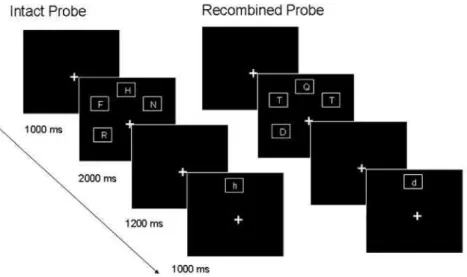
adapted by Elsley and Parmentier (Elsley and Parmentier, 2009) consisting of a visual memory array of four consonants displayed in four locations (Fig. 1). The verbal stimuli comprised a set of eight consonants (Arial font; 48 pt), selected so as to differ in appearance between upper- and lower-case forms (D, F, H, J, N, Q, R, T). The spatial stimuli were presented within a set of eight spatial locations, marked by squares, placed equidistantly in a circular manner at an eccentricity of 3'63° from the center of the squares to fixation cross. Both tasks used identical stimuli, but differed with respect to the feature to be attended and memorized. In the verbal task, participants were asked to remember the identity of the consonants, irrespective of their location. In the spatial task, participants were instructed to remember the location of the consonants while ignoring their identity. Each task began with a self-paced set of instructions, and five practice trials. At the beginning of each trial, participants first saw a 500-ms central fixation cross, followed by the sample memory array consisting of four consonants, displayed in white (against a black background) and in upper-case, selected at random (without replacement) from the above set of eight. Each consonant appeared in a distinct location randomly selected (without replacement) from the possible set of eight. The letters were presented within al'87°xl'87° white frame to reduce variations in spatial configuration caused by the consonants per se (Delvenne et al., 2002). The to-be-remembered array remained on the screen for 2000 ms. After a 1200 ms delay interval, for both conditions, participants were presented with a single lower-case letter in a location for 1000 ms, during which they were required to respond (a 1000 ms blank screen followed this response period before the onset of the next trial). The task in the verbal condition was to indicate, by button press, whether the consonant had been presented in the to-be-remembered array, regardless of its location. In the spatial task, participants had to decide whether the location had been occupied in the to-be-remembered array, regardless of the identity of the consonant inside. Two types of positive-recognition probes (requiring a "yes" response) were presented, a consonant in its original location (intact probe), and a recombination of a consonant and a location presented in that trial but not together (recombined probe). The negative-recognition probes (requiring a "no" response) were as follows: a new consonant in a new location (in both the verbal and the spatial tasks); an old consonant in a new location (in the spatial task only); and an old location occupied by a new consonant (in the verbal task only). In both tasks, instructions emphasized the importance of both accuracy and speed.
Procedures
MEG scans were obtained during the verbal and the spatial tasks. A total of 480 trials were presented in each task. For counterbalancing purposes the order of presentation of the tasks was controlled. Experimental conditions were completed in different sessions lasting 45 min approximately, separated by a 10- to 15-min resting interval. Tasks were purpose-written for the experiment using E-prime
(Schneider et al., 2002).
The stimuli were projected through a LCD video-projector (SONY VPL-X600E), situated outside the shielded room on-to a series of in-room mirrors, the last of which was suspended approximately 60 cm above the subject's face (19'8°x26'l°).
Data collection and analysis
horizontal bipolar electro-oculograms (EOG) were also recorded by bipolar montages using a Synamps amplifier (NeuroScan, El Paso, Texas) with Ag/ AgCI electrodes (same sample rate and online filters as mentioned previously). Trials containing eye movement or blinks (as indicated by peak-to-peak amplitudes in the EOG channels in excess of 50 uV.) or other myogenic or mechanical artifacts were removed using the automated artifact rejection algorithm implemen-ted in the Brain Electrical Source Analysis software suite (BESA 5.1; Megis Sofware). Only the retention period of trials with correct responses (hits and correct rejections) were included for subsequent analyses.
Digitized MEG data were imported into MATLAB Version 7.4 (Mathworks, Natick, MA) for analysis using the Fieldtrip software package (http://www.ru.nl/fcdonders/fieldtrip/) and custom-writ-ten scripts. Time-frequency (TF) representation of MEG data was calculated on a single trial basis for a 1700 ms time window starting from 500 ms before the onset of the stimulus presentation, and 1200 ms starting from the beginning of maintenance period using a multi-taper Fourier transform approach applied to short sliding time windows (50 ms). We used adaptive Hanning tapers of four cycles, with frequencies ranging from 4 to 50 Hz, in 1-Hz steps (de Lange etal., 2008).
As dipolar magnetometer topographies are difficult to interpret with respect of the underlying generator sources, we decided to model frequency changes in the source space (Fan et al., 2007). As stated by Liljestrom et al., (2005) "Localization of ongoing oscillatory activity is important for establishing the normal spatial and spectral variation of cortical rhythmicity in the healthy human brain." In order to construct the source image of the TF data a minimum-norm estimation procedure (MNE) was applied to estimate the cortical origin of the retention period neuronal response. A tessellated cortical mesh template surface derived from the Montreal Neurolog-ical Institute (MNI) phantom brain and implemented in SPM5
(http://www.fil.ion.ucl.ac.uk/spm/software/spm5/) served as a brain model to estimate the current source distribution. This MNI dipole mesh (3004 nodes) was used to calculate the forward solution using a head model based on overlapping local spheres (Huang et al., 1999). The inverse solution was calculated by applying 12 MNE, with standard Tikhonov regularization, implemented in Brainstorm
(http://neuroimage.usc.edu/brainstorm/). Tikhonov regularization is needed to control the effect of the noise on the solution
(Bouhamidi and Jbilou, 2007). Jensen and Vanni (2002) have demonstrated that transforming the real and imaginary parts of the Fourier components in the source domain by means of MNE and combining them it is possible to identify source areas of rhythmic activity in the frequency domain. Accordingly, in our study the underlying current source density (the source strength at each node of the MNI phantom brain) of four frequency bands (theta, 4-8 Hz; alpha, 8-12 Hz; beta, 13-30 Hz; gamma, 30-50 Hz) was estimated by calculating the MNE in the frequency domain (Jensen and Vanni, 2002; see also Moratti et al., 2008). Here, the real and imaginary parts of each Fourier component averaged within each of the four frequency bands was submitted to the MNE analysis. Thereafter, the MNEs of the real and imaginary parts were combined by using the root square of the sum of squares of the two Fourier parts as an estimate of absolute amplitude. The change in amplitude was calculated with respect to a baseline period before the beginning of each trial. For each frequency band, the mean time-frequency amplitude of the prestimulus period (between 500 and 0 ms before stimulus onset) was considered as a baseline and subtracted from the time-frequency representation in order to normalize it. Data were log-transformed in order to reduce the effect of the non-Gaussian distribution (Pivik et al., 1993). The log transformed amplitude values at each dipole location of the brain surface mesh corresponding to the TF-values were statistically analyzed by using a Student's t-test to compare the verbal and spatial conditions.
Associated p-values were thresholded at p<0.001 (uncorrected) (see Brookes et al., 2005; Busch et al., 2006; Kilner et al., 2009; Kim and Chung, 2008; Tsuchiya et al., 2008; Van Snellenberg et al., 2007
for a similar statistical approach).
Results
Behavioral data
Data from three participants contained MEG signals with noise levels that prevented further analysis. Consequently, these data were excluded from behavioral and T-F analysis. Performance was assessed in terms of accuracy (% correct) and reaction time (RT) for both positive probe trials (intact and recombined) in each task.
In the verbal task, participants were more accurate for intact (M = 89.78 %; SD = 8.61) relative to recombined probe trials (M=83.67 %; SD = 7.17) (t10 = 3.46, p<0.01). Additionally, re-sponse latencies in the verbal task were also significantly faster on intact probe trials (M = 908.36 ms; SD= 163.67) relative to recombined probe trials (M = 927.27 ms; SD = 158.21) (t10 = 2.60, p<0.05). In contrast, in the spatial task, accuracy measures for intact (M = 90.59 %; SD = 8.73) and recombined probe trials (M= 89.18 %; SD = 8.51) did not show significant differences (t10 = 1.32, p>0.20), and did not differ in terms of RT measures (intact: M = 859.36 ms; SD = 224.60; recombined: (M= 850.54 ms; SD = 224.85) (t10 = 0.92, p>0.30).
In sum, and in accordance with past research, statistical analyses of our behavioural data indicated verbal-spatial binding effects when consonant identity was task-relevant, but no such effect when spatial location was the task-relevant feature. Based on these observations, we compared the distributed source localization of oscillatory activity between both tasks (Fig. 1).
Distributed source localization of oscillatory activity during maintenance period
Theta frequency band (4-8 Hz)
Higher T-F source amplitudes in the verbal task as compared to the spatial task were observed in anterior brain regions, specifically left premotor area between 100 and 150 ms (ti0 = 4.99, p < 0.0005, all reported t-values correspond to the maximum t-value observed within a significant source cluster) and left dorsolateral prefrontal cortex between 350 and 400 ms (t10 = 4.95, p < 0.001). The topo-graphical distribution of the source estimates of rhythmic activity in the theta frequency range revealed that frontal activity was only greater during the verbal task as compared to the spatial task. Distinct posterior parietal regions also showed greater theta oscillatory activity in the verbal task between 750-800 ms (t10 = 5.36, p<0.0005), 850-900 ms (t10 = 7.67, p<0.0001) and 1150-1200 ms (tio = 4.93, p < 0.001). Greater activity was also observed over posterior parietal regions in the spatial task as compared to the verbal task between 100 and 150 ms (t10 = 6.42, p<0.0001), 150-200 ms (t10 = 7.04, p<0.0001), 950-1000 ms (t10 = 4.75, p<0.001) and 1150-1200 ms (t10 = 4.73, p<0.001) (see Figs. 2 and 3 upper panels).
Alpha frequency band (8-12 Hz)
Intact Probe
Recombined Probe
Fig. 1. Schematic illustration of both types of positive recognition probes. Trials in the verbal and spatial conditions were identical and differed only with respect to the instructions given to participants (to memorize either the consonants or the locations). The examples depicted on this Figure are that of an intact probe (a letter that was in location) and recombined probe (both consonant and location were presented in the to-be-remembered array but not together). Probe consonants were always in lower case form.
250 and 350 ms (t10 = 4.65, p<0.001; t10 = 5.61, p<0.0005) and between 500 and 650 ms (t10 = 5.25, p < 0.0005 ;tw = 4.67, p < 0.001; t10 = 5.25, p<0.0005) during the spatial task as compared to the verbal task. Right premotor area also showed greater oscillatory response during the spatial task between 650 and 700 ms (t10 = 5.19, p<0.0005) (Fig. 3 mid-upper panel). Again the topographical distribution of the source estimates revealed an effect of greater
activity in prefrontal areas during the verbal task. The greater frontal activity during the spatial task was located more posteriorly.
Beta frequency band (13-30 Hz)
Right prefrontal, dorsolateral and ventrolateral regions showed greater beta enhancement during the verbal task between 100-150 ms (tio = 5.62, p<0.0005) and 500-550 ms (t1 0 = 6.20,
Theta Band
Alpha Band
Beta Band
Gamma Band
Verbal > Spatial
100-150ms 350-400ms 750-800ms 650-900ms 1150-1200 ms
P < . 0 0 0 5 P < . D 0 1 P<.QD05 P < . a 0 D l P < . 0 0 1
100-lSOms 200-250m£ 450-SOOms
P < . 0 0 0 5 P<.O0OS P < . 0 0 1
100-150ms 200-2SOms 500-550ms
P < , 0 0 0 5 P < . 0 0 0 5 P < . 0 0 0 1
S0-100ms 2S0-300ms SOO-SSOms 600-6S0ms
-1
«11
P < . 0 0 Q 1 Pi.ODOS P < . 0 0 0 5 P < . 0 0 1
Spatial > Verbal
Theta Band
100-150ms 150-200ms 950-1000ms 1150-1200ms
p<.oooi P<.OOOI p<mi
Alpha Band
2SD-3D0ms 3uO-350ms SDO-SSOms SSO-SODrns 60O-650ms 6S0-700ms
P<.001 P i . 0 0 0 5 Pi.OOOS P < , 0 0 1 P < . 0 0 0 5 P < 0005
300-3SOms 400-450ms 900-950ms 950-1000ms
Beta Band
P < . 0 0 0 5 P < . 0 0 1
100-lSOms 350-400ms 400-4S0ms 1000-1050ms
Gamma Band
Fig. 3. Shows the results of the group analysis projected onto a tessellated cortical mesh template surface derived from the Montreal Neurological Institute (MNI) phantom brain. The figure depicts cortical source clusters indicating statistically significant increase in amplitude for the spatial task relative to the verbal task in specific time bins for different frequency ranges by means of p values (p<0.001 uncorrected). Only p values exceeding the critical p value of 0.001 are shown. The colorbar indicates the p values.
p<0.0001), respectively (see Fig. 2 mid-lower panel). Additionally, sources located in parietal and temporal areas also exhibited greater oscillatory activity in the beta frequency range in the verbal task as compared to the spatial task between 200-250 ms (t10 = 5.33, p<0.0005) and between 500-550 ms. Greater activity in this frequency was observed mainly in premotor areas during the spatial task between 300-350 ms (t10 = 5.34, p<0.0005), 900-950 ms (tio = 4.64, p<0.001), and 950-100 ms (t10 = 4.90, p<0.001). Additionally, the posterior parietal cortex also showed greater oscillatory activity between 400 and 450 ms (ti0 = 4.66, p<0.001) (see Fig. 3 mid-lower panel). The anterior-prefrontal pattern of activity during the verbal task is also observed in the beta frequency range.
Gamma frequency band (30-50 Hz)
Topographical distribution of the source estimates for oscillatory activity in the gamma frequency range showed an enhancement over left prefrontal ventrolateral and temporal anterior regions between 50 and 100 ms (t10 = 6.62, p<0.0001), over right posterior temporal region between 500 and 550 ms (ti0 = 6.08, p<0.0005), and over posterior parietal cortex between 600 and 650 ms (tio = 4.77, p<0.001) during the verbal task as compared to the spatial task (Fig. 2 lower panel). Parietal areas showed greater oscillatory activity in the gamma frequency range during the spatial task between 100-150 ms (t10 = 4.93, p<0.001), 400-450 ms (t10 = 4.70, p<0.001) and 1000-1050 ms (t10 = 4.92, p<0.001), and also premotor areas between 350 and 400 ms (ti0 = 4.66, p<0.001) (Fig. 3 lower panel).
Discussion
The goal of the current study was to describe the oscillatory activity produced during maintenance of implicit verbal-spatial binding. Our behavioral investigation of spatial (location) versus identity (consonants) maintenance processing, indicated that cross-code binding occurred when spatial information was irrelevant for task completion. In other words, in attending to consonant identity the involuntary binding of spatial location ensued while spatial locations could be attended to in isolation of the consonants occupying them. Consequently, our findings are in agreement with the proposal of an asymmetrical contribution of the spatial dimension previously reported in visual WM studies (Constantinidis and Steinmetz, 2005; Elsley, Parmentier and Maybery, unpublished;
Jiang et al., 2000; Mazza et al., 2007; Meegan and Honsberger, 2005). Second, these results indicate that in the absence of explicit processing, cross-code features might be bound and represented in an integrated format (Melcheretal., 2005; O'Craven et al., 1999; Sohn et al., 2004).
parietal activity during the retention period of the spatial task is compatible with the proposed role of this area in retaining spatial locations of stimuli (Corbetta et al., 2002; Chafee and Goldman-Rakic, 1998). Along with its involvement in spatial WM, there is a large body of evidence showing that PPC is also engaged in different forms of visual feature integration and cross-modal binding (Martinez et al., 2007; Nobre et al., 2000; Saito et al., 2005; Shafritz et al., 2002; Todd and Marois, 2004; Xu and Chun, 2006; see Macaluso and Driver, 2005
for a review). Our observation of activity over this area in the verbal task is consistent with this view. It has been posited that the parietal lobe cannot be considered as "a unitary entity with a single function"
Qeannerod and Jacob, 2005). Several authors have proposed cross-modal influences of spatial attention on sensory brain regions during multisensory interactions (Macaluso and Driver, 2005; Senkowski et al., 2005). Nonetheless, the critical role of PPC in integrating different features might be independent from spatial processing (Corbetta and Shulman, 2002; Marois and Ivanoff, 2005), and part of its functional role may be to build integrated mental representations of complex stimuli (Marois and Ivanoff, 2005). While forming an interesting avenue for future research, the current data do not allow us to elucidate whether the processes supported by the PPC regions activated during the spatial task are different from those that are engaged during the verbal task.
We also found bilateral effects in theta, beta and gamma band activity over anterior and posterior temporal regions specifically during the verbal task. This pattern of activation could be linked with phonological processing of verbal information (for a review see
Gernsbacher and Kaschak, 2003). However, the most interesting finding of the current study is that although differences in activity in all analyzed frequency bands were observed in the verbal and spatial tasks in anterior regions, only activity in the prefrontal cortex, dorsolateral and ventrolateral, was greater during the verbal task. These differences over prefrontal areas were observed during the first half of the retention period (first 600 ms). Anterior sources in the spatial task were mainly observed in right premotor regions. Indeed, anterior prefrontal areas are considered to be recruited when "selected items become more complex or increase in number"
(Corbetta and Shulman, 2002). The precise role of the prefrontal cortex within this task remains open for debate, however. Prefrontal cortex has been proposed as a crucial area in integration processes since it is densely connected with sensory-specific cortices and heteromodal cortical regions (Duncan, 2001; Fuster, 1995). Further-more, neurons coding different types of information are inter-mingled in the prefrontal cortex (Petrides and Pandya, 1999; Wilson et al., 1993). Previous work on object-location binding using monkeys concluded that information about object and location converged in the prefrontal cortex, encompassing dorsolateral and ventrolateral surfaces (Rainer et al., 1998a,b; Rao et al., 1997). In humans, greater prefrontal activity during integrated object-location processing has also been shown (Filbey et al., 2005; Mitchell et al., 2000; Simon-Thomas et al., 2003). Moreover, earlier functional neuroimaging (Prabhakaran et al., 2000) and neurophysiological studies (Campo et al., 2005; Wu et al., 2007) in humans have revealed increased activation in prefrontal areas during maintenance of integrated verbal-spatial information. As verbal-spatial binding was observed only in the verbal task it can be inferred that the greater oscillatory activity found in prefrontal areas might be signaling neural processes specifically involved in cross-code binding. However, it is important to highlight that the prefrontal activity in the current study was mainly observed in dorsal and medial regions corresponding to Brodmann's areas (BA) 9 and 46 (see also Campo et al., 2005), while in the study of Prabhakaran et al. this activity was found in BA10. Whether this difference is related to specific mechanisms supporting implicit vs. explicit binding should explored in future studies. Prabhakaran et al (Prabhakaran et al., 2000) suggested that the greater prefrontal activation associated
with the integration of verbal and spatial information could be explained by a flexible representational architecture. However, an alternative interpretation is possible since several authors propose that the prefrontal cortex does not maintain mnemonic representa-tions (Lebedev et al., 2004; Owen et al., 1998; Petrides, 2000; Rissman et al., 2008; Rowe and Passingham, 2001). Instead, prefrontal cortex is considered to participate in controlled processing of the activity of posterior brain regions more directly involved in representing specific features as well as categorical information
(Doesburg et al., 2009; Grimault et al., 2009; Kessler and Kiefer, 2005; Mechelli et al., 2004; Rainer and Ranganath, 2002; Serences and Yantis, 2006). This control could be exerted by means of long-range fronto-posterior connections (Grimault et al., 2009; Hasegawa et al., 2000; Kessler and Kiefer, 2005). Models invoking cross-modal influences of spatial attention in multisensory integration include frontal-parietal interactions as part of the superior attention network
(Corbetta and Shulman, 2002; Macaluso and Driver, 2005; Marois and Ivanoff, 2005; Senkowski et al., 2005). Thus, rather than functioning as a storage medium for bound representations, the prefrontal cortex may function as a "pointer" indexing the features that form an object, while the features themselves are retained in more posterior regions. The time window in which we observed greater prefrontal oscillatory activity during the verbal task (0-550 ms) is in line with previous results about the maintenance of integrated verbal-spatial representations (Campo et al., 2005; see also Doesburg et al., 2009). Further, the time range associated with prefrontal oscillatory enhancement is in agreement with a proposal suggesting that processes occurring during this time interval in the information processing pathway could be associated with the establishment of convergent associations, enabling the integration of different types of information into a multimodal representation
(Saito et al., 2005; Vogel et al., 2001; Xu and Chun, 2006), which is built and stored in visual WM. Considered together, the current results are consistent with models that suggest a distributed network involving prefrontal and posterior regions, and are in good agreement with the findings of others showing increased fronto-posterior synchronization during verbal-spatial binding (Wu et al., 2007). However, present data do not allow a firm conclusion on whether the activity observed in different frequency ranges bares distinct functional roles in verbal-spatial integration. Oscillatory activity corresponding to the classical theta, alpha, beta frequency bands, along with gamma band, have been associated with binding processes in previous studies (Bassett et al., 2006; Filbey et al., 2005; Hummel and Gerloff, 2005; Mima et al., 2001; Palva et al., 2005; Wu et al., 2007). Although somewhat speculative, our data might signal of the necessity of interactions between activities observed across distinct frequencies as a mechanism for the integration of distributed processing (Bassett et al., 2006; Palva et al., 2005).
clear that attendance to any object feature is not sufficient to produce the spontaneous or involuntary binding of all features of that object within the episodic buffer. Which features gain obligatory (or involuntary) access to the episodic buffer and under what circum-stances remains to be established.
Acknowledgments
This work was supported by a research grant from the Spanish Ministry of Education and Science (GrantSEJ2006-14571) to Pablo Campo, by a research grant from the UK's Economic and Social Research Council (GrantRES-062-23-0241) to Fabrice Parmentier and partially supported by a Grant from the Comunidad Autónoma de Madrid (Madr.lB S-SAL-0312-2006). We also acknowledge Angel Nevado for helpful comments on the manuscript.
References
Alvarez, G.A., Cavanagh, P., 2004. The capacity of visual short-term memory is set both by visual information load and by number of objects. Psychol. Sci. 15,106-111. Baddeley, A., 1996. The fractionation of working memory. Proc. Natl. Acad. Sci. U. S. A.
93,13468-13472.
Baddeley, A, 2000. The episodic buffer: a new component of working memory? Trends Cogn. Sci. 4,417-423.
Baddeley, A., Hitch, G., 1974. Working memory. In: Bower, G.A (Ed.), The psychology of learning and motivation. Academic Press, New York PP- 48-79.
Bao, M., Li, Z.H., Zhang, D.R., 2007. Binding facilitates attention switching within working memory. J. Exp. Psychol. Learn. Mem. Cogn. 33, 959-969.
Bassett, D.S., Meyer-Lindenberg, A., Achard, S., Duke, T, Bullmore, E., 2006. Adaptive reconfiguration of fractal small-world human brain functional networks. Proc. Natl. Acad. Sci. U. S. A 103,19518-19523.
Bays, P.M., Husain, M., 2008. Dynamic shifts of limited working memory resources in human vision. Science 321, 851-854.
Bodelon, C, Fallah, M., Reynolds, J.H., 2007. Temporal resolution for the perception of features and conjunctions. J. Neurosci. 27, 725-730.
Bouhamidi, A., Jbilou, K., 2007. Sylvester Tikhonov—regularization methods in image restoration. J. Comput Appl. Math. 206, 86-98.
Brookes, M.J., Gibson, A.M., Hall, S.D., Furlong, P.L, Barnes, G.R, Hillebrand, A., Singh, K.D., Holliday, I.E., Francis, ST., Morris, P.G., 2005. GLM-beamformer method demonstrates stationary field, alpha ERD and gamma ERS co-localisation with fMRI BOLD response in visual cortex. Neuroimage 26, 302-308.
Busch, N.A, Schadow, J., Frund, I., Herrmann, C.S., 2006. Time-frequency analysis of target detection reveals an early interface between bottom-up and top-down processes in the gamma-band. Neuroimage 29,1106-1116.
Calvert, G.A., Campbell, R., Brammer, M.J., 2000. Evidence from functional magnetic resonance imaging of crossmodal binding in the human heteromodal cortex. Curr. Biol. 10, 649-657.
Campo, P., Maestu, F., Ortiz, T, Capilla, A., Santiuste, M., Fernandez, A, Amo, C, 2005. Time modulated prefrontal and parietal activity during the maintenance of integrated information as revealed by magnetoencephalography. Cereb. Cortex 15,123-130.
Campo, P., Maestu, F., Capilla, A, Morales, M., Fernandez, S., del Rio, D., Ortiz, T, 2008. Temporal dynamics of parietal activity during word-location binding. Neuropsychology 22, 85-99.
Constantinidis, C, Steinmetz, M.A, 2005. Posterior parietal cortex automatically encodes the location of salient stimuli. J. Neurosci. 25, 233-238.
Corbetta, M., Shulman, G.L, 2002. Control of goal-directed and stimulus-driven attention in the brain. Nat. Rev. Neurosci. 3, 201-215.
Corbetta, M., Shulman, G.L, Miezin, F.M., Petersen, S.E., 1995. Superior parietal cortex activation during spatial attention shifts and visual feature conjunction. Science 270, 802-805.
Corbetta, M., Kincade, J.M., Shulman, G.L, 2002. Neural systems for visual orienting and their relationships to spatial working memory. J. Cogn. Neurosci. 14, 508-523. Cowan, N., 2001. The magical number 4 in short-term memory: a reconsideration of
mental storage capacity. Behav. Brain Sci. 24, 87-114 discussion 114-185. Cowan, N., Saults, J.S., Morey, CC, 2006. Development of working memory for
verbal-spatial associations. J. Mem. Lang. 55, 274-289.
Chafee, M.V., Goldman-Rakic, P.S., 1998. Matching patterns of activity in primate prefrontal area 8a and parietal area 7ip neurons during a spatial working memory task. J. Neurophysiol. 79, 2919-2940.
de Lange, F.P., Jensen, O., Bauer, M., Toni, I., 2008. Interactions between posterior gamma and frontal alpha/beta oscillations during imagined actions. Front Hum. Neurosci. 2, 7.
Delvenne, J.F., Braithwaite, J.J., Humphreys, G.W., 2002. Capacity limits in visual short term memory for local orientations. Curr. Psychol. Cogn. 21, 681-690.
Doesburg, S.M., Emberson, L.L., Rahi, A, Cameron, D., Ward, L.M., 2008a. Asynchrony from synchrony: long-range gamma-band neural synchrony accompanies percep-tion of audiovisual speech asynchrony. Exp. Brain Res. 185,11-20.
Doesburg, S.M., Roggeveen, AB., Kitajo, K., Ward, L.M., 2008b. Large-scale gamma-band phase synchronization and selective attention. Cereb. Cortex 18, 386-396.
Doesburg, S.M., Green, J.J., McDonald, J.J., Ward, L.M., 2009. Rhythms of consciousness: binocular rivalry reveals large-scale oscillatory network dynamics mediating visual perception. PLoS One 4, e6142.
Donner, T.H., Kettermann, A, Diesch, E., Ostendorf, F., Villringer, A., Brandt, S.A, 2002. Visual feature and conjunction searches of equal difficulty engage only partially overlapping frontoparietal networks. Neuroimage 15,16-25.
Duncan, J., 1984. Selective attention and the organization of visual information. J. Exp. Psychol. Gen. 113, 501-517.
Duncan, J., 2001. An adaptive coding model of neural function in prefrontal cortex. Nat. Rev. Neurosci. 2, 820-829.
Elsley, J.V., Parmentier, F.B., 2009. Is verbal-spatial binding in working memory impaired by a concurrent memory load? Q.J. Exp. Psychol. (Colchester) 1-10. Eng, H.Y., Chen, D., Jiang, Y., 2005. Visual working memory for simple and complex
visual stimuli. Psychon. Bull. Rev. 12,1127-1133.
Engel, A.K., Fries, P., Singer, W., 2001. Dynamic predictions: oscillations and synchrony in top-down processing. Nat Rev. Neurosci. 2, 704-716.
Fan, J., Byrne, J., Worden, M.S., Guise, K.G., McCandliss, B.D., Fossella, J., Posner, M.I., 2007. The relation of brain oscillations to attentional networks. J. Neurosci. 27, 6197-6206.
Filbey, F.M., Holroyd, T, Carver, F., Sunderland, T, Cohen, R.M., 2005. A magnetoence-phalography spatiotemporal analysis of neural activities during feature binding. Neuroreport 16,1747-1752.
Friedman-Hill, S.R., Robertson, LC, Treisman, A., 1995. Parietal contributions to visual feature binding: evidence from a patient with bilateral lesions. Science 269, 853-855.
Fuster, J.M., 1995. Memory in the cerebral cortex. MIT Press, Cambridge.
Gernsbacher, M.A, Kaschak M.P., 2003. Neuroimaging studies of language production and comprehension. Annu. Rev. Psychol. 54, 91-114.
Grimault, S., Robitaille, N., Grova, C, Lina, J.M., Dubarry, A.S., Jolicoeur, P., 2009. Oscillatory activity in parietal and dorsolateral prefrontal cortex during retention in visual short-term memory: additive effects of spatial attention and memory load. Hum. Brain Mapp. 30 (10), 3378-3392.
Hasegawa, RP., Matsumoto, M., Mikami, A, 2000. Search target selection in monkey prefrontal cortex. J. Neurophysiol. 84,1692-1696.
Hommel, B., Colzato, L, 2004. Visual attention and the temporal dynamics of feature integration. Vis. Cogn. 11,483-521.
Huang, MX, Mosher, J.C., Leahy, RM., 1999. A sensor-weighted overlapping-sphere head model and exhaustive head model comparison for MEG. Phys. Med. Biol. 44, 423-440.
Hummel, F., Gerloff, C, 2005. Larger interregional synchrony is associated with greater behavioral success in a complex sensory integration task in humans. Cereb. Cortex 15, 670-678.
Humphrey, G.K., Goodale, M.A, 1998. Probing unconscious visual processing with the McCollough effect Conscious Cogn. 7,494-519.
Jeannerod, M., Jacob, P., 2005. Visual cognition: a new look at the two-visual systems model. Neuropsychologia 43, 301-312.
Jensen, O., Vanni, S., 2002. A new method to identify multiple sources of oscillatory activity from magnetoencephalographic data. Neuroimage 15, 568-574. Jiang, Y, Olson, I.R., Chun, M.M., 2000. Organization of visual short-term memory. J. Exp.
Psychol. Learn. Mem. Cogn. 26, 683-702.
Jokisch, D., Jensen, O., 2007. Modulation of gamma and alpha activity during a working memory task engaging the dorsal or ventral stream. J. Neurosci. 27, 3244-3251. Kahana, M.J., 2006. The cognitive correlates of human brain oscillations. J. Neurosci. 26,
1669-1672.
Kahneman, D., Treisman, A., Gibbs, B.J., 1992. The reviewing of object files: object-specific integration of information. Cogn. Psychol. 24,175-219.
Kessler, K., Kiefer, M., 2005. Disturbing visual working memory: electrophysiological evidence for a role of the prefrontal cortex in recovery from interference. Cereb. Cortex 15,1075-1087.
Kilner, J.M., Marchant, J.L, Frith, CD., 2009. Relationship between activity in human primary motor cortex during action observation and the mirror neuron system. PLoS One 4, e4925.
Kim, J.S., Chung, C.K., 2008. Language lateralization using MEG beta frequency desynchronization during auditory oddball stimulation with one-syllable words. Neuroimage 42,1499-1507.
Kubovy, M., Van Valkenburg, D., 2001. Auditory and visual objects. Cognition 80, 97-126.
Lebedev, M.A, Messinger, A, Kralik, J.D., Wise, S.P., 2004. Representation of attended versus remembered locations in prefrontal cortex. PLoS Biol. 2, e365.
Lee, D., Chun, M.M., 2001. What are the units of visual short-term memory, objects or spatial locations? Percept. Psychophys. 63, 253-257.
Liljestrom, M., Kujala, J., Jensen, O., Salmelin, R., 2005. Neuromagnetic localization of rhythmic activity in the human brain: a comparison of three methods. Neuroimage 25, 734-745.
Logie, RH., 1995. Visuo-spatial working memory. Lawrence Erlbaum, Hove. Luck, D., Foucher, J.R, Offerlin-Meyer, I., Lepage, M., Danion, J.M., 2008. Assessment of
single and bound features in a working memory task in schizophrenia. Schizophr. Res. 100, 153-160.
Luck, S.J., Vogel, E.K., 1997. The capacity of visual working memory for features and conjunctions. Nature 390, 279-281.
Macaluso, E., Driver, J., 2005. Multisensory spatial interactions: a window onto functional integration in the human brain. Trends Neurosci. 28, 264-271. Marois, R, Ivanoff, J., 2005. Capacity limits of information processing in the brain.
Trends Cogn. Sci. 9, 296-305.
Martínez, A., Ramanathan, D.S., Foxe, J.J., Javitt, D.C., Hillyard, S.A., 2007. The role of spatial attention in the selection of real and illusory objects. J. Neurosci. 27, 7963-7973.
Maybery, M.T., Clissa, P.J., Parmentier, F.B., Leung, D., Harsa, G., Fox, A.M., Jones, D.M., 2009. Binding of verbal and spatial features in auditory working memory. J. Mem. Lang. 61 (1), 112-133.
Mazza, V., Turatto, M., Umilta, C, Eimer, M., 2007. Attentional selection and identification of visual objects are reflected by distinct electrophysiological responses. Exp. Brain Res. 181, 531-536.
Mechelli, A, Price, C.J., Friston, K.J., Ishai, A., 2004. Where bottom-up meets top-down: neuronal interactions during perception and imagery. Cereb. Cortex 14, 1256-1265.
Meegan, D.V., Honsberger, M.J., 2005. Spatial information is processed even when it is task-irrelevant: implications for neuroimaging task design. Neuroimage 25, 1043-1055.
Melcher, D., Papathomas, TV., Vidnyanszky, Z., 2005. Implicit attentional selection of bound visual features. Neuron 46, 723-729.
Mima, T., Oluwatimilehin, T, Hiraoka, T, Hallett, M., 2001. Transient interhemi-spheric neuronal synchrony correlates with object recognition. J. Neurosci. 21, 3942-3948.
Mitchell, K.J., Johnson, M.K., Raye, CL, D'Esposito, M., 2000. fMRI evidence of age-related hippocampal dysfunction in feature binding in working memory. Brain Res. Cogn. Brain Res. 10,197-206.
Mitroff, S.R, Alvarez, G.A, 2007. Space and time, not surface features, guide object persistence. Psychon. Bull. Rev. 14,1199-1204.
Miyake, A, Shah, P., 1999. Models of Working Memory. Cambridge University Press, Cambridge.
Moratti, S., Rubio, G., Campo, P., Keil, A., Ortiz, T., 2008. Hypofunction of right temporoparietal cortex during emotional arousal in depression. Arch. Gen. Psychiatry 65, 532-541.
Morey, C.C., 2009. Integrated cross-domain object storage in working memory: Evidence from a verbal-spatial memory task Q, J. Exp. Psychol. (Colchester) 1-17. Nobre, A.C., Gitelman, D.R, Dias, E.C., Mesulam, M.M., 2000. Covert visual spatial
orienting and saccades: overlapping neural systems. Neuroimage 11, 210-216. O'Craven, K.M., Downing, P.E., Kanwisher, N., 1999. fMRI evidence for objects as the
units of attentional selection. Nature 401, 584-587.
Oberauer, K., Vockenberg, K., 2009. Updating of working memory: lingering bindings. Q.J. Exp. Psychol. (Colchester) 62, 967-987.
Olson, I.R, Marshuetz, C, 2005. Remembering "what" brings along "where" in visual working memory. Percept Psychophys. 67,185-194.
Owen, AM., Stern, C.E., Look, RB., Tracey, I., Rosen, B.R, Petrides, M., 1998. Functional organization of spatial and nonspatial working memory processing within the human lateral frontal cortex. Proc. Natl. Acad. Sci. U. S. A 95, 7721-7726. Palva, J.M., Palva, S., Kaila, K., 2005. Phase synchrony among neuronal oscillations in the
human cortex. J. Neurosci. 25, 3962-3972.
Petrides, M., 2000. Mapping prefrontal cortical systems for the control of cognition. In: Toga, AW., Mazziota, J.C, Frackowiak, RS. (Eds.), Brain mapping. The systems. Academic Press, New York, pp. 159-175.
Petrides, M., Pandya, D.N., 1999. Dorsolateral prefrontal cortex: comparative cytoarch-itectonic analysis in the human and the macaque brain and corticocortical connection patterns. Eur. J. Neurosci. 11,1011-1036.
Pivik, RT., Broughton, R.J., Coppola, R, Davidson, RJ., Fox, N., Nuwer, M.R, 1993. Guidelines for the recording and quantitative analysis of electroencephalographic activity in research contexts. Psychophysiology 30, 547-558.
Prabhakaran, V., Narayanan, K., Zhao, Z., Gabrieli, J.D., 2000. Integration of diverse information in working memory within the frontal lobe. Nat. Neurosci. 3, 85-90. Rainer, G., Ranganath, C, 2002. Coding of objects in the prefrontal cortex in monkeys
and humans. Neuroscientist 8, 6-11.
Rainer, G., Asaad, W.F., Miller, E.K., 1998a. Memory fields of neurons in the primate prefrontal cortex. Proc. Natl. Acad. Sci. U. S. A. 95,15008-15013.
Rainer, G., Asaad, W.F., Miller, E.K., 1998b. Selective representation of relevant information by neurons in the primate prefrontal cortex. Nature 393, 577-579. Rao, S.C, Rainer, G., Miller, E.K., 1997. Integration of what and where in the primate
prefrontal cortex. Science 276, 821-824.
Rissman, J., Gazzaley, A, D'Esposito, M., 2008. Dynamic adjustments in prefrontal, hippocampal, and inferior temporal interactions with increasing visual working memory load. Cereb. Cortex 18,1618-1629.
Rowe, J.B., Passingham, RE., 2001. Working memory for location and time: activity in prefrontal area 46 relates to selection rather than maintenance in memory. Neuroimage 14, 77-86.
Saito, D.N., Yoshimura, K., Kochiyama, T., Okada, T., Honda, M., Sadato, N., 2005. Cross-modal binding and activated attentional networks during audio-visual speech integration: a functional MRI study. Cereb. Cortex 15,1750-1760.
Sauseng, P., Klimesch, W., Doppelmayr, M., Hanslmayr, S., Schabus, M., Gruber, W.R, 2004. Theta coupling in the human electroencephalogram during a working memory task. Neurosci. Lett. 354,123-126.
Schneider, W., Eschman, A., Zuccoloto, A., 2002. E-Prime reference guide. Psychology Software Tools Inc., Pittsburgh.
Schoenfeld, M.A, Tempelmann, C, Martinez, A, Hopf, J.M., Sattler, C, Heinze, H.J., Hillyard, S.A., 2003. Dynamics of feature binding during object-selective attention. Proc. Nad. Acad. Sci. U. S. A 100,11806-11811.
Scholl, B.J., 2001. Objects and attention: the state of the art. Cognition 80,1-46. Senkowski, D., Talsma, D., Herrmann, C.S., Woldorff, M.G., 2005. Multisensory
processing and oscillatory gamma responses: effects of spatial selective attention. Exp. Brain Res. 166,411-426.
Senkowski, D., Molholm, S., Gomez-Ramirez, M., Foxe, J.J., 2006. Oscillatory beta activity predicts response speed during a multisensory audiovisual reaction time task: a high-density electrical mapping study. Cereb. Cortex 16, 1556-1565.
Serences, J.T., Yantis, S., 2006. Selective visual attention and perceptual coherence. Trends Cogn. Sci. 10, 38-45.
Shafritz, K.M., Gore, J.C, Marois, R, 2002. The role of the parietal cortex in visual feature binding. Proc. Natl. Acad. Sci. U. S. A 99,10917-10922.
Simon-Thomas, E.R, Brodsky, K., Willing, C, Sinha, R, Knight, RT., 2003. Distributed neural activity during object, spatial and integrated processing in humans. Brain Res. Cogn. Brain Res. 16,457-467.
Singer, W., 1999. Neuronal synchrony: a versatile code for the definition of relations? Neuron 24, 49-65 111-125.
Singer, W., 2001. Consciousness and the binding problem. Ann. N. Y. Acad. Sci. 929, 123-146.
Singer, W., Gray, CM., 1995. Visual feature integration and the temporal correlation hypothesis. Annu. Rev. Neurosci. 18, 555-586.
Smith, E.E., Jonides, J., 1998. Neuroimaging analyses of human working memory. Proc. Nad. Acad. Sci. U. S. A. 95,12061-12068.
Sohn, W., Papathomas, TV., Blaser, E., Vidnyanszky, Z., 2004. Object-based cross-feature attentional modulation from color to motion. Vis. Res. 44,1437-1443.
Tallon-Baudry, C, Bertrand, O., 1999. Oscillatory gamma activity in humans and its role in object representation. Trends Cogn. Sci. 3,151-162.
Tesche, CD., Karhu, J., 2000. Theta oscillations index human hippocampal activation during a working memory task. Proc. Natl. Acad. Sci. U. S. A. 97, 919-924. Todd, J.J., Marois, R, 2004. Capacity limit of visual short-term memory in human
posterior parietal cortex. Nature 428, 751-754.
Todd, J.J., Marois, R, 2005. Posterior parietal cortex activity predicts individual differences in visual short-term memory capacity. Cogn. Affect. Behav. Neurosci. 5,144-155.
Treisman, A, 1998. Feature binding, attention and object perception. Philos. Trans. R. Soc. Lond. B Biol. Sci. 353, 1295-1306.
Tsuchiya, N., Kawasaki, H., Oya, H., Howard III, M.A, Adolphs, R, 2008. Decoding face information in time, frequency and space from direct intracranial recordings of the human brain. PLoS One 3, e3892.
Van Snellenberg, J.X., Whitman, J., McDonald, J.J., Liotti, M., 2007. High temporal resolution imaging of spatial working memory. Int. Congr. Ser. 1300,433-436. Várela, F., Lachaux, J.P., Rodriguez, E., Martinerie, J., 2001. The brainweb: phase
synchronization and large-scale integration. Nat. Rev. Neurosci. 2, 229-239. Vecera, S.P., Farah, M.J., 1994. Does visual attention select objects or locations? J. Exp.
Psychol. Gen. 123,146-160.
Vogel, E.K., Machizawa, M.G., 2004. Neural activity predicts individual differences in visual working memory capacity. Nature 428, 748-751.
Vogel, E.K., Woodman, G.F., Luck, S.J., 2001. Storage of features, conjunctions and objects in visual working memory. J. Exp. Psychol. Hum. Percept. Perform. 27, 92-114.
Widmann, A, Gruber, T., Kujala, T, Tervaniemi, M., Schroger, E., 2007. Binding symbols and sounds: evidence from event-related oscillatory gamma-band activity. Cereb. Cortex. 17, 2696-2702.
Wilson, F.A., Scalaidhe, S.P., Goldman-Rakic, P.S., 1993. Dissociation of object and spatial processing domains in primate prefrontal cortex. Science 260,1955-1958. Womelsdorf, T, Schoffelen, J.M., Oostenveld, R, Singer, W., Desimone, R., Engel, A.K.,
Fries, P., 2007. Modulation of neuronal interactions through neuronal synchroni-zation. Science 316,1609-1612.
Wu, X., Chen, X., Li, Z., Han, S., Zhang, D., 2007. Binding of verbal and spatial information in human working memory involves large-scale neural synchronization at theta frequency. Neuroimage 35,1654-1662.
Xu, Y, Chun, M.M., 2006. Dissociable neural mechanisms supporting visual short-term memory for objects. Nature 440, 91-95.