
Improving English Reading Abilities in 9 th Graders Through the Use of Authentic Materials and Reading Tasks
92
0
0
Texto completo
(2) IMPROVING ENGLISH READING ABILITIES IN 9TH GRADERS THROUGH THE USE OF AUTHENTIC MATERIALS AND READING TASKS 1. Improving English Reading Abilities in 9th Graders Through the Use of Authentic Materials and Reading Tasks. Martha J. MORENO BLANCO. Research Report submitted in partial fulfillment of the requirements for the degree of Master in English Language Teaching for Self – Directed Learning. Directed by Maritza HOUSSET. Department of Foreign Languages and Cultures Universidad de La Sabana Chía, Colombia June 2013.
(3) IMPROVING ENGLISH READING ABILITIES IN 9TH GRADERS THROUGH THE USE OF AUTHENTIC MATERIALS AND READING TASKS 1 Declaration. I hereby declare that my research report entitled:. Improving English Reading Abilities in 9th Graders Through the Use of Authentic Materials and Reading Tasks. . is the result of my own work and includes nothing which is the outcome of work done in collaboration except as declared and specified in the text;. . is neither substantially the same as nor contains substantial portions of any similar work submitted or that is being concurrently submitted for any degree or diploma or other qualification at the Universidad de La Sabana or any other university or similar institution except as declared and specified in the text;. . complies with the word limits and other requirements stipulated by the Research Subcommittee of the Department of Foreign Languages and Cultures;. . has been submitted by or on the required submission date.. Date: June 21st - 2013_________________________________________________ Full Name:. _____Martha Johanna Moreno Blanco_________________________. Signature:. ____________________________________________________________.
(4) IMPROVING ENGLISH READING ABILITIES IN 9TH GRADERS THROUGH THE USE OF AUTHENTIC MATERIALS AND READING TASKS 2 Acknowledgements Above all I want to thank God for giving me support to achieve this dream. Moreover, I want to thank my mother and my husband for helping me in this hard process; without their support, patience and love I could not have finished this research.. I offer my regards to my students from Manuel del Socorro Rodríguez School (SENA), who helped me with their participation in the development of this research project.. I dedicate this work to my father who died, and to my son Juan Francisco who gave me a lot of his precious childhood days to develop this work..
(5) IMPROVING ENGLISH READING ABILITIES IN 9TH GRADERS THROUGH THE USE OF AUTHENTIC MATERIALS AND READING TASKS 3 Abstract The aim of this research project was to encourage learners to improve their reading abilities through the implementation of reading tasks to develop reading strategies. The students involved in this research project were ten students who had a pre – intermediate level of English. They belonged to a sub – program called “Tecnologos en guianza turistica local” available in the school Manuel del Socorro Rodríguez from Bogotá, as part of a project which was intended to promote technical education. These students were in 9th grade and they were taking English classes with specific purposes.. The strategy used in this study was planned, implemented and also evaluated as part of an action research project. The intervention was planned to use 6 units of authentic readings tasks which were uploaded to the Edmodo social network. The authentic tasks were planned and designed by the members of a research circle who were working on the same topic. After the intervention, the data collected were analyzed through qualitative methods and also based on the grounded theory. The conclusions show that the students’ awareness towards the use of reading strategies increased as well as their self-directed skills due to the implementation of the reading tasks with authentic texts and the Edmodo social network.. Key words: Reading; Reading Comprehension; Reading Strategies; Authentic Materials; Action Research; Self-Directed Learning..
(6) IMPROVING ENGLISH READING ABILITIES IN 9TH GRADERS THROUGH THE USE OF AUTHENTIC MATERIALS AND READING TASKS 4 Resumen El objetivo de este proyecto de investigación era promover el mejoramiento de habilidades de lectura a través del uso de tareas que apuntaban al desarrollo de estrategias de lectura. Los estudiantes involucrados en este proyecto fueron 10 estudiantes quienes tenían un nivel pre intermedio de Inglés, ellos pertenecían al sub - proyecto “Tecnólogos en guianza turística local” en el colegio Manuel del Socorro Rodríguez un proyecto que permitió promover la educación técnica en estos estudiantes quienes cursaban noveno grado y estaban tomando clases de Inglés con propósitos específicos.. La estrategia usada en este trabajo fue planeada, implementada y además evaluada como parte de un modelo de investigación acción participativa. La intervención fue planeada para usar 6 unidades de tareas de lectura elaboradas con materiales auténticos, las cuales fueron subidas a la red social Edmodo. Las tareas auténticas fueron diseñadas por los miembros de un círculo de investigación que estaban trabajando en el mismo tema. Después de la intervención, la información recolectada fue analizada a través de métodos cualitativos y también usando la teoría fundamentada en datos. Las conclusiones mostraron que los estudiantes se hicieron conscientes del uso de estrategias de lectura al igual que sus habilidades para aprender de manera auto-dirigida debido a la implementación de tareas de lectura con materiales auténticos y el uso de la red social Edmodo. Palabras clave: Lectura; Comprensión Lectora; Estrategias de Lectura; Materiales Auténticos; Investigación Acción; Aprendizaje Auto-dirigido..
(7) IMPROVING ENGLISH READING ABILITIES IN 9TH GRADERS THROUGH THE USE OF AUTHENTIC MATERIALS AND READING TASKS 5 Table of Contents Acknowledgements......................................................................................................... ii Abstract ......................................................................................................................... iii Resumen ........................................................................................................................ iv Table of Figures ........................................................................................................... viii Table of Tables .............................................................................................................. ix Chapter One: Introduction.............................................................................................. 10 1.1 Research Question ................................................................................................ 12 1.2 Research objective ............................................................................................... 13 1.2.1 Specific objectives ......................................................................................... 13 1.3 Rationale .............................................................................................................. 14 Chapter Two: Theoretical Framework ............................................................................ 17 2.1 Reading ................................................................................................................ 17 2.2. Reading comprehension .................................................................................... 18 2.3 Reading strategies ................................................................................................ 19 2.4. Authentic Texts ................................................................................................... 20 2.5 Motivation ........................................................................................................... 21 2.6. Self-Directed Learning ........................................................................................ 22 Chapter Three: Research Design .................................................................................... 24 3.1 Type of study ....................................................................................................... 24.
(8) IMPROVING ENGLISH READING ABILITIES IN 9TH GRADERS THROUGH THE USE OF AUTHENTIC MATERIALS AND READING TASKS 6 3.2 Context ................................................................................................................ 24 3.3. Participants ......................................................................................................... 25 3.4. Researchers’ role ................................................................................................. 26 3.5 Ethical Considerations .......................................................................................... 27 3.6. Data Collection Instruments ................................................................................ 28 3.7. Data Collection Procedures ................................................................................. 30 3.8. Design and validation of instruments and procedures .......................................... 31 Chapter Four: Pedagogical Intervention and Implementation ......................................... 33 Chapter Five: Results and Data Analysis ........................................................................ 36 How does the use of reading tasks and authentic texts enhance reading comprehension in 9th grade students of Colegio Distrital Manuel del Socorro Rodriguez? .............................. 37 5.1 The use of authentic texts ..................................................................................... 37 5.2. The use of Reading Strategies ............................................................................. 40 5.3. The use of a social network to promote self-direction .......................................... 43 Chapter Six: Conclusions, Limitations, Pedagogical Implications and Further Research 46 6.1. Conclusions......................................................................................................... 46 6.2. Pedagogical Implications ..................................................................................... 47 6.3. Limitations .......................................................................................................... 48 6.4. Further Research ................................................................................................. 49 References ..................................................................................................................... 50.
(9) IMPROVING ENGLISH READING ABILITIES IN 9TH GRADERS THROUGH THE USE OF AUTHENTIC MATERIALS AND READING TASKS 7 Appendices .................................................................................................................... 57 Appendix A Consent Letters for parents ..................................................................... 57 Appendix B Pre – Reading test.................................................................................. 59 Appendix C Pre - Questionnaire ................................................................................ 62 Appendix D Structured Interview .............................................................................. 64 .................................................................................................................................. 64 Appendix E Lesson Plan Sample ................................................................................ 67 Appendix F Reading Task # 1 .................................................................................... 78 Appendix G Personal Journal Sample. ....................................................................... 83 Appendix H Post- questionnaire ................................................................................. 84 Appendix I Post Reading Test .................................................................................... 87 Appendix J Chronogram for the intervention .............................................................. 88.
(10) IMPROVING ENGLISH READING ABILITIES IN 9TH GRADERS THROUGH THE USE OF AUTHENTIC MATERIALS AND READING TASKS 8. Table of Figures Figure 1. Students’ reading preferences .......................................................................... 38 Figure 2. Feelings towards the reading tasks according to the students’ responses in the journals ..................................................................................................................................... 38 Figure 3. Post-questionnaire results-Level of interest on the topics presented in the reading tasks ............................................................................................................................. 39 Figure 4. Post-questionnaire results-Thinking about the best strategy to read authentic texts .......................................................................................................................................... 42 Figure 5. Post-questionnaire results-perception of the students about the use of reading strategies after the intervention .................................................................................................. 44.
(11) IMPROVING ENGLISH READING ABILITIES IN 9TH GRADERS THROUGH THE USE OF AUTHENTIC MATERIALS AND READING TASKS 9 Table of Tables. Table 1. Pedagogical Intervention and Implementation chronogram ............................... 34 Table 2. Reading comprehension pre-test results ........................................................... 35 Table 3. Categories and sub-categories related to constructs and research questions ....... 37 Table 4. Pre-questionnaire results- Use of reading strategies .......................................... 40 Table 5. Pre-questionnaire results- Use of reading strategies .......................................... 44 Table 6. Reading Comprehension post-test results.......................................................... 45.
(12) 10 Chapter One: Introduction The development of reading abilities on learners, especially in foreign and second language learners, is a demanding task. The attitude that many learners have is negative when they are required to read a text; most of the time because they are not motivated to read or because they have not developed different reading strategies that allow them to comprehend better what they read. It is important then, the introduction of innovative proposals that aim to the development of reading skills on the learner. For instance, the use of authentic materials related to the needs and interests of the learner and the use of technology might be positive in the achievement of the aim previously stated.. This research study precisely aims to illustrate how through the use of reading tasks, authentic texts and a social network, reading strategies and self-direction can be fostered on learners.. The unique indicator that the government and Colombian schools have in order to evaluate the teaching and learning success is the standardized test SABER in all its versions. In our context, the pedagogical work done in the schools is just evaluated by the government through the SABER test and its scale. This is what indicates the success or failure in public institutions in terms of pedagogical practices. Given those circumstances, it is important to work hard on reading as a fundamental tool for our students because they have to demonstrate their ability to pass the government official high school SABER test..
(13) 11 Reading in a second language is a skill that facilitates the development of metacognitive processes on our students. Being able to read by ourselves, facilitates the development of abilities such as: analysis, synthesis, critical thinking, interpretation, criticism, inferences, among others. These abilities are transversal to all subjects and are fundamental to be competent in the 21st Century.. The Colorado department of education (2010, p1) considers that: “A strong command of the language arts (reading, writing, speaking, and listening) is vital for being a successful student and ultimately a productive member of the 21st century workforce. Language skills have always been fundamental for academic and professional success. However, students in the 21st century are now facing more complex challenges in an ever-changing global society. These challenges have created the need for rigorous state standards in reading, writing, speaking, and listening”.. It can be considered that the view of the Colorado department of education is totally right; a strong command of the language arts is not enough to succeed nowadays. That is why, it is necessary to encourage learners to acquire certain strategies that facilitate the development of skills in terms of writing, speaking, listening and reading.. As it was previously stated, this study aims to form efficient readers through a combination of three aspects: Background knowledge through authentic materials, reading strategies and the use of ICT tools. Schallert (1979), develops these three important concepts; the first aspect, about background knowledge is defined as the process of making the learning meaningful through the use of the learners’ previous knowledge. The second aspect about the training in reading strategies states that:.
(14) 12 “If the students want to read in an active way, probably they have to feel comfortable with the things that they are reading or they should make a concept compensation, which means that they have to feel that when they read they can analyze, observe and also understand what they read…” Schallert (1979) cited in Malley (2009, p.2). The third aspect about the use of ICT is addressed in more detail by Grabe (1991) cited in Chi-Fen Emily Chen (NA), who describes how the use of computers can engage students with the six essential components for increasing reading fluency. Muñoz and González (2010) also support this view. They point out that: “the automatic word recognition, the vocabulary and structured knowledge, the formal discourse structured knowledge, the content/world background knowledge, the synthesis and evaluation, and the metacognitive knowledge are essential reading skills for any learner”. These skills can be moderated, fostered and performed through the use of the correct ICT tool. Similarly, some authors like Rubio and Serrat (2010) have suggested, that social networks like: Facebook, Twitter and My space, work as natural class extensions.. 1.1 Research Question. How does the use of reading tasks and authentic texts enhance reading comprehension in 9 th grade students of Colegio Distrital Manuel del Socorro Rodriguez?.
(15) 13 1.2 Research objective . To determine to what extent the use of reading tasks using authentic texts can enhance reading comprehension.. 1.2.1 Specific objectives . To motivate students to read for pleasure. . To make students aware of the reading strategies that they use while working on reading tasks.. . To encourage learners to develop self-direction when reading authentic texts.
(16) 14 1.3 Rationale Teaching to teenagers who are not engaged with their own learning process and who are in a hard social and economic situation is a challenge for English teachers. The lack of learning materials, internet access and the poor conditions of education make this process harder.. Within the educational context where I work, previous research about the way how students develop their reading comprehension has not been carried out. The development of this study can be taken as an opportunity to develop an innovation that can lead teachers, from this and other schools, to teach and guide the learning process of the learners in a more efficient and interesting way.. Key concepts such as: Motivation, reading strategies, reading comprehension, task based learning, authentic materials and the use of social networks with academic purposes have been studied in detail throughout this research.. Several studies had demonstrated that learning motivation is a factor that depends on the age, context and also the purpose of the learning. For instance, Sullivan (1991) cited in Wong (2008, p. 366) found that “older students take less responsibility for their learning, desire less personal challenge, care less about the approval of others, and feel less school-related competence compared to younger children”. This aspect is very evident in our learning context. Most of the time, older learners are only extrinsically.
(17) 15 motivated and have interests and needs that are very different from children. In terms of English learning, children are usually more motivated than adults and teenagers because the motivation showed by older learners is the result of a professional interest.. How to motivate teenagers is an aspect that has been studied and has been linked to the theory of cognitive styles, which recognize different levels and ways to learn and the importance of understanding learners in an individual way. This theory complements the task based learning concepts, which consider that the learner has to be the center of the learning process.. The concept of background Knowledge, which is widely exposed in schema theory presented by Carrel and Eisterhoold (1983, p.557), represents one of the most important aspects to justify an investigation about this topic: “Reading comprehension involves one´s knowledge of the world, which may be culturally based and culturally biased”. According to this, the learning process must be centered on the learners providing them with scaffolded tasks and exercises that facilitate their learning process. Malley (1999) shows reading as an active process in which learners use their background knowledge and their vision of the world to go beyond the merely interpretation of a text.. Schallert mentioned in Malley (1999) not only provided a definition about authentic materials, he also gave some conclusions about the importance that this kind of materials has in second language reading. The use of authentic materials is the first step.
(18) 16 to help learners in the construction of self - directed learning due to the fact that in the outside world the students will find texts that have not been modified or adapted taking into account the English level that they have.. The use of reading strategies is another aspect that has been widely included in this research. The study of reading strategies has many advantages. For instance Weinstein, Goetz and Alexander, cited in Malley (1999), pointed out that one of the advantages of developing reading strategies is the function of training in reading strategies use which helps students to be naturally conscious about the use of these skills which were previously unconscious and often under developed.. The purpose of this study is to determine if the use of reading tasks based on authentic texts is a motivating factor that contributes to get an improvement in the reading comprehension level of 10 pre- intermediate students from a SENA technical program in a high school institution of Bogotá, Colombia. Six different reading tasks, based on the students’ interests were planned, designed and applied in order to collect the data necessary to answer the research question presented above..
(19) 17 Chapter Two: Theoretical Framework. This section provides information about the different key concepts addressed along the study. Also, a framework of some studies related to the key concepts is addressed here.. 2.1 Reading Different definitions of reading can be found after making a careful review of the literature available. Authors such as: Halliday (1980) and Nunan (1999) have provided ideas related to this term. Halliday (1980) cited in Ambatchew (2003, p.89) for instance, suggest that: “The reading process inherently involves the interaction of a reader and a text.” In addition, Nunan (1999, p.249) defines reading as: “a passive skill for English foreign language learners, which has a component of thinking who engages reading background and the use of authentic materials”. Other authors who have addressed this term are: Grabe (1991) cited in Chi-Fen (2007) and Young (1991) who talk about reading like an interaction. According to them, texts have to be interactive and they require from the reader the ability to relate textual material with the person’s own knowledge. Making a summary that covers all the aspects addressed by these authors, it is possible to say that reading is the ability to process and interpret the ideas given by others through the language. This interpretation can be carried out in a literal or metacognitive way involving high and complex cognitive processes..
(20) 18 When defining reading, it is important to mention what are the key elements during the reading process. According to Grabe (1991) cited in Chi-Fen (2007) the reading process involves three elements: the text, the reader, and the interaction between them. All the three aspects play an important role during the reading process and they need to interact harmonically among them. For instance, if the level of difficulty of the text is high or if the topic addressed in the text is not interesting, the reader will have fewer opportunities to interpret the ideas stated on it. On the other hand, if the text is interesting but the reader does not use reading strategies, the opportunities to interpret the text or state a personal opinion about it are reduced. As it can be seen, in order to develop a proper reading process, a good interaction between the text and the reader is required and it is here where the use of appropriate and well prepared reading tasks play an important role in the process of facilitating the interaction between the text and the reader.. 2.2. Reading comprehension The ability to read and comprehend a text is a tool that has become necessary to be developed to succeed in the academic and daily life of individuals. Through reading, students can improve and develop thinking skills due to the fact that reading comprehension supports knowledge construction in other areas. Beaugrande (1982) cited in Chun (1997) explains the process of reading comprehension using more simple words. According to him, when people read: “what is in fact comprehended is not. sentences, but conceptual content”. (Beaugrande, 1982 cited in Chun, 1997, p.61).
(21) 19 Some researchers had studied reading comprehension in L1 better than in L2. Some of these studies had drawn important conclusions in this regard, which have been contrasted and have been helpful to understand the reading comprehension process in the L2. These studies had been based on the psycholinguistics and pedagogical studies of language like the one carried out by Koda (1992) cited in Chun (1997, p 61), who refers to reading comprehension as “an automatic recognition skill”. In their study, Swaffar, Arens and Byrnes (1991) cited in Chun (1997, p.61) also concluded that: “fluent readers synthesize textual subsystems (e.g. content, contexts, intent, language) into a larger metasystem of meaning”. In simpler words reading comprehension is a complex process that has to do with the act of understanding what we read by an intentional, active and interactive process that takes place before, during and after reading a text. In words of Chun & Plass (1997, p.63) “readers comprehend a text when they construct a mental representation for incoming pieces of verbal information”. 2.3 Reading strategies Reading is a complex process that goes beyond the simple establishment of the reading purpose. It is necessary that the reader can use effectively a set of different reading strategies that can be addressed depending on the kind of text or the kind of activity or task required while or after reading the text. Reading strategies is not a new concept; this term was widely studied in the past, is being studied in these days and will continue being studied in the future. Oxford & Crookall (1989) for instance, refer to reading strategies as learning techniques, behaviors, problem-solving or study skills that make learning more effective and efficient. Other authors such as Block (1986) and.
(22) 20 Barnett (1988) provide more precise definitions of this term. This last author for example defines reading strategies as: “the mental operations involved when readers purposefully approach a text and make sense of what they read" (Barnett, 1988, p.66).. Some of the most common reading strategies used by learners are related to the use of background knowledge (Carrel,1983 cited in Young 1991,p.1124), the use of inferences based on the context that surround the lecture (Young, 1991) and the use of visual organizers (Grabe, 2009). These are precisely the reading strategies that will be addressed and aimed to be developed through the reading tasks with authentic texts that were prepared and applied during the implementation of this research study.. 2.4. Authentic Texts The term authentic text has been defined by different authors like Peacock (1997), Nunan (1989) and Morrow (1977). This last author for instance, defines the term authentic text as a: “stretch of real language, produced by a real speaker or writer for a real audience and designed to convey a real message of some sort.” (Morrow 1977, cited in Taylor, 1994, p.12) other authors like Harmer (1983) cited in Taylor (1994, p.12) describes: Authentic texts (either written or spoken) as: “those which are designed for native speakers: they are real texts designed not for language students, but for the speakers of the language in question”. According to the definitions presented above, authentic texts refer to any material that has been created in response to a communicative need and not with a teaching purpose. As Nunan (1989, p.54) states: “A rule of thumb for.
(23) 21 authentic here is any material which has not been specifically produced for the purposes of language teaching”.. Having clear what authentic texts are, it is important to address some of the advantages that the use of this kind of materials have when learning a language. Several studies such as: Bacon & Finneman, (1990) and Berardo, (2006) have addressed the importance of using authentic texts in the learning process of a foreign language and have found that authentic materials can increase reading development by introducing students to new vocabulary and expressions and by increasing students’ motivation towards this activity.. Due to the fact that the role played by authentic texts is one of the main aspects to be addressed in this study, the selection of the topics and the texts to be considered in the design of the reading tasks were carefully developed taking into account the students’ needs, interests and language level.. 2.5 Motivation Motivation is one of the most important aspects when reading. Motivation has to do with the reasons that are behind the actions or behavior developed by an individual. To be more specific, motivation towards reading refers to the different reasons or circumstances that facilitate to the reader his/her engagement with all the mental processes behind the lecture..
(24) 22 Guthrie and Cox (2001) studied motivation and the long term reading engagement. According to them, motivation towards reading takes place differently if we compare children and adults. In most of the cases the motivation towards reading decreases from children learners towards adult learners.. Something that is evident in our society and that does not require evidence from a careful developed study is how motivating the new technologies result for children and teenagers. A great number of young learners spend several hours during the day in front of their laptops, tablets or smart phones; that is why, it is necessary to plan proposals or innovations that involve the use of this kind of devices in their learning process. This was precisely one of the reasons that motivated the use of a social network in the implementation phase of this study.. 2.6. Self-Directed Learning Self-directed learning (SDL) is one of the newest concepts in education nowadays. Researchers and experts on education claim that SDL has to be developed transversally in all subjects and fields and must be a key element in the curricular design.. According to Skiff (2009) Self-Directed learning:. “…describes a process by which individuals take the initiative, with our without the assistance of others, in diagnosing their learning needs, formulating learning goals, identifying human and material resources for learning, choosing and implementing appropriate learning strategies, and evaluating learning outcomes” Skiff (2009, p, 56)..
(25) 23. Self-Directed Learning is a concept that is closely related to motivation. Within the process of developing self- direction on the learners, they need to be motivated in order to succeed in the scaffolded tasks. Taking into account how motivating the use of ICT tools might results for learners, it is believed that learners can develop self -direction through a social network with teaching purposes and activities intended to promote the development of reading and self-directed strategies. If the implementation of this innovation works, as teachers we would be approaching to the benefits of SDL pointed out by Abdullah (2001) who stated that those individuals who develop self-direction can get greater awareness of the responsibility and self-monitoring making more meaningful their own learning process. According to Garrison (1997) alluded in Ainoda (2001), this is something positive due to the fact that having the possibility to monitor one-self facilitates the development of autonomy, learning curiosity and solve problem skills on the learner..
(26) 24 Chapter Three: Research Design 3.1 Type of study This study emerged after the identification of different problems that a group of ninth graders from colegio distrital Manuel del Socorro Rodriguez had when reading. Different observations and a couple of instruments (pre-interview and pre-questionnaire) were applied to this group of students before the intervention in order to have a clearer identification of the problem. In order to address the reading difficulties faced by the students, different reading tasks were planned and designed. These tasks were based on authentic texts which were considered to be motivating and facilitated the use of reading strategies on the participants.. As the origin of this research study began with a research question and a research problem that took place in the classroom, a reflection, exploration and evaluation of the aspects that had an influence on the problem were developed. In other words, an action research was carried out because the origin and main foundations of the research were based on classroom situations that were studied and developed by the tutor. As Nunan and Bailey (2009, p.227) state: “action research represents a particular stance…in which the practitioner is engaged in critical reflections, on ideas, the informed application and experimentation of ideas in practice, and the critical evaluation of the outcomes.”. 3.2 Context This research project was developed at colegio distrital Manuel del Socorro Rodríguez. This is a public school located in Avenida 44 sur 23 – 52, Claret.
(27) 25 Neighborhood, in Bogota-Colombia. This is an institution that has a great number of students who face different social problems such as: drugs, young gangs and abortion. The school mission is based on 10 principles called “El Decalogo Manuelista”. This document outlines the rules that need to be followed or considered at school; they are: In this document it can be found the rules that need to be followed at school which are: a) I take care of myself b) I take care about you. c) I take care about my environment d) I respect your rights. e) I am kind to you f) Respectful Communication. g) I reach my goals h) I recognize my rights and obligations. i) I construct my life project j) I am unique, integral and “Manuelista”.. 3.3. Participants As it was mentioned above, the students chosen to be active participants of this study were a group of ten 9th graders who were part of a SENA project called: “Técnico en Guianza Turistica”. This group of students was taking 4 hours of English classes per week at the moment of developing the study..
(28) 26 The research plan established that the students had to develop 4 hours of individual and autonomous work supported by the tutor during the eight weeks that that the intervention lasted. During that time, the students had to work on six different reading tasks as well as in some other instruments that were used to collect data for the research.. Based on the age, the reading problems showed and the English level that this group of ninth grade had, ten students were selected to be part of the intervention. Once the students were selected, a pre-reading test was applied to collect data about the reading difficulties that the students had before working on the reading tasks with authentic texts. The pre-reading test applied to the students was adapted from the textbook American English File 3 from Oxford University press.. The students who took part in the project were positively engaged with its development because their current English level would be favored and also because they were already familiarized with the Edmodo social network, which could facilitate the accomplishment of all the goals that had been set previously.. 3.4. Researchers’ role The researcher played different roles throughout the study. Some of them were: observer, planner, leading analyzer, evaluator and conclusions maker..
(29) 27 At the beginning of the investigation the researcher was an observer who had a critical view about the main needs that had to be addressed in the classroom. Afterwards, the researcher became a conscious leader and analyzer because she had to join the students’ needs with their personal interests in order to formulate clear and interesting objectives to be carried out along the intervention. Afterwards, the researcher role turned into a planner and designer of materials who carefully searched and adapted different authentic texts. During the implementation, application stage, the researcher role was the one of motivator and tutor who helped to the learners to make progress while developing their self-directed skills.. In the last part of the study, the researcher became a data organizer and analyzer who carefully studied all the information collected in order to select and classify the information necessary to give an answer to the research question.. 3.5 Ethical Considerations Following the Colombian laws, the pictures, publications and the use of information of children and teenagers under 18 is forbidden without parents’ permission. That is why, at the beginning of the study each student was given a consent given a consent permission letter that had to be signed by their parents in order to be part of the study. (see appendix A.). In terms of confidentiality the names of the subjects were kept anonymous in the different tables and figures in order to maintain and respect their right to privacy..
(30) 28. 3.6. Data Collection Instruments The Data were collected using 3 different instruments at the beginning of the study, 6 during the application and 2 more instruments at the end of the intervention. In the first stage of the investigation, a pre- reading test, a pre-questionnaire and a structured interview were administered in order to gather preliminary data to plan and develop the next stages of the study.. At the beginning of the study, the students took a pre-reading test that allowed to the researcher to have an idea of the reading comprehension level that the students chosen had before the implementation. (See appendix B). The other instrument applied at the beginning of the investigation was a pre-questionnaire (see appendix C) that was designed and applied in order to identify the students’ perceptions about reading and also about the kind of text that they liked reading about. Questionnaires are important in research because they facilitate the standardization and uniformity of questions having participants that respond to the same set of questions under the same conditions which facilitates the analysis of the data collected (Key, 1997).. The other instrument used was a structured interview (see appendix D). Nunan and Bailey (2009, p.313) described this instrument as: “a questionnaire that is administered orally rather than in writing.” This tool works as an excellent elicitation technique and is essential to gather valuable data useful for the next stages of the.
(31) 29 investigation. As Nunan and Bailey (2009) point out, the structured interviews provide data that can be compared with the information provided by other informants.. After the analysis of the information collected through the instruments described above, it was necessary to plan the reading tasks that were going to be applied during the application stage. Six different reading tasks (see appendix E) using authentic texts were planned, designed and applied to the students. These reading tasks were planned following a template given by La Sabana University which was adapted from Joan Rubbins´ Lesson Planner & ICELT. The reading tasks that were planned included characteristics of presentation, programmed instructions, self-pacing and well described steps to develop the tasks.. The main advantage of uploading the tasks to a social. network was that the students could have access to them at any time, in any place, and for unlimited number of times.. Each week the students had to work on one different reading task. The students had to login and access to their Edmodo accounts to download the task assigned. Then, following the instructions suggested in the reading task they worked on the different activities set on them.. As it was previously mentioned, one of the instruments that was very useful during the intervention was the weekly journal (see appendix G). That instrument provided data about the feelings and perceptions the students had about their weekly.
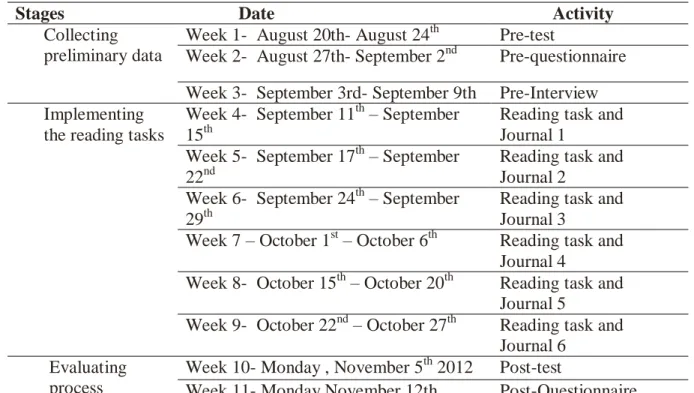
(32) 30 work on the reading tasks. This instrument also allowed the learner to reflect on their own reading process through the different questions that were included in the journal. One of the advantages of using journals when doing research is outlined by Lindenberg (1987) who sees the journal as an instrument that helps learners to understand better what they do during a reading time.. At the end of the intervention, a post questionnaire (See appendix H) and a post – reading test (See appendix I) were the final instrument applied during the intervention process. The post questionnaire contained ten questions that could help students to reflect upon all the strategies they performed to carry out the activities in the platform as well as their perceptions of their reading comprehension level and their skills to work autonomously. On the other hand, the post – reading test was a tool that was designed in order to compare the performance showed by the students before and after being exposed to the reading tasks using authentic texts.. 3.7. Data Collection Procedures Three steps were developed during the research study. The first step consisted on a reflective process developed by the researcher acting as a participant observer who reflected about the difficulties of the students chosen in regards to their reading comprehension process. This reflection and observation process was accompanied by some data gathered though a pre-questionnaire and a pre-interview. It is important to mention that in this step the researchers had the opportunity to reflect also about the use of reading strategies and the reading preferences of the learners..
(33) 31. During the second step, the researchers applied the six reading tasks that were designed for the pedagogical intervention. During this step, the students were encouraged to write their reflections about the development of the tasks on their personal journals. These instruments provided useful information that was used later in the analysis and reports that emerged from this study.. At the end of the study, the researcher had the opportunity to continue doing a deeper analysis of the research question using the information collected with the different instruments. It is important to highlight the value that the careful development of these three steps had in terms of reliability and validity and also on the general organization of the research.. 3.8. Design and validation of instruments and procedures In any investigation or study, it is necessary to make sure that the instruments used to gather the data really elicit the information needed. In order to achieve this, all the instruments used along the intervention were piloted before using them to collect data. The purpose of piloting them was to make adjustments and changes in order to make them more effective..
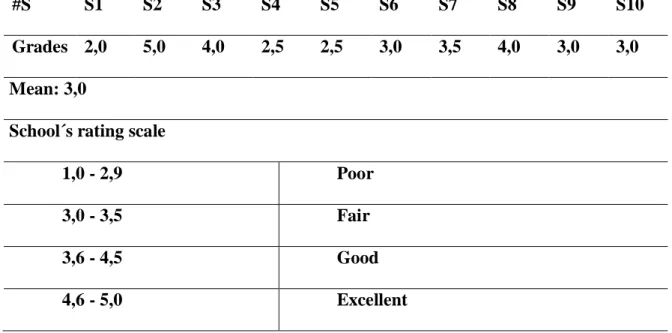
(34) 32 Different techniques were used to collect and analyze the data. The main purpose of using different instruments to collect the data was to triangulate all the information collected and give validity and reliability to it..
(35) 33 Chapter Four: Pedagogical Intervention and Implementation In order to give to this study the pertinence that it needs, it is imperative to check the instruments used to collect the data. It is important to check that the tools used elicit the required information. To achieve this, all the instruments used to collect the data were carefully analyzed and piloted. In order to pilot the different instrument used during the intervention a different group of ninth graders of this school was selected.. The preliminary data was obtained through a pre – reading test, a pre – questionnaire and a structured pre – interview. Through these two last instruments, the students had the opportunity to express their reading preferences, their opinion about reading and they could think about their use of reading strategies among other aspects. Then, during the intervention, six different reading tasks were developed by the students using the Edmodo social network. At the end of the study, a post questionnaire and a post-reading test were applied to the students in order to analyze the results obtained after using reading tasks based on authentic texts.. A chronogram was planned and followed in order to carry out the process of intervention and implementation. This was divided into three stages. In each stage, different instruments were used to gather information. For more detail of this chronogram see table 1 below:.
(36) 34 Table 1. Pedagogical Intervention and Implementation chronogram Stages Collecting 1 preliminary data Implementing the reading tasks 2. Date Week 1- August 20th- August 24th Week 2- August 27th- September 2nd. Activity Pre-test Pre-questionnaire. Week 3- September 3rd- September 9th Week 4- September 11th – September 15th Week 5- September 17th – September 22nd Week 6- September 24th – September 29th Week 7 – October 1st – October 6th. Pre-Interview Reading task and Journal 1 Reading task and Journal 2 Reading task and Journal 3 Reading task and Journal 4 Reading task and Journal 5 Reading task and Journal 6 Post-test Post-Questionnaire. Week 8- October 15th – October 20th Week 9- October 22nd – October 27th Evaluating 3 process. Week 10- Monday , November 5th 2012 Week 11- Monday November 12th. During the first week of the intervention the students worked on the pre reading test that was very similar to other tests that they had taken in the school in the English classes.. The results provided by this pre-reading test showed that the mean was 3,0 which suggests that most of the participants had a fair level of reading comprehension according to the institutional evaluation system. (See table 2).
(37) 35 Table 2. Reading comprehension pre-test results #S. S1. S2. S3. S4. S5. S6. S7. S8. S9. S10. Grades 2,0. 5,0. 4,0. 2,5. 2,5. 3,0. 3,5. 4,0. 3,0. 3,0. Mean: 3,0 School´s rating scale 1,0 - 2,9. Poor. 3,0 - 3,5. Fair. 3,6 - 4,5. Good. 4,6 - 5,0. Excellent. In order to start with the implementation and taking into account the characteristics of the participants, the students were instructed on the objectives of the reading tasks and the way how they were scaffolded. The whole process of implementation took 6 weeks. During this time, the students had to download the reading tasks from Edmodo and they had to work on them in order to upload to Edmodo the required product and their journal reflections.. The last step in the intervention had to do with the application of a post - reading test and a post questionnaire in order to triangulate all the information collected and draw conclusions about the way how reading tasks and the use of authentic texts could have a positive influence over the reading comprehension level of the students..
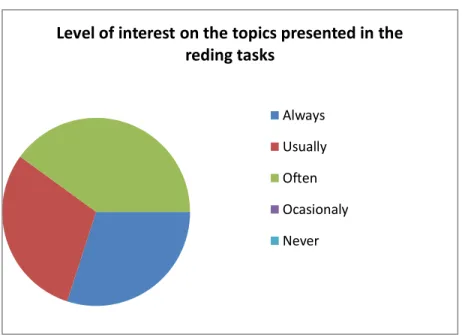
(38) 36 Chapter Five: Results and Data Analysis The data analysis was based on the Grounded theory (GT). According to Scott (2009) GT has to do with an approach for the analysis of data that enable the subjects to understand a social phenomenon. This approach usually offers an explanation about the main concern of the population of the substantive area and how that concern is solved or processed. To analyze the data, the grounded theory suggests three stages: open coding, axial coding and selective coding.. The first stage (open coding), refers to the part of the data analysis in which codes are selected and assigned for the information collected, labeling and classifying the information extracted from the intervention process. In the second stage (axial coding) the data are joined in new ways; the idea in this stage is to establish relationships among the data and the selected categories. The third stage (selecting coding) consists of the selection of one single core category which is related to all the other categories and subcategories.. For this particular study, three categories were extracted and summarized as shown in table 3..
(39) 37. Table 3. Categories and sub-categories related to constructs and research questions RESEARCH QUESTIONS How does the use of reading tasks and authentic texts enhance reading comprehension in 9 th grade students of Colegio Distrital Manuel del Socorro Rodriguez?. CATEGORIES. SUB-CATEGORIES. The use of authentic texts. Interesting topics Non-traditional texts. The use of reading strategies. Scaffolding Planning. The use of a social network to promote selfdirectness. . Self- directed learning Non-traditional learning environments. 5.1 The use of authentic texts The use of authentic texts can be a motivating factor for the learners, which at the same time can be a facilitating factor for the reading comprehension process of the learners if the texts are graded for their level and if the learners use the appropriate set of reading strategies to face the authentic texts.. The design of the activities uploaded in Edmodo was based on the information extracted from the pre – questionnaire carried out before the intervention. The students´ answers in this regard can be seen in figure 1 below..
(40) 38. Figure 1. Students’ reading preferences. 10 9 8 7 6 5 4 3 2 1 0. Historical texts. short stories. funny texts. news. short music stories articles with and news pictures. what kind of reading material (short stories, news, sport articles, etc.) do you prefer?. The results shown in the graphic were also compared with the opinions stated in the pre- questionnaire in order to triangulate all that data and design the most suitable reading tasks, taking into account the reading preferences of the students.. Figure 2 shows the students’ feelings posted in their journals about how motivating the topics included in the reading tasks were. Figure 2. Feelings towards the reading tasks according to the students’ responses in the journals Did you like the reading task?. X - Rays Sports Sea Level rise. I do not like it. Maradona task. I like it. Headphones task. Nokia task 0 1 2 3 4 5 6 7 8 9 10.
(41) 39 Figure 3 shows the level of interest that the students had towards the reading tasks. This information shown in this figure comes from the answers that the students gave to question 1 of the post-questionnaire.. Figure 3. Post-questionnaire results-Level of interest on the topics presented in the reading tasks. Level of interest on the topics presented in the reding tasks Always Usually Often Ocasionaly Never. The results shown in this figure were also compared with the opinions stated by the students in their journals. This information was triangulated in order to validate the information obtained. The opinions stated by the students in their journals as well as questions 1 and 8 of the post – questionnaire support the belief that the use of authentic texts and reading tasks foster the development of reading comprehension on the learners..
(42) 40. 5.2. The use of Reading Strategies The conscious or unconscious use of reading strategies used by students was one of the most interesting findings before and after the intervention; as can be seen in table 4 below.. The results obtained in the pre- questionnaire and the pre - interview provided valuable information about the use of reading strategies by the students. For instance items 3, 5, and 6 of the pre – questionnaire showed how the students were using reading strategies before the intervention.. Table 4. Pre-questionnaire results- Use of reading strategies Item. Never. Occasionally. Often. Usually. Always. When I start reading: I read the title of the reading, look for familiar words and take a look at the images of the text before reading it.. 0%. 0%. 20%. 80%. 0%. Before reading a text I think about the best strategy to understand it.. 0%. 20%. 20%. 30%. 30%. I take into account my previous knowledge before and during the reading exercise.. 0%. 20%. 20%. 30%. 30%.
(43) 41 The data collected in this part of the study evidenced that the number of students that were consciously or unconsciously using the reading strategies before the intervention was high. The data collected also suggest that the use of background knowledge was the strategy that the students used the most before the intervention.. As it was mentioned before, the students kept a journal in which they wrote about their feelings and about the strategies that they used while working on each reading task, among other aspects. For more details about the structure of the journal see appendix G.. Below, some excerpts of the reflections written by the students are presented as samples that support the previous point.. “I follow these steps: At the beginning I thinked about Maradona because I saw a photography of this soccer player in the text. After I read the reading and compared my ideas with the information I read.” Student 4- Journal Reflection- Reading task about Maradona. “The strategy I used were to look the picture about contamination and make a list of ideas that I had about this topic. Later I read the exercises and last I read the text to answer the questions and the exercises”. Student 10- Journal Reflection- Reading task “Sea Level Rise”.
(44) 42 Taking into account the opinions stated by the students in their journals, the following conclusions can be drawn: a) The students´ opinions stated in the journal keep a relationship with the answers given in the pre - questionnaire to the question about the conscious or unconscious use of reading strategies while working on the reading tasks. b) The students´ preferred reading strategies were: Inference and the use of previous knowledge. c) The students applied different reading strategies depending on the complexity of the texts proposed.. The post – questionnaire also provided some information that evidenced a better perception from the students towards the conscious use of reading strategies after the development of the reading tasks. This can be better seen in figure 4 below.. Figure 4. Post-questionnaire results-Thinking about the best strategy to read authentic texts Before reading a text I thought about the best strategy to understand it. 0% 0% 40%. 20% Never 40%. Ocassionally Often Usually. Always.
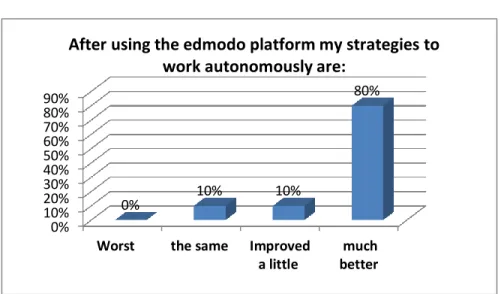
(45) 43. 5.3. The use of a social network to promote self-direction Goldstein (2013) assumes that teachers should consider students as digital natives, who should naturally know how to learn online. However, in order for this assumption to become real, it is necessary that teachers spend some time modeling online learning and encouraging learners to develop different strategies that allow them to manage these resources appropriately taking responsibility for, and ownership of their own learning process.. Getting involved in learning environments different from the traditional ones is one of the actions that students need to perform in order to move towards self-direction. The fact of using social networks with teaching purposes like Edmodo gives to students the opportunity to develop reading strategies and improve their reading comprehension at the same time that they develop self - directed strategies.. The main purpose of using a social network to develop the reading tasks was to confirm the assumption that the traditional practices that the students were developing were not leading them to develop self-directed strategies. Questions 1 and 10 of the prequestionnaire help to support this view. (See table 5).
(46) 44 Table 5. Pre-questionnaire results- Use of reading strategies Question or item. Never. Occasionally. Often. Usually. Always. I read texts in English when I am not in the English class. After reading a text I selfevaluate the strategy that I used to see if it worked or not.. 20%. 40%. 20%. 30%. 0%. 40%. 40%. 10%. 10%. 0%. As it can be seen, before the intervention most of the students were used to traditional teaching practices that were centered on the tutor.. On the other hand, the results of the post-questionnaire (See figure 6) suggest that after using Edmodo to develop the reading tasks with authentic texts, the reading strategies to work autonomously improved considerably. Figure 5. Post-questionnaire results-perception of the students about the use of reading strategies after the intervention After using the edmodo platform my strategies to work autonomously are: 90% 80% 70% 60% 50% 40% 30% 20% 10% 0%. 80%. 0%. Worst. 10%. the same. 10%. Improved a little. much better.
(47) 45 Through the information presented above it can be assumed that a great number of the participants observed a change in the development and acquisition of self-directed skills after using Edmodo.. Finally, table 6 below shows the results of the post – readings test in order to establish comparisons and draw conclusions about the improvement obtained by the students in their reading comprehension process after working on reading tasks using authentic texts in a social network with teaching purposes.. Table 6. Reading Comprehension post-test results. #S. S1. S2. S3. S4. S5. S6. S7. S8. S9. S10. Grades. 3,5. 3,0. 4,5. 3,5. 3,0. 3,0. 3,0. 4,0. 5,0. 3,2. Mean: 3,5 School´s rating scale 1,0-2,9. Poor. 3,0-3,5. Fair. 3,6-4,5. Good. 4,6-5,0. Excellent.
(48) 46 Chapter Six: Conclusions, Limitations, Pedagogical Implications and Further Research 6.1. Conclusions Different ideas related to the use of reading strategies and the use of authentic texts to improve reading comprehension could be analyzed and studied through this research project. Also, it was possible to find out if the use of reading tasks using authentic texts supported by the use of non-traditional learning environments could help to improve the teaching methodologies and the quality of instruction at Colegio Distrital Manuel del Socorro Rodriguez.. The research question that guided the development of this study was: How does the use of reading tasks and authentic texts enhance reading comprehension in 9 th grade students of Colegio Distrital Manuel del Socorro Rodriguez? The data collected along this study allowed the identification of three categories which were considered to provide an answer to the research question stated above.. After carrying out this research study it was possible to conclude the following: . A noticeable improvement about the reading comprehension level of the participants could be seen after the implementation if the results of the prereading test and post reading test are analyzed. (see tables 2 and 6). . Reading tasks using authentic materials favored the motivation of the students. The topics selected for the design of the reading tasks considered the reading preferences of the participants and for that reason the students.
(49) 47 kept motivated during the development of the six reading tasks. This is a clear example that support the claim of different researchers such as Krashen (1987) who consider that providing learners with interesting texts facilitates the acquisition of the language. . The use of a social network facilitated the process of fostering selfdirected learning strategies on the participants who were used to teacher centered classes.. . The level of consciousness in the use of the most suitable reading strategies to be used increased after the implementation of the reading tasks (see figure 5).. . The reading strategies most used by the students during (reading tasks) and after the intervention (post-reading test) were: the use of background knowledge and inference.. 6.2. Pedagogical Implications The use of reading tasks and authentic texts through a social network brought many benefits to the group of learners that was taken as participants of the study, especially in the improvement of the level of reading comprehension that they showed after the implementation and the acquisition and development of certain self-directed skills. Furthermore, this research was important for the community where it took place for two reasons. The first one is related to the results obtained from the study and the future changes in terms of methodologies to teach reading within the school. The second one was related to the adoption of an institutional model of self-directed learning..
(50) 48. The results obtained with this study need to be analyzed with the school community in order to plan and implement a different methodology for the teaching of reading where the use of authentic texts and the use of non - traditional environments are privileged. It would be interesting to include within the PILEO (plan institucional de lectura y oralidad) the reading of English texts as it has been demonstrated that they contribute to the development of reading strategies and critical thinking.. 6.3. Limitations From this study it has been possible to obtain positive results related to the reading comprehension level improvement of a group of 10 ninth grade students thanks to the use of reading tasks and authentic texts. However, there were two important drawbacks during the development of this study. The first one had to do with the students’ schedule and the time available to develop the different reading tasks. Due to the fact that the students selected for the study were attending other requirements and compromises from the school and their technical program, some of them began to work on the implementation but they quit. For this reason it was necessary to replace these participants and start with the new participants the development of the six reading tasks.. The second drawback had to do with some internet problems at school during the last week of implementation. As a result, the students were invited to develop the reading task at home. However, some of them did not have internet access at home and because of that, the reading task had to be printed and developed on paper within the classroom..
(51) 49. 6.4. Further Research In order to develop a replication of this study and taking into account all the data collected, it is advisable to reflect a little more on the methods to be used in the collection and analysis of data before working on the implementation. The grounded theory is a great technique to analyze qualitative data in action research. However, certain changes related to the instruments used to collect the data can be made. For instance, instead of applying a pre-interview and a pre-questionnaire it is recommendable to make use of a needs analysis that cover the same aspects of the pre interview and the pre-questionnaire. Furthermore, it is advisable to use another appealing platform or technological resource that works offline in order to avoid certain difficulties when internet access is not available.. Finally, it is important to take into account that through the replication of this study, reflection and conclusions can be drawn in some other areas such as: motivation and the use of ICT’s as instruments that facilitate and foster cooperative learning and self-direction on the learners..
(52) 50 References Abdullah, M. (2001). Self-directed learning. ERIC Clearinghouse on Reading English and Communication Bloomington IN., ED459458, Retrieved from: http://www.ericdigests.org/2002-3/self.htm. Ainoda, N., Onishi, H., & Yasuda, Y. (2005). Definitions and goals in "self - directed learning" in contemporary medical education literature. An Academic Singapore, 34(8), 515 - 519. Retrieved from: http://www.annals.edu.sg/pdf/34volno8200509/v34n8p515.pdf. Ambatchew, M (2003). The effect of primary English readers on reading skills in Ethiopia: a study in African educational needs. (Master's thesis). Retrieved July 4th- 2012 from http://upetd.up.ac.za/thesis/available/etd-06142004143840/unrestricted/02chapter2.pdf. Bacon, S., & Finneman, M. (1990). A study of attitudes, motives, and strategies of university foreign language students and their disposition to authentic oral and written input. Modern Language Journal, 74(4), 459-73. Barnett, M.A. (1988). Teaching reading strategies: how methodology affects language course articulation. Foreign language Annuals, 21, 109-119.
(53) 51 Barnett, M. A. (1989). More than meets the eye. Foreign language reading: Theory and practice.. Englewood Cliffs NJ: Prentice-Hal.. Berardo, S (2006) The use of authentic materials in the teaching of Reading. The reading Matrix. Vol.6, N° 2. Retrieved, May 4th – 2012 from: http://www.readingmatrix.com/articles/berardo/article.pdf. Block, E. (1986). The comprehension strategies of second language readers. Tesol Quaterly, 20:3, 463-494.. British Council, B. (2003). Interacting with texts - directed activities related to texts (darts) [Online forum comment]. Retrieved from: http://www.teachingenglish.org.uk/articles/interacting-texts-directed-activitiesrelated-texts-darts.. Carrel, P., & Eisterhold, J. (1983). Schema theory and ESL Reading Pedagogy. TESOL Quarterly, 17(4), 553-573. Retrieved April 15th-2013 from: http://www.jstor.org/stable/3586613. Chi-Fen , E. C. (2012). Unit 7. Using Technology to Teach Reading Skills. Unpublished raw data. Department of English, National Kaohsiung First University of Science and Technology, Taiwan, China. Retrieved April 15th-2013 from: http://www2.nkfust.edu.tw/~emchen/CALL/unit7.htm.
(54) 52. Chun, D., & Plass, J. L. (1997). Research on text comprehension in multimedia environments. LLT Journal, 1(1), 60 - 81. Retrieved September 21st-2012 from: http://llt.msu.edu/vol1num1/chun_plass/default.html. Colorado Department of Education. Colorado Geographic Alliance, (2011). Colorado academic standards social studies and literacy reference (summer 2011). Retrieved from: http://www.uccs.edu/Documents/coga/Standards/ColoradoAcademicStandards_ SocialStudies_Literacy_Reference.pdf. European Council. (2002). Common European framework of reference for languages: Learning, teaching, assessment (cefr). Madrid: Council of Europe.. Denzel, N. K., & Lincoln, Y. S., (Eds.). (1994) Handbook of qualitative research. Thousand Oaks:Sage. Goldstein, A. (2013). E-Tech Ohio and lessons from our work at hannah ashton middle school [Online forum comment]. Retrieved March 18th-2013 from: http://educationelements.com/tag/blended-classrooms. Grabe, W. (2009). Reading in a second language: moving from theory to practice. N.Y: Cambridge University Press..
(55) 53. Guthrie, J. T., & Cox, K. E. (2001). Classroom conditions for motivation and engagement in reading. Educational Psychology Review, 13(3), 283-302. Retrieved from http://dee690-summer12.wikispaces.com/file/view/Classroom Conditions for Motivation.pdf. Key, J (1997) Questionnaire and Interview as Data Gathering Tools. Research Design in Occupational Education. Retrieved from: http://www.okstate.edu/ag/agedcm4h/academic/aged5980a/5980/newpage16.ht m. Krashen, S (1987) Principles and practice in Second Language Acquisition. Hertfordshire: Prentice Hall International.. Lindenberg, G (1987) The Journal conference: from dialectic to dialogue. The Journal Book. Heinemann, Portsmouth, New Hampshire.. Maley, A. (2009). Extensive reading: why it is good for our students… and for us. [Online forum comment]. Retrieved from http://www.teachingenglish.org.uk/articles/extensive-reading-why-it-good-ourstudents…-us.
(56) 54 Muñoz, J. H., & Gonzalez, A. (2010). Teaching reading comprehension in English in a distance web-based course: New roles for teachers. Profile, 12(2), Retrieved June 17th-2013 from: http://www.revistas.unal.edu.co/index.php/profile/article/view/17672/36819. Nunan, D. (1999). Second Language Teaching and Learning. (1 ed.). Boston: Heinle & Heinle Pub.. Nunan, D & Bailey, K (2009) Exploring Second Language Classroom Research: A comprehensive guide. Boston: Heinle/CENGAGE learning.. Oxford, R.L. & Crookall, D. (1989). Research on language learning strategies: methods, findings, and instructional issues. Modern Language Journal, 73, 404-419.. Pinzon, Y., & Moreno, M. J (2012). Currículo para el área de Ingles proyecto SENA guianza turistica. Colegio Manuel del Socorro Rodríguez. Bogotá. Scott, H. (2009). What is grounded theory? Retrieved March 1st-2013 from: http://www.groundedtheoryonline.com. Skiff, D. (2009). What is self-directed learning? Retrieved October 17th-2013 from: http://www.selfdirectedlearning.org/what-is-self-directed-learning.
(57) 55 Taylor, D. (1994). Inauthentic authenticity or authentic inauthenticity? Educational Psychology Review, 13(3). Retrieved January 27th-2013 from: http://www.zait.uni-bremen.de/wwwgast/tesl_ej/ej02/a.1.html. Universidad de La Sabana, U. (2011). Lesson plan addapted from Joan Rubbins´ lesson planner & ICELT lesson plan template. Informally published manuscript, Departamento de Lenguas y Culturas Extranjeras, .. Wigfield, A., Guthrie, J. T., & Perencevich, K. C. (2004). Motivating reading comprehension: Concept-oriented reading instruction. New Jersey: Taylor & Francis Group. Retrieved June 6th-2012 from: http://books.google.com.co/books?id=hD1vC94B3OsC&pg=PA193&dq=readin g comprehension definition&hl=es&sa=X&ei=jsQvUfWWHofc8wSRh4DoCw&ved=0CCsQ6AE wAA. Wong, R. M. H. (2008). Motivation to learn English and age differences. Univeridad del Turabo-Biblioteca Virtual, 365 - 404. Retrieved march 7th-2013 from: http://bibliotecavirtualut.suagm.edu/Glossa2/Journal/jun2008/Motivation_to_lea rn_English.pdf.
(58) 56 Young, D. J. (1991). Activating student background knowledge in a take charge approach to foreign language reading. Hispania, 74(4), 1124 - 1132. Retrieved March 6th2013 from: htpp://links.jstor.org/sici?sici=00182133(199112)74:4:ASBKIA>2.0.CO;2-T.
(59) 57 Appendices Appendix A Consent Letters for parents.
(60) 58.
(61) 59 Appendix B Pre – Reading test.
(62) 60.
(63) 61.
(64) 62 Appendix C Pre - Questionnaire.
(65) 63.
(66) 64 Appendix D Structured Interview.
(67) 65.
(68) 66.
(69) 67 Appendix E Lesson Plan Sample. DEFINING AND IMPLEMENTING TEACHING STRATEGIES TO FOSTER SELF-DIRECTED LANGUAGE LEARNING IN COLOMBIA RESEARCH PROJECT PART 2 (On-going Work) 2012 LESSON PLAN TEMPLATE FOR INTERVENTION Adapted from Dr. Joan Rubin´s Lesson Planner & ICELT lesson plan template Name of co-researcher:. Martha Moreno B.. University Code Number:. 201114034. Institution: SENA ESP Program – Manuel del Socorro Rodríguez School. Date of Class:. DAY. MONTH. YEAR. Time of Class:. 24th. 09. 2012. Length of class: 180 minutes. 28th. 09. 2012. Time Frame: One class period and two hours of independent work. Class/grade: 9th grade students. Room: Edmodo Virtual Learning Room – Special room SENA Project.. Number of students: 10 Students. Average age of Students: 13-15 years old. Number of years of English study: 7 years. Level of students A1 A2 B1 B2 C1 C2 Research Circle Leader: Maritza Housset. Lesson Number 1. 2. 3. 4. 5. 6. 7. 8.
Figure


+4

Documento similar
Government policy varies between nations and this guidance sets out the need for balanced decision-making about ways of working, and the ongoing safety considerations
Although some public journalism schools aim for greater social diversity in their student selection, as in the case of the Institute of Journalism of Bordeaux, it should be
In the “big picture” perspective of the recent years that we have described in Brazil, Spain, Portugal and Puerto Rico there are some similarities and important differences,
The cornerstone of the suspicion of a chiral phase transition is the singular behavior of the quark condensate < q ¯ q >, since this expectation value is an order parameter
The aim of this paper is to demonstrate that reading authentic literary material in the English as a Foreign Language (EFL) classroom can improve students’ language learning skills as
Keywords: Metal mining conflicts, political ecology, politics of scale, environmental justice movement, social multi-criteria evaluation, consultations, Latin
In the previous sections we have shown how astronomical alignments and solar hierophanies – with a common interest in the solstices − were substantiated in the
Even though the 1920s offered new employment opportunities in industries previously closed to women, often the women who took these jobs found themselves exploited.. No matter
