
Internet of Things demonstrator based on the OpenMote platform
90
0
0
Texto completo
(2) GNU Free Documentation License (GNU FDL) Copyright © 2018 Arturo Medina Merino Permission is granted to copy, distribute and/or modify this document under the terms of the GNU Free Documentation License, Version 1.3 or any later version published by the Free Software Foundation; with no Invariant Sections, no Front-Cover Texts, and no BackCover Texts. A copy of the license is included in the section entitled "GNU Free Documentation License"..
(3) FICHA DEL TRABAJO FINAL Internet of Things demonstrator based on the. Título del trabajo: OpenMote platform. Nombre del autor: Arturo Medina Merino Nombre del consultor/a: José Lopez Vicario Nombre del PRA: Fecha de entrega (mm/aaaa): 23/05/2018 Titulación::. Máster universitario Telecomunicación. de. Ingeniería. de. Área del Trabajo Final: Telemática Idioma del trabajo: Inglés Palabras clave iot, cloud computing, edge computing Resumen del Trabajo (máximo 250 palabras): Con la finalidad, contexto de aplicación, metodología, resultados i conclusiones del trabajo.. i.
(4) Abstract (in English, 250 words or less): In recent years, the number of systems which leverage Internet of Things technologies has experienced an enormous growth. From industrial machine-tomachine applications to personal data metrics, the connectivity of all kinds of devices has become an incredibly interesting tool for improving the performance of existing systems, and, in many occasions, it has led to the creating of whole new business areas. In this context, open source and open hardware frameworks and devices have become a key driving force of innovation. Thanks to their use, it has been possible to accelerate the research and development of new technologies and protocols, rapidly closing the existing gap between the academia and commercial applications. The purpose of this project is to develop an Internet of Things (IoT) demonstrator which makes use of currently relevant open source and hardware technologies in the field, from the physical layer to the application layer, as a way of demonstrating such potential. A sensor network, including data collection, transmission and centralization will be studied. In addition, two current trends in the IoT research area will be analyzed and compared, namely the different approaches of edge computing and cloud computing. In this manner, a small scale but close to real-world scenario will be presented, acting as a valid example of the potential impact of IoT systems as an enabler for increasing the intelligence and efficiency of applications across different industries.. ii.
(5) Acknowledgments Thanks to all my friends and family for their unconditional support, to Ricardo, Virgilio and David for accompanying me in this journey, to María and Pablo, for their charm and help, and to José Lopez for his always helpful and sincere feedback.. iii.
(6) Index. Acknowledgments .............................................................................................. iii 1 Introduction ................................................................................................ 1 1.1 Objectives .............................................................................................. 3 1.2 Planning................................................................................................. 4 1.3 Gantt Chart ............................................................................................ 5 1.4 Related work .......................................................................................... 1 2 IoT components, technologies and protocols ............................................. 2 2.1 Open Hardware and Open Source solutions for the IoT ........................ 2 2.2 Operating systems for embedded devices and wireless sensors .......... 2 2.2.1 TinyOS .......................................................................................... 3 2.2.2 RIOT OS ....................................................................................... 3 2.2.3 Contiki OS ..................................................................................... 4 2.2.4 Comparison of WSN operating systems........................................ 5 2.3 IoT Protocols.......................................................................................... 6 2.3.1 Brief overview of the OSI model .................................................... 6 2.3.2 Infrastructure protocols.................................................................. 7 2.3.2.1 RPL ....................................................................................... 7 2.3.2.2 IEEE Std 802.15.4: Low-Rate Wireless Personal Area Networks 8 2.3.2.2.1 Network nodes...................................................................... 8 2.3.2.2.2 Topologies ............................................................................ 8 2.3.2.2.3 Physical layer (PHY) ............................................................. 9 2.3.2.2.4 MAC sublayer ....................................................................... 9 2.3.3 Application Protocols ..................................................................... 9 2.3.3.1 MQTT .................................................................................... 9 2.3.3.2 CoaP protocol ..................................................................... 10 2.4 Strategies for data processing and storage ......................................... 11 2.4.1 Cloud computing ......................................................................... 12 2.4.2 Edge computing .......................................................................... 14 2.4.3 Cloud computing vs edge computing .......................................... 17 2.5 Hardware platforms for IoT .................................................................. 18 2.5.1 Raspberry Pi 3 B+ ....................................................................... 19 2.6 IoT Cloud Platforms ............................................................................. 21 2.6.1 thethings.iO ................................................................................. 21 2.6.2 thethings.iO overview .................................................................. 22 2.7 Data storage: the database ................................................................. 25 2.8 Ethics of the IoT ................................................................................... 26 3 Proposed design ...................................................................................... 27 3.1 System overview.................................................................................. 27 3.2 System processes ............................................................................... 28 3.2.1 Cloud computing model............................................................... 29 3.2.1.1 Retrieve and send to the cloud sensor data from motes ..... 29 3.2.1.2 Analyze stored information to compute relevant statistical metrics 30 3.2.1.3 Data representation ............................................................ 31.
(7) 3.2.1.4 Intruder detection ................................................................ 31 3.2.2 Edge computing model................................................................ 32 3.2.2.1 Retrieve and store sensor data from motes ........................ 32 3.2.2.2 Analyze stored information to compute relevant statistical metrics 34 3.2.2.3 Actuate over the air conditioning system based on the temperature ......................................................................................... 36 3.2.2.4 Data cleanup ....................................................................... 37 3.2.3 Comparison of designed features................................................ 37 3.3 Deployment ......................................................................................... 37 3.3.1 Summary of collected and generated data .................................. 39 3.4 Database model................................................................................... 39 3.4.1 Tables ......................................................................................... 40 3.4.1.1 MOTES ............................................................................... 40 3.4.1.2 SOURCE_TYPES ............................................................... 40 3.4.1.3 READINGS ......................................................................... 40 3.4.1.4 TEMPERATURE ................................................................. 40 3.4.1.5 HUMIDITY .......................................................................... 41 3.4.1.6 PRESENCE ........................................................................ 41 3.4.2 Relationship between tables ....................................................... 42 4 Implementation ........................................................................................ 43 4.1 Simulation of motes ............................................................................. 43 4.1.1 Web interface .............................................................................. 44 4.1.1.1 Motes .................................................................................. 44 4.1.1.2 Event bus ............................................................................ 45 4.1.1.3 Topology ............................................................................. 45 4.1.1.4 Routing ............................................................................... 45 4.1.1.5 Connectivity ........................................................................ 46 4.1.1.6 Documentation .................................................................... 46 4.2 Developing OpenWSN applications ..................................................... 46 4.2.1 C Implementation ........................................................................ 47 4.2.1.1 Initialization ......................................................................... 48 4.2.1.2 Reception callback .............................................................. 48 4.2.2 Compilation ................................................................................. 49 4.2.3 Implementation of computation models ....................................... 49 4.2.4 Communication using CoAP ....................................................... 50 4.2.5 Interfacing with PostgreSQL from Python ................................... 50 4.2.6 Interfacing with thethings.iO ........................................................ 52 4.2.7 Scheduling of periodic operations ............................................... 52 4.3 Cloud Computing implementation ........................................................ 53 4.3.1 Server-side computation ............................................................. 54 4.4 Edge Computing implementation ......................................................... 56 5 Comparison of models ............................................................................. 61 5.1.1 Latency........................................................................................ 61 5.1.1.1 Edge computing .................................................................. 61 5.1.1.2 Cloud computing ................................................................. 61 5.1.2 Network traffic ............................................................................. 62 5.1.2.1 Cloud computing ................................................................. 62 5.1.2.2 Edge computing .................................................................. 63 5.1.3 Power consumption ..................................................................... 63. 5.
(8) 5.1.3.1 Cloud computing ................................................................. 63 5.1.3.2 Edge computing .................................................................. 63 5.1.4 Cost ............................................................................................. 64 5.1.4.1 Cloud computing ................................................................. 64 5.1.4.2 Edge computing .................................................................. 64 5.1.5 Security ....................................................................................... 65 5.1.5.1 Edge computing .................................................................. 65 5.1.5.2 Cloud computing ................................................................. 65 5.1.6 Summary of comparison ............................................................. 66 6 Conclusions ............................................................................................. 67 7 Future work .............................................................................................. 68 8 Glossary ................................................................................................... 69 9 References............................................................................................... 70 10 Appendix .................................................................................................. 74 10.1 psycopg2 setup ............................................................................... 74 10.2 Raspberry Pi 3 Model B+ setup ....................................................... 74 10.3 OpenSim setup ................................................................................ 74 10.4 PostgreSQL setup ........................................................................... 74. 6.
(9) Figures. Figure 1: Project Gantt chart, describing the planned work packages ................ 1 Figure 2: Partition into ROM and RAM memory in Contiki OS. Adapted from [20]. ........................................................................................................................... 5 Figure 3: two example message exchanges. In both cases, the message type, CON, indicates that a confirmation is required. In the first case, the request ends successfully, while in the second is does not. However, in both occasions, an ACK message is sent. Adapted from [25]. ........................................................ 11 Figure 4. Overview of Cloud Computing Architecture. Adapted from [26]. ....... 12 Figure 5: Edge computing. Edge computing is performed o between the source (devices) and the cloud platform. Some of the load, in both upstream and downstream directions, is handled by the network edge and not by the cloud platform, thus effectively reducing response time and making a more efficient use of network capacity. Adapted from [29]. ........................................................... 14 Figure 6: configuration of an IoT product in thethings.iO. The chosen format .. 23 Figure 7: Definition of a “thing”. The Thing Token identifies the device which is sending the information. ................................................................................... 23 Figure 8: Example data received at thethings.iO. As it can be seen, the data is represented with its associated timestamp, so that the evolution of the measurement over time can be observed. In addition, several sources can be represented at the same time (temperature and humidity, in this case). Consequently, it becomes easy to observe correlations between them. .......... 24 Figure 9: thethings.iO Dashboard, showing temperature and OpenMote location ......................................................................................................................... 24 Figure 10: system overview. Sensor data is collected by OpenMote devices distributed along a property. Such data is sent to a central point, the Raspberry Pi, which acts as a gateway, processing the data and sending it to the thethings.iO platform. ....................................................................................... 27 Figure 11: flow diagram which describes how the process of retrieving data from sensors and sending it to the cloud is performed ............................................. 30 Figure 12: flow diagram which describes how the sub-process of reading a value from a mote is performed. ................................................................................ 30 Figure 13: flow diagram showing the process of detecting an intruder ............. 32 Figure 14: flow diagram which describes how information is read from the motes in the Edge Computing model. ......................................................................... 33 Figure 15: flow diagram which describes the sub-process of reading a resource value from a mote............................................................................................. 34 Figure 16: flow diagram which describes how statistical analysis is performed on the stored data. ................................................................................................ 35 Figure 17: flow diagram which describes the sub-process of calculating different statistical metrics on the stored data. ............................................................... 36 Figure 18: flow diagram which describes how the air conditioning system is actuated based on the temperature. ................................................................. 36 Figure 19: proposed home deployment for the application. .............................. 38 Figure 20: Relationship between tables in the database model ....................... 42 Figure 21: High level overview of the implementation ...................................... 43 Figure 22: Mote overview ................................................................................. 44.
(10) Figure 23: Location and topology of motes ...................................................... 45 Figure 24: Overview of OpenSim and its components. Adapted from OpenWSN documentation. ................................................................................................. 46 Figure 25: CoAP GET request captured with Wireshark .................................. 49 Figure 26: Interaction between Python scripts and the PostgreSQL database 50 Figure 27: Interaction between Python scripts and the PostgreSQL database 52 Figure 28: summarized syntax of crontabs ....................................................... 52 Figure 29: overview of the different parts which compose the cloud computing model. Triggers execute code upon data reception and perform some action as a response (in this case, sending an alert email). Jobs are executed periodically an interact with the internally stored resources to calculate KPIs (key performance indicators). ........................................................................................................ 53 Figure 30: representation of the maximum temperature calculated using a job 55 Figure 31: example of received email ............................................................... 56 Figure 32: overview of the different parts which compose the edge computing model. edge_readings.py fetches data from OpenSim and stores it internally into the Raspberry Pi. On the other hand, the analyze_readings.py scripts is executed every hour to extract relevant information for data collected during the previous hour. ................................................................................................................. 56 Figure 33: creation of a dashboard for representing a resource calculated on the edge ................................................................................................................. 59 Figure 34: panel displaying number of people at home .................................... 60 Figure 35: CoAP messaging for reading resource values. ............................... 61 Figure 36: severe communication delay in the communication with thethings.iO ......................................................................................................................... 62 Figure 37: encrypted conversation between Raspberry Pi and Thethings.iO ... 62 Figure 38: bytes sent from Raspberry Pi to thethings.iO in the edge model ..... 63 Figure 39: 802.15.4 frame containing presence reading .................................. 65.
(11) 1 Introduction Nowadays, it is undeniable that the Internet of Things, abbreviated as IoT, has become one of the most exciting and prominent areas in the field Information Technology and its related industries. Far from being a mere buzzword, IoTenabled devices are already a key component of many real-world systems, both in industrial and home environments. One of the reasons why this has happened is that such devices and systems can be applied to a significant number of situations. From factories to hospitals, the power offered by IoT-enabled networks offers great opportunities for improving, optimizing and even redefining many different types of tasks. It is worth stopping for one second to present a brief definition of what Internet of Things is, since some confusion might appear. However, as with any industry trend, the term “IoT” is used broadly, and what is considered as IoT by some actors could not be deemed as such by others. For this purpose, [1] will be cited verbatim: IoT can be defined as the ever-growing network of Things (entities) that feature Internet connectivity and the communication that occurs between them and other Internet-enabled devices and systems IoT networks are often characterized by its closed range of action and almost complete lack of infrastructure. They are usually composed of small devices which communicate with each other sending small amounts of information, which is usually collected in a central node or gateway. Due to these features, such devices must usually be small, inexpensive and power-efficient, since this allows for its use in applications such as health monitoring, home automation and sensor networks. Under the umbrella of this definition, many things can be considered IoT devices. Typical examples include a fridge connected to the Internet. In this case, the fridge might be able to monitor what amount of a certain product is left. Moreover, if it detects that the quantity of such product, for example milk, falls below a certain level, it has the possibility of autonomously ordering more milk bottles from a chosen provider. In this example, the fact that the fridge has network connectivity has allowed for a concrete improvement of our everyday life, namely that we no longer need to worry about not having milk for our morning coffee. By means of this example, many of the elements most commonly found in IoT applications can be identified. It can be appreciated that a sensor has been used to capture a concrete piece of information (quantity of milk left), which has then been collected (in this case by the fridge itself, although other possibilities exist, such as a central home hub for collecting information from different appliances). Once the information has been gathered, it has been processed (compared to a predefined level) and the conclusions obtained has been communicated via the. 1.
(12) Internet. Not all applications will present all these elements, but this can help to shed some light into what can be considered an IoT-enabled system.. In summary, IoT transforms ordinary objects into smart and cognitive systems, capable of monitoring their environment and actively actuating to transform it. This can be applied to almost any device, and therefore it can be applied to almost any application. For that reason, IoT embraces many different vertical markets, including, but not limited to, transport, manufacturing industries, healthcare, agriculture, smart cities and smart homes. With so many options to choose, it is necessary to select the area of application for this project. Nonetheless, this dissertation will focus on only a small part of the IoT world, attempting to develop a smart home system. There are several reasons for this: •. •. •. •. Smart homes, a rarity some years ago, are become increasingly common. The irruption of Wi-Fi controlled light bulbs, continuous remote surveillance and monitoring, and even assistants with artificial intelligence capabilities, are creating a thriving environment for innovation, pushing the evolution of mere homes to smart homes [2] Smart homes is a trending research area, with many different disciplines studying how to maximize the comfort and minimize resource consumption [3] [4]. A smart home application can be easily simulated with scarce resources. Unlike other fields such as healthcare, which deal with very complex signals and systems, a smart home application can monitor and control simple metrics such as room temperature. The application of IoT to home environments goes beyond monitoring and controlling comfort metrics. Thanks to the fact that precise information can be collected in a periodic and consistent manner, advanced studies can be performed on the habits of citizens on their homes. This can lead to the creation of advanced models which can help to better understand how does society make use of their homes, allowing the optimize energy consumption and providing insights into how to better design houses. However, this is not only limited to homes, being also applicable in public building such as hospitals, schools, train stations, museums, government buildings, etc. In these areas, IoT can also be used to model and study the relationship between different indicators, such as occupancy, temperature and energy consumption, also leading to better designs in the future [5].. Consequently, the elements that compose the project have been selected with the idea of being representative of the technological areas to which they belong, resulting in the following choices for the different parts of the system: •. Hardware: o OpenMote: IoT-oriented open-hardware prototyping ecosystem. 2.
(13) •. •. o Raspberry Pi: low-cost single-board computer suitable for cheap and open-source oriented projects Software: o Contiki: IoT-oriented operating system for low-power microcontrollers o thethings.iO: cloud platform for storage, analytics and tools for managing IoT devices o OpenWSN: operating system which provides simulation capabilities through the OpenSim component. Telecommunication standards: o 802.15.4e: communication standard especially suitable for close range communications (such as in sensor networks) using lowpowered devices o CoAP: web transfer protocol for constrained devices.. The combination of the aforementioned elements results in a rich ecosystem of open source and open hardware which nonetheless provides a valid approach to IoT-related technologies.. 1.1 Objectives The main objective of this project can be described as: Develop an Internet of Things demonstrator which makes use of currently relevant technologies, resembling real-world applications as much as possible, to demonstrate the applicability and relevance of open-source and open-hardware platforms as key enablers of real-world IoT deployments. In addition, several other objectives and motivations have been defined: •. •. •. •. •. •. Perform a comparison between different approaches to the analysis and computation of results obtained from IoT-generated data, namely the edge computing and cloud computing paradigms. Investigate the status of open-hardware platforms in IoT, with on a focus on aspects such as availability, ease of use and viability as solutions for real-world applications. Investigate the current ecosystem of open-source utilities, operating systems and web platforms in IoT. In particular, the Contiki operating system will be thoroughly used and therefore studied throughout the duration of the project. Gain an insight into the IEEE 802.15.4e standard, analyzing its significance in IoT applications and the implementation of such standard provided by hardware platforms. Make use of the OpenMote platform as a key component of a IoT demonstrator, including its configuration, programming and interconnection with other elements. Adapt a Raspberry Pi SBC for its use as in IoT applications.. 3.
(14) •. • •. Gain an insight into available commercial-off-the-shelf websites, such as thethings.iO which can act as IoT getaways and provide both data aggregation and data display capabilities, analyzing its impact into accelerating IoT developments. Analyze the integration of different pieces of hardware, potentially provided by different vendors, to create a unique IoT-oriented product. Enhance the authors ability to plan an undertake Information Technology projects.. 1.2 Planning In this section, a description of the work packages which the project will be composed of is presented, serving as companion explanation to the Gantt chart included in the following section. A hierarchy of tasks has been defined, divided in three level, namely work areas (e.g. Project Implementation), work packages (e.g. simulator set-up) and low-level activities. •. •. •. Project Planning: o Initial Planning: develop understanding of project description and purpose and create a draft of project planning. Project Implementation: o Research state-of-the-art: analyze current trends in IoT and possible implementations at hardware and software level. o Design of demonstrator: determine components of the demonstrator, interfaces between them, data to be collected, how data will be stored, how devices will communicate and how the user will access the stored information. o Create software repositories: work on the code will be performed on software repositories (Github, Bitbucket, etc.) so that they are under version control and are accessible from multiple places. o Simulator set-up: install and configure the emulator. o First tests with simulator: familiarization with the simulator by implementing different basic scenarios. o Implementation of demonstrator in simulator: implementation of the designed demonstrator in the simulation. o Acquisition of required physical material: purchase/obtain the required hardware for implementing the demonstrator. It is necessary to consider possible delays in the delivery of such hardware. o Hardware set-up: upon reception of the hardware, it will be necessary to configure it, including OS installation (e.g. installing an OS for Raspberry Pi on a SD card). o Implementation of demonstrator using real hardware: final implementation of the demonstrator using the received components. Project Documentation: the documentation associated to each submission will be prepared in parallel to everyday work performed on the project. However, it has been considered necessary to allocate specific work. 4.
(15) •. packages to reflect the fact that documenting and formatting all the generated information will require a non-negligible amount of time, being necessary to assign resources to it. Submissions: milestones for documentation submission, as well as objectives for percentage of field work finalized (60% for PEC 2 and 100% for PEC3).. 1.3 Gantt Chart The project timeline has been represented by means of a Gantt chart, as shown in Figure 1. For this purpose, the Microsoft Project 2013 software was used. The Gantt chart includes the work packages introduced in the previous section, assigning them a duration and defining the interdependencies existing between them. Estimated duration is provided for work packages, which make up the estimated duration of work areas. It is considered that the definition of low-level activities can be performed as the project progresses, and a deeper understanding of the project is developed.. 5.
(16) Figure 1: Project Gantt chart, describing the planned work packages. 1.
(17) 1.4 Related work IoT demonstrators based on OpenWSN are commonly found in the literature. In particular, other students of the UOC has undertaken master’s dissertations under the same topic. • [6] presented an IoT demonstrator based on 802.15.4e, OpenMote, OpenWSN and Thethings.iO. • [7] also presented an IoT demonstrator based on 802.15.4e, OpenMote, OpenWSN and Thethings.iO. Both dissertations are in essence similar, although some implementation differences exist. For example, one of them sent alarms from Thethings.iO platform using SMS, while the other us emails for the same purpose. In contrast to those works, the current dissertation provides the following novelties. • More variety of statistics, going beyond the average/maximum/minimum value of the comfort indicators. • More detailed database design, which allows readers to build on top of the obtained results in an easier manner. • Use of PostgreSQL instead of alternatives such as MySQL. PostgreSQL is a highly influential database system, and therefore the study of its suitability in an IoT demonstrator can prove beneficial for research on the topic. • Power consumption has been considered for the comparison of cloud and edge models. • Analysis of the use of Contiki OS for the OpenMote devices. Although that it has not finally being possible to implement the design in real hardware, some progress has been made into analyzing the current relevant of Contiki OS in the context of IoT and WSNs. • Although a minor difference that might not be noteworthy, the fact that the master’s dissertation is written in English can help to increase its potential impact, and help to create a more connected and international research environment. Besides master’s dissertations at UOC, many investigators are applying open source technologies such as OpenWSN and OpenMote to different fields. Some examples include: • •. •. [8] uses OpenWSN to design a WSN system for monitoring patient health. [9] used OpenMote and OpenWSN to perform energy measurements during operation of the 802.15.4e protocol in TSCH mode. [10] analyzes the implementation of the TSCH extension of the 802.15.4e protocol in different devices, including OpenWSN and Contiki OS, as well as different hardware platforms, such as TelosB, Zolertia Z1, and OpenMote.. 1.
(18) 2 IoT components, technologies and protocols The purpose of this section is presenting the main elements of which the system is composed. Therefore, a theoretical introduction to the relevant technologies and protocols will be provided.. 2.1 Open Hardware and Open Source solutions for the IoT The status of open source applications shows that they are not only a valid replacement for existing proprietary products, but also a crucial point of innovation. In fact, many of the most interesting and innovating technologies are being developed as open source projects. Some examples include the GNU/Linux operating system, which is quintessential to many different aspects of modern computing, including IoT, the open hardware Arduino prototyping board and RabbitMQ, and opensource message which is typically used in some IoT applications. On the other hand, the open hardware community is not as mainstream, most probably due to the increased difficulty of working with a fully proprietary ecosystem of existing electronic devices. However, great progress is being made, with systems such as Arduino and Raspberry Pi becoming referents in the hobbyist and educational areas, but also in professional applications [11]. In the context of wireless sensors, the trend seems to go open hardware and open source [12], with valid solutions existing for prototyping and implementation of recent wireless protocols, including those which are still in draft version. This allows for a faster adoption and in-depth research of new technologies, since open hardware and source allows to share acquired knowledge easily, usually creating a thriving community of academics and enthusiasts that can provide accurate feedback to the industry.. 2.2 Operating systems for embedded devices and wireless sensors The purpose of this section is to present the most relevant open source operating systems which are currently available, highlighting the main differences between them. As it was introduced in the previous section, the use of open source and open hardware platforms is a strong trend among wireless sensor networks researches. Therefore, despite their differences, all the following operating systems share some common traits, which form a common theme in this research area: • • • • • •. Low memory requirements. Low energy consumption. Off-the-shelf support for popular network stacks and standards. Flexibility, understood as the possibility of easily installing, updating or modifying embedded applications in the sensors. Ease of use. Public and accessible documentation.. 2.
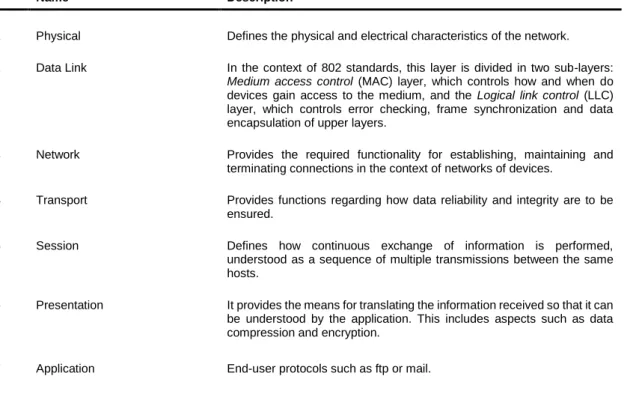
(19) 2.2.1 TinyOS TinyOS is a hardware-agnostic operating system aimed at microcontroller-based sensor devices with networking capabilities, developed under the BSD open source license [13]. More specifically, it is a programming framework rather than a fully-pledged operating system. This approach provides developers with a set of components that make it possible to create a specific OS suited for each hardware platform and application. The OS required only 400 B of storage, while applications built on top of it require around 15 KiB [14]. TinyOS supports many network protocols: FTSP (time synchronization) [15] , CTP (data collection) [16], Trickle (data dissemination) [17], RPL (packet routing) [18] and IPv6 support for 802.15.4. These features support low-power operation, making it possible to use TinyOS in battery-constrained applications. The programming model of TinyOS is Event. It is based on non-blocking function calls, i.e. execution of applications does not stop when calling a function. Instead, the normal flow of operation continues after the system call, but the function is not actually executed until sometime after, being notified by means of events. This model is useful due to the resource constraint of the devices to which it is intended. The programming model is implemented using the NesC language, developed by the TinyOS working groups, which is an extension of C. This has the disadvantage of not being suitable for CPU intensive applications, since they lock the execution of the program for too long, preveting other events from being processed. To tackle this problem TinyOS implements a threads library. TinyOS supports many hardware platforms: telos family, micaZ, IRIS, mica2, the shimmer family, epic, mulle, tinynode, span, and iMote2. 2.2.2 RIOT OS RIOT OS main goal is to create a modern operating system which respects the constrains present in IoT applications while presenting a developer friendly environment, as well as providing access to features of general purpose operating systems such as native multithreading [19]. Design aspects: • • •. The kernel can be built so that is monolithic, layered or even take the form of a microkernel. The scheduling strategy can be varied to support real-time applications and different degrees of user interaction. Tasks can be executed either in the same context or in their own memory stack.. 3.
(20) Architecture: • • •. It natively supports multithreading. It implements a full TCP/IP stack. The modular approach to the kernel allows to isolate components of the system so that a failure in one part of it does not translate to the whole system.. Technical Details: • • •. RIOT enforces constant periods for kernel tasks to fulfill strong real-time requirements. Static memory allocation is used for the kernel, but applications can make use of dynamic memory allocation. RIOT implements a scheduler that works without any periodic events, so that it can switch to the idle state whenever there are no more pending tasks, and stays in that state as long as possible.. 2.2.3 Contiki OS As any other operating systems aimed at WSNs, Contiki [20] is designed for memory constrained systems, with a focus on low energy consumption. Additionally, one of Contiki’s main design drivers is to make it easy to replace or update running programs directly on the network, i.e. dynamically download code without requiring a full reload of Contiki’s core and the application. As a result, it is considerably easier to manage existing deployments, since it is no longer necessary to remove each sensor, re-program it and install it again on its previous location. Moreover, due to the smaller amount of memory required for applications, energy consumption during transmission is reduced, as well as transmission time, which optimizes energy use in battery-powered devices. Contiki’s architecture is event-driven, with optional preemptive multi-threading capabilities, implemented as a library which is linked to application programs. Therefore, multithreading is not part of the kernel, reducing its complexity and avoiding the overhead of managing multiple stacks. Contiki is not intended for a specific hardware platform. Instead, it is designed for portability. Consequently, Contiki’s approach is based on only abstracting key components, namely CPU multiplexing and support for loadable programs and services. Therefore, a reduced number of system components need to be ported: boot up code, device drivers, architecture specific parts of the program loader, and the stack switching code of the multi-threading library. The following components can be found in Contiki: kernel, libraries, program loader and processes (either application programs or services). Services are special processes that provide common functionality to be used by several application programs. An example of how memory is partitioned during an application execution is shown in Figure 2.. 4.
(21) A process is composed of an event handler function and an optional poll handler function. Processes can keep a state. Inter-process communication is done by posting events.. Figure 2: Partition into ROM and RAM memory in Contiki OS. Adapted from [20].. 2.2.4 Comparison of WSN operating systems A comparison between TinyOS and Contiki with other operating systems is presented in [21], which has been adapted and summarized in Table 1. The row detailing RIOT OS characteristics is entirely new.. OS/Feature. Architecture. Programming model. Scheduling. Memory Management and Protection. Resource Sharing. TinyOS. Monolithic. Primarily event Driven, support for, TOS threads has been added. FIFO. Static Memory Management with memory protection. Virtualization and Completion Events. Contiki. Modular. Protothreads and events. Events are fired as they occur. Interrupts execute w.r.t. priority. Dynamic memory management and linking. No process address space protection.. Serialized Access. RIOT. Either monolithic or layered. Real-time. Support for multithreading. Minimized scheduler for interrupt service routines. Dynamic memory management. Either all task in the same context or one context for each task. Table 1: Comparison of most popular WSN operating systems. One of the main advantages of Contiki OS over other options is that it has been designed to be updatable via low-rate connections. This makes it attractive for. 5.
(22) IoT applications, since it removes the necessity of retrieving the devices, flashing them and putting them back in place. Another advantage of Contiki over RIOT OS is that Contiki fully supports board simulation by means of Cooja. The possibility of simulating sensor running the operating system which will be finally used greatly facilitates the initial phases of the design, due to the fact that it can be validated even before real hardware is used. Finally, Contiki has been in development since 2002, and has a solid codebase, with hundreds of contributors, guaranteeing the health of the project. Therefore, it can be concluded that Contiki as valid choice and a worthy operating system to be studied.. 2.3 IoT Protocols In spite of the fact that IoT shares many protocols and technologies, such as the 802.11 suite of protocols (Wi-Fi) with other areas of computer sciences, its particularities have created the necessity of designing specific protocols that are more suitable for energy and resource constrained devices that operate in the context of IoT. For that reason, this section presents some of those protocols, which will also be used as part of the proposed design and implemented solution. 2.3.1 Brief overview of the OSI model Although knowledge of the OSI model should be considered basic for any form of study of IT systems, it has been deemed useful to include at least a brief description of the OSI layers in this dissertation. The OSI (Open System Interconnection) model is a theoretical representation of how communication functions performed by network-aware devices can be divided. Table 2 describes the seven layers which are defined by the model, and describes its function [22].. 6.
(23) Name. Description. 1. Physical. Defines the physical and electrical characteristics of the network.. 2. Data Link. In the context of 802 standards, this layer is divided in two sub-layers: Medium access control (MAC) layer, which controls how and when do devices gain access to the medium, and the Logical link control (LLC) layer, which controls error checking, frame synchronization and data encapsulation of upper layers.. 3. Network. Provides the required functionality for establishing, maintaining and terminating connections in the context of networks of devices.. 4. Transport. Provides functions regarding how data reliability and integrity are to be ensured.. 5. Session. Defines how continuous exchange of information is performed, understood as a sequence of multiple transmissions between the same hosts.. 6. Presentation. It provides the means for translating the information received so that it can be understood by the application. This includes aspects such as data compression and encryption.. 7. Application. End-user protocols such as ftp or mail.. Table 2: overview of the layers which are defined by the OSI model. 2.3.2 Infrastructure protocols Infrastructure protocols are a key component of all IoT-based systems. The reason for this is that they provide the low-level transport capabilities for the upper layers. Hence, they also play a crucial role in fulfilling the requirements of resource constrained systems, as they directly influence in how much energy is spent transmitting and receiving information from the medium. Therefore, a common design driver in these protocols is the focus on low power consumption. 2.3.2.1. RPL. The Routing Protocol for Low Power and Lossy Networks is a link-independent routing protocol based on IPv6 for resource-constrained nodes called, designed for building a robust topology over lossy links. The core of RPL is the Destination Oriented Directed Acyclic Graph (DODAG), which describes how information is routed between nodes. The DODAG has a single root, and each node in it are aware of its parents, but not of its childer. To maintain the routing topology, four types of control messages are used: • •. DODAG Information Object (DIO) is used to keep the current rank (level) of the node and choose the preferred parent path. Destination Advertisement Object (DAO): provides upward traffic as well as downward traffic support.. 7.
(24) • •. DODAG Information Solicitation (DIS): used by a node to acquire DIO messages from a reachable adjacent node. DAO Acknowledgment (DAO-ACK): response to a DAO message.. 2.3.2.2. IEEE Std 802.15.4: Low-Rate Wireless Personal Area Networks. The goal of the 802.15.4 standard, developed by the IEEE, is to define the physical (PHY) layer and Medium Access Control (MAC) sublayer layer of the OSI model so that it allows for low-cost, low-power communications for Wireless personal area networks (WPANs) [23]. As it can be concluded, its focus on low-power consumption, low data rate, low cost and high message throughput make it a suitable protocol for the IoT. Another key feature which makes it interesting is that it supports a significant number of nodes, in the order of tens of thousands. Therefore, it can be particularly interesting for extended IoT deployments, where thousands of devices and sensors collect and send information through the network. An example of this can be monitoring networks in agricultural areas. 802.15.4 also provides security capabilities, allowing for the encryption of the sent data as well as providing authentication mechanisms to control access to the network. However, 802.15.4 lacks any kind of processes to provide an agreed level of QoS. 2.3.2.2.1. Network nodes. 802.15.4 can support two different kinds of nodes, namely Full and Reduced Function Devices (FFD and RFD, respectively). • FFD: full-pledged nodes which ca act as coordinators of the network. o PAN Coordinator: node responsible for the creation, control and maintenance of the network. An IEEE 802.15.4 network has exactly one PAN coordinator. o Coordinator: a device in an LR WPAN that provides synchronization services to other devices in the LR WPAN. o Normal node: node which can have bidirectional communication with other nodes but which cannot act as a coordinator. • RFD: they are restricted to communication with coordinator nodes, and they can only be part of star topologies. 2.3.2.2.2. Topologies. Two different topologies are supported: • Star topology: the communication is established between devices and a single central controller, the PAN coordinator. Each which is usually either the initiation point or the termination point for network communications, except for the PAN coordinator, which is focused on enabling routing of information on the network.. 8.
(25) •. Peer-to-peer topology: although a PAN coordinator exists, any device is able to communicate with any other device as long as they are in range of one another. A mesh networking topology can be mounted on top of the Peer-to-peer topology.. 2.3.2.2.3. Physical layer (PHY). Functions of the Physical Layer can be divided in two groups: • The PHY data service enables the transmission and reception of PHY protocol data units (PPDUs) across the physical radio channel. • The PHY management service provides activation and deactivation of the radio transceiver, ED, LQI, channel selection, clear channel assessment (CCA), and transmitting as well as receiving packets across the physical medium. 2.3.2.2.4. MAC sublayer. Functions of the MAC sublayer can be divided in two groups: The MAC sublayer provides two services: the MAC data service and the MAC management service interfacing to the MAC sublayer management entity (MLME) service access point (SAP) (known as MLME-SAP). • •. The MAC data service enables the transmission and reception of MAC protocol data units (MPDUs) across the PHY data service. The MAC management service provides beacon management, channel access, GTS management, frame validation, acknowledged frame delivery, association, and disassociation. In addition, the MAC sublayer provides hooks for implementing application-appropriate security mechanisms.. 2.3.3 Application Protocols Protocols in the application layer aim to provide services which are requested by users. Therefore, the possible forms in which application protocols manifest are very divers, and can depend on the vertical market. However, many IoT protocols are designed to be suitable for many different environments. This section briefly presents some of such protocols. 2.3.3.1. MQTT. The Message Queue Telemetry Transport (MQTT) [24] is an application protocol in which information is formatted in for of messages. Although it was created in 1999 by independent researchers, it was standardized in 2013. MQTT can be used to connect embedded devices with each other, as well as with applications from upper layers. It supports different routing mechanisms, including one-to-one, one-to-many and many-to-many.. 9.
(26) The message exchange is based on a publish/subscribe, i.e. nodes in the network subscribe to a “topic” to listen to all information sent (published) to that particular topic. For example, one device can subscribe to the “temperature” channel, and therefore will receive all “temperature” readings from other devices. Since MQTT is built on top of the TCP protocol and it does not make heavy use of resources, MQTT is suitable for resource constrained devices that use unreliable or low bandwidth links. 2.3.3.2. CoaP protocol. The CoaP (Constrained Application Protocol) [25] is a web transfer protocol aimed at offering an optimum solution for enabling communication in constrained devices. It is designed under the REST model, and therefore it works in a very similar way to HTTP. Consequently, starting to use CoAP is straightforward for people familiarized with existing web technologies. The main features of CoAP are described below: •. • • • •. • •. Suitable for machine-to-machine (M2M) communication. Transport over UDP, extended by means of Datagram Transport Layer Security (DTLS) to optionally support unicast and multicast requests. Asynchronous message exchanges. Simple and light header to reduce complexity and power consumption. In a similar manner to HTTP, a CoAP client requests an action (using a Method Code) on a resource (identified by a URI) on a server, to which the server response with the corresponding Response code, indicating the status of the request. Support of Content-type. Simple proxy and caching capabilities.. CoAP requests can make use of different methods, depending on the type of action that is to be applied on the destination resource. There are four CoAP methods available: •. •. •. GET: retrieves a representation of the resource identified by the request URI. Possible response codes include 2.05 (Content) or 2.03 (Valid) upon success. POST: requests that the resource transported in the request to be processed. Although the function performed by the POST method is defined on the server side, it usually corresponds with creating or updating a new resource. As a result, the 2.01 (Created), 2.04 (Changed) or 2.02 (Deleted) response code should be sent as an answer upon success. PUT: requests that the resource identified by the request URI be updated or created with the enclosed data. If the resource is indeed updated, the 2.04 (Changed) response code is to be returned. On the other hand, if the resource does not exist, and the server decides to create it with that URI, a 2.01 (Created) response code is returned.. 10.
(27) •. DELETE: requests that the resource identified by the request URI be deleted. If the request succeeds, A 2.02 (Deleted) response code SHOULD is returned.. A thorough list of all available response codes is out of the scope of this document. However, it is worth mentioning that error codes common in HTTP do exist, e.g. 4.03 (Forbidden) or 4.04 (Not Found). In addition to the request methods described, CoAP messages can be classified according to their desired reliability. Messages which need to be confirmed are labeled as CON (Confirmable), while does who do not need to be confirmed are labeled as NON (Non-confirmable). CON messages are answered with an ACK (Acknowledgment) message, indicating that the server has received the request. An example of communication between client and server using CoAP is shown in Figure 3.. Figure 3: two example message exchanges. In both cases, the message type, CON, indicates that a confirmation is required. In the first case, the request ends successfully, while in the second is does not. However, in both occasions, an ACK message is sent. Adapted from [25].. 2.4 Strategies for data processing and storage In the context of IoT, the traditional approach has been collecting data on the edge of the network by means of sensors, and then centralizing such information transmitting it to a main server for later processing. In recent times, this has evolved to become what is known as Cloud Computing, in which applications can make use of a vast amount of cloud platforms for storage, analysis, processing and display of information. However, the increase in complexity and capacity of edge nodes has allowed for a new approach, edge computing. In the following sections, both Cloud and Edge computing models will be introduced, highlighting their differences, strengths and weaknesses.. 11.
(28) 2.4.1 Cloud computing. Figure 4. Overview of Cloud Computing Architecture. Adapted from [26].. Cloud computing has been the most extended system for exploiting IoT-based applications until date. It can be defined as a computation model where a shared pool of network-accessible computing resources can be autonomously and effortlessly provisioned on-demand, thus allowing for desired characteristics such as ubiquity and full availability of computing capabilities. The main features that define a Cloud Computing services are listed below [27]: • On-demand self-service: cloud users can access to automatically assigned computing capabilities without required human interaction. • Broad network access: cloud services can be accessed from commonly available standard network protocols. • Resource pooling: resources are shared among users, but ensuring isolation between application and guaranteeing service levels by means of virtualization of such resources. • Rapid elasticity: computing capabilities must be capable of dynamically adapting to the evolving requirements of an application in real time. • Measured service: service elements such as storage and network capacity need to be monitorable and configurable. Although cloud services are usually associated with outsourcing, this does not need to be the case. Different deployment models can be followed, as described in []: • Private cloud: a single organization manages, owns and operates the cloud. • Community cloud: a group of organizations with shared concerns operates the cloud. • Public cloud: the cloud is available for open use by general public, being usually provided by public entities like governments of academic institutions.. 12.
(29) •. Hybrid cloud: a combination of the aforementioned types of clouds, with the capability of exchanging data and providing application interoperability. As it can be concluded from the previously described characteristics, the essence of cloud computing is that it allows a company to outsource its computing and storage necessities, which are provided by an external company. Many advantages can be obtained from this approach, mainly because the centralizing and sharing resources between a significant number of applications, belonging to different companies, helps to reduce costs. In addition, the complexity of managing the computation systems is delegated into an external company, allowing the cloud users to focus on their own products without having to worry about its deployment aspects. Other critical benefits obtained from cloud computing include [26]: • It reduces the necessity of planning ahead: cloud services elasticity means that users do not need to be concerned about over-provisioning or under-provisioning risks. The use of computing resources can grow or be reduced depending on the application needs, and, more importantly, it is not necessary to re-negotiate or re-define the resource usage, since this adaptation happens automatically and autonomously. • It follows a “pay-as-you-go” model: companies which make use of cloud services can decide when and how increase the contracted capacity. As a result, the application can be rapidly start working and generating benefits without having to worry about infrastructure deployment. • It is highly scalable: from a user perspective, infinite resources are available. If the application resource demands are increased, the cloud platform will provide them without issues. • Easy access: cloud services are designed to be easy to use, allowing users to access them using traditional methods such as web browsing from a variety of devices, including computers and laptops. Finally, even though cloud computing brings multiple benefits, it comes with its associated risks and challenges to be solved [28]: • Business continuity and service availability: users demand extremely high standards of availability, perceiving even small service disruptions as major threads. • Data Lock-in: reliable methods need to be provided to achieve platform interoperability and allow for data migrations between providers. • Data Confidentiality/Auditability: the privacy and security of data stored in external platforms needs to be guaranteed, and methods for auditing it must be available. • Data transfer bottlenecks: transferring huge amounts of information between locations (as required for redundancy, for example) involves a high cost. • Performance unpredictability: the fact that computing and network resources are shared creates some level of concern regarding fluctuations in performance if such resources become insufficient for serving all users simultaneously. Virtualization and containerization are key for addressing this issue.. 13.
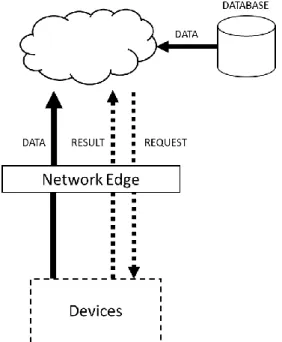
(30) •. Scalable storage: the fact that “infinite storage capacity” needs to be provided results in severe storage demands. • Bugs in large-scale distributed systems: unlike traditional centralized infrastructures, identified and fixing bugs becomes extremely difficult due to the overwhelming number of actors and entities involved at the same time. • Scaling quickly: dynamically providing the appropriate amount of resources can prove difficult in some applications, such as algorithmicallyintense applications. • Software licensing: purchased software licenses (e.g. Oracle database licenses used by cloud providers) are limited to particular machines and periods of time. This does not fit well with the “pay-as-you-go” philosophy of cloud platforms, since it reduces its operation flexibility. New licensing models or open source alternatives need to be explored. 2.4.2 Edge computing In simple terms, edge computing differs from the traditional cloud-based approach in which computing and storage is performed close to where data is generated [29]. Thus, under this paradigm, part of the intelligence of the network is moved closer to the edge nodes of the network.. Figure 5: Edge computing. Edge computing is performed o between the source (devices) and the cloud platform. Some of the load, in both upstream and downstream directions, is handled by the network edge and not by the cloud platform, thus effectively reducing response time and making a more efficient use of network capacity. Adapted from [29].. The necessity of edge computing arises from some of today’s threats to the development of IoT applications, which are presented below: • Network capacity: although the processing capacity of cloud platforms has increased considerably over the years, this has not been accompanied by an equal amount of improvement in the network capacity. Due to the sheer amount of IoT devices that will be connected. 14.
(31) to the internet, the network used to transmit data from data sources to processing centers will become a bottleneck, limiting the growth of the IoT ecosystem. • Privacy: as IoT spreads to more contexts, concerns is raised about how to handle sensitive information collected by sensors, which is to be transmitted to data centers. In fields such as healthcare, it would be desirable to protect the data collected before sending it, or even more, not even having to transmit such sensitive data over the network, avoiding potential threats. The processing centers can take many forms used in edge computing, and range from fully-pledged, although smaller, data centers (micro-datacenters), to devices very close to the end user, such as smartphones. Their common characteristic is that they need to be placed between data sources and cloud platforms. This is shown in Figure 5. As it can be observed, data, requests and services pass through the edge processing centers before continuing to the cloud. In this manner, part of the services required by the application can be provided by the edge devices without requiring the intervention of the cloud platform. Several advantages can be obtained from this model: • Reduced network load: since edge devices handle part of the application services, it is not necessary to transmit all the data to the cloud. Consequently, cloud platforms can provide service to a bigger number of applications, therefore guaranteeing the scalability of IoT applications. • Reduced latency: due to the fact that processing takes place closer to the end devices, the communication between them and processing centers is much faster. This is especially important in time-constrained applications which require a quick response time. • Power usage: some applications can benefit from reduced consumption, since processing data closer to the edge can prove to be more energy efficient that performing such task at the cloud and then transferring result to the end application. • Improved privacy: sensitive data can be better protected by processing it before sending it to the cloud. Additionally, in some cases, all the computation can take place at the edge, so that it is not necessary to transmit it, greatly reducing the threat of data theft in the network middle nodes. • Greater redundancy: the load distribution among cloud platforms and edge processing centers makes it possible to provide continuous service, because in case of failure in the cloud platform, part or all of the computing activities can take place at an alternative edge center. As it has been described, there are many benefits in edge computing. However, this means that edge computing systems need to be designed to fulfil the same requirements as traditional cloud-based applications, because of the necessity of availability and speed of response, which cannot be sacrificed. As a result, aspects such as differentiation, extensibility, isolation and reliability must be considered [29].. 15.
(32) In particular, some specific issues need to be solved before edge computing can become completely mainstream. Some of the most relevant ones are listed below [30]: • Disperse ecosystem of protocols and technologies: many solutions exist for performing communication, processing and storage tasks. While this is good for innovation, it also makes it more difficult to design for interoperability and simplicity. • Distributed management: losing cloud computing centralized architecture increases management complexity and costs. New approaches and technical solutions need to be develop efficiently communicate and handle an increasing number of distributed processing centers. • Weaker security: less centralization also means increasing the attack surface. Security in distributed systems is more difficult to guarantee, and therefore should be considered a priority in the design of edge applications. • Undeveloped ecosystem: for developers and companies to seriously consider edge computing, a rich ecosystem of edge computing providers and applications must be put in place. However, edge computing providers need real-word applications to justify edge computing deployments, so the situation is blocked. Research, in conjunction with public and private investment can help to clear the situation. Before concluding this section, it is worth mentioning that in spite of its nobility, real edge computing deployments are already in place. Some examples include the Radio Applications Cloud Server (RACS) for 4G/LTE networks and the Living Edge Lab [30]. From the perspective of IoT applications, Edge Computing is a specially interesting model, mainly because of its close to real-time nature, which allows for instantaneous response and subsequent decision making. This is particularly useful in industrial applications where collected information needs to be applied instantly, as the delay of sending the data back to the cloud, processing it and receiving the results might be unacceptable. In addition, its distributed layout makes it possible to use collected data, and associated computations, even if no network connectivity exists, which can be the case in remote deployments like agricultural settings. Another reason why Edge Computing is useful for IoT is because of its scalability. In order to leverage the power of IoT, it is often required to deploy hundreds, or even thousands or devices. This causes traffic to grow exponentially, therefore exhausting networking, storage and computing capabilities. Edge Computing reduces this threat by reducing the amount of data that needs to be transferred and stored in central nodes, allowing for the growth of the application without putting the infrastructure network to its limits.. 16.
(33) 2.4.3 Cloud computing vs edge computing Previous sections have described the characteristics of both Cloud and Edge computing paradigms. While both of them are valid approaches for implementing IoT solutions, the suitability of each model will depend on the application at hand. Table 3 presents a possible criterion for choosing between both approaches depending on which is the key design driver of the application. Different applications have different requirements, and knowing which of them are the most relevant makes it easier to select the model to choose. Design driver Low latency. Choice Description Edge The proximity between processing centers and data Computing sources greatly reduces the time required to transfer data and thus improves the overall system response time.. Low network traffic. Edge Only computed data is transferred to central nodes. Computing Consequently, the amount of network traffic is significantly smaller.. High scalability. Edge Networks can grow naturally by adding more edge Computing nodes. In this manner, computation power grows as the same rate as the application.. High redundancy. Edge Although a high level of redundancy can be achieved Computing in Cloud Platforms (e.g. distributed datacenters), redundancy is more naturally achieved in Edge Computing deployments.. Complex data processing. Cloud When complex data analysis is required, such as in big Computing data applications, the reduced computation power of edge devices make them unsuitable for performing the required operations.. Centralized management. Cloud Cloud Computing deployments are comparatively Computing easier to manage and maintain, since all resources can be controlled from a reduced set of nodes. On the other hand, debugging applications implemented in a Edge Computing philosophy can prove to be difficult.. Cost reduction. Cloud Since Cloud computing centers can be shared by Computing multiple applications, even from different companies, it is possible to optimize resource consumption and therefore reduce costs.. Table 3: comparison of cloud and Edge computing models based on different key design drivers.. In summary, choosing Edge or Cloud computing depends on the requirements of the application. In broad terms, if such application requires computation in realtime, or with very small delay, then the Edge computing model is more suitable. Another typical use of Edge Computing is when end devices already have a significant amount of computation power, such as in smartphones [31]. If instead the application is not time constrained, and other aspects such as cost or. 17.
(34) management complexity are more important, the traditional cloud computing model can be more beneficial. However, it must be noticed that despite their differences, they are not mutually exclusive. Using mixed models can help to obtain all their respective benefits without sacrifices.. 2.5 Hardware platforms for IoT One of the key enablers of IoT has been the emergence of small, cheap and flexible computer hardware which facilitates the rapid design and deployment of IoT applications. A rich ecosystem of development platforms exists, from general purpose platforms, oriented for prototyping, to fully customized systems. In the context of this dissertation, only prototyping boards have been considered, since it makes it possible to work on an initial version of the project, validating its model and design, without having to worry about secondary aspects like manufacturing and testing the platform. Once the model is validated, applicationspecific platforms can be designed, if the cost saving are deemed significant enough. Some of the most relevant prototyping platforms include [32]: •. Arduino: open source, microcontroller-based computing platform. The board includes a microcontroller and all related components that are required to operate and interface with it, including memory, oscillators for generating the clock signal and input/output pins, which can be connected to sensors and actuators. In addition, a development environment is provided, which allows the user to program applications using a dialect of C++, instead of having to write assembly code.. •. BeagleBone Black: single-board computer based on low-power Texas Instruments processors, using the ARM Cortex - A8 core. It has a size (roughly the size of a credit card), and it is able to run full operating systems, including GNU/Linux and Android. It has a mugh higher processing power compared to Arduino, as it is more like a computer than a controller.. •. Phidgets: rather than a pre-built, Phidgets follows a modular philosophy. Systems are formed by combining building blocks (temperature sensors, RFID tags, switches, etc.), all of which communicate using a USB interfaces. The resulting system can be programmed using C++ by means a collection of library and a API. Due to these features, Phidgets enables programmers to rapidly develop physical interfaces without the need for extent knowledge in electronics design issues.. •. Udoo: open hardware minicomputer based on the ARM i.MX6 Freescale process, being compatible with Android and GNU/Linux. In addition, it has and embedded Arduino-compatible board. Therefore, it combines elements of computers and controllers in a single device. It provides connectivity using the usual interfaces, such as Ethernet, WiFi and USB, 18.
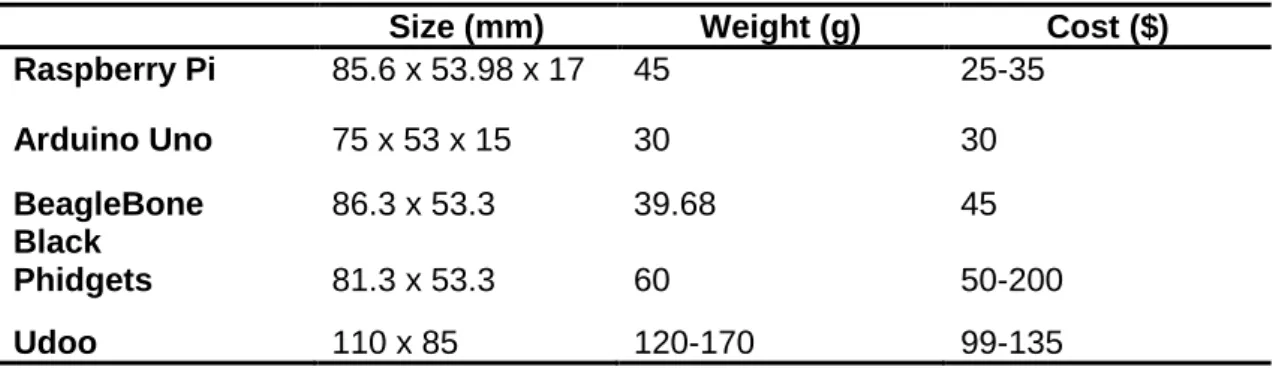
(35) while also providing connectivity with sensors and actuators by means of the Arduino-compatible board. Despite the suitability of these platforms for many applications, the selected platform for the purpose of this project has been Raspberry Pi. Its main characteristics, as well as its advantages over the options, are described in the following section. 2.5.1 Raspberry Pi 3 B+ The Raspberry Pi [33] is a Single Board Computer (SBC) designed to be open and accessible, making it suitable for education purposes, as well as for DIY projects, research and prototyping. It enjoys an enormous popularity, mainly because of its high-quality documentation and convenient price (around 40€). Consequently, a significant number of examples, libraries and off-the-shelf software exists for this platform, greatly simplifying the learning curve and the bootstrap of new developments. The reasons for choosing the Raspberry Pi as the hardware for this project are summarized below: •. • • • • •. • •. It can run GNU/Linux, providing an environment with an enormous amount of existing software (e.g. Python, PostgreSQL, etc.), which in addition feels familiar for developers. Large RAM memory, making it suitable for applications with non-negligible complexity, such as those present in Edge Computing systems. It supports expandable memory, thus allowing storage of up to 128 GiB. This is more than enough memory for the purposes of this project. It has 4 cores, and therefore supports multithreading, increasing performance. Off-the-shelf WiFi, Bluetooth, Ethernet and USB connectivity. Expandable by means of widely available shields, aimed at specific purposes like LTE connectivity, which can be very useful in IoT applications. It can be battery-powered. More importantly, it is a highly popular project with a thriving community of enthusiasts. Consequently, documentation is highly available and of great quality. This also includes tutorials for developing common applications. Hence, it becomes very easy to start using Raspberry Pi for prototyping purposes. These features, combined with a competitive price (see Table 4), makes it a good choice.. 19.
Figure
![Figure 2: Partition into ROM and RAM memory in Contiki OS. Adapted from [20].](https://thumb-us.123doks.com/thumbv2/123dok_es/7379177.374059/21.892.145.744.198.547/figure-partition-rom-ram-memory-contiki-os-adapted.webp)
+7





Documento similar