
An introduction to prosody in the EFL classroom
46
0
0
Texto completo
(2)
(3) Abstract This project started as a need of covering an aspect of the English language which was missing in the EFL classroom in Secondary school. Teaching prosody is important and necessary in order to develop a good communicative competence since stress and intonation convey meaning. After an observation of the class and the aspects taught, pronunciation appeared to be neglected. Therefore, the creation of a Didactic Unit dealing with prosody was created and implemented in order to show students its importance in real language and real communication. The results show that the students understood its relevance and were capable of producing and they are willing to improve..
(4) Table of Contents 1. Introduction.................................................................................................... 1 2. Theoretical Framework: Teaching Pronunciation ........................................... 2 2.1 Contextualization ..................................................................................... 4 2.2 “Practical English”: 2nd of Bachillerato ...................................................... 5 3. Teaching Proposal: Didactic Unit ................................................................... 6 3.1. Justification ............................................................................................. 6 3.2. Curricular Contents ................................................................................. 6 3.3. Objectives, Competences and Learning Results ..................................... 7 3.4. Methodology ........................................................................................... 8 3.5. Temporization ......................................................................................... 9 3.6. Materials and Spaces............................................................................ 10 4. Implementation of the Lesson Plan “Stress and Intonation” ......................... 10 4.1. Activities: Lesson Plan .......................................................................... 10 4.2. Session 0: Pretest ................................................................................. 13 4.2.1. Pre-test: Results ............................................................................. 13 4.3. Session 1: Stress .................................................................................. 19 4.4. Session 2: Intonation............................................................................. 22 4.5. Evaluation ............................................................................................. 23 5. Results ........................................................................................................ 24 5.1. Stress.................................................................................................... 24 5.2. Intonation .............................................................................................. 28 6. Conclusions and possible improvement ....................................................... 30 References ...................................................................................................... 32 Appendixes ..................................................................................................... 33 Appendix 1. Pre-test .................................................................................... 33 Appendix 2. Pronunciation: Stress (Power Point presentation)..................... 34 Appendix 3. Stress Handout ........................................................................ 37 Appendix 4. Pronunciation: Intonation (Power Point Presentation) ............... 38.
(5) Appendix 5: Intonation: printable cards. ....................................................... 40 Appendix 6: Satisfaction Survey................................................................... 41. List of Tables Table 1. Curricular Contents .............................................................................. 7 Table 2. Competences, Objetives and Learning Results ................................... 8 Table 3. Lesson Plan Activities ........................................................................ 11 Table 4. Students's proficiency ........................................................................ 14 Table 5. Average Grading: Proficiency ............................................................ 14 Table 6. Importance of Grammar, Vocabulary and Pronunciation .................... 15 Table 7. Average Grading: Importance ............................................................ 15 Table 8. Previous Teaching ............................................................................. 16 Table 9. Word Stress: Grammatical Function .................................................. 17 Table 10. Sentence Stress .............................................................................. 18 Table 11. Intonation in Questions .................................................................... 19 Table 12. Stress Results. Exercice 2 ............................................................... 25 Table 13. Stress Results: Exercise 3 ............................................................... 25 Table 14. Stress Results: Exercise 4 ............................................................... 26 Table 15. Stress Results: Exercise 5 ............................................................... 27 Table 16. Stress Results: Exercise 6 ............................................................... 27 Table 17. Intonation Results. Satisfaction Survey ............................................ 29.
(6) Introduction to Prosody in the EFL Classroom 7 de Julio de 2015. 1. Introduction This document belongs to the first modality of the Final Project of the Master. Therefore, this project deals with the identification of an area of English Language teaching in secondary school that presents a problem and needs to be improved. In addition, it suggests a possible improvement for this area. The body of the document is divided into six main sections including the introduction. Section 2 introduces the area that needs the improvement. Thanks to the observation period of the internship in the high school, pronunciation was thought to be the most problematic and forgotten area. In addition, this section describes how pronunciation has been taught according to different methods and how it is taught in the Spanish context. In the following section, number 3, the improvement proposal is described. This proposal has been designed taking into account the official curriculum for optional subjects in Bachillerato. As Roach (2000) insists on the need of teaching pronunciation in the foreign language classroom and Wells (2006) focuses his work on prosody, these authors have been the basis to develop the proposal. Section 4 describes the implementation of a didactic unit in a real language classroom. It was prepared for my internship period focusing on pronunciation, particularly, on stress and intonation (prosody). The proposal was implemented during two sessions in I.E.S Francesc Ribalta. After the implementation of the proposal, the results obtained are shown in section number 5. Then, the last section, number 6, includes the final conclusions extracted from this experience. I decided to focus my project on pronunciation because I consider that speaking and particularly pronunciation have traditionally been neglected by foreign language teaching in general. This may be the reason why Spanish people are said to have very poor pronunciation in English. I believe that a good pronunciation is the base of good communication, but secondary students do not have the opportunity to learn. They may learn to pronounce vowels and consonants by receiving input, but this is not enough to learn other aspects, such as prosody. They need to be taught formerly. I wanted to give them this chance and open an interesting new door to improve not only their pronunciation but also the pragmatic aspects.. 1.
(7) Introduction to Prosody in the EFL Classroom 7 de Julio de 2015. 2. Theoretical Framework: Teaching Pronunciation Learning and teaching a foreign language implies lots of different aspects, such as the four skills, which are equally important. However, in some contexts, it seems that some skills are more important than others. This is the case of Spain, and concretely Secondary Education, where speaking and pronunciation have been forgotten or even neglected for years. Theses aspects of the language are not given the relevance they should have. Therefore, the improvement of teaching oral skills has to be fundamental nowadays. According to Roach (2000), teachers and language-teaching theorists have not always considered teaching pronunciation popular. In fact, it was considered an attempt to make nonnative speaker sound like native speakers. The author also says that claiming this is to mix up models (native speakers) and goals (effective communication). At the same time, the Common European Framework of Reference for languages (2001) states that, among the competences of a learner, the communicative competence is more specifically language-related. This competence is composed by the. linguistic,. sociolinguistic. and. pragmatic. competences.. Here,. the. CEFR. distinguishes 6 more competences regarding the linguistic competences. As this project focuses on pronunciation, the most relevant of them is the phonological competence which involves a knowledge of sentence phonetics (prosody), that is sentence stress and intonation (suprasegmental features). Also, a user of the language should consider what the relative importance of sounds and prosody is. From the late 1800s and 1900s, teaching languages has used different methods in order to help students acquire the foreign language. As Celce-Murcia (1996) explains in her Teaching pronunciation, some of the methods have focused on speaking and have offered techniques to teach pronunciation. Supposedly, the current trend is to follow the Communicative Approach, but before the development of this method, many others were used. Since the 1800s, there have been different methods applied for teaching a foreign language. However, not all of them have given the same importance to the different aspects of a language. One of the most well-known and spread methods is the Grammar Translation method which considered that speaking was not an important part of the process of learning a foreign language. This method focused on teaching grammar using the students’ mother tongue. Later, continuing with the methods that focus on speaking, the Direct method became important in the late 1800s and 1990s. This approach states that pronunciation. 2.
(8) Introduction to Prosody in the EFL Classroom 7 de Julio de 2015 should be taught through intuition and imitation. The students are supposed to learn by repeating and imitating a model that can be the teacher or a recording. This method tries to use the strategies of the first language acquisition in the second language acquisition. After this approach, some others more naturalistic, such as the Natural Approach and the Total Physical Response, appeared claiming that students have to be exposed to language (listening) before they produce. In this way, pronunciation is supposed to be good in spite of the lack of explicit pronunciation teaching. In 1886, after the creation of the International Phonetic Association, phoneticians, such as Henry Sweet, Wilhelm Viëtor and Paul Passy developed the International Phonetic Alphabet (IPA). This meant the Reform Movement in the field of language learning. This trend defended that learning pronunciation should be taught explicitly by using phonetics and IPA whose written symbols represent sounds. During the 1940s and 1950s in United States and in Britain, two similar approaches,. Audiolingualism. and. Oral. Approach,. respectively,. were. gaining. importance with the idea of using IPA in order to teach pronunciation, working with transcriptions, imitation and repetition. Some techniques dealt with teaching articulation and with working with the minimal pair drill, an activity derived from the notion of contrasts in structural linguistics. However, later approaches in the 1960s attempted to stop focusing on speaking, and consequently, on pronunciation. Influenced by transformationalgenerative grammar (Chomsky, 1959, 1965) and cognitive psychology (Neisser, 1967), the Cognitive Approach considered the language as a set of rules and focused on other aspects rather than pronunciation. According to Scovel (1969), due to the fact that native-like pronunciation was an unrealistic objective, time should not be spent on teaching pronunciation, but on teaching grammar or vocabulary. Pronunciation and speaking were paid attention again in the 1970s thanks to the development of the Silent Way. This method aims the accuracy of sounds and structures, that is, how words, including stress and intonation, create sentences. Although this method focuses on the sound system like Audiolingualism, the Silent way does not use the IPA or explicit linguistic teaching. In the same decade, a new method developed by Charles A. Curran (1976) emerges. Communicative Language Learning (CCL) focuses on teaching pronunciation by repeating and imitating. In contrast, the student decides how many times he should repeat until he is satisfied with the pronunciation. After all these methods, the Communicative Approach became popular in the 1980s holding that the use of the language should be the aim and the goal of the study. 3.
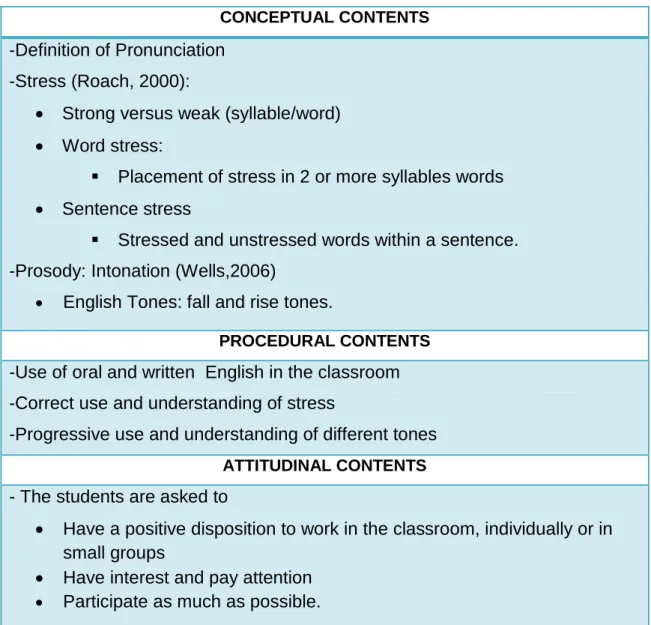
(9) Introduction to Prosody in the EFL Classroom 7 de Julio de 2015 of a foreign language. Regarding oral communication, pronunciation is considered a necessary component. Therefore, it should be taught in order to communicate effectively, taking into account both fluency and accuracy. The goal of teaching pronunciation is never to make students sound like native speakers of English because this goal is unrealistic. On the contrary, the main objective is to enable students to use the language to understand and make themselves understood. In order to teach pronunciation, the Communicative Approach follows a series of techniques also used in other methods, such as “listen and imitate” (Direct Method). Most of these strategies focused on the segmental level and were rejected due to its incompatibility with teaching language as communication. The optimal way to organize a short-term pronunciation course is to focus on teaching suprasegmental features which have the greatest impact on comprehensibility, i.e. teaching stress and intonation.. 2.1 Contextualization During the internship period of this Master in a high school, observation allowed us to discover and learn how English is taught in a real classroom. Also, this was a period in which we had to find an aspect of teaching which could be changed and improved. The most noticeable aspect was that pronunciation is not taught. In the classroom, speaking is not always possible. However, when the students speak, they are never corrected. In this way, students are fluent in English, but they are not always accurate and they can hardly be if they are not given feedback. Regarding the center, IES Francesc Ribalta, located in the city center of Castellón, is a center concerned with the need of learning English. Its English department contributed to the creation of a multilingualism department which gives support to those teachers who want to use the CLIL method. In this way, the level of some students is very high. Their comprehension skills (Listening and Reading) have been developed further and, later, this helps them to improve production skills (Writing and Speaking) However, our specialty is English as a Foreign language and our observation took place in this subject’s sessions. During the lessons of the internship, our tutor tried to foster speaking by making small groups including one internship student in each group. However, this activity was only possible when we were six teachers, including the tutor, in the classroom. Normally, in an average classroom in Spain, there is only 1 teacher for 30 students. This does not allow to take into account diversity or students’. 4.
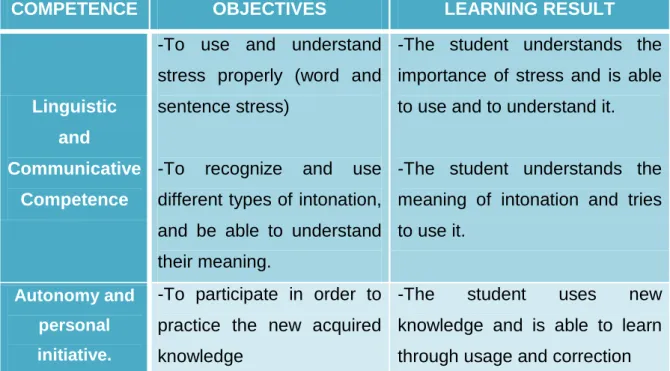
(10) Introduction to Prosody in the EFL Classroom 7 de Julio de 2015 needs. Our presence was a great opportunity for all the students who could use English without feeling ashamed or embarrassed due to their level, because they were organized depending on it. The role of the teacher was to encourage students to speak and to participate. In some occasions, we were also correctors, but this was not our main goal. Our speaking sessions were based on informal conversations or debates. The students in the groups were asked to talk about an interesting issue, familiar to them, or a recent piece of news, chosen by them. We never used the student book, because our focus was not on teaching grammar or vocabulary, which is the main aspect with which the book deals. Also, in some groups, i.e. “Practical English”, they do not use text book since the main purpose of this subject is to use English freely.. 2.2 “Practical English”: 2nd of Bachillerato Practical English is an optional subject that the students can choose, among others, in all the years of secondary school in IES F. Ribalta. However, after the observation period, and taking into account the courses that my tutor had, I decided to choose this subject of 2nd of Bachillerato. This group is formed by 17 students of 17-18 years old who are originally in five different groups (2BA, 2BC, 2BD, 2BK, 2BL). The level of this group is a B1-B2 (and a case of a C1 level) according to the European Common Framework of Reference for Languages. Although they may have a good level of proficiency, this does not guarantee the good use of pronunciation. The main objective of this subject is to use language fluently and with an acceptable accuracy, according to ORDEN de 17 de Junio de 2009, de la Conselleria de Educación, which regulates the optional subjects in Bachillerato [2009/7863]. Therefore, an ordinary lesson includes students’ presentations, debates, watching videos, written activities, etc. Although they deal with all the skills of the language, there is not an explicit teaching of them. In the case of Writing, Reading and Listening, this does not suppose a problem, since they have another subject, “English: Foreign Language”, in which they are taught. However, Speaking and pronunciation are forgotten and assumed. One of the reasons to choose this course is the level of the students who have, at least, an intermediate level. Some authors agree that teaching some aspects of pronunciation, such as stress and intonation, is suitable for intermediate and advanced learners of English. In their works, both, Bradford (1988), Hancock (1995 and 2003) focus on teaching suprasegmental features of phonetics to intermediate, upperintermediate and advanced learners.. 5.
(11) Introduction to Prosody in the EFL Classroom 7 de Julio de 2015. 3. Teaching Proposal: Didactic Unit 3.1. Justification In order to justify this proposal, it needs to be linked to the educational curriculum of the course and subject chosen. In this case, the government of the Valencian Community, in “ORDEN 2009/7863, de 17 de Junio, de la Consellería de Educación, del Consell”, establishes “Inglés Práctico” (Practical English) as an optional subject in the 2nd year of Bachillerato. According to this document, communicative and linguistic competences need to be improved in order to facilitate comprehension in a multicultural world. In the content section, part “2.2. Expresión e interacción oral”, an “acceptable” pronunciation is needed in order to produce simple oral texts and to interact with other speakers. Apart from being part of the curricular contents for this subject, pronunciation is also considered in the evaluation criteria. However, it is not always taken into account. Therefore, this lesson plan aims to cover the pronunciation that is not usually dealt with in the classroom. The concepts to deal with are stress and intonation, which have never been formerly taught, according to this year’s course program. However, in order to know if these are new concepts for the students, they completed a pre-test (see appendix 1) and the results showed the students previous knowledge.. 3.2. Curricular Contents The students have shown to have a good domain of pronouncing vowels and consonants. However, they fail, to some extent, in producing a more natural speech because they do not have a fluent use of stress or intonation. Consequently, the content of this proposal will focus on these two aspects. At the end of the session, they will be expected to have acquired the curricular contents of this lesson plan which are detailed and organized according to conceptual, procedural and attitudinal contents in the following table:. 6.
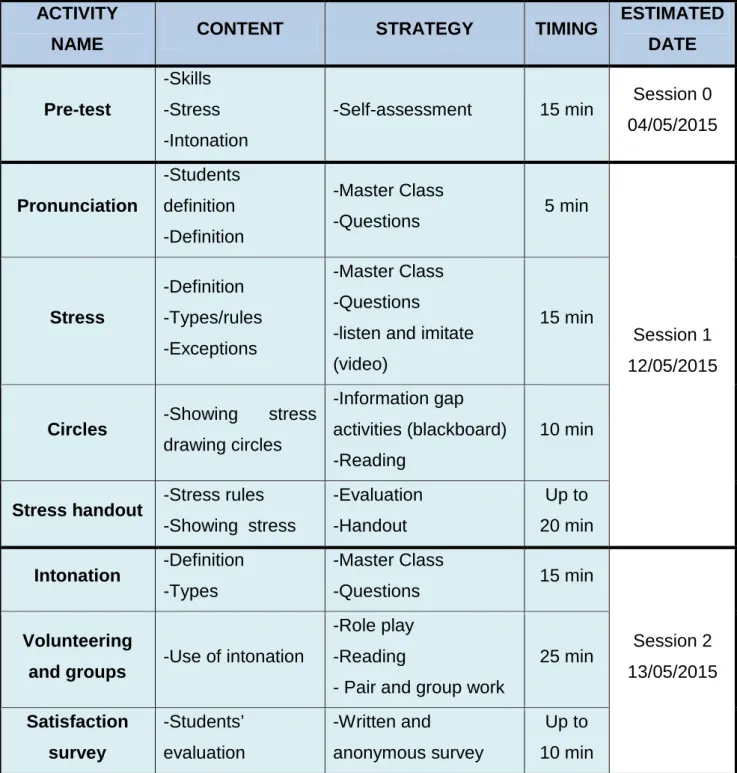
(12) Introduction to Prosody in the EFL Classroom 7 de Julio de 2015 Table 1. Curricular Contents. CONCEPTUAL CONTENTS. -Definition of Pronunciation -Stress (Roach, 2000): • Strong versus weak (syllable/word) • Word stress: . Placement of stress in 2 or more syllables words. • Sentence stress . Stressed and unstressed words within a sentence.. -Prosody: Intonation (Wells,2006) •. English Tones: fall and rise tones. PROCEDURAL CONTENTS. -Use of oral and written English in the classroom -Correct use and understanding of stress -Progressive use and understanding of different tones ATTITUDINAL CONTENTS. - The students are asked to • • •. Have a positive disposition to work in the classroom, individually or in small groups Have interest and pay attention Participate as much as possible.. 3.3. Objectives, Competences and Learning Results In this section, the competences, objectives and learning results will be described in relation to each other. According to ORDEN 2009/7863, de 17 de Junio de 2009, de la Conselleria de Educación, the general objective for this course is to achieve the level of independent speaker (B1) and be able to use the language in most of the situations that may occur in a trip to where English is spoken. Also, the learner should be able to describe experiences, events, wishes, aspirations, and justify his or her opinions about topic of personal interest. Although some of the students already have this level, they still need to improve the use of stress and intonation. Also, this document established that the general objectives of this subject are the following regarding the oral skills (emphasized areas in this lesson plan): 7.
(13) Introduction to Prosody in the EFL Classroom 7 de Julio de 2015 • •. •. •. •. To understand the global and specific sense of oral texts produced by speakers about a wide variety of general topics. To produce oral texts as well as to interact orally with other speakers in daily situations accurately, using an acceptable pronunciation, fluency, appropriate use of the linguistic and communicative strategies and a correct application of the socio-communicative norms. To reflect upon how English Works and the discursive squemata in communicative situations and to use this reflection in order to continue progressing. To develop a critical awareness by securing self-assessment and selfcorrection strategies during the acquisition of the communicative competence. To appreciate the importance of English as a communication and understanding language and as an instrument to acquire knowledge.. This subject aims to help learners to acquire a series of capacities, regarding different skills and areas. Concretely, in this lesson plan, the competences and objectives are the following: Table 2. Competences, Objectives and Learning Results. COMPETENCE. OBJECTIVES. LEARNING RESULT. -To use and understand -The student understands the stress properly (word and importance of stress and is able Linguistic. sentence stress). to use and to understand it.. and Communicative -To Competence. recognize. and. use -The student understands the. different types of intonation, meaning of intonation and tries and be able to understand to use it. their meaning.. Autonomy and. -To participate in order to -The. student. uses. new. personal. practice the new acquired knowledge and is able to learn. initiative.. knowledge. through usage and correction. 3.4. Methodology The teaching method used in this lesson plan follows the Communicative Approach (1980s). This approach aims to make interaction the aim and the goal of the study. Since these sessions are focused on Listening and Speaking, the students are asked to interact to each other and participate in order to observe the results. 8.
(14) Introduction to Prosody in the EFL Classroom 7 de Julio de 2015 Apart from the formal teaching, the students have to answer a series of questions and activities and the strategies used in order to design these activities are: •. •. •. •. •. •. Master class: This strategy is used in order to show the students the theory needed to understand the concepts and main ideas. The students are expected to interrupt the explanation as long as they need to solve a doubt. During the explanation, exaggeration is needed so that the students realize the stress and intonation. Information gap activities: The students are asked to complete some activities in order to show what they have learnt. These activities focus on filling some gaps applying the theory recently learnt. Pair and group work: the activities can be done individually, but it is preferable that the students make pairs or small groups in order to work and share the results. “Listen and imitate”: this technique is also used in Direct method and it consists in making the students repeat something they hear in order to make them practice. Role play: the students are given a situation and they have to act out with a partner or alone in front of the class. In this way, the rest of the students have the chance to correct and reflect upon mistakes. Reading: The student is asked to read a sentence given by the teacher and he/she has to produce the correct intonation or stress.. The works of Wells (2006) and Roach (2000) have been the basis of this teaching proposal. In addition, the format of some activities has been extracted from Hancock (1995 and 2003), Hewings (2004) and Bradford (1988). All the activities are expected to be done in class. Therefore, the students will not have extra homework due to the amount of homework which the students already have (this decision was made taking into account the tutor’s advice, who knows the students and their background).. 3.5. Temporization This lesson plan has been designed to cover 2 sessions of 50 minutes. It requires also some minutes taken from another previous session (session 0) in order to fill a self-assessment (pre-test). Although it is supposed to take about 15 minutes, the students can spend more time filling the questionnaire if they need it. Session 0 can take place one or two weeks before the other sessions, so that the results can be read and used to prepare the following session, 1 and 2. These should be implemented in the same week.. 9.
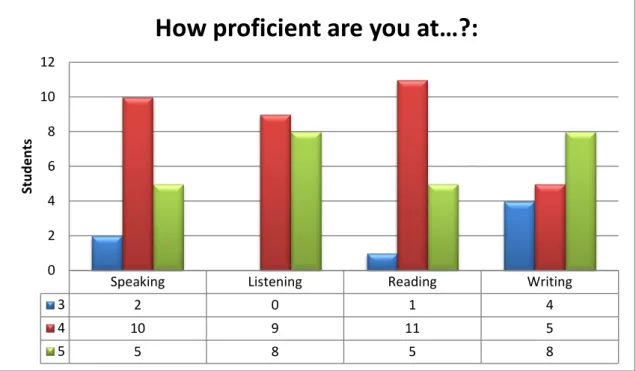
(15) Introduction to Prosody in the EFL Classroom 7 de Julio de 2015. 3.6. Materials and Spaces The human resources needed for this lesson plan are the teacher and the students. In the class there will be also 4 internship students and the tutor. As originally planned, it is not necessary that they participate, but there will not be any inconvenience. The sessions will be implemented in the habitual classroom which is number 4 in IES Francesc Ribalta. A multimedia classroom will not be needed because classroom number 4 is equipped with the multimedia devices needed, i.e. a computer and a projector. Also, there is a blackboard that can be used for the activities. Apart from the devices above mentioned, this lesson plan uses different materials, such as power point presentations and handouts given by the teacher printed on paper (see appendixes 3, 5 and 6). In order to fill the handouts and complete the activities, the students are asked to have writing material in order to complete the handouts. Also, a YouTube video (“Stress and Rhythm in English | A QUICK Overview”) will be used as an overview of the first session. It is recommendable that the students follow this YouTube channel (elemental English) in order to improve their skills since the channel offers real language and also lessons on pronunciation. In addition, this way of learning can be more profitable and motivating for some students.. 4. Implementation of the Lesson Plan “Stress and Intonation” This section is divided into 5 main parts in which the activities and their implementation are explained. The first section is a summary of all the relevant aspects of the activities. They are shown in a table together with the content, strategy, timing and estimated date of implementation. Then, the list of the specific objectives described. The following section (4.2) includes the first activity (the pre-test) and the results which have been essential to develop the following activities. These are explained in two different sections (4.3 and 4.4) regarding the session in which they were implemented, i.e. session 1 and session 2. The results of these sessions are shown in section 5. And finally, the fifth section is devoted to describe the evaluation of this implementation.. 4.1. Activities: Lesson Plan In this section, the activities of this lesson plan are shown together with other relevant aspects that define them. The following table shows the order which these. 10.
(16) Introduction to Prosody in the EFL Classroom 7 de Julio de 2015 activities should follow in order to be implemented and lists, after the name of each activity, the content, the strategy, the time needed and the estimated date. The basic competences for these activities, as it has already been said, are the linguistic and communicative competences as well as the autonomy and personal initiative. Table 3. Lesson Plan Activities. ACTIVITY NAME. CONTENT. STRATEGY. TIMING. -Self-assessment. 15 min. -Skills Pre-test. -Stress -Intonation -Students. Pronunciation. -Master Class. definition. -Questions. -Definition. -Questions. -Types/rules. -listen and imitate. -Exceptions. Circles. Stress handout. Intonation. Volunteering and groups. -Showing. DATE Session 0 04/05/2015. 5 min. -Master Class. -Definition Stress. ESTIMATED. 15 min Session 1. (video) stress. drawing circles. 12/05/2015. -Information gap activities (blackboard). 10 min. -Reading. -Stress rules. -Evaluation. Up to. -Showing stress. -Handout. 20 min. -Definition. -Master Class. -Types. -Questions. 15 min. -Role play -Use of intonation. -Reading. 25 min. - Pair and group work. Satisfaction. -Students’. -Written and. Up to. survey. evaluation. anonymous survey. 10 min. 11. Session 2 13/05/2015.
(17) Introduction to Prosody in the EFL Classroom 7 de Julio de 2015 Apart from the objectives given by the government of Valencian Community in ORDEN 2009/7863, de 17 de Junio de 2009, de la Conselleria de Educación, some specific objectives are established for each activity: Session 0: As it has already been explained, this is not a complete session. In fact, it only takes about 15 minutes to make students answer a pretest that will be necessary to prepare the activities of the implementation. Depending on the results, the emphasis of certain aspects can be changed. The main objectives of this activity are: • • •. To obtain as many answered tests as possible. To know students’ level, previous knowledge and interests. To introduce implicitly the topics of the following sessions.. Session 1: This session is an introductory session in which the concept of pronunciation is defined and then, the notion of stress, which includes several aspects. Consequently, the time needed to develop the 4 activities that have been planned for this section is a whole lesson, i.e. 50 minutes. The objectives are: • • • • • • •. To teach definitions of pronunciation and stress To make students understand stress properly, first, word and then, sentence stress. To make students understand how native speakers’ speech works. To make students practice stress to seem more natural in oral production To teach how to show stress using circles. To make students understand the importance and usefulness of word and sentence stress in communication. To evaluate if the students have acquired the new concepts.. Session 2: The second and last session is devoted to intonation and its practice. There are two very intense activities prepared for this session. Also, at the end of the session, a short survey should be completed by the students. The objectives to achieve are: • • • •. To teach fall and rise tones and their use. To make students understand how native speakers’ speech works. To make students practice intonation to seem more natural in oral production To make students understand the importance and usefulness of good intonation.. 12.
(18) Introduction to Prosody in the EFL Classroom 7 de Julio de 2015 • •. To evaluate if the students have acquired the new concepts. To know students’ opinion.. 4.2. Session 0: Pretest The pre-test (see appendix 1) is a questionnaire which has been designed as a needs analysis. In order to check certain aspects and to introduce topics implicitly, the students had to answer a series of questions. It is important to know the students’ general level of English (according to themselves), previous knowledge about stress and intonation and interests in order to design following sections. This activity was developed session 0 which took place in a session of Practical English before session 1 and 2. The pretest was printed and given to the students to answer. At the beginning of this activity, I explained the students of 2nd of Bachillerato that they had to answer a series of questions honestly and individually. Also, if they did not know what to say, they did not have to answer. All of them were informed and agreed that this pre-test would be part of this project and the results would be shown anonymously. There were 15 participants at first, and then 2 participants more shared their wish to complete the test. In total, there were 17 answered tests. 4.2.1. Pre-test: Results This pre-test is composed by 10 questions. The first 3 questions deal with the time spent studying and learning English, their current level and the importance which some aspects of the language have from their point of view. The last questions deal with pronunciation aspects, such as definitions, past experiences and suprasegmental features. At the beginning of the page, the students had to write their age and the group to which they originally belonged. In this way, it was easier to contextualize the situation of this group. In the first question of this pre-test, the students had to answer how many years they had spent studying or learning English. After reading the answers, they showed that the average is 12 years and there was a case in which a participant had English as her mother tongue. In the following question, the students had to self-assess their level of English, grading their proficiency in each skill (Speaking, Listening, Reading and Writing) from 1 (very bad) to 5 (very good). The following table shows the number of students that graded with 3, 4, or 5 the four skills.. 13.
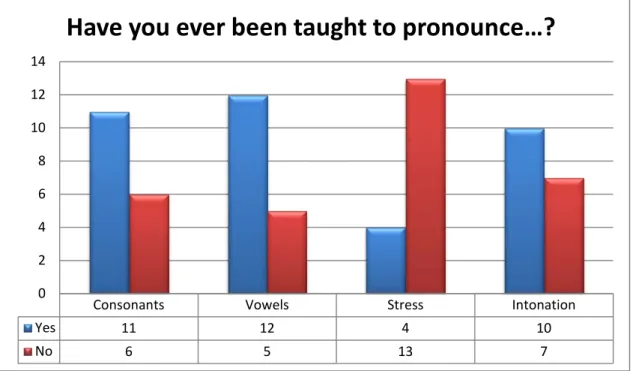
(19) Introduction to Prosody in the EFL Classroom 7 de Julio de 2015 Table 4. Students’ proficiency. How proficient are you at…?: 12. Students. 10 8 6 4 2 0. Speaking. Listening. Reading. Writing. 3. 2. 0. 1. 4. 4. 10. 9. 11. 5. 5. 5. 8. 5. 8. None of the students graded using 1 or 2. In consequence, this numbers have not been added to the previous table. In addition, none of the students graded all the skills with a 5. The average grading of each skill shows, as it can be seen in the following table, that the best graded is listening. Table 5. Average Grading: Proficiency. Skills: Proficiency Speaking. Listening. Reading. Writing. 4,5. 4,2. 4,2. 4,2. Average. After this, the students were asked to grade (using from 1 to 5) the importance of three areas of language: Grammar, vocabulary and pronunciation. The following table shows the grades given by the students. 14.
(20) Introduction to Prosody in the EFL Classroom 7 de Julio de 2015 Table 6. Importance of Grammar, Vocabulary and Pronunciation. Grade the level of importance of the following items 16 14. students. 12 10 8 6 4 2 0. Grammar. Vocabulary. Pronunciation. 3. 6. 2. 2. 4. 9. 5. 1. 5. 2. 10. 14. The best graded area was pronunciation. This fact may be a positive aspect for future sessions. The importance given by the students may be related to the motivation to learn. The average shows that students believe that pronunciation is the most important area (among these three) Table 7. Average Grading: Importance. Area: Importance Grammar. Vocabulary 4,5. Pronunciation 4,7. 3,8. AVERAGE. The following question in this pre-test was concern with the definition of pronunciation. The students were asked to define this concept using their own words,. 15.
(21) Introduction to Prosody in the EFL Classroom 7 de Julio de 2015 since they had no access to dictionaries or to the Internet. This revealed their thoughts as the question is formulated in order to check that. After reading the definitions, there are some aspects to take into account. Most of the students use the word “way” or “ability” in order to define pronunciation. They agree that this concept has to do with production (“say”, “speak”, “talk”), imitation and accuracy. Also, several definitions focus on segmental features (vowels and consonants) while only three of them mention prosody (“tone”, “intonation”). However, there were two definitions that caught my attention. One of the students wrote that “some words may change their meaning depending on pronunciation” and I found it very interesting because this student mentioned “meaning”. The other curious definition was written by a student who claimed that pronunciation “is the sound you give to a word or sentence”. This student was the only one who mentioned “sentence” and not isolated words as the rest did. These definitions helped to create a word cloud to introduce the definition of pronunciation in the first session. Also, the results of this question showed that the students, in general, did not take into account suprasegmental features, such as stress, in their definitions. This means that regardless of their level of proficiency, they may not have a good domain or knowledge of pronunciation. The following question aims to know if the students have received formal teaching about some aspects on pronunciation, such as consonants, vowels, stress and intonation. The results are shown this table: Table 8. Previous Teaching. Have you ever been taught to pronounce…? 14 12 10 8 6 4 2 0. Consonants. Vowels. Stress. Intonation. Yes. 11. 12. 4. 10. No. 6. 5. 13. 7. 16.
(22) Introduction to Prosody in the EFL Classroom 7 de Julio de 2015 The table shows that several students have been taught to pronounce consonants, vowels and intonation. However, most of them (13 students) have never been taught how to pronounce stress. This fact made me consider emphasizing the topic of stress, designing more activities in order to practice more with those who had never been taught. An interesting fact is that three of the students claim that they have been taught all the aspects. In contrast, there are four that claim the contrary: they have never been taught any of the aspects asked. The following questions deal with how they have been taught and if they would like to be taught (again or for the first time). Among the strategies to teach, the students said that they were taught by repetition, correction, singing, practicing and making presentations. There was one participant that answered that he has been taught naturally while he was living in the USA. In the case of the native speaker, she claimed having learnt naturally, but she confessed not to be aware of stress. Regarding their desire to be taught, unanimously, they agreed on being taught pronunciation. The following questions aimed to introduce implicitly the topics of future sessions. However, thanks to the observation while they were filling the questionnaire, the students did not seem to understand the implicit content. In addition, none of them gave further explanation regarding pronunciation. The activity included four words that change their grammatical function depending on the pronunciation (stress) of that word. The possible functions were verb, noun or both noun and verb. In the activity, the students had to translate or define and according to their answers these are the results: Table 9. Word Stress: Grammatical Function. Can you translate or define…? 9 8 7 6 5 4 3 2 1 0. Record. Insult. Comment. Contrast. Verb. 8. 8. 7. 5. Noun. 2. 2. 4. 5. Both. 7. 7. 6. 7. 17.
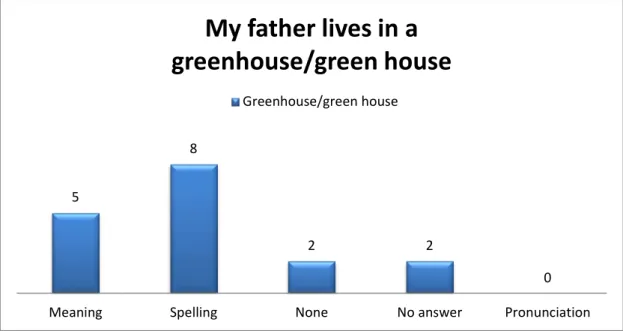
(23) Introduction to Prosody in the EFL Classroom 7 de Julio de 2015. As the table shows, the results are very irregular and only in 7 cases (6 in “comment”) answered translating or defining the words given as a verb and noun. There were 5 students who answered with a translation of the word meaning both functions in all the words. However, none of them mentioned or gave reasons why it could have both functions. The following question also deals with stress. The students are given two sentences that apparently are the same, except for the last word. In one case it is “greenhouse” and in the other they are “green” and “house”. The students are asked if there is any difference. Although it is not written, I told them that they could justify their answer if they found it necessary. After reading all the answers, the results were the following: Table 10. Sentence Stress. My father lives in a greenhouse/green house Greenhouse/green house 8 5 2. 2 0. Meaning. Spelling. None. No answer. Pronunciation. I could find different answers, but none of them dealt with pronunciation. While most of the students (8) though that the difference between “greenhouse” and “green house” is spelling (but they have the same meaning), five of them knew that these words have different meaning (in some cases, the translation was offered). Two of the students did not see any difference and two of them did not answer this question. The last question of the pre-test also dealt with pronunciation, in this case, intonation in questions. There was only a question to answer, but I also offered students the chance to write more details if they wanted.. 18.
(24) Introduction to Prosody in the EFL Classroom 7 de Julio de 2015 Table 11. Intonation in Questions. Is there any difference between asking for information and confirming information? Difference 14. 2. Meaning. 1 "yes". None. 0 Pronunciation. The results show that 14 of the students said simply “yes”, but they did not give further information. There were two cases in which the students also said yes but added an explanation which included the word “meaning”. Only one student did not find any difference. Finally, as it is shown in the previous table, none of them made reference to pronunciation. In conclusion, I believe that the objective of introducing implicitly the topics of future session was not fulfilled, because none of the students made reference to the use of pronunciation in their answers. Also, taking into account the questions they made and comments they added (orally in class), I could understand that none of them had pronunciation in mind. Therefore, I decided to show these three last questions during sessions 1 and 2, respectively.. 4.3. Session 1: Stress Session 1 was the beginning of this proposal. The first minutes of it were devoted to introducing myself and the topic we were dealing with. Some of them already knew me from the small groups that were done by the teacher. The most relevant issue was to make clear that the lessons were not dealing with phonetics and they were not learning to transcribe, but to pronounce stress and intonation.. 19.
(25) Introduction to Prosody in the EFL Classroom 7 de Julio de 2015 In order to develop this lesson, I needed a Power Point presentation (see appendix 2), the blackboard of the classroom and the stress handout (see appendix 3). At the beginning of the lesson, in the first slide of the power point presentation, I showed the transcription of the word “pronunciation” in order to introduce them how transcriptions work as a curiosity and to reinforce that this was not the topic of our lessons. This session was divided into 4 activities whose features have already been shown in table 3. The results of the pre-test showed that only 4 out of 17 students (24%) of the students had been taught stress. Therefore, I wanted to emphasize this aspect by making the students participate more. The results of the pre-test also showed that all the students wanted to be taught. Consequently, I expected high interest. I took into account students feelings and I wanted them to feel confident and comfortable. I tried constantly to make them feel relaxed, but aware. The first activity (2.-Pronunciation) dealt with the definition of pronunciation. As the pre-test showed, most of the students defined pronunciation as the production of segmental features. In some cases, there were students that included “words” and “sentence” to the definitions, but none of them made explicit the word “stress”. I supposed that most of them would not know the meaning of stress. However, before beginning with stress, and wanted them to remember their own definitions of pronunciation. In a word cloud, I showed the most repeated words in the students’ definitions. Then, the definition of pronunciation was shown in the slide and a volunteer student read it. Although this was meant to be a master class, I wanted students to participate and debate, but participation did not fulfill my expectations. To raise debate, I asked the students if they agreed or knew this piece of information. Some of the students nodded. At this point I asked if they believed that pronunciation and phonetics are the same. One of the students said that phonetics is written and pronunciation is spoken and most of the students seemed to agree. To continue with the lesson, since the contests were summarized in the slides of the Power Point presentation, I taught them what stress meant and what types of stress they were going to learn. Since most of them did not know stress, I tried to explain the concepts in a way in which the students can understand properly. I used written examples in the blackboard and I exaggerated while speaking to them in order to raise awareness. Although this was designed to be a master class, I wanted to interact with the students in order to know if they were following the explanation and understanding the concepts.. 20.
(26) Introduction to Prosody in the EFL Classroom 7 de Julio de 2015 I explained first word stress introducing the questions that they had already answered in the pre-test and then sentence stress. Most of their faces showed surprise because it was the first time they had been taught this. I made clear that this topic is essential to understand native speakers’ speech and to seem more natural in oral production. Thanks to this, the students understood why sometimes they do not fully understand what they hear. I made explicit that some unstressed syllables are difficult to hear. I introduced a joke to catch the students’ attention by saying that they are not deaf, it is stress. After that, students were asked to try to imitate the isolated words that I was proposing. I chose 2 syllables words at first and then longer words. Also, I told the students to organize themselves in small groups or pairs to practice. One of the students had to propose a long word or a sentence and the other student had to exaggerate the pronunciation to show stress. The most important aspect is that the students interact using English properly. Thanks to this activity, I was able to evaluate if the students understood the new contents. However, as I needed written proof to evaluate and to obtain results, I also taught them how to show word or sentence stress using circles. This activity has been inspired by Hancock's English Pronunciation in use (2003). As the author explains, the big circle (O) is used for the stressed syllables or words, and the small circle (o) is used for the unstressed syllable. I asked the students to say or write in the blackboard random words or sentences. Another student had to write the result in the blackboard so that every student could see it. I proposed that the student could correct their mates in order to make them pay more attention. Before the last activity, in order to review the content, I played a YouTube video that I had previously selected. I chose the video “Stress and Rhythm in English | A QUICK Overview” (YouTube: Elemental English) because it showed perfectly what it has been explained during the lesson. This part of the lesson took longer than the expected because there were some technical problems with the computer in the classroom, but a volunteer student solved it. To finish the lesson, I gave the students a handout (see appendix 3) previously prepared with exercises dealing with the contents of the lesson in order to evaluate what they had learn. The questionnaire is composed by information gap activities in which the students will use stress. Since this is the last activity of the session, the students had the rest of the time left to answer. I walked around the class so that the students could ask doubts privately. If it had been necessary, I would have explained again any conflictive. 21.
(27) Introduction to Prosody in the EFL Classroom 7 de Julio de 2015 concept, but the students did not ask. Finally, they handed the answered handout and the lesson finished.. 4.4. Session 2: Intonation This session took place the day after session 1. As I had a quick look at the handouts completed by the students the day before, I decided to devote the first minutes of the lesson to remind the concept of stress and how to use circles. I reminded the students that one of the best techniques to recognize stress is to exaggerate syllables. The summary of this concept is summarized at the beginning of “Intonation: Power point presentation” (see appendix 4). Also, I reminded the definition of pronunciation to make students understand that intonation (prosody) is a part of pronunciation too. Following, I began with the explanation of intonation and the rise and fall types. As in the other lesson, this explanation was meant to be a master class, but the students can participate and interrupt if it is necessary. During the explanation, I gave several examples exaggerating the tones to make students understand. Also, I asked them to repeat and practice. I taught different situations in which the students should use rise or fall intonation. The explanation took few minutes since the students did not interrupt. As the pre-test results showed, 7 of them had never been taught intonation. I checked constantly if the students understood because this is a very important feature of English and I wanted them to fully understand. The following activity (7. volunteering) was designed to practice intonation and see if the students understood the concepts recently explained. In order to develop this activity, I designed and used a handout called “intonation printable” (see appendix 5) in which some situations are given. As the name of the activity shows, the students are expected to have personal initiative and interest and to volunteer. The activity was based on role-play and reading. In the handout (see appendix 5), the explanations are already given, and the number of volunteers depends on the number of cards, which should be cut out. At the beginning of the activity I explained that I needed several volunteers to develop the activity and that I was expecting participation. In order to make the activity more dynamic I told them that there were not going to write anything. However, in order to be able to show the results, I took some notes evaluating the performance of the students.. 22.
(28) Introduction to Prosody in the EFL Classroom 7 de Julio de 2015 The mistakes made by the students were immediately corrected together with the explanation. In this way, I could make sure that the students were going to perform correctly. This activity took very long since the students were enjoying it. In some cases (exercise 2 and 5) were repeated by different volunteers. As I could see, the students were laughing and were very comfortable except for some students who participated but they did not volunteer. When this activity was over, that all the students had participated at least once, I showed in one of the slides a summary of the two lessons, making special emphasis on stress. I asked them to fulfill a satisfaction survey (see appendix 6) that I prepared for the end of the lesson plan. When they finished filling this, as there were some minutes left, I organized the class in small groups to continue doing activity 7, with the other internship students. However, in my group, the topic was a reflection upon the lessons. I asked the 4 students in my group about their opinion, which are shown in section 5.. 4.5. Evaluation The evaluation of this proposal is designed to be oral and written and to involve different types of evaluation, i.e. self-assessment, teacher’s, students’ and peer assessment. Evaluations can be found in every session: session 0 evaluation is a written self-assessment to be answered by the students. They have to answer a series of questions regarding their level of English (according to their own opinion), past experiences learning pronunciation, their desire to learn pronunciation and some activities to raise awareness about future lessons. As it has been explained, the results of this assessment were taken into account in order to the development future sessions (1 and 2). In session 1, the students had to answer a handout especially designed to evaluate if the students had understood and acquired the new contents. Also, some other notes were taken during students’ performance in the oral activities. The students were allowed to correct their classmates if they considered it necessary. The second session was evaluated only orally. As in this session the main focus was on speaking and interaction, the students were supposed to perform and use spoken English- Thus, feedback was delivered immediately. Finally, the students were given the chance of giving their opinion and evaluate the contents, the teacher and the timing by grading according to their opinion. They could also write any comment they felt necessary.. 23.
(29) Introduction to Prosody in the EFL Classroom 7 de Julio de 2015. 5. Results This section is divided into two parts, one for each session. In each part, the results shown have been obtained from the written material done by the students, and the written notes taken from oral interaction and evaluation.. 5.1. Stress As it has been already explain, the first session dealt with stress. The activities were spoken and written. During the oral activities, I took some general notes about the performance of the students. I could observe that the students were comfortable while speaking in front of the class, but they were shy when they had to exaggerate stress. Although interest and attention were high, participation was not that high. I had to choose the students to answer my questions and once they were asked, they answered properly. Some of the reasons why they had this attitude may be embarrassment, boredom or worries about the final exams. However, I tried to keep a good environment to make them feel confident and comfortable. At the end of the lesson, I wanted them to complete a handout (see appendix 3) in which they had to show stress with circles, as I taught them, and then, write examples using the stress pattern I gave them. These exercises were inspired by Hancock’s (2003) English Pronunciation in Use. After all the students handed their answers, I obtained a total of 15 answered tests. Not all of them were complete and this will be shown in the following tables. In the first activity, the students had to show the stress of very simple and familiar words: Monday, Sunday, thirteen, thirty, July and August. This activity was answered by all the students and all of them did it in the right way. Exercise 2 in this handout dealt with writing words following a given pattern. In the table of the exercise, the students had to write nouns, adjectives or verbs which had, first, the stressed syllable at the beginning, and, second, the stressed syllable at the end. All the exercises were completed by the students, except one who did not answer (NA), as it can be seen in the following table:. 24.
(30) Introduction to Prosody in the EFL Classroom 7 de Julio de 2015 Table 12. Stress Results. Exercise 2. Exercise 2 16 14. students. 12 10 8 6 4 2 0. Noun Oo. Verb Oo. Noun oO. Verb oO. right. 14. 13. 14. 14. wrong. 1. 1. 1. 1. NA. 0. 1. 0. 0. Exercise 3 asked the students to write the pattern for the words proposed depending on the type of word. This activity included 4 out of 8 words that were already included in the pretest in order to remind students that the spelling of a word can be the same even if these have different meaning and different pronunciation. As the table shows, most of the students answered correctly this exercise and it was fully complete: Table 13. Stress Results: Exercise 3. Exercise 3 16. Students. 14 12 10 8 6 4 2 0. Comment. Insult. Contrast. Answer. Object. Present. Record. Promise. Right. 13. 14. 11. 12. 15. 15. 14. 10. Wrong. 2. 1. 4. 2. 0. 0. 1. 5. 25.
(31) Introduction to Prosody in the EFL Classroom 7 de Julio de 2015. Exercise 4 dealt with stress in longer words. The students had to add an affix to a given word and then write the stress pattern of both words. The words given were music, relate, author, nation, chemist and atom. I did not evaluate if they added a correct affix because in all the cases it was correct. I evaluated the stress pattern written with circles by the student. This exercise seemed to be more problematic because despite the fact that most of them answered properly, some other failed or left the exercise in blank as the table shows: Table 14. Stress Results: Exercise 4. Exercise 4 12 10 Students. 8 6 4 2 0. Relate. Author. Nation. Chemist. Atom. 10. 9. 10. 9. 10. 10. 1. 2. 1. 2. 1. 1. NA. 4. 4. 4. 4. 4. 3. Illegible. 0. 0. 0. 0. 0. 1. Right Wrong. Music. In activity 5, the students had to ask another partner to write a sentence for them and, then, to show the stress pattern with circles. This exercise, together with number 6, was one of the less answered questions because in 6 of the handouts this exercise was left in blank (NA). In addition, one of them showed very irregular orthography and it could not be read. In consequence, it was considered intelligible. Only 4 of the students could answer this without any mistake. 3 of them had between 99’99% and 75% of mistakes and 1 of them had between 74’99% and 50% of mistakes. This percentage was made counting the syllables of the sentence written by the partner and counting how many big or small circles did not correspond with the right syllable, i.e. strong and weak, respectively.. 26.
(32) Introduction to Prosody in the EFL Classroom 7 de Julio de 2015 Table 15. Stress Results: Exercise 5. Exercise 5 7 6 5. 100% 75%-99,99%. 4. 50%-74,99% 3. NA Illegible. 2 1 0. In the last exercise, the students had to write a word or a sentence which was suitable for the given patters. As it has already been said, this question exercise was not completed for all the students. As there were 6 different patterns, the results of this are divided in the following table in this way: Table 16. Stress Results: Exercise 6. Exercise 6 12 10 Students. 8 6 4 2 0. Ooo. oOo. ooO. OoO. OooO. OoOo. Right. 10. 7. 5. 2. 4. 5. Wrong. 0. 2. 0. 8. 4. 0. NA. 5. 6. 10. 5. 7. 10. 27.
(33) Introduction to Prosody in the EFL Classroom 7 de Julio de 2015 This table shows very different results. In the case of the first two patterns there are more answered and right questions than not answered (NA). However, as difficulty increases, the answers decrease or are wrong. Only one of the students could give a good example for all the patterns. The results show that these may have been affected the amount of content and the time available to develop and answer all the exercises. The wrong answer could mean that there were too many contents to deal with and to learn, while the answers left in blank clearly suggests a lack of time.. 5.2. Intonation The evaluation of this session was oral. While the students were interacting, I was taking general notes. There was only one activity in which the students had to show what they had learnt, but it was long enough to make all of them participate. The activity was based on role play and reading. The situations given to the students can be seen in appendix 5. For each exercise, the number of cards means the number of volunteers. For the first exercise, I asked for 6 volunteers. Each of them was given a card which told how they were supposed to feel to role play. In front of the class, they were supposed to say something using a suitable tone, and the rest of the class had to guess the feeling. I asked them to exaggerate a lot and it worked. The students had no problems with this activity. The second exercise dealt with intonation in questions. As they had been taught, they had to use the suitable intonation depending on the type of question. Since this activity was easy and quick, instead of asking for 4 volunteers, I asked for 8, so more students had the chance to practice. The students were supposed to ask questions to other student who was not a volunteer for this exercise. In this way, almost all the students participated. Dealing with questions, the students performed better because, according to their opinion, this was the most similar aspect, regarding Spanish language- their mother tongue. After this activity, the third one consisted in a very small conversation in which student A read the card, and then student B had to read the other card using a suitable tone, depending on the type of information given, i.e. new or shared, as a response. All the students used the suitable tone in each situation The following activity was the longest and most complicated for the students. They had to follow the instructions given in the card in order to tell a story to another partner making clear by the tone that the information given was new or shared. One of the students had problems because she could not understand where to place the rising 28.
(34) Introduction to Prosody in the EFL Classroom 7 de Julio de 2015 and falling tones. Therefore, further explanation was needed. I advised the student to exaggerate, but she was very shy so she preferred not to participate and to try later in the small groups. I preferred not to insist because she was flustering. For the final exercise, the volunteer students had to choose a partner to respond to their reading. Then, the first student should guess if the response is a true feeling or not, depending on the tone. This exercise was repeated twice and also, was performed again without the card. This means that the volunteer students improvised their sentences. All the students were able to make the tones and differentiate them. The general impression of this session was that the students were having fun and feeling comfortable at the same time they were learning. As they were role playing in front of the class, when they were right, they had their peers’ positive reinforcement. In this session, most of the students volunteered and participation and attitude were better than in the other lesson. When they committed a mistake, the feedback was provided immediately. I preferred to correct them by giving the right answer and, then, making them repeat. In this way, the rest of the class could also hear twice the right form. Finally, the students answered a satisfaction survey that I designed in order to give them the chance to evaluate the lesson plan briefly. The objective was to know the opinion of the students regarding my performance as a teacher, my level of English, the topic, the materials and the timing. Also, this survey included a question to answer if they had learnt something new and if they were comfortable during the sessions. in the last question, they stated which their favorite part of this lesson plan had been. The results of grading items are shown in the following table: Table 17. Intonation Results. Satisfaction Survey. Students. Satisfaction survey: Grading 18 16 14 12 10 8 6 4 2 0. Performance. English. Topic. Materials. Timing. 3. 1. 0. 2. 0. 2. 4. 0. 0. 7. 3. 3. 5. 16. 17. 8. 14. 12. 29.
(35) Introduction to Prosody in the EFL Classroom 7 de Julio de 2015 The rest of the questions do not need tables since the results are clear. When the students were asked if they had learnt something new, all of them answered positively. In contrast, when they were asked if they had felt comfortable, there were three students that answered “no” and gave the same reason. They did not feel comfortable speaking in front of the class because they are shy and preferred to be in small groups. As the answers of the last question showed, all the students agreed that their favorite part of this lesson plan was the activity called “volunteering” in session two. Some of the students wrote the reasons and, among them, words such as “funny”, “dynamic” and “useful” can be found. When the surveys were answered and the small groups formed, the boys which formed my group debated about the fact of teaching pronunciation in general in the EFL classroom. They agreed that it was motivating and encouraging because they felt that they were learning something not only useful but also new. One of them confessed that he had never heard about these issues and had never thought about it before I taught them, and found it necessary to the real use of English.. 6. Conclusions and possible improvement After this proposal was implemented, the results analyzed lead me to some conclusions. On the one hand, I have taken into consideration stress and on the other hand, intonation. Although these two aspects are part of pronunciation, since they have been the focus of different sessions, there are different conclusions. Regarding stress, I believe that the most important factor was that most of the students had never been taught before. As it can be observed in the previous sections, the results show that students are good at showing stress with circles, i.e. at analyzing word and sentence stress. They are able to analyze examples, which is useful to know where to place stress speaking. However, they were not as good at giving examples following a certain pattern. Using simple patterns referring to words has been easier for them, but longer patters referring to full sentences or longer words have supposed a problem for most of them. Therefore, I consider that I would spend another session in which the most useful approach would be to begin with explaining syllables at first, without assuming that they may know, Dealing with exemplifying patterns, giving more examples and making the students interact and participate more should be something to improve too. It has been proved that these students have enjoyed being the protagonists. Due to the 30.
(36) Introduction to Prosody in the EFL Classroom 7 de Julio de 2015 amount of conceptual contents, dividing this only session into two sessions may improve the proposal and the learning of this aspect of pronunciation. Also, their lack of previous knowledge would not be a problem since they would have more time to assimilate the new concepts. In contrast, the intonation activities seemed to work better. The students were more motivated and more active. Even those who had never been taught could follow the sessions because this was more interactive and they had more opportunities to participate. Although the time was the same in both sessions, the amount of contents was fewer in the second one. This made possible that the students could form small groups in order to solve possible doubts or problems with the support of the other internship students. In general terms and given the limitations of the practice, I am satisfied with the results obtained because most of the students were able to assimilate the new concepts and consolidate the old ones. This approach was suitable, but it should be modified in terms of time and interaction, as it has been previously said. Although the survey showed that the students have learned new contents, they could learn more if this proposal were longer and took more sessions. The most important aspects regarding this proposal are confidence and comfort. I found out that the students are capable of learn more and better if they are in a comfortable environment that facilitates their learning. For me, it was very important to make them understand that the role of the language teacher is to help them to learn and understand. Also, I believe that it is important to ask students’ opinions from time to time because they are closer to feel the protagonists of their own learning. My experience showed me that, adjusted to the suitable level, i.e. intermediate, learning pronunciation can be both challenging, and motivating. It is not only motivating for the teacher, but also for the students because stress and intonation are a very interesting and useful aspect of the real language, according to their own opinion. Dealing with pronunciation in the secondary education classroom is not usual. In fact, this had not been done before in this course and the necessity of teaching this is undeniable. Pronunciation plays an important role in communication and it should be taught in every year of secondary education, at least once. It is true that English is a compulsory subject of this period, but we should never forget that, more than this, it is a real language and, as such, it should be taught in order to use it properly.. 31.
(37) Introduction to Prosody in the EFL Classroom 7 de Julio de 2015. References Celce-Murcia, M., Brinton, D. & Goodwin, J. (1st edition: 1996, 2nd edition: 2011). Teaching pronunciation: A reference for teachers of English to speakers of other languages. New York: Cambridge University press.. Bradford, B (1988). Intonation in Context. Intonation practice for upper-intermediate and advanced learners of English. Melbourne: Cambridge University Press.. Hancock, M (1995): Pronunciation Games. Cambridge: Cambridge University Press.. Hancock, M (2003): English pronunciation in Use. Intermediate. Cambridge: Cambridge University Press.. Hewings, M. (2004) Pronunciation Practice Activities. A resource book for teaching English pronunciation. Cambridge: Cambridge University Press.. Roach, P (2000): English phonetics and phonology. Cambridge: Cambridge University Press.. Wells, J.C. (2006). English Intonation. An Introduction. Cambridge: Cambridge University Press. Council of Europe (2001) Common European Framework of Reference for Languages: Learning, Teaching, Assessment. Strasbourg. Available at http://www.coe.int/t/dg4/linguistic/Source/Framework_EN.pdf [last access: 30/06/2015]. ORDEN de 17 de junio de 2009, de la Conselleria de Educación. Available at: http://www.docv.gva.es/datos/2009/07/07/pdf/2009_7863.pdf [last access: 23/06/2015]. 32.
(38) Introduction to Prosody in the EFL Classroom 7 de Julio de 2015. Appendixes Appendix 1. Pre-test How long have you been studying/learning English?______________________ GRADE: 1.- Very Bad. 2.-Bad. 3.-Regular. 4.-Good. 5.-Very Good. How proficient are you at…?: Speaking?. 1. 2. 3. 4. 5. Listening?. 1. 2. 3. 4. 5. Reading?. 1. 2. 3. 4. 5. Writing?. 1. 2. 3. 4. 5. Please, grade the level of importance of the following items: Grammar. 1. 2. 3. 4. 5. Vocabulary. 1. 2. 3. 4. 5. Pronunciation. 1. 2. 3. 4. 5. What do you think pronunciation is? _____________________________________________________________________ ____________________________________________________________________ Have you ever been taught to pronounce…? Consonants. Yes. No. Vowels. Yes. No. Stress. Yes. No. Intonation. Yes. No. If so, How? _______________________________________________________ Would you like to be taught?. Yes. No. Can you translate or define…? Record: __________________________ Comment: ________________________ Insult:____________________________ Contrast: __________________________ Can you find any difference between…? __________________________ My father lives in a greenhouse // My father lives in a green house Making questions: Is there any difference between asking for information and confirming information? ___________________________________________. 33.
(39) Introduction to Prosody in the EFL Classroom 7 de Julio de 2015. Appendix 2. Pronunciation: Stress (Power Point presentation). 34.
(40) Introduction to Prosody in the EFL Classroom 7 de Julio de 2015. 35.
(41) Introduction to Prosody in the EFL Classroom 7 de Julio de 2015. 36.
(42) Introduction to Prosody in the EFL Classroom 7 de Julio de 2015. Appendix 3. Stress Handout 1. Show stress with circles: Monday. Sunday. Thirteen. Thirty. July. August. _________________________________________________________________ 2. Write (at least) one example of each pattern …oO. Oo… NOUN ADJECTIVE VERB. or. 3. Write the pattern for each word depending on the type: VERB. NOUN. Comment Insult Contrast Answer Object Present Record Promise 4. Add an affix to the following words and write the stress pattern of both words: Music:________________________________________________________ Relate: ________________________________________________________ Author: _______________________________________________________ Nation: _______________________________________________________ Chemist: _______________________________________________________ Atom: _________________________________________________________. 5. Ask your partner to write a sentence for you and then write the stress pattern:. 6. Write sentences or words according to the following patterns: Ooo: _____________________________ OoO: ____________________________ oOo: _____________________________ OooO: ___________________________ ooO: _____________________________ OoOo: ____________________________. 37.
(43) Introduction to Prosody in the EFL Classroom 7 de Julio de 2015. Appendix. 4.. Pronunciation:. Presentation). 38. Intonation. (Power. Point.
(44) Introduction to Prosody in the EFL Classroom 7 de Julio de 2015. 39.
Figure
+7




Documento similar
Public archives are well-established through the work of the national archive services, local authority-run record offices, local studies libraries, universities and further
Keywords: iPSCs; induced pluripotent stem cells; clinics; clinical trial; drug screening; personalized medicine; regenerative medicine.. The Evolution of
The aim of this paper is to demonstrate that reading authentic literary material in the English as a Foreign Language (EFL) classroom can improve students’ language learning skills as
Astrometric and photometric star cata- logues derived from the ESA HIPPARCOS Space Astrometry Mission.
In addition to traffic and noise exposure data, the calculation method requires the following inputs: noise costs per day per person exposed to road traffic
2004, Space physics : an introduction to plasmas and particles in the he- liosphere and magnetospheres (Space physics : an introduction to plasmas and particles in the heliosphere
As the chart illustrates, the majority of the class passed the poster’s task using the passive voice satisfactorily, thanks to the explanations and the exercises
The analysis revealed significant differences in categories such as word count, clout, emotional tone, or analytical thinking when comparing the texts written by an
