
Status of the eastern Pacific agujon needlefish Tylosauruspacificus (Steindachner, 1876) (Beloniformes: Belonidae
7
0
0
Texto completo
(2) 52. R E V I S TA DE BIOLOGIA T R O P I C A L. bia by Franke and Acero (1992). They recommended elevating T. acus pacificus to species status based on their occurrence together. An anomaly that occurs occasionally only in T. acus melanotus, possession of a bony ventral keel on the lower jaw (Fig. 1), was the basis of a junior synonym, T. appendiculatus Klunzinger. A specimen with this anomaly was recently received from Panamá, also showing co-occurrence of the two “subspecies”. This paper re-appraises the taxonomic status of the eastern Pacific subspecies using meristic, morphometric, and molecular characters. MATERIALS AND METHODS Many specimens of Tylosurus have been examined by Collette in connection with published research (Collette and Parin, 1970) and during on-going studies of needlefishes. Material of eastern Atlantic populations was listed in Collette and Parin (1970), material of western Atlantic populations will be included in the account being prepared for inclusion in “Fishes of the western North Atlantic”. Only eastern Pacific material is listed here. Material examined is from the following institutions (abbreviations from Leviton et al., 1985): AMNH, BPBM, ANSP, CAS-SU, FMNH, LACM, MCZ, SIO, UCLA, UMMZ, and USNM. Counts and measurements follow Collette and Parin (1970). Frequency distributions of numbers of dorsal, anal, and pectoral fin rays, and vertebrae for Tylosurus pacificus and populations of T. acus are presented.. Regression equations and other statistics were computed for 10 morphometric characters against body length for T. pacificus and Pacific specimens of T. acus melanotus . Analysis of covariance tests for differences of slopes and intercepts were performed as for Atlantic subspecies (Collette and Parin, 1970:table 15). Only F values greater than those of P = 0.999 were considered significant to make this information comparable with that presented for Atlantic populations of T. acus. Tylosurus pacificus (Steindachner, 1876) Belone pacifica Steindachner, 1876:93 (original description, Panamá and Acapulco). Strongylura galapagensis Fowler, 1944:136 (original description, Abingdon I., Galápagos Is.; holotype ANSP70251). Böhlke, 1984:27 (=Tylosurus acus pacifi cus, based on a pers. commun. from B.B. Collette). Tylosurus pacificus. Meek and Hildebrand, 1923:227-228 (description, Panamá). Franke and Acero, 1992:120 (description, specimens from Isla Gorgona, specific status proposed). Tylosurus acus pacificus . Collette and Berry, 1965:392 (eastern Pacific population T. acus pacificus). Collette and Parin, 1970:44-46 (“...the population in the eastern Pacific approaches specific distinction”). Allen and Robertson, 1994:90 (description), 93 (color pl. VI, fig. 11). Collette, 1995:925 (description, range). Tylosurus acus melanotus (not of Bleeker, 1850). Grove and Lavenberg, 1997:268 (description is of T. pacificus).. Diagnosis: A species of Tylosurus with dorsal-fin rays 21-23 (x 21.7, Table 1); anal fin-rays 18-21 (x 19.6); pectoral fin-rays 1114; vertebrae 74-80 (x 77.2); predorsal scales 303-405.. Fig. 1. Tylosurus acus melanotus, USNM 362835, Panamá City market, 675 mm Body Length, with ventral keel on lower jaw. Photograph by D. Ross Robertson..
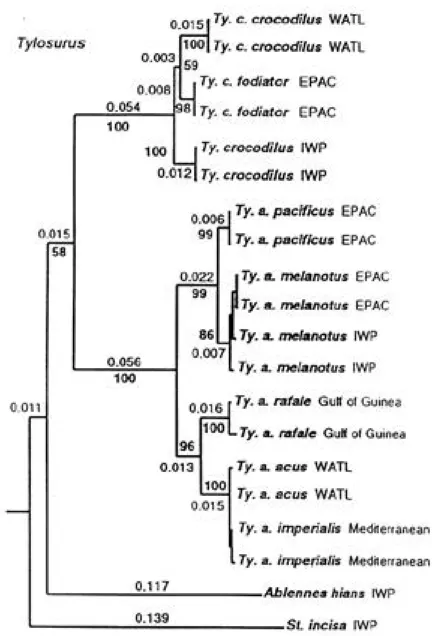
(3) I N T E R N AT I O N A L J O U R N A L OF T R O P I C A L B I O L O G Y AND CONSERVAT I O N. 53. Fig. 2. Monophyletic subtree based on neighbor-joining analysis of K2p distances derived from mitochondrial ATPase8, 6 genes. Numbers in bold represent boot strap confidence estimates based on 1000 NH replications. (from Banford et al., in review:fig 3B).. Comparisons: Tylosurus pacificus is completely separated from all populations of T. acus in vertebral number (74-80 vs. 82-96) and from Pacific T. acus melanotus in numbers of dorsal (21-23, rarely 24 vs. 24-27) and anal (18-21 vs. 22-24) fin-rays. It is much less distinct morphometrically than meristically. from T. acus melanotus. Using the unusually high value of 0.999 as Collette and Parin (1970) did, only one of the analyses of covariance of regressions of 10 morphological characters (intercepts of orbit length) was significantly different between west-central Pacific T. acus melanotus and eastern Pacific.
(4) 54. R E V I S TA DE BIOLOGIA T R O P I C A L.
(5) I N T E R N AT I O N A L J O U R N A L OF T R O P I C A L B I O L O G Y AND CONSERVAT I O N. 55.
(6) 56. R E V I S TA DE BIOLOGIA T R O P I C A L. T. pacificus (Table 2). Conversely, there were 2-7 significant morphometric differences between the three Atlantic subspecies of T. acus (Collette and Parin, 1970:table 15). While Banford et al. (in review) focused on relationships of American and eastern Atlantic species of the needlefish genera Strongylura and Tylosurus, we examined mtDNA from specimens of all five recognized subspecies of Tylosurus acus and both subspecies of T. crocodilus. Two major clades of Tylosurus acus were found, Atlantic and Indo-Pacific, with significant genetic differentiation in each major area. We defer full consideration of the systematic implications of this until a later, more comprehensive study and wish to focus on differences between T. acus melanotus and T. acus paci ficus (Fig. 2). The eastern Pacific sympatric pair of T. a. pacificus and T. a. melanotus had a Kimura 2-parameter (K2p, Kimura, 1980) genetic distance of 0.018 for 1652 base pairs (bp) of the mtDNA protein-coding genes (ATPase 8,6 and cyt b); while trans-Pacific distance within T. a. melanotus from Panamá and Phillipines was only 0.006. The two subspecies clustered separately in phenetic (Fig. 2) and parsimony analyses. Size: Maximum known size 640 mm body length (from posterior margin of opercle to caudal base), about 900 mm SL. Range: Known from the Gulf of California south to Cabo Blanco, Peru including one record from the Galápagos Islands. Replaced in islands off the coast of Central America (Tres Marias Is., Revillagigedos Is., and Cocos Is.) by T. acus melanotus. Material examined. Tylosurus pacificus. Forty specimens (26.8-640 mm body length) from 29 collections arranged north to south by country. Mexico: LACM 8802 (5, 456-550); Gulf of California, Bahia Las Palmas; R. Cannon; 19 Oct. 1959. LACM 8993-3 (1, 302); 35 mi. SW Mazatlan; S. Giacolone; Jan.-Feb. 1967. CAS-SU 14975 (1, 311); Gulf of Tehuantepec, 50 mi. SW Champauco; P. Sandez et al.; June 1943. UCLAW59-249 (1, 50.4); Gulf of California, Bahia Las Palmas; B. Walker; 17 Oct. 1959. SIO H-53-121-23A(1, 640); Baja California Sur, Bahia Almejas, 23o24.6’ N, 1 11o43.4’W; L.D. Berner et al.; 15 July 1953. CAS uncat. (1, 115); Baja California, 26o53’ N, 112 o16.5’W; A.S. Loukashkin; 8. Sept. 1958. USNM 268821 (1, 577); Sonora, Choya Bay; M. Gonzalez; 1969. SIO 61-251-23A (1, 450); Gulf of California, Bahia Las Palmas, 23o38.75’N, 109o40.5’W; 19 June 1961. SIO 62-61-23A (1, 450); Isabel I., 21 o 52’N, 105 o 54’W; F.H. Berry; 24 Aug. 1961. Guatemala: CAS-SU 39317 (1, 296); San Geronimo. Costa Rica: LACM 8801 (1, 335); 6 mi. off Uvita Bay; 14 Feb. 1955. UCLA W49-463 (1, 112); 10 mi. W Quepas Point; M/V Renown; 26-27 Oct. 1949. SIO 6682-23A(1, 120); 8 o27’N, 84 o27’W; Papaguero Exped.; 9 July 1965. USNM 306879 (5, 26.8-38.5); Gulf of Nicoya, Pta. Mordes; W. Szelistowski; 15 June 1989. Panamá: USNM 79639 (1, 430); Panamá market; S.E. Meek and S.F. Hildebrand; 17 May 1911. UCLAW51243 (1, 90.3); Hannibel Bank; R.C. Wilson; 1 Nov. 1951. USNM 226604 (1, 76.3); Chame Point; Tweedlie. AMNH 15982 (1, 106); off Panamá; Mandel. USNM 211321 (2, 324-338); Canal Zone, Naos I.; H. Wright; 30 July 1967. CAS-SU 12806 (1, 378); Panamá; C.H. Gilbert. USNM 76822 (1, 339); Taboga I. USNM 29300 (1, 495); Panamá. USNM 200575 (1, 66.5); Chame Pt.; Tweedlie. USNM 128562 (1, 85.2); Taboga Point; S.F. Hildebrand; 31 Mar. 1957. UCLA W54-325 (1, 282); mouth of río Anton; Clemens; 28 Apr. 1954. Colombia: FMNH 59418 (1, 286); Tumaco; Henn and Wilson. Ecuador: UMMZ 191023 (1, 307); La Libertad; Velero III; 17-20 Jan. 1933. Galápagos Islands : ANSP 70251 (1, 241); Galápagos; 5th Vanderbilt Expedition; holotype of Strongylura galapagensis Fowler. Peru: USNM 203529-31 (3, 302-316); off Cabo Blanco, 4o14’S, 81o21’W; Bruun Cr. 15.; 12 April 1966. Tylosurus acus melanotus. Seven specimens (162675 mm body length) from four collections. Mexico: SIO 62-21-23A (3, 397-455); Tres Marias Is., Maria Magdalena I., 21o 28’N, 106 o26’W; 15 Aug. 1961. USNM 188884 (1, 382); Revillagigedos Is.; Fitch; 14 Apr. 1955. Costa Rica: USNM 188883 (1, 162); 50 mi. S Cabo Blanco; Clemens; 4 Apr. 1954. LACM 8796 (1, 470); Cocos Is.; 24 Oct. 1951. Panamá: USNM 362835 (1, 675), Panamá City fish market, D.R. Robertson, June 1999.. Remarks: We support Franke and Acero’s (1992) suggestion to elevate Tylosu rus pacificus to full species rank based on: 1) sympatry of both forms at Isla Gorgona and in Panamá (Fig. 1 and Banford, pers. obs.); 2) strong level of morphological differentiation in numbers of vertebrae, dorsal and anal fin rays; and 3) strong level of mtDNA differentiation. The larger question of what taxonomic rank to attribute to the other subspecies of Tylosurus acus will be addressed in subsequent publications..
(7) I N T E R N AT I O N A L J O U R N A L OF T R O P I C A L B I O L O G Y AND CONSERVAT I O N. ACKNOWLEDGMENTS We thank the curators and staffs of the museums housing the material examined for this paper. Radiographs were prepared by a long series of technicians in the Systematics Laboratory over the last 40 years. Meristic data were summarized by Janet Nestlerode and morphometric data were analyzed by Martin Wiley. The specimen and photograph of Tylosurus acus melanotus from Panamá were provided by D. Ross Robertson. The second author thanks E. Bermingham and the Smithsonian Tropical Research Institute (STRI) Molecular Evolution Program for support of the DNA sequencing portion of this research; the STRI Naos Marine Laboratory staff; and Recursos Marinos Panamá. RESUMEN Se confirma que Tylosurus pacificus (Steindachner, 1876) tiene el rango de especie con base en su simpatría con T. acus melanotus , morfometría y mitocondrial.. REFERENCES Allen, G. R. & D. R. Robertson. 1994. Fishes of the tropical eastern Pacific. Univ. Hawaii Press, Honolulu, HI, 332 p. Banford, H.B., E. Bermingham & B.B. Collette. In Review. Molecular phylogenetics and biogeography of transisthmian and amphi-Atlantic needlefishes (Belonidae: Strongylura and Tylosurus): Perspectives on New World marine speciation. Syst. Biol.. 57. Böhlke, E.B. 1984. Catalog of type specimens in the ichthyological collection of the Academy of Natural Sciences of Philadelphia. Acad. Nat. Sci. Philad. Spec. Publ. 14, 246 p. Collette, B.B. 1995. Belonidae. Agujones. In: W. Fischer et al., Guía FAO para la identificación de especies para los fines de la pesca. Pacifico Centro-Oriental 2:919-926. Collette, B.B. & F.H. Berry. 1965. Recent studies on the needlefishes (Belonidae): An evaluation. Copeia 1965:386-392. Collette, B.B. & N.V. Parin. 1970. Needlefishes (Belonidae) of the eastern Atlantic Ocean. Atlantide Rept. No. 11:7-60. Fowler, H.W. 1944. Results of the Fifth George Vanderbilt Expedition (1941) (Bahamas, Caribbean Sea, Panama, Galápagos Archipelago and Mexican Pacific islands). The fishes. Acad. Nat. Sci. Philad. Monogr. 6:57-583. Franke, R. & A. Acero P. 1992. Peces óseos comerciales del Parque Gorgona, Pacífico colombiano (Osteichthyes: Elopidae, Chanidae, Exocoetidae, Belonidae y Scombridae). Rev. Biol. Trop. 40:117124. Grove, J.S. & R.J. Lavenberg. 1997. The fishes of the Galápagos Islands. Stanford Univ. Press, Stanford, CA, 863 p. Kimura, M. 1980. A simple method for estimating evolutionary rates of base substitution through comparative studies of nucleotide sequences. J. Mol. Evol. 16:111-120. Leviton, A.E., R.H. Gibbs, Jr., E. Heal & C.E. Dawson. 1985. Standards in herpetology and ichthyology: part I. Standard symbolic codes for institutional resource collections in herpetology and ichthyology. Copeia 1985:802-832. Meek, S.E. & S.F. Hildebrand. 1923. The marine fishes of Panama. Part I. Field Mus. Nat. Hist., zool. ser. 15:1-330. Parin, N.V. 1967. Review of the marine Belonidae of the western Pacific and Indian oceans. Trudy Inst. Okean. 84:3-83 [in Russian, Systematics Lab. translation no. 68] Steindachner, F. 1876. Ichthyologische Beiträge (III). Sitz. Akad. Wiss. Wien 72:29-96..
(8)
Figure

Documento similar
H I is the incident wave height, T z is the mean wave period, Ir is the Iribarren number or surf similarity parameter, h is the water depth at the toe of the structure, Ru is the
The regression of the JJAS ATL3 index onto the SOND SLP and low-level winds in ATL_VARAGCM, reveals that westerly anomalies in the eastern equatorial Pacific weaken, whereas
In the “big picture” perspective of the recent years that we have described in Brazil, Spain, Portugal and Puerto Rico there are some similarities and important differences,
1. S., III, 52, 1-3: Examinadas estas cosas por nosotros, sería apropiado a los lugares antes citados tratar lo contado en la historia sobre las Amazonas que había antiguamente
Since such powers frequently exist outside the institutional framework, and/or exercise their influence through channels exempt (or simply out of reach) from any political
Of special concern for this work are outbreaks formed by the benthic dinoflagellate Ostreopsis (Schmidt), including several species producers of palytoxin (PLTX)-like compounds,
In the previous sections we have shown how astronomical alignments and solar hierophanies – with a common interest in the solstices − were substantiated in the
Plotinus draws on Plato’s Symposium (206c4–5) – “procreate in what is beautiful” – 3 in order to affirm that mixed love (which is also a love of beauty) is fecund, although
