
Discourse and blocked mourning – A Logics approach to Mexican Drug War Security Policy and the Peace and Reconciliation Forums
34
0
0
Texto completo
(2) Perspectivas REVISTA de CIENCIAS SOCIALES. Año 3. No. 6 Julio | Diciembre 2018 Editor Responsable ante ISSN Ezequiel Fabricio Barolin 3 De Febrero 731 Tel. 03777 15336451 2000 ─ Rosario ─ Argentina Sitio Web: www.perspectivasrcs.com Correo Electrónico: [email protected] URI: http://rephip.unr.edu.ar/handle/2133/6586 ISSN 2525-1112. Directores Ezequiel Fabricio Barolin - Universidad Nacional de Rosario, Argentina Luis Maximiliano Barreto - Universidad Nacional de Rosario, Argentina Comité Académico Anabella Busso - Universidad Nacional de Rosario - CONICET, Argentina Carlos da Silva - Universidad Nacional de Rosario - Universidad Católica Argentina, Argentina Francesco Bruni - Università di Bologna, Italia Francisco Iturraspe - Universidad Nacional de Rosario - CONICET, Argentina Germán Soprano – Inst. de Investigaciones en Humanidades y Cs. Sociales (UNLP-CONICET), Argentina Gilberto Aranda Bustamente - Instituto de Estudios Internacionales – Universidad de Chile - Chile Javier Orso - Universidad Nacional de Rosario, Argentina Juan Recce - Fundación Argentina ASE, Argentina Marcelino Teixeira Lisboa - Universidade Federal da Integração Latino-Americana, Brasil Olga Saavedra – Universidad Nacional de Rosario, Argentina Salvador Mercado - Universidad Autónoma de Querétaro, México Silvina Caleri - Universidad Nacional de Rosario, Argentina Colaboradores Editoriales Agustina Villegas - Universidad Nacional de Rosario, Argentina Dalila Emilse Capeletti - Universidad Nacional de Rosario, Argentina Esteban Covelli - Universidad Nacional de Rosario, Argentina Florencia Díaz Rojo - Universidad Nacional de Rosario, Argentina María Elvira Grioni - Universidad Nacional de Rosario, Argentina María Luz Silva - Universidad Nacional de Rosario, Argentina Natalia Díaz - Universidad Nacional de Rosario, Argentina Natalin Posadas - Universidad Nacional de Rosario, Argentina Vanesa Mangini - Universidad Nacional de Rosario, Argentina Victoria Mariani - Universidad Nacional de Rosario, Argentina.
(3) Perspectivas Revista de Ciencias Sociales (PRCS) (ISSN 2525-1112) es una publicación electrónica de periodicidad semestral (junio y diciembre), editada por un grupo de graduados y estudiantes de la Universidad Nacional de Rosario, en interacción con dicha Casa de Estudios, en la ciudad de Rosario, Provincia de Santa Fe, Argentina. Los fascículos se publican en formato digital los meses de junio y diciembre.. PRCS Tiene como principal objetivo aportar al intercambio y difusión de trabajos de investigación bajo diferentes modalidades: artículos de investigación originales e inéditos, notas breves de investigación, estudios de caso, ensayos y artículos de revisión o estado del arte, clases y conferencias, entrevistas, traducciones y reseñas. Está dirigida a investigadores, docentes, directivos, funcionarios, profesionales y estudiantes de la gran área de las Ciencias Sociales con especial énfasis en Historia, Ciencia Política y Relaciones Internacionales.. PRCS cubre todos los temas de las Ciencias Sociales, en un sentido amplio e interdisciplinario. Publica trabajos en español, portugués, inglés e italiano. Los aportes son sometidos a la evaluación de al menos dos especialistas, a través de una revisión doble ciego que permite mantener el anonimato tanto de los autores como de los evaluadores. También se publican los mismos materiales por invitación, así como noticias de interés académico o notas de opinión sometidos simplemente a evaluación de pertinencia.. Política de acceso abierto La aceptación del manuscrito por parte de la revista implica la no presentación simultánea a otras revistas u órganos editoriales y la cesión no exclusiva de los derechos patrimoniales de los autores en favor del editor, quien permite la reutilización, luego de su edición (postprint), bajo Licencia Creative Commons Atribución-NoComercial-CompartirIgual 4.0 Internacional (https://creativecommons.org/licenses/by-nc-sa/4.0/). Se puede compartir, copiar, distribuir, alterar, transformar, generar una obra derivada, ejecutar y comunicar públicamente la obra, siempre que: a) se cite la autoría y la fuente original de su publicación (revista, editorial y URL de la obra); b) no se usen para fines comerciales; c) se mantengan los mismos términos de la licencia. La cesión de derechos no exclusivos implica también, la autorización por parte de los autores para que el trabajo sea depositado en el Repositorio Hipermedial de la Universidad Nacional de Rosario http://rephip.unr.edu.ar/ y difundido a través de las bases de datos que el editor considere adecuadas para su indización, con miras a incrementar la visibilidad de la publicación y de sus autores. Asimismo, nuestra revista promueve y apoya el movimiento de acceso abierto a la literatura científica-académica por lo tanto sus ediciones no tienen cargos para el autor ni para el lector, e incentiva a los autores a depositar sus contribuciones en otros repositorios institucionales y temáticos, con la certeza de que la cultura y el conocimiento es un bien de todos y para todos.. Declaración de privacidad Los nombres y direcciones de correo-e introducidos en esta revista se usarán exclusivamente para los fines declarados por esta revista y no estarán disponibles para ningún otro propósito u otra persona.. Patrocinadores PRCS y su sitio web están sostenidos económicamente por el Equipo Editorial. El Repositorio Hipermedial de la Universidad Nacional de Rosario y el Open Journal System son provistos por dicha Casa de Estudios en interacción con PRCS.. Los artículos y toda la información suministrada en ellos son de exclusiva responsabilidad de sus autores y no reflejan necesariamente la opinión de los editores de la revista.. BINPAR. facebook.com/perspectivasrcs. Bibliografía Nacional de Publicaciones Periódicas Argentinas Registradas. twitter.com/perspectivasok www.linkedin.com/in/perspectivasrevista.
(4) EDITORIAL Este año ha sido de enorme trascendencia para América Latina. No sólo se ha dado un recambio gubernamental en numerosos países de la región, sino que muchos de estos nuevos gobiernos son de una orientación ideológica diferente a la predominante durante la llamada “marea rosa” de principios de siglo. Lo que podríamos llamar “nuevas derechas”, iniciaron ruidosamente su ciclo con el ascenso de Mauricio Macri en Argentina a fines del año 2015 y, desde entonces dicho giro se ha profundizado. El presente año ha dado mucho de qué hablar al respecto: el gigante económico latinoamericano, Brasil, reafirmó su rumbo con la elección del ex militar Jair Bolsonaro, por muchos identificado como un “populista de derecha” que, en lo económico – es muy probable– continuará el rumbo de su cuestionable “constitucional” antecesor y, en lo social, significará un proceso regresivo dada su intolerancia y discriminación proclamadas en la campaña presidencial, asentadas en su visión patriarcal y conservadora de la sociedad. ¿Qué cambios nos esperan en la política internacional latinoamericana? En Colombia, Iván Duque Márquez, candidato de centro derecha, venció a la izquierda unida tras una segunda vuelta. Pese a mostrar cierto progresismo cristalizado en la promoción de la paridad de género en su gabinete –su vicepresidenta es mujer–, el cuidado ambiental y el uso de nuevas tecnologías, es claramente un conservador en lo económico. Al igual que varios vecinos regionales, se ha inmiscuido en la política interna de Venezuela, promoviendo la destitución de Nicolás Maduro y alentando la condena conjunta a la situación social y política de su vecino. En lo que respecta a Venezuela, también tuvo elecciones este año. Con casi el 68% de los votos y una escasa participación electoral que apenas llegó al 46%, Nicolás Maduro fue reelecto para el período 2019-2025: la crisis humanitaria, las irregularidades electorales y las acusaciones tanto internas como internacionales, han puesto en jaque a la izquierda en América Latina, que no sabe si encontrar en el país caribeño un aliado o un paria. Algunos estados en base al principio de no intervención, otros en base a la afinidad ideológica o incluso debido a la necesidad de contrapeso estratégico a Estados Unidos, rápidamente han reconocido las elecciones en Venezuela: Cuba, Rusia, Irán, Corea del Norte y China, por ejemplo. Cuba, “la eterna resistencia”, también ha enfrentado cambios en la dirección política de la isla. Miguel Díaz-Canel fue elegido Presidente, siendo el primer dirigente cubano que no formó parte de la Revolución. En cuanto a política exterior, ha declarado que no realizará concesiones ni aceptará condicionamientos, manteniendo a la misma inalterable. La novedad principal es la reciente Constitución política que se someterá a referéndum en febrero del año próximo. Entre los nuevos elementos se encuentran el reconocimiento a la propiedad privada, al mercado y a la inversión, así como la eliminación de la idea referida a la creación de una “sociedad comunista”, privilegiando la noción de una sociedad cuyo sistema político se.
(5) caracteriza como “socialista”. En lo que refiere a la Presidencia, el período en el cargo se limitó a 5 años con posibilidad de reelección. Y en lo que respecta a cuestiones sociales, el más resonado avance estriba en el reconocimiento implícito del matrimonio igualitario. Enorme transformación política, social y económica ¿Qué puede esperarse de Cuba en el concierto latinoamericano a partir de estas iniciativas? Otro cambio a nivel político se dio en la República del Perú. El electo Presidente, Pedro Pablo Kuczynski renunció en un contexto de inestabilidad política. Frente a la posibilidad de un segundo proceso de vacancia presidencial (prácticamente un juicio político) y debido a acusaciones de corrupción, Martín Vizcarra, el vicepresidente, tomó su lugar. El camino neoliberal continuó su senda en Perú, al igual que en el Paraguay de Mario Abdo Benítez, que ocupó el sillón de López tras una reñida contienda electoral. El gran protagonista del año fue México. Manuel López Obrador, caracterizado como una figura de centro-izquierda ascendió a la presidencia después de haberse postulado por tercera vez consecutiva. Apeló a la no intervención y el respeto a la soberanía de los estados para no condenar ni opinar sobre Venezuela o Cuba, y propone un Estado con características de tinte más social. No obstante, no parece perfilarse como un actor regional de contrapeso a la ofensiva neoliberal; por el contrario, su interés aparenta concentrarse principalmente al interior de sus fronteras, en la lucha contra la corrupción, la inseguridad, la pobreza, y en sus siempre complejas relaciones con Estados Unidos. En efecto, ¿qué le espera a América Latina en los próximos años? Es difícil imaginarlo, sobretodo en un contexto internacional caracterizado por populismos de diversos tipos, por derechas e izquierdas deformadas y prácticamente inclasificables ideológicamente, y la existencia de conflictos constantes dadas la prepotencia y las acciones “irracionales” que se observan en el mundo. ¿Cómo no pensar, entonces, América Latina desde América Latina? El desafío es reconocernos a nosotros mismos y buscar, en el margen de maniobra más amplio que nos permita nuestra condición y contexto, el desarrollo económico y social de nuestros pueblos. Es en este marco general que, en colaboración con la Escuela de Relaciones Internacionales de la Universidad Nacional de Rosario, queremos recuperar a un gran pensador: Juan Carlos Puig. Abogado, diplomático, investigador, docente y escritor, fue también el primer Director de, la por entonces, Escuela Superior de Ciencia Política y Relaciones Internacionales. Escribió más de 12 libros y numerosos artículos especializados en áreas tales como el Derecho, la Ciencia Política y las Relaciones Internacionales. Nos dejó su pensamiento como legado y, en tanto maestro de la Casa, nos corresponde honrarlo y preservar su memoria: he aquí, la razón de la Sección Dossier propuesta en este número. Además de los diversos artículos que se pueden encontrar en el presente volumen, y a cuyos autores agradecemos por su colaboración, queremos destacar a los docentes e investigadores que apoyaron específicamente este homenaje. En primer lugar, a Miryam Colacrai, Roberto Miranda y Carla Morasso, todos académicos de la Casa, que le dan un significado mayor a este sencillo reconocimiento en el 90 aniversario del natalicio de Puig. Del mismo modo, agradecemos a Alejandro Simonoff, que desde que iniciamos este proyecto.
(6) colectivo nos ha apoyado desinteresadamente. Finalmente, el dossier también cuenta con el inestimable aporte de María Cecilia Míguez, Pablo Alberto Bulcourf y Nelson Dionel Cardozo. A todos ellos nuestro sentido agradecimiento..
(7) SUMARIO Artículos . . . . . . . . El sistema ferroviario argentino en los 90’ desde una mirada socio-técnica: privatizaciones y atraso tecnológico. Páginas 7-22 Marcelo José García Farjat, Nicolás Novaira, Sergio Salguero Desafíos para una ampliación de las prácticas cívicas. Reconsideración de la lucha por los derechos humanos a partir de H. Arendt. Páginas 23-41 Giuliana De Battista ¿Crisis en la globalización o crisis de la globalización? Páginas 42-59 Julieta Zelicovich El despliegue de la política habitacional “Conformación de Consejos de Administración” en el barrio 7 de Septiembre. Rosario, Argentina. Páginas 60-77 Andrea Cardoso Adur, Ornella Uberti, Virginia Zamboni On Power and Open-ended Process of Social Change. Páginas 78-100 Héctor Cuadra-Montiel, Sandra Carmona El conflicto del Atlántico Sur: del ascenso de Galtieri a la recuperación de las Islas Malvinas. Páginas 101-114 Ezequiel Magnani Las relaciones entre Argentina y Japón en el período 2011-2018: entre la variedad de temáticas y la concentración en cuestiones económicas. Páginas 115-139 Marina Zalazar Discourse and blocked mourning – A Logics approach to Mexican Drug War Security Policy and the Peace and Reconciliation Forums. Páginas 140-166 Joshua Hurtado Hurtado Tendiendo puentes en aguas tumultuosas: la política exterior del gobierno de Mauricio Macri (2015-2018). Páginas 167-188 Tomás Listrani Blanco, Carolina Zaccato Cambios en la estructura de poder, competencia internacional y transformación postneoliberal: ¿qué rol juega el G20? Páginas 189-208 Andrés Musacchio. Sección Dossier: Homenaje a Juan Carlos Puig . . Sobre la autonomía heterodoxa y las debilidades del concepto. Páginas 209-220 María Cecilia Míguez Pensar la autonomía puigiana en tiempo de un orden mundial en transición. Páginas 221-242 Alejandro Simonoff La heterodoxia de la autonomía. Páginas 243-254 Roberto Miranda Juan Carlos Puig: el profesor y el teórico. Páginas 255-261 Miryam Colacrai Por los caminos de la dependencia: reflexiones en torno a la orientación de la política exterior macrista. Páginas 262-278 Carla Morasso Juan Carlos Puig y la escuela de relaciones internacionales de Rosario. Página 279 Pablo Alberto Bulcourf, Nelson Dionel Cardozo.
(8) Perspectivas Revista de Ciencias Sociales - ISSN 2525-1112|Año 3 No. 6 Julio-Diciembre 2018, pp. 140-166. Discourse and blocked mourning – A Logics approach to Mexican Drug War Security Policy and the Peace and Reconciliation Forums JOSHUA HURTADO HURTADO MA in International Relations (specialization in Discourse Analysis), University of Essex. MDP in Futures Studies at Turku School of Economics (TSE), University of Turku. Former head of Research Unit in Social Innovation at the Ministry of Social Development, Nuevo Leon, Mexico. Correo electrónico: [email protected], [email protected]. Abstract While there has been research focusing on security issues in Mexico in the context of the Mexican Drug War and the effects of violence on its population, little has been done to explore the relationship between public-official discourse, political practices and mourning at a societal level. Using the Logics of Critical Explanation (LCE) framework developed by Jason Glynos and David Howarth, and focusing on the notions of mourning and melancholia at a societal level, this paper argues that the conditions for mourning at a societal level have not been met in public-official discourse regarding the security policy and the Mexican Drug War, resulting in subjects experiencing blocked mourning. It views the Peace and Reconciliation Forums as a political logic that seeks to differentiate the approach taken by the incoming López Obrador administration in relation to security strategy formulation and attention to victims and Human Rights’ groups. It also argues that while the forums themselves have some attributes that could pave the way for successful mourning to occur, a comprehensive. victims and Human Rights’ groups. It also argues that while the forums themselves have some attributes that could pave the way for successful mourning to occur, a comprehensive set of practices needs to materialize that addresses the concerns of violence-affected subjects.. Keywords Mourning – Regimes – Mexico – Logics of Critical Explanation – Peace and Reconciliation Forums. 140.
(9) Perspectivas Revista de Ciencias Sociales - ISSN 2525-1112|Año 3 No. 6 Julio-Diciembre 2018, pp. 140-166. Introduction It has been over a decade since the Mexican Drug War was started by former Mexican president Felipe Calderón’s administration, in December 2006. From 2007 to 2016, 174,652 civilian casualties were registered, according to official sources (El País, 2017). Since then, this number has risen to more than 250,000 people, considering the data from the last two years1. The security policies of both the Calderón administration and the Peña Nieto administration have been heavily criticized in relation to the violence that has spread in Mexico as a result of the Drug War and its links with political corruption, institutional weakness and economic and foreign policy, both in the media (Aguilar & Castañeda, 2012, October 17) and in academic research on the subject (Tamayo, 2012). Violence in 2017 and 2018 has reached historically high levels, with 2017’s homicide rate being 24 deaths per 100,000 people, or close to 29,000 victims (Institute for Economics and Peace, 2018). A substantial part of it derives from the security strategy of cartel’s leadership disruption and their ensuing fragmentation, with former cartel members resorting to ordinary criminal activity to compensate for the high levels of risk associated with their involvement in organized crime. The increase in ordinary crime has also led to violence reaching areas of society that were previously considered unaffected by such phenomena (ibid). Thus, security concerns have gained new prominence for the majority of Mexicans, something which was reflected in polls previous to this years’ elections (Parametría, 2018). The experience and perspective of the Drug War-related violence by the general population has generally not been present neither in public official discourse nor in the narratives of the conflict managed by the Calderón and the Peña Nieto administrations. When it has, the focus has been on framing these experiences as isolated cases instead of as a structural problem, one in which the federal government has a critical role to play (Bautista Arias, 2016). Briefly described, the predominant narrative in the Calderón administration was that most of the victims were involved in criminal activities or were simply collateral damage, while the Peña Nieto administration continuously shifted its narrative on a case by case basis. Meanwhile, an opposite narrative, promoted by civil society initiatives seeking to establish a human-centered narrative about the victims of Drug War-related violence, began to emerge, focusing on the deceased and the disappeared as irreplaceable human lives and not as abstract numbers or collateral damage (Olalde, 2015). This resulted in a clash of narratives – one led by the civic initiatives and people affected by violent events, with a focus on the victims and their families, and another one led by the federal government, focusing mostly on security tactics, criminal activities and operational logistics. This paved the way for Andrés Manuel López Obrador, a leftist politician and the founder and presidential candidate from the Morena political party, to occupy the narrative gap between the victim-focused narrative and the one managed by the The official source of data is the Secretariado Ejecutivo del Sistema Nacional de Seguridad Pública. The first number, 174,652 people, was based on the analysis done by newspaper El País of the numbers given by the Secretariado Ejecutivo, and to that I have added the numbers from 2017 and the most updated numbers from 2018 to a sum of more than 250,000 individuals killed in the Drug War. 1. 141.
(10) Perspectivas Revista de Ciencias Sociales - ISSN 2525-1112|Año 3 No. 6 Julio-Diciembre 2018, pp. 140-166. federal government. Although López Obrador’s security promises in his campaign were ambiguous and sometimes contradictory, comprised of proposals without a clear connection with one another and some of them shared with his fellow candidates (Observatorio Nacional Ciudadano, 2018), his leftist stance and his anti-establishment reputation garnered him political credibility in the eyes of voters. After his and his party’s victory in the 2018 Mexican elections, López Obrador’s transition team presented the plan to carry out the Peace and Reconciliation forums, which had the objective of “generating a space for dialogue (…) in which proposals that respond to the priorities of different sectors of the population and in different regions are identified” (Guevara, 2018, July 22, own translation). These proposals will be considered primary inputs for the formulation of the incoming administration’s security strategy and policy, which the transition team says will lead to the pacification of and reconciliation in the country. Although considered by some as a political maneuver to provide grounds for a proposed amnesty towards some individuals who have been arrested for low-level crimes (Camil, 2017, December 19), these forums present an approach with stark contrasts with the previous administrations’ top-down approach to security policy formulation and implementation, and one that attempts to integrate the primary concerns from the Mexican population from the beginning2. The nature of this break with the previous administrations’ approach to security policy formulation requires a more in-depth examination, looking at its implications within the larger political context and what these forums mean for civil society and their human and victim-centered narrative of the Mexican Drug War-related violence. Thus, the purpose of this paper is to provide a critical insight about the discursive strategies of the security approaches of the previous, current and incoming administrations in Mexico. It does so by examining how each administrations’ discourse in relation to security policy contributes to enabling or hindering successful mourning at a societal level. To do so, the Poststructuralist discourse analysis method Logics of Critical Explanation (LCE) will be used, as it is has proven a useful method for the problematization and critique of public policy. I will first provide a review on the relevant literature on mourning and melancholia at an individual and at a societal level, along with the relevant literature regarding the effects of Drug War-related violence on the Mexican population. Next, I establish the theoretical framework and research design. Afterwards, I use the LCE method to problematize and characterize the discursive aspects of the security policies of the Calderón and Peña Nieto administrations, and how these aspects stunt the mourning. It is true that the mechanism itself, even in the context of the Mexican Drug War, is not new. There have been many forums, carried out by different levels of government and non-governmental organizatons, which have attempted to hear the testimonies from the victims’ families and friends. Perhaps the most known was the meeting between the Calderón administration and the Movement for Peace with Justice and Dignity in Mexico. The main difference between the forums carried out by López Obrador’s transition team and the previous attempts, however, is that the outcomes and main concerns will be translated into public policy in the sphere of security, whereas previous attempts by government officials had the palliative function to reduce tensions between the government and the civil society initiatives focused on Human Rights’ violations and the victim-centered narrative. 2. 142.
(11) Perspectivas Revista de Ciencias Sociales - ISSN 2525-1112|Año 3 No. 6 Julio-Diciembre 2018, pp. 140-166. process at a societal level. Finally, I examine the discursive importance of López Obrador’s Peace and Reconciliation forums in relation to mourning.. Mourning, melancholia and their usefulness for critical social and political analysis Mourning and melancholia are both concepts derived from the discipline of psychoanalysis in their modern form3 and, as such, the primary dimension of analysis in which these concepts are used is focused on the individual. However, as will be explained in this section, both provide the lenses through which several social and political phenomena can be viewed and understood. Understood at the individual level, mourning is a reaction that brings suffering and affliction in the face of significant loss. Although this loss may be of a person, an animal or an object to which an individual had an affective attachment to (Freud, [1917] 1991; Bowlby-West, 1983; Lafuente, 1996; Howarth, 2007), this need not be. When an event, a circumstance, a moment or a change that brings about a disruption in the fabric of an individual’s life, these sensations of suffering and affliction also arise, albeit they may not be directly recognizable by the subject when they result from an intangible source (Özselçuk, 2006; West & Glynos, 2014; Glynos & Voutyras, 2016; Hurtado, 2016). A concept that relates to mourning from a psychoanalytical perspective is that of dislocation, “the moment when the subject’s mode of being is experienced as disrupted” (Glynos & Howarth, 2007: 110). Subjects most often will have an affective investment in discourse, so when they face dislocation, different sensations arise, the primary being anxiety and uneasiness. Instances of loss and its prospects, particularly those that are related to death, violence and forced disappearances, might represent potent moments of dislocation because they cause disruption in a subject’s narrative, in social life and in political discourse. In such a context, mourning is a process that can help the subject deal effectively with the experience of loss and their feelings of grief. In the words of Jason Glynos, “mourning the loss of someone is thus largely about mourning the loss of our attachment to the material support underpinning the symbolic and/or imaginary roles the deceased played for us in shaping our social relations and fantasy life” (Glynos, 2014: 140). But mourning is not a process that will come automatically for subjects. Freud himself recognized it, mentioning that the mourning process has nothing natural about it (Freud, [1917] 1991), but instead the subjects must engage with it voluntarily and accept the permanent loss of their loved ones and their absence in their personal narratives. If mourning is successful, according to psychoanalyst Darian Leader (2009), the subject will choose life over death, and will acknowledge that life must continue despite the losses. Although it is true that different cultures and civilizations have studies these processes and their relation to the dead, although not with a systematic and rigorous approach. For more on this, see Rosenblatt, Walsh and Wackson (1976), Grief and Mourning in Cross-cultural Perspective. Indiana: HRF Press. 3. 143.
(12) Perspectivas Revista de Ciencias Sociales - ISSN 2525-1112|Año 3 No. 6 Julio-Diciembre 2018, pp. 140-166. Because mourning is a process that requires the will to acknowledge the emotions associated with the loss, there is a likelihood for mourning to become pathological or even blocked from reaching its conclusion. Leader (2009) recognizes two modalities in which mourning can face obstacles: the first one is pathological or complicated mourning, and melancholia. The first one refers to the blocked path of choosing life over death results from powerful negative emotions that get mixed with positive ones the subjects felt for the deceased, whereas the second one involves the direction of feelings of hate towards oneself, the sensation of worthlessness and an abandonment of the will to live. This occurs due to an identification of the subjects with the deceased: were the subjects allowed to direct feelings of hate and anger towards those who have passed away, guilt would arise. Thus, an alternative way for subjects to experience negative emotions comes in the form of self-reproach. So far, the discussion has been about mourning at an individual level, but Jason Glynos, using a social constructionist approach to understand and evaluate phenomena associated with death and loss, identifies two conditions that enable successful mourning: “(1) an event or site that enacts for an individual or collective subject a publicly shared recognition of loss; and (2) an appropriate context within which loss can be processed ethically and creatively integrated into one’s individual and collective life” (Glynos, 2014: 157). As I have argued elsewhere (Hurtado, 2016), these two conditions allow the notions of mourning, pathological or complicated mourning, and melancholia to be used as concepts for critical social and political analysis. Because mourning is a relational and institutional practice as much as it is an individual one, the actions of other actors in relation to death and loss enables or stunts successful mourning. This explains why some deaths are registered as losses and highlighted at certain moments in the political process and the same, or other, deaths can be negated as losses at different moments, depending on the interests of the prominent actors involved. In critical social and political analysis, Judith Butler has done research on mourning, death and loss in relation to national identity (2006) and war (2009), examining how norms are established to define who counts as human and who is excluded from humanity. According to Butler, mourning is political insofar as humans are members of a political community, one which is mediated by discourse that draws differences across groups of people, and argues that vulnerability is not evenly distributed across the globe, with some losses receiving more exposure than others. The whole subject area of necropolitics, introduced by Achille Mbembe, questions the role in which the state uses its authority and institutional power to decide how individuals or groups may live or die within its territory (Mbembe, 2003). By extension, the state can also use these elements to decide whom to mourn and whom to forget, as evidenced by research on racialization and global capitalism (Grznic & Taltic, 2016), and extreme human rights’ violations towards certain groups (Fernández & Robben, 2017). Highlighting mourning-related concepts for analysis follows a similar line of critical research. As I will argue, examining public-official discourse in the context of the Mexican Drug War will reveal the role the Mexican state has played in hindering. 144.
(13) Perspectivas Revista de Ciencias Sociales - ISSN 2525-1112|Año 3 No. 6 Julio-Diciembre 2018, pp. 140-166. successful mourning at a societal level so far, and how the Peace and Reconciliation Forums present a new opportunity to enable successful mourning.. The security policy in Mexico – approaches, rising violence and its consequences A starting point for understanding the assumptions and values under which security policy is formulated in Mexico can be found in the security-insecurity continuum. As research carried out by Carranza (1997), Sandoval Palacios (2000), Alvarado (2009) and Zackseski (2010) suggests, security policy in Mexico, and indeed in Latin America more broadly, can be understood as having a central focus on stopping criminal activities, as opposed to establishing mechanisms for crime prevention. In this focus, security is placed in opposition to the notion of insecurity and its sources, and a state of security is achieved by eliminating the sources of insecurity. Thus, an approach to security policy formulation would attempt to locate sources of insecurity and combat them directly. Simultaneously, it would design systems that minimized risk emergence and the resurgence of the identified insecurity sources. Such an approach is, according to Arteaga and Fuentes (2009), what has been taking place in Mexico since before the onset of the Mexican Drug War, but it reached new levels due to the importance the Calderón administration assigned to monitoring and tracking the Cartel activities. In this context, the federal government operates under the assumption that crime and violence are located within whole families and communities. In Latin America as a whole, Mexico included, there has been a trend of (re)militarizing public security to deal with groups which present a challenge to the authority of the state, be they paramilitary groups and guerrillas, or organized crime syndicates. Authors such as Rojas Aravena (2005) and Machillanda (2005) argue that in countries where organized crime and paramilitary groups are disruptive to everyday life, the militarization of public security is justified as necessary to preserve democratic practices and social life, and security policies are designed in a top-down approach. Thus, some values associated with security provision under conditions of high crime rates and violence can be safety of being, safety of private property and possessions, presence of the rule of law, peace, order, stability and development (Pérez García, 2004; Cheyre Espinosa, 2015). The security policy implemented since the beginning of the Mexican Drug War has been heavily criticized for its militarization and the negative consequences it has had on institutional performance at the federal level (Chabat, 2010), coordination and institutional weakness with the states and the municipalities (Gloria Morales, 2012; Aguirre & Herrera, 2013), democracy and electoral integrity (Schedler, 2014) and its effects on violence levels in Mexico (Vite Pérez, 2014). On the last issue, the violence was not limited to inter-cartel conflict or between authorities at any level of government and the drug cartels, but it also affected citizens who were not involved in any criminal activities. After the Mexican Drug War was formally declared, innocent bystanders getting caught in the crossfire, and some others getting kidnapped or facing extortions from the drug cartels, became more common occurrences. It is estimated that during the presidency of Felipe Calderón (2006-2012) approximately 70,000 people had been. 145.
(14) Perspectivas Revista de Ciencias Sociales - ISSN 2525-1112|Año 3 No. 6 Julio-Diciembre 2018, pp. 140-166. murdered in Drug War-related violence and an additional 26,000 had disappeared (Rosen & Zepeda, 2014; Carpenter, 2015). During the Peña Nieto administration (2012-2018), the media focus on security diminished, and the violence levels seemed to decrease at the beginning of the sixyear term, but towards the end of the six-year period they surpassed the levels of violence in the worst years of the Calderón administration (Rosen & Zepeda, 2014; Corona, 2018, August 29; Redacción / Sin Embargo, 2018, September 2). A notable feature of the violence experienced under the Peña Nieto administration is its dispersion to states where there were previously isolated cases. Under Peña Nieto, states like Guanajuato registered an increase in homicide rates and, according to the Mexican Peace Index 2018, 25 out of 32 federal entities in Mexico deteriorated in peacefulness levels. Additionally, for 2017 the murder rate increased 25 percent compared to the previous year, making it the most violent year on record and decreasing Mexico’s overall peacefulness score by 10.4 percent (Institute for Economics and Peace, 2018). Research done on the effects of violence on the Mexican population in the context of the Drug War has highlighted an increased sense of vulnerability (Vite Pérez, 2014), but also the psychosocial processes and practices that victims’ families and those who have experienced or witnessed violent events carry out. The violent nature of the narcomessages4, the brutality of the executions, and the confrontations between government forces and criminal groups has been shown to have a negative effect on the mental health of individuals. This suggests that the general population in Mexico is also a direct victim of the violent context in Mexico as a result to the exposure of narcomessages and gruesome scenes despite not being direct victims of violent crime (Flores Martínez & Atuesta, 2018). Human-centered areas of study within the context of the Drug War that have surfaced over the years focus on civil society initiatives’ attempts to reframe the narratives surrounding the victims of the Mexican Drug War (Karl, 2015), the understanding of Drug War-related violence for the general population (Gutiérrez-Romero, 2014; Bautista Arias, 2016) and mourning practices (Olalde, 2015). Research done on this last subject covers social-psychoanalytic perspectives on the impossibility of mourning within an ongoing context of violence (Soria Escalante, et al. 2014), the emergence of memorial sites to encourage public mourning (Díaz Tovar & Ovalle, 2018), and a sociological perspective focusing not just on the murdered victims but also on the difficulty of mourning disappeared individuals (Robledo Silvestre, 2012). While these approaches analyze the issue by looking at relationship violence has to the mourning process, they do not center on a critical aspect for mourning to occur: the publicofficial discourse surrounding the Drug War and its victims. This research fills this gap by providing a critical examination of the discourse surrounding the security policy formulation and its implementation, its effects on mourning and how a new approach. A form of communication used by the Drug Cartels that usually accompanies a crime scene and one or more several corpses with a threatening message directed at the authorities, members of rival cartels and journalists. In rare occasions, it also threatens civilian, non-combatant population. 4. 146.
(15) Perspectivas Revista de Ciencias Sociales - ISSN 2525-1112|Año 3 No. 6 Julio-Diciembre 2018, pp. 140-166. to security policy formulation, reflected in the Peace and Reconciliation Forums, might open the path to successful mourning.. Theoretical Framework and Research Strategy – The Logics of Critical Explanation (LCE) The Logics of Critical Explanation (LCE) method emanates from the Essex School of Discourse Analysis originated by the work of Ernesto Laclau and Chantal Mouffe ([1985] 2014) and the Poststructuralist tradition. It was developed by Jason Glynos and David Howarth, Laclau’s former students, as a response to the perceived normative and methodological deficits of the Essex School. The LCE approach generates a conceptual framework with which to engage in critical empirical research, focusing in the centrality attributed to practices of meaning. The LCE approach can be best understood as an explanatory unit within an interpretive, discursive and rhetorical framework of evaluating social and political practices, being an effective method in critically evaluating public policy (Howarth, 2010; Clarke, 2012; Glynos & Speed, 2012; Glynos, Klimecki & Willmott, 2012; Glynos, Klimecki & Willmott, 2015). As an explanatory unit, it is situated within the Poststructuralist tradition, and it stands as a distinct approach from social mechanisms, which belong to the Critical Realism tradition, and contextualized self-interpretations, which belong to the Hermeneutics tradition. Together, however, these three methods stand in opposition to a hegemonic approach in Social Science research in which the dominant explanatory unit is causality, which emanates from a Positivist tradition, and is more predominantly used in neoclassical economics (Glynos & Howarth, 2007). What counts as a social and political practice within the LCE methodological framework are those networks of activities and intersubjective relations that are sufficiently individuated that appear to cohere around a set of norms, values and other conditions of existence and thus allow us to talk about them meaningfully. A social and political practice encompasses not only what is said and written, but also the tangible practices in the social, political and economic realms that are arranged according to norms and values expressed in public official discourse, as well as those manifested in the margins of discourse. The logic of a practice, then, “comprises the rules or grammar of the practice, as well as the conditions which make the practice both possible and vulnerable” (Glynos & Howarth, 2007: 136, emphasis in original). In other words, when examining social and political practices, the LCE’s method main aim is to capture the features and principal attributes about the roles, norms and narratives, as well as the ontological presuppositions that, together, render a practice or regime of practices possible, intelligible and/or vulnerable. There are three types of logics within the LCE framework: social, political and fantasmatic. Social logics capture the features of a practice at a synchronic level, and enable us to characterize an already established practice in terms of the norms or rules that govern them, allow them to function and which give them meaning. Political logics operate in a diachronic dimension and reveal the processes in which the norms, values and rules of a practice emerge, are contested, defended or transformed. For political logics, logics of equivalence and difference reveal the different ways in which. 147.
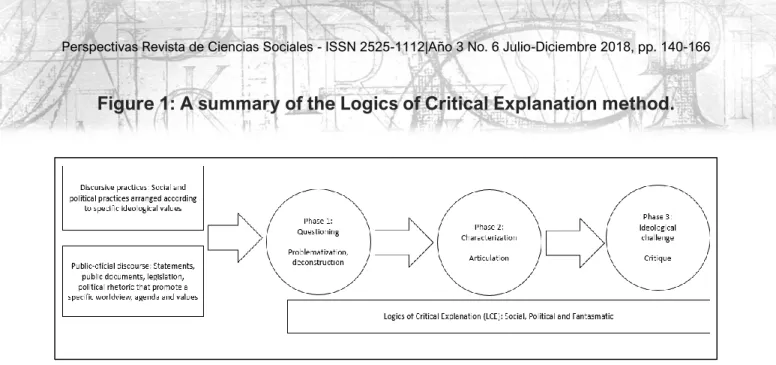
(16) Perspectivas Revista de Ciencias Sociales - ISSN 2525-1112|Año 3 No. 6 Julio-Diciembre 2018, pp. 140-166. a norm is structured or challenged by drawing chains of equivalence or difference among different elements, either linking them together or breaking them apart. Fantasmatic logics operate by either revealing or concealing the affective attachment to and radical contingency of these practices, characterizing the ideological dimension and explaining the ideological grip on the subjects (Glynos & Howarth, 2007). Although the LCE method allows the researcher to examine different kinds of social and political practices, their usefulness in performing a critical evaluation of public policy lies in its emphasis on “how policy change and policy stasis are linked to the ideas of political contestation and struggle, highlighting the radically contingent and incomplete character of social practices, as well as their fantasmatic underpinnings” (Glynos, Klimecki & Willmott, 2015: 3). The practice of doing research with the LCE method, as a discourse analytical method located within the Poststructuralist tradition, can be best summarized as follows: 1. Identifying a discursive practice worthy of examination, as well as the related sources of public-official discourse that could provide empirical material for analysis. These include, but are not limited to, statements, public documents, political rhetoric, interviews, and legislation that promote a specific worldview, agenda and values. 2. Questioning the practice in hand, going through a process of problematization and, if needed, deconstruction of said practice, by referencing the gathered data. 3. Characterizing said practices according to each type of logic: either social, political or fantasmatic. It does so by undergoing an articulation process, in which the different components of a practice are arranged and made intelligible according to the values and norms identified in the gathered data in the form of signifiers. 4. Presenting an ideological challenge of said practices via ideological critique. This is done by referencing their prevailing values and norms and unveiling the different forms in which power is exercised in the social and political practices under analysis. This could be accompanied by outlining alternative (preferred) values and norms under which practices could be arranged, favoring an emancipatory political project. While some steps and practicalities have been left out, this general overview of the method should prove enough for the reader to understand research done with the LCE.. 148.
(17) Perspectivas Revista de Ciencias Sociales - ISSN 2525-1112|Año 3 No. 6 Julio-Diciembre 2018, pp. 140-166. Figure 1: A summary of the Logics of Critical Explanation method.. Own elaboration. For this research, I set as the object of study the public-official discourse belonging to the security policy and Drug War-related violence in both the Calderón and Peña Nieto administrations, as well as in López Obrador’s Peace and Reconciliation Forums, and the different social and political practices linked to the security policy formulation and implementation. Because practices imply actions between individuals, groups and institutions that carry out and are affected by the security policy, I also make references to actors of different natures, i.e. government authorities, civil society, media, etc. Further narrowing my research, I do not attempt to problematize and characterize all practices and all public-official discourse that could be related to the security policy, but only those that affect the mourning process at a societal level. I argue that mourning should be thought of as societal instead of only belonging to the groups of families and friends of those who have died as a result of Drug War-related violence, as public-official discourse is aimed at Mexican society in general, and its resultant social and political practices are not restricted to those groups, but affect Mexican society as a whole. This does not mean that those groups do not have a more direct understanding of the experience of loss than the rest of the Mexican society, but it does mean that mourning is a process that is affected by and occurs within a wider institutional and societal setting. This research has two guiding research questions. The first: How do public-official discourse and its associated discursive practices in the context of the Mexican Drug War hinder or enable mourning? This research question presupposes that publicofficial discourse and its associated discursive practices do influence mourning. I do not believe I need to justify this assumption, given the aforementioned research by Butler (2006; 2009), Glynos (2014) and Hurtado (2016), as well as the subject area of necropolitics. For this first question, I present the following hypothesis (H1): significant sectors of Mexican society experienced blocked mourning due to the public-official discourse regarding the security policy and the Mexican Drug War. The second guiding question is: What is the significance of the Peace and Reconciliation Forums in relation to mourning? This question presupposes that the Forums are mechanisms that signal a different approach to security policy formulation from the incoming. 149.
(18) Perspectivas Revista de Ciencias Sociales - ISSN 2525-1112|Año 3 No. 6 Julio-Diciembre 2018, pp. 140-166. administration, and thus their significance should be explored. The hypothesis for this second question (H2) is the following: the Peace and Reconciliation Forums constitute consultation logics that, while not sufficient in themselves, open the path to successful mourning. The LCE method allows me to problematize and characterize the justification, design and execution of the Calderón and Peña Nieto administrations’ security strategy and policies. Similarly, it allows me to highlight how the federal government’s rhetoric surrounding Drug War-related violence created a regime of practices in which subjects experienced blocked mourning. Furthermore, it allows me to characterize the forums as political logics that allow for contestation of the current regime of practices and provides the pathway to a projected regime of practices, with its accompanying logics, and how this response and the projected regime have the potential to enable successful societal mourning. In accordance with the LCE method, the research strategy consists of gathering information and empirical raw material regarding the security policies and rhetoric followed since the beginning of the Drug War, as well as material related to Drug Warrelated violence. This material comprises a variety of sources, among them government policy plans, speeches, legislation, news websites, etc. It does not include restricted documents that were later made available through investigative journalism, as those do not present a source of public-official discourse but instead refer to internal and operational communications. Among the documents that provide insight into the Calderón and Peña Nieto administrations’ approach to security policy are the National Development Plans, the Programs for National Security, and the Sectorial Programs for National Defense. Official documents do not provide suitable information to characterize the effects of the security policies and the rhetoric surrounding Drug Warrelated violence on mourning. Thus, for this purpose, news reports and statements made by the relevant actors will provide the basis for analysis. With this material I will critically explain the security discourse and practices and examine its relationship to mourning at a societal level.. Discourse analysis - Regime of Dismissal, social logics, and hindered mourning In the following, I provide a critical analysis of both the Calderón and the Peña Nieto administrations’ security policy areas that influence mourning at a societal level. My analysis will first problematize and characterize the security policy areas in either or both administrations that can be considered to have an impact on mourning. Then, the focus shifts to explaining how the discursive justifications of the security policy and its associated practices hinder the mourning process. Although by method the analysis focuses on the Mexican federal government’s discourse on security and violence, to get an understanding of the self-interpretations of the actors involved in the logics, references to their statements and actions will be made. The security policy areas, discourses and practices of both the Calderón and the Peña Nieto administrations that influence mourning can be understood as forming a regime of dismissal comprised of three features: top-down approach to security policy. 150.
(19) Perspectivas Revista de Ciencias Sociales - ISSN 2525-1112|Año 3 No. 6 Julio-Diciembre 2018, pp. 140-166. formulation, underestimation of violence levels and dismissal of victims’ collectives and Human Rights groups’ claims relating to the dead, the disappeared and other victims of violent crime. The regime of dismissal earns its label because each administration has dismissed opposing narratives and concerns, minimizes the effects of violence on the Mexican population, and justifies state violence in the context of the Mexican Drug War. Although each administration emphasized different aspects in its respective security policy, their common features allow for a grouped characterization under the regime of dismissal. The regime consists of four social logics: confrontational, declarative, mistrust and dismissal, and bureaucratic. Each of these logics has different actors involved in it, as well as different practices that constitute them by following its norms, rules and conditions. These are social logics insofar as they represent established practices within the security strategy followed by both administrations, constituting patterns of behavior around which actors and actions coalesce. Confrontational logics are about openly attacking those groups that have been framed as the adversary in the Mexican Drug War, and how different actors enact this norm or play a role in its material manifestation. In these logics, criminal organizations such as the drug cartels are framed as threats that have taken hold of different public spaces and spheres. Discursively, as shown in Calderón’s National Development Plan, the government’s duty is to “apply the force of the State, within the legal framework” (Gobierno de la República, 2007: 58, own translation) to recover these spaces. The Mexican Armed Forces, who have “the enormous responsibility and the great privilege of being guarantors of security, of national sovereignty and of the protection of the interests of the nation” (ibid:67, own translation), provide aid. The underlying assumption for confrontational logics is that the best way to deal with the adversary is through open, frontal attacks, and the best means to achieving conditions of security is by using the Armed Forces. The practices that follow the confrontational rule are the militarization of public security, which views the Armed Forces as a preferable means for public security provision; the aggressive challenge posed by both the Mexican Government and criminal organizations in relation to each other; and intergroup killings, referring to those resulting from government and criminal organizations’ attacks on each other, but also those that happen among the criminal organizations themselves. The self-interpretation that emerges here is one of deadly adversary, which emerged from the Calderón administration’s statements but is also discursively constructed by the media, foreign governments and the criminal organizations. It is important to note that although in practice the security policy of the Peña Nieto administration also continued the confrontational approach, discursively it was deemphasized. For the Peña Nieto administration, declarative logics became the norm. In content, they are about making statements and commitments concerning public security and appropriate institutional responses to violence. The adjective “declarative” points to a fundamental contradiction within these logics: what was stated in public-official discourse would rarely materialize in its practices. In other words, the attention in public-official discourse to the multidimensional essence of violence, as seen in the Peña Nieto administration’s Program for National Security 2014-2018 (Consejo. 151.
(20) Perspectivas Revista de Ciencias Sociales - ISSN 2525-1112|Año 3 No. 6 Julio-Diciembre 2018, pp. 140-166. Nacional de Seguridad, 2014), and its commitments, such as those in reaction to the disappearance of the Ayotzinapa students (Causa en Común, 2015), were not reflected in coherent security policy actions. As such, the constitutive practices of the declarative logics are the making of void commitments, referring to the administration’s multiple statements regarding its intended response to increasing violence and Human Rights’ abuses but few concrete actions to follow up on those statements; and unimplemented and/or poorly implemented strategies and programs, such as the National Program for the Social Prevention of Violence and Crime, which, according to political analyst Alejandro Hope, “served for many things, but not to prevent crimes, at least there was no evidence that it served to prevent a single crime” (Hope in Cisneros, 2016, December 19, own translation). The actors in these logics were the Federal Government, civil society in the form of victims’ and Human Rights’ groups, and the media. The resulting self-interpretation can be characterized as merely being actors involved in an empty communication process, ignoring its discursive content because of each actor’s understanding of the others’ nature and interests, with victims’ groups claiming that the increasing forced disappearances and violence levels have not “been adequately recognized and assumed by your (Peña Nieto’s) government” and the government abandoning the monitoring of the cases (Mendes Robles, 2015, February 15, own translation). Mistrust and dismissal logics can be said to apply equally to both administrations and concern the lack of trust among the actors and a dismissal of each other’s views and concerns, which may result from different priorities or negative previous experiences. The main actors here are the Federal Government, victims and Human Rights’ collectives, and Self-defense groups, and its activities include, but are not limited to inter-group meetings, claim dismissal, forms of vigilantism, and protests. Both administrations underestimate the impact of violence on civil society and how it reflects a systemic Human Rights’ crisis, as suggested by their comments that most of the victims have been involved with organized crime (Univisión, 2010, April 18), and that violence is not systemic but is localized in only some regions of the country (Vanguardia MX, 2018, September 2). Similarly, civil society groups and movements have questioned their approaches to Human Rights’ issues in the security policy formulation and implementation, mentioning that “from the moment the army arrived the abuses began” (Althaus, 2012, April 14, own translation). Further, where violence has reached critical levels and organized crime groups have de facto replaced the state as the dominant authority, self-defense groups have come together to oppose them, believing the Government to be ineffective. This, however, has caused them to enter into conflict with formal authorities, as their activities can be considered a form of vigilantism (Verza, 2014, January 14). The self-interpretation picture that emerges in these logics is that each actor views each other as a rival who pursues its own agenda, which conflicts with their own. Finally, the bureaucratic logics refer to formal transactional practices and paperwork between the main actors, in this case the three levels of Government and civil society, that are the means for their intended ends. In the case of the Government, formally it is to fulfill its role in justice procurement, but logistically it also involves registering. 152.
(21) Perspectivas Revista de Ciencias Sociales - ISSN 2525-1112|Año 3 No. 6 Julio-Diciembre 2018, pp. 140-166. criminal cases and related data. For civil society, however, the stakes are higher, because reporting instances of crime is the only stage of the process where victims and Human Rights’ groups have agency, relying instead on the Mexican institutional frameworks to give them justice. However, federal institutions such as Províctima have been described as “practically useless” (Turati, 2012, October 6, own translation), and the General Attorney’s Office has faced criticism for their failure to give convincing and evidence-based results on disappearance and Human Rights’ violations cases (Mendes Robles, 2015, February 15). The self-interpretation picture that emerges from these logics is one where the actors view themselves in relation to each other as means to an end, although the asymmetrical power relationship implies that many criminal reports and complaints do not produce the intended results for victims’ groups.. Table 1: Regime of dismissal and constituting social logics. REGIME OF DISMISSAL ADMINISTRATION. Logic. Actors. Constituting practices. Source evidence translation). CALDERÓN. Confrontational logics: About openly attacking the adversary.. Government (three levels). Militarization of public security. Armed forces. Aggressive challenge (bidirectional, from Government to organized crime groups and vice-versa). “The long struggle to establish ourselves in a free nation, in a nation of law, cannot be understood without the Armed Forces” (Gobierno de la República, 2007:7). “Recover the strength of the state and security in social coexistence, taking a frontal fight against drug trafficking and other expressions of organized crime” (Gobierno de la República, 2008: 4). “Mr. President, a question ... do you estimate that your life will be enough for you to find all my people? Take care, we have a mission and we promise the people that it will be fulfilled” (La Redacción Proceso, 2009, August 12). “The National Security policy is multidimensional insofar as it provides comprehensive attention to the vulnerabilities, risks and threats that directly impact the development of the Mexican State and the quality of life of its population” (Consejo Nacional de Seguridad, 2014: 2728). “One year after the announcement of President Enrique Peña Nieto's 10 measures regarding security ... what we find is that nothing has changed and that the human rights crisis is installed in the country. This decalogue was a discourse to move the moment,. Criminal organizations Foreign governments. PEÑA NIETO. Declarative logics: About making statements concerning public security and institutional responses to violence.. Media. Inter-group killing. Government (federal level). Void commitments. Civil society (Victims’ and Human Rights’ groups). Unimplemented and/or poorly implemented strategies and programs.. Media. (own. 153.
(22) Perspectivas Revista de Ciencias Sociales - ISSN 2525-1112|Año 3 No. 6 Julio-Diciembre 2018, pp. 140-166. but that as announced was left behind” (Román, 2015, November 24).. BOTH. BOTH. Mistrust and dismissal logics: None of the parties interested in reducing criminal violence trusts each other, have opposing views on same issues.. Government (federal level). Bureaucratic logics: formal transactional practices and paperwork.. Government (three levels). Civil society Self-defense groups. Claim dismissal Lack of commitment to agreed cooperation and dialogue Protests marches. and. Vigilantism. Complaint filing. Crime reporting.. Civil society Case monitoring and results production.. "More than 90% of those homicides and executions… are precisely due to the fight of some cartels against others" (Calderón, in Univisión, 2010, April 18). “His (Felipe Calderón’s) strategy multiplied crime and made society even more vulnerable to crime, but also refuses to keep his word and the commitments made to the victims of violence" (Movimiento por la Paz con Justicia y Dignidad, 2012, July 27, parenthesis added). “From the moment the army arrived the abuses began” (Althaus, 2012, April 14). “President Enrique Peña Nieto assures, in the document of his Sixth Government Report, that the violence in Mexico "in no way (is) a generalized crisis"” (Vanguardia MX, 2018, September 2). “Criticisms against the practically useless Social Procurement Office for the Attention to the Victims of Crimes (Províctima) multiply, those who come to it are received, but they cannot find a solution to their problems” (Turati, 2012, October 6). "The General Attorney’s Office (PGR) decided to stop accompanying the relatives of missing persons, who in the absence of effective results from the authorities have had to assume the search for at least 380 victims of disappearance in Iguala” (Mendes Robles, 2015, February 15).. The four social logics which form the regime of dismissal, taken together, hinder the mourning process at a societal level, although they affect more directly victims’ collectives and Human Rights’ groups. This can be best explained by examining the role these logics play in relation to Glynos’ aforementioned two conditions that enable mourning: 1) an event or site that endorses a publicly shared recognition of loss, and 2) an appropriate context within which loss can be processed. Confrontational logics meet neither condition, as a context in which open armed combat between criminal organizations and the Armed Forces is favored will inevitably result in the loss of life from both sides and, additionally, from unrelated individuals involved in the conflict. A prominent case related to confrontational logics is the ordeal experienced by the Reyes Salazar family, in the state of Chihuahua, who after having three family members killed in a short period of time, became activists critical of the. 154.
(23) Perspectivas Revista de Ciencias Sociales - ISSN 2525-1112|Año 3 No. 6 Julio-Diciembre 2018, pp. 140-166. militarization of public security and the policies promoted by president Calderón. They claimed that such policies “put in so many federals in Chihuahua who are the ones that are ending us” and demanded that “you withdraw and retire and end this stupid and dirty war that you have” (Álvarez, 2011, February 25, own translation). Amid such a context in which families and groups keep losing members to Drug War violence, the mourning process will face constant interruption, as events keep occurring that create constant disruption in the subjects’ narratives and generate anxiety, uneasiness and despair. Declarative logics may seem, initially, to fulfill the first condition, an event that produces a publicly shared recognition of loss. Yet, this is done as repeated statements and void commitments, lacking significant institutional action. What results is not a publicly shared recognition of loss, but a public perception of political distance and lack of concern that the ruling class exhibits in relation to the Mexican population affected by violent crime. Any potential for enabling the mourning process afforded by public statements or commitments is, therefore, nullified by the absence of actions that give them substance. This lack of substance also limits their capacity to fulfill the second condition, firstly because the action of making a statement is one-directional, without engaging in dialogue with the affected population, and then because nothing is done via institutional action to create an appropriate context through which loss can be processed. Mistrust and dismissal logics meet neither condition, as some actions from the Armed Forces, such as the “allegations of human rights committed by the military, extrajudicial executions, sexual assault and torture” (Ordorica, 2011, December 1st, own translation) enhance the mistrust from civil society in the Mexican state and its institutions. Also restricting the possibility to mourn, and I would argue, create a state of melancholia at a societal level, is the discursive decision to, on the one hand, understate the violence levels (Vanguardia MX, 2018, September 2) and, on the other, group victims not participant in criminal activities with victims who were members of organized crime (Calderón, in Univisión, 2010, April 18; Campos Garza, 2016, March 18). Further, by failing to provide a safe environment, hampering the attempts by selfdefense groups to organize themselves and protect their communities from criminal organizations and labeling this as vigilantism (CNN México, 2014, January 23), the Mexican state discourages the population to look at its fragile institutional framework and encourages to look at themselves for the causes of violence. By doing this, both administrations have created in public-official discourse a framework that encourages subjects to question their perceptions of a societal problem and their moral allegiance. In this discourse, the consequences of violence, and victimhood, are thus responsibility of the Mexican population for not taking appropriate safeguard measures and for breaking the rule of law by defending themselves, not of either administration nor of their approach to security policy. Finally, bureaucratic logics fail to meet either condition, as the emphasis on bureaucratic complaints and paperwork does not create an event that addresses the loss for the victims’ families and Human Rights groups. Instead, what it creates is a transactional, de-personalized situation in which the experience of loss is disembodied. 155.
(24) Perspectivas Revista de Ciencias Sociales - ISSN 2525-1112|Año 3 No. 6 Julio-Diciembre 2018, pp. 140-166. by having it written in printed or digital forms, to be received and evaluated by the security procurement institutions, which often fail to produce results that enable victims to find justice and begin the mourning process. Thus, bureaucratic logics fail both as an event that creates a publicly shared recognition of loss, and do not provide an appropriate context for mourning.. The Peace and Reconciliation forums and the potential for mourning After explaining how the regime of dismissal hinders the mourning process, and to some degree contributes to generating melancholic subjects, the Peace and Reconciliation forums held by López Obrador’s team can be characterized in relation to the social logics and their potential for enabling mourning at a societal level. The political role the forums have in the context of the Drug War but also in the political climate in Mexico is multiple. From a policy formulation perspective, they are mechanisms that allow López Obrador and his transition team to express their premises and views on security issues, but also to get enough inputs to design a comprehensive and attuned security policy. For this purpose, these forums are open not only to the victims’ collectives and Human Rights’ groups, but to all groups that have been affected by Drug War-related violence, including but not limited to individual victims, general citizenship, civil society organizations and experts on security issues (Consulta de la Paz y Reconciliación Nacional, 2018). From a psychosocial perspective, it allows different actors affected by and acting within a social and political issue to interact with each other, to see the role they play in the political scene and to confront different approaches to public security. But from a political perspective, what these forums signal is a break from dominant practices to security policy formulation, as well as a closer engagement with the population affected by violence and criminal activity. This break allows for the characterization of the forums as a political logic within the LCE methodological framework. As previously stated, political logics seek to draw equivalences or differences between elements, groups or individuals, typically by appealing to an existing social norm or an alternative, projected norm. In this case, both the Calderón and the Peña Nieto administrations have a particular vision of the security policy, its needs, its threats, its mechanisms, its actors and its consequences, elements of which have been highlighted here and which constitute social logics and belong to the regime of dismissal. The forums work as a political logic because, in abstract, through their discourse they draw differences between the incoming López Obrador administration and its predecessors. What norms, rules and values do the forums contest, and how can the forums be characterized? An initial norm and rule that the forums contest is the top-down approach to security policy formulation that rests primarily in the Mexican president and the members of his ministries, with the decision for the intervention of the Armed Forces for public security activities being by request of the political authority (Moloeznik, 2011), with little to no input from the Mexican population. In this sense, the forums break with the traditional model of policy-making in Mexico in favor of a more democratic approach, with the forums involving any individuals or groups who. 156.
Figure


Documento similar
