
Development of discourse pragmatic markers in a multilingual classroom: A mixed method research approach
36
0
0
Texto completo
(2) Keywords: classroom pragmatics; pragmatic markers; multilingualism; pragmatics; discourse markers; classroom research; L3 pragmatics; longitudinal research; mixed method research.. 1. Introduction. Classroom pragmatics involves the study of pragmatic learning in instructional contexts. This type of research has been widely conducted in foreign language learning contexts, where opportunities for exposure or interaction outside the classroom are very limited. In the past three decades, most classroom-oriented research on pragmatics has mainly addressed the question of whether pragmatics can be learned and taught in L2 instructional contexts (see Jeon and Kaya, 2006, Taguchi, 2011a, 2015, and Takahashi, 2010, for an overview of instructional studies in pragmatics) taking Schmidt’s (1990, 2001) noticing hypothesis and the constructs of attention and awareness as the basis for pedagogical approaches. However, in today’s globalised world, a variety of classroom environments have emerged, and the need for research into these new learning contexts from new theoretical perspectives has been capitalised (Bardovi-Harlig, 2013).. One learning environment that has motivated research in the last decade is the multilingual classroom. Despite the increase in studies on pragmatic learning in multilinguals (e.g. Alcón-Soler, 2012; Martín-Laguna, 2016; Martín-Laguna and AlcónSoler, 2015; Portolés, 2015; Safont-Jordà, 2005; Safont-Jordà and Alcón-Soler, 2012; Safont-Jordà and Portolés, 2015), the process of pragmatic learning in multilingual instructional contexts remains rather underexplored. Research to date has reported the advantages of learning pragmatics in multilingual contexts over other instructional contexts (Alcón-Soler, 2012; Portolés, 2015) and has indicated that the languages in the 2.
(3) multilingual’s mind interact with each other at the pragmatic level (Safont-Jordà, 2011, 2012, 2013). Taking into account the scarcity of longitudinal studies on pragmatic learning in multilingual classrooms, the present work looks at the patterns of change in the process of pragmatic learning in a multilingual classroom context. Following a mixed method research approach, this article has two purposes: i) to explore the patterns of change and interaction between the languages of instruction of multilingual learners, and ii) to examine the reasons behind these patterns of change.. The paper is structured as follows. First, the background section provides an overview of research on pragmatics in multilingual contexts with a focus on written production, and then, synthesises the defining features of discourse-pragmatic markers, the pragmatic target of this study. Next, the method section explains information about research participants, data collection instruments, and data analysis in the present study. After that, results related to the first and second research questions are presented, the latter including teachers’ and learners’ perspectives on the reasons behind patterns of change of discourse-pragmatic markers over time. This section is followed by a Discussion of results, and the paper finishes highlighting the main conclusions, limitations and pedagogical implications.. 2. Background research. 2.1 Pragmatics in multilingual written production Research on pragmatic learning in multilingual environments is still in its initial stages. In fact, only a few studies have adopted a multilingual perspective to explore pragmatic comprehension (Portolés, 2015; Safont-Jordà and Portolés, 2015) and production. 3.
(4) (Portolés and Safont-Jordà, 2013; Safont-Jordà, 2011, 2012, 2013). Research from a multilingual perspective has also provided evidence for the interaction between languages in multilinguals. For instance, Cenoz and Gorter (2011) adopted a “Focus on Multilingualism” approach for the analysis of Basque, Spanish and English compositions written by 165 Basque/Spanish bilingual secondary school learners of L3 English. The study found positive relations between the three languages in four out of five dimensions analysed (content, grammar, vocabulary, mechanics), and only between English and Spanish regarding organisation. With a focus on argumentative writing, Kobayashi and Rinnert (2012) analysed several text features in five multilingual Japanese university students (L1 Japanese, L2 English, and L3 French, Spanish or Korean). The results showed that discourse marker use and the construction of arguments were consistent across the three languages, which the authors relate to the development of a personal style that is shared across languages. The lowest frequency of discourse markers was found in L1 Japanese writings, in comparison with L2 and L3 essays. The study also identifies developmental sequences in the ways of constructing arguments and highlights the influence of L1 or L2 writing instruction and experience on choices in text construction. Kobayashi and Rinnert (2013) also conducted a 2.5-year case study of one multicompetent writer (L1 Japanese, L2 English and L3 Chinese). Data were collected from multiple sources: argumentation essays in the three languages known by the participant, retrospective stimulating recall, interviews and natural observations. Findings from this study revealed that while many text features overlap across the three argumentation essays, some others remain language-specific.. The above-mentioned studies illustrate the connections between the languages in multilinguals in the grammar and rhetoric of texts, but pragmatic dimensions have 4.
(5) remained underexplored in written production (Kuiken and Vedder, 2016). MartínLaguna and Alcón-Soler (2015) examined pragmatics in learners’ written production. The authors performed a cross-sectional analysis of the use of metadiscourse markers in the compositions written by Catalan-Spanish bilingual learners of English in secondary education. The study found that multilingual learners tended to use the same textual metadiscourse marker categories in Catalan, English and Spanish, and mostly relied on the forms present in the input available, which were correctly used in the three languages. Likewise, Martín-Laguna (2016) also provided evidence on cross-linguistic interaction in multilinguals in the production of textual pragmatic markers.. Although previous studies on learners’ use of discourse markers show some relations between languages (English, Spanish and Catalan), to our knowledge, no studies to date have analysed how this relation between the three languages develops over time. As far as we are aware, the only longitudinal studies taking a multilingual perspective are those by Safont-Jordà (2011, 2012, 2013), which were conducted outside the classroom. In particular, the author examines the development of requests by a trilingual child (L1 Catalan, L2 Spanish, L3 English). Oral data in these three languages obtained from play and mother-child interaction provided evidence that the three languages interact and modify one another. In particular, the results show a decrease in the use of direct requests in the participant’s L1 and L2 as a result of the introduction of English at an early age.. Finally, we acknowledge that a mixed method approach may provide a more comprehensive understanding of learners’ pragmatic development. To date, few longitudinal studies have used a mixed method approach to examine pragmatic. 5.
(6) development. In an immersion setting, Taguchi (2011b, 2012) reported quantitative gains in the participants’ ability to produce speech acts in English over time, although the qualitative analyses revealed that learners’ experiences in the learning context may influence pragmatic change at the individual level. In a study-abroad context, AlcónSoler (2017) and Sánchez-Hernández (2017) are also examples of how the combination of research methods may reveal patterns of change and the reasons behind individual variation. On the one hand, Alcón-Soler (2017) analysed the effect of instruction of email requests and the reasons behind the patterns of change observed, reporting that, although the frequency of request mitigators increased after the instructional treatment, learners’ perception of the study-abroad experience interacted with instructional effects and influenced request production over time. On the other hand, Sánchez-Hernández (2017) examined the effect of acculturation and background culture on the development of recognition and production of pragmatic routines during study-abroad programmes. Results indicated a general pattern of increase in pragmatic development, which was influenced by learners’ acculturation experiences. However, a qualitative analysis revealed different developmental paths across cultural groups and across individual learners.. 2.2 Discourse-pragmatic markers Communicative approaches have emphasised the adoption of a discourse-pragmatic perspective to language teaching and research, which “involves us in looking not just at isolated, decontextualized bits of language (…) [but] involves exploring the relationship between the linguistic patterns of complete texts and the social contexts in which they function” (McCarthy and Carter, 1994, p. 38). That is to say, there is a strong interrelation between discourse and pragmatics, and one cannot be understood without 6.
(7) the other. One linguistic aspect that clearly reflects this connection is discoursepragmatic markers (DPMs). In fact, the variety of labels adopted to refer to DPMs (e.g. cue phrases, discourse connectives, discourse operators, pragmatic connectives, pragmatic markers, pragmatic expressions, sentence connectives, see Fraser, 1999, p. 932) illustrates the overlap between both perspectives in the study of these elements.. Traditionally, the use of DPMs has been related to coherence relations (Halliday and Hasan, 1976). However, this view is rather limited, and some pragmatic approaches have emphasised the interactional functions of DPMs in discourse, arguing that the role of pragmatic markers is not simply text-organising or discoursive, but also the result of the writer’s assumptions about the reader and writer’s relationships (Hyland, 2005). According to this view, in this study DPMs are defined as discourse-pragmatic elements which signal writer (or speaker) and reader (or hearer) interaction in discourse. In other words, they mark the author’s presence within the ongoing oral or written discourse and guide the reader to “organise, classify, interpret, evaluate, and react to such material” (Vande Kopple, 1985, p. 83). They convey non-propositional content, that is, their main function is not to add content to the proposition or utterance but to perform a textual function creating a coherent discourse or an interpersonal function expressing the writer’s attitudes to the text (Hyland, 2005; Martín Zorraquino and Portolés, 1999; Schiffrin, 1987).. In addition, DPMs can be realised in a variety of ways to achieve a particular discoursal effect, including a diversity of syntactic items that can be considered DPMs, such as adverbials, lexical phrases or prepositional phrases. These elements can follow different syntactic patterns in initial, mid and final sentence position depending on grammatical. 7.
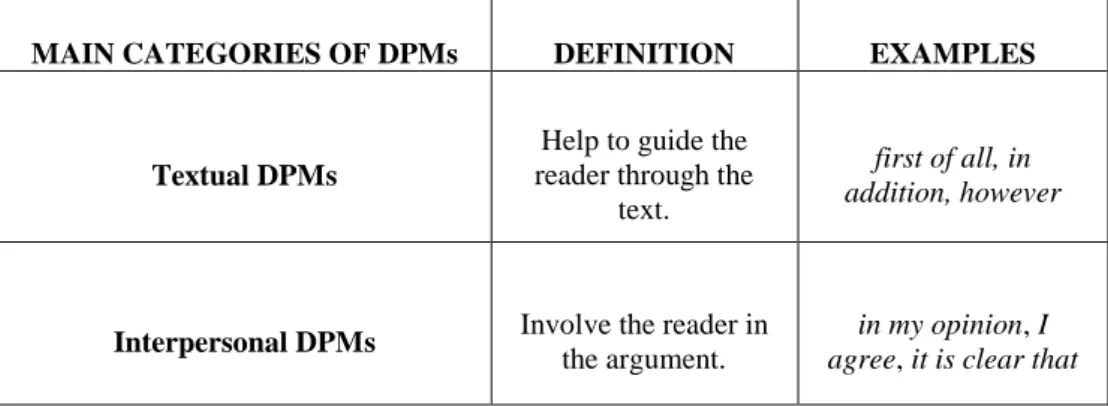
(8) constraints and on the pragmatic effect to be achieved (see Fraser, 1998). Drawing on previous taxonomies (Crismore et al., 1993; Hyland, 2000, 2005), we have distinguished two main types of DPMs: textual and interpersonal DPMs (see Table 1).. Table 1 Main types of DPM analysed in the present study. MAIN CATEGORIES OF DPMs. DEFINITION. EXAMPLES. Textual DPMs. Help to guide the reader through the text.. first of all, in addition, however. Interpersonal DPMs. Involve the reader in the argument.. in my opinion, I agree, it is clear that. Although Hyland (2005, 2010) considers these markers as intrinsically interpersonal or pragmatic, we understand textual and interpersonal DPMs as multifunctional elements that are part of a discourse-pragmatics continuum, both types performing discourse and pragmatic functions at the same time. In our view, ‘textual DPMs’ are towards the discourse end of the continuum, since they tend to be more closely related to the textual context and the management of the flow of discourse, whereas ‘interpersonal DPMs’ can be placed towards the pragmatic end, since they are used taking into account interaction between the participants in the communicative event.. Summarising, DPMs are non-propositional and multifunctional elements that perform discourse and pragmatic functions simultaneously, since not only do they contribute to text organisation but they also shape the interaction between the participants in a communicative event. Because we are dealing with learners who have limited linguistic resources in their L3 and are non-expert writers in their L1 and L2, our main focus will. 8.
(9) be on DPM use rather than on the particular discourse or pragmatic effect conveyed by the position of DPMs in the sentence.. Therefore, in the present study, we will examine learners’ use of DPMs in the Spanish, Catalan and English compositions written by Catalan/Spanish bilingual secondary school learners of L3 English. Taking into account the results from previous research showing that (a) the patterns of change between languages in the same multilingual learners are interrelated, and (b) learners’ experiences in the learning context may affect the patterns of change, two research questions are addressed:. Research question 1: What are learners’ patterns of change in the production of textual and interpersonal DPMs in the languages of instruction (English, Catalan and Spanish) in a multilingual classroom over one academic year?. Research question 2: What are the reasons behind the patterns of change in the production of textual and interpersonal DPMs in English, Catalan and Spanish over one academic year?. 3. METHOD. 3.1 Participants Three hundred and thirteen learners of L3 English (140 males and 173 females) from ten high schools in the Valencian Community in Spain participated in the study. Their ages ranged from 16 to 20 years old. Their English proficiency was judged to be lower intermediate based on the standardised Quick Oxford Placement test (UCLES, 2001).. 9.
(10) Participants were enrolled in the first of a two-year non-compulsory stage of secondary education that is intended to prepare learners for the university entrance examinations. Language instruction consisted of three hours per week of each language (English, Spanish and Catalan). English language sessions involved using the language to improve grammar and communication related to the four skills (writing, reading, listening and speaking), whereas Catalan and Spanish classes were focused on reading and writing skills, and also on literature, syntax and grammar.. There were fifty-six language teachers involved in the project, and a subset of fifteen volunteered to be interviewed for the present study (5 Catalan teachers, 5 Spanish teachers and 5 English teachers; 3 males and 12 females). Their experience teaching Catalan, Spanish or English ranged from 10 to 34 years.. 3.2 Data collection instruments Research on pragmatics has traditionally used a variety of data elicitation techniques, such as discourse completion tests or multiple choice questionnaires. However, when doing classroom-based research, the use of real classroom tasks confers ecological validity to the study and contributes to enlarge the still incipient body of research that applies a task-based language teaching framework to pragmatics research. In the present study, classroom-authentic argumentative writing tasks were used to collect data on pragmatics. Two reasons account for this choice of task. First, argumentative texts are required in the three languages (English, Catalan and Spanish) in the university entrance examinations, which guaranteed that learners were familiar with these tasks in the three languages. Second, argumentative texts are persuasive texts in which pragmatic aspects are important to convey the message to the reader in a way that it can be understood by 10.
(11) means of textual DPMs, and to involve the reader in the argument in order to be convinced by using interpersonal DPMs.. Moreover, the classroom argumentative tasks used in the present study satisfy the requirements for an activity to be defined as a ‘task’, following Ellis and Shintani’s (2014, p.135) criteria, by giving a context to make the task meaning-based. In addition, Brown and Levinson’s (1987) sociopragmatic variables (high power, medium social distance and low degree of imposition) were considered, taking into account research reporting that situational variables influence pragmatic development (Taguchi, 2011b, 2012).. As shown in Appendix 1, learners were asked to write texts stating their opinion to be read by the school’s head teacher about an issue related to the school. In order to connect the task with a real-life purpose, the discussion topics (see Table 2) were suggested by the learners in the pilot study, inspired by decisions that had raised debate in the school, e.g. Should students be allowed to take smartphones to school?, and also rated so that all topics were of a similar level of difficulty. The pilot study also showed that time pressure worked better in making adolescents concentrate on classroom activities and a time limit of 20 minutes was set to write around 120-150 words, following the guidelines established in the university entrance exams.. Table 2 Topics selected for the argumentative writing task. English. Time 1. Time 2. The end-of-school trip. Smartphones at school. Time 3. New technologies in the. 11.
(12) classroom. Catalan. The school has won a prize. Exchange programmes. Drinking alcohol at the graduation party. Spanish. The university entrance exams. Going out at night on a school trip. Content-based instruction in English. In addition, teachers’ semi-structured interviews and learners’ diaries provided multiple perspectives to understand the patterns of change during the process of learning DPMs. In the interviews, teachers were asked about their teaching practices and experiences with the students participating in the study in relation to the process of learning DPMs. The following structure and questions were prepared as a guide, but the teachers were allowed room to talk as much as they wanted: 1) General presentation of the study; 2) Teachers’ introduction of themselves and the school; 3) General questions about teaching, e.g. What aspects do you value in an essay? What do you think is important? What do you insist on?; and 4) Presentation and discussion of results with follow-up questions, e.g. How do you work on each type of DPM with the students? What patterns of change would you expect? Why are gains significant in textual DPMs as compared to interpersonal DPMs? What factors do you think may affect DPM learning? How would you explain differences between languages? The interviews were audio and video recorded and then transcribed for the analysis.. Concerning learners’ diaries, participants were given a set of guiding questions and asked to answer them in written form immediately after finishing each of the compositions in the language they preferred. The questions were provided in the three languages (English, Spanish and Catalan) and referred to general performance in the. 12.
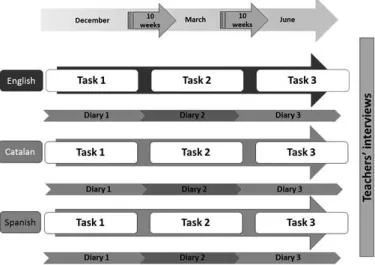
(13) task (question 1), to textual (questions 2 and 3) and interpersonal DPMs (questions 4 and 5) (see Appendix 2).. 3.3 Data analysis To answer the first research question, dealing with the patterns of change of DPMs in English, Catalan and Spanish, a total of 2,817 essays were analysed, 939 in each language (Spanish, Catalan and English). In other words, each participant wrote nine compositions, three in each language, over one academic year. As shown in Figure 1, data were gathered in three waves and there were 10 teaching weeks between each data collection time. All the essays were handwritten in the corresponding language class (English, Catalan and Spanish) and then typed by the researchers.. Figure 1 Data collection timeline. The DPM categories were coded semi-automatically using a Microsoft Access Database and manual revisions of the automatic results to allow for disambiguation, i.e. to discard forms that, depending on the context, may not act as DPMs, such as the DPM ‘and’ connecting phrases, e.g. the students and the teachers. Interrater reliability was 13.
(14) conducted on 30% of the data and 95% agreement was found between two raters on the forms to be discarded. The classification adopted in this study was adapted from Crismore et al. (1993) and Hyland (2000, 2005), who based their taxonomies on the one proposed by Vande Kopple (1985). Two main types of DPMs were analysed: textual DPMs and interpersonal DPMs (see Appendix 3).. Pragmatic learning ability was operationalised as the ability to produce textual and interpersonal DPMs fluently. Fluency was assessed by dividing the number of DPM tokens by the total number of words used by each participant in each essay. The statistical test used was repeated measures ANOVA (three levels). The independent variable was time with three levels (Time 1, 2 and 3), and the dependent variable was the ratio of use of textual and interpersonal DPMs.. To answer the second research question, that is, the reasons that could account for pragmatic changes, learners’ diaries and the interviews with five teachers of each language were examined to identify common trends that could account for the quantitative results.. 4. Results. 4.1 Results related to RQ1: Patterns of change in the production of DPMs in the languages of instruction The first research question addressed the patterns of change in the production of DPMs in the languages of instruction (English, Catalan and Spanish) over time. Table 3 shows. 14.
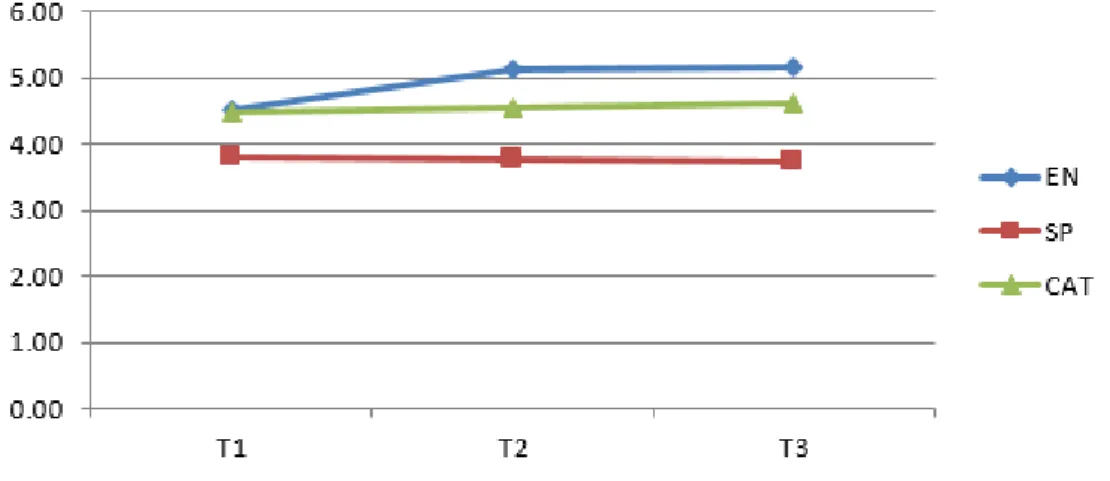
(15) descriptive statistics of the ratio of use of textual DPMs in English, Catalan and Spanish.. Table 3 Descriptive statistics of the ratio of use of textual DPMs in English, Catalan and Spanish. Textual DPMs in English Textual DPMs in Catalan Textual DPMs in Spanish. Mean 4.51 5.14 5.15 4.49 4.54 4.61 3.80 3.77 3.73. T1 T2 T3 T1 T2 T3 T1 T2 T3. SD 1.66 1.77 1.88 1.83 1.80 1.92 1.50 1.66 1.62. The ANOVA test revealed no significant gains in the production of textual DPMs in Spanish (F (2, 624) = 0.195, p = 0.823) and Catalan (F (2, 624) = 0.461, p = 0.631), although there was a slight increase in Catalan. In contrast, in English (F (2, 624) = 16.683, p < 0.01) the ratio of use was found to develop significantly in the first period (between Times 1 and 2) and overall (between Times 1 and 3), although no significant gains were found in the second period (between Times 2 and 3), where there seems to be steady progress. As illustrated in Figure 2, the patterns of change in Spanish and Catalan were linear, whereas in English there was a pattern of growth which was more noticeable in the first research period and was maintained to a lesser extent in the second research period.. 15.
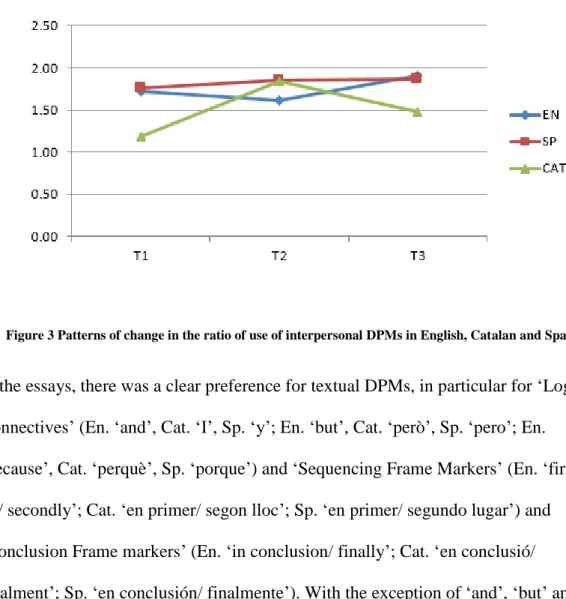
(16) Figure 2 Patterns of change in the ratio of use of textual DPMs in English, Catalan and Spanish. Table 4 shows descriptive statistics of the ratio of use of interpersonal DPMs in English, Catalan and Spanish. Pair comparisons in the ANOVA test revealed significant gains in English (F (2, 624) = 5.685, p < 0.01) between Times 2 and 3. However, these significant results between Times 2 and 3 may be due to the fact that the mean ratio diminishes at Time 2. Although the highest ratio of use was shown at Time 3, this increase was not statistically significant overall (between Time 1 and Time 3). Thus, we can conclude that gains do not seem to take place as far as this type of DPM is concerned. In Catalan (F (2, 624) = 38.553, p < 0.01), there were significant gains overall (between Times 1 and 3) and in the first research period (between Times 1 and 2), while no significance was found in Spanish (F (2, 624) = 0.833, p = 0.435). The lowest mean score was found in Catalan at Time 1, which may be explained by topic influence, since nine different topics were selected in order to avoid a repetition effect.. Table 4 Descriptive statistics of the ratio of use of interpersonal DPMs in English, Catalan and Spanish. Interpersonal DPMs in English Interpersonal DPMs. Mean 1.72 1.61 1.91 1.19. T1 T2 T3 T1. 16. SD 1.13 1.20 1.28 0.93.
(17) in Catalan Interpersonal DPMs in Spanish. 1.84 1.47 1.77 1.85 1.87. T2 T3 T1 T2 T3. 1.15 1.01 1.09 1.20 1.27. As represented in Figure 3, in interpersonal DPMs, which were the most pragmatic-like type of DPM in the discourse-pragmatics continuum, we could state that the learning of pragmatics fluctuates. While the pattern in Spanish was linear with few changes, in English and Catalan the pattern of change was more dynamic, subject to more fluctuation.. Figure 3 Patterns of change in the ratio of use of interpersonal DPMs in English, Catalan and Spanish. In the essays, there was a clear preference for textual DPMs, in particular for ‘Logical Connectives’ (En. ‘and’, Cat. ‘I’, Sp. ‘y’; En. ‘but’, Cat. ‘però’, Sp. ‘pero’; En. ‘because’, Cat. ‘perquè’, Sp. ‘porque’) and ‘Sequencing Frame Markers’ (En. ‘first of all/ secondly’; Cat. ‘en primer/ segon lloc’; Sp. ‘en primer/ segundo lugar’) and ‘Conclusion Frame markers’ (En. ‘in conclusion/ finally’; Cat. ‘en conclusió/ finalment’; Sp. ‘en conclusión/ finalmente’). With the exception of ‘and’, ‘but’ and. 17.
(18) ‘because’ and their Spanish and Catalan equivalents, most textual and interpersonal DPMs occurred in sentence-initial position.. A generalised practice observed is the use of similar DPM strategies to start the essays. Learners tended to start not only their English compositions with hedges such as ‘I think’ or ‘in my opinion’, but also use their DPM counterparts in the compositions written in Spanish and Catalan. Example 1 below illustrates how the same learner starts all his compositions, regardless of the language, with a hedge (En. ‘I think’, Cat. ‘Jo crec que’, Sp. ‘En mi opinión’ / ‘Yo creo que’), in most cases followed by a logical connective indicating cause (En. ‘because’, Cat. ‘ja que’/ ‘perquè’, Sp. ‘porque’/ ‘ja que’):. Example 11. St. 777. English. Catalan. I think that the best place to go on the. Per a començar senyor director, jo crec. En mi opinión, yo creo que la ley está. end of school trip is Mallorca because. que. el. mejor como la tenemos ahora, es. we need to relax ourselves at the beach. manteniment del centre ja que cal. decir, con la prueba de la Selectividad. and go to parties too. [...]. arreglar algunes coses com per exemple. porque. fer. perque. acostumbrados y creo que la otra. s'acumula molta gent i no hi podem. opción puede ser un poco mas dura.. entrar o ficar aire acondicionat perque. [...]. Time 1. seria. els. una. banys. Spanish. bona. mes. opció. grans. es. a. lo. que. estamos. quan fa calor, a les classes, no es pot quasi ni respirar. [...]. Time 2. I think that students should be allowed. Jo crec que seria important fer un. En mi opinión salir por las noches no. to take the smartphones to school but. intercanvi amb. estranger. acarrearia ningún problema ya que de. with some rules that they should respect.. perque així, a més de aprendre un altre. esta manera también podriamos saber. [...]. idioma també tindriem l'oportunitat de. como son estas ciudades por la noche.. coneixer altres païssos i ciutats. [...]. Además tambien nos vendria bien. un. institut. para. relacionarnos. con. los. compañeros a los que no conocemos tanto. [...]. 1. All the examples in this paper have been faithfully transcribed as they were written by participants.. 18.
(19) Time 3. I think that using new technologies. Jo crec que si que es tendrie que deixar. Yo creo que seria mala idea poner más. should be very beneficial for us because. beure als menors o al menys als majors. asignaturas en inglés ya que esto nos. if we have any dout we can look for it. de. ayudaría a desenvolvernos mejor en. on the Internet and we could not. important. interrupt the lesson. [...]. sempre ajuda a que ho pases millor. [...]. 16. anys.. Beure. pero. quan. alcohol vas de. no. es. festa. diversas situaciones. [...]. Another general trend is finishing the text with a frame marker indicating conclusion (Cat. ‘Finalment’, En. ‘Finally’, Sp. ‘En conclusión’) followed by a hedge (Cat. ‘pense que’, En. ‘I think’, Sp. ‘opino que’) in the three languages, as Example 2 illustrates:. Example 2. […] Finalment, pense que sí que hi hauria d'haver alcohol en la festa de graduació, ja que, alguns, som prou responsables per veure com ens trobem i quina quantitat de alcohol beure sense anar malament. (#110/CatT3#) […] Finally, I think that in my secondary school should improve a lot of things than importants how the technologie. (#110/EnT3#) […] En conclusión, opino que sí que sería positivo una asignatura, pero si se hace se hace desde el principio de primaria o secundaria. (#110/SpT3#). To sum up, in response to the first research question, results showed differences depending on the type of DPM analysed and variations across languages. Findings revealed a significant development of textual DPMs in English, which was more pronounced in the first research period. In Catalan and Spanish, trajectories were linear with no significant gains. In the case of interpersonal DPMs there were fluctuations in both English and Catalan, with overall significant gains in Catalan, whereas Spanish remained constant with no progression or regression.. 19.
(20) 4.2 Results related to RQ2: Reasons behind the patterns of change in the languages of instruction In order to answer the second research question – the reasons behind the patterns of change – and to further understand the quantitative findings, we looked at the information gathered from teachers’ interviews and learners’ guided diaries. Despite belonging to ten different high schools, several common trends can be defined within each group, i.e. learners and teachers.. 4.2.1 Teachers’ perspective The answers given by teachers to explain the factors that may have exerted an influence on the patterns of change above can be grouped into three categories: (i) teachingrelated factors, (ii) context-related factors, and (iii) affective factors.. Regarding teaching-related factors, there were similarities and differences in teachers’ practices in the classroom, depending on the language taught, that may have contributed to shape patterns of DPM development. First, all teachers pointed out the importance of DPMs on their assessment scales for written production, which followed the marking criteria of the university entrance examinations. In addition, the focus on aspects of discourse (coherence, cohesion, text structure and organisation) may have promoted a higher use of textual DPMs than interpersonal DPMs. In this regard, teachers reported that interpersonal DPMs receive more attention in oral activities than in written ones, because they are used more often in the oral mode. This is evidenced in the teaching materials. Teachers also said that some interpersonal DPMs come out more naturally.. 20.
(21) Second, another commonality is that in all language subjects, teachers provided students with lists of DPMs. However, the different approaches taken to teach DPMs in Catalan and Spanish with respect to English may explain differences in patterns of change between languages. In Spanish and Catalan, although there was time for practice and feedback, the main focus was on reading, analysing and identifying DPMs, and commenting on syntax and grammar. In contrast, the approach taken when teaching DPMs in English was more practical and focused on output. In fact, the role of English teachers in drawing learners’ attention to DPMs and the feedback provided may have promoted the use of particular types of DPMs in this language. For example, one teacher emphasised the importance of drawing learners’ attention to notice and use DPMs with the following anecdote in Excerpt 1:. Excerpt 1.. [For example, there is a structure that I told them to highlight, which was ‘it is undoubtedly true’. They liked it so much that I now have fifty essays that I marked at the weekend in which most students used this structure.] (#Teacher 5#, our translation). The teaching practices reported above focused on textual DPMs rather than interpersonal ones in the English class, in contrast to what occurs with Catalan and Spanish, may account for the overall significant gains in textual DPMs in English. In addition, all teachers agreed in stating that the lack of significant gains between Time 2 and Time 3 in textual DPMs in English may be due to the fact that learners have reached the top end. In this regard, one of the teachers went further and pointed out that, if the study had continued, there may not have been an improvement in the ratio of use. 21.
(22) of textual and interpersonal DPMs but in the range of vocabulary used, as well as in the development of more elaborated ideas as a result of the effects of maturation at that age.. Third, teachers’ feedback on DPMs may have also shaped more fluctuating trajectories in interpersonal DPMs in English. One teacher explained that learners tend to start their compositions with the DPM ‘I think’, which is considered a very basic structure. Another teacher also reported that when textual DPMs are introduced, teachers insist on their use. As a result, learners focus on textual DPMs, the ones introduced by the teachers, which leads to a decrease in the pattern of change of interpersonal DPMs in English at Time 2, while there is an increase in textual DPMs. At Time 3, learners maintain their knowledge of textual DPMs, which may explain why the change is positive but not so pronounced, while interpersonal DPMs are introduced again, with a corresponding positive change in interpersonal DPMs.. With regard to context-related factors, the patterns of change of DPMs in English were the ones that raised the most comments in the interview. Teachers noted that the lack of significant gains between Times 2 and 3 in textual DPMs in English may be due to the fact that, during this research period, there are many holidays. Teachers reported that it seems to take some time to gain students’ attention before and after the holidays, and this affects their overall performance at the end of the academic year. Similarly, one teacher pointed out that the important aspects need to be worked on before the third term, which coincides with these holidays and the end of the academic year. She added that anything that is not done before this point is not really learnt because students are not so efficient and do not pay so much attention in class. Another dimension that Catalan teachers mentioned is the sociolinguistic context of the study, where Spanish. 22.
(23) has more prestige than Catalan, and this may have raised negative attitudes towards Catalan, which in turn may have shaped fluctuating trajectories in interpersonal DPMs.. Attitudes to languages, together with motivation, constitute the third aspect identified that may explain the patterns of change observed in the process of learning DPMs in the multilingual classroom. In contrast to Spanish and Catalan, English is the lingua franca for international communication and a requirement to apply for most jobs. As a result, learners seem to make the effort of improving their discourse-pragmatic competence in English. In the case of Spanish and Catalan, learners are fluent in these languages and are able to write an average text without much effort, so they remain on a comfortable plateau that may explain the linearity in trajectories.. 4.2.2 Learners’ perspective In order to better understand DPM learning trajectories, the data obtained from the teachers’ perspective were triangulated with data from the point of view of the learners.. Regarding the use of textual DPMs in English (reported in the second and third questions of Appendix 2), the diaries showed that most learners were able to name examples of textual DPMs used in their text from Time 1, although they were able to identify and use more varied textual DPMs at Times 2 and 3. This provides evidence of learners’ awareness of textual DPMs, probably as a result of teachers’ emphasis on DPMs in the classroom and may explain significant gains in the patterns of change of textual DPMs in English. In Spanish and Catalan, the diaries show that learners know these markers but participants’ comments are similar at all time points, indicating that perhaps learners pay attention to their performance in these languages and remain on a 23.
(24) comfortable plateau. One reason may be that learners are able to communicate in Spanish and Catalan without much effort and can ‘get by’ with the language they know, which leads to patterns of change with no significant gains in textual DPMs in these languages.. It is also worth noting that, in some cases, learners illustrate their answers on textual DPMs by including examples of interpersonal DPMs in English, Catalan and Spanish. This finding is consistent with the way interpersonal DPMs are presented in the input materials, without any reference being made to them as pragmatic elements.. When being asked about interpersonal DPMs in the fourth and fifth questions, learners were told to explain whether the text was adequate for the reader. In this case, a variety of responses were found in the three languages, which may explain fluctuations in the patterns obtained regarding the use of interpersonal DPMs. A few learners left the space blank, stating that they did not know what to say. The vast majority pointed out that they had not taken the reader into account and would have written the same for another addressee. A third group of learners reported that they had taken the reader into account because they had mentioned him or her, or that they rely on the use of pragmatic formulas such as Thank you for your attention, Thanks for consider my opinion, Mr headmaster, Yours sincerely, dear headmaster… Finally, in a few cases, learners reported the use of the interpersonal DPMs ‘in my opinion’ and ‘I think’, which are the most widely used interpersonal DPMs in the compositions analysed.. To sum up, in order to answer the second research question, it seems that both learners and teachers approached DPMs not as pragmatic elements but as discourse elements.. 24.
(25) This may have contributed to shape a positive developmental trajectory in textual DPMs in English. In contrast to textual DPMs, in interpersonal DPMs a clear regular pattern cannot be explained from the qualitative data, which is in line with the irregular trajectories found in interpersonal DPMs in the quantitative analysis. Differences in teachers’ approaches to dealing with both types of DPMs in the classroom, classroomrelated factors, and attitudes towards languages may account for differences in the patterns of development in English, Spanish and Catalan.. 5. Discussion. Research on pragmatics in multilingual classrooms is still incipient. The present study intended to advance current practice by assessing pragmatic development in such a context following a mixed method research approach. With regard to the first research question, which explored patterns of development in the production of textual and interpersonal DPMs in English, Spanish and Catalan in multilinguals, the results showed variations across types of DPMs, since more stable patterns were found in textual DPMs in contrast to fluctuations in interpersonal DPMs. In line with previous research on pragmatic development (Taguchi, 2011b, 2012), the present study evidences that not all pragmatic functions develop at the same pace, even in instructed learners (Alcón-Soler, 2017).. Our findings also revealed variations in DPM learning trajectories between languages in multilingual instructional contexts. In particular, there was an increase in the use of textual DPMs in English in contrast to stagnation and linearity of the use of textual DPMs in Catalan and Spanish over the academic year. The patterns of learning interpersonal DPMs were irregular in English and Catalan and these languages 25.
(26) interacted, whereas stagnation was found in Spanish, following a linear trajectory. In spite of fluctuations in interpersonal DPMs, progress was only made over time in Catalan. One reason that may account for these findings could be that the sociolinguistic status of Spanish as a majority language enhances linearity in pragmatic learning trajectories. In the case of the minority language (Catalan) and the L3 (English), the lower presence of Catalan and the scarcity of opportunities to write in English both in and out of school may explain why DPMs in these languages are more dynamic.. Another possible explanation is related to attitudes and motivation towards languages. Learners may have an instrumental motivation to learn textual DPMs in English, which is reflected in gains in development, whereas they may have more emotional affinity with Catalan, resulting in a positive overall development of interpersonal DPMs. This interpretation is in line with previous research showing that attitudes to languages have an effect on pragmatic awareness in multilinguals (Portolés, 2015).. Findings related to the second research question, dealing with the reasons for the developmental patterns described above, showed that learners’ and teachers’ awareness of textual and interpersonal DPMs may be explained by classroom-related factors and attitudes towards English, Spanish and Catalan. The centrality of context-related factors to shed light on developmental patterns, namely teachers’ approach to teaching DPMs and the influence of the sociolinguistic context, also supports previous research findings in other learning contexts (Alcón-Soler, 2017; Sánchez-Hernández, 2017; Taguchi, 2011b, 2012), which point out that there is an interaction of factors contributing to shape pragmatic developmental trajectories.. 26.
(27) Finally, findings from the study showed that there was a preference for the use of DPMs in sentence-initial position in the three languages analysed, which may be related to the participants’ proficiency level in the L3. It may be less risky, in terms of L3 accuracy, to use structures that are adjacent to the sentence separated by commas or to use conjunctions connecting clauses than DPMs introducing subordinate clauses, which are more complex. Another reason that may account for this result in L1 and L2 DPM production may be learners’ lack of awareness of the possibilities of manipulating language to create a particular effect. Teachers’ focus on discourse and text structure may have also influenced the use of ‘Sequencing Frame Markers’ and ‘Conclusion Frame Markers’. Our findings also reveal that textual DPMs tend to be taught more explicitly than interpersonal DPMs, which may explain differences in the patterns of change. In addition, our results seem to suggest the need to raise learners’ awareness on how to use interpersonal DPMs, and how to exploit these pragmatic resources in the other languages known by multilinguals (Cenoz and Gorter, 2011).. 6. Conclusions, limitations and pedagogical implications. This study goes beyond previous research conducted in multilingual instructional settings by investigating pragmatic learning trajectories in English, Catalan and Spanish in the same learners over time. This study has shown that changes in the process of DPM development are determined by a complex interplay between awareness of DPMs, teaching-related factors, context-related factors and affective factors.. Several considerations are in order when interpreting our findings as evidence of pragmatic development. First, we focused on the use of DPMs without taking into account whether these pragmatic targets were used appropriately in the text. Further 27.
(28) studies need to combine frequency analysis with measures for a holistic evaluation of functional adequacy (Kuiken and Vedder, 2016). Second, this study explained changes in pragmatic development with qualitative data to supplement quantitative findings, tracing common trends in the data gathered. However, we have not considered cases of particular learners as previous studies have done in other learning contexts (AlcónSoler, 2017; Taguchi, 2011b, 2012). Future research should consider individual trajectories compared to group development in order to consider whether individual differences may have an impact on pragmatic development in multilingual classrooms. Despite these limitations, the present study fills a research gap by exploring pragmatic development in a particular classroom context, the multilingual classroom, which has not been addressed in previous research on pragmatic development.. Our findings also suggest some pedagogical implications. First, taking into account our results showing that textual DPMs are developed in English under propitious conditions, and that boundaries between languages are blurred in multilinguals (Cenoz and Gorter, 2011), learners should be encouraged to transfer their discourse-pragmatic knowledge across the languages they know. This may be facilitated if teachers adopt a multilingual approach in their teaching. By so doing, teachers should also take a more pragmatic approach, paying greater attention to interpersonal DPMs and to the possibilities of changing the position of particular DPMs to create a particular effect. Drawing learners’ attention to the functions and position of DPMs during written activities seems to be important to learn how to write adequately. How teachers can effectively raise learners’ awareness of these functions and positions is also an aspect to be explored in future classroom-oriented research in multilingual educational contexts.. 28.
(29) References Alcón-Soler, E. (2017). Pragmatic development during study abroad: An analysis of Spanish teenagers’ request strategies in English emails. Annual Review of Applied Linguistics, 37, 77-92. doi: 10.1017/S0267190517000125. Alcón-Soler, E. (2012). Teachability and bilingualism effects on third language learners’ pragmatic knowledge. Intercultural Pragmatics, 9(4), 511–541.. Bardovi-Harlig, K. (2013). Developing L2 Pragmatics. Language Learning, 63(1), 68– 86.. Brown, P., & Levinson, S. C. (1987). Politeness: Some Universals in Language Usage. Cambridge, UK: Cambridge University Press.. Cenoz, J., & Gorter, D. (2011). Focus on Multilingualism: A Study of Trilingual Writing. The Modern Language Journal, 95(3), 356–369.. Crismore, A., Markkanen, R., & Steffensen, M. (1993). Metadiscourse in persuasive writing: a study of texts written by American and Finnish university students. Written Communication, 10(1), 39–71.. Ellis, R., & Shintani, N. (2014). Exploring language pedagogy through second language acquisition research. London: Routledge.. 29.
(30) Fraser, B. (1998). Contrastive Discourse Markers in English. In A. H. Jucker & Y. Ziv (Eds.), Discourse Markers: Description and Theory (pp. 301-326). Amsterdam/ Philadelphia: John Benjamins.. Fraser, B. (1999). What are discourse markers? Journal of Pragmatics, 31, 931–952.. Halliday, M. A. K., & Hasan, R. (1976). Cohesion in English. London: Longman.. Hyland, K. (2000). Disciplinary Discourses: Social Interactions in Academic Writing. Harlow: Pearson Education.. Hyland, K. (2005). Metadiscourse. Oxford: Continuum.. Hyland, K. (2010). Metadiscourse: Mapping Interactions in Academic Writing. Nordic Journal of English Studies, 9(2), 125–143.. Jeon, E. H., & Kaya, T. (2006). Effects of L2 instruction on interlanguage pragmatic development. In J. M. Norris & L. Ortega (Eds.), Synthesizing Research on Language Learning and Teaching (pp. 165–211). Amsterdam: John Benjamins.. Kobayashi, H., & Rinnert, C. (2012). L1/L2/L3 text construction by multicompetent speakers. In C. Conlan (Ed.), Evolving Paradigms: Language and Applied Linguistics in a Changing World. Refereed proceedings of the Applied Linguistics Association of Australia Annual Conference, School of Education, Curtin University.. Kobayashi, H., & Rinnert, C. (2013). L1/L2/L3 writing development: Longitudinal case study of a Japanese multicompetent writer. Journal of Second Language Writing, 22, 4–33. 30.
(31) Kuiken, F., & Vedder, I. (2016). Functional adequacy in L2 writing: Towards a new rating scale. Language Testing, 1–16.. Martín-Laguna, S. (2016). Exploring Textual Pragmatic Markers in a Multilingual Classroom Context. In F. Bianchi & S. Gesuato (Eds.), Pragmatic Issues in Specialized Communicative Contexts (pp. 195–216). Leiden/Boston: Brill Rodopi.. Martín-Laguna, S., & Alcón-Soler, E. (2015). Do learners rely on metadiscourse markers? An exploratory study in English, Catalan and Spanish. Procedia - Social and Behavioral Sciences, 173, 85–92.. Martín Zorraquino, M. A., & Portolés, J. (1999). Los marcadores del discurso. In I. Bosque & V. Demonte (Eds.), Gramática descriptiva de la Lengua Española (pp. 4051-4213). Madrid: Espasa-Calpe.. McCarthy, M. & Carter, R. (1994). Language as Discourse. Perspectives for language teaching. Harlow: Longman.. Portolés, L. (2015). Multilingualism and very young learners: an analysis of pragmatic awareness and language attitudes. Boston: Mouton de Gruyter.. Portolés, L., & Safont-Jordà, M. P. (2013). Translanguaging and formulaic speech in the L3 classroom. In A. Diaz, M. Fumero, M. Lojendio, S. Burgess, E. Sosa, & A. Cano (Eds.), Comunicación, Cognición, Cibernétic@. Actas del XXXI Congreso Internacional de AESLA (pp. 407–420). La Laguna, Spain: Universidad de La Laguna.. 31.
(32) Safont-Jordà, M. P. (2005). Third Language Learners: Pragmatic Production and Awareness. Clevedon: Multilingual Matters.. Safont-Jordà, M. P. (2011). Early requestive development in consecutive third language learning. International Journal of Multilingualism, 8(3), 256–276.. Safont-Jordà, M. P. (2012). A longitudinal analysis of Catalan, Spanish and English request modifiers in early child language learning. In D. Gabrys-Barker (Ed.), Cross-linguistic Influences in Multilingual Language Acquisition (pp. 99–114). Heidelberg: Springer.. Safont-Jordà, M. P. (2013). Early stages of trilingual pragmatic development. A longitudinal study of requests in Catalan, Spanish and English. Journal of Pragmatics, 59, 68–80.. Safont-Jordà, M. P., & Alcón-Soler, E. (2012). Teachability of request act peripheral modificaton devices in third language learning contexts. In M. EconomidouKogetsidis & H. Woodfield (Eds.), Interlanguage Request Modification (pp. 275– 313). Amsterdam: John Benjamins.. Safont-Jordà, M. P., & Portolés, L. (2015). Pragmatic awareness in early consecutive third language learners. In M. P. Safont-Jordà & L. Portolés (Eds.), Learning and using multiple languages. Current findings from Research on Multilingualism (pp. 220–239). Cambridge: Cambridge Scholars Publishing.. Sánchez-Hernández, A. (2017). Acculturation and acquisition of pragmatic routines in the study abroad context. Castellón de la Plana, Spain: Unpublished doctoral dissertation. Universitat Jaume I. 32.
(33) Schiffrin, D. (1987). Discourse Markers. Cambridge: Cambridge University Press.. Schmidt, R. (1990). The role of consciousness in second language learning. Applied Linguistics, 11(2), 129–158.. Schmidt, R. (2001). Attention. In P. Robinson (Ed.), Cognition and second language instruction (pp. 3–32). Cambridge: Cambridge University Press.. Taguchi, N. (2011a). Teaching pragmatics: Trends and issues. Annual Review of Applied Linguistics, 31, 289–310.. Taguchi, N. (2011b). Pragmatic development as a dynamic, complex process: General patterns and case histories. The Modern Language Journal, 95(4), 605–627.. Taguchi, N. (2012). Context, individual differences, and pragmatic competence. New York and Bristol: Multilingual Matters. Taguchi, N. (2015). “Contextually” speaking: A survey of pragmatic learning abroad, in class, and online. System, 48, 3–20.. Takahashi, S. (2010). The effect of pragmatic instruction on speech act performance. In A. Martínez-Flor & E. Usó-Juan (Eds.), Speech Act Performance. Theoretical, empirical and methodological issues (pp. 127–142). Amsterdam: John Benjamins.. UCLES. (2001). Quick Placement Test. Oxford: Oxford University Press.. Vande Kopple, W. (1985). Some exploratory discourse on metadiscourse. College Composition and Communication, 36, 82–93.. 33.
(34) Acknowledgements As members of the LAELA (Lingüística Aplicada a l’Ensenyament de la Llengua Anglesa) research group at Universitat Jaume I (Castellón, Spain), we would like to acknowledge that this study is part of research projects funded by (a) the Spanish Ministerio de Economia y Competitividad (FFI2016-78584-P), (b) the Universitat Jaume I (P1·1B2015-20), (c) Projectes d’Innovació Educativa de la Unitat de Suport Educatiu 3457/17, (d) Ajudes per a la contractació de personal investigador en formació en fase postdoctoral de la Conselleria d’Educació, Cultura i Esport, Generalitat Valenciana (APOSTD/2016/059).. 34.
(35) APPENDIX 1: Example of the prompt for the writing task CONTEXT: The headmaster of your secondary school is considering the possibility of banning smartphones at school and is interested in knowing the students’ opinion.. TASK Should students be allowed to take smartphones to school? Write your opinion taking into account that the headmaster of your school may read it.. IDEAS TO THINK ABOUT: (You don’t need to use them all. You can add new ones.) . What if students get distracted during the lesson?. . Can we use smartphones for learning purposes?. . Can smartphones be addictive?. . What if you have to make an emergency call?. . What if somebody steals your smartphone?. . What if somebody records your voice, the teacher’s voice or takes a picture without permission?. . etc.. APPENDIX 2: Example questions for the learners’ diaries Read your text again and answer the following questions. 1. Explain the steps that you have followed to write the text. 2. While you were writing your opinion, did you take into account how to organise and connect all the parts of your text so that the reader could follow it easily? 3. State the words or expressions that, in your opinion, justify your previous answer. If you cannot find any examples, say so and explain what you based your previous answer on. 4. While you were writing your opinion, did you take into account who was going to read the text so as to be more convincing or would you have written the same for any reader? 5. State the words or expressions that, in your opinion, justify your previous answer. If you cannot find any examples, say so and explain what you based your previous answer on.. 35.
(36) APPENDIX 3: Classification of DPMs adopted in the present study CATEGORIES AND SUBCATEGORIES Addition. TEXTUAL DPMs Help to guide the reader through the text.. EXAMPLES in addition. Contrast. Introduces opposing points, disadvantages or counterarguments.. however. Consequence. Indicates a cause-effect relationship.. Consequently. Cause. Describes a cause or reason.. because, for this reason. Sequencing. Initiates, shows a sequence or lists points.. first of all, secondly, finally. Frame markers. Distribution. Distinguishes between two parts or aspects of the discourse.. on the one hand… on the other hand. Indicate sequences, text organisation or text stages.. Topic shift. Introduces a new topic or a different aspect.. Regarding…. Conclusion. Closes the discourse or an aspect in it by emphasising the thesis or summarising the main ideas defended.. in conclusion, to sum up. Clarification. Clarifies what has been said before, either to say it differently or to introduce a subtle difference.. that is. Exemplification. Illustrates an idea or reinforces it by means of an example.. for example, for instance. Hedges. Express partial commitment to the truth-value of the assertion and open dialogue.. maybe, I think that. Certainty markers. Express the writer’s full commitment to the certainty of the assertion. evidently, of course. Attitude markers. Express the writer’s affective values towards the proposition. fortunately. Logical connectives Express semantic relation between main clauses.. Code glosses Help readers grasp meanings of textual material showing instances or alternative contents or formulations. They are used to reformulate, clarify, exemplify or specify textual material. INTERPERSONAL DPMs Involve the reader in the argument.. DEFINITION Adds points on the same topic or to continue with the same topic.. 36.
(37)
Figure
Documento similar
The interplay of poverty and climate change from the perspective of environmental justice and international governance.. We propose that development not merely be thought of as
In the preparation of this report, the Venice Commission has relied on the comments of its rapporteurs; its recently adopted Report on Respect for Democracy, Human Rights and the Rule
The assessment of the value of the filtration process was assayed for the nanoformulation and, although the results showed no significant changes in the particle size when using
In this dissertation we have examined the development of foreign accent and comprehensibility in the oral productions of 25 adolescent Spanish learners of English before
In the “big picture” perspective of the recent years that we have described in Brazil, Spain, Portugal and Puerto Rico there are some similarities and important differences,
17,18 Contrary to graphene, the band gap in ML-MDS separating the valence and conduction bands is naturally large and due to the absence of inversion symmetry in ML-MDS the
Equally, although there is not any published research in Spain that examines the discourse patterns of Gypsy children in school (or sociolinguistic studies of Gypsy Spanish
languages of study: Spanish, Catalan and English as a foreign language. Learners’
