
Educational and vocational guidance services for the 14 25 age group Italy, Portugal and Spain
116
0
0
Texto completo
(2) This document has been prepared for use within the Commission. It does not necessarily represent the Commission's official position. Cataloguing data can be found at the end of this publication.. Luxembourg: Office for Official Publications of the European Communities, 1988 ISBN 92-825-7855-0 Catalogue number: CB-52-88-025-EN-C © ECSC-EEC-EAEC, Brussels · Luxembourg, 1988 Reproduction is authorized, except for commercial purposes, provided the source is acknowledged. Printed in Belgium.
(3) Commission of the European Communities. EDUCATIONAL AND VOCATIONAL GUIDANCE SERVICES FOR THE H - 2 5 AGE GROUP: Italy, Portugal and Spain. Document. D.
(4) This document has been prepared for use within the Commission. It does not necessarily represent the Commission's official position.. Copyright ECSC-EEC-EAEC, Brussels - Luxembourg, 1987 Reproduction is authorized, except for commercial purposes, source is acknowledged.. provided the.
(5) Introduction to Country Studies - Watts' study on guidance. The Director of the National Institute for Careers, Education and Counselling (NICEC, Cambridge, U.K.), Mr. A. Watts has recently concluded his work on a study on Education and Vocational Guidance Services for the 14-25 age group within the Member States of the European Community. He was assisted in this extensive and complicated study by a multilingual team, representing all Member States, and in particular by Ms. C. Dartois of the Agence Nationale pour le Développement de l'Education Permanente (ADEP ) France, and Mr. P. Plant, Guidance Counsellor, Denmark. As is well-known, since 1980, unemployment amongst young people has risen dramatically, and Member States have initiated or intensified their programmes of training and work-experience for young people, whether school-leavers or unemployed. A problem encountered by all Member States is to provide the right quality and quantity of guidance for young people in their choices in school or on the labour market. The Second Community programme on Transition of Young People from School to Adult and Working Life has guidance as one of its central themes, and several projects are concerned wholly or partially with this problem. As a result of the Commission's work in this programme, and studies such as that by Professor Drévillon on recent developments in Member States policy on guidance, the Commission's services concluded that it was necessary to make an indepth study on guidance issues, Community wide, for the 14-25 age group, with a view to providing Member States with an overall picture of guidance provision and needs and to formulating future Community policy in this field. The study set out to cover in a comparative way the nature and size of guidance services, their staffing and funding, the identity of their clients, and in particular the cooordination existing between the different branches of the services. It has now been successfully completed. A synthesis report of Mr. A. Watts, Ms. C. Dartois and Mr. P. Plant, analysing all the country studies has already been published as a Social Europe Supplement^. Each country study was produced by an expert on guidance from the Member State concerned, in cooperation with one of the three coordinators named above. Each study has been written according to the same basic plan, thereby affording easy comparison. There will be four volumes published as follows :. 1.. R eports from United Kingdom, Ireland and Greece (in English). 2.. R eports from Denmark, Federal R epublic of Germany and Netherlands (in English). 3.. R eports from France, Belgium and Luxembourg (in English). (1). For information and copies, please apply to COMMISSION OF THE EUROPEAN COMMUNITIES Directorate Seneral V Rue de la Loi, 200 Β - 1049 Bruxelles.
(6) -. 4.. 2. -. Reports from Italy, Spain and Portugal (in English)1. The reports can be read separately since each is self standing, or together with the synthesis report. However only the synthesis report contains the author's recommendations to the Commissions's services and those of Member States. An executive summary of the synthesis report and its conclusions and recommendations have been published as an Article in Social Europe. ? The services of the Commission feel that the quality and range of the country reports will provide a most useful base for information and for policy formulation for administration and policy makers within the Member States, and would like to express their thanks to all who contributed to the success of the study.. 4Λ Paul Gormley. (1) (2). The country reports on Spain and Portugal do not form part of the synthesis report For information and copies, please apply to : COMMISSION OF THE European Communities Directorate-General V Rue de la Loi, 200 Β - 1049 Bruxelles.
(7) EDUCATIONAL AND VOCATIONAL GUIDANCE SERVICES FOR THE 14-25 AGE GROUP IN ITALY. Colette DARTOIS in association with Mauro MARCANTONI. A contribution to a study conducted by A.G. Watts, C. Dartois and P. Plant on behalf of the Commission of the European Communities (Directorate-General for Employment, Social Affairs and Education).
(8) CONTENTS. Page I.. Background 1. Educational system and school population after the age of 1Ί 2. Youth unemployment 3. New measures to improve transition or employment opportunities 1 . Pilot-projects of the Second EC Transition Programme. II.. The structure and staffing of professional guidance services 1. Introduction 2. Guidance inside the educational system 3. Regional and local administrations Ί . Other organizations involved in guidance 5. Staffing. 10 10 12 17 19 22. III.. Linkages. 21. IV.. Conclusions. 26. References. 1 1 6 7 8. 28.
(9) I. BACKGROUND. 1. Educational system and school population after the age of 14 Full-time schooling is compulsory in extension. until. the. age of. Ttaly. 16 has. until. been. the age of 11. Tts. discussed, but no new. regulation has been set up yet. Elementary school starts at the age of with. 6. and lasts 5 years. Tt ends. an examination that most pupils pass : the "licenza elementare". (elementary certificate).. A new curriculum for this school level has. been established in 1985, to be in operation in school-year 1987-88. All the pupils then enter the comprehensive the. "scuola. media. lasts. media. lower. secondary school,. unica" (instituted in december 1962). The. scuola. 3 years (normally from ages 11 to 11) and leads. to an. examination, the "licenza media", that most students pass (2.2% failed in 1983-81). But two problems arise during the scuola media : a rather high. repeating rate (12.9% for the first year, 9.1% for. 5.1% for the third one in 1982-83),. and. also. a. of. second,. rather high rate of. dropping out of school (1.3%, 1.1%, 3.6% respectively second. the. for. the first,. and third years). That means that around 120,000 young people. 11 years. old. and. more. left. school without. any. recognized. certificate that year (1). After the scuola media, students have several opportunities to choose from : - leave full-time schooling and, in. some. industrial. (165,000 young people did so in 1982-83). cases, enter working life, (only for. light work, or. work if they are 15 years old); in other cases. join the ranks of the unemployed;. (1) see references at the end.. they will.
(10) - enrol in a basic vocational. course, most. of which last two years,. (280,111 students in 82-83, including. a. people. since. above);. these courses. (CFP),. part of the working young 1978, are. under the. responsibility of the Regional Authorities; - start apprenticeship. in craftwork or industry (599,183 young people. in 1983, only 510,451 in 1981); most apprenticeships 1981, 65% of the employed. young. people. aged. last 1 years; in. between 11 and 19 were. •. apprentices; - enter one of the channels secondary. of the. "scuola. media superiore" (upper. school) as did 2,170,036 students in 1982-83 (2,516,772 in. 1981-85); the passage rate from. the scuola. media. to. the media. superiore was 76.5 % in 1983, and 79*7% in 1981; the percentage of the 11-18 year olds attending the media superiore has increased from 51.1% in 1981 to 56.1% in 1984. The media superiore divides into : - "istituti professionali" (short-time vocational institutes), lasting 2 to 5 years, preparing for a and. leading. to. the. large range of different skilled works. "maturità professionale" (vocational. secondary. certificate);. - "istituti tecnici" (technical. institutes) which cover 8 branches in. 3 main fields : commerce, industry, surveyors "feminine. institute",. preparing. for. (one of the 8 is the. "specifically. professions"); most of them last 5 years and lead to the maturità. tecnica". feminine. "diploma di. (technical secondary certificate) of the chosen. branch and give entry to university or third-level education; -. "scuole. institutes). e. istituti magistrali" lasting. 4 years, and. (teacher leading. training to. the. colleges and "abilitazione. magistrale" (teaching ability certificate), giving access. to teaching. positions in elementary schools, and also to a few university. courses. (foreign languages, pedagogical sciences); to have access to the other faculties, students have to take a preparatory (integration. course). lasting one year; - classical and scientific scientifici"), both. high. lasting. schools ("licei classici" and "licei. 5 years and. leading to the "maturità.
(11) "classica". or. certificate),. "scientifica" giving. (classical. or. scientific. access to all the faculties of. secondary. University. and. third-level education; - "istituti d'arte" (art. institutes),. 5-years. courses,. and. "licei. artici" (artistic high schools), 1-years studies. A reform of the media superiore has several. successive. projects. had. been. planned. for years, but the. not succeeded so far. This. whould be linked to the extension of compulsory schooling to of. 16,. and divide the scuola supreriore into 2 cycles, a. lasting 2 years and the second one 3 years. This would two. problems. leaving the. the. age. first. one. to. this school level : the high rate of early. media. 6.3%,. in. year. 1982-83, comprising 205,000 leavers in. 5.2% left respectively. the. 3rd,. 1th. and. solve school-. (10.2% left the first year and 8.7% left the second. scuola. 8.5%,. of. try. reform. 5th. of». total; years,. comprising 50,000 leavers). That. makes. around. 490,000 young people leaving. school. completion of the second year of the media superiore,. of. before which. the only. one third have passed the licenza media certificate. About the half of them probably attend the regional basic vocational courses. them might have enrolled in the experimental State "scuola workers",. A. few of. media. where 1/3 of the participants in 1981 were aged between. for 11. and 18 years.. There. have been. criticisms about the high rate. of. success. secondary certificate (2), since more than 90% of entrants. at. have. the been. successful during the last few years. However, in fact, it is not such a. high. rate as it seems because only about 50% of. them. reach. the. final year in which the exam is taken. It seems then that a process of "diluted selection" is at work (3)..
(12) Table 1 Distribution of the 11-19 year olds into the main channels in 1981-85 Basic vocational courses :. 281,735. 1st. professionali :. 503,859. Ist. tecnici (5 years) :. 1,156,221. Ist. magistrali :. 210,600. Licei scientifici :. 100,110. Licei classici :. 206,618. Licei & ist. d'arte :. 69,331. Total :. 2,828,507 Table 2. Leavers at the different school levels in 1982-83 (in thousands) Without the licenza media (a,b) :. 120. Just after the licenza media (b):. 165. During scuola sup 1 4 2 (b) :. 205. ". ". " 3, 1 & 5 :. 50. With vocation, or teach, cert, (c) :. 95. With basic vocation, cert, (rég.) :. 90. Just after maturity cert, (d) :. 125. During university studies (d) :. 150. With university diploma (a) : having left either. :. 75. elementary. or lower secondary school; (b) :. partly enrolling in the regional basic vocational courses; than half of. the qualified. go on. further. (c) : more. studies; (d) : partly. enrolling in the regional second level vocational courses. Elaboration from (1). It is to be noted that the last few years in the. have seen a slight increase. students attending both vocational and technical institutes,. while there was a decrease in attendance at the classical high schools as well as in teachers' schools..
(13) There. is also an increase in the attendance. vocational regions than. courses,. in. half. although. relation of. the. there. is. at. the. regional. basic. some variation between. the. to the quantity and quality of provision. regions. have. started. More. post-secondary vocational. courses also (or "second level vocational" courses). and a few of them. operate post-university vocational courses. Young men of 18 years old have to do their military one year.. service,. lasting. It is postponed by a few years for students.. All the holders of the secondary polytechnic. certificate. may enter university or. schools and university institutes. They have. been. about. 65% to do so, for the last few years (they were 87% in 1970-71, 72% in 1980-81). This decrease in. proportion is accompanied, however, with a. generally slight increase in overall number related. to the increasing. number of maturity certificate holders. For the last years, have been less students to enter first year at university,. if. there. the. total. number is slightly increasing, around 20% of the 19-21 year olds class (716,070 in 1983-81,. out. of. which 256,611 in the first year). A big. problem of the university studies (most of them last 1 years) high rate of dropping out before the completion of the 1982-83, 150,000 students. left. university. before. is. courses. the :. in. the diploma while. 75,000 obtained their degrees. There is some concern about this phenomenon before. completion. system. have. of. studies at all levels of the. Italian. An increasing number of innovative projects (727. been. secondary. set. up,. schools,. 11.1%. projects,. in. from. the. to. the. upper. of the lower secondary schools' forms. framework. School. school-. in 1981-85). at various levels, involving 9.6% of. 21.1% of the elementary schools' People. of dropping out of school. pupils. of. Adult. (1). Similarly, eight pilot-. the Programme "Transition of and. and. Working Life". of. the. Young. European. Community, involve around 2,500 teachers and 21,000 students. All this shows the vitality of an educational system where the innovation comes from. the. inside. this. can. be. and the actors themselves. The positive. limited. by. the. aspect. related lack of coordination. dissemination of the outcomes (1).. and. of of.
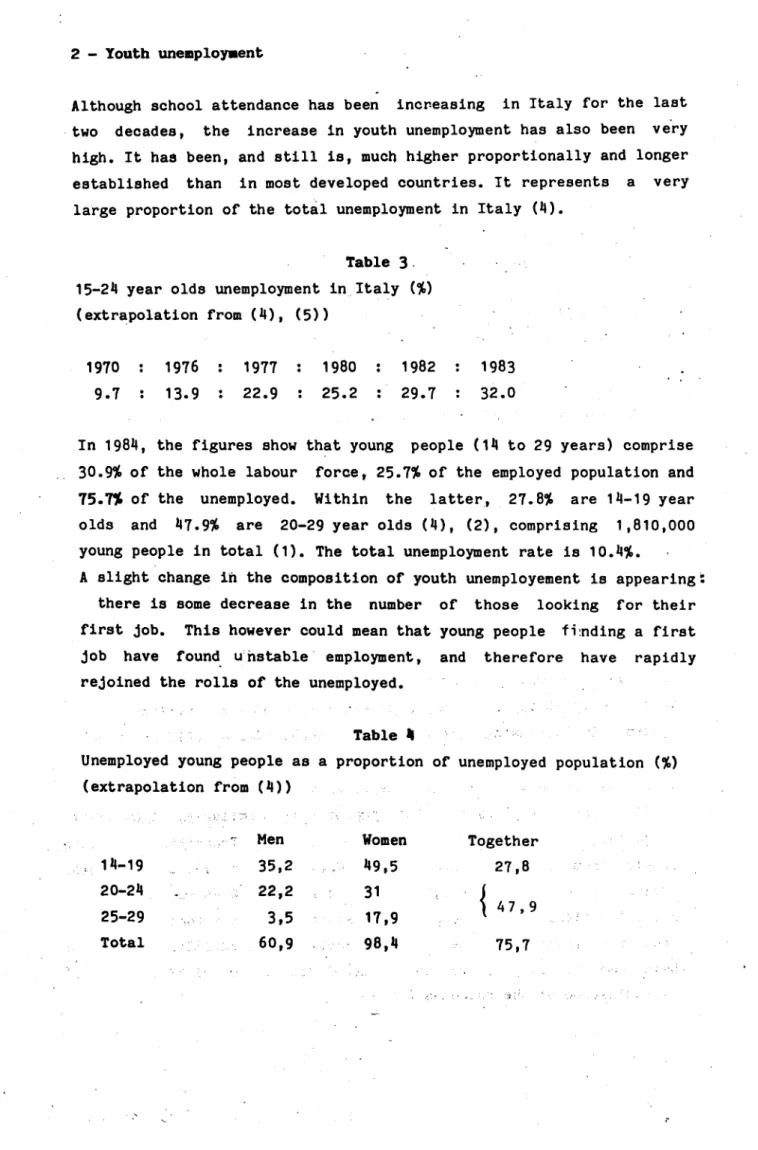
(14) 2 - Youth unemployment Although school attendance has been two decades, the. increasing. in Italy for the last. increase in youth unemployment has also been very. high. It has been, and still is, much higher proportionally and longer established. than. in most developed countries. It represents. a very. large proportion of the total unemployment in Italy (1). Table 3 15-21 year olds unemployment in Italy (%) (extrapolation from (4), (5)) 1970. 9.7. • • • •. 1976. •. 1977. 13.9. • •. 22.9. • • •. • • • •. 1980 25.2. 1982 29.7. In 1981, the figures show that young 30.9% of the whole labour 17.9% are. 1983 : 32.0. people (11 to 29 years) comprise. force, 25.7% of the employed population and. 75.7% of the unemployed. Within olds and. •. the. latter, 27.8% are 11-19 year. 20-29 year olds (1), (2), comprising. 1,810,000. young people in total (1). The total unemployment rate is 10.1%. A slight change in the composition of youth unemployement is appearing : there is some decrease in the number. of those. looking. for their. first job. This however could mean that young people fi Tiding a first job have. found unstable. employment, and. therefore. have. rapidly. rejoined the rolls of the unemployed. Table 4 Unemployed young people as a proportion of unemployed population (%) (extrapolation from (1)) Men. Women. Together. 11-19. 35,2. 19,5. 20-21_. 22,2. 31. 25-29. 3,5. 17,9. u. Total. 60,9. 98,1. 27,8. 9. 75,7.
(15) If the proportion of the less qualified young. Job. seekers,. is. rather. high. amongst the. it is about the same as that in the rest of. unemployed population. However, this particular group may be. the. seen. as. especially "at risk" (6). In relation to another specific group, study. by. the. Ministry. of. Public. i.e.. University. Education. graduates, a. shows. integration into working life takes from 9 to 18 months. that. their. depending. on. their specialization, the average being 11 months (7). The observatory of youth integration (EVA : Entrata nella vita attiva) showed, they. in. 1985, the situation of school-leavers; three years. completed. studies. and. got. after. their certificate (lower secondary. certificate and/or upper secondary certificate) 55% were employed, 28% were still seeking their first Job, 17% were unemployed, 9% active.. The situation was worse in the South than. in. were non-. the North, for. women than for men. 3. New measures to improve transition or employment opportunities Actions to improve opportunities years. for. the 'whole. public. have. been set up for the last three. as well as for young people : flexible. work, part-time work, "solidarity" contracts, etc. Involving specifically young people (15-29 year olds) : -. the labour-training. contracts. (1983) have involved around 285,000. persons so far (1), (3); -. a reform of apprenticeship. in. 1981. defines. new. duration (18 to 60 months for young people under 18, for. those. length. of. over. 18,. training,. rules about its 12. to 18 months. according to the level of skill required), the. salary;. a few regions give incentives. the to. companies hiring apprentices, or set up schemes to improve the quality of the training; - incentives are given to improve job-creation through new cooperative enterprises contribution. : of. in. February. the. State. 1986, in. a. that. law. was. passed defining. the. regard, in aiding new cooperatives. launched by young people under 29 years, especially in the Mezzogiorno (South Italy);.
(16) a few other regions are also joining the same project (4), (3),. 4. Pilot-Projects. of. the Second Transition Programme of the European. Communities Building on the work of the first established. Transition. after. Programme,. was. Ministers. of Education in 1982. Eight projects were set up in Italy,. involving. different. students.. The philosophy and field of action of those projects are to. about. 2,500. of. teachers. build closer relationships between the school and environment, and to discover new development trends for. employment.. They. have. the. Second. Programme. Provinces,. a resolution. the. and. 21,000. and possibilities. all laid stress upon guidance the. teaching materials that can be disseminated throughout. country at the end of the projects.. of. its social-economic. involved in-service training for teachers, as well as of. Council. and. have. production the. whole.
(17) The Educational System in Italy. Ì. UNIVERSITA·. ISTITUTI SUPERIORI. MONDO. I. DEL. SCUOLA. LAVORO. MEDIA. The Guidance Services in I t a l y. Administrative Control Guidance programmes in lower secondary schools. : : : : :. Private : educational: guidance : organiza- : : tions : : : : : :. Ministry of Education. : : :. Aged 11-11. Main Services : : Observation of. : students; advice on educational choices Group sessions; individual interviews. Private (some : under contract to : regional authori- : Mainly aged 11-19 ties). : : : : : :. Aged 18 + - student : group sessions; : University guidance in last year of : individual inter- : : vi ews : : Regional authoriies: upper secondary centres (opere : school and in third : : : education universitarie) • ·. : Information: Regional or : centres : provincial or : (Informa- : local authorities : giovani). • •. Clients. :. Aged 1 1 - 2 5. : : : : : :. Information on vocational and occupational opportunities as well as leisure, travel, etc... : : : : : :.
(18) 10. II. THE STRUCTURE AND STAFFING OF PROFESSIONAL GUIDANCE SERVICES. 1 - Introduction The first "office for the study of vocational the. guidance" was set up in. City of Rome in 1921 (8). Since that time centres or foundations. have operated in the field of guidance, carrying.out as well as offering consultations to young people. research studies. and. their. parents. and teachers, either under contract with public bodies or on a private basis.. This has mostly concerned vocational guidance.. As in several other countries, guidance "putting the right analysis there. man. into. has. had asits first objective. the right place", and used psychometric. of aptitudes, for vocational and industrial. followed. centred. one. new and,. purposes.. Then. theories : a "socio-cultural" one, a personality lately, an educational and personal. theory. (9),. rather close to the "career education", as guidance became involved in the educational field. From 1950 onwards, a national legislation been. expected. and., there. setting. out standards. have been several successive. However there is still no general legislation. although. is on the drawing-board at the Parliament (an attempted. draft. has laws.. a new project synthesis. of. three previous different projects, approved by a multiparty commission of. the Parliament; at the time of writing, it seemed improbable. that. it would be adopted in 1986). However, there was a first major change with the reform of the "scuola media unica" (instituting the comprehensive lower secondary school) in 1962 (law 1852/1962). the. educational. Guidance. process. was. itself,. decreed to be an organic part of of. the curriculum in the form. of. "assisting the guidance for young people towards their further choices of. an. activity". In 1963, in the decree organizing the timetable. the scuola media, "educational guidance" is talked about as every. subject,. interests. and. helping aptitudes. students to discover and develop in. view of the educational and. choices they will have to make.. of. a part of their. own. vocational.
(19) 11. A concretization of the guidance. activities. in the. lower secondary. school was made through a further law (9l2 in 1966) which. made. the. financial allocation for this activity. In the framework of this law, for one decade, directives were given every year by. the Ministry. of. Public Education concerning the organization of guidance. One of these annual. directives. (in. 1975) introduced. the. role of. the. "school. guidance counsellor". In 1973 were created, at local level, the school-districts which were given a role (among others) in educational guidance : a decree in 1971 lays down that the School District Council has the task, every year, to set up, in relation to the school councils as well as regional and local bodies, the programme of educational guidance services. These. services were. activities and. not administered by the Ministry. of. Public Education but were under contract with its administration; most of. them were. the. (COSP), which were education;. some. centres. for educational and vocational. guidance. part of the provincial organizations for technical of them. however were. professional. or. private. o rganizations. Meanwhile, "vocational guidance" was still under the responsibility of the Ministry of Labour, operated through services recognized. by. the. Ministry, and relating to unemployed workers getting training courses, apprentices, young people enrolled in vocational training, handicapped workers. The last, and most important event in guidance 1977 law (following the 1970. law. on decentralization). Regional Authorities responsibility on areas (as well as for vocational. organization. was the. that gave to. of vocational. guidance. training), underlining the responsibility. of school districts on educational guidance and thus maintaining distinction between educational guidance and vocational the. framework. of this. law, the provincial. the. guidance. In. services of technical. instruction which administered the guidance centres were eliminated or. (2). transferred. to. centres. the national office for those suffering. of. the regional administration, as well as the guidance from. industrial.
(20) 12. accidents. (which. was. previously. under. the responsibility. of. the. Ministry of Labour) (10). Since. that. dividing up of the guidance roles. authorities. and. the. school. districts,. between. the. although the. regional. necessity. of. coordination is often underlined, there have been two main streams. On one side, the school district has the task of planning the educational guidance. activities. and. (although limited), and. services, and gets a financement it. works. for. them. on behalf of the provincial school. council, the provincial administration of public education, and of the Ministry of Public Education which gives. the general directives, gets. and distributes the budget for these activities and. coordinates them.. On the other side, every regional authority may define by regional law its. policy. in matters of vocational guidance, and. financial. allocation. vocational. guidance. for it. They have responsibility, for. centres,. workers. persons.. So. the. achievements. in. in. "conversion". regional. policies,. training as. that field, are very different from. their own regional organizations for complete. mention. the 1986 landscape. that. activities. the. of. information. Ministry. its. (an. the. anyway,. for. local. of. experiment. is. disabled. one. Region. to. have access to. guidance (law 153/1975).. of guidance Labour. offices. and. well as the regional. another (11). Finally, farm workers and their families To. upon. the apprentices, students of the vocational. training. far,. decide. so. being. in. would as. Italy, like. also. launched. to. one. should. to enlarge offer. in 20. the. guidance. unemployment. offices at provincial level).. 2 - Guidance inside the educational system In the lower secondary school (Scuola Media) As has been said before, since its central. aim. of. the. comprehensive. creation. in. 1962, guidance is a. lower secondary school.. already been stated the scuola media is the last education, and the choices at the end of its third. step. of. year. As. has. compulsory are. of some.
(21) 13. importance. Although the legal texts are not very clear,. it is widely. assumed. students. that. the education system is the best way. for. to. discover and improve their own interests, aptitudes and abilities, and that. teachers. are. the best placed to help them. This was reasserted. when. a new curriculum for the scuola media was set up in 1979,. two of the main objectives are related to guidance in a broad the. school. links to the world, that is to say it helps. acquire a knowledge of social reality, and to recognize to. sense :. students. to. the ways that. people. use. life".. The school also guides, which means that it contributes to the. students'own. earn. where. a living and to. transform their "conditions. development, to the discovery of their own identity,. their ability to make their own choices according to their and. their. of. personal. "project. of. life". objective can be seen as a mean to achieve. (11). A. more. self-image educational. this : the school. aim of helping students to acquire logical, scientific. to. and. has the technical. abilities, and a better knowledge of themselves. To. summarize,. guidance. is. seen. as. a. formative. integrated into every subject of the curriculum, and. process, into. to. the. be. whole. educational process of the school. Although detractors say that if it activities guidance field. per at. who. whole.. se,. it. is. difficult. to isolate guidance. is difficult to be sure that. there. all..., there are people in the educational think that the laws on the scuola media are. There. seems. to. be. some. is. and. social on. the. consensus about it, and about. the. importance of the teachers' role in guidance. This led. good. to some debate. when a draft law (in 1980) was published which proposed to set centres of information and orientation outside the role. (really. specific. school,. training.. This. law,. however,. up new. and a new. a new profession) : the "guidance counsellor",. post-graduate. any. with. was. a. never. adopted.. However, a problem arises from the conception of guidance as a part of the. educational. teachers functions. in. functions. guidance.. The. :. the competence and/or the training. official. definition. of. still do not explicitly mention any role in. the. of. teachers'. guidance.. The.
(22) 11. principles implement. have. not. them. on. been. followed. by. operational. programmes. a general and institutional basis.. Studies. to have. shown that teachers are not very aware of their guidance role, or that they do not know how to play it (12). Attempts have been made to solve. this problem and to improve teachers. training and activity in the field of guidance, notably in projects of the first EC Transition Programme.. One of them. course, including group training, practical activities dissemination media.. of. relevant material, for 16 teachers. engaged. in. no. formal. set. up a. in school, and of. The experiment produced substantial increase in. activities of 30% of the participants, though, at still. few pilot-. the the. the. scuola guidance. other end, 10%. guidance activities at all.. The. main. contents of the training were : - an analysis of guidance needs during adolescence, - what work means to the young people who are being counselled, - the development of information and communication skills, - the development of relationship skills (13). Other. studies. have tried to define the competencies. needed. by. the. teachers to assume their role in guidance. One of these suggests that, apart from a deep knowledge of the subject taught,. the. teacher would. have a knowledge of the cognitive and learning process,. developmental. psychology,. social. differential. psychology,. careers. related. and. knowledge competency. of. the. psychology,. education. research. training;. specific. sociology,. methodology,. practice. problems. of. in. assessment,. information. relationship. guidance. could be acquired either in initial and/or. about skills,. ! (11). Such in. a. in-service. training. The author of this study notices, moreover, that most of the above. subjects. are. integral. parts. of. teaching competencies.. actually there is a large disparity in matter of for. teachers. in-service. according to regions, school districts,. Although it is quite difficult to. get. any. even. training schools.. figures about this, it is. probable that only a small number have been involved so far. among the experiments and pilot-projects going on many are concerned with guidance.. But. in. However,. schools, a good.
(23) 15. In the upper secondary school (secondaria superiore) Tt. is. to. be noted that, in the current. secondary. legislation. on. the. school, there is no mention at all of guidance,. upper. except. the regulations on the leaving examinations (1969), where it. is. in said. that the "commission (for the exam) gives its own assessment regarding ... vocational orientation. and. ... the choice of university studies". (11). However the upper secondary school has been awaiting a reform for many years. This reform is still on the drawing-board. One of the. problems. which has to be solved is precisely the place of guidance in. the. (future). upper. compulsory. secondary. education.. "orientating" year?. school,. Would. related. to. the first year become. the a. new. extension. of. comprehensive. or would the two first years be dedicated to that. purpose? Can the upper secondary school prepare for university studies as well as for. integration. into. adult. and working life, and if so,. how? One of the main problems, and criticisms of the educational system, is that it is closed in upon itself, far away from the world of work, and that the connexion between supply (i.e. young people) and demand (i.e. industry's needs) does not happen. So there is a great deal of concern about guidance irt the upper secondary school. Most. people still think. that. guidance is the job of the school and of the teachers,. and. same. ideology. probably. applies here as in the scuola media. That is. why most experiments and activities about guidance take place school these. level, involve. at this. launched by varied organisations and bodies. the. headteachers. the. Most. of. of the schools as well as teachers,. students and parents. Among. these. school. activitities. about guidance,. in-service. teachers and headteachers are organized at regional. level by AIOSP, the Italian association for educational guidance. reform. seminars. of. Most the. local. or vocational. of these seminars are on guidance within upper. or. for. the. secondary school. Other initiatives, and. future most. experiments give a prominent place to the teachers' training. As far as the professionnel and technical few. projects. are. aiming. at. ("stages") for the students.. institutes are concerned, a. the implementation of work. experience.
(24) 16. In University Following the same conception of guidance. as a part of the curriculum. and of educational institutions, a decree in I98O. specified. full-time lecturers would have to dedicate a part of time. to. that the. their. service's. play a guidance role towards the students/(actual or. students). about. future. the choices of their main and optional subjects. of. studies, their achievement and eventual reorientation. The same decree created also a tutorial function to be assumed by. academic staff vis-. à-vis the students; such a role includes some guidance element. Beside. this. pedagogical. organisations their. exist. guidance,. within. several. universities.. A. types. of. guidance. few universities. own guidance centres; in some others, the psychology. offer guidance services or experiments.. have. faculties. Most regions operate students. services (Istituti per il diritto allo studio) which deal with general students'. problems (accommodation, grants, etc.) as well as. (choice of studies, help. guidance. in placement); some students associations as. well as graduates associations work in the same field. An experimental guidance scheme was. set. up. in the University of "La. Sapienza" in Rome a few years ago, on behalf of the Ministry of Public Education.. The Department of Psychology. of. this. University offered. guidance activities to students from the final year secondary. schools.. These. interventions. of. included. several upper consultations,. psychometric testing, group information, dissemination of. informative. material.. Within the school-districts If the school districts have a responsibility. in guidance, not all of. them exercise it. This might be explained by the fact that. they often. do not have the necessary financial and (particularly) human resources to. carry. out. this. task. The 1983 report on guidance activities. Italy (11), which used postal questionnaires. to. gather. information,. received. 1I6 (out of 76O) answers from the school districts.. the. answers,. Ilo. 16. said. in. Out. of. they had had no activity in relation. to. guidance for some years. (NB : there were very few answers school administration units at provincial level).. from other.
(25) 17. When. services exist within the school districts,. most. former guidance centres, under contract. These centres complement to the teacher; they are available, on seems,. of. them. are. are. seen as a. request, mainly, it. in difficult cases, for students having learning, personal. relationship. problems.. They are a part of the more general. or. "support. services", and include generally : a social worker, a psychologist, nurse or medical worker, and a guidance counsellor. They to. "follow". appropriate. permanently intervention. the. students. to. be. able. when needed. It seems that. a. are supposed to. make. these. the. services. carry out too a number of psychometric assessments on request from the students which. or their families during the last year of the scuola. is. the first important point of choice. These centres. exist everywhere and it is rather difficult to give them.. media, do. not. any figures about. They operate directly in relation to the schools more. than. to. the district's administration. 3 - Regional and local administrations As we have seen before, since 1977, vocational. guidance.. the. regions are in charge of the. Here again, the picture is very varied.. A. large regions (Piemonte, Marche, Emilia-Romagna) have delegated responsibility intercommunal. to. the. associations. (Lombardia, Puglia) manage guidance. centres. (Trento-Bolzano, d'Aosta) provinces centres.. operate and. or. provinces, or the. even. to mountain communes. A. local. Umbria) few. to. regions. The regions with a special. Friuli-Venezia-Giulia, a. their. guidance activities through their own. institutes.. through. (Toscana,. few. (local). Sicilia, central. status. Sardegna,. organization.. communities also administer their own. Here too, figures are difficult to get. For. the. Valle A. few. guidance same. report (11), the reply rate was : 9 out of 19 for the regions,. 1983 21 out. of 95 for the provinces.. The regional legislation about guidance is. very. diverse. cases, the subject is no more than mentioned in passing.. :. in a few. But,. on the.
(26) 18 other. hand, initiatives have been developed in some regions.. should. be. made,. Alessandria,. in. for. instance,. of the creation by the province. Piemonte, in 1981,. of. the. orientamento" (guidance centre foundation). the. Mention. "Fondazione. of. centro. di. This brought together all. relevant local organizations : the seven main town councils,. seven school districts, the provincial administration, the union,. the. bank,. with. industrial. commerce, industry and crafts Chamber, the local the. participation. of. the. provincial. administration and a representative of the Region.. One. the. savings. educational of. the first. objectives of this foundation is to bridge the gap between educational and vocational guidance and to face in a coordinated way the needs and problems work. the. arising. complexity of transition from school. to. It is open to students, families, teachers, representatives. of. world. order. to. of. from. work,. the. to facilitate the ciculation of information. guarantee well considered personal choices by young. (15). Among its activities infomation final. in. in. people. 1986, the Foundation has developed. programme about University studies, addressed. year students of the upper secondary schools in. This programme included a general meeting,. held. in. to. the. an. all the. province.. Alessandria,. of. students with University representatives, meetings of the same kind at every secondary school and individual or small group. interviews. with. various professionals.. Other similar centres have been set up elsewhere. there. is. a. pyramidal. organization. as. In. follows. Region Toscana, :. the. Regional. Authorities decide upon the main orientations and financing : the nine provinces the. (which are coordinated with the regional representative. "inter. provincial. group. activities at their own level.. for. guidance"). These activities. plan are. the. in. guidance. implemented. by. local organizations through 33 communal or intercommunal associations. The whole organization employs around 50 guidance appropriate. qualification. :. sociology,. workers (having the. pedagogy,. economics).. Activities range from research and studies to individual interviewing, information. and. in-service. training. for. teachers,. development, production of informative material, etc.. curriculum.
(27) 19. Among the main services operating in other regions, there are the COSP (Centre for education. and. vocational. guidance). Piemonte and the COP (Centre for vocational. in. Torino,. region. guidance) in the province. of Trento. The North and Central Italy have developed. many. more. initiatives of. this kind. Tn these centres the main interest of. the. action. is. the. will. for. coordination behind it.. 4 - Other organizations involved in guidance Private. organizations such as private foundations. and. some of which are related to religious organizations. associations,. have operated in. the field of guidance for many years. Many of them continue in. some. cases. in. cooperation. with. public. bodies. to do so,. i.e.. regions,. provinces, communes. Tn some cases, although they are operating. on. a. private basis, they are the only guidance service to be offered to the local population. Some new private guidance services have been recently set up on behalf of. workers unions. Tn the present Situation and in the absence. of. a. national legislation, almost anybody can start a guidance centre. Professional and Industrial organisations For. the last few years, employers' organizations. have. shown. a. new. interest in creating closer relationships with the educational system, notably in the field of guidance and transition. The participation. of. companies representatives in meetings in schools on the world of work, or. field. visits for students in companies are now commonplace.. relationships. can. be. extended to the school districts, and. Such. include. other local or regional public bodies. The major industrial organization, the Confindustria,. has. drawn up a. large policy and action plan in this field. The main objectives. are :. to. on. a. the school,. a. develop the image of industry inside the school and to pass. minimal. knowledge. about. industry;. to. develop,. in.
(28) 20. "culture" of industry,. notably. activities. a. include. :. for. training. guidance plan. for. purposes. The relevant teachers,. development research, the use of business games in and. students' visits to companies ("open company"),. for. students,. etc.. A. guide. curriculum. school,. teachers'. work. experience. has'been published to help. the. local. employers'associations to implement these activities (16). A joint initiative in 1986 : the three days for guidance A national initiative was launched. in 1986 jointly by the Ministry of. Labour and the Ministry of Public Education, national. television. in. association with the. network (the RAI). For three days, in. April,. a. number of events at various levels took place : national TV broadcasts on. the. working. subject. of. groups. students. as. parents,. etc.. at. well. disseminated. school as. A. on. guidance or. community. industry. certain this. and transition, meetings, debates and. amount. occasion,. of to. level,. with. and. teachers and. administration representatives, material help. was. published. schools and. and. teachers. to. organize the three days and to give relevant basic information : a set of six booklets (by ISFOL fo. the Ministry of Labour) on. the economic. situation, new ways for transition, etc. and suggestions for on. how. to. manage. guidance. activities. teachers. (1); a guide to university. studies, by the Ministry of Public Education; a special issue of "Vita Italiana", the magazine of the Presidency. of. Ministries. Council, on. the employment policy prospects for the next decade.. None. of. those responsible for the'"three. days". event,. which. involved the students in the last year of the upper secondary. only. school,. think that this is the answer to the need for better organization implementation. of. initiative. the. by. guidance. two. Nevertheless,. ministries. involved all over the country. be used on a longer term basis. questionnaire. it was the. concerned.. 18000. and. first. joint. classes. were. The material that was disseminated can Furthermore, the. booklets included a. for the teachers to complete in order to arrive. appreciation of the impact of this initiative and far, it seems that a large number of questionnaires. at. an. of the material. So is being returned. which shows the great interest of teachers in guidance..
(29) 21. Parents The family i3 still a strong institution in. Italy,. and. parents. are. generally much involved in the educational system. They participate in every. school. organization.. council as well as in other levels of Parents. the. educational. also seem to play an important role. regarding. guidance and transition; a recent study on unemployed young people (6) shows that for 65% of these people, the first assistance in search. comes. from. their job. their families. In.the 1985 report on the. social. situation of the country (18), the CENSIS also notes that families are increasingly. involved. in. guidance. and transition, as. economic support for their children, since the state enough. opportunities. family. (even. transfer. of. after the. as. in. fails to provide. in this respect. Among the ways. brought about, the report mentions a longer stay for. well that. this. children. the age of 25), and a bigger trend. is. in the. towards. the. parents' work to their children, even in industries. where they often have a priority for getting a job. Research institutes at the national level Several institutes at the national level play. a role, through various. activities, in the fields of guidance and transition : - ISFOL is in charge of the. labour. people For. market,. current surveys for the Ministry of Labour on. vocational training, and the insertion of. into working-life (particularly the permanent inquiry. the Ministry of Education it is. in. charge. of. the. guidance (first published in 1983, second to be issued 1986), and it is a member. of. young "EVA").. reports. by. on. the end of. the National Committee for guidance and. planning, - The RUI Foundation carries abroad. projects. out. studies. on. guidance. It has been in charge of coordinating one on. guidance, authorities. the. EEC pilot. and it takes part in the European network. university guidance services. educational. of. in Italy and of. It also lends assistance to regional or. for the implementation of guidance. policies. and activities, - CENSIS carries out studies. on. the. educational system, and has the.
(30) 22. task. of coordination and/or evaluation of pilot projects, notably. on. guidance. Information centres A new kind of service is rapidly services,. dedicated. either. improving to. the. in. Italy. public. or. : to. information services. professionnals dealing with them. Among the first ones, we. or. find Youth. Information Centres (Informagiovani), which have been in operation for a few years in a few cities (Torino, Forli, Bergamo, Most of them are run by local or provincial with,. the. young. people.. A. few. of. European network of Youth Information Second. Transition. Verona, Milano).. authorities for, and even. these. centres are part of the. Centres, in relation to the EEC. Programme. Some of them. mainly. give. information. about educational or occupational opportunities, others cover the main areas of young people's lives, including leisure The different centre s are now occupied with. time and travelling.. organizing data-bases and. inter-connecting them. Other. information. workers'. unions. unemployed,. centres and. dedicated. provide. to young. information. on. people the. are. rights. run. by. of. the. educational and vocational opportunities, labour-training. contracts, enterprise creation, etc. A few private associations have started similar centres too, for young people or the general public. 5. Staffing Because of the specific structure. of. guidance. in. Italy, there is a. relatively small number of professional guidance advisers, few some. hundred. have. special. no. Some of them are former psychologists or specialized. qualification,. probably a. sociologists,. and some have attended. post-graduate course lasting two years and delivered. Pontificio Ateneo Salesiano, a private university in Rome.. by. a the.
(31) 23. We. have. various years. mentioned several special courses for pilot. teachers. related. projects or experiments going on in schools. The. have seen these courses improve widely towards teachers. supervisors in the two levels of the secondary school.. Some. to last. and/or of these. courses involve parents as well, and education administrators..
(32) 21. III. LINKAGES. Linkages or coordination may be the main problem of guidance in Italy, although some substantial progress have been made lately. As we have seen, almost everyone. can. start. guidance activities, and. the main characteristic of the italian situation is fragmentation. 1. At the national level. Apart from a formal link established. through. the. National Committee. for Guidance and Educational Planning (which brings ministries. including. together. several. Education and Labour as well as representatives. from regions, provinces, enterprises' and workers' organizations, ISFOL), the main real connection has. been. and. the joint operation of the. three days for guidance in April 1986. This operation is planned to be repeated all. during the spring 1987. It will even be enlarged,. levels of post-elementary schools, including. involving. vocational. schools. under the responsibility of Regional Authorities.. 2. At the regional level. As we have seen in section II, 1. have. and. 3 · , the. Regional Authorities. legal responsibility for implementing policy and. vocational. guidance. activities. in. matters.. that. field. The have. regions all. activities. in. having started important. stressed. coordination. and. establishment of linkages between levels (Provincial, Communal, etc.), organizations vocational. (private,. state. run), schools. (general. education,. education), and between the educative world and the. world. of work. Although it is difficult to know. how. well they are succeeding, it is. important to note that they are continuing, and that getting involved.. more regions are.
(33) 25. Furthermore, in order to better achieve. their assignment in matter of. guidance. an. matters,. coordination 1981).. they. have. set. up. interregional. committee" (after the initiative of Region. This committee. tried. first. to. define. "Technical Toscana,. common. distribution of responsibilities for guidance at the. views. regional. in on. level.. They then started to work on any subject related to guidance including research,. informative. material,. the. use. of computers in guidance,. financing, information centres, etc. They work mostly. on. an exchange. of experience basis, and this committee constitutes, currently. one of. the main interlocutors at the national level in guidance matters. After a few years of cooperation,. reflections and evaluation of their. various. experiences, the regions involved in the committee have. to. conclusion. the. matters,. that. in. order. come. to assume their role in guidance. they need to refer to an outline law at the national. This law will more clearly define what guidance. level.. is, who is concerned,. who has a role to play and which role etc. This will replace the "good will". of a few people or organizations by clear responsibilities. remits.. and.
(34) 26. IV. CONCLUSIONS. Although very fragmented, guidance. activities. in. Italy. more developed during the past few years, perhaps as a. have become. result. of the. first European Community Transition Programme pilot projects. More and more organizations have been involved in these activities. at. various. levels. However, most of these activities deal with information has. become. a. very important part of the existing provision. field of guidance. who. does. not. It is estimated that there is no. receive. at. least. which in. the. child, no family. one leaflet a year in relation. to. guidance, educational or vocational choices. But the information is not perfectly. shared between all the potential. users. It is certainly more available in the North than in and in some regions or provinces than in others.. The. the South,. "voluntary way". of supplying these services makes the coverage of the territory at the national level very diverse. This,. accordingly,. service. or. again demonstrates the need. network. of. for. a. wide. public. guidance services that will ensure that. the. needs of all potential users are covered in a satisfactory way. In the current situation, although there. have. been. a few attempts to. overcome it, there is still a factual distinction between. educational. and. in. vocational guidance. Therefore, guidance. activities. schools. should be more concerned with future career and vocational choices, as well. as with labour-market information.. activities. from. should. carefully. be. guidance with. the. outside. At the same time informative. (industry, vocational. coordinated. with. the. courses,. etc.). schools. All the. same,. information for users having left school should. be. matched. educational opportunities, in order to help the user to. acquire. the necessary abilities to use information and to make his decisions.. or her own.
(35) 27. The. need,. then, is to consider guidance as. informative. and. formative. a. long. and. process, occuring at various. life, and to provide the users with a coordinated network. continuous moments of. in. various. agencies able to answer their needs. To achieve this the solution may be to set national. up. an. level that whould define the rights of the user,. and responsibilities of the various organizations administration. close. outline law at the. It would also define the necessity. coordination. at. and and. every level (school, community,. of. the. tasks. the public the ways for province. or. region, and at state level). This would give then a stronger framework to implement more innovative projects, designed to last.. 3).
(36) 28. REFERENCES. 1 - CENSIS, Educazione Italia '85 : voglia di scuola, F. Angeli, 1986. 2 - F. BARONE, Primato Italiano. : l'inflazione dei maturi, La Stampa, 22 -. 7 - 1986. 3 - G. GIOVANNI, La selezione diluita, Scuola e Professione, 1 - 1986. I. -. Ministero. del. Lavoro -. ISFOL,. Materiali. per. le. giornate. dell'. orientamento (cuaderni 1, 2, 3, ^, 5, 6 ) , 1986. 5 - Soambi Culturali, 5, sett.-ott. 1981. 6 - A. DE BERNARDIS, Conoscere. i. disoccupati,. Scuola. e Professione, 5 -. 1986. 7 - Ministero della Pubblica. Istruzione,. Guida. all'istruzione superiore,. 1986. 8 - M. G. MORIANI, Une pionera dell' orientamento professionale : M. GasceDiez, Orientamento Scolastico e Professionale, 1, 1981. 9 - A. RAZZANO, I sistemi d'orientamento. in Italia e all'estero, 0. S. P.,. 1, 1981. 10 - M. G. MORIANI, L'orientamento. nell'ambito del distretto. scolastico :. normativa, problematiche, ipotesi d'intervento, 0. S. P., 2-3, 1983. II - ISFOL - Ministero della. Pubblica Istruzione : rapporto sulle attività. di orientamento in Italia, Maggioli, 1981. 12. -. 0.. ROSSI. CASSOTANA,. Funzione. orientativa. docente. :. modalità. vocazionali e formazione, 0. S. P., 2, 1981. 13. - L. DE LUCA, G. GIUGNI,. Formazione. in. servicio. di. insegnanti. sui. problemi dell'orientamento, 0. S. P., 1, 2, 1981. 11 - L. B0NC0RI, L'orientamento nell' ambito della formazione universitaria iniziale degl'insegnanti, 0. S. P., 3-1* 1981. 15 - Fondazione "Centro di. orientamento". scolastico e professionale della. provincia di Alessandria, 0. S. P., 2, 1981. 16 - C0NFIDUSTRIA, L'industria per la scuola, manuale d'azione. 17 - S. GALETTI, C. MAGAGNOLI,. Orientamento. allo sportello, un'esperienza. della provincia di Bologna, Scuola e Professione, 5, 1986. 18 - CENSIS - XIX Rapporto 1985.. sulla. situazione sociale del Paese, F. Angeli,.
(37) EDUCATIONAL AND VOCATIONAL GUIDANCE SERVICES FOR THE 14-25 AGE-GROUP IN PORTUGAL. J. Ferreira Marques Faculty of Psychology and Education University of Lisbon Lisbon, Portugal in association with A.G. Watts National Institute for Careers Education and Counselling Cambridge, United Kingdom. A contribution to a study directed by A.G. Watts on behalf of the Commission of the European Communities (Directorate-General for Employment, Social Affairs and Education).
(38) CONTENTS Page I.. Background. 1. II.. The Structure and Staffing of Professional Guidance Services. 8. 1. 2. 3. 4. 5. III.. 8 9 15 16 20. Linkages. 21. 1. 2.. 21. 3. 4. IV.. Introduction Guidance in Schools Guidance in Tertiary Education Vocational Guidance Provided by the Institute of Employment and Vocational Training (IEFP) Private Guidance Services. Between Different Professional Guidance Services Between Professional Guidance Services and Guidance Activities Organised by Professionals in Other Fields Between Professional Guidance Services and Other Agencies Between Professional Guidance Services and the Help Offered by Parents etc.. Conclusions. 23 24 25 27.
(39) - 1 BACKGROUND. The Portuguese educational system is highly centralised.. Certainly. there has been concern in recent years to devolve more responsibility to regional and other authorities*, and as from January 1987 the Ministry of Education has been reorganised to'incorporate a stronger element of regionalisation (Decreto-Lei No. 3/87).. Nonetheless, the normal practice until. now has been for most policy matters, major and minor, to be referred to the Ministry; the Ministry, in turn, issues decree laws and regulations, on which the functioning of the official system depends. The structure of the Portuguese educational system operating in June 1987 is arranged in four levels: nursery education (voluntary, from 3 to 6 years old), basic education (4 years of primary school followed by 2 years at the intermediate preparatory school), secondary education (lasting 6 years), and higher education.. The main features of this system are portrayed in figure 1.. A new Education Act (Lei de Bases do Sistema Educativo - Law No. 46/86) was published in October 1986, and is introducing some major changes, including the extension of compulsory school from 6 to 9 years.. This legislation will be. implemented gradually over the next few years and is not included in the information given in this report. Secondary education.. In 1982/83, about one in five young people failed. to complete their basic education**; while about one in five of those in their final year of basic education failed to enter secondary education.***. Students. *. See e.g. OECD: Reviews of National Policies for Education: Portugal, pp.104-107. Paris: OECD, 1984.. **. Gabinete de Estudos e Planeamento: Analise Conjunctural: Educação 1985, p.110. Lisbon: Ministério da Educação e Cultura, 1986.. ***. Ibid, p.28..
(40) - 2 who enter secondary education usually do so at the age of 12.. Secondary educa-. i. tion is divided into two stages, each normally lasting three years: the first (from the 7th to the 9th school year) is characterised by a common curriculum; the second (the 'complementary stage') covers a number of different paths.. The. subjects studied during the 10th, 11th and 12th school years determine which courses in higher education the students will be qualified to enter.. Thus their. choices at the end of the 9th school year (around the age of 15) have important educational and vocational implications. The 10th and 11th years of education are now organised in five broad areas: natural sciences, scientific and technological studies, economic and social studies, humanistic studies, and visual arts.. This system was established in. 1978, ending the traditional separation between high school and technical school courses.. Accordingly, all high schools and all technical schools. became secondary schools. In 1983, two other types of paths after the 9th school year were added: the technical courses (tecnico-profissionais), and the occupational courses (profissionais).. The former normally last three years, while the latter lasts. one year in school followed by a probationary period of six months' work experience (Despacho Normativo No. 194-A/83).. Over the last few years, these. new technical and occupational courses have been introduced in a large number of secondary schools all over the country.. The occupational areas covered. are: agriculture, mechanics, electricity, electronics, building, accounting, goldsmithery, chemistry, computers, ceramics, graphic arts, equipment design, textiles, social services, fishing, and optics.. The aims of the technical. courses are to provide a technical qualification at an intermediate level and simultaneously to offer the general preparation required for access to higher education.. The occupational courses lead to an occupational qualification in. particular areas of activity..
(41) - 3 -. Tertiary education.. The eligibility of students to enter higher. education in the official institutions (12 universities, 6 polytechnics and a few other colleges) does not depend on the satisfactory completion of the 12th year alone.. A selection system organised by the Ministry of Education takes. into account each year the number of vacancies offered by each institution and the preferences and qualifications of each candidate.. The selection is based. on the school marks attained at the end of the 11th and 12th year, especially in the national written examinations taken at the end of the 12th year.. In. order to be admitted to the course and the university they prefer, students may try to improve their marks by repeating the examinations. In 1985, 13,381 out of 23,434 candidates succeeded in entering higher education in the official institutions.. Thus, after the 12th year of. schooling, many students fail to achieve access to higher education, while others are admitted to courses which are not their first choices.. The vast. majority of the students in higher education attend official institutions (79,248 students in 1984); about 12% are in private colleges (10,892 students in 1984).*. The problem of access to higher education is exacerbated at present. by the shortage of places on vocational courses outside the universities: such places are currently very limited, but are due to increase over the next few years. Apprenticeship.. In 1980, with the co-operation of the Ministry of. Education and the Institute of Employment and Vocational Training (IEFP), a new training programme in companies was introduced for young people aged over 14 at the end of compulsory schooling.. This programme paved the way for the. organisation of the apprenticeship system adopted in 1984 with the. *. Instituto Nacional de Estatistica: Estatísticas da Educação 1984, p.3. Lisbon, 1986..
(42) introduction of new legislation (DecretoL ei No. 102/84).. Youngsters aged. between 14 and 24, who have fulfilled the requirements for compulsory education, may sign an apprenticeship contract.. The training does not last. more than 4 years and requires a maximum of 40 hours of instruction weekly, including general education (Portuguese, mathematics, a unit called 'the actual world' and, if possible, a foreign language) and specific vocational preparation (with a theoretical part and a practical part).. The training. concludes with a final examination and the apprenticeship certificate issued by the IEFP provides an official occupational qualification.. During the. training period, the apprentices receive a grant corresponding to a given proportion of the minimum national wage (30% in the first year of training, 40% in the second year, 50% in the third year, 60% in the fourth year).. In. the development of this apprenticeship system, priority was given to the following occupational areas: agriculture and food production; electronics; computers; mechanics; and services.* Other vocational training.. An OECD report on Portugal, published in 1984,. commented that facilities for education and training outside the upper secondary school were much too thin.**. The Institute of Employment and Vocational. Training (IEFP) is the most active institution in Portugal in the field of vocational training, especially for the industrial sector.. There are 13 IEFP. training units (Centros de Formação Profissional) in different areas of the country.. The trainees are aged 18 and over, and may be employed or. unemployed.. The duration of their studies is between 12 and 44 weeks.. The. organisation of other centres of vocational training (centros protocolares). *. Mota, Α., and others: Descrição do Sistema de Formação Profissional em Portugal, pp.3642. Berlin: CEDEFOP, 1985.. **. See e.g. OECD: Reviews of National Policies for Education: Portugal, p. 4. Paris: OECD, 1984..
(43) 5 . has also been possible through agreements (protocolos) with workers' unions or employers' associations.. In cooperation with different regional institutions. and local authorities, the IEFP promotes activities and gives financial support through several programmes in the area of vocational training and of integration into the world of work.. The Ministry of Agriculture is also. involved in the training of farmers and other agricultural workers.* Employment structure etc.. In comparison with more industrialised. European countries, the proportion of the Portuguese employed population in the primary sector (agriculture and fisheries) is relatively high: 21.8% at the beginning of 1986.. A further 33.6% were in the secondary (manufacturing). sector and 44.6% in the tertiary (services) sector. The unemployment rate in the total population in 1986 (first quarter of the year) was 11.1%.. It was higher for females (15.8%) than for males (7.7%) .. Almost half of the unemployed (46.2%) were aged 1524 years (22.9% in the 15 19 agegroup and 23.3% in the 2024 agegroup).. The unemployment rate for the. 1519 agegroup was 13.6%; for the 2024 agegroup it was 16.5%.. Most. unemployed young people are financially dependent on their parents.. In 1986 about. 20,000 young people participated in a workexperience programme (Ocupação Temporária de Jovens) organised by the Department of Youth and the Institute of Employment and Vocational Training (supported by the European Social Fund), and 30,000 are expected to take part in 1987: they can stay on the programme for between six months and a year.. In addition, in February 1987 a scheme. was introduced to provide a subsidy to unemployed young people who were involved in the creation of 'independent activities' for at least 36 hours a week. The proportion of the population in fulltime education was 39.4% in the. *. Mota, Α., and others: Descrição do Sistema de Formação Profissional em Portugal, pp.5567. Berlin: CEDEFOP, 1985..
(44) - 6 -. 15-19 age-group but only 16.5% in the 20-24 age-group.*. All males have to. undergo military service for a period of about 15 months around the age of 20/21: those entering tertiary education can defer this obligation until after they have completed their studies.. *. Instituto Nacional de Estatística: Inquérito ao Emprego 1- Trimestre de 1986. Lisbon, 1986..
(45) TERTIARY EDUCATION. SECONDARY EDUCATION. BASIC EDUCATION. Compieme nt ar y Stage (5 areas) 10. Nursery Education. Primary School. Preparatory School. Unified. 10 8. 12. Technical Courses. M 7. 11. Universities. 11. >. A. Β. C. ι. D. E. I ι. Polytechnics. 12. ι. 9. Occupational Courses \. 10 Optional. + 6 months. 6 years of compulsory schooling -»Some Vocational Courses. 'T) H-. C M. Entrance subject to > numerus clausus.
(46) 8 -. II.. 1.. THE STRUCTURE AND STAFFING OF PROFESSIONAL GUIDANCE SERVICES. Introduction. The educational and vocational guidance system in Portugal is as follows: Services. Clients. Main activities. (a). Institute for Vocational Guidance (IOP) and guidance services in schools dependent on the IOP. Pupils throughout the period of schooling. Group work; interviews with pupils; advice on educational opportunities and on occupations. (b). Psychological and guidance services in schools, coordinated by the Educational and Vocational Guidance Units (Núcleos) in Coimbra, Lisbon and Porto. Pupils throughout the period of schooling, particularly those aged 12-18 and attending secondary education. Curricular programmes; individual and group counselling; visits to work-places; interviews with pupils and parents; information on educational opportunities and occupations. (c). Vocational guidance services provided by the Institute of Employment and Vocational Training (IEFP). All ages, but mainly young people who have left full-time education. Information on training and employment opportunities; guidance on vocational training and on apprenticeship; links to placement services. (d). Private guidance services. Mainly aged 12-18. Psychometric tests and interviews; advice on educational opportunities and occupations. Services (a) and (b) are covered in Section II.2; this is followed by a short Section II.3 on tertiary education where careers guidance is not yet well developed.. Services (c) and (d) are then described in Sections II.4 and II.5. respectively..
(47) Guidance in Schools. (a). Introduction The first developments in the introduction of guidance services in Portugal. were initiated by Faria de Vasconcelos, professor of psychology at the University of Lisbon, who founded in 1925 the Institute for Vocational Guidance (Instituto de Orientação Profissional - IOP). When the common curriculum in secondary education was extended to the 9th year of schooling in 1977, some attention was given to the development of guidance services in schools.. The Ministry of Education reassigned to the IOP. the task of providing guidance in state schools and asked it to start activities for pupils in the 7th year during the school year 1977/78.. Also in. 1977, the Ministry of Education decided to admit each year up to 20 teachers from secondary or preparatory schools to a course designed to train perito orientadores (guidance officers) organised by the IOP (Despachos Nos. 103/77 and 171/77).. In addition to co-ordinating the activities of these orientadores in. schools after completing their training, the IOP offers a public service of individual vocational guidance in its office in Lisbon. A report on Educational and Vocational Guidance in the Ministry of Education was published in January 1984 by a committee appointed by the Portuguese Government.. In the introduction to this report, the situation of. guidance services in the school system was summarised: it was observed that although since 1970 there had been some increase in the number of schools with guidance services, by 1982/83 they were still provided in only 5% of preparatory schools and one-third of secondary schools, and even in these.
(48) - 10 schools only to a limited number of pupils.*. Accordingly, the report. emphasised the need to define new structures through which educational and vocational guidance services could be made available to all pupils in the Portuguese educational system, and made several specific proposals and recommendations.. In particular, it recommended that counsellors (psicologo. conselheiro) should be appointed to schools all over the country.. Unlike the. orientadores, they would not necessarily be teachers, and would receive a university-level training in guidance.. There should be roughly one counsellor. for each secondary school, but with some flexibility: larger schools might have more than one; smaller schools might share one.. The counsellors would be. school-based and would be grouped for communication and professional-support purposes into 80 or so Units (Núcleos), each supporting 3-10 counsellors in the local area; these Núcleos would then be co-ordinated regionally. Three of the Núcleos would be linked to the counsellor training programme in the Faculties of Psychology and Education at the Universities of Coimbra, Lisbon and Porto.** In the event, only these three latter Núcleos have been created, as pilot centres (Despacho No. 118/ME/84).. Accordingly, they have assumed. a regional co-ordinating function for the counsellors who have been appointed in schools in the North (Porto), Centre (Coimbra) and South (Lisbon) respectively. The development of this new structure was given momentum by the introduction of new technical and occupational courses in secondary education from 1983 onwards, *. A Orientação Escolar e Profissional no Ambito do Ministerio da Educação: Relatório da Comissão Criada pelo Despacho Conjunto ME/MTSS No. 86/83, p.5. Lisbon, 1984.. **. Ibid, pp.15-16. See Marques, J.F.: 'Organização de Serviços de Orientação Escolar e Profissional no Campo da Educação'. Cadernos de Consulta Psicologica, Volume 1, 1985, pp.193-199..
(49) Il and by the pressure for extended guidance services which this stimulated.. By. 1986/87, the counsellors covered nearly twothirds of the staterun secondary schools in the country.. Most of the remaining schools were covered by orienta. dores or by IEFP services (see Section II.4 below).. Only a few rural schools in. remote areas offered no guidance services at all.. (b). Finance All guidance services provided in state schools are free of charge to. the pupils.. The funding for IOP and for school guidance services dependent on. IOP comes from central government (the Ministry of Education).. The. orientadores are paid as teachers in their respective schools. The guidance services coordinated by the Units (Núcleos) are funded by the Ministry of Education in two different ways: financial support for the contract of each counsellor is provided by the school where his or her professional activities are based; and small direct subventions are made available to cover the general expenses of the Núcleos.. (c). Clients The clients of the services provided by the IOP and the orientadores are. mainly situated in the school system from kindergarten up to the 9th year.* Special attention is given to pupils in the last three years of unified education (the 7th, 8th and 9th years). In the guidance services coordinated by the Núcleos, the policy adopted by the Ministry of Education has been to give priority to pupils in the 9th year of schooling and in the technical and occupational courses.. This. priority is justified by the existence of the important decisionpoint at the. *. Mota, Α., and others: Descrição do Sistema de Formação Profissional em Portugal, p.49. Berlin: CEDEFOP, 1985..
Figure

Documento similar
H4: Personal variables - such as age and gender -, professional variables - such as professional experi- ence - and organisational variables - such as the num- ber of students and
The expansionary monetary policy measures have had a negative impact on net interest margins both via the reduction in interest rates and –less powerfully- the flattening of the
presents exploratory evaluations of 120 students and 40 industry professionals as the level of acceptance that students about his training in the industry, level of knowledge
Linked data, enterprise data, data models, big data streams, neural networks, data infrastructures, deep learning, data mining, web of data, signal processing, smart cities,
After analysing the causes for it and determining that the creation of a collection of resources for the study of educational reverse engineering activities in the area of
In the previous sections we have shown how astronomical alignments and solar hierophanies – with a common interest in the solstices − were substantiated in the
Some families may legitimize their role in setting the terms of the relationship between teachers and parents, others may seek educational improvements in
384 Table 88 European quality assurance in vocational education and training - EQAVET in France, Germany, Italy, Spain and the United Kingdom .... 432 Table 98 Main NQF
