
A New Mexican Steleops (Psocoptera: Psocidae)
5
0
0
Texto completo
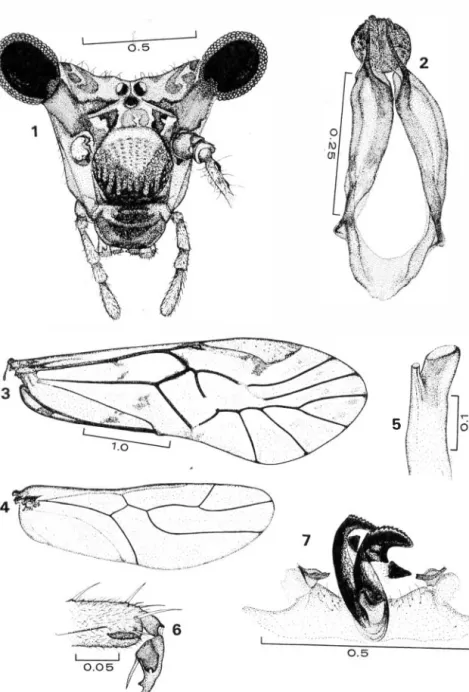
(2) 1 34. REVISTA DE BIOLOGIA TROPICAL. STELEOPS (STELEOPS) MONTICOLA. SlJ.. n.. Diagnosis: Head pattern distinct (Fig . 1 ) ; phallosome c1osed , arms fused distally into a rounded , sc1erotized bulb (Fig. 2). Hypandrium mesally with a sclerotized , forked projection , each half curved, with a row of denticles on outer edge (Fig. 7). Subgenital plate (SGP) bro ad , mesal projection short, apically rounded (Fig . 1 1) . Third valvula of gonapophyses with a distinct , long, distal lobe (Fig. 1 2). Male: Color (in alcohol) . Body dark brown on a clear background . Compound eyes black ; ocelli, c1ear, each with a dark brown centripetal crescent, grouped in a tubercle ; head with a distinct , dark brown, V- shaped mark, the apex on lower postc1ypeus (Fig. 1 ) . Distal part of fourth segments ofmaxillary palps pale brown, other segments creamish-white . Scape , proximal end of pedicel and first flagellomere of each antenna pale brown, other flagellomeres pale yellowish. Tergal lobes of meso- and metathorax, upper pleura, areas next to coxae and intercoxal spaces brown . Forewings slightly spotted (Fig. 3) ; veins pale brown on proximal halves of wings, dark brown on distal halves of wings; hindwings hyaline (Fig. 4). Meso- and metathoracic coxae deep brown proximally; prothoracic coxae creamish-white . Each femur and tibia with a subapical , dark brown , semicircular bando Tarsomeres dark brown . Abdomen clear, with dark brown sub cuticular rings. Morphology: Hypandrium (Fig. 7) narrow , with small triangular , sclerotized apophyses on post-lateral corners, and with a large , mes al, strongly sclerotized, posteriorIy directed projection, forked, each arm curved upward and bearing distally a row of dentic1es on outer edge. Phallosome (Fig. 2), closed; arms dilated toward distal end, then tapering and fusing terminally to form a rounded bulb ; each arm with a small , lateral protuberance near the base. Epiproct (Fig. 8) , distally bilobed, paraprocts (Fig . 8) articulated to clunium at end nearer epiproct, each with an apical, slender, sc1erotized prong. Sensory fields each with 26 trichobothria. Lacinial tip (Fig . 5). Tarsal claw (Fig . 6) . Measu rements (in mm) : FW: 4 . 170; HW: 3 .000 ; F : 0 .842; T: 1 .8 1 7 ; t ( 0.776 ; t2 : 0 . 1 5 1 ; t 1 ct : 36; f 1 : 0.8 5 1 ; f2 : 0 .78 5 ; f3 : 0.700 ; f4 : 0 .577 ; fS : 0.378; f6 : 0.274 ; fi 0 .20 8 ; 10: 0 .6 1 S ; D : 0 .3 1 2 ; d : 0 .2S S ; IO/D: 1 .969 ; PO : 0.8 1 8 . F emale: Color (in alcohol). Same as in the male o Forewing spots, femoral and tibial brown bands more distinct than in the ma1e. Morphology: SGP (Fig. 1 1 ) broad, setose , with the median projection short, apically rounded. Gonapophyses (Fig. 1 2) : frrst valvula long, slender; second valvula broad , distally acuminate; third valvula with a distinct , long, distal lobe, blunt apically. Epiproct (Fig. 9) . Paraprocts (Fig. 1 0) with mesal, longitudinal row of setae ; sensory fields each with 21 trichobothria. Measu rements (in mm) : FW: 3 .780 ; HW: 2.790 ; F : 0 .86 1 ; T: 1 .741 ; t ( 0.776; t2 : 0 . 160; t I ct : 3 2 ; f ( 0 .889; f2 : 0 .747; f3 : 0 .586 ; f4 : 0 .473 ; fS : 0 .302 ; f6 : 0.208 ; f7 : 0 . 1 7 9 ; 10: 0.643 ; D : 0 .32 1 ; d : 0 .246 ; IO/D: 2.0 ; PO : 0.764 ..
(3) GARCIA ALDRETE: A new Steleops from Mexico. 1 35. 5. StructUles of Steleops monticola sp . n. (O) Fig. 1 . Fig . 2. Fig . 3.. Front view of head Phallosome Forewing. Fig. 4.. Hindwing. Fig. 5 . Apex of lacinia Tarsa! c!aw, hind !eg Fig. 6 . Hypandrium Fig. 7 . Sca!es in· mm. Fig. 4, same scale as Fig. 3..
(4) 1 36. REVISTA D E BIOLOGIA TROPICAL. Structures of Steleops monticoÚl sp. n. Fig. 8. Fig. 9. Fig. 1 0 .. Subgenital plate 9 Fig. 1 1 . Paraprocts and epiproct Ó Gonapophyses 9 Fig. 1 2. Epiproct 9 Scales in mm. Figures 9 and 1 2, same scale as Fig. 1 0 . R ight paraproct 9. Type local i ty : MEXICO : Oaxaca: ca. 40 km SE of Nochixtlán; 4 km S of Hwy. 1 90 , Rd. to San Andrés Nuxiño, elevation 2,100 m, pine-oak forest, holotype O, 1 0.XI . 1 977 , beating oak branches on mountain slope , A .N . García Aldrete . Allotype 9, MEXICO : Oaxaca; 29 km SE óf Nochixtlán, 2 1 .VIII1 . 1 973 , beating oak branches, A.N. García Aldrete . Types deposited in the collection of the Instituto de Biología , Universidad Nacional Autónoma de México , Apartado Postal 70- 1 5 3 , México 20, D .F . M EXICO ..
(5) GARCIA ALDRETE: A new Steleops from Mexico. 1 37. R ecord s: (from type locality) : 6 ,VIII .l975 , beating oak branches, 1 larva, A .N . García Aldrete . Guerrero; 6 km NE of Ayotoxtla, 24.x.1 97 3 , beating oak branches , oak forest 1' 9 , A .N. García Aldrete . Comments: Steleops monticola sp .n., together with S. punctipennis Enderlein , 1 9 1 0 and S. pulchra New, 1 972 , be long within the subgenus Steleops. The other two species recognized in the genus: S. pedunculata Enderlein , 1 9 1 0 and S. maculata New, 1 972, belong in the subgenus Pelmatocoria, as separated by Roesler ( 1 944). Enderlein's description of the male genitalia of Steleops (Pelmatocoria) pedunculata is strongly reminiscent of the hypandrium of S monticola sp . n ., except that in the former the projection of the hypandrium is not divided in two arms. Unfortunately, the specimens of Steleops available for study are few, most of the species being representd by single specimens ; the eventual study of more abundant material of the known species will probably shed light on the true nature of the subgeneric division as well as on the relations with other genera . The presence of S. mon ticola sp. n . , in Mexico is of interest, since the other known species in the genus are from Paraguay and Brazil; it is also of interest that in Mexico it occupies an area of temperate forest at 2 ,000 m , contrasting with the tropical forests in which the other species are found.. ACNOWLEDGMENTS I deeply appreciate the colaboration of Leticia Beatriz Menchaca López; she too k the measurements and did most of the illustrations inc1uded in the paper . RESUMEN Steleops (Steleops) monticola sp. n. es la quinta especie reconocida en Steleops, un género americano previamente registrado sólo en Paraguay y Brasil. La nueva especie fue colectada en el sur de México . Se presentan ilustraciones de estructuras de ambos sexos, así como medidas, proporciones y cuentas de ctenidia de un ejemplar de cada sexo . S. (S. ) monticola sp. n . , se distingue de las otras especies del género por las diferencias en la genitalia y en el moteado de las alas anteriores. Los tipos están depositados en la colección de insectos del Instituto de Biología, UNAM, Departamento de Zoología, Apdo . Postal 70- 1 5 3 , México 20, D .F . M EXIC O. LITERATURE CITED Enderlein, G. 1 91 0 . Eine dekade neuer Copeognathengattungen. S. B. Ges. naturf. FI. Berl. 1 9 1 0 : 6 3-7 7. New, T.R. 1 972. Roesler, R . 1 944.. A Collectiun of Psocidae (Psocoptera) from Central Brazil. Arq. Zool . , S. Pauto, 2 2 : 1 93-23 7 .. Die Gattungen der Copeognathen. Stett. ent. Ztg., 1 05 : 1 1 7-1 66.. Smithers, C.N. 1 96 7 . The C1assifieatioll and Phylogeny of thf; Psocoptera. Memoir 14 , The Australian Museum , Sydney , 1-34 9 ..
(6)
Figure
Documento similar
Species of freshwater turtles studied in urban area in the southern of Brazil: (A) D'Orbigny's slider (Trachemys dorbigni dorbigni); (B) Geoffroy’s slide- necked turtle
Linked data, enterprise data, data models, big data streams, neural networks, data infrastructures, deep learning, data mining, web of data, signal processing, smart cities,
A este respecto, las preguntas hasta aqu´ı consideradas son: ¿en qu´ e medida las condiciones de partida en el proceso de desregulaci´ on y de liberalizaci´ on marcaron los
[r]
Objective and methods: Male patients in a therapeutic community (n=102) from a city in southern Brazil, with a primary diagnosis of cocaine dependence, were evaluated with Exner’s
In addition, given the widespread use of prescription benzodiazepines in society, and their diversion to the illicit drug market, the increase in new benzodiazepines might also
The expansionary monetary policy measures have had a negative impact on net interest margins both via the reduction in interest rates and –less powerfully- the flattening of the
Jointly estimate this entry game with several outcome equations (fees/rates, credit limits) for bank accounts, credit cards and lines of credit. Use simulation methods to
