UNIVERSIDAD TÉCNICA DE AMBATO
DIRECCIÓN DE POSGRADO
MAESTRÍA EN LA ENSEÑANZA DEL IDIOMA INGLÉS
COMO LENGUA EXTRANJERA
Tema: SELF-ASSESSMENT STRATEGIES TO ENHANCE
VOCABULARY RETENTION IN ADULT
STUDENTS
Trabajo de Investigación, previo a la obtención del Grado Académico de Magister en Enseñanza del Idioma Inglés como Lengua Extranjera.
Autor: Licenciada Maritza de los Ángeles Ortiz Paredes
Directora: Doctora Sara Nidhya Camacho Estrada Magíster
Ambato – Ecuador 2018
A LA UNIDAD ACADÉMICA DE TITULACIÓN DE LA FACULTAD
El Tribunal receptor del Trabajo de Investigación presidido por Doctor Héctor Fernando Gómez Alvarado, Presidente del Tribunal e integrado por los señores: , miembros del Tribunal designados por la Unidad Académica de Titulación de la Universidad Técnica de Ambato, para receptar el Trabajo de Investigación con el
tema: “SELF-ASSESSMENT STRATEGIES TO ENHANCE
VOCABULARY RETENTION IN ADULT STUDENTS”, elaborado y
presentado por la Licenciada Maritza de los Ángeles Ortiz Paredes, para optar por el Grado Académico de Magíster en la Enseñanza del Idioma Inglés como Lengua Extranjera; una vez escuchada la defensa oral del Trabajo de Investigación el Tribunal aprueba y remite el trabajo para uso y custodia en las bibliotecas de la UTA.
--- Dr. Héctor Fernando Gómez Alvarado Doctor Presidente del Tribunal
--- Lcda. Ximena Alexandra Calero Sánchez, Mg Miembro del Tribunal
--- Lcda. Lorena Monserrath Meléndez Escobar, Mg Miembro del Tribunal
--- Lcda. Ana Jazmina Vera de la Torre, Mg Miembro del Tribunal
AUTORÍA DEL TRABAJO INVESTIGACIÓN
La responsabilidad de las opiniones, comentarios y críticas emitidas en Trabajo de Investigación presentado con el tema: “SELF-ASSESSMENT STRATEGIES
TO ENHANCE VOCABULARY RETENTION IN ADULT STUDENTS”, le
corresponde exclusivamente a la Licenciada Maritza de los Ángeles Ortiz Paredes, Autora, bajo la dirección de la Doctora Sara Nidhya Camacho Estrada Magíster, Directora del Trabajo de Investigación, y el patrimonio intelectual a la Universidad Técnica de Ambato.
--- Lic. Maritza de los Ángeles Ortiz Paredes
c.c: 180403023-5
AUTORA
--- Dra. Sara Nidhya Camacho Estrada, Mg.
c.c. 180291375-4
DERECHOS DE AUTOR
Autorizo a la Universidad Técnica de Ambato, para que el Trabajo de Investigación, sirva como un documento disponible para su lectura, consulta y proceso de investigación, según las normas de la Institución.
Cedo los Derechos de mi trabajo, con fines de difusión pública, además apruebo la reproducción de este, dentro de las regulaciones de la Universidad.
--- Lic. Maritza de los Ángeles Ortiz Paredes
c.c: 180403023-5 AUTORA
GENERAL TABLE OF CONTENTS
Portada... i
A la Unidad Académica de Titulación de la Facultad... ii
Autoría del Informe Investigación ... iii
Derechos de Autor... iv
General Table of Contents ... v
List of Tables... viii
List of Figures ... ix
Acknowledgement... x
Dedication ... xi
Resumen Ejecutivo... xii
Executive Summary ... xiii
Introduction ... 1 CHAPTER I PROBLEM STATEMENT 1.1. Topic ... 3 1.2. Problem Statement ... 3 1.2.1 Contextualization ... 3 1.2.2 Critical Analysis ... 8 1.2.3 Prognosis ... 9
1.2.4 Research Problem Formulation ... 10
1.2.5 Research Questions ... 10
1.2.6 Delimitation of the Research Problem ... 10
1.3. Justification ... 11 1.4. Objectives ... 12 1.4.1 General Objective ... 12 1.4.2 Specifics Objectives ... 12 CHAPTER II THEORETICAL FRAMEWORK
2.2 Philosophical Foundation ... 17
2.3 Legal Foundation ... 18
2.4 Fundamental Categories ... 21
2.4.1 Fundamental Categories Network ... 22
2.4.2 Independent Variable Interrelated Graphics... 23
2.4.3 Dependent Variable Interrelated Graphics ... 24
2.5 Dialectical View of Conceptualizing Variables ... 25
2.5.1 Independent Variable Theoretical Framework ... 25
2.5.2 Dependent Variable Theoretical Framework ... 33
2.6 Hypothesis ... 41 2.7 Identification of variables ... 41 2.7.1 Independent Variable ... 41 2.7.2 Dependent Variable ... 41 CHAPTER III METHODOLOGY 3.1 Research Approach... 42
3.2 Basic Research Modality ... 43
3.2.1 Bibliographic-Documentary Research ... 43 3.2.2 Field Research ... 43 3.3 Level of Research ... 43 3.3.1 Descriptive ... 43 3.3.2 Relational ... 44 3.4 Population y sample ... 44 3.5 Operationalization of Variables... 45
3.6 Techniques and instruments ... 47
3.6.1 Techniques ... 47
3.7 Data Collection Plan ... 47
3.8 Information Processing and Analysis Plan ... 48
CHAPTER IV ANALYSIS AND INTERPRETATION 4.1 Analysis of results and data interpretation ... 49
4.2 Hypothesis verification ... 65
4.2.1 Calculated Chi-squared ... 65
4.2.2 Tabulated Chi-squared ... 68
4.2.3 Chi square distribution ... 69
4.2.4 Decision rule ... 70
CHAPTER V CONCLUSIONS AND RECOMMENDATIONS 5.1 Conclusions ... 71
5.2 Recommendations ... 72
CHAPTER VI THE PROPOSAL 6.1 Informative data ... 74
6.2 Background of the proposal ... 74
6.3 Justification ... 75
6.4 Objectives ... 76
6.4.1 General ... 76
6.4.2 Specific ... 76
6.5 Feasibility analysis ... 76
6.6 Theoretical foundation of the proposal ... 77
6.7 Administration of the proposal ... 144
6.8 Evaluation of the proposal ... 144
References ... 145
Linkography ... 156
LIST OF TABLES
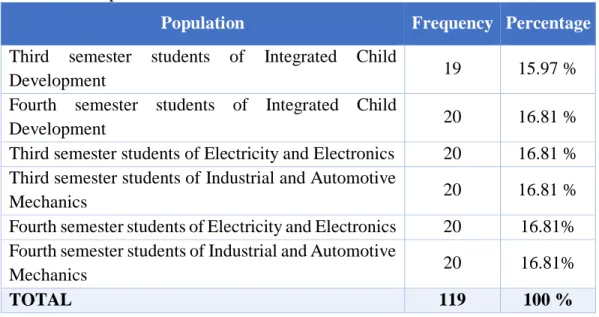
Table Nº 1. Population. ... 44
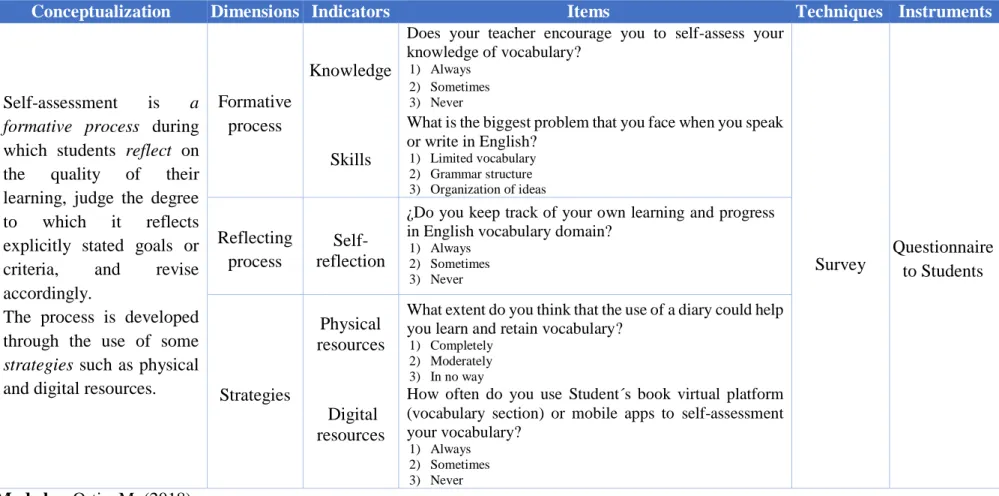
Table Nº 2. Operationalization of the Independent Variable. Self-assessment strategies. ... 45
Table Nº 3. Operationalization of the Dependent Variable. English vocabulary retention... 46
Table Nº 4. Data collection plan... 47
Table Nº 5. Your teacher encourages you to self-assess your vocabulary. ... 49
Table Nº 6. Biggest problem when you speak or write in English... 50
Table Nº 7. You keep track of your own learning and progress in vocabulary. .. 52
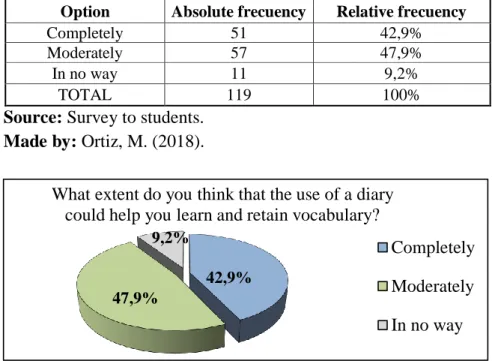
Table Nº 8. You think the use of a diary could help you retain vocabulary. ... 53
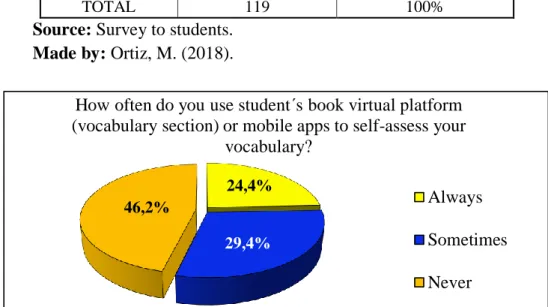
Table Nº 9. You use student´s book virtual platform or mobile apps. ... 54
Table Nº 10. You are able to associate the spoken with written form. ... 55
Table Nº 11. The hardest words to recognize... 56
Table Nº 12. Level you handle most of the English vocabulary. ... 57
Table Nº 13. The methodology used by your teacher let you learn vocabulary. . 58
Table Nº 14. You memorize and understand the meaning of words. ... 59
Table Nº 15. Doing a basic conversation in English is. ... 60
Table Nº 16. Your teacher performs academic reinforcement activities... 61
Table Nº 17. Level of vocabulary knowledge. ... 62
Table Nº 18. Teacher ever implemented a method to evaluate your vocabulary. 63 Table Nº 19. You learn vocabulary better in interaction activities. ... 64
Table Nº 20. Qualitative equivalence. ... 66
Table Nº 21. Observed Frequencies. ... 66
Table Nº 22. Expected frequencies. ... 67
Table Nº 23. Chi-squared calculation. ... 68
Table Nº 24. Lorin Anderson revisited Bloom´s Taxonomy. ... 81
Table Nº 25. Bloom´s Taxonomy dimensions. ... 81
Table Nº 26. Levels of the cognitive process. ... 83
LIST OF FIGURES
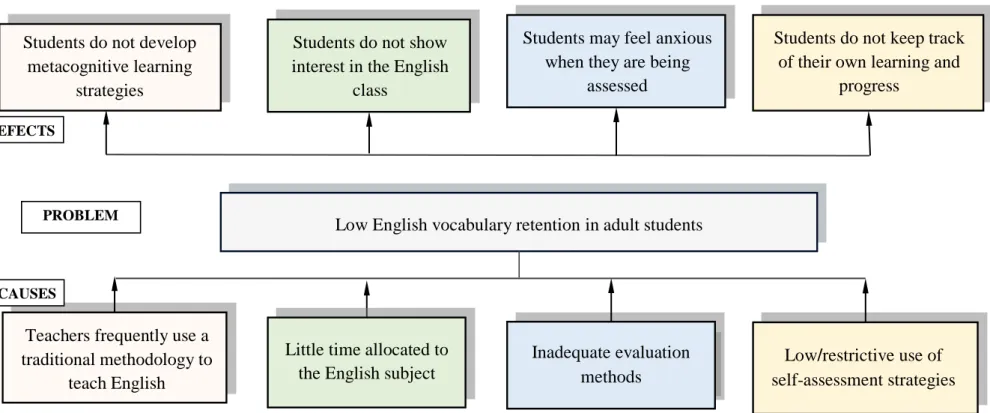
Figure Nº 1. Problem tree analysis. ... 7
Figure Nº 2. Fundamental Categories. ... 22
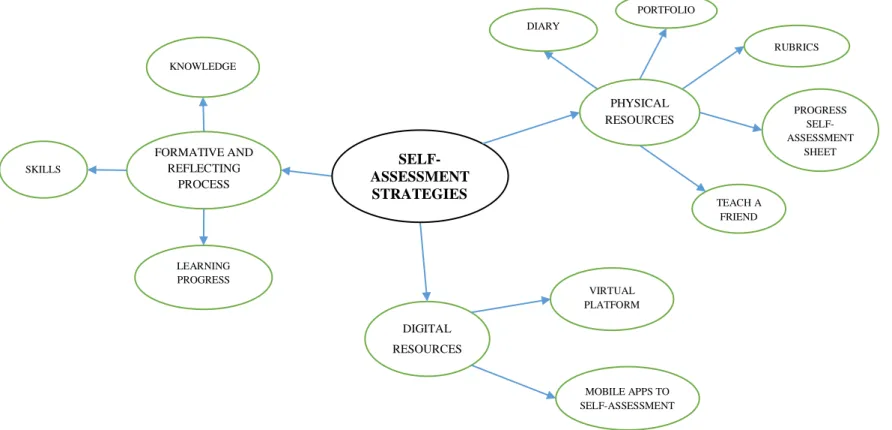
Figure Nº 3. Graphics Independent. ... 23
Figure Nº 4. Graphics Dependent. ... 24
Figure Nº 5. Your teacher encourages you to self-assess your vocabulary. ... 49
Figure Nº 6. Biggest problem when you speak or write in English. ... 50
Figure Nº 7. You keep track of your own learning and progress in vocabulary. . 52
Figure Nº 8. You keep track of your own learning and progress in vocabulary. . 53
Figure Nº 9. You use student´s book virtual platform or mobile apps... 54
Figure Nº 10. You are able to associate the spoken with written form. ... 55
Figure Nº 11. The hardest words to recognize. ... 56
Figure Nº 12. Level you handle most of the English vocabulary. ... 57
Figure Nº 13. The methodology used by your teacher let you learn vocabulary. 58 Figure Nº 14. You memorize and understand the meaning of words. ... 59
Figure Nº 15. You are able to associate the spoken with written form. ... 60
Figure Nº 16. Your teacher performs academic reinforcement activities. ... 61
Figure Nº 17. Level of vocabulary knowledge. ... 62
Figure Nº 18. Teacher ever implemented a method to evaluate your vocabulary. ... 63
Figure Nº 19. You learn vocabulary better in interaction activities. ... 64
ACKNOWLEDGEMENT
I want to express my sincere gratitude to all the people who took their time to help me and guide me during all this process. Thank you for your valuable time.
DEDICATION
This work is for all those teachers who look for a different way to teach and love their profession. For those who keep trying new things every day.
UNIVERSIDAD TÉCNICA DE AMBATO DIRECCIÓN DE POSGRADO
MAESTRÍA EN LA ENSEÑANZA DEL IDIOMA INGLÉS COMO LENGUA EXTRANJERA
TEMA: “ESTRATEGIAS DE AUTOEVALUACIÓN PARA MEJORAR LA RETENCIÓN DEL VOCABULARIO EN LOS ESTUDIANTES ADULTOS” AUTOR: Licenciada Maritza de los Ángeles Ortiz Paredes.
DIRECTORA: Doctora Sara Nidhya Camacho Estrada, Magíster.
FECHA: 13 de Julio de 2018
RESUMEN EJECUTIVO
La presente investigación consiste en el estudio de las estrategias de autoevaluación, como herramientas que se utilizan para mejorar la retención del vocabulario en los estudiantes adultos de un idioma extranjero. En el estudio se consideró a los estudiantes del Instituto Tecnológico Superior Guayaquil de la ciudad de Ambato, quienes reciben inglés en un nivel básico y presentan un bajo nivel de retención de vocabulario. El principal objetivo del presente trabajo consistió en investigar como las estrategias de autoevaluación mejoran la retención del vocabulario en los estudiantes adultos. A partir de la aplicación de una encuesta se determinó que la metodología utilizada por los docentes no contribuye a que los estudiantes presenten una buena retención del vocabulario en inglés y se estableció que los alumnos no suelen utilizar recursos para autoevaluar su proceso de aprendizaje del idioma. De igual manera, mediante el estadístico de prueba de hipótesis Chi-Cuadrado se demostró que las estrategias de autoevaluación inciden en la retención del vocabulario. Con la finalidad de aportar a la solución de la problemática existente, se formuló un folleto de siete estrategias que pueden ser utilizadas por los estudiantes en clase o en su casa, entre las cuales constan: un diario, rúbricas, una plataforma virtual, aplicaciones libres para smartphones, una hoja de autoevaluación del progreso y una estrategia de enseñanza a un amigo y un portafolio. En cada una de las estrategias se indican el modo de uso, el objetivo, la función, los recursos requeridos y una escala de calificación para que los estudiantes tengan conocimiento de su progreso en el aprendizaje.
Descriptores: Autoevaluación, conocimiento de la palabra, estrategias, estudiantes
adultos, folleto, habilidades, retención de vocabulario, portafolio, proceso cognitivo, taxonomía.
UNIVERSIDAD TÉCNICA DE AMBATO DIRECCIÓN DE POSGRADO
MAESTRÍA EN LA ENSEÑANZA DEL IDIOMA INGLÉS COMO LENGUA EXTRANJERA
THEME: “SELF-ASSESSMENT STRATEGIES TO ENHANCE
VOCABULARY RETENTION IN ADULT STUDENTS”
AUTHOR: Licenciada Maritza de los Ángeles Ortiz Paredes.
DIRECTED BY: Doctora Sara Nidhya Camacho Estrada, Magíster.
DATE: July 13th, 2018
EXECUTIVE SUMMARY
This research is about the study of self-assessment strategies, as tools that are used to improve the vocabulary retention in adult students of a foreign language. Students from the Instituto Tecnológico Superior Guayaquil in the city of Ambato were considered in the research, who receive English at a basic level and have an important problem which is a low vocabulary retention. The main research objective is to investigate how self-assessment strategies enhance English vocabulary retention in adult students. It was found that the methodology used by teachers does not contribute to the students having a good vocabulary retention, the data were got from the application of a survey and it was established that the students do not usually use resources to self-assess their language learning process. Similarly, the results obtained from the statistical Chi-Squared hypothesis test showed that self-assessment strategies influence vocabulary knowledge in adult students. In order to contribute to the solution of the problem, a brochure of seven strategies that can be used by students in class or at home was formulated, among which are: a diary, rubrics, a virtual platform, mobile free Apps, progress self-assessment sheet, teach a friend, and portfolio. In each of the strategies, the mode of use, the objective, the function, the resources required and a rating scale are indicated so that the students have knowledge of their progress in learning.
INTRODUCTION
This research aims to study the impact of self-assessment strategies to enhance vocabulary retention in English language learners at Instituto Tecnológico Superior Guayaquil. It is known that adult students have a low retention of English language vocabulary according to the teachers, this does not allow them to develop listening, reading, speaking and writing skills. In several studies it was determined that the use of self-assessment strategies such as diaries, rubrics, mobile applications, portfolios, virtual platforms, among others, motivate students the desire to learn a foreign language and improve the learning capacity, reflection and self-assessment of learning. In that sense, the implementation of a booklet of self-assessment strategies is implemented to help teachers to evaluate the vocabulary retention in adult students, assigning part of the evaluation process responsibility to the students themselves.
The research study has been organized in the following chapters:
Chapter I. The problem. It contains the research topic and describes the problem which has to be solved. It encompasses the reasons why the research is done. It also has the problem tree, the critical analysis, the justification as well as the general and specific objectives.
Chapter II. Theoretical Framework. It includes the research background, the philosophical foundation, the legal grounds, the fundamental categories, the hypothesis and the identification of variables. Theoretical Framework development requires a revision of bibliographical resources from data bases and digital repositories.
Chapter III. Methodology. It describes how the research is carried out. It has the research approach, the basic research modality, the level of research, the population and the sample calculated, the operationalization of variables, the techniques and instruments, the data collection plan and the information processing and analysis
plan. All of these items provide a explanation of the process the author follows to do the research.
Chapter IV. Analysis and interpretation of the results. It includes a quantitative and qualitative analysis of the results obtained through a survey. Moreover, this chapter contains the hypothesis verification which allows the evaluation of the feasibility of the implementation of proposal.
Chapter V. Conclusions and recommendations. It encompasses the final thoughts based on the results, in response to the research objectives, in order to give a solution to the problem.
Chapter VI. The proposal. It contains a booklet of self-assessment strategies to enhance vocabulary retention. This proposal has been made based on the results obtained in the study. Therefore, it has all the components such as: the informative data, the background of the proposal, the justification, the objectives, the feasibility analysis, the theoretical foundation which contains seven strategies, the administration and the evaluation of the proposal. All this information aims to contribute to the practical implementation of the booklet in the classroom or home. Finally, there is a list of bibliographical references and the annexes.
CHAPTER I
PROBLEM STATEMENT 1.1. Topic
“Self-assessment strategies to enhance vocabulary retention in adult students”.
1.2. Problem Statement
1.2.1 Contextualization
According to (EF Education First Ltd, 2017) in its report called “EF English Proficiency Index” in its seventh edition, Latin America was identified as the region with the lowest proficiency in English in the world, with an average proficiency score barely surpassing the low proficiency cut-off. Eighty countries were evaluated worldwide, as well five categories were also considered in the ranking: very high, high, moderate, low, and very low. However, there are some Latin American countries, such as: Argentina, Dominican Republic, and Cost Rica that reach a moderate level. Most programs to improve English proficiency in Latin America focus on financing teacher training or student exchange to North America. This emphasis on training is adequate given the level of teachers in the region. Other initiatives are under development, including programs that use technology for teachers in other countries to teach high quality English lessons.
In some countries, including Uruguay, the “Plan Ceibal” was implemented, which showed favorable results in sixth grade students, especially in terms of vocabulary, grammar and reading skills. The plan needs participation in the teaching-learning of native English speaking teachers (Plan Ceibal, CEIP, & ANEP, 2015).
One of the reasons why Latin Americans have a low level of English proficiency is because teachers are not trained at a high level and they also do not apply all the teaching-learning strategies available (EF Education First Ltd, 2017, p. 27). Therefore, the ability to retain vocabulary in adult students is not known, but it is assumed to be limited due to the results of the EF English Proficiency Index.
The English vocabulary retention is one of the main problems that limits the language learning. The factors that interfere with learning a word are: difficult pronounceability, similarity of form and morphology between the word and other words, different syntactic patterning in native language, multiplicity of meaning and metaphors/idioms nonsristent in native language, differences in lexical gridding between native and foreign language, deceptive morphological structure, lexical voids, connotations nonsristent in first language and apparent rulelessness of collocation (Laufer, 1990, p. 150). According to Saigh & Schmitt (2012) who studied the case of Arabian students, English learners have serious troubles with the word form and they show difficulties with the spelling of English vowels in general. These aspects and added to the fact of the poor preparation of English teachers or the use of obsolete teaching strategies, contribute to the difficulties in the English learners’ vocabulary retention.
In relation to the Latin American context, Pérez and Alvira, (2017) state that there is lack of vocabulary and the ability to retain and retrieve words. He found that, when Colombian university students read a text, the strategies used by them to learn new words are limited to trying to infer their meaning from the context and to resorting to their native language to guess the meaning of words and understand the reading (p. 105).
In the case of Ecuador, the situation is not different, despite the fact that the state has promoted the training of teachers and the increase of academic hours in the English language subject, however satisfactory results are not achieved. According to the EF Education First, Ecuador ranked 55th among the 80 countries assessed in
the English proficiency index seventh edition (2017), because its level is low domain (the score was 49.42) although the tendency is to improve.
The Ministry of Education (2014) makes emphasis on the development of skills in adult students proposed by the National Curriculum Guidelines for English as a Foreign Language. This initiative had a number of aspects, including targets for functional competence aligned with the Common European Framework of Reference for Languages (CEFR), a new evaluation parameters for newly qualified English teachers, continuous professional development for existing English teachers, travel-study options for English teachers, scholarships for students to study at universities abroad that teach in English, among others (Villalba & Rosero, 2014).
Related to the vocabulary, assessment indicators for every skill have been given in Ecuador, such as: to recognize cognate words, to write short words that are in their vocabulary with reasonable phonetic accuracy, to have enough language to get by with sufficient vocabulary to express themselves on topics such as family, hobbies, interests, work, travel and current events. In order to obtain good results in these evaluations, the need to apply self-evaluation strategies to enhance vocabulary retention in adult students (Villalba & Rosero, 2014).
Institutes do not have standards for the teaching-learning process of a foreign language. Under these circumstances, the vocabulary retention required for students according the CEFR do not satisfy the requirement. Unfortunately, there are still many teachers who are adopting methods, strategies and techniques which are not necessarily efficient and meaningful to teach the language. Some teachers are still employing ineffective ways to make their students develop their vocabulary understanding and retention, and obviously, they fail to do so since the methodology used was inaccurate.
At Instituto Tecnológico Superior Guayaquil from Ambato, there is a low degree of English language acquisition. Several problems have been detected in the English vocabulary retention according to the information provided by the area
meetings, in which there are evaluations that evidence that from the 100 percent of the grade, 30 percent from the vocabulary section has a low degree from most of the students. Additionally, the methodology of teaching is not standardized, so the teacher is responsible for programming the curriculum according to their knowledge and experience, in that sense it has also been demonstrated that the teachers do not adopt self-assessment strategies as support in the learning process. The resources used by teachers are: a workbook, auxiliary written material and audio recordings, the tests contain questions prepared according to the topics by units. While student self-assessment is used in a limited way, as a part of educative feedback.
Problem Tree
Figure Nº 1. Problem tree analysis. Made by: Ortiz, M. (2018).
Students do not show interest in the English
class
Low English vocabulary retention in adult students
Students do not keep track of their own learning and
progress
Low/restrictive use of self-assessment strategies Inadequate evaluation
methods Students do not develop
metacognitive learning strategies
Teachers frequently use a traditional methodology to
teach English
Students may feel anxious when they are being
assessed
Little time allocated to the English subject
CAUSES EFECTS
1.2.2 Critical Analysis
The core problem of this research is the low English vocabulary retention in adult students at Instituto Tecnológico Superior Guayaquil. Firstly, it is necessary to refer that teachers frequently use a traditional methodology to teach English, they promote memorization and use of printed resources. This does not encourage independent learning, so students do not develop metacognitive learning strategies. Consequently, they are not able to identify their strengths and weaknesses when learning a foreign language.
On the other hand, there is little time allocated to the English subject at Instituto Tecnológico Superior Guayaquil, students only have two hours of English subject per week. This is a limitation because students generally do not contribute in the evaluation of their learning progress. For this reason, vocabulary retention do not reach a high level, according to the opinion of the teachers of the subject, based on the tests applied to measure the vocabulary domain. As a result, students do not show interest in English class nor in their home and consequently they do not feel the necessity to use English language in their daily life neither in reading activities.
Another aspect is that teachers do not develop adequate evaluation methods, which are almost exclusively written and they reward memorization rather than reading comprehension, that does not contribute to the vocabulary retention and it causes that students may feel anxious when they are being assessed. As a result of that, the students do not make progress in English learning skills.
Furthermore, the low/ restrictive use of self-assessment strategies causes difficulties in the development of the ability to associate words and to get an English vocabulary retention. For this reason, students do not keep track of their own learning and progress. There is low self-assessment strategies that are applied considering the time of each class and are: dialects among peers, writing a diary of learning advances, identification of song lyrics, flash cards, class discussions, and
of strategies based on the aforementioned resources is the fact that some of the students are native speakers of Quichua, they also work, and they have difficulties to use the virtual platform that contains tests.
The use of dialects among peers, diaries of learning advances, identification of song lyrics, flash cards, class discussions, and a virtual platform has been well received by the students, because according to a preliminary interview applied to some students, they consider that these resources motivate them to pay more attention to learn and reduce monotony. They also state that they would like to take advantage of the availability of mobile apps to assess their vocabulary domain, thanks to the fact that they can observe images that facilitate the mental assimilation of concepts and words. But it is difficult to spread the resources for several reasons, especially due to the limited time available in the classes and at home by the students.
1.2.3 Prognosis
If the low English vocabulary retention in the students keeps on happening, the students in third and fourth semesters at Instituto Tecnológico Superior Guayaquil will not improve their ability to retain the words and will have difficulty in developing the receptive (listening and reading) and productive (speaking and writing) skills of the English language. If the problem is not successfully solved now, it will affect the adult students´ academic future and professional lives.
Besides, the low vocabulary retention of the English language will lead the students to be disengaged because of the poor understanding and they will not show interest in the activities planned by the teacher during the class time. Additionally, their experience learning English as a foreign language will not be meaningful or long-lasting. In fact, they will see English as a difficult subject and not as an opportunity to improve their own learning for professional purposes.
In the social and professional field, students will not apply English in their daily lives and will have limitations in their professional development, due to the fact that it is becoming necessary to have knowledge of the universal language to
communicate with the outside world and to be efficient at work even more when most of the manuals that students use as part of their training in the different technological fields are illustrated in English.
1.2.4 Research Problem Formulation
Which types of self-assessment strategies enhance English vocabulary retention in adult students?
1.2.5 Research Questions
What self-assessment strategies do enhance vocabulary retention from students?
What are the word knowledge components and the features of learnability? How are developed the cognitive skills in English vocabulary retention? How could adult students improve the vocabulary retention?
1.2.6 Delimitation of the Research Problem
Field: Education
Area: Young Education
Specific Field: Vocabulary teaching and learning, and Self-assessment strategies.
1.2.6.1 Time Delimitation
1.2.6.2 Spatial Delimitation
This research will take place at Instituto Tecnológico Superior “Guayaquil” with third and fourth semesters of Automotive Mechanic, Industrial Mechanic, Electricity, Electronic and Integrated Child Development.
1.3. Justification
The present research has the interest to determine how the adoption of self-assessment strategies can contribute to enhance the vocabulary retention in the students at Instituto Tecnológico Superior Guayaquil. In that sense, the work is done in order to provide an effective solution to the present problem in the English language vocabulary retention. It is of great importance to find a solution in order to have more active students in the language learning process.
There is a clear evidence of the poor acquisition of the language and that problem comes from the low vocabulary that students have. In order to give a solution to this problem it is important to apply an strategy that could get students involved in vocabulary learning and retaining it as much as possible to be able to use it in future situations where communication is required.
The self-assessment can be an instrument that helps students to pay attention, respect and value the different learning rhythms, according to the different characteristics of students. The research focuses on contributing to the metacognitive development of students, so that they will be able to control their mental processes during their learning. In this way a contribution will be made for the benefit of the Instituto Tecnológico Superior Guayaquil and its students.
At the same time, the research is innovative because there are not studies applied to the knowledge on how self-assessment strategies enhance vocabulary retention. In addition, it encourages the independent learning of students in this institution. This work will be a mean of consultation for teachers who wish to innovate in the teaching of the English language through the use of self-assessment strategies such
as a diary, rubrics, a virtual platform, mobile free apps, self-assessment progress sheet and a portfolio. These are strong, convincing reasons to support and justify the development of this research work.
From the development of the research work it is expected that teachers have self-assessment resources to use in the classes and students improve the vocabulary retention as well it will allow them to develop reading, writing, speaking, and listening skills that is may be the main advantages of vocabulary retention. Therefore, it is fundamental to find out the impact of self-assessment strategies on the development of the vocabulary domain to help students be more accurate and fluent in English when using it to communicate in authentic settings.
In terms of feasibility, from the academic point of view, teachers could incorporate the strategies they consider appropriate for the improvement of the teaching-learning process. Additionally, the subject of research is within the scope of the academic field of the Master's Program in Teaching the Language English as a Foreign Language. Finally, from the economic scope, the costs will be covered by the researcher.
1.4. Objectives
1.4.1 General Objective
To investigate how self-assessment strategies enhance English vocabulary retention in adult students.
1.4.2 Specifics Objectives
To identify the self-assessment strategies that enhance English vocabulary retention in adult students.
To determinate the cognitive skills developed in English vocabulary retention.
To propose an alternative solution that effectively helps to enhance the vocabulary retention in adult students.
CHAPTER II
THEORETICAL FRAMEWORK
2.1 Research Background
When checking the repository of Universidad Técnica de Ambato, there is concluded that researches evidence related to the topic “Self-assessment strategies to enhance vocabulary retention in adult students” does not exist. That is the reason why this thesis will be of great help for future studies.
It is necessary to consider a study made by Casso (2010), titled “Análisis y revisión crítica de los materiales de evaluación de la competencia léxica. Elaboración de un test de vocabulario de nivel umbral”, research made to obtain the official Master's degree in Linguistics Applied to the Teaching of Spanish as a Foreign Language at Universidad Nebrija. In that research, the author did lexical tests, based on frequency lists that would serve to measure the size of the receptive and productive vocabulary of B1 Spanish students. However, at the same time, a revision of the vocabulary proficiency tests in the English language was carried out. In this sense, the most used tests for the evaluation of the extension and depth of the vocabulary were analyzed. Among the conclusions established by the author, he states the main types of tests are diagnostic, sufficiency and proficiency tests. There are some tests that measure the lexicon in English, for example, The Vocabulary Levels Test, The Eurocentres Vocabulary Size Test (EVST), Productive Vocabulary Levels Test, Word Associates Test, Association Vocabulary test, and The Vocabulary Knowledge Scale (VKS). In addition, he concludes that the tests evaluate the size of the candidate's receptive and productive vocabulary. Other tests could be made to evaluate the depth of that knowledge, in terms of collocations, synonyms,
The information obtained is very useful to choose the appropriate test to measure the retention of vocabulary in English, by students at Instituto Tecnológico Superior Guayaquil because the measurement indicators of the knowledge of the vocabulary are described.
Another related research to keep in mind, made by Alqahtani (2015), is titled “The importance of vocabulary in language learning and how to be taught”. In the Literature review section, the author addresses the importance of vocabulary learning, the definition of vocabulary, the kinds of vocabulary, the techniques in teaching vocabulary, and vocabulary learning strategies. The author also concludes that lexical knowledge is central to communicative competence and to the acquisition of a second/foreign language and lack of vocabulary knowledge is an obstacle to learning. Additionally, he says that the most important techniques of teaching vocabulary are using objects, drawing, using illustrations and pictures, enumeration, contrast, mime, expressions and gestures, translation, guessing from context, and eliciting. These techniques of teaching vocabulary are of great importance and therefore should be widely known by English teachers.
In the study conducted by Martínez-Figueira, Tellado-González, & Raposo-Rivas (2013), called "The rubric as an instrument for self-evaluation: a pilot study", published in journal REDU, the aim of the research is to experiment with a methodology based on peer evaluation and self-assessment of learning by the students themselves through e-rubrics. In that sense, the researchers adopted the use of rubrics as instrument for the content learning self-assessment in a group of 70 students. According the results, students states the use of rubrics allows them to improve their learning, cooperate with their peers, reflect, respond and identify mistakes. As students progress in the use of rubrics, they will verify the indicators that are considered important for their correct resolution, which gives them "clues" of where to focus their work in groups. This research contributes as a support for the adoption of the rubric for the self-assessment of foreign language vocabulary.
Berns, Palomo-Duarte, Dodero, Ruiz-Ladrón, and Calderón-Márquez (2015), in their research titled “Mobile apps to support and assess foreign language learning”, the purpose of the project is to explore some of the possibilities of integrating smartphones in blended teaching practices to make independent learning processes. The researchers designed an application architecture idea aimed at a group of 100 students from the University of Cádiz, Spain. Personalized tests to self-assess are among the app components whose experience and results sheds some light on the possibilities of using mobile apps to facilitate learning as well as assessment processes. Students reported that by creating definitions themselves they significantly improved their vocabulary retention and writing skills, getting much more confident in the target language. This research supports the importance of using mobile apps to develop vocabulary retention.
Popescu-Mitroia, Todorescu, and Greculescu (2015), in the research named “The usefulness of portfolios as assessment tools in Higher Education”, in this study, authors made a comparative analysis between the features of the portfolio acknowledged by experts in education and those identified by students, expressed as advantages-disadvantages. The researchers made a qualitative and quantitative analysis of the students’ opinions regarding the advantages and disadvantages of the portfolio as an evaluation method. It was discovered that among the main benefits of the use of the portfolio are the motivation for training in the field of study, consolidation of the extensive knowledge, the theory put into practice, the interest in the topics discussed, the development of the capacity to synthetize, the development of oral and written communication competence, the creativity and originality, the participation in the learning process, and the analysis of self-study. The portfolio strategy evaluates what students can do (rather than what they know), reveals students’ professional competence and measures the students’ active involvement in learning and evaluation. This study is useful because it reveals the advantages of using portfolios in student learning.
2.2 Philosophical Foundation
This research will be based upon constructivism paradigm proposed by Jean Piaget (1972). This approach sees learning as interdisciplinary, integrating and practical process. This means learners relate prior knowledge to new knowledge in different contexts. Moreover, developing thinking, imagination, creativity, critical analysis, collaboration and cooperation constitute important elements in this approach.
The constructivist paradigm encourages students to construct their own knowledge, ideas and learning situations where they can freely use the language acquired according to their needs and interests. With this approach, students will be dealing with authentic tasks that resemble real situations in the world where they have to use the input in meaningful contexts. On the other hand, constructivism promotes collaborative work boosting learners to share their knowledge to equally succeed through cooperation rather than competition.
The central principles of this approach are that learners can only make sense of new situations in terms of their existing understanding. Learning involves an active process in which learners construct meaning by linking new ideas with their existing knowledge (Jones M., 2002).
Besides, this approach emphasizes on how learners acquire new knowledge. The active role of the students is what makes this approach attractive to educators. What learners bring to the classroom permits them to construct new understandings and have new experiences (Jones M. 2002). Based on this, it can be said that the traditional teaching approach disappears with constructivism because students are not passive learners. In fact, the learning process is centered on students. Sanaa (2006) mentioned that constructivism is reflected in the student-centered approach since learners construct their own understanding.
Similarly, this research is axiological because it requires participants to show a good practice of values. Students, teachers and authorities are the main audience of the
present study. Consequently, values such as respect, cooperation, responsibility, honesty and others should be reflected in every action taken by the participants.
2.3 Legal Foundation
The legal statutes that support this research are the following:
Ley Orgánica de Educación Superior LOES (2010) “Art. 124. Formación en valores y derechos.
Es responsabilidad de las instituciones del Sistema de Educación Superior proporcionar a quienes egresen de cualesquiera de las carreras o programas, el conocimiento efectivo de sus deberes y derechos ciudadanos y de la realidad socioeconómica, cultural y ecológica del país; el dominio de un idioma extranjero y el manejo efectivo de herramientas informáticas”.
[Art. 124. Training in values and rights.
It is the responsibility of the institutions of the Higher Education System to provide those who graduate from any of the careers or programs, effective knowledge of their duties and citizenship rights, and of the socioeconomic, cultural, and ecological reality of the country; the domain of a foreign language, and the effective use of computer tools.]
Instituto Tecnológico Superior Guayaquil from Ambato is part of the Higher Education System institutions. Therefore, according to LOES it is obliged to provide the domain of a foreign language those who graduate from their careers and the vocabulary knowledge is one of aspects that are part of the English language proficiency.
Ley Orgánica de Educación Intercultural LOEI (2011) Art. 7. Derechos de los estudiantes.
“a. Ser actores fundamentales en el proceso educativo”.
[Art. 7. The Rights of Students.
a. Be fundamental executors in the educational process].
It is recognized in the LOEI that students have to be fundamental actors in the educational process, which supports the need for them to self-assess their knowledge through the use of strategies. In the present case, it belongs to develop self-assessment to vocabulary learning.
Art. 11. Obligaciones de los docentes.
“i. Dar apoyo y seguimiento pedagógico a las y los estudiantes, para superar el rezago y dificultades en los aprendizajes y en el desarrollo de competencias, capacidades, habilidades y destrezas”.
[Art. 11. The Obligations of Teachers.
i. Give students support and pedagogical monitoring to overcome the lag and difficulties in learning and development of competences, capacities, abilities and skills.]
The article states that teachers must provide pedagogical support to students, which justifies the need to monitor the use of self-assessment strategies for English vocabulary.
Reglamento de Régimen Académico Consejo Educación Superior (2017) Art. 31. Aprendizaje de una lengua extranjera.
“…las IES garantizarán el nivel de suficiencia del idioma para cumplir con el requisito de graduación de las carreras de nivel técnico superior, tecnológico superior y sus equivalentes; y, tercer nivel, de grado, deberán organizar u homologar las asignaturas correspondientes desde el inicio de la carrera. La suficiencia de la lengua extranjera deberá ser evaluada antes de que el estudiante se matricule en el último periodo académico ordinario de la respectiva carrera; tal prueba será habilitante para la continuación de sus estudios, sin perjuicio de que este requisito pueda ser cumplido con anterioridad.
En las carreras de nivel técnico superior, tecnológico superior y equivalentes, se entenderá por suficiencia en el manejo de una lengua extranjera el nivel correspondiente a B1.1 y B1.2, respectivamente, del Marco Común Europeo de referencia para las Lenguas”.
[Art. 31 Learning a foreign language.
…the IES will guarantee the level of proficiency in the language to meet the graduation requirement of higher technical, higher technological and equivalent degrees; and, third level of degree, they will have to organize or homologate the corresponding subjects from the beginning of the race. The sufficiency of the foreign language must be evaluated before the student enrolls in the last regular academic period of the respective career; such proof will be enabled for the continuation of their studies, without prejudice to the fact that this requirement can be fulfilled previously.
In higher technical level, higher technological and equivalent careers, proficiency in the use of a foreign language must be understood as the level corresponding to B1.1 and B1.2, respectively, of the Common European Framework of Reference for Languages.]
The communicative-functional approach proposed for the English curriculum is characterized by two main features:
2. Relationship of language forms (grammar, vocabulary, and pronunciation) and function (use): “Language techniques are designed to engage learners in the authentic, functional use of language for meaningful purposes” (Brown, 2007, p.46) supported by knowledge of the language structures.
Linguistic competence: “includes lexical, phonological, syntactical knowledge and skills and other dimensions of language as a system” (CEFR, 2003, p.13). For example: vocabulary, pronunciation, and grammar (Villalba & Rosero, 2014). It is expressly noted that the domain of the vocabulary is part of the linguistic competence, which justifies the need to implement the proposal of the present research.
2.4 Fundamental Categories
Self-assessment strategies.
2.4.1 Fundamental Categories Network
Independent Variable Dependent Variable
Figure Nº 2. Fundamental Categories. Made by: Ortiz, M. (2018).
English language domain Language learning acquisition Linguistic competence Vocabulary retention Influences
2.4.2 Independent Variable Interrelated Graphics
Figure Nº 3. Graphics Independent. Made by: Ortiz, M. (2018).
KNOWLEDGE FORMATIVE AND REFLECTING PROCESS SKILLS LEARNING PROGRESS DIGITAL RESOURCES VIRTUAL PLATFORM MOBILE APPS TO SELF-ASSESSMENT SELF-ASSESSMENT STRATEGIES PHYSICAL RESOURCES PORTFOLIO RUBRICS PROGRESS SELF-ASSESSMENT SHEET DIARY TEACH A FRIEND
2.4.3 Dependent Variable Interrelated Graphics ENGLISH DOMAINS PRODUCTIVE VOCABULARY RECEPTIVE VOCABULARY CREATIVE THINKING COGNITIVE SKILLS MEMORY LOGICAL THINKING ENGLISH VOCABULARY RETENTION WORD KNOWLEDGE COMPONENTS SYNTACTIC PATTERN WORD MEANING LEXICAL RELATIONS WORD STRUCTURE WORD FORM
2.5 Dialectical View of Conceptualizing Variables
2.5.1 Independent Variable Theoretical Framework
2.5.1.1 Teaching and learning methodology
Learning is a process that is developed through complex systems of our brain which begins with life and becomes more latent as our age develops, it is expected that in developing those mental processes we will become competent beings, and a person is competent when that knowledge is used for their own benefit or the benefit of others focusing on the resolution of problems and the application of professional technical skills or research.
The English language, like any other object of knowledge, bases its principles on what the taxonomy of Marzano & Kendall (2006), both in the levels of information processing and the domain of the knowledge.
The level of processing is that which allows us to identify how the brain is articulating information from a very basic level such as motivation, planning, to the domain of knowledge. At the processing level, a hierarchy of processes such as internal (motivation), metacognitive (goals and objectives), and cognitive (recovery, understanding, analysis, and use of knowledge) is distinguished. Furthermore, the domain of knowledge is one that integrates information, mental and psychomotor procedures to achieve learning from the basics such as vocabulary to reach the highest level of thought as macroprocedures. It involves information, mental procedures, and psychomotor procedures (Mejía, 2016, pp. 10-13).
Moreover, teaching is a set of events, outside the learners which are designed to support internal process of learning. Teaching (Instruction) is outside the learner. Learning is internal to learners, you cannot motivate others if you are not self-motivated. Learning is both a motive and behavior but only behavior is seen, learning is internal, performance is external. The modern role of a teacher is to be a facilitator instead the center of attention (Sequeira, 2012, p. 3).
It is understood that teaching and learning are intimately linked, the process begins with teaching conceived as the transmission of knowledge, which are assimilated by the receiver. This implies that the apprentice will participate actively in the reception of knowledge and will be able to develop the capacity to use it in the circumstances that it requires up to a level of cognitive processing. In the case of the mastery of a language, teaching-learning is a process that evolves gradually through the four skills of language proficiency.
2.5.1.2 Active-dynamic learning
Having a dynamic approach to teaching is essential to exploit students’ potential to get the maximum results. Learners´ attitude towards learning suffers a positive transformation. Their motivation, enthusiasm, energy is fostered. Consequently, the quality of their performance is superior compared to the passiveness they have in a teacher-centered lesson. Hughes and Reed (2016) point out that this dynamic teaching approach is authentic and exciting since it activates intrinsic motivation in learners. Moreover, the author stated that a student-centered methodology aims at promoting continuous development, reflection and improvement.
Likewise, Caine and Caine (2011) state that a more dynamic and less prescriptive approach to learning and teaching includes the following aspects:
Hierarchy between students and teachers is flattened as everyone respectfully exchanges ideas and information, with teachers becoming the facilitators of excellence.
Students become more creative and ready to explore and experiment with their own ideas, with teachers preserving some boundaries as they integrate high standards into student-generated products.
Learning becomes more complex, with a focus on questions that require uniquely organized research and demonstration of higher-level thinking skills
rather than 24 the mere gathering of facts and information for written or verbal summaries or reports. (p. 21)
With these aspects, both teachers and students take a more dynamic role. A collaborative culture is initiated in an environment like this. Students are provoked to crystallize, clarify and concretize their thoughts by discerning meaning and making sense of the things around them.
2.5.1.3 Metacognitive learning
Metacognition is the process by which we are able to control mental processes during our learning; It is undoubtedly an element that can be of great help in our daily teaching. To make it happen students must be able to identify, organize and know when the learned information will serve them. Also, to analyze and better determine learning challenges. That makes them more effective in solving problems (Ramírez García, 2012, p.384).
According to the definition, the metacognitive knowledge is the information that people know about themselves, as well as the ways in which the try to solve problems and know how to identify what is needed to get ahead in specific learning activities. It is about knowing how they think and how solve problems when learning.
2.5.1.4 Self-assessment strategies
Self-assessment is a formative process during which students reflect on the quality of their learning, judge the degree to which it reflects explicitly stated goals or criteria, and revise accordingly (Andrade & Heritage, 2017, p. 88).
A self-assessment demands the active and critical intervention of a student, since they must analyze for themselves how much each person is learning to understand the strengths and weaknesses, for example in the vocabulary domain of a foreign language.
Teachers are not the sole source of judgment of student learning in the classroom. At the same time, students themselves can analyze learning and recommend next steps via peer and self-assessment (Andrade & Heritage, 2017, p. 87). There are three steps of formative self-assessment: the first is understanding learning goals and criteria, the second is critiquing their learning in terms of those goals and criteria, and the third is revision of their ideas and work. The last one is crucial because students must have opportunities to update their understandings of concepts and skills, and improve their performances (Andrade & Heritage, 2017, p. 88).
The research on student self-assessment is pretty clear: When students have opportunities to review and revise their own learning in light of the criteria for it, their performance improves.
Characteristics inherent to: capacities, learning styles, cognitive strategies, previous experiences and knowledge, motivation, attention, emotional and social adjustment. Self-evaluation is the main strategy to educate in responsibility and to learn to value, criticize and reflect on the individual learning process (Calatayud, 2018, p. 1).
Self-evaluation processes are developed through the use of some strategies such as self-assessment block, weekly plan sheets, self-reflection tools developed by the teacher, student diary, portfolio, student dialogues, flash cards, class discussion forums, online evaluation, and others. However, these resources are not widely used in the teaching-learning of English.
Teaching strategies aimed at verbal intelligence are among others: storytelling, journal writing, brainstorming, publishing and tape recording. Whereas the strategies directed to the visual intelligence can be: color cues, idea sketching, graphic symbols, picture metaphors, visualization, and others (Pishghadam, Khodadady, & Khoshsabk, 2010, p. 381).
Formative process
A formative process is composed by a set of actions and interactions that are generated, in a planned manner, between different agents as students, teachers, educational space and educational resources, to achieve the proposed learning outcomes. The purpose of formative process and assessment is to provide feedback and correctives at each stage in the teaching-learning process (Bennett, 2011, p. 7). The role of the student is to be the protagonist of the training process itself, this implies knowing, wanting and being able to learn (Moreno, 2002, p. 9).
The formative process in the foreign language learning involves the acquisition of knowledge and the development of skills.
Knowledge. The definition of knowledge in relation to the cognitive processes of
students is linked to instructional models that make school knowledge equivalent to the cognitive domains to be evaluated in students. The most well-known and widely used approach is the Benjamin Bloom proposal of the mid-fifties, which organizes cognitive domains into ordered categories from the simple to the complex and from the concrete to the abstract. Bloom's proposal defines six categories for the cognitive domain: knowing, understanding, applying, analyzing, synthesizing and evaluating (Villalta-Páucar, Budnik, & Valencia, 2013, p. 86).
Skills. The learning of English involves the knowledge of four skills, which are fundamental to speak and understand this language. The mastery of these skills that are: speaking, written, listening and reading comprehension, will hvelp to improve the knowledge of this language (Sánchez, 2007, p. 91). The four skills are divided in two categories such as receptive (listening and reading) and productive (speaking and writing) skills. The main senses that intervene in receptive abilities are sight and hearing. Receptive skills include understanding when students listen and read. Learners receive the language and decode the meaning to understand the message. Knowing the gist of a word is all learners need when hear or read. In other words, students must be in control of a lot of information about a word before you are able to use it appropriately.
Reflecting process
Farell (2007) states that reflecting process helps teacher and students to think about “what happened, why it happened, and what else could have been done to reach these goals” (p. 4).
Reflective process involves three attributes on students: responsibility, wholeheartedness and open-mindedness. Responsibility is the consideration of the consequences which an action leads, wholeheartedness implies that students can overcome fears and uncertainties to critically self-assess their learning, open-mindedness is a desire to listen to more that one sight of an issue which means to give attention to alternative views (Farell, 2007, p. 2).
Self-reflection implies a self-initiation, a self-direction and a self-evaluation, so teachers or students can apply strategies to know if their goals have been reached. In the case of students, the self-assessment strategies can help them to known the effectiveness of the learning progress.
Learning progress. It is very important to measure the English language learning progress and self-assessment has an important role in this regard. It must be considered that learning rhythm is different to an initial level of language knowledge of the compared to what happens at an advanced level. When students start learning English it is easier for them to progress because there is so much to learn. In the traditional teaching system, written tests have always been used to measure progress.
In the traditional teaching system, written tests have always been used to measure progress, in that sense student assessment will measure the progress they show in the English language domain. Indicators are used to measure the learning progress in the application of the exams, for which performance standards are used, which are established based on the learning objectives. In the case of Latin America there is a deficit of current measurement standards to assess the English progress
Physical resources
The resources used for the teaching-learning of the English language can be very varied, although basically they can be classified as physical and digital as well as the human beings use the verbal and the visual intelligence in the assimilation of knowledge. For this reason, teachers must apply strategies for the development of both intelligences, with the aim of contributing to the learning of the foreign language. There are a lot of physical resources to self-assess vocabulary knowledge, such as: a diary, rubrics, a portfolio, a progress self-assessment sheet, among others.
Diary. The first methodological option to assess the learning is a diary which is a
document made by a student to collect the different situations lived through the learning process (Trujillo-Sáez, 2013, p. 4). Diaries have an important role in English language learning, according to Klimova (2015) more successful learners are in control of their learning which implies students know what they are doing, what they want to achieve and they can identify their mistakes and correcting them. Teachers can review students’ diaries, see what are the patterns of individual problems and make suggestions to solve them.
Rubrics. The use of rubrics is commonly associated with the evaluation of the
learning process, whether it has a formative or summative purpose. Rubrics allow teachers to monitor and evaluate the competencies acquired by students in a more systematic way by using indicators that measure their progress, creating a more objective and consistent evaluation (Martínez-Figueira, Tellado-González, & Raposo-Rivas, 2013, pp. 375-376). The evaluation rubrics allow students to specify and detail the criteria of evaluation according to the main learning tasks and they significantly facilitate the performance rating of students in productions that are imprecise and complex (Navarro, Ortells, & Martí, 2009, p. 3).
According to Martínez-Figueira, Tellado-González, & Raposo-Rivas (2013), Rubrics encourages cooperative learning and is an agile, useful and coherent tool that promotes learning, favors a more systematic evaluation by the teacher, is a tool of extraordinary value for the development of monitoring, self-evaluation and peer
evaluation skills, contributing to a greater understanding of the learning process itself and to a greater autonomy and self-regulation of the student (pp. 375-376).
Portfolio. A portfolio can be used as an assessment tool, teachers can use them to
evaluate students’ performance based on genuine samples of student work. At the same time, students can also use their own portfolios for self-assessment and reflection. Portfolios allows students to increase the meaningful learning and to promote students’ role in assessment and decision making (Rostami Charvade, Jahandar, & Khodabandehlou, 2012, p. 137).
Progress self-assessment sheet. A progress self-assessment sheet is a strategy that
has specific questions about the development that students have had to improve their vocabulary retention. The main function of progress self-assessment sheet is to analyze the necessities and requirements to be improved for a next lesson (Wride, 2017, p. 1).
Digital resources
Digital resources are currently indispensable elements for the process of foreign language teaching. There is a wide variety of resources that can be used for different purposes, in that sense digital resources can be used as self-assessment strategies, among the most known are virtual platform and mobile apps.
Virtual platform. A virtual platform is the technology used for the creation and
development of courses or training modules on the Web (Wiki Didactic, 2013). Virtual platforms could have some tools such as: chats, bookmarks, forums, e-mail, group work areas, profiles, calendar, self-assessment tools, support tools, bulletin board, assessments for a course.
Mobile apps. Apps are mobile technologies tools installed on smartphones which
has an Android or iOS operating system. They allows learners to acquire new language input and create new language learning contents, share information with
people, and assess their foreign language knowledge (Berns, Palomo-Duarte, Dodero, Ruiz-Ladrón, & Calderón-Márquez, 2015, pp. 51-52).
2.5.2 Dependent Variable Theoretical Framework
2.5.2.1 English language domain
According to Mejía (2016), “for a person to demonstrate knowledge and expertise in the use of a second language, in this case the English language, must demonstrate that domain the inherent components of the language called skills such as: listening, reading, writing, and speaking” (p. 17).
There are other ways that measure this acquisition of the language, among them, examinations of national educational centers where each institution at the end of the studies grant "sufficiency" as irrefutable proof that the student is able to function in an environment where the language. Additionally, there are international certifications such as the Test of English as a Foreign Language (TOEFL), and the FC, first certificate, for its acronym in English, which also certify the competences of students in the language domain.
2.5.2.2 Language learning acquisition
Language is a fundamental part of total human behaviour, and behavioural psychologists have examined it as such and sought to formulate consistent theories of language acquisition. A behaviourist considers effective language behaviour to be the production of correct responses to stimuli. Children produce linguistic responses that are reinforced, they learn to comprehend an utterance by responding appropriately to it and reinforcing for that response (Brown, 2007, p. 36).
It is important consider that acquisition-learning distinction states that adults have two distinct and independent ways of developing competence in a second language. Language acquisition and acquired competence are subconscious processes, language acquirers are not usually aware of the fact that they are acquiring
language, but are only aware of the fact that they are using the language for communication. Learners are not also conscious aware of the rules of a second language. On the other hand, implicit, informal and natural learning interact in the process of acquiring a new language to "picking-up" a new language (Krashen, 1982, p. 13).
The second way to develop competence in a second language is by the conscious language learning, knowing the rules, being aware of them, and being able to talk about them. In non-technical terms, learning is "knowing about" a language, known to most people as "grammar", or "rules" (Gass, 2013, p. 87). Some second language theorists have assumed that children acquire a seconf language, while adults can only learn. However, adults can access the same natural "language acquisition device" that children use. As we shall see later, acquisition is a very powerful process in the adult (Krashen, 1982, pp. 13-14).
From the previous paragraphs it is evident that the process of acquiring a second language can be developed consciously or unconsciously. In the present case, the study of the acquisition of language in young people or adults is of interest, for this reason it is pertinent to prioritize conscious learning, which implies that the trainees consider the grammatical rules and the mastery of the cognitive abilities of the language.
2.5.2.3 Linguistic competence
According to Brown (2007) “competence refers to one's underlying knowledge of a system, event, or fact” (p. 43). The language teacher needs to understand the functioning and system of the second language and the differences between the first and second language of learners. It is one of the most important things for a teacher to speak and understand a language to explain the system of that language. The linguistic competence involves phonemes, words, sentences, morphemes, and discourse structures (Brown, 2007, p. 13).