i
UNIVERSIDAD TÉCNICA DE AMBATO
DIRECCIÓN DE POSGRADO
MAESTRÍA EN LA ENSEÑANZA DEL IDIOMA INGLÉS COMO LENGUA EXTRANJERA
Tema: PROJECT-BASED APPROACH IN THE ENGLISH ORAL PRODUCTION
Trabajo de Investigación, previo a la obtención del Grado Académico de Magíster en la Enseñanza del Idioma Inglés como Lengua Extranjera
Autora: Licenciada Gabriela Alejandra Robayo Dávalos Director: Licenciado Manuel Xavier Sulca Guale Magíster
Ambato – Ecuador 2018
ii
A la Unidad de Titulación de la Universidad Técnica de Ambato
El Tribunal receptor del Trabajo de Investigación presidido por el Doctor Héctor Fernando Gómez Alvarado, Presidente de Tribunal e integrado por las señoras: Licenciada Ana Jazmina Vera de la Torre Magíster, Doctora Elsa Mayorie Chimbo Cáceres Magíster, Licenciada Ximena Alexandra Calero Sánchez Magíster, Miembros de Tribunal designadas por la Unidad de Titulación de la Universidad Técnica de Ambato, para receptar el Trabajo de Investigación con el tema “PROJECT-BASED APPROACH IN THE ENGLISH ORAL PRODUCTION” elaborado y presentado por la Licenciada Gabriela Alejandra Robayo Dávalos, para optar por el Grado Académico de Magíster en La Enseñanza del Idioma Inglés como Lengua Extranjera ; una vez escuchada la defensa oral del Trabajo de Investigación el Tribunal aprueba y remite el trabajo para uso y custodia en la bibliotecas de la UTA.
--- Dr. Héctor Fernando Gómez Alvarado Presidente del Tribunal ---
Lcda. Ana Jazmina Vera de la Torre,Mg Miembro del Tribunal
--- Dra. Elsa Mayorie Chimbo Cáceres, Mg Miembro del Tribunal
--- Lcda. Ximena Alexandra Calero Sánchez, Mg Miembro del Tribunal
iii
AUTORÍA DEL TRABAJO DE INVESTIGACIÓN
La responsabilidad de las opiniones, comentarios y críticas emitidas en el Trabajo de Investigación presentado con el tema: “PROJECT-BASED APPROACH IN THE ENGLISH ORAL PRODUCTION”, le corresponde exclusivamente a: Licenciada Gabriela Alejandra Robayo Dávalos, Autora bajo la Dirección del Licenciado Manuel Xavier Sulca Guale Magíster, Director del Trabajo de Investigación; y el patrimonio intelectual a la Universidad Técnica de Ambato.
--- Lcda. Gabriela Alejandra Robayo Dávalos
c.c: 1804146981 AUTORA
--- Lcdo. Manuel Xavier Sulca Guale, Mg.
c.c: 1802447548 DIRECTOR
iv
DERECHOS DE AUTOR
Autorizo a la Universidad Técnica de Ambato, para que el Trabajo de Investigación, sirva como un documento disponible para su lectura, consulta y proceso de investigación, según las normas de la Institución.
Cedo los Derechos de mi trabajo, con fines de difusión pública, además apruebo la reproducción de este, dentro de las regulaciones de la Universidad.
--- Lcda. Gabriela Alejandra Robayo Dávalos
C.C: 1804146981 AUTORA
v
ÍNDICE GENERAL DE CONTENIDOS
Portada ………...……….……… i
A la Unidad de Titulación de la Universidad Técnica de Ambato ... ii
Autoría del Trabajo de Investigación ... iii
Derechos de Autor... iv
Índice General de Contenidos ...v
Índice de Cuadros ... ix
Índice de Graficos ...x
Agradecimiento ... xi
Dedicatoria ... xii
Resumen Ejecutivo... xiii
Executive Summary ... xiv
Introduction ...1 CHAPTER I ...3 1. THE PROBLEM ...3 1.1 Research Topic ... 3 1.2 Problem statement ... 3 1.2.1 Contextualization ... 3 1.2.2 Critical analysis ... 6 1.2.3 Prognosis ... 8
1.2.4 Setting of the problem ... 8
1.2.5 Research questions ... 8
1.2.6 Research delimitation ... 8
1.3 Justification ... 9
vi 1.4.1 General ... 11 1.4.2 Specific ... 11 CHAPTER II ...12 2. THEORETICAL FRAMEWORK ...12 2.1 Research Background ... 12 2.2 Philosophical foundation ... 15 2.3 Legal basis ... 15 2.4 Key categories ... 18 2.5 Independent variable ... 19 2.5.1 Pedagogy ... 19 2.5.2 Teaching methods ... 21 2.5.3 Teaching techniques ... 23
2.5.4 Project-Based learning Approach ... 25
2.6 Dependent variable ... 32
2.6.1 English as a foreign language ... 32
2.6.2 Language skills ... 34
2.6.3 Productive skills ... 36
2.6.4 Oral production ... 39
2.7 Hypothesis ... 48
2.8 Signaling hypothesis variables ... 48
CHAPTER III ...49
3. METHODOLOGY ...49
3.1 Basic method of research ... 49
3.2 Type of research ... 49
vii
3.4 Operationalization of variables ... 51
3.5 Method of data collection ... 55
3.6 Collection of information ... 55
3.7 Data collection and analysis ... 56
CHAPTER IV ...58
4. ANALYSIS AND INTERPRETATIONS ...58
4.1 Analysis of results ... 58
4.2 Data interpretation ... 69
4.3 Hypothesis verification ... 69
CHAPTER V ...71
5. CONCLUSIONS AND RECOMMENDATIONS ...71
5.1 Conclusions ... 71 5.2 Recommendations ... 73 CHAPTER VI ..……….75 6. THE PROPOSAL ...75 6.1 INFORMATIVE DATA ... 75 6.2 PROPOSAL BACKGROUND ... 75 6.3 JUSTIFICATION ... 77 6.4 OBJECTIVES ... 77 6.4.1 General objective ... 77 6.4.2 Specific objectives ... 78 6.5 Feasibility analysis ... 78 6.6 Theoretical basis ... 78 6.7 Proposal development ... 80 6.8 Administration ... 149
viii
6.9 Assessment ... 149 List of references ... 150 ANNEXES ...154
ix
ÍNDICE DE CUADROS
Chart 1 : Population and sample ... 50
Chart 2 : Operationalization of the independent variable ... 51
Chart 3 : Operationalization of the dependent variable ... 53
Chart 4: Collection of information. ... 55
Chart 5 : Averages from the control and experimental group in the pre and post-test. ... 59
Chart 6: Mean, variance and standard deviation from the control and experimental group’s scores in the pre-test and post-test: grammar and vocabulary, pronunciation and interactive communication. ... 62
Chart 7 : Frequencies from the total scores obtained in the pre-test and post-test by the control and experimental group... 65
x
ÍNDICE DE GRAFICOS
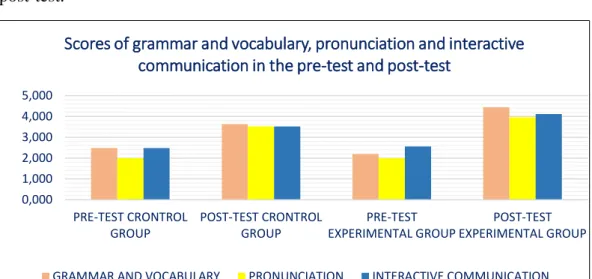
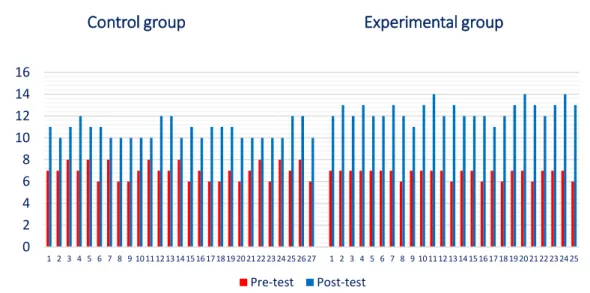
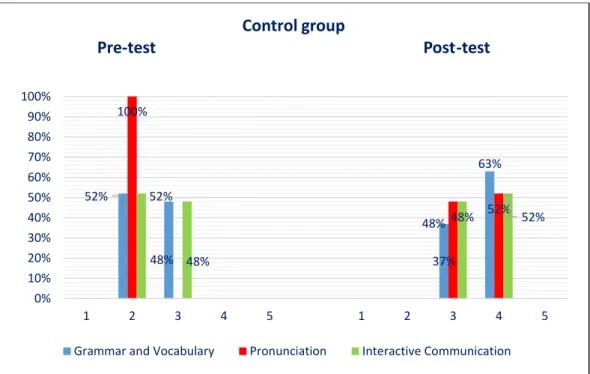
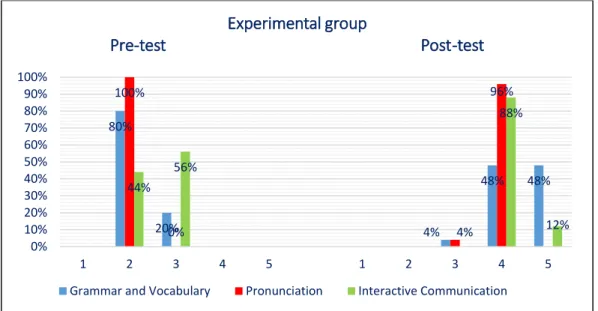
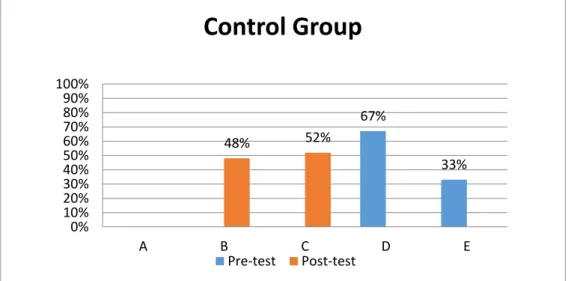
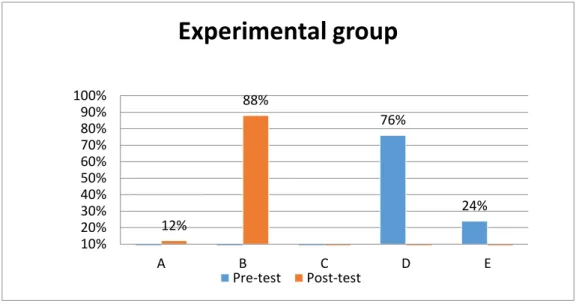
Figure 1. Critical Analysis ... 6 Figure 2. Key Categories... 18 Figure 3 Comparison of averages obtained in the parameters of grammar and vocabulary, pronunciation and interactive communication in the pre-test and the post-test. ... 60 Figure 4 Students’ individual scores from the control and experimental group obtained in the Pre-test and Post-test. ... 61 Figure 5 Comparison of scores according to each parameter (grammar and
vocabulary, pronunciation and interactive communication) obtained by the control group in the pre-test and post-test. ... 63 Figure 6 Comparison of scores according to each category (grammar and
vocabulary, pronunciation and interactive communication) obtained by the
Experimental group in the pre-test and post-test. ... 64 Figure 7 Frequencies of the total scores obtained in the pre-test and post-test by the control and experimental group... 65 Figure 8 Frequencies of the total scores obtained in the pre-test and post-test by the experimental group. ... 66
xi
AGRADECIMIENTO
Me gustaría agradecer a Dios por proporcionarme vida, salud y sabiduría para continuar estudiando. A mi familia, especialmente a mi hija por apoyarme y alentarme durante este proceso de aprendizaje. A mi tutor por ayudarme con sus valiosos consejos para concluir este trabajo y a mis alumnos por permitirme compartir algunos conocimientos con ellos
xii
DEDICATORIA
Me gustaría dedicar esta investigación a Dios, porque puedo despertarme todos los días gracias a él, a mi hija por ser mi inspiración para seguir estudiando y esforzándome en cada situación personal y académica; y a mis padres por haberme ayudado siempre que los necesitaba.
xiii
UNIVERSIDAD TÉCNICA DE AMBATO DIRECCIÓN DE POSGRADO
MAESTRÍA EN LA ENSEÑANZA DEL IDIOMA INGLÉS COMO LENGUA EXTRANJERA
TEMA:
“PROJECT – BASED APPROACH IN THE ENGLISH ORAL PRODUCTION”
AUTORA: Licenciada Gabriela Alejandra Robayo Dávalos DIRECTOR: Licenciado Manuel Xavier Sulca Guale Magíster FECHA: Abril 5 th, 2018
RESUMEN EJECUTIVO
Esta investigación se desarrolló con el objetivo de determinar el efecto de la aplicación del Aprendizaje Basado en Proyectos en el desarrollo de la producción oral (speaking) del idioma inglés en los estudiantes. En esta investigación se utilizó un método cualitativo-cuantitativo; cualitativo porque se observó el rendimiento de los alumnos en clase; cuantitativa debido a que se analizó estadísticamente las calificaciones obtenidas en el pre and post test. La población estuvo compuesta por cincuenta y dos estudiantes de la Unidad Educativa Pelileo del nivel elemental A.1.2 de acuerdo al libro Ministerio de Educación y se dividieron en un grupo de control con veintisiete estudiantes y un grupo experimental con veinticinco alumnos. Además, se llevó a cabo una investigación cuasi-experimental. Así también, este trabajo se desarrolló a través de una investigación bibliográfica y de campo. Por un lado, bibliográfico porque la información sobre esta investigación se obtuvo de libros ya publicados; por otro lado, la investigación fue de campo puesto que hubo un grupo experimental que fue observado y sometido a un tratamiento con aprendizaje basado en proyectos. Además, el instrumento utilizado en esta investigación fue la parte oral de un examen KET (MOCK) que se administró antes y después del tratamiento basado en el aprendizaje basado en proyectos. De igual manera, se llevó a cabo una prueba T para verificar la hipótesis, teniendo como resultado que la hipótesis nula fue rechazada y la hipótesis alternativa fue aceptada. Por lo tanto, el tratamiento con aprendizaje basado en proyectos contribuyó a un mejor rendimiento en la producción oral. Se obtuvo una mejora significativa de los puntajes en los tres parámetros, gramática y vocabulario, pronunciación, y comunicación interactiva establecida en el instrumento de evaluación (prueba KET)
DESCRIPTORES: Aprendizaje, investigación, Proyectos, Producción oral , pre-test , post-pre-test , quasi-experimental , rendimiento significativo , tratamiento , T de student.
xiv
UNIVERSIDAD TÉCNICA DE AMBATO DIRECCIÓN DE POSGRADO
MAESTRÍA EN LA ENSEÑANZA DEL IDIOMA INGLÉS COMO LENGUA EXTRANJERA
THEME:
“PROJECT-BASED APPROACH IN THE ENGLISH ORAL PRODUCTION”
AUTHOR: Licenciada Gabriela Alejandra Robayo Dávalos DIRECTED BY: Licenciado Manuel Xavier Sulca Guale Magíster DATE: April 5th, 2018
EXECUTIVE SUMMARY
This research work was developed aiming to determine the effectiveness of applying Project-Based Learning activities for developing the students’ English oral production (speaking skill). A quali-quantitative approach was used in this research; the qualitative aspect was embodied by the observation of students’ performance in class, whilst the quantitative point of view regards the statistical analysis of students’ scores obtained in the pre and post-test. Besides, the population was made of fifty-two students from Unidad Educativa Pelileo. They belonged to the A.1.2 elementary level according with the student’s book of the Ministry of Education and were divided into a control group with twenty-seven students and an experimental group with twenty-five learners. Furthermore, a quasi-experimental research was carried out with the implementation of project-based learning activities in English classes. Moreover, this research was developed through a bibliographic and field research. On the one hand, bibliographic because the information on this research was obtained from already published books; on the other hand, field research because there was an experimental group that was observed and subjected to a treatment with project-based learning. Additionally, the instrument used in this research was the speaking part of a Key English Test (KET), it was administered before and after the treatment based on project-based learning activities. In addition, a t-test was carried out in order to verify the hypothesis having as a result that the null hypothesis was rejected and the alternative hypothesis was accepted. Thus, the treatment with project-based learning contributed to a better performance in the students’ English oral production. It also showed a significant improvement on the scores in the three parameters i.e., grammar and vocabulary, pronunciation, and interactive communication established on the instrument used to assess the speaking part (Ket test).
Key words: Learning , Projects , Oral production , Treatment - pre-test - post-test, research , quasi-experimental , treatment , performance, T- test.
1
INTRODUCTION
This research’s aim focuses on the way how Project-based Learning affects the students’ English oral production. It was necessary to revise bibliographic material which permitted to show that exists a clear relationship among the two variables under investigation. This research was developed due to the identification of students’ oral production problems i.e., they presented difficulties to communicate among them through the speaking skill in the English classes. Learners showed constraints on the parameters of grammar and vocabulary, pronunciation, and interactive communication, these parameters are established on the instrument used to evaluate them (KET examination).
Moreover, this research is considered important because English oral production is necessary for every day interaction. Besides, it was required to know how project-based learning served as a help to overcome learners’ speaking constraints. Hopefully, this research will be helpful because other teachers and institutions could use the theoretical support to carry out future investigations regarding the use of project-based learning to deal with oral production problems.
This research consisted of a field quasi- experimental research. This approach was selected because the population was divided into experimental group with 25 students and control group with 27 learners. The experimental group was subjected to a project-based learning treatment that was carried out attempting to improve students’ oral production in both scores and performance. It is important to mention that this research was developed using a qualitative-quantitative approach. Besides, the speaking part of a Key English Test was the instrument used to carry out a pre and post-test before and after the treatment with project-based learning.
Finally, this research was useful to realize how project-based learning helped students in the oral production as well as collaborative and interpersonal skills development.
2 This research work is divided into six chapters:
CHAPTER I presents the theme of the problem, its contextualization at macro, meso and micro levels, critical analysis, prognosis, the setting of the problem, research questions, research delimitation, justification, and the objectives to be achieved.
CHAPTER II displays the research background taking into consideration previous studies related to the topic under research which were deeply analyzed, philosophical foundations, legal basis, key categories, theoretical support for independent variable which was called as Project-Based Learning activities as well as the dependent variable which was named as oral production development variables, the hypothesis, and signaling of hypothesis.
CHAPTER III describes the methodology applied in this study in terms of the basic method of research, the level or type of research, the population, operationalization of variables, method of data collection and data collection, and analysis.
CHAPTER IV presents the results obtained from the pre and post- test applied to the students before and after the treatment. It also displays the analysis and results, data interpretation, and hypothesis verification in order to evaluate the feasibility of the research.
CHAPTER V addresses the conclusions and recommendations that are established according to the objectives of this research as well as the research questions. CHAPTER VI displays the proposal which contains information about informative data, proposal background, justification, objectives, feasibility analysis, theoretical basis, proposal development, methodology, administration and assessment.
3 CHAPTER I
1. PROBLEM STATEMENT 1.1 Theme of the problem
The influence of Project-Based Learning Activities in the deficient English Oral Production level
1.2 Problem statement 1.2.1 Contextualization
According to Brown and Gillian (1983) the history of spoken language dates from very long ago, nevertheless, it was taken seriously in the language teaching field just after the Second World War. Oral production can be considered the most difficult skill to be developed when learning a foreign language. This could happen for some reasons. First, the assessment of this productive skill has traditionally been a difficult task for teachers. Second, students do not have enough opportunities to practice through pair or team work in class (Lightbown & Spada, 2006). Third, English language learners are not accustomed to interact using the target language in the classroom. Those are the reasons why the problem has been contextualized according to world, country, and city settings
English is considered as a global language. Therefore, it is the official language for communication, entertainment, military issues, business, technology, science, among other fields (Crystal, 2003). English is the third spoken language around the world. About 360 million people speak it as their mother tongue, and around one of the half a billion people speak it as a second language; for that reason it is also considered as a “lingua franca” (Lane, 2016). However, there are some countries like France, Russia, South Arabia, Colombia among others where the level of speaking performance and English in general is very low (Newlink Education (2015)
According to the English Proficiency Index (EPI) 2017 Ecuador has a low English proficiency level. It has been ranked in the 55th place after Guatemala. Even though Ecuador stands out for an above-average gained since 2007 until 2017, it is still one
4
of the countries with the lowest English proficiency levels in Latin America. The deficient oral production level could be due to the lack of interaction among Ecuadorian students and native English speakers. Although Ecuador has been mentioned as a tourist country it is not possible to keep a conversation with native speakers easily. Foreign people can be found just in certain places such as Baños de Agua Santa, Shell, Tena, Quilotoa and other specific cities. However, they seem to be reluctant to make friends. For that reason, it is not possible to address them for achieving oral interaction.
English language students just practice the target language in class. This is the only time when they are placed in an English environment. English classes are sometimes more focused on grammatical aspects rather than spoken interaction. Besides, students are in contact with English language just a few hours during the week and when they finish English class they almost forget and even avoid practicing in the target language. The students may feel shy to speak in English because it could be seen as weird or strange in a dominant Spanish spoken environment.
The students were assessed the speaking skill and the results showed a deficient of the English production level on the pre-test. For that reason, it is important to be aware of the importance that oral production has. Oral production is an essential productive skill which has to be developed taking many considerations such as what we say, to whom we are talking to, and how we want to convey the message. It is also important to take into account the already mentioned points because language has to be used appropriately in order to communicate with other people effectively.
English oral production could be improved if teachers implement appropriate methods or techniques. In order to improve this productive skill, project-based learning activities could be implemented. The activities or projects could range from research papers, to multimedia presentations, video documentaries, musical, theatrical performances, and so on. Lightbown and Spada (2006) argue that pair
5
and group work provide more speaking practice than a teacher-centered class when the activities are appropriately designed. In addition, students do not make as many mistakes when working among them rather than speaking to a more advanced level speaker. Thus, Project-Based Learning activities could be suitable to be used with the students.
Furthermore, Project-Based Learning activities could be used to enhance oral production. Teachers could use this teaching method to have students interacting together on assigned tasks. That will allow that they can speak between them and communicate in a student centered class. Besides, according to Leaver & Stryker (1989) “students who work on projects show increased motivation and engagement in their studies”. For that reason, project-based learning activities were implemented on this study to help learners improve their speaking skill.
The implementation of projects in class could be a good option to have the students practice the speaking skill in the target language. It will allow interaction, communication and participation in a student centered class where they will be the ones who practically manage the class. Projects will also be a good option to practice oral production because they will have to present the work product of their projects. This for sure will make them practice the oral skill more than what they were accustomed, having hopefully an improvement on this skill.
6 1.2.2 Critical analysis
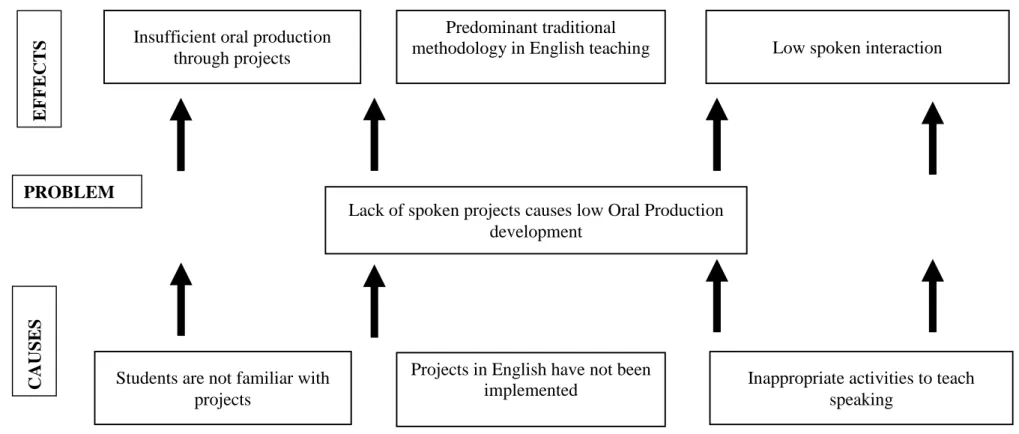
Figure 1. Critical Analysis Source: Direct investigation Author: Robayo, G. (2017)
Low spoken interaction Insufficient oral production
through projects
Predominant traditional methodology in English teaching
Lack of spoken projects causes low Oral Production development
Students are not familiar with projects
Inappropriate activities to teach speaking
Projects in English have not been implemented E FFECTS CA USE S PROBLEM
7
One problem is that students are not familiar with oral projects; it may produce insufficient oral production through project-based learning activities; even teachers do not manage teaching English through oral projects or assessing by this means (Boonkit, 2010). In many institutions, standardize books are imposed to be used. Even though those books contain a wide range of vocabulary and information about other countries they induce to monotonous classes. For this reason, students have an insufficient oral production through projects in English class. It could not allow them to learn authentic vocabulary while learning how to develop different kind of projects.
Another factor that may cause low oral production development is the use of traditional methodology. According to Andrew (2012) with traditional methodology, students have limited opportunities to intervene orally through projects in a teacher-centered class. This also may affect students’ confidence which may lead students to fear of speaking in English; if students do not want to speak in the target language, they will not be confident enough to interact among them, thus they may not want to continue learning English.
In addition, teaching speaking requires activities which go along with the students’ needs. The use of inappropriate activities to teach this productive skill demotivates students to practice conversations among them. It is necessary to use innovative activities in order to get the students’ attention (Barker & Westrup, 2000). However, it seems that many if not most EFL teachers are accustomed to teaching-centered classes where they are the ones who explain what the subject matter is about while the students keep just sitting and listening to the teacher’s instructions; hence, they have little or no spoken interaction. This, for sure causes
non-effective spoken communication among students, limiting even more their oral production in the target language.
8 1.2.3 Prognosis
If this problem is not solved, students may continue being non-effective English speakers. Besides, they may not achieve a good oral production level in the target language. For these reasons, they should be encouraged to practice English oral production through Project-Based Learning activities in class.
According to Chard and Katz (2008) (as cited in D'Ambra, 2014), teachers can help students acquire skills and provide various opportunities to apply them by using Project-Based Learning activities. Intrinsic motivation and active participation in the project is essential for learning. Students are aware of their own level of challenge which offers them a choice of how they want to learn. They can also take the role of an expert in class in order to achieve a certain level of proficiency. Both, teacher and students share accountability for learning, progress, and achievement. 1.2.4 Setting of the problem
What is the influence of the use of Project-Based Learning activities to improve the English oral production development in English language?
1.2.5 Research questions
What is the students’ English Oral Production proficiency level at Unidad Educativa Pelileo according to fluency and accuracy?
What are the effects of implementing Project-Based Learning activities at Unidad Educativa Pelileo?
What are the relationships between Project-Based Learning activities and English Oral production?
How can Project-Based Learning activities be applied for the students’ English Oral Production development?
1.2.6 Research delimitation Content delimitation.
9 Line of research: Methodology
Place delimitation: Unidad Educativa Pelileo
Delimitation of time: September 2017 – June 2018 school year.
1.3 Justification
This research is relevant because there is not any other research related to this theme developed at Unidad Educativa Pelileo. For this reason, this work is innovative because it was focused on developing oral skills through the use Project-based learning approach. As the projects are closely related to solving everyday problems, the students could find a useful tool to interact orally in real situations.
This research is important because it permits to understand the influence of Project-Based Learning activities in the low English Oral Production level applied to 25 ninth graders at Unidad Educativa Pelileo, located in Pelileo-Tungurahua, in the September 2017- June 2018 school year. English oral production is vital to communicate with others, thus it is necessary to put special emphasis on teaching this skill because English is considered lingua franca and there are thousands of people who speak it all over the world. Besides, Ecuador is frequently visited by tourists from many parts of the world who communicate through English. Thus, it is important to achieve a good proficiency level on this skill.
Since speaking is the main way to communicate orally, this work is of local and national interest because the main goal is to help improve the oral production (speaking) on the students. Besides, the implementation of Project-based learning approach allowed the students to face real life situations and they could practice the target language by using appropriate vocabulary and grammatical structures in context. Also, it can be added that most teachers are concerned about the importance of oral production on the students. Thus, it is always helpful to devote all efforts to find appropriate techniques and strategies to improve oral production.
10
It is necessary to mention that this research was feasible because it was not difficult to implement Project Based Learning Activities with the students at Unidad Educativa Pelileo. Besides, it was not necessary to spend money because the projects were very simple to develop. Additionally, the human resource was provided by the students and the teacher who shared information to develop the projects. For all those reasons, this research was feasible to achieve, and it could be implemented not only with elementary students, but also with all levels as necessary.
This research has appositive impact, because it was possible to observe an increment in the post test’s scores in relation to the pre test’s grades. Besides, not only the scores increased, but also shows an improvement in the pronunciation, grammar and interactive communication. These factors may help the students feel more comfortable when they interact in class and outside of it, or when they have to use the target language to communicate in real situations.
Finally, it is also important to highlight that the beneficiaries are absolutely the students at Unidad Educativa Pelileo, because they belong to tourist places such as Pelileo where foreign visitors go frequently, therefore they can be able to communicate through English with foreign people. Besides, teachers and the institution are beneficiaries too because Project-based activities could be implemented at this high school to help its students improve the oral production
11 1.4 Objectives
1.4.1 General
To determine the influence of Project-Based Learning activities in the English Oral Production development on 25 ninth graders at Unidad Educativa Pelileo, located in Pelileo, Tungurahua province.
1.4.2 Specific
To identify the students’ English Oral Production proficiency level according to fluency and accuracy at Unidad Educativa Pelileo. To describe the effects of applying Project-Based Learning
activities.
To establish the relationship between Project-Based Learning and English Oral production.
To propose a Handbook with activities based on Project-Based Learning activities for improving students’ English Oral Production development?
12 CHAPTER II
2. THEORETICAL FRAMEWORK 2.1 Research Background
After the research done in order to find papers on this topic, some studies have been found about the use of Project-Based Learning for English Oral Production development. Some resources were found to be taken care as basis of the present study; for instance, it was demonstrated that the improvement on the oral production is a fundamental part in the teaching learning process, so that the students can communicate in an appropriate way.
Apolo, Arcos & Avalos (2013) developed a proposal which aimed to find a way to encourage Ninth graders’ English learning through the application of Project-based learning. They applied inquiry tools such as an interview, surveys, and a questionnaire in order to have the needed information. With their class intervention, they obtained good results. Therefore, they concluded that Project-Based Learning did improve listening skills in their students. Finally, they strongly recommended the use of projects such as: Debates, Group Work, Graphic Organizers, Oral Expositions, Researching, and Projects for helping students to improve their English performance.
As stated by Yang and Puakpong (2016) on their paper “The Effects of
Project-Based Learning on speaking abilities of Non-English Major Chinese”, developed
with eighty students from Kaili University from Thailand. On this study, a speaking pretest, posttest, a questionnaire and a semi-structured interview were used to gather the data. Besides, quantitative and qualitative data analysis was developed to get the results. The main finding of the project derived on positive effects of Project Based Learning on non-English students’ speaking ability, besides, the students expressed that they had faced a good learning environment while working with projects.
13
These conclusions were showed not only by the results on the post test, but also by the students’ opinions on the questionnaire and the interview. Moreover, it was claimed by the authors that Project based learning could enhance the students’ speaking ability through a real world learning environment, allowing them to be not only autonomous learners, but also to work in groups. The students also improved their social skills working with projects. In conclusion, positive effects regarding the students’ speaking ability were showed in this research.
Furthermore, Maulany (2013) developed another study “The use of Project-Based Learning in improving the students` speaking skill (A Classroom Action Research at One of Primary Schools in Bandung)”. It was developed with four graders at a primary school in Bandung. Participatory observation was done to collect the data as well as eight meetings. Besides, speaking assessment was conducted three times in the first, fifth, and eighth meetings (pre-test, post-test 1, post-test 2) were also conducted; and qualitative analysis was developed in the design of study.
The findings showed that Project Based Learning helped students improve their speaking and comprehension skills. This improvement was indicated by the results of the post-test after the treatment with Project based learning activities. The improvement covered comprehension, vocabulary, grammar, fluency, and pronunciation. Of all the five aspects, comprehension and vocabulary were improved most significantly. In conclusion, a positive effect was showed after the Project based treatment, because the students showed improvement in relation to the pre and post-test.
Apart from the studies previously showed, Anuyahong (2015) on her paper “Using Project –Based Approach to enhance English speaking ability of Thai- Nichi Institute of Technology students” states that it was developed with 60 first year undergraduate students at Thai-Nichi Institute of Technology, during first semester of 2014 school year. The instruments used in this research included lesson plans, a
14
project evaluation form, an English speaking pre and post-test, a student’s self-assessment form and a satisfaction questionnaire.
Furthermore, after the data analysis and interpretation of the post-test’s results and the questionnaire, the main findings of this study showed that the students’ speaking performance after the Project-Based Approach was significantly higher than before. Besides, the results showed students’ satisfaction towards the treatment with project-based approach, it allowed to enhance the English speaking ability of the students after the development of three projects.
Another interesting research work centered in Project-Based instruction is Beckett’s (2002) which is titled as “Teacher and Student evaluations of Project-Based Instruction”. The author claims that it has gained fame in education; nevertheless, there are discrepancies between teachers and learners about this kind of instruction. For general educators and students, this kind of activities are suitable for creating opportunities to cover contents of subject matters and foster problem-solving skills; on the contrary, English as a second language teachers and students think that Project- based learning stops them to learn from books and instructors even though it provides opportunities for comprehensible output. Taking into account these points of view, the searcher conducted a study through philosophical, cultural, and linguistic prospects. Finally the author highly recommends that a framework must be developed to help teachers in assisting learners from different cultures to comprehend about the benefits of Project-based instruction in Second language acquisition courses.
Finally, investigations from this research background used somehow similar instruments to gather the information such as pre, post-test, questionnaire. The three of them reported satisfactory results after the data analysis and interpretation of results. Besides, these papers reported positive findings and results after the treatment with project based learning approach, for that reason, it was useful and
15
motivating to develop this research at Unidad Educativa Pelileo because its main goal was to help the students not only obtain good grades on the tests, but also to communicate appropriately in real world situations.
In summary, the three research papers have been cited. These researches are placed within the educational and methodological field. Besides, in the three investigations, it was found that project-based learning approach had a positive impact on the speaking skill development from the students. For that reason, all the information found was helpful in order to have a clearer idea about the use of project-based learning approach in the English speaking skill development.
2.2 Philosophical foundation
This research is based on constructivism because it is guided by the idea of developing consciousness in learners. In addition, some elements such as creativity, collaboration, imagination, thinking and critical analysis are important characteristics within this approach. Moreover, acquiring new knowledge is seen as an integrating, practical and interdisciplinary process i.e., students relate prior knowledge to new learning in different contexts. It also aims at connecting knowledge to the reality so that students can take constructive actions in order to help the teaching learning process (Brooks & Brooks as cited in Jones, 2002)
Constructivism is a theory about knowledge and learning not teaching (Brooks & Brooks as cited in Jones, 2002). For that reason, learners are the main character in the learning process. They are the ones who construct their own knowledge and learning in the classroom through the active process of linking the existing knowledge with new ideas (Naylor & Keogh as cited in Jones, 2002).
2.3 Legal basis
This research is legally supported by Constitución de La República del Ecuador (2008) in which standard and legal rules are established. Besides, national intervention and control of education bodies are implied and embodied by Ley
16
Orgánica Intercultural de Educación (LOEI) (2011). These legal bodies are cited to support the legal framework of this research. Additionally, this research is based on some articles from Código de la Niñez y Adolescencia (2009).
Constitución de la República (2008)
Art. 26.- La educación es un derecho de las personas a lo largo de su vida y un deber ineludible e inexcusable del Estado. Constituye un área prioritaria de la política pública y de la inversión estatal, garantía de la igualdad e inclusión social y condición indispensable para el buen vivir. Las personas, las familias y la sociedad tienen el derecho y la responsabilidad de participar en el proceso educativo.
Art. 27.- La educación debe estar centrada en el ser humano y garantizará su desarrollo holístico, en el marco del respeto a los derechos humanos, al medio ambiente sustentable y a la democracia; será participativa, obligatoria, intercultural, democrática, incluyente y diversa, de calidad y calidez; impulsará la equidad de género, la justicia, la solidaridad y la paz; estimulará el sentido crítico, el arte y la cultura física, la iniciativa individual y comunitaria, y el desarrollo de competencias y capacidades para crear y trabajar.
Art.- 343 El Sistema Nacional de Educación tendrá como finalidad el desarrollo de capacidades y potencialidades individuales y colectivas de la población que posibiliten el aprendizaje, generación y utilización de conocimientos mediante las técnicas, estrategias, procesos y dinámicas que sean adecuados y flexibles a dicho procedimiento.
Código de la Adolescencia
Art.- 37 numeral 4 “Garantice que los niños, niñas, y adolecentes cuenten con docentes, materiales didácticos, laboratorios, locales, instalaciones y recursos adecuados y gocen de un ambiente favorable para el aprendizaje.
Ley de Educación Intercultural.- Art. 2. Lit. bb. Plurilingüismo.- “Se reconoce el derecho de todas las personas, comunas, comunidades, pueblos y nacionalidades a
17
formarse en su propia lengua y en los idiomas oficiales de relación intercultural; así como en otros de relación con la comunidad internacional”. En este caso sería el Idioma Ingles que a su vez es el Idioma Extranjero que se encuentra en el Currículo Nacional.
18 2.4 Key categories
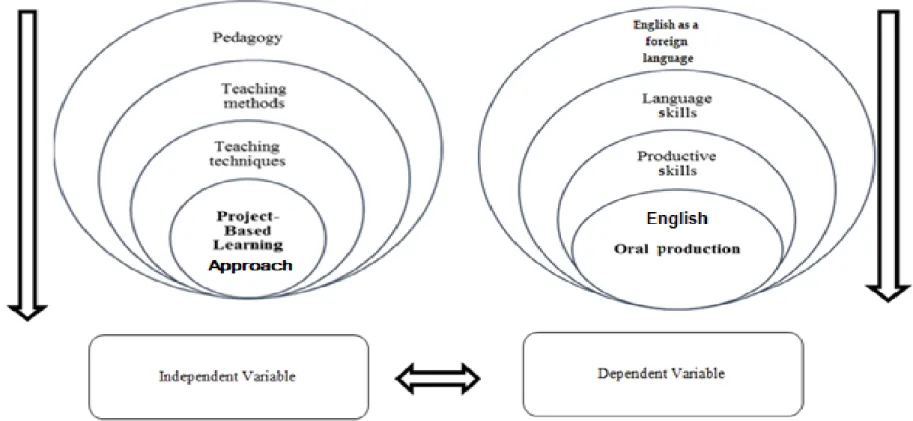
Figure 2. Key Categories Source: Direct investigation Author: Robayo, G. (2017)
19 2.5 Independent variable
2.5.1 Pedagogy
According to Tomei and Morris (2010) Pedagogy is a teacher-directed way of instruction that comes from the Greek word “paid,” which means child plus “agogos,” which means leading. Thus, pedagogy has been defined as “the art and science of teaching children”. Besides, pedagogy is seen as the most prevalent form of instruction which is expressed through a didactic and teacher-directed approach. Additionally, in the pedagogical model, the teacher decides what, how and when something will be learned. Pedagogy also requires the students to follow a teacher-dependent class based on the assumption that the instructor knows best what students need to learn.
Furthermore, Ceranic (2009) refers to pedagogy not only as the art or science of teaching, but also as the strategies, techniques and approaches used by teachers in order to help in the learning process. It has been stated that pedagogy contains some characteristics such as class managing, questioning techniques, lesson planning and teaching strategies. Even though these features are often forgotten, they allow to differentiate among experienced and new teachers (Broughton, Brumfit, Flavell, Hill, & Pincas 1980).
On the other hand, Cummins (2000) provides three subdivisions of pedagogy. The first is traditional pedagogy in which the basic assumption is that knowledge or skills are taught to students by the teacher. The implication in this kind of pedagogy is that the interaction in class is begun and controlled by the teacher, permanently aimed at achieving the instructional goals. Besides, the content is basically derived from the internal structure of the language or subject matter and is often imparted through highly structured drills and workbook exercises. Traditional, Pedagogy has some components such as phonics, vocabulary, and grammatical rules. In this model, learning is assumed to be hierarchical, beginning from simple elements to more complex structures. Thus, a prerequisite for reading development is teaching
20
explicit phonics; and, before students can start writing grammar, vocabulary and spelling must be taught.
The second subdivision presented by Cummins (2000) is progressive pedagogy. In this model, interaction among peers and teachers is vital for constructing learning. In addition, students are encouraged to utilize written and oral language so that they can actively express and share their experiences within classroom context. That sharing makes conceivable the assertion of students’ identity. Progressive models put emphasis on the role of cooperative query and creation of meaning as vital for students’ academic development. Additionally, the classroom is seen as a community of learning where knowledge is created by both teachers and students.
The third model is transformative pedagogy. There are some similarities to the ones of progressive pedagogy. Nevertheless, they differ in respect to social assumptions. Transformative pedagogy uses cooperative crucial inquiry to permit students to analyze and understand their own social realities and of their communities. Students argue, and often act on manners in which these realities might be changed via several forms of social action. Besides, teaching goals are to go beyond the sanitized curriculum; that is still the norm in most schools. Finally, it struggles to elaborate a critical literacy which reflects the analytic abilities involved in cutting through the surface layer of persuasive arguments (Cummins, 2000).
Finally, Tomei and Morris (2010) argue that it has been recently tried to alleviate some pedagogical deficiencies focusing on critical thinking or critical pedagogy, attempting to replace the teacher-dependent instruction. Critical pedagogy looks for teacher and learner joint educational activities. The teacher and student work mutually in order to produce an output. Besides, interdisciplinary competencies are developed by applying certain strategies; teaching curriculum is identified within the learner’s experiences in home, society, and school. In addition, challenging standards for learner accomplishments are established exceeding traditional
21
teaching and pushing teachers to go beyond their teaching with academic, goal-directed, and small-group interaction.
2.5.2 Teaching methods
In order to talk about teaching methods; first of all, it is necessary to have an idea about what teaching is. According to Westwood (2008), most dictionaries could define teaching as transmitting knowledge or skills, instructing somebody or equipping people with information in a systematic way. Teaching could also be defined as the matter of sharing knowledge about a certain subject or issue in a setting where chiefly two or more people intervene. Besides, teaching goes hand in hand with learning and it could happen not only in an educational context, but also in daily or general situations.
On the other hand, a method could be described as a particular way of approaching and fulfilling an objective or goal. Thus, teaching method can be defined as a systematic way of instructing people or sharing knowledge in diver kind of settings and contexts. For that reason, Davis (as cited in Westwood, 2008:1) suggests that the nature of the subject matter and the needs of the students and the way in which they learn have to be taken into account for the design and selection of any teaching method.
For the argument above presented, the basis of methods seems to have very different positions about the concept of language and language learning. Regarding teaching methods specifically, it is argued that their study and procedures in the field of language teaching embraced a more critical function in applied linguistics since the 1940s. Besides, many endeavors have been made in order to assign an origin of the nature of methods so that the link among theory and practice that a method involves can be discovered (Richards & Rodgers, 1986).
It is stated by Larsen and Anderson (2011) that methods play an important paper to make instructors reflect on teaching. Hence, an explicit understanding about
22
teaching methods can help teachers increase awareness on the relevance that methods have in the teaching learning process. It is also argued that when teachers meet with teaching methods and strategies, they reflect on the standards of those strategies producing an effective use of the teaching procedures. Therefore, teachers become more attentive regarding the function that methods fulfill.
Apart from the arguments above mentioned; Patel and Jain (2008) argue that a method is related to how a language is taught. Besides, the authors mention five methods and two approaches regarding English language teaching, they are presented in the following way. The Grammar Translation Method, the Direct Method, the Bilingual Method, the Reading Method and the Situation Method. Additionally, two approaches are introduced. The Structural Approach and the Communicative Approach. This study is closely related to the Communicative Approach, because the aim of this CLT is to fulfill communicative competence in sociolinguistic, grammar and speech aspects.
Regarding Communicative Language Teaching; Brumfit (1986) claims that this term was presented for the first time in 1971, to the International Association of Teachers of English as a Foreign Language Conference in London. Even though several of the remarked characteristics of CLT development were encountered in earlier language teaching, the term did not begin to be taken into account until it was already used in other parts of the globe.
Additionally, in Communicative Language Teaching, it is necessary to recognize the importance of learners' communicative needs and goals. These aspects have to be taken into account in order to design the course syllabus in the best way. A good syllabus design is important because students participate actively in the interpretation, expression, and negotiation of meaning in class. All these aspects are relevant in this modern model of teaching English as second or foreign language (Savignon, 2001).
23
Finally, Nunan (2015) recommends that educators should adopt their own personal teaching style, one that goes along with their identity, and which best meets the students’ needs, because many years ago, teaching was seen not only as encountering the best method to transmit knowledge, but also as the key that could help find the way to teaching development. Nevertheless, it is recognized that there is neither key to open all doors nor best teaching method. Teachers are the ones who may find the best way to transmit the knowledge according to the setting and context where they work and the students’ needs.
2.5.3 Teaching techniques
According to Anthony (as cited by Richards and Rodgers, 1986) a technique is a particular way of doing something; which constitute specific actions that have been designed to achieve strategic objectives (Patel & Jain, 2008). A technique has been also described as a special tip, style or characteristic that can be used in the classroom in order to accomplish a close goal. Besides, it must get along and work in symmetry with both a method and an approach. It is also stated that there are distinct techniques to teach and learn not only foreign languages, but also various other issues, subjects or skills. For that reason, teachers are responsible for selecting the best techniques in order to transmit the knowledge appropriately, creating an interactive environment where the students are able to participate, perform and work actively.
Furthermore, Patel and Jain (2008) claim that there are specific techniques to practice and learn the four language skills i.e listening, speaking, reading and writing. As this paper is aimed at looking for oral production improvement; some techniques to practice speaking have been cited; for example, oral compositions and storytelling. The first technique has been widely used by teachers in order to improve oral production. To develop this activity, some questions based on a common thing, story, or picture are required to be answered by the students. The second technique is completing a story, in order to develop this technique, storytelling is used as the main activity, after the students have heard the story it is
24
repeated by the students as many times as they can, and then they are required to re-tell it in their own words.
The third technique is dramatization; the main characteristic of this technique is that students are able to perform speaking by performing a drama; they are also supposed to be actively engaged while acting a drama. The fourth technique is conversational activities; the use of commands and answering some given questions about different topics are the most principal activities to practice speaking within this technique. The fifth one is language games; the speaking skill is practiced by dividing the class into two groups and having conversations based on some teacher’s questions, this technique requires the students to participate actively with their peers. Talks, debates and discussion are other techniques which may be used in order to practice speaking effectively in the classroom, and could be chosen according to the students’ level (Patel & Jain, 2008).
Apart from the techniques above presented, oral projects can also be used as a technique to practice and assess the speaking skills. The students are given some topics which have to be investigated and developed by them. The topics can be related to local, national or international aspects. After that, they are the assigned a period of time to complete the oral project. Then, the students have to present or perform the topic in front of the class in a well-prepared manner; it can be done individually, in pairs, or groups, depending on the assignment and the topic. Thus, having the students work with oral projects presentations could be useful to help students be more confident and it could be used by teacher as an interesting means to practice and assess the speaking skill.
Additionally, teaching and learning requires of certain techniques. Some books, articles, web pages, etc., have been developed to teach not only language skills such listening, speaking, reading and writing, but also teaching grammar, testing and other issues or subjects in general. Many techniques to teach and learn these skills and issues have been presented in the already mentioned pedagogical material. Thus, if teachers do not manage appropriate techniques, they have to be aware of
25
the importance that researching and reading those materials have, because that will help them transmit their knowledge more effectively in order to achieve better results.
Finally, the same as teaching methods, there are no specific techniques to learn everything. Teachers may implement their techniques such as drilling, using the students’ first language, discussion, debates and so on to share the knowledge with the students; and learners may adopt their own techniques i.e taking notes, asking for clarification, etc., in order to get the most benefited results in a certain subject matter or course. It all depends on the context where the teaching-learning process takes place, the needs presented by the students and the desired results.
2.5.4 Project-Based learning Approach
Regarding Project-Based learning, Capraro, Whitfield, Etchells, and Capraro (2016) argue that projects permit the students to show their capacity to work in pairs or groups in an effective manner. At the same time, they can be able to manifest their critical thinking as well as their potential to solve the problems that could be found in the project working process. Besides, group work is seen as one of the most vital features in any project development because projects can help the students enhance teamwork and communication skills. Thus, it is vital to have successful cooperation and collaboration among the people involved in the project because failure can be experienced in the entire work when these features are not accomplished.
Furthermore, according to Laur (2013), projects are sometimes simulated practices in the classroom that are graded by the teacher and then returned to the student with some feedback so that they can improve their work. It is stated that projects are most of the time almost real activities created and completed for the students. These approach demands them not only to put in practice their critical thinking, but also dare them to go from basic memorization of content to active involment and participation. Working with projects may encourage the studetns to be involved in
26
their own learning. Thus, teachers should help learners in order to choose an appropriate project which can certainly help them improve the needed skills.
Moreover, Project-Based Learning could be used as a helpful process not only to have the students engaged with the subject matter or course content, but also to foster their collaboration and creativity. Besides, project-based approach could be used in the teaching learning process in order to look for authentic work and assessment. There is an additional point that should be taken into account, the use of projects could be useful to develop the students’ self-steam and it could also allow them to interact cooperatively and present the development of projects through the oral skill (Gettingsmart, 2016).
Additionally, it has been stated that Project-Based Learning approach could be used by teachers as an action to make the students the main characters in the classroom. Besides, working with projects could help teachers work in a dynamic and interacting class because, according to Blank (as cited in Aytekin, 2011:2) “in project-based learning, students plan, implement, and evaluate projects that have real-world applications beyond the classroom”. Thus, real world activities could motivate students to actively participate in class while their performance is constantly monitored by the teacher.
Teachers also need to recognize whether the students are getting knowledge or not. Besides, educators should have a strategy in order to deal with the students’ needs and interests. When teachers get to know his or her students, they will be able to guide them throughout the project process by providing enough support to them. Therefore, educators should not work in isolation, they should be encouraged to work and get along with their colleagues so that lesson plans, assessment rubrics, and activities can be shared and feedback can be provided and received. Thus, a peer-supported learning environment can be built in order to benefit the students in the teaching-learning process (Laur, 2013).
27
Another reason to state that Project-Based Learning approach could help in the teaching learning process is because projects can be used in primary or secondary education whenever necessary. Besides, a student-centered environment is promoted when projects are used in class. In addition, students work on their own or in groups to obtain and present the information about the selected topic. Something that has to be highlighted about working with projects is that they can be daily life issues which can be solved with a solution through promoting students’ high-order thinking skills (Tan and Chapman, 2016).
Project-Based learning activities are used in subject matters like Mathematics, English, Visual Media Analysis and Production, Physics, and Art. In Math, students are able to use tools to determine measurements to find perimeter and area of geometric figures as well as to calculate areas of polygons and to apply mathematical processes. In English language learning, students are expected to work in cooperation with others to produce writing and oral outcomes and establish communication. Besides, in Visual Media Analysis and production students produce visual and media text for creating communication. In Physics, learners answer laboratory and field research questions. Finally, in Arts, students communicate their ideas through art work by challenging imagination (Capraro et al., 2016:10-11).
The development of projects consists mostly of a student-centered environment where learners are the main participants. Nevertheless, teachers also play an important role during the working process. They are in charge of monitoring constantly throughout the whole development in order to provide feedback if necessary. Teachers have to be conscious that learners will make as many mistakes as they can. However, this is not a good reason to stop their work, because as mentioned before, project-based learning activities are carried out in a learning environment where mistakes are allowed and seen as part of the learning process (Straub et al., 2017).
28
It is important to mention that the aim of introducing project work in the classroom is basically to let the students learn in an autonomous way. They can also experience activities that can be faced in real life situations during the project development. All these activities permit the students gain important skills such as cooperation, collaboration, communication and independent learning. Thus, they may become more aware of their own learning and may be prepared for future challenges not only in the educational field, but also in the general situations that could be faced during their life (Tan and Chapman, 2016).
Besides, Wong et al. (as cited by Tan and Chapman, 2016) state that; when students work with projects, they are involved in genuine learning. The originality of Project-Based Learning setting moves them form teacher-centered class to a student-centered learning environment. Additionally, permitting the students to work with projects provide them the chance to experience authentic activities in an assigned period of time. Thus, the initiative, collaboration and interaction are fostered in the students, having as a result a clearer knowledge of the subject matter or course content.
In Project-based learning, a little time is provided to the students to work on discussion. Most of the class time is devoted to work on their projects whilst the teacher fulfills the role of a facilitator. The teacher also has to monitor all the groups and ask questions in order to make sure the students are developing the task according to the instructions. After that, the teacher has to provide feedback as necessary. Then, the students are required to present their final products which sometimes can be debates and dissertations or written productions such as poems (Duch et al., 2001).
In addition, as citied by Pierce and Jones (2000) an activity that has the project-based learning format is asking the students to investigate about a given topic. Then they have to do some research in order to find printed or electronic information about it. After that, they have to report the findings of the investigation to the class.
29
It is claimed that this kind of activities engage students in motivating and challenging learning experiences. This working process also emphasizes on learning categorical, factual information and fulfills the characteristics of Project-Based teaching.
According to Savin (2003) project-based learning is mainly task-based and the projects are frequently set by the teacher. Besides, one of its goals is to give solutions to problems and has some characteristics that are presented as follows: - Students are required to produce a final product in the form of a report or
design.
- The tutor supervises and provides support. Students are required
- to produce a solution or strategy to solve the problem.
- An input from the teacher happens in project-based learning, it is given in the form of some type of teaching, during the development of the project.
- Students are sometimes given a predetermined list in order to choose a project to work on.
- Project-based learning sometimes happens towards the end of a learning program after a given period of teaching that has previously developed, because teachers address contents at the beginning of academic periods and with this acquired knowledge, students put it into action through the development of their projects.
- The project group/team only come together for the duration of the project. - Project-based learning is often seen as a mechanism for bringing together
several subject areas under one overall activity at the end of a course.
Teaching also plays an important part in this model because Blumenfeld (as cited in Tan, 2004:99) claims that training is a hard-working and complicated process. Thus, educators really need to have preparation and experience so that they can be successful at teaching. In addition, teachers are in charge of fostering students’
30
motivation and cognitive involvement. Part of the teaching process contains some of the following aspects:
- Provide access to information in order to build chances for learning.
- Advocate learning by scaffolding teaching and modeling and guiding students in order to handle the activities easily.
- Motivate students to use learning and metacognitive processes.
- Assess progress, diagnose problems, give feedback, and evaluate outcomes. - Create an environment conducive to constructive inquiry.
- Manage the classroom to ensure that work is accomplished in an orderly and efficient manner.
Additionally, Blumenfeld (as cited in Tan, 2004:104) argues that project-based learning needs a considerable amount of knowledge, effort, perseverance, and awareness from the students. They will need all those personal aspects in order to develop a good product so that effective results can be achieved during all working process. Nevertheless, those requirements are not easily shown by the students. For that reason, teachers should support learning and provide an appropriate environment as well as opportunities for achieving meaningful learning during all the process.
Working with Project-Based Learning has the possibility to strength not only certain areas of knowledge or subjects matters, but also it could foster the use of technology in class. Technology could be required and reinforced because some projects may require the use of technological tools or appliances to search and present for information and data e.g., Web-based resources, e-books, online communication tools, etc., (Capraro et al., 2016). Besides, the use of technology seems to be common in today’s world. For this reason, the use of it is linked not only with project development, but also with several area of knowledge. Thus, teachers should encourage the use technological appliances and tools so that the students get engaged in the learning process.
31
When students work with projects, they are provided the opportunity to achieve experience in daily real-world situations. In addition, they can foster learning new personal competencies that go beyond the content of a course such as initiative, leadership, motivation, innovation, communication skills, teamwork, writing business plans, and collaboration. These skills could be considered to be important for the students so that they can perform their activities without much hesitation. Besides, entrepreneurship can be enhanced through developing projects because students may be required to manufacture items or products that could be commercialized at the end of the academic term. Thus, teaching through a project based learning model seems to contain many benefits for the students (Straub et al., 2017).
Furthermore, according to Larmer, Mergendoller, and Boss (2015) this teaching action allows the students to have the chance of learning such characteristics as, responsibility, get along with others, work independently, and be confident. Besides, they will be able to apply the traditional academic content in real life circumstances. Even though project-based learning is not a mighty remedy to solve all teaching problems, some supporters of project-based learning argue that it is an effective teaching method that can motivate and inspire inactive students and make learning more enjoyable. Besides, it could help learners meet standards and do well on tests that ask them to demonstrate in-depth knowledge and thinking skills as well as prepare them for college, careers, and citizenship, and learn in a more satisfying way.
Project-Based Learnig approach was implemented at Unidad Educativa Pepileo because it has alrady been used in other countries such as Singapore. The Ministry of Education from that country commonly refers to Project-Based Learning as project work. It is catalogued as learning activities that permit the students to construct their own knowledge in differen subjects and after that put it in practice in real life situations. Besides, the students develop creativity and critical thinking skills throughout the process of working with project work MOE, 2012 (as cited in