
Full PDF
8
0
0
Texto completo
(2) analysis we extracted only those records that dealt with three areas where the OTS has field stations (5 610 records): La Selva (3 930), Palo Verde (859) and Las Cruces (821) and that were published from 1963 to 2011 but in the figures we only present data until 2007. This was our “population” and includes records of reference to the areas not only as a study site but also mention some of the OTS Biological Stations; this may overestimate some metrics. There might be publications conducted at OTS stations that do not include the name of the station and these would underestimate the metrics. However, we do not have concrete data of any such cases and from our experience with BINABITROP we believe that overestimation and underestimation are minimal and do not affect general trends. For title relevance we used the Bradford index and for authors we used productivity based on Lotka (IP logarithm of the number of original articles that identify the authors in productivity levels, small: with 1 item and a PI equal to zero, medium: 2 to 9 items with IP zero and less than 1, and large producers: 10 or more with IP contributions greater than 1). IC: number of authors per item/total articles, i.e. mean authors per item. We identified prolific authors (total output) and visibility by considering which journals were preferred by authors. We also wanted to study the distribution of records by taxonomic group and biological field. It was not possible to do it for the whole “population” so we used a computer-generated random sample of 5 610 records (www.random. org). The recommended minimal size for the random sample was 76 records (for an expected effect size 0.15, statistical desired power level 0.8, number of predictors 3 and probability level 0.05; Sample size Statistics Calculators V3.0, www.danielsoper.com, University of California). However, to be even more confident of the results we used far more than the minimal recommended sample and analyzed in detail the triple (229 random records). 494. RESULTS Taxonomic groups and biological fields: The three geographic areas differed in the taxonomic groups that were more common in the BINABITROP records. Records that referenced La Selva dealt mostly with plants, followed by invertebrates and vertebrates. Most Las Cruces records were about invertebrates, followed by plants and vertebrates. Palo Verde records mostly dealt with invertebrates, followed by vertebrates and plants (Fig. 1). Most work related with La Selva analyzed ecological aspects, followed by records about systematics and, in a distant third place, natural history. Systematics dominated in Las Cruces, followed by ecology and - as in La Selva - natural history was a distant third. Palo Verde had the same pattern as Las Cruces, but behavior was in third place instead of natural history (Fig. 2). Journals and authorship: Articles associated with La Selva have appeared in 615 journals. The most important according to the Bradford distribution (Table 1) were Biotropica (an American journal about terrestrial ecosystems), Zootaxa (a taxonomy journal published in New Zealand) and Revista de Biología Tropical/International Journal of Tropical Biology and Conservation (a Costa Rican journal with a strong presence of aquatic biology). TABLE 1 Journals that include most articles related with La Selva Field Station Journal Biotropica Zootaxa Revista de Biología Tropical Ecology Oecologia American Journal of Botany Brenesia Journal of Tropical Ecology. Number Country of articles of publication 203 USA 99 New Zealand 96 Costa Rica 91 USA 75 Germany 68 USA 66 Costa Rica 61 Great Britain. These journals have 33% of all articles from the period. Only journals with more than 50 articles are shown.. Rev. Biol. Trop. (Int. J. Trop. Biol. ISSN-0034-7744) Vol. 61 (2): 493-500, June 2013.
(3) 45 40 35 30 25 20 15 10 5 0. Las Cruces. 45 40 35 30 25 20 15 10 5 0. Palo Verde. 70. Number of records. La Selva. La Selva. 60 50 40 30 20 10 0. Number of records. 70. Las Cruces. 60 50 40 30 20 10 0. Number of records. 70. Palo Verde. 60 50 40 30 20. Las Cruces were referenced in 239 articles, of which Revista de Biología Tropical published 44, Zootaxa 39, Biotropica 19, Brenesia 17, Principes 16, Annals of the Missouri Botanical Garden 12 and Novon 10. These journals are published in the USA (4), Costa Rica (2) and New Zealand (1). Palo Verde had a similar pattern: Brenesia with 28 articles, Biotropica 26, Zootaxa 23 and Revista de Biología Tropical 22. La Selva was referenced by 2.814 authors. Of these, 74 registered more than 10 articles and 803 authors at least two. The top authors were David B. Clark with 72 articles, Deborah A. Clark with 68 and Robin L. Chazdon with 59.. Other. Bibliometric. Behavior. Biochemistry and survey. Evolution. Biogeography. Ecology. Natural history. Physiology. Systematics. Genetics. Paleontology and Paleoecology. Fig. 1. Records by taxonomic group in BINABITROP.. Morphology and Anatomy. 0. Other. Vertebrates. Invertebrates. Fungi. Plantae. Monera. 10 Bacteria. Number of records Number of records Number of records. 45 40 35 30 25 20 15 10 5 0. Fig. 2. Records by biological field in BINABITROP.. Las Cruces was referenced by 874 authors of whom the top authors were Gretchen C. Daily with 29 records, Luis Diego Gómez with 20, Paul R. Ehrlich with 18, Robert Lücking with 15, C. Hugh, F. Rowell, Jay M. Savage and Rakan A. Zahawi (each with 11) and Donald R. Hodel with ten. There were 237 authors that registered at least two articles for Las Cruces.. Rev. Biol. Trop. (Int. J. Trop. Biol. ISSN-0034-7744) Vol. 61 (2): 493-500, June 2013. 495.
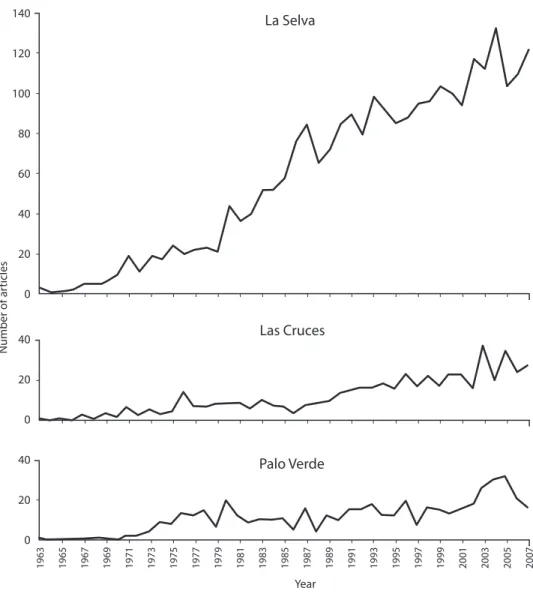
(4) Most records referenced La Selva, followed by Las Cruces and Palo Verde. The number of records generally increased during the period presented here (Figs. 3-7).. Palo Verde was referenced by 1 029 authors; the top authors were Daniel H. Janzen with 13 records, Joanna Burger with 11 and, with ten each, Eugenio González Jiménez, Michael B. MacCoy and José Manuel Mora Benavides. There were 257 authors that referenced at least two articles of Palo Verde. In all cases the typical authorship was composed of one author and one coauthor: La Selva had a mean of 2.07 authors per article (Las Cruces 1.88 and Palo Verde 1.94 authors per article).. 140. DISCUSSION The rapid ecological change that is affecting tropical ecosystems has increased the urgency and importance of understanding them, and in the case of Costa Rican ecosystems, BINABITROP provides a valuable. La Selva. 120 100 80 60 40. Number of articles. 20 0. Las Cruces. 40 20 0 40. Palo Verde. 20. 2007. 2005. 2003. 2001. 1999. 1997. 1995. 1993. 1991. 1989. 1987. 1985. 1983. 1981. 1979. 1977. 1975. 1973. 1971. 1969. 1967. 1965. 1963. 0 Year Fig. 3. Records of articles associated with OTS field stations.. 496. Rev. Biol. Trop. (Int. J. Trop. Biol. ISSN-0034-7744) Vol. 61 (2): 493-500, June 2013.
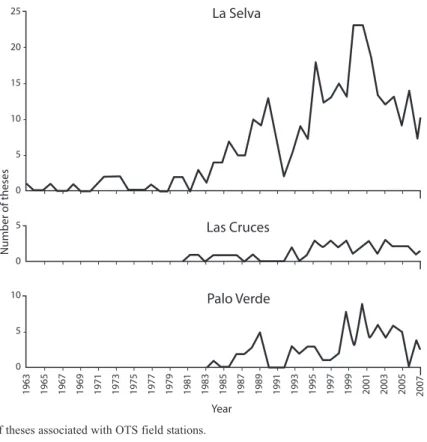
(5) La Selva. 25 20 15 10. Number of theses. 5 0. Las Cruces. 5 0. 10. Palo Verde. 5. 2001. 2003. 2005. 2007. 2001. 2003. 2005. 1999. 1999. 1997. 1995. 1993. 1991. 1989. 1987. 1985. 1983. 1981. 1979. 1977. 1975. 1973. 1971. 1969. 1967. 1965. 1963. 0. Year. Fig. 4. Records of theses associated with OTS field stations. 35. La Selva. 30 25 20 15. Number of book chapters. 10 5 0. Las Cruces. 5 0. Palo Verde. 10. 2007. 1997. 1995. 1993. 1991. 1989. 1987. 1985. 1983. 1981. 1979. 1977. 1975. 1973. 1971. 1969. 1967. 1965. 0. 1963. 5. Year. Fig. 5. Records of book chapters associated with OTS field stations.. Rev. Biol. Trop. (Int. J. Trop. Biol. ISSN-0034-7744) Vol. 61 (2): 493-500, June 2013. 497.
(6) 45. La Selva. 40 35 30 25 20. Number of conferences. 15 10 5 0. Las Cruces. 10 5 0. Palo Verde. 10. 2007. 2005. 2003. 2001. 1999. 1997. 1995. 1993. 1991. 1989. 1987. 1985. 1983. 1981. 1979. 1977. 1975. 1973. 1971. 1969. 1967. 1965. 0. 1963. 5. Year. Fig. 6. Records of presentations in professional meetings associated with OTS field stations. 25. La Selva. 20 15. Number of other items. 10 5 0. Las Cruces. 10 5 0. Palo Verde. 10 5. 2007. 2005. 2003. 2001. 1999. 1997. 1995. 1993. 1991. 1989. 1987. 1985. 1983. 1981. 1979. 1977. 1975. 1973. 1971. 1969. 1967. 1965. 1963. 0. Years. Fig. 7. Records of other literature items associated with OTS field stations.. 498. Rev. Biol. Trop. (Int. J. Trop. Biol. ISSN-0034-7744) Vol. 61 (2): 493-500, June 2013.
(7) source of information not only because of its large coverage in number of years and records, but because it is freely available (http://www. ots.ac.cr; 2013). Furthermore, the only study about the database was done when it was in its early stages, covered only the standard bibliometric indices and was not formally published (Aguirre, Céspedes & Vargas 1988). Ours is the first published study of BINABITROP. When we analyzed the dominating subjects in BINABITROP, we expected botany to dominate the records especially considering that Las Cruces includes the Wilson Botanical Garden. However, this was not the case. One hypothesis, which we leave to future researchers, is that the organisms and themes studied result from complex factors that include the personal interest of scientists working at the station and the funding priorities of agencies and foundations at any particular time. Most authors only have one record related to work in these field stations and the reasons remain open for future research, but this is a common pattern in science and often results from thesis work (Monge-Nájera, NielsenMuñoz & Azofeifa 2010). On the other hand, some of the authors with many publications have served as station directors (David B. Clark, Deborah A. Clark, Luis Diego Gómez, Eugenio González and Rakan A. Zahawi). Considering our limited knowledge of tropical nature, the first question is typically “which species live in these ecosystems?” and the second is “how do they interact?” In agreement with these two basic questions, most studies reported in BINABITROP dealt with systematics and ecology. This is quite different from the situation in Western Europe, where research has been intense for centuries and finer details such as the physiology and genetics of organisms are more common than systematics or general ecology. Considering that the comprehensive coverage of formal and grey literature makes BINABITROP unique in the tropics, we hope future research will ask new queries of BINABITROP, such as how much impact the database has had on new research, how it. differs from Scopus and Web of Knowledge, and how it affects other activities such as education and conservation. ACKNOWLEDGMENTS We thank Susana Aguilar, Sergio Aguilar, Julie Denslow, Gilbert Fuentes, Pedro León, Óscar Madrigal, Carolina Murcia, Karla Vega and Zak Zahawi for BINABITROP data, their kind assistance and valuable suggestions to improve an earlier draft. The authors did not receive financial support to do this research, which they dedicate to the OTS in its 50th Anniversary. RESUMEN BINABITROP es una base de datos bibliográfica con más de 38 000 registros sobre los ecosistemas y organismos de Costa Rica. En contraste con bases de datos comerciales como Web of Knowledge y Scopus, que excluyen a la mayoría de las revistas científicas publicadas en los países tropicales, BINABITROP registra casi por completo la literatura biológica sobre Costa Rica. Analizamos los registros de La Selva, Palo Verde y Las Cruces. Hallamos que la mayoría de los registros corresponden a estudios sobre ecología y sistemática; que la mayoría de los autores sólo registraron un artículo en el período de estudio (19632011) y que la mayoría de la investigación formalmente publicada apareció en cuatro revistas: Biotropica, Revista de Biología Tropical/International Journal of Tropical Biology, Zootaxa y Brenesia. Este parece ser el primer estudio de una base de datos integral sobre literatura de biología tropical. Palabras clave: investigación tropical de campo, publicaciones, artículos por investigador, temas de estudio.. REFERENCES Aguirre, G.H., M.E. Céspedes & M. Vargas. 1988. Análisis informétrico de la producción científica del área de biología tropical y temas afines en Costa Rica: según el proyecto BINABITROP período 1990-1995. Tesis de Licenciatura, Universidad de Costa Rica, San José, Costa Rica. Burlingame, L.J. 2002. Evolution of the Organization for Tropical Studies. Rev. Biol. Trop. 50: 439-472. Chazdon, R.L. 1985. Palm research at La Selva, Costa Rica. Principes 29: 72-73.. Rev. Biol. Trop. (Int. J. Trop. Biol. ISSN-0034-7744) Vol. 61 (2): 493-500, June 2013. 499.
(8) Clark, D.A. 1988. Research on tropical plant biology at the La Selva Biological Station, Costa Rica. Ev. Trends Plants 2: 75-78. Dauphin, G. 1994. OET y biólogos ticos. Semanario Universidad 29 abr. Denslow, J.S. 1990. The Organization for Tropical Studies: 27 years of research and education in the tropics. J. Veg. Sci. 1: 133-134. Gómez, L.D. & J.M. Savage. 1983. Searchers on that rich coast: Costa Rican field biology, 1400-1980, p. 1-22. In D.H. Janzen (ed.). Costa Rican Natural History. University of Chicago, Chicago, USA. McDade, L.A., K.S. Bawa, H.A. Hespenheide & G.S. Hartshorn (eds.). 1994. La Selva: Ecology and Natural History of a Neotropical Rain Forest. University of Chicago, Chicago, USA. Michener, W., K. Bildstein, A. McKee, R. Parmenter, W. Hargrove, D. McClearn & M. Stromberg. 2009. Biological field stations: research legacies and sites for serendipity. BioScience 59: 300-310.. 500. Monge-Nájera, J. 1994. OEA, Niehaus y la OET. Semanario Universidad 15 abr. Monge-Nájera, J. 1994. OET: Respuesta al Dr. Enrique Villalobos. Semanario Universidad 10 jun. Monge-Nájera, J., V. Nielsen-Muñoz & A.B. Azofeifa. 2010. Determinants of scientific output: an in-depth view of the productivity of tropical botanist and conservationist, Luis Diego Gómez Pignataro. Rev. Biol. Trop. 58: 1093-1114. Monge-Nájera, J. & Y.S. Ho. 2012. Costa Rica Publications in the Science Citation Index Expanded: A bibliometric analysis for 1981-2010. Rev. Biol. Trop. 60: 1649-1661. Smith, C.M. 1978. The impact of the OTS on the ecology of Costa Rica. Texas J. Sci. 30: 283-289. Villalobos, E. 1994. Otro punto de vista sobre la OET. Semanario Universidad 20 may. Wyman, R.L., E. Wallensky & M. Baine. 2009. The activities and importance of international field stations. BioScience 59: 584-592.. Rev. Biol. Trop. (Int. J. Trop. Biol. ISSN-0034-7744) Vol. 61 (2): 493-500, June 2013.
(9)
Figure


Documento similar
The major journals included in this analysis are the International Marketing Review (IMR), Journal of International Business Studies (JIBS), Journal of World Business (JWB), Journal
Our flagship journal Chemical Science, launched in 2010, is Gold open Access from issue 1, 2015. Any articles that are part of a special free
The inclusion criteria were: 1) articles published in peer- reviewed journals; 2) articles that included adults diag- nosed with schizophrenia in their sample; 3) articles that
Ponemos un ejemplo: Vamos a buscar la revista: International Journal of Business. Escribimos en el cajetín de búsqueda el nombre de
ACS Journal of Natural Products 1520-6025 429 American Chemical Society Wiley Journal of Clinical Periodontology 1600-051X 425 John Wiley and Sons ScienceDirect International Journal
environmental statistics : An applied journal of the American Statistical Association and the International Biometric Society.. 10857117
Quantitative Phase Analysis of Laboratory-Active Belite Clinkers by. Synchrotron Powder Diffraction Journal American Ceramic Society, 2007 ,
Liabeuf et al., “Serum indoxyl sul- fate is associated with vascular disease and mortality in chronic kidney disease patients,” Clinical Journal of the American Society of
