
A Finer Grained Approach to Psychological Capital and Work Performance
17
0
0
Texto completo
(2) 462. meeting the schedule (Avey et al., 2011; Luthans, Avolio, Avey, & Norman, 2007). However, most of today’s organizations need also to understand work performance from a behavioral and multidimensional approach, because changing technologies, fierce competition, and evolving customers’ requirements over the last decades have led to greater organization complexity. In this scenario, organizations need to promote at least proficient, adaptive and proactive behavior among their members in order to cope with this complexity (Griffin, Neal, & Parker, 2007). Second, even though psychological capital has the potential of directly increasing work performance, little is still known on whether psychological capital is helpful with performance when facing adversity expressed in, for example, stressful conditions (cf. Karasek, 1979). The latter issues deserve to be addressed, taking into account that job demands, such as time pressure and heavy workloads, are part of the environmental complexity in today’s workplace (Bakker, Demerouti, & Sanz-Vergel, 2014). As such, we aim to build and test a finer grained approach to psychological capital and work performance, determining first if each psychological capital dimension has a specific and remarkable association with proficiency, adaptivity, or proactivity (Griffin et al., 2007). This requires examining the relationships between the discrete dimensions of psychological capital and these dimensional performance criteria, because narrower predictors—i.e., hope, efficacy, resilience, and optimism—should be more relevant to predicting narrower outcomes—i.e., proficient, adaptive, and proactive behavior—(Judge & Kammeyer-Muller, 2012). Underlying these specific relationships, we propose to pay attention to the bandwidth-fidelity dilemma (Cronbach & Gleser, 1965) and congruence in the temporal focus of the constructs (George & Jones, 2000; Shipp, Edwards, & Lambert, 2009; Sonnentag, 2012). Thus, we argue that resilience and proficiency would be primarily related to each other because they essentially deal with the present; whereas, hope, efficacy, and optimism would be primarily associated with adaptivity and proactivity, because they mainly concern the future. Furthermore, as part of the finer grained approach, we aim to determine whether psychological capital dimensions that are more relevant for proficiency, adaptivity, and proactivity would reduce the negative relationship between job demands and these behaviors. To address this, we draw on the job demands-resources model (Bakker et al. 2014; Demerouti et al., 2001) and propose that psychological capital would help to perform well when facing demands, due to prevention of psychological resources depletion (Hobfoll, 1989). In the following sections, we first build the theoretical rationale supporting the links between psychological capital dimensions with dimensions of work performance. Then, the buffering function of psychological capital dimensions in the relationship between job demands and work performance is argued, and finally, two survey studies testing our proposals. J Bus Psychol (2018) 33:461–477. are presented and discussed in light of the theoretical framework developed.. Psychological Capital and Work Performance Luthans et al. (2007b) define psychological capital as a positive psychological state comprised by the personal resources of hope, efficacy, resilience, and optimism. Specifically, hope refers to a cognitive process driven by a sense of success in fulfilling individual goals (Snyder, 1995). Efficacy denotes confidence linked to one’s own conviction about having the abilities to effectively execute a task (Bandura, 1997). Resilience refers to positive adaptation in the context of significant adversity (Bonanno, 2004; Rutter, 1987; Masten & Reed, 2002). Finally, optimism denotes a positive expectation that individuals’ goals can be achieved in future (Scheier & Carver, 1992; Peterson, 2000). Drawing on the theoretical integration underlying these personal resources (Luthans et al., 2007a, b), most of research has adopted a higher order factor comprising hope, efficacy, resilience, and optimism (Avey et al., 2011; Luthans et al., 2007a, b). This approach is valuable and appropriate when the aim is to understand broader outcomes entailing wide-ranging information about the phenomenon of interest, such as general work performance. But, when the interest is to have a more detailed understanding of the outcome studied, for instance a multidimensional approach to performance, paying attention to the specific characteristics of the psychological capital dimensions is required. This follows the discussion on the bandwidth-fidelity dilemma (Judge and Kammeyer-Muller, 2012), which stresses the importance of the construct correspondence principle when developing theory, namely, predictors and criteria should correspond in terms of generality-specificity. In other words, theoretically and empirically broader criteria favor broader predictors, while narrower criteria favor specific predictors. Here, we adopt the multidimensional framework of work performance developed by Griffin et al. (2007), which highlights that proficient, adaptive and proactive behaviors are needed for most of today’s organizations. Proficiency represents the actions oriented to the accomplishment of the job minimum requirements and expectations through implementing formally established procedures. Adaptivity involves coping with, responding to, and supporting changes unfolding in the organizational environment, such as changes in strategy, technology, or job design. Adaptivity is a highly reactive behavioral process, because individuals act in an adaptive fashion in order to fit with changes rather than provoking them. In turn, proactivity is described as the employee Bself-initiated and future-envisioned^ actions oriented to transform the work environment. These behaviors should require high levels of psychological capital to protect minimum work performance—proficiency—and deal.
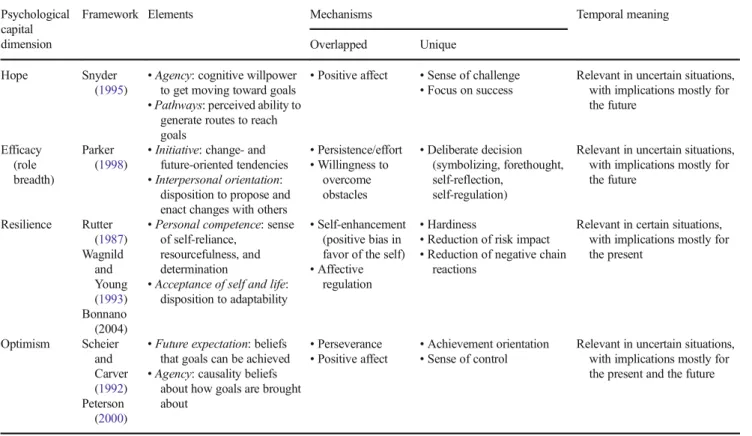
(3) J Bus Psychol (2018) 33:461–477. with uncertainty and unforeseen consequences linked to changes underlying the adaptive and proactive behavior. When considering whether psychological capital is beneficial for proficiency, adaptivity, and proactivity, relevant questions from a bandwidth-fidelity dilemma approach, for example, are as follows: Do hope, efficacy, resilience and optimism equally predict proficiency? Are there some dimensions of psychological capital that have a stronger association with adaptivity compared to the remaining dimensions? Do we have to invest in all the dimensions of psychological capital to increase proactivity? Underlying these questions is the interest to have a more comprehensive conceptualization and nomological network for psychological capital. Furthermore, answering these questions is relevant for organizational investment in fostering psychological capital. If all dimensions of psychological capital have an equivalent contribution to explain a specific behavior, organizations should put emphasis on improving psychological capital as a whole. However, if some specific dimensions of psychological capital have a remarkable relative contribution to explain a specific behavior, organizations could focus their assets to improve the relevant dimensions according to the work behavior of interest, saving resources. Our proposal is that dimensions of psychological capital exert different unique contribution to explain proficiency, adaptive, and proactive behavior at work. This follows the principle of construct correspondence described by the bandwidth-fidelity dilemma (Cronbach & Gleser, 1965; Judge & Kammeyer-Mueller, 2012), because proficiency, adaptivity, and proactivity are narrow performance criteria which would be primarily associated with narrow rather than broader predictors (higher order psychological capital). Notwithstanding, the bandwidth-fidelity dilemma only offers the formal understanding for this finer grained approach to psychological capital and work performance but not the psychological explanation. In doing that, we argue that the congruence in temporal focus embedded in the dimensions of psychological capital and work performance is the explanation for more specific relationships between these constructs (George & Jones, 2000; Shipp et al., 2009; Sonnentag, 2012). According to George and Jones (2000), a comprehensive theory should consider time condition as directly impacting on what the constructs of interest are for the theory, as well as how and why these constructs are associated. In order to understand why one or some of the dimensions of psychological capital would exert a stronger weight than the others to explain proficient, adaptive, and proactive behavior, we concentrate on the temporal focus of constructs. Shipp et al. (2009) conceptualized temporal focus as a traitlike construct, such that people would differ in their general allocation of attention to past, present, or future events. Going a step further, we argue that a particular temporal focus would also be intrinsically embedded in mental states like. 463. psychological capital and on behaviors such as proficiency, adaptivity, and proactivity. Drawing on this, we performed a detailed examination of the psychological processes entailed in hope, efficacy, resilience, and optimism, in order to disentangle the temporal focus denoted by these personal resources (Table 1). In Table 1, overlapping psychological processes among the dimensions described for psychological capital are described. As such, hope, efficacy, resilience, and optimism share a state of persistence, effort, self-enhancement, affective regulation, and the experience of positive affect, being common processes as the basics for describing a higher order factor of psychological capital. Yet, dimensions of psychological capital have also unique mechanisms not accounted for a higher order factor. Drawing on the latter, we argue for the relative association of each psychological capital dimension with specific dimensions of performance below. Resilience is characterized by involving a state of hardiness together with action tendencies to reduce risk impact and negative chain reactions (Bonanno, 2004). These psychological processes should be very valuable when facing situations with low uncertainty, considering that resilience is primarily a matter of coping when facing explicit adversity (Bonanno, 2004; Rutter, 1987; Masten & Reed, 2002). Thus, we argue that resilience should involve a temporal focus mainly oriented to the present where concrete adversity is experienced. We are not suggesting that resilience is unlinked to the future by, for example, learning and development experiences, but the primary function of resilience should be to cope with evident adversity at the moment this is occurring. So, resilience would be very important for proficient behavior. This sort of performance mostly denotes a present temporal focus because it involves accomplishment of minimum and well-known requirements for a job in the daily work activities. As such, when explicit emerging issues threaten daily and regular activities at work, resilience would offer hardiness to face the challenges together with strategies to reduce the risk of impact of downsides and minimize negative chain reactions that might hamper proficiency. In a different way, optimism, hope, and efficacy would have a weaker association than resilience with proficiency, because they primarily involve a future temporal focus. Optimism is about future expectations, hope refers to goals to be achieved in the future and efficacy, as it is conceptualized in the psychological capital literature, denotes confidence in enacting future-oriented initiatives. &. Hypothesis 1: Resilience will have the greatest contribution among dimensions of psychological capital in explaining proficiency.. Optimism is distinctive among the psychological resources entailed in psychological capital because it involves agency and positive future expectations (Luthans et al., 2007a, b;.
(4) 464 Table 1. J Bus Psychol (2018) 33:461–477 Psychological processes and temporal meaning of psychological capital dimensions. Psychological Framework Elements capital dimension Hope. Snyder (1995). Efficacy (role breadth). Parker (1998). Resilience. Rutter (1987) Wagnild and Young (1993) Bonnano (2004) Scheier and Carver (1992) Peterson (2000). Optimism. • Agency: cognitive willpower to get moving toward goals • Pathways: perceived ability to generate routes to reach goals • Initiative: change- and future-oriented tendencies • Interpersonal orientation: disposition to propose and enact changes with others • Personal competence: sense of self-reliance, resourcefulness, and determination • Acceptance of self and life: disposition to adaptability. Mechanisms. Temporal meaning. Overlapped. Unique. • Positive affect. • Sense of challenge • Focus on success. • Persistence/effort • Willingness to overcome obstacles. Relevant in uncertain situations, • Deliberate decision with implications mostly for (symbolizing, forethought, the future self-reflection, self-regulation). • Self-enhancement (positive bias in favor of the self) • Affective regulation. Relevant in certain situations, • Hardiness with implications mostly for • Reduction of risk impact the present • Reduction of negative chain reactions. • Future expectation: beliefs • Perseverance that goals can be achieved • Positive affect • Agency: causality beliefs about how goals are brought about. • Achievement orientation • Sense of control. Relevant in uncertain situations, with implications mostly for the future. Relevant in uncertain situations, with implications mostly for the present and the future. Conceptual integration based on the theoretical models for hope (Snyder, 1995), efficacy (Parker, 1998), resilience (Rutter, 1987, Wagnild & Young, 1993), and optimism (Scheier & Carver, 1992; Peterson, 2000) adopted by the literature on psychological capital (Luthans et al., 2007b). Seligman, 1998), which lead to heightened achievement orientation and sense of control over the possible forthcoming events in life. As such, higher levels of optimism should move the temporal focus from the present to the future under the expectation that positive outcomes will come, even when the present is not being positively appraised. In relation to performance, optimism would be primarily associated with adaptivity, because this denotes reacting to unfolding changes having implications for, at least, the near future. When transformations are happening in the workplace, future expectations of optimism should facilitate openness to change and functional behavior, such as acquisition of new knowledge (Griffin et al., 2007), linked to assimilating uncertain implications underlying the changes. Furthermore, achievement orientation and sense of control embedded in optimism would motivate employees to take active part in the process of change, in order to contribute to building a better future in the workplace. In contrast, resilience, as it is argued earlier, involves a temporal focus mostly oriented to the present, while hope and efficacy, as it is argued in detail below, are resources embedding a future focus expressed in agency to initiate, rather than to assimilate, changes in the workplace.. &. Hypothesis 2: Optimism will have the greatest contribution among dimensions of psychological capital in explaining adaptivity.. Regarding the remaining dimensions of psychological capital, hope disposes individuals to think about the events and conditions that they consider are worth to be enacted upon and achieved in the future, increasing energy to move toward one’s own goals (willpower) and facilitating the generation of routes to pursue these envisioned goals (way power) (Snyder, 1995). Hope also enhances a sense of life success that makes individuals prone to activities involving challenge. In turn, efficacy is a dimension of psychological capital involving positive self-evaluations about whether individuals are capable to perform their tasks (Bandura, 1997). It is important to note though that the psychological capital research in most cases has adopted measures of a specific form of this construct called Brole breadth self-efficacy^ (Parker, 1998), which refers to the confidence in expressing self-initiative and expanding the current job role. In this sense, Luthans et al. (2007a, b) highlight that efficacy involves symbolizing processes, forethought, self-regulation, and self-reflection. Symbolizing facilitates the creation of mental models in which a different future can be envisioned. Forethought leads to planning actions oriented to achieve the future envisioned..
(5) J Bus Psychol (2018) 33:461–477. Self-regulation allows managing energy and persistence to attain planned goals. And self-reflection facilitates the extraction of learning from previous experiences in order to progress toward future conditions envisioned. The previous description of hope and efficacy highlights the future as the main temporal focus of these constructs; but, more specifically, it seems to be a focus for instigating changes evolving in the future. Therefore, hope and efficacy would have a remarkable contribution to promote proactivity which is a matter of envisioned rather than actual changes, so it involves high uncertainty and a need for future temporal focus. In contrast, as it is argued earlier, resilience is primarily a matter of the present, whereas optimism is about future expectations in relation to assimilate, rather than to initiate, changes in the workplace. &. Hypothesis 3: Hope, efficacy, and optimism will have the greatest contribution among dimensions of psychological capital in explaining proactivity.. Psychological Capital as a Buffering Factor Between Job Demands and Work Performance Thus far, our finer grained approach has argued for psychological capital dimensions as personal resources that may directly benefit work behavior. However, personal resources may also benefit performance by buffering the effect of adversity at work (Judge, Bono, Erez, & Locke, 2005). This is aligned with the proposals of the job demands-resources model (Bakker et al. 2014; Demerouti et al., 2001), which points out that psychological resources are helpful in reducing the impairment effects of job demands, expressed in, for example, heavy workload, work pace, and time pressure. As such, psychological resources can mitigate detrimental effects of job demands because they reduce dysfunctional cognition and health-damaging consequences evoked by the stressful situation, and facilitate a reappraisal process of the confronted adversity. It is important to say that the abovementioned proposals assume job demands as only hampering work behavior, even when some demands may benefit performance through increasing motivation. Empirical evidence supporting this positive effect indicates that strain accompanies such motivational process (Crawford, Lepine, & Rich, 2010; Lepine, Podsakoff, & Lepine, 2005); therefore, in balance, we believe right to propose that job demands involve the risk of impairing work performance. Furthermore, taking the above together, it is likely that individuals having a greater amount of resources available are less prone to experience distress, resource depletion, and decreased performance when facing adversity in the workplace.. 465. Accordingly, Van Doorn and Hülsheger (2013), drawing on conservation of resources theory (Hobfoll, 1989), argued that an increased pool of personal resources should lead to greater mastery, increasing capabilities to implement strategies to meet stressful demands. Nevertheless, empirical research has offered mixed results about this, since the interaction between job demands and personal resources on wellbeing indicators (e.g., exhaustion, stress, engagement) has been supported in some studies, but not observed in others (Van Doorn & Hülsheger, 2013; Van den Broeck, Van Ruysseveldt, Smulders, & De Witte, 2011; Xanthopoulou, Bakker, Demerouti, & Schaufeli, 2007). One explanation for these mixed results is the relevance of personal resources examined for the dependent variables studied (Xanthopoulou et al., 2007), such that not any personal resource might be highly valuable to a specific form of, for example, behavior. The finer grained approach to psychological capital proposed in the previous section would help with solving these issues. Firstly, according to our proposals, resilience would have a greater relative contribution in determining proficiency. Thus, resilience would also buffer the association of job demands with the same outcome. Specifically, work stressors, by the experience of strain, increase emotional exhaustion and hinder cognitive functioning, leading to decline in memory, concentration, and executive functioning (Deligkaris, Panagopoulou, Anthony, & Masoura, 2014), all of which are fundamental to accomplish, at least, the minimum requirements for a job. However, these dysfunctional processes would be mitigated when individuals experience resilience, because the pool of psychological resources available to cope with adversity is conserved by the contribution of tendencies to hardiness, reduction of risk impact, and reduction of negative chain reactions associated with resilience. Thus our next hypothesis states that: &. Hypothesis 4: Resilience will moderate the relationship between job demands and proficiency, such that this relationship will be negative when resilience is low and there will be no relationship between demands and proficiency when resilience is high.. Secondly, optimism, as a relevant resource to adaptivity, would act as a buffer variable on the link of job demands to this outcome. In addition to effects on emotional exhaustion, memory, attention, and executive functioning, strain associated with job demands narrows cognition, such that a closer attentional focus and convergent information processing are dominant (Gable & Harmon-Jones, 2010). Therefore, job demands would jeopardize adaptivity due to this behavior requiring to pay attention in an open way to environmental changes. Notwithstanding, perseverance and achievement orientation offered by optimism would help with controlling the abovementioned issues, thereby facilitating also being.
(6) 466. J Bus Psychol (2018) 33:461–477. adaptive with changes unfolding in the environment. Hence, the next hypothesis states that: &. Hypothesis 5: Optimism will moderate the relationship between job demands and adaptivity, such that this relationship will be negative when optimism is low and there will be no relationship between demands and adaptivity when optimism is high.. Finally, hope and efficacy, as valuable resources to foster proactivity, would mitigate the negative association of job demands with self-initiated and future-oriented actions. Strain linked to job demands is also associated with limited reflection, convergent thinking, risk avoidance, and tendency to behavioral withdrawal (Carver & White, 1994; Schwarz, 1990). These psychological processes are indeed detrimental for proactivity, since this behavior needs openness to change, creativity, and approach behavioral tendencies to make things happen. Hope and efficacy, therefore, would reduce impairment effects of job demands on proactivity, because they prevent depletion of resources by increasing energy (hope) and facilitating self-regulation for managing energy and persistence over time (efficacy). Therefore, our last hypothesis states that: &. Hypothesis 6: Hope (a) and efficacy (b) will moderate the relationship between job demands and proactivity, such that this relationship will be negative when hope is low or when efficacy is low, and there will be no relationship between demands and proactivity when hope is high or when efficacy is high.. The Present Research To test the hypotheses outlined, we conducted two survey studies based on two independent samples of employees working in diverse organizations. The first study examines the factorial structure of psychological capital to determine if the dimension level for this construct is appropriate for the subsequent process of hypothesis testing. Furthermore, regression and relative weight analyses were conducted to examine the association of psychological capital with proficient, adaptive, and proactive work behavior. The second study tested the replication of results observed in the BStudy 1^ section and also examined the moderation processes of psychological capital proposed for the relationships between job demands and work performance. Study 1 Methods A cross-sectional survey study was conducted using paper-based questionnaires. In this, participants offered self-. reports of their psychological capital and work performance together with covariates included in the study. Furthermore, the participants were asked for their general demographic information. Full-time employees working in several organizations who were also part-time MBA students from three major Chilean universities participated in the study. They were recruited and responded the questionnaires after work, during their regular activities at their respective universities. After deleting two cases for having missing data in most of the variables measured, a total number of 382 individuals participated in the study. The participants’ gender was 54.4% male, with an average age of 32.98 years (SD = 7.85), and average organizational tenure of 5.16 years (SD = 5.87). In terms of job role, the participants worked as administrative staff (13.3%), professional staff without supervision role (36.4%), supervisor (27.9%), manager/director (13.8%), and others (8.6%). The sector of the participants’ organizations was either public (17.9%) or private (82.1%). A 16-item scale based on the PCQ instrument developed by Luthans et al. (2007a, b) was used to measure hope (α = .76), efficacy (α = .85), resilience (α = .78), and optimism (α = .83), having four items for each of these dimensions. Examples of items included (with a response scale from 1 strongly disagree–5 strongly agree) are the following: BAt this time, I am meeting the work goals that I have set for myself^ (hope), BI feel confident helping to set targets/goals in my work area^ (efficacy), BI can get through difficult times at work^ (resilience), and BI always look on the bright side of things regarding my job^ (optimism). In turn, individual proficiency, adaptivity, and proactivity were measured with the scales developed by Griffin et al. (2007). Each of these behaviors was measured with three items framed as follows: During the last month, indicate the extent to which you have … (1 never–5 almost always). Examples of items are as follows: Bcarried out the core parts of your job well (proficiency, α = .75); Badapted well to changes in core tasks^ (adaptivity, α = .73); and Binitiated better ways of doing your core tasks^ (proactivity, α = .87). In order to account for possible systematic relationships between personality traits and reports of one’s own psychological capital and work behavior (Podsakoff, MacKenzie, & Podsakoff, 2012; Spector, 1994), extraversion and neuroticism were used as covariates in all analyses. For example, high neuroticism could lead individuals to negatively biased appraisals about their personal resources together with negatively biased appraisals of their own work behavior (cf. Spector, 1994). Therefore, the inclusion of variables denoting affective dispositions as covariates is recommended for studies dealing with constructs sensitive to the affective experience, particularly when there are risks for common-method variance issues such as the case of survey designs based on self-reported data. These personality traits were measured.
(7) J Bus Psychol (2018) 33:461–477. with four-item scales adapted from Benet-Martinez and John (1998) framed as BI see myself as someone who…^ (1 strongly disagree–5 strongly agree). Examples of items are as follows: Bis outgoing, sociable^ (extraversion, α = .82); Bgets nervous easily^ (neuroticism, α = .77). Finally, gender, age, and organizational tenure were considered as additional control variables to control possible confounding effects linked to demographics. For instance, employees with longer organizational tenure might be more proficient compared with newcomers. In terms of analytical strategy, we conducted a series of confirmatory factor analyses to determine if the factor structure described by the dimensions of psychological capital was appropriate to conduct the subsequent analyses. Following previous research on psychological capital (Luthans et al., 2007a, b), all confirmatory analysis assumed reflective models (Bollen & Lennox, 1991), such that underlying constructs tested are reflected in indicators sharing common variance between them. This assumption fits with the conceptualization of psychological capital described as a construct representing the common source of variance connecting observed and latent variables for hope, efficacy, resilience, and optimism. Consistent with our theoretical proposals, four first-order latent variables denoting hope, efficacy, resilience, and efficacy would better represent the psychological capital construct compared with a model describing a higher order latent variable comprised by lower level latent variables describing hope, efficacy, resilience, and efficacy. This is because although psychological capital dimensions have substantive common variance, they also would have unique variance, which would not be reduced to a higher order construct. In doing confirmatory factor analyses, first, normal distribution of measures was examined using tests for skewness and kurtosis in order to determine if the maximum likelihood estimation would be appropriate for factor analyses. Second, a single-factor model loading all the psychological capital measures was tested. Third, a four-factor model described by hope, efficacy, resilience, and optimism was tested and compared with the single-factor model of psychological capital. Fourth, a model describing a higher order factor of psychological capital loading the latent factors for hope, efficacy, resilience, and optimism was tested and compared with the four-factor model. Finally, three additional models were tested to examine the factor structure of psychological capital together with performance and extraversion and neuroticism. Hypothesis testing was performed using multiple linear regressions; regressing work behavior on the control variables and psychological capital dimensions first. Furthermore, in order to determine the specific contribution of every psychological capital dimension to the work behavior examined, we estimated relative weights in regression models (Tonidandel, LeBreton, & Johnson, 2009; Tonidandel & LeBreton, 2011). The recommendation is to estimate relative weights when testing the unique contribution of a set of highly correlated. 467. predictors, such as dimensions of psychological capital, because in this case, regression coefficients and p values are prone to bias due to multicollinearity issues. We adopted the framework to estimate relative weights developed by Tonidandel and LeBreton (2011), which offers information about the specific amount of variance explained for a specific predictor in relation to the overall R2 of the model estimated. For example, a relative weight of .10 (p < .05) observed for a predictor over an R2 = .30 (p < .05) informs that this predictor contributes 33% to the total variance explained by the regression model as a whole. Furthermore, a 95% confidence interval for the amount of variance estimated allows determining in a more accurate way the hierarchical order for a set of predictors in terms of their unique variance explained (Tonidandel & LeBreton, 2011). Supplementary analyses were conducted with general measures of psychological capital and work performance, in order to examine the relationship between these constructs using a broader operationalization and compare it with the relationships observed between the psychological capital dimensions and the specific work behaviors. Specifically, the general measure of psychological capital was computed based on the mean from all the items for hope, efficacy, resilience, and optimism, while the general measure of work performance was computed with the mean from all the items for proficiency, adaptivity, and proactivity. According to the bandwidthfidelity dilemma proposals (Cronbach & Gleser, 1965; Judge & Kammeyer-Mueller, 2012), the general factor of psychological capital should have a stronger relationship to the general factor of work performance rather than on each specific work behavior. Results Tests for skewness and kurtosis conducted with measures involved in the constructs studied showed values that minimally deviate from zero (interval values [.37, 1.85] for skewness and [.08, 2.06] for kurtosis), providing support that these measures do not violate the assumption of normal distribution.1 Thus, confirmatory factor analyses using maximum likelihood were adopted. Results for the first model loading all the measures of psychological capital in a single factor showed very poor goodness-of-fit (χ2 = 1253.55, df = 104, p < .01; RMSEA = .17; SRMR = .11; CFI = .57; TLI = .50). In contrast, the four-factor model describing hope, efficacy, resilience, and optimism showed acceptable goodness-of-fit (χ2 = 272.96, df = 98, p < .01; RMSEA = .07; SRMR = .06; CFI = .94; TLI = .92) and a substantive and significant improvement of goodness-of-fit in comparison with the singlefactor model (Δχ2 (Δdf) = 980.59(6), p < .01). Subsequent analyses showed that the model describing a higher order factor of psychological capital described by the latent factors of hope, efficacy, resilience, and optimism had acceptable 1. Absolute values above 3.00 indicate violation of normality assumption..
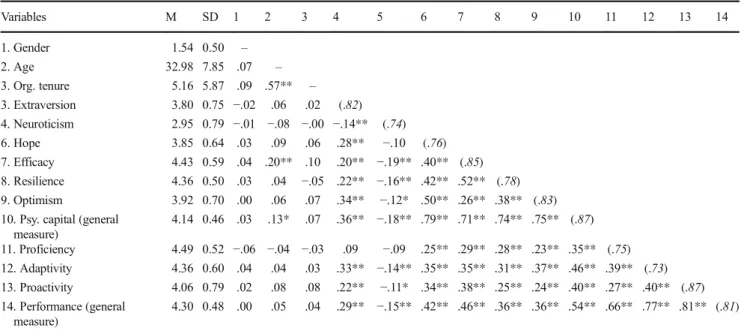
(8) 468. J Bus Psychol (2018) 33:461–477. goodness-of-fit (χ 2 = 298.53, df = 100, p < .01; RMSEA = .07; SRMR = .07; CFI = .93; TLI = .91), but this model showed a significant decrement of goodness-of-fit compared with the four-factor model (Δχ2 (Δdf) = 25.57(2), p < .01). In substantive terms, the latter results indicated that there is variance in each psychological capital dimension not accounted by the higher order factor. Therefore, consistent with our proposal, results indicated that the dimensional level describing hope, efficacy, resilience, and optimism is the best representation for the psychological capital construct. Finally, with regard to performance and control variables, results supported the robustness of the model described by the four-factor solution for psychological capital, proficiency, adaptivity, proactivity, extraversion, and neuroticism (χ2 = 947.63, df = 459, p < .01; RMSEA = .05; SRMR = .06; CFI = .91; TLI = .90). Thus, the complete measurement model involved in hypothesis testing was supported. Means, standard deviations, correlations, and reliabilities of the variables are summarized in Table 2. Hypothesis 1 stated that resilience would have the greatest contribution among dimensions of psychological capital in explaining proficiency. Results in Table 3 show a positive and significant relationship between efficacy and proficiency (β = .18, p < .01) being the dimension of psychological capital with the largest contribution in explaining this behavior (relative weight = .04, p < .05). Resilience also showed a positive but not non-significant relationship to proficiency (β = .12, p < .10); however, this is the dimension of psychological capital with the second largest contribution in explaining Table 2. proficiency (relative weight = .03, p < .05). In turn, hope and optimism showed little contribution to proficiency (hope: β = .07, p > .05; relative weight = .02, p < .05; optimism: β = .12, p < .05; relative weight = .02, p < .05). Taken together, these results rejected hypothesis 1. Hypothesis 2 proposed that optimism would have the greatest contribution among dimensions of psychological capital in explaining adaptivity. Results in Table 3 show a positive and significant relationship between optimism and adaptivity (β = .18, p < .01). The relative weight analysis indicated that adaptivity is explained primarily by optimism (relative weight = .06, p < .05), followed by efficacy (relative weight = .05, p < .05), hope (relative weight = .04, p < .05), and resilience (relative weight = .03, p < .05). Thus, hypothesis 2 was supported. Hypothesis 3 suggested that hope and efficacy would have the greatest contribution among dimensions of psychological capital in explaining proactivity. Results in Table 3 show positive associations between proactivity with efficacy (β = .26, p < .01) and hope (β = .20, p < .01). Relative weight analysis indicated that efficacy and hope contribute positively in explaining proactivity (relative weight = .08, p < .01; relative weight = .06, p < .05, respectively), but optimism did not show a substantive contribution (relative weight = .03, p > .05). Furthermore, resilience showed no contribution to proactivity (β = .00, p > .05; relative weight = .02, p > .05). Thus, hypothesis 3 was supported. Supplementary analyses with general measures of psychological capital and work performance (Table 3) showed that the general measure of psychological capital was positively. Means, standard deviations, reliabilities and correlations (study 1). Variables 1. Gender 2. Age 3. Org. tenure 3. Extraversion 4. Neuroticism 6. Hope 7. Efficacy 8. Resilience 9. Optimism 10. Psy. capital (general measure) 11. Proficiency 12. Adaptivity 13. Proactivity 14. Performance (general measure). M. SD. 1.54 0.50. 1. 2. 3. 4. 5. 6. 7. – .02 −.00 .06 .10 −.05 .07 .07. (.82) −.14** .28** .20** .22** .34** .36**. 9. 10. 11. 12. 13. 14. – –. 32.98 5.16 3.80 2.95 3.85 4.43 4.36 3.92 4.14. 7.85 5.87 0.75 0.79 0.64 0.59 0.50 0.70 0.46. .07 .09 −.02 −.01 .03 .04 .03 .00 .03. (.74) −.10 −.19** −.16** −.12* −.18**. (.76) .40** .42** .50** .79**. (.85) .52** (.78) .26** .38** (.83) .71** .74** .75** (.87). 4.49 4.36 4.06 4.30. 0.52 0.60 0.79 0.48. −.06 −.04 −.03 .09 −.09 .04 .04 .03 .33** −.14** .02 .08 .08 .22** −.11* .00 .05 .04 .29** −.15**. .25** .35** .34** .42**. .29** .35** .38** .46**. .57** .06 −.08 .09 .20** .04 .06 .13*. Reliability is displayed by italic figures in parenthesis on the diagonal *p < .05; **p < .01. 8. .28** .31** .25** .36**. .23** .37** .24** .36**. .35** .46** .40** .54**. (.75) .39** (.73) .27** .40** (.87) .66** .77** .81** (.81).
(9) J Bus Psychol (2018) 33:461–477 Table 3. 469. Hierarchical regression for psychological capital and work performance (study 1). Variables. Proficiency. Adaptivity. Proactivity. General performance. β. β. β. β. Relative weight. Relative weight. Relative weight. Step 1 Gender. −.06. .05. .01. Age. −.06. .01. .02. .00. .01 .31**. .05 .19**. .03 .26**. Org. tenure Extroversion. .02 .06. Neuroticism −.08 .01 R2 Step 2 Hope .07. −.09† .12. −.07 .05. −.10* .09. .04* [.01, .09], 16%. .20** .06* [.02, .10], 32%. .19** .07* [.01, .12], 23%. .18** .04* [.01, .17], 31% .12† .03* [.01, .07], 23%. .18** .05* [.01, .14], 20% .05 .03* [.01, .06], 12%. .26** .08* [.02, .15], 42% .00 .02 [.01, .02], 11%. .29** .10* [.01, .24], 32% .06 .04* [.01, .08], 13%. Optimism. .12* .13. .18** .06* [.01, .12], 24% .25 Sum % relative weights = 72% .13**. .03 .19. .14* .31. .14**. .22**. .39** .16* [.01, .27], 67% .24 .12**. .37** .13* [.07, .22], 76% .17 .11**. .49** .24* [.16, .35], 83% .29 .21**. .02* [.01, .07], 15% Sum % relative weights = 84%. .12** ΔR2 Model for general factorsa Psy. capital .36** .11* [.01, .23], 85% 2 .13 R .11** ΔR2. .11†. .01. Efficacy Resilience R2. .02* [.01, .05], 15%. Relative weight. .02 [.01, .02], 11% Sum % relative weights = 96%. .05* [.01, .10], 16% Sum % relative weights = 84%. Standardized regression estimates. Relative weights inform R2 attributed to the specific predictor, 95% interval confidence in square brackets, and proportion of each predictor contribution to the overall R2 of the model †p < .10; *p < .05; **p < .01 a. Model including gender, age, organizational tenure, extraversion, and neuroticism as control variables. related to proficiency (β = .36, p < .01; R2 = .11; relative weight = .11, p < .05), adaptivity (β = .39, p < .01; R2 = .12; relative weight = .16, p < .05), and proactivity (β = .37, p < .01; R2 = .11; relative weight = .13, p < .05). However, the stronger positive relationship was between the general factor of psychological capital and the general factor of work performance (β = .49, p < .01; R2 = .21; relative weight = .24, p < .05). Discussion Results of this study indicated that the dimension level is the best factorial solution for psychological capital but not the higher order model loading the latent factors of the same dimensions. These results depart from the original research on the construct validity of psychological capital (Luthans et al., 2007a, b), suggesting that although hope, efficacy, resilience, and optimism share communalities to configure a general factor, the same dimensions have singular features not accounted for by this general factor. This provided fundamental support for our proposal that a finer grained approach to psychological capital and work performance would be valuable. Subsequent regression and relative weight analyses supported the idea that dimensions of psychological capital would have remarkable contribution to specific behaviors;. yet, the hierarchy of relevance was slightly different than the original hypotheses. Resilience was positively and substantially related to proficiency but less than efficacy. Optimism, as expected, was the dimension of psychological capital with the largest contribution to adaptivity. Furthermore, as expected also, hope and efficacy showed the largest contributions to proactivity. Finally, supplementary analyses conducted with general measures supported the proposals of the bandwidthfidelity dilemma and its principle of construct correspondence by showing that the general factor of psychological capital had a stronger relationship with the general factor of performance. Nevertheless, the above findings should be considered with caution because an important limitation of this study is its cross-sectional design which, together with the use of selfreported data, might introduce issues of common-method variance and biases (Podsakoff et al., 2012). These issues and the tests for hypotheses 4, 5, and 6 are addressed in a second study presented below. Study 2 Methods A two-wave survey study was conducted to test the replication of the results observed in study 1 and examine the.
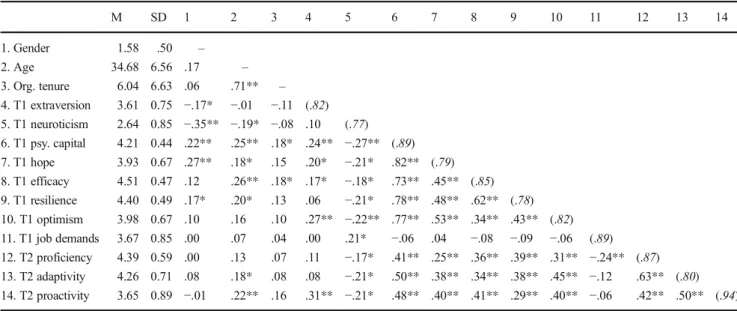
(10) 470. moderation processes described in hypotheses 4, 5, and 6. In time-1, a questionnaire measuring self-reports of psychological capital, work performance, and job demands together with covariates included in the study and demographic information was applied to participants. Four weeks later (time-2), the participants responded to a second questionnaire exploring individual work behavior performed over the last month. This design relies on the proposal that psychological capital represents a long-lasting state construct, whose consequences can last over several weeks. This design aimed to reduce concerns of common-method variance issues discussed in study 1. Full-time employees working in several organizations who were also part-time MBA students from two major Chilean universities participated in the study. The participants were recruited and responded to the study’s questionnaires after work, during their regular university activities. A total number of 188 individuals participated in the first survey, while 174 individuals responded to the second survey, 4 weeks later. After merging data collected on both occasions, a total number of 148 participants comprised the final sample whose data was utilized in subsequent analyses (response rate of 79%). The participants’ gender was 49.9% male, with an average age of 34.68 years (SD = 6.56), and average organizational tenure of 6.04 years (SD = 6.63). In terms of job role, the participants worked as administrative staff (10.7%), professional staff without supervision role (19.6%), supervisor (38.7%), and manager/director (31%). The sector of the participants’ organizations was either public (16.4%) or private (83.6%). In time-1, psychological capital, extraversion, and neuroticism (control variables) were measured with the same instruments as study 1, observing appropriate reliabilities for hope (α = .79), efficacy (α = .85), resilience (α = .78), optimism (α = .82), extraversion (α = .82), and neuroticism (α = .77). In addition, job demands were measured using a five-item scale denoting time pressure and heavy workload (Karasek, 1979). Items were framed as follows: To what extent does your job require… (1 not at all–5 very much) Bworking fast?^, Bworking hard?^, Ba great deal of work to be done?^; To what extent is there… Bnot enough time for you to do your job?^, Bexcessive work in your job?^ (α = .89). As in study 1, we also included gender, age, and organizational tenure as control variables in all analyses to account for possible confounding effects. In time-2, proficiency, adaptivity, and proactivity were measured with the same scales as in study 1, observing appropriate reliabilities for proficiency (α = .87), adaptivity (α = .80), and proactivity (α = .94). The same strategy as used in study 1 was adopted for data analyses, namely, first a series of confirmatory factor analyses were conducted for examining the factorial structure of psychological capital and the robustness of the measurement model with the variables involved in the hypotheses. Subsequent regression and relative weight analyses were performed to examine the replication of hypotheses 1, 2, and 3.. J Bus Psychol (2018) 33:461–477. After this, moderation regression analyses were added to test the interaction processes proposed in hypotheses 4, 5 and 6. Results In terms of skewness and kurtosis, replicating the results of study 1, measures utilized showed values that minimally deviate from zero (interval of values [.20, 1.25] for skewness, and [.02, 2.37] for kurtosis). Thus, confirmatory factor analyses were based on maximum likelihood estimation because measures did not violate the assumption of normal distribution. Congruent with study 1, a single-factor model loading all measures of hope, efficacy, resilience, and optimism showed very poor goodness-of-fit (χ2 = 489.70, df = 104, p < .01; RMSEA = .16; SRMR = .11; CFI = .65; TLI = .60), whereas the four-factor solution showed appropriate and improved goodness-of-fit (χ2 = 133.81, df = 95, p < .01; RMSEA = .05; SRMR = .06; CFI = .97; TLI = .96; Δχ2 (Δdf) = 355.89(9), p < .01). As in study 1, the model describing a higher order factor model for psychological capital showed good goodness-of-fit (χ2 = 147.26, df = 97, p < .01; RMSEA = .06; SRMR = .08; CFI = .95; TLI = .94), but this was significantly worse than the four-factor model (Δχ2 (Δdf) = 13.45(2), p < .01). Furthermore, the robustness of the measurement model described for the four factors of psychological capital, the three factors of performance, extraversion, neuroticism, and job demands was supported (χ 2 = 486.33, df = 374, p < .01; RMSEA = .05; SRMR = .06; CFI = .96; TLI = .95). Means, standard deviations, correlations, and reliabilities of the variables are summarized in Table 4. Hypothesis 1 stated that resilience would have the greatest contribution among dimensions of psychological capital in explaining proficiency. Results in Table 5 show a positive and significant relationship between resilience and proficiency (β = .21, p < .01), being the dimension with the largest contribution in explaining this behavior (relative weight = .07, p < .01). This was followed by efficacy (β = .16, p > .05; relative weight = .05, p < .05), optimism (β = .17, p > .05; relative weight = .04, p < .05), and hope (β = .00, p > .05; relative weight = .02, p > .05). Thus, in contrast to study 1, hypothesis 1 was supported. Hypothesis 2 proposed that optimism would have the greatest contribution among dimensions of psychological capital in explaining adaptivity. Results in Table 5 show a positive relationship between optimism and adaptivity (β = .31, p < .01). Relative weight analysis indicated that adaptivity is explained primarily by optimism (relative weight = .10, p < .05), then by resilience (relative weight = .05, p < .05), hope (relative weight = .05, p < .05) and efficacy (relative weight = .04, p > .05). Thus, similar to study 1, hypothesis 2 was supported. Hypothesis 3 suggested that hope and efficacy would have the greatest contribution among dimensions of psychological capital in explaining proactivity. Results in Table 5 show.
(11) J Bus Psychol (2018) 33:461–477 Table 4. 471. Means, standard deviations, reliabilities and correlations (study 2) M. 1. Gender. SD. 1.58. 2. Age. .50. 1. 2. 3. 4. 5. 6. 7. 8. 9. 10. 11. 12. 13. 14. –. 34.68 6.56 .17. – .71** – −.01 −.11 (.82). 3. Org. tenure 4. T1 extraversion. 6.04 6.63 .06 3.61 0.75 −.17*. 5. T1 neuroticism 6. T1 psy. capital. 2.64 0.85 −.35** −.19* −.08 .10 (.77) 4.21 0.44 .22** .25** .18* .24** −.27** (.89). 7. T1 hope. 3.93 0.67 .27**. .18*. .20*. −.21*. .82** (.79). 8. T1 efficacy 9. T1 resilience. 4.51 0.47 .12 4.40 0.49 .17*. .26** .18* .17* .20* .13 .06. −.18* −.21*. .73** .45** (.85) .78** .48** .62** (.78). 10. T1 optimism 11. T1 job demands. 3.98 0.67 .10 3.67 0.85 .00. .16 .07. .10 .04. .27** −.22** .77** .53** .34** .43** (.82) .00 .21* −.06 .04 −.08 −.09 −.06. 12. T2 proficiency. 4.39 0.59 .00. .13. .07. .11. 13. T2 adaptivity 14. T2 proactivity. 4.26 0.71 .08 3.65 0.89 −.01. .18* .08 .22** .16. .15. −.17*. (.89). .41** .25** .36** .39** .31** −.24** (.87). .08 −.21* .31** −.21*. .50** .38** .34** .38** .45** −.12 .48** .40** .41** .29** .40** −.06. .63** (.80) .42** .50** (.94). Reliability is displayed by italic figures in parenthesis on the diagonal *p < .05; **p < .01. positive associations between proactivity and efficacy (β = .25, p < .01) but not with hope (β = .16, p < .10). Table 5. Relative weight analysis indicated that efficacy, optimism, and hope contribute positively and equivalently in explaining. Hierarchical regression for psychological capital and work performance (study 2). Variables. Step 1 Gender Age Org. tenure Extroversion Neuroticism R2 Step 2 Hope Efficacy. Proficiency. Adaptivity. Proactivity. General performance. β. β. β. β. Relative weight. −.04. .02. .14 −.02 .12 −.21* .07. .20 −.07 .12 −.22 .10. .00 .16. .02 [.01, .06], 9% .05* [.01, .12], 22%. Resilience Optimism R2. . 21* .07* [.02, .15], 30% .17† .04* [.01, .11], 17% .23 Sum % relative weights = 78% .16** ΔR2 Model for general factorsa Psychological capital R2 ΔR2. .14 .10. Relative weight. .05* [.02, .11], 16% .04 [.01, .09], 13%. .08 .05* [.01, .11], 16% .31** .10* [.04, .19], 32% .31 Sum % relative weights = 77% .21**. Relative weight. −.07. −.04. .18 .05 .32** −.22** .19. .21† .00 .24** −.26**. .16† .06** [.02, .12], 18% .25** .07** [.02, .14], 21% −.07 .18* .34. .02 [.01, .04], 6% .06** [.02, .14], 18% Sum % relative weights = 63%. .14 .22*. Relative weight. .06* [.02, .13], 15% .08* [.03, .16], 21%. .15**. .06 .05* [.02, .10], 13% .26** .11* [.04, .20], 28% .39 Sum % relative weights = 77% .22**. .41** .16* [.06, .29], 76%. .49** .22* [.12, .34], 76%. .40** .17* [.09, .29], 55%. .52** .27* [.15, .38], 71%. .21 .13**. .29 .19**. .31 .13**. .38 .21**. Standardized regression estimates. Relative weights inform R2 attributed to the specific predictor, 95% interval confidence in square brackets, and proportion of each predictor contribution to the overall R2 of the model †p < .10; *p < .05; **p < .01 a. Model including gender, age, organizational tenure, extraversion, and neuroticism as control variables.
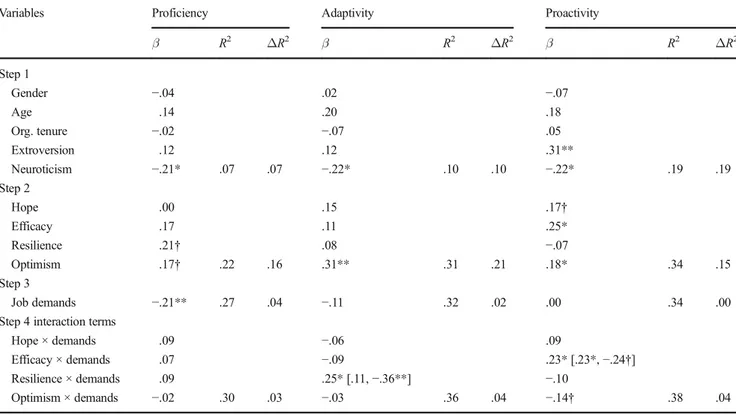
(12) 472. proactivity (relative weight = .07, p < .05; relative weight = .06, p < .05; relative weight = .06, p < .05, respectively), but resilience showed little contribution to this outcome (relative weight = .02, p > .05). Thus, hypothesis 3 was supported. Supplementary analyses conducted with general measures of psychological capital and work performance (Table 5) replicate the results observed in study 1, such that the general factor of psychological capital was positively related to proficiency (β = .41, p < .01; R2 = .13; relative weight = .16, p < .05), adaptivity (β = .49, p < .01; R2 = .19; relative weight = .22, p < .05), and proactivity (β = .40, p < .01; R2 = .13; relative weight = .17, p < .05); yet, the stronger positive relationship was between the general factor of psychological capital and the general factor of work performance (β = .52, p < .01; R2 = .21; relative weight = .27, p < .05). Hypothesis 4 proposed that resilience would moderate the relationship between job demands and proficiency, such that this relationship would be negative when resilience is low. Results in Table 6 indicate that the interaction term between resilience is unrelated to proficiency (β = .09, p > .05). As a result, hypothesis 4 was not supported. Hypothesis 5 proposed that optimism would moderate the relationship between job demands and adaptivity, such that the relationship between job demands and adaptivity would be negative when optimism is low. Results in Table 6 show that the interaction term between optimism and job demands is unrelated to adaptivity (β = −.03, p > .05). Thus, hypothesis 5 was not supported. However, even when not hypothesized, the interaction term between resilience and job demands positively relates to adaptivity (β = .25, p < .05). Figure 1 graphs the simple slope test, which showed a negative relationship between job demands and adaptivity when resilience is low (β = −.36, p < .01), but a lack of relationship between the same variables when resilience is high (β = .11, p > .05). Thus, resilience, in a post-hoc fashion, was found as a moderator for the relationship between job demands and adaptivity. Hypothesis 6a proposed that hope would moderate the relationship between job demands and proactivity, while hypothesis 6b stated that efficacy would moderate the relationship between job demands and proactivity, such that the relationship between job demands and proactivity would be negative when hope is low and when efficacy is low. Results in Table 6 show that the interaction term between hope and job demands was not related to proactivity (β = .09, p > .05), whereas the interaction term between efficacy and job demands was positively related to proactivity (β = .23, p < .05). Figure 2 graphs the simple slope test for the latter, which showed a negative relationship between job demands and proactivity when efficacy is low (β = −.24, p < .10),2 but a 2 The p value for this simple slope was non-significant [.05 < p < .10]; yet, this likely represents an issue of statistical power for this slope.. J Bus Psychol (2018) 33:461–477. positive relationship between the same variables when efficacy is high (β = .23, p < .05). Hence, hypotheses 6a was not supported, whereas hypothesis 6b was supported.. General Discussion Expanding on previous research, the results of this study offer evidence supporting the positive association between psychological capital and work performance. However, consistent with our argumentation, a finer grained approach drawing on the dimension level of psychological capital offered a more comprehensive view about the strength of hope, efficacy, resilience, and optimism in predicting proficient, adaptive, and proactive behavior. Across the two studies conducted, results showed that resilience was substantively related to proficiency, occupying the second and first relative weight in study 1 and study 2, respectively. According to the finer grained approach we theorized, the salient relative contribution of resilience to proficiency would be explained because both these constructs mostly involve a present temporal focus. These relationships are sensible because having strength to face adversity should be particularly relevant to sustain the minimum regular requirements for a job. In turn, both studies consistently showed that optimism was strongly and predominantly associated with adaptivity. The future temporal focus linked to the explanatory style of optimism is functional to assimilate the changes that will likely have implications for the future, and even to take an active part in these changes. Furthermore, in both studies and supporting our proposals, hope and efficacy were strongly related to proactivity, which should be explained because will power, way power, and self-confidence about one’s own capabilities to express initiative and ignite active change-oriented behavior. Another interesting but unanticipated result was that efficacy had substantive associations with all behaviors examined, namely, proficiency, adaptivity, and proactivity. This problematizes the finer grained approach proposed here, because efficacy was proposed as having a future temporal focus but proficiency was argued as denoting a present temporal focus. One explanation for these puzzling results is the profile of employees who participated in the studies. The participants represented highly educated and qualified employees who in most cases performed in professional, management, and directive roles. Accordingly, proficiency for these employees in many cases can involve initiating activities with future implications, for which experiencing efficacy is crucial. Addressing these issues with more diverse samples of employees from the general population is an important challenge for future research..
(13) J Bus Psychol (2018) 33:461–477 Table 6. 473. Hierarchical regression for interactions between psychological capital, job demands, and work performance (study 2). Variables. Proficiency β. Adaptivity R2. ΔR2. Proactivity. β. R2. ΔR2. β. R2. ΔR2. .19. .19. Step 1 Gender Age. −.04 .14. .02 .20. −.07 .18. Org. tenure Extroversion. −.02 .12. −.07 .12. .05 .31**. Neuroticism. −.21*. Step 2 Hope. .07. −.22*. .07. .10. .10. −.22*. .00. .15. .17†. Efficacy Resilience. .17 .21†. .11 .08. .25* −.07. Optimism. .17†. .22. .16. .31**. .31. .21. .18*. .34. .15. Step 3 Job demands. −.21**. .27. .04. −.11. .32. .02. .00. .34. .00. .38. .04. Step 4 interaction terms Hope × demands Efficacy × demands Resilience × demands. .09 .07 .09. Optimism × demands. −.02. −.06 −.09 .25* [.11, −.36**] .30. −.03. .03. .09 .23* [.23*, −.24†] −.10 .36. .04. −.14†. Standardized regression estimates. Simple slope tests [+1SD, −1SD] in square brackets †p < .10; *p < .05; **p < .01. Taken together, the above findings expand the discussion on the psychological capital literature by challenging the Boverall approach^ frequently adopted in theory and research. However, we do not believe that a higher order level factor of personal resources should be turned down. Instead, we propose that an overall factor of psychological capital is valuable when the interest is to understand and foster general performance, as widely demonstrated by previous studies and replicated in the two studies presented here using general measures for both psychological capital and work performance. Nevertheless, the use of psychological capital dimensions as related but separate factors would be more accurate when. understanding and promoting specific work behaviors. This represents an applied example of the bandwidth-fidelity dilemma described by Cronbach and Gleser (1965); namely, broad antecedents are better predictors of broad outcomes, while narrow antecedents are better predictors of narrow outcomes. As Judge and Kammeyer-Mueller (2012) suggested for research on organizational behavior, acknowledging these issues is fundamental for theory development on psychological capital and its nomological network, because it provides a more comprehensive view of which specific personal resources are more relevant for specific positive outcomes in organizations. Complementing the formal theorization offered. 4.8. Fig. 1 Interactive effect between job demands and resilience on adaptivity. 4.6. Adaptivity. 4.4 4.2. Low Resilience. 4. High Resilience. 3.8 3.6 3.4 Low Job Demands. High Job Demands.
(14) 474. J Bus Psychol (2018) 33:461–477 4. Fig. 2 Interactive effect between job demands and efficacy on proactivity. 3.8. Proactivity. 3.6 3.4. Low Efficacy. 3.2 High Efficacy. 3 2.8 2.6 2.4 Low Job Demands. by the bandwidth-fidelity dilemma, we argued the congruence in temporal foci described for personal resources and work behavior as the psychological explanation for the finer grained approach proposed. This represents, to the best of our knowledge, a novel contribution to the psychological capital literature. An additional contribution of this article is the application of the job demands-resources model to explain why dimensions of psychological capital are valuable to buffer negative consequences of job demands on work behavior. The job demands-resources theory has been widely supported in relation to contextual resources (e.g., autonomy, feedback, social support), but before this study, scant empirical research was conducted regarding personal resources, such as psychological capital dimensions (Xanthopoulou et al., 2007; Van Doorn & Hülsheger, 2013). In study 2, even in a post-hoc fashion, resilience was found to help in reducing the negative relationship between job demands and adaptivity, while efficacy, as anticipated, had a similar function in relation to job demands and proactivity. A detailed examination of these moderation processes indicates that job demands are negatively associated with adaptivity when individuals have a low level of resilience, but there is no relationship between job demands and such behavior when individuals have higher levels of the same resources. Moreover, the relationship between demands and proactivity is negative when individuals have a low level of efficacy, but positive when efficacy is high. The latter is consistent with the proposals of Bakker et al. (2014) suggesting that job demands joined to additional resources could improve a sense of challenge and positive performance. In terms of methods, the study presented here contributes to the adoption of relative importance assessment in regression analysis, through the estimation of relative weights for the dimensions of psychological capital. These supplementary analyses are very valuable, if not essential, when dealing with the contribution of a set of highly correlated predictors to explain a specific outcome (Johnson, 2004; Tonidandel et al., 2009). So, we applied, in an innovative fashion, the. High Job Demands. estimation of relative weights to psychological capital dimensions in relation to indicators of work performance. Practical Implications According to the results and discussion offered here, scholars and practitioners should consider measuring and analyzing as separate but related factors the dimensions of hope, efficacy, resilience, and optimism, in order to have a more accurate assessment of psychological capital implications. Furthermore, organizations should bear in mind the specific criterion of performance of interest before assessing psychological capital. If the concern is general performance (e.g., quantity and quality of work), then a higher order factor of psychological capital should be appropriate. In turn, if the organizational interest is focused on a specific work behavior (e.g., proficiency, adaptivity, proactivity), assets should be spent in assessing and fostering the psychological capital dimensions that have a greater association with the behavior in question. A similar rationale applies to interventions under high job demands, because different dimensions of psychological capital are more relevant in buffering negative effects of demands on specific behaviors. In many cases, time pressure and heavy workload are unavoidable. In such cases, development of critical dimensions of psychological capital, according to the work behavior desired, is recommended. Luthans and colleagues have provided evidence for the effectiveness of overall psychological capital training (Luthans, Avey, Avolio, Norman, & Combs, 2006; Luthans, Avey, & Patera, 2008; Luthans et al., 2007a, b). So, adapting these developmental strategies according to the performance criterion of interest will contribute to organizations effectively using their resources for human resource interventions. Limitations, Future Research, and Conclusion The studies presented in this article have limitations to be mentioned. In both studies, we adopted reflective measurement models, meaning that a latent factor of psychological capital causes observed indicators of hope, efficacy, resilience, and optimism (cf. Bollen & Lennox, 1991). In substantive.
(15) J Bus Psychol (2018) 33:461–477. terms, this assumes that psychological capital involves underlying psychological processes that are common among personal resources, such that indicators of hope, efficacy, resilience, and optimism offer useful redundancy about this commonality (Edwards, 2011). Adoption of the reflective models approach followed the practice of previous research on psychological capital (Luthans et al., 2007a, b); thereby, our studies can be comparable with previous studies in this field, being the experience of Bpsychological strength^, the common psychological process that we believe underlies hope, efficacy, resilience, and optimism and justify the use of a reflective approach. Nevertheless, principles of formative measurement models (Bollen & Lennox, 1991) may also apply to address dimensionality of psychological capital. In this case, in contrast to reflective models, observed indicators of hope, efficacy, resilience, and optimism should be the causes of a psychological capital latent variable. In this approach, also known as composite models, multidimensionality of constructs is addressed by default, because useful redundancy about common underlying processes is not assumed, due to observed indicators comprising different and unique information that contribute to the latent variable examined. At a first glance, a formative model approach seems to be the appropriate way to address dimensionality of psychological capital, but not reflective models as utilized in the studies here. However, diverse theoretical and empirical developments have pointed out that formative models are flawed in statistical terms, so their adoption is problematic and not recommended (Edwards, 2011). Details about these shortcomings are beyond the limits of this research article and debate on reflective and formative models is far from complete (Edwards, 2011; MacKenzie, Podsakoff, & Burke, 2005). Thus, new research on psychological capital dimensionality will be valuable when advanced measurement models that solve current limitations of reflective and formative models will be available. In terms of performance, we operationalize work behavior utilizing ratings of general actions that involve proficiency, adaptivity, and proactivity, but not using indicators about specific behaviors. This was because participants of both studies were from diverse organizations and occupations, thus a definition of a specific set of behavioral indicators would not be practical and possible to be adopted. Complementary studies conducted, for example, within an organization with a performance appraisal system describing specific work behaviors that denotes proficient, adaptive and proactive actions will be relevant to corroborate and expand results observed here. Furthermore, we assumed that adaptive and proactive behaviors are effective behaviors across diverse organizational contexts, but in fact, they could be sensitive to contextual features. This is aligned with Griffin, Neal and Parker’s proposition (2007) that adaptive and proactive behaviors are particularly functional under increasing environmental uncertainty, such. 475. that prescribed actions leading to task performance are not enough for organizational effectiveness. Thus, future research should not take for granted that change-oriented behavior represents effective work performance across all work settings and thus level of contextual uncertainty should be considered as well. Moreover, from a methodological stance, the use of selfreports to measure all the variables investigated might offer bias associated with common-method variance, due to implicit theories held by participants about relationships between variables, social desirability, and leniency biases when assessing one’s own behavior (Podsakoff et al., 2012). Study 1 is more affected by these concerns because of the adoption of a cross-sectional design based on a single measurement point. The utilization of a two-wave survey design and the use of extraversion and neuroticism as covariates in regression analysis in study 2 helped with controlling these issues; however, some degree of method variance was likely to be present when estimating regression models because, even when using two measurement points, the design is also cross-sectional. So, future research using independent ratings of work behavior (i.e., proficiency, adaptivity, proactivity) from supervisors or co-workers is highly recommended. Finally, the causality direction of psychological capital on work behavior was only inferred theoretically in these studies, due to the use of a survey research design. The two-wave survey design of study 2 offers some support for this causal relationship; yet, only an experimental design can provide strong evidence about causality direction between these constructs. In fact, work behavior might also cause an increase in psychological capital through, for example, an experience of competence and achievement at work. Similarly, the state of psychological capital may relate to perceptions of job demands, through affecting information processing about how stressful the work environment would be. Thus, future longitudinal experimental studies dealing with these issues are needed to improve theory on psychological capital and behavior at work. To sum up, the work presented in this article provides a finer grained approach to psychological capital and work performance, showing the value of hope, efficacy, resilience, and optimism to proficiency, adaptivity, and proactivity, particularly in contexts of high job demands. We trust future theory and research adopt and improve findings presented here, in order to enhance organizational effectiveness and well-being.. References Avey, J. B., Luthans, F., & Youssef, C. M. (2010). The additive value of positive psychological capital in predicting work attitudes and behaviors. Journal of Management, 26(2), 430–452. doi:10.1177/ 0149206308329961..
Figure
Documento similar
de Inform ´atica e Ingenier´ıa de Sistemas, University of Zaragoza,
In a survey of 1,833 business management undergraduates in six Ibero-American countries, factor analysis identified three approaches to stakeholder relations, behaviors, and
In order to enlighten the original cultural space of Beauvoir and her work, the first chapter of the study provides an overview of Simone de Beauvoir and her work in
O BJECTIVE AND APPROACH In this work, our main concern is to provide a stability and error analysis of high-order CFQM exponential integrators for the time integration of
The main goal of our work is to provide easy-to-use mechanisms for customizing dynamic web pages. To achieve this, a methodical approach for generating and
This work shows, first, how the Labovian approach to personal oral narratives of “vivid” events is applied to emotionally charged texts and, second, how the theoretical concepts
Therefore, the main goal of this work is to analyze the performance and the optimal system configuration update strategies over different time functions-based signature
The main goal of the work presented is to provide easy-to-use mechanisms for personalizing dynamic web pages. To achieve this, a methodological approach for generating and authoring
