
Coexistence and intertidal zonation of chthamalid barnacles along central Chile: Interference competition or a lottery for space?
12
0
0
Texto completo
(2) J.L. Shinen, S.A. Navarrete / Journal of Experimental Marine Biology and Ecology 392 (2010) 176–187. Coexisting barnacle populations are a ubiquitous feature along shores, worldwide (Luckens, 1975; O'Riordan et al., 2004; Chan 2006; Navarrete et al., 2008) and have often served as empirical and model systems for examining competitive coexistence (Connell 1961a,b; Dayton, 1971; Denley and Underwood, 1979, Roughgarden et al., 1985; Hyder et al., 2001). At the local scale, strong, asymmetric competition for space has long been established as an important component of barnacle inter-specific interactions (Connell, 1961a; Luckens, 1975; Wethey, 1983). Dominant species can overgrow and undercut neighboring barnacles (Newman and Stanley, 1981) or preemptively occupy space through early settlement or high settlement density (Dungan, 1985; Chan and Williams, 2004), effectively restricting the range of sub-dominant species. Local, tide elevation dependent patterns of adult barnacles may also be mediated by physiological stress (Wethey, 1984; 2002; Menge, 2000b; Sousa et al., 2000), predation (Connell, 1961b; Carroll, 1996), or bulldozing by grazing gastropods (Dayton, 1971; Gosselin and Qian, 1996). Barnacle populations can be remarkably open over comparatively large spatial scales (Roughgarden et al., 1988), with reproductive potential (Leslie et al., 2005) and rates of recruitment (Jenkins et al., 2000; Navarrete et al., 2002; Menge et al., 2004; O'Riordan et al., 2004) varying dramatically throughout species' ranges. Empirical work has identified a number of adult barnacle populations that are structured by larval supply processes, which determine patterns of abundance between regions, among sites, or across environmental gradients (Miyamoto et al., 1999; Hills and Thomason, 2003; Grosberg, 1982; Raimondi, 1991). Moreover, studies have also found barnacle distributions to be the result of the interactive effects of competition and recruitment (Connell, 1961a; Carroll, 1996; Menge, 2000b; Zabin, 2009). Along the central-northern coast of Chile, the higher elevations of rocky intertidal communities are dominated by two chthamalid barnacles, Jehlius cirratus and Notochthamalus scabrosus (Guiler, 1959; Castilla, 1981). In addition to a broad overlap in their geographical distributions (1000 s of km, Castilla, 1981; Fernández et al., 2000), these morphologically similar species overlap extensively across intertidal elevations, with Jehlius numerically dominating slightly higher on the shore and Notochthamalus slightly lower (Castilla, 1981; Paine, 1981). Regionally, recruitment of Jehlius and Notochthamalus is highly correlated in both space and time (Lagos et al., 2007; Navarrete et al. 2005), though total recruitment rates can vary dramatically along the coastal shelf (Navarrete et al., 2002, 2008). Although these and other barnacles along the Chilean coast were described by Charles Darwin over 175 years ago (Castilla, 2009), to date, we know little about the processes that regulate the coexistence of Jehlius and Notochthamalus. Given their similarity in size and general morphology, most intertidal studies have simply pooled them together into a chthamalid barnacle functional group. As a result much is unknown about variability in intertidal distribution across sites and environmental gradients. Based on field observations in central Chile, Paine (1981) suggested that Jehlius is competitively dominant over Notochthamalus, displacing heterospecifics by overgrowth and crowding. In contrast, manipulative experiments near Puerto Montt, southern Chile, suggest an opposite hierarchy, where Jehlius suffers high mortality where Notochthamalus is abundant (Lopez and Gonzalez, 2003). In contrast, our observations in central Chile suggest that there is no competitive dominance of one species over the other, suggesting that local coexistence between these two species might conform to a lottery-type of system. Here we quantify regional and local patterns of distribution, abundance and recruitment of Jehlius and Notochthamalus at several sites along the central coast of Chile. We determine how variable these patterns of coexistence and distribution are across sites and attempt to identify whether they could be better explained by recruitment limitation, hierarchical interference competition for space, or a lottery-type of interaction.. 177. 2. Materials and methods 2.1. Study sites and species All experiments and surveys were conducted at 15 sites spanning 6° of latitude along the rocky shores of the central coast of Chile (see Supplementary material, Fig. 1). Sites are characterized as high wave exposure with variable, upwelling-driven sea surface temperatures, semidiurnal tide cycle and similar tidal ranges of ca. 1.8 m across the study region (Navarrete et al., 2005; Finke et al., 2007). In this section of the coast the distributions of Jehlius and Notochthamalus overlap extensively in the high intertidal, from the “splash zone” to lower elevations where mussels or macroalgae species dominate (Fig. 1a, and see Results). Both species have planktotrophic larvae that spend between 20 and 30 days in the water to develop to competent cypris stage (Venegas et al., 2000) and all larval stages can be found in surface waters a few kilometers offshore (Vargas et al., 2003, 2006), suggesting comparatively large dispersal potential in these species (see also Wares et al., 2009). Although sites below 32° S experience strong top-down forcing from predators (Navarrete et al., 2005), the ‘chthamalid zone’ occupies the highest intertidal elevations and is above the range of most common and effective intertidal predators, and are thus usually considered to have little effect on the post-settlement mortality of Jehlius and Notochthamalus at this tidal level (Lopez and Gonzalez, 2003). Toward the mid and low intertidal zones, several consumers (crabs, sea stars, whelks, and chitons) consume barnacle spat or adults and create bare rock spaces of varying sizes within the barnacle beds (Navarrete and Castilla, 1990; Navarrete and Castilla, 2003; Aguilera and Navarrete, 2007). There is no evidence of selective predation (between the two chthamalids) by any of these predators. 2.2. Local patterns of distribution In the austral summers (Dec–Feb) of 2007, 2008 and 2009, we examined local patterns of intertidal distribution of Jehlius and Notochthamalus at 6 to 15 sites across the region. Ten 50× 50 cm quadrats were haphazardly placed in each of the high, mid, and low shore levels (see Fig. 1a). Within each quadrat, species-specific barnacle density and percent cover were quantified in 10 5 × 5 cm sub-quadrats. Only 6 sites were surveyed in 2007 at all 3 tidal levels, which showed very low barnacle cover in the low zone (see Results). In 2008 we increased the number of sites to 12, but sampled only the high and mid intertidal zones to be able to finish surveys within a single month. In 2009 we added 3 additional sites. In the summer of 2009, we also conducted 3 vertical contiguous transects per site across tidal levels to better distinguish patterns and transitions in species dominance across the chthamalid zone at 14 sites in the study region. Beginning in the splash zone, at the upper limit of barnacle occurrence, 10 × 10 cm quadrats were photographed (using an Olympus 1030 W digital camera) at 30 cm intervals through the vertical extent of the chthamalid occurrence (see Fig. 1). Transects were of variable length, depending mostly on inclination of the substrate and slight differences in wave exposure, and terminated with the intertidal platform or where barnacles recede into mussel or algal dominance. From photographs, the number of individuals of Jehlius and Notochthamalus were counted. Species are distinguished by their distinctive opercular plate patterns. 2.3. Barnacle recruitment To characterize recruitment patterns of Jehlius and Notochthamalus, we took advantage of an on-going monitoring program established in 1997 that includes the 15 sites considered in this study (Navarrete et al., 2002, 2008). Once monthly, 5 10 × 10 cm settlement collectors, consisting of plexiglass plates covered with a standard rugosity (Safety Walk, 3 M), were deployed and retrieved from the upper shore, at.
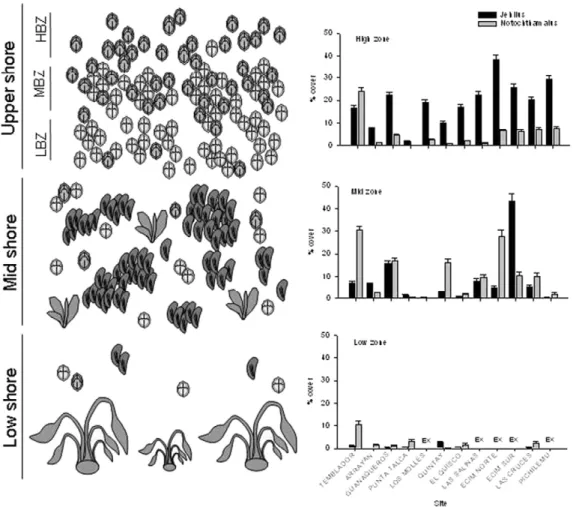
(3) 178. J.L. Shinen, S.A. Navarrete / Journal of Experimental Marine Biology and Ecology 392 (2010) 176–187. Fig. 1. a) Generalized depiction of intertidal chthamalid barnacle zonation patterns on the central coast of Chile. The upper shore is further subdivided into high, mid, and low barnacle zones (HBZ, MBZ, and LBZ, respectively) to illustrate patterns of coexistence between Jehlius and Notochthamalus. b) Mean percent coverage (± SE) of Jehlius and Notochthamalus at high, mid, and low shore levels, average across survey years (2007–2009). Sites that were excluded from surveys are noted by EX.. approximately the middle of the chthamalid zone (MBZ, Fig. 1). In the laboratory, juvenile barnacles, newly metamorphosed spat, and cyprid larvae were identified to species level under a dissecting microscope. Since the time plates were exposed in the field varied somewhat depending on tidal cycles and sea conditions, recruitment was expressed as the number of individuals per day of exposure per collector (see Lagos et al., 2008; Navarrete et al., 2008). Only spring– summer months (Sept–Feb) were considered in calculations as settlement the rest of the year is nearly null (Lagos et al., 2005; Navarrete et al. 2008).. groups, surrounded by heterospecifics. Total barnacle cover in these plots varied between 14 and 78%. Target individuals were relocated over time with the aid of the marking screws, which also served as scale reference, and their maximum opercular carino-rostral length and opercular width were measured. With these measurements we estimated the opercular area simply multiplying opercular length× width (Lopez and Gonzalez, 2003). ImageJ Image Analysis (Abramoff et al., 2004) was used to score and analyze photos.. 2.5. Data analyses 2.4. Intra- and inter-specific effects on growth rates To examine the potential effects of intra- and inter-specific crowding on individual growth rates, in April 2008 we installed 10 10× 10 cm plots in each of the 3 chthamalid sub-zones along the upper shore of one site (Pichilemu): the high barnacle zone, where Jehlius numerically dominates; the mid barnacle zone, where Jehlius and Notochthamalus are well mixed; and the low barnacle zone, where Notochthamalus numerically dominates (see Fig. 1a and Results). Plots were marked with two stainless-steel screws anchored directly in the upper left and bottom right corners and photographed with a digital camera (Olympus 1030 W) approximately every 3 months, with the final photos taken in June 2009. For this study, we selected from the photographs 10 individuals of each Jehlius and Notochthamalus in each of the 3 sub-zones which were found under the following conditions: 1) individual barnacles existing singly, not sharing walls with any neighboring barnacles; 2) individuals that were in aggregated groups, surrounded by conspecific individuals only; 3) individuals that were in aggregated. We compared density of individuals between species (Jehlius and Notochthamalus, fixed factor), among tidal levels (high and mid, fixed factor) and among sites (12 sites, random factor) with a three-way ANOVA, using the most complete dataset on adult densities collected in the field in 2008. To determine whether there were differences between species in the way individuals use space, we calculated the relationship between density and cover of individuals in the 10× 10 cm quadrats for each species and tidal level (high and mid zone) at each site and quadrat. To this end, we used ordinary least square regressions between density and cover. We then compared the slopes of these regressions between species (Notochthamalus, Jehlius, fixed), tidal level (high and mid, fixed factor) and sites (random) using a 3-way ANOVA. To examine whether there is evidence of negative relationships (e.g. interference competition and segregated settlement) at the scale of quadrats (50 × 50 cm) and at the scale of sub-samples (5× 5 cm) we calculated Pearson correlations between Jehlius and Notochthamalus densities for each site and quadrat, respectively..
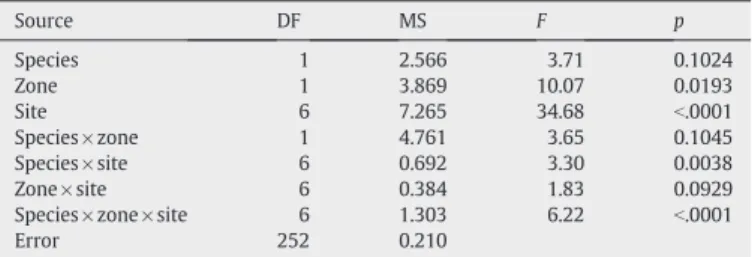
(4) J.L. Shinen, S.A. Navarrete / Journal of Experimental Marine Biology and Ecology 392 (2010) 176–187 Table 1 Results of a mixed model ANOVA of the mean density of Jehlius and Notochthamalus using 3 factors: Site (random), Zone (fixed), and Species (fixed). Mean are expressed on a per-quadrat level, averaged across all sub-samples. Source. DF. MS. F. p. Site Zone Species Species × zone Site × species Zone × species Site × zone × species Error. 11 1 1 11 11 1 11 432. 822.517 839.714 1516.504 214.259 484.013 3279.298 351.824 43.259. 19.06 3.92 3.13 4.45 11.19 9.32 8.13. b.0001 0.0733 0.1044 b.0001 b.0001 0.0110 b.0001. To characterize the vertical extent of overlap between the chthamalid barnacle species with respect to tidal elevation and its variability across sites, we calculated the proportion of barnacle species expressed as the ratio of Jehlius to total barnacle density (J/(J+N)adults =density of Jehlius/ total barnacle density) in each quadrat along the vertical photographic transects. Moreover, because transect length and inclination differed within and among sites, relative tidal elevations were calculated for each quadrat dividing its position on the transect (in cm) starting from the highest point, by the total transect length. In this manner vertical distribution patterns were not confounded with differences in overall barnacle density among sites and vertical changes were expressed relative to the extension of the barnacle zone.. 179. Table 2 Results of a mixed model ANOVA of the slopes of linear regressions between number of individuals and percent cover Jehlius and Notochthamalus, comparing: site (random), intertidal zone (fixed), and species (fixed). Mean slopes are expressed on a per-quadrat level, averaged across all sub-samples. Source. DF. MS. F. p. Species Zone Site Species × zone Species × site Zone × site Species × zone × site Error. 1 1 6 1 6 6 6 252. 2.566 3.869 7.265 4.761 0.692 0.384 1.303 0.210. 3.71 10.07 34.68 3.65 3.30 1.83 6.22. 0.1024 0.0193 b.0001 0.1045 0.0038 0.0929 b.0001. Using only the portions of the vertical transect where Jehlius and Notochthamalus co-occur within the 10 × 10 cm quadrats (0 b J/(J + N)adults b 1), we calculated the extent of the transition zone or rate of change from Jehlius to Notochthamalus domination. To this end, we regressed the proportion of Jehlius against relative tidal elevation using ordinary least square linear regression for each transect. A sharp zonation pattern (narrow transition zone) was then reflected in steep slopes, while extensive mixing through the barnacle zone was reflected in shallow slopes. We then examined whether variation in the extent of the mixing zone (slopes of linear regressions) across sites was related to changes in barnacle recruitment rates, using linear regression on log-transformed data. To examine species-specific trends in recruitment across the study region we simply plotted long-term (1997–2008) mean recruitment rates across all sites ordered geographically and examined the correlation in recruitment between species across sites using Pearson correlation on log-transformed data. To evaluate the contribution of recruitment to the pattern of abundance in the upper shore (barnacle zone), i.e. whether there is evidence of recruitment limitation across the region, we compared average daily recruitment rates of the two species for the years 2006– 2008 to the average density of adults the following year within MBZ level of the barnacle zone using linear regression on log-transformed data. This comparison was done across sites and not following individual cohorts (e.g. Connell, 1985; Menge, 2000a,b), and therefore the adult density in a given year represents the recruitment cohort of the prior year as well as carry over from earlier cohorts. Thus, we also examined the relationship using the previous two years of recruitment. Similarly, to determine whether the pattern of relative abundances of adults of the two species could be explained by the relative abundance of recruits, we used a linear regression between J/ (J + N)adults for years 2006–2008 against J/(J + N)recruits for the year before and also examined the previous two years. Individual growth rates (final area − initial area)/days were compared among species, tidal elevation, and the three “crowding” conditions (single, surrounded by conspecifics, and surrounded by heterospecifics) using a 3-way ANOVA, considering all factors fixed. Before analysis, individual growth curves were inspected for nonlinearity or seasonal trends. Growth rate increments were examined against initial opercular area and no evidence of size-dependent growth was found (see Results). 3. Results 3.1. Local patterns of distribution. Fig. 2. a) Patterns of space occupation expressed as the change in percent cover by the density of individuals for Jehlius (closed circles) and Notochthamalus (open circles). Species-specific regression coefficients are indicated by subscripts J (Jehlius) and N (Notochthamalus).. The abundance of both Jehlius and Notochthamalus varied across tidal levels (Fig. 1b). In the upper shore, where overall cover of chthamalids was highest, Jehlius generally was more abundant than Notochthamalus across the region, except at one site (Temblador) at the northern end of the study region (Fig. 1b). In the mid shore level at most but not all sites, Notochthamalus cover was higher. In the low.
(5) 180. J.L. Shinen, S.A. Navarrete / Journal of Experimental Marine Biology and Ecology 392 (2010) 176–187. Fig. 3. Correlations between the densities of Jehlius and Notochthamalus at the upper (closed circles, US) and mid (open circles, MS) shore levels, by site.. shore, both species were rare, rarely reaching over 5% cover and at most sites Notochthamalus was more abundant than Jehlius. Changes in relative abundances of species across tidal levels and differences in numerical dominance at some sites were reflected in a significant interaction among these three factors in a 3-way ANOVA (Table 1). Overall, there were tight linear relationships (R2 N 0.84) between the number of individuals (density) and percent cover for both species (Fig. 2). Although the slopes of the relationships were similar between species when averaging across sites and tidal levels (Fig. 2, Table 2), suggesting overall similar patterns of per capita space occupation, there were significant differences in the slopes between tidal levels and sites, which also varied between species (Table 2, significant three-way interaction). We interpret this as an indication that local processes determine per capita space occupation (e.g. size structure, recruitment, or post-settlement mortality) and that these processes are not consistent across the region. Correlations between the densities of Jehlius and Notochthamalus within the 5 × 5 cm sub-quadrats were generally positive and centered around a correlation r = 0.23 on the upper shore and r = 0.34 in the mid shore, which differed significantly from the null expectation of no correlation (Supplementary material Fig. 2). Only 3 significantly negative correlations were observed out of the 527. correlations examined at the scale of the 5 × 5 cm quadrats. At the scale of the 50 × 50 cm quadrats (averaging all sub-samples within quadrats to provide estimates of density at the quadrat level), correlations were generally non-significant at all sites and zones (Fig. 3). Only 4 significantly positive relationships were identified at this scale, 2 in the upper (El Quisco, Pichilemu) and 2 in the mid shore (ECIM Norte, Guanaqueros), and no negative correlations were observed (Fig. 3). We interpret the lack of negative correlation between species-specific chthamalid density at both the 5 × 5 cm and 50 × 50 cm scales as an indication that the relative abundance of one species does not inhibit the other. The generally positive correlations at the smallest scale suggest that there are site and shore level specific conditions that benefit both species or contribute to inter-specific aggregated settlement. Across shore levels and among sites, Jehlius and Notochthamalus were found to overlap extensively in their vertical distribution (Fig. 4). At all sites Jehlius dominated in the highest tidal elevations while at most sites Notochthamalus dominated in the lowest part of the barnacle zone. Although all sites exhibited these transitions in species dominance, the rate of transition from Jehlius to Notochthamalus, or the sharpness of zonation, varied considerably among sites (Fig. 7a). At a few of the sites, the transitions of species dominance.
(6) J.L. Shinen, S.A. Navarrete / Journal of Experimental Marine Biology and Ecology 392 (2010) 176–187. 181. Fig. 4. Site-specific patterns of co-occurrence of Jehlius and Notochthamalus across relative tide elevation. Co-occurrence is expressed at the proportional densities of Jehlius to Notochthamalus (J:(J + N)adults = density Jehlius/total barnacle density). Dotted reference line indicates where species would be in equal proportion (J:(J + N)adults = 0.5). See Materials and methods for details.. were likely affected by intertidal shores that are truncated abruptly (Montemar and Punta Talca) or are influenced by strong changes in inclination along the rock surface (Quintay), never reaching a zone of clear dominance by Notochthamalus. More striking than species. transitions, however, was that at the majority of sites, high levels of mixing occurred throughout most of the sampled area from about 60– 80% of the entire chthamalid zone, indicating high levels of local spatial coexistence between Jehlius and Notochthamalus..
(7) 182. J.L. Shinen, S.A. Navarrete / Journal of Experimental Marine Biology and Ecology 392 (2010) 176–187. higher post-settlement mortality than Notochthamalus on the upper shore, but this mortality appears to be unrelated to the proportion of Notochthamalus, at least in 2007 and 2009. Across the expanse of the chthamalid zone, the rates of change of species dominance across tidal elevation (transition slopes) increased in magnitude with increasing mean total recruitment (Fig. 7b), indicating that as recruitment increases, the zonation from Jehlius to Notochthamalus dominance was sharper, with less mixing between the species. 3.3. Growth rates and effects of intra- and inter-specific crowding. Fig. 5. Regional annual mean recruitment rates (± SE) of Jehlius and Notochthamalus from 1997 to 2008. Graphical insert depicts the correlation between recruitment rates of Jehlius and Notochthamalus across sites and years.. 3.2. Regional patterns of recruitment Mean daily recruitment rate varied across four orders of magnitude across sites, with generally higher recruitment rates in southern sites (Fig. 5, and see Navarrete et al. 2005, for details of these patterns). With the exception of one site (Temblador), recruitment rates of Jehlius exceeded those of Notochthamalus throughout the study region. Recruitment rates of Jehlius and Notochthamalus were also highly correlated across the study region (Fig. 5). Across sites, the density of adult Notochthamalus was significantly and linearly associated with recruitment rates the year before for all three years examined (Fig. 6a). This positive relationship suggests that Notochthamalus may be recruitment limited across the study region. The density of adult Jehlius, however, was poorly explained by recruitment rates of the previous years for all years examined (Fig. 6a). Although the causes for such a pattern are difficult to establish with existing data, we interpret these results as indicative that larval supply is not limiting in this species and that postsettlement factors might be more important in determining local adult abundance. Analyses of the relationship between adult abundance and recruitment two years prior were all non-significant. Removing density effects, the proportion of recruits (J:(J + N)recruits) was a good predictor of the proportion of adult barnacles in the upper shore (J:(J + N)adults) on two (2007 and 2009) out the 3 years examined (Fig. 6b), although the low number of sites in 2007 rendered the relationship non-significant (p = 0.0596). Of the two years with linear relationships, in 2007 the slope was close (slope= 0.89) to the expected slope of 1.0 (proportions of adults reflecting proportion of recruits). However, the slope from 2009 was significantly less than 1.0 (p = 0.0081), indicating that in 2007 relative adult abundances across sites followed changes in relative recruitment rates of the species, but in 2009 Jehlius experienced higher post-settlement mortality with increasing Notochthmalus recruitment. In 2008 adult proportions were not associated to the relative recruitment observed the previous year. Relationships with recruitment the previous 2 years were all nonsignificant. Moreover, in all years there was a slight trend to underestimate the proportion of adult Jehlius to total barnacle abundance, indicating a greater abundance of Notochthamalus in the adult population than would be predicted by the recruitment fraction (Fig. 6b). Combined with saturating recruitment densities, lower proportional density of Jehlius suggests that Jehlius may be experiencing. Opercular growth was observed in all marked barnacles and there was no size-dependent growth rate in either of the species (Fig. 8). Examination of individual growth curves revealed linear trends with an absence of seasonal peaks. Moreover, mean growth rate did not vary between Jehlius and Notochthamalus, irrespective of tide elevation or crowding condition (Fig. 8, Table 3), i.e. intra- or interspecific crowding had no measurable effects on growth rates with respect to isolated individuals (Supplementary material Fig. 3). Moreover, growth rates were not correlated to the total cover of barnacles within the 10 × 10 cm2 plots (linear fit R 2 = 0.02, p = 0.5558), suggesting that neither local crowding scenarios nor the proximal density of individuals have significant effects on growth. Survivorship of all barnacles (target and non-target individuals) was generally high, with mortality only noted at the level of the entire 10 × 10 cm plot, in which the majority or all the barnacles present within the plot were removed, independent from experimental crowding treatments. The causes of this mortality, which occurred with greater frequency in the plots lower on the shore, are under investigation. Furthermore, we found no visual evidence of interference competition in terms of overgrowth or under cutting among marked individuals. 4. Discussion Patterns of distribution of chthamalid barnacles were largely consistent across the study region in central Chile and generally followed previous descriptions of zonation between these species (Guiler, 1959; Castilla, 1981); J. cirratus was numerically dominant at the highest intertidal levels and Notochthamalus was relatively more abundant at lower shore levels (Figs. 1, 2, and 4). However, our results show that there is a very ample overlap in the distribution of these species, with mixing between individuals at small spatial scales occurring over 60–80% of the entire barnacle zone. Based on our results on per capita use of space, recruitment and adult abundances at multiple sites and years, and on growth rates under different scenarios of neighborhood competition, we conclude that a combination of subtle tidal segregation and a lottery-type of space occupation with no competitive hierarchy is the best working hypotheses to explain coexistence patterns of these species. Close examination of recruitment patterns and the relationships with adult distributions shed light on several important features of coexistence between Jehlius and Notochthamalus. First, differences over several orders of magnitude were found in recruitment of the species among sites (Fig. 5). Moreover, although the relative proportion of recruits of the two species varied somewhat from site to site and from year to year (see below), recruitment of the two species was highly correlated across the region. We interpret this as an indication that both chthamalids are experiencing generally similar effects of transport processes over scales of kilometers. Although we do not have information on reproductive output for these sites, the high correlation in recruitment among sites suggests that a source-sink type of dynamics across sites (Iwasa and Roughgarden, 1986; Pulliam, 1988) is unlikely to play an important role in favoring coexistence between these species..
(8) J.L. Shinen, S.A. Navarrete / Journal of Experimental Marine Biology and Ecology 392 (2010) 176–187. 183. Fig. 6. a) Annual patterns of density of Jehlius (closed circles) and Notochthamalus (open circles) on the upper shore by the mean recruitment rate of the previous year. b) Annual proportion of adult barnacles (J:(J + N)adults = density Jehlius/total barnacle density) on the upper shore by the proportion of recruits (J:(J + N)recruits = density of Jehlius recruits/total recruit density) of the previous year. Dotted reference line indicates where J:(J + N)recruits perfectly predicts J:(J + N)adults (slope = 1.0).. Second, the relationship between recruitment rates and adult abundances suggested that Notochthamalus but not Jehlius might be recruitment limited. A linear relationship between density of recruits and subsequent adult density has historically been interpreted as evidence that the arrival rates of larvae from the plankton, or the subsequent mortality during the first days of benthic life, are limiting local population size (Connell, 1985; Carroll, 1996; Menge, 2000a,b). In our study, this relationship was evaluated across sites and with non-manipulative surveys (no clearings to follow single cohorts), thus our assessments of adult distributions are estimating the pooled outcome of site-specific influences, population input rate (recruitment), and turnover rates (postsettlement mortality). When turnover rate is low, populations become. saturated more quickly, regardless of larval supply, and thus will not appear to be strongly recruitment limited. Our analyses of the relationships between the recruitment and adult fractions are liable to be confounded by the carryover of adult populations from previous years, but nevertheless, under these conditions we found significant relationships between recruitment and adult abundance only in Notochthamalus. In contrast, Jehlius recruits generally arrived at higher densities, but postsettlement mortality rather than recruitment seems to determine adult population abundance across sites. Although the possibility and consequences of species-specific recruitment, slightly offset by tide elevation, should be further explored, the observed patterns suggest that the upper limit and population abundance of Notochthamalus within the barnacle.
(9) 184. J.L. Shinen, S.A. Navarrete / Journal of Experimental Marine Biology and Ecology 392 (2010) 176–187. Fig. 7. a) Regional species dominance transition rates (± SE) calculated by regressing the rate of change of the relative proportion of chthamalid species J:(J + N)adults by relative tidal elevation, using only the portions of the transect where Jehlius and Notochthamalus co-occur (0 b J:(J + N)adults b 1). b) Linear regression of site-specific species dominance transition rates (J:(J + N)adults/ relative tide elevation) by daily recruitment rates from 2008.. zone is self-limited by recruitment and not the result of competitive interactions with Jehlius. Recruitment limitation and not inter-specific competition has been shown to set the distribution limits in other coexisting barnacle species (Denley and Underwood, 1979; Grosberg, 1982; Miyamoto et al., 1999). It must be noted, however, that even under relatively low recruitment competition for space can still occur in the form of neighborhood competition if, for instance, settlement of the species are highly correlated over small spatial scales (Lloyd and White, 1980; Weiner, 1982). This is clearly the case in these chthamalid species (see below) and suggests that bare space might not be a good indicator of resource availability. Third, although total recruitment rates varied substantially among sites, the relative proportion of adults was correlated to the relative proportion of recruits the previous year on two of the three years examined. The slope of this relationship was close to 1 in 2007, suggesting that relative abundances of adults were set by recruitment and not by post-recruitment processes. However, low number of sites on that year rendered the relationship non-significant. In 2009 the relationship between relative proportions of recruits and adults was. significant, but the recruit fraction significantly (slope b 1) overestimated the relative abundance of adult Jehlius. This could be an indication of asymmetrical, pre-emptive occupation of attachment substrate (Denley and Underwood, 1979; Schoener, 1982) or interference competition for space with Notochthamalus (Connell, 1961a,b; Wethey, 1983), or simply the result of strong species-specific densitydependent mortality in Jehlius (Jenkins et al., 2008). This particular analysis gives us some conflicting evidence as to the existence and importance of asymmetric competition in setting adult abundances in the mixed barnacle zone. The fact that in all years the final relative abundance of Jehlius was under-estimated from the recruitment and that the difference in the proportion of Jehlius as recruits versus adults was not related to Notochthamalus recruitment (Supplementary material Fig. 4) suggest that these patterns are better explained by stronger species-specific post-settlement morality of Jehlius. In sharp contrast with Paine's (1981) observations that suggested dominance of Jehlius over Notochthamalus, we found weak evidence of competitive hierarchies or inter-specific interference competition for space between the chthamalids. Since Jehlius and Notochthamalus had nearly equal per capita use of space (from relationships of cover versus density), it is unlikely that “passive” pre-emption of space, when it occurs, could be asymmetric. We showed that increased recruitment rates of the species across sites led to sharper transitions from Jehlius to Notochthamalus dominance across the chthamalid zone. This pattern is further suggestive of recruitment segregation by tide elevation, and that symmetrical pre-emptive competition for space may play a more important role at higher recruitment densities. The absence of asymmetric interference competition was also suggested by the existence of positive, instead of negative correlations between densities of these species even within 25 cm2 quadrats. Generally positive correlations at these small scales are probably the result of similar larval selectivity for settlement sites, a possibility that warrants further exploration (Jenkins, 2005). At slightly larger spatial scales of 2500 cm2, densities appeared uncorrelated, which is probably the results of random and unbiased variation in sources of mortality over these scales. Perhaps the most compelling evidence in favor of weak and symmetrical competitive interactions between the chthamalids within the upper shore are the results of growth rates under different neighborhood conditions. These results show that, at least in terms of growth rates, Jehlius and Notochthamalus are competitively equivalent and are not affected by crowding. As reported for other chthamalids, Jehlius and Notochthamalus, exhibited relatively slow, linear growth rates (Barnes, 1956) and as reported by Lopez and Gonzalez (2003), the opercular area was a size-independent measure of growth. Notably, even the smallest individuals, identified in the early post-settlement phase, grew at the same rate as larger individuals, regardless of crowding condition or of overall plot level cover of barnacles (a correlate of overall density). It is important to note, however, that these observations were conducted at a single site, Pichilemu; large intertidal platform, characterized by moderate–low recruitment and a moderate cross-shore transition rate between Jehlius and Notochthamalus. Moreover, considering the slow growth rates of both species, it is possible that competitive interactions are occurring, but the time scope of our observations was not sufficient to observe its manifestation on barnacle growth. Future studies should investigate variability in competitive interactions among sites and, in particular, the potential effects on barnacle survival, which we were not able to fully address in this study. Coexistence between Jehlius and Notochthamalus may also be favored by small-scale niche partitioning. Despite extensive mixing of species through the chthamalid zone, slight segregation by tidal height was apparent, creating “local refugia” for each species. It is unknown what creates and maintains this slight segregation. Further scrutiny of settlement patterns may reveal slight differences in tide elevationspecific settlement or post-settlement mortality (Jenkins, 2005). In any case, these findings are consistent with other work on co-occurring.
(10) J.L. Shinen, S.A. Navarrete / Journal of Experimental Marine Biology and Ecology 392 (2010) 176–187. 185. Fig. 8. Mean specific growth rates of Jehlius and Notochthamalus (expressed as the change in growth by initial size) growing in different crowding conditions: no competition (closed circles), intra-specific competition (open circles), and inter-specific competition (inverted triangles). Results are shown for each high, mid, and low barnacle zones (HBZ, MBZ, and LBZ, respectively).. barnacles where adult distributions depend on species-specific responses to shore level and site effects such as desiccation stress and wave exposure (Carroll, 1996; Menge 2000b; Delany et al., 2003). These. Table 3 Results of an ANOVA of the mean growth rates of Jehlius and Notochthamalus using 3 fixed factors: species, barnacle zone (within the upper shore), and crowding condition (CC). Source. DF. MS. F. p. Species Zone CC Species × zone Species × CC Zone × CC Species × CC × zone Error. 1 2 2 2 2 4 4 162. 0.826 21.933 4.197 17.207 0.313 9.695 8.597 8.487. 0.10 2.58 0.50 2.03 0.04 1.14 1.01. 0.7555 0.0786 0.6108 0.1350 0.9638 0.3386 0.4024. factors should be investigated through replicated transplant experiments across tidal elevations. In summary, we believe that coexistence and mixing between these chthamalid species are the result of: a) slight tidal segregation, probably maintained by small tidal differences in recruitment rates which might or might not relate to competition past, b) overall weak competition for space at many, perhaps most sites due to recruitment limitation of Notochthamalus within the mixed barnacle zone, and c) absence of interference for space and equal competitive abilities of the two species, which allows them to hold the space once settled even at sites of high recruitment rates and limited rock surface. Thus, this two-species system appears to have similar elements of a lottery-type of competitive coexistence as proposed for territorial reef fish (Sale 1977). The slight sorting of species across tidal elevations might be sufficient to prevent that a species recruiting in greater density could monopolize space and exclude heterospecifics, but variation in competitive ability across sites should be further investigated. It is clear that detailed experiments are.
(11) 186. J.L. Shinen, S.A. Navarrete / Journal of Experimental Marine Biology and Ecology 392 (2010) 176–187. badly needed to evaluate these propositions if we are to improve our understanding of distribution and coexistence of the species that fascinated a young Charles Darwin more than 150 year ago. Acknowledgements We are indebted to a great many students and technicians for their field assistance and processing of recruitment samples, including Elliott Ramos, Randy Finke, Mirtala Parragué, Fredy Véliz, Joan Escobar, Jhon Gajardo, Mario Barahona, Tatiana Manzur, and José Pantoja. This project was funded by grants to SAN from Fondecyt # 1070335 and Fondap-Fondecyt 15001-001 to the Center for Advanced Studies in Ecology and Biodiversity (CASEB). JLS was supported by the Andrew Mellon Foundation during these studies, for which we are most grateful. [SS] Appendix A. Supplementary data Supplementary data associated with this article can be found, in the online version, at doi:10.1016/j.jembe.2010.04.033. References Abramoff, M.D., Magelhaes, P.J., Ram, S.J., 2004. Image processing with image. J. Biophotonics Int. 11, 36–42. Aguilera, M.A., Navarrete, S.A., 2007. Effects of Chiton granosus (Frembly, 1827) and other molluscan grazers on algal sucesión in wave exponed mid-intertidal rocky shores of central Chile. J. Exp. Mar. Biol. Ecol. 349, 84–98. Amarasekare, P., 2003. Competitive coexistence in spatially structured environments: a synthesis. Ecol. Lett. 6, 1109–1122. Amarasekare, P., 2004. Spatial variation and density-dependent dispersal in competitive coexistence. Proc. R. Soc. Lond. Ser. B 271, 1497–1506. Barnes, H., 1956. The growth rate of Chthamalus Stellatus (Poli). J. Mar. Biol. Assoc. UK 35, 355–361. Carroll, M.L., 1996. Barnacle population dynamics and recruitment regulation in southcentral Alaska. J. Exp. Mar. Biol. Ecol. 199, 285–302. Castilla, J.C., 1981. Perspectivas de investigación en estructura y dinámica de comunidades intermareales rocosas de Chile central. II. Depredadores de alto nivel trófico. Medio Ambiente 5, 190–215. Castilla, J.C., 2009. Darwin taxonomist: barnacles and shell burrowing barnacles. Rev. Chil. Hist. Nat. 82, 477–483. Chan, B.K.K., 2006. Ecology and biodiversity of rocky intertidal barnacles along a latitudinal gradient, Japan, Taiwan and Hong Kong. The Nagisa World Congress, pp. 1–10. Chan, B.K.K., Williams, G.A., 2004. Population dynamics of the acorn barnacles, Tetraclita squamosa and Tetraclita japonica (Cirripedia: Balanomorpha), in Hong Kong. Mar. Biol. 146, 149–160. Chesson, P.L., 2000a. Mechanisms of maintenance of species diversity. Ann. Rev. Ecolog. Syst. 31, 343–366. Chesson, P.L., 2000b. General theory of competitive coexistence in spatially varying environments. Theor. Pop. Biol. 58, 211–237. Connell, J.H., 1961a. The influence of interspecific competition and other factors on the distribution of the barnacle Chthamalus stellatus. Ecology 42, 710–723. Connell, J.H., 1961b. The effects of competition, predation by Thais lapillus, and other factors on natural populations of the barnacle Balanus baianoides. Ecol. Monogr. 31, 61–104. Connell, J.H., 1985. The consequences of variation in initial settlement vs. postsettlement mortality in rocky intertidal communities. J. Exp. Mar. Biol. Ecol. 93, 11–45. Dayton, P.K., 1971. Competition, disturbance, and community organization: the provision and subsequent utilization of space in a rocky intertidal community. Ecol. Monogr. 41, 351–389. Denley and Underwood, 1979. Experiments on factors influencing settlement, survival, and growth of two species of barnacle in New South Wales. J. Exp. Mar. Biol. Ecol. 36, 269–293. Delany, J., Myers, A.A., McGrath, D., O'Riordan, R.M., Power, A.M., 2003. Role of postsettlement mortality and ‘supply-side’ ecology in setting patterns of intertidal distribution in the chthamalid barnacles Chthamalus montagui and C. stellatus. Mar. Ecol. Prog. Ser. 249, 207–214. Dungan, M.L., 1985. Competition and the morphology, ecology, and evolution of acorn barnacles: an experimental test. Paleobiology 11, 165–173. Fernández, M., Jaramillo, E., Marquet, P.A., Moreno, C.A., Navarrete, S.A., Ojeda, F.P., Valdovinos, C.R., Vásquez, J.A., 2000. Diversity, dynamics and biogeography of Chilean benthic nearshore ecosystems: an overview and guidelines for conservation. Rev. Chil. Hist. Nat. 73, 797–830. Finke, G.R., Navarrete, S.A., Bozinovic, F., 2007. Tidal regimes of temperate coasts and their influences on aerial exposure for intertidal organisms. Mar. Ecol. Prog. Ser. 343, 45–55. Gosselin, L.A., Qian, P.Y., 1996. Early post-settlement mortality of an intertidal barnacle: a critical period of survival. Mar. Ecol. Prog. Ser. 135, 69–75.. Grosberg, R.K., 1982. Intertidal zonation of barnacles: the influence of planktonic zonation of larvae on vertical distribution of adults. Ecology 63, 894–899. Guiler, E.R., 1959. The intertidal ecology of the Montemar area, Chile. Pap. Proc. R. Soc. Tasman. 93, 165–183. Hills, J.M., Thomason, J.C., 2003. The ‘ghost of settlement past’ determines mortality and fecundity in the barnacle, Semibalanus balanoides. Oikos 101, 529–538. Holyoak, M., Leibold, M.A., Mouquet, N., Holt, R.D., Hoopes, M.F., 2005. Metacommunities. A framework for large-scale community ecology. In: Holyoak, M., Leibold, M.A., Holt, R.D. (Eds.), Metacommunities: Spatial dynamics and ecological communities. University of Chicago Press, Chicago, pp. 1–31. Hyder, K., Aberg, P., Johnson, M.P., Hawkins, S.J., 2001. Models of open populations with space limited recruitment: extension of theory and application to the barnacle Chthamalus montagui. J. Anim. Ecol. 70, 853–863. Iwasa, Y., Roughgarden, J., 1986. Interspecific competition among metapopulations with space-limited subpopulations. Theor. Pop. Biol. 30, 260-214. Jenkins, S.R., 2005. Larval habitat selection, not larval supply, determines settlement patterns and adult distribution in two chthamalid barnacles. J. Anim. Ecol. 74, 893–904. Jenkins, S.R., Aberg, P., Cervin, G., Coleman, R.A., Delany, J., Della Santina, P., Hawkins, S.J., LaCroix, E., Myers, A.A., Lindegarth, M., Power, A.M., Roberts, M.F., Hartnoll, R.G., 2000. Spatial and temporal variation in settlement and recruitment of the intertidal barnacle Semibalanus balanoides (L.) (Crustacea: Cirripedia) over a European scale. J. Exp. Mar. Biol. Ecol. 243, 209–225. Jenkins, S.R., Murua, J., Burrows, M.T., 2008. Temporal changes in the strength of density-dependent mortality and growth in intertidal barnacles. J. Anim. Ecol. 77, 573–584. Lagos, N., Navarrete, S.A., Véliz, F., Masuero, A., Castilla, J.C., 2005. Meso-scale spatial variation in settlement and recruitment of intertidal barnacles along central Chile. Mar. Ecol. Prog. Ser. 290, 165–178. Lagos, N.A., Tapia, F.J., Navarrete, S.A., Castilla, J.C., 2007. Spatial synchrony in recruitment of intertidal invertebrates along central Chile. Mar. Ecol. Prog. Ser. 350, 29–39. Lagos, N.A., Castilla, J.C., Broitman, B.R., 2008. Spatial environmental correlates of intertidal recruitment: a test using barnacles in northern Chile. Ecol. Monogr. 78, 245–261. Leibold, M.A., Holyoak, M., Mouquet, N., Amarasekare, P., Chase, J., Hoopes, M., Holt, R., Shurin, J., Law, R., Tilman, D., Loreau, M., Gonzalez, A., 2004. The metacommunity concept: a framework for multi-scale community ecology. Ecol. Lett. 7, 601–613. Leslie, H.M., Breck, E., Chan, F., Lubchenco, J., Menge, B., 2005. Hotspots of barnacle reproduction associated with nearchore ocean conditions. Proc. Natl. Acad. Sci. U. S. A. 102, 10534–10539. Lloyd, M., White, J., 1980. Reconciling patchy micro-spatial distributions with competition models. Am. Nat. 115, 29–44. Lopez, D.A., Gonzalez, M.L., 2003. Denisty-dependent effects in Jehlius cirratus (Darwin, 1854) (Cirripedia: Chthamalidae) under different growth conditions. Mar. Ecol. 24, 289–302. Luckens, P.A., 1975. Competition and intertidal zonation of barnacles at Leigh, New Zealand. N.Z. J. Mar. Freshwater Res. 9, 379–394. Menge, B.A., 1976. Organization of the New England rocky intertidal community: role of predation, competition and environmental heterogeneity. Ecol. Monogr. 46, 355–393. Menge, B.A., 2000a. Top-down and bottom-up community regulation in marine rocky intertidal habitats. J. Exp. Mar. Biol. Ecol. 250, 257–289. Menge, B.A., 2000b. Recruiment vs. postrecruitment processes as determinants of barnacle population abundance. Ecol. Monogr. 70, 265–288. Menge, B.A., Blanchette, C., Raimondi, P.T., Freidenberg, T.L., Gaines, S., Lubchenco, J., Lohse, D.P., Hudson, G., Foley, M.M., Pamplin, J., 2004. Species interaction strength: testing model predictions along an upwelling gradient. Ecol. Monogr. 74, 663–684. Miller, A.D., Chesson, P., 2009. Coexistence in disturbance-prone communities: how a resistance-resilience trade-off generates coexistence via the storage effect. Am. Nat. 173, E30–E43. Miyamoto, Y., Noda, T., Nakao, S., 1999. Zonation of two barnacle species not determined by competion. J. Mar. Biol. Assoc. UK 79, 621–628. Navarrete, S.A., 2007. Maintenance of biodiversity. In: Denny, M.W., Gaines, S.D. (Eds.), Encyclopedia of Tidepools and Rocky Shores. University of California Press, Los Angeles, pp. 76–81. Navarrete, S.A., Castilla, J.C., 1990. Resource partitioning between intertidal predatory crabs: interference and refuge utilization. J. Exp. Mar. Biol. Ecol. 143, 101–129. Navarrete, S.A., Castilla, J.C., 2003. Experimental determination of predation intensity in an intertidal predator guild: dominant versus subordinate prey. Oikos 100, 251–262. Navarrete, S.A., Broitman, B., Wieters, E.A., Finke, G.R., Venegas, R.M., Sotomayor, A., 2002. Recruitment of intertidal invertebrates in the southeast Pacific: inter-annual variability and the 1997–1998 EL Niño. Limnol. Oceanogr. 47, 791–802. Navarrete, S.A., Wieters, E., Broitman, B., Castilla, J.C., 2005. Scales of benthic-pelagic coupling and the intensity of species interactions: from recruitment limitation to top down control. Proc. Natl. Acad. Sci. U. S. A. 102, 18046–18051. Navarrete, S.A., Broitman, B.R., Menge, B.A., 2008. Interhemispheric comparison of recruitment to intertidal communities: pattern persistence and scales of variation. Ecology 89, 1308–1322. Newman, W.A., Stanley, S.M., 1981. Competition wins out overall: reply to Paine. Paleobiology 7, 561–569. O'Riordan, R.M.A., Arrontes, F., Castro, J., Cruz, J.J., Delany, T., Martínez, J., Fernandez, C., Hawkins, S.J., McGrath, D., Myers, A.A., Oliveros, J., Pannacciulli, F.G., Power, A.M., Relini, G., Rico, J.M., Silva, T., 2004. Spatial variation in the recruitment of the intertidal barnacles Chthamalus montagui Southward and Chthamalus stellatus (Poli) (Crustacea: Cirripedia) over an european scale. J. Exp. Mar. Biol. Ecol. 304, 243–264. Paine, R.T., 1981. Barnacle ecology: is competition important? The forgotten roles of disturbance and predation. Paleobiology 7, 553–560..
(12) J.L. Shinen, S.A. Navarrete / Journal of Experimental Marine Biology and Ecology 392 (2010) 176–187 Paine, R.T., 1984. Ecological determinism in the competition for space. Ecology 65, 1339–1348. Pfister, C.A., 2006. Concordance between short-term experiments and long-term censuses in tide pool fishes. Ecology 87, 2905–2914. Poloczanska, E.S., Hawkins, S.J., Southward, A.J., Burrows, M.T., 2008. Modeling the response of populations of competing species to climate change. Ecology 89, 3138–3149. Pulliam, H.R., 1988. Sources, sinks, and population regulation. Am. Nat. 132, 652–661. Raimondi, P.T., 1991. Settlement behavior of Chthamalus anisopoma larvae largely determines the adult distribution. Oecologia 85, 349–360. Roughgarden, J., Iwasa, Y., Baxter, C., 1985. Demographic theory for an open marine population with space-limited recruitment. Ecology 66, 54–57. Roughgarden, J., Gaines, S., Possingham, H., 1988. Recruitment dynamics in complex life-cycles. Science 241, 1460–1466. Sale, P.F., 1977. Maintenance of high diversity in coral reef fish communities. Am. Nat. 111, 337–359. Sale, P.F., 1978. Coexistence of coral reef fishes — a lottery for living space. Environ. Biol. Fishes 3, 85–102. Sale, P.F., Hanski, I., Kritzer, J., 2006. The merging of metapopulation theory and marine ecology: establishing the historical context. In: Kritzer, J., Sale, P.F. (Eds.), Marine Metapopulations. Elsevier Academic Press, San Diego, California, pp. 3–29. Schoener, T., 1982. The controversy over interspecific competition. Am. Sci. 70, 586–595. Sousa, E.B., Cruz, T., Castro, J.J., 2000. Distribution and abundante of co-occurring chthamalid barnacles Chthamalus montagui and Chthamalus stellatus (Crustacea, Cirripedi) on the southwest coast of Portugal. Hydrobiologia 440, 339–345. Steele, M.A., Forrester, G.E., 2002. Early postsettlement predation on three reef fishes: effects on spatial patterns of recruitment. Ecology 83, 1076–1091. Tilman, D., Pacala, S., 1993. The maintenance of species richness in plant communities. In: Ricklefs, R.E., Schluter, D. (Eds.), Species Diversity in Ecological. 187. Communities: Historical and Geographical Perspectives. University of Chicago Press, pp. 13–25. Vargas, C.A., Araneda, S.E., Valenzuela, G., 2003. Influence of tidal phase and circulation on larval fish distribution in a partially mixed estuary, Corral Bay, Chile. J. Mar. Biol. Assoc. UK 83, 217–222. Vargas, C., Manríquez, P.H., Navarrete, S.A., 2006. Feeding by larval of intertidal invertebrates: assessing their position in pelagic food webs. Ecology 87, 444–457. Venegas, R.M., Ortiz, V., Olguín, A., Navarrete, S.A., 2000. Larval development of the intertidal barnacles Jehlius cirratus and Notochthamalus scabrosus (Cirripedia: Chthamaloidea) under laboratory conditions. J. Crustac. Biol. 20, 495–504. Wares, J.P., Pankey, M.S., Pitombo, F., Gómez-Daglio, L., Achituv, Y., 2009. A shallow phylogeny of shallow barnacles (Chthamalus). PLoS ONE 4, e5567. Warner, R.R., Chesson, P.L., 1985. Coexistence mediated by recruitment fluctuations: a field guide to the storage effect. Am. Nat. 125, 769–787. Wethey, D.S., 1983. Intrapopulation variation in growth of sessile organisms: natural populations of the intertidal barnacle Balanus balanoides. Okios 40, 14–23. Wethey, D.S., 1984. Sun and shade mediate competition in the barnacles Chthamalus and Semibalanus: a field experiment. Biol. Bull. 167, 176–185. Wethey, D.S., 2002. Biogeography, competition, and icroclimate: the barnacle Chthamalus fragilis in New England. Integr. Comp. Biol. 42, 877–880. White, J.W., 2007. Spatially correlated recruitment of a marine predator and its prey shapes the large-scale pattern of density-dependent prey mortality. Ecol. Lett. 10, 1054–1065. Weiner, J., 1982. A neighborhood model of annual-plant interference. Ecology 63, 1237–1241. Wieters, E.A., Gaines, S.D., Navarrete, S.A., Blanchette, C.A., Menge, B.A., 2008. Scales of dispersal and the biogeography of marine predator–prey interactions. Am. Nat. 171, 405–417. Zabin, C.J., 2009. Battle of the barnacle newcomers: niche compression in invading species in Kaneohe Bay, Oahu, Hawaii. Mar. Ecol. Prog. Ser. 381, 175–182..
(13)
Figure


Documento similar
The existence of metamagnetic transitions also reveals the strong competition between F - and E-type orders in this family of double perovskites and how small changes in the
The expansionary monetary policy measures have had a negative impact on net interest margins both via the reduction in interest rates and –less powerfully- the flattening of the
Jointly estimate this entry game with several outcome equations (fees/rates, credit limits) for bank accounts, credit cards and lines of credit. Use simulation methods to
In our sample, 2890 deals were issued by less reputable underwriters (i.e. a weighted syndication underwriting reputation share below the share of the 7 th largest underwriter
17,18 Contrary to graphene, the band gap in ML-MDS separating the valence and conduction bands is naturally large and due to the absence of inversion symmetry in ML-MDS the
So we have obtained a comparison result between the capacity of a convex body in M and the capacity of a round ball in the Euclidean space via the previous comparison of the
To summarize, the emergence and evolution of the shape coexistence in the neutron-deficient lead isotopes have been investigated within the configuration mixing IBM model with
ANESTHESIOLOGY. LAHIRI BN, MILLAR F ET AL. ADVERSE EFFECTS OF LARGE TIDAL VOLUME AND LOW PEEP IN CANINE ACID ASPIRATION. GUINARD T, RAHN MB ET A L THE OPEN LUNG DURING SMALL
