
Measurement with the ATLAS detector of multi particle azimuthal correlations in p plus Pb collisions at root s(NN)=5 02 TeV
24
0
0
Texto completo
(2) Measurement with the ATLAS detector of multi-particle azimuthal √ correlations in p+Pb collisions at sNN = 5.02 TeV The ATLAS Collaboration. Abstract In order to study further the long-range correlations (“ridge”) observed recently in p+Pb collisions at √ sNN = 5.02 TeV, the second-order azimuthal anisotropy parameter of charged particles, v2 , has been measured with the cumulant method using the ATLAS detector at the LHC. In a data sample corresponding to an integrated luminosity of approximately 1 µb−1 , the parameter v2 has been obtained using two- and four-particle cumulants over the pseudorapidity range |η| < 2.5. The results are presented as a function of transverse momentum and the event activity, defined in terms of the transverse energy summed over 3.1 < η < 4.9 in the direction of the Pb beam. They show features characteristic of collective anisotropic flow, similar to that observed in Pb+Pb collisions. A comparison is made to results obtained using twoparticle correlation methods, and to predictions from hydrodynamic models of p+Pb collisions. Despite the small transverse spatial extent of the p+Pb collision system, the large magnitude of v2 and its similarity to hydrodynamic predictions provide additional evidence for the importance of final-state effects in p+Pb reactions.. 1. 2 3 4 5 6 7 8 9 10 11 12 13 14 15 16 17 18 19 20 21 22 23 24 25 26. 1. Introduction Recent observations of ridge-like structures in the two-particle correlation functions measured in proton-lead (p+Pb) collisions at 5.02 TeV [1–3] have led to differing theoretical explanations. These structures have been attributed either to mechanisms that emphasize initial-state effects, such as the saturation of parton distributions in the Pbnucleus [4–7], or to final-state effects, such as jet– medium interactions [8], interactions induced by multiple partons [9–12], and collective anisotropic flow [13–18]. The collective flow of particles produced in nuclear collisions, which manifests itself as a significant anisotropy in the plane perpendicular to the beam direction, has been extensively studied in heavy-ion experiments at the LHC [19–24] and RHIC (for a review see Refs. [25, 26]). In p+Pb collisions the small size of the produced system compared to the mean free path of the interacting constituents might have been expected to generate weaker collective flow, if any, compared to heavyion collisions. However, two-particle correlation studies performed recently on data from p+Pb collisions at √ sNN = 5.02 TeV revealed the presence of a Preprint submitted to Elsevier. 27 28 29 30 31 32 33 34 35 36 37 38 39 40. 41. 42 43 44 45 46 47 48 49 50 51. “ridge”, a structure extended in the relative pseudorapidity, ∆η, while narrow in the relative azimuthal angle, ∆φ, on both the near-side (∆φ ∼ 0) [1] and away-side (∆φ ∼ π) [2, 3]. Furthermore, it was shown in Refs. [2, 3] that, after subtracting the component due to momentum conservation, the ∆φ distribution in high-multiplicity interactions exhibits a predominantly cos(2∆φ) shape, resembling the elliptic flow modulation of the ∆φ distributions in Pb+Pb collisions. The final-state anisotropy is usually characterized by the coefficients, vn , of a Fourier decomposition of the event-by-event azimuthal angle distribution of produced particles [25, 27]: vn = hcos n(φ − Ψn )i,. (1). where φ is the azimuthal angle of the particle, Ψn is the event-plane angle for the n-th harmonic, and the outer brackets denote an average over charged particles in an event. In non-central heavy-ion collisions, the large and dominating v2 coefficient is associated mainly with the elliptic shape of the nuclear overlap, and Ψ2 defines the direction which nominally points in the direction of the classical impact parameter. In practice, initial-state fluctuations can blur the relationship between Ψ2 and May 17, 2013.
(3) 52 53 54 55 56 57 58 59 60 61 62 63 64 65 66 67 68 69 70 71 72 73 74 75 76 77 78 79. the impact parameter direction in nucleus-nucleus collisions. In contrast, Ψ2 in proton-nucleus would be unrelated to the impact parameter and determined by the initial-state fluctuations. In nucleusnucleus collisions, the v2 coefficient in central collisions and the other vn coefficients in all collisions are related to various geometric configurations arising from fluctuations of the nucleon positions in the overlap region [28]. In this Letter, a direct measurement of the second-order anisotropy parameter, v2 , is presented √ for p+Pb collisions at sNN = 5.02 TeV. The cumulant method [29–32] is applied to derive v2 using two- and four-particle cumulants. The cumulant method has been developed to characterize true multi-particle correlations related to the collective expansion of the system, while suppressing correlations from resonance decays, Bose–Einstein correlations and jet production. Emphasis is placed on the estimate of v2 , v2 {4}, obtained from the fourparticle cumulants which are expected to be free from the effects of short-range two-particle correlations, e.g. from resonance decays, unlike the twoparticle cumulants, used to estimate v2 {2}. The measurements of multi-particle cumulants presented in this Letter should provide further constraints on the origin of long-range correlations observed in p+Pb collisions.. 90 91 92 93 94 95 96 97 98 99 100 101 102 103 104 105 106 107 108 109 110 111 112 113 114 115 116 117 118 119. 80. 2. Event and track selections. 120 121. 81 82 83 84 85 86 87 88 89. The p+Pb data sample was collected during a short run in September 2012, when the LHC delivered p+Pb collisions at the nucleon–nucleon centre√ of-mass energy sNN = 5.02 TeV with the centreof-mass frame shifted by −0.47 in rapidity relative to the nominal ATLAS coordinate frame1 . The measurements were performed using the ATLAS detector [33]. The inner detector (ID) was used for measuring trajectories and momenta. 122 123 124 125 126 127 128 129 130 131 132. 1 ATLAS. uses a right-handed coordinate system with its origin at the nominal interaction point (IP) in the centre of the detector and the z-axis along the beam pipe. The x-axis points from the IP to the centre of the LHC ring, and the y-axis points upward. Cylindrical coordinates (r, φ) are used in the transverse plane, φ being the azimuthal angle around the beam pipe. For the p+Pb collisions, the incident Pb beam travelled in the +z direction. The pseudorapidity is defined in laboratory coordinates in terms of the polar angle θ as η = − ln tan(θ/2). Transverse momentum and energy are defined as pT = p sin θ and ET = E sin θ, respectively.. 133 134 135 136 137 138 139 140 141. 2. of charged particles for |η| < 2.5 with the silicon pixel detector and silicon microstrip detectors (SCT), and a transition radiation tracker, all placed in a 2 T axial magnetic field. For event triggering, two sets of Minimum Bias Trigger Scintillators (MBTS), located symmetrically in front of the endcap calorimeters, at z = ±3.6 m and covering the pseudorapidity range 2.1 < |η| < 3.9, were used. The trigger used to select minimumbias p+Pb collisions requires a signal in at least two MBTS counters. This trigger is fully efficient for events with more than four reconstructed tracks with pT > 0.1 GeV. The forward calorimeters (FCal), consisting of two symmetric systems with tungsten and copper absorbers and liquid argon as the active material, cover 3.1 < |η| < 4.9 and are used to characterize the overall event activity. The event selection follows the same requirements as used in the recent two-particle correlation analysis [3]. Events are required to have a reconstructed vertex with its z position within ±150 mm of the nominal interaction point. Beam–gas and photonuclear interactions are suppressed by requiring at least one hit in a MBTS counter on each side of the interaction point and at most a 10 ns difference between times measured on the two sides to eliminate through-going particles. To eliminate multiple p+Pb collisions (about 2% of collision events have more than one reconstructed vertex), the events with two reconstructed vertices that are separated in z by more than 15 mm are rejected. In addition, for the cumulant analysis presented here, it is required that the number of reconstructed tracks per event, passing the track selections as described below, is greater than three. With all the above selections, the analysed sample consists of about 1.9 × 10⁶ events. Charged particle tracks are reconstructed in the ID using the standard algorithm optimized for p+p minimum-bias measurements [34]. Tracks are required to have at least six hits in the SCT detector and at least one hit in the pixel detector. A hit in the first pixel layer is also required when the track crosses an active pixel module in that layer. Additional requirements are imposed on the transverse (d0 ) and longitudinal (z0 sin θ) impact parameters measured with respect to the primary vertex. These are: |d0 | and |z0 sin θ| must be smaller than 1.5 mm and must satisfy |d0 /σd0 | < 3 and |z0 sin θ/σz | < 3, where σd0 and σz are uncertainties on the transverse and longitudinal impact parameters, respectively, as obtained from the covariance matrix of.
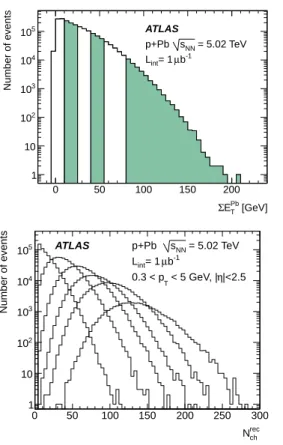
(4) Number of events. 105. ATLAS. 104. p+Pb sNN = 5.02 TeV Lint= 1 µb-1. Pb ΣET range [GeV] > 80 55–80 40–55 25–40 10–25 < 10. 3. 10. 102 10. Pb hΣET i. [GeV] 93.7 64.8 46.7 31.9 16.9 4.9. range in fraction of events [%] 0–1.9 1.9–9.1 9.1–20.0 20.0–39.3 39.3–70.4 70.4–100. rec hNch i (RMS). 134 (31) 102 (26) 80 (23) 60 (20) 37 (17) 16 (11). 1 0. 50. 100. 150. Table 1: Characterization of activity intervals as selected Pb . In the last column, the mean and RMS of the by ΣET number of reconstructed charged particles with |η| < 2.5 and rec , is given for each activity interval. 0.3 < pT < 5 GeV, Nch. 200. Number of events. ΣEPb T [GeV]. 105. ATLAS. p+Pb. sNN = 5.02 TeV. Lint= 1 µb-1 0.3 < pT < 5 GeV, |η|<2.5. 104. 170. response to electrons and hadrons. The distribution Pb of ΣET for events passing all selection criteria is shown in Fig. 1. These events are divided into six Pb ΣET intervals to study the variation of v2 with overall event activity, as indicated in Fig. 1 and shown in Table 1. Event “activity” is characterized Pb : the most active events are those with by ΣET Pb rec the largest ΣET . The distribution of Nch for each activity interval is shown in the lower plot of Fig. 1.. 171. 3. Data analysis. 162. 103. 163 164. 102. 165 166. 10. 167. 1 0. 168. 50. 100. 150. 200. 250. 300 rec. Nch. Pb distribution with the six acFig. 1: Upper plot: the ΣET tivity intervals indicated. Lower plot: the distribution of rec for each activity interval. The leftmost distribution Nch Pb , etc. corresponds to the interval with the lowest ΣET. 169. 172 173 174 142 143 144 145 146 147 148 149 150 151 152 153 154 155 156 157 158 159 160 161. the track fit. The analysis is restricted to charged particles with 0.3 < pT < 5.0 GeV and |η| < 2.5. The tracking efficiency is evaluated using HIJING-generated [35] p+Pb events that are fully simulated in the detector using GEANT4 [36, 37], and processed through the same reconstruction software as the data. The efficiency for charged hadrons is found to depend only weakly on the event multiplicity and on pT for transverse momenta above 0.5 GeV. An efficiency of about 82% is observed at mid-rapidity, |η| < 1, decreasing to about 68% at |η| > 2. For low-pT tracks, between 0.3 GeV and 0.5 GeV, the efficiency ranges from 74% at η = 0 to about 50% for |η| > 2. The number of reconstructed charged particle tracks, not correc rected for tracking efficiency, is denoted by Nch . The analysis is performed in different intervals Pb of ΣET , the sum of transverse energy measured in the FCal with 3.1 < η < 4.9 in the direction of the Pb beam with no correction for the difference in. 175 176 177 178 179 180 181 182 183 184 185 186 187 188 189 190 191 192 193 194. 3. The cumulant method involves the calculation of 2k-particle azimuthal correlations, corrn {2k}, and cumulants, cn {2k}, where k = 1, 2 for the analysis presented in this paper. The two- and four-particle correlations are defined as corrn {2} = hein(φ1 −φ2 ) i and corrn {4} = hein(φ1 +φ2 −φ3 −φ4 ) i, respectively, where the angle brackets denote the average in a single event over all pairs and all combinations of four particles. After averaging over events, the two-particle cumulant is obtained as cn {2} = hcorrn {2}i, and the four-particle cumulant cn {4} = hcorrn {4}i − 2 · hcorrn {2}i2 . Thus the effect of two-particle correlations is explicitly removed in the expression for cn {4}. Further details are given in Refs. [29, 30, 32]. Direct calculation of multi-particle correlations requires multiple passes over the particles in an event, and requires extensive computing time in high-multiplicity events. To mitigate this, it has been proposed in Ref. [32] to express multi-particle correlations in terms of thePmoments of the flow vector Qn , defined as Qn = i einφi , where the index n denotes the flow harmonic and the sum runs.
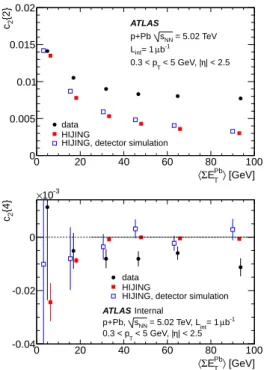
(5) 197 198 199 200 201 202 203 204 205. 206 207 208 209 210 211 212 213 214 215 216 217 218 219 220 221 222 223 224 225 226 227 228 229 230 231 232 233 234 235 236 237 238 239 240. where v2ref {2} (v2ref {4}) denotes the reference estimate of the second-order anisotropy parameter obtained using two-particle, c2 {2} (four-particle, c2 {4}) cumulants. The flow-vector method is easiest to apply when the detector acceptance is azimuthally uniform [32]. A correction for any azimuthal non-uniformity in the reconstruction of charged particle tracks is obtained from the data [25], based on an η–φ map of all reconstructed tracks. For each small (δη = 0.1, δφ = 2π/64) bin (labelled i), a weight is calculated as wi (η, φ) = hN (δη)i/Ni (δη, δφ), where hN (δη)i is the event-averaged number of tracks in the δη slice to which this bin belongs, while Ni (δη, δφ) is the number of tracks in an event within this bin. Using this weight forces the azimuthal angle distribution of reference particles to be uniform in φ, but it does not change the η distribution of reconstructed tracks. weighted P A inφ i Q-vector is evaluated as Qn = [32]. i wi e From Eqs. (2) and (3) it is clear that the cumulant method can be used to estimate v2 only when c2 {4} is negative and c2 {2} positive. In the second step, the harmonic coefficients are determined as functions of pT and η, in bins in each variable (10 bins of equal width are used in η and 22 bins of varied width in pT ). These differential flow harmonics are calculated for “particles of interest” which fall into these small bins. First, the differential cumulants, d2 {2} and d2 {4}, are obtained by correlating every particle of interest with one and three reference particles respectively. The differential second harmonic, v2 {2k}(pT , η), where k = 1, 2, is then calculated with respect to the reference flow as derived in Refs. [29, 30]:. v2 {4}(pT , η) = 241 242 243 244 245 246 247 248 249. (4). (5). 0.02 ATLAS p+Pb sNN = 5.02 TeV Lint= 1 µb-1 0.3 < pT < 5 GeV, |η| < 2.5. 0.015. 0.01. 0.005. data HIJING HIJING, detector simulation. 0 0. 20. 40. 60. 80 100 Pb ⟨ΣET ⟩ [GeV]. ×10-3. 0. data HIJING HIJING, detector simulation. -0.02. -0.04 0. ATLAS Internal p+Pb, sNN = 5.02 TeV, Lint= 1 µb-1 0.3 < pT < 5 GeV, |η| < 2.5. 20. 40. 60. 80 100 ⟨ΣEPb ⟩ [GeV] T. Fig. 2: The two-particle (upper plot) and four-particle (lower plot) cumulants calculated using the reference flow particles Pb for data (circles), the fully simulated as a function of ΣET HIJING events (open squares) and the large generator-level HIJING sample (filled squares). For clarity, the points for the fully simulated (generated) HIJING events are slightly shifted to the left (right). 250 251 252 253 254 255 256 257. d2 {2} , v2 {2}(pT , η) = p c2 {2}. −d {4} p2 . −c2 {4}. 3/4. The differential v2 harmonic is then integrated over wider phase-space bins, with each small bin weighted by the appropriate charged particle multiplicity. This is obtained from the reconstructed multiplicity by applying η- and pT -dependent efficiency factors, determined from Monte Carlo (MC) simulation as discussed in the previous section. Due to the small number of events in the data sample, the final results are integrated over the full acceptance in η. c2{2}. 196. over all particles in an event. This analysis is restricted to the second harmonic coefficient, n = 2. The method based on the flow-vector moments enables the calculation of multi-particle cumulants in a single pass over the full set of particles in each event. The cumulant method involves two main steps [29, 30]. In the first step, the so-called “reference” flow harmonic coefficients are calculated using multi-particle cumulants for particles selected inclusively from a broad range in pT and η as: p (2) v2ref {2} = c2 {2}, p 4 ref v2 {4} = −c2 {4}, (3). c2{4}. 195. 258 259. 4. Fig. 2 shows the two- and four-particle cumulants, averaged over events in each event-activity Pb class defined in Table 1, as a function of ΣET . It is observed that four-particle cumulants are negative only in a certain range of event activity. This restricts subsequent analysis to events with Pb ΣET > 25 GeV, for which the four-particle cumulant in data is found to be less than zero by at least two standard deviations (statistical errors only). It.
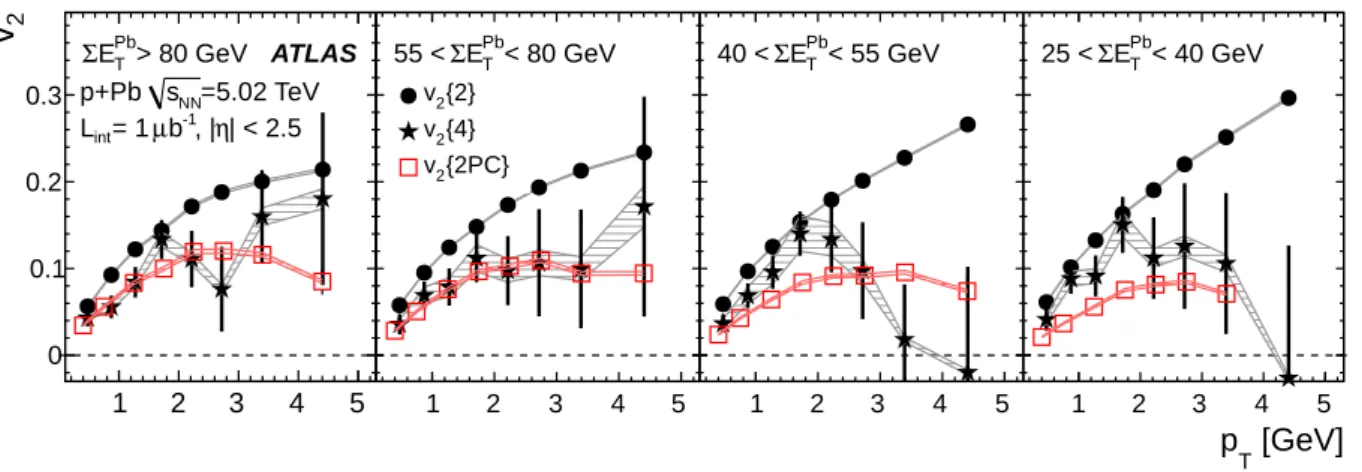
(6) 260 261 262 263 264 265 266 267 268 269 270 271 272 273 274 275 276 277 278 279 280 281 282 283 284 285 286 287 288 289 290 291 292 293 294 295 296 297 298 299 300 301 302 303 304 305 306 307 308 309 310 311. was also checked that for these events c2 {4} is unchanged within errors for any high-multiplicity selection. For example, defining N20 as the value of rec rec Nch such that 20% of events have Nch < N20 (i.e. N20 is the 20th percentile), then selecting rec Nch > N20 leaves c2 {4} unchanged within errors. Pb And for ΣET > 25 GeV this holds for any percentile selection. Fig. 2 also shows the cumulants calculated for 50 million HIJING-generated events, using the true particle information only, as well as for one million fully simulated and reconstructed HIJING events, using the same methods as used for the data. The Pb ΣET obtained from the HIJING sample is rescaled to match that measured in the data. It should be noted that the HIJING Monte Carlo model does not contain any collective flow, and the only correlations are those due to resonance decays, jet production and momentum conservation. The values of c2 {2} for HIJING events are smaller than the values obtained from the data, and there is no significant difference between the HIJING results obtained at the generator (“truth”) level and at the reconstruction level. For c2 {4}, the HIJING events Pb ∼ 20 GeV show a negative value compaat ΣET rable to the values seen in the data, indicating that correlations from jets or momentum conservation contribute significantly to v2 {4} in events of low Pb multiplicity. For ΣET > 25 GeV the generatorlevel HIJING sample’s values for c2 {4} are also negative, but the magnitude is much smaller than in Pb . the data or in HIJING events with smaller ΣET The size of the fully simulated HIJING event sample is too small to draw a definite conclusion about the sign or magnitude of c2 {4}. The systematic uncertainties on v2 {2} and v2 {4} Pb as a function of pT and ΣET have been evaluated by varying several aspects of the analysis procedure. Azimuthal-angle sine terms in the Fourier expansion should be zero, but a non-zero contribution can arise due to detector biases. It was found that the magnitude of the sine terms relative to the cosine terms is negligible (below 1%) for v2 {2} measured as a function of pT , as well as for the pT -integrated v2 {2} and v2 {4}. In the case of the measurement of the pT -dependent v2 {4}, the systematic uncertainty attributed to the residual sine terms varies between 6% and 14% in the different Pb ΣET intervals. Uncertainties related to the tracking are obtained from the differences between the main results and those using tracking requirements modified to be either more or less restrictive. They. 334. are found to be negligible (below 0.2%) for v2 {2}. For the pT -dependent v2 {4} they give a contribution of less than 6% to the systematic uncertainty, and less than 1% for the pT -integrated v2 {4}. In addition to varying the track quality requirements, an uncertainty on the pT dependence of the efficiency corrections is also taken into account, and found to be below 1% for the v2 {2} and v2 {4} measurements. The correction of the azimuthal-angle uniformity is checked by comparing the results to those obtained with all weights, wi , set equal to one. This change leads to small relative differences, below 1%, for the v2 {2} measured as a function of pT , as well as for the pT -integrated v2 {2} and v2 {4}. Up to 4% differences are observed in the pT -dependent v2 {4}. All individual contributions to the systematic uncertainty are added in quadrature and quoted as the total systematic uncertainty. The total systematic uncertainties are below 1% for the v2 {2} measurement. The v2 {4} measurement precision is limited by large statistical errors, whereas the systematic uncertainties stay below 15% for v2 {4}(pT ) and below 2% for the pT -integrated v2 {4}.. 335. 4. Results. 312 313 314 315 316 317 318 319 320 321 322 323 324 325 326 327 328 329 330 331 332 333. 336 337 338 339 340 341 342 343 344 345 346 347 348 349 350 351 352 353 354 355 356 357 358 359 360 361. 5. Fig. 3 shows the transverse momentum dependence of v2 {2} and v2 {4} in four different classes Pb . of the event activity, selected according to ΣET A significant second-order harmonic is observed. v2 {4} is systematically smaller than v2 {2}, consistent with the suppression of non-flow effects in v2 {4}. This difference is most pronounced at high Pb where jet-like pT and in collisions with low ΣET correlations not diluted by the underlying event can contribute significantly. Thus, v2 {4} appears to provide a more reliable estimate of the second-order anisotropy parameter of collective flow. As a function of transverse momentum the second-order harmonic, v2 {4}, increases with pT up to pT ≈ 2 GeV. Large statistical errors preclude a definite conclusion about the pT dependence of v2 {4} at higher transverse momenta. The shape and magnitude of the pT -dependence of v2 {4} is found to be similar to that observed in p+Pb collisions using two-particle correlations [2, 3]. The second-order harmonic, v2 , can be extracted from two-particle azimuthal correlations using charged particle pairs with a large pseudorapidity gap to suppress the short-range correlations on the near-side (∆φ ∼ 0) [3, 22]. However, the twoparticle correlation measured this way may still be.
(7) v2 {2PC}. Pb. 40 < ΣET < 55 GeV. v2. v2. Pb. Pb. ΣET > 80 GeV ATLAS 55 < ΣET < 80 GeV v2 {2} 0.3 p+Pb sNN=5.02 TeV 0.3 Lint = 1 µ b-1, |η| < 2.5 v2 {4}. Pb. 25 < ΣET < 40 GeV. 0.3. 0.3. 0.2. 0.2. 0.2. 0.2. 0.1. 0.1. 0.1. 0.1. 0. 0. 0. 0. 1. 2. 3. 4. 5. 1. 2. 3. 4. 5. 1. 2. 3. 4. 5. 1. 2. 3. 4. 5. p [GeV] T. 362 363 364 365 366 367 368 369 370 371 372 373 374 375 376 377 378 379 380 381 382 383 384 385 386 387 388 389 390 391 392 393 394. affected by the dijet correlations on the away-side (∆φ ∼ π), which can span a large range in ∆η. In Ref. [3], the away-side non-flow correlation is estimated using the yield measured in the lowest Pb ΣET collisions and is then subtracted from the Pb higher ΣET collisions. The result of that study, v2 {2P C}, is shown in Fig. 3 for the four activPb , and compared to ity intervals with largest ΣET v2 {4}. Good agreement is observed between v2 {4} Pb > 55 GeV. and v2 {2P C} for collisions with ΣET Pb For ΣET < 55 GeV, the disagreement could be due either to the subtraction procedure used to obtain v2 {2P C} or to non-flow effects in v2 {4}, or to a combination. The dependence on the collision activity of the second-order harmonic, integrated over 0.3 < pT < 5 GeV, is shown in Fig. 4. The large magnitude of v2 {2} compared to v2 {4} suggests a substantial contamination from non-flow correlations. The value of v2 {4} is approximately 0.06, with little dependence on the overall event activity for Pb ΣET >25 GeV. The extracted values of v2 {4} are also compared to the v2 {2P C} values obtained from two-particle correlations. Good agreement is Pb Pb observed at large ΣET , while at lower ΣET the v2 {2P C} is smaller than v2 {4}, which may be due to different sensitivity of the two methods to nonflow contributions that become more important in Pb low ΣET collisions. Although v2 {4} is constructed to suppress local two-particle correlations, it may still include true multi-particle correlations from jets, which should account for a larger fraction of the correlated particle production in the events with. v2. Fig. 3: The second-order harmonic calculated with the two-particle (circles) and four-particle (stars) cumulants as a function of transverse momentum in four different activity intervals. Bars denote statistical errors; systematic uncertainties are shown as shaded bands. The v2 derived from the Fourier decomposition of two-particle correlations [3] is shown by squares.. 0.1. ATLAS p+Pb, sNN = 5.02 TeV, Lint= 1 µb-1. 0.05. v 2 {2} v 2 {4} v 2 {2PC} v 2 {2} hydro. 0.3 < pT < 5 GeV |η| < 2.5 0 20. 40. 60. 80. 100. 120 Pb. ⟨ΣE ⟩ [GeV] T. Fig. 4: The second-order harmonic, v2 , integrated over pT and η, calculated with two- and four-particle cumulants (cirPb . Systemcles and stars, respectively), as a function of ΣET atic uncertainties are shown as shaded bands. Also shown is v2 {2P C} (squares) and predictions from the hydrodynamic model [18] (triangles) for the same selection of charged particles as in the data.. 395 396 397 398 399 400 401 402 403 404. 6. Pb the lowest ΣET . If the HIJING results, shown in Fig. 2, were used to correct the measured cumulants for this non-flow contribution, the extracted v2 {4} would be decreased by at most 10% for v2 {4} shown in Fig. 4. However, this correction is not applied to the final results. It is notable that the trend of the pT dependence of both v2 {4} and v2 {2P C} in p+Pb collisions resembles that observed for v2 measured with the event-plane method in Pb+Pb collisions.
(8) 405 406 407 408 409 410 411 412 413 414 415 416 417 418 419 420 421 422. √ at sNN = 2.76 TeV [21, 22], although with a magnitude between that observed in the most central and peripheral Pb+Pb collisions. While the trend is found to be nearly independent of the Pb+Pb collision geometry, the magnitude in Pb+Pb events depends on the initial shape of the colliding system, and has been modelled for pT < 2 GeV using viscous hydrodynamics [39–41]. Harmonic flow coefficients in p+Pb collisions at √ sNN = 5.02 TeV have also been predicted using viscous hydrodynamics, with similar initial conditions as the Pb+Pb calculations [18]. The predicted magnitude of the second-order harmonic2 is compared to the measured v2 {4} and v2 {2P C} in Fig. 4. It can be seen that the hydrodynamic predictions agree with our measurements over the Pb ΣET range where the model predictions are available.. 452. for the importance of final-state effects in the highest multiplicity p+Pb reactions. Final-state effects may lead to collective flow similar to that observed in the hot, dense system created in high-energy heavy-ion collisions.. 453. 6. Acknowledgements. 448 449 450 451. 491. We thank CERN for the very successful operation of the LHC, as well as the support staff from our institutions without whom ATLAS could not be operated efficiently. We acknowledge the support of ANPCyT, Argentina; YerPhI, Armenia; ARC, Australia; BMWF and FWF, Austria; ANAS, Azerbaijan; SSTC, Belarus; CNPq and FAPESP, Brazil; NSERC, NRC and CFI, Canada; CERN; CONICYT, Chile; CAS, MOST and NSFC, China; COLCIENCIAS, Colombia; MSMT CR, MPO CR and VSC CR, Czech Republic; DNRF, DNSRC and Lundbeck Foundation, Denmark; EPLANET, ERC and NSRF, European Union; IN2P3-CNRS, CEA-DSM/IRFU, France; GNSF, Georgia; BMBF, DFG, HGF, MPG and AvH Foundation, Germany; GSRT and NSRF, Greece; ISF, MINERVA, GIF, DIP and Benoziyo Center, Israel; INFN, Italy; MEXT and JSPS, Japan; CNRST, Morocco; FOM and NWO, Netherlands; BRF and RCN, Norway; MNiSW, Poland; GRICES and FCT, Portugal; MERYS (MECTS), Romania; MES of Russia and ROSATOM, Russian Federation; JINR; MSTD, Serbia; MSSR, Slovakia; ARRS and MVZT, Slovenia; DST/NRF, South Africa; MICINN, Spain; SRC and Wallenberg Foundation, Sweden; SER, SNSF and Cantons of Bern and Geneva, Switzerland; NSC, Taiwan; TAEK, Turkey; STFC, the Royal Society and Leverhulme Trust, United Kingdom; DOE and NSF, United States of America. The crucial computing support from all WLCG partners is acknowledged gratefully, in particular from CERN and the ATLAS Tier-1 facilities at TRIUMF (Canada), NDGF (Denmark, Norway, Sweden), CC-IN2P3 (France), KIT/GridKA (Germany), INFN-CNAF (Italy), NL-T1 (Netherlands), PIC (Spain), ASGC (Taiwan), RAL (UK) and BNL (USA) and in the Tier-2 facilities worldwide.. 492. References. 454 455 456 457 458 459 460 461 462 463 464. 423. 424 425 426 427 428 429 430 431 432 433 434 435 436 437 438 439 440 441 442 443 444 445 446 447. 5. Conclusions ATLAS has measured the second harmonic coef√ ficient in p+Pb collisions at sNN = 5.02 TeV using two- and four-particle cumulants. A significant magnitude of v2 is observed using both two- and four-particle cumulants, although v2 {2} is consistently larger than v2 {4}, indicating a sizeable contribution of non-flow correlations to v2 {2}. The transverse momentum dependence of v2 {4} shows a behaviour similar to that measured in Pb+Pb √ collisions at sNN = 2.76 TeV. The magnitude of v2 {4} increases with pT up to about 2–3 GeV. As a function of the collision activity, v2 {4} remains constant, at the level of about 0.06, for the colliPb >25 GeV, which corresponds to sions with ΣET about 40% of the data. The measured v2 {4} is found to be consistent with the second harmonic coefficient extracted by the Fourier decomposition of the long-range two-particle correlation function for Pb collisions with ΣET > 55 GeV. Good agreement is also found with the predictions of a hydrodynamic calculation for p+Pb collisions. Extending previous results based only on twoparticle correlations, the multi-particle cumulant results presented here provide additional evidence. 465 466 467 468 469 470 471 472 473 474 475 476 477 478 479 480 481 482 483 484 485 486 487 488 489 490. 2 We. are grateful to the authors of Ref. [18] for providing us with the model predictions for charged particles with η and pT ranges matching those used in the analysis. The model predictions are for two activity intervals corresponding to fractions of events of 0 − 3.4 % and 3.4 − 7.8 % which Pb intervals using Fig. 1. are then translated into the ΣET. 493 494. 7. [1] CMS Collaboration, Phys. Lett. B 718 (2013) 795 [arXiv:1210.5482]..
(9) 495 496 497 498 499 500 501 502 503 504 505 506 507 508 509 510 511 512 513 514 515 516 517 518 519 520 521 522 523 524 525 526 527 528 529 530 531 532 533 534 535 536 537 538 539 540 541 542 543 544 545 546 547 548 549 550 551 552 553 554 555 556 557 558 559. [2] ALICE Collaboration, Phys. Lett. B 719 (2013) 29 [arXiv:1212.2001]. [3] ATLAS Collaboration, submitted to Phys. Rev. Lett., [arXiv:1212.5198]. [4] K. Dusling and R. Venugopalan, [arXiv:1210.3890]. [5] K. Dusling and R. Venugopalan, [arXiv:1211.3701, 1302.7018]. [6] B.A. Arbuzov, E.E. Boos, V.I. Savrin, Eur. Phys. J. C 71 (2011) 1730 [arXiv:1104.1283]. [7] Y.V. Kovchegov and D.E. Wertepny, [arXiv:1212.1195]. [8] Ch.Y. Wong, Phys. Rev. C 84 (2011) 024901 [arXiv:1105.5871]. [9] M. Strikman, Acta Phys. Pol. B 42 (2011) 2607. [10] S. Alderweireldt and P. Van Mechelen, [arXiv:1203.2048]. [11] M.G. Ryskin, A.D. Martin and V.A. Khoze, J. Phys. G 38 (2011) 085006 [arXiv:1105.4987]. [12] M. Diehl and A. Schafer, Phys. Lett. B 698 (2011) 389 [arXiv:1102.3081]. [13] E. Avsar, Ch. Flensburg, Y. Hatta, J.-Y. Ollitrault, T. Ueda, Phys. Lett. B 702 (2011) 394 [arXiv:1009.5643]. [14] K. Werner, Iu. Karpenko, T. Pierog, Phys. Rev. Lett. 106 (2011) 122004 [arXiv:1011.0375]. [15] T.-W. Deng, Z. Xu, C. Greiner, Phys. Lett. B 711 (2012) 301 [arXiv:1112.0470]. [16] E. Avsar, Ch. Flensburg, Y. Hatta, J.-Y. Ollitrault, T. Ueda, J. Phys. G 38 (2011) 124053 [arXiv:1106.4356]. [17] P. Bożek, Phys. Rev. C 85 (2012) 014911 [arXiv:1112.0915]. [18] P. Bożek and W. Broniowski, Phys. Lett. B 718 (2013) 1557 [arXiv:1211.0845]. [19] ALICE Collaboration, Phys. Rev. Lett. 105 (2010) 252302 [arXiv:1011.3914]. [20] ALICE Collaboration, Phys. Rev. Lett. 107 (2011) 032301 [arXiv:1105.3865]. [21] ATLAS Collaboration, Phys. Lett. B 707 (2012) 330 [arXiv:1108.6018]. [22] ATLAS Collaboration, Phys. Rev. C 86 (2012) 014907 [arXiv:1203.3087]. [23] CMS Collaboration, Phys. Rev. C 87 (2012) 014902 [arXiv:1204.1409]. [24] CMS Collaboration, Phys. Rev. Lett. 109 (2012) 022301 [arXiv:1204.1850]. [25] S. A. Voloshin, A. M. Poskanzer, R. Snellings, [arXiv:0809.2949]. [26] P. Sorensen, [arXiv:0905.0174]. [27] A.M. Poskanzer, S. A. Voloshin, Phys. Rev. C 58 (1998) 1671 [arXiv:nucl-ex/9805001]. [28] B. Alver and G. Roland, Phys. Rev. C 81 (2010) 054905 [arXiv:1003.0194]. [29] N. Borghini, P. M. Dinh, J. -Y. Ollitrault, Phys. Rev. C 63 (2001) 054906 [arXiv:nucl-th/0007063]. [30] N. Borghini, P. M. Dinh, J. -Y. Ollitrault, Phys. Rev. C 64 (2001) 054901 [arXiv:nucl-th/0105040]. [31] R. Kubo, J. Phys. Soc. Japan, Vol. 17, No. 7, (1962). [32] A. Bilandzic, R. Snellings, S. Voloshin, Phys. Rev. C 83 2011) 044913 [arXiv:1010.0233]. [33] ATLAS Collaboration, JINST 3 (2008) S08003. [34] ATLAS Collaboration, New J. Phys. 13 (2010) 053033. [35] X.-N. Wang and M. Gyulassy, Phys. Rev. D 44 (1991) 3501. [36] S. Agostinelli et al., Nucl. Instrum. Meth. A 506 (2003) 250 [arXiv:1012.5104]. [37] ATLAS Collaboration, Eur. Phys. J. C 70 (2010) 823 [arXiv:1005.4568].. 560 561 562 563 564 565 566 567 568. 8. [38] ATLAS Collaboration, ATLAS-CONF-2012-118, http://cdsweb.cern.ch/record/1472940. [39] M. Luzum, Phys. Rev. C 83 (2011) 044911 [arXiv:1011.5173]. [40] C. Gale, S. Jeon, B. Schenke, P. Tribedy and R. Venugopalan, Phys. Rev. Lett. 110 (2013) 012302 [arXiv:1209.6330]. [41] C. Shen, U.W. Heinz, P. Huovinen and H. Song, Phys. Rev. C 84 (2011) 044903 [arXiv:1105.3226]..
(10) 569. 570 571 572 573 574 575 576 577 578 579 580 581 582 583 584 585 586 587 588 589 590 591 592 593 594 595 596 597 598 599 600 601 602 603 604 605 606 607 608 609 610 611 612 613 614 615 616 617 618 619. The ATLAS Collaboration G. Aad48 , T. Abajyan21 , B. Abbott111 , J. Abdallah12 , S. Abdel Khalek115 , A.A. Abdelalim49 , O. Abdinov11 , R. Aben105 , B. Abi112 , M. Abolins88 , O.S. AbouZeid158 , H. Abramowicz153 , H. Abreu136 , Y. Abulaiti146a,146b , B.S. Acharya164a,164b,a , L. Adamczyk38a , D.L. Adams25 , T.N. Addy56 , J. Adelman176 , S. Adomeit98 , T. Adye129 , S. Aefsky23 , J.A. Aguilar-Saavedra124b,b , M. Agustoni17 , S.P. Ahlen22 , F. Ahles48 , A. Ahmad148 , M. Ahsan41 , G. Aielli133a,133b , T.P.A. Åkesson79 , G. Akimoto155 , A.V. Akimov94 , M.A. Alam76 , J. Albert169 , S. Albrand55 , M. Aleksa30 , I.N. Aleksandrov64 , F. Alessandria89a , C. Alexa26a , G. Alexander153 , G. Alexandre49 , T. Alexopoulos10 , M. Alhroob164a,164c , M. Aliev16 , G. Alimonti89a , J. Alison31 , B.M.M. Allbrooke18 , L.J. Allison71 , P.P. Allport73 , S.E. Allwood-Spiers53 , J. Almond82 , A. Aloisio102a,102b , R. Alon172 , A. Alonso36 , F. Alonso70 , A. Altheimer35 , B. Alvarez Gonzalez88 , M.G. Alviggi102a,102b , K. Amako65 , Y. Amaral Coutinho24a , C. Amelung23 , V.V. Ammosov128,∗ , S.P. Amor Dos Santos124a , A. Amorim124a,c , S. Amoroso48 , N. Amram153 , C. Anastopoulos30 , L.S. Ancu17 , N. Andari30 , T. Andeen35 , C.F. Anders58b , G. Anders58a , K.J. Anderson31 , A. Andreazza89a,89b , V. Andrei58a , X.S. Anduaga70 , S. Angelidakis9 , P. Anger44 , A. Angerami35 , F. Anghinolfi30 , A. Anisenkov107 , N. Anjos124a , A. Annovi47 , A. Antonaki9 , M. Antonelli47 , A. Antonov96 , J. Antos144b , F. Anulli132a , M. Aoki101 , L. Aperio Bella18 , R. Apolle118,d , G. Arabidze88 , I. Aracena143 , Y. Arai65 , A.T.H. Arce45 , S. Arfaoui148 , J-F. Arguin93 , S. Argyropoulos42 , E. Arik19a,∗ , M. Arik19a , A.J. Armbruster87 , O. Arnaez81 , V. Arnal80 , A. Artamonov95 , G. Artoni132a,132b , D. Arutinov21 , S. Asai155 , N. Asbah93 , S. Ask28 , B. Åsman146a,146b , L. Asquith6 , K. Assamagan25 , R. Astalos144a , A. Astbury169 , M. Atkinson165 , B. Auerbach6 , E. Auge115 , K. Augsten126 , M. Aurousseau145a , G. Avolio30 , D. Axen168 , G. Azuelos93,e , Y. Azuma155 , M.A. Baak30 , G. Baccaglioni89a , C. Bacci134a,134b , A.M. Bach15 , H. Bachacou136 , K. Bachas154 , M. Backes49 , M. Backhaus21 , J. Backus Mayes143 , E. Badescu26a , P. Bagiacchi132a,132b , P. Bagnaia132a,132b , Y. Bai33a , D.C. Bailey158 , T. Bain35 , J.T. Baines129 , O.K. Baker176 , S. Baker77 , P. Balek127 , F. Balli136 , E. Banas39 , P. Banerjee93 , Sw. Banerjee173 , D. Banfi30 , A. Bangert150 , V. Bansal169 , H.S. Bansil18 , L. Barak172 , S.P. Baranov94 , T. Barber48 , E.L. Barberio86 , D. Barberis50a,50b , M. Barbero83 , D.Y. Bardin64 , T. Barillari99 , M. Barisonzi175 , T. Barklow143 , N. Barlow28 , B.M. Barnett129 , R.M. Barnett15 , A. Baroncelli134a , G. Barone49 , A.J. Barr118 , F. Barreiro80 , J. Barreiro Guimarães da Costa57 , R. Bartoldus143 , A.E. Barton71 , V. Bartsch149 , A. Basye165 , R.L. Bates53 , L. Batkova144a , J.R. Batley28 , A. Battaglia17 , M. Battistin30 , F. Bauer136 , H.S. Bawa143,f , S. Beale98 , T. Beau78 , P.H. Beauchemin161 , R. Beccherle50a , P. Bechtle21 , H.P. Beck17 , K. Becker175 , S. Becker98 , M. Beckingham138 , K.H. Becks175 , A.J. Beddall19c , A. Beddall19c , S. Bedikian176 , V.A. Bednyakov64 , C.P. Bee83 , L.J. Beemster105 , T.A. Beermann175 , M. Begel25 , C. Belanger-Champagne85 , P.J. Bell49 , W.H. Bell49 , G. Bella153 , L. Bellagamba20a , A. Bellerive29 , M. Bellomo30 , A. Belloni57 , O. Beloborodova107,g , K. Belotskiy96 , O. Beltramello30 , O. Benary153 , D. Benchekroun135a , K. Bendtz146a,146b , N. Benekos165 , Y. Benhammou153 , E. Benhar Noccioli49 , J.A. Benitez Garcia159b , D.P. Benjamin45 , J.R. Bensinger23 , K. Benslama130 , S. Bentvelsen105 , D. Berge30 , E. Bergeaas Kuutmann16 , N. Berger5 , F. Berghaus169 , E. Berglund105 , J. Beringer15 , P. Bernat77 , R. Bernhard48 , C. Bernius25 , F.U. Bernlochner169 , T. Berry76 , C. Bertella83 , F. Bertolucci122a,122b , M.I. Besana89a,89b , G.J. Besjes104 , N. Besson136 , S. Bethke99 , W. Bhimji46 , R.M. Bianchi30 , L. Bianchini23 , M. Bianco72a,72b , O. Biebel98 , S.P. Bieniek77 , K. Bierwagen54 , J. Biesiada15 , M. Biglietti134a , H. Bilokon47 , M. Bindi20a,20b , S. Binet115 , A. Bingul19c , C. Bini132a,132b , C. Biscarat178 , B. Bittner99 , C.W. Black150 , J.E. Black143 , K.M. Black22 , R.E. Blair6 , J.-B. Blanchard136 , T. Blazek144a , I. Bloch42 , C. Blocker23 , J. Blocki39 , W. Blum81 , U. Blumenschein54 , G.J. Bobbink105 , V.S. Bobrovnikov107 , S.S. Bocchetta79 , A. Bocci45 , C.R. Boddy118 , M. Boehler48 , J. Boek175 , T.T. Boek175 , N. Boelaert36 , J.A. Bogaerts30 , A. Bogdanchikov107 , A. Bogouch90,∗ , C. Bohm146a , J. Bohm125 , V. Boisvert76 , T. Bold38a , V. Boldea26a , N.M. Bolnet136 , M. Bomben78 , M. Bona75 , M. Boonekamp136 , S. Bordoni78 , C. Borer17 , A. Borisov128 , G. Borissov71 , I. Borjanovic13a , M. Borri82 , S. Borroni42 , J. Bortfeldt98 , V. Bortolotto134a,134b , K. Bos105 , D. Boscherini20a , M. Bosman12 , H. Boterenbrood105 , J. Bouchami93 , J. Boudreau123 , E.V. Bouhova-Thacker71 , D. Boumediene34 , C. Bourdarios115 , N. Bousson83 , S. Boutouil135d , A. Boveia31 , J. Boyd30 , I.R. Boyko64 , I. Bozovic-Jelisavcic13b , J. Bracinik18 , P. Branchini134a , A. Brandt8 , G. Brandt118 , O. Brandt54 , 9.
(11) 620 621 622 623 624 625 626 627 628 629 630 631 632 633 634 635 636 637 638 639 640 641 642 643 644 645 646 647 648 649 650 651 652 653 654 655 656 657 658 659 660 661 662 663 664 665 666 667 668 669 670 671. U. Bratzler156 , B. Brau84 , J.E. Brau114 , H.M. Braun175,∗ , S.F. Brazzale164a,164c , B. Brelier158 , J. Bremer30 , K. Brendlinger120 , R. Brenner166 , S. Bressler172 , T.M. Bristow145b , D. Britton53 , F.M. Brochu28 , I. Brock21 , R. Brock88 , F. Broggi89a , C. Bromberg88 , J. Bronner99 , G. Brooijmans35 , T. Brooks76 , W.K. Brooks32b , G. Brown82 , P.A. Bruckman de Renstrom39 , D. Bruncko144b , R. Bruneliere48 , S. Brunet60 , A. Bruni20a , G. Bruni20a , M. Bruschi20a , L. Bryngemark79 , T. Buanes14 , Q. Buat55 , F. Bucci49 , J. Buchanan118 , P. Buchholz141 , R.M. Buckingham118 , A.G. Buckley46 , S.I. Buda26a , I.A. Budagov64 , B. Budick108 , L. Bugge117 , O. Bulekov96 , A.C. Bundock73 , M. Bunse43 , T. Buran117,∗ , H. Burckhart30 , S. Burdin73 , T. Burgess14 , S. Burke129 , E. Busato34 , V. Büscher81 , P. Bussey53 , C.P. Buszello166 , B. Butler57 , J.M. Butler22 , C.M. Buttar53 , J.M. Butterworth77 , W. Buttinger28 , M. Byszewski10 , S. Cabrera Urbán167 , D. Caforio20a,20b , O. Cakir4a , P. Calafiura15 , G. Calderini78 , P. Calfayan98 , R. Calkins106 , L.P. Caloba24a , R. Caloi132a,132b , D. Calvet34 , S. Calvet34 , R. Camacho Toro49 , P. Camarri133a,133b , D. Cameron117 , L.M. Caminada15 , R. Caminal Armadans12 , S. Campana30 , M. Campanelli77 , V. Canale102a,102b , F. Canelli31 , A. Canepa159a , J. Cantero80 , R. Cantrill76 , T. Cao40 , M.D.M. Capeans Garrido30 , I. Caprini26a , M. Caprini26a , D. Capriotti99 , M. Capua37a,37b , R. Caputo81 , R. Cardarelli133a , T. Carli30 , G. Carlino102a , L. Carminati89a,89b , S. Caron104 , E. Carquin32b , G.D. Carrillo-Montoya145b , A.A. Carter75 , J.R. Carter28 , J. Carvalho124a,h , D. Casadei108 , M.P. Casado12 , M. Cascella122a,122b , C. Caso50a,50b,∗ , E. Castaneda-Miranda173 , A. Castelli105 , V. Castillo Gimenez167 , N.F. Castro124a , G. Cataldi72a , P. Catastini57 , A. Catinaccio30 , J.R. Catmore30 , A. Cattai30 , G. Cattani133a,133b , S. Caughron88 , V. Cavaliere165 , P. Cavalleri78 , D. Cavalli89a , M. Cavalli-Sforza12 , V. Cavasinni122a,122b , F. Ceradini134a,134b , B. Cerio45 , A.S. Cerqueira24b , A. Cerri15 , L. Cerrito75 , F. Cerutti15 , A. Cervelli17 , S.A. Cetin19b , A. Chafaq135a , D. Chakraborty106 , I. Chalupkova127 , K. Chan3 , P. Chang165 , B. Chapleau85 , J.D. Chapman28 , J.W. Chapman87 , D.G. Charlton18 , V. Chavda82 , C.A. Chavez Barajas30 , S. Cheatham85 , S. Chekanov6 , S.V. Chekulaev159a , G.A. Chelkov64 , M.A. Chelstowska104 , C. Chen63 , H. Chen25 , S. Chen33c , X. Chen173 , Y. Chen35 , Y. Cheng31 , A. Cheplakov64 , R. Cherkaoui El Moursli135e , V. Chernyatin25 , E. Cheu7 , S.L. Cheung158 , L. Chevalier136 , V. Chiarella47 , G. Chiefari102a,102b , J.T. Childers30 , A. Chilingarov71 , G. Chiodini72a , A.S. Chisholm18 , R.T. Chislett77 , A. Chitan26a , M.V. Chizhov64 , G. Choudalakis31 , S. Chouridou9 , B.K.B. Chow98 , I.A. Christidi77 , A. Christov48 , D. Chromek-Burckhart30 , M.L. Chu151 , J. Chudoba125 , G. Ciapetti132a,132b , A.K. Ciftci4a , R. Ciftci4a , D. Cinca62 , V. Cindro74 , A. Ciocio15 , M. Cirilli87 , P. Cirkovic13b , Z.H. Citron172 , M. Citterio89a , M. Ciubancan26a , A. Clark49 , P.J. Clark46 , R.N. Clarke15 , J.C. Clemens83 , B. Clement55 , C. Clement146a,146b , Y. Coadou83 , M. Cobal164a,164c , A. Coccaro138 , J. Cochran63 , L. Coffey23 , J.G. Cogan143 , J. Coggeshall165 , J. Colas5 , S. Cole106 , A.P. Colijn105 , N.J. Collins18 , C. Collins-Tooth53 , J. Collot55 , T. Colombo119a,119b , G. Colon84 , G. Compostella99 , P. Conde Muiño124a , E. Coniavitis166 , M.C. Conidi12 , S.M. Consonni89a,89b , V. Consorti48 , S. Constantinescu26a , C. Conta119a,119b , G. Conti57 , F. Conventi102a,i , M. Cooke15 , B.D. Cooper77 , A.M. Cooper-Sarkar118 , N.J. Cooper-Smith76 , K. Copic15 , T. Cornelissen175 , M. Corradi20a , F. Corriveau85,j , A. Corso-Radu163 , A. Cortes-Gonzalez165 , G. Cortiana99 , G. Costa89a , M.J. Costa167 , D. Costanzo139 , D. Côté30 , G. Cottin32a , L. Courneyea169 , G. Cowan76 , B.E. Cox82 , K. Cranmer108 , S. Crépé-Renaudin55 , F. Crescioli78 , M. Cristinziani21 , G. Crosetti37a,37b , C.-M. Cuciuc26a , C. Cuenca Almenar176 , T. Cuhadar Donszelmann139 , J. Cummings176 , M. Curatolo47 , C.J. Curtis18 , C. Cuthbert150 , H. Czirr141 , P. Czodrowski44 , Z. Czyczula176 , S. D’Auria53 , M. D’Onofrio73 , A. D’Orazio132a,132b , M.J. Da Cunha Sargedas De Sousa124a , C. Da Via82 , W. Dabrowski38a , A. Dafinca118 , T. Dai87 , F. Dallaire93 , C. Dallapiccola84 , M. Dam36 , D.S. Damiani137 , A.C. Daniells18 , H.O. Danielsson30 , V. Dao104 , G. Darbo50a , G.L. Darlea26b , S, Darmora8 , J.A. Dassoulas42 , W. Davey21 , T. Davidek127 , N. Davidson86 , E. Davies118,d , M. Davies93 , O. Davignon78 , A.R. Davison77 , Y. Davygora58a , E. Dawe142 , I. Dawson139 , R.K. Daya-Ishmukhametova23 , K. De8 , R. de Asmundis102a , S. De Castro20a,20b , S. De Cecco78 , J. de Graat98 , N. De Groot104 , P. de Jong105 , C. De La Taille115 , H. De la Torre80 , F. De Lorenzi63 , L. De Nooij105 , D. De Pedis132a , A. De Salvo132a , U. De Sanctis164a,164c , A. De Santo149 , J.B. De Vivie De Regie115 , G. De Zorzi132a,132b , W.J. Dearnaley71 , R. Debbe25 , C. Debenedetti46 , B. Dechenaux55 , D.V. Dedovich64 , J. Degenhardt120 , J. Del Peso80 , T. Del Prete122a,122b , T. Delemontex55 , M. Deliyergiyev74 , A. Dell’Acqua30 , L. Dell’Asta22 , M. Della Pietra102a,i , D. della Volpe102a,102b , M. Delmastro5 , P.A. Delsart55 , C. Deluca105 , S. Demers176 , 10.
(12) 672 673 674 675 676 677 678 679 680 681 682 683 684 685 686 687 688 689 690 691 692 693 694 695 696 697 698 699 700 701 702 703 704 705 706 707 708 709 710 711 712 713 714 715 716 717 718 719 720 721 722 723. M. Demichev64 , A. Demilly78 , B. Demirkoz12,k , S.P. Denisov128 , D. Derendarz39 , J.E. Derkaoui135d , F. Derue78 , P. Dervan73 , K. Desch21 , P.O. Deviveiros105 , A. Dewhurst129 , B. DeWilde148 , S. Dhaliwal105 , R. Dhullipudi25,l , A. Di Ciaccio133a,133b , L. Di Ciaccio5 , C. Di Donato102a,102b , A. Di Girolamo30 , B. Di Girolamo30 , S. Di Luise134a,134b , A. Di Mattia152 , B. Di Micco134a,134b , R. Di Nardo47 , A. Di Simone133a,133b , R. Di Sipio20a,20b , M.A. Diaz32a , E.B. Diehl87 , J. Dietrich42 , T.A. Dietzsch58a , S. Diglio86 , K. Dindar Yagci40 , J. Dingfelder21 , F. Dinut26a , C. Dionisi132a,132b , P. Dita26a , S. Dita26a , F. Dittus30 , F. Djama83 , T. Djobava51b , M.A.B. do Vale24c , A. Do Valle Wemans124a,m , T.K.O. Doan5 , D. Dobos30 , E. Dobson77 , J. Dodd35 , C. Doglioni49 , T. Doherty53 , T. Dohmae155 , Y. Doi65,∗ , J. Dolejsi127 , Z. Dolezal127 , B.A. Dolgoshein96,∗ , M. Donadelli24d , J. Donini34 , J. Dopke30 , A. Doria102a , A. Dos Anjos173 , A. Dotti122a,122b , M.T. Dova70 , A.T. Doyle53 , M. Dris10 , J. Dubbert87 , S. Dube15 , E. Dubreuil34 , E. Duchovni172 , G. Duckeck98 , D. Duda175 , A. Dudarev30 , F. Dudziak63 , L. Duflot115 , M-A. Dufour85 , L. Duguid76 , M. Dührssen30 , M. Dunford58a , H. Duran Yildiz4a , M. Düren52 , R. Duxfield139 , M. Dwuznik38a , W.L. Ebenstein45 , J. Ebke98 , S. Eckweiler81 , W. Edson2 , C.A. Edwards76 , N.C. Edwards53 , W. Ehrenfeld21 , T. Eifert143 , G. Eigen14 , K. Einsweiler15 , E. Eisenhandler75 , T. Ekelof166 , M. El Kacimi135c , M. Ellert166 , S. Elles5 , F. Ellinghaus81 , K. Ellis75 , N. Ellis30 , J. Elmsheuser98 , M. Elsing30 , D. Emeliyanov129 , Y. Enari155 , O.C. Endner81 , R. Engelmann148 , A. Engl98 , B. Epp61 , J. Erdmann176 , A. Ereditato17 , D. Eriksson146a , J. Ernst2 , M. Ernst25 , J. Ernwein136 , D. Errede165 , S. Errede165 , E. Ertel81 , M. Escalier115 , H. Esch43 , C. Escobar123 , X. Espinal Curull12 , B. Esposito47 , F. Etienne83 , A.I. Etienvre136 , E. Etzion153 , D. Evangelakou54 , H. Evans60 , L. Fabbri20a,20b , C. Fabre30 , G. Facini30 , R.M. Fakhrutdinov128 , S. Falciano132a , Y. Fang33a , M. Fanti89a,89b , A. Farbin8 , A. Farilla134a , T. Farooque158 , S. Farrell163 , S.M. Farrington170 , P. Farthouat30 , F. Fassi167 , P. Fassnacht30 , D. Fassouliotis9 , B. Fatholahzadeh158 , A. Favareto89a,89b , L. Fayard115 , P. Federic144a , O.L. Fedin121 , W. Fedorko168 , M. Fehling-Kaschek48 , L. Feligioni83 , C. Feng33d , E.J. Feng6 , H. Feng87 , A.B. Fenyuk128 , J. Ferencei144b , W. Fernando6 , S. Ferrag53 , J. Ferrando53 , V. Ferrara42 , A. Ferrari166 , P. Ferrari105 , R. Ferrari119a , D.E. Ferreira de Lima53 , A. Ferrer167 , D. Ferrere49 , C. Ferretti87 , A. Ferretto Parodi50a,50b , M. Fiascaris31 , F. Fiedler81 , A. Filipčič74 , F. Filthaut104 , M. Fincke-Keeler169 , K.D. Finelli45 , M.C.N. Fiolhais124a,h , L. Fiorini167 , A. Firan40 , J. Fischer175 , M.J. Fisher109 , E.A. Fitzgerald23 , M. Flechl48 , I. Fleck141 , P. Fleischmann174 , S. Fleischmann175 , G.T. Fletcher139 , G. Fletcher75 , T. Flick175 , A. Floderus79 , L.R. Flores Castillo173 , A.C. Florez Bustos159b , M.J. Flowerdew99 , T. Fonseca Martin17 , A. Formica136 , A. Forti82 , D. Fortin159a , D. Fournier115 , A.J. Fowler45 , H. Fox71 , P. Francavilla12 , M. Franchini20a,20b , S. Franchino30 , D. Francis30 , M. Franklin57 , S. Franz30 , M. Fraternali119a,119b , S. Fratina120 , S.T. French28 , C. Friedrich42 , F. Friedrich44 , D. Froidevaux30 , J.A. Frost28 , C. Fukunaga156 , E. Fullana Torregrosa127 , B.G. Fulsom143 , J. Fuster167 , C. Gabaldon30 , O. Gabizon172 , A. Gabrielli132a,132b , S. Gadatsch105 , T. Gadfort25 , S. Gadomski49 , G. Gagliardi50a,50b , P. Gagnon60 , C. Galea98 , B. Galhardo124a , E.J. Gallas118 , V. Gallo17 , B.J. Gallop129 , P. Gallus126 , K.K. Gan109 , R.P. Gandrajula62 , Y.S. Gao143,f , A. Gaponenko15 , F.M. Garay Walls46 , F. Garberson176 , C. Garcı́a167 , J.E. Garcı́a Navarro167 , M. Garcia-Sciveres15 , R.W. Gardner31 , N. Garelli143 , V. Garonne30 , C. Gatti47 , G. Gaudio119a , B. Gaur141 , L. Gauthier93 , P. Gauzzi132a,132b , I.L. Gavrilenko94 , C. Gay168 , G. Gaycken21 , E.N. Gazis10 , P. Ge33d,n , Z. Gecse168 , C.N.P. Gee129 , D.A.A. Geerts105 , Ch. Geich-Gimbel21 , K. Gellerstedt146a,146b , C. Gemme50a , A. Gemmell53 , M.H. Genest55 , S. Gentile132a,132b , M. George54 , S. George76 , D. Gerbaudo163 , P. Gerlach175 , A. Gershon153 , C. Geweniger58a , H. Ghazlane135b , N. Ghodbane34 , B. Giacobbe20a , S. Giagu132a,132b , V. Giangiobbe12 , F. Gianotti30 , B. Gibbard25 , A. Gibson158 , S.M. Gibson30 , M. Gilchriese15 , T.P.S. Gillam28 , D. Gillberg30 , A.R. Gillman129 , D.M. Gingrich3,e , N. Giokaris9 , M.P. Giordani164c , R. Giordano102a,102b , F.M. Giorgi16 , P. Giovannini99 , P.F. Giraud136 , D. Giugni89a , C. Giuliani48 , M. Giunta93 , B.K. Gjelsten117 , I. Gkialas154,o , L.K. Gladilin97 , C. Glasman80 , J. Glatzer21 , A. Glazov42 , G.L. Glonti64 , J.R. Goddard75 , J. Godfrey142 , J. Godlewski30 , M. Goebel42 , C. Goeringer81 , S. Goldfarb87 , T. Golling176 , D. Golubkov128 , A. Gomes124a,c , L.S. Gomez Fajardo42 , R. Gonçalo76 , J. Goncalves Pinto Firmino Da Costa42 , L. Gonella21 , S. González de la Hoz167 , G. Gonzalez Parra12 , M.L. Gonzalez Silva27 , S. Gonzalez-Sevilla49 , J.J. Goodson148 , L. Goossens30 , P.A. Gorbounov95 , H.A. Gordon25 , I. Gorelov103 , G. Gorfine175 , B. Gorini30 , E. Gorini72a,72b , A. Gorišek74 , E. Gornicki39 , A.T. Goshaw6 , C. Gössling43 , M.I. Gostkin64 , I. Gough Eschrich163 , M. Gouighri135a , D. Goujdami135c , M.P. Goulette49 , A.G. Goussiou138 , C. Goy5 , 11.
(13) 724 725 726 727 728 729 730 731 732 733 734 735 736 737 738 739 740 741 742 743 744 745 746 747 748 749 750 751 752 753 754 755 756 757 758 759 760 761 762 763 764 765 766 767 768 769 770 771 772 773 774 775. S. Gozpinar23 , L. Graber54 , I. Grabowska-Bold38a , P. Grafström20a,20b , K-J. Grahn42 , E. Gramstad117 , F. Grancagnolo72a , S. Grancagnolo16 , V. Grassi148 , V. Gratchev121 , H.M. Gray30 , J.A. Gray148 , E. Graziani134a , O.G. Grebenyuk121 , T. Greenshaw73 , Z.D. Greenwood25,l , K. Gregersen36 , I.M. Gregor42 , P. Grenier143 , J. Griffiths8 , N. Grigalashvili64 , A.A. Grillo137 , K. Grimm71 , S. Grinstein12 , Ph. Gris34 , Y.V. Grishkevich97 , J.-F. Grivaz115 , J.P. Grohs44 , A. Grohsjean42 , E. Gross172 , J. Grosse-Knetter54 , J. Groth-Jensen172 , K. Grybel141 , D. Guest176 , O. Gueta153 , C. Guicheney34 , E. Guido50a,50b , T. Guillemin115 , S. Guindon2 , U. Gul53 , J. Gunther126 , B. Guo158 , J. Guo35 , P. Gutierrez111 , N. Guttman153 , O. Gutzwiller173 , C. Guyot136 , C. Gwenlan118 , C.B. Gwilliam73 , A. Haas108 , S. Haas30 , C. Haber15 , H.K. Hadavand8 , P. Haefner21 , Z. Hajduk39 , H. Hakobyan177 , D. Hall118 , G. Halladjian62 , K. Hamacher175 , P. Hamal113 , K. Hamano86 , M. Hamer54 , A. Hamilton145b,p , S. Hamilton161 , L. Han33b , K. Hanagaki116 , K. Hanawa160 , M. Hance15 , C. Handel81 , P. Hanke58a , J.R. Hansen36 , J.B. Hansen36 , J.D. Hansen36 , P.H. Hansen36 , P. Hansson143 , K. Hara160 , A.S. Hard173 , T. Harenberg175 , S. Harkusha90 , D. Harper87 , R.D. Harrington46 , O.M. Harris138 , J. Hartert48 , F. Hartjes105 , T. Haruyama65 , A. Harvey56 , S. Hasegawa101 , Y. Hasegawa140 , S. Hassani136 , S. Haug17 , M. Hauschild30 , R. Hauser88 , M. Havranek21 , C.M. Hawkes18 , R.J. Hawkings30 , A.D. Hawkins79 , T. Hayakawa66 , T. Hayashi160 , D. Hayden76 , C.P. Hays118 , H.S. Hayward73 , S.J. Haywood129 , S.J. Head18 , T. Heck81 , V. Hedberg79 , L. Heelan8 , S. Heim120 , B. Heinemann15 , S. Heisterkamp36 , L. Helary22 , C. Heller98 , M. Heller30 , S. Hellman146a,146b , D. Hellmich21 , C. Helsens12 , J. Henderson118 , R.C.W. Henderson71 , M. Henke58a , A. Henrichs176 , A.M. Henriques Correia30 , S. Henrot-Versille115 , C. Hensel54 , G.H. Herbert16 , C.M. Hernandez8 , Y. Hernández Jiménez167 , R. Herrberg16 , G. Herten48 , R. Hertenberger98 , L. Hervas30 , G.G. Hesketh77 , N.P. Hessey105 , R. Hickling75 , E. Higón-Rodriguez167 , J.C. Hill28 , K.H. Hiller42 , S. Hillert21 , S.J. Hillier18 , I. Hinchliffe15 , E. Hines120 , M. Hirose116 , D. Hirschbuehl175 , J. Hobbs148 , N. Hod105 , M.C. Hodgkinson139 , P. Hodgson139 , A. Hoecker30 , M.R. Hoeferkamp103 , J. Hoffman40 , D. Hoffmann83 , J.I. Hofmann58a , M. Hohlfeld81 , S.O. Holmgren146a , J.L. Holzbauer88 , T.M. Hong120 , L. Hooft van Huysduynen108 , J-Y. Hostachy55 , S. Hou151 , A. Hoummada135a , J. Howard118 , J. Howarth82 , M. Hrabovsky113 , I. Hristova16 , J. Hrivnac115 , T. Hryn’ova5 , P.J. Hsu81 , S.-C. Hsu138 , D. Hu35 , Z. Hubacek30 , F. Hubaut83 , F. Huegging21 , A. Huettmann42 , T.B. Huffman118 , E.W. Hughes35 , G. Hughes71 , M. Huhtinen30 , T.A. Hülsing81 , M. Hurwitz15 , N. Huseynov64,q , J. Huston88 , J. Huth57 , G. Iacobucci49 , G. Iakovidis10 , I. Ibragimov141 , L. Iconomidou-Fayard115 , J. Idarraga115 , P. Iengo102a , O. Igonkina105 , Y. Ikegami65 , K. Ikematsu141 , M. Ikeno65 , D. Iliadis154 , N. Ilic158 , T. Ince99 , P. Ioannou9 , M. Iodice134a , K. Iordanidou9 , V. Ippolito132a,132b , A. Irles Quiles167 , C. Isaksson166 , M. Ishino67 , M. Ishitsuka157 , R. Ishmukhametov109 , C. Issever118 , S. Istin19a , A.V. Ivashin128 , W. Iwanski39 , H. Iwasaki65 , J.M. Izen41 , V. Izzo102a , B. Jackson120 , J.N. Jackson73 , P. Jackson1 , M.R. Jaekel30 , V. Jain2 , K. Jakobs48 , S. Jakobsen36 , T. Jakoubek125 , J. Jakubek126 , D.O. Jamin151 , D.K. Jana111 , E. Jansen77 , H. Jansen30 , J. Janssen21 , A. Jantsch99 , M. Janus48 , R.C. Jared173 , G. Jarlskog79 , L. Jeanty57 , G.-Y. Jeng150 , I. Jen-La Plante31 , D. Jennens86 , P. Jenni30 , C. Jeske170 , P. Jež36 , S. Jézéquel5 , M.K. Jha20a , H. Ji173 , W. Ji81 , J. Jia148 , Y. Jiang33b , M. Jimenez Belenguer42 , S. Jin33a , O. Jinnouchi157 , M.D. Joergensen36 , D. Joffe40 , M. Johansen146a,146b , K.E. Johansson146a , P. Johansson139 , S. Johnert42 , K.A. Johns7 , K. Jon-And146a,146b , G. Jones170 , R.W.L. Jones71 , T.J. Jones73 , C. Joram30 , P.M. Jorge124a , K.D. Joshi82 , J. Jovicevic147 , T. Jovin13b , X. Ju173 , C.A. Jung43 , R.M. Jungst30 , P. Jussel61 , A. Juste Rozas12 , S. Kabana17 , M. Kaci167 , A. Kaczmarska39 , P. Kadlecik36 , M. Kado115 , H. Kagan109 , M. Kagan57 , E. Kajomovitz152 , S. Kalinin175 , S. Kama40 , N. Kanaya155 , M. Kaneda30 , S. Kaneti28 , T. Kanno157 , V.A. Kantserov96 , J. Kanzaki65 , B. Kaplan108 , A. Kapliy31 , D. Kar53 , K. Karakostas10 , M. Karnevskiy81 , V. Kartvelishvili71 , A.N. Karyukhin128 , L. Kashif173 , G. Kasieczka58b , R.D. Kass109 , A. Kastanas14 , Y. Kataoka155 , J. Katzy42 , V. Kaushik7 , K. Kawagoe69 , T. Kawamoto155 , G. Kawamura54 , S. Kazama155 , V.F. Kazanin107 , M.Y. Kazarinov64 , R. Keeler169 , P.T. Keener120 , R. Kehoe40 , M. Keil54 , J.S. Keller138 , H. Keoshkerian5 , O. Kepka125 , B.P. Kerševan74 , S. Kersten175 , K. Kessoku155 , J. Keung158 , F. Khalil-zada11 , H. Khandanyan146a,146b , A. Khanov112 , D. Kharchenko64 , A. Khodinov96 , A. Khomich58a , T.J. Khoo28 , G. Khoriauli21 , A. Khoroshilov175 , V. Khovanskiy95 , E. Khramov64 , J. Khubua51b , H. Kim146a,146b , S.H. Kim160 , N. Kimura171 , O. Kind16 , B.T. King73 , M. King66 , R.S.B. King118 , S.B. King168 , J. Kirk129 , A.E. Kiryunin99 , T. Kishimoto66 , D. Kisielewska38a , T. Kitamura66 , T. Kittelmann123 , K. Kiuchi160 , E. Kladiva144b , M. Klein73 , U. Klein73 , K. Kleinknecht81 , 12.
(14) 776 777 778 779 780 781 782 783 784 785 786 787 788 789 790 791 792 793 794 795 796 797 798 799 800 801 802 803 804 805 806 807 808 809 810 811 812 813 814 815 816 817 818 819 820 821 822 823 824 825 826 827. M. Klemetti85 , A. Klier172 , P. Klimek146a,146b , A. Klimentov25 , R. Klingenberg43 , J.A. Klinger82 , E.B. Klinkby36 , T. Klioutchnikova30 , P.F. Klok104 , E.-E. Kluge58a , P. Kluit105 , S. Kluth99 , E. Kneringer61 , E.B.F.G. Knoops83 , A. Knue54 , B.R. Ko45 , T. Kobayashi155 , M. Kobel44 , M. Kocian143 , P. Kodys127 , S. Koenig81 , F. Koetsveld104 , P. Koevesarki21 , T. Koffas29 , E. Koffeman105 , L.A. Kogan118 , S. Kohlmann175 , F. Kohn54 , Z. Kohout126 , T. Kohriki65 , T. Koi143 , H. Kolanoski16 , I. Koletsou89a , J. Koll88 , A.A. Komar94 , Y. Komori155 , T. Kondo65 , K. Köneke30 , A.C. König104 , T. Kono42,r , A.I. Kononov48 , R. Konoplich108,s , N. Konstantinidis77 , R. Kopeliansky152 , S. Koperny38a , L. Köpke81 , A.K. Kopp48 , K. Korcyl39 , K. Kordas154 , A. Korn46 , A. Korol107 , I. Korolkov12 , E.V. Korolkova139 , V.A. Korotkov128 , O. Kortner99 , S. Kortner99 , V.V. Kostyukhin21 , S. Kotov99 , V.M. Kotov64 , A. Kotwal45 , C. Kourkoumelis9 , V. Kouskoura154 , A. Koutsman159a , R. Kowalewski169 , T.Z. Kowalski38a , W. Kozanecki136 , A.S. Kozhin128 , V. Kral126 , V.A. Kramarenko97 , G. Kramberger74 , M.W. Krasny78 , A. Krasznahorkay108 , J.K. Kraus21 , A. Kravchenko25 , S. Kreiss108 , J. Kretzschmar73 , K. Kreutzfeldt52 , N. Krieger54 , P. Krieger158 , K. Kroeninger54 , H. Kroha99 , J. Kroll120 , J. Kroseberg21 , J. Krstic13a , U. Kruchonak64 , H. Krüger21 , T. Kruker17 , N. Krumnack63 , Z.V. Krumshteyn64 , A. Kruse173 , M.K. Kruse45 , T. Kubota86 , S. Kuday4a , S. Kuehn48 , A. Kugel58c , T. Kuhl42 , V. Kukhtin64 , Y. Kulchitsky90 , S. Kuleshov32b , M. Kuna78 , J. Kunkle120 , A. Kupco125 , H. Kurashige66 , M. Kurata160 , Y.A. Kurochkin90 , V. Kus125 , E.S. Kuwertz147 , M. Kuze157 , J. Kvita142 , R. Kwee16 , A. La Rosa49 , L. La Rotonda37a,37b , L. Labarga80 , S. Lablak135a , C. Lacasta167 , F. Lacava132a,132b , J. Lacey29 , H. Lacker16 , D. Lacour78 , V.R. Lacuesta167 , E. Ladygin64 , R. Lafaye5 , B. Laforge78 , T. Lagouri176 , S. Lai48 , H. Laier58a , E. Laisne55 , L. Lambourne77 , C.L. Lampen7 , W. Lampl7 , E. Lançon136 , U. Landgraf48 , M.P.J. Landon75 , V.S. Lang58a , C. Lange42 , A.J. Lankford163 , F. Lanni25 , K. Lantzsch30 , A. Lanza119a , S. Laplace78 , C. Lapoire21 , J.F. Laporte136 , T. Lari89a , A. Larner118 , M. Lassnig30 , P. Laurelli47 , V. Lavorini37a,37b , W. Lavrijsen15 , P. Laycock73 , O. Le Dortz78 , E. Le Guirriec83 , E. Le Menedeu12 , T. LeCompte6 , F. Ledroit-Guillon55 , H. Lee105 , J.S.H. Lee116 , S.C. Lee151 , L. Lee176 , M. Lefebvre169 , M. Legendre136 , F. Legger98 , C. Leggett15 , M. Lehmacher21 , G. Lehmann Miotto30 , A.G. Leister176 , M.A.L. Leite24d , R. Leitner127 , D. Lellouch172 , B. Lemmer54 , V. Lendermann58a , K.J.C. Leney145b , T. Lenz105 , G. Lenzen175 , B. Lenzi30 , K. Leonhardt44 , S. Leontsinis10 , F. Lepold58a , C. Leroy93 , J-R. Lessard169 , C.G. Lester28 , C.M. Lester120 , J. Levêque5 , D. Levin87 , L.J. Levinson172 , A. Lewis118 , G.H. Lewis108 , A.M. Leyko21 , M. Leyton16 , B. Li33b , B. Li83 , H. Li148 , H.L. Li31 , S. Li33b,t , X. Li87 , Z. Liang118,u , H. Liao34 , B. Liberti133a , P. Lichard30 , K. Lie165 , J. Liebal21 , W. Liebig14 , C. Limbach21 , A. Limosani86 , M. Limper62 , S.C. Lin151,v , F. Linde105 , B.E. Lindquist148 , J.T. Linnemann88 , E. Lipeles120 , A. Lipniacka14 , M. Lisovyi42 , T.M. Liss165 , D. Lissauer25 , A. Lister168 , A.M. Litke137 , D. Liu151 , J.B. Liu33b , K. Liu33b,w , L. Liu87 , M. Liu33b , Y. Liu33b , M. Livan119a,119b , S.S.A. Livermore118 , A. Lleres55 , J. Llorente Merino80 , S.L. Lloyd75 , F. Lo Sterzo132a,132b , E. Lobodzinska42 , P. Loch7 , W.S. Lockman137 , T. Loddenkoetter21 , F.K. Loebinger82 , A.E. Loevschall-Jensen36 , A. Loginov176 , C.W. Loh168 , T. Lohse16 , K. Lohwasser48 , M. Lokajicek125 , V.P. Lombardo5 , R.E. Long71 , L. Lopes124a , D. Lopez Mateos57 , J. Lorenz98 , N. Lorenzo Martinez115 , M. Losada162 , P. Loscutoff15 , M.J. Losty159a,∗ , X. Lou41 , A. Lounis115 , K.F. Loureiro162 , J. Love6 , P.A. Love71 , A.J. Lowe143,f , F. Lu33a , H.J. Lubatti138 , C. Luci132a,132b , A. Lucotte55 , D. Ludwig42 , I. Ludwig48 , J. Ludwig48 , F. Luehring60 , W. Lukas61 , L. Luminari132a , E. Lund117 , B. Lundberg79 , J. Lundberg146a,146b , O. Lundberg146a,146b , B. Lund-Jensen147 , J. Lundquist36 , M. Lungwitz81 , D. Lynn25 , R. Lysak125 , E. Lytken79 , H. Ma25 , L.L. Ma173 , G. Maccarrone47 , A. Macchiolo99 , B. Maček74 , J. Machado Miguens124a , D. Macina30 , R. Mackeprang36 , R. Madar48 , R.J. Madaras15 , H.J. Maddocks71 , W.F. Mader44 , A. Madsen166 , M. Maeno5 , T. Maeno25 , L. Magnoni163 , E. Magradze54 , K. Mahboubi48 , J. Mahlstedt105 , S. Mahmoud73 , G. Mahout18 , C. Maiani136 , C. Maidantchik24a , A. Maio124a,c , S. Majewski25 , Y. Makida65 , N. Makovec115 , P. Mal136,x , B. Malaescu78 , Pa. Malecki39 , P. Malecki39 , V.P. Maleev121 , F. Malek55 , U. Mallik62 , D. Malon6 , C. Malone143 , S. Maltezos10 , V. Malyshev107 , S. Malyukov30 , J. Mamuzic13b , L. Mandelli89a , I. Mandić74 , R. Mandrysch62 , J. Maneira124a , A. Manfredini99 , L. Manhaes de Andrade Filho24b , J.A. Manjarres Ramos136 , A. Mann98 , P.M. Manning137 , A. Manousakis-Katsikakis9 , B. Mansoulie136 , R. Mantifel85 , L. Mapelli30 , L. March167 , J.F. Marchand29 , F. Marchese133a,133b , G. Marchiori78 , M. Marcisovsky125 , C.P. Marino169 , F. Marroquim24a , Z. Marshall120 , L.F. Marti17 , S. Marti-Garcia167 , B. Martin30 , B. Martin88 , 13.
(15) 828 829 830 831 832 833 834 835 836 837 838 839 840 841 842 843 844 845 846 847 848 849 850 851 852 853 854 855 856 857 858 859 860 861 862 863 864 865 866 867 868 869 870 871 872 873 874 875 876 877 878 879. J.P. Martin93 , T.A. Martin170 , V.J. Martin46 , B. Martin dit Latour49 , H. Martinez136 , M. Martinez12 , S. Martin-Haugh149 , A.C. Martyniuk169 , M. Marx82 , F. Marzano132a , A. Marzin111 , L. Masetti81 , T. Mashimo155 , R. Mashinistov94 , J. Masik82 , A.L. Maslennikov107 , I. Massa20a,20b , N. Massol5 , P. Mastrandrea148 , A. Mastroberardino37a,37b , T. Masubuchi155 , H. Matsunaga155 , T. Matsushita66 , P. Mättig175 , S. Mättig42 , C. Mattravers118,d , J. Maurer83 , S.J. Maxfield73 , D.A. Maximov107,g , R. Mazini151 , M. Mazur21 , L. Mazzaferro133a,133b , M. Mazzanti89a , S.P. Mc Kee87 , A. McCarn165 , R.L. McCarthy148 , T.G. McCarthy29 , N.A. McCubbin129 , K.W. McFarlane56,∗ , J.A. Mcfayden139 , G. Mchedlidze51b , T. Mclaughlan18 , S.J. McMahon129 , R.A. McPherson169,j , A. Meade84 , J. Mechnich105 , M. Mechtel175 , M. Medinnis42 , S. Meehan31 , R. Meera-Lebbai111 , T. Meguro116 , S. Mehlhase36 , A. Mehta73 , K. Meier58a , C. Meineck98 , B. Meirose79 , C. Melachrinos31 , B.R. Mellado Garcia173 , F. Meloni89a,89b , L. Mendoza Navas162 , A. Mengarelli20a,20b , S. Menke99 , E. Meoni161 , K.M. Mercurio57 , N. Meric136 , P. Mermod49 , L. Merola102a,102b , C. Meroni89a , F.S. Merritt31 , H. Merritt109 , A. Messina30,y , J. Metcalfe25 , A.S. Mete163 , C. Meyer81 , C. Meyer31 , J-P. Meyer136 , J. Meyer30 , J. Meyer54 , S. Michal30 , R.P. Middleton129 , S. Migas73 , L. Mijović136 , G. Mikenberg172 , M. Mikestikova125 , M. Mikuž74 , D.W. Miller31 , W.J. Mills168 , C. Mills57 , A. Milov172 , D.A. Milstead146a,146b , D. Milstein172 , A.A. Minaenko128 , M. Miñano Moya167 , I.A. Minashvili64 , A.I. Mincer108 , B. Mindur38a , M. Mineev64 , Y. Ming173 , L.M. Mir12 , G. Mirabelli132a , J. Mitrevski137 , V.A. Mitsou167 , S. Mitsui65 , P.S. Miyagawa139 , J.U. Mjörnmark79 , T. Moa146a,146b , V. Moeller28 , S. Mohapatra148 , W. Mohr48 , R. Moles-Valls167 , A. Molfetas30 , K. Mönig42 , C. Monini55 , J. Monk36 , E. Monnier83 , J. Montejo Berlingen12 , F. Monticelli70 , S. Monzani20a,20b , R.W. Moore3 , C. Mora Herrera49 , A. Moraes53 , N. Morange62 , J. Morel54 , D. Moreno81 , M. Moreno Llácer167 , P. Morettini50a , M. Morgenstern44 , M. Morii57 , S. Moritz81 , A.K. Morley30 , G. Mornacchi30 , J.D. Morris75 , L. Morvaj101 , N. Möser21 , H.G. Moser99 , M. Mosidze51b , J. Moss109 , R. Mount143 , E. Mountricha10,z , S.V. Mouraviev94,∗ , E.J.W. Moyse84 , R.D. Mudd18 , F. Mueller58a , J. Mueller123 , K. Mueller21 , T. Mueller28 , T. Mueller81 , D. Muenstermann30 , Y. Munwes153 , J.A. Murillo Quijada18 , W.J. Murray129 , I. Mussche105 , E. Musto152 , A.G. Myagkov128 , M. Myska125 , O. Nackenhorst54 , J. Nadal12 , K. Nagai160 , R. Nagai157 , Y. Nagai83 , K. Nagano65 , A. Nagarkar109 , Y. Nagasaka59 , M. Nagel99 , A.M. Nairz30 , Y. Nakahama30 , K. Nakamura65 , T. Nakamura155 , I. Nakano110 , H. Namasivayam41 , G. Nanava21 , A. Napier161 , R. Narayan58b , M. Nash77,d , T. Nattermann21 , T. Naumann42 , G. Navarro162 , H.A. Neal87 , P.Yu. Nechaeva94 , T.J. Neep82 , A. Negri119a,119b , G. Negri30 , M. Negrini20a , S. Nektarijevic49 , A. Nelson163 , T.K. Nelson143 , S. Nemecek125 , P. Nemethy108 , A.A. Nepomuceno24a , M. Nessi30,aa , M.S. Neubauer165 , M. Neumann175 , A. Neusiedl81 , R.M. Neves108 , P. Nevski25 , F.M. Newcomer120 , P.R. Newman18 , D.H. Nguyen6 , V. Nguyen Thi Hong136 , R.B. Nickerson118 , R. Nicolaidou136 , B. Nicquevert30 , F. Niedercorn115 , J. Nielsen137 , N. Nikiforou35 , A. Nikiforov16 , V. Nikolaenko128 , I. Nikolic-Audit78 , K. Nikolics49 , K. Nikolopoulos18 , P. Nilsson8 , Y. Ninomiya155 , A. Nisati132a , R. Nisius99 , T. Nobe157 , L. Nodulman6 , M. Nomachi116 , I. Nomidis154 , S. Norberg111 , M. Nordberg30 , J. Novakova127 , M. Nozaki65 , L. Nozka113 , A.-E. Nuncio-Quiroz21 , G. Nunes Hanninger86 , T. Nunnemann98 , E. Nurse77 , B.J. O’Brien46 , D.C. O’Neil142 , V. O’Shea53 , L.B. Oakes98 , F.G. Oakham29,e , H. Oberlack99 , J. Ocariz78 , A. Ochi66 , M.I. Ochoa77 , S. Oda69 , S. Odaka65 , J. Odier83 , H. Ogren60 , A. Oh82 , S.H. Oh45 , C.C. Ohm30 , T. Ohshima101 , W. Okamura116 , H. Okawa25 , Y. Okumura31 , T. Okuyama155 , A. Olariu26a , A.G. Olchevski64 , S.A. Olivares Pino46 , M. Oliveira124a,h , D. Oliveira Damazio25 , E. Oliver Garcia167 , D. Olivito120 , A. Olszewski39 , J. Olszowska39 , A. Onofre124a,ab , P.U.E. Onyisi31,ac , C.J. Oram159a , M.J. Oreglia31 , Y. Oren153 , D. Orestano134a,134b , N. Orlando72a,72b , C. Oropeza Barrera53 , R.S. Orr158 , B. Osculati50a,50b , R. Ospanov120 , C. Osuna12 , G. Otero y Garzon27 , J.P. Ottersbach105 , M. Ouchrif135d , E.A. Ouellette169 , F. Ould-Saada117 , A. Ouraou136 , Q. Ouyang33a , A. Ovcharova15 , M. Owen82 , S. Owen139 , V.E. Ozcan19a , N. Ozturk8 , A. Pacheco Pages12 , C. Padilla Aranda12 , S. Pagan Griso15 , E. Paganis139 , C. Pahl99 , F. Paige25 , P. Pais84 , K. Pajchel117 , G. Palacino159b , C.P. Paleari7 , S. Palestini30 , D. Pallin34 , A. Palma124a , J.D. Palmer18 , Y.B. Pan173 , E. Panagiotopoulou10 , J.G. Panduro Vazquez76 , P. Pani105 , N. Panikashvili87 , S. Panitkin25 , D. Pantea26a , A. Papadelis146a , Th.D. Papadopoulou10 , K. Papageorgiou154,o , A. Paramonov6 , D. Paredes Hernandez34 , W. Park25,ad , M.A. Parker28 , F. Parodi50a,50b , J.A. Parsons35 , U. Parzefall48 , S. Pashapour54 , E. Pasqualucci132a , S. Passaggio50a , A. Passeri134a , F. Pastore134a,134b,∗ , Fr. Pastore76 , G. Pásztor49,ae , S. Pataraia175 , N.D. Patel150 , 14.
(16) 880 881 882 883 884 885 886 887 888 889 890 891 892 893 894 895 896 897 898 899 900 901 902 903 904 905 906 907 908 909 910 911 912 913 914 915 916 917 918 919 920 921 922 923 924 925 926 927 928 929 930 931. J.R. Pater82 , S. Patricelli102a,102b , T. Pauly30 , J. Pearce169 , M. Pedersen117 , S. Pedraza Lopez167 , M.I. Pedraza Morales173 , S.V. Peleganchuk107 , D. Pelikan166 , H. Peng33b , B. Penning31 , A. Penson35 , J. Penwell60 , T. Perez Cavalcanti42 , E. Perez Codina159a , M.T. Pérez Garcı́a-Estañ167 , V. Perez Reale35 , L. Perini89a,89b , H. Pernegger30 , R. Perrino72a , P. Perrodo5 , V.D. Peshekhonov64 , K. Peters30 , R.F.Y. Peters54,af , B.A. Petersen30 , J. Petersen30 , T.C. Petersen36 , E. Petit5 , A. Petridis146a,146b , C. Petridou154 , E. Petrolo132a , F. Petrucci134a,134b , D. Petschull42 , M. Petteni142 , R. Pezoa32b , A. Phan86 , P.W. Phillips129 , G. Piacquadio143 , E. Pianori170 , A. Picazio49 , E. Piccaro75 , M. Piccinini20a,20b , S.M. Piec42 , R. Piegaia27 , D.T. Pignotti109 , J.E. Pilcher31 , A.D. Pilkington82 , J. Pina124a,c , M. Pinamonti164a,164c,ag , A. Pinder118 , J.L. Pinfold3 , A. Pingel36 , B. Pinto124a , C. Pizio89a,89b , M.-A. Pleier25 , V. Pleskot127 , E. Plotnikova64 , P. Plucinski146a,146b , A. Poblaguev25 , S. Poddar58a , F. Podlyski34 , R. Poettgen81 , L. Poggioli115 , D. Pohl21 , M. Pohl49 , G. Polesello119a , A. Policicchio37a,37b , R. Polifka158 , A. Polini20a , V. Polychronakos25 , D. Pomeroy23 , K. Pommès30 , L. Pontecorvo132a , B.G. Pope88 , G.A. Popeneciu26a , D.S. Popovic13a , A. Poppleton30 , X. Portell Bueso12 , G.E. Pospelov99 , S. Pospisil126 , I.N. Potrap64 , C.J. Potter149 , C.T. Potter114 , G. Poulard30 , J. Poveda60 , V. Pozdnyakov64 , R. Prabhu77 , P. Pralavorio83 , A. Pranko15 , S. Prasad30 , R. Pravahan25 , S. Prell63 , K. Pretzl17 , D. Price60 , J. Price73 , L.E. Price6 , D. Prieur123 , M. Primavera72a , M. Proissl46 , K. Prokofiev108 , F. Prokoshin32b , E. Protopapadaki136 , S. Protopopescu25 , J. Proudfoot6 , X. Prudent44 , M. Przybycien38a , H. Przysiezniak5 , S. Psoroulas21 , E. Ptacek114 , E. Pueschel84 , D. Puldon148 , M. Purohit25,ad , P. Puzo115 , Y. Pylypchenko62 , J. Qian87 , A. Quadt54 , D.R. Quarrie15 , W.B. Quayle173 , D. Quilty53 , M. Raas104 , V. Radeka25 , V. Radescu42 , P. Radloff114 , F. Ragusa89a,89b , G. Rahal178 , S. Rajagopalan25 , M. Rammensee48 , M. Rammes141 , A.S. Randle-Conde40 , K. Randrianarivony29 , C. Rangel-Smith78 , K. Rao163 , F. Rauscher98 , T.C. Rave48 , T. Ravenscroft53 , M. Raymond30 , A.L. Read117 , D.M. Rebuzzi119a,119b , A. Redelbach174 , G. Redlinger25 , R. Reece120 , K. Reeves41 , A. Reinsch114 , I. Reisinger43 , M. Relich163 , C. Rembser30 , Z.L. Ren151 , A. Renaud115 , M. Rescigno132a , S. Resconi89a , B. Resende136 , P. Reznicek98 , R. Rezvani93 , R. Richter99 , E. Richter-Was38b , M. Ridel78 , P. Rieck16 , M. Rijssenbeek148 , A. Rimoldi119a,119b , L. Rinaldi20a , R.R. Rios40 , E. Ritsch61 , I. Riu12 , G. Rivoltella89a,89b , F. Rizatdinova112 , E. Rizvi75 , S.H. Robertson85,j , A. Robichaud-Veronneau118 , D. Robinson28 , J.E.M. Robinson82 , A. Robson53 , J.G. Rocha de Lima106 , C. Roda122a,122b , D. Roda Dos Santos30 , A. Roe54 , S. Roe30 , O. Røhne117 , S. Rolli161 , A. Romaniouk96 , M. Romano20a,20b , G. Romeo27 , E. Romero Adam167 , N. Rompotis138 , L. Roos78 , E. Ros167 , S. Rosati132a , K. Rosbach49 , A. Rose149 , M. Rose76 , G.A. Rosenbaum158 , P.L. Rosendahl14 , O. Rosenthal141 , L. Rosselet49 , V. Rossetti12 , E. Rossi132a,132b , L.P. Rossi50a , M. Rotaru26a , I. Roth172 , J. Rothberg138 , D. Rousseau115 , C.R. Royon136 , A. Rozanov83 , Y. Rozen152 , X. Ruan33a,ah , F. Rubbo12 , I. Rubinskiy42 , N. Ruckstuhl105 , V.I. Rud97 , C. Rudolph44 , M.S. Rudolph158 , F. Rühr7 , A. Ruiz-Martinez63 , L. Rumyantsev64 , Z. Rurikova48 , N.A. Rusakovich64 , A. Ruschke98 , J.P. Rutherfoord7 , N. Ruthmann48 , P. Ruzicka125 , Y.F. Ryabov121 , M. Rybar127 , G. Rybkin115 , N.C. Ryder118 , A.F. Saavedra150 , A. Saddique3 , I. Sadeh153 , H.F-W. Sadrozinski137 , R. Sadykov64 , F. Safai Tehrani132a , H. Sakamoto155 , G. Salamanna75 , A. Salamon133a , M. Saleem111 , D. Salek30 , D. Salihagic99 , A. Salnikov143 , J. Salt167 , B.M. Salvachua Ferrando6 , D. Salvatore37a,37b , F. Salvatore149 , A. Salvucci104 , A. Salzburger30 , D. Sampsonidis154 , A. Sanchez102a,102b , J. Sánchez167 , V. Sanchez Martinez167 , H. Sandaker14 , H.G. Sander81 , M.P. Sanders98 , M. Sandhoff175 , T. Sandoval28 , C. Sandoval162 , R. Sandstroem99 , D.P.C. Sankey129 , A. Sansoni47 , C. Santoni34 , R. Santonico133a,133b , H. Santos124a , I. Santoyo Castillo149 , K. Sapp123 , J.G. Saraiva124a , T. Sarangi173 , E. Sarkisyan-Grinbaum8 , B. Sarrazin21 , F. Sarri122a,122b , G. Sartisohn175 , O. Sasaki65 , Y. Sasaki155 , N. Sasao67 , I. Satsounkevitch90 , G. Sauvage5,∗ , E. Sauvan5 , J.B. Sauvan115 , P. Savard158,e , V. Savinov123 , D.O. Savu30 , C. Sawyer118 , L. Sawyer25,l , D.H. Saxon53 , J. Saxon120 , C. Sbarra20a , A. Sbrizzi3 , D.A. Scannicchio163 , M. Scarcella150 , J. Schaarschmidt115 , P. Schacht99 , D. Schaefer120 , A. Schaelicke46 , S. Schaepe21 , S. Schaetzel58b , U. Schäfer81 , A.C. Schaffer115 , D. Schaile98 , R.D. Schamberger148 , V. Scharf58a , V.A. Schegelsky121 , D. Scheirich87 , M. Schernau163 , M.I. Scherzer35 , C. Schiavi50a,50b , J. Schieck98 , C. Schillo48 , M. Schioppa37a,37b , S. Schlenker30 , E. Schmidt48 , K. Schmieden21 , C. Schmitt81 , C. Schmitt98 , S. Schmitt58b , B. Schneider17 , Y.J. Schnellbach73 , U. Schnoor44 , L. Schoeffel136 , A. Schoening58b , A.L.S. Schorlemmer54 , M. Schott81 , D. Schouten159a , J. Schovancova125 , M. Schram85 , C. Schroeder81 , N. Schroer58c , M.J. Schultens21 , 15.
Figure
Documento similar
33 (a) Institute of High Energy Physics, Chinese Academy of Sciences, Beijing; (b) Department of Modern Physics, University of Science and Technology of China, Anhui; (c) Department
35 ( a ) Institute of High Energy Physics, Chinese Academy of Sciences, Beijing; ( b ) Department of Modern Physics, University of Science and Technology of China, Anhui; ( c
33 (a) Institute of High Energy Physics, Chinese Academy of Sciences, Beijing; (b) Department of Modern Physics, University of Science and Technology of China, Anhui; (c) Department
Institute of High Energy Physics, Chinese Academy of Sciences, Beijing; (b) Department of Modern Physics, University of Science and Technology of China, Anhui; (c) Department
4 (a) Department of Physics, Ankara University, Ankara, Turkey; (b) Istanbul Aydin University, Istanbul, Turkey; (c) Division of Physics, TOBB University of Economics and
35 (a) Institute of High Energy Physics, Chinese Academy of Sciences, Beijing; (b) Department of Modern Physics, University of Science and Technology of China, Anhui; (c) Department
Institute of High Energy Physics, Chinese Academy of Sciences, Beijing; (b) Department of Modern Physics, University of Science and Technology of China, Anhui; (c) Department
Institute of High Energy Physics, Chinese Academy of Sciences, Beijing; (b) Department of Modern Physics, University of Science and Technology of China, Anhui; (c) Department
