
he Brain of Pooh: Winnie the Pooh and Non Epistemic Wisdom
22
0
0
Texto completo
(2) White Rabbit: English Studies in Latin America Issue 6 (December 2013) ISSN: 0719-0921. The Brain of Pooh: Winnie-the-Pooh and Non-Epistemic Wisdom María Paz Muñoz1 An adult is not a dead child, but a child who survived. —Ursula Le Guin. The collected stories of Winnie-the-Pooh and The House at Pooh Corner are based on Christopher Robin Milne’s childhood. His father, British writer Alan Alexander Milne, fictionalized their life in Cotchford Farm and their visits to Ashdown forest, which inspired the stories’ setting: the Hundred-Aker-Wood. In Winnie-the-Pooh, Christopher Robin lives accompanied by his toys, which acquire human-like characteristics within the magical forest. Although the stories are studied under the category of children’s literature, Winnie-the-Pooh is a crossover text as it appeals to both children and adults. The. 1. María Paz Muñoz is a recently graduated student from the BA in English Literature and Linguistics from Pontificia Universidad Católica de Chile. Her research interests lie in Children’s and Postcolonial Literature. Her work focuses on understanding the position of the subordinate, in the past she has worked from a colonial perspective, but more recently centered in the tension between the categories of childhood and adulthood. She plans on continuing her studies in this area from an educational perspective.. 1.
(3) María Paz Muñoz Pooh saga is considered to be a domestic fantasy by expert Peter Hunt, because in them “nothing can go really wrong” (114), except, perhaps, growing up. Winnie-the-Pooh challenges the traditional understanding of the world from an adult perspective, particularly in terms of the construction of knowledge and the reliability of language. Childhood represents a potential threat for certain ideas that constitute the adult mentality. The stories of Winnie-the-Pooh are told by the narrator within the context of an afternoon of storytelling between father and son, which eventually leads to tensions between the world inside and outside the narrative in The House at Pooh Corner. Since the Hundred-Aker-Wood is a space temporarily protected from the vicissitudes of the intellect and real world, as it is subjected to the rationale of a child, the contrast between the two functions as a catalyst for an epistemic debate centered on the protagonist, Winnie-the-Pooh. He is essential to this discussion because he manages to thrive in his environment despite lacking in what is commonly regarded as intelligence. Also, Milne’s play with language in the stories generates semantic instability that questions the reader’s reliance on it. The present study takes Ludwig Wittengestein’s concepts of “certainty” and “language games” present in Philosophical Investigations and On Certainty as well as Martin Heidegger’s “present-at-hand” and “ready-to-hand” from Being and Time. These concepts help explain how Winnie-the-Pooh manages to destabilize the adult subject and create a discussion on the losses of growing up. Pooh’s adventures function as a philosophical exercise for those who have forgotten how to understand the world in terms of a certainty independent of justification. In the introduction of Winnie-the-Pooh, the narrative voice addresses the polarity of concepts such as knowledge and certainty: “he [Piglet] has got more education than Pooh, but Pooh doesn’t mind. Some have brains, and some haven’t, he [Pooh] says, and there it is” (Milne iii). This exchange demonstrates how the term “brain” functions as a trope of knowledge, and it also shows Pooh’s indifference to his own lack of. His attitude disagrees with the traditional Western notion of a fundamental relationship with the world by means of knowledge, also defined as justified true belief. 2.
(4) White Rabbit: English Studies in Latin America (Moyal-Sharrock 15). In their works, Wittgenstein and Heidegger recognize how knowledge is not only created through a process of justification, but also by means of intuition. Thus, they develop theories that re-value the experiential over the theoretical. Winnie-the-Pooh’s relevance lies in its childlike simplicity and the way its humor questions the understanding of knowledge as justified true belief. By means of a teddy bear, Milne suggests a way back from the dominating and sometimes solipsistic view of the world produced by an excessive rationality. The chapter “In Which Eeyore Loses a Tail and Pooh Finds One” shows a stereotype of the skeptic in Eeyore, who is a chronically depressed donkey who rambles on about existential questions: “Sometimes [Eeyore] thought sadly to himself, ‘why?’ and sometimes he thought, ‘Wherefore?’ and sometimes he thought, ‘Inasmuch as which? —sometimes he didn’t quite know what he was thinking about (45). The absurdity of his meditations comically exemplify one of the flaws of skepticism, that is, semantic nihilism; the feeling that we stand on the vertiginous precipice of verbal anarchy (Braver 123). The donkey’s confession “he didn´t quite know what he was thinking about” suggests he has already fallen off the cliff. However, Eeyore’s anguish is soothed with Pooh’s help. He treats the donkey’s suffering as a disease, performing a visual inspection and identifying his missing tail as the problem. Eeyore’s lack of awareness points to some of the vices of Western Philosophy’s methodology which “turns us away from our mortal body’s distractions to look upon truth” (Braver 27). Metaphorically, in Eeyore’s lost tail lies the rub. In an effort to tackle abstract problems, countless generations have cherished a disengagement from the body, in an attempt to find knowledge from a cerebral perspective only. The cure to afflictions such as semantic nihilism is a reconnection with our own bodies, so that anxieties of thought can be appeased. After Eeyore’s tail is reattached to him, he shows a rare display of happiness “Eeyore frisked about the forest, waving his tail so happily that Winnie-the-Pooh came over all funny” (55). This chapter can be read as a literal representation of the problems of skepticism.. 3.
(5) María Paz Muñoz One of the main questions the Pooh books pose is explaining what makes a “Bear of Very Little Brain” wise? Other writers have dealt with this question before, such as Leo Tolstoy, who recognizes the value of wisdom absent knowledge in his works. In fact, his short story “The Three Hermits” represents Wittgenstein’s concept of certainty. The tale is about three hermits who have no formal education in order to serve God, so a Bishop instructs them. He unsuccessfully teaches them the ‘Holy Prayer’ and yet the hermits manage to prove their devotion in their humble and kind behavior. The Bishop realizes how their understanding of God —despite their ignorance— runs deeper than his own as he watches them walk upon water. This event leads him to conclude “Your own prayer will reach the Lord, men of God. It is not for me to teach you. Pray for us sinners” (Heaton Groves 173). The three hermits embody Wittgenstein’s concept of certainty. He uses the term “objective certainty” to account for a set of basic beliefs such as for example knowing that “I have a body”. These notions are not empirical observations or epistemic conclusions, but logical certainties that unquestionably stand fast for normal human beings. These certainties are born not from an epistemic source but appear out of action. Unlike knowledge, certainty does not require reasoning (Moyal-Sharrock 8-15). The character of Pooh represents what the hermits do in Tolstoy’s story; all of them have a non-theoretical grasp of how the world works, giving them better insight into complex concepts such as God. In Winnie-the-Pooh, Milne uses his protagonist as a way to release us from the hegemony of the intellect, by showing us how certainty is also necessary for a successful understanding of the world. Although Pooh is an anti-hero —because he is weak and wise at the same time— his weakness comes from having a “Very Little Brain” yet his wisdom comes from that same feature (Hunt, Alternative Worlds 32). His lack of brains makes him immune to the “disease of wanting to explain” (Wittgenstein, Remarks on 333). Pooh’s decisions are made without the burden of justification. The. 4.
(6) White Rabbit: English Studies in Latin America following conversation between Pooh, Piglet and Christopher Robin depicts two modes of understanding when confronted with an unknown concept: the epistemic and the pre-reflective. Christopher Robin finished the mouthful he was eating and said carelessly: “‘I saw a Heffalump to-day, Piglet’ . . . ‘I saw one once,’ said Piglet. ‘At least, I think I did,’ he said. ‘Only perhaps it wasn’t’ ‘So did I,’ said Pooh, wondering what a Heffalump was like. (56) In this exchange, Piglet’s initial confidence in knowing what Heffalumps are disappears as he gives the issue more thought. This case exemplifies how the conscious exercise of finding meaning sheds a smokescreen upon that which it attempts to clarify. The following quotation from On Certainty points to this phenomenon: ‘I know that that’s a tree.’ Why does it strike as if I did not understand the sentence? . . . It is as if I could not focus my mind on any meaning. Simply because I don’t look for the focus where the meaning is. As soon as I think of an everyday use of the sentence instead of a philosophical one, its meaning becomes clear and ordinary. (347) Piglet’s case is an extreme one because he cannot technically find any suitable meaning by means of reason or even perception, since he has most likely never seen a Heffalump (elephant). Nevertheless, his train of thought serves as an example of how the clarity of meaning becomes unclear, just like concepts do under philosophical scrutiny. Furthermore, the contrast between Piglet’s reaction and Pooh’s shows how the pre-reflective mind differs from the reflective one in the process of understanding. Like Piglet, Pooh immediately claims that he has seen a Heffalump, notwithstanding, the narrator shows us that the bear has no idea what it looks like. But, this can be explained as he thinks based upon action rather than reflection, so although he wonders about Heffalumps, it is as an afterthought. Pooh is not lying when he claims he has seen a Heffalump, because the act of conversation itself has priority over the concepts under discussion. Looking for a logical explanation. 5.
(7) María Paz Muñoz for Pooh’s behavior is pointless because he embodies an attitude that cannot be outlined with conscious thought. For him meaning exists only in action. Thus, Wittgenstein’s discussion regarding trees explains how Pooh’s assertions are coherent, in the philosopher’s quotation he explains how the meaning of words lies in their everyday use rather than on an abstract level. Therefore, Milne simply amplifies this idea to the extent that meaning is literally created out of the act of talking. In the discussion regarding Heffalumps, Pooh feels no need to question the words being used, because his priority is having an entertaining conversation. Observing Pooh’s apparently nonsensical behavior makes the reader exercise a different perception of the world, since he challenges, or even mocks the traditional view of language as an abstract entity and it shows us how it is also actively created. Knowledge is similarly produced in the Hundred-Aker-Wood, an example of this can be found in Christopher Robin’s search for the north pole. He organizes an expedition with his friends, with the scant information that the pole is: “just a thing you discover” (114). In this statement, Christopher Robin makes the connection between certainty and knowledge clear. His expedition to acquire knowledge is based on a pragmatic certainty: the act of finding. As the story develops, the boy confesses to Rabbit that he does not know how the north pole looks like, and says that he once knew but he forgot (118). The fact that the expedition is failing due to the vagueness of his information again shows how certainties collapse under analysis. However, they avoid a crisis because Pooh finds a long pole which he uses to rescue Roo from a river. Christopher Robin is genuinely impressed with Pooh’s discovery and exclaims, “‘the Expedition is over. You have found the North Pole!’” (127). This episode graphically illustrates how pragmatic certainties are an essential part of knowledge formation. In Christopher Robin’s decision that Pooh has found the north pole, he proves not to be influenced by the necessity to rely on reason, even after discussing the shortcomings of his plan with Rabbit. Instead of doubting, he sticks to his initial certainty and in that way creates knowledge.. 6.
(8) White Rabbit: English Studies in Latin America Heidegger’s concepts of “present-at-hand” and “ready-to-hand” relate to Wittgenstein’s ideas on certainty and knowledge, focusing on the way certain dispositions towards objects influences us. The primary goal of Heidegger’s philosophy is to correct the understanding of ourselves that has been dominated by theories that distance people from the proper way of living, since, according to Heidegger, they produce alienation, rule-following, and skepticism. He believes that this particular mode of being sprung from a relationship with the world of presence-at-hand. This term is used to denote an attitude towards the objects that make up our world, which considers them to have properties that do not change over time (Braver 27-9). The concept of present-at-hand is analogous to Wittgenstein’s knowledge. Furthermore, Heidegger proposes an alternative way to comprehend the world as “ready-to-hand” which implies that “meaningful objects have, as their mode of being involvement with other meaningful things. A hammer is what it is in virtue of its relationship to things like nails and boards, and its use in activities like hammering” (Wrathall 12-3). Therefore, the real constitution of the world is made up of these interrelated tools (Braver 29). The concept of ready-tohand is akin to Wittgenstein’s certainty. Heidegger’s readiness-to-hand represents Pooh’s mode of being. For example, this can be seen in his creativity and ability at problem solving, which can be explained from his capacity to find new properties for objects. In fact, “The Brain of Pooh” is the name given by Christopher Robin to the boat used by Pooh to save Piglet from a storm, a boat that is in fact an umbrella. The boy’s perhaps odd choice for a name seems accurate, as it pinpoints what constitutes Pooh’s “brain” i.e. his ability to perceive and make use of the interrelated tools that make up his world. The first story from Winnie-the-Pooh is a great example of how there are two modes of being (present-at-hand and ready-to-hand) which is linked to the perception of tools in one or another. The episode revolves around Pooh’s schemes to get honey. He plans to steal it by floating with a balloon in order to reach a honeycomb located in a treetop. Christopher Robin’s presence in this scene is. 7.
(9) María Paz Muñoz essential to show a contrast between Pooh’s readiness-to-hand and his more conventional presenceat-hand. Although Christopher Robin is willing to play along, he is reluctant to accept the logic behind Pooh’s plan, and when it becomes more elaborate (he decides to blend in with the background by looking like a small cloud) he voices his disbelief; “you look like a Bear holding on to a balloon” (14). However, he helps him anyway by walking beneath him with an umbrella while pretending it is raining in order to deceive the bees. Despite his incredulity, Christopher Robin changes from a present-athand to a ready-to-hand attitude once he becomes involved in the plan as an active participant. Notice the change of name by which the character of Pooh is referred to in the midst of the action: “‘Christopher —ow! — Robin’ called the cloud” (18). The speaker is no longer a “Bear holding a balloon”, he is a cloud. His transformation takes place unnoticed by Christopher Robin, but it demonstrates the dynamic nature of attitudes towards the world, from a skeptical to a non-reflective one. This chapter demonstrates how the way a tool is perceived depends on the attitude with which it is treated (i.e. as present-at-hand or as ready-to-hand). When Christopher Robin is only an observer of Pooh’s plan, he acts in a very different manner than when he becomes a part of it. Milne’s exploration of these two kinds of views regarding objects is at the core of Winnie-the-Pooh. From the outset, the existence of the inhabitants of the Hundred-Aker-Wood lies in an understanding of them as beings of readiness-to-hand, which explains why the reader will seldom remember that they are inanimate objects. The Pooh books present toys from two angles: on the one hand, as stuffed animals and on the other as independent thinking creatures. Winnie-the-Pooh is a framed narrative as the stories of the Hundred-Aker-Wood take place during an afternoon of storytelling. Lois Kuznets explains how “the frame establishes two levels of reality in this fantasy” (49). These levels explicitly show the transformative role of narration, which makes objects usually perceived as present-at-hand become ready-to-hand. Edward Bear is Pooh’s official name in the external world and Winnie-the-Pooh is. 8.
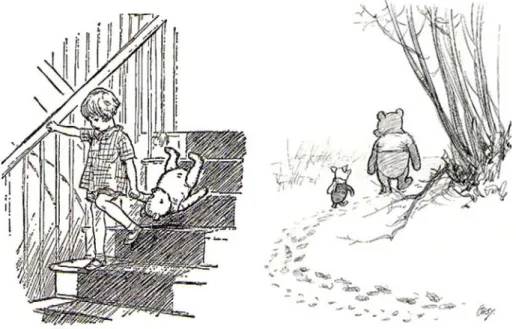
(10) White Rabbit: English Studies in Latin America presented as a nickname in the real one and a proper in the fictitious one. Two names denote different identities; this duality in Pooh reaffirms Heidegger’s notion of objects as having two modes of being: present-at-hand and ready-to-hand. Edward Bear, Pooh’s official name in the world outside the Hundred-Aker-Wood contrasts with Winnie-the-Pooh, which is his nickname in that world and a proper one within the stories.. Fig 1. Illustration of Winnie-the-Pooh. E.H. Shepard (Artist). Winnie-the-Pooh (New York: Penguin Books, 2005) 2,37. Print. The left side of Fig.1 is the first illustration of the bear, it belongs to the first chapter of the book before the narration begins, in that image we clearly see him as Edward Bear. His evident lack of mobility (i.e. his dependence on Christopher Robin for transportation) shows him as a present-athand object, a lifeless individual or simply a toy. Furthermore, the reader can easily identify the ways in which the initial version of Pooh differs from subsequent ones of him. Once the stories begin (right side of Fig.1) he is shown walking freely with Piglet, at this point he is an object perceived as readyto-hand which is evident in the contrast between the images from Fig.1.. 9.
(11) María Paz Muñoz Nonetheless, Christopher Robin and his father seem oblivious to his initial presence-at-hand state shown in the left side of Fig.1. Both of them constantly address Pooh as an animated being even at the beginning. The following extract belongs to the same chapter from Fig.1 and it is said by Alan Milne as a character: “Sometimes Winnie-the-Pooh likes a game of some sort when he comes downstairs” (4). The narrator seems as concerned as Christopher Robin with the bear’s needs. The significant change between Pooh from the left and right side of Fig.1 is ignored by both father and son. According to Kuznets, the explanation for Pooh’s constant treatment as an animate being lies in that he has an intimate role for them, because the teddy bear acts as an “intermediary of communication between himself [Milne] and the child” (49), caring for Pooh is something father and son share, which allows them to connect with each other. Due to the communicative and affective investment in the bear they always perceive him in as a ready-to-hand object. For the audience, Pooh’s readiness-to-hand is generated by the use of language. Before the stories begin, the reader could be confused as to what Pooh is. Fig.1 clearly shows him as a stuffed animal, but this image contradicts the treatment given to the bear by the narrator and his son. However, when the stories begin, it is immediately clear for us who Winnie-the-Pooh is: A living bear with a mind and personality. In this manner, the ambiguity of his being is cleared. Pooh’s mode of being changes as it becomes harder to see him as Christopher Robin’s possession rather than as a character of its own. In other words, Pooh goes from being present-at-hand into ready-to-hand. Since he never completely appears as a present-at-hand object (due to the ambiguity described before), Milne defies the traditional notion that presence-at-hand is the appropriate attitude towards the objects that make up our world. In the same line of thinking, Braver claims that presence-at-hand “presses itself on us as the only form of reality” (30), this statement implies that reality should be understood also through readiness-to-hand . Heidegger considers that the way of omprehending reality in all its. 10.
(12) White Rabbit: English Studies in Latin America complexity involves an attitude of readiness-to-hand towards objects. Milne emphasizes this view by deciding to make Pooh’s condition as a stuffed animal secondary to him as a bear. In Understanding Children’s Literature, Hunt explains that traditionally childhood is perceived as a state we grow away from (1). It is a period of life without responsibilities that is not so much defined by age as it is by social circumstances (Introduction to Children 6). The degree of responsibilities is one of the major differences between what makes a child and an adult. Rabbit exemplifies the latter’s frame of mind: “It was going to be one of Rabbit’s busy days. As soon as he woke up he felt important, as if everything depended upon him” (The House at 71). Rabbit takes responsibilities to the extreme, inventing them if necessary. In contrast, the prospect of a day with obligations sounds like a “bothering sort of day” for Pooh (38). Although Winnie-the-Pooh has a proclivity for child-like behaviors, it still includes a number of characters who behave adult-like. As if intending to make the conflict between child-like and adult-like characters clearer, Milne divides them into two groups: child-like such as Pooh, Piglet, Tigger, and Roo, and adult-like Rabbit, Owl, Kanga and Eeyore. The flaws of the second group undermines the figure of the adult, as Rabbit spends his time spreading cynicism and fear, Owl lives in pretence, Kanga acts as an overprotective mother, and Eeyore is in a constant state of depression (Hunt, Alternative Worlds 32). The co-existence and clash between childhood and adulthood is relevant, since Winnie-the-Pooh’s grim portrayal of the latter highlights the positive one of the former. Moreover, it is also the story of Christopher Robin’s bildungsroman and the prospect of growing up into a Rabbit presents a bleak future. However, the author does not make age a significant factor to establish what makes someone adult-like or child-like –since the characters are roughly the same age. By eliminating the age factor, childhood and adulthood can be seen as two states of being that differ from each other in terms of the way they perceive the world. While the adult-like characters trust knowledge, the child-like rely on certainty. By placing them in a world where there is a balance between. 11.
(13) María Paz Muñoz the two and eliminating the age variable, the author shows us how knowledge and certainty are simply just attitudes towards the world. Language is a key factor for the construction of the Hundred-Aker-Wood as a territory of children. Most characters cannot read or write, and when they do, they frequently spell words incorrectly. Nonetheless, their communication is not hindered by these apparent weaknesses, Pooh is a talented poet for instance. However, the characters of the Hundred-Aker-Wood do sense their language is deficient in some ways, which explains the status given to those who are educated. This shows in Rabbit’s evaluations of the intelligence of his friends: “And he [Christopher Robin] respects Owl, because you can’t help respecting anybody who can spell TUESDAY” (30), in the case of the bird, his authority lies in his literacy. However, his language skills turn out to be a fraud, since he cannot truly write as the following excerpt shows, “‘Can you read, Pooh?’ he [Owl] asked, a little anxiously” once reassured that he is indeed unable to read, he dares to write “HIPY PAPY BTHURHDTH THUTHDA BTHUTHDY” to Pooh’s great admiration, by claiming it means ‘happy birthday’(83). The irony of this exchange lies in Milne’s subversion of the untouchable position that language and knowledge has in our world. The reader can identify Owl’s fraud while the bear cannot so this exemplifies how fickle apparent beacons of wisdom —such as the Owl— can be. The comedy of Winnie-the-Pooh frequently derives from the contrast between the language within the Hundred-Aker-Woods and the world outside of it, including the reader’s. In many occasions, characters misunderstand the meaning and spelling of words from the external world. These changes occur because the members of the forest accommodate unknown concepts into definitions that they can readily understand. This phenomenon can be explained by Wittgenstein’s concept of “language games”, which means that “[t]o imagine a language means to imagine a form of life” (Remarks on 19). The unique language of the Hundred-Aker-Wood is in itself one of the reasons. 12.
(14) White Rabbit: English Studies in Latin America why the forest functions differently from the outside world, in this case, with child-like values. Piglet’s explanation of his grandfather’s name demonstrates this idea: Next to his [Piglet] house was a piece of broken board which had: ‘TRESPASSERS W’ on it. When Christopher Robin asked Piglet what it meant, he said it was his grandfather’s name . . . Christopher Robin said you couldn’t be called Trespassers W, and Piglet said yes, you could, because his grandfather was, and it was short for Trespassers William. (Milne 34) In this case, Piglet invents a family history as an explanation for the mysterious message on the board. The strength of this example lies in the distance that these divergent language games have –the childlike and adult-like. Generally, a board with TRESSPASERS W written on it would have a message along the lines of ‘TRESPASSERS WILL BE PROSECUTED’ or ‘TRESPASSERS WIL BE SHOT’. However, in Piglet’s universe the word ‘trespassers’ signifies the name of a loved one, not someone who enters unlawfully upon the land of another. The second definition is absurd in a community of peace such as the one from the Hundred-Aker-Wood. Even Christopher Robin who senses there is something off with Piglet’s interpretation, believes him because as a child himself they share a similar understanding of the world. The darkness of the message on the board is eliminated as its message is rendered inert or even bright by the reading Piglet gives it. Milne creates a unique lifestyle in Winniethe-Pooh precisely because of the difference its language has with the one from the real world. In two books a subculture is developed in which the adult reader makes the exercise of understanding and living with an alternative version of his or her own language. The language game of childhood from the Pooh books also has political implications as it threatens the position of the adult. David Rudd explains that “adults, in this case are never in a secure position . . . this is because power is not an abstract possession, but an effect of discursive relations which are productive as well as repressive” (22). Milne alters the discursive relations from the outer. 13.
(15) María Paz Muñoz world in his stories, this takes control from the adult. This alternative use of words is essential for demonstrating the way Pooh and his friends show an escape from the rule-following paradox (i.e. the notion that one is forced to follow particular interpretations of a word) (Braver 121). Winnie-the-Pooh constantly finds new meanings for familiar words, which demonstrates the flexibility of language: Trespasser W, Heffalump, or Woozle are not examples of alternative definitions for words in the dictionary. In some cases, they are brand new words that share only the spelling with the one from the outer world. Like Kuznets explains, the effect of recreating the language games from childhood in Winnie-the-Pooh depicts how culturally bound and slippery the relation between sign and signified is (52). By testing the hegemony of language, the author shakes foundational perceptions of adulthood as he demonstrates its vulnerability. Russell Hoban, writer of The Mouse and His Child, acknowledges how children can represent a threat for the very ideas that make up the world of grownups: Each new generation of children has to be told: “This is a world, this is what one does, one lives like this.’ Maybe our constant fear is that a generation of children will come along and say, ‘This is not a world, this is nothing, there’s no way to live at all. (qtd in Rudd 21) The Pooh saga makes the fear outlined by Hobban real. Milne creates a small paradise that by its very existence exposes some of the inadequacies of the real world. Since the only human within the Hundred-Aker-Wood is Christopher Robin, his pleasant life in the forest stands for a criticism against adulthood. The Hundred-Aker-Wood is basically an inversion of the external world: “[w]hat Milne has done is to turn the child’s world upside down, creating a particularly elegant reversal of parental authority. In reality Christopher Robin is a very small boy in a world of adults” (Kuznets 51). By means of this reversal, the author makes a boy’s way of thinking the dominant schema of a world. Not only is he the only human, but he is the ultimate source of authority. The relevance of his persona can be seen in the chapter “In Which Pooh Invents A New. 14.
(16) White Rabbit: English Studies in Latin America Game and Eeyore Joins In”. In this chapter, the donkey falls into a river while playing a game and blames Tigger for it. He aggressively accuses him while Pooh and Piglet defend him by arguing that he “is just bouncy and he can’t help it” (42) when Tigger is cornered by Eeyore’s arguments, Rabbit claims “The point is, what does Christopher Robin think about it?” (42). The characters expectantly await the child’s decision, which turns out to be: “I think we all ought to play Poohsticks!”(43). His solution, which incidentally works perfectly, is playing a game. This is, of course, the kind of ruling a child would give, and it works because of Christopher Robin’s influence over this world. Nonetheless, the forest is not exempt from violence and the use of reason but the social dynamics of the HundredAker-Wood are simpler than those of the external world. What makes it different from the outer world is the way conflicts are solved. The previous example shows how it is through a game that they reach a resolution, this explains why Winnie-the-Pooh is said to be a “peepshow into paradise” (Kuznets 47). The characters’ non-reflective mentality allows such simple solutions. The redemptive power of games is another example of how Milne puts Wittgenstein’s and Heidegger’s theories into practice. Throughout the stories, Christopher Robin’s coming of age process takes place subtly in the background and in The House at Pooh Corner it becomes evident, as his visits to the Hundred-AkerWood become less frequent. In the first book, Christopher Robin shares Pooh’s understanding of the world. However, his humanity eventually produces an internal conflict in him, since he acts partly upon knowledge and partly upon certainty, unlike the other characters that show a clear and unchanging tendency towards one or the other disposition. His natural growth interferes with his initially pre-reflective attitude towards the world. Thus his instinctual behavior weakens over time as he goes from childhood into the verge of adulthood. Christopher Robin’s relationship with the community of the Hundred-Aker-Wood in The House at Pooh is different from Winnie-the-Pooh because of this transition. At the introduction of the sequel, the narrator says the characters from the stories will be saying goodbye because when Christopher asks for a story, the narrator instead asks him. 15.
(17) María Paz Muñoz “[w]hat about nine times a hundred and seven?” and he prefers to do arithmetics (i). Milne foreshadows the departure from the fantasy world as Christopher Robin’s preferences start changing. Learning mathematics conflicts with the foundations of the fantasy world as a place that operates on the principles of certainty and readiness-to-hand. As an exact science, it is toxic for an action based understanding of the world. However, mathematics is not the only element responsible for the departure from the forest. Christopher Robin starts receiving lessons in the House at Pooh, which contributes to his acquisition of knowledge and of an adult-like language game. Moyal-Sharrock explains that this shift is unavoidable, as all of us transit from a natural, nonreflective grasp of the world to a sophisticated, reflective and hesitating pondering. From doing to thinking (10). There are no archetypical enemies in Winnie-the-Pooh, but what endangers it is education, particularly in the form of an invasive adult-like language. As Kuznet states; “Paradoxically, language is both villain and savior in this book” (53). Although for the most part the inhabitants of the Hundred-Aker-Wood manage a successful use of language, they eventually suffer from their incompetence in the area. This realization causes significant distress in Eeyore who struggles to learn how to write the letter ‘A’: “People come and go in this forest … Do they know anything about A? They don’t. It’s just three sticks to them. But to the Educated –mark this little Piglet– to the Educated, not meaning Poohs and Piglets, it’s a great and glorious A” (The House at 86). The villain in these books is the pernicious influence of knowledge, in a universe that is based on ignorance. In the first book and most of the second, the characters manage to easily accommodate foreign words into their system because they do not feel the need to explain themselves. However, once an external language permeates the narrative, it establishes a hierarchy in which those who possess knowledge are at the top of the chain, and Poohs and Piglets are at the bottom of it. The importance of this change can be seen in the atmosphere of violence that enters the Hundred-Aker-Wood with it. When Rabbit observes the three sticks Eeyore proudly assembles into a letter, he comments on its quality: “‘An A,’. 16.
(18) White Rabbit: English Studies in Latin America said Rabbit, ‘but not a very good one’” (Milne 87). Eeyore’s anger at his comment is so strong he reacts by destroying them. With the arrival of an adult-like language game, the status of knowledge — which had been subjected to certainty— rises as it starts becoming the dominant disposition in Winniethe-Pooh. In the same episode containing Eeyore’s obsessive attempts at writing, Rabbit conducts an investigation into the mystery of Christopher Robin’s absences. When he goes searching for him, he finds a note that says “GON OUT BACKSON BISY BACKSON C.R.”(75). Rabbit and his friends develop the theory that he has another friend called Backson with whom he is spending his mornings, we can see how they accommodate the unknown word into a reasonable definition for them. When Rabbit runs into Eeyore asking him if he knows what Christopher Robin does in the mornings, he replies: “He learns. He becomes Educated . . . he instigorates Knowledge” (87). This explains the donkey’s efforts to assemble the letter A. In an attempt to be up to the boy’s intellectual level, he tries to learn on his own, which puts him under stress. The aforementioned mystery ends when Rabbit finds a note with the ominous message “GONE OUT BACK SOON C.R.” (88). This chapter illustrates how quickly violence and anxiety enters the universe of Winnie-the-Pooh making it unstable. At the end of The House At, Pooh and his friends realize Christopher Robin is leaving the Hundred-Aker-Wood for good, and before he leaves, Pooh has significant conversation with him. The child seems upset at this point, and decides to lead Pooh into a specific place in the forest called Galleons Lap, an enchanted place because no one has ever been able to count the number of trees in it (172). The magic of Galleons Lap lies in how it is still untouched by the threat of arithmetic or, in other words, of reason. Once in Galleons Lap, Christopher Robin tells Pooh about the things he has learned “Europe, Knights, Queens and something called Factors” (173). As usual, when confronted with an unknown concept, the bear nods and tries to maintain the conversation flowing. But this time, Pooh’s method feels awkward and uninteresting to the child as the following extract shows:. 17.
(19) María Paz Muñoz Is it a very Grand thing to be an Afternoon, what you said? ‘A what?’ said Christopher Robin lazily, as he listened to something else. ‘On a horse?’ explained Pooh ‘A Knight?’ ‘Oh, was that it?’ said Pooh. (173) Pooh’s comments do not satisfy Christopher Robin as they used to since he is spending more time in the outside world and developing a deeper connection with it. Moreover, he can now identify the “errors” that Pooh makes, as his lessons have created a more static relationship between signifier and signified. Nonetheless, Pooh can tell that there is a distance between them and reflects upon it: “Then he began to think of all the things Christopher Robin would want to tell him. . . and how muddling it would be for a Bear of Very Little Brain to try to get them right in his mind” (174). This is perhaps the only moment in which Pooh feels truly uncomfortable and insecure about his brain. He even wonders how it would be to have a “Real Brain” (172). In the previous stories, Pooh’s remarks succeeded in being reasonable and wise despite their apparent absurdity. However, in the last chapter his poor intellectual level proves insufficient for communication. Instead of desiring a bigger brain he wants a real one because he is aware that that it would allow him to exist beyond the limits of the fantasy. In this moment, Pooh collapses under the pressures of the external world, and it is the only time he accommodates to the demands of a knowledge-based world. On the other hand, Christopher Robin is suffering too, he voices his distress in the cryptic extract “‘I’m [Christopher Robin] not going to do Nothing any more’ ‘Never again?’ ‘Well, not so much. They don’t let you’” (175). The ambivalence of the pronoun ‘they’ appears as an almost sinister presence that is compelling him to change, but the reader can assume he refers to the educational system and perhaps adults in general. While Pooh wishes for a “Real Brain” Christopher Robin wishes for the opposite, “he sits there looking out over the world, and wishing it wouldn’t stop” (172). His. 18.
(20) White Rabbit: English Studies in Latin America choice of words reveals that he can see the limitations of the world he is inevitably entering. In a Heideggerean sense, the world is becoming an inert substance, a world made up of presence-at-hand tools. Like Christopher Robin, Wittgenstein and Heidegger can perceive how the world as is traditionally seen by means of knowledge has metaphorically ‘stopped’. The fluid production of knowledge seen in previous chapters, like in their search of the North Pole, is no longer possible for an educated boy. Therefore, their conflict is against the traditional notion that the greatest asset of human beings is their use of reason, which is in a broad sense responsible for this stagnation. They all agree that “a purely rational being . . . could not achieve the understanding that four-year-old children effortlessly have” (Braver 153). Winnie-the-Pooh is based on this idea; that children are more perceptive than adults, and that Pooh’s and Christopher Robin’s grasp of the world denotes a greater insight into it. Notwithstanding, Milne deliberately makes us witness the suffering attached to the child’s loss of certainty. The dramatic element heightens the message of his books, because he makes the reader see Christopher Robin’s tragedy, which lies in the clarity he has to assess his loss. Heidegger and Wittgenstein developed theories that dissipate the skeptical illusion of a relationship with knowledge through justification only. This view has propagated in Western society to the point where it seems as if this was the only way to comprehend the world. Winnie-the-Pooh acts as a statement against this paradigm, the books reinstate the value of action and child-like behaviors as a sensible way of thinking. He makes a caricature of the adult by creating a reality in which those who behave as such are an undesirable prospect. Moreover, the position of the adult is shaken even more as the reader can witness how Pooh’s and Christopher Robin’s friendship falls apart: “‘Pooh’ said Christopher Robin earnestly, ‘if I – if I’m not quite’ – he stopped and tried again – ‘Pooh, whatever happens, you will understand, won’t you?’” (176). Christopher Robin’s inarticulate apology dramatically represents the losses of growing up. The criticism towards society and the educational system gains its full force in the ending of Winnie-the-Pooh, as the bear’s charm is not enough to stop. 19.
(21) María Paz Muñoz Christopher Robin’s departure. Milne shows us how the disease of wanting to explain infects his son and results in the symbolic death of the child within him. His “death” speaks to the dead child within the adult reader as well. Winnie-the-Pooh and The House at Pooh Corner are a way to re-experience, even if only imaginatively, the kind of life before reading, writing and existentialism. By means of a boy and his teddy bear, and the emotional impact of losing them, the author argues in favor of the value of certainty and perceiving objects as ready-to-hand. His stories uncover the ugly face of knowledge, urging us to question it and consider alternative views. He shows us with Winnie-the-Pooh that an adult does not and should not be a dead child, but rather, a child who survived.. 20.
(22) White Rabbit: English Studies in Latin America Works Cited Hunt, Peter. An Introduction To Children's Literature. Oxford [England: Oxford University Press, 1994. Print. ---.Understanding Children's Literature Key Essays from the International Companion Encyclopedia of Children's Literature. London: Routledge, 1999. Print. Hunt, Peter, and Millicent Lenz. Alternative Worlds In Fantasy Fiction. London: Continuum, 2001. Print. Braver, Lee. Groundless Grounds: A Study of Wittgenstein and Heidegger. Cambridge, Mass.: MIT Press, 2012. Print. Kuznets, Lois R.. When Toys Come Alive: Narratives of Animation, Metamorphosis, and. Development. New. Haven: Yale University Press, 1994. Print. Milne, Alan Alexander. Winnie-the-Pooh. 1926. Reprint. New York: Penguin Books, 2005. Print. ---. The House at Pooh Corner. 1928. Reprint. London: Egmont UK Limited, 2004. Print. Rudd, David. "Theorizing and Theories: How does Children's Literature Exist?" Understanding Children's Literature Key Essays From the International Companion. London: Routledge,. 1999. 15-. 29. Print. Sharrock, Danièle. Understanding Wittgenstein's On Certainty. New York: Palgrave Macmillan, 2004. Print. Wittgenstein, Ludwig. Philosophical Investigations. Oxford: B. Blackwell, 1953. Print. ---. et al. On Certainty. New York:. Harper & Row, 1972. Print.. ---. et al. Remarks on the Foundations of Mathematics. Rev.ed., 1st MIT Print.. Cambridge, Mass.: MIT. Press, 1983. Print. Wrathall, Mark A. How to Read Heidegger. New York: W.W. Norton, 2006. Print.. 21.
(23)
Figure
Documento similar
Issue congruence between citizens and representatives in Latin America: a multidimensional perspective.. Juan
Nevertheless, the author also found that those students with Valencian as L1 and who were enrolled in immersion programmes (PIL programme) were more favourable towards Valencian
The studies from Canada and Latin America are focused on the effect of board composition on the practice of earnings management in Canada (Park and Shin, 2004); the
The Dwellers in the Garden of Allah 109... The Dwellers in the Garden of Allah
While some authors like Dilthey would describe this two-pronged structure of the social sciences in terms of a distinction between explanation and understanding, the
Although there have been some theoretical studies dealing with the possibility of a coherent exchange of energy between a single QE and surface EM modes in metal nanostructures
Scarcity: The resources available Albani, are not very difficult to achieve, since with regard to human resources, with a good selection and training of its employees
But given that there did not exist two completely different modes of conversation inside and outside councils, treatises on council and manuscript advice allow reconstructing
