Inter-American Development Bank Banco Interamericano de Desarrollo
Latin American Research Network Red de Centros de Investigación Research Network Working paper #R-474
Teacher Unionization and the Quality
of Education in Peru:
An Empirical Evaluation Using Survey Data
by
Eduardo Zegarra
Renato Ravina
Instituto APOYO
Cataloging-in-Publication data provided by the Inter-American Development Bank
Felipe Herrera Library
Zegarra, Eduardo.
Teacher unionization and the quality of education in Peru : an empirical evaluation using survey data / by Eduardo Zegarra, Renato Ravina.
p. cm. (Research Network Working papers ; R-474) Includes bibliographical references.
1. Teachers’ unions--Peru. 2. Education--Effect of teachers’ unions on--Peru. I. Rabian, Renato. II. Inter-American Development Bank. Research Dept. III. Latin American Research Network. IV. Series.
331.88113711 Z72--dc21
©2003
Inter-American Development Bank 1300 New York Avenue, N.W. Washington, DC 20577
Abstract*
This paper analyzes the evolution and current profile of teacher unionization and estimate the impact of unionization on the quality of public education in Peru. The research uses data from a 1999 household survey (ENAHO) and from a recent evaluation of a public program oriented to improve the quality of Peruvian public education.
Regarding the evolution of unionization, there is evidence compatible with the hypothesis that the rate of teacher unionization has dropped during the last three decades, but especially during the 1990s, due basically to the hiring of temporary teachers.
With respect to the profile of unionization, it is found that unionized teachers are older and more experienced, and that males are more common in the union membership. There is no empirical evidence that unionized teachers enjoy better access to educational infrastructure at the polidocente (larger) schools, but they do have better access at the multigrado (intermediate) schools.
Introduction
Peruvian public education is characterized by high coverage (at developed country levels) but extremely low expenditures per student, which raises serious concerns regarding the quality of the educational services that Peruvian children are receiving. Recent efforts by the Government of Peru to face this problem have been oriented toward increasing public expenditures on education infrastructure, inputs and teacher training, especially through a program focused on increasing the quality of education called MECEP (Mejoramiento de la Calidad de la Educacion Peruana). The program has increased inputs and training to teachers, although without significant changes in the institutional context in which the educational system works. There are concerns that the effectiveness of this policy may be limited due to adverse institutional factors.
One such important institutional factor is the presence of an important teachers’ union (known by its Spanish acronym SUTEP) in the Peruvian educational public sector. The union might play a role in the provision of educational services if it affects the allocation of public resources to education and/or the incentives their affiliates face to provide services. This study is oriented toward evaluating empirically whether teacher unionism plays such a role in the Peruvian context.
There are no prior studies in Peru about the role of the teachers’ union in the provision of education from an institutional and economic perspective. SUTEP is the only teachers’ union in Peru and its current membership is estimated at 145,000 teachers nationwide. Founded in the 1970s, SUTEP has had an important role in the last three decades due to the mobilization of teachers, especially during the 1970s and 1980s. Its political clout and economic importance declined during the 1990s, although recently (2000-2001) it has started to increase its influence on policy in response to the Ministry of Education’s controversial practice of appointing temporary teachers. As the union is still one of the largest in Peru’s public sector, questions regarding its effect on the quantity and quality of educational services clearly remain important for policymakers and researchers.
non-unionized teachers?; and (iv) is there empirical evidence that unionized teachers display different (better or worse) performance in the provision of public educational services?
Recent program evaluations and case studies have made available data that allow for an empirical treatment of these issues. A growing body of evaluations and studies has created a critical mass of information permitting a more rigorous exploration into which institutional and economic factors may affect the quality and provision of education services to Peruvian children (Instituto Apoyo 1999a, 1999b and 2000). In particular, this study uses data taken from a recent evaluation of the MECEP Program (Instituto Apoyo, 1999b) and from a national household survey (ENAHO, 1999) in which there is a large sub-sample of teachers.
This paper is divided into the following five sections: Section 1 describes the institutional context in which teacher unionization has taken place in Peru in the last three decades; Section 2 analyzes questions about the evolution of unionization, union profiles and differential access to educational infrastructure; Sector 3 develops a model which will be used to answer the fourth question on performance based upon a production function approach; Section 4 describes the estimation results for the model; and Section 5 concludes.
1. Unionization and the Peruvian Educational System
In contrast with the U.S. and other Latin American countries (Hoxby, 1996), the public education system in Peru is fairly centralized, and most if not all allocation decisions are made by a central authority, the Ministry of Education (MOE). Likewise, the teachers’ union, Sindicato Unico de Trabajadores de la Educacion del Perú (SUTEP) is a consolidated and centralized body that seeks to influence both general policies as well as sector decisions. Founded in 1973 through a merger of four autonomous unions, SUTEP has since been the sole teacher’s union in Peru, with a current membership of about 145,000 of the country’s 265,000 public teachers.
During the 1980s SUTEP concentrated its activities on organizing eventual national strikes which were less and less effective as the country’s economic conditions deteriorated. In 1984 the union was finally recognized by the Belaúnde Government (1980-1985) after several years of union pressure and mobilization.
In interviews with people related to the union, it was mentioned that unionization in the early years of SUTEP (1970s and early 1980s) was basically related to the political convictions of university students. In those years, young students in the education career were easily attracted to the leftist ideology of Patria Roja, and after graduation they became union members as an expected next step. Another proposition that called for attention was that the presence of SUTEP in rural areas was important due to the political work done by the main party behind the leadership. As representation in the union leadership is related to the number of political districts rather than to the number of students in schools (higher in urban sites), rural areas remain important for party advocates and union work.
Each year SUTEP approves a document called the “Pliego de Reclamos” in which it lists all its demands to the Government in terms labor conditions, wage increases and educational goals, among other general political issues. The document has been losing importance over the years, but it is still one of the main tools that SUTEP leaders use in their union activities.
Another very important tool of union operation is the DERRAMA fund, a fund that is managed by the SUTEP Executive Committee and used to provide some services (including loans) to union members. The fund started with teacher salaries confiscated during the 1977 strike, and it is also maintained by monthly contributions from members. An important change to the institutional context of the Peruvian educational system was the approval, in 1990 at the end of the Alan García government, of a new law for teachers (Ley del Profesorado) that created a special status for teachers. After that law, it was stated that only those persons who have studied to be a teacher can be hired in the public sector, closing this option for other professionals. Also, according to this law, teachers in the public sector are public servants with full duties and privileges. A teacher who is tenured (i.e., which occupies a formal position in the public cadre of personnel, or CAP) has job security and social security benefits when retiring. The approval of the Law is considered one of the SUTEP’s most important achievements.
any significant increase in teachers’ wages in real terms. After the severe economic crisis of 1990 (in which inflation reached four digits), the new Fujimori Government froze the size of the educational CAP in order to avoid increasing pressure on the budget from the almost 40,000 retired teachers. However, the demand for teachers remained high in a country in which most of the population sends their children to public schools. Thus, after 1993, the authorities introduced an innovation in its labor relations, allowing the hiring of “temporary” teachers. Currently, it is estimated that about 25 percent of teachers have non-tenured status in the public sector.1 This dual structure for teachers is not linked to any significant wage differences (differentials are minimal; wages being equally low for all teachers). There is, however, an important distinction: non-tenured teachers do not enjoy job security and as a consequence can be fired at any moment without compensation. In addition, they do not receive any pension benefits, as they are hired under a contract in which the non-tenured teacher is a sort of service provider without any of the considerations of a stable labor relationship. Clearly this option was used to avoid increasing pressure for social benefits among teachers while accommodating the demand for an increasing number of teachers.
In the 1990s the SUTEP did not play a direct role regarding wage bargaining or even policy decisions. After the collapse of wages at the beginning of the 1990s, teachers’ real wages did not recover during the whole decade under Fujimori’s rule, and at the end of the decade they were a mere 70 percent of real wages in 1990 (Figure 1).
1 The Toledo administration has recently begun to grant tenure to temporary teachers based on an
Figure 1.
With teachers’ salaries at low levels, the Fujimori Government increased public investment in education. Since 1996 the Peruvian educational system enjoyed higher levels of investment, especially in inputs, training and infrastructure.2 Although SUTEP did not play a significant role in these decisions, at least at the central level, it may have influenced the impacts on educational outputs. Because of the massive coverage and network structure of the union, the possibility cannot be ruled out that SUTEP plays a significant role in the efficiency of resource allocation; this topic will be explored in Sections 3 and 4.
Another important avenue through which the union may influence the educational output is in the process of teacher allocation itself, for example among rural and urban areas, or among different types of schools. In general, according to experts interviewed for this paper, the process of allocation is not linked to performance or training, and teachers are assigned to rural and urban areas without major planning, evaluation and incentives by the MOE. In recent years, temporary teachers have been much more likely to be assigned to less favorably located schools in rural areas. It is plausible that SUTEP may have ways to influence this allocation process favoring unionized teachers (to better schools), and therefore affecting the final output of the
education process. This result would be policy relevant if unionized teachers are really different in the provision of educational services, which will be evaluated in Sections 3 and 4.
2. Unionization, Teacher Profile and Access to Educational Infrastructure
2.1. Unionization in the Public Teacher Career
This papers uses two sources of data regarding the unionization status of teachers: (i) the 1999 ENAHO survey, which is a representative sample of all Peruvian households in which there is a sub-sample of 574 teachers; and (ii) the 2000 MECEP evaluation survey, which is based on a stratified sample of 700 schools nationwide, with about 1,400 teachers surveyed.
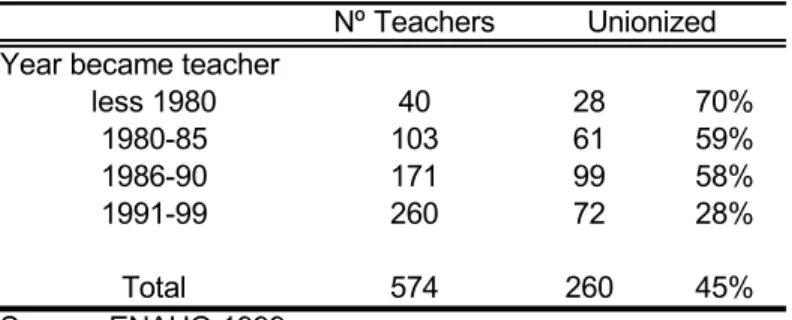
Table 1 relates teachers’ experience to current unionization status in the 1999 ENAHO survey. The rate of unionization among surveyed teachers is 45 percent, and teachers with more experience are more likely to be unionized. The data are also compatible with a declining rate of unionization in the last three decades. For the purpose of relating these figures to rates of unionization, however, it is necessary to accept the assumption that exit rates and changes in union status among teachers do not have a significant impact on the average rate of unionization.
Table 1. Experience and Unionization
If it is accepted that the rate of unionization in the public educational system has been dropping in the last three decades, the data suggest that this phenomenon has been more dramatic in the 1990s, associated basically with the entry of non-tenured teachers who are less likely to be unionized.
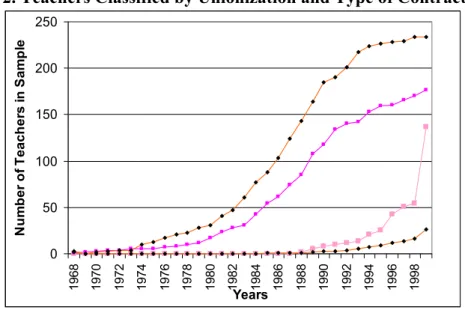
Figure 2 shows the total number of teachers in the ENAHO sample by four categories in terms of unionization and labor contract. The horizontal axis displays the year in which teachers in the sample started teaching.
Figure 2. Teachers Classified by Unionization and Type of Contract
0
The figure supports the idea that lower unionization in the 1990s could be associated with the increasing importance of non-tenured teachers in that decade, especially after 1995. If temporarily hired teachers are excluded from the sample, the proportion of unionization is 57 percent instead of 45 percent. Thus, the average rate of SUTEP affiliation may be about 60 percent among tenured teachers.
Figure 3.
Number of union affiliations per year (in the sample)
0 5 10 15 20 25 30 35 40
1965 1972 1974 1977 1979 1981 1983 1985 1987 1989 1991 1993 1995 1997 1999
Source: MECEP evaluation survey, MOE and Instituto APOYO.
2.2. Teacher Profile and Union Status
Table 2 presents the distribution of teachers taken from the ENAHO sample of teachers at the national level by type of location.
Table 2. Unionization of Teachers and Location
Non Unionized Rate of Unionized Union
Capital cities 81 52 39%
Big cities 58 68 54%
With more than 2,000 inh. 88 57 39%
Total urban 227 177 44%
500-2000 inhabitants 35 43 55%
Disperse 52 40 43%
Total rural 87 83 49%
Total 314 260 45%
As can be seen, unionization is greater in rural areas (49 percent) than in urban areas (44 percent), a difference that is statistically significant at the 95 percent confidence level. This result is consistent with interviews with SUTEP members, who state that the union has a strong presence in rural areas.
Table 3 displays a similar breakdown for teachers’ tenure status.
Table 3. Tenure Status of Teachers and Location
Non Tenured Rate of
Tenured Tenure
Capital cities 26 107 80%
Big cities 36 90 71%
With more than 2,000 inh. 46 99 68%
Total urban 108 296 73%
500-2000 inhabitants 22 56 72%
Disperse 33 59 64%
Total rural 55 115 68%
Total 163 411 72%
Source: ENAHO 1999.
As can be seen, non-tenured teachers are more likely to be assigned to rural areas than tenured teachers, which reflects the increasing presence of temporary teachers in rural areas. This factor may negatively affect the rate of unionization in rural areas (as temporary teachers are less likely to join), although it still did not have the effect of making unionization less strong in rural than in urban areas. In general, as mentioned before, temporary teachers are currently being allocated to the poorest schools, which are generally located in rural areas without major incentives.
have a slightly higher presence of secondary activities than non-unionized, but the difference is not significant in statistical terms.
Table 4. Secondary Activity by Teachers
Non-Tenure Tenure Total Non-Tenure Tenure Total
Have secondary activity(%)
Capital cities 38% 40% 40% 80% 40% 44%
Big cities 35% 52% 43% 80% 33% 37%
With more than 2,000 inh. 41% 39% 40% 57% 58% 58% Rural 500-2000 inhabitants 53% 39% 46% 60% 55% 56%
Rural disperse 52% 65% 58% 25% 61% 57%
Total 43% 45% 44% 62% 48% 49%
Non-Unionized Unionized
Source: ENAHO 1999.
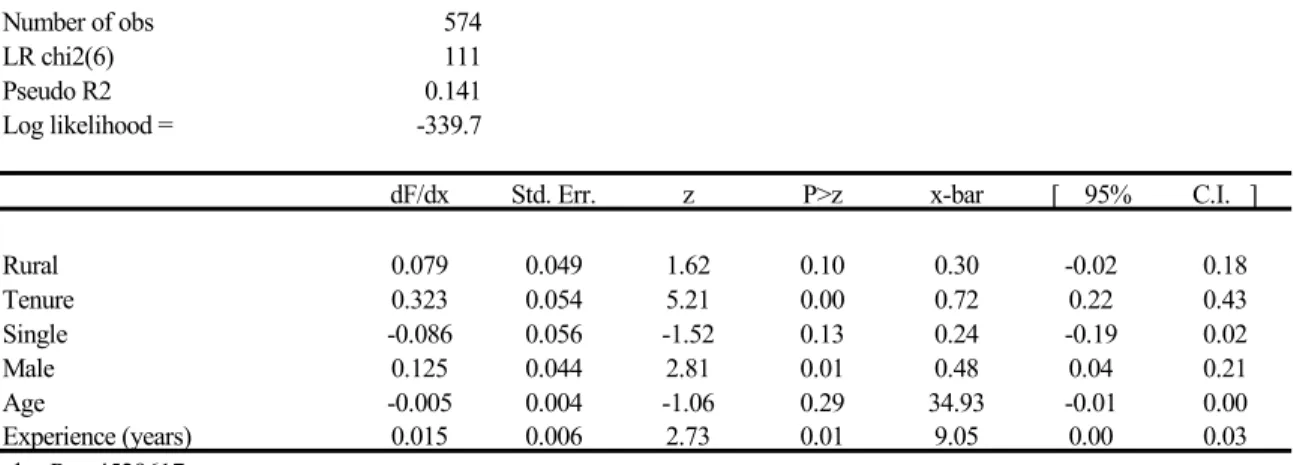
Looking at other characteristics of teachers and their union status in the ENAHO sample of teachers, a probit estimation was made of the probability of being unionized in relation to several other characteristics. The results are presented in Table 5.
Table 5. Factors Affecting Unionization Rates
Probit estimates for Unionization of Teachers
Rural 0.079 0.049 1.62 0.10 0.30 -0.02 0.18
Tenure 0.323 0.054 5.21 0.00 0.72 0.22 0.43
Single -0.086 0.056 -1.52 0.13 0.24 -0.19 0.02
Male 0.125 0.044 2.81 0.01 0.48 0.04 0.21
Age -0.005 0.004 -1.06 0.29 34.93 -0.01 0.00
Experience (years) 0.015 0.006 2.73 0.01 9.05 0.00 0.03
obs. P .4529617
pred. P .4356322 (at x-bar)
controlled for, the experience variable appears significant implying than unionization is more likely among teachers with more experience. Another important result is that male teachers are much more likely (13 percent) to be unionized than female teachers. Marital status and age appear as non-significant at the 10 percent level of significance.
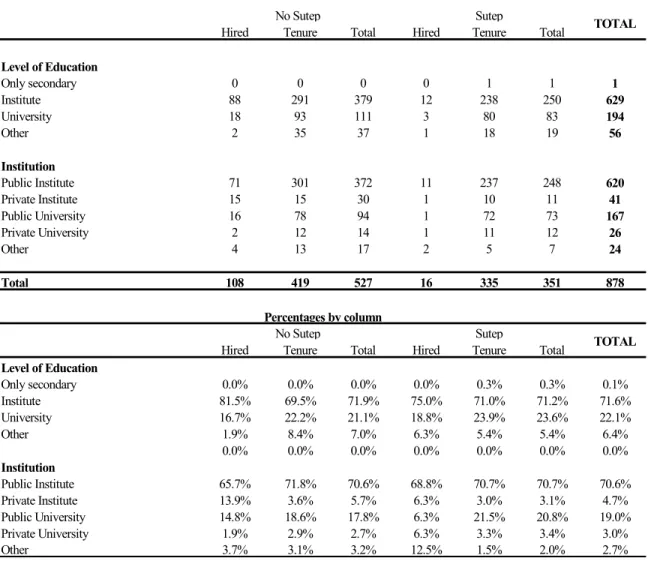
The data from the MECEP evaluation survey provides similar results in terms of the variables analyzed with the ENAHO survey. However, the MECEP data provide somewhat more information about teachers. For instance, Table 6 presents the level of education and the institution from which teachers graduated. It can be seen that hired (i.e., non-tenured) teachers are more likely to come from an institute than from a university. They are also more likely to come from a private institute in comparison with tenured teachers.
Table 6. Teachers’ Levels of Education
Hired Tenure Total Hired Tenure Total
Level of Education
Only secondary 0 0 0 0 1 1 1
Institute 88 291 379 12 238 250 629
University 18 93 111 3 80 83 194
Other 2 35 37 1 18 19 56
Institution
Public Institute 71 301 372 11 237 248 620
Private Institute 15 15 30 1 10 11 41
Public University 16 78 94 1 72 73 167
Private University 2 12 14 1 11 12 26
Other 4 13 17 2 5 7 24
Total 108 419 527 16 335 351 878
Hired Tenure Total Hired Tenure Total
Level of Education
Only secondary 0.0% 0.0% 0.0% 0.0% 0.3% 0.3% 0.1% Institute 81.5% 69.5% 71.9% 75.0% 71.0% 71.2% 71.6% University 16.7% 22.2% 21.1% 18.8% 23.9% 23.6% 22.1%
Other 1.9% 8.4% 7.0% 6.3% 5.4% 5.4% 6.4%
0.0% 0.0% 0.0% 0.0% 0.0% 0.0% 0.0%
Institution
Public Institute 65.7% 71.8% 70.6% 68.8% 70.7% 70.7% 70.6% Private Institute 13.9% 3.6% 5.7% 6.3% 3.0% 3.1% 4.7% Public University 14.8% 18.6% 17.8% 6.3% 21.5% 20.8% 19.0% Private University 1.9% 2.9% 2.7% 6.3% 3.3% 3.4% 3.0% Other 3.7% 3.1% 3.2% 12.5% 1.5% 2.0% 2.7%
This sample shows that 9 percent of teachers are not degreed, a proportion which is greater among unionized teachers (10 percent versus 6 percent among the non-unionized). In the non-unionized group, non-degreed teachers are found exclusively among temporarily hired teachers, whereas in the unionized group the non-degreed percentage is the same for hired and tenured teachers.
2.3. Access to Educational Resources
Teachers may have differentiated access to educational resources according to different characteristics and the decisions made by the MOE. This sub-section therefore analyzes the access of teachers to some educational resources using data from the MECEP evaluation study.
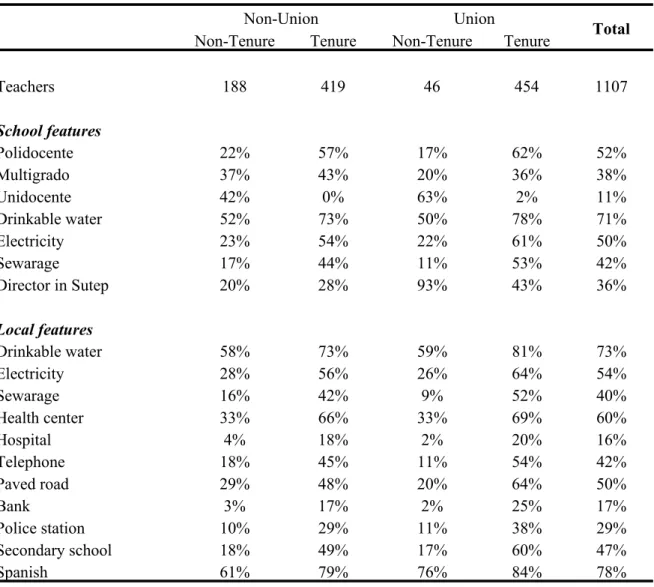
Table 7. Infrastructure and Teachers’ Union and Tenure Status
Non-Tenure Tenure Non-Tenure Tenure
Teachers 188 419 46 454 1107
School features
Polidocente 22% 57% 17% 62% 52% Multigrado 37% 43% 20% 36% 38%
Unidocente 42% 0% 63% 2% 11%
Drinkable water 52% 73% 50% 78% 71% Electricity 23% 54% 22% 61% 50%
Sewarage 17% 44% 11% 53% 42%
Director in Sutep 20% 28% 93% 43% 36%
Local features
Drinkable water 58% 73% 59% 81% 73% Electricity 28% 56% 26% 64% 54%
Sewarage 16% 42% 9% 52% 40%
Health center 33% 66% 33% 69% 60%
Hospital 4% 18% 2% 20% 16%
Telephone 18% 45% 11% 54% 42%
Paved road 29% 48% 20% 64% 50%
Bank 3% 17% 2% 25% 17%
Police station 10% 29% 11% 38% 29% Secondary school 18% 49% 17% 60% 47%
Spanish 61% 79% 76% 84% 78%
Non-Union Union
Total
Source: MECEP Evaluation, MOE, Instituto APOYO.
This pattern clearly affects access to educational and local infrastructure. Polidocente
schools are more likely to have electricity and drinkable water. Also, in terms of the context in which the school is located, it is apparent that polidocente schools are more common in urban areas and so, have better local services. This analysis suggests that in comparing access to educational resources by unionized or non-unionized teachers it is necessary to control for type of school
that in multigrado and unidocente schools the interviewed teacher is generally the principal of the school as well.
In order to make the analysis easier and to incorporate other variables associated with teachers, an index of access to educational infrastructure was constructed in which school features have a weight of 75 percent and local services 25 percent.3 This index gives a good idea of differences in school quality, i.e., in teachers’ access to educational infrastructure.
Two regressions were run, one for polidocente schools and the other for multigrado
schools, in order to see whether there are some differences in teachers’ access to educational resources controlling by type of school (problems were encountered with teachers’ data for
unidocente schools). The results are presented in Table 8.
Table 8. Effects of Unionization on Access to Infrastructure
Coef. Std. Err. t P>t [95% Conf. Interval]
Union 0.011 0.018 0.603 0.547 -0.025 0.046 Tenured 0.049 0.031 1.583 0.114 -0.012 0.109 Number classrooms 0.022 0.001 15.289 0.000 0.019 0.024 Male -0.038 0.018 -2.043 0.042 -0.074 -0.001 Age (years) 0.022 0.012 1.734 0.084 -0.003 0.046 Constant 0.200 0.039 5.182 0.000 0.124 0.276
Regression of Infrastructure index on teacher features
Coef. Std. Err. t P>t [95% Conf. Interval]
Union 0.049 0.023 2.135 0.033 0.004 0.094 Tenured 0.001 0.028 0.052 0.959 -0.053 0.056 Number classrooms 0.043 0.007 5.913 0.000 0.029 0.058 Male -0.001 0.001 -0.537 0.592 -0.004 0.002 Age (years) -0.001 0.001 -1.001 0.317 -0.003 0.001 Constant 0.084 0.035 2.377 0.018 0.015 0.154
As can be seen, in the case of polidocente schools union and tenure status do not seem to play a role in differential access. However, all other variables are significant at 10 percent, implying that female and older teachers have better access. Also, as expected, the number of classrooms (school size) is clearly associated with the quality of infrastructure.
multigrado schools). Tenure, age and gender do not have statistically significant coefficients in the regression.
These regression assume causality from unionization to access, an assumption that can be challenged as teachers with better access may have more incentives to become unionized. The use of panel data (with teachers changing union status through time) or finding a good instrumental variable linked to unionization but not to access may help to solve this problem, but these types of data were not available. In this case the only conclusion that can be derived is that there is a positive correlation between unionization and access to infrastructure, but only for
multigrado schools, which are smaller and more rural. This relationship, however, requires further investigation using more appropriate data.
This section has found empirical evidence about potential factors affecting unionization of teachers and correlations between union status and access to educational infrastructure. This section did not, however, address how unionization may affect the quality of the education service provided by the state. The next section develops a model to assess this issue, and this model is used to test hypotheses regarding the impact of unionization on educational services.
3. A Production Function Model for Assessing the Impact of Unionization on
the Provision of Education
3.1. The Production Function Model
In order to consider the potential impact of unionization on the quality of educational services, a production function approach like that of Hoxby (1996) will be used to analyze the impact of teacher unionization on educational services in the United States. The “classroom” will be used as the unit of analysis for the specification. Furthermore, each classroom is mainly associated with one teacher, as the focus is on primary education.
A generic production function for educational services in a given classroom is defined as:
(
e
r
h
f
y
=
,
;
)
(1)other geographic, school, teacher, and student characteristics. As usual, it is assumed that f’e>0,
f’’e<0; f’r>0; f’’r<0; f’er>0; so “e” and “r” are inputs with decreasing returns given any fixed
input and are complementary in the production of educational services.
Departing from Hoxby’s model for the United States (where teachers have influence on budget decisions and input allocation), a model is here specified in which the only variable that teachers control is effort level:
(2)
(
w
u
t
v
g
e
=
;
,
,
)
where w is the implicit cost or disutility of effort for the teacher, u is union status, t is tenure status, and v are specific teacher characteristics.
Equations (1) and (2) have the form of a production function in which effort enters as an input in the production equation, and it depends on prices and institutional variables. As generally effort cannot be directly measured, most studies estimate a reduced form, plugging (2) into (1).
In the present case, however, alternative direct measures of effort will be used in the estimation of equation (1). The output measure is taken from math and language tests applied to a sample of students in the MECEP evaluation.
3.2 Looking for a Direct Measure of Effort
The MECEP evaluation4 includes in-class observation data, from which three variables have been taken to approximate teachers’ effort: (i) use of time in class, (ii) good control of the classroom and (iii) students’ opinions about the teacher. Students’ opinions on their teachers’ ability and behavior are drawn from the student survey. The mean of these variables for unionized and non-unionized teachers are shown in Table 9.5
4 See Annex 1 for a brief description of the MECEP evaluation dataset.
Table 9. Teacher Behavior in Class
Non-Union Union Total
Use of time in class (minutes)
Time required 261 266 263**
Time observed 213 203 208**
Lecturing 38 29 33**
Dialog 27 34 31**
Students reading 16 25 21**
Students writing 66 69 68*
Individual work 52 50 51
Group work 47 54 51**
Answers my questions 90% 90% 90%
Is concerned about my learning 91% 87% 89%**
Asks us to use books from library 77% 76% 76%
Source: In-class observation and student survey, MECEP Evaluation, sample size: 90 classrooms. ** Means are different at 95 percent; * Means are different at 90 percent.
The means among the two groups (unionized and non-unionized) are statistically different for most variables. However, there are some variables in which differences are not significant, mostly in students’ opinions about their teachers.
unionized teachers accomplish only 77 percent of the required time versus 82 percent for non-unionized. This may imply that unionized teachers devote less time to teaching.
Despite the absolute time devoted to daily sessions, it is important to consider the use of that time. According to what trained observers report, teachers use about one hour daily for teacher activity as such (lecturing and talking with students). The use of that time is different by unionization status: unionized teachers spend less time lecturing and more time talking with students than non-unionized teachers. It is not clear whether these differences may be important in terms of the quality of teaching, although it seems that unionized teachers seem to involve students more in class activity.
In terms of the second variable, good class control, the observers rate teachers’ behavior on a scale from 1 to 4 in terms of knowledge of the matter taught; clarity of explanations and conduct control in class. In all areas items unionized teachers demonstrated better class management.
Students do not express major differences in their opinions of unionized and non-unionized teachers, with the notable exception of teachers’ tendency to hit students in class. Among children surveyed, 45 percent stated that teachers sometimes hit them in class, a percentage that is greater for non-unionized teachers (51 percent compared to 40 percent). This is consistent with observers’ reports of better class control by unionized teachers. In all other areas, students do not perceive significant differences.
4. Production Function Analysis
The dataset used for the estimation consists of 90 classrooms in which math and language test scores were applied to students and in which teacher practices and their use of inputs were observed during three days by specialized observers. This dataset has most of the variables used in equation (1) from the model.
This dataset, however, has some limitations given its relatively small size. Moreover, in only 65 classrooms did evaluators ask about unionization. Within this sample, 15 teachers did not respond to this question, which leaves a total of only 50 classrooms for analysis with the union variable.
An additional feature of the data was that all the teachers in the 90 classrooms sampled were tenured. This is not a bad thing for the estimation, as it prevents confusing union and tenure status effects. Using a dataset in which all teachers are tenured makes it possible to check for pure union impacts. Another important feature of this dataset is that it did not include
unidocente (mostly rural) schools, so that dimension is excluded from the analysis.
Still, as complete information is available for about the 90 classrooms and teachers when the union variable is not considered, the estimation process will begin by abstracting for a moment from the union variable. The union question will be introduced after estimating the production function for the whole 90-classroom dataset.
4.1. The Production Function without Union Status
Based on equation (1) of the model the following equation is estimated:
u
Table 10.
Coef. Std. Err. t P>t [95% Conf. Interval]
Effort 0.0772 0.0439 1.7590 0.0820 -0.0100 0.1644 Use of text 0.0344 0.0190 1.8080 0.0740 -0.0034 0.0722 Urban area 0.0394 0.0296 1.3320 0.1860 -0.0194 0.0981 Student works -0.0522 0.0118 -4.4250 0.0000 -0.0757 -0.0288 School index 0.1967 0.0621 3.1690 0.0020 0.0733 0.3200 Sixth grade 0.0022 0.0201 0.1070 0.9150 -0.0378 0.0422 Experience -0.0096 0.0103 -0.9340 0.3530 -0.0300 0.0108 Teacher male -0.0517 0.0256 -2.0200 0.0460 -0.1026 -0.0008 Constant 5.4073 0.1007 53.6820 0.0000 5.2071 5.6075
Language Test
Coef. Std. Err. t P>t [95% Conf. Interval]
As can be seen, most variables are statistically significant and have the expected sign. In particular, teachers’ effort, measured as the sum of the three class control variables, has a positive coefficient at the 8.2 percent significance level for the math test, and at the 2.4 percent significance level for the language test, implying that what teachers do in class has a clear impact on student achievement. Textbook use appears to be positive for student achievement in math, but negative for the language test; according to these estimations, it therefore seems that the math textbook is having a better impact on students than the language textbooks.
Among other variables, the fact that a student works has a negative impact on student achievement, both in math and language, whereas the index of school quality favors student achievement in both cases. Teacher experience appears with a coefficient not significantly different from zero, whereas male teachers tend to have a lower performance in math and language tests.
4.2. Production Function with Union Analysis
Table 11.
Regression of Unionization on Effort
Number of obs 1329 Number of strata 1 Number of PSUs 50 Population size 1329 F( 5, 45) 2.18 Prob > F 0.0734 R-squared 0.1697
Coef. Std. Err. t P>t [95% Conf. Interval] Union 0.0428 0.0461 0.9280 0.3580 -0.0499 0.1354 Urban -0.0389 0.0596 -0.6530 0.5170 -0.1587 0.0809 School index 0.2661 0.1394 1.9090 0.0620 -0.0141 0.5462 Experience 0.0725 0.0352 2.0630 0.0440 0.0019 0.1432 Male 0.0272 0.0470 0.5780 0.5660 -0.0673 0.1216 Constant 1.8673 0.1124 16.6170 0.0000 1.6414 2.0931
Table 12.
Production Function R egression w ith U nion V ariable
M ath test
U nion 0.0352 0.0230 1.5330 0.1320 -0.0109 0.0814 U se of text 0.0488 0.0240 2.0340 0.0470 0.0006 0.0970 U rban 0.0266 0.0485 0.5480 0.5860 -0.0709 0.1241 Student w orks -0.0458 0.0169 -2.7130 0.0090 -0.0798 -0.0119 School index 0.1778 0.0907 1.9600 0.0560 -0.0045 0.3601 Sixth grade 0.0188 0.0298 0.6310 0.5310 -0.0411 0.0787 E xperience 0.0024 0.0141 0.1700 0.8660 -0.0259 0.0307 T eacher m ale -0.0728 0.0338 -2.1530 0.0360 -0.1407 -0.0049 C onstant 5.5539 0.0588 94.4060 0.0000 5.4356 5.6721
Language Test
5. Conclusions
This paper has combined two sources of quantitative information in order to answer questions regarding the extent, profile and role of teachers’ unionization on the quality of public education in Peru.
An analysis of the cross-section data taken from ENAHO 1999 and the MECEP evaluation study finds evidence compatible with the hypothesis that unionization has been declining in the last three decades, especially during the 1990s due to the hiring of temporary teachers. From rates of 70 percent to 80 percent for teachers who started working in the 1970s, the rate of unionization currently is less than half the teacher population. It is not clear if this trend will continue in the near future, as the current government has begun a process of eliminating temporary teaching positions from public education.
In general, unionized teachers tend to be older and more experienced, and are more likely to be male. Most unionized teachers are tenured, although there is a small set of non-tenured teachers who are members of the union. The presence of the union in rural areas is still important, and is related to the electoral mechanisms for union representation.
In term of access to educational infrastructure, the MECEP evaluation data indicates that unionized teachers do not enjoy access to better infrastructure at the polidocente schools, but that they have better access at the multigrado schools (which are an intermediate between
polidocente and unidocente or rural schools). This may imply that unionized teachers are more successful in improving their position at this intermediate level, but with no ability to do so for larger schools.
Annex 1. Description of the MECEP Evaluation Database
At the end of 1995 the Ministry of Education (MOE), Inter-American Development Bank (IADB) and World Bank (IBRD) jointly designed and created a nationwide program (known by its Spanish acronym MECEP) to improve the quality of primary education. The program was designed to achieve improvements in the quality of education through the introduction of new teaching practices, modernization of the administrative process, and the rehabilitation of existing infrastructure.
A team at Instituto Apoyo made a comprehensive evaluation (Instituto Apoyo, 1999 b) of the impact of MECEP throughout Peru. A by-product of the evaluation is a large database, described below, which will allow exploration of the determinants of the quality of education at the primary level and how these relationships are affected by teachers’ union status.
The first part of Instituto Apoyo’s MECEP database is comprised of teachers’ and principals’ answers to detailed questionnaires. Of a total of 26,606 education centers throughout Peru, a random sample of 700 was chosen using stratification methodologies that ensure representative samples with respect to geography, size, and MECEP involvement. Furthermore, within the 700 schools, three classrooms (one of each of second, fourth, and sixth grades) were randomly chosen.6 The result is a dataset of approximately 2,200 teachers and 700 school directors throughout Peru. A summary of the main variables of interest follows.
I Geographic Location
a. Nationwide MOE school ID III School Characteristics
a. Access to basic services (light, water, sewage)
b. Government intervention through some social program
c. Type of social assistance
d. Other groups that provide social assistance
IV Teacher Profile
a. Sex b. Age
c. Educational Level d. Years of study e. Place of study f. Specialty of study
g. Licensed/not licensed as a teacher h. Tenured / contracted teacher
i. Member / non-member of teacher’s union (SUTEP) j. Number of years as a teacher
k. Training under MECEP program l. Number of years trained
m. Place of geographic origin V Characteristics of teacher’s job
a. Number of grades taught
b. Number of primary grades taught c. Years dedicated to teaching d. Years teaching at current school e. Attendance of teacher
VI Materials & Curricula
a. Availability of educational materials b. Use of educational materials
c. Use of consolidated curriculum
VII Teacher Training
Furthermore, a subset of 90 classrooms (randomly chosen from 45 of the 700 schools) were selected for a second phase of the evaluation. Standardized tests that will gauge student aptitude in basic language and mathematics skills will be administered to 30 students in each of the 90 classrooms and the corresponding teachers were evaluated as to the use of new pedagogical techniques and practices. A small survey of all 2,700 students obtained information about their socio-economic background and their opinions about their teacher.
The evaluators conducted 3-day in situ evaluations of the teachers’ techniques, practices and use of educational materials. A detailed analysis of the resources available to the class (blackboards, desks, books, computers, etc.) as well as an assessment of the effort and/or dedication of the teachers was also part of the three-day evaluations. The information from these evaluations is of critical importance for this study, as evaluators attempted to gather information not only on input availability and practices as stated by teachers but also on input use and practice adoption from a more objective point of view. Also, they were able to provide an assessment of teachers’ ability in class, a factor rarely available for empirical research. It is clear that the information also has limitations, as the presence of the evaluator may have changed teacher behavior.
The variables of interest from the second phase of the evaluation are presented below:
I. Classroom Environment & Materials a. Classroom layout
b. Availability and condition of blackboards c. Usage of wall space
d. Availability and condition of desks and chairs e. Condition of teacher desk
II. Educational Materials
a. Availability and usage of books
b. Various observations regarding the use of books in teaching c. Existence and usage of library
a. Total duration b. Duration of lecture
c. Duration of dialog and student interaction IV. Pedagogical Activities
a. Group work
b. Form of supervision
V. Teacher Aptitude
a. Logic/Mathematics b. Communication c. Language
References
Banco Interamericano de Desarrollo. 1996. Cómo Organizar con Éxito los Servicios Sociales.
Informe de Progreso Económico y Social en América Latina. Washington, DC, United States: Inter-American Development Bank.
Banco Mundial. 1999. “Estudio Sectorial sobre Financiamiento Educativo y Educación Rural en el Perú.” Washington, DC, United States: Banco Mundial. Draft document.
Díaz, H., and J. Saavedra. 2000. “La Carrera de Maestro: Factores Institucionales, Incentivos Económicos y Desempeño.” Research Network Working Paper R-410. Washington, DC, United States: Inter-American Development Bank, Research Department.
Hanushek, E.A. 1986. “The Economics of Schooling: Production and Efficiency in Public Schools.” Journal of Economic Literature 24: 1141-1177.
Hoxby, C.M. 1996. “How Teachers’ Unions Affect Education Production.” Quarterly Journal of Economics 111: 671-718.
Hoxby, C.M. 1999. “The Productivity of Schools and Other Local Public Goods Producers.”
Journal of Public Economics 74: 1-30.
Instituto APOYO. 1999a. “Estudio de Evaluación del Programa de Capacitación Docente PLANCAD: Evaluación de resultados del Programa de Capacitación sobre el desempeño del docente en el aula y sobre el aprendizaje de los alumnos.” Lima, Peru: Instituto APOYO.
----. 1999b. “Evaluación de Impacto del Programa MECEP (Primer Avance. Ministerio de Educación, Plan Institucional 1999, San Borja 1999.) Lima, Peru: Instituto APOYO. ----. 2000a. “Estudio sobre Alternativas para la Optimización del Sistema de Bonificaciones a
plazas docentes rurales y otras condiciones Especiales.” Lima, Peru: Instituto APOYO. Pritchett, L., and D. Filmer. 1997. “What Education Production Functions Really Show: A