Facultad de Educación
Programa de Magíster en Enseñanza del Inglés como Lengua Extranjera.
Thesis to obtain the Master of Arts degree in Teaching of English as a Foreign Language
Autor: ERICK BERNARDO SOTO HERNANDEZ
Profesor guía: Dra. Roxana Balbontin
Concepción, Chile 2016
ACKNOWLEDGEMENT
THE IMPACT OF VOICE MESSAGING TO BOOST WILLINGNESS TO PARTICIPATE IN
I would like to dedicate this project to my dear family and awesome“Bullingeros”
friends who have unwittingly helped during rough times. I would also like to
dedicate this to my fellow classmates and esteemed friends Fernando Verdugo
and Miguel Angel Ruiz for being so kind and helpful throughout the Master
programme. I also have to thank God for everything I have and everything I have
accomplished. Moreover, I thank Marcela Velasquez for having listened to me
when I needed it the most and to Yenny Ayala for having kindly and selflessly
shared valuable knowledge. And Alexis as well.
Last but certainly not least, I would like to acknowledge my advisor Dr. Roxana
Balbontin who I look up to. Shenot only guided me wisely and provided
paramount insights but she was instrumental to lower my unrelenting anxiety. I
TABLE OF CONTENTS
INTRODUCTION
Acknowledgement……….………..…….……...ii
Table of contents ……….……….…...iii
List of tables ……….………...vii
List of figures ……….viii
Summary ……….………..………...…ix
Summary in Spanish ……….……….…...……x
Description of the problem ……….……….………xi
Objectives and research question ……….………..…xiii
CHAPTER 1 1.1 Referential Framework ……….……….…………...…..….…1
1.1.1 Use of Technology in Language Teaching ……….……….……1
1.1.2 M.A.L.L ……….………...……….…………..………….…4
1.1.3 Social Networks ……….……….……...………….….…5
1.1.4 WhatsApp ……….……….………..….….…..…6
CHAPTER 2
2.1 Theoretical Framework ……….……….………8
2.1.1 Interactionist Theory……….………..……….…8
2.1.2 Direct Feedback ……….……….…11
2.1.3 Willingness ……….……….……...….…12
2.1.4 The Affective Filter ……….………..……….…14
2.1.5 Motivation ……….……….….………..……….…15
2.1.6 Scaffolding ……….……….……….…17
CHAPTER 3 3.1 Methodological Framework ……….………..…………20
3.1.1 Epistemological and Ontological Assumptions ……….……….…20
3.1.2 Methodology and Design ……….……….………..……...….…21
3.1.3 Data Collection ……….………...…………....…25
3.1.4 Sampling ……….……….…….……..…26
3.1.5 Validation ……….………..….….…..…27
CHAPTER 4
4.1 Qualitative and Quantitative Data Analysis Description ……….……….…30
CHAPTER 5
5.1 Findings ……….……….…..……….…50
5.2 Recording Opinions via Voice Messaging Using WhatsApp prior Whole Class Settings ………..……50
5.3. Providing Remote Homework Assistance via Voice Messaging Using
WhatsApp……….…55
5.4 Forum Based Interactions Using Voice Messaging via WhatsApp...………57
5.4.1 Anxiety ……….………..………...……….…57
5.4.2 Confidence and Willingness ……….……….……….…58
CHAPTER 6
6.1 Discussion ……….……….……….…..….…65
6.2 Recording Opinion via Voice Messaging Using WhatsApp prior Whole Class Settings………..65
6.3 Providing Remote Homework Assistance via Voice Messaging Using
WhatsApp………....…69
CHAPTER 7
7.1 Conclusions……….……….….…81
7.2 Limitations and Future Studies …….………85
Bibliography …….……….…….…….…87
LIST OF TABLES
Table 4.1: Percentages Tabulation sample……….……..…… 30
Table 4.2: Tabulated values sample……….….…………....31
Table 4.3: Preliminary categories……….33
Table 4.4: Final categories……….…..34
Table 4.5: Complete set of categories, sub-categories and their conceptualization ……….…....36-38
Table 4.6: Categories, sub-categories and coded
phrases………..………..……….40-47
LIST OF FIGURES.
Figure 0.1:Homework sample ……….…………xv
Figure 4.3: Sample of coding process. ……….…………32
Figure 5.1: Quantitative results from questions 3 and 5……….………...52
Figure 5.2: Quantitative results from questions 4, 5 and 7 ………….…………53
Figure 5.3: Quantitative results from questions 8, 9 and 10 ………56
Figure 5.4: Quantitative results from question 4 – Anxiety issue …….………..57
Figure 5.5: Quantitative results from question 5 dealing with confidence……. 59
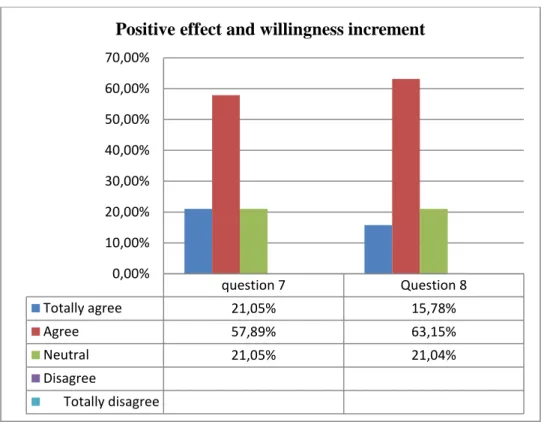
Figure 5.6: Quantitative results from questions 7 and 8 (section B)……… 57
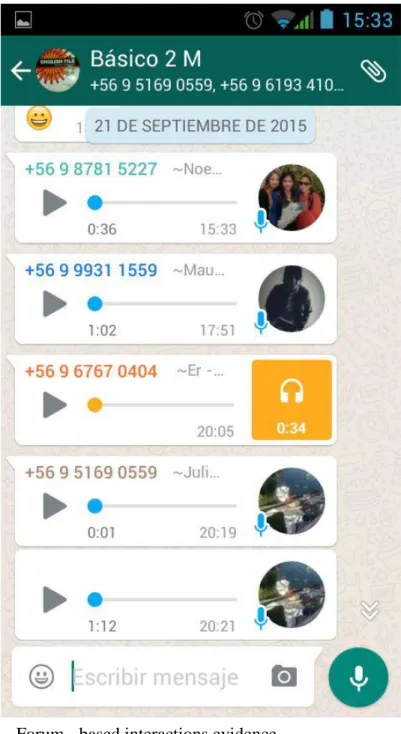
Figure 5.7: Forum - based interactions evidence……….62.
Figures 5.8:Forum - based interactions evidence……….……63
Figures 5.9:Forum - based interactions evidence……….………. 64
Figure A1: Evidence of forum feedback ………. 136
Figure A2: Forum sample ……….137
Figure A3: Further evidence of forum based interactions ……….137
SUMMARY
This research project explores the alleged benefits of voice messaging via
WhatsApp to strengthen willingness to communicate during whole class
discussion. The study took place at language institute and 19 adults with an
elementary level of English participated. To implement the system 2 WhatsApp
groups were created, one for each section, and 3 related interaction resources were
designed. The resources names were: Recording opinions via voice messaging
prior group in-class conversation, providing remote homework assistance through
voice messages and voice messages - driven forums. The intervention lasted little
more than a month. After data analysis it was concluded that “recording opinions before group discussions” and “homework assistance” had not been very
successful. However, there is some evidence that support the idea that forum
based activities using voice messaging sparked a moderate level of willingness to
RESUMEN
Este estudio explora los aparentes beneficios de la mensajería de voz a través de
WhatsApp para aumentar la voluntad de comunicarse durante discusiones que
involucran a toda la clase. El estudio se realizó en un instituto de idiomas y conto
con 19 participantes los cuales tenían un nivel de inglés elemental. Para
implementar el sistema se crearon 2 grupos en WhatsApp, uno por cada curso,
además se diseñaron 3 recursos de interacción. Los recursos fueron llamados:
grabación de opiniones por mensajes de voz, asistencia remota para tareas usando
mensajería de voz y foros generados por mensajería de voz.
La intervención duro poco más de un mes y luego de la recolección de datos se
concluyó que grabar opiniones y asistencia remota para tareas no fueron
efectivas. Sin embargo, hubo evidencia que los foros generaron un moderado
grado de voluntad para comunicarse como también se sugiere que podían ser
DESCRIPTION OF THE PROBLEM
The issue that is addressed in this study is students’ resistance and dearth of
enthusiasm to produce oral language in class discussions which might stem from
affective factors. Through the use of voice messaging the aforesaid factors might
be presumably mitigated so as to make learners feel more at ease to produce oral
language. In turn, more confidence would be allegedly and gradually built to take
part in activities with less fear or anxiety.
There are many reasons that sparked this project. First of all, there’s the
ubiquitous feature of the WhatsApp application in people’s lives which might be
beneficial to generate some willingness to utter opinions orally during class. Technology in general has found its ways to permeate every aspect of one’s life
and it seems adequate to integrate these tools in language learning and to take
advantage of them.
Another reason would be the ever increasing need that teachers of English have in
this department and their struggle to make learners dare make mistakes or simply
to say something when a question is put forward.
A further motive would be the limited number of studies conducted around M.A.L.L (Mobile assistance Language Learning) particularly WhatsApp voice application feature. Hence, this research might contribute to understand the usefulness and the promising qualities of the aforesaid technology. Finally, the whole text is organized in chapters which are preceded by introductory
MAIN OBJECTIVE
The main objective of this research project is to assess to what extent voice messaging boosts willingness to take part in oral whole class discussions.
SPECIFIC OBJECTIVES
1- Establish if allowing students to send their opinion through a voice message instead of giving it in front of the class has a positive impact on their willingness to subsequently provide their opinion with fewer restrictions during whole class oral activities.
2- Discover whether providing oral homework assistance through voice messaging interactions increases willingness to give opinions in whole class discussions.
3- Determine the relevance of forum based oral activities using voice messaging to increment students’ willingness to utter opinions and lessen affective factors during whole class discussions
RESEARCH QUESTIONS
1.1 REFERENTIAL FRAMEWORK
1.1.1. USE OF TECHNOLOGY IN LANGUAGE TEACHING
As time elapses, one gets cognizant of the fact that technology becomes more and more omnipresent and every single aspect of people’s life is shaped by
unrelenting flares of it. Education and of course language learning are not the exception. There is Computer assisted language learning (CALL), for instance, which seemed revolutionary at the beginning
Nowadays, there are several claims of the existence of an online pedagogy none
of which appear too convincing as Colpaert (2006) concluded. He defines online systems for language learning as having the capacity to render one’s approach more effectual when analysing which tools, softwares or components were more telling for designing language courses.Similarly, Zhao (2003) expresses the general positive effect of language learning. He even points out that there’s some although limited evidence advancing that technology-driven teaching could be as equally efficacious as mainstream teaching
Gilakjani (2012) claims that the use of multimedia in language teaching can allow students to enhance their comprehension about the target language. Amaral & Meurers (2011) explain the benefits of using technology in language learning classroom arguing that these tools provide contextualized, as well as
In the same vein, Bidabadi (2013) argues that the use of motivational computers in EFL contexts would increase students’ self-esteem and thus a better attitude to learn a foreign language would ensue.
Amaral and Meurers (2011) explain that computers have been extensively employed in EFL to aid students interact with the language and its cultural
aspects. They go onto say that the myriad of technological tools provide instances to use English in a contextualized and meaningfulfashion. Now, another more recent trend has welled up in the light of this aforesaid unflappable disruption of technology, namely Mobile Assisted language Learning (MALL).
There are more cautious voices though such as Salaberry (2001) who studied historic reviews of papers published in the Modern Language Journal, allegedly one of the most prominent journals in Foreign language learning (EFL).He points out that while technologies such radio, TV, VCR and the PC were hailed as a powerful contribution in people’s lives there is not enough evidence to adamantly avert that they have had an equal level of attainment when it comes to second language teaching. He advocates for a healthier, more sceptical and critical approach when it comes to new technologies and their usefulness in the field. He highlights that one shall not jump to conclusions and that new technologies must be circumspectly surveyed before labelling as effective.
1.1.2. M.A.L.L
As it was hinted earlier MALL is rapidly becoming a very popular trend. New applications and technological means are replacing old ones such as plain old - fashioned messages or blogs. Thus, thescope of mobiles phones seems rather unlimited and quite promising when it comes to language learning. Kukulska-Hulme, A. (2009) explicates how technology has permeated every aspects of human existence. She also points out that getting text messages outside classroom time to aid learning can be a positive endeavour.
Valarmathi (2011)concurs withKukulska-Hulme and observes how mobile learning is rapidly evolving. She comments on the idea that computers are better than mobiles phones in many ways though the mobile stand out regarding the portability feature. They can be use almost everywhere which allows students to go through practical small bit of language and exercise them.
Burston (2013) holds concerns on the topic being discussed saying that there are
not a lot of studies on MALL. He- therefore - launches onto writing a
bibliography or record of all the investigations carried out in the area. He defines
MALL as learning that takes place with the help of mobile devices such as:
pocket electronic dictionaries, personal digital assistants, mobile phones as well as
1.1.3. SOCIAL NETWORKS
As has been formerly implied the use of social networks has had a widespread impact on today’s society (Donmus 2010). Interaction patterns and
communication have somehow evolved and have been blatantly altered by social
networks irruption. In the same vein, mobile phones have become so momentous in people’s lives that one feels that one’s limb is missing when these devices are
lost or forgotten.
When analysing the positive and negative side of using social networking in language learning classrooms Md Yunus, Salehi and Chenzi (2012) observe these tools in ESL writing lessons can be helpful to expand contents, boost students’ drive to learn and nurture their confidence to write or learn how to do it in English. They also seem to concur with the idea that using social networks in language learning environments ignites interaction or at least a chance for it to come to pass.
As with the negative aspects of using the formerly mentioned communication
channels the aforesaid investigators determined that learners were bound to get
distracted when usingtechnology. They noticed that internet access and the
1.1.4. WHATSAPP
WhatsApp is a popular mobile phone application designed to be used in smart
phones. People that make use of this platform are able to exchange pictures,
videos, songs and audio files. This programme is compatible with phones that
work with Android, Blackberry OS and Widows phones among others. Alsaleem
(2014)
According a study presented in Harvard University in 2014 conducted
byAlsaleem (2014) in the light of writing skills enhancement WhatsApp appears
to be enjoyable for students, feature that lets them use this platform for learning
purposes. This project which was developed in an undergraduate environment also invites teachers to ponder upon the potential value of using WhatsApp to strengthen writing skills such as lexical choice.
In a study conducted in India Bansal and Joshi (2014) investigated students
attitudes towards the use of WhatsApp based interactions among students and
teacher outside the class. The subjects were a group of 37 people whose degree
would be Bachelor in educations. During data collection and analysis the students
expressed favourable views towards the integration of WhatsApp in the
curriculum. They also regarded this application as being helpful for cooperative and team work which are areas that are not entirely exploited in mainstream learning.
One thing yielded in the same study was annoyance from a minor married group
being fonder of traditional lessons and commented on how constant beeps on their
mobiles were rather irksome.
1.1.5. VOICE MESSAGING
As it was mentioned earlier this project was thought and developed with the
intention of lowering anxiety caused by the mere act of speaking in public or in
front of peers. Therefore, a less threatening system to elicit oral production was
designed using voice messages. Traditionally these kinds of applications have
been categorized as synchronous interactions which happen simultaneously and
asynchronous interactions which appear not to spark an immediate response
(Miyazoe and Anderson 2012). Taking advantage of such non-simultaneous
format was one of the underlying objectives of this work. The sheer idea of
emulating the writing process by eliminating the immediacy factor of oral
production was supposed to generate less anxiety, more confidence and
willingness to provide discourse.
As regards the utility of voice messaging Vetter and Chanier (as cited inMiyazoe
and Anderson 2012) submitted that a blend between written and voice messaging
was useful to make students feel empowered to produce oral language. Kim
2.1. THEORETICAL FRAMEWORK
2.1.1. INTERACTIONIST THEORY
This investigation is acutely underpinned by The Interactionist Theory of
language acquisition for it relies on the idea that language development is deeply
affected by the environment. As it is known the interactionist theory does not only encompass outside influences in language acquisition meaning environmental stimuli but it also envelops innate factors to explain this process. As Larsen- Freeman and Long (1991) point out these theories “invoke both innate and
environmental factors to explain language learning” (p. 266) which is a point also remarked by Mitchell and Myles (2004)who say that “ For the most part,
this'interactionist' perspective does not challenge the concept of an autonomous language module or cognitive mechanisms at work within the individual learner, which develop the interlanguage system by analysing and processing
environmental language in a variety of ways” (p. 159).
Thus mere exposure would not be enough for people to acquire or learn a language but interaction with other individual would of uttermost saliency (Ghazali, 2006)
The former idea is also supported by Vygotsky who argues that language is a social construction (as cited in Watson-Gegeo& Nielsen 2003)
According to the Common European Framework of Reference for Languages through the TKT glossary“Interaction” is defined as a two-way exchange between
The former act can also include a reader and the text itself. However, interactive
strategies are so-called techniques employed in oral production to maintain
individuals engaged when communication is taking place for example, eyes
contact, gesturing, repetitions, clarifying.
Among interactionists Long’s Interactionist hypothesis appears to be striking and
influential. Long states (as cited in Mitchel, Myles & Marsden, 2013) that the
environment contributes to language acquisition but he suggests that these contributions are influenced by the learner’s selection means and their second
language processing skills. He also argues that the aforesaid mechanisms yield the
most meaningful results during negotiation of meaning, which is just another way to define one form of interaction. Longalso draws onFeedback, particularly negative one, received during interactions or later. He explains that negative feedback could aid the development of a second language, especially concerning to lexical items, morphology and specific syntactic features. As for contrasting L1 and L2 the aforementioned type of feedback is said to be essential. The issue of corrective feedback will be analysed later on.
As for studies conducted on the interactive approach Mitchel, Myles and
Marsden 2013 emphasize that researches continue to focus on it and that there is a
great deal of evidence that support the notion that interaction can foster or
Furthermore, there is some evidence provided by Trofimovich and Ammar,
Gatbonton (as cited in Mitchel, Myles and Marsden 2013)pointing out that second
language interactions not only appear to facilitate acquisition but they would also
allow learner to exercise their memory retention, analytic skills and attention
capacity.
As it was formerly established in previous sections,the aim of this project is
toassess to what extent voice messaging increases students’willingness to
participate in oral whole class discussions.Considering the objective of the study the Interactionist Theory is thought to be suitable to support this research because it merges both cognitive and environmental factors to explain language
acquisition. As Larsen – Freeman and Long (1991) insist, there are many
2.1.2. DIRECT FEEDBACK
One of the strategies employed during the intervention was providing corrective feedback which was given orally after each of the seven forum events. A
Questionwould be posted in the WhatsApp group for students to respond to orally. A model would be given either in class or by means of the application itself using a voice message. After that, students would react to the question displayed while being at home. Once all the messages had been posted or sent, the teacher would provide feedback using a voice message sent to each of the
participants. The feedback would be related to grammar issues and lexical
problems shown. Positive feedback would also be given to each student within the same voice message so as to reinforce their confidence and not to damage or negatively affect their willingness (The issue of willingness will be dealt with in the next section). Historically, the role of feedback has been rather controversial and researchers have had some restrictions on its effectiveness in language learning. Truscott (as cited in Farrokhi & Sattarpour 2012) questions the usefulness of providing correcting feedback. He goes as far as labelling it as detrimental.
Less radical views such as Long (as cited in Mitchel, Myles and Marsden 2013)advances that including feedback plus appropriate interaction in second
language yields negative evidence which is information given about sentences
students’ discourse, can aid them to beware of the differences between their L2 (second language) defective utterances and the expected or ideal structures in L2. Similarly, Ammar and Spada (as cited in Mitchel, Myles and Marsden 2013)show evidence concerning the valuable nature of corrective feedback for L2 instruction
environments.
In accordance with what has just beenpointed out, Lyster &Saito;Russell
&Spada(as cited in Mitchel, Myles and Marsden 2013) concludedthat continuous feedback given orally, as the one used in this study, is more beneficial in language learning than not giving any type of feedback at all, findings that stand in outright opposition to Truscott’s views. In other words, Truscott’s perspective on feedback provision seems to be rather limited and does not reflect the treatment and
conceptualization of feedback raised by the researcher in the present study. 2.1.3. WILLINGNESS
Willingness to communicate (WTC) in English has always been a fascinating
topic especially from a pedagogic point of view. It seems an absolute mystery
why some people are unduly afraid to make mistakes which hinders oral
production altogether. It was this allegedly pervasive quality of WTC which
prompted the development of this project. It appears that it is simpler to do
something that one is good at than doing something you are not. It was thought
that by altering or removing the immediacy of a two-way interaction and by
scaffolding the speaking process through voice messaging subjects would perhaps
be more willing or would show increased levels of participation, as far whole
Some authors as Maclntyre, Dornyei, Clement, Noels (1998) go as far as
describing WTC as being so strikingly ubiquitous that he would dare write off a language programme devoid of any yearning to foster WTC as a failure.
Maclntyre et al. (1998) also hold that willingness to communicative involves a demeanour like- intention, for instance one can engineer discourse when the chance arises.
Behavioural patterns and intentionality belong to the field of psychology and from that perspective the Theory of planned Behaviourconstructed by Ajzen (as
citedMaclntyre et at. 1998) is one of the most well-known theories in this area. The former set of principles explains how situational behaviour is not mediated by free will alone but by the interaction with an interlocutor.
Now when dealing with willingness to produce oral messages McCroskey and Richmond (as cited in Kim, 2004) define it as predisposition, feature that is quite steady in a number of communicative scenarios. They also claim that willingness to communicate might as well depend on the situation; on that account
willingness would fluctuate in proportion to the communicative circumstances. Interestingly Kim’s (2004) found out that willingness to communicate bore features somewhat unchanging, rather than being mediated by the circumstance(s) where communication takes place, as least as far as the Korean context is
Finally, Maclntyre et al. (1998) hold that WTC appears to be situational rather than fixed though they do not disregard the last feature. Concisely put, WTC would be dependent on the circumstances where communication is to befall (situational –fluctuating influences) but there are also several unwavering factors that come into play such as affective factors (which are dealt with in the next sections), cognitive context (communicative competence, intergroup attitudes) and personality which would have a purported lesser impact (enduring
influences).
2.1.4. AFFECTIVE FILTER
One of the aims of this study was to essay to lower the affective filter or
emotional disturbances, if you will, so as to preserve of boost willingness using voice messaging. The idea of employing mobile phones which are suspected to be nonthreateningand massively used might be useful to affect these aforestated
emotional factors
acquisition by drawing on innate qualities that would trigger learning. He claims that individuals learn best when they are immersed in a non-threatening
environment thus their alleged filter would be lowered which would - in turn – spark acquisition. He makes allusion to motivation - variable that is also discussed in the next section- , anxiety, self-confidence and attitude to depict his
model,factors pointed out by Maclntyre et al. (1998)too. Needless to say, the Affective Filter theory appears to be relevant to the present study and can be sustained within the Interactionist theory.At any rate, Krashen’s innate- driven contributions would not seem alien to Interactionists since The Interactionism embraces both environmentalist and innate theories of second language acquisition.
Along the same vein, it was the culprit of this exploratory study to make a bit to diminish some of those affective influences through the use of technology due to its acute effect on language learning. It is reckoned that having access to express ideas orally through a mobile device would perchance lessen any possible
emotional distractors and allow learners to convey ideas and feel less threatened.
2.1.5. MOTIVATION
As posited above, motivation is one is of the forces that breeds WTC or as Mizruchi (as cited in Gass & Selinker, 2008, p. 431) spoils it. Likewise, Krashen (as cited in Gass & Selinker, 2008) brought it forward to explain his affective filter theory.
Historically, motivation has been vastly discussed and studied thus there are some models that have been widely accepted, namely the one proposed by
Dörnyei(2005) (as cited in Gass & Selinker, 2008, p. 430). He divides motivation in 3 stages:
- Preactional stage entails intentions, goal, starting a course of action - Executive Motivation includes executing ideas, continuous judgment of
one’s accomplishments and action adjustment
- Motivational retrospective involves creating standard courses of action, assessment and future planning.
As has been discussed earlier, WTC deals with intention hence it is directly connected to motivation predominantly in the preactional stage.
Garner Gardner (1985) (as cited in Gass & Selinker, 2008, p. 426) divided motivation in four pivotal parts which are: an aim, a hankering to obtain the aim, arduous endevours, and positive attitudes about the task to be performed.
Additionally, Garner - as well as Maclntyre whose work has already been singled out within this study - concurred on the idea that motivation is an intricate
anddealt with here are the ones that are regarded as salient for the context of the research project based on informal classroom observation.
2.1.6. SCAFFOLDING
As it was previously declared, this project sought to explore the possible benefits
of shifting the simultaneity of in- class communication by the inclusion of
pondering time and modelling, as well as catering for their interests and lowering
the complexity of face-to-face oral exchanges. By making these above mentioned
accommodations it was speculated that willingness to communicate could perhaps
rise.
As to some background information on scaffolding, Wood, Brunner and Ross (1976) introduced the concept from Vygotsky’s explanations on the way learning
takes place which it would as a consequence of the aid provided by a more
experienced or more well-informed person. Wood et al. (as cited in Ko, Schallert
and Walters. 2014) believe that these individuals ignite learning internalization
processes in the light of what it is being taught. Moreover, the aforementioned
authors name six scaffolding undertakings to illustrate the assistance given by a
more well-versed party, such as:making use of students’ interests, making the task
simpler, emphasising its momentous characteristics, preserving engagement and task direction, channelling student’s thwarting, and modelling. From the allotted
list the first two and the last appear to be prominent for the present investigation
for models were given before class discussions and forum based activities. In the
appealed by technology or at least felt comfortable using it by virtue of their
owing a portable mobile and their access to WhatsApp application.
One of the driving forces behind this project was the assumption that by using
something learners felt so at ease and familiar with would help weaken damaging
emotional factors (affective filter) and therefore willingness to communicate
orally in the classroom would be ignited or boosted.
Finally, when deciding whether it would be possible and sensible to link Vygotsky’s socio – cultural perspective with interactionist theories the answer
would be “yes”. In fact
Sarem and Shirzadi (2014) markedly state that single out as an interactionist. Vygotsky (as cited in Sarem and Shirzadi, 2014) “believed that higher psychological functions, such as learning, develop in interaction between
3.1. METHODOLOGICAL FRAMEWORK
3.1.1. EPISTEMOLOGICAL AND ONTOLOGICAL ASSUMPTIONS
This research is supported by Constructivism since it views reality as a social
construction forged and altered by individuals. It acknowledges that matters and
reality are subjective and that the latter doesn’t only influence people or produces
a constraining effect but it is continually changing (Bryman 2008).These
aforesaid shifts or fluctuations are man –made as issues are progressively
evolving. Willingness – the focus of this study – can be said not to be a static
phenomenon but rather subjected to variations as it can be analysed thought people’s insight (Bunniss & Kelly, 2010).
Contrary to positivism, the ontological assumptions declared above accept that
any world experiences being explored are value – laden and would be deeply outlined by people’s cognitions of their environment or of a certain problem.
From an epistemological perspective this work takes an interpretivist
stancebecause it was carried out with the notion that the scientific method might
not be tailor- made in social sciences(Mackenzie and Knipe, 2006). Thus by learning about a group of students’ perceptions on the use of technology, social
issueslike the one that the present research explores, could be better fathomed by
going deeper into it rather than touching the surface of it, as it were.
As this study has interpretivist foundations it relies heavily on a triple
interpretation of willingness to participate in oral discussions. The first level being
studied. Then, there is the interpretation made by researcher of those findings and
the last level entails an interpretation of results in relation to theories and existing
knowledge in the area. (Bryman 2008).
3.1.2. METHODOLOGY AND DESIGN
Methodology is loosely an encompassing style to conduct research connected to an underlying paradigm (Mackenzie and Knipe, 2006).A mixed method approach is used here since it is the best way to approach the issue that is being investigated because it provides numerical data which helps comprehend the problem being addressed on a surface level. Then a deeper understanding of students’
willingness to take part in oral whole class discussion is yielded- in other words their perceptions are unearthed. Focus group provides detailed information, instrument that was designed following the preliminary findings of data obtained through the survey. As constructivists point out studies framed in this world assumptions are to consider either qualitative methods or a mix method approach which is a blend of qualitative and quantitative methods and analysis of data (Mackenzie and Knipe, 2006).
1988). Creswell (2009) expresses similar claims in favour or a mixed-methods approach.
The type of designed employed is exploratory taking into consideration that a type of relatively new set of classroom activities was used and even when there are many investigations about the use of voice messaging there are not many that deal with WhatsApp application and its voice messaging feature. Much less are there studies that explore this application in relation to willingness to engage in oral discussions. Hence, exploration seems to be a good word to label what was done throughout this project.
3.1.3. DATA COLLECTION
Method is defined as organized means and tools to collect and analyse
information (Mackenzie and Knipe, 2006).As it was declared earlier methods utilized by the researcher was a survey and a focus group.
A questionnaire as Brown puts it (as cited in Dörnyei, 2003) is an overall word that encompasses surveys. He outlines questionnaires as data collection
instruments that contain a number of either interrogative or affirmative sentences in written form which are given to a group of subjects. In turn they must react by proving written responses or choose from a poll of existing answers.
The survey applied for this enquiry has 30 statements which were divided in three dimensions called sections. DimensionsA and B gather information pertaining to the three specific objectives listed below:
1- Establish if allowing students to send their opinion through a voice message instead of giving it in front of the class has a positive impact on their willingness to subsequently provide their opinion with fewer restrictions during whole class oral activities.
3- Determine the relevance of forum based oral activities using voice messaging to increment students’ willingness to utter opinions and lessen affective factors during whole class discussions.
Dimension C was designed to generate data as regards the general impact of voice messaging might have had in students’ willingness to utter opinion in whole class discussions as well as the utility of this technology. In other words it addresses the main objective which is:
To assess to what extent voice messaging boosts willingness to take part in oral whole class activities/discussions.
Each dimension has 10 statements which have five possible answers to choose from in a Likert style. An example is given below which is question number six from dimension/section “A”:
El hecho de no haber utilizado la mensajería de voz antes de las discusiones grupales me impulso a participar en las discusiones que involucran a toda la clase.
The second method collect data was a focus group. Cohen, Manion and Morrison (2007) delineate focus groups as a tool to obtain data that is encompassed within interviews. In other words, they are one kind of interviews. They rely on
interaction among a group of people that provide or verbalize their take on a certain issue. The idea is to generate a group perspective therefore communication among group member is of uttermost importance so as to yield a collective vision. It is from and due to the aforesaid interactions that information can well
up(Cohen, Manion and Morrison 2007).
After having applied the survey, an initial analysis was carried out. Data was tabulated conducive to having an initial frame of reference which was instrumental in designing the focus groups.
Eleven questions were got after having examined the results of the survey. After receiving feedback from experts the number of questions was reduced to nine. One of the discarded questions was deemed irrelevant in the light of the objective of the study and the other was thought to be redundant or repetitive. The final list of questions was presented in a power point presentation to the sample group process and it was recorded using a video camera. An example of a question from the focus group is shown below:
3.1.4. SAMPLING
The study was conducted in a language institute in Concepcion which has a universe of around 600 hundred students. There are about 12 elementary courses which are divided into Basic 1 and Basic 2. This research involved Basic 2 level of which there are around 6 within the institute. Each course has between five to twelve students. Out of those six Basic 2 courses twogroups were selected to be part of this investigation. The reason behind this alleged selection was that the researcher had access to these two groups due to his involvement with them as a teacher of English. Each course has a letter to differentiate them the rest for administrative purposes and the groups that took part in this research were Basic 2D and Basic 2M.
Basic 2D had 10 students one of which dropped out during the middle of the course however he was participated in the activities and the survey.
Out of the 10 people mentioned above 3 were women and 7 were men. Their ages ranged from 23 to 32 approximately. Four of them were students and 6 of them were professionals out of those 6 four of them were engineers.
The second course named Basic 2M had 11 students, 5 of which dropped during the middle of the course though 9 answered the survey and were part of the activities that were designed for this project.
All in all one can safely say that the 19 students were the first sample and 19 students answered the survey as it was formerly hinted.
Cohen, Manion and Morrison (2007) describes the word sample as being a more reduced group whose views and perspectives or information they supply might be representative of the whole universe if selected accordingly.
As with the focus groups one in each group was conducted and in each was carried out with 4 individuals.
A convenience sample was used in both instances both for the survey and the focus group itself. This type of sample procedure is explicated by Cohen et al. (2007) as one kind of non-probabilistic sampling procedure. It entails drawing on the people that are close at hand or the ones that are available when data
collection is to transpire. This type of sample does not aim to yield generalization about large groups of individual other than the group itself.
3.1.5. VALIDATION
Validity in its simplest form can be said to be evidence that shows that an instrument gauges what it should gauge. More precise definitions suggest that there is qualitative and quantitative validity. With respect to qualitative data validity, this may be seen - for instance - considering how honest, deep, rich information gathered can be, as well as its range. From a quantitative perspective validity could be enhanced via circumspect sampling procedures, suitable
To ensure content validity – which has to do with showing that the instrument includes the topics and concepts it says it includes (Cohen, Manion and Morrison (2007) - both the survey and the focus group questions underwent the judgment of experts. This process entails the informed opinion of experienced people in the area of enquiry.These people have usually been singled out by others experts as to be qualified. The experts can provide data, evidence judgements and valuations (Escobar-Pérez and Cuervo-Martínez 2008)
The 2 experts chosen for the present study were teachers from Universidad del Bio Bio in Chillan who have postgraduate studies. Both instruments were altered or modified ever so slightly after having received them back.
3.1.6. ETHICAL CONCERNS
One of the first things that were considered involving ethical issues was the informed concerned procedure. A document containing a set of aspects borrowed from Bryman (2004). For this project this document was printed and handed in to participant and it included the following information:
The nature of the project The rationale for the study The name of the researcher
Another ethical issue that was catered for has got to do the way the institution - where this project was developed- was addressed throughout these pages. Readers will only be able to know that the institution is an English institute located in Concepcion.
One final ethical consideration refers to the neutral way the researcher approached data analysis so as to avoid skewness.
4.1. QUALITATIVE AND QUANTITATIVE DATA ANALYSIS DESCRIPTION
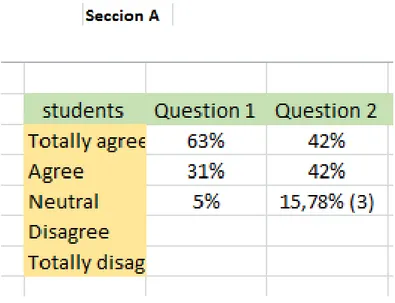
Once the survey was applied the results were tabulated in two different ways. The
first tabulation was used to get percentages. A sample of this process is shown
below:
Table 4.1.– Percentages Tabulation
This process was carried out using an Excel sheet and a formula to get each
percentage. Once every percentage was obtained the survey values per each
question were put in another Excel sheet in order to get the Mean, Mode and The
Standard Deviation. Analysing data in this manner is called Descriptive Statistics
(Gay, Mills, and Airasian2012). A sample of the previously mentioned process is
Table 4.2 – Tabulated values
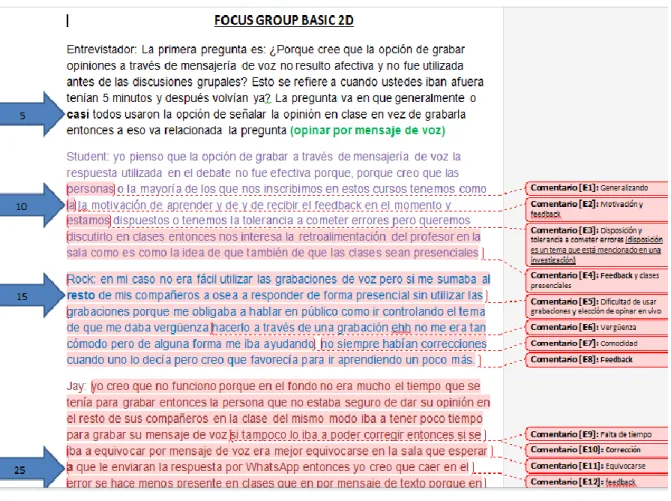
As for qualitative data categorization and coding were used. Figure 4.1 shows a
preliminary categorization stage in other words open coding process. A large
Figure 4.1 – Sample of Coding process.
Subsequently, mayor themes were identified and put together as categories. This
process is sometimes done using an inductive approach that is to say collecting
data rather freely with some macro guidelines but in the present study a deductive
approach was employed. Categories were taken and built from the research
objectives as well as the empirical and theoretical framework. (Osses, Sanchezand
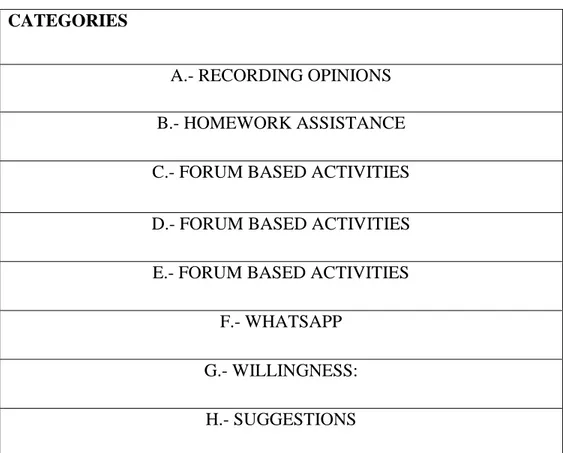
Table 4.3. Preliminary categories
The next stage was to reduce the numbers of categories which was a process that
was unwittingly made or unplanned but it made sense when thinking about the
objective and specific objectives or considering how were they going to be
approached later in the discussion section.
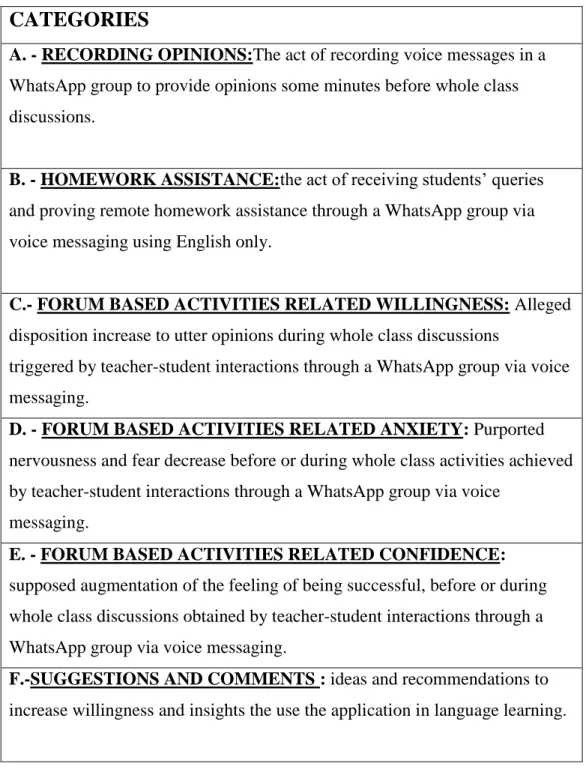
The final list of categories and their conceptualization stand as follow: CATEGORIES
A.- RECORDING OPINIONS B.- HOMEWORK ASSISTANCE C.- FORUM BASED ACTIVITIES D.- FORUM BASED ACTIVITIES E.- FORUM BASED ACTIVITIES
F.- WHATSAPP G.- WILLINGNESS:
Table 4.4. - Final categories
CATEGORIES
A. - RECORDING OPINIONS:The act of recording voice messages in a WhatsApp group to provide opinions some minutes before whole class discussions.
B. - HOMEWORK ASSISTANCE:the act of receiving students’ queries and proving remote homework assistance through a WhatsApp group via voice messaging using English only.
C.- FORUM BASED ACTIVITIES RELATED WILLINGNESS: Alleged disposition increase to utter opinions during whole class discussions
triggered by teacher-student interactions through a WhatsApp group via voice messaging.
D. - FORUM BASED ACTIVITIES RELATED ANXIETY: Purported nervousness and fear decrease before or during whole class activities achieved by teacher-student interactions through a WhatsApp group via voice
messaging.
E. - FORUM BASED ACTIVITIES RELATED CONFIDENCE: supposed augmentation of the feeling of being successful, before or during whole class discussions obtained by teacher-student interactions through a WhatsApp group via voice messaging.
Since categories were identified and put together,sub- categories were to be
elicited from the transcripts. Transcripts yielded hundreds of codes and those
codes were grouped in a process called axial coding from which sub-categories
were found (Osses, Sanchez and Ibañez2006).
The complete set of categories, sub-categories and their conceptualization is
CATEGORIES
SUB-CATEGORIES
A
RECORDING OPINIONS:The act of recording voice messages in a WhatsApp group to provide opinions some minutes before whole class discussions.
A1. - Face to face interactions:
Interactions that take place within the class between students without using
technology to exchange ideas.
A2. - Feedback: Comments and suggestions given by the teacher to
enhance or positively reinforce stretches of language or a given performance.
A3. - Mistakes: stretches of language or single lexical items that contain linguistic flaws.
B
HOMEWORK ASSISTANCE:the act of receiving students’ queries and proving remote homework assistance through a WhatsApp group via voice messaging using English only.
B1. - Language difficulty: Obstacle faced by elementary level students that employ remote assistance system using English.
B2. - Artificiality and slowness of interactions: features found in some related App based interactions. C
FORUM BASED ACTIVITIES RELATED WILLINGNESS: Alleged disposition increase to utter opinions during whole class discussions
triggered by teacher-student interactions through a WhatsApp group via voice
messaging. D
FORUM BASED ACTIVITIES RELATED ANXIETY: Purported nervousness and fear decrease before or during whole class activities achieved by teacher-student interactions through a WhatsApp group via voice messaging.
D1. - Scaffolding and preparation: Making the speech act less threatening as well as proving some kind of demonstration and preparation time and using technology to generate task interest.
D3. - Neutral impact: Failure to affect anxiety before or during face-to -face whole class discussions.
E
FORUM BASED ACTIVITIES RELATED CONFIDENCE: supposed augmentation of the feeling of being successful, before or during whole class discussions obtained by teacher-student interactions through a WhatsApp group via voice messaging.
E1.-Neutral impact: Failure to affect confidence before or during face-to- face whole class discussions.
Table4.5. - Complete set of categories, sub-categories and their conceptualization F
SUGGESTIONS AND
RECOMMENDATIONS: ideas and recommendations to increase willingness and insights the use the application in language learning
F1. - Practice: activities done inside or outside the class to reinforce knowledge or partially learned items.
F2. - Interest: inclusion of relevant and meaningful topics to hinder affective filters and yield more willingness to take part on oral face-to- face discussions inside the class.
F3. - Lexical growth: knowledge related to the increment of linguistic items.
F4. - Group cohesion: feeling of comfort
generated among members of a group.
F5- Incidental collaborative
group work: unplanned type of work or interactions among members of a group.
F6.-Alternative Feedback
The next stage was the selection of sample comments to add and exemplify each
subcategory. These, according to (Osses, Sanchez and Ibañez 2006) are called
coded phrases. The complete set of categories, sub-categories and coded phrases
are shown in table 4.6.
In order to decide what comments were worthy to be taken into consideration to
both build sub- categories and include as samples in the coded phrases section a
CATEGORIES
SUB-1.- “uno en la vida real cuando quiere hablar en inglés con una persona lo más probable que cuando lo tenga frente a frente le va a hablar de esa manera “
2.- “en mi caso no era fácil utilizar las grabaciones de voz pero si me sumaba al resto de mis compañeros a osea a responder de forma presencial sin utilizar las
grabaciones”
3.- “es más productivo prefiero volver a eso…. Como Hablar como “de verdad” en persona en vez de hablarle a la maquinita (indicando el celular”
4.- “ Yo pienso, para mí en mi caso fue más cómodo decir en… o hablar en la clase que grabarlo en el celular”
1.- “la mayoría de los que nos inscribimos en estos cursos tenemos como la, la motivación de aprender y de y de recibir el feedback en el momento”
A2. - Feedback
3.- “ …por ejemplo que lo discutamos en clases, intentemos hablarlo que nos corrijan “
4.- “…no siempre habían correcciones cuando uno lo decía pero creo que favorecía para ir aprendiendo un poco más”.
A3. - Mistakes
1.- “ si se iba a equivocar por mensaje de voz era mejor “equivocarse en la sala que esperar “
2.- “Yo creo que uno se puede equivocar y sabe que va a quedar grabado entonces…y podía ser como…”
3.- “…la mayoría de los que nos inscribimos en estos cursos tenemos como la, la
motivación de aprender y de y de recibir el feedback en el momento y estamos
B
1.- “…..la mayor herramienta que utilizamos en el WhatsApp grupal fue la mensajería de voz y como todo era en inglés también la pregunta había que realizarla en inglés entonces muchas veces eso complicaba cuando alguien quería preguntar algo porque nosotros estamos aprendiendo inglés….”
2.- “ Lo otro complejo es también hacer las preguntas, de repente uno se equivoca haciendo las preguntas”
3.- “Elvis: quizás no se utilizó mucho por el tema de que… haber… quizás se sentías no obligados…pero tratar de poder preguntarlo en inglés y se hacía más complicado. Bueno en mi caso yo le pregunte varias cosas.
B2. – curso es para aprender un idioma es tratar de poder, poder replicarlo y utilizarlo en la vida real entonces la mejor manera de simular un situación real es entrar a la sala y conversar la discusión que no es lo mismo que
mandarlo por mensajería de voz”
al teléfono siendo que la persona la tengo aquí (apuntando o señalando a como si hubiese alguien en frente de él)”
3.- “Para mí es raro hablar por WhatsApp, tienes que enviar el…”
1.- yo encuentro que si porque te hace más proactivo en el ámbito cuando uno entra a clases porque ya estas más acostumbrado…”
2.- “ …la voluntad de expresar, como dice la pregunta, también vendría un poco de la mano con la confianza entonces de qué manera ganamos confianza o tenemos más voluntad para expresar más cosas en clases yo creo que la única manera es a través de la práctica y de la de la experiencia de utilizar el inglés, utilizar el inglés, utilizar el inglés entonces cualquier herramienta que
utilicemos para para utilizar el inglés va a ser un granito de arena y va a ser un aporte en este caso el foro es un aporte si, como
también lo seria ver películas sin subtítulos o cualquier cosa todo suma en el fondo”
4.- “lo mismo pero no se para… en cierta parte tuvo, provoco eso tuvo ese impacto pero insisto el impacto más grande fue poder hablar en frente de todos ahí como que rompí un poco el hielo y pude tener más confianza a la hora de expresar la opinión”
1.-“yo encuentro que este ámbito fue más beneficioso porque uno tenía el tiempo de exponerlo bien, ósea pensarlo en un tiempo más detenido irlo procesando de a poco y después irlo soltando, cosa en clases no pasa porque uno se vecomo ahí en elmomento y a veces uno lanza y tira cosas no más en cambio uno en el foro se preparaba no exponía algo así.”
2.- ““ Student: eeee yo pienso con respecto a esto básicamente lo mismo que dijo Jay ósea las diferencias en niveles de ansiedad tienen mucho que ver con la comodidad que uno tiene para elaborar una respuesta en su casa con todo el tiempo del mundo, que pueda redactarla o no y no es lo mismo que cuando uno está en la sal de clases porque el
profesor te hace una pregunta y uno quiere intentar responder en ese instante de tiempo …”
tranquilidad puedes preparar la respuesta, puedes decir ensayarla, puedes buscar a través de internet….ósea hay una mayor y un ambiente más relajado en la casa y acá es mayor la tensión.
D2. - Neutral impact
1.- “ yo creo que era más ansiedad a la hora de decirlo en el foro que acá ”
E
1.- “No, yo pienso lo mismo la confianza aquí fue neutral porque, porque taba el tema de foro era, era tener un poco más de
contexto para poder empezar a decir las cosas, yo creo. Yo encuentro que la
confianza a mí no me aumento por el hecho de tener el, el foro….”
2.- “en mi caso como dije la confianza no aumento mucho….”
E2. - Slight impact
1.- “Yo creo que si mejoro la confianza porque yo creo que en fondo son cosas distintas el miedo a equivocarse y la confianza que uno tiene en uno porque yo creo que muchas veces el miedo a
equivocarse va como en la personalidad de cada persona…”
F
1.- “…entonces yo creo que es como andar en bicicleta cayéndose, cayéndose,
cayéndose, cayéndose, cayéndose pero si lo haces más seguido va a aprender....”
F2. – Interest
1.- “yo creo que definitivamente insisto con poner un tema del interés”
2.- “…. y eso lo que dice Justo igual es bueno creo porque quizás no son temas de interés mundial pero son más chistosos y el tema de ser más chistosos o más simpáticos a uno como que incentiva a participar un poco… no se…
3.- “hacia algo… ponían videos, quizás series tuve una profesora que vino de intercambio y ella ponía un serie inglesa y por lo menos así entendía más y no ponía los subtítulos en español y ponía los subtítulos en inglés por lo menos así te fijabas en la gramática y como se pronunciaba y también era como entretenido, se aprendía”
F3.-Lexical growth
1.- “Elvis: pero aun así el, el, la dinámica del foro servía harto por el tema de que uno también iba buscando nuevas palabras, te ayudaba a tener más vocabulario
Table 4.6. Categories, sub-categories and coded phrases. de mi mente.”
F4.- Group cohesion
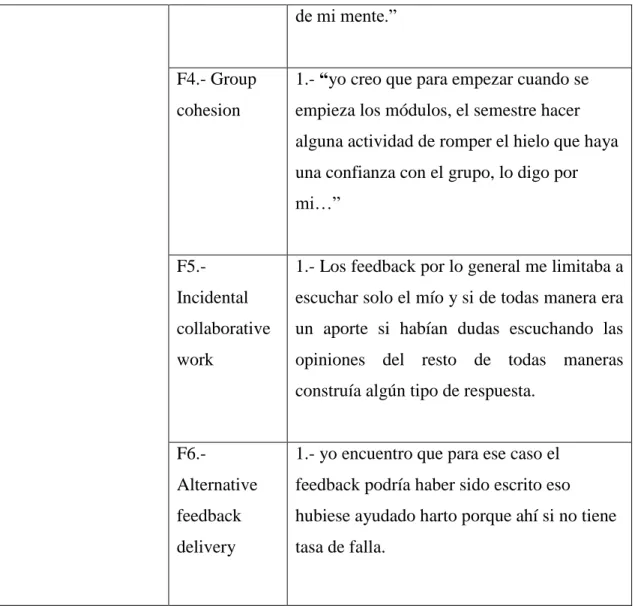
1.- “yo creo que para empezar cuando se empieza los módulos, el semestre hacer alguna actividad de romper el hielo que haya una confianza con el grupo, lo digo por mi…”
F5.- Incidental collaborative work
1.- Los feedback por lo general me limitaba a escuchar solo el mío y si de todas manera era un aporte si habían dudas escuchando las opiniones del resto de todas maneras construía algún tipo de respuesta.
Los feedback por lo general me limitaba a escuchar solo el mío y si de todas manera era un aporte si habían dudas escuchando las opiniones del resto de todas maneras construía algún tipo de respuesta. F6.-
Alternative feedback delivery
Table 4.7.
CATEGORIES
SUB-CATEGORIES
A
RECORDING OPINIONS
A1. - Face to face interactions
A2. - Feedback
A3. - Mistakes
B
HOMEWORK ASSISTANCE.
B1. - Language difficulty
B2. - Artificiality and slowness of interactions
C
FORUM BASED ACTIVITIES RELATED WILLINGNESS:
Summary chart with categories and sub- categories. F
SUGGESTIONS AND RECOMMENDATIONS
F1. - Practice
F2. – Interest
F3. - Lexical growth
F4.- Group cohesion
F5.- Incidental collaborative group work
5.1. FINDINGS
As this research follows a mixed methods tradition two distinct paralleled
sub-analyses were conducted one for the survey and another for the focus groups.A
copy of both the survey and focus group questions can be found in the Appendix
section labelled as appendix 1 and 2 respectively.As qualitative data provided
initial information from which the focus group was designed this section will start
by making reference to some questions from the survey. Little by little
survey-generated information- analysed through description statistics using Excel
programme- will be complemented with qualitative data that was obtained
through categorization and coding.
5. 2.
RECORDING OPINIONS VIA VOICE MESSAGING USING WHATSAPP PRIOR WHOLE CLASS SETTINGS
This heading makes reference the first specific objective that seeks to comprehend
the reason behind the ineffectiveness of the activity. At the beginning of the
project the idea was to discover if this type of settings would have an impact on
students willing to produce oral language or opinion during whole class
discussions. However, in the light of the lack of momentum generated through
such an idea and considering that students would not use it, it was decided to find
the culprit of its so-called unpopularity. The survey itself used a Likert scale and
was made up of 30 statements or sentences each of the statements had 5 options
quantitative values were assigned to each option so as to be able to use descriptive
statistics. Then, the mean and standard deviation were calculated for each
question.
5 Totally agree 4 agree 3 neutral 2 disagree 1 totally disagree
In section A of the survey students were asked to express possible discomfort
with the system about recording opinions, what was found out was that around
31% agreed to it and around 42% disagreed thus the main reason had not been
discomfort, one might venture. When they sample was asked to decide whether
the activity had been a bad idea to encourage them to give opinions 73%
disagreed with the statement. The next graph shows the abovementioned data. SD
Question 3. - Discomfort with activity Mean: 2, 7 SD: 1, 4 Mode: 1
Question 5. - Bad initiative to yield opinions Mean: 1, 7 SD: 0, 9 Mode:1
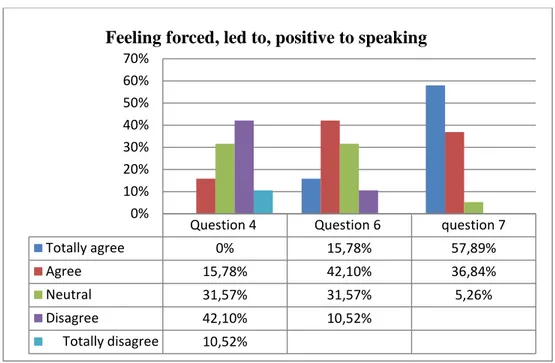
In a similar vein and regarding section A of the survey again, students were asked
to react towards more neutral sentences, namely 4, 5 and 6. Statement 4 required
them to decide whether the fact of not having used the system of recording
messages before discussions had forced them to express their opinions during the
whole class discussions. The results showed that only 15% agreed and 52%
disagreed. Then, the same issue was approached from a different angle and
theywere asked to decide if the mere fact of not having utilized WhatsApp to
provide their opinion before the discussions had made them participate by
Question 3 Question 5
expressing their views on the issue being addressed. To this students 57%
concurred and 31% remained neutral. Finally and again when it comes to section
A of the survey, learners were required to say if they thought the system or
activity that had been created was positive to develop oral production competence
even when they had not used it. Descriptive analysis showed that 57% concurred
and 36% remained neutral. The following graph depicts the aforesaid finding:
Figure 5.2 - Quantitative results from questions 4, 5 and 7
Question 4 Question 6 question 7
Totally agree 0% 15,78% 57,89%
Agree 15,78% 42,10% 36,84%
Neutral 31,57% 31,57% 5,26%
Disagree 42,10% 10,52%
Totally disagree 10,52% 0%
10% 20% 30% 40% 50% 60% 70%
Question 4. - Discomfort with activity Mean: 2, 5 SD: 0, 9 Mode: 2
Question 6. - Bad initiative to yield opinions Mean: 3, 6 SD: 0, 8 Mode:4
Question 7. - Bad initiative to yield opinions Mean: 4, 5 SD: 0, 6 Mode: 5
Once some preliminary conclusions were obtained and having seen for a fact that the activity had not been appealing for the subject, doubts began to cloud the horizon so the issue was tackled qualitatively. The question to be answer in the focus group session was about discovering the reasons the system had been inefficient and had not been used.
After having transcribed data obtained a category was developed marked with an “A” and called “Recording opinions” simultaneously 3 sub-categories were found which were called:
A1. - Face to face interactions
A2. - Feedback
5.3. PROVIDING REMOTE HOMEWORK ASSISTANCE VIA VOICE MESSAGING USING WHATSAPP
This heading corresponds to the second specific objective of this present studyand
it makes reference to some other questions from part A of the survey as well as
the qualitative data that was gathered afterwards.
From the outset of this investigation it was thought that remote homework
assistance could have an influence on willingness to express opinions on a whole
class environment. Be that as it may, the system that was designed was flawed
and again it was not massively used. Thus, it was decided that the rationale behind
their lack of zeal for the resource provided was to be discovered.
Statement 8 required subjects to express whether remote homework assistance
was useless to this 67% of the sample disagreed and 21% remained neutral.
For statement 10 people had to determine if remote homework assistance had
been a bad way to increment their willing to voice their take on a given topic
while whole class discussion were being conducted. To this 78% of the sample
disagreed.
Finally, in sentence 9, learners were invited to declare if they had used this remote
assistance system. Consequently, 25% said they had not employed but a
surprising 47 % took a neutral position.
Figure 5.3 - Quantitative results from questions 8, 9 and 10
Later on, more detailed information was gathered and students were asked to
assess the remote assistance system developed through focus group questions.
Also, subjects were invited to name the cause of their lack of engagement with the
system.
During data analysis one category was put together labelled “B” and called “Homework Assistance” naturally 2 sub-categories were developed too called:
B1. - Language difficulty
B2. - Artificiality and slowness of interactions
Question 8 question 9 question 10
5.4. FORUM BASED INTERACTIONS USING VOICE MESSAGING VIA WHATSAPP
5.4.1. ANXIETY
As in the preceding sections the first and second specific objectives were targeted,
the third will be aimed at here. In section B of the survey forums were to be
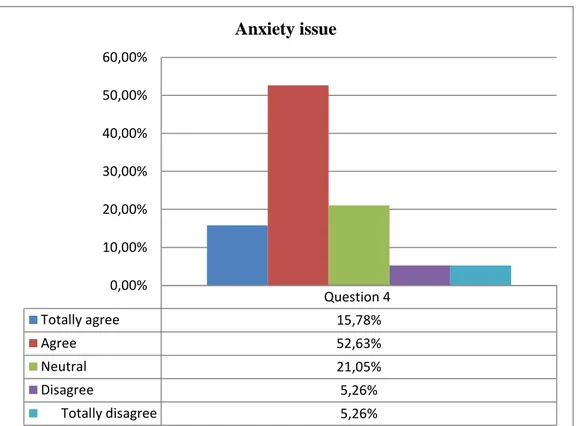
mused upon. In statement 4 subjects were expected to say if using forums had
diminished their anxiety of expressing themselves. Quantitative analysis shows
that almost 69% of students agree to the former idea and 21 remained neutral. The
following graph portrays the same information in a more visual manner.
Earlier conclusions indicated - as shown above - that there had been an impact on
anxiety and by virtue of such assumptions more in-depth data was collected by
means of qualitative questions in the focus group session. In question 3 from the
formerly mentioned instrument students had to compare their level of anxiety
during face-to-face whole class discussions and remote generated opinions
elicited via means of a voice messaging application. The idea was to try to
address part of the third specific objective that has to do with establishing the
significance of forum based activities to decrease affective factors such as
anxiety. With that in mind a new category originated which was labelled with a “D” and was named “Forum based activities related anxiety.” From that category
2 sub-categories hatched which are listed below:
D1. - Scaffolding and preparation
D2. - Neutral impact
5.4.2. CONFIDENCE AND WILLINGNESS
In section B of the survey there were 3 more questions that had to do with
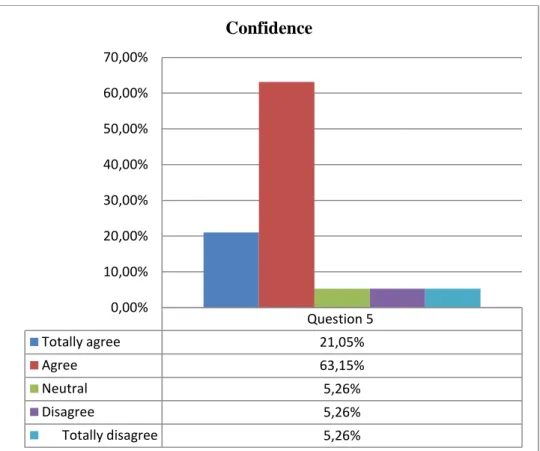
confidence and willingness. In question 5 subjects were supposed to agree or
disagree with the statement related to a presumable positive effect of forum based
interactions in their confidence to express opinions in whole class settings. What
was discovered was that 84% of the sample agreed with the statement as can be
Figure 5.5 – Quantitative results from question 5 dealing with confidence.
Question 5. – Confidence issue Mean: 3, 8 SD: 0.9 Mode: 4
Upon a more circumspect enquiry meant to fathom such allegedly startling
results, quite a different picture was found. A focus group question that was
meant to disclose their views on the idea that forums had had some impact on
their confidence to verbalize opinions in group classroom discussions. It was
learned that technology driven forums have mixed effects in the two groups. A
more detailed examination of this issue is to be found in the discussion section of
this study. In the meantime only the category that was produced during qualitative
be defined. The category is labelled “E” and it is called “Forum based related
confidence.” The sub-categories that unfolded from the transcription process are
as follows:
E1.-Neutral impact
E2. -Slight impact.
As for willingness 2 statements were shown to students to get information related to the possible impact in whole class debates generated owing to forum based interactions. The 2 questions belong to section B of the survey and they are 8 and 7. They address the same issue with different lexical tools. Initial analysis
detected was that 78% of the sample coincided that forums produce willingness to communicate when class discussions were being held, results that correspond to questions 7. As to questions 8, 69% of individuals are in accord with the idea of willingness boost.