
Astronomy
&
Astrophysics
A&A 614, A94 (2018)https://doi.org/10.1051/0004-6361/201731671
© ESO 2018
An outflow in the Seyfert ESO 362-G18 revealed by
Gemini-GMOS/IFU observations
?
Pedro K. Humire
1, Neil M. Nagar
1, Carolina Finlez
1, Verónica Firpo
2,3, Roy Slater
4, Davide Lena
5,6,
Pamela Soto-Pinto
1, Dania Muñoz-Vergara
1, Rogemar A. Riffel
7, Henrique R. Schmitt
8, Steven B. Kraemer
9,
Allan Schnorr-Müller
10, Travis C. Fischer
11, Andrew Robinson
12, Thaisa Storchi-Bergmann
10,
Mike Crenshaw
13, and Martin S. Elvis
141 Departamento de Astronomía, Universidad de Concepción, Casilla 160, Concepción, Chile e-mail:[email protected]
2 Departamento de Física y Astronomía, Universidad de La Serena, La Serena, Chile 3 Gemini Observatory, Southern Operations centre, La Serena, Chile
4 Dirección de Formacion General, Facultad de Educación y Cs. Sociales, Universidad Andres Bello, Sede Concepción, autopista Concepción-Talcahuano 7100, Talcahuano, Chile
5 SRON, Netherlands Institute for Space Research, Sorbonnelaan 2, 3584 CA Utrecht, The Netherlands
6 Department of Astrophysics/IMAPP, Radboud University, Nijmegen, PO Box 9010, 6500 GL Nijmegen, The Netherlands
7 Universidade Federal de Santa Maria, Departamento de Física, Centro de Ciencias Naturais e Exatas, 97105-900 Santa Maria, RS, Brazil
8 Naval Research Laboratory, Washington, DC 20375, USA
9 Institute for Astrophysics and Computational Sciences, Department of Physics, The Catholic University of America, Washington, DC 20064, USA
10Instituto de Física, CP 15015,Universidade Federal do Rio Grande do Sul, 91501-970, Porto Alegre, RS, Brazil 11Astrophysics Science Division, Goddard Space Flight centre, Code 665, Greenbelt, MD 20771, USA
12Department of Physics, Rochester Institute of Technology, 84 Lomb Memorial Drive, Rochester, NY 14623, USA
13Department of Physics and Astronomy, Georgia State University, Astronomy Offices, 25 Park Place Suite 605, Atlanta, GA 30303, USA
14Harvard-Smithsonian centre for Astrophysics 60 Garden St., ms.6, Cambridge MA 02138 USA
Received 28 July 2017 / Accepted 16 February 2018
ABSTRACT
We present two-dimensional stellar and gaseous kinematics of the inner 0.7×1.2 kpc2 of the Seyfert 1.5 galaxy ESO 362-G18, derived from optical (4092–7338 Å) spectra obtained with the GMOS integral field spectrograph on the Gemini South telescope at a spatial resolution of≈170 pc and spectral resolution of 36 km s−1. ESO 362-G18 is a strongly perturbed galaxy of morphological type Sa or S0/a, with a minor merger approaching along the NE direction. Previous studies have shown that the [OIII] emission shows a fan-shaped extension of≈1000
to the SE. We detect the [OIII] doublet, [NII] and Hαemission lines throughout our field of view.
The stellar kinematics is dominated by circular motions in the galaxy plane, with a kinematic position angle of≈137◦
and is centred approximately on the continuum peak. The gas kinematics is also dominated by rotation, with kinematic position angles ranging from 122◦
to 139◦
, projected velocity amplitudes of the order of 100 km s−1, and a mean velocity dispersion of 100 km s−1. A double-Gaussian fit to the [OIII]λ5007 and Hαlines, which have the highest signal to noise ratios of the emission lines, reveal two kinematic components: (1) a component at lower radial velocities which we interpret as gas rotating in the galactic disk; and (2) a component with line of sight velocities 100–250 km s−1higher than the systemic velocity, interpreted as originating in the outflowing gas within the AGN ionization cone. We estimate a mass outflow rate of 7.4×10⁻² M
yr−1 in the SE ionization cone (this rate doubles if we assume a biconical configuration), and a mass accretion rate on the supermassive black hole (SMBH) of 2.2×10⁻²M
yr−1. The total ionized gas mass within∼84 pc of the nucleus is 3.3×10⁵ M
; infall velocities of∼34 km s−1in this gas would be required to feed both the outflow and SMBH accretion.
Key words. galaxies: active – galaxies: individual: ESO 362-G18 – galaxies: Seyfert – galaxies: nuclei – galaxies: kinematics and dynamics
1. Introduction
It is now widely accepted that the intense radiation emitted by an active galactic nucleus (AGN) is due to accretion onto a
?The reduced datacube (FITS file) is only available at the CDS via
anonymous ftp to cdsarc.u-strasbg.fr (130.79.128.5) or via http://cdsarc.u-strasbg.fr/viz-bin/qcat?J/A+A/614/A94
supermassive black hole (SMBH;Lynden-Bell 1969;Begelman et al. 1984) in the mass range ∼106–109M
. However, the mechanisms responsible for transferring the mass from galactic (kpc) scales down to nuclear scales (sub-parsec) to feed the SMBH are still under debate. This has been the subject of many theoretical and observational studies (Shlosman et al. 1990;
Maciejewski 2004a,b; Knapen 2005; Emsellem et al. 2006;
Schnorr-Müller et al. 2014a,b,2017).
active galaxies of about 75% versus 57%, respectively (Knapen et al. 2000; Laine et al. 2002; Laurikainen et al. 2004). Fur-ther, structures such as disks or small-scale nuclear bars and the associated spiral arms are often found in the inner kiloparsec of active galaxies (Erwin & Sparke 1999;Pogge & Martini 2002;
Laine et al. 2003;Combes et al. 2014). In general, the most com-mon nuclear structures are dusty spirals, estimated to reside in more than half of active and inactive galaxies (71% and 61%, respectively;Martini et al. 2003).
Simões Lopes et al. (2007) reported a marked difference in the dust and gas content of early-type active and non-active galaxies: the former always have dusty structures and only 25% of the latter have such structures. Thus, a reservoir of gas and dust is required for the nuclear activity suggesting that the dusty structures are tracers of feeding channels to the AGN. This fact, along with the enhanced frequency of dusty spirals, supports the hypothesis that nuclear spirals are a mechanism for fueling the SMBH, transporting the gas from kiloparsec scales down to a few tens of parsecs of the nucleus.
Accretion onto the SMBH requires the removal of angular momentum, which can be achieved not only through gravita-tional torques, but also via outflows or winds (Bridle & Perley 1984). The most powerful of these outflows are produced by the interaction between the ionized gas and magnetic field (Bisnovatyi-Kogan & Lovelace 2001) reaching velocities of up to 1000 km s−1 (Rupke & Veilleux 2011; Greene et al. 2012) and outflow rates several times larger than host galaxy star for-mation rates (SFR; Sturm et al. 2011). Massive AGN-driven outflows have been observed in many AGN, from Seyfert galax-ies to quasars at low (Morganti et al. 2007) and high redshifts (Nesvadba et al. 2011), and could dramatically affect the evo-lution of galaxies due to the large amounts of energy they feed back into the interstellar medium (Di Matteo et al. 2005). At the less powerful end, studies of nearby Seyferts show that compact outflows (∼100 pc in extent) with velocities of∼100 km s−1and mass outflow rates of a few solar masses per year are common even in low-luminosity AGNs (e.g.Müller-Sánchez et al. 2011;
Davies et al. 2014).
At low outflow velocities, it can be difficult to identify if AGNs or host galaxy starbursts are responsible for the outflow: a cut-off of 500 km s−1is often used (Fabian 2012;Cicone et al.
2014) to differentiate the two. Identifying low-velocity outflows requires relatively high spectral resolutions and two-dimensional spectroscopy (integral-field spectrographs) to disentangle the different velocity components present: from the galactic disk and from outflow(s) and/or inflow(s) (Storchi-Bergmann et al. 2010;
Schnorr-Müller et al. 2014b). Moreover, in some special cases
star formation (Fabian 2012; Karouzos et al. 2014). Empirical scaling relations between the masses of the SMBH and the host-galaxy bulge (e.g.Gültekin et al. 2009), and between the AGN luminosity and the molecular outflow velocity (Sturm et al. 2011) or dynamical mass (Lin et al. 2016), have motivated a more intensive study of outflows.
In this work, we present results obtained from integral field spectroscopy observations of the nuclear region of ESO 362-G18 (a.k.a. MCG 05-13-17), a nearby galaxy of morphological type Sa (Malkan et al. 1998, hereafter MGT) or S0/a (RC3;
de Vaucouleurs et al. 1991) harbouring a Seyfert 1.5 nucleus (Bennert et al. 2006). ESO 362-G18 has a redshift of 0.012445 and a systemic velocity of 3731 km s−1 (Paturel et al. 2003) or 3707 km s−1 (Makarov et al. 2014); we consider the for-mer estimate since it represents our data very well. Assuming H0 = 73.0 km s−1Mpc−1, this corresponds to a distance of 50.8 Mpc and a linear scale of 246 pc arcsec−1. Previous stud-ies estimated morphological position angles (PA) between 110◦ and 160◦ (RC3; Fraquelli et al. 2000, and references therein) and a disk inclination (i), ranging from 37◦ to 54◦ (Fraquelli
et al. 2000, RC3, respectively). ESO 362-G18 has been stud-ied in the radio, near-infrared (NIR), optical, UV, and X-ray; its nucleus has typically been classified as Seyfert 1 (MGT;
Mulchaey et al. 1996; Rodríguez-Ardila et al. 2000; Fraquelli et al. 2000;Agís-González et al. 2014).
Previous studies indicate that ESO 362-G18 is a highly dis-turbed galaxy (Mulchaey et al. 1996) with a “long faint plume” to the NE (Corwin 1985); this plume is likely an infalling less mas-sive galaxy 1000to the NE, i.e. a minor merger. The emission-line maps ofMulchaey et al.(1996) revealed strong [OIII] emission centred near the continuum peak with a fan-shaped emission of
∼1000 in the SE direction, roughly along the host galaxy major axis and coincident with the strongest Hαemission that is more symmetrically distributed about the nucleus. Mulchaey et al.
(1996) estimated that the highest excitation gas is located∼700 SE from the nucleus on one edge of the ionization cone, but
Bennert et al.(2006) found that only the central±300 show line ratios typical of AGN ionized gas, and confirm the suggestion of
Fraquelli et al.(2000) that the ionization parameter is peaked in the nucleus and rapidly decreases within the narrow line region (NLR) based on the increased [OII]/[OIII] ratio.Fraquelli et al.
P. Humire et al.: ESO362-G18 with Gemini-GMOS/IFU
the regime of HIIregions. Indeed,Tsvetanov & Petrosian(1995) identified 38 HIIregions in their ground-based Hα+[NII] image of ESO 362-G18, distributed in a cloud around the nucleus with distances between 300and 1800.
The nuclear optical spectrum is dominated by broad permitted lines and narrow permitted and forbidden lines (Rodríguez-Ardila et al. 2000) and shows a featureless nuclear continuum due to the AGN (Fraquelli et al. 2000), and main stellar features of Ca II K, G band, Mg I b and Na I D, as well as high order Balmer absorptions lines outside the nucleus. A broad Balmer decrement Hαbroad/Hβbroad of 5.7 indicates a slightly higher reddening of the broad line region (BLR) with respect to the central NLR (Bennert et al. 2006).
Near-infrared spectroscopy (Riffel et al. 2006) shows strong, broad H I, and He I lines with a full width at half maximum (FWHM) of ≈4500 km s−1 and ≈5400 km s−1, respectively. Besides, numerous forbidden lines are seen, including high-ionization lines of [SIX], [SiX], and [SiVI]. The Brγand H2 molecular emission lines are observed as well, although they are intrinsically weak. The NIR continuum emission present stel-lar absorption features of Ca II, CO inHband, and the 2.3µm CO band heads in Kband on top of a steep power-law like the continuum.
The most recent detailed study of this galaxy has been con-ducted by Agís-González et al. (2014). Their most important result was to detect a large variability in X-ray absorption which they explain as a clumpy, dusty torus lying in a compact region within ∼50 rg (probably with 7 rg, 1 rg = GMBH/c2) from the central black hole. They also estimated an inner accretion disk inclination ofi= 53◦±5◦, i.e. aligned with the large-scale galaxy disk (RC3; 54◦).
This paper is organized as follows. Section2describes the observations, data processing, and analysis; Sect.3presents our results; Sect. 4 discusses the results and presents estimates of the mass outflow and inflow rates; and Sect. 5 presents our conclusions.
2. Observations, data processing, and analysis software
The observations were obtained with the integral field unit of the Gemini Multi-Object Spectrograph (GMOS-IFU;Gimeno et al. 2016) at the Gemini South telescope on the night of December 23, 2014 (Gemini project GS-2014B-Q-20). The observations were made in the one-slit mode of GMOS-IFU, in which the sci-ence IFU has a field of view (FOV) of 3.005×500. Two pointings, shifted by 0.005 were observed so that the total sky coverage was 400×500, centred on the nucleus. Two exposures of 900 seconds were made at each pointing with a shift in the central wavelength of 50 Å between the two. The seeing at the time of the science observations was 0.007, as listed in the Gemini observations log, and we confirmed this value by fitting the luminosity profile of the broad line component of Hα(see Sect.3.5). This corresponds to a linear resolution of 172 pc at the distance of the galaxy. The spectroscopic standard star LTT 1788 (V =13.16) was observed in a 360 s exposure∼1 hr before observing ESO 362-G18, under similar atmospheric conditions and with the same instrument set-up.
The selected wavelength range was 4092-7338 Å to cover the Hβ λ4861, [OIII]λλ4959,5007, Hα+[NII]λλ6548,6583 and [SII]λλ6716,6731 emission lines, observed with the grat-ing GMOS B600-G5323 (set to central wavelength of either λ5700 Å or λ5750 Å) at a spectral resolution of R≈3534 at
λ6440 Å corresponding to an instrumental dispersion (σinst) of
≈36 km s−1. Wavelength calibration is expected to be accurate to the order of 8 km s−1.
The data reduction was performed using specific tasks developed for GMOS data in the GEMINI.GMOS version 1.13 package and generic tasks in IRAF1. The reduction process (see
Lena 2014) comprised bias subtraction, flat-fielding, trimming, wavelength calibration, sky subtraction, relative flux calibration, building of the data cubes at a sampling of 0.0008 ×0.0008, and finally the alignment and combination of the four data cubes. Owing to signal-to-noise (S/N) limitations, we used only the overlapping area of the two spatial pointings and also elimi-nated spaxels at the edge of the IFU. The final science FOV was thus 2.008 ×4.008. Sky subtraction, performed using spectra from the sky IFU. In Fig.1, we note a residual telluric absorp-tion at∼6870 Å but the [SII]λλ6716,6731 emission lines are not affected by these telluric absorptions.
Flux calibration was performed using the spectroscopic stan-dard star LTT 1788 (V =13.16) for which fluxes are tabulated every 50 Å.
In order to measure the stellar kinematics and create an emission-line-only cube, we employed the penalized pixel fit-ting technique (pPXF; Cappellari & Emsellem 2004), using single stellar population (SSP) templates derived within the MILES Stellar Library (Sánchez-Blázquez et al. 2006). These templates have a spectral resolution of 2.51 Å (FWHM) orσinst
∼58 km s−1 and cover a spectral range of 3525 Å to 7500 Å. Although the spectral resolution of the MILES templates is lower than that of our science data (36 km s−1), the MILES Stellar Library give better results than, for example, the Indo-US Library (σinst≈30 km s−1, Valdes et al. 2004), since the later does not give optimal fits especially within the inner seeing disk. Comparing the pPXF results obtained using the two libraries individually, we observe that the differences in the fits are within the errors for the most part. When run-ning pPXF with the MILES templates we did not convolve either to a lower spectral resolution. This is valid as the intrin-sic stellar velocity dispersion in each spaxel is almost always above 60 km s−1 (as confirmed when using the Indo-US tem-plate library). The resulting stellar velocity dispersion map was corrected for the instrumental resolution of the science data (36 km s−1).
Spatial averages (over large and small apertures) of spectra over various regions of the cube were first used to identify the 20 template spectra most used in the fits. These 20 spectra were then used to fit all individual spaxels in the cube. Before running pPXF, we masked spectral regions covering all broad and narrow emission lines; note that the former are present mainly within the inner seeing disk of 0.007 (172 pc). We used a tenth order additive polynomial in pPXF to take away the effects of the continuum shape of the stellar templates, host galaxy, and any AGN power-law continuum. The resulting best-fit templates were used to create an emission-line-only spectrum for each spaxel. Examples of this process are shown in Fig.2.
The centroid velocities, velocity dispersions and the emission-line fluxes of the gas were initially obtained from the emission-line-only cube by fitting a single Gaussian to the Hα, Hβ, [NII], [OI], [OIII], [SII]λ6716 and [SII]λ6731 emission
1 IRAF is distributed by the National Optical Astronomy Observato-ries, which are operated by the Association of Universities for Research in Astronomy, Inc., under cooperative agreement with the National Science Foundation.
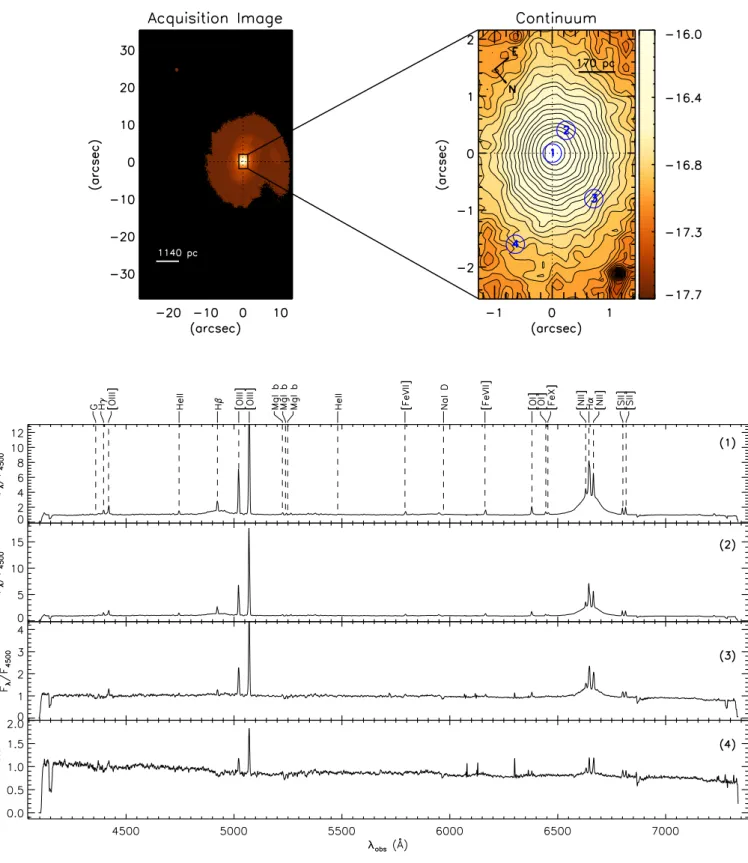
Fig. 1.Top left: acquisition Gemini GMOS image. The rectangle shows the FOV of the IFU observation.Top right: continuum image of ESO 362-G18 (see Sect.3) is shown.Bottom: observed-frame spectra corresponding to the regions are indicated as 1–4 in the IFU image.
lines using FLUXER2, which allows us to determine the residual continuum level around the emission lines in an interactive way; this is necessary for the [SII] lines since they are very close to the broad component of Hα. The resulting gaseous velocities are similar to those obtained from the Gas AND Absorption
2 Interactive IDL routine written by Christof Iserlohe.
http://www.ciserlohe.de/fluxer/fluxer.html
P. Humire et al.: ESO362-G18 with Gemini-GMOS/IFU
Fig. 2.Fits of the Gemini GMOS spectra of ESO 362-G18 using the MILES Stellar Library (Sánchez-Blázquez et al. 2006) for six spaxels, indicated by the arrows on the continuum image of ESO 362-G18 (the same as Fig.1top right panel). The spectra (black lines) and their corresponding fits (red lines) at various locations in the Gemini GMOS field are shown. The vertical and horizontal lines in this continuum image delimit the small apertures where spatial averages of spectra were taken to obtain the spectra most used by pPXF (whose contributions were more important for the best fit to the continuum). The vertical position of the best-fitting spectra obtained with pPXF (Cappellari & Emsellem 2004) are slightly shifted for legibility; the residual (emission line only) spectra are presented on thebottom(blue lines). Axes units of the continuum image are arcseconds and theyaxes of the spectra have units of erg cm−2s−1Å−1.
criterion (Akaike 1974) with the additional caveats that all Gaussian amplitudes are positive. All emission-line velocity dispersion maps were corrected for the instrumental resolution (36 km s−1).
The kinematic PAs for both stars and gas were estimated using the code Kinemetry: a generalization of photometry to the higher moments of the LOS velocity distribution (Krajnovi´c et al. 2006). The systemic velocity (hereafterVsys) of 3731 km s−1 was taken fromPaturel et al.(2003).
3. Results
The top left panel of Fig. 1 presents the Gemini acquisition image filter r of ESO 362-G18, where the posited minor merger approaching from the NE direction is also clearly seen; the rect-angle shows the FOV of the IFU. The top right panel shows the stellar continuum image obtained from our IFU data cube by integrating the flux within a spectral window fromλ5345 Å to λ5455 Å. We assume a nuclear position that coincides with the location of the continuum peak in this image.
In the bottom panel, we present four spectra from the loca-tions indicated as 1 (nucleus), 2 and 3 (intermediate regions) and 4 (boundary region) in the IFU image and extracted within apertures of 0.002×0.002. The nuclear spectrum (identified as 1 in Fig. 1) shows broad Hαand Hβcomponents, which led to the classification of ESO 362-G18 as a Seyfert 1 galaxy (Fraquelli et al. 2000), and also narrow [OIII]λλ4959,5007 Å, [OI]λλ 6300,6363 Å, [NII]λλ6548,6583 Å and [SII]λλ6717,6731 Å emission lines. Large variations in the broad Hβemission line of ESO 362-G18 has occasionally led to its classification as a Seyfert 1.5; such variations are not uncommon in Seyfert galaxies.
We created a structure map of ESO 362-G18 (right panel of Fig.5) by running the IDL routine unsharp_mask.pro on an image obtained with Wide Field Planetary Camera 3 (WFPC3) through the filter F547M aboard the Hubble Space Telescope (HST; Program ID 13816). Inspection of the dust structure shows signs of spiral arms together with stronger obscuration to the SW than to the NE. We thus conclude that the SW is the near side of the galaxy. This is also consistent with flux asymmetries (Sect.3.1) and a trailing spiral pattern (Sect.3.2).
Fig. 3.Maps of the Hα, Hβ, [NII], [OI], [OIII] and [SII] integrated fluxes in logarithmic scale (erg cm−2s−1 per pixel) following the colour bar above each panel. Axes are in arcseconds with respect to the nuclear continuum peak. The solid (dashed) lines indicate the major (minor) axis of the kinematics of the respective line, and the intersection between the lines indicate the continuum peak.
Fig. 4. Maps of the estimated electron density (cm−3) distribution and the line ratios [NII]/Hα, [OI]/Hα, Hα/Hβ, and [OIII]/Hβ. The cross represents the continuum peak and each panel follows the colour bar shown on its right.
3.1. Morphology and excitation of the emitting gas
In Fig.3. we present the flux distributions derived from single Gaussian fits to the Hα, Hβ, [NII]λ6583 Å, [OI]λ6300 Å, [OIII]λ5007 Å and [SII]λ6716 Å emission lines. The flux dis-tributions show a relatively smooth and symmetric pattern for all the emission lines, slightly elongated along the kinematic major axis (see Figs.6and7), as expected given the inclination. The highest fluxes are within the inner 100(246 pc). If the best-fitting two-dimensional Gaussian is subtracted from these flux distri-butions, the greatest asymmetries are found in the SW, implying a stronger presence of dust here. This supports our previous interpretation of the SW as the near side of the galaxy.
Maps of the estimated electron density and the [NII]/Hα, [OI]/Hα, Hα/Hβ, [OIII]/Hβline ratios are presented in Fig.4. The electron density was obtained from the [SII]λλ6716/6731 Å line ratio assuming an electronic temperature of 10 000 K (Osterbrock & Ferland 2006). The electron density reaches a peak value of ∼2900 cm−3 at the nucleus, decreasing to 1000 cm−3at 100 and 800 cm−3at 1.500 from the nucleus. These values are in agreement with those obtained by Bennert et al.
(2006) who estimated values from 1000 cm−3 up to 2500 cm−3 in that region.
The [NII]/Hα line ratio shows values of 0.55–0.78 within the inner 100 and reach its highest values of close to 0.9 in a nuclear-centred ring of radius 1.5.00 The [OIII]/Hβratio varies between 5.6 and 9 in the inner 0.500and has a depression in the nucleus and increasing to 11 at 1.00 Taking into account both the line ratios, the values can be considered typical of Seyfert galaxies (Cid Fernandes et al. 2010).
3.2. Stellar kinematics
P. Humire et al.: ESO362-G18 with Gemini-GMOS/IFU
Fig. 5.Stellar velocity field, stellar rotation model, residual velocity field (observed – model), stellar velocity dispersion (all in units of km s−1 following the colour bars above panels), and the structure map (the bright nucleus masked to show details better at fainter fluxes) for ESO 362-G18. In theleft panelthe solid (dashed) black line indicates the position of the kinematic major (minor) axis. The cross denotes the continuum peak in all panels.
Fig. 6.Observed [NII] velocity field, [NII] rotation model, residual velocity field (observed – [NII] model), and residual velocity field (observed – stellar model). The solid (dashed) black line indicates the position of the kinematic major (minor) axis. The cross represents the continuum peak. All panels follow the colour bar (km s−1) shown on the right.
SE and towards the edges of the FOV. Median radial velocity errors reported by pPXF are 32.6 km s−1 in the inner 0.0075 and 33.2 km s−1 in the inner 1.0025. Median errors in the velocity dispersion (also from pPXF) are 30.0 km s−1in the inner 0.0075, and 40.2 km s−1in the inner 1.0025.
We employed Kinemetry (Krajnovi´c et al. 2006), in which the kinematic centre is fixed to the continuum peak, to obtain the PA of the stellar kinematics at various radii from the nucleus. The resulting values range from 130◦ to 139◦, thus we chose the median value of 137◦as the “global kinematic” PA, as sug-gested by Krajnovi´c et al. (2006, Appendix C). This value is consistent with the morphological major axes from the litera-ture of between 110◦ and 160◦ (RC3, Fraquelli et al. 2000, and references therein).
We model the stellar velocity field by assuming circular orbits in a plane and a spherical potential (Bertola et al. 1991), where the observed radial velocity at a position (R, ψ) in the plane of the sky is given by
V=Vs+
ARcos(ψ−ψ0) [R2[sin2(ψ−ψ
0)+cos2θcos2(ψ−ψ0)]+c2cos2θ]p/2 ,
whereθis the inclination of the disk (withθ= 0 for a face-on disk),ψ0 is the PA of the line of nodes measured with respect to thex-axis within the field shown,Vsis the systemic velocity, Ris the radius andA,c, and pare parameters of the model. We assumed the kinematical centre to be cospatial with the peak of the continuum emission, a PA of 137◦as derived via Kinemetry above, a disk inclination of 37◦, obtained from the apparent axial
Fig. 7.Emission line gas velocity fields and residual velocity fields (observed – [NII] model) for Hαand [OIII].Panels 1and3show the gaseous centroid velocities (km s−1) obtained from a single Gaussian fit. The cross denotes the location of the stellar continuum peak, and the solid and dashed lines delineate the major and minor kinematic axes as derived using kinemetry (Sect.3.3). For the [OIII] velocity map (and residual velocity field) the red lines denote the bounds of the ionization cone; we use an opening angle of 70◦
in agreement with the value (≥60◦
) proposed byFraquelli et al.(2000). All panels follow the colour bar (km s−1) shown on the right.
ratio (Winkler 1997; Fraquelli et al. 2000) under the assump-tion of a thin disk geometry, and an initial guess of 3731 km s−1 for Vsys (Paturel et al. 2003). We used Levenberg-Marquardt least-squares algorithm to fit the rotation model to the velocity map. The resulting parametersA,candp, are 203 km s−1, 1.0009 and 1.93, respectively. The fittedVsyscorrected to the heliocen-tric reference frame is very similar to our initial guess, so we continue to use the latter. The model stellar velocity field and velocity residuals are shown in Fig.5.
3.3. Gas kinematics
The velocity fields of all strongly detected emission lines, that is Hα, Hβ, [NII]λ6583 Å, [OI]λ6300 Å, [OIII]λ5007 Å and [SII]λ6716 Å, show clear signatures of rotation; the projected peak rotation velocities range from 66 km s−1 up to 82 km s−1, although non-rotation signatures and offset kinematical centres are also present in most lines. The velocity maps from a single Gaussian fit of the [NII]λ6583 Å, Hα, and [OIII]λ5007 Å emis-sion lines are shown in the left column of Fig.6 and first and third panels of Fig.7.
Inspecting the velocity maps of these emission lines, we find an offset of≈0.005 (128pc) between the continuum peak and kine-matic centre for Hα, Hβ, [OI], and [OIII], while no significant offset is present in [NII]λ6583 or [SII]λ6716. To more clearly visualize these offsets, we plot the rotation curves of the stars and the stronger emission lines along their respective kinematic PAs in Fig.8. The offsets cause an apparent asymmetry in the velocity fields within our FOV, reaching greater blueshifts than redshifts in the majority of cases. However, comparing this fea-ture with previous long-slit spectroscopy of the inner 1000 and 3000(Bennert et al. 2006;Fraquelli et al. 2000, respectively), we can infer that this asymmetry is exclusively due to the offset in the kinematic centre.
We used Kinemetry to fit the velocity maps of all emission lines. Given that the rotation curves of the emission lines are offset from that of the stars and each other we obtained reason-able results from Kinemetry only if the kinematic centre was set to a position 0.005 to the SE of the continuum peak for Hα,
Hβ, [OI]λ6300 Å, and [OIII]λ5007 Å; for [NII]λ6583 Å and [SII]λ6716 Å, setting the kinematic centre to the continuum peak gave meaningful results.
Fitting the individual emission line velocity fields with Kinemetry resulted in global kinematic PAs ranging between 121◦ and 139◦. For each given emission line, the radial varia-tions of the PA do not exceed 20◦, and all emission line global kinematic PAs are in rough agreement (within 16◦) with the stel-lar kinematic PA except for [SII] for which the difference is 24◦. While we expected similar kinematics in Hαand Hβ, Kinemetry gives global PAs of 139◦for Hαand 130◦for Hβ, and indeed at most radii the fitted PA for Hαis∼9◦larger than that of Hβ. We thus use a global PA of 134.5◦for both Hαand Hβ.
Since the [NII] emission line is both strong and without a significant kinematic offset from the stellar continuum peak, we fit a gas-kinematic Bertola model to its velocity field, fol-lowing the procedure outlined in Sect. 3.2. Once more we fix the disk inclination to 37◦,Vsys to 3731 km s−1, and a kine-matic centre cospatial with the stellar continuum peak. The resulting values are 125 km s−1, 1.0006, 1.04, and 125◦ for A, c, p and the PA, respectively. This gas-kinematics model is shown in the second column of Fig. 6. The third and fourth columns of Fig.6show the residual velocity fields of the emis-sion line gas after subtraction of gas-kinematics model and the stellar velocity model, respectively. For all lines except [NII] and [SII] we see the above-mentioned excess redshift SE of the nucleus.
P. Humire et al.: ESO362-G18 with Gemini-GMOS/IFU
Fig. 8.Radial velocity (rotation curves) curves of the emission lines along with the Bertola model (Stars model) for the stellar kinematics, following the legend in the bottom left. The PAs along which these velocities were taken are those derived by Kinemetry (Sect.3.3) for each emission line: 135◦for Hα, 121◦
for [NII], 137◦
for [OIII] and 113◦
for [SII]. The zero velocity (horizontal line) corresponds to a (heliocentric) velocity recession of 3731 km s−1. Error bars in the corresponding colour indicate the velocity errors determined by pPXF (stars) or Fluxer (Gaussian fitting to emission lines). The vertical line denotes the position of the continuum peak.
A&A proofs:manuscript no. aanda
Fig. 9: Velocity dispersions (km s−1) for Hα, [Oiii], and [Nii] emission lines. Each colour bar (km s−1) is centred on the average velocity dispersion of the respective line. Crosses denote the continuum peak.
these errors vary between 1 and 24 km s−1 in the inner 100.25. As the remaining emission lines observed are not
present throughout our FOV, we obtained the errors within the inner 000.75, where they vary in the range between 0.8
and 27 km s−1. Errors in the velocity dispersion (also from FLUXER) for Hα, [Oiii] and [Nii] emission lines vary be-tween 0.7 and 16 km s−1in the inner 100.25, and between 1.6 and 29 km s−1in the inner 000.75 for the remaining emission
lines.
3.4.Position–velocity diagrams
To better constrain the emission-line kinematics we built position-velocity (PV) diagrams (Fig. 10) for the three strongest emission lines, [Oiii], Hα, and [Nii]. We centred these PV diagrams on the continuum peak and along PA 130◦since this is the kinematic major axis found in the sin-gle Gaussian fit. The pseudo slit is 000.8 wide. The velocity
prediction from the single Gaussian fit is superposed for an easy direct comparison.
While the PV diagram of [Nii] shows a good agreement with the single Gaussian fit, the diagrams of both [Oiii] and Hαshow a second velocity component redshifted by∼150 km s−1in the nuclear region. If the prominent emission in Hαand [Oiii] is seen from a larger velocity range, it may be noted that the most of the emission occurs at velocities below±500 km s−1for both these lines.
3.5.Double Gaussian fit
Given the clear evidence for a second velocity component in some of the emission lines, we fit the [Oiii] and Hα emis-sion lines with a double Gaussian; these two lines were cho-sen as they have the highest S/N ratio among the double peaked lines. Given the clear velocity separation seen be-tween the two components in the PV diagrams, we discrim-inated these components by their radial velocity (rather than, e.g. width), and they are henceforth referred to as the low-velocity component and high-velocity component. The line profile at each spaxel in the data cube was fit with a double Gaussian using a series of Python codes, mainly
within the lmfit package3. To decide whether the observed
line profile is a better fit with a single or double Gaussian, we use the corrected Akaike information criterion (AICc, Akaike 1974) with the additional caveats that all Gaus-sian amplitudes are positive. For the Hαemission line, the double Gaussian fit was performed after subtraction of the broad component (Fig. 1), which can be detected as far as
∼100 from the nucleus, even though the seeing was ∼000.7.
This broad component is also present in Hβ (Fig. 1). The top three panels of Fig. 11 show a detailed example of the fitting process to the Hαemission line in a nuclear spaxel. These panels show the multi-component Gaussian fit to the Hαand [Nii] λλ6548,6583 emission lines, before (left) and after (middle) the subtraction of the broad Hα component, and the subsequent double Gaussian fit to the narrow Hαemission. In the bottom panels of the same fig-ure, we present examples of single/double (as decided by the AICc) Gaussian fits for [Oiii] in different spaxels ((x,y) axes) of our data cube.
To estimate the errors in the velocities of the narrow components of Hα produced by an erroneous broad com-ponent subtraction, we use the following iterative process. For each spaxel, we vary the central velocity of the broad line over the range±3times the1σvelocity error reported bylmf it. The double narrow components are then fit after subtraction of this broad line, and the results compared to those of the best fit (Fig. 12, bottom panels). We find that the narrow component velocities vary by less than 1.8 km s−1 for the low-velocity component and typically less than 6 km s−1 for the high-velocity component (in this latter two spaxels show velocity differences of up to 38 km s−1). The errors recorded by lmfit for the narrow Hα compo-nent velocities are negligible. Less than 3% of the spaxels which were originally better fitted with a double (instead of single) Gaussian are occasionally better fitted with a sin-gle Gaussian during our iterative process. Thus, overall, the two narrow component velocities are robust w.r.t. the seeing-smeared contamination of the (unresolved) BLR.
Does the velocity profile of the unresolved (but seeing-smeared) nuclear NLR also affect the velocities of the two-component Gaussian fit? It is difficult to quantify this
ef-3
https://lmfit.github.io/lmfit-py/intro.html
Article number, page 10 of 18
Fig. 9. Velocity dispersions (km s−1) for Hα, [OIII], and [NII] emission lines. Each colour bar (km s−1) is centred on the aver-age velocity dispersion of the respective line. Crosses denote the continuum peak.
prominent in the nuclear region causing blended profiles and thus non-reliable fits to a single Gaussian. The dispersion of the Hβline is similar to that of Hα, while bothσ[O I]andσ[S II] do not present centrally peaked distributions.
Radial velocity errors were taken directly from FLUXER (Sect.2). For Hα, [OIII] and [NII] emission lines, these errors vary between 1 and 24 km s−1in the inner 1.0025. As the remain-ing emission lines observed are not present throughout our FOV, we obtained the errors within the inner 0.0075, where they vary in the range between 0.8 and 27 km s−1. Errors in the velocity dispersion (also from FLUXER) for Hα, [OIII] and [NII] emis-sion lines vary between 0.7 and 16 km s−1in the inner 1.0025, and between 1.6 and 29 km s−1 in the inner 0.0075 for the remaining emission lines.
3.4. Position–velocity diagrams
To better constrain the emission-line kinematics we built position-velocity (PV) diagrams (Fig.10) for the three strongest emission lines, [OIII], Hα, and [NII]. We centred these PV dia-grams on the continuum peak and along PA 130◦ since this is the kinematic major axis found in the single Gaussian fit. The pseudo slit is 0.008 wide. The velocity prediction from the single Gaussian fit is superposed for an easy direct comparison.
While the PV diagram of [NII] shows a good agreement with the single Gaussian fit, the diagrams of both [OIII] and Hαshow a second velocity component redshifted by∼150 km s−1 in the nuclear region. If the prominent emission in Hαand [OIII] is seen from a larger velocity range, it may be noted that the most
iii ii
which is along the kinematic major axis (and the ionization cone). We note that the spectra are continuum subtracted. Colours and contours denote flux (erg cm−2 s−1 Å−1) following the colour bar above each panel. The corresponding rotation curves obtained from the single Gaussian fit (see Sect. 3.3) are superimposed in red circles. The solid black line indicates the zero velocity (Vsys= 3731 km s−1), the dashed horizontal lines denotes velocities of±100 km s−1, and the
dashed vertical lines indicates offsets of±100from the nucleus. The colour bar above each panel indicates the integrated flux. Contours are in powers of√2to trace both the faint and strong emission structure.
6550
0
6600
wavelength (
6650
Å)
6700
6750
1
6550
6600
wavelength (
6650
Å)
6700
6750
0.0
6630 6635 6640 6645 6650 6655 6660 6665 wavelength
(
Å)
5055 5060 5065 5070 5075 5080 5085
wavelength (
Å
)
5055 5060 5065 5070 5075 5080 5085 wavelength
(
Å)
5055 5060 5065 5070 5075 5080 5085
wavelength (
Å
)
Fig. 11: Example multiple Gaussian fits to the Hα+[Nii]λλ6548,6583 Å (top panels) and [Oiii]λ5007 Å (bottom panels) normalized emission profiles (see Sect. 3.5) for three of the six spaxels shown in Fig. 2. In the top panels we show the fitting process used for the Hα+[Nii] λλ6548,6583 Å in a single nuclear spaxel: from left to right, we show: (1) the multiple Gaussian fit to Hα(one broad and one narrow component) and [Nii]λλ6548,6583 (one narrow component each) emission lines, (2) the same as (1) but with the broad Hαcomponent subtracted, and (3) the subsequent double Gaussian fit to the Hαline. In the bottom panels, we present examples of Gaussian fits to the [Oiii] emission line in three different spaxels; the AICc is used to choose between a single or double Gaussian fit. In spaxel 30,12 (to the N) a single Gaussian
provides a better fit, while in the spaxels near to the nucleus (16,33) and to the E (24,42) double Gaussians are required.
fect, but we note that the PV diagrams of [Oiii] and Hα (see Figs. 10 and 12 for those along the major axis) clearly
show that the velocity profiles are not symmetric about the nucleus even in the nuclear seeing disk. The velocities from
major axis (and the ionization cone). We note that the spectra are continuum subtracted. Colours and contours denote flux (erg cm−2 s−1 Å−1) following the colour bar above each panel. The corresponding rotation curves obtained from the single Gaussian fit (see Sect.3.3) are superimposed in red circles. The solid black line indicates the zero velocity (Vsys= 3731 km s−1), the dashed horizontal lines denotes velocities of±100 km s−1, and the dashed vertical lines indicates offsets of±100
from the nucleus. The colour bar above each panel indicates the integrated flux. Contours are in powers of
√
2 to trace both the faint and strong emission structure.
of the emission occurs at velocities below±500 km s−1for both these lines.
3.5. Double Gaussian fit
Given the clear evidence for a second velocity component in some of the emission lines, we fit the [OIII] and Hα emis-sion lines with a double Gaussian; these two lines were chosen as they have the highest S/N among the double peaked lines. Given the clear velocity separation seen between the two com-ponents in the PV diagrams, we discriminated these comcom-ponents by their radial velocity (rather than, e.g. width), and they are henceforth referred to as the low-velocity component and high-velocity component. The line profile at each spaxel in the data cube was fit with a double Gaussian using a series of Python codes, mainly within the lmfit package3. To decide whether the
observed line profile is a better fit with a single or double Gaus-sian, we use the corrected Akaike information criterion (AICc;
Akaike 1974) with the additional caveats that all Gaussian ampli-tudes are positive. For the Hαemission line, the double Gaussian fit was performed after subtraction of the broad component (Fig.1), which can be detected as far as∼100 from the nucleus, even though the seeing was∼0.007. This broad component is also present in Hβ(Fig.1).
The top three panels of Fig.11show a detailed example of the fitting process to the Hαemission line in a nuclear spaxel. These panels show the multi-component Gaussian fit to the Hα and [NII] λλ6548,6583 emission lines, before (left) and after (middle) the subtraction of the broad Hαcomponent, and the subsequent double Gaussian fit to the narrow Hαemission. In the bottom panels of the same figure, we present examples of single/double (as decided by the AICc) Gaussian fits for [OIII] in different spaxels ((x,y) axes) of our data cube.
To estimate the errors in the velocities of the narrow com-ponents of Hα produced by an erroneous broad component subtraction, we use the following iterative process. For each spaxel, we vary the central velocity of the broad line over the range ±3 times the 1σ velocity error reported by lm f it. The
3 https://lmfit.github.io/lmfit-py/intro.html
double narrow components are then fit after subtraction of this broad line, and the results compared to those of the best fit (Fig. 12, bottom panels). We find that the narrow component velocities vary by less than 1.8 km s−1for the low-velocity com-ponent and typically less than 6 km s−1 for the high-velocity component (in this latter two spaxels show velocity differences of up to 38 km s−1). The errors recorded by lmfit for the nar-row Hαcomponent velocities are negligible. Less than 3% of the spaxels which were originally better fitted with a double (instead of single) Gaussian are occasionally better fitted with a single Gaussian during our iterative process. Thus, overall, the two nar-row component velocities are robust w.r.t. the seeing-smeared contamination of the (unresolved) BLR.
Does the velocity profile of the unresolved (but seeing-smeared) nuclear NLR also affect the velocities of the two-component Gaussian fit? It is difficult to quantify this effect, but we note that the PV diagrams of [OIII] and Hα(see Figs.10
and 12 for those along the major axis) clearly show that the velocity profiles are not symmetric about the nucleus even in the nuclear seeing disk. The velocities from the double compo-nent Gaussian fit appear to relatively well trace features seen in the PV diagrams, so any unresolved nuclear component would smooth out but not hide variations. We note however that to the NW of the nucleus, the two-component fit to the Hαline does not appear to follow the PV diagram. Instead the PV diagram is more consistent with a single Gaussian at a slightly larger redshift.
The results of the two-component fits to [OIII] and Hαare shown in Fig.12. The left four panels show the velocity fields of the two components of Hα and [OIII], and the two right-most panels of Fig.12show the same major axis PV diagrams as Fig.10(along PA 130◦). But this time we overlay the velocities of each of the two velocity components (high-velocity component in red and low-velocity component in blue) along with the veloc-ities obtained from the single Gaussian fit to the respective line (green), the velocities obtained by a single Gaussian fit to the [NII] line (brown) and the Bertola model fit to the stellar kine-matics (black). According to the AICc, the two-component fit is required only to the SE. To the NW, a single component fit gives better results. The lower [OIII] velocity component has
P. Humire et al.: ESO362-G18 with Gemini-GMOS/IFU
6550
6600
wavelength (
6650
6700
6750
Å
)
6550
6600
wavelength (
6650
6700
6750
Å
)
5055 5060 5065 5070 5075 5080 5085
wavelength (
Å
)
5055 5060 5065 5070 5075 5080 5085 wavelength
(
Å)
5055 5060 5065 5070 5075 5080 5085
wavelength (
Å
)
Fig. 11.Example multiple Gaussian fits to the Hα+[NII]λλ6548,6583 Å (top panels) and [OIII]λ5007 Å (bottom panels) normalized emission profiles (see Sect.3.5) for three of the six spaxels shown in Fig.2. In thetop panelswe show the fitting process used for the Hα+[NII]λλ6548, 6583 Å in a single nuclear spaxel:from left to right, we show: (1) the multiple Gaussian fit to Hα(one broad and one narrow component) and [NII]λλ6548,6583 (one narrow component each) emission lines, (2) the same as (1) but with the broad Hαcomponent subtracted, and (3) the subsequent double Gaussian fit to the Hαline. In thebottom panels, we present examples of Gaussian fits to the [OIII] emission line in three different spaxels; the AICcis used to choose between a single or double Gaussian fit. In spaxel 30,12 (to the N) a single Gaussian provides a better
fit, while in the spaxels near to the nucleus (16,33) and to the E (24,42) double Gaussians are required.
velocities ranging from –30 km s−1to –135 km s−1 and a kine-matic PA of∼123◦, while the higher [OIII] velocity component shows values≈200 km s−1 higher. The lower Hαvelocity com-ponent shows velocities of –80 km s−1to 70 km s−1, with a PA of
∼123◦, while the higher Hαvelocity component show values of 100 km s−1up to 255 km s−1.
The corresponding velocity dispersions are shown in Fig.13. The low-velocity component of Hα shows a centrally peaked velocity dispersion map, while in the higher velocity component shows high dispersions only in disjoint regions &0.006 from the nucleus. The low-velocity component of [OIII] has systemati-cally higher dispersions (except in the nucleus) in comparison to the high-velocity component.
3.6. Black hole mass
Black hole mass estimations for ESO 362-G18 were rigorously explored byAgís-González et al.(2014); our new observations allow us a better constraint on the value of the FWHM of Hβ since we have a better spectral resolution and two-dimensional data for this line. We fit theHβprofile with a double Gaussian using the lmfit package as described in Sect. 3.5, and use the FWHM of the broad component (hereafter FWHMHβ) to estimate the black hole mass.
Assuming a disk-like BLR geometry to avoid assuming a virial coefficient f, which can vary widely,Agís-González et al.
(2014) used the following expression:
MBH=RBLRFWHM2Hβ(4Gsin2i)−1
whereiis the angle between the LOS and the angular momentum vector of the disk-like BLR (53◦±5◦), R
BLRis the radius of the BLR (∼5.2×1016cm), andGis the gravitational constant. Using our new value of FWHMHβ, 5689+−398723km s
−1, calculated in the inner∼0.0035 around the continuum peak (i.e. within the seeing disk), we obtain a black hole mass MBH of 4.97+−1.601.61×107M
, which is consistent with the value (4.5±1.5×10⁷ M
) obtained byAgís-González et al.(2014), and in a range typical of both nar-row line and broad line Seyfert 1 galaxies (Greene & Ho 2005, Fig. 4).
4. Discussion
The structure map (rightmost panel of Fig.5) shows spiral arms that get increasingly fainter as they approach the nucleus. Given the scale of the FOV and the asymmetries we find after sub-tracting two-dimensional Gaussians from the flux maps of each emission line, we interpret the unusual spiral arm structure as a result of instabilities produced by the inner Lindblad resonance, which is expected to lie in the inner 1.6 kpc (Laine et al. 2002). We thus argue that the unusually high value of the parameter p (>1.5) in the Bertola stellar model is a direct consequence of this resonance. The abundant dust seen in the structure map also supports the hypothesis of (Simões Lopes et al. 2007) that the presence of dust is a necessary condition for accretion onto the nuclear SMBH.
Previous studies of ESO 362-G18 have found an asymmet-ric [OIII] emission-line morphology with a fan-shaped structure
Fig. 12.Results of the double component fit to the [OIII] (top) and Hα(bottom) lines.Left and middle panels: Velocity fields of the high-velocity and low-velocity narrow components, following the colour bar to the right, are shown. White denotes regions where a single Gaussian fit is preferred (see Sect.3.5).Rightmost panels: PV diagrams as in Fig.10, but this time we use blue and red points to denote the velocities of the low- and high-velocity components, respectively, and green points to denote the velocities obtained from the single Gaussian fitting. For comparison, we overplot the [NII] (filled brown squares) and stellar (open black stars) velocity curves along the same PA.
extending 1000 from the nucleus to the SE, and an asymmetric morphology in the stellar continuum that is reminiscent of a minor merger system (Mulchaey et al. 1996, Fig. 29).Fraquelli et al.(2000), using long-slit spectra, noted that the kinematics of this extended emission-line region is similar to that of the stars. They posited, primarily based on the morphological appearance, the presence of an AGN outflow with a collimating axis orien-tated at an angle ≤30◦ with respect to the galactic plane; this small angle is required to allow the nuclear radiation to inter-cept the gas in the disk and to allow a direct LOS to the BLR. They proposed an opening angle larger than 60◦for the ionizing
P. Humire et al.: ESO362-G18 with Gemini-GMOS/IFU
P. Humire et al.: ESO362-G18 with Gemini-GMOS/IFU
Fig. 13: From left to right: The velocity dispersion of the [Oiii] and Hα high-velocity and low-velocity components, respectively. All panels follow the colour bar (km s−1) shown on the right.
(black). According to the AICc, the two-component fit is
required only to the SE. To the NW, a single component fit gives better results. The lower [Oiii] velocity component has velocities ranging from -30 km s−1 to -135 km s−1 and a kinematic PA of∼123◦, while the higher [Oiii] velocity component shows values≈200 km s−1 higher. The lower Hαvelocity component shows velocities of -80 km s−1to 70 km s−1, with a PA of∼123◦, while the higher Hαvelocity component show values of 100 km s−1 up to 255 km s−1.
The corresponding velocity dispersions are shown in Fig. 13. The low-velocity component of Hα shows a centrally peaked velocity dispersion map, while in the higher veloc-ity component shows high dispersions only in disjoint re-gions&000.6 from the nucleus. The low-velocity component
of [Oiii] has systematically higher dispersions (except in the nucleus) in comparison to the high-velocity component.
3.6. Black hole mass
Black hole mass estimations for ESO 362-G18 were rig-orously explored byAgís-González et al. (2014); our new observations allow us a better constraint on the value of the FWHM of Hβ since we have a better spectral reso-lution and two-dimensional data for this line. We fit the Hβ profile with a double Gaussian using the lmfit package as described in Sec. 3.5, and use the FWHM of the broad component (hereafter FWHMHβ) to estimate the black hole
mass.
Assuming a disk-like BLR geometry to avoid assuming a virial coefficientf, which can vary widely,Agís-González et al.(2014) used the following expression:
MBH=RBLRF W HMHβ2 (4Gsin2i)−1
whereiis the angle between the LOS and the angular mo-mentum vector of the disk-like BLR (53◦ ±5◦), RBLR is
the radius of the BLR (∼ 5.2 × 1016 cm), and G is the gravitational constant. Using our new value of FWHMHβ,
5689+398−723km s−1, calculated in the inner∼000.35 around the
continuum peak (i.e. within the seeing disk), we obtain a black hole massMBH of 4.97−+11..6061×107M, which is
con-sistent with the value (4.5± 1.5 × 10⁷ M) obtained by
Agís-González et al.(2014), and in a range typical of both narrow line and broad line Seyfert 1 galaxies (Greene & Ho 2005, Fig. 4).
4. Discussion
The structure map (rightmost panel of Fig. 5) shows spiral arms that get increasingly fainter as they approach the nu-cleus. Given the scale of the FOV and the asymmetries we find after subtracting two-dimensional Gaussians from the flux maps of each emission line, we interpret the unusual spiral arm structure as a result of instabilities produced by the inner Lindblad resonance, which is expected to lie in the inner 1.6 kpc (Laine et al. 2002). We thus argue that the unusually high value of the parameter p (>1.5) in the Bertola stellar model is a direct consequence of this reso-nance. The abundant dust seen in the structure map also supports the hypothesis of (Simões Lopes et al. 2007) that the presence of dust is a necessary condition for accretion onto the nuclear SMBH.
Previous studies of ESO 362-G18 have found an asym-metric [Oiii] emission-line morphology with a fan-shaped structure extending 1000 from the nucleus to the SE, and an asymmetric morphology in the stellar continuum that is reminiscent of a minor merger system (Mulchaey et al. 1996, Fig. 29). Fraquelli et al.(2000), using long-slit spec-tra, noted that the kinematics of this extended emission-line region is similar to that of the stars. They posited, primar-ily based on the morphological appearance, the presence of an AGN outflow with a collimating axis orientated at an angle ≤30◦ with respect to the galactic plane; this small angle is required to allow the nuclear radiation to intercept the gas in the disk and to allow a direct LOS to the BLR. They proposed an opening angle larger than 60◦ for the ionizing radiation cone. We note that the spectral resolu-tion of the long-slit spectra used byFraquelli et al.(2000) was not high enough to resolve the nuclear outflow that we posit. Our results are consistent with the outflow scenario posited byFraquelli et al.(2000): both [Nii] and [Sii] share the same kinematic PA (≈120◦), ≈10◦ less than the kine-matic PA of Hα, Hβ, [Oi], and [Oiii] (≈130◦). The offset in the kinematic centres of Hα, Hβ, [Oi] and [Oiii] are closest to the direction of the ionization cone (158◦,Fraquelli et al.
Article number, page 13 of 18
Fig. 13. From left to right:
plane, and following a rotation curve similar to that of the stars (Fig.8).
The PV diagrams (Fig.10) of [OIII] and Hαclearly show a second velocity component∼150 km s−1 to the red. Its con-tribution is most significant in the inner arcsecond and is the reason why the single Gaussian fit gives velocities redder than the expectation of pure rotation in the nucleus (see Fig.7). The equivalent PV diagrams for [OI] and Hβ(not shown) are also consistent with the presence of the second higher velocity com-ponent, but we could not rigorously fit double Gaussians to these profiles owing to their relative faintness, especially at distances &1.500from the nucleus (see Fig.1). Further, both [O
I] and Hβ (not shown) show the same asymmetries as [OIII] and Hαin their velocity maps derived from a single Gaussian fit (Fig.7).
The appearance of the velocity fields (PAs, velocity ranges, and rotation curves) of the low-velocity component of [OIII] and Hα(middle panels of Fig.12) are very similar to those derived from [NII] in the same region. Therefore we interpret this com-ponent as emission from gas in the galactic disk that is rotating in the same manner as the [NII]-emitting gas and the stars. Only the negative velocities in [OIII], reached very close to the nucleus (from –75 km s−1to –120 km s−1), can be attributed to an outflow approaching the observer.
The high-velocity component of both these lines shows a very different velocity field, with values that exceed 200 km s−1 (>330 km s−1 deprojected). We thus conclude that the high-velocity component corresponds to the bright gas within the AGN ionization cone. Given that (deprojected) velocities larger than 150 km s−1 are typically observed in outflows instead of inflows in nearby galaxies (seeBarbosa et al. 2009;
Storchi-Bergmann et al. 2010 and Riffel & Storchi-Bergmann 2011for examples of outflow velocities, andFathi et al. 2006;
Schnorr Müller et al. 2011andSchnorr-Müller et al. 2014a for examples of inflow velocities), the most plausible explanation is that the high-velocity component is gas entrained by the AGN outflow at an angleigreater than zero, located behind the plane of the sky from our LOS, and thus redshifted to the observer. Why would we preferentially see gas on the far side of the ion-ization cone (redshifted to us) rather than on the near side (which would be blueshifted)? The explanation lies in the illumination of the NLR clouds by the AGN: on the far side of the cone in ESO 362-G18 we see the side of the gas cloud that is illumi-nated by the AGN, while on the near side we see primarily the dark side of the NLR clouds (see e.g. Lena et al. 2015). The low- and high-velocity components in ESO 362-G18 are remi-niscent of the case in NGC 4151 (Storchi-Bergmann et al. 2010).
The difference is that in NGC 4151 the high-velocity component corresponds to gas illuminated by a symmetric bicone, extend-ing both in front and behind the galactic plane, while in ESO 362-G18 only the gas in front the galactic disk, illuminated by a single ionization cone, is seen.
Agís-González et al.(2014) have estimated an inner accretion disk inclination of 53◦ ±5◦; on the other hand, using the ratio of the minor to major photometric axis from Winkler (1997),
Fraquelli et al.(2000) derived a galactic disk inclination of≈37◦. Therefore, we suggest a picture for ESO 362-G18 in which the ionization cone has an inclination anglei∼8◦±5◦with respect to the plane of the sky with a half-opening angle of 45◦ in such a way that the cone intersects with the galactic disk in the SE direction, illuminating gas receding from our LOS due to the outflow; this value of the half-opening angle of the ionization cone was also suggested byAgís-González et al.(2014). We only see blueshifted gas very close to the nucleus (see Fig.12, middle top panel), where the [OIII] gas is entrained by the approaching side of the cone in a small region corresponding to the thickness of the disk or bulge of the galaxy. This proposed configuration for the nuclear region in ESO 362-G18 is shown schematically in Fig.14.
For both [OIII] and Hα, the highest dispersion values are predominantly reached in the low-velocity component (Fig.13), which we interpret as gas rotation in the galactic disk. Only the central region of the high-velocity component (the outflow com-ponent) in [OIII] shows dispersions higher than 105 km s−1, which we can interpret as coming from the approaching side of the outflow where the outflow is still within the galactic disk. The value ofσHαof the outflow component is very sensitive to the subtraction of the broad emission in Hα. This process was carried out before the two Gaussian fit, so the large dispersion values (∼0.008 SE from the nucleus) should be taken with some reserve since this is potentially due to confusion with the broad emission. We can only deduce that the decrease ofσ[O III] and σHαin the outflow component is due to its partial occultation by the galactic disk.
Since the outflow velocities posited above are not as high as the dividing line commonly adopted to discern immediately between starburst-driven superwinds and AGN-driven outflows (>500 km s−1, Fabian 2012; Cicone et al. 2014), we must test whether the kinetic power injected by supernovae in the inner 100 pc is sufficient to drive the outflow. The outflow, while it extends over at least∼0.5 kpc to the SE, is already seen at high velocities in the inner seeing disk (∼0.1 kpc). The global SFR of ESO 362-G18 is relatively low: the Hα-derived global SFR
region close to the nucleus, producing the greatest blueshift seen in the low-velocity component of [OIII]. The NW (bottom) ionization cone, if it does exist, is almost always hidden by the galactic disk for our LOS.
is ∼5.5×10⁻³Myr−1 (Galbany et al. 2016) and we derive a similar value from the far-infrared luminosity (based on IRAS fluxes). We note that Meléndez et al. (2008) quoted a rela-tively high instantaneous SFR of 0.85Myr−1in the inner kpc, based onSpitzerspectroscopy of the [NeII] line; these authors, however, made many estimations and assumptions beyond those previously used (e.g.Genzel et al. 1998;Ho & Keto 2007) in the disentanglement of the AGN versus star formation contribution to the [NeII] line and its posterior conversion to a SFR method. Given that the outflow is seen in the inner kpc and starts within the inner∼100 pc, the SFR in this corresponding nuclear region is expected to be significantly lower than 10−2Myr−1.
Using the relationship of Veilleux et al. (2005), Pkin,SF(erg s−1) = 7×1041SFR(Myr−1), the galaxy-wide kinetic power injected by supernovae,Pkin,SF, is∼1040erg s−1, which is similar to the kinetic power of the outflow (see Sect. 4.2). However, the typical SFRs of galaxies with can-didate starburst-driven outflows are in the range 1 M yr−1 to 100Myr−1 (see e.g. Cicone et al. 2014). Attributing the outflow to the starburst thus requires a concentration of the galaxy-wide SFR in the inner 100 pc and/or an instantaneous SFR significantly larger than the long-term average SFR and a 100% coupling of the supernova kinetic energy to the outflow. We thus conclude that starburst superwinds as the origin of the outflow in ESO 362-G18 are possible, but very unlikely.
4.1. Feeding versus feedback
We can estimate the mass outflow rate as the ratio of the mass of the outflowing gas to the dynamical time at the nucleus,Mg/td. The gas mass is given by
Mg=NempV f, (1)
whereNeis the electron density,mpis the mass of the proton,V is the volume of the region where the outflow is detected; we fix this value as 0.0035 around the nucleus (i.e. within the seeing) and
f is the filling factor. The filling factor can be estimated from
LHα≈ f Ne2jHα(T)V, (2)
where jHα(T) = 3.3534×10⁻²⁵erg cm−3s−1 (Osterbrock 1989) and LHα is the Hα luminosity emitted within the volume V. Substituting Eq. (2) into Eq. (1) we have
This gives a td of ∼2 × 10⁵ years. Finally, the mass outflow rate ˙M is 0.074 M yr−1. We point out that this ˙M is only a lower limit since it corresponds only to the outflowing mass asso-ciated with the ionized side of the clouds. Additionally, if we consider a biconical outflow, assuming most of the far side of the bicone is hidden by the galactic disk, the ˙M can be twice the calculated value, that is, ˙M ≈0.15 M yr−1, in agreement with others ˙Mobserved in nearby galaxies (Barbosa et al. 2009;
Müller-Sánchez et al. 2011;Lena et al. 2015)
We can now compare the mass outflow rate with the mass accretion rate required to feed the SMBH ˙Macc, which can be estimated as
˙
Macc= Lbol
ηc2, (4)
where c is the speed of light and Lbol is the bolometric luminosity. Using the Lbol estimated by (Agís-González et al. 2014) of 1.3×1044erg s−1, we derive a mass accretion rate of 2.2×10⁻² M
yr−1, where we assume the radiative efficiency, η, to 0.1, the typical value derived from Shakura-Sunyaev accre-tion models onto a non-rotating black hole (Shakura & Sunyaev 1973). Therefore, the ˙Macc is ∼7 times lower than the mass outflow rate. This is consistent with previous works in nearby galaxies (Barbosa et al. 2009; Müller-Sánchez et al. 2011) and indicates that most of the observed outflowing gas is mass entrained by the surrounding interstellar medium (Veilleux et al. 2005;Storchi-Bergmann 2014).
In a sample of 15 pairs of Seyfert plus inactive galaxies,
Dumas et al. (2007) found that SMBHs with accretion rates larger than 10−4.5 M
yr−1tend to lie in galaxies with disturbed kinematics. However, in the case of ESO 362-G18, although the value of Macc˙ is almost a thousand times greater than 10−4.5M
yr−1, large twists in the gas kinematics or significant misalignments between the gas and stellar kinematics are not observed. Thus, the nuclear activity in ESO 362-G18 may be related to major mergers in the past (Hopkins et al. 2010) that do not leave current disturbances in its kinematics, rather than perturbations in the ionized gas or misalignments between the stellar and gas rotations (Dumas et al. 2007). The posited minor merger observed in the acquisition image (Fig.1) produces no discernible disturbances in the gas or stellar kinematics within our nuclear FOV.
Considering the galactic disk as well as the BLR from the broad component of Ha, the total ionized gas mass within

![Fig. 4. Maps of the estimated electron density (cm −3 ) distribution and the line ratios [N II ]/Hα, [O I ]/Hα, Hα/Hβ, and [O III ]/Hβ](https://thumb-us.123doks.com/thumbv2/123dok_es/3663717.636756/6.892.53.829.516.746/fig-maps-estimated-electron-density-distribution-line-ratios.webp)

![Fig. 7. Emission line gas velocity fields and residual velocity fields (observed – [N II ] model) for Hα and [O III ]](https://thumb-us.123doks.com/thumbv2/123dok_es/3663717.636756/8.892.119.774.122.409/emission-velocity-fields-residual-velocity-fields-observed-model.webp)
![Fig. 9: Velocity dispersions (km s −1 ) for H α, [O iii], and [N ii] emission lines. Each colour bar (km s −1 ) is centred on the average velocity dispersion of the respective line](https://thumb-us.123doks.com/thumbv2/123dok_es/3663717.636756/9.892.55.600.649.906/velocity-dispersions-emission-centred-average-velocity-dispersion-respective.webp)
![Fig. 11: Example multiple Gaussian fits to the H α+[N ii] λλ6548,6583 Å (top panels) and [O iii] λ5007 Å (bottom panels) normalized emission profiles (see Sect](https://thumb-us.123doks.com/thumbv2/123dok_es/3663717.636756/10.892.72.831.118.380/example-multiple-gaussian-panels-panels-normalized-emission-profiles.webp)
![Fig. 11. Example multiple Gaussian fits to the Hα+[N II ] λλ 6548,6583 Å (top panels) and [O III ] λ5007 Å (bottom panels) normalized emission profiles (see Sect](https://thumb-us.123doks.com/thumbv2/123dok_es/3663717.636756/11.892.62.829.128.554/example-multiple-gaussian-panels-panels-normalized-emission-profiles.webp)
![Fig. 12. Results of the double component fit to the [O III ] (top) and Hα (bottom) lines](https://thumb-us.123doks.com/thumbv2/123dok_es/3663717.636756/12.892.65.839.128.864/fig-results-double-component-fit-iii-hα-lines.webp)
![Fig. 13: From left to right: The velocity dispersion of the [O iii] and Hα high-velocity and low-velocity components, respectively](https://thumb-us.123doks.com/thumbv2/123dok_es/3663717.636756/13.892.58.682.123.380/fig-right-velocity-dispersion-velocity-velocity-components-respectively.webp)
