
Employability skills: a system of recognition at Universitat Jaume I
5
0
0
Texto completo
(2) single service (CS), and since 2002 the powers of this service have been increasing. Moreover, since 2010 the CS is an independent office and it is intended to promote employability and to enhance the career opportunities of graduates and students through different initiatives. The main programmes developed are: international workplacements for students (Erasmus + Placements Programme, University Junior International Entrepreneurs; and Poor Countries Solidarity Placements), Professional Guidance, Employability training (SuperTuesday for the Employment; Careers Events) Intermediary actions (as Job Vacancies;) Conferences and Job Fairs (“Ocuparty” Programme) and the Career Observatory. Every programme has a year’s follow-up and assessment of results. Also, a process of ISO 9001 Quality Standards is being introduced for the core process. We are aware of our responsibilities towards our clients and have a service chart in which our commitments and success indicators are published: [6] All programmes are coordinated. We also encourage every trainee on a placement to participate in career guidance activities. Since its origins, Universitat Jaume I was pioneer in Spain in the promotion of workplacements in order to develop future employability, and it adopted a model of obligatory placements in which 100% of its graduated students had at least one professional experience.. 1.2 Benchmarking In this context, we have carried out diferent bechmarking studies through direct contact with good practices in other universities. Especially the revised reference has been the international context, in British universities that we have visited and with which we have had direct contact: In many Universities in the United Kingdom there is the “graduates attributes model” [8] system, which is similar to the educational model, but it highlights the competences that must be achieved by the students. A definition will be “A policy statement created by a HE provider to inform academic development. These statements detail the qualities and skills that the provider believes graduates should develop through the course of their study and engagement in student life. Graduate attributes are defined differently from one HE provider to another but generally include components which relate to the mastery of subject-specific knowledge, study skills, digital literacies and other 21st century skills.” University of Kent [9] “Employability Points Squeme”: through participation in activities, published each year, which have two principles 1) relevance to employability 2) commitment to compliance; which facilitate them to obtain assessed points, students have access to "points awards" such as participation in internships; projects and work experience. Collected activities: presentations at conferences; organize events at the University; part-time job; go through employment service, conduct interviews; Mentoring, student awards, volunteering; studying, working or volunteering abroad (extra-academic); complete language courses; training in skills ... University of Glasgow: [10] “HEAR project”: Support to the student in the elaboration and monitoring of an electronic portfolio through Mahara, to equip them with a certificate of recognition in all workshops related to the employability that they organize (The students do not receive academic credits). In their web they relate the competences to develop, and behaviors and evidences that are suggestions to the students on how to increase these competences. An officer in charge of this website and coordinating with the academics. They are starting to use the Mahara for this. They have one booklet for students and one for academics. Students decide the privacy level of their portfolio: 1, private; 2 university, 3 web. In addition, PhD Students are working in transversal skills workshops. The Hear project is wider, since it includes recognition for actions of employability, representation, sports, internships and employment, volunteering, associationism. Also it is published a guide for academic staff.. 2. METHODOLOGY. The objective of the system is to visualize and demonstrate to the potential employers the acquisition of transversal skills of the students with high impact on employability, through participation in training, awareness and experience activities organized by the Universitat Jaume and/or others that may be recognized by the evaluating committee (Committee of Experts). This recognition will be independent of the recognition of skills for entrepreneurship [11] [12] and accreditation in foreign languages, that are set up with a similar process.. 2350.
(3) In the next paragraph we will go in depth with the procedure, approved by the Management Committee of the University, which includes Rector and all the Vice-rectors of Universitat Jaume I.. 3. RESULTS. 3.1 Procedure for the System of employability skills recognition The outcome is the recognition and validation (for undergraduates and recent graduates in the last two academic years in Bachelor/Master/PhD) of 700 hours of activities in training, increasing awareness and experience actions. The process will be completed with the issue of a formal document duly signed by the Secretary of the University.. 3.2 Public call The applications will be submitted by the telematic register of the Universitat Jaume I and will be directed to the Career Development and Workplacements (Career Service, CS). For this purpose, an administrative procedure will be created within the catalog of administrative procedures of the Universitat Jaume I. Together with the application for recognition of competences for employability, documents must be attached that confirm that the requirements established in each call are fulfilled. The documentation will be reviewed and validated by a committee of experts, which will study the individual application of each student / graduate. The committee of experts will be formed by: Table 1. Composition of the Committee of Experts. Members Presidency. Vicerectorate for Students, Employment and Educational Innovation Vicerectorate for Studies. Secretary Chairs. Head of Careers Service Three members of the Employability Board (Academic Staff, Companies) Students political representative. The committee will meet at least once a year at the proposal of the presidency and its function will be to evaluate the requests and issue a reasoned resolution.. 3.3 Requirements for the recognition The applicant must have carried out training, awareness and experience actions, during or after their degree that are specified below: Table 2. Requirements for the System of recognition of Employability Skills.. Total amount. Training. Increasing awareness. Experience Actions. At least 80 hours. At least 20 hours. At least 600 hours or 6 months. 2351.
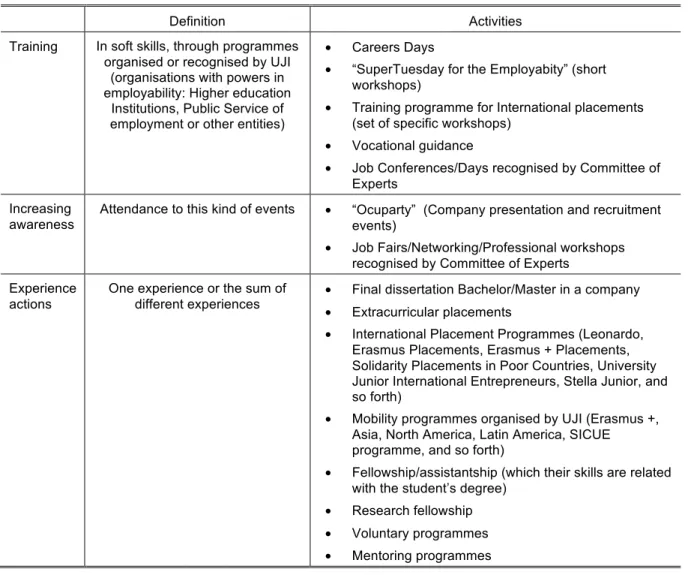
(4) Table 3. Activities included in the recognition system. Definition Training. Increasing awareness. Experience actions. 4. In soft skills, through programmes organised or recognised by UJI (organisations with powers in employability: Higher education Institutions, Public Service of employment or other entities). Attendance to this kind of events. One experience or the sum of different experiences. Activities •. Careers Days. •. “SuperTuesday for the Employabity” (short workshops). •. Training programme for International placements (set of specific workshops). •. Vocational guidance. •. Job Conferences/Days recognised by Committee of Experts. •. “Ocuparty” (Company presentation and recruitment events). •. Job Fairs/Networking/Professional workshops recognised by Committee of Experts. •. Final dissertation Bachelor/Master in a company. •. Extracurricular placements. •. International Placement Programmes (Leonardo, Erasmus Placements, Erasmus + Placements, Solidarity Placements in Poor Countries, University Junior International Entrepreneurs, Stella Junior, and so forth). •. Mobility programmes organised by UJI (Erasmus +, Asia, North America, Latin America, SICUE programme, and so forth). •. Fellowship/assistantship (which their skills are related with the student’s degree). •. Research fellowship. •. Voluntary programmes. •. Mentoring programmes. CONCLUSIONS. It will be delivered to the graduate or undergraduate a final certification by the Universitat Jaume I. This system of recognition of employability skills will be launched in early 2018, starting by the open process for students and graduates. The next steps to run cost-effectively the process are: The communication of the benefits of this process to all stakeholders, by different methods (website, social media, workshops and meetings) including: − Educational community, including professors and administrative staff, − Potential employers, including public and private, − Graduates and undergraduates. − Other higher education institutions, both national and international, − Scientific and dissemination journals related to the topic, − Also families and the society in general.. REFERENCES [1]. Cedefop (2014). Terminology of European education and training policy: a selection of 130 terms. 2nd ed. Luxembourg: Publications Office.. 2352.
(5) [2]. Williams,S.; Dodd, L.; Steele, C. and Randall, R. “A systematic review of current understandings of employability” Journal of Education and Work, 2016. Volume. 29, No. 8, pp 877–901, 2016,. [3]. Universitat Jaume I, strategic plan: Retrieved from http://www.uji.es/institucional/estrategia/plans/estrategic/. [4]. Educational Model of the Universitat Jaume Retrieved from http://ujiapps.uji.es/institucional/estrategia/plans/modeleducatiu/. [5]. Lapeña Barrachina, L. and Beas, M. I. “The role of the Careers Service Area of the UJI in enhancing the employability of students and recent graduates”. International Techonology Education and Development Conference INTED. Internacional. Científic. 2007. Ed. International Academy of Technology, Education and Development (IATED).. [6]. OIPEP, Service charter. Retreived from http://www.uji.es/serveis/oipep/base/carta/. [7]. Graduate attributes framework: Retreived from https://www.heacademy.ac.uk/knowledgehub/graduate-attributes-framework. [8]. University of Kent: Employability points Retreived from www.kent.ac.uk/. [9]. University of Glasgow: HEAR project Retreived from https://www.gla.ac.uk/myglasgow/students/attributes/hearandyourdegree/. [10]. Educational Model of the Universitat Jaume Retrieved from http://ujiapps.uji.es/institucional/estrategia/plans/modeleducatiu/. [11]. UJI Emprèn: Retreived from http://ujiapps.uji.es/perfils/empresa/ujiempren/. [12]. García-Agustín, P. Beas-Collado, M. I. and Ripollés, M. “UJI Emprèn: How to enhance entrepreneurship from the university side?” 9th International Technology, Education and Development Conference Pages: 7070-7078 Published: 2015.. 2353.
(6)
Figure

Documento similar
By contrast, other countries are not parties to a single bilateral or multilateral international treaty generally applicable to recognition or enforcement of foreign judgments.
THE ITESM UNIVERSITY SYSTEM 1 1.1 MISSION 1 1.2 ORGANISATION 2 1.2.1 Geographical Distribution 3 1.2.2 Academic and Research Programmes 3 1.2.3 National and International Liaisons 6
Upon they arrival in Malaga, Erasmus students and non-EU mobility students must attend one of the official meetings of the International Office in September (SM1) or in February
Upon they arrival in Malaga, Erasmus students and non-EU mobility students must attend one of the official meetings of the International Office in September (SM1) or in February
The “Course for Erasmus and International Exchange Students” of the University of Mala- ga, 70 class hours, allows students to consolidate and acquire Spanish skills in order to
International applicants participating in an exchange or Erasmus program gain admission to the University of Tübingen through the Admission Office for Exchange students..
In the UK academics at the University of Plymouth are leading the way in the latest techniques in faculty development and are offering the International Faculty Developer Programme
The University Health Insurance Plan (UHIP) is a mandatory health insurance program for all international students. It is the responsibility of each student to print their proof of
