
Troop movement and food habits of white faced monkeys in a tropical dry forest
11
0
0
Texto completo
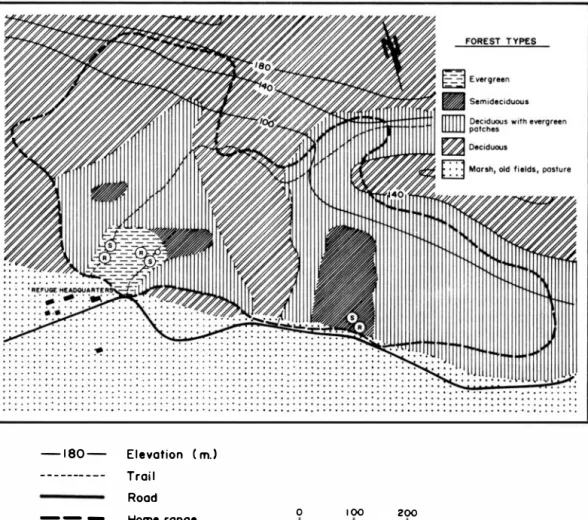
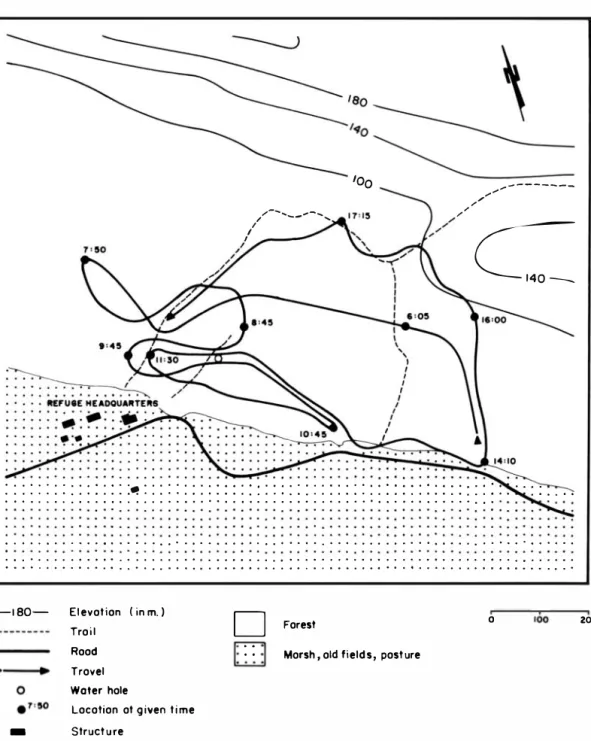
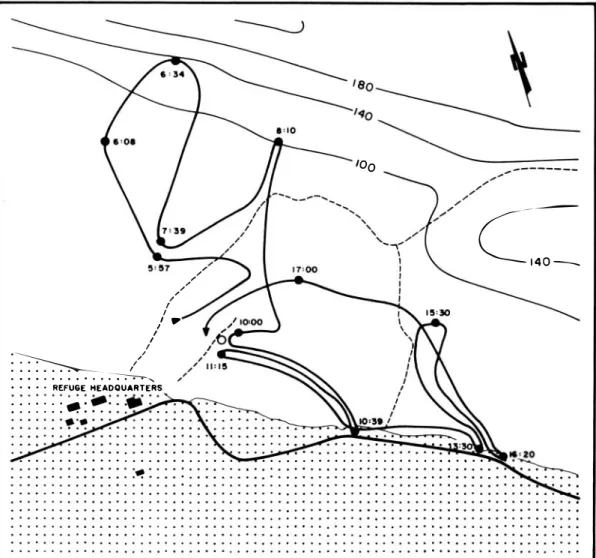
(2) 288. REVISTA DE BIOLOGIA TROPICAL. 0-25%, 2 5 -75% and greater than 75% of their leaves during the latter part of the dry season. The study troop consisted of three old and two young adult males, three adult females, seven juveniles and one infant for a total of 1 6 indivi duals. METHODS The study was conducted from 6 to 25 March and from 1 3 to 29 April 1 9 8 2 . Our ob servations began about 15 min before sunrise (05 1 5 hrs) when capuchins were leaving their sleeping sites. The troop was followed until about 20 min after sunset ( 1 800 hrs) when it settled into trees to sleep. A group of more than six monkeys was arbitrarily defmed as a troop and a group of six or less, as a sub-group. The focal animal technique (Altmann 1 9 74) was used for collecting activity data, where a single capuchin was initially chosen at random and followed. Duration of each activity was re corded to the nearest minute which was the smallest time unit . Activity was grouped into hourIy periods and for one statistical test, into two periods of four and one of five hours. When the focal animal separated from the troop or was lost by us, our observations was directed to the next capuchin seen. It was at times im possible to pursue monkeys close enough to observe feeding activities. Four activities were studied : moving, resting, drinking and feeding. Movement was defmed as travel. Resting was described as a variety of re latively stationary activities, including reclining with or without closed eyes, sitting alert , grooming, and play. Drinking involved ingestion of water from waterholes. Feeding occurred when the focal animal searched for, picked, bit or chewed a food source. The food unit was the plant part picked, bitten, or collected and par tially or completely ingested. When the plant part was a fruit, the fruit part consumed was also annoted. For example , the Spondias purpu rea tree was a food source and the fleshy meso · carp , the food unit . Each minute of feeding time usually included ingestion of one or more food units. Food units and the relative amounts of food discarded or dropped were determined by direct observation of feeding capuchins and when possible quantitative examination of fresh food remains beneath food sources. Troop position and time of day were recor ded on a map when abrupt changes occurred in capuchin direction of travel. Only relatively. large-scale directional travel was considered , while small-scale movements were exc1uded from the map. Daily distance traveled by the troop was calculated by summing all measured distances between consecutive estimated troop positions. Home range was estimated by using the minimum convex polygon of all troop posi tons calculated (Mohr 1 947). Statistical notation followed that of Sokal and Rolhf ( 1 98 1 ) . RESULTS AND DISCUSS ION F or each hour of the day, between 220 and 360 min (x = 3 1 4.4 min; S.D. = 45 .2) of obser vatio n time was collected. The ratio of observa tions collected for adults and juveniles was 60: 40 , respectiveIy. This approxirnated the age class composition of 50: 50 of adults to juveni les for the study troop . Troop home range. During March and Ap ril, the troop had a horne range of 0 .67 km 2 . A significantly greater proportion of diurnal activ ity occurred in the evergreen forest compared to its total area in the study area (x2 = 8 .4 , d J. = 1 , P<O .005). The evergreen forest occupied only 5% of the home range , but the troop spent 32% of the daytime there (Table 1 ) . In addi tion, 75% ( 1 2 of 1 6) of nights, about 50% of diurnal resting and a large proportion of feeding time, were spent in the evergreen foresto Sleep ing and resting sites occurred mostly in leafy mango (Mangifera indica) and ojoche (Brosi mum alicastrum) trees found in evergreen and semi-deciduous areas (Fig. 1 ) . On a daily basis, the troop occupied about 30-50% of their overall home range area; similar to what Baldwin and Baldwin ( 1 977) described for the same species in Panama. In Palo Verde , there are seven evergreen forest patches, and waterholes are found in each. We observed daily visits to water sources by capuchin troops. The evergreen forest is an invaluable so urce of food, water and cover during the dry season for capu chins and other wildlife species.. Troop movement. Troop movement was re corded for six days from 0500-1 800 hrs. Daily travel was 3.9, 4 .0 , 4.2, 4 .5 , 5 . 1 and 5 .2 km (x = 4.5km ; S.D. = 0 .6). The capuchin troop sorne times repeated a certain route four times a day (Fig. 2 and 3). They also crisscrossed estab lished routes and even backtracked . Sorne.
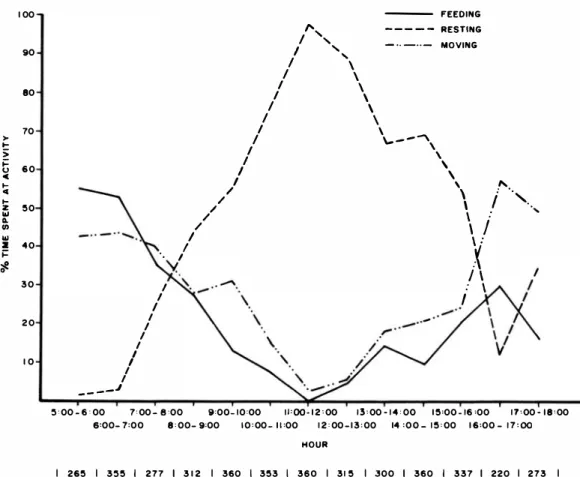
(3) MOSCOW & VA UGHAN: W ite-faced monkeys in a tropical dry forest. 289. TABLE 1 Diurnal use of forest types by a white·faced monkey (Cebus capucinus) troop. Palo Verde. (March·April, 1 982). Forest Type. Home Range. Evergreen Semideciduous Deciduous Deciduous with evergreen pitches Total. Time Spent in Forest Type. ha. %. hrs. %. 3.3 6.0 22. 1. ( 5) ( 9) (33). 1 9.9. (32) (15) (25). 35.6 67.0. routes were highly defined, and capuchins moved through specific trees. Others were gen· eralized, and the monkeys trayeled in particular directions via many nearby paths. Troop movements of C. capucinus were observed by Baldwin and Baldwin ( 1 977) on the Burica Peninsula in Panama, with daily path lengths ranging from 0.6 to 1 .5 km . Clutton Brock and Harvey ( 1 977) have listed sorne daily path lengths for 56 primate species belonging to eight families. Our value of 4 .5 km . for C. capu cinus exceeded the daily path lengths of all 56 species with the exception of three species of Papio. In their analysis of feeding and move ment data for the 56 species, Clutton-Brock and Harvey ( 1 977) found a negative association between daily path length and the proportion of foliage in the dieto The results for the Palo Verde C. capucinus troop conform to this trend: in March and April the capuchins spent only 4.6 and 3 .6% respectively of total feeding time eating leaves and shoots, while they travel led large daily distances. Clutton-Brock and Harvey ( 1 977) suggested that this trend would be expected since , compared to the reproducti ve parts of plants, foliage represented a dense and relatively predictable food supply . Capuchins occasiona11y traveled to outIying parts of their home range and were observed eating food sources absent in the core area of the home range . For example , on 1 8 March there was an excursion to a large Mastichoden· dron capiri tree which had just begun to flower. The trips up the ridge on 25 March inc1uded extensive feeding on Bursera simaruba seeds (Fig. 2). Excursions to outIying parts of the home range occurred anytime before 1 030 hrs and after 1 430 hrs.. (53). 9.3 15.5 1 7.4. (24). ( l OO). 62. 1. ( l OO). On many occasions, especia11y in deciduous f o rests, several adult capuchins walked at ground level while the remainder of the troop continued arborea11y. These terrestrial move ments covered up to 50 m, lasted up to six min and inc1uded foraging . Baldwin and Baldwin ( 1 977) reported that C. capucinus foraged for insects for distances of more than 20 meters along the ground. Moreover, Defler ( 1 979) observed that C. albifrons spent up to 50% of their active period foraging at ground level dur ing the dry season (February) in Colombia. Activity patterns. Feeding was significantly greater between 0500-0900 hrs' than in the other four and five hour periods of the day (H = 9 . 1 7 , dJ. = 2, p<O .O l O). Feeding ceased by noon, then increased to 24% of total observa tion time from 1 500-1 700 hrs (Fig. 4). Move m e n t w a s highly correlated with feeding throughout the day (r= 0 .7404, d J. = 1 1 , P<0 .05). Resting occupied the majority of each hoür between 1 000 - 1 500 hrs (Fig. 4). Resting bouts coincided with highest ambient tempera tures in the refuge . In Colombia, Defler ( 1 979) found the foraging period of C. albifrons to occur from 0500 to about 1 300 hrs, followed by rest until 1 500 hrs and then foraging until 1 600 or 1 700 hrs after which they slept. Ba1d win and Baldwin ( 1 977) reported C. capucinus usually spend between 50-70% of daily activity in foraging and travelling. Gundersen ( 1 977) reported active foraging periods between 0800 and 1 000 hrs and from 1 600 to 1 800 hrs for Co lobus badius monkeys during the dry season in west Africa, which approximates our results.The same author noted that in the wet season, activ ity pattems are more flexible , and suggested.
(4) REVISTA DE BIOLOGIA TROPICAL. 290. -. 1 80 -. - - - - - -- - - -. E l e votion ( m. ) Troi l Rood. -- -. O. 0 0 -. Home ronge Wate r hole. o ,. 1 00 ,. 200 ,. METERS. Sleeping site Resting s i te. St ruct ure. Fig. 1 . Home range of a white-faced monkey (Cebus capucinus ) troop. Palo Verde. March-April, 1 982.. this was due to variation in daily temperatures and food sources. Herbivory. Capuchins fed on 27 plant species ( 1 6 families), several insect species, and one ver tebrate (Table 2). Plant parts eaten inc1uded; seeds, fruits, flowers, flower buds, leaves, young shoots, sap, and woody tissue . Fruit was the primary food source in both months. Shifts from one plant food so urce to. another folIowed changes in the fruiting phe nology in sorne cases. For example , ripe Bauhi nia pods were abundant in March throughout the home range , but were absent in Aprll . Brosi mum alicastrum fruits were more plentiful in March than Aprll, and Muntingia calabura was an abundant and much used food source in Aprll . The percentage of whole food units discar ded or dropped andfor the portion of a unit.
(5) 291. MOSCOW & VA UGHAN: White-faced monkeys in a tropical dry forest. '·0. lOO. �. _ _ _ _ _ _. /""-- ...._ - ' - .... , / I � I __. // ,.. /. ,. ,. ,.. ,-. ,.. ,. ,/. ... -. _ - - ------. ,/. e. : : : : : : : : : : : : : : : :� : : : : : : : : : : : : : : : : : : : : : : : : : : : : : : : : : : : : : : : : : : : : : . . . . . . . . . . . . . . . . ..... . . . . . . . . . .. .. .. .. .. .. .. .. .. .. .. .. .. .. .. .. .. .. .. .. .. .. .. .. .. .. .. .. .. .. .. .. .. .. ::. .. .. .. .. .. .. .. .. .. .. .. .. .. .. .. .. •. .. .. .. .. .. .. . .. .. .. .. . . . . .. .. .. .. .. .. .. .. .. .. .. .. .. .. .. .. .. .. .. .. .. .. .. .. .. .. .. .. .. .. o. .. ·. .. .. ·. .. .. ·. .. .. .. o. •. •. •. •. •. •. •. •. •. •. •. •. ,. .. '. •. •. •. •. •. •. '. ". •. •. •. •. •. •. •. •. •. •. •. •. •. •. •. •. •. •. •. •. •. •. o. •. •. •. •. •. •. •. •. •. •. •. o. •. •. •. •. •. •. •. •. •. •. •. •. •. •. •. •. •. •. •. •. •. •. •. •. •. •. •. •. •. •. •. •. •. '. ". •. •. •. •. •. •. •. •. •. •. •. •. •. •. •. •. •. •. •. •. •. •. '. •. •. •. •. •. •. •. •. •. •. •. •. •. •. •. •. •. •. •. o. •. •. '. -1. 80-. E l evot ion. ( in m. ). Tro i l Rood Trovel. .. D 1: : : :1. Forest. o. ¡. 200 .... Morsh , old field s , post ure. Water hole Locotion ot g iven t i me -. Struct u re. Fig. 2. White-faced monkey (Cebus capucinus) troop. movement. Palo Verde. March 1 2, 1 982. Directed travel = 4.5 km.. rejected by a monkey varied between feeding events for a particular plant food. Discarded Bauhinia pods, for example, still contained an average 66% of their seeds, but sorne were picked c1ean of seeds. The capuchins ate 5 to 80% of the fleshy mesocarp of mangos. The. average percentages of seeds found in picked fruits after capuchin feeding was 70% in Pithe cellobium saman, and 33% in Brosimun alicas tmm. An average of 3 3% of fleshy fruit tissue of Spondias purpurea was rejected by capu chins. F or C. albifrons, Defler ( 1 979) found.
(6) REVISTA DE BIOLOGIA TROPICAL. 292. TABLE 2 Percent of total feeding time spent on different foods by a white·faced monkey (Cebus eapucinus) troop. Palo Verde. (March·April, 1 982) a, b/. Speeies. Family. MARCH. p lant Part Eaten.. Feeding Time (min.). % of total feeding time. Fruits and seeds: el Caesalpiniaeeae Anaeardiaeeae Moraeeae Elaeoearpaeeae Anaeardiaeeae Burseraeeae Mimosaeeae Moraeeae Moraeeae Bombaeaeeae Mimosaeeae Ebenaeeae Flaeourtiaeeae Sterculiaeeae Sapotaeeae Fabaeeae. s f. 178 73 47 40 40 40 21 10 7 6 2 2 1 (4) (2) (2). 3 2 .0 1 3 .1 8.5 7.2 7 .2 7.2 3.8 1 .8 1 .3 1 .1 0.4 0.4 0.2. 14 13 7 1 1 (1) (1). 2.5 2 .3 1 .3 0.2 0.2. 16 15 11 5. 2.9 2.7 2.0 0.9. 4 2 (2). 0.7 0.4. Total feeding time on fruits and seeds: Total feeding on other plant parts: Total feeding time on animals. 467 36 53. 84.2 6 .5 9.6. Total observed feeding time. 556. 1 00.3. Bauhinia glabra Mangifera indica '" Brosimum alicastrum Muntingia calabura Spondias purpurea Bursera simaruba Pithecellobium soman Ficus ovalis Cecropia peltata Ceiba pentandra Enterolobium cyclocarpum Diospyros nicaraguensis Xylosoma flexuosum Guazuma ulmifolia Mastichodendron capiri Canavalia sp.. s,m f f, ex,(s?) s, m fr s fr s, (fr?) ?. Other Plant Parts: Mastichodendron capiri Caesolpinia eriostachys Astronium graveolens Calycophyllum candidissimum Unident. wood stick Brosimium alicastrum Enterolobium cyclocarpum. Sapotaeeae Caesalpiniaeeae Anaeardiaeeae Rubiaeeae Moraeeae Mimosaeeae. flb lf. sf flb wt sap flb. Inseets and Other Animals: d,el .unident., from ground in/e:ast. in/b : ast. lizard (A nolis cupreus) in/w, termite (Termitida.e ); Trema m icrantha. in/w: Guazuma ulmifolia in/dl. : asto. APRIL Fruits and seeds: Muntingia calabura Brosimum alicastrum Mastichodendrom capiri Cassia grandis Cecropia peltata Ficus ovalis Xylosoma flexuosum. Elaeoearpaeeae Moraeeae Sapotaeeae Caesalpinael"ae Moraeeae Moraeeae Flaeouritaeeae. s,m s m , (s?) fr s,m fr. 361 24 20 14 13 11 10. 54.9 3.6 3.0 2.1 2.0 1 .7 1.5.
(7) MOSCOW & VA UGHAN: White-faeed monkeys in a tropical dry forest. Species. Plant Part Eaten. ? s, (fr?) f. Family. Astronium graveo/ens Guazuma u/mifo/ia Mangifera indica* Pithecellobium saman Luehea candida Acacia collinsii Stercu/ia apetata Spondias purpurea Piper tubercu/atum Enter% bium cyclocarpum. Anaeardiaeeae Stereuliaeeae Anaeardiaeeae Mimosaeeae Tiliaeeae Mimosaeeae Stereuliaeeae Anaeardiaeeae Piperaeeae Mimosaeeae. s f,(s?) s f fr. 293. % of Feeding Time total (min.) . feeding time 1 .5 10 10 1 .5 9 1 .4 8 1 .2 1.2 8 3 0.5 2 0.3 1 0.1 1 0.1 1 0.1. Other Plant Parts: Manilkara zapora Enter% bium cyclocarpum Caesa/pinia eriostachys Pithecellobium saman Spondias mombin Enter% bium cyclocarpum Trichilia sp. Mastichodendron capiri. Sapotaeeae Mimosaeeae Caesalpiniaeeae Mimosaeeae Anaeardiaeeae Mimosaeeae Meliaeeae Sapotaeeae. fl flb. 29 21 16 6 2 2 2 1. 4.4 3.2 2.4 0.9 0.3 0.3 0.3 0 .2. 14 13 13. 2.1 2.0 2.0. 10 10 6 5 1 1. 1 .5 1 .5 0.9 0.8 0.2 0.2. Total feeding time on fruits and seeds Total feeding time on other plant parts Total feeding time on animals. 506 79 73. 76 .8 1 2.0 1 1 .2. Total feeding time. 658 min. lf. fl st wt sap fl. Inseets and Other Animals: in/b: Enter% bium cyclocarpum in/b: ast unident., from ground in/dI. katydid (Tettigonüdae): Stercu/ia apetata. in/di: ast in/th: ast in/w, andt (Formicidae): Ceiba pentandra in/e: ast wasp nets of Po/ybia sp. (nest, honey, larvae) lizard A nolis cupreus. 100.0. Key to symbols -al. For foods whieh laek feeding time data, the number of feeding events is given in parentheses.. -b/. A question mark in parentheses indieates that the plant part may or may not have been eaten.. -e/. Key to plant parts injested s seed(s), f fleshy mesoearp and/or endoearp, ex exoearp, m = sticky or juicy matrix surrounding seeds. fl flower, flb flower bud, lf leaf, st young shoot, wt woody tissue sap = sap, fr = complete fruit including seed(s). =. =. -dI. =. =. =. =. =. =. Key to inseet foods (classified by method of proeur�ment): in/b Insects obtained by stripping off bark, in/w = Insects obtained by cracking or splitting woody tissue. in/di Insects obtained through inspection of dead leaves on trees or shrubs, in/th = Insects removed by hand from tree holes, and in/c = Inseets eaught with cupped hand(s). =. =. -e/. The plants harboring the insects are listed after the method of procurement symbols. ast sourees .. (*). Not native to Guanaeaste.. =. assorted plant.
(8) 294. REVISTA DE BIOLOGIA TROPICAL. �________________�. " 0. �. 10 0. e. .. / I I. .-'.- /. .. / ... .-. I I. .�'. •. .. •. •. •. •. •. .. •. .. •. .. •. .. .. .. .. .. •. • .. . . . . .. •. .. .. .. I f. .. .. Rf:FU6E HEADOUARTERS. •. •. •. •. .. .. . .. ... . . ....... . �-----. : . : : : : : : : -' : . . : : :� : . . : . . . •. .. .. .. .. .. .. � ' 20 : : : : : : : : : : : : : : : :� : : : : : : : : : : : : : : : : : : : : : : : : : : : : : : : : : : : : : : : : : : : : : . •. •. •. .. .. •. •. •. •. •. •. .. - 1 80 ----------. T ro i l. �--- �. Trovel. •. .. Elevo t i o n. .. •. .. •. •. •. •. .. .. ( i n m. l. Rood. o. . 7 ' 39. -. •. •. .. •. •. •. D . . O ·· .. .. •. •. .. •. •. •. •. •. •. •. •. •. .. •. •. •. .. •. Fo rest. •. •. •. •. •. •. �. •. o. 100. 200 M.. Morsh , old field s , posture. Woter hole locotion ot g i ven t i me S t r uct u re. 3. White-faced monkey (Cebus capucinus) troop. movement. Palo Verde. March 25, 1 982. Directed travel = 5 . 1 km. Fig.. 80% of foraging time dedicated by monkeys to plant matter and 20% to animal matter. Hladik et al. ( 1 97 1 ) reported an omnivorous diet for capuchins. The diet consisted of 65% fruit , 20% animals and 1 5% shoots, leaves and other vege tation.. During the dry season, in a tropical-dry for est in northwestern Costa Rica, Freese ( 1976) found e capucinus to spend 1 1 % of observed activity time feeding on insects and 26% on plants. The sorne author cited the most used fruit and seed sources in March and April as:.
(9) MOSCOW & VA UGHAN: White-faced monkeys in a tropical dry forest. ", / ,. /. 90. / / I I / / I / I I. 80. >-. .... :; � .., oC .... '" .... z '" Q. '" '" a. �. _. ---. 1 00. 70. -•.. 50. / /. /. /. /. FEEOING. - - - - - RESTlNG '. ". \ \ \. \. \. .. -. MOVING. \. \.- - - -.\. /. 60. \ \. '\. "1. 20. ... ',. /. \. ... ,. . ". , .. X·. /\. I I I I I I I. 30. ;. ". /. '. / �. 40. 295. : I. ,. /. 10. I I _ - --.1 5 ' 00 - 6 ' 00. 7 ' 00 - 8 '00. 8'00- 7:00. 11'00- 1 0 '00. 8 : 00- 9:00. 1 1 ' 00 - 1 2 ' 00. 1 0 ' 00 - 1 1 '00. 1 5 ' 00 - 1 4 ' 00. 1 2 : 00 - 1 3 : 00. 1 5 '00 - 16 '00. 14 : 0 0 - 1 5 ' 00. 1 1 ' 00 - 1 8 ' 00. 1 6 :00 - 1 7 : 00. HOUR. I. 265. I. 355. I. 277. I. 312. I. 360. I. 353. I. 380. OBSE RVATIO N. TIME. I. 31 5. I. 300. I. 360. I. 337. I. 220. I. 273. I. ( M I N U TE S ). Fig. 4. Activity pro file of a white-faced monkey (Cebus capucinus) troop. Palo Verde. March-April. 1 982.. Bursera simaruba, Ficus Sp . , Diptodendron cos tarricense, and Luehea candida. Although Bur sera simaruba and Ficus ovalis were also eaten in Palo Verde, they were not major food sour ces during the study period (Table 2). Capuchins in Palo Verde spent on1y a small percentage of feeding time on foliage (4.6% in March and 3 .6% in April). Hladik et al. ( 1 9 7 1 ), in a comparative study of feeding habits of four sympatric monkey species on Barro Colorado Island, Panama, found that the leaf-eating howler monkey, Alouatta vil/osa, caught in sects, while C. capucinus and Saquinus geoff royi, spent 20 and 30% respectively, of their feeding time on animal prey. Insectivory and Carnivory. Capuchins spent Httle time fo raging on animals between 0500-0700 hrs and 1 700- 1 800 hrs. Freese and Oppenheimer ( 1 98 1 ) suggested that daily feed ing begins with fruits because they are a readily. found carbohydrate source and that searching for insects is difficult under dim light conditions. Feeding on animals in our study involved a variety of behaviors (Table 2). Adult capuchins frequent1y sought insects on the ground . Two monkeys caught and ate small A nolis cupreus lizards on the ground, one taking four min to consume all but the tail. Baldwin ( 1 977) repor ted a capuchin grasping the tail of a large iguana (Iguana iguana) and after a struggle , breaking off the end segment and eating it. Capuchins in our study located a katydid , and thrust a cupped hand at the springing insecto During a one-hour period on 24 April, a young adult male fed on ten paper wasp nests (Polybia sp .), four of which harbored wasps. Swatting at the stinging insects, the monkey removed the nests thin outer layer and ate the honey and larvae ftlled comb . C. capucinus demonstrates considerable manual dexterity in removing seeds from fruits,.
(10) 296. REVISTA DE BIOLOGIA TROPICAL. extracting insects from woody tissue, catching insects and other small animals, and other feed ing behaviors. The superior manual abilities of this species were noted by various authors (Freese 1 976, Jolly 1 972, Moynihan 1 976). Drinking. The waterhole in the study area was found within the evergreen forest (Fig. 1 ) in close proximity t o maj or sleeping and resting sites. Both evergreen forest and water availabili ty influenced capuchin home range and move ments during the dry season. At least during the dry season in Palo Verde we agree with Freese ( 1 978) that Cebus troops are limited to areas where water is presento Drinking was observed during all five study days in Apnl, but on on1y two of five days in March. Our presence might have affected the monkey's behavior more in March when the troop was less accustomed to us In April, adult males drank from one to three times daily be tween 064 1 and 1 73 6 hrs while females and juveniles drank less often, perhaps because they were move timid to our presence. Capuchins approached the waterhole cautiously, and of the three occasions in which the first drinker was observed, the leader was an adult maleo Freese ( 1 978) found that adult males led drink ing processions. Stress periods. This study was carried out during the latter part of the dry season, when water was a limiting factor and may have caused troop concentration around waterholes in addition to defense of these water sources by the monkeys. We did not observe any other.C. capucinus troops in the evergreen forest during this study. F ood sources seemed sufficiently abundant for the monkeys, as evidenced by the prolonged resting periods taken around midday. McCoy ( 1 985) found that collared peccary (Tayassu tajacu) herds in Palo Verde showed variation in movement patterns, home range and activity and he suggested that this was co rrelated with food availability , increased move ment in search of water or travel between forag ing sites and cool bedding areas. Both Bigler ( 1 974) and Day ( 1 977) noted this latter trend with peccaries in Arizona. Perhaps year-Iong studies would show clear periods of food re source scarcity and an optimal foraging strate gy for the primates, such as McCoy ( 1 985) found for collared peccaries during November·. December and May-June when movement and home ranges increased and less than optimal foods were found in feces. RESUMEN El radio de acción, patrones de movimiento , actividad y dieta de una manada de 1 6 indivi duos de mono carablanca (Cebus capucinus) fueron estudiados en un bosque seco-tropical de Costa Rica a finales de la época seca (marzo y abril) de 1 982 . La tropa se desplazó en un area de 0 .67 km2 , y recorrió un promedio de 4.5km ± 0.6 diarios. Se identificaron tres actividades basicas diarias: descanso , movimiento y alimen tación . Descansaron más entre las 1 000-1500 hrs. El movimiento de la manada estaba fuerte mente correlacionado con la alimentación y o c urrió m á s e ntre las 0500.0900 hrs y 1 300- 1 800 hrs. Los primates son omnívoros y consumieron partes de 27 especies de plantas, cuatro de in sectos y una lagartij a del género Anolis. ACKNOWLEDGMENTS We thank Colin Chapman, Curtis Freese, Winnifred Hallwachs, Bruce Marcot and Michael McCoy for comments on the manuscript, Jorge Barrantes for typing severaldrafts and Miguel Ro dríguez for plant identifications. Friendship of workers and scientists in Palo Verde was appre ciated during the study period o The Associated Colleges of the Midwest, National University and Organization of American States provided logistical support . The project is part of Natio nal University research project No. 782085 "Study and management of wildlife in Costa Rica" . REFERENCES Altmann, J .S . 1 974. Observational study of behavior sampling methods. Behavior 49: 227-26 7 . Baldwin, J.D & J .C. Baldwin . 1 9 7 7 . Observations on Cebus capucinus in southwest Panama. Primates 1 8 : 93 7-941 . Bigler, W. J. 1 974. Seasonal movements and activity patterns of the collared peccary. J. Mammal. 55 : 85 1 -855 Clutton-Brock, T.H. & P.G . Harvey . 1 977. Species differences in feeding and ranging behavior in pri-.
(11) MOSCOW & VA UGHAN: White-faced monkeys in a tropical dry forest. mates. p. 55 7-584 In Primate Ecology (T. H. Clutton-Brock, ed.). Academic Press, New York . 6 3 1 p. Day, G./. 1 977. Javelina activity patterns. A final re porl. Pittman-Robertson Fed . Aid in Wildl. Res. Pro . W-78-R, Work Plan 2, Job 9. Arizona Game and Fish Depl. (mimeo.). l 3 pp. Defler, T.R. 1 979. On the ecology and behavior of Cebus albifrons in eastern Colombia. 1. Ecology. Primates 20: 475-490. Freese, C. 1976 . Food habits of white-faced monkeys (Cebus capucinus L.) (primates: Cebidae) in Santa Rosa National Park, Costa Rica. Brenesia 10/1 1 : 43-56 . Freese, C. 1 978. The behavior of white-faced monkeys (Cebus capucinus) at a dry season waterhole. Pri mates 19: 275-2 86 . Freese, C. & 1 . Oppenheimer. 1 9 8 1 . The capuchin monkeys: genus Cebus sp . Pp In Ecology and behavior of neotropical primates. (A. Coibra-Filho and R. Mittermeier, eds.). Vol. 1 . Academia Brasi leira de Ciencias, Rio de J aneiro. Gunderson, V. 1977. Sorne observations on the ecolo gy of Colobus badius temmincki, Abuko Nature Reserve, the Gambia, West Africa. Primates 1 8 : 305-3 14. Hall, E . 1 981 . The marnmals of North America. 2 vo lumes. Wiley Press. New York. 1 1 89 p . Hladik, C . M ., A. Hladik, J . Bousset, P . Valdebouze, G. Viroben, & 1 . Delort-Laval . 1 97 1 . Le regime ali-. 297. mentaire des Primates de l'ile de Barro Colorado (Panama). Folia Primal. 16 : 85-1 22. Jolly, A. 1972. The Evolution of Primate Behavior. MacMillan, New York. 397 pp. McCoy, M . 1 985 . Season movement, home range, acti vity and diet of collared peccaries in Costa Rican dry forest. M .S . Thesis. Humboldt State University. California. 109 pp. Mohr, C.O. 1 947. Table of equivalent populations of North American small mammals. Am . Mid. Nal . 3 7 : 23 3-249. Moynihan, M. 1976 . The New World Primates. Prince ton Univ. Press, Princeton, New Jersey. 26 2 p. Oppenheimer, 1 . 1 960. Behavior and ecology of the white-faced monkey Cebus capucinus on Barro Colorado Island, C.Z .. Ph.D. Dissertation . Univ. of Illinois, Champaign. 1 89 p . Sokal, R .R. & F.J. Rohlf. 1 9 8 1 . Biometry. Second edition. W. H. Freeman and Company, San Francis co. 859 p . Tosi, 1 . 1 969. Mapa ecológico d e Costa Rica. Centro Científico Tropical, San José. Escala 1 : 750.000, en colores. Vaughan, C., G. Canessa, M. McCoy, M. Rodríguez, 1 . Bravo, 1 . Sánchez, R . Morales, T . Hawkins, E . Crozier, D . Shaffer M . Rodríguez & F. Hodgson. 1 982. Refugio de Fauna Silvestre DI. Rafael Lucas Rodríguez Caballero: plan de manejo y desarrollo. Editorial Universidad Nacional, Costa Rica. 271 pp ..
(12)
Figure
Documento similar
17,18 Contrary to graphene, the band gap in ML-MDS separating the valence and conduction bands is naturally large and due to the absence of inversion symmetry in ML-MDS the
The validity of food and nutrient intake obtained with DH-E was estimated using Pearson correlation coefficients between the DH-E conducted at the end of the study (DH-E2) and the
We assessed the potential effect of tiller height and phenology on standing levels of herbivore and pathogen damage on adults of the woody perennial grass Lasiacis ruscifolia in
The potential displacement of reduction process at less negative values in the voltammograms and the changes in cathodic charge when iridium is present in the solution at
porpuses such as; reviewing vocabulary already checked or for introducing new vocabulary about food and drink and as a support for teaching how to order food in a
We find that individuals politically aligned to the regional incumbent shift responsibility to the central government upon receiving negative news about the number of contact tracers
For example, it requires people to consider how technical choices establish particular social orders, and how those orders shape experiences. Because technical choices cannot be
From Snow White to Shreisher Dahbu: the construction of gender in Saharawi storytelling dry and golden wadis 1 , where “en la sombra de cada acacia … en cada pozo … hay miles
