
TítuloConversations about self identity in Alzheimer disease: augmentative and alternative communication memory books as an aid
13
0
0
Texto completo
(2) Abstract Alzheimer disease (AD) is a progressive and degenerative neurological disorder that affects memory, language and communication, thinking, and social skills. The inability to recall incidents and events, especially when symptoms become more prevalent and severe, can cause a person to experience a loss of self or to have doubts about his or her identity. One approach to helping these patients with their memory and language problems is to use memory books, a kind of Augmentative and Alternative Communication (AAC) tool. The aim of this study was to verify whether the introduction of AAC books could have an impact on conversations about self-identity through an increase of ‘self’-positive conversational contents and on improving conversational skills. Three single case studies were carried out with three elderly women with mild, moderate and severe AD, respectively. Each participant was involved in a conversation about their ‘selves’ in an alternating treatment design (ABAB) without a memory book in phase A and with the aid of this AAC tool in phase B. The results showed a similar conversational response pattern in all participants. AAC aids increased the number of ‘self’positive conversational statements with a reduction in negative, ambiguous and repetitive utterances. In conclusion, AAC memory tools seemed to help participants with dementia to focus their attention on relevant personal information, allowing them to centre the conversation on core positive identity contents, thus improving the quality of the conversations with fewer ambiguous utterances. Resumen La Enfermedad de Alzheimer es una enfermedad neurológica degenerativa y progresiva que afecta a la memoria, el lenguaje y la comunicación, el pensamiento y las habilidades sociales. La incapacidad para recordar incidentes y acontecimientos, cuando los síntomas son más prevalentes y severos, puede causar que la persona experimente una pérdida del self o tenga dudas sobre su identidad. Un enfoque que ayuda con los problemas de memoria y de lenguaje es el uso de los libros de memoria, herramientas de Comunicación Aumentativa y Alternativa (CAA). El objetivo de este estudio es comprobar si la introducción de libros de CAA tiene un impacto en las conversaciones sobre la propia identidad, a través del incremento de contenidos conversacionales positivos sobre “si mismo”, y en la mejora de habilidades conversacionales. Se llevaron a cabo tres estudios de caso único con tres mujeres mayores con enfermedad de Alzheimer, leve, moderada y severa, respectivamente. Se implicó a cada participante en una conversación sobre “si misma” en un diseño de tratamientos alternos (ABAB) sin libro de memoria en la fase A y con apoyo de la CAA en B. Los resultados muestran un patrón de respuesta conversacional similar para las tres participantes. Con las ayudas de CAA se incrementaron las frases positivas sobre “si misma” en la conversación y se redujeron las declaraciones negativas, ambiguas y repetitivas. La conclusión es que parece que las herramientas de memoria han ayudado a enfocar la atención sobre información personal relevante, permitiendo centrar la conversación en contenidos básicos de su identidad y mejorando su calidad con menos ambigüedades. Keywords Augmentative and Alternative Communication; Memory books; Conversations; Alzheimer disease Palabras clave Comunicación Aumentativa y Alternativa; Libros de memoria; Conversación; Enfermedad de Alzheimer.
(3) Introduction Communication deficits associated with dementia are often attributed to significant memory deficits (Swihart & Pirozzolo, 1988). The provision of prosthetic memory aids or Augmentative and Alternative Communication (AAC) is one remedial approach to Alzheimer's disease (AD) memory deficits. AAC basic goal is to help persons with communication impairments increase their participation in desired activities and create opportunities for social interaction (Beukelman & Mirenda, 2005). AAC in the form of external aids that incorporate stimuli highly relevant to a person's daily life may include, among others, memory wallets, memory books, or notebooks that provide cues for interaction and support communication participation of persons with dementia (Bourgeois, Fried-Oken, & Rowland, 2010). Bourgeois, Burgio, Schulz, Beach, and Palmer (1997) have pointed out some forms of long-term memory (procedural, non-declarative, and episodic) that remain relatively intact until later stages can be harnessed for maintaining desired behaviours as conversation. Due to limitations of AD individuals to learn new skills and strategies to encode new information, these AAC interventions have been designed to maintain conversation skills taking advantage of the relatively intact repetition and oral skills of patients with AD. Moreover, memory AAC aids provide desired or needed information in an obvious, visible way becoming part of the environment, and provide an alternate pathway to the stored information allowing for encoding and retrieval processes (Bourgeois, 2002). Pairing the external aid that contains personally relevant picture and sentence stimuli to the person with AD with familiar and spared skills based on intact procedural memory, such as page turning, reading aloud, or autobiographical memories, should maximize a person's opportunity for success (Bourgeois, 1994). The usefulness of memory aids to improve conversational skills has been demonstrated in a variety of settings such as private settings, personal care and nursing homes, and with a variety of conversational partners as spouse, adult children, nursing staff, friends, and day-care centre volunteers (Allen-Burge, Burgio, Bourgeois, Sims, & Nunnikhoven, 2001; Bourgeois, 1990, 1992, 1993, 1996; Bourgeois & Mason, 1996). With the use of memory aids, moderate AD patients significantly increased the frequency of factual statements, made significantly more sense, stayed on the topic better, provided more unambiguous information and used more appropriate referents. Subjects also decreased the amount of counterproductive speech, such as ambiguous, perseverative, erroneous, and unintelligible utterances said during the same conversation (Bourgeois, 1990, 1992; Bourgeois & Mason, 1996). Similar results on the improvement of the quantity and quality of conversations were obtained by Bourgeois (1993) and Hoerster, Hickey, and Bourgeois (2001) when a prosthetic memory aid was introduced in dyads with moderate to severe dementia. Andrews-Salvia, Roy, and Cameron (2003) results revealed that all severe dementia subjects stated more on-topic facts using the memory books than during the baseline condition. Bourgeois, Dijkstra, Burgio, and Allen-Burge (2001) also found improvements on conversational measure, such as duration of speaking time and frequency of utterances, between treatment and control conditions as a function of memory book use. A replication of previous research conducted by Wan-Zu (2011) with 3 Chinese mild, moderate and severe dementia participants found an increase of number of on-topic factual statements and a reduction of ambiguous, unintelligible, and perseverative utterances with a memory book. On the other hand, memory of oneself and one's life provides information from which one can derive a sense of identity (MacRae, 2010). Due to changes in cognition, language and memory, Alzheimer's disease poses a special threat on patients’ self. The inability to recall incidents and events can cause an Alzheimer's disease patient to experience a loss of self and self-identity. When family and friends notice the observable changes they may treat the person with dementia differently or do not interact with the person as they did before the symptoms (Sabat, 2001). People with dementia tend to lose their sense of self at a more rapid rate due to the way others treat them (Pearce, Clare, & Pistrang, 2002). This inability to interact creates problems with communication and identity (Cohen-Mansfield, Parpura-Gill, & Golander, 2006)..
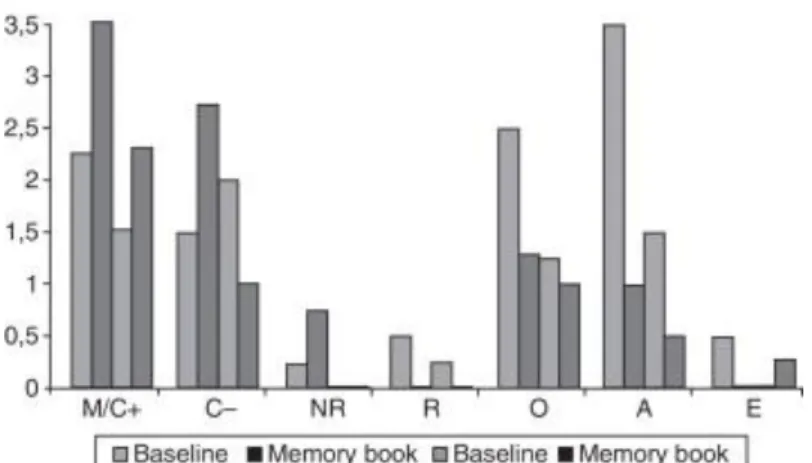
(4) Because most of the above mentioned memory book studies addressed personally relevant information about the person with dementia, it is also possible that these books could impact selfidentity statements. A sense of self-identity is constructed through the collection of stories or personal biographies that we build about ourselves and that incorporate references to the past, the present and the future (Stuart, Lasker, & Beukelman, 2000). To date, however, only the study of Trela (2009) has evaluated the potential of memory books to deal with the preservation of identity specifically. Results of a pilot study carried out with the aim to explore the preservation of self-identity in one woman with moderate dementia using a memory book revealed that in the presence of a memory book positive statements about selfidentity increased along with the person's ability to communicate their thoughts effectively, negative and ambiguous statements decreased and the participant demonstrated the ability to maintain quality conversations with few errors. The aim of this study is to verify AAC tools contribution to the maintenance of self-identity in conversations held by individuals with Alzheimer's disease. Specific aims are: (a) to analyze whether there are quantity changes in ‘self’ conversational contents after AAC tools are introduced; and (b) to analyze whether there is an improvement in the quality of conversational skills. Based on previous research our hypothesis is that AAC tools contribute to an increase of positive statements about participants’ self with a decrease of negative, ambiguous and repetitive statements for mild, moderate and severe levels of Alzheimer's disease.. Materials and methods Materials A memory book was compiled for each participant with the aid of their family members. These books were focused on participants’ accomplishments and roles in their lives and consisted of an eleven pages binder, inside plastic sleeves, with an image of the subject and a sentence on each page that represented the main idea on the page. An Iphone 4 cellular with digital voice recorder was used to record all sessions. The Mini Mental Exam (Folstein, Folstein, & McHugh, 1975; Lobo, Saz, & Marcos, 2002) was used to categorize participants’ severity level of dementia. Participants Three elderly women diagnosed with mild, moderate and severe AD, respectively, participated in this study. The inclusion criteria were: (a) verified Alzheimer disease (AD) by a board certified neurologist, (b) vision and hearing within functional limits or corrected with prostheses, (c) belonging to Family AD Association of Bergantiños county (AFABER, A Coruña, Spain) and (d) reading decoding abilities. Although no formal assessment of reading comprehension was administered, all subjects were judged able, based on informal evaluation, to orally read and comprehend personally relevant typed statements of comparable length and complexity to those included in the memory books. Other neurologic or psychiatric illness (no reported brain damage, CVA, psychological disorder) was the exclusion criteria..
(5) Mild dementia participant She was an 86-year-old woman. In 2010 received an Alzheimer disease diagnostic. She scored 19 out of 30 in the Mini Mental Exam (Folstein et al., 1975; Lobo et al., 2002) categorizing her with a mild case of dementia. After matching font size to her vision capabilities, the Memory Book text was decided to be a font size of 16 pt. She wears glasses; she has not got other health problems. Her pragmatic communication skills were preserved. She made correct grammatically structured sentences with wide vocabulary and followed conversations. Orientation was affected. Moderate dementia participant She was an 86-year-old widow woman. She scored 10 out of 30 in the Mini Mental Exam (Folstein et al., 1975; Lobo et al., 2002) categorizing her with a moderate case of dementia. The Memory Book text was determined to be of 16 pt. She has corrected vision capabilities with glasses. She has not got any other clinical problems. Anomia and naming were her main communicative problem, she had reduced vocabulary and tended to repeat the same words. Main cognitive functions affected were attention and concentration and short term memory. Severe dementia participant She was an 87-year-old woman. She scored 3 out of 30 in the Mini Mental Exam (Folstein et al., 1975; Lobo et al., 2002) categorizing her with a severe case of dementia. The Memory Book text was determined to be of 20 pt. All cognitive functions were severely deteriorated as well as her communication skills as she had severe difficulties in keeping on a conversation. Her vocabulary was extremely reduced and needed to be repeated. All participation consent forms were signed by a family member. Setting All sessions for the three participants were conducted individually in a quiet room of AFABER. AFABER is a non-profit association created in 2001 with the aim of improving quality of life of the elderly and their caregivers through the provision of integral treatment including speech language pathologist and occupational therapy services. The researcher and the participant sat next to each other at a table, with no noises in the environment. Design and variables This research study consisted of three single case studies with an alternating treatment design (Barlow & Hayes, 1979) for each participant. The independent variable was the memory book AAC tool. Conversational contents were the dependent variables: (M) Memory aid statements: printed statements read in intelligible and unambiguous way from the memory book; Content novel statement related, that can be either (C+) an intelligible and unambiguous positive nature statement about themselves or about their lives, including recognition or statement about a person, place or event in the memory book, or (C−) negative nature statement about their life; (NU) Novel statement unrelated: intelligible and unambiguous statement of a fact, not related to stimuli present but in the environment; (R) Repetitive utterance: intelligible utterances that are a repetition of any previously stated utterance; (O) Other speech acts: intelligible and ambiguous statements (“yes”, “no”, “I don’t know”), and answers to a question that do not contain content; (A) Ambiguous statements, not related to subject material; word mispronunciations or paraphasias; fragments and incomplete thoughts; (E) Errors: statements containing false content..
(6) Procedure There were four baseline sessions (A), at least 24 h apart, in which the participant was engaged in conversations for five minutes per session. This period time was reported in previous research (Bourgeois, 1990, 1992; Trela, 2009). Questions about participants’ life, accomplishments, roles, fears and worries were used as prompts to elicit conversations. The sessions began with the researcher stating “Today I’d like to talk about your life and keep a conversation. Is this all right?” Then, prompts like the ones used in Trela's (2009) [“What are you proud of in your life?”; “What makes you a special person?”, or “What would you change about your life?”] were given to initiate the conversation or to continue it when a new page of the memory book was introduced. If the participant remained in silence more prompts were given as, for example, “What else could you say about this?” By the end of the five minutes, the experimenter ended the conversation thanking the participant conversation. There were 4 treatment sessions (B), at least 24 h apart that consisted of five-minute interviews with the memory book. Each participant was explained the book was made for helping them to talk about their lives. One prompt followed the explanation. As in the baseline sessions, participant's statements were acknowledged with neutral comments, and after the five minutes conversation period the session ended. The second phase of each study, as these were alternating treatment designs, consisted of memory book withdrawal (A) followed again by the memory book intervention (B). Every baseline and memory book intervention session was recorded with a voice recorder on an Iphone4 cellular, transcribed, and then each utterance was numbered and coded using eight of the ten categories and codes used by Trela (2009). Data of the dependent variables categories were summed and entered into an Excel spreadsheet. Reliability A second experimenter was trained to code transcriptions. Fifty percent of the transcripts (eight of sixteen) were recoded for reliability. The overall percent agreement was 87.5%. There was disagreement for only one statement in the recoding. Data analyses Descriptive statistical analyses of the data using SPSS 15.0 version were conducted and included the mean and standard deviations of the dependent variables. To compare quantitative data, a non-parametric test was used, the Wilcoxon's test, as data did not fulfil the requirement of variance homogeneity. Results for each participant are presented separately. Data were gathered in two separate categories: Self-identity desired or positive utterances that comprised Memory book phrases and positive content statements; and Undesired conversational content that included novel new unrelated utterances, repetitions, ambiguous, other speech acts and errors..
(7) Results Mild dementia participant Table 1 displays the mild dementia participant results in the ABAB conditions. Fig. 1 illustrates the positive and desired conversational utterances grouped and the undesired or negative conversational responses.. Table 1. Means and standard deviations of mild dementia participant's conversational contents. M+C+. C−. UN. R. O. A. E. Mean. 2.25. 1.50. 0.25. 0.50. 2.50. 3.50. 0.50. Std Dev. 2.86. 1.29. 0.50. 0.55. 1.00. 1.00. 0.57. Baseline sessions (A). Memory book treatment (B) Mean. 3.50. 2.75. 0.75. 0. 1.25. 1.00. 0. Std Dev. 2.07. 1.70. 1.50. 0. 1.25. 0. 0. Mean. 1.50. 2.00. 0. 0.25. 1.25. 1.50. 0. Std Dev. 1.69. 0.81. 0. 0.55. 0.50. 0.55. 0. Baseline sessions (A). Memory book treatment (B) Mean. 2.25. 1.00. 0. 0. 1.00. 0.50. 0.25. Std Dev. 1.83. 0.81. 0. 0. 0. 1.00. 0.50. M+C+: Memory aid statement plus positive content; C−: Negative statement; UN: Novel statement unrelated; R: Repetitive utterance; O: Other speech acts; A: Ambiguous statements; E: error.. Figure 1. Mild dementia participant's conversational utterances..
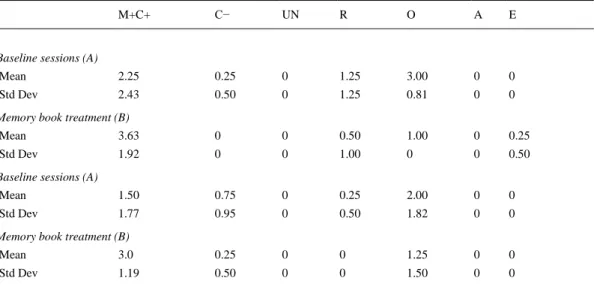
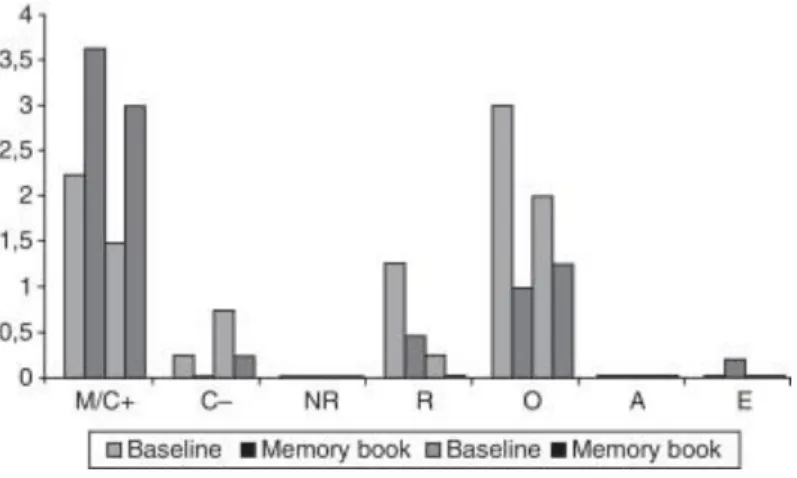
(8) For the first AB phase, the mean and standard deviation of Memory Book and Content Positive (M+C+) utterances in baseline was 2.25 and 2.86, and during treatment was 3.5 and 2, respectively. For the second AB phase, the mean for baseline was 1.5 (SD = 1.6), and for treatment was 2.25 (SD = 1.8). For the first AB phase, Content negative statements (C−) had a mean of 1.5 (SD = 1.2) during the first baseline and a mean of 2.7 (SD = 1.7) during the intervention sessions. In the second AB phase, the mean of baseline was 2 (SD = 0.8) and the mean of treatment was 1 (SD = 0.8). Novel Unrelated statements (NU) had a mean of 0.25 (SD = 0.5) in the baseline, and the mean was 0.75 (SD = 1.5) in the intervention for the first AB phase. There were not any novel unrelated statements neither in the second baseline nor in the second treatment condition. The mean of Repetitive statements (R) during first and second baseline were (M = 0.5; SD = 0.5) and (M = 0.2; SD = 0.5), respectively. There were no repetitions during either treatment sessions. Errors (E) had a mean of 0.5 (SD = 0.5) during the first baseline phase but there were not any during the first treatment phase. During the second AB phase there were no errors. The Other category (O) had a mean of 2.5 (SD = 1) for baseline and a mean of 1.2 (SD = 1.2) for intervention during first AB phase. For the second AB phase, the baseline mean was 1.2 (SD = 0.5) and intervention statements mean was 1 (SD = 0). The Ambiguous statements (A) had a mean of 3.5 (SD = 1) and a mean of 1 (SD = 0) in the first baseline and intervention sessions, respectively. These means differences nearly reach statistical significance [Z = −1.89; P=.059]. During the second AB phase, baseline and intervention statements means were 1.5 (SD = 0.5) and 0.5 (SD = 1), respectively. No significant differences were found for the other measures. Moderate dementia participant Table 2 and Fig. 2 display the moderate dementia participant results. Desired and positive conversational contents had a mean of 2.25 (SD = 2.4) during the first baseline and a mean of 3.6 (SD = 1.9) after the introduction of the memory book. Means differences were statistically significant [Z = −2.15; P=.03]. After the withdrawal of the memory book the mean of desired and positive conversational contents was 1.5 (SD = 1.7) and with the reintroduction of the AAC tool the mean was 3 (SD = 1.1). Differences between the means were significant [Z = −2.23; P=.02] for the memory book condition.. Table 2. Means and standard deviations of moderate dementia participant's conversational contents. M+C+. C−. UN. R. O. A. E. Mean. 2.25. 0.25. 0. 1.25. 3.00. 0. 0. Std Dev. 2.43. 0.50. 0. 1.25. 0.81. 0. 0. Baseline sessions (A). Memory book treatment (B) Mean. 3.63. 0. 0. 0.50. 1.00. 0. 0.25. Std Dev. 1.92. 0. 0. 1.00. 0. 0. 0.50. Mean. 1.50. 0.75. 0. 0.25. 2.00. 0. 0. Std Dev. 1.77. 0.95. 0. 0.50. 1.82. 0. 0. Baseline sessions (A). Memory book treatment (B) Mean. 3.0. 0.25. 0. 0. 1.25. 0. 0. Std Dev. 1.19. 0.50. 0. 0. 1.50. 0. 0.
(9) Figure 2. Moderate dementia participant's conversational utterances.. Content negative statements (C−) had a mean of 0.25 (SD = 0.5) during the first baseline sessions. There were not any content negative statements during the first treatment sessions. In the second AB phase, the mean of baseline was 0.75 (SD = 0.9) and the mean of treatment was 0.25 (SD = 0.5). The mean of Repetitive utterances (R) in baseline was 1.25 (SD = 1.25) and in treatment was 0.5 (SD = 1). There was a decrease of repetitive utterances from the baseline (Mean = 0.25; SD = 0.5) to intervention sessions. Despite the decrease of content negative statements and repetitive utterances no significant differences were found. The Other category (O) means were 3 (SD = 0.8) in baseline and 1 (SD = 0) in intervention. For the second AB phase the mean of other utterances was 2 (SD = 1.8) in baseline and 1.25 (SD = 1.5) in intervention. Mean differences for the Other category statements were not significantly different. There were Errors (E) only during the first intervention phase (M = 0.25; SD = 0.5), but no significant differences were found between baseline and intervention means..
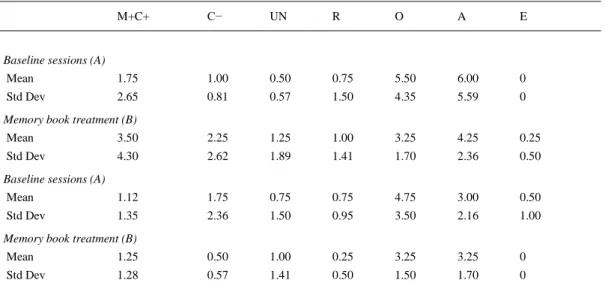
(10) Severe dementia participant Severe dementia participant results are displayed in Table 3 and Fig. 3.. Table 3. Means and standard deviations of severe dementia participant's conversational contents M+C+. C−. UN. R. O. A. E. Mean. 1.75. 1.00. 0.50. 0.75. 5.50. 6.00. 0. Std Dev. 2.65. 0.81. 0.57. 1.50. 4.35. 5.59. 0. Baseline sessions (A). Memory book treatment (B) Mean. 3.50. 2.25. 1.25. 1.00. 3.25. 4.25. 0.25. Std Dev. 4.30. 2.62. 1.89. 1.41. 1.70. 2.36. 0.50. Mean. 1.12. 1.75. 0.75. 0.75. 4.75. 3.00. 0.50. Std Dev. 1.35. 2.36. 1.50. 0.95. 3.50. 2.16. 1.00. Baseline sessions (A). Memory book treatment (B) Mean. 1.25. 0.50. 1.00. 0.25. 3.25. 3.25. 0. Std Dev. 1.28. 0.57. 1.41. 0.50. 1.50. 1.70. 0. M+C+: Memory aid statement plus positive content; C−: Negative statement; UN: Novel statement unrelated; R: Repetitive utterance; O: Other speech acts; A: Ambiguous statements; E: Error.. Figure 3. Severe dementia participant's conversational utterances..
(11) For the first AB phase, the mean and standard deviation of Memory Book and Content Positive (M+C+) utterances in baseline was 1.75 and 2.6, and during treatment was 3.5 and 4.3, respectively. In spite of an increment in content positive utterances, differences were not significant. For the second AB phase, the mean for baseline was 1.12 (SD = 1.3), and for treatment was 1.25 (SD = 1.2). Content negative statements (C−) had a mean of 1 (SD = 0.8) during the first baseline sessions and a mean of 2.25 (SD = 2.6) in the treatment condition. For the second baseline and treatment sessions the means and standard deviation were (Mean = 1.75; SD = 2.3) (Mean = 0.5; SD = 0.5), respectively. No significant differences were found. For the first AB phase, Novel Unrelated statements (NU) had a mean of 0.5 (SD = 0.5) in baseline and 1.25 (SD = 1.8) in intervention, and Repetitive utterances (R) had a baseline mean of 0.75 (SD = 1.5) and an intervention mean of 1 (SD = 1.4). For the second AB phase, the baseline mean was 0.75 (SD = 1.5) and the treatment mean was 1 (SD = 1.4) for NU; for R the baseline mean was 0.75 (SD = 0.9) and the intervention mean was 0.25 (SD = 0.5). The Other category (O) had a mean of 5.5 (SD = 4.3) in the first baseline and a mean of 3.25 (SD = 1.7) in the first intervention. In the second baseline the mean was 4.75 (SD = 3.5) and in treatment the mean was 3.25 (SD = 1.5). With regard to Ambiguous (A) statements, the mean in baseline was 6 (SD = 5.5) and after AAC intervention was 4.25 (SD = 2.3). For the second phase, the mean of A in baseline was 3 (DT = 2.1) and after AAC treatment was 3.25 (DT = 1.7). No significant differences between means were found neither for NU nor for R, O, A or E.. Discussion and conclusions The aim of this study was to explore whether a memory book focused on relevant information about personal accomplishments and roles would have an impact on the maintenance of selfidentity through an increase of positive statements about the selves of the three mild, moderate and severe Alzheimer disease participants. The present alternative treatment design has extended original Trela's sample, to include all levels of dementia severity, and quantitative and qualitative changes in communication patterns were expected. From a descriptive point of view, this study revealed that for the three participants the memory AAC intervention has contributed to the purpose of maintaining self-identity conversations. When comparing the results for the three participants altogether, a common conversational profile for positive content and memory aid statements emerged. There was an increase of positive statements about participants’ selves and an improvement in the efficacy of communication with fewer errors and ambiguous statements during treatment sessions. After intervention the moderate and severe participants doubled content positive statements as Trela's moderate AD participant although this increase was significant only for the moderate participant, but not for the other participants. An increase of factual statements through the use of an autobiographical memory book was also found by Bourgeois (1990, 1992). Hence the memory book has allowed the moderate dementia participant to read and expand on what was written in a positive way and it has also allowed her an access to her autobiographical memory. This finding replicates Trela's one, but it is not applied to the other participants. In spite of conversational improvement, lack of significance in the severe dementia participant results may be due to her deterioration which prevented her to significantly take advantage of the AAC tool; the mild dementia participant also improved her conversational content but her cognitive deterioration still allowed her to autonomously manage her conversations. With regard to negative content utterances there was not a significant reduction of this type of statements attributable to the memory book for any participant. These results clearly contrast those of Trela (2009) and Bourgeois (1990, 1992) who found a significant reduction of content negative statements in the memory book condition. A possible explanation is that the mean number of negative content statements was minimum along all the phases of the study; therefore the memory book was irrelevant for this type of content..
(12) Lack of ambiguous, repetitive or new unrelated utterances together with lack of error are all aspects that improve quality of conversations. There was a main difference between this study and Trela's in that our moderate dementia participant did not produce any ambiguous utterance throughout the study meanwhile Trela's moderate participant produced a mean of 9.5 ambiguous utterances. From a descriptive point of view, there was a decrease from baseline to intervention in the mean number of ambiguous statements for the mild and severe dementia participants; specifically for the mild dementia participant there was a reduction of the triple. These decreases in the treatment conditions are in agreement with previous results (Bourgeois, 1990, 1992). With regard to repetitive, new unrelated utterances and errors, same results as in Trela's (2009) were found. Lack of significant differences in the treatment conditions may be attributed, as Trela pointed out, to the fact that there were very few instances of those utterance types in either condition. The results analysis also revealed differences between baseline and treatment in the other speech acts category for the three participants although these differences were not significant. The mild participant was the one that produced less other speech utterances while the severe participant was the one with the highest amount of other speech acts. These results are clearly in line with Trela's; her participant produced many other utterances in both conditions, but no significant differences were found. This category includes intelligible and ambiguous statements and answers to a direct question that do not contain content. It may be said that the memory book condition has contributed to restore fluency in the speech by reducing irrelevant conversational contents. To conclude, it seems that the memory AAC tool has aided all participants with dementia, and significantly aided the moderate participant, to focus their attention on relevant personal information through the provision of written text and images, allowing them to centre the conversation on core positive identity contents. The memory books have also allowed participants to access their inner recollections through the external AAC support and to reject irrelevant information maintaining their self-identity in their conversations through the production of positive contents, the reduction of repetitive and ambiguous utterances, improving conversation's quality. Cautions must be taken in generalizing the results of this study to all dementia population. There are various limitations that must be considered. First, the inclusion of 3 participants prevents widespread generalization. The inclusion criteria were quite specific in relation to participants having reading decoding abilities, but the whole elderly population may not be literate. Second, although general questions about self-identity were used as prompts for the participants to have a conversation about “themselves” a refined list of inquiries should be developed. Third, prompts were neither analyzed nor counted, making it difficult to know whether a high number of prompts increased conversational responses. Finally, although the Mini Mental Exam was not used to make a diagnosis but to classify the participants, further studies should examine cognitive deterioration through other neuropsychological batteries or tests as the Test Barcelona-R (Peña Casanova, 2005).. Conflict of interest The authors declare no conflict of interest.. Acknowledgements Nuestro agradecimiento a la Asociación de Familiares de Alzheimer de Bergantiños (AFABER) de A Coruña y a las tres mujeres participantes en este estudio..
(13) References Allen-Burge, R., Burgio, L., Bourgeois, M., Sims, R., & Nunnikhoven, J. (2001). Increasing communication among nursing home residents. Journal of Clinical Geropsychology , 7, 213--230. Andrews-Salvia, M., Roy, N., & Cameron, R. (2003). Evaluating the effects of memory books for individuals with severe dementia. Journal of Medical Speech-Language Pathology , 11, 51-59. Barlow, D. H., & Hayes, S. C. (1979). Alternating treatment design: One strategy for comparing the effects of two treatments in a single subject. Journal of Applied Behavior Analysis , 12, 199-210. Beukelman, D. R., & Mirenda, P. (2005). Augmentative and Alter- native Communication. Supporting children and adults with complex communication needs. Baltimore: Paul H. Brookes Publishing Co. Bourgeois, M. (1990). Enhancing conversation skills in Alzheimer’s Disease using a prosthetic memory aid. Journal of Applied Behavior Analysis, 23, 29-42. Bourgeois, M. (1992). Evaluating memory wallets in conversations with patients with dementia. Journal of Speech and Hearing Research, 35, 1344-1357. Bourgeois, M. (1993). Effects of memory aids on the dyadic conversations of individuals with dementia. Journal of Applied Behavior Analysis, 26, 77-87. Bourgeois, M. (1994). Teaching caregivers to use memory aids with patients with dementia. In Caregiving in Alzheimer’s disease II: Caregiving interventions. Seminars in Speech and Language, 15(4), 291-305. Bourgeois, M. S. (1996). Memory wallet intervention in an adult day-care setting. Behavioral Interventions, 11(1), 3-18. Bourgeois, M. S. (2002). Where is my wife and when am I going home. The challenge of communicating with persons with dementia. Alzheimer’s Care Quarterly, 3(2), 132-144. Bourgeois, M. S., Burgio, L., Schulz, R., Beach, S., & Palmer, B. (1997). Modifying repetitive verbalization of community dwelling patients with AD. Gerontologist, 37, 30-39. Bourgeois, M. S., Dijkstra, K., Burgio, L., & Allen-Burge, R. (2001). Memory aids as an augmentative and alternative communication strategy for nursing home residents with dementia. Augmenta- tive and Alternative Communication, 17(3), 196-210. Bourgeois, M. S., Fried-Oken, M., & Rowland, C. (2010 March 16). AAC strategies and tools for persons with dementia. The ASHA Leader . Bourgeois, M., & Mason, L. A. (1996). Memory wallet intervention in an adult day care setting. Behavioral Interventions, 11, 3-18. Cohen-Mansfield, J., Parpura-Gill, A., & Golander, H. (2006). Utilization of self-identity roles for designing interventions for persons with dementia. Journal of Gerontology, 61(4), 202-212. Folstein, M. F., Folstein, S. E., & McHugh, P. R. (1975). Mini-mental state: A practical method for grading the cognitive state of clients for the clinician. Journal of Psychiatry Research, 12, 189-198. Hoerster, L., Hickey, E. M., & Bourgeois, M. S. (2001). Effects of memory aids on conversations between nursing home residents with dementia and nursing assistants. Neuropsychological Rehabilitation: An International Journal, 11(3-4), 399-427. Lobo, A., Saz, P. , Marcos, G., & Grupo de Trabajo ZARADEMP. (2002). MMSE: Examen Cognoscitivo Mini-Mental. Madrid: TEA Ediciones. Mac-Rae, H. (2010). Managing identity while living with Alzheimer’s disease. Qualitative Health Research, 20, 293-305. Pearce, A., Clare, L., & Pistrang, N. (2002). Managing sense of self. Dementia, 1(2), 173-192. Peña Casanova, J. (2005). Programa integrado de exploración neuropsicológica. Test Barcelona Revisado. Barcelona: Masson: TBR. Sabat, S. R. (2001). The experience of Alzheimer’s disease. Oxford: Blackwell. Swihart, A. A., & Pirozzolo, F. J. (1988). The neuropsychology of aging and dementia: Clinical issues. In H. A. Whitaker (Ed.), Neuropsychological studies of nonfocal brain damage (pp. 160). New York: Springer-Verlag. Stuart, S., Lasker, J. P., & Beukelman, D. R. (2000). AAC message management. In D. R. Beukelman, K. M. Yorkston, & J. Reichle (Eds.), Augmentative and alternative communication for adults with acquired neurologic disorders (pp. 25-54). Baltimore: Paul H. Brookes. Trela, M. J. (2009). Using memory books to enhance sense of self. A Senior Honors Thesis. In Presented in Partial Fulfillment of the Requirements for graduation with research distinction in Speech and Hearing Science in the undergraduate colleges of The Ohio State University . Wan-Zu, D. C. (2011). Effects of Memory Aids on the Conversations of Elderly Chinese Persons. In Thesis presented in Partial Fulfillment of the Requirements for the Degree Master of Arts Graduate School of The Ohio State University.
(14)
Figure
Documento similar
The present experiments study the effects of memory contents and memory load in RSVP speeded responses in two different situations: when memory and attentional tasks must be
The expansionary monetary policy measures have had a negative impact on net interest margins both via the reduction in interest rates and –less powerfully- the flattening of the
Jointly estimate this entry game with several outcome equations (fees/rates, credit limits) for bank accounts, credit cards and lines of credit. Use simulation methods to
In our sample, 2890 deals were issued by less reputable underwriters (i.e. a weighted syndication underwriting reputation share below the share of the 7 th largest underwriter
– Data copies to/from device memory – Manual work scheduling.. – Code and data management from
- User program introduce the memory copies in the program to access host memory. - Dataflow pragma can be used with functions
When considering inadequacies in working memory as a source of learning difficulties, the focus is not on the structure of ideas held by students in their memory, but on the
Ian McBride also alludes to the difference in memory between personal experience and social memory, defending that we should “bal- ance institutionalised memories with oral or
